Monthly Archives: April 2021

Time Zones

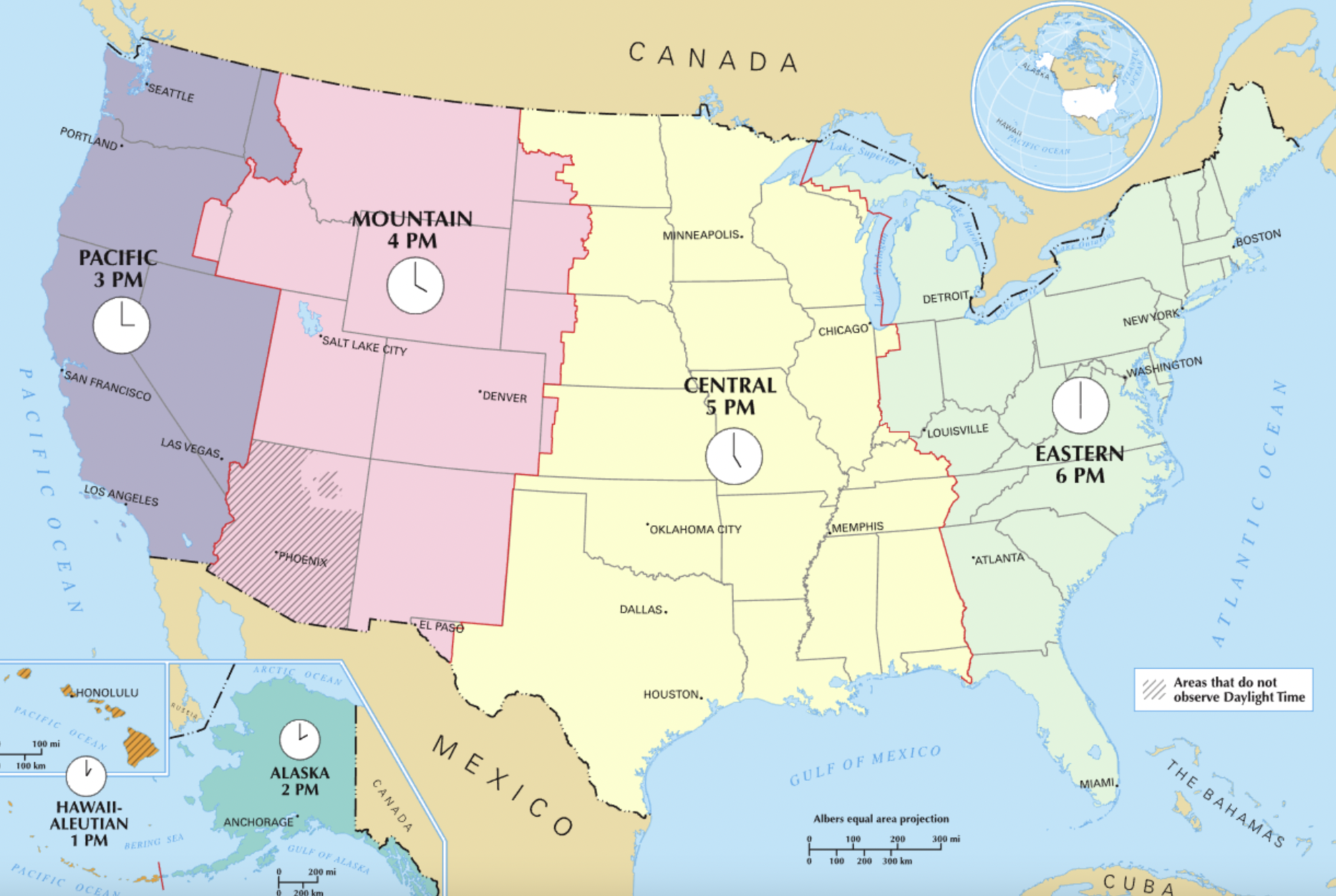
I’ve always been fascinated by how we understand the passage of time, from the older ideas of local solar time, to the nineteenth century adoption of standardized regional time zones, to now how most people I know seem to have at least one aspect of their life guided by the reality that they have to work with multiple time zones in a given day. Take my case: I work at a university located in New York, which is in North America’s Eastern Time Zone, but at the moment I’m staying with my parents in Kansas City, a city located in the Central Time Zone. This means that I have to keep an eye on the clock with a mind not only for the local time where I am, but the time as it is one hour ahead of me in New York.

As any Midwesterner from west of most of Indiana will tell you, any national TV or radio broadcast will always be announced in Eastern Time and Pacific Time, meaning that those of us in the Central Time Zone just have to subtract an hour from the listed broadcast time in the East to get our own broadcast time. And our friends out in the Mountain West just have to look at the Pacific broadcast time and add an hour to get their’s. What this means is that the listed broadcast times on any TV or radio show in the Continental United States relies on 35.8% of the population rarely ever sees national broadcasts listed in their own local time. Granted, the largest population centers in the country are on the coasts, but coming from the middle of the country, this has always been a bit of a sticking point for me.

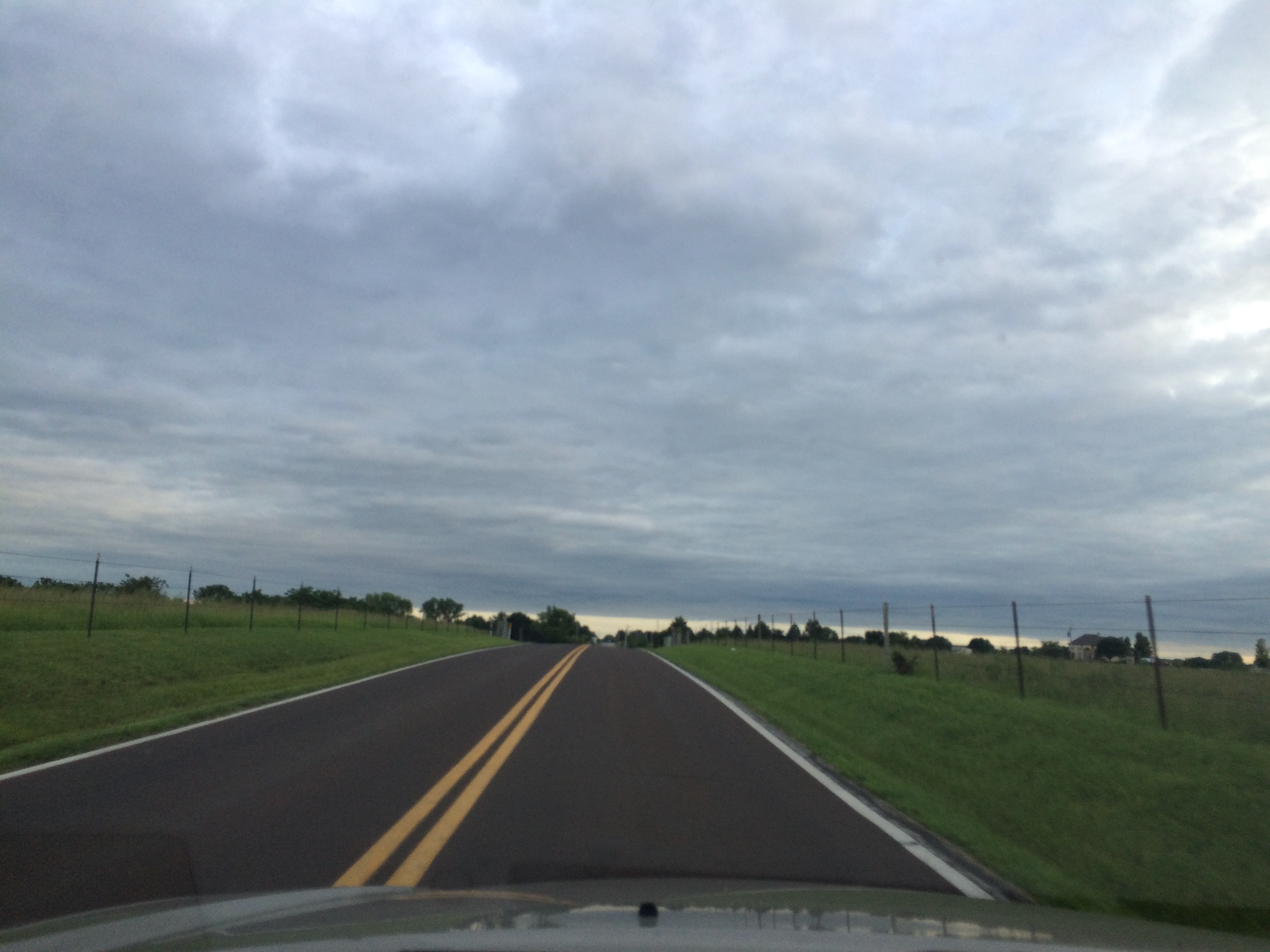
Driving across the US, you’ll often come across the usual Welcome signs when entering new states, new counties, or new cities. In some places, particularly in the Rockies, each city’s welcome sign will include that city’s elevation where in the prairies it might include the population or the date that settlement was founded. Meanwhile, each state has its own at times unique welcome sign. I always enjoy seeing those, because it marks a real milestone on each of my long drives. My favorite welcome sign to date remains Colorado’s, though normally where I see it on I-70 at the Kansas/Colorado border the dominant colors in colorful Colorado are the golden brown of the Great Plains stretching off to an endless blue, though sometimes gray, sky.

Photo by the author. 26 July 2013.

Yet alongside all these welcome signs, and the signs advertising this country’s wonderful and often weird roadside tourist attractions, are the occasional signs you’ll pass by that announce that you’ve entered a new time zone. It baffles me that neither the Illinois nor the Indiana Departments of Transportation have put such signs on I-70 on their shared border just west of Terre Haute, where I usually will gain or lose an hour depending on the direction I’m driving between Binghamton and Kansas City. Still, these signs are always an even bigger marker of progress on a trip, a sign (pun intended) that you’ve moved not from one of the 50 states to another, but from one of the 6 continental North American time zones to another.1 It’s a rarer thing to do.

There is one thing about how this country is divided by time zone that does bug me, and that’s the eastern edge of my own native time zone in Indiana and up the middle of Lake Michigan. You see, back in the nineteenth century when these time zones were first being set up, the merchants and city leaders in Detroit wanted to be on the same time zone as the markets in New York and Toronto, so they got Michigan as a whole to be put in Eastern Time. Later, in the twentieth century, Indiana’s state government decided the majority of their state should also be on Eastern Time, probably because of Michigan’s decision, leaving the option of being on Central Time up to only the westernmost Hoosier counties. As a result, cities like Gary in Northwestern Indiana that are a part of Chicagoland are in Central Time, while the rest of the state is an hour ahead.

But geographically, that border between Eastern and Central Time should be further to the east. Geographically, Indiana and Michigan should be on Central Time, not Eastern. This would allow both states to be on the same time as the Midwest’s biggest markets in Chicago, while at the same time causing some problems for Detroiters driving across the border to Windsor, Ontario, or people commuting into Toledo, Ohio from Michigan. All that said, I do use the time change on the Illinois/Indiana border to my benefit when I’m driving in either direction across it. Going east, if I leave Kansas City at 07:00 CT, it means I can stop for dinner around 17:00 ET in Indianapolis, which if it were in Central Time would usually be an hour too far west (16:00 CT) for my usual dinner time. Going west, if I leave Binghamton at 07:00 ET, I can use the extra hour to get a little further along the drive, even making it as far as St. Louis, which is only 3.5 hours from Kansas City before 22:00 CT (23:00 ET).

Then there’s the issue of the seasonal time changes. In North America we call it Daylight Savings Time, while in Europe it’s called Summer Time. This means that over here the official time zone abbreviations change from CST in the cold months to CDT in the warm ones, while the UK’s time zone remains BST (British Standard Time/British Summer Time) all year round. I personally tend to agree with the people calling for us to just adopt Daylight Savings, i.e. Summer, Time all year round. It makes more sense, and even though it can be a pain to get up before dawn in the mornings in the Winter, that’s just a part of Winter. I always thought it was kinda neat, though I admit I never really have been a morning person, so my appreciation for any wake-ups before 08:00 are limited at best.

That said, even if one US state here in the Midwest or in the East did vote to switch permanently to Daylight Savings Time, as Missouri is currently considering, it would require every other state in that region to do so as well. Unlike Arizona, the most notable state to make this change, there are too many cities in the Midwest that are close, or cross to state borders. Some notable ones among these are Chicago, St. Louis, Kansas City, Cincinnati, Louisville2 Milwaukee, the Twin Cities, Omaha, the Quad Cities, Duluth-Superior, and Detroit.

Even today, the furthest eastern reach of Chicago’s suburban train network extends from the Central into the Eastern Time Zone with the South Shore Line in South Bend and Hudson Lake, Indiana. Imagine if Missouri’s bill was signed into law without the provision that Kansas agreeing to it as well. Every time someone crossed State Line Road here in Kansas City between the first Sunday in November and the second Sunday in March, they’d have to adjust their clocks by an hour. Because of this, if one Midwestern state decides to adopt Daylight Savings Time permanently, everyone else will have to follow along, or else it won’t work.

As you can see, just from the intricacies of it, I enjoy thinking about time zones. In a couple of months when I drive west from Kansas City on a vacation out to the Rockies, I’ll look forward to seeing that rare sign on I-70 in Western Kansas announcing my entry into Mountain Time. I know, it’s nerdy, but it’s something I enjoy thinking about.


Notes

1 The six continental North American time zones are: Atlantic, Eastern, Central, Mountain, Pacific, and Alaskan. You could also include Hawaiian-Aleutian because part of it does reach sections of the Alaskan mainland (I think), but that seems a bit of a stretch.

2 Yeah, Louisville is in Kentucky, but it’s borderline Midwestern.

Friends

This weekend, I got the opportunity to attend the wedding of one of my close high school friends. It was probably my first big event outside of my own family since being vaccinated, and the first time that I was indoors around a lot of other people who I didn’t know. There was a core group of us, friends from our days at St. James Academy, among the first three graduating classes of that fine institution, who tended to stick together throughout the wedding on Saturday afternoon and reception later that evening, a number of whom I hadn’t seen in nearly a decade.

All throughout the day and evening, I was struck by how much I had come to appreciate these people over the years, and the memories I had of our time studying together, and in many cases, making The Awesome Alliance (2009–2013) together. It seems to me that I never really came to appreciate the people around me until after we had all moved on with our lives, and especially until the COVID pandemic forced all of us to stop what we were doing for nearly 13 months, giving us all a lot of time to think.

I think my own appreciation for my friends from high school, undergraduate, my two masters degrees, and now my doctorate has been just as influenced by my own self-perception as it has on any of their actions. My own shyness and self-doubt often left me doing less than I wanted to, being less outgoing than I hoped for, often feeling like Chaplin’s Little Tramp looking through the windows of the dance hall in The Gold Rush watching other people’s happiness from afar. On Saturday though, I did something I hadn’t done in a long time, at least since I began to overthink nearly everything: I danced at the reception, if only briefly. Sure, I still needed to announce some sort of justification aloud for why I felt like joining in the dance, something to justify it to my own self-doubt, so that I could let my guard down for at least a little bit and have a bit of fun with everyone else.

After the last year of on again, off again isolation, I’ve come to really appreciate what it meant to be with other people, family and friends alike. In the past I’ve written about how dearly I appreciated my friends and their willingness to spend time with me, but today my sentiments feel richer and fuller than before. Maybe it comes with maturity, I am after all nearing my 30th birthday. Getting to spend time with these people as an adult, rather than as a teenager was a memorable experience, and as I drove away that evening alone, I was struck as I have been in the recent past after similar events, at how much I appreciate these people who I spent a good four years of my life with. It reminds me to not take this current time, my time as a graduate student in the Binghamton History Department, for granted.

Rhyme Time

Taken on the grounds of Dover Castle, 14 May 2016

My fellow regular daily viewers of Jeopardy, that classic American TV game show, hosted until earlier this year by the legendary and dearly missed Alex Trebek, will no doubt recognize the title of this post. I admit, it’s an homage of sorts to that daily bread which my parents and I partake in five days a week around dinner time. I love how the Jeopardy clue writers play with English, and occasionally other languages, in their clues, the twists and turns, even the multipart answers that often I tend to have trouble with.

This post isn’t about Jeopardy, however, but instead is about rhymes in time. My old boss, Dr. Becky Davis, at UMKC, to whom I am deeply grateful, often used the old Mark Twain quote, “History doesn’t repeat itself, it rhymes” (or something to that effect) to help contextualize how themes seem to reappear throughout history, especially American history. I’ve found that to be a handy way of thinking about history, and our place in it, because as odd as it may sound there are certain times in history that do seem to me to rhyme with our own. There are moments in the past that seem far more familiar than others, far more relatable than others.

Consequently, those tend to be moments well documented among my fellow academic historians; they’re the popular topics of the day. I wasn’t always interested in being a Renaissance Europeanist and Atlanticist (yeah, those are real words), I kind of settled into these fields out of a combination of circumstance and curiosity. Luckily, neither has killed this cat yet.1 I looked into a pretty wide range of historical fields before settling on this one. They included late republican Rome, early medieval Ireland, late medieval England, Renaissance England (my MA thesis), early Stuart England, Georgian London, Dutch colonial New Amsterdam, French Upper Louisiana (aka Missouri), the First French Empire (aka Napoleonic France), (1804–1815), France under the July Monarchy (1830–1848), the history of Baseball, Old Hollywood, and the history of the US restaurant industry. As one of my friends said, I’m interested in too many things for my own good.

Of those considered fields, I do see clear rhyme times with our present moment in a couple, most notably with Georgian Britain, and the late eighteenth century in general. Our social narrative seems to have taken itself to a similar moment where we are at Robert Frost’s diverging two roads. One could take us towards progress, towards addressing our societal ills, the other toward likely political instability and society becoming fed up with the gridlock resulting likely in revolution.

Like Georgian Britain, we live in a highly class-conscious society, one where wealth defines much. Like Georgian Britain, our society has come to value profit over welfare, the maintained power of the few over the well-being of the many. Like Georgian Britain, just as in late republican Rome, a vast majority feel unheard by the ruling big wigs. We’ve seen divergent camps of the unheard, the have nots to borrow a term from a later early Victorian writer of note, who have adopted varying messages and manifestos born out of similar fears and troubles.

Times are not the only things that rhyme: often, I’ve found, our ideas, our hopes, and especially our troubles have a tendency to rhyme as well. Let’s talk about those rhymes, because there’s a chance that beyond the demographics that often divide us are commonalities that could well unite us. Maybe that’ll take us down the better road, the one that’ll benefit everyone. After all, no one of us can walk down it without the rest of us carried along. We will rise together, or we will fall together. It’s up to us to heed our rhymes.

Notes

1 Meow

Why We Need Explorers

I’ve always loved the idea of exploration. I remember on the evening of Sunday, 31 May 2015, I decided to take my dog Noel for a drive down State Line Road here in Kansas City. We kept going south until the Sun started to set, making it as far as about 300th Street. Lately, during my time in Binghamton this Spring, I made a point of doing some sort of weekend drive into the surrounding countryside, just choosing a cardinal direction and driving until I decided to turn around. I suppose it makes sense then that I’d end up training as a historian of Renaissance explorers and travelers in the Americas.

When I decided to write about this topic rather than another post about grammar (you’re welcome), I started wondering why is it that so many of our history’s greatest explorers and most pivotal encounters happened at times of great social unrest at home? Columbus’s world-defining 1492 voyage launched the most recent great Age of Exploration, which I would say lasted from 1492 to around 1800, 1 yet much of that same period is also characterized by a series of disastrous internal conflicts in Europe collectively known as the Wars of Religion and the later eighteenth century dynastic wars of succession, and the first truly global war, the Seven Years’ War (the French and Indian War here in English-speaking North America). Why would a civilization so focused on its own internal divides, the prejudices and hatreds of its own communities, polities, churches, and states, also want to invest so much time, effort, and capital in exploring places in what were ostensibly other worlds across vast hitherto impassable oceans?

I think one main reason was well expressed by a Bonnie Tyler song, originally from the 1984 film Footloose, that my friends and I happened to lovingly use for the theme tune of our YouTube series The Awesome Alliance (2008–2013), they needed a hero, someone ambitious and daring who was wiling to push the boundaries of what was believed possible and achieve something extraordinary. In these cases, the extraordinary is encountering previously unknown worlds.

I wonder what might have become of a Europe wracked by generations of successive wars, after all, it’s important to remember that many of the continent’s major powers were at war with each other before the Reformation and Wars of Religion began. At that point, the European wars were largely dynastic fights between royal families like the Habsburgs, the Valois, and the Tudors. Naturally then, once the Wars of Religion had generally fallen out of fashion after the disastrous Thirty Years’ War, Europe settled down into a familiar pattern of dynastic warfare, only now between the Habsburgs in Austria and Spain, the Bourbons in France and also in Spain, and Hanoverians in Britain.2

All throughout the sixteenth, seventeenth, and eighteenth centuries, with some very real continuations into the nineteenth and twentieth centuries (here lies another historical debate), explorers traveled from their homes to faraway places. Their travels inspired people to keep looking beyond what was known, to keep pushing the boundaries of knowledge and society. The diversity that characterizes our world today wouldn’t have been possible without the explorers of 500 years ago challenging the mould of their day.

Today, we need to continue to celebrate and fund our explorers, to embrace them. We need their efforts to inspire us to remind us that we can to amazing things. When we reach for the stars as our astronomers and astronauts do, we discover new horizons over which we can glimpse. And when we wander into a new city or country where we might not’ve been before, taken that road less traveled, we meet people who enrich our lives with their stories, their experiences, their memories.

Wherever my next trip takes me, off into some place I may not have been before, I hope it’ll be somewhere exciting, somewhere new. Once we’re past the pandemic, and travel is easier and safer again, I hope to use my time in Binghamton to visit more of the Northeast, to see the Green Mountains of Vermont or to visit Boston again for the first time in 20 years. Maybe, if my timing works out right, I can drive down to the Space Coast in Florida and see one of the Artemis mission launches in 2022 and beyond, and see that new class of astronauts begin their long voyage to establish the first human outpost on the Moon.

Eventually, I hope, we’ll have a new name for the Moon as we discover and settle on many other moons and the planets they orbit. The horizon continues eternally, and while chasing after it might seem quixotic, it only means there’s always another adventure to be had, another place to explore out there.

“Holding out for a Hero,” the “Awesome Alliance” theme song

Notes

1 My fellow historians will no doubt recognize the fertile ground for historiographical debate here. For the sake of the sanity of my readers, I’m going to leave that for a later publication.

2 This is a gross over-simplification of 17th and 18th century European political history, especially coming from someone who’s TAing a class called “Europe Since 1500” at the moment.