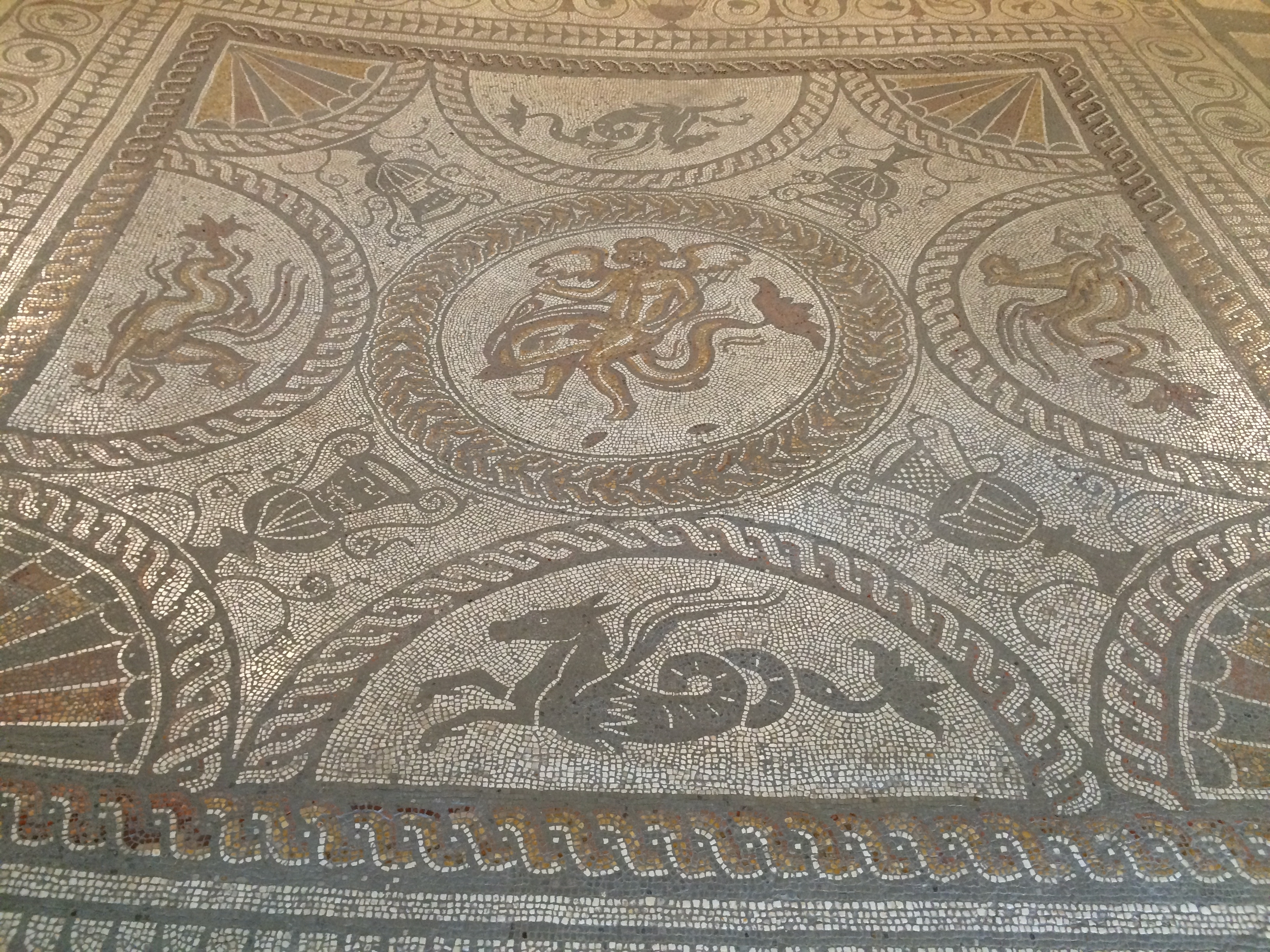
Mosaic of Cupid riding a dolphin, Fishbourne Roman Palace. Photo by the author, 2 April 2016.
Mythology has always been central to our stories, whether they be stories of Orpheus’s tragic attempt to rescue Eurydice from Hades or Casey’s tragic failure at the bat. Myths serve to bind us together in ways that only stories can. And while there’s always a grain of truth to every myth, it’s the story that people keep returning to. Over the past year, I’ve been listening on and off again to the audio version of Stephen Fry’s 2017 book Mythos while driving around town and on my long drives across the country between Kansas City and Binghamton. Often, I leave each story feeling like the characters, all ancient gods and heroes, are in fact relatable figures who I could imagine living in our own time.
It seems fair to me to think of the attributes of each ancient god or goddess, the antecedents to our modern patron saints, as being not entirely different from how we each have our own talents and passions. It’s curious, that Athens, a city dedicated to the goddess of wisdom, would be the seat of Greek philosophy. Equally curious is the relationship between philosophy, which at its core seeks to understand the human condition through logic, and religion which seeks the same goal but through faith. I’m a religious person, a faithful Catholic, yet this question of the balance between faith and reason, Fides et Ratio as Pope Saint John Paul II entitled his 1998 encyclical, strikes me as something to be studied further. My own faith gains strength through my doubt and questioning.
I’m not entirely comfortable with the idea of writing self-promotional stuff anywhere. Sure, I get the feeling I’m doing something right, but I appreciate the anonymity of working in quiet. I enjoy hearing and reading praise, as anyone does, but I don’t feel like shouting it to the pigeons in the rafters is the best way to live. Maybe that’s how myths are made, when stories are half-remembered and embellished, so that someday if someone well after I’m dead remembers me, they’ll remember a version of the truth, though perhaps not the full truth. We historians can appreciate not having all the sources on someone’s life, but that interpretation is what makes studying the past fun.
Well, it’s been almost a year and a half or so since the pandemic started and we at SUNY Binghamton largely switched to online remote learning. All of this became possible for the masses through the widespread introduction of Zoom, the ubiquitous video-calling platform. I actually advocated more than others among the TAs I was working with in the Spring 2020 semester that we switch to online synchronous classes, thinking the face-to-face interactions with the students was essential to their ability to learn, after all it always has been for me. But now, after two and a half semesters and one inter-semester session, I’m ready to be back in person.
Sure, teaching remotely gave me the golden opportunity to deal with my relative isolation in Binghamton and do my work from my parents’ house in Kansas City, something I’d hoped might be possible in my first semester at Binghamton when my homesickness was at its most virulent. I still would much rather live and work full-time in Kansas City, in a city that has become home to me through decades of experience, but at this moment in my life, in mid-2021 at the age of 28 my work is still centered on that much smaller city in the Susquehanna Valley in the Southern Tier of New York.
But the impact of teaching first from my apartment and later from my parents’ house had a number of more unwelcome side effects. When I’ve been in Binghamton over the last year, I’ve largely been in isolation, about as alone as a guy can be. It’s a bit unnerving in the first couple weeks, but by the end of my second month of it this winter, when I’d wake up in the morning after after having had similar recurring dreams of home, I knew I needed a break from the monotony of solitude. Being alone like that for that long really made me generally melancholic, perhaps more so than usual, something I often tried to treat with the best medicine I knew: work.
During those two months that I was in Binghamton this Spring semester, February and March, I worked most weeks for 5 to 6 days a week, spending a good 14 hours at my desk. This semester in particular was a tough one, I was studying for my comprehensive exams, one of the biggest turning points in the life of someone in a PhD program, one which could make or break my career. I kept myself going with the thought that once I got that done, and once my dissertation proposal was accepted by my committee, it’d be just up to me how much longer I’d need to make the long drive east every August and January back to that “Valley of Opportunity” as Binghamton was once called, to complete my degree. I could set things on my own terms, and finish my work to the best of my ability in a timely and efficient manner.
The only problem was, after two months of working 70 to 96 hours a week, I was burnt out in a very big way. I’ve been in that funk for the better part of the last month or so, it’s why frankly I haven’t gotten much done. I’ve taken some solace in the fact that I got back to Kansas City at the end of March, on the morning of Palm Sunday, and have been able to take breaks from my desk to enjoy my favorite haunts here in town, to see my family, my friends, and to take my dog for walks around the neighborhood. Sitting here now, I’m annoyed that I haven’t done as much as I’d hoped in the last couple weeks, but as much as it may set me back by a little bit, I know that I’ve needed a break.
So, on that warm late-August day in humid Binghamton, NY, when I don my suit and tie again and step back into the classroom, onto my stage, I’m going to enjoy the moment, because it’s one I’ve really been looking forward to. This will be the start of my 5th consecutive academic year working as a TA, having begun in the Fall 2017 semester still not entirely knowing what I was doing.
In the last couple weeks, I’ve tried to restore a bit of normalcy to my Zoom classrooms, by playing a bit of piano jazz as people are coming into the meeting before class starts. I’d started this in Spring 2020, on Valentine’s Day no less, with an outtake of Oscar Levant playing Gershwin’s “They’re Writing Songs of Love, But Not For Me” as a bit of a humorous sigh to being single on that romantic holiday, and the idea seemed to work. So, as the pianist, usually Duke Ellington or more recently Jon Batiste, sets the more mellow mood of my classroom, one where I hope the students will feel comfortable to join the conversation, and come away both having learned something, and having had a good time.
Oscar Levant “But Not For Me”
But even as we move back to fully teaching in-person again, I want to suggest that we keep some of the things we’ve learned and improvised into working during this time when education was conducted over Zoom. Firstly, I want to keep the option of remote teaching in the cards, to allow students who are unwell to tune into the class via Zoom, or better yet to tune into office hours over Zoom. In the event that I get accepted onto a conference’s program, and they decide despite my requests to the contrary to schedule me to speak on a Friday, that I could still maybe teach the class remotely for the week if needs be.
Also, let’s continue to have conferences and lecture series be conducted with a virtual part. I’ve been able to attend conferences at universities across the US, as well as in Italy, New Zealand, and the UK since the pandemic began, something that certainly wouldn’t have been as possible before. Virtual conferences have in some ways helped democratize academia, allowing for scholars who even in normal circumstances wouldn’t be able to travel long distances to still attend conferences, to have their voices and research be heard, or to hear fantastic scholars from around the globe.
I’d like to think I’ve made the most of the last year and a half, no matter how awful things have been. Now, at the end of teaching for the Spring 2021 semester at SUNY Binghamton, let’s hope the coming Fall semester proves to be a much needed return to a new normal, a normal improved and informed by recent experiences. First though, I’ve got to get through one more intersession online asynchronous class, this one of my own creation.
Yesterday evening, my parents and I drove out into my old high school stomping grounds in Lenexa and Overland Park, in the southwestern suburbs of Kansas City. My Dad had to return a truck part to a shop he frequents in Lenexa, and seeing as we were out there around dinner time, we decided to stick around and go to a restaurant in that part of town. It still feels strange sitting down inside restaurants again after a year of staying away. But it’s comforting to return to something that was so normal before COVID now as the crisis seems to at last be receding here in Kansas City.
What struck me the most about the experience of yesterday’s errands in Johnson County was actually getting an opportunity to just sit back and watch as people went to and fro around us. After all, this was one rare occasion when I wasn’t driving, instead taking my old childhood spot in the back seat of my Mom’s car, which gave me a great vantage point to just look around as we were driving on I-435 and along the streets and avenues. Seeing the myriad of vehicles all moving at different yet interdependent speeds seemed almost elegant to me, like a ballet of sorts. Yet I was especially struck in that moment by getting a chance to really stop and look at the highway signs themselves not for the sake of navigation or anything else particularly utilitarian, but just out of curiosity.
Here in the US, we have a couple different types of highways. At the top are the federal interstate highways, our controlled-access thoroughfares, essentially the same as motorways in Britain, Autoroutes in Francophone Europe and the parts of Québec I’ve been to, or the Autobahn in Germany. To date, I will say the best highways I’ve ever been on as a passenger was the highway between Helsinki and Turku in Finland. Below the interstates are the older US highways, federally designated roads that predate the creation of the interstate highways in the 1950s. I always found it fun growing up that my elementary school and parish church, St. Pat’s in Kansas City, KS was on US-24, the same highway that the road up to the top of Pikes Peak begins at. Below the US highways are state highways. In some cases, like with NY-17, these can be freeways like interstate highways. In others, like with much of NY-7, they tend to be official designations of older roads that predate the auto industry.
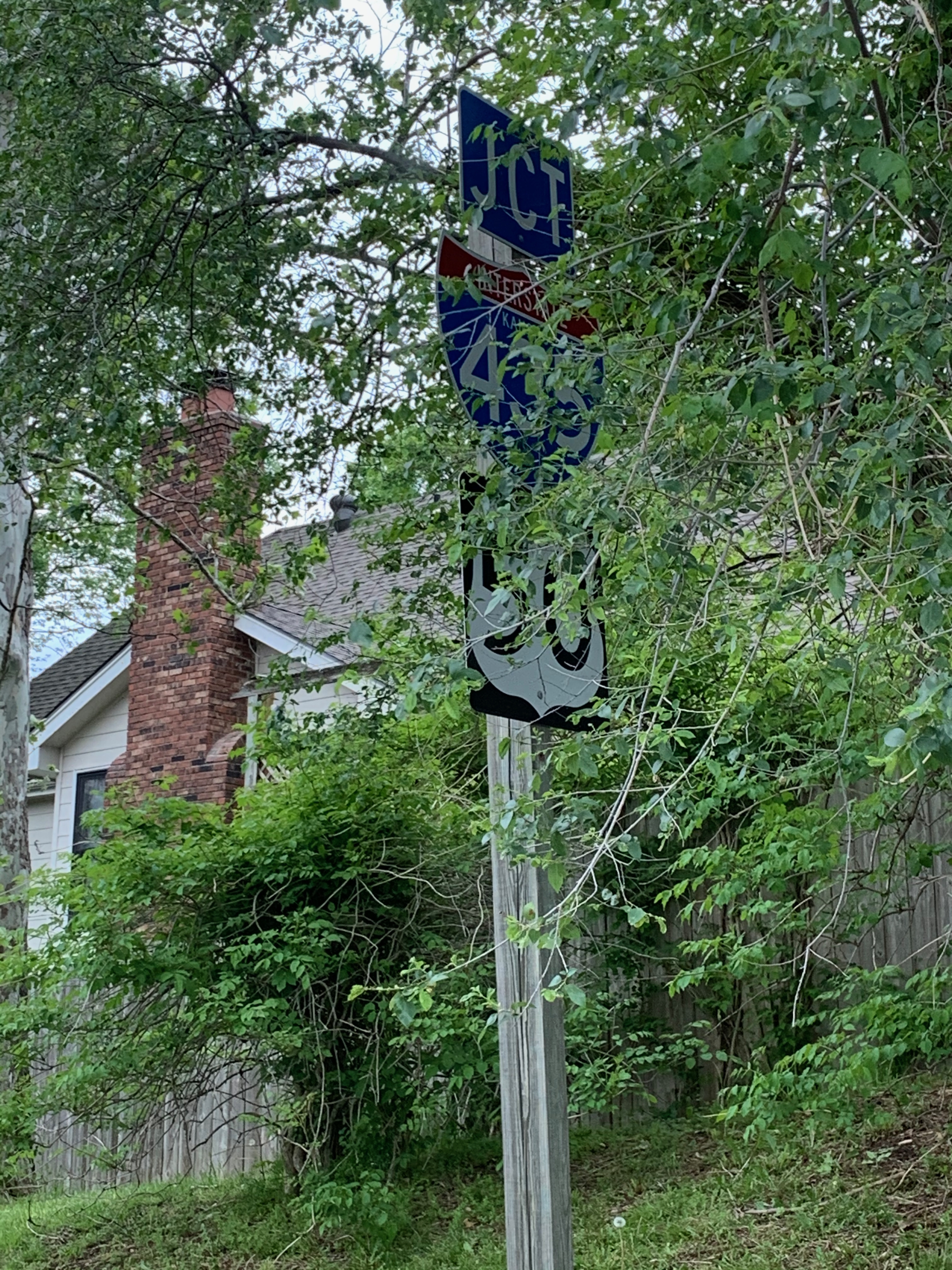
Because state highways are designated by each individual state, that means that their signage gets to be much more distinct than the federal highways. There is a standard look for state highways if the state government can’t come up with something themselves, basically a white oval or circle with the highway number in the middle, but most states choose interesting alternatives. New York’s for example are in a quasi-hexagonal shape, that I’m guessing was the original shape of their state highway signs in general. Colorado’s are done up in the colors of the state flag. And Kansas’s, which got me to write about this topic, put the highway number in the middle of a sunflower on a black field.
In my high school years, I used to drive twice a day, every day, up and down K-7 (Kansas Highway 7) between western Kansas City, KS and western Lenexa, KS where my alma mater, St. James Academy, is located. At the time, I noticed the distinctive signage, but it never really meant much to me. Yesterday however, seeing it again and really looking at it, I realized how much I’d come to like it. There’s something about that Kansas sunflower highway sign that feels as homely to me as California’s rounded sign seems a bit exotic. Seeing the sunflower again yesterday brought a smile to my face, thinking about how much I’ve come to like it.
While I’m on the topic of state highways, I do want to make one big suggestion. The way in which we refer to our different highways in this country is really inconsistent. I’m often confused when I’m in the Northeast, not being a local, trying to figure out what people are referring to when it comes to highway names. For me, having grown up in Kansas, state highways are “[State Name] [Highway Number]”, so K-7 (Kansas 7) or NY-17 (New York 17). US Highways in turn are US-X, so US-71 or US-11, and interstates are I-X, so I-70 or I-35. In some cases, like in my original hometown of Chicagoland, highways are actually named, and there I’d rather use the names. I may write another post about that in future, so in those cases while the highway may be I-55, I’ve always just called it the Stevenson.
All that said, when I moved to New York, I was constantly confused when locals would offer me directions in large part because every highway was just called “Route X,” so Interstate 81 is Route 81, US 11 is Route 11, and New York 26 is Route 26. There are other examples, around Binghamton NY-17 is still being upgraded to interstate standards, resigned as I-86, so whereas I call it I-86, most locals I’ve talked to still call it Route 17. Despite the NY plates on my car, it’s one way that I think I still stand out not being a New Yorker.
This morning, in an effort to get out of a funk born out of a mix of exhaustion and burn out after a long semester preparing for my comprehensive exams, I decided to watch the Mozart episode of Scott Yoo’s series Now Hear This, which has been airing as a part of Great Performances on PBS. In the episode, Yoo worked with pianist Stewart Goodyear to learn how to not only play the solo part in Mozart’s Piano Concerto No. 20, but to do so while conducting the orchestra as Mozart himself did when he performed that concerto in 1785. Watching Yoo and Goodyear work together on this performance got me thinking about my own work as a performer, which nowadays is usually through my work as a teacher.
At its core, the reason why I love teaching is because it’s purely a performance. Like actors and musicians, teachers have as much need to keep their audience entertained and connected to the topic of their performance as they do to transmit the content they’re teaching. All of the best teachers I’ve studied under in my 24-25 years as a student have gotten this fact down in some way or another.
To put this into context, when I teach on Friday afternoons, I have to put together an hour long performance that covers the content while making that information engaging. This means less reliance on notes and more extemporaneous dialogue with my audience, in this case my students.
I’ve found the best thing I can do at the beginning of any performance I’ve given, whether it be as a teacher, a musician, or an actor, is to try and connect with my audience, make it clear to them that I’m on their side, and that I can understand what they’re going through. This means, among other things, incorporating humor into my teaching, and acknowledging that they have other responsibilities than my class and my requirements for them should bear that fact in mind. For example, normally I have my students answer a set of weekly discussion questions. It’s a good way to make sure they come to class prepared to talk. That said, on weeks when they have a bigger assignment like an essay due, I’ll make sure to waive the regular discussion questions so I’m not giving them too much work.
Currently at Binghamton for the Spring 2021 semester, I’m teaching 2 classes of about 25 students each. It’s a decent number to handle, especially when it comes to grading, but considering at my last university I was teaching 2 classes of 35 students each, it’s not nearly as taxing. What is a bit more hard on me as a performer is that at Binghamton both of my classes are always back-to-back on Friday afternoons, meaning I have to turn around after the first performance and do the entire thing over again. It’s a huge challenge, and normally by the end of the second class I’m physically and mentally exhausted.
All that said, the challenge of creating a new show every week, and doing everything live is something I love. Having done pre-recorded shows like The Awesome Alliance, as much as I enjoy the security of playing my part ahead of time and not being around when my audience sees it, the thrill of performing isn’t as strong in that sort of a setting. That said, where a live performance differs from a pre-recorded one in my experience is in my own ability to really live in the performance. In a live class, I have to be present in the moment with my students, paying attention to their answers as well as their body language, making sure what I’m trying to teach is coming across. In a pre-recorded performance, like on Awesome Alliance, I’m more able to let myself live fully in my performance, in that case to become my character, something that is less readily feasible in teaching than in acting or music.
Improvisation is equally hugely important in my experience. I always have a lesson plan, usually revolving around my discussion questions which I provide ahead of time to my students. But beyond that, in the context of actually answering those questions, everything hinges on the unknown factor of what the students will say, how they’ll answer the questions, and then how I’ll respond to their answers. These are supposed to be discussions, focused around a particular topic but dependent as well on the individuals involved and what’s most present in their thoughts.
All of this relies on a great degree of being comfortable in your own skin. I know I’m going to make a fool of myself from time to time while teaching, it’s just a fact of life. But if I can explain a historical concept in a way that’s going to meet my students where they’re at, then I’ll find a way to do it. Last Spring, when I was TAing for a US History class, I was given a version of the Battle Hymn of the Republic written by Mark Twain to discuss with my classes. Not finding a good recording of it with the exact words of the version the professor had given me, I decided to go on a very big limb and sing it myself, after all I know the melody line pretty well.
I could’ve never begun to perform without being able to laugh at myself, and accept that in performing I am inherently putting myself out in front of people. The confidence that has allowed me to do this as an adult really began when I was in high school, when in my Junior Year English class, I decided to tell a couple jokes in what was otherwise a somewhat awkward presentation where I had to show a baby picture of myself to the class. I ended up bringing a picture of a very large and old tree on the grounds of Canterbury Cathedral with myself at age 9 just barely in the bottom of the frame, shrugging and saying “it was the best I could find.” Like Julie Andrews’s Maria in the Sound of Music, it’s great having “confidence in me.”

 Wednesday Blog by Seán Thomas Kane