
I’m writing this having just read a stirring article in Commonweal by Cathleen Kaveny, a professor of law and theology at Boston College, on the merits of reading St. Augustine’s Confessions in the original Latin. Professor Kaveny’s article was in response to Princeton’s Classics department’s much noted decision to cut the requirement for its undergraduate majors to prove proficiency in Latin and/or Ancient Greek in order to earn their degrees. I’ve had a number of discussions with friends and colleagues about that particular decision, being a current student of Latin myself, and an off-again-on-again student of Classical and Koine Greek. While I personally haven’t yet read Augustine in the original Latin, in part from a personal dislike for what I perceive as the grumpiness of St. Augustine’s writings (of the early Church Fathers I prefer St. Gregory of Nyssa), I can relate to the thrill and benefit of reading these texts in their original languages.
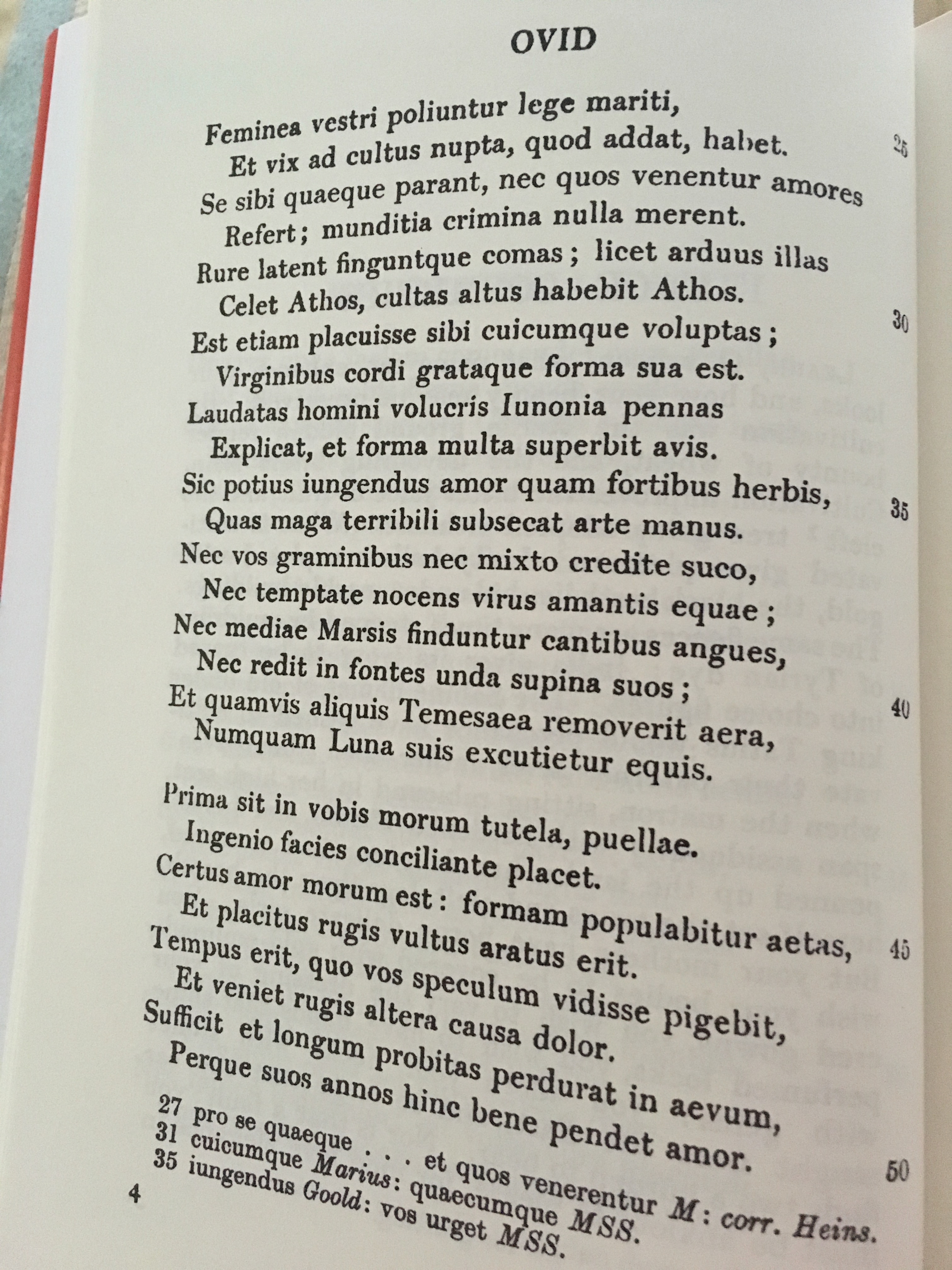
There’s something lost in the translation of any text. English, for all its excessive complexity, lacks the imperfect tense for verbs, meaning that when I am trying to express an idea in any of the languages my sources are written in that uses imperfect verbs, I’m often left struggling to find a really good clear way of expressing that the action is in the past but not quite completed. Think about particular words or phrases in English that sound like other words; the planet Uranus has a funny name depending on how you pronounce it, but that relation between the seventh planet and your posterior anatomy is lost if you try to translate it into practically any other language.
Beyond just understanding literature as its authors intended, the study of Latin and Ancient Greek is critically important to understanding the origins of our civilization, however problematic that word may well have become. The civilization of the peoples whose cultural origins are drawn from Europe, both eastern and western, derive in their origins from the ancient civilizations of the Greeks and the Romans. Those cultures, those powers, those memories have had such a profound and lasting influence on our world today that it would be profoundly shortsighted to stop teaching about them to such a detailed level as many programs do. Our political systems have their origins at least in part in the Classical World, modern representative governments can draw some of their lineage from the democracy of Athens as well as from the Roman Republic.
Generation after generation following the fall of the Western Roman Empire tried in their own way to set themselves up as the heirs of Rome, from Theodoric and the Ostrogoths based at Ravenna in the fifth century CE through Charlemagne and his successors the Holy Roman Emperors in the German-speaking lands north of the Alps, to the Tsars of Russia, the revolutionaries of France, and the founders of the United States. I once wrote in my book Travels in Time Across Europe that to me, Paris today feels as close to what I’d imagine an idealized vision of Rome during the height of the Republic would’ve been like two thousand years ago. The symbols of those governments, particularly of the Roman Republic and the later Roman Empire, remain so present in so many aspects of our world today.
I study the history of French natural history texts written in the second-half of the sixteenth century right at the tail end of the Renaissance that began in Florence in the late fourteenth and early fifteenth centuries. The whole idea of a renaissance is that it was a period when classical culture, literature, architecture, politics, and philosophy saw a revival, a rebirth as is the etymology of the word “renaissance” itself. Advocates of this “renaissance” at the time saw themselves as rekindling the light of the classical world, of restoring the course of what at that time was beginning to be understood as European (aka Western) civilization.
The accidental realization that the Americas existed in 1492 thanks to Columbus resulted in one of the greatest changes in the history of humanity, the opening of the Atlantic and the beginning of permanent contact between the peoples of the Americas and those of Eurasia and Africa. It’s because of this that I prefer not to refer to our civilization as “Western” or “European,” but rather as an Atlantic civilization. It is still the descendant of the civilization of Christian Europe, itself a descendant of the older Mediterranean civilizations of Greece and Rome, but since 1500 our civilization has been profoundly altered by its encounters with civilizations beyond Europe’s waters.
I concede that many of the worst aspects of our Atlantic civilization, from colonialism to slavery can trace some of their origins back to the Greeks and Romans, and that ideas like Manifest Destiny here in the United States have been argued to have drawn influence from older ideas like Rome’s right to rule the world, but even in the historical periods when these claims were being made they were incredibly flimsy. That said, of any problem today, one cannot tie modern ideas of race back to the classical world, as our ideas about race didn’t really begin to develop until 1500; it’s development in the Americas is a central theme to my research.
All this said, we need to understand our history to understand who we are and how we got here, and to do that we need to understand the classical foundations upon which our civilization has been built. The best way to understand those foundations is to be able to read the books they left behind in their original languages. Since the Renaissance we’ve remained generally in the same steady period of knowledge about the classical past; in fact one could argue that the beginnings of all modern fields of research can draw their origins back to the humanists of the Renaissance who sought to revive the sciences of the classical past. Language barriers speak more so to the problems with our education system in general than to anything else. Language education isn’t prioritized in this country, where assimilation and Americanization have been the standards for generations; we come to expect schoolchildren to only know American English because anything else would be unpatriotic. Even if a student comes into a Classics program with a foundational knowledge of one of the Romance languages, in this country likely Spanish, they’ll have a way into beginning to understand Latin. There are strong connections between languages as much as there are between cultures of different ages, we just have to know where to look.
 Wednesday Blog by Seán Thomas Kane