
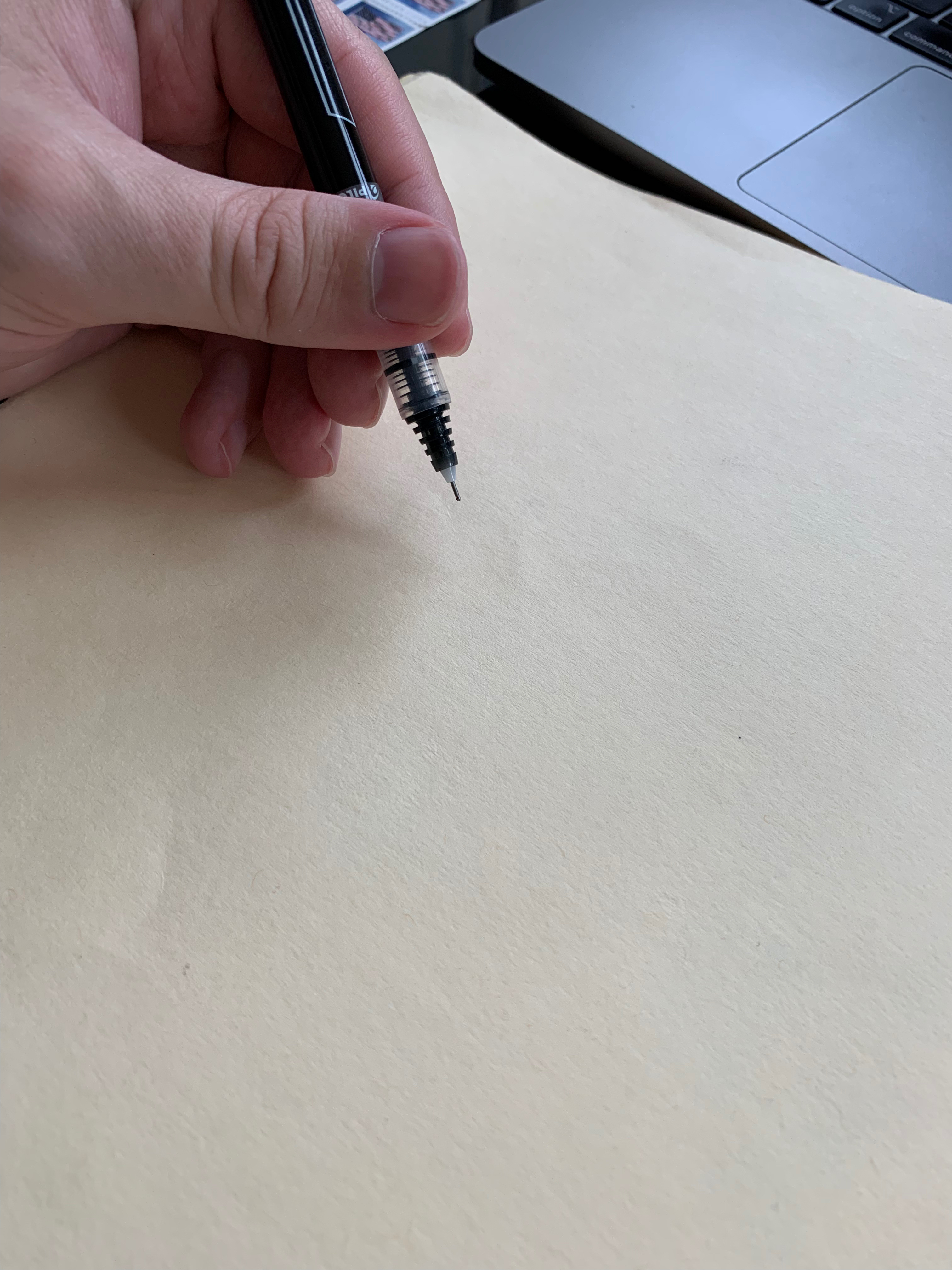
I still remember my first ever school assignment. It was in March 1999, my second semester of Kindergarten. The job was to learn how to write the number “1”, which in the U.S. is normally just written like a vertical line (|). I didn’t listen to all of the instructions, and brought my work back to my teacher, who was flabbergasted to see I had written slashes (/) across the page. It was not only my first assignment, but also my first F. Now, 22 years and eight schools/universities later, it’s interesting to me to look back at the early years in my life when I was learning to write my letters, first in print, and later starting in second grade in cursive.
I grew to be fairly proud of my handwriting, for how fluid it steadily became, but especially for how much it seemed to reflect back on my own personality. Yet in the last few years I’ve found myself writing things by hand far less than ever before, and since starting my first MA in London six years ago, handwritten notes have become a hassle to transport back and forth to Kansas City.
For me, of any of the essential skills I learned in my elementary school years, cursive was the one that seemed the most validating. Everything official, proper, or grown-up that I knew about that wasn’t printed by a press or typed on a computer was written in cursive. I even tried to emulate my favorite cursive handwriting, that being Thomas Jefferson’s on the Declaration of Independence, which after seeing it on the wall in so many classrooms over the years was almost as familiar an image to me as any classic and often replicated picture, like George Washington Crossing the Delaware or the shot of Sammy Sosa hitting a home run that I had up on my bedroom wall as a kid (Go Cubs!)
As a result of my interest in emulating that older style of cursive, I quickly moved past the standard style of cursive script that we were taught at my parochial school, the D’Nealian style, with its regimented curves and extra humps on the n and m, to something that was all my own, yet still mostly legible for my teachers, except of course for when I tried reintroducing the old long s character among the double-s in my handwriting, making Congress appear as it did in the 18th century as Congreſs. I was quick to decide that it was better to keep the long-s out of homework, lest it lose me credit, and use it for fun though.
When I started my college years, now a full decade ago, my experience with handwriting seemed to undergo a sort of flowering. I quickly found that I could remember more information if I hand-wrote it, and developed a very particular style of note-taking that was entirely my own. What’s more, I insisted on taking all of my notes on a type of yellow legal paper that worked perfectly for what I was trying to do. In 2010 and 2011, at the end of my high school years, I’d expanded my writing to include the Greek and Cyrillic alphabets, and often found it fun to try and write down names and other important notes in English but using those alphabets rather than the usual Latin one, just to see how things would work out.
Over the four years that I was an undergrad, and briefly during my two years working on my History MA at UMKC (2017-2019), I used this system to its fullest extent, and really grew to enjoy the process of putting the ideas being discussed at the front of the room down on paper, always imagining that someday I’d go back and look at those notes. In all honesty, I actually have done that from time to time, but usually when I’m looking for something specific in those notes.
My experiences moving across the water to do my first MA at the University of Westminster in International Relations and Democratic Politics (2015-2016) spelled the first end for my use of handwritten notes. I took my yellow legal paper with me, but as I discovered, it seemed less useful to take regular notes in my classes when I wasn’t being graded on the material covered in the lectures, and overall any documents I created while in London would have to be brought back with me to Kansas City when I finished my degree there. That simple need to conserve space, and the benefit of having a computer that’s perfectly capable of recording writing made my handwritten note taking fairly untenable.
Today, as I’m working on my doctorate, I still occasionally take notes by hand, though usually only in the form of edits to typed documents and even more specifically only when I’m in Kansas City where I have easy access to a printer. Like my experience in London, the need for the things I’m taking back and forth across the eastern half of the U.S. to fit in my Mazda means that it’s more helpful if I don’t have a big set of file folders full of handwritten notes in tow. Plus, today I have everything filed away digitally on my computer, meaning every set of notes I have on a specific book or a specific article, or on a lecture I heard is easy to find with my computer’s search tools. Today, if I can have a book or an article available for me to digitally take notes on it, then I’ll take that option a thousand times over having the physical paper document or paperback in front of me any day.
I don’t know how much I’ll use my handwriting in the future, now that I don’t use it for work. I’ve never been too fond of writing my fiction by hand either, it usually takes much longer than typing it, and my thinking through a story often happens much faster than my hands can write with pen and paper. I still try to send handwritten letters and cards to people when I can, though again when the ease and utility of computers and smartphones is brought into the discussion it quickly becomes evident that any “snail mail” is almost as much of an antique as using an old fashioned typewriter; while those older technologies work, they fall short of the efficiency of the new in many ways.
So, is this the end of handwriting for me? Maybe. I certainly think cursive should still be taught in schools, but I concede the fact that my own experience has shown that with the rise of so much still fairly new digital technology, including every device that you are reading this on, has made a fair deal of handwritten communication redundant.
 Wednesday Blog by Seán Thomas Kane