Today after passing a major milestone in my work, my comprehensive exam, I find myself reflecting on what it took to get me to this point. What would I say to myself from Spring 2019 when I was getting that acceptance letter into the History PhD program from Binghamton amid all the other rejections?
I remember one particular moment when I was standing at my bus stop on a cold windy February morning, the Winter Sun carving with its jagged coldness into my bare face and hands. On that particular morning I received the fifth of ultimately six rejection letters. It was one I expected, to be honest, but it still hurt like all the others did. At that moment I remember thinking, “If I get turned down by all seven I’ll find something else, it’ll hurt for a long time, but I’ll figure things out.” Today though, after finally passing my comps, an experience that was overall almost as stressful as the admissions process, I feel like were I able to talk to myself from two years ago, I’d probably say, “Don’t worry, it’ll all work out in the end. Take whatever win you can, and stand on that because trust me, this doesn’t get any easier.”
Looking at where I’m at today, now halfway through my fifth semester of the PhD, with the end of my work here hopefully closer in sight than the beginning, I do feel proud about what I’ve accomplished. It’s a big deal to make it this far, no matter how challenging it’s been. If anything, I’ve come to understand where my strengths and weaknesses lie, to understand myself and both my limits and potentials better than I ever have before.
As it happens, the day after that spell at the bus stop when the rejection letter arrived via email, I got my first acceptance letter in from Binghamton. It was St. Valentine’s Day, and as worn down as I was by the whole process of applying for doctoral programs at that point, I still celebrated in my own way, knowing that I’d be continuing in this career in academia. Today feels a lot like that day, it’s a moment when I have reason to celebrate, but also a moment when I need to stop and think about all the things that led to today. How can I make these sorts of really important events run smoother in the future? And how can I succeed in what I’m doing from here on out?
That’s the beauty of life, there’s always something new out there to explore, and the potential futures can seem boundless.
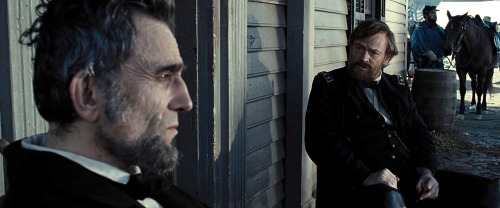
On Sunday evening while I was watching the Chiefs game, I found myself putting that contest in the background and focusing instead on YouTube on my phone. One of the first recommended videos was a clip from the 2012 Steven Spielberg film Lincoln starring Daniel Day-Lewis as the 16th President. In the clip, Lincoln sits on a porch with General Grant talking about how to handle the Confederate surrender in the coming days at the end of the Civil War. It struck me, in light of all the examples of leadership we’ve seen in the last four years in this country, how humble Lincoln was in that moment, how plain and honest his directions to Grant that the Confederate soldiers should be allowed to go home.
I’ve been entrusted with a number of leadership roles throughout my life, from serving as a two-term Senior Patrol Leader in my Boy Scout troop (Troop 1, Kansas City, KS), to most recently being entrusted with heading the committee as President of the Graduate History Society here at my university. Over the years I’ve learned that as much as having the power of an office can be alluring, I’m more interested in being an equal partner with the people who’ve entrusted me with that job. I don’t know if I’d say I’m a good leader, after all there’s more to leadership than trying to be a nice guy and someone who’s easy to work with, but I try to do my best every day.
Something that’s often talked about in terms of the long memory of leadership is legacy, what will people remember your term in office for? I wonder about that with all the work I’m doing here in my twenties. When they do write my obituary in however many decades from now, what will they say about the things I did at this point in my life? Looking back on the last six years, the years after I graduated from Rockhurst with my BA, I see a life that wasn’t nearly as stable as I’d like it to be, a transitory life where I moved from Kansas City to London, back to Kansas City, and eventually now to Binghamton. It’s been a time when I’ve moved even more frequently between jobs and dreams of what I want my future to be like.
Yet now, in 2021, I feel like I’m on the verge of some of my best writing, some of my best work. Much of that will not be possible without the support of my family and friends, and you kind readers as well. I do feel constantly tired, and I always seem to have a lot to do, but I figure if I get one thing done at a time eventually the entire puzzle will be finished, no matter how frustrating the puzzling will be in the process.
I’ve always looked up to Lincoln as someone I’ve respected since I was very little. Maybe that’s something I learned at a young age living in Illinois, but of all the presidents from the 18th and 19th centuries, I always felt like Lincoln was the one who I’d like to sit down and talk to. God willing I won’t have to experience all the pain he went through in his life, both personal and through his service as President during the Civil War. Whitman’s description of him as the captain of a ship in stormy seas is fitting for the man who seemed to have aged nearly 20 years in just 4. Still, there’s something about the man, the leader, that seems much more understandable to me than many others in our history.
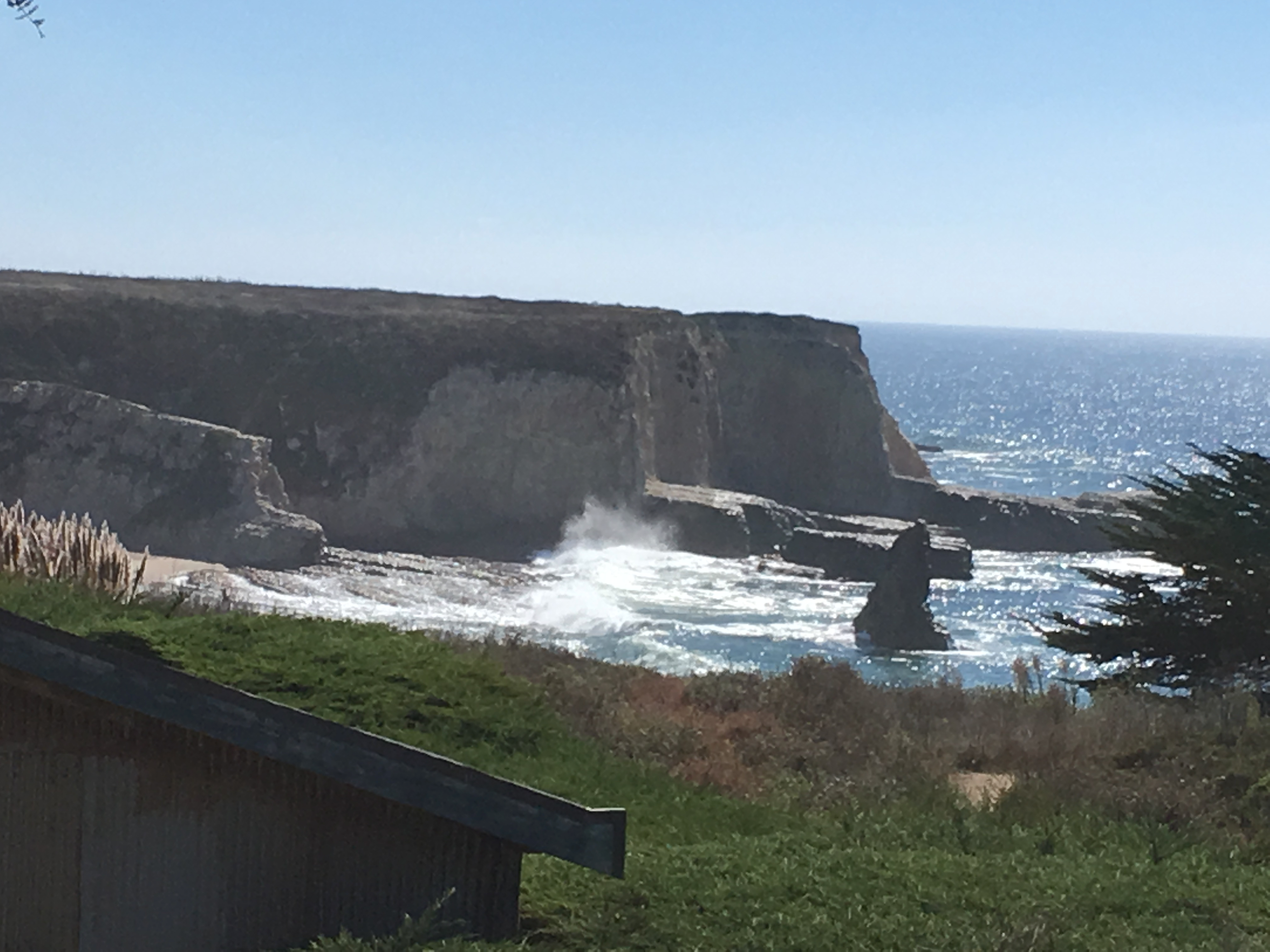
A picture I took of Shark Tooth Rock in Davenport, CA (13 October 2018)
A few years ago when I started working on my PhD here at SUNY Binghamton I arrived not only with a game plan in mind for getting this job done but with 4 chapters written of the sequel to my novel Erasmus Plumwood. That sequel, Plum in the Sun, follows Plumwood west to San Francisco where he’s started working on his dream job in a Silicon Valley company called Technophilia. The only problem is that when he arrives there he finds the job to be far from the dream he hoped it’d be, in particular because of a really awful boss named Don Basil who has it out for Erasmus.
I tried a few times to keep writing Plum in the Sun in my first semester in Binghamton but I found the task was a lot more difficult to do now that my mind was so squarely focused on the doctorate and setting myself up for success academically here. With that in mind I set the novel aside figuring I’d come back to it eventually. It’s only been in the last couple of months that I’ve started to think about working on it again, and while I’m certainly not going to do much of anything with it as I’m in the middle of the doctorate right now, I’m nevertheless beginning to think about working on that novel again.
The next chapter on the list to write is another of my fictionalizations of my own memories, replacing the real people who were with me in the moment with the characters populating this story. The basic premise of the chapter is that the two main characters, Erasmus Plumwood and his girlfriend Marie-Thérèse Merlinais, get more comfortable being together in California on a Sunday drive along the Pacific Coast Highway around Half Moon Bay, something my Mom and I did in October 2018 in what was one of my favorite days yet. I’m looking forward to describing the indescribable beauty of the redwoods and the coastline, the bird song and the feel of the sea breeze on my face.
But this is a story that I have to be in the right sort of mood to write. It’s not something I can do when I’m annoyed or tired or grumpy in any way, it has to be something I write when I’m in a really good mood, not all that different to how I was feeling on the day of. There’ll be some things that will be different between the real event and its fictionalized counterpart; for one thing we made that drive in October and the characters will do it in June, but considering that like it was for me it’ll be Erasmus and Marie-Thérèse’s first time seeing those sights I think my experience can still inform theirs even if I didn’t see it all in Summer.
I do intend to finish Plum in the Sun. If I’m being honest the plot and the characters are a lot stronger than the original book in what’s becoming a series. I was joking a few years ago with a friend that if I did make a series out of Erasmus Plumwood and Plum in the Sun then I might try and make it sound grandiose, if in a mocking way, and call it the Plumwoodiad. I do have a third book in the back of my head wrapping up at least this part of the lives of my characters, but considering I’m putting a dissertation ahead of Plum in the Sun on my writing assembly line, any third book in this Plumwoodiad is well further down the line and won’t be seen for a while.
So as I keep moving through my doctorate, I can’t help but smile when I think of what awaits me when I eventually do get to writing this chapter. It’ll be a wonderful few days spent intensely remembering that day and all I saw in one of the most beautiful parts of this country.
Late last week moving into Labor Day weekend I realized later than most at SUNY Binghamton that we not only had the long weekend off but also Tuesday and Wednesday for Rosh Hashanah, the Jewish New Year. I guess I didn’t expect we’d be in class for two weeks and then suddenly out for nearly an entire week. In any case, I knew I wanted to make the most out of the extended break, so I decided I was going to go on at least a couple day trips around the Southern Tier of New York and the Finger Lakes just to the north of here.
On Saturday then, feeling frustrated by staying too long in my apartment on such a beautiful day I got in the car and decided to drive up towards Ithaca following what I knew of the local geography and state highway system without plugging directions into my car’s navigation system. I eventually made it to the shores of Cayuga Lake, and proceeded to drive north up the western shore of the lake thinking I’d try reaching the top and take the interstates back down to Binghamton.
After Saturday, I’d hoped I could get out again on Monday or Tuesday and take another multi-hour drive, give myself some time to see the beautiful scenery of this part of the country, and enjoy a few hours of a good podcast or audiobook. I ended up staying in Binghamton on Sunday and Monday, wanting to avoid most of the holiday weekend crowds, with the goal of waking up on Tuesday and getting on the road early with no destination in particular in mind.
Still, after spending the morning in my apartment doing some much needed cleaning I finally got on the road around 13:00 EDT. This time I did set a route into the navigation system to a town I’d wanted to visit since the first time I drove by the signs on I-86 pointing to it when I moved here in August 2019: Watkins Glen. The drive was scenic and uneventful, lots of small towns and country roads. I listened to Stephen Fry’s book Heroes, his retelling of the Labors of Heracles took up the entire afternoon’s drive.
When I arrived in Watkins Glen I quickly found a parking spot across the street from Watkins Glen State Park, my destination for the day, and made my way into the park’s main gate. Watkins Glen is home to one of a number of spectacular waterfalls that mark the furthest reach of the glaciers that dug the Finger Lakes into the New York landscape during the last Ice Age, only unlike Taughannock Falls outside of Ithaca the gorge that lies at the heart of Watkins Glen State Park is far narrower and honestly an impressive feat of engineering by the people who made it a tourist attraction at the turn of the last century.
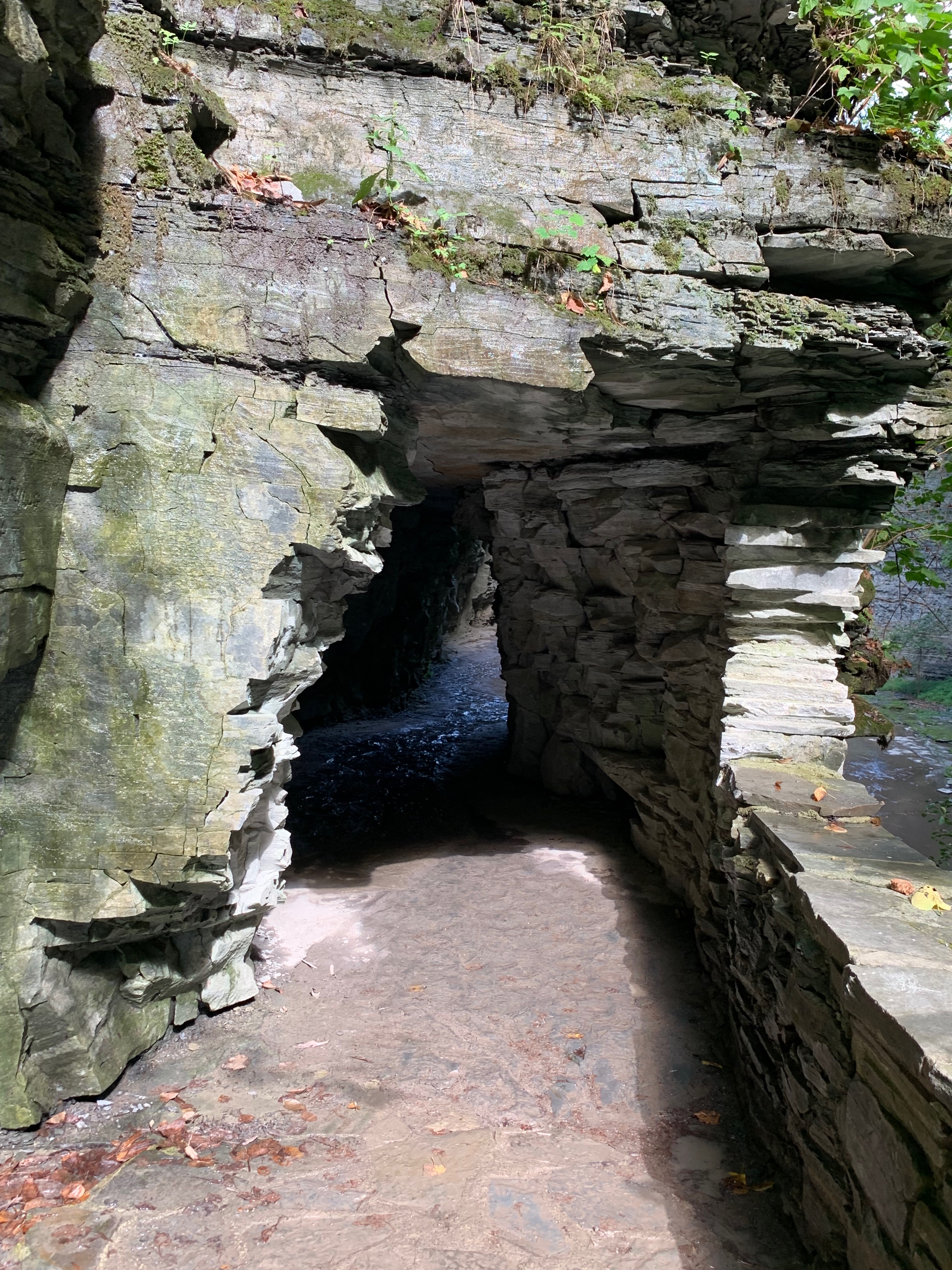
I decided to take the Gorge Trail and see where it led. Running at 1.5 mi (2.4 km) the Gorge Trail is the main attraction of the park. Its high narrow walls make the place seem otherworldly, like something that might be fitting among the tales of the Greek heroes retold in Stephen Fry’s books. It was awe-inspiring and a little frightening at the same time. The trail is made up of an elongated stairway rising up the gorge to its conclusion at a set of 150 stone steps leading to the Upper Entrance to the park called Jacob’s Ladder. I hiked the entire route from the main entrance up to the top of Jacob’s Ladder. Along the way I was dazzled by the amazing power of all the ice and water that carved out that gorge over millions of years.
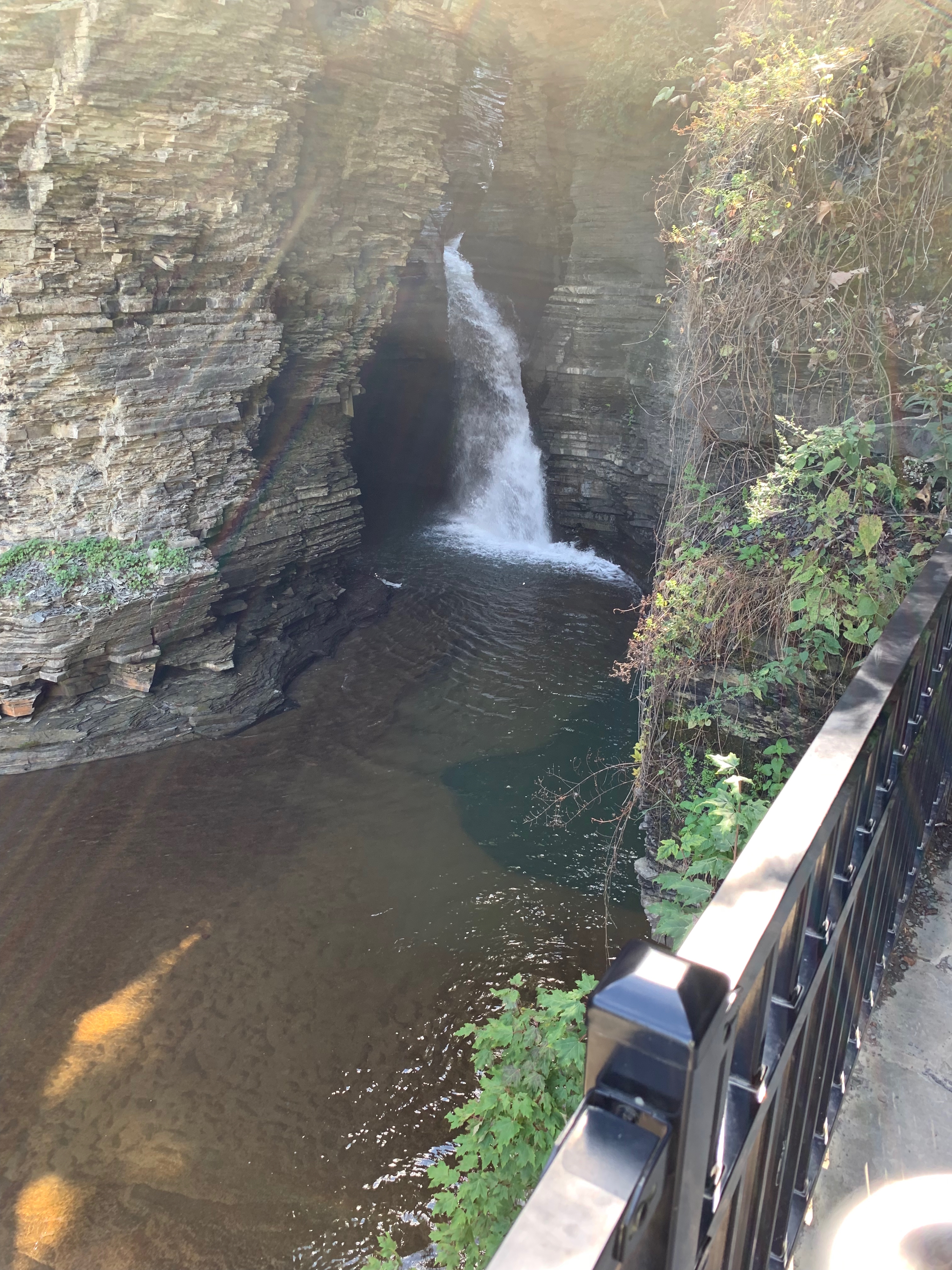
This was my favorite part of the Gorge Trail.
In the first half of the hike I took a fair number of pictures and videos that I figured I’d post onto my Instagram and Facebook after I’d left the park. I didn’t stop to look at what I’d captured, as much as I want to take pictures and videos of these places I visit, more than anything else I want to experience those places in the moment that I’m there. Selfies in particular are rare among my pictures; I care less about showing that I’m somewhere than showing the people who happen to see my pictures what I got to see.
After hiking back down to the main entrance on the far easier 1.1 mi (1.8 km) long North Rim Trail with a friendly couple from the Binghamton area I got back in the car and drove back to Binghamton, figuring I’d look at those pictures once I was back in my apartment and could really focus on them alone. 90 minutes later once I was back at my desk I looked through them, picked out 4 videos and a handful of photos and initially posted them to Instagram. One video that I chose to be the first of the lot, the cover picture as I see it, ended up getting posted to Instagram as a reel. I think at the time I intended it to go up as a longer video file that I could share onto my Instagram story and it’d play automatically instead of just showing a preview frame like videos uploaded as regular Instagram posts tend to do.
I posted everything and turned to Facebook, making a fairly similar update for my family and friends who tend to follow me on that platform. Yet as the videos were uploading to Facebook I kept noticing my phone lighting up with updates from Instagram at a dizzying pace. In the first 3 minutes that reel I’d posted had gotten 40 “likes.” I texted one of my best friends (and a frequent reader of this site) to tell her what was happening, and in the process of typing and sending the message another 45 “likes” appeared. In the next minute the total number rose from 85 to 280.
As I went into the notification settings in the Instagram app to see if I could reset things so my phone battery wouldn’t be drained too quickly by so many updates so quickly the number of “likes” rose over 300. By the time I finally went to bed around 23:00 the total was at 350. At the time of writing this post that number stands at 368.
Normally a post of mine might top out at around 40 “likes” that are often from the same people. Occasionally the things I post on Facebook will top out around 100 similar reactions, as Facebook now has more than just the like button, but nothing in my experience with social media can compare with the reaction to that Instagram reel of a pan shot across the gorge at a particular placid spot. I know for the people who are actively trying to get lots of reactions and “likes” to their social media posts that the 368 that mine received might seem insignificant, but to me it’s something to write home about.
I don’t particularly expect people to view the things I post on social media. I think it’s interesting that this particular reel has a lower than average reaction from my usual viewers. As far as I’m concerned even though this Instagram reel went as close to viral as anything I’ve ever posted on the internet, I see it as a happy accident, something that speaks more so to what the video showed than anything about me personally. Sure some of the people who “liked” that reel might subscribe to my Instagram account and follow future things I post, but either way it’s not something that’s going to change how I use that platform or social media in general. If anything the speed at which the “like” count on that reel grew seemed funny to me in the moment.
In any case if I were to try to use Instagram to promote the really important things that I make, my writing, I’d need at least 10,000 followers to activate the feature that’d allow me to add links to outside webpages to my Instagram stories. It’s one reason why I think this blog has such a steadily low readership: the place where the majority of my audience interacts with me is also a place where I can’t promote this blog or anything else I write lest I direct my audience to the “link in bio.”
Social media can serve a good purpose in my life: it’s a way that a small fish like me can make myself known for the things I do. It can have a lot of downsides too, the amount of spam subscriptions I see on my Instagram account can be gobsmacking. I’ve also got some pretty sour memories of experiences with Facebook from my high school years as well that lurk in the background, but now in my late 20s as much as I may notice what the trolls might have to say, for now I’ve been lucky not to have been harassed enough to spoil the utility of the platform for me.
The idea of a rivalry and all the extra stuff that goes with it seems to be baked into American culture. Rivalries often make for the most exciting games in a league’s calendar not only for the history traditionally associated with that matchup but also for the antics and occasional brawls that break out in the process of playing the game. As a young Cub fan I always expected there’d be a fight during a Cubs vs Cardinals game or a Cubs vs White Sox game, just as any meeting between the Red Sox and the Yankees seemed sure to produce the sort of atmosphere normally reserved in North American professional sports for the hockey rink.
Interestingly, going off of what I wrote about last week in terms of regionalism, I think it’s important to recognize that rivalries often define a region’s local identity more than anything else. The two great cities of Missouri, Kansas City and St. Louis, are defined just as much by the shuttlecocks at the Nelson-Atkins and the Gateway Arch as they are by the rivalry between the Royals and Cardinals, particularly during the 1985 World Series, which ended in Game 7 with a Royals victory over the red birds. I only hope that with the introduction of MLS’s new St. Louisian team, St. Louis City SC, that we’ll see a strong rivalry between “City” as likely they’re going to call themselves, and our own Sporting.
If anything unites most American cities and their surrounding metropolitan suburbs it’s a general dislike for other cities and their metros. Often the greatest of these rivalries seem to be founded in sports: the Chicago/St. Louis rivalry for example, which certainly began as a disagreement among two of the Midwest’s greatest metropolises in the nineteenth century and developed in the last decades of that century and into the early decades of the twentieth through the birth of the Cubs in 1871 and the ancestors of the Cardinals, the original St. Louis Browns, in 1882. In the decades and generations since that rivalry has grown not only with the introduction of the Blackhawks vs. Blues rivalry in hockey but also a general sentiment that I experienced as a Cub fan going to college at a place dominated by St. Louisians; it didn’t help that my freshman year was also a year when the redbirds won their last World Series.
On a larger scale it seems like we could carry this idea of the rivalry to a geopolitical level. Sure, the US has rivals, traditionally they’d be our counterparts in Europe, in particular in the nineteenth century Britain and in the first half of the twentieth century Germany. More recently though, in the last few generations the US’s biggest global rivals have tended to be the likes of Russia and more recently China. I will fully admit to playing off of the eternal bogeyman in the American psyche by playing the sublimely stereotypically Russian theme tune to the fantastic 1990 film The Hunt for Red October every time I find myself in St. Louis when the Cardinals are doing well. In my own silly way it’s playing off of fears of the bogeyman projected on the wall in this country in communism, comparing my own Cubs’ greatest rival to that red scourge.
It’s interesting though that we have come to develop such profound senses of national pride out of how different we are from other countries, or at least how different we see ourselves from other countries. People in positions of authority, both in government and in the media, have taken advantage of this idea of rivalry to profoundly change the political discussion: we hear more banter about the creeping influences of socialism or Islam today than we do from the same people about problems that face our country internally like racism, vast inequality, and the constant threat of violence due to our overly lenient gun laws.
I’ve often thought that if anything is true it’s that a people who define themselves by what they aren’t rather than what they are will surely fall apart in the long run. Equally, a people who cry wolf at the shadow of the wolf on the wall, labelling it something foreign, when its fangs are being used by the same crier to cause chaos in the cave itself is a people doomed to falter. We’ve found ways to use the excitement of sports to infiltrate our politics and our daily lives, forcing us to adopt a mindset that it’s always us vs. them. Eventually, if we’re not careful we’re going to bring about our own defeat on the field of play, and not by anything our opponents do. It’ll be an own goal, a safety, our knives in our own back that will bring the land of rivals to its knees.




 Wednesday Blog by Seán Thomas Kane