
Monthly Archives: December 2021

How Space Exploration Can Unite Us

How Space Exploration Can Unite Us Wednesday Blog by Seán Thomas Kane

In this episode I argue that we should consider Space exploration as a way of uniting humanity around a common cause in what otherwise is a time when we seem far more divided.

My Dad woke me up just before 6 am on Christmas morning to watch the long-anticipated launch of the James Webb Space Telescope (JWST) from the European Space Agency’s spaceport in French Guiana. Over the past few months, I’d heard and read a great deal about Webb, the engineering behind it, and the mission it has been sent on to travel to the Lagrange 2 point about 1 million miles, or 1.5 million kilometers, from Earth. Once there, Webb will serve as our newest set of eyes on the stars and planets far removed from our own. It will even be able to detect the chemical composition of the atmospheres of distant exoplanets, which could provide us with far better leads than ever before to finding life on distant worlds.

In this last week of 2021, during the Christmas season, a generally happy time of the year, I’ve got to admit there are a lot of problems facing us that are sure to dominate the year to come. The COVID pandemic continues and has recently flooded humanity with a new wave powered by the omicron variant, leaving us scared and worried during the holiday season. The tensions that have boiled over in the last few years in this country, social unrest born out of decades of dissatisfaction, disenchantment, and the pressures of our lives in this Second Gilded Age have brought we Americans closer to the brink than we’ve been in quite some time. Globally, we can’t bring ourselves to do enough to combat climate change, the greatest existential threat humanity has yet faced. Still, the familiar tempo of the drumbeats rises quicker and quicker as the Ukrainians prepare for a potential invasion from Russia, and tensions continue to simmer in the waters between China and Taiwan. Both of these regional wars could well draw my country, the United States, and our allies in, cycling further and further until that simmering pot comes to a boil in the form of another world war.

Meanwhile civil wars, famines, and the other children of fear torment people around the globe in nearly every country, some worse than others. The 2020s have thus far proven to be one of the darkest decades in recent memory, with many of its woes being fruits born from the troubles of the 2010s, 2000s, and the century prior.

Yet alongside all of this, I still have hope that we, humanity, will see ourselves through these threats, that somehow, someway we’ll survive as we have now for so long. It’s interesting to me how the same story, human history, can be told in so many different ways. I was brought up learning the story of human progress, of ingenuity and invention from the Promethean discovery of fire to the digital age in which we now live. It’s a story that has a happy ending, that believes we will eventually overcome our sins and the ghosts that have haunted our waking days as much as our dreams of a better tomorrow. The question I’m left with now, as an adult prone to daydreaming rather than a child without a responsibility to make something of myself, is how do we achieve that future? How do we make tomorrow better than today or all the yesterdays in our collective memory ever have been?

I suggest we look to the potential of what Webb can tell us about the Universe around us. We are after all made of stardust, as Carl Sagan was famous for saying, and at the end of the day it is to that stardust that we will return. The exploration of Space has the potential to be truly revolutionary to our story. If done right, it could be the catalyst that pushes our boulder over the hill, letting us the eternal Sisypheans we are, out of the Hadean turmoil we’ve been in for as long as we can remember. By realizing we are not alone in the Universe, that there are others out there who like us have struggled and fallen time and time again yet still found the strength within them to rise up and build civilizations in their own images, to leave legacies for others to remember them by. We have the potential to overcome our troubles: war, hunger, poverty, ignorance. Let’s set those drums aside and sit down and talk to one another, get to know one another, and learn from each other. Let’s realize that we’re more alike than different, no matter who we are, where we’re from. We may speak different languages, and by extension think in slightly different ways, we may have different incentives for our actions, but at the end of the day we’re all still human.

On the Sunday of Christmas weekend, a date I know as St. Stephen’s Day, I read a thoughtful editorial in the Washington Post by the conservative columnist George Will called “National conservatives and racial identitarians have a common enemy: Individualism”. While I didn’t agree entirely with his argument, and while in general Mr. Will and I only agree on a small number of things (in particular our mutual love of baseball) the main thesis of this column made good sense to me, that here in the United States individuality and the ability of the individual to express their self has fallen by the wayside in many circles in favor of a degree of collective identity on both sides of the political spectrum. The focus has fallen so much on what divides us that we’ve lost sight of how we are really so alike. 

We are all Scrooges as long as we stay in our camps and refuse to venture out into the no man’s land between them. There are past wrongs that need to be delt with, crimes that have yet to be punished, I would be naïve to deny that. At the same time, we need something to bring us together, to break these circles of violence that have been carried out since the time immemorial, embodied in stories like the primordial Fall from Paradise described in the Abrahamic religions. At this point, it’s fair to say we’re in a time when revolutions and counterrevolutions born out of a spirit of vengeance are far more in vogue than any belief in a common humanity. Yet through the fog of war that we allow the dragons of our imagination to breathe out into our world, there are still those among us who send missions beyond Earth with hopes that knowledge will broaden our horizons and increase our knowledge of not only the Universe around us but of ourselves as well. This Second Age of Exploration offers us the chance to unite around a common purpose of bettering ourselves, of elevating humanity above that fog and into a new age in our history when we can achieve all those lofty ideals we continue to set ourselves from each generation to the next.
Christmas and the Passing of the Seasons

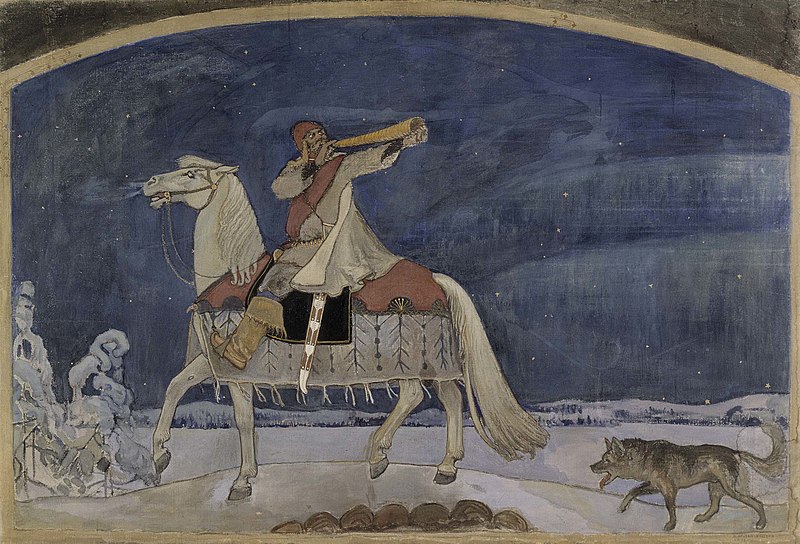
Akseli Gallen-Kallela, Kullervo Sets Off for War, 1901, tempera, 89 x 128 cm, Ateneum, Helsinki, Finland.

Christmas and the Passing of the Seasons Wednesday Blog by Seán Thomas Kane

This week I'm discussing what Christmas has meant to me throughout my life, and how it fits into the mythos of the seasons overall.

I think the general feelings I get at different times of the year were instilled very early on. I remember in first grade being told that if the weather in March came in “like a lion” it would surely go out “like a lamb,” meaning if the month started with bad weather, snow, ice, or even thunderstorms in a warmer year, then we’d end up with a quiet end to that month. Likewise, I can’t remember quite when I first heard it, that the Winter Sun always shines with the wolf’s teeth. This to say that as bright and warm as the Sun’s rays appear in Winter, you’ll still feel the biting cold of Winter if you go outside in that time of the year.

To me, Christmas has always been a bright light on a wine-dark sea, a moment of celebration, of seeing family and friends, of hearing the triumphant hymns at Midnight Mass and reaffirming how much we all really do care for each other. Christmas has its traditions, both sacred and secular: not only is Midnight Mass, now often celebrated at 21:00 or 22:00 on Christmas Eve a part of the schedule, but so too traditionally are the big family parties, unwrapping gifts on Christmas morning next to our tree, and watching any number of Christmas specials, especially Charlie Brown, and occasionally Die Hard too. The week before Christmas always includes my birthday, the 20th, which has its own traditions and things I look forward to every year.

Yet as I get older, now in the last year of my twenties, I can understand what C.S. Lewis meant in The Last Battle when he said that the eldest Pevensie sibling, Susan, didn’t return to Narnia because she had grown up and didn’t believe in it anymore. I still believe in the fact that there’s something special at Christmas, even if I’m more the skeptic about any sort of “Sanity Claus”, as Chico Marx put it, but it doesn’t have the same impact on me as it did when I was a wide-eyed child. Last Christmas … (I’ll give you a minute to sing that Wham! song) … Last Christmas, our first during the COVID pandemic, my parents and I decided to take a firmly defiant stance: we were going to go all out with the decorating and try to force the point that it was Christmas as much as possible, lest we remember we wouldn’t be going to any services or hosting any big family parties. It ended up being a melancholy affair, sure there were wonderful moments, but by and large I found myself longing for Christmases of yore when we’d be so exhausted come bedtime on Christmas night that we’d drift off into wonderful dreams, perhaps “visions of sugar-plums” dancing in our heads.

This year though, now in our second year of the pandemic if anything the three of us are exhausted by it all. The constant fear of infection, the usual work-induced weariness, and life in general. 2021 has been a hard year. We’ve struggled through it, through every season as the calendar rolls along, but I think it’s fair to say 2021, like 2020, is a year we’ll be happy to leave. This Christmas feels like Christmas, just as my birthday this week felt like my birthday usually does, but with a shrug instead of a smile. Winter even seems harder to tolerate this year. 

I was in high school when I first saw a Finnish painting that to me spoke of the nature of Winter. It shows a horseman mounted, wearing a slightly medieval garb, turning around to look up into the stars that carpet the purple night sky, illuminated as much by the snow below as the lights in the heavens above. In his hand he holds a hunting horn, which he blows to announce his ride onward as his trusty hound follows behind. The image there, of the rider in the snow beneath the stars in the purplish Winter’s night sky always seemed to speak to me of Winter, meagre and cold, yet suggestive of some magic that might exist in those long dark nights. 

It was only later, when I visited Finland for the first time in May 2016 that I learned that this painting, first created in 1901, is one by Akseli Gallen-Kallela (1865-1931), called Kullervo Sets Off for War. It depicts Kullervo, a tragic character from the Kalevala, the Finnish national epic compiled by Elias Lönnrot in the 19th century. The story behind the painting, while different from how I imagined it, reminds me nevertheless of the mystery of Winter, the unknown quality that those long dark nights hold, and the stories I’ve heard and come up with myself to give character, voice, and song to what might otherwise be a quiet, dark, and lonely time for us all.

For those of you who celebrate it, I wish you a most Merry Christmas, and for all the rest of you, Happy Holidays.

Federalism vs. Regionalism

Federalism & Regionalism Wednesday Blog by Seán Thomas Kane

This week, I want to talk about some reasons that I see for why we Americans are so deeply divided. You can find the editorial by Charles M. Blow that inspired this episode here.

A few evenings ago, I read an editorial by the frequent New York Times contributor Charles M. Blow about what he called the first signs of the next civil war looming on the horizon. Blow’s argument boils down to the idea that today’s political actors on the right who accept our most recent former President’s Big Lie that the 2020 Election was somehow stolen are themselves inheriting rhetoric from former Vice President, and Senator from South Carolina John C. Calhoun. Calhoun has often been called the father of secession, the one who laid the rhetorical and political groundwork for eleven southern states to leave the Union in open rebellion, launching a Civil War in 1861, 11 years after Calhoun’s death, that would lead to around 720,000 American deaths. Just as today the Trumpist faction feeds on this Big Lie of their own creation, so too the secessionists of the nineteenth century made their fateful decision to embark on the conflict that my friend and fellow historian of Midwestern extraction Josh Kluever recently termed the “Treasonous Southern Enslavers’ Rebellion” on the basis of an even bigger lie, one that contends that there are varying degrees of humanity, some better than others, and that those degrees are understood on an arbitrary designation based on phenotype: distinctions in skin color.

If the Trumpist argument has any merit it’s that it’s a reaction to a sense that some Americans feel left behind by the dominant forces in our culture and society today. As much as being American implies that we are all one people, one culture, in the same way that old caesaropapist rhetoric would cry that under the banner of the emperor of the day there was “One God, One Emperor,” so too the idea that the United States is “one nation indivisible” makes it entirely evident that we are expected to be unified not only politically but culturally and socially as well. The great façade of this line from our Pledge of Allegiance is that we have never truly been “one nation” in any more of a sense than we share some common cultural and social bonds brought about in part through the spread of American dominance on this continent through westward expansion, phantom dreams of manifest destiny, and frequent generational rallying calls of “America First,” embodied in the idea of the melting pot that boils down all of us ethnic descendants of immigrants and makes us one common people: Americans. The South, in its misguided attempt at going it alone in the 1860s, has long recognized that it has a distinct culture from the rest of the country. We in the Midwest too are different from our cousins in the Northeast, even if we generally come from the same immigrant roots as our fellow Americans in New England or the Mid-Atlantic states. Then there’s the great gulf between the east and West, which falls somewhere in the Great Plains. During my recent visit to San Diego I mentioned to my family back in Kansas City that if any part of this country could even remotely think about successfully seceding from the Union it would be California, which is geographically so remote from the still largely eastern center of power and wealth in this country that as American as it does feel, it still seems foreign enough to my Midwestern senses as to be mistaken for a foreign country.

The greatest fault that our collective popular history has perpetuated is by smoothing out the surfaces of our past to make an easy to digest collective etiological story, a creation myth of this most artificial of countries born out of a series of settler colonies founded by the English in the seventeenth and eighteenth centuries on the Atlantic coast. Unlike the majority of countries around the globe, the United States is not a nation, it is a political collection of peoples living together in the same region of the globe. A nation is something far more ancient, its members share not only a common political leadership but common heritage going back centuries if not millennia. The purest examples of nationhood are countries like Iceland that have had little immigration to its shores, and thus a fairly stable population for generations. 

Considering this, by my estimation there are few nations today, instead many countries, states which represent the interests of the peoples who live in those places. Those peoples are often either native to those areas or varying degrees of newcomers. Yet the degree to which people are either native or newcomer is itself vague, after all would the old Bay Staters be considered at this point after 400 years of settlement on the shores of Massachusetts Bay native to that part of the world? Or are they, like the descendants of the Ulster Scots who were brought to Ulster in the same century still relative newcomers to the places that they have called home for generations?

Here in the United States, we often highlight the English and Dutch colonial heritage of our country while demoting the French, Spanish, and Russian colonial heritages of other regions beyond the old Thirteen Colonies. Our holidays commemorating the colonial period, notably Thanksgiving, commemorate the founding of one English colony on Cape Cod, and even the history behind that commemoration is flimsy at best. It struck me when I was walking through the Museum of Us, San Diego’s renamed anthropology museum in Balboa Park, that the most basic understanding of “us” as the intended audience of the museum’s exhibits are Anglo-Americans. I feel a sort of secondary connection to this idea of “us” as Anglo-Americans, after all I have old colonial ancestry on my Mother’s side going back to seventeenth-century Connecticut, and eighteenth-century Maryland and Pennsylvania, but I see myself far more in light of my more recent and familiar status as a third-generation Irish American. What was especially profound about this particular definition of “us” in San Diego’s anthropology museum was that it was being used in a city that was founded not by the English or later American settlers but by the Spanish in 1769. Sure, there were exhibits that included the stories of the local indigenous peoples, notably the Kumeyaay, but they were always the object of focus not the subject describing the object. In the process of conquest by the United States during the Mexican-American War of the 1840s, not only were the Amerindians living in the West and Southwest subjugated and demoted to second-class citizens in their own home, so too were the Californios, Nuevomexicanos, and Tejanos, the descendants of the Spanish colonists who settled in their northernmost American colonies and would later become regional identities in a newly independent Mexico after 1821. 

Similar patterns can be seen among the French of the Mississippi Basin; it’s noteworthy that Homer Plessy of Plessy vs. Ferguson fame was seen as a free person of color within the French and Spanish racial contexts, while to the Americans any hint of African ancestry deemed him to be legally black. If you want to understand why the fight for racial justice is so complex consider that firstly race is an artificial concept that was created to promote a colonial order of hierarchy, and secondly that out of these ideas of race entire notions of identity and community have developed that are very real, very powerful, and frankly beautiful. Just because I don’t feel any affinity for my legal identification as white doesn’t mean that my relatives, friends, and neighbors who identify as black aren’t in any way unjustified in being proud of being black.

Secessionist rhetoric had power in the nineteenth century because of how new the Union was. Remember how Lincoln introduced his Gettysburg Address, noting that he spoke “four score and seven years” after the Declaration of Independence from the British Empire was made in 1776. Speaking only 87 years after the conception of this idea of a country called America, populated by a people called Americans, it makes sense that some in the South would feel far closer to their identities as South Carolinians, Georgians, and Virginians among others. Yet it is interesting to me that the President of the Confederacy, Jefferson Davis, was born in Kentucky but served from Mississippi, both states that were created by the United States out of territories controlled by the Federal Government after the signing of the Federal Constitution in 1787. In short, Davis’s claim to some innate loyalty to his state before any loyalty to the Union was far less well founded than that of the father of secession, John C. Calhoun of South Carolina. I’ve written before about how I argue that the moment that the United States became more important than the individual states themselves was when the United States Congress began admitting new states to the Union west of the Appalachians that hadn’t existed before the Revolution. The first thirteen states created the Union, yet the Union created nearly every state that would follow its own founding, save a few holdouts with preexisting governments that elected to join the Union, whether by popular demand like Texas or by coup and minority rule like Hawaii.

Today though, secessionist rhetoric is less well founded on the idea that the states have some precedence over the Union and more on the idea that the power of the Union relies on the states’ and by extension the voters’ full faith in the credit and authority of the Union itself. No institution exists without that most fundamental level of trust that it can do what it sets out to do. Historically, governments have been able to hold power through a combination of force of arms and public support. This is at the heart of what Machiavelli argued about how a good prince ought to govern in the sixteenth century. The definition of what it means to be American is inherently exclusive, it relies on this identity created out of the twin foundation myths of Jamestown and Plymouth. Because of this we have seen a continual multigenerational struggle to expand that definition to become inherently inclusive, that it might embrace not only the English heritage of the oldest colonies that eventually contributed to the foundation of the United States but all the other identities, whether indigenous, colonial, or immigrant that best express the intricate mosaic of what it means to be an American.

If we do have a second civil war, whether on the battlefield or in the destabilization of the authority of the ballot box, it will be because we don’t recognize the interests and needs of our myriad of different Americans. I agree with Mr. Blow that the efforts of activists and politicians on the right in the last year to take control of government at the local level, whether on school boards or in local election boards, better reflects the true battleground of this second civil war. Yet I’d take that argument one step further and say that the fact that this focus has been so intent on assuming authority over the most local of political offices reflects more than anything else how at the local level we are still divided into our own nations, whether they be as Southerners, Northeasterners, Midwesterners, or Westerners, or whether it’s even more particular that we truly define ourselves by our towns and cities, or even by our neighborhoods and blocks. The homogenization inherent in the narratives constructed around being American over the last 245 years brews conflict with this hyperlocal level of identity that is inherent not only in we the American people, but in all humanity no matter who we are.

Contemporary English

This week, I'm proposing that we've entered a new period in the history of the English language.

Could it be good for us to start thinking about a new period in the history of the English language? A bold question if ever there was one, after all that would imply that we’ve moved past Modern English and into something that could potentially be “Postmodern”? Heaven forbid I go into “post-this” and “pre-that”, things which we academics love to play with on a daily basis in our writing. I’d argue that we may well have moved past “Modern English” as it has been known for the last five hundred years, since its birth in the Renaissance, and into something new. This change isn’t dramatic, it’s been happening over a very long time; even though English has been in its modern phase since the sixteenth century, it’s continuously evolved with each passing generation.

So, what makes today any different than yesterday? Why make the break here between Modern English and whatever we’re going to define the next period of English as? I’d argue this is in large part because of the influx of a great many more voices speaking and writing in English than ever before. Not only is English now a global language, spoken by hundreds of millions of people around our planet, but it’s become one of only a handful of languages through which most global affairs, whether economic, political, or social, are conducted. English is influenced by the introduction of popular words like woke just as much as it is by the theorizing of scholars like me trying to invigorate those ancient Germanic and Latinate elements still living in the fibers of our tongue.

My own native form of English, American English, is a great example of how the language is changing. I argue that one of the main reasons why many American English speakers differ in their phonology and word choice from both the old colonial Americans of the East, as well as our English cousins across the water, is because we have far more ethnically diverse immigrant elements in our English. There are hints of the Irish, Finnish, Flemish, Swedish, and Welsh in my English that my ancestors spoke, just as there are traces of the German that many the immigrants who settled in my native Midwest spoke. Our ancestors may have spoken “broken English” when they first arrived, but that broken English has become our English, another thread in the beautiful and diverse tapestry that is this most diverse of languages. 

Yet alongside the influx of new words, and ways of expressing ideas that have proliferated in English are new circumstances that have forced us to come up with new words to express ideas we hadn’t considered before. Just as Modern English was born out of the dramatic transformations in the European understanding of their world and the globe at large in 1500, so too our English is being changed by our own growing understanding of our now global world and its place in the Cosmos. This may be a good time to begin to talk about a Second Age of Exploration, this time not out across the oceans but instead out among the stars. And just as the English of Caxton developed into the English of Shakespeare by way of the English of More, so too our English has developed from the English of Asimov, Heinlein, and Sagan into an English that can prove useful to humanity as it tries to make sense of the wonders previously unknown that our explorers are sure to encounter in Space.

So, what do we call this new English? Perhaps we could take after the oft-quoted George Orwell and call it Newspeak? After all, dystopian visions of the future are just as much in vogue today as stories of violent moments in our past ever are. Or we could call it Global English, to better reflect the geosocial nature of our language as a new lingua franca for all humanity? I see the point in both arguments, but I have less a taste for dystopia and more for utopia, expressed in my love for the stories told in Star Trek, and as much as I’d say it’s good to acknowledge the global nature of English in naming this new period in the history of the language “Global English”, that name also smacks of hegemony and empire, something to be avoided. Instead, I suggest we consider something like “Contemporary English”. This reflects that a change has occurred from Modern English, while effectively meaning the same thing. In short, it’s a perfectly politically safe bet.

Think of how this language is changing every day. There are more efforts at either being gender neutral in speech or inclusive of the diversity of gender which we are all quickly learning about. Think of the extreme irregularity in spelling personal names. My own given name, Seán, has at least four different spellings. For the record, I spell it the Irish way, Seán. English spelling really hasn’t been purely phonetic for centuries, yet today I often meet people who do have phonetic spellings of their names. The funny thing is, at first situations like that throw me for a loop because I’m so used to the idiosyncratic ways that we spell words, including names, in English. This new phonetic spelling is one big influence that the diversity of English speakers has had on our common language. I do think there should be more cultural awareness of the underlying rules in English, but that’s more a problem of poor English education than anything else, something I’ve written about previously.How we react to the diversity of English speakers will dictate how this language continues to evolve in the coming generations. Just as the first English explorers’ interpretations of indigenous American names and languages reflected the culture of their time, so too the ways we interpret what to us are foreign words and ideas will reflect upon our own time. In this Second Age of Exploration, I hope we can learn from our history and explore with a passion for learning far more than any desires for conquest. Our English will be a reflection of our intentions as much as it will be a tool for our usage.