Monthly Archives: January 2022

Fiction

This week, I want to explain how fiction is necessary for my survival.

I am in the business of writing serious, analytical, and factual accounts about the human experience. As a historian, that’s my job. I do write fiction as well, though I keep both as separate as the church and state are supposed to be in this country. Still, as much as I enjoy my work, as much as I like the feeling of getting my academic writings on paper and presenting them at conferences, when I’m looking for some fun reading, I usually turn to fiction. Fiction is fundamental to the human spirit, it allows us to dream, to imagine alternate possibilities, to envision possible futures.

At any given moment I’m usually reading 2 or 3 books for fun, normally there’s at least one sci-fi novel, maybe a memoir, and possibly something relating to natural history. I admit, 2 out of 3 of those are nonfiction, depending on how you understand the truth of that memoir, but if I had to choose between those three genres when I’m sitting alone in a restaurant at lunch or dinner or looking for something to read before bed, I’ll go for the fiction ahead of the others. I also tend to disagree with the trend of late that prefers dystopian fiction over anything else. There are so many of those stories out there, from the Ender’s Game books by Orson Scott Card, to the Blade Runner and Mad Max films, to even my old favorite Douglas Adams’s A Hitchhiker’s Guide to the Galaxy. I don’t like dystopia, and I don’t honestly understand how it could be enjoyable to read or watch a story talking about such a future. 

Rather, I prefer the opposite, utopian fiction, stories that offer us a vision of what our future could be like. I think that’s why I’ve been drawn to Star Trek since the pandemic began, and have now watched several of the TV series, a few of the films, and even read some of the accompanying novels. There’s something about a vision of humanity’s future as a contributing member of an interstellar community that really seems heartening to me, that as distant as that potential future seems now, we might well reach it someday. This is one area where my work and my favorite stories intersect; my historical research deals squarely with exploration, in my case mostly set in Brazil in the 1550s. In many respects, my research is a cautionary story of all the horrible things that the explorers fanning out from Europe did to the peoples they encountered. Normally, academic history books aren’t read by many people, and certainly there are only a few that get much public attention. So, I hope that if anyone eventually reads my work, they’ll recognize in it my efforts at warning our own generations and generations to come of the rocks and shoals that threaten any present or future explorer who seeks to venture out without harming others in the process.

So yes, my love of fiction does influence my work, but only indirectly. When it comes to my writing, when I need to refresh and rethink my work, I’ll turn to those same novels and bask in their eloquence and style. As a writer, as a dreamer, as an optimist, fiction is necessary to my survival.

Natural History

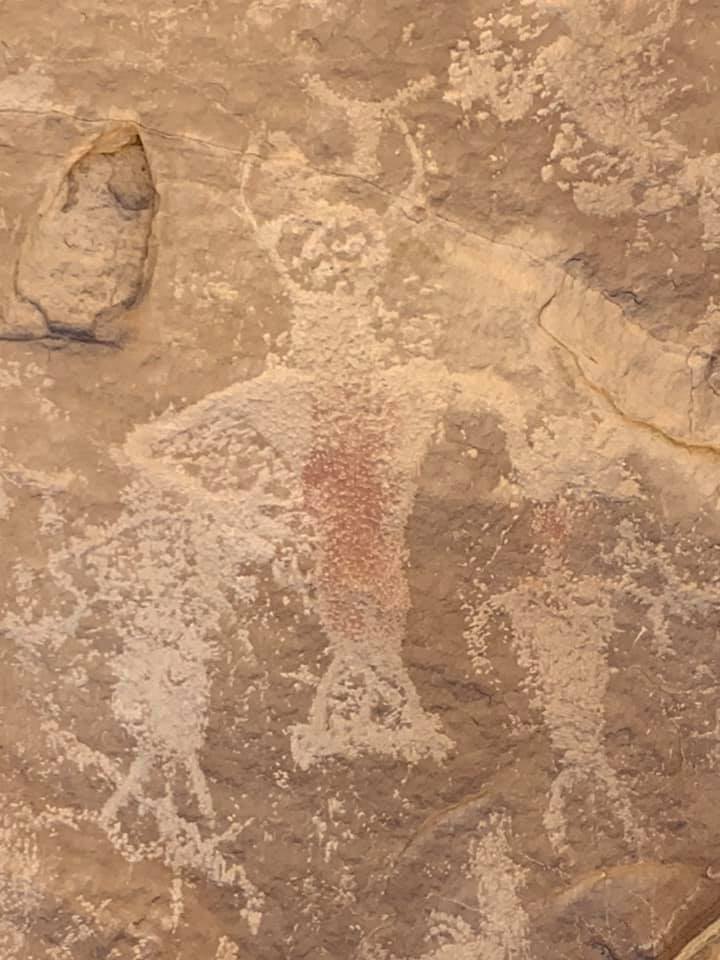
Fremont culture petroglyphs, Dinosaur National Monument. Photo by the author.
This week, I'm thinking about how we humans fit into the structures of natural history.

There’s a big problem with a lot of older anthropology exhibits in natural history museums around the globe, namely that they were built in the last two centuries often using either old and out of date information about the peoples they seek to describe, or like the old bronzes depicting the variety of humanity in the Musée de l’Homme in Paris, they were inherently racist to begin with.

Museums like San Diego’s anthropology museum have sought to rectify this with rebrandings and reorganizations. The museum in question, located in the California Tower building in Balboa Park, has recently renamed itself from the Museum of Man to the Museum of Us. Others like the Musée de l’Homme in Paris have worked to reassess how they display older historic anthropological exhibits like those old bronzes, so that today their primary message is one of “this is how people used to think, but not how we think anymore.” They’ve gone from being scientific teaching tools to historical artifacts.

There needs to be a very fine balance between lumping individual ethnicities with the rest of the natural world and actually considering humanity as a whole as part of nature. We are, after all natural beings, no matter how far we try to remove ourselves from nature with the edifices of civilization we’ve built up around ourselves. In case you’re wondering, this is a pretty central theme to the dissertation that I’m writing. In older generations, the idea of “natural humanity” was inherently understood to mean different peoples who were less civilized than others. It was used in the idea of the savage as a means of demeaning and describing the native peoples of the Americas following the beginning of the Columbian Exchange in 1492 (borrowing a term from one of my favorite historians, Alfred Crosby, here).

I’ve often thought of the world natural as being something good. Natural, or organic, food often tastes far better than the processed stuff. Natural soaps and such are less likely to harm our bodies. There’s even a style of music that I’ve called “natural” before, but only to myself. The liturgical music written by the St. Louis Jesuits, or the album Adiemus by Karl Jenkins would fall into this category.

So, if we’re natural beings, why then shouldn’t we be included in the kaleidoscope of life studied under the big tent of natural history? I for one have developed my own professional career from being an intellectual historian of the Renaissance to being a historian of late Renaissance natural history. That means I study natural history texts written between 1550 and 1600, in particular those which introduced new species from the Americas to audiences in Europe. At the time, natural history was closely related to another field called Cosmography, which while originally a theological study of the Cosmos had by the Renaissance become essentially the study of everything natural and human under the Sun. The first great proto-encyclopedias of our own modern age were descendants of the cosmographies of people like Sebastian Münster and my own focus of study, André Thevet (1516-1590), whose Cosmographie Universelle (1575) basically sought to describe everything, and yes I mean everything, that he knew about.

Today, we live at a turning point in human history. It seems like the last vestiges of the post-World War II order are finally beginning to break off, letting whatever the current century will bring be hatched from that shell born of the last century. Every century’s generations live in the shadows of their forebearers and have to figure out how to deal both with the benefits and the problems those generations left them. So, for us today talking about natural history we have the terrible realities of racism and bigotry which cloud this field and all its constituent studies. I do think humanity ought to be considered a part of natural history, ought to be studied like any other animal, but if we are going to speak of ourselves in those sorts of terms then it ought to do it in the same language across the board for all humanity, recognizing that we are all equal.

Today though, even more than any other time in our past, humanity has a critical role in the future of nature, and the stories that will be told someday in natural history. We’ve entered the beginnings of a new geological epoch, the Anthropocene, when we are the greatest influencers on the natural order of things. I’m seeing this in how many natural history and science museums have extensive exhibits on climate change, and even the handful of older ones on human biology, like my personal favorite at the Natural History Museum in London. We can try to ignore our part in shaping life on Earth, but at the end of the day as much as we’ll ignore it, we’ll end up like the proverbial unicorns who missed the boat. At that point, we will fall victim to our own pride, to our own endless thirst for more raw materials until the nature we need to survive has been stripped away. Human history has always been a part of natural history. Perhaps that’s a key to solving our current crises and all potential crises in the future: we must reckon with nature and our place within it.

Electric Cars

This week, I'm talking about my first road trip in an electric car. For my sources see: [1] 7-Eleven Corporate, "7-Eleven Charges Forward with Installation of 500 Electric Vehicle Ports by End of 2022, Providing Convenient Charging Options that Drive a More Sustainable Future," (1 June 2021), https://corp.7-eleven.com/corp-press-releases/06-01-2021-7-eleven-charges-forward-with-installation-of-500-electric-vehicle-ports-by-end-of-2022-providing-convenient-charging-options-that-drive-a-more-sustainable-future [2] Statista, "Number of 7-Eleven Stores in the United States from 2017 to 2020," (July 2021), https://www.statista.com/statistics/1130946/number-of-7-eleven-stores-us/

Last week I got the opportunity to ride along with my parents in my Mom’s Tesla on a cross-country road trip for the first time. We traveled across Missouri the 3.5 hours from Kansas City to St. Louis to visit relatives, many of whom we hadn’t seen in nearly 2 years because of COVID. When they were first looking at buying an electric car it was understood that because of battery range limitations those vehicles would make good city cars but wouldn’t be nearly as good for any long trips between cities. So, when Tesla announced their Model 3 would have an option for a 300-mile range and would be priced low enough that they could be more likely to be affordable in the long term, my Mom jumped at the opportunity. In many ways, while the electric car market was quietly growing before Tesla, with models like the Nissan Leaf driving the way forward, Tesla has in its own way revolutionized the speed at which electric cars are growing in the American automotive market.

In ideal conditions, at 248 miles, St. Louis is within the range for the Model 3 to make it without stopping to recharge. That said, generally it’s a good idea to stop and recharge in the middle. Yet as much as Tesla has revolutionized electric cars, the batteries are still susceptible to range fluctuations depending on the weather. In this case, we left Kansas City on a blistering cold day, and were lucky to make it as far as the supercharger at a Holiday Inn on the eastern side of Columbia, MO where we could recharge. Superchargers have the benefit of fast charging; it only takes 30 minutes or so for the batteries on a Model 3 like ours to fully recharge at a supercharger. Still, the idea that we were making a “refueling stop” that would take longer than 5 minutes, my usual stop length when I’m driving my Mazda, seemed a little bizarre. Still, the rare moment where we didn’t really have anything to do gave us the opportunity to stand around and chat.

Developments are being made in terms of making electric car charging stations more common across the country. 7-11 announced in June 2021 that they were beginning the process of installing charging points at 250 of their 9,522 stores in the United States. Meanwhile, cities like Kansas City, MO have long had partnerships with their local power companies to provide electric car charging stations at businesses and institutions throughout the city. Going forward, I think it would be well within the best interests of gas station chains like QuikTrip, BP, Speedway, Shell, or Mobil to invest in electric car charging at their locations around the US and globally.

In my own case, I plan on my next car being electric, whether that’s in five years or seven. I currently drive a 2014 Mazda 3, a wonderful sporty car that has proven itself time and again on my long drives between Kansas City and Upstate New York four times a year over the last four years. As much as I love that car, I fully recognize the need to move off fossil fuels and internal combustion in favor of vehicles and other transportation modes that aren’t as harmful to our environment. Thus, my interest in an electric car.

While my ideal would see the United States moving toward more public transit, better electrified rail networks, including a national high-speed rail system, and less car ownership all around, we live in a country rebuilt after the Great Depression and World War II with the car in mind. Here in Kansas City, I’m lucky to live in a neighborhood that is walkable, and that has regular bus service to Midtown and Downtown. I could conceivably even take the city buses as far as KCI Airport and not worry about driving up there at all, though the way the local public transit system is currently set up, connecting buses is more challenging than it needs to be.

As it stands, the US is going to remain a car-dependent country. Better to drive cars that are more sustainable, quieter, and safer. Progress means we continue innovating and moving forward. Let’s do it in electric cars!

Freedom from Fear

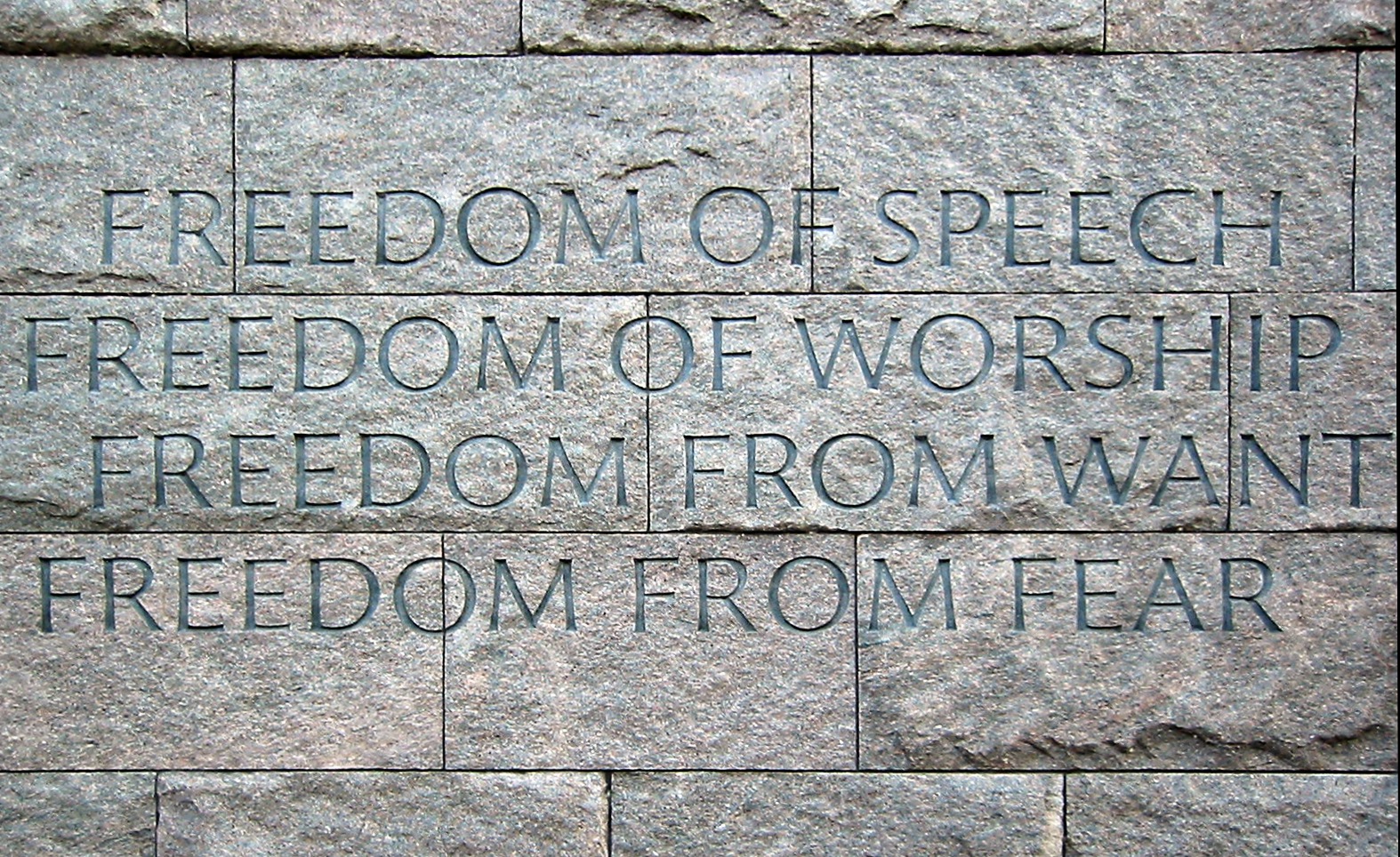
Credit: Wikimedia Commons CC BY-SA 3.0
In this episode I talk about how FDR’s Four Freedoms from his 1941 State of the Union is pertinent to today.

When I worked as a Teaching Assistant for the US History II class (1877-present) at the University of Missouri-Kansas City, the week that we’d discuss the Great Depression and the New Deal, I would always highlight President Franklin Delano Roosevelt’s Four Freedoms and spend a good deal of time discussing them, what they meant to Americans in the 1940s, and what they mean to us today. Chief among these for me has always been the most abstract yet primeval of these Four Freedoms: Freedom from Fear.

At the time he announced the Four Freedoms in his 1941 State of the Union Address, 81 years ago this week, FDR saw Freedom from Fear as “a world-wide reduction of armaments to such a point and in such a thorough fashion that no nation will be in a position to commit an act of physical aggression against any neighbor –– anywhere in the world.” 

This spoke as profoundly to a world plunged into the worst war yet known in human history as it does to us today in a world where the instability of war has of late shown its face both in the form of terrorism and paramilitary attacks as well as in more conventional fighting around the globe. Yet now as I write this, headlines in the major papers and other prominent news outlets continue to warn of aggression from the likes of China or Russia against Taiwan and Ukraine, both conflicts that surely, we in the United States would be likely to involve ourselves in.

Yet beyond the terrible yet over-glorified world of weapons and war, I often think of this fourth freedom in other social contexts all the same. It saddens me, yet still doesn’t surprise me to know that now, nearly as distant from FDR’s presidency as Lincoln’s was from the Continental Congress, we still are a country that lives in fear of enemies both foreign and, yes, domestic as well. This cycle of fear has led to so many of our fellow citizens buying guns for self-defense, often in response to the frequent mass shootings and other homicides that are a wrathful shadow over our lives. 

This cycle of fear has kept us indebted to our for-profit health insurance industry, without which we couldn’t afford to pay the medical bills that result from the healthcare that keeps us alive. I thank God that my employer has good quality health insurance, because honestly if I were given the choice of surviving or going into severe debt to pay for an emergency surgery or other procedure, I’d have to really think about that before making a decision. What value is there in life if you can’t really live because all your earnings are going to pay off not only your debt but also the interest on that debt?

Fear can drive us to achieve better things, to overcome our fears, yet it can also inspire us to do terrible things. Fear of the other, fear of difference, is the root cause of so many problems that beset our country and humanity at large. I study this in the context of how the idea of the savage was understood in Renaissance natural history in my professional capacity as a PhD candidate in history.

One of my favorite episodes of Star Trek: Voyager provides a clue as to how we could truly achieve the dream of this fourth freedom. In the second season episode “The Thaw” Captain Janeway and the crew of Voyager take on an AI that was created by the imaginations of a group of interstellar settlers who put themselves into cryogenic stasis for decades. That AI ended up manifesting itself as Fear itself and proceeded to terrorize the settlers and eventually the Starfleet officers from Voyager who enter the stasis chambers to try and deactivate it from the inside. At the end of the day, Captain Janeway herself confronts Fear and proceeds to give the best argument for power that I’ve ever heard; power only lasts if its authority is unchallenged. Fear only lasts if we are afraid. At the end of the day, the answer it seems is coming to terms with our own agency, our own ability to make decisions for ourselves.

We as the United States have become paralyzed by fear; there are reforms and changes we really should make but the people who could make them more often say it’s too dangerous to disrupt the status quo, to shake the foundations if only slightly. To quote another President, this time Mr. Lincoln from his 1862 “Annual Message to Congress”, “As our case is new, so we must think anew and act anew.” Times have changed, and with them the ways we deal with our government and its relationship with the people must change as well. We need universal healthcare; we need electoral reform that will fully protect the right to vote enshrined in the Voting Rights Act. We need to make the changes necessary in our educational system, policing, and in nearly every other facet of our society to tackle bigotry in every venomous form it takes. We need to rethink our immigration laws, unscramble them, welcome in people who want to become our fellow citizens, our friends, our neighbors, who want to contribute to our society by their presence within our borders.

Eventually, I dearly hope, we’ll finally achieve FDR’s fourth freedom. I look forward to a day when I, and everyone around me has nothing to fear. I’m a teacher, admittedly in higher ed rather than in K-12, but a teacher nonetheless, and here in the United States being a teacher means knowing that there’s always a chance someone is going to decide they need to attack the students, faculty, and staff at your school or university. In my classroom, while my first priority is to teach, in that situation my first priority is to ensure my students’ safety. I long for the day when I won’t have to worry about someone attacking my classroom, and frankly I know there’s a decent chance even if I don’t experience a school shooting firsthand that I’m likely to experience a lockdown because of one, and not just the frequent drills we did for school shooters when I was in high school.

We fear each other because we don’t trust each other, and a country comprised of citizens who are too afraid to trust one another is a country in peril. Everything that I said today could well be interpreted as a partisan statement. Think about that: fear itself has been weaponized for partisan purposes to such an extent that the few solutions to that fear are themselves inherently partisan, fundamentally political. What have we done to ourselves to get to this point?

To turn again to President Roosevelt, freedom from fear “is no vision of a distant millennium. It is a definite basis for a kind of world attainable in our own time and generation.” Make this my hope, my prayer even, that if my generation and the generations to follow are remembered for anything it’s at long last overcoming those innate human fears that have driven us since the first Cain of our legendary past cast their stones against their fellow humans.


In the podcast version of this post, the recording of FDR’s 1941 State of the Union Address, his “Four Freedoms Speech” comes from the Archives of the Franklin D. Roosevelt Presidential Library and Museum in Hyde Park, New York which is operated by the National Archives and Records Administration. I’d also like to thank my friend the immensely talented voice actor Michael Ashcraft for his giving life to President Lincoln’s words in this episode.