Monthly Archives: March 2022

The Syntax of Internet Culture

Photo by fauxels on Pexels.com

The Syntax of Internet Culture Wednesday Blog by Seán Thomas Kane

This week, some things I've noticed about how people communicate online.

I’ve had access to computers for as long as I can remember. My parents work in the tech world, so naturally I was probably one of the first people in my class to have an email address. I still remember that first email I sent, it was to my Aunt Jennie in Kansas City. Even then at the spry young age of 3 or 4 I was already growing into an expected typical Midwesterner: I asked her about the weather where she was. Over the years my access to the internet have only increased to the point where today it is ubiquitous. I’m rarely, if ever, away from a data signal, and any simple question I have can be easily answered by a quick question to Siri or a Google search.

The amount of technology in our lives today is sometimes scary. The fact that it surrounds us at all times, in all places makes us all the more dependent on it. What’s more, it’s changed the way we talk, the way we solve problems, and quite possibly the way we think too. In the last couple years, the majority of my time online has shifted from being spent reading long-form articles on the New York Times, the BBC, and such to watching videos, both long and short, on platforms like YouTube and Instagram. In the early years of YouTube, content on that platform tended to be much more diffuse with different creators crafting different sorts of videos in their own style, yet as that frontier continues to be settled YouTube videos have become more standardized. There’s the catchy title that’s supposed to get the algorithm to convince you to watch the video. There’s the introduction, the body, and the conclusion, demonstrating how so much YouTube content is essentially an extension of the essay. 

And of course, there’s the sponsored content thrown in there for good measure. I admire quite a few of these YouTubers and have a handful that I’ll watch on a regular basis. I even tried publishing short history videos on YouTube a few years ago, they’re still out there, but I found the work needed to get those videos out simply was too much for my production abilities and schedule. This podcast has ended up being a happy medium for me, something that I can write, record, edit, and release in a couple hours on a weekday afternoon. Of any transformational aspect of our current time, YouTube and podcasts and the democratization of knowledge that they embody have to be some of the most critical aspects.

Then there are the shorter videos, pure mind-numbing entertainment. I tend to have a soft spot for cat and dog videos on Instagram, many of which were originally made for Tik Tok, one platform I continue to avoid. There seem to be a few usual tropes and themes that run through all of these, identical music, identical storylines, say a cat or a dog doing something silly. Then there are the videos that try to express situational emotions, that take the subtext of life and turn it into a loud and proud declaration of what the person on camera is thinking or more often feeling. I feel that these sorts of videos are an outgrowth of memes that I’ve seen on Facebook in particular for over a decade now. Memes that often include the horrendously poorly worded phrase “be like…” as one example. If anything marks out the syntax, the sentence structure, of English internet culture most clearly it’s the disregard for grammar and the fluidity of English. On the one hand it has a tendency to annoy me, yet on the other hand I recognize that this is likely the development of new forms of English that will be how this language is expressed and used as our current century continues. After all, my own English is the product of both generations of immigrant interpretations of this language and official dictates of varying degrees of linguistic validity.

The one great problem with internet culture is how much content is processed and released at any given moment. After the tenth video using the same song to varying degrees of effectiveness, I get even more annoyed than I already was at the whole conversation underway. This Sunday and Monday for example I only lasted half an hour scrolling through Twitter and Instagram before I was annoyed at all the memes trying to interpret excessively diffuse meanings from Will Smith’s altercation with Chris Rock at the Oscars. That’s the beauty of more traditional forms of media: they limit how many voices are speaking at once. As anyone who has sat through endless Zoom calls over the last two years will know the signal connecting everyone attending can only pick up 1 voice at a time, and as much as we want to believe we can multitask that’s simply not the case.

I’ve thought about dropping some of my social media accounts. I’ve been on Facebook, Twitter, and Reddit for a decade now, and on Instagram for almost that long. I recognize the ability of social media to distract from work and more importantly from living my own life rather than watching other people and their pets do silly things online. I still see some utility in social media though, it’s the primary way that I promote this blog and podcast, I still have thoughtful conversations every so often over news articles or essays that I’ll post online with other intelligent people. There have even been opportunities I’ve taken because I saw an announcement or some other listing online. But compared to the overwhelming cacophony of the internet, and to the things that really make me happy, I’ve come to the conclusion that I’d be happy if I did drop some of my social media accounts.

In short, our ability to communicate without boundaries has expanded far faster than any guidelines for how to do so safely and civilly have been able to be set in place. There is so much potential in the internet, we just have to recognize that like with everything else we need to keep that space tidy, and that we need to find a balance so we can live full and fruitful lives while enjoying the benefits of this greatest creation of our global world.
Bad Practices in Baseball Broadcasting

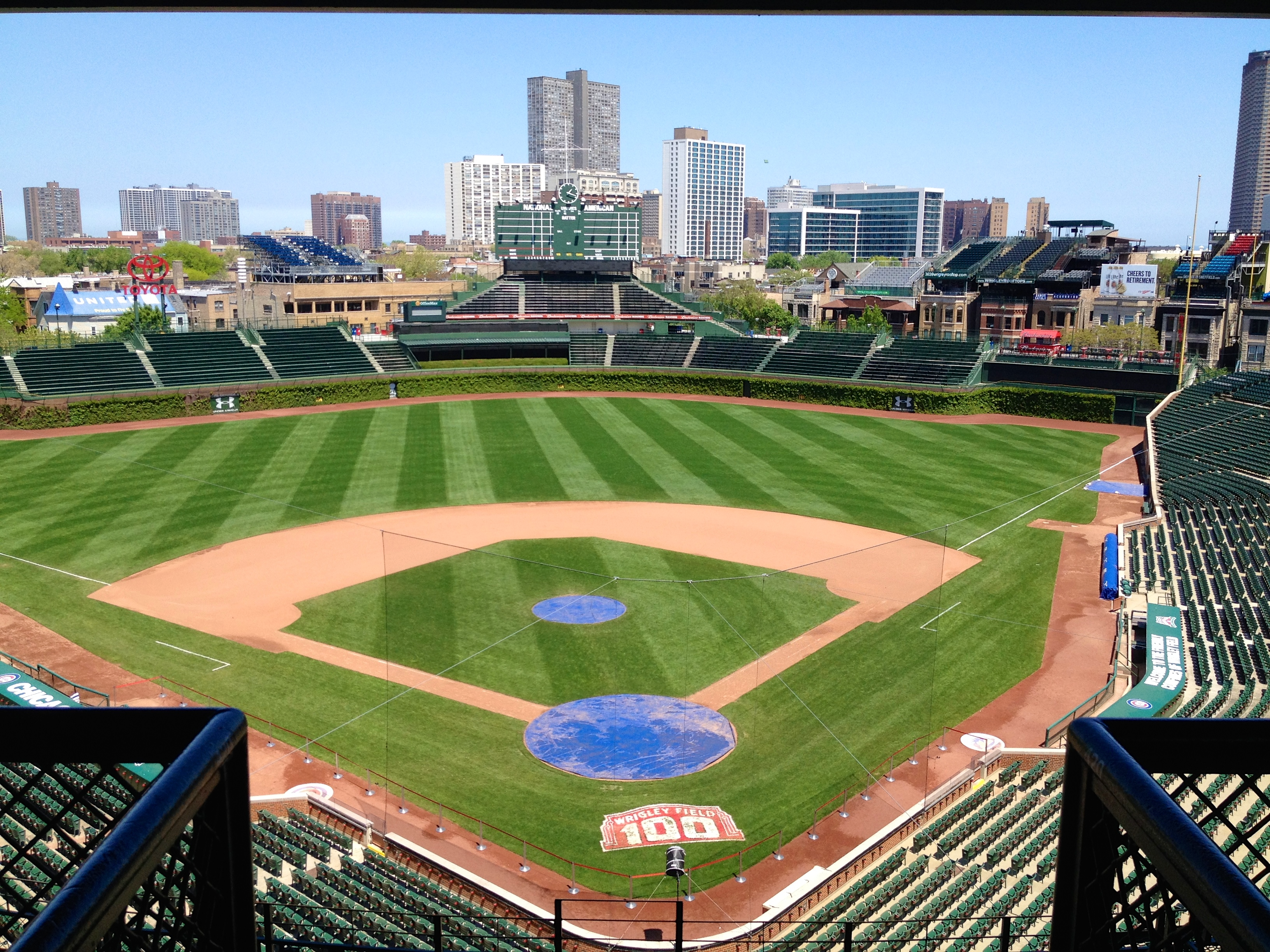
Wrigley Field from the press box.

Bad Practices in Baseball Broadcasting Wednesday Blog by Seán Thomas Kane

This week, how baseball broadcasting today is a tale in what not to do. All musical performances included are my own.

As you’ll have gathered from last week’s episode, I’m a big baseball fan. I always have been, and probably always will be. Baseball was the first sport I watched as a kid, the first I played (Kindergarten T-Ball), and the one that I have spent the most time watching both in the stadium and at home on TV. Growing up in the 90s and 2000s baseball was one of a handful of things that were just normal to have on the TV or the radio during the day in the background. No matter which major league city you were in, the local team or teams would probably be on the airwaves on any given Spring or Summer afternoon or evening. 

As a lifelong Cub fan, I was lucky after my parents & I moved to Kansas City in June 1999 to be able to still watch the Cubs live on WGN’s national superstation. Those broadcasts became one real big constant in my young life, something I even introduced to my cousins on occasion during those long summers in the early 2000s when I spent the day at their house. They were all Royals fans first and foremost, but I distinctly remember one particularly exciting game from Wrigley when we all were buzzing with excitement in front of the TV watching an especially close day game, cheering & celebrating when the Cubs won with a walk-off home run in the bottom of the 9th.

That all began to change in the early 2010s when baseball began to move from the ubiquitous over-the-airwaves channels to special sports channels that you either got through your cable package or that were only available at special request. The Cubs left WGN in 2015, and one of my last day-to-day links with my original hometown went with the last of those broadcasts. I didn’t notice it at first, in September 2015 I moved across the water to London to do a master’s degree in International Relations and Democratic Politics at the University of Westminster, and only rarely got to see baseball at the odd American restaurant in the British capital. When I returned to the U.S. the following year the Cubs were almost always on MLB Network or any of the other regular baseball broadcasters, mostly ESPN and Fox Sports. It was 2016, the year when the drought was finally lifted (see last week’s episode for an emotional recounting of the night of Game 7). In the following years I was able to see the Cubs fairly regularly on national TV, and the Kansas City Royals, my favorite American League team on the local Fox Sports Kansas City broadcasts on a daily basis, but as the 2010s ended all that began to change yet again.

Around the same time as the beginning of the pandemic in this country in March 2020 the news broke that Fox was selling their Fox Sports division as a part of the Disney acquisition of 20th Century Fox. The Federal Trade Commission ruled that Disney couldn’t control Fox Sports and ESPN, that’d be a monopoly, so Fox Sports was up for grabs to the highest bidder. That bidder turned out to be Sinclair, America’s shadiest right-wing owned media conglomerate, the Hearst of the 21st century, the true Charles Foster Kane. I wasn’t happy from the beginning about this; Sinclair had been caught red handed making their local news anchors read a prepared statement that sounded way too much like propaganda for my liking, and nearly anything they touched seemed to be weaponized to benefit their own ideals and mission. So, when Sinclair announced that the Fox Sports naming rights had been sold to Bally’s, the casino chain, I wasn’t totally surprised. One thing to get out of the way: I’m fine with legalized sports betting, I’m just annoyed with how gaudy and grotesque its advertising often tends to be, and frankly I don’t want any part in it. What frustrated me the most was that as a part of the deal Sinclair decided to get greedy, as robber barons are known to do, and raise their rates to the point that Fox Sports, now Bally Sports, was cut from most TV providers’ channel listings, especially from streaming TV providers like YouTube TV and Sling. For the first time in my life, I couldn’t watch baseball, whether the Cubs or the Royals, on local TV.

I recognize that this isn’t a serious societal problem on its own. Having professional baseball off the airwaves for a good portion of the population isn’t going to cause people to starve or to lose their homes or their jobs; it isn’t a matter of public education or human rights. Compared to those problems this is insignificant. Culturally though, in a country that is largely isolated from the global sports market, baseball remains our national past-time. It’s something that developed as our country grew, a sport that came into its own after the Civil War with teams that have existed as long as some communities in this country have. My own Chicago Cubs have an old heritage in professional baseball dating back to around 1870. They joined the National League at its founding in 1876 and have stuck around in the same city ever since. For the first 30 to 40 years professional baseball was seen by spectators in the stands and reported on in the newspapers. In the next few decades with the invention of radio it was broadcast around the country alongside sports like boxing to homes and businesses from Atlantic to Pacific. Following World War II it began to be seen on TV screens, with greats like Jack Brickhouse calling games from the press box at Wrigley Field. Some of my fondest memories of baseball are the most mundane ones, like the times I’d sit in my grandparents’ kitchen watching the Cubs with my grandmother, or the summer evenings in recent years when my parents and I would sit around in our living room in Kansas City watching as the Royals played fun small ball, outwitting heavy-hitting teams with their base running, base stealing, and excellent fielding. Memories like those are what companies like Sinclair are burying deep in the ever-receding past.

A year ago, Sinclair announced they’d have a streaming service ready to go for the 2022 baseball season called Bally Sports+ (because every streaming service is called “so and so +” for some reason). The report said it would cost around $23 a month, or $184 per baseball season, including Spring Training and the playoffs (March-October). This would cater to people like me who don’t have traditional cable packages, owing to their exorbitant prices around $80-120 a month, and would fill the void that Sinclair themselves created to gouge the market during the 2020 and 2021 seasons. Well, Spring Training has begun for 2022 and Bally Sports+ is nowhere in sight. I was lucky enough on Monday afternoon this week to catch a Royals Spring Training game against the Angels but that feels more like a chance encounter than a solid resolution to the problem.One potential solution would be to build off the legal exception that the 1922 Supreme Court Case Federal Baseball Club v. National League made for Major League Baseball to be exempt from the Sherman Antitrust Act, the very act which opened the door for Sinclair to buy Fox Sports over Disney’s objections. In the present case, I’d argue that baseball is an exception to the rule because it’s a deep-rooted part of American culture. As such it ought to be available to watch over-the-air, exempt from any special cable or streaming packages, exempt from being hogged by the greedy arms of broadcasting conglomerates like Sinclair. Unlike the NFL, baseball’s closest competitor, Major League Baseball’s season doesn’t lend itself well to having an all-national broadcast schedule. We’re talking about 24 weeks between April and the end of September with 162 games being played by 30 teams, or 2,430 games in a season. A solely national broadcast system like the NFL’s simply wouldn’t work for the MLB. Instead, local broadcasts should be prioritized, and broadcasting companies should be incentivized to put the viewers first. The alternative, if baseball isn’t easy for people to watch on a regular basis, is for the sport to decline in popularity, something that hurts companies like Sinclair anyway. I only hope that Sinclair’s executives realize it’s to their benefit to let people watch baseball at a fair price.

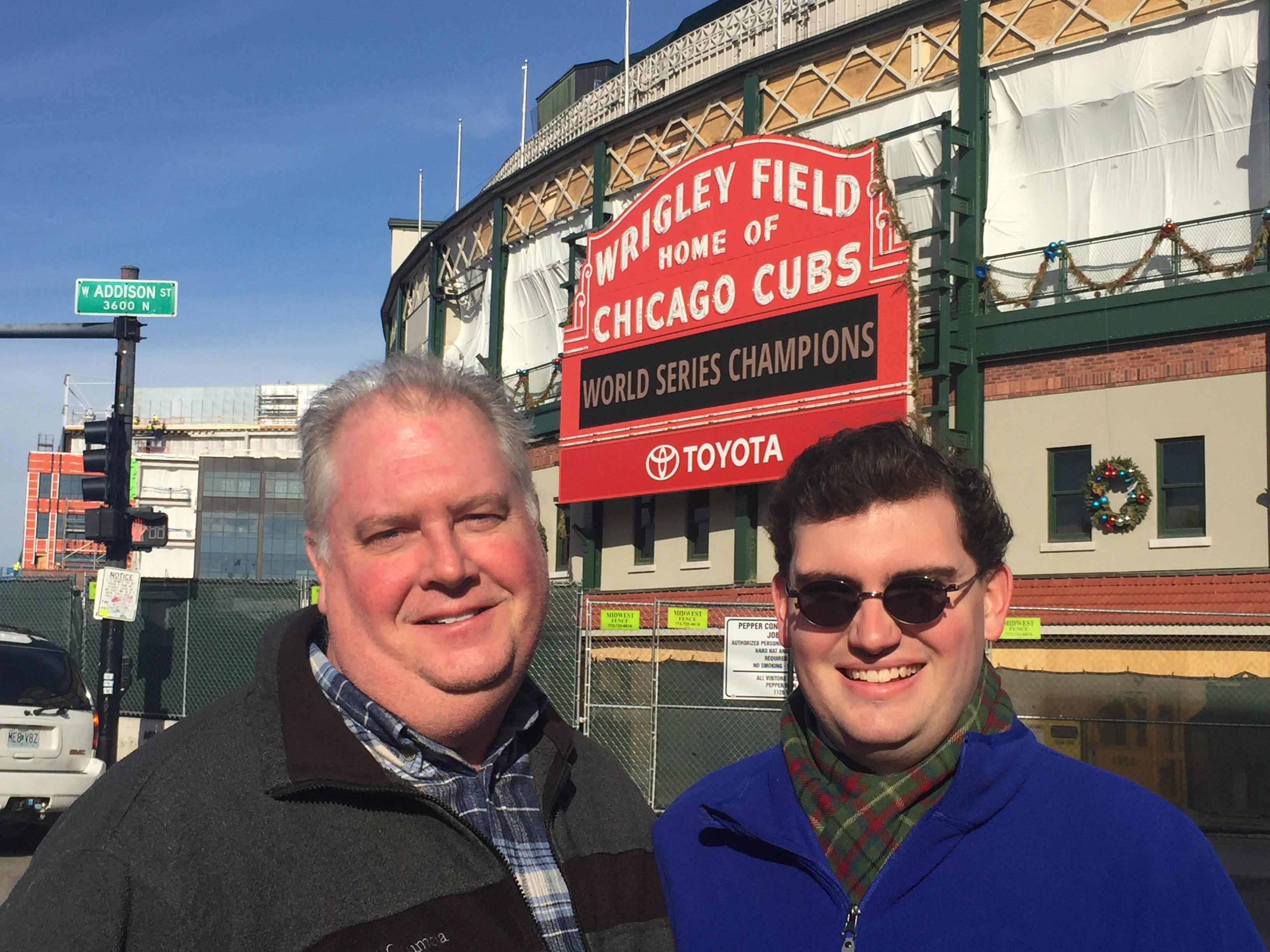
My Dad and I in front of the Wrigley Field Marquee in December 2016

Baseball is Back

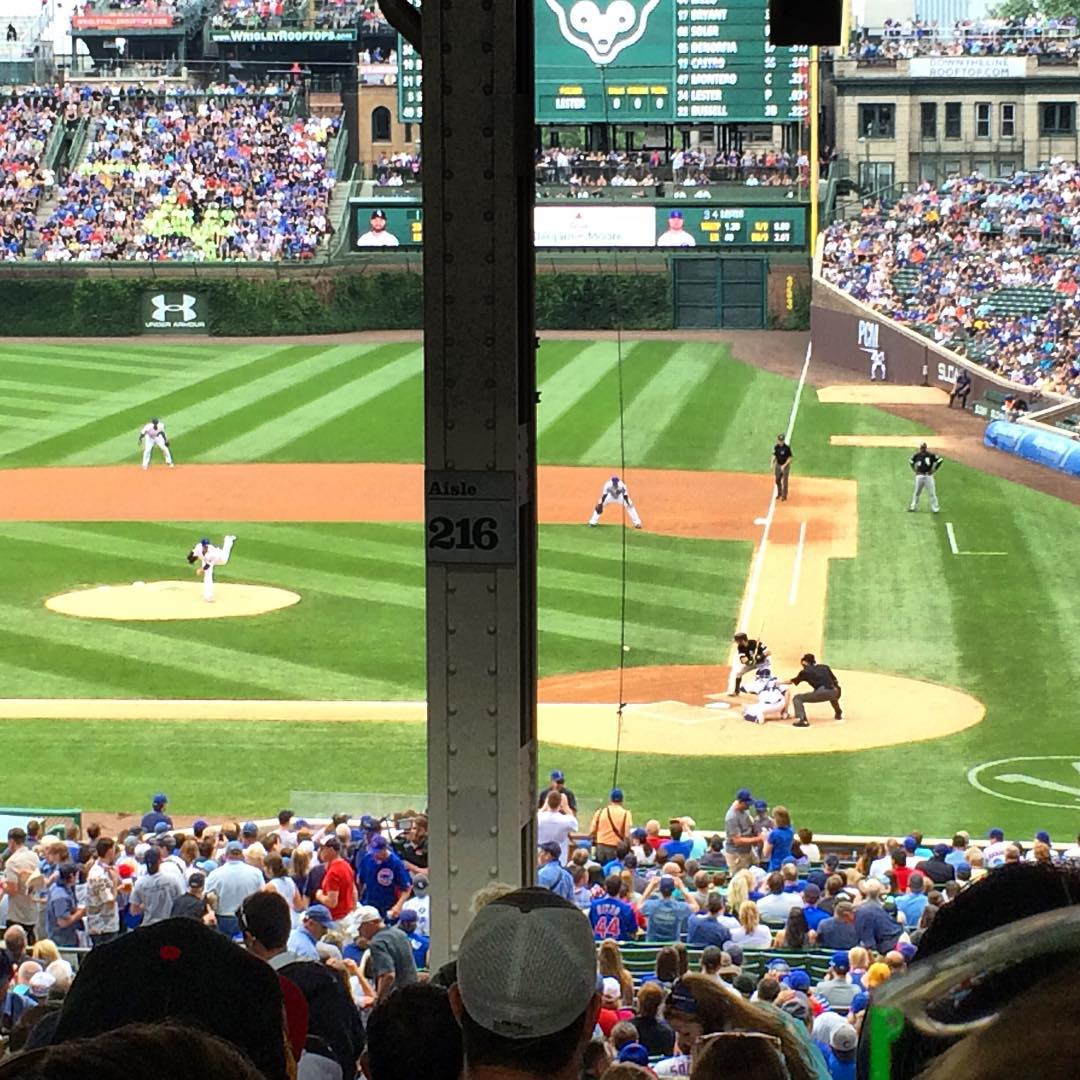
Jon Lester pitching against the White Sox in 2015.
This week, a celebration of baseball's triumphant return and one small complaint about a rule change.

This past Thursday afternoon I listened to the latest episode of the Sidedoor at the Smithsonian podcast talking about the history of the song Take Me Out to the Ballgame and the Seventh Inning Stretch, one of the most American of rituals out there. It’s the moment in a baseball game when the entire stadium stands up and sings about going out to the ball game, eating cracker jacks, and peanuts of course as well. In the last 20 years following Take Me Out to the Ballgame usually we will also sing God Bless America, because that’s what we do in this country.

In the aftermath of listening to that podcast episode I began to think about how I might like to go see a ball game this Spring, but with the Major League Baseball lockout I knew I needed to find another outlet to see baseball, excluding the majors and probably the minor leagues as well. So, I looked at college ball. I was going to buy a ticket to a game or two of the Binghamton Bearcats Division 1 Men’s Baseball Team, my own university’s team. I still plan on doing so, however in the process of going to buy those tickets I saw the wonderful news that the lockout had been resolved and was going to end. Major League Baseball would be returning for the 2022 season with some changes to the rules.

Plenty of bloggers, columnists, and people on the radio have complained about different aspects of the rules. I want to add my voice to once specific area: the introduction of a universal designated hitter rule. This means that the National League will no longer have the distinction of having pitchers that bat alongside all the other players. Now National League teams too will have Designated Hitters like the American League has had for a while now. I’ve got to say I’m not terribly happy about this. For the longest time I’ve always preferred the National League’s way of doing things. In my own humble opinion, my own entirely amateur, spectator opinion, standing atop my soap box way out in the bleachers, some of the best ball games we’ve ever seen have been pitchers’ duels. Where it’s back and forth, back and forth two amazing pitchers on either side striking out almost everyone, letting in a few pop flies but very few runs. Those games often finally finish, perhaps miraculously with one pitcher getting a hit off of another pitcher and batting in a run. 

Even better, there was Game 3 of the 2016 National League Divisional Series between the Chicago Cubs and the San Francisco Giants out in California. Madison Bumgarner was pitching for the home team and Jake Arrieta for the visitors, my beloved Chicago Cubs. Bumgarner to this point was unbeatable. He was the darling of everyone in San Francisco and especially Fox Sports commentator Joe Buck. He was unbeatable until Arrieta looked him in the eye that night and with two men on swung for the fences and got a three-run home run. He cracked the façade of the unbreakable Madison Bumgarner for the first time in the playoffs. The Cubs would go on to win that divisional series, and then they’d win the National League Pennant over the Los Angeles Dodgers and on a stormy night in Cleveland at the beginning of November they won their first World Series since 1908 on a night when I prayed more decades of the rosary than I’ve ever prayed before in my life.

Having pitchers bat allow for games like that to happen, allow for moments like that to happen. They allow for the opportunity for the most dramatic of finishes to take places, of pitchers taking the game into their own hands and becoming the hero of the day. On the other hand, so many major league pitchers are terrible batters that if you don’t have a really dramatic grandiose situation like Arrieta’s home run in Game 3 let’s say then at the very least it’s going to be a quick out, meaning it speeds the game up. Designated hitters are fun to watch, they’re sluggers after all, but the more fun kind of baseball is small ball, it’s the singles and the doubles, the base hits, not the home runs. The home runs and grand slams are exciting but it’s more exciting to see the team work together and strategize to earn runs over a couple of at bats, that’s the most fun kind of baseball out there.

So as much as I’m happy to see Major League Baseball return, to see the 2022 season after a long lockout, after the greed of the ownership was made plain and clear for all to see, and even though I have many other grievances alongside the universal DH rule I’m happy to see the season starting so soon. I do have other problems with professional baseball today, notably how Bally Sports continues to be the Scrooge of baseball broadcasting here in the Midwest, keeping their televised games off most peoples’ TVs out of the same greed that kept the lockout going so long. I hope this will be a good season for my beloved Chicago Cubs as well as for my adopted second team the Kansas City Royals. And if not, well, let’s just hope for a good year of baseball.

Electric Cars, Part 2

This week, how electric cars can contribute to the sanctions against the Russian government.

A few weeks ago, I released an episode about my first road trip in an electric car, and I was surprised to see that it topped the charts in terms of listener numbers for the next few weeks. Maybe it’s the topic, people just like electric cars. Maybe it was the picture I used that week of me looking like an executive standing in front of my Mom’s Tesla and a private jet at Kansas City’s Downtown Airport. Either way, you guys liked that one so here’s a sequel: Electric Cars, Part 2.

Today I want to talk to you about one idea I had of how we the United States, and our allies around the globe, can respond to Russia’s unprovoked invasion of Ukraine and move ourselves closer to carbon neutrality at the same time. Russia is one of the planet’s biggest oil producers, in fact I’d go as far as to say that oil is the backbone of Russia’s economy today, maybe not quite like Saudi Arabia or the UAE but on a similar vein. Here in the US, we’ve seen gas prices, which were already high, rise to levels unknown since the darkest days of the Great Recession. Gas prices here in Binghamton, New York range from $4.12 a gallon to as high as $4.35 a gallon right now. It’s likely that price is just going to keep rising, especially as our political leaders have decided to cut off Russian exports into the global petroleum market as a part of the wide-ranging sanctions levied against the Russian government and the ruling elite of that country in response to the Ukrainian War.

This morning I found myself thinking about the trips I have planned in the coming weeks. I knew that my usual $25 per tank of gas wasn’t going to get me nearly as far as I’m used to, and I’ve even gone as far as to cut some weekend day trips around Upstate New York and northern Pennsylvania from my schedule as a result of the rising fuel prices. Yet as I thought about my own trips I couldn’t help but smile at the thought of my Mom in her Tesla, one driver who wouldn’t be impacted by the rising fuel costs to the same degree. After all, Russia may be one of the great oil producers of our time but the electricity powering her Model 3 is locally sourced.

With this in mind I have a small suggestion: let’s use this moment of crisis globally and take the step to really begin transitioning wholesale our automotive industry from gas-powered cars to electric cars. We have the technology, which continues to improve day by day, and we know how to build the infrastructure for it, so why not take a moment of what could lead to great internal crises of long lines at the pumps and offer even greater incentives for people to trade in their internal combustion cars for EVs? We could even say it’s the humanitarian, or in the very American case that we like in this country the “patriotic thing” to do. The greatest innovations of our past have been born out of moments of crisis and trouble.

One big concern I know I’ll hear from the naysayers is that big oil won’t go for it, after all they have too much to lose in electric vehicles. To them I say, big oil would be idiotic to not see the potential in electric vehicles and start making the switch themselves. The easiest way for things to change is if we frame the change in dollars and cents, in profits. Greed, as a certain TV bartender would say, is the way to people’s hearts. 

Of course, there are some issues with this particular idea. For one we have other shortages of raw materials needed to make the batteries and computers used in electric vehicles. And even then, the mining of those materials isn’t terribly green. In the short term though, one way we could begin to threaten the aggressors in Moscow with long term trouble would be to deny them their greatest source of wealth.

I for one look forward to the day when I won’t have to fill up gas on a weekly basis. The potential changes to how our society functions through the economic changes imposed by this switch to EVs, which guys is likely going to happen anyway, are likely to be one of the core things that define the current twenty-first century as distinct from the twentieth.

National Mall

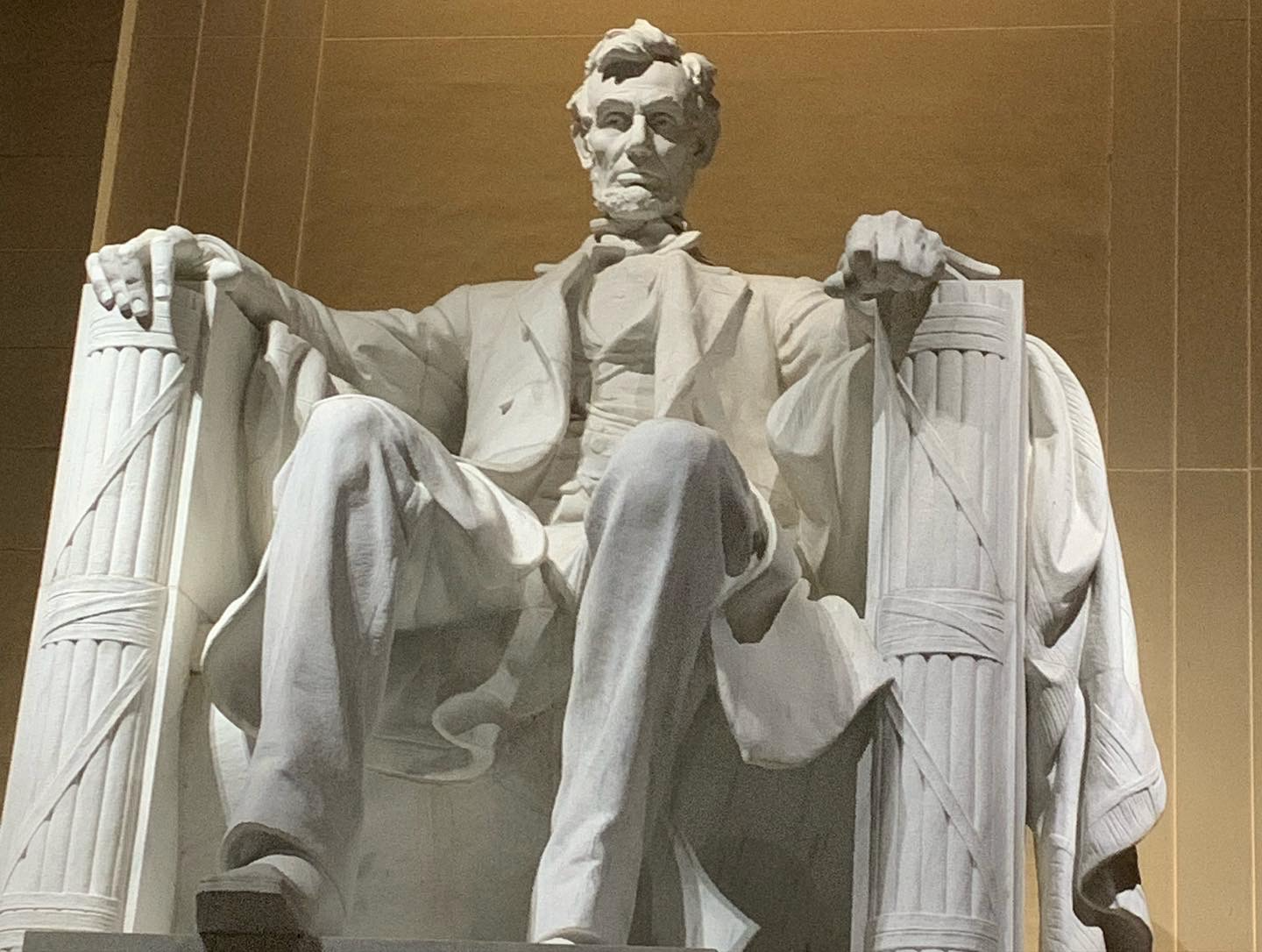
Mr. Lincoln
This week, I want to tell you about a trip I took last weekend to Washington, D.C. Links: The Smithsonian's Futures Exhibit: https://aib.si.edu/futures/ The Planetary Society's Sailing the Light documentary premiere live stream: https://youtu.be/NnKsHlV1NhA

Of all the cities in the east, Washington remains my favorite. It’s place at the emotional heart of our republic, the center of the Union that my lifelong hero President Lincoln fought to preserve, makes me yet another Mr. Smith every time I return to the capital. This week I made such a trip back to some of my favorite museums, some powerful monuments, and some good weather after months of cold and snow in Upstate New York. I decided that I wanted to make my trip a bit of an adventure and chose to drive down from Binghamton rather than fly, an easier option. This led me to an occasionally tense journey down Interstates 81 and 83 through Pennsylvania and Maryland to the BWI Amtrak station where I decided to leave my car for the weekend, figuring it’d be better to not try to drive and park in the District if possible.

Arriving in D.C. on the Acela, currently this country’s fastest passenger train, something the train nerd in me specifically chose to do, I had a similar arrival to Jimmy Stewart’s Mr. Smith at Union Station, its high vaulted ceilings designed by Chicago’s own Daniel Burnham over a century ago. Unlike Smith I didn’t see the capitol dome from the station, instead looking downward trying to find the nearest metro station to get to my hotel.

Seeing the monuments at night is always a special treat. As elegant as they are in the daytime, and some like the Vietnam Memorial are better seen under the Sun, there’s a special artistry in seeing the work of sculptors and architects illuminated with floodlights. That’s how I saw the Washington, Lincoln, and MLK Memorials, lit up solemnly. Mr. Lincoln and Dr. King looked as though they were great titans of antiquity in the glow of their memorials’ lights. 

At this time in our history, Lincoln’s struggle to save the Union and end slavery in this country once and for all seems all the more present. In the week since my last post (episode for those listening) the Russian military has invaded Ukraine. I alluded to those threats last week, but now threats have become a living nightmare for the Ukrainian people and a great storm cloud over the rest of Europe that threatens to engulf all of humanity. How do we embrace the true and righteous words of Mr. Lincoln to do the right thing and feel no evil towards others, even those like President Putin who have so brutally attacked their neighbors? I don’t have an answer to that question yet, nor am I certain that I ever will. But today’s feast, Ash Wednesday for us Catholics, fits well into this narrative as an annual reminder “Remember you are dust, and to dust you shall return.”

I spent a good deal of time on Saturday in several of the Smithsonian museums, returning to the Natural History Museum that I visited in July to double check a label for a sloth for my dissertation, and revisiting an old favorite in the Asian Art Museum. I also visited the American History Museum for the first time in over a decade and enjoyed it quite a bit more. The previous time in 2011 it seemed to be sparse in actual history, yet this time I could notice the nuance in the stories it told in the objects on display in what little space it had available.

The most insightful museum visit though was to the Futures exhibit currently housed in the Arts and Industries Building on the south side of the Mall next to the Smithsonian Castle. This exhibit, which asks visitors to imagine how our future could be a sign of human life improving offered a much needed antidote to the troubles of the world. There were examples of carbon-neutral and renewable building techniques and materials, electric cars, air taxis, and hyperloops. There was a new model of a space suit that was far less bulky than those used by astronauts today and a model of Light Sail 2, a spacecraft sent into orbit by the Planetary Society, a space advocacy organization of which I’m proud to say that I’m a member. There is no one future but many for us to choose from. It’s up to us to determine how we want our future to be written, to be designed, to be imagined.

The National Mall is the emotional heart of this country. It speaks to me of generations of memory, passion, and possibility. On this trip as well though I could imagine myself there in the future, introducing the next generation and later generations to come to that heart, to the ideals and hopes and dreams of this republic. Now at the end of my 20s, my visits to the capital mean something different to me than they did in the last decade. They represent my own future, its infinite possibilities, and how I might be able to do my part, however small it may be, to influence and improve upon our experiences.