Monthly Archives: July 2022

Artemis

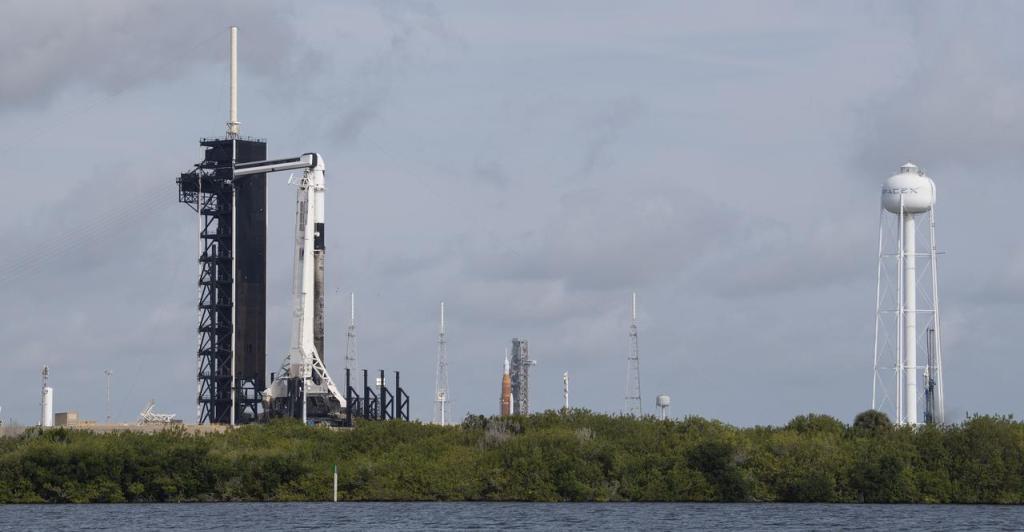
NASA’s SLS and SpaceX’s Falcon 9 at Launch Complex 39A & 39B. NASA Images Library.
This week, some exciting news about the upcoming launch of Artemis 1. The audio clips used today come from the NASA Audio and Ringtones Library. You can learn more at http://www.nasa.gov/connect/sounds.

As long as I can remember I’ve known Neil Armstrong’s now immortal words “It’s one small step for Man, one giant leap for Mankind.” They were spoken a couple decades before I was born at a time when my parents were themselves children. I think I may have recognized Armstrong’s voice earlier than many other public figures. Then again, Space exploration has always been a big deal in my life, from the endless sci-fi novels that lined the shelves of our basement library in our suburban Chicago home to the Hubble pictures that adorned the walls of many of my classrooms through the years.

Looking back at a lot of those novels and hopeful calls for future Space exploration and settlement, like Gerard K. O’Neill’s The High Frontier or Stanley Kubrick’s classic film 2001: A Space Odyssey it’s striking how far we are now today in 2022 from where we hoped we’d be over the last 60 years. Our last lunar mission ended 20 years to the day before my own birth in December 1972, and besides the odd Chinese robotic mission we humans haven’t been back to our largest satellite since.

So, in December 2017 when NASA announced the beginning of the Artemis program I was thrilled. Artemis, like its twin Apollo, will take humans back to the Moon at some point later this decade or in the early 2030s. Not only that, but Artemis is supposed to be the beginning of the first permanent human outpost on the lunar surface, the beginning of a new stage of human settlement. Since that announcement I’ve enjoyed the thought that in future when I look up at the Moon, I’ll be able to see from a very great distance places where other humans will be living.

The troubles of the last few years, the great crises we’ve been living in with the pandemic and all its associated problems, have certainly contributed to delays in the launch of Artemis 1, an uncrewed mission that will orbit the Moon and lay the groundwork for future crewed missions in the Artemis program. There were even moments when I admit I worried that Artemis 1 would never leave the ground, like the Constellation program that Artemis replaced.

Many of those worries were relieved a few weeks ago when Artemis 1 was moved onto its launchpad at the Kennedy Space Center in Florida. The rocket, the first launch of the Space Launch System (SLS), a 365 ft (111.25 m) tall super-heavy lift expendable launch vehicle, now waits for its date on the same Pad 39B where the Apollo missions left Earth five decades ago. Only in the last few weeks has NASA given a deadline for this momentous launch: at some point between 29 August and 6 September 2022.

We stand at a point on the verge of entering a new generation in our exploration of Space, a generation when our horizons are far greater than ever before. The dreams of the 1960s haven’t been forgotten entirely, in many ways the Artemis missions to the Moon and the future Martian landings evoke those dreams best expressed in our stories. What’s more, we have a real opportunity here to make a difference through these missions, to let them inspire us to make our lives better here on Earth. I’ve often heard it said from astronauts that seeing Earth from orbit is a humbling experience, because it demonstrates just how interconnected we all are. 

It really brings home what Carl Sagan wrote in his book Pale Blue Dot that we are capable of doing so much more if we recognize our common stewardship of this our home, the only home we’ve ever known. We certainly can use Space exploration in the long term to try to find another home, if we continue to mistreat this one so badly that we need to look for a new one, but it would be far better of us if we use these experiences of visiting strange new worlds to use those experiences to appreciate what we have here even more deeply.

My hope is that Artemis will be a beacon of light in an ever-turbulent period in our history, and that it will be remembered as a moment when humanity came together to achieve a common goal for the benefit of all of us.

S’Wonderful

Georges Guétary (L) and Gene Kelly (R) singing “S’Wonderful” in 1951’s An American in Paris with Oscar Levant (C) between them.
This week, I wonder about the word wonder.

Have you ever thought about the words you use to show appreciation for something? Or better yet, have you ever considered what the words you use to show excitement mean? You might say a very modern “cool,” or a more traditional “good,” or a Midwestern “neat,” or a more midcentury “groovy.” There could be a “dude” thrown in there if that’s your style, or you could go even further and offer an “awesome” or a “fantastic,” or Mr. Spock’s own measured “fascinating” into the mix. There’s one such exclamation that bears some consideration, one that is “wonderful” to behold.

What does it mean when something is wonderful? What does it mean to be full of wonder? Growing up I knew the word wonder from the Age of Empires series of computer games where a player could win the game by building a wonder and keeping it standing for 2,000 years in the game’s time (10 minutes in our own reckoning). I always wanted to build wonders in those games but was never quite good enough a player as a child to get to that point. 

There are other uses of the word wonder that come to mind like the German Wunderkind, or Wonder-Child, whose abilities outmatch all others. Or there’s the 2016 Sir Elton John album Wonderful Crazy Night that I got to see him promote and perform on the night when I was in the audience at the Graham Norton Show in London. Wonder is a flexible word because of how lofty an idea it evokes. There are wonderous things out there that are worldly, like the blueberry danishes at McLain’s Bakery in Kansas City, and there are wonders unimaginable to behold like the visions of previously unimaginable beauty seen by the James Webb Space Telescope in recent months.

Yes, I was there.

In the last couple years, I’ve come across the word wonder more and more in my work. It is one of the best English translations of the French word singularité which appears frequently in my primary sources, a word which can be translated as both “individuality [and] uniqueness” as well as a “peculiarity [or an] oddity.” Une singularité is a wonderous thing because it defies expectations. The wonders beheld by the European explorers who arrived on the Atlantic shores of these continents five centuries ago opened their eyes to visions they could not previously have imagined. They became “marvelous possessions” as the literary scholar Stephen Greenblatt described in a landmark study of the First Age of Exploration. 

In my own specialization the 3-toed sloth was a wonder to behold for all these very reasons. It was a mammal that did not seem to provide any usefulness to the humans who lived around it. Nor did it seem to contribute to its own ecosystem by hunting or foraging beyond whatever it could slowly grasp in its own favorite tree. What’s more an especially wonderous claim was made by one of the leading sloth writers of the day, a Frenchman named André Thevet (1506–1590) that claimed because there was no eyewitness evidence of the sloth eating or drinking that had been proven by a European then the animal must be one of only a very small number, if not a true singularité in that it could “live only on air.”

Another place where the word wonder appears is in religion. In Exodus 3 where Moses encounters God at the Burning Bush, God says that when the Pharoah of Egypt does not heed God’s command to let the Hebrews go that God “will stretch out [God’s] hand and strike Egypt” “with wonderous deeds.” (Exodus 3:20 NAB) These same wonders were then performed by Moses and his brother Aaron to assert God’s will that their people should be freed (Exodus 11:10), leading to a transformation in the relationship between the Egyptians and the Hebrews from master and slave to former oppressor and the defiant.

To be wonderous is to be unfathomable, to be terrifying in power and incomprehensibility. The other great nearly religious experience where I’ve heard the word wonder used is in those moments of joy when words fail, and song takes over. I’m of course talking about falling in love, and of that great Gershwin song “S’Wonderful,” which I first heard in the 1951 Gene Kelly film An American in Paris sung by the Pittsburgh native song and dance man himself alongside the French cabaret singer and actor Georges Guétary. It’s one of those songs that I know by heart, having played the film’s album enough times and seen it quite a few at that. One of these days I’ll sing it for myself.

To Gaze into the Past

“Cosmic Cliffs” on the Carina Nebula, NASA JWST, Public Domain.
This week, some inspiration from the first images taken by the James Webb Space Telescope. You can view all of these images at: https://webbtelescope.org/news/first-images/gallery

Historians like me spend our working days trying to understand past generations, to see their worlds through their eyes and to interpret that world in a way that’s understandable to our modern audiences. I for one would love to see the sloths that my dissertation focuses on as they lived in their own time and place 467 years ago. Better yet, I would love the opportunity to sit down and chat with such greats as Abraham Lincoln, Benjamin Franklin, Eleanor Roosevelt, or Hypatia of Alexandria just to hear these great minds of their own times speak as regular people without all the pretenses, titles, and theories that we frame their lives within our histories.

Unfortunately, as far as I know the time machine hasn’t been successfully built yet, and time travel even by slingshoting an object around a sun hasn’t been attempted yet. Give it a few centuries, maybe. My conversation with Mr. Lincoln will have to wait. Yet there are ways we can gaze back into the past that are possible today. If you’re reading or listening to this at night go outside and look up at the stars and see what you can find up there. Maybe even use a star chart app on your phone to figure out which stars you’re looking at. Once you’ve done that see how many light years distant they are from us on Earth. That light took quite some time to reach us, meaning that that light left those distant stars years, decades, or even centuries or millennia ago.

Last summer I wrote about my profound sense of awe at gazing up towards the light radiating out from the star Vega while sitting on the rim of the Split Mountain Canyon in the Utah side of Dinosaur National Monument. What struck me most was that Vega is 25 light-years away from Earth, meaning that that light left that star when I was still a small child in a moment of my life I look back on quite fondly. What’s more, I knew I could return to the same spot 25 years later in 2046 with my children, if I’m so lucky in the future, and show them the light that left that star on the night when I went up there with my Dad back in 2021.

The same idea is central to how we ought to understand the immensity of space. Einstein is responsible for the development of the idea of spacetime, that time itself is a dimension alongside the others we might already recognize. I often think about this when I’m daydreaming, imagining observing the passage of time in a very small scale by watching the light move across the walls of a room however slowly as the day goes by. This past Halloween evening I sat with a fellow sixteenth-century historian in San Diego’s Waterfront Park and looking out towards San Diego Harbor to the west stared at the sunset as it seemed to almost faintly radiate up and down as it slowly set below the horizon. In that moment I knew I could begin to understand the passage of time just as I learned at a young age to comprehend the passage of space in the form of physical objects moving across the landscape, like cars driving along an open highway.

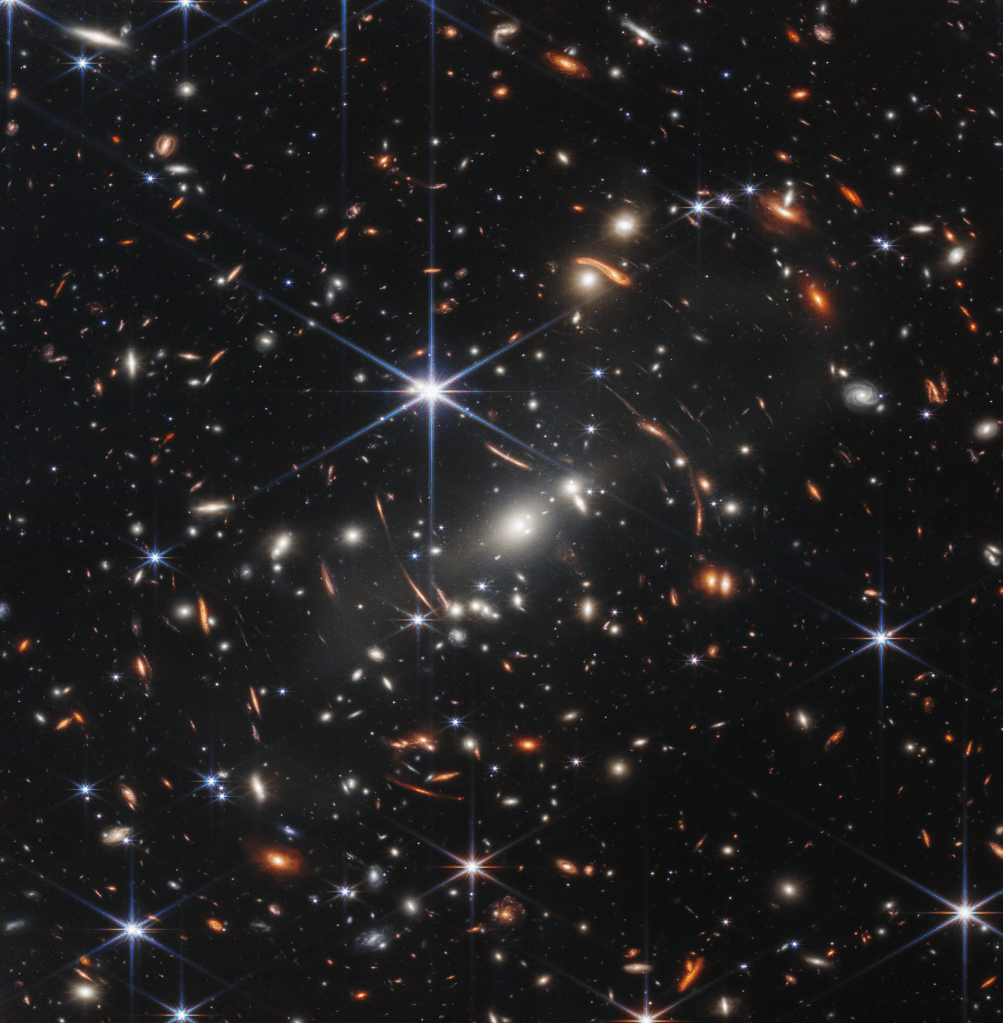
So, this week’s breaking news from NASA Goddard of the reveal of the first five images taken by the James Webb Space Telescope out in orbit of the Earth was a profoundly beautiful moment for me. Webb captured our first images of galaxies as they existed a mere 4.6 billion years ago. Those same galaxies could look very different today, yet their light has only just reached us across the vastness of Space. That image, Webb’s First Deep Field, was released on Monday evening by the White House after NASA offered a preview of the five images to the President and Vice President. Lucky them!

Webb’s First Deep Field, NASA JWST, Public Domain.

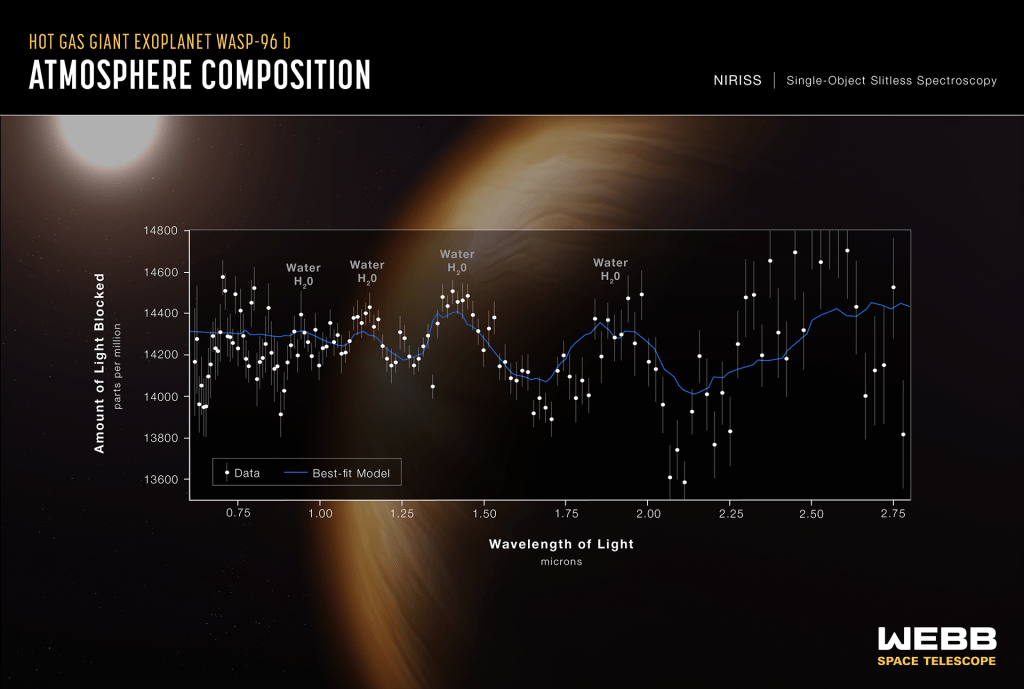
As profound as that deep field is, I was struck more by the potential offered by another one of Webb’s images, the second image released to the public which shows the atmospheric composition of an exoplanet called WASP-96 b, which is about 1,120 light-years from Earth. WASP-96b’s atmosphere confirms the presence of water on that planet’s surface, a sign of potential life on that planet’s surface. This is the part of Webb’s mission I’m the most excited about, its potential to help us in our endeavors to find out whether we’re alone in this vast Universe of ours, or if we’re one planet among many populated and teeming with intelligent, thinking, and innovative people.

I can’t help but mention the picture, which is probably my favorite on an aesthetic level, that being the image of the “Cosmic Cliffs” of the Carina Nebula, a stellar nursery located roughly 7,600 light-years distant from Earth. The vibrant colors of the Carina Nebula even unseated Thomas Wilmer Dewing’s 1904 painting The Lute from the coveted role of my computer’s background, at least for now.  A closer nebula to Earth, the Southern Ring Nebula, was also photographed. This time though instead of a stellar nursery this nebula surrounds a dying star in its cloudy sphere. Even more profound are the quintet of galaxies captured by Webb from some 290 million light-years away, old enough that its light was contemporaneous with the end of the Carboniferous Period and beginning of the Permian Period here on Earth, well before even the evolution of the first dinosaurs.

On a side note: the Carboniferous room in the Evolving Planet exhibit at the Field Museum remains my favorite room in that collection; I’ve always loved those trees.

The images released by the Webb team and broadcast Tuesday from NASA Goddard represent 25 years of combined efforts from a whole host of scientists and engineers at space agencies around the globe working together to achieve a common goal. By expanding our knowledge of the universe around us we are also demonstrating to ourselves and our descendants that it is possible to work across national divides, to achieve common goals. When we do pull ourselves out of our current string of interrelated crises and societal problems it will be because we’ve finally decided to work together as one humanity for the betterment of all of us.

We have an opportunity now to gaze into the past, to see light coming from stars that may well have died long ago. Yet with their light memories of their existence remains. With that light we’re reminded not only of what once was both out there and here on our home planet, but also of what could be in our future, of a time when maybe we will explore further afield, spread out from our home not as conquerors but as explorers. Stay curious.

Politics and the Citizen

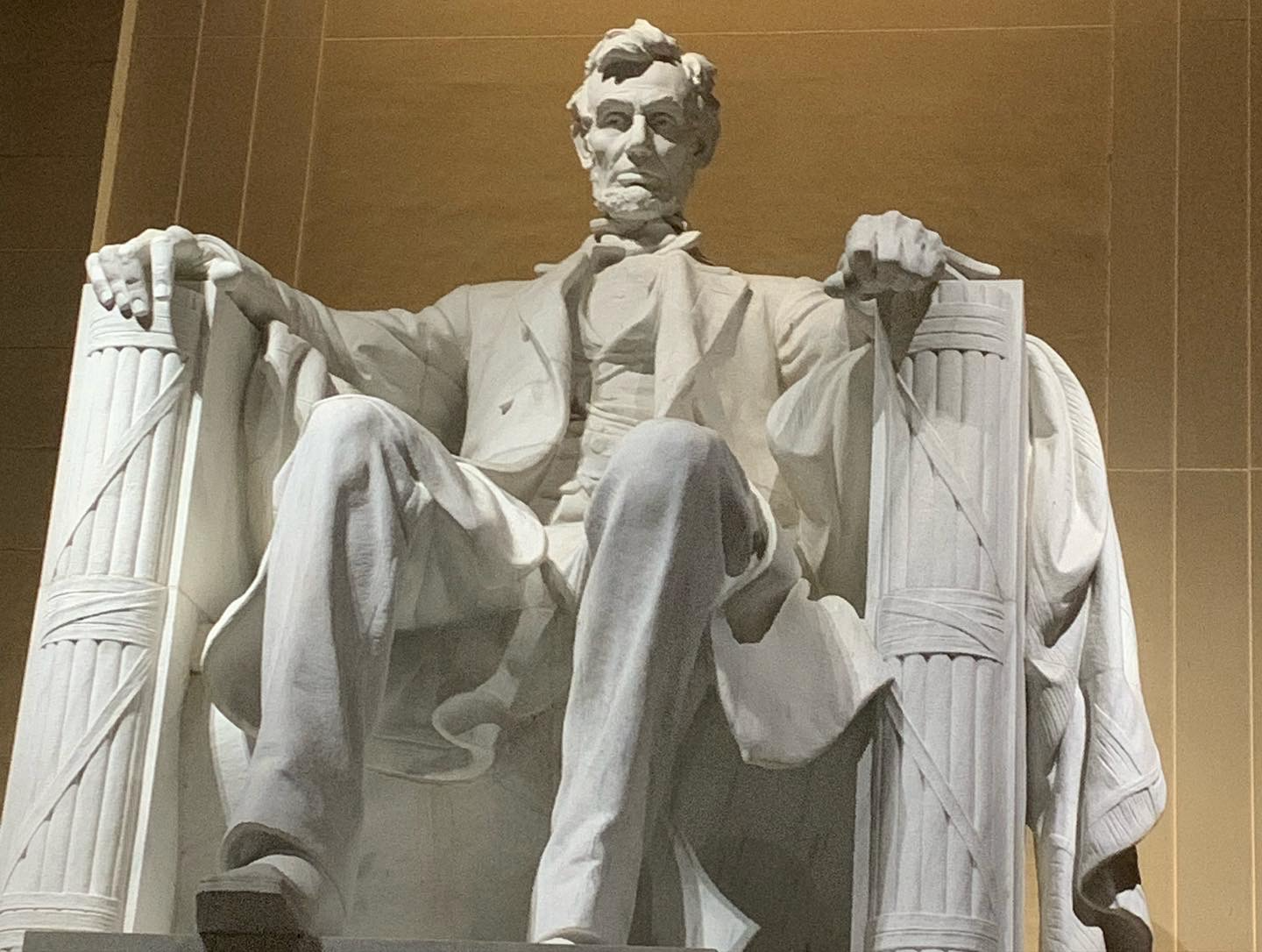
Mr. Lincoln

Politics and the Citizen Wednesday Blog by Seán Thomas Kane

This week, I want to speak to you about the meaning of the word "political."

Words are at the center of all our political debates. They are at the center of our lives, the core of our existence. We would not exist as we do without words. Words have tremendous power to do good, to inspire people to achieve wonderous things, to rise above what they thought possible and make a better future. Yet words are also dangerous when poorly used. They can have the effect of destroying trust between people; they are capable of breaking up families and communities. Without common words we cannot have a common society.

I was struck last week reading in the New York Times how the protests following the recent Supreme Court ruling of Dobbs v. Jackson Women’s Health Organization were rephrased by the far right as an “Insurrection.” That is a word that has been far more justly levied at their own faction, whose actions on January 6th last year proved their lack of faith in a democratic society. Other words and ideas have been poisoned by the same fearmongers from Critical Race Theory to the Green New Deal. These are ideas and proposals that if considered in their true meaning have merit, yet any mention of them in the political square anymore will be met with the screaming banshees in the wings whose greatest weapon and sole power is the volume of their voices.

One such word which they have demonized by their own behavior, perhaps the most critical word to our democracy, is politics. It is taboo now to be political in a crowd when you don’t know everyone else’s own political views. A professional soccer team wearing practice shirts recognizing racial inequality is dangerously “politicizing” an otherwise family event. It’s curious to me because their own use of the word “political” has no bearing on the actual meaning of the word, nor on its origins.

The word political simply refers to the idea of the city, the polis in Greek. To be political is to be a citizen, an active member of society. To be political is to participate in government through voting, running for public office, and serving the people in the public sector. To be called political is one of the greatest honors anyone can bestow, for it means you care about something greater than yourself, you care about your community and want to contribute to its future.

In the ancient and medieval context, a citizen was far more particular of a person than today. The idea of universal suffrage is a modern thing, something that has been fought for down the generations and even still is being fought over today. Today though I believe the best way to describe a citizen is simply a person who wants to contribute to their own community. They need not have the papers conferring official legal citizenship in their country of residence, for even without those individual people can make a difference to their communities.

This is intolerable to those who demonize the word political. Why else would they make such an effort to poison an entire population against such an idea that at its core is meant to better their lives? It is intolerable to them because they know their views, as extreme as they are, are in the minority among their fellow citizens. There are generations of Americans who have come to recognize the benefits of democracy, and who have pushed us to improve upon those benefits already existing, that they might be extended to more and more people until eventually some day we may have true political equity. 

Yet now, as has happened in every generation since the founding of the first English colonies on the East Coast 415 years ago the powerful voice of a small few who see democracy as a threat to their own interests has influenced the course of affairs in this country to the great detriment not only of we the American people but of humanity at large. I’m speaking of course of the West Virginia v. Environmental Protection Agency ruling made on the last day of the recent session of the Supreme Court. In that ruling the conservative majority declared that regulation should only be conducted through legislation. This means the President and any federal agency acting under the authority of the Presidency, even if acting in the best interests of the people they are sworn under oath to serve, have less ability to create broad regulations that are not expressly allowed under Acts of Congress.

The voices of a few who feel greater concern for their profits than they do for the future health of humanity and our home planet spoke up and were heard over the cries of the rest of us. I could say let’s trust in Congress to do their part now and legislate new regulations that will replace what was stripped from those executive orders revoked by the Court but those in Congress with the power to save us are also listening to that swansong of the soloists rather than the Dies Irae being belted by we, the chorus.

Our politics are in many ways broken by our extreme partisanship. It is this word, partisan that ought to be used when the far right uses the word political as a curse. We retreat into our slogans but don’t actually talk to one another. One side hears “Defund the Police” and the other “Law and Order” and neither leaves the table any better off. Rather, both parties find themselves far less willing to talk to the other, to find things in common with the other, to learn from each other. Once again, those fissures that threatened to make two countries out of one in that messy divorce of 160 years ago that left 6% of the population dead are beginning to show. 

Do we really want to go down that path again? Do we really want to fall into such political disfunction that we cease to see each other as fellow citizens and instead as enemies? We have let the battle cry change from “E Pluribus Unum, Out of Many One” to “No Compromise”, leading us to rally ’round our own partisan flags to the detriment of our common threads. I want to cry out in pain every time I see the American flag used as a symbol by those who want to be exclusionary, by those who would see all it has stood for over these past centuries be replaced by the worst of our nature: by our greed.

2016 Super Tuesday Democrats Abroad Primary

As citizens of a democracy, we have a right to know, to understand, and to discuss these questions of who we were, who we are, and who we want to be. And, as citizens of a democracy, we do have the right to dissolve our democracy, to end the experiment that’s been running for so long. I recognize that our current federal system isn’t going to last forever, nothing does, yet I remain hopeful that when it does eventually take its leave that that system will be succeeded by something better, crafted by the wisdom and love of another set of founders inspired by the precedents set by the first, who will craft a new system with all the best traits of our own yet reimagined in such a way as to overcome the faults in our own today. Until then, we citizens are caretakers of this democracy. It’s a fragile gift passed down to us from our ancestors, which we get to treasure and improve as best we can so that when we pass it on to our descendants it will be in better shape than how we found it. Let’s do our duty.