Monthly Archives: February 2023

Ash Wednesday

Today is Ash Wednesday, the start of Lent. Some thoughts about that. Click here to support the Wednesday Blog: https://www.patreon.com/sthosdkane

In past years when I’ve written columns and devotionals around this time of year recognizing the beginning of Lent, they’ve been on some levels joking (I once referred to this season as the past tense of to lend) while on others they’ve been overly serious and solemn. There’s certainly room for both angles. This year, I feel a little less strongly moved by the whole experience, yes, I know we’re approaching a time of great meaning and purpose, yet in my mind that’s overwhelmed by the onset of what hopefully will be better Spring weather this week. 

As I’ve gotten older, I’ve found that the passing of the seasons impresses me differently than it used to. When I was first learning the names of the months and seasons in school, I noticed the changes quite profoundly. The first of each month was a moment of regard. Today though, month by month passes as one after another in a parade ever blending with its compatriots into one great cyclical mass of the year. I notice today more so the changing of the weather than I do the months or even the seasons. I notice the waves of warm air coming out of the southwest fighting against the cold air pushing down from the northwest. I notice now how each passing rain and snow leads either towards the warmth of summer or the cold of winter. For me the year is far more a day-by-day affair now than anything else.

So, where does that leave the liturgical year, the cycles around which my faith orbits? Honestly, I’m not sure. Perhaps because I had the opportunity to attend Catholic schools for much of my life the Catholic feast days and holidays stood out to me more at one time than they do now. The highest holy days, the Easter Triduum, Christmas, and of course the Irish feast days of Saints Patrick, Brigid, and Columcille stand out the most for me today, days when I can imagine my present moment lining up neatly with memories of my past and of the generations who came before me.

If Ash Wednesday has any potency for me today it’s in its reminder that we’re all mortal, and yes, at some point our lives are going to end. It’s a reminder of our limits, in body if possibly not in mind. I’ll go to Mass and get the ashes on my forehead as I’ve done for as long as I can remember, and yes, I’ll do the Catholic fasting (one large meal with two small meals, no meat), and I’ll likely be a bit grumpy about the whole affair. Ash Wednesday is a reminder of our lives on this Pale Blue Dot, to blend Carl Sagan’s humanism with Catholic theology. We’re all a part of this our home planet, forever tied to it, no matter how far we and our descendants might travel from its surface.A holy day like Ash Wednesday is a reminder of our worldliness, and how that world which we cherish and which we have helped build is as fragile, as mortal as we are. The ashes of the palm branches from last year’s Palm Sunday are from this same world that we are. It’s an honesty that can’t be beat or diluted, we are who we are. That’s what I’ve got this week.
Author vs Writer

Today, on Chiefs Parade Day, I thought it'd be interesting to consider the distinctions between an author and a writer. Click here to support the Wednesday Blog: https://www.patreon.com/sthosdkane

Recently I noticed when someone referred to a guy as “the author of x”, in my mind I thought about what it means that they were called “the author” and not “the writer.” This whole question came to me considering that in Irish, I’d introduce myself with “Is staraí agus scríbhneoir mé,” or rather “I’m a historian and a writer,” and the same goes in French « Je suis historien et écrivain, » yet in neither context would I introduce myself at a party as “I’m an author.” Both words have their origins and similar yet separate meanings in every language, and that distinction is worth noting.

Author comes to us from the Latin auctor via Old French autor, it’s a cognate of the modern French auteur. The Irish version of this, údar also comes from the Latin auctor, demonstrating that the core idea of an author may well have spread northwards with the Romans. On the other hand, writer is an inherently English word, a writer is most fundamentally someone who writes. I like words that make their function this clear, words that are built off of the verb that they accomplish. When I’ve thought about trying to emulate Tolkien’s work it’s been less to create my own massive legendarium of fantasy literature and more to devise new ways of understanding the world through constructed languages like his own Quenya and Sindarin. In those thought experiments one of the key principles, I’ve wanted to address is crafting a language where there is a relatively small vocabulary because every word is a stem upon which one adds grammatical endings to make it a noun, adjective, verb, or adverb, or to include prepositional elements to it. This is something you see in older languages like Latin with its declensions and conjugations or in Finnish with its 14 noun cases. So, these simplest of English words like writer that demonstrate what they do as efficiently as possible are among my favorites.

Author too in its Latin origins was a word like writer. An auctor is someone who increases or nourishes their object (augeō in Latin). In classical literature the story comes from the muses, In the Loeb translation Ovid began his Metamorphoses acknowledging “my mind is bent to tell” the stories that will follow, for “ye gods, for you yourselves have wrought the changes, breathe on these my undertakings, and bring down my song in unbroken strains from the world’s very beginning even unto the present time.” (Met. 1.1.1–4) Shakespeare picked up on this in his reading and began Henry V with the chorus uttering the line 

            “O, for a muse of fire that would ascend

            The brightest heaven of invention!” (Henry V, 1.0.1–2.)

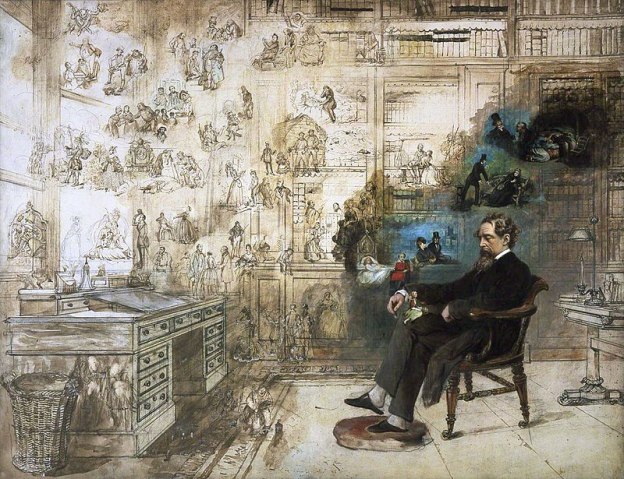
In my mind an author is both someone who has received inspiration for their work and an active participant in the creation of those works. There is a wonderful print of Dickens dreaming at his desk with all his myriad of characters he nourished into existence in his stories floating about him. I sometimes wish that this is the way that I’ll be remembered, as a storyteller who crafted so many lives that while they only exist in my writings therein is encapsulated a little world, an imagined reality all its own. In this act of creation, I am an author, but I am also a writer, for it’s my job to translate these worlds from my imagination onto paper where others can experience these characters’ lives.

A writer is a craftsman busy in their workshop devising new ways of getting information across. They could be writing serious factual information, reports of the events of the modern world, or setting the scene of stories more fantastical than anyone before could’ve imagined. I think of Dr. Franklin in his printing shop as the archetypal writer his sleeves rolled up hard at work, a stark contrast to the image of Dickens asleep in his chair dreaming of his many creations. Yet we rarely have authors without writers anymore, they are of course more often than not the same person, still in older times there were stories that existed without the written word. The Gaelic file tradition which I hope my own stories can be worthy heirs to is one such form of authorship beyond the boundaries of the written word.

So perhaps I don’t like to introduce myself as an author because of the world-building implications of authorship. Day-to-day I am a writer, a craftsman of words, scrawled onto paper, typed into a computer, and printed onto the page. I am an author of some stories, there are characters you’ve met here on the Wednesday Blog like Dr. Noël Felix and Captain Amelia Daedalus from a few weeks ago. I hope to get back into writing more fiction again in the coming months and years, to telling those kinds of stories. Yet perhaps because my authorship is so much more personal than my craftsmanship as a writer, I am left preferring to keep my creations closer to my chest and instead hold my craft out for all the world to see.


“Casablanca” at 80

Today, I'm talking about the classic 1942 film Casablanca with my good friend Alex Brisson. Click here to support the Wednesday Blog: https://www.patreon.com/sthosdkane Today's episode features contributions from Alex Brisson (https://www.alexbrisson.com) and Michael Ashcraft (https://soundslikeashcraft.com). Thanks to both of them for their help making this week's episode!

Listen to this week’s podcast for a conversation about Casablanca with Alex Brisson


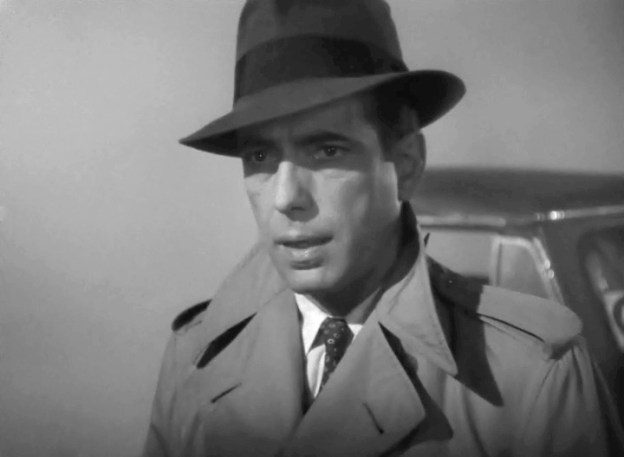
Few films have held our attention for as long as Casablanca, a romantic drama filmed at the height of the Second World War telling a story yearning for America to remember it’s passion and enter the fray against the forces of evil. The story, now well known, is about an American café owner, Rick Blaine, in the Moroccan city of Casablanca, then a French protectorate under the control of the Vichy government. Into his purely neutral life walks an old love interest, Ilsa Lund with her husband the resistance leader Victor Laszlo.

Everything that could be said about Casablanca has likely already been said. So, what I’m going to say here isn’t anything new, there really isn’t any intervention that I can make into this particular discussion as my fellow academics would insist every bit of writing make. So, I’m going to point out a few things that I thought of watching the film, subtextual themes that I hadn’t noticed the first time I watched it a few years ago. That time, I paired Casablanca with a delightful French film titled Que la lumière soit ! (Let There Be Light!) starring Hélène de Fougerolles. They were an odd pairing I’ll admit.

Casablanca is set in December 1941 on the eve of the Japanese attack on Pearl Harbor and America’s entry into the war. It’s the last hour in the limelight of an isolationist America, an America that still around but has been forced into the shadows by our country’s leading role in the postwar world. I nevertheless found it interesting that the opening credits placed Casablanca the city less as a Mediterranean, or rather Mediterranean-adjacent port, but rather as a city on the map behind the opening titles on the far northwestern corner of Africa. Casablanca is a gateway for those seeking to leave Europe either to the west across the water to America or south across the Sahara to the remaining Free French and British colonies in Africa. This makes it clear that Casablanca is distinct from Europe, it’s exotic when compared to the port of origin and the destination of the travelers waylaid in Casablanca.

Amid all of them one such traveler who’s made a slightly more stable living than most, accepting the circumstances of his complicated situation in isolation amid many others of the displaced appears Rick Blaine, who’s found stability in his café after losing stability in his life at the German invasion of Paris and Ilsa’s disappearance all on the same day. The film’s central conflict is Rick’s internal struggle between the isolationism he’s adopted since Ilsa left him and he ended up a saloon keeper in Casablanca and the passion he once felt for Ilsa in the last summer of the age of optimism in 1939. Now that Ilsa appears with Laszlo, the embodiment of the resistance to Nazi rule in Europe, Rick is confronted by his lost passion for that cause. Ilsa is a reminder of the passion for liberty he once felt that left him on the run from the Nazis in Paris where they met in the first place.As with the first time that I watched this film in 2021, I now find myself pondering the message of isolation vs. passionately standing up for the causes one believes in. I know people who are leaving this country to escape all the troubles we inflict on ourselves. I’ve thought of it myself, but there’s that stubborn passion in me that won’t give up on America. Rick’s isolationism shows us how we can let bullies march into our lives and dictate orders to us if we let them if we try to simply survive. That’s a fair way to live, I dealt with bullies in school and life by not reacting to them. But at some point, a person can only take so much pushing around, and I worry that today in America we’ve forgotten that fact. Rick’s turning point comes when the Nazi officers bully their way into controlling the voice of his café, Sam’s piano, to play a march of their own, Die Wacht am Rheinwhich was written in response to French efforts to annex the western banks of the Rhine in the 1840s, a moment a century before when France was the great power and Germany still divided among its princes. Laszlo tells the band to respond to this insult by playing La Marseillaise, not only the French anthem but an anthem for the struggle of the people against oppression everywhere. At that point, Rick is no longer an isolationist, America is no longer on the sidelines, but is tacitly helping the Allies, readying to cross the Atlantic in the words of French philosopher Bernard-Henri Lévy like an Aeneas returning to the aid of old Troy.


St. Brigid’s Day

Among the saints are the Irish Trinity, Saints Patrick, Colmcille, and Brigid. These three were among the first Christian leaders and holy figures in the history of the Church in Ireland and remain centrally prominent today. This Wednesday, the first day of February, was once the ancient feast of Imbolc, which celebrated an ancient harvest goddess known as Brigid, whose patronage included wisdom, poetry, and healing. Brigid’s springs and wells remain sacred places today for how the deity was incorporated into Irish Christianity through the person of Saint Brigid, perhaps a real holy woman named for the goddess who converted in those first generations after St. Patrick’s arrival, or perhaps a reinterpretation of the goddess herself into a saint.

Either way, I don’t honestly mind. St. Brigid represents for me the continuation of the oldest of rituals, the most ancient of memories, into the modern day. Her feast marks the beginning of Spring according to tradition, a time of year which I do yearn for with how cold it’s been here in Kansas City of late. My own faith is open to the reality that it has a variety of sources, both biblical and traditional. In my lifetime I’ve heard here and there of efforts either by the Vatican or by other Catholic authorities to soften the devotions of certain saints deemed mythic, like St. Brigid, St. Barbara, or St. Christopher. I get where they’re coming from, after all who’s to really say if these people ever lived? I for one can’t prove it. Yet I disagree with this assessment because there are truths about life and nature we can learn from saints like Brigid.

The one catch about honoring a saint like Brigid who is so tied to Ireland and the environment of that island country is that some of these traditions don’t entirely make sense here in America. To say that Spring begins at the start of February is laughable here in the Midwest. The forecast today calls for highs of 36ºF (2ºC) and lows of 16ºF (-9ºC), far from Springtime temperatures that would be expected for the first day of Spring. True, we have had some nice days of late, days when I’m comfortable walking around without a hat or gloves, but they’re becoming fewer as January ends and February begins. I hope that February will see warmer temperatures return, heading into what might be a lovely March. But enough of the weather, to my point I find it hard to follow some of these traditional understandings of saints from back in Europe because the world of the Americas is different enough to make the experience of trying to say “Spring’s begun” when it’s snowing laughable.

Perhaps a better way to think of St. Brigid’s Day as an Irish American is to consider it as one of the last winter holidays which began with Advent in December. These winter festivities are marked by their sense of mystery, earned through the long dark nights this time of year and all the unknown things that can go on when the Sun remains down for longer hours and so much of our native wildlife sleeps in their burrows. St. Brigid’s Day means the winter is coming to its climax, and soon will fade into the first whisperings of Spring with its rains and lush greenery. If St. Brigid’s Day is the beginning of the end of Winter, then St. Patrick’s Day is the beginning of the height of Spring, a time when here in Kansas City sure it could snow, but it could also be warm and comfortable for parades under the Spring Sun. So, to all my listeners who feel like commemorating the story of St. Brigid, Lá Fhéile Bhrigid shóna daoibh! Happy St. Brigid’s Day!