Monthly Archives: April 2023

Springtime

This week I want to share a few words about the beauty of Spring. Click here to support the Wednesday Blog: https://www.patreon.com/sthosdkane

I’m so glad to have enjoyed this April, to have had some truly beautiful days in short sleeves out under the blue skies listening to the birdsong that rings around my neighborhood. Throughout my life one of the most commonly asked questions has been “what’s your favorite season?” For the longest time I’d say Winter for the mystery of those long, dark, cold nights, for the appearance of the constellations like Orion that I remembered seeing the most in my childhood, and for the exuberant joy of Christmas and New Year’s. Yet today, I don’t think I have a favorite anymore. There are things I like about all four seasons, from the radiant red leaves of Fall to the warm days and nights of Summer. Spring is perhaps the most beautiful of the four seasons for how much joy it radiates. Spring sees the rebirth of the gardens and trees here in Kansas City, it sees our wild neighbors––the birds and beasts alike––returning from their wintering to a new year of life here in the Fountain City.

I find myself drawn to less dramatic things today, less of the big lightning storms that race across the prairies in Summer, and more to the softer, gentler, more subtle breezes of Spring. Sure, it does rain a lot here in the Springtime, as the winter snows begin to warm up and turn to rain. Spring is a time when we have the rains we need throughout the Summer, the water that keeps life possible here on the edge of the Great Plains, in a region dry enough that really it shouldn’t support a city of 2 million.

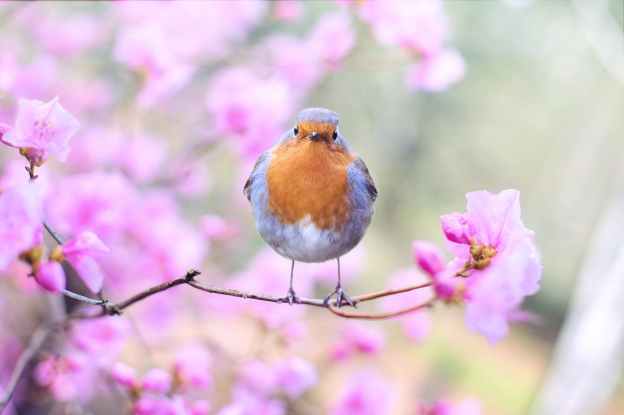
Yesterday, after finishing writing my lecture notes for my upcoming Summer class titled The Columbian Exchange in the First Age of Exploration, 1500–1700, I took a break from my desk and went outside into our backyard to get a better listen to the birds that were singing their hearts out on our back fence and in our fountain. There’s one blackbird who spent most of the weekend playing in the bubbling water that burst from the trunk of that elephant-shaped fountain. If a bird could laugh, then that little blackbird was giggling with joy the whole time.

My fascination with Spring began seven years ago in April 2016 when after a long winter I found myself vacationing in France with my parents. We spent our first week together staying in a guest house on the shores of Lake Annecy in the French Alps, the clearest glacial lake I’ve ever seen, enjoying the stillness of the place and the immense natural wonder that the lake, the forests, and surrounding mountains held. Then, as that week came to an end, we boarded a train in Geneva and headed northwest to Paris, savoring a week together there in the French capital before I returned to London, where I was then living, and my parents home to Kansas City. I remember a great deal about that week in Paris, in fact I wrote an entire chapter in my book Travels in Time Across Europe all about that week. 

Yet what I remember most about that city is the light, the brilliant delicacy of the April sunshine in Paris will always stay with me. It made the impressionist paintings that I grew up loving, the works of Monet, make more sense to me having been there in that moment. I remember one day in particular when we traveled out to Meudon to visit Renoir’s home and studio where the grand boulevards of the city give way to a mix of suburbia and creeping remnants of the countryside. I learned to appreciate Renoir’s sculptures far better that day, and to understand more of what makes Spring such a beautiful season in our lives. Vivaldi captured that emotion in his Four Seasons, Johann Strauss Jr. evoked the joy of the Flowers of Spring in his Frühlingsstimmen Walzerand Ella Fitzgerald embodied it in her own famous song April in Paris. I for one will let that little blackbird have the last word.

To hear the blackbird, click on the podcast player at the top.
Ab urbe condita

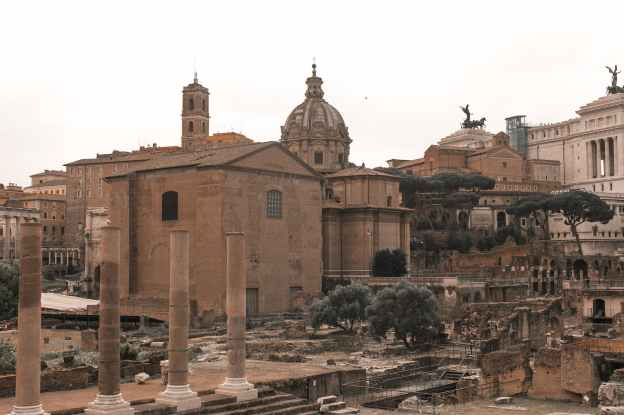
This coming Friday will mark the 2,776th anniversary of the traditional date for the founding of the City of Rome. Click here to support the Wednesday Blog: https://www.patreon.com/sthosdkane

I find it interesting as an adult that my first understanding of my own religion, explained to me by my Mom when I was little, was that “we are Roman Catholics.” Even at that point, when I must’ve been no more than five years old, I knew what Rome was, I can remember my thoughts from that moment as clear as day: I pictured in my mind a map of the Italian peninsula descending from the Alps down into the Mediterranean. Whether that map was my memory of the globe in my grandparents’ home next to their collection of the 1979 edition of the World Book Encyclopedia, or of some other map I had seen I can’t say for sure. Rome, with all its antiquity, has had a hold over my imagination just as it has over the collective imaginations of those of us in the European and American orbits since its fall.

Several years later, after we’d moved to Kansas City, and I continued my schooling at St. Patrick’s in Kansas City, Kansas, I checked a book on Ancient Rome out of the school library. As I remember it, it was one of the few history books in color, most of them had been donated when the school first opened in 1949 and were by modern standards rather outdated. Still, I had this book in my bag that had a wonderful colored picture of the greatest extent of the Roman Empire in the reign of Hadrian during the 2nd century CE. I had looked over it several times already before this particular memory took place, but when one afternoon I was denied entry into an after school club, I think a geography bee club perhaps, I found myself sitting on the bench in front of the school’s office, reading that book.

My ancestors, the Irish Gaels, were never conquered by Rome. There were likely Roman merchants visiting the Leinster coast during the imperial period, after all the western boundaries of the Roman Empire were across the Irish Sea in Wales, but Roman influence didn’t fully arrive until after the Western Roman Empire had already collapsed in the form of missionaries like St. Patrick who introduced Christianity, the Latin alphabet & language, and fostered a new sense of European connectivity for my people that has never left. For me conversations of heritage are always complicated. Yes, I am an Irish American with roots going deep into that island’s past beyond what’s considered historical, but so much of the culture I’ve lived in and embraced comes from Europe’s classical past: from Greece & Rome, that I feel a strong bond if not in blood, then in civilization to those continental cultures.

When I teach Western Civilization or European History I, or whatever you want to call the intro class that covers European history from Bronze Age Greece to the Reformation, I make a point of trying to define civilization as being inherently tied to the concept of the city. Mapping civilizations is like charting the stars in the sky, with each city glowing bright like those lights in the heavens, at the heart of their own civilizations. In antiquity this ideal makes sense, for the city-state was the most common type of polity. Rome was a city-state governed by its own balance between an aristocratic Senate and an Assembly representing the rest of the People that in turn ruled over an ever growing empire of subjected peoples until at last it became too much for the standing political order in Rome to control and 150 years of civil wars lead to a Principate, rule by the Princeps, the First Citizen, in this case Augustus Caesar and his heirs and successors who we today know as the Emperors.

Today, I look at Roman history and see several ideals that every generation since its conception has espoused. On the one hand there’s the model of the Caesar as the best sort of leader. The Caesars who ruled Rome from Augustus’s elevation in 31 BCE to Constantine XI Paleologos’s death at the Fall of Constantinople in 1453 CE have their heirs and imitators in all the Kaisers, Tsars, and Emperors to rule in Europe and its erstwhile American colonies since, as well as in kings like Louis XIV, le roi soleil, who like Augustus fashioned himself the Sun at the center of all his domain. Yet on the other hand I see the republican ideal of citizen government espoused before the Principate, lauded by men like Cicero and the Gracchi yet never fully realized by anyone then or since. 

I would rather emulate that republican ideal of citizenship, refashioned in a modern sense with the blending of republicanism with democracy. The founders of the United States saw in their new republic a revival of the best of Rome, emulating their ancient heroes in law, government, and architecture. One needs only wander around the National Mall to find all the classical buildings one’s heart could ever desire to see how our new Rome on the banks of the Potomac has come to be. Yet in all honesty, as much as Washington fits this idealized model of a republican Rome reborn, with even the great headquarters of our Department of Defense across the Potomac beyond the confines of the capital in the Pentagon, not unlike Rome’s ancient Campus Martius, experience has taught me that the greatest modern inheritor of the symbols of the Roman Republic in its art & architecture can be found in Paris, a city whose grand boulevards and monumental architecture built during and after the Revolution of 1789 are alive with the symbols and spirit of Roman republicanism. This is in part thanks to one of the great Romanophiles of the last 250 years, Napoléon Bonaparte, whose reign as First Consul and later Emperor of the French sought to create a new Rome in his own day, albeit in the transitional model of Julius Caesar whose reign at least nominally sought to preserve the Republic yet established the foundations for the Empire that Augustus, his adoptive son, created.Today the meaning of the republic has changed so dramatically that I doubt Cicero or even the Gracchi would approve; and as much as I look up to so many of those old Roman republicans as people who I appreciate and enjoy reading, I firmly believe we’re better off without all the trappings of what was inherently a limited and oligarchical Roman Republic. I would rather live in a modern democratic republic, one where social welfare, tradition, and the markets were kept in balance. So, on this the 2,776th anniversary of the founding of the City of Rome, I’m worried to see the reactionaries among us pulling us backward toward that oligarchy that initially established our own Republic here on the far side of the Atlantic almost 240 years ago. The Roman Republic fell because its leaders misdiagnosed the sickness and killed the patient, ignoring the needs of the people for their own power & wealth. Rome continues to provide us lessons today. We should listen to them.

On Perspective

Some words about how changing perspective changes what one sees. Click here to support the Wednesday Blog: https://www.patreon.com/sthosdkane

A part of being a historian is learning how to reach into the sources and find the perspectives of the people you’re researching. In my case that’s a French explorer and writer named André Thevet (1516–1590), who longtime readers and listeners to this publication will now be familiar with. The best way to learn about Thevet’s perspective is to read his books, and in my case to translate them as well. It’s a humbling experience to get to know this man, or at least to get to know the public persona he crafted in his published works over a 45 year career.

These are lessons I’ve found important to carry over into my daily life. I’m more hesitant to get angry at someone who cuts me off driving, or to get annoyed at the crying baby in a café or restaurant because I don’t know what’s bothering the baby or how their parents’ day might be going. I do remember my own phase in life when my initial reaction to most things was to cry, as an adult I figure that’s because I was scared of the unknown, scared of being away from familiar places, people, and things. I hope I remember that when the day comes that I’m lucky enough to be a parent, should that day come indeed.

I’ve learned to adapt my speech to fit the people I’m talking to, using the official wording of a company or that someone in a professional capacity used to make sure we’re talking on the same wavelength. One instance of this that annoyed me to no end was at my local Panera, since closed, where the staff had a different way of referring to sizes of soups and mac & cheese than what was on the menu. Whereas it was written above their heads that portions were served as half or whole they instead would only refer to them as small or large, and often wouldn’t seem to understand what I wanted when I used the printed terminology from Panera. I learned after a few awkward encounters, though admittedly Panera’s mac & cheese has always been hit or miss, somedays it’s delicious with a creamy hot melted cheese, other times the cheese is clumpy and more a lukewarm solid than a liquid.

For a while I’ve been thinking about the contemporary efforts underway to find a gender neutral 3rd person pronoun to use in English. The choice of they makes a great deal of sense considering the history of this language. For each person (1st, 2nd, and 3rd) we have two pronouns, singular and plural, except of course for the 2nd person which is you all around. For the 3rd person options we have it and they, and while they is a clunky solution to the conundrum of gender neutrality in language, they is still a better fit than itIt bears an air of inhumanity; it’s what we use to refer to things that are less-than human: animals, plants, and inanimate objects. The division between something referred to as it rather than he, she, or they is murky. I often became quite annoyed with people who referred to my dog Noel as it rather than she, after all she had a gregarious personality. She expressed emotions, love, joy, happiness, fear, sadness, boredom. It was clear to me having lived with her for over a decade that she knew how to think for herself, how to make her desires known to those of us who could understand her. It reflects English’s Germanic roots more than anything else. I tend to think of the English it in the context of its closest German cognate, the pronoun es, as well as in the German distinction between the action of humans eating essen and the action of animals eating fressen

We’ve preserved this distinction in our language because we find it useful to define boundaries between different types of subjects and objects. This distinction demonstrates our priorities toward one set from another, toward the human over what older schools of natural history referred to as lesser forms of life. I for one find that to be an outdated way of thinking for it ignores what we have to learn from the great kaleidoscope of life in all its radiance and color. I became a better person because of the years I spent living with Noel, playing with her, taking her for walks, comforting her when she needed it, and letting her comfort me when I was feeling down.

If we have one great flaw as humans, it’s our hubris. We let ourselves believe that we know all there is out there to know, that we have gotten to a point in our evolution as a species where we’ve developed tools that can make sense of anything and everything the Universe can throw at us. Life has proven to me that that kind of thinking is flawed on so many levels. We know a lot more about what’s out there around us now than we did in the past, but the most wonderous part of being alive is knowing that we don’t know everything yet! I love that fact for how simple it is, and because it means there’s more for us to explore, that there’s still a horizon to look over.

I think that’s why I’m drawn to people like Thevet, like Noel. I like explorers because in my own way I’m an explorer too. I may not always take off for far distant countries or alien worlds, but I do get out of bed every morning not knowing what the day ahead is going to bring. And no matter if it’s a good day or a bad one, I know eventually it’ll make a good story, and that I’ll learn from it so I can wake up the next day better prepared for life.

Holy Week

It's Holy Week in Western Christianity (Catholicism and Protestantism), so some words about that. Click here to support the Wednesday Blog: https://www.patreon.com/sthosdkane

Some years I find Lent and the arrival of Easter just kind of happens without much ceremony or pomp. In our culture Christmas is the more notable holiday, the one that we travel for and take time off work for. Christmas is what defines our academic calendar, our Winter Break is essentially just the time we get off for Christmas and New Year’s. Yet theologically Easter is the more important of the two holidays.

This past Sunday during the Palm Sunday Mass at my local parish, I found myself deeply moved by the traditional recitation of the Passion Story from St. Matthew’s Gospel. From where I sat in the back row of the choir I could feel the trio of voices, two of our parishioners and our pastor, echoing off the walls of the church and moving about the packed congregation. I’ve been preparing for Holy Week a bit longer than usual this year because I’ve got a small part in the Masses on Palm Sunday, Holy Thursday, and during the Easter Vigil with the choir, so perhaps that contributed as well. Still, at a time when I’m unsure about my own faith in a way that would seem strange to my younger self a decade ago, Holy Week this year really does have a great deal of deeper meaning to me than I expected five weeks ago.

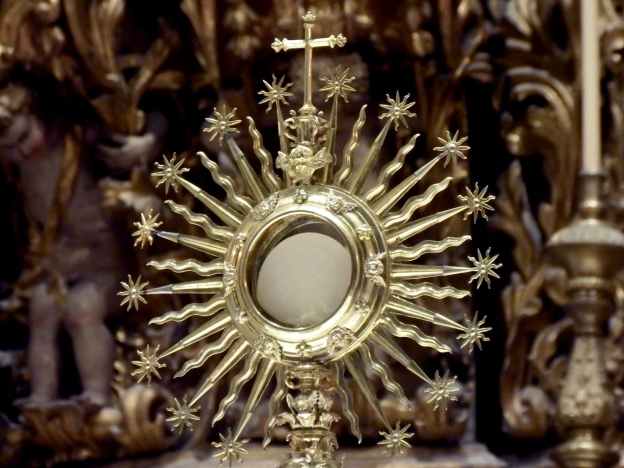
This week culminates in the Easter Triduum, three days of interconnected liturgies beginning on Holy Thursday with the commemoration of Jesus’s Last Supper, continuing on Good Friday with the Passion Service, and concluding at sunset on Holy Saturday with the Easter Vigil Mass. I’ve long found the Holy Thursday Mass to be my favorite, not just of the Triduum but of the entire year. For me, the mystery of the Eucharist is perhaps the most inspiring and compelling part of my faith that has continued regardless of the doubt and skepticism with which I’ve approached so many other aspects of reconsidering what I believe. One of the greatest lessons I ever heard in all my now 27 years of schooling was from Dr. Daniel Stramara, Professor of Theology at Rockhurst University, who explained that in the old Nicene Church of the Roman Empire, while in the Latin Rite the old Roman legalistic tradition persists in seeking answers to every question under the Sun, in the Greek Rite the prevailing opinion was open to mystery, to not having all the answers. I know I won’t really understand how “the biscuit turns into Jesus” to quote Craig Ferguson, one of my favorite comedians and all-time favorite late night host, yet that’s okay with me. It remains a mystery, and I trust in the long Tradition of our sacraments that there is deeper meaning in the Eucharist.

Good Friday was once described to me by my high school theology teacher Sebastian D’Amico as the one day of the year when we Catholics don’t celebrate, after all the Mass is a celebration of our faith. Good Friday is a somber day. Traditionally I’ve tended to attend the 3 pm Stations of the Cross service rather than the Passion Service later in the evening. The Stations of the Cross is a series of prayers which follow the path of Jesus from the Last Supper to the Crucifixion and eventually to the Resurrection that you’re taught very early on in Catholic school. Still, in the last decade I’ve probably returned for the Passion Service that evening on more occasions than not. Some years that service is so deeply moving, while in others I leave it feeling frustrated or downtrodden. I think of Good Friday as a sort of wild card in that way, it’s a day that has huge significance. It reminds me of other days in the year that mark the anniversaries of the deaths of relatives and loved ones, and historical figures who I have a great fondness for, curiously including President Lincoln who was shot on Good Friday 1865 of all days and died on the following morning on Holy Saturday.

With that segue Holy Saturday is a newer commemoration for me. I didn’t start going to the Easter Vigil Mass on an annual basis until just 2018 but have since found it a tremendously rewarding experience. The same mystery involved in the humble awe of Holy Thursday and the mournful remembrance of Good Friday trumpets itself on Holy Saturday in all the splendor of 2,000 years of liturgical tradition and precedent. I’m excited to serve my parish in this year’s Vigil Mass as one voice in the choir. 

The first of the nine readings said at that Mass always comes from Genesis 1, the Creation stories, which I will likely write about here in the Wednesday Blog at some point. I think of the Biblical Creation in the context of the opening verse of St. John’s Gospel, “in the beginning was the Word,” which with all its original Greek meaning also speaks to me of the idea that this vision of Creation first occurred through the voice, perhaps even as Tolkien wrote in his Silmarillion through song. Now of course, I don’t believe that the Universe was created in six days, I accept the idea of the Big Bang and cosmic evolution. There was a recent awe-inspiring episode of NOVA that talked about the raw energy that came before and propelled the Big Bang, which to me seems like a profound reflection of our own older traditional beliefs of the beginning, of Creation, though I’m not saying we can prove the existence of God, that again is best left to a whole separate week.

I’m looking forward to the rest of Holy Week this year, and I hope it will be a time of reflection and inspiration.