Monthly Archives: May 2024

Inferno

A while ago, I began reading Dante's Divine Comedy. So, over the next three weeks I will be writing my own reflections on each of its three parts. This week then, I begin with the Inferno. — Click here to support the Wednesday Blog: https://www.patreon.com/sthosdkane — Dante: Inferno to Paradise, https://dantedocumentary.com The Blues Brothers, "Everybody Needs Somebody to Love and Sweet Home Chicago," https://youtu.be/FrLZoQUl2mQ?si=g9rLDM6ZPM7tXJ97 Molly Fischer, "The Tyranny of Terrazzo: Will the millennial aesthetic ever end?", The Cut: New York Magazine, (3 March 2020), https://www.thecut.com/2020/03/will-the-millennial-aesthetic-ever-end.html Ian McKellen's performance in Macbeth "Tomorrow, tomorrow, and tomorrow" speech (5.5.17–28): https://youtu.be/4LDdyafsR7g?si=3qgAmsaKW6oKJKXq


A while ago, I began reading Dante’s Divine Comedy. So, over the next three weeks I will be writing my own reflections on each of its three parts. This week then, I begin with the Inferno.


Three years ago marked the 700th anniversary of the death of the great Italian poet Dante Alighieri, the author of the Divine Comedy, whose Tuscan dialect is widely regarded as foundational for the modern standardized Italian language taught today. I will write at length about language standardization in the future, if I haven’t already, yet today, dear Reader, I wish to address his Commedià itself. Around the time of his great anniversary, the Center for Medieval and Renaissance Studies (CEMERS) at my university held a variety of lectures concerning Dante. In one such instance, I became critically self-aware of the fact that I was likely one of the few people in the room who had not read the work.

I finally got around to reading the Commedià in the last month when a new two-part documentary on the life of Dante aired on PBS. I realized then that even though I hadn’t read his magnum opus, I still knew a great deal about it because of how closely tied it is to my Catholic culture. The concepts of Hell, Purgatory, and Heaven as I grew up understanding them have clear support from Dante’s vision of these three realms. Yet like Dante, my own vision of these three is just as drawn from far older classical and biblical sources. He recognized the importance of connecting the beliefs of his own age with those that they replaced.

This is a point I made in conversation with a friend and fellow historian: Dante was a man of his own time. In his moment, it is fitting to see the great classical heroes, philosophers, and poets resting on the outer most layers of the Inferno because they had no introduction to God during their lives. Even more unsettling is his placement of the Prophet Muhammad within the eighth circle’s ninth bolgia as one of the “Sowers of discord.” Again, this fits in Dante’s own time and place, living at the same time as the Crusaders lost Acre in 1291, nine years before when the Commedià is set.

The Inferno is proof of four great truths which I wish to discuss in the remainder of this week’s post. The first of these is that faith often requires trust in more tangible things that one can see and touch and most importantly imagine. This past weekend on Trinity Sunday, I was moved by how my pastor––Fr. Jim Caime, SJ––described his relationship with the Trinity in his own prayer life. I believe in the Trinity, though what draws me towards that belief at this moment in my life is an appreciation for the mystery of the Trinity. It’s funny there, I appreciate the mystery of the most important doctrines of the faith yet when it comes to things that are more tradition than anything else, my faith is still built on a foundation that is strikingly tangible in its nature. At times I’ve thought that superstition might stick with me more because it’s something that is more tangible and everyday than some of the more metaphysical elements of my Catholic faith. Faith needs to be lived in “to live, thrive, and survive” in the words of the great Elwood Blues.

Second, I’m not a fan of iconoclasm. Culture is built by individuals yet adopted by communities. We live in a present moment which is layered upon the past. In those layers we can see bygone moments, years, decades, generations, centuries, millennia, and ages when our past thought something they made was worth cherishing even for a moment. Everything from the eternal grace of the great monuments of human endeavor, and our striving for greater truths is just as central to these ringed layers that form our culture as are the passing fads that come and go year by year. An article I read over the weekend in New York Magazine‘s style outlet The Cut about the millennial aesthetic that has defined the tastes of my generation in the last decade asked if “the tyranny of terrazzo” will ever end. The article concludes with a foreboding of the dominance of bright yellow among the style choices of our successors, Generation Z. I for one felt a similar sense of dread the last time I went clothes shopping at Target only to discover everything in the menswear section was geared to younger generations than my own. I continue to shop at Macy’s when I’ve gotten a nice paycheck and Costco when my parents are around with their membership.

If you’ll pardon that digression, the iconoclastic spirit would burn down the terrazzo of my generation’s invention and inspiration and would replace the soft hues with new and reactive bright colors. It would respond to decades of slow burning negotiation and working within the status quo with a fierce clamor to fight and resist even if the odds aren’t in your favor that your resistance will do you any good in the long run. I’ve been there and found that sort of thinking didn’t accomplish much and so settled for Dr. Franklin’s approach to change, make friends with as many people as possible and nudge them to do things you think important. In this light, my vote tends to be cast for more moderate candidates than my own views, and I’ll freely admit my own views on issues have changed with my own changing sense of frustration and irritation towards others whose voices are perhaps projected louder than necessary through social media.

So, I appreciate how Dante kept the voices and spirit of the pre-Christian past alive in his Inferno, that he was guided by the great poet Virgil, whose Aeneid I became quite familiar with in my senior year Latin IV class (Grātiās tibi agō, Bob Weinstein). It never seemed strange to my faith that the old faiths of Europe or any other religions could also exist within our understanding of Heaven, Hell, and all the rest. Again, Dante was a man of his time and his place, so to fit in the great heroes of Ancient Greece and Rome into his vision of the afterlife is only natural. Iconoclasm only harms us and our posterity by robbing all of us of the riches of our past and the finest parts of the great human inheritance. The iconoclast’s tradition to destroy what came before will only lead to their own destruction in turn by their posterity. Third, as powerful some may be in life it is the writers who will preserve their memories for eternity. Chaucer and Dante both preserved the memories of their enemies in a way that has led to the survival of those men’s names. Yet their names are not spoken kindly, so the world would do well to heed the power of the pen. They can live long beyond their memory ought to have otherwise. While more ancient stories began and lived for generations told orally and remembered from that recitation, we now in our learned state require things be written if they are to be remembered. In Shakespeare’s words, written for the Scottish King to utter upon news of his wife’s death:

She should have died hereafter;

There would have been a time for such a word.

— To-morrow, and to-morrow, and to-morrow,

Creeps in this petty pace from day to day,

To the last syllable of recorded time;

And all our yesterdays have lighted fools

The way to dusty death. Out, out, brief candle!

Life’s but a walking shadow, a poor player

That struts and frets his hour upon the stage

And then is heard no more. It is a tale

Told by an idiot, full of sound and fury

Signifying nothing. (Macbeth 5.5.17–28)

The writer helps human memory survive long after each generation is gone. Before our carbon dating or genetic coding of the remains of beings now dead, writing remains the original technology by which we recorded our nature and taught our learning, and dare I say our wisdom, to those who come after us.

Fourth, I admired how Dante cast himself as both observer and listener to the plight of the damned. In every circle he chose to stop and ask the souls he encountered their names and to tell him about their lives and why they were where they ended up. This more than anything else is a model we ought to emulate, as I’ve written before here, we ought to listen to each other more. I believe this would solve a fair number of the problems we face in our lives. Pope Francis’s message from the balcony after his election eleven years ago echoed this sentiment when he simply asked that we pray for him as he began this new ministry in his life. This is something that I want to get better at; I am so used to my own solitary company that I often have to consciously remind myself to make smaller gestures of gratitude toward the people around me.

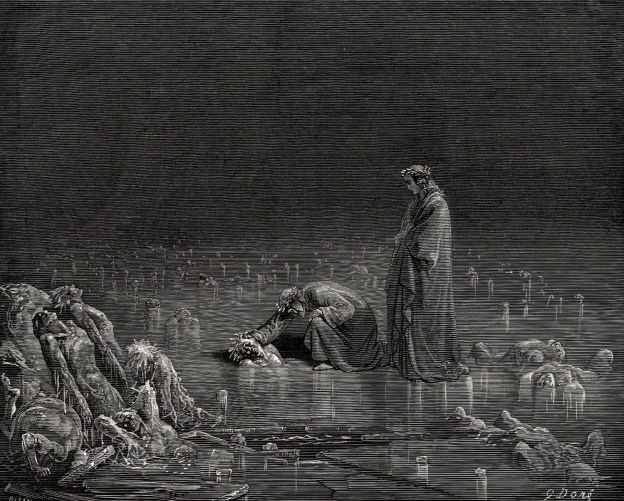
Dante often offered to speak to the loved ones of those who he recognized on his journey through Hell or to pray for their souls. Yet where I saw the greatest pity was at the bottom circle when he beheld the three great traitors of his world being devoured by the heads of the Devil: Judas Iscariot, Brutus, and Cassius. After reading this Canto, I wondered if the Inferno were to be written by an American who might be our three great traitors? Yet here my own beliefs divert from Dante’s, as I find it distasteful to say with any authority what the spirituality of anyone else might be.

I recently finished listening to the most recent Star Was anthology book From a Certain Point of View: Return of the Jedi which is a collection of stories told from the perspectives of minor characters who appear in the film in question. One of the last stories was the main one I was looking forward to the most. It was from the eyes of Anakin Skywalker after his redemption from 23 years living under his evil alter ego as Darth Vader. What struck me here was that despite everything Anakin did in his life, the Force and his best friend Obi-Wan Kenobi, whose force ghost beckoned him into the next life, forgave him. I don’t claim to have any authority over whether one person or another ended their life in one state or another because of the power of forgiveness. Forgiveness is a deep expression of love that we ought to express and inhabit more. Forgiveness it isn’t something that necessarily came naturally. Most of the bullies I faced in my childhood got a silent response from me later in life. I’m not proud of how I’ve reacted to certain people and situations in a way that echoes my own fear and anger, because I know I can do better. Fear isolates us from love, after all.

As I continue reading, I’m eager to see how Dante grapples with forgiveness and with the love that fuels it. I for one am eager to climb from the depths of Hell alongside Dante and Virgil onto the slopes of Mount Purgatory, a cantica which I expect I might allow myself to read in my usual pre-bedtime hour. I chose to spare my dreams of the Inferno, figuring I give myself enough nightmares of my own invention as it is.

Next week then, I will write to you about the Purgatorio and Dante’s climb towards the climax of his literary life.
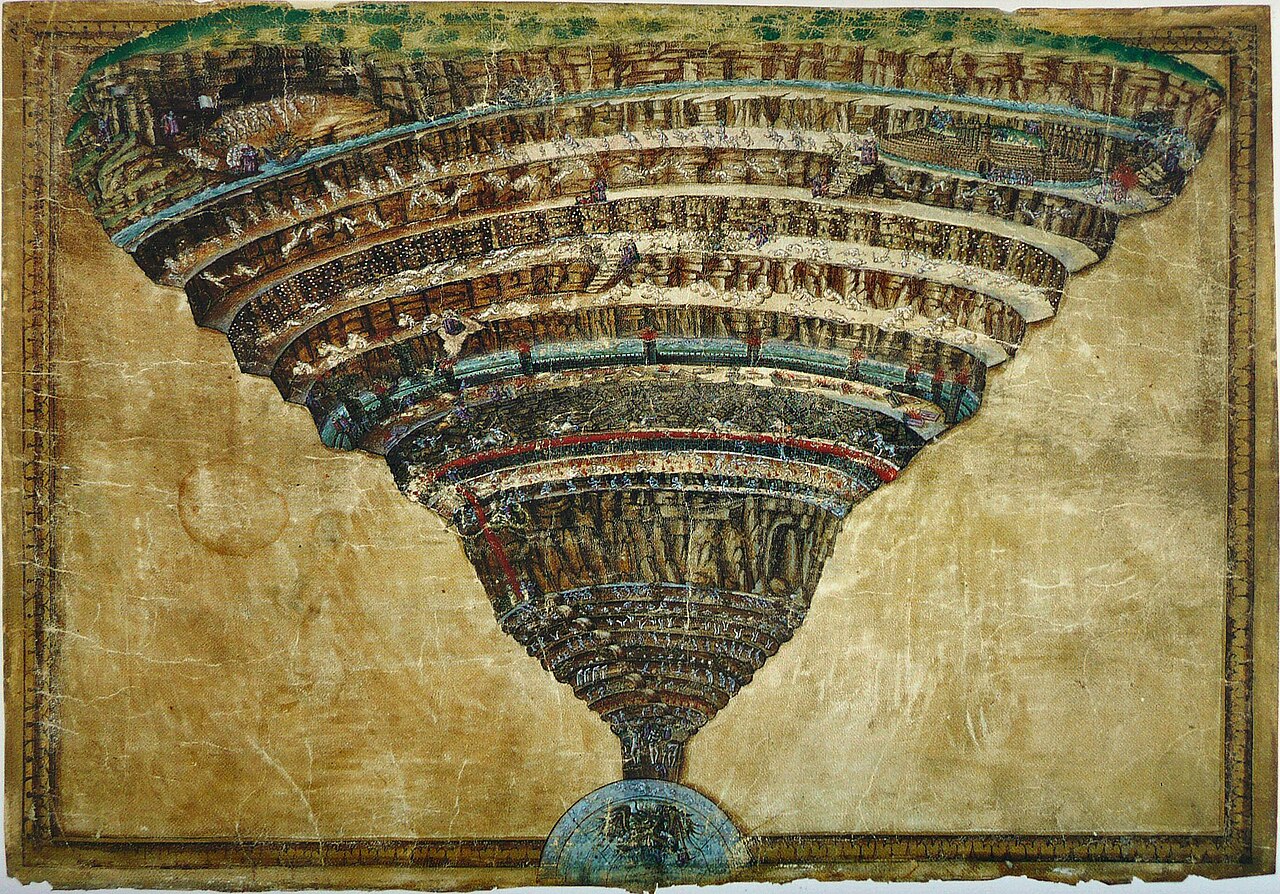

Dante’s vision of the circles of Hell.

Our First Languages

Last week, I listened to an essay from the New York Times Magazine about the possibility that one might lose their first language if they use another too much. Today then, I write to my own experience in this matter. — Click here to support the Wednesday Blog: https://www.patreon.com/sthosdkane

Last week, I listened to an essay from the New York Times Magazine about the possibility that one might lose their first language if they use another too much. Today then, I write to my own experience in this matter.


We choose how we sound to the extent that our physical bodies can allow. This means that our voices and body language can change as we move between environments and groups. I’ve seen this, and even noticed it in myself. My jokes change depending on the setting for one, yet also my tone and accent will deviate to the slightest degree when I move from one group to the next. This change is all the more dramatic when I’m speaking a different language to any significant degree. Last October, when I was in Brussels and Paris, I was speaking French far more than English. On two occasions when I met with friends who I normally speak with in English, I noticed something strange was happening to my voice: my accent was dulled. 

I like to compare the human voice to a pen, in the right hands and with the right training it can move with fluid precision. When at my best moments I can glide in and out of a series of registers with ease and use those different registers to accentuate the point I’m making. You’ve heard some of this here on the Wednesday Blog, those who listen to the podcast that is. The range of sounds I can make is far broader than the mere 26 letters of the English alphabet; this is thanks to my experience speaking other languages, French and Irish in conversation, and to the years of singing Latin hymns at Mass and practicing reciting Ovid and Virgil in my high school Latin classes. I can make myself understood in German, Italian, and Spanish as well if needs be, thanks to the other four I’ve spoken most frequently.

So, at those two dinners, one in Paris and the other a few days later in Brussels, I found that the usual fluidity of my speech was lacking, that I couldn’t quite make all the sounds I usually can. It occurred to me then that speaking French so much had made it harder to switch back into English after all the exercise that my vocal muscles had parler français produced different results to my usual practice speaking English. The author of the essay in the Times Magazine, Madeleine Schwartz, writes about losing recall of one language as much as the physical difficulty of making the sounds not made in the language, she uses the most. For her, the American English r sound was especially challenging after saying the French r so often. For me, my version of the French /ʁ/ is in fact an approximation that I make based on the Irish /ɣ/ sound as in the word dhá, a variation of the number two. These two sounds are approximates of each other, the French /ʁ/ is an uvular fricative while the Irish ɣ is a velar fricative. This means that the French /ʁ/ is produced further back in the mouth than the Irish /ɣ/. Still, my American English /r/ becomes a challenging sound to make when I’ve been saying /ɣ/ or /ʁ/ all day.

On top of this, I’ve steadily worked on mastering another r sound, the trilled r sounds. I say sounds because there are a variety of these that an individual speaker can make depending on where on the tongue you produce the sound. I can make three of these sounds, one which is more of a clipped r that I picked up from Peter Cushing’s performance as Grand Moff Tarkin in the original Star Wars that I think of as more high-brow stage English, the second is a fuller trill, scientifically called a velar fricative, not quite at the tip of the tongue that I use at the beginnings and middles of Irish words, and in Latin and when I’ve spoken Italian and Spanish, and the third is a wisping of air just beyond the tip of the tongue that I use to make the r sound at the ends of Irish words. This last r is called a palatized fricative. These have all taken practice to learn and even more practice to begin doing on a regular basis. Again, I chose to speak the way that I do, and to change registers when I am speaking to a public audience, what you hear here, compared to when I’m speaking with family and friends.

I find that the letter r is important for getting down any accent, because it is so particular to each. It’s a sort of in-between sound that is a consonant yet can act like a vowel in some ways. It’s perhaps fitting then that this same Irish velar fricative ɣ is spelled dh, a digraph which is also pronounced in my Irish as the schwa vowel, /ə/. In my speech, I want to be understandable to my audience, yet also express an aspect of myself in a way that will appeal to that person. While my first language is English, my own urban Midwestern variety of it, my experiences and travels have transformed my idiolect into something that transcends regional boundaries now with bits of London and the Northeastern American English accents that I’ve been exposed to filtering in alongside the ways that my family and community here at home talk amongst ourselves.

One question I still have, one which I’ve pondered for years, is does our modern code switching reflect the abilities of our prehistoric ancestors and perhaps the early evolutionary history of language and human speech? Are other animals able to change how they communicate to reach the widest possible audience? It’s notable to me that a great deal of evidence shows that adult domesticated cats only meow to humans, a vocalization they normally only make as kittens to their mothers. So, in the cat’s meow we hear a conscious change in vocal expression intended to get whatever they’re feeling or thinking across to us. Had I not become a historian, I would have probably chosen to pursue anthropology, focusing on the evolution of human communication and human language.

What do you think about this? Do you intentionally change how you speak to be understood by specific audiences? Let me know in the comments on this blog post at wednesdayblog.org, or on the social media platforms where I share this: Facebook, Instagram, LinkedIn, and X (formerly Twitter). You can also share your comments on the Wednesday Blog Patreon feed where I share these blog posts with more of an introduction from me and a bit before they go onto the social media channels.


The Promise of Hope

Last week, the 7th of May 2024, marked the 200th anniversary of the premiere of Ludwig van Beethoven's Symphony No. 9. Today then, I want to talk with you about the hope which runs through that Ode to Joy. The recordings of Beethoven's Ninth Symphony heard in this episode came from the 1956 album by the ProMusica Symphony Orchestra and Chorus under the direction of Jascha Horenstein and are free to use under the Public Domain Mark 1.0 Universal label and can be found in full at archive.org. — Click here to support the Wednesday Blog: https://www.patreon.com/sthosdkane

Last week, the 7th of May 2024, marked the 200th anniversary of the premiere of Ludwig van Beethoven’s Symphony No. 9. Today then, I want to talk with you about the hope which runs through that Ode to Joy.


Last time on the Wednesday Blog, I wrote to you in what I hoped would appear to be an optimistic tone that still acknowledged the troubles and trials I find before me, and to an extent I think that worked. While I did not intend to write a sequel to that post, this week’s topic is one which fits well enough, and which I feel quite fervent about as to warrant mention here in the Wednesday Blog.

I began to explore the world of classical music around the time I started high school. Quite honestly, my big introductions were the music of George Gershwin and the original cast album of Phantom of the Opera. Yet around that time I was introduced to an ensemble called the William Baker Summer Singers and joined them for the 2008 season when we performed Beethoven’s Ninth in Grace & Holy Trinity Cathedral in Downtown Kansas City. I was not the best singer by a long shot, still very new to the whole experience, yet it was the start of my off-and-on tenure singing with choirs around Kansas City.


The first measures of the 1st Movement

Beethoven’s Ninth thunders into life with the opening measures of its first movement, as though the hope and joy which makes this piece so famous is born from something elemental deep beneath the ground, rising out and toward the audience with the orchestra as its first voice. This then makes the chorus out to be some even deeper root of the spirit of this work, its power growing throughout the first three movements leading up to the tremendous clamoring second movement. I’ve always imagined the second movement told the story of a fast paced and clattering horse and rider making their way through fields and farms to pass on good news to some learned recipient.

The third movement is far softer than the first, yet again it speaks to something grand as yet only being revealed to the audience. There is a sense in the third movement of a fundamental truth as of yet untold, whose voice could raise both the living and the dead to new heights of human dignity and grace. Through music, Beethoven captured the full spectrum of human aspiration and expressed our innate confidence in our own abilities to improve our lives. It reminds me of the “Et incarnatus est” movement in Beethoven’s Missa Solemnis, which is written in the Dorian mode, giving it a distinct feeling of rising from a deep ether into the light of a new day. The Missa Solemnis was also written in 1824, premiering on the 7th of April of that year.


The 3rd Movement’s climax

I hear something inherent in Beethoven’s optimism, that even with all the troubles of his life there near its end he could still dream that we might become better versions of ourselves. The tempo marker for the first movement Allegro ma non troppo e un poco maestoso (Quick but not too much and a little majestic) might well be a good motto for life; a good life ought to be taken at a fair pace, yet not too fast, and with some majesty for one’s nature. We can hope for something better because we are born with minds capable of dreaming of better tomorrows.

At the heart of the Ninth Symphony and in particular its choral fourth movement is a fairly simple melody, one that I learned quickly during my time rehearsing it. That melody has taken on a life of its own beyond Beethoven’s original composition and become something ubiquitous in many respects. There are two church hymns set to its tune in the hymnal we use in my current parish choir, “Joyful, Joyful, We Adore Thee,” and the slightly more modern, yet traditionally formal, “Joyful, Joyful, We Adore You.” What I love about this melody is that it is easy to learn, easy to adapt, and so upbeat.


The Ode to Joy theme from the 4th Movement

The words which Beethoven set to that tune were written by the German poet Friedrich Schiller (1759–1805) in the summer of 1785. They are an outgrowth of the Enlightenment and the fervent calls for acknowledging our common humanity that grew from this reassessment of our relationship with Nature. Those words speak volumes to me, that joy makes brothers and sisters of us all, revealing our original state of nature to us amid all the nebulous fog of our lived expectations. It’s easy to forget that beneath all the mantles of identity we hoist upon ourselves that we are all the same in our life and yes in our mortality.

There is a deep promise here that with hope we can accomplish tremendous things. Hope alone will not solve our problems, we will always need to act to improve ourselves and our communities. True hope, pure and fulfilling hope, is such that it requires we all act together to our common benefit, that we think of each other more than of ourselves. I have such a hope in humanity, after all I’ve seen moments in my own life and in our history in which we’ve come together to work for a higher purpose than any one of us. Again, quoting from Schiller’s poem:

“Seid umschlungen, Millionen!
Diesen Kuß der ganzen Welt!”

            “Be embraced, all ye millions!

            With a kiss for all the world!”

This promise of hope is something that is sacred because it offers us a chance at redemption no matter how terrible the things we may have done. There is something truly divine about it, that we can become better versions of ourselves not in spite of who we’ve been but rather because we are willing to improve who we are and how we live with our neighbors.

That is a promise that I hope we can fulfill.


The recordings of Beethoven’s Ninth Symphony heard in this episode came from the 1956 album by the ProMusica Symphony Orchestra and Chorus under the direction of Jascha Horenstein and are free to use under the Public Domain Mark 1.0 Universal label and can be found in full at archive.org.


The Art of Joy

This past weekend, the Nelson-Atkins Museum of Art debuted a new retrospective exhibit on the life and work of Franco-American artist Niki de Saint Phalle. One of her great initiatives was to express rebellious joy in her art, especially later in her career. — Click here to support the Wednesday Blog: https://www.patreon.com/sthosdkane


This past weekend, the Nelson-Atkins Museum of Art debuted a new retrospective exhibit on the life and work of Franco-American artist Niki de Saint Phalle. One of her great initiatives was to express rebellious joy in her art, especially later in her career.


I wasn’t familiar with the name Niki de Saint Phalle (1930-2002) before the Nelson-Atkins Museum of Art announced they would be hosting the first American retrospective exhibition of her work, yet having seen aspects of it, particularly her Nanas, I find that I do remember seeing these around here and there. The exhibit begins with her early work, highlighting her tirs paintings (1961–63) which involved her shooting paint-filled collages of popular material objects each with their own cultural meanings, until they bled their paint out. I found these hard to appreciate, the violence at the core of these pieces and the claustrophobic nature of their assemblages filled me with a sense of dread.

Yet, it was the latter two thirds of the Saint Phalle exhibit which I returned to, the section radiating and erupting in light and color in a manner that felt welcoming and brilliant as though it were made to bathe in the warm rays of the Sun. These portions of the gallery were filled with her Nanas (1964–73) and other works in the same style. Saint Phalle created her Nanas as an evocation of the power of women, often drawing from ancient fertility figurines like the Venus of Willendorf, today housed at the Museum of Natural History in Vienna. Even the serpentine figures which I would normally be wary of felt warm and cheering.

So, what then is it about Saint Phalle’s work and this dramatic change between her early creations in the 1960s and 1970s to her later works in the 1980s, 1990s, and early 2000s that the latter ones feel so different? In my two visits thus far I’ve gotten a sense that early on she was fighting back against oppressive forces and that her resolve was to take hold of the ancient model of fighting violence with violence, while later once she felt liberated from these old shadows, as much as she could’ve been, she began to create in a spirit of wonderous joy.

I’ve had a hard time with joy lately, and I’m usually the eternal optimist. In many respects, I feel my emotions have had a softening in the last year and a half out of fatigue more than anything else. After I finished my teaching job in the Fall, I could not feel much for a good two weeks; I was so tired that Christmas came and went with only a passing acknowledgement from me. I gave every last drop of my enthusiasm and optimism in that job, knowing that I would have to do no less if I wanted to do that job justice. Joy then, the emotion that I felt even in the darkest and most terrifying days of the pandemic as I dreamed of better tomorrows, is something distant from me even now.

Yet I prefer to be optimistic, to live joyfully, rather than to be consumed by the trends of pessimism and destruction that are well in vogue now. There are horrific things happening in our world every single day, and I applaud those who are fighting to stop those horrors from spreading. The great fight of our time is one to defend democracy in a year when it is very well and truly under threat. It might seem naïve to some, yet I feel it is my vocation to try to keep a positive outlook and remind the people around me of all the good things we’re fighting for. What good is war if we give up any hope of finding peace again? Like Saint Phalle, I see joy in color and light. Where years ago, I would want to keep the shutters closed on my windows today I love having the sunlight dance between their opened gates and radiate an exuberance that reminds me of St. Francis wandering the fields around Assisi 800 years ago. There are great horrors in our world, and we need heroes who will face them and restore them to their box, yet we also need people to remind us of the good times so that we have a reason to envelop that darkness in light.

In the arts, the greatest periods in recent American history of optimism and joy are the New Deal and the Great Society, two moments when the political will to make life better for all Americans translated into an artistic awakening which sings the spirit of the times. The New Deal policies of President Franklin Delano Roosevelt responded to a time of great pessimism and trouble for America and the globe, when at the heart of the Great Depression he and his brain trust found ways to invigorate society through economic and financial reforms as well as new funds for the arts that had not been known at any time before. Here in Kansas City, we look to the paintings of our local artist Thomas Hart Benton (1889–1975) to evoke the regionalist style of the day, or nationally to the works of Georgia O’Keefe, Edward Hopper, and Grant Wood. I often associate O’Keefe’s art with the bright colors and lights of the desert Southwest, a region that was conquered by the United States from Mexico in 1848 yet not fully realized into our national mentality until after World War II.

For me, the great voice of this optimism is Aaron Copland, whose music evokes the same regional influences of the painters just mentioned. A long standing question in American classical music is how best do we define our national voice? I say we here because the compositions created in this country live or die by the audience’s appreciation. I found it fitting then when I read that the Kansas City Symphony’s first European tour, happening this August, will include performances of Copland’s Third Symphony in Berlin and Hamburg alongside performances of the works of three other great American composers: Bernstein, Gershwin, and Ives. In Copland’s music there’s a sense of the enduring youth of this country, the optimism of a new society building itself from these foundations.[1]

I love how the third symphony uses his famed Fanfare for the Common Man as a central theme, this idea that while in other countries fanfares would be reserved for only the great and the good descending down to our common level on their golden escalators, in our country that fanfare is open to anyone who is willing to live their best life. We are all capable of greatness as long as we live within that brilliant sunlight that so dominates the most optimistic periods in our art.

The greatest challenge that we humans have ever received is to love one another, to be kind and generous with our compassion, and to work for the betterment of all of us. I see that message fading somewhat today, its brilliance drowned in the neon glow of our own individualism and aspirations for fame and riches. It runs contrary to our culture as it has developed that we ought to prefer charity over transactionalism, that we ought to be kind to each other for no other reason than because it’s the right thing to do. I worry that this is lost amid all the revolving cycles of fads and trends that catch our attention for but a moment only to be overshadowed by the next.

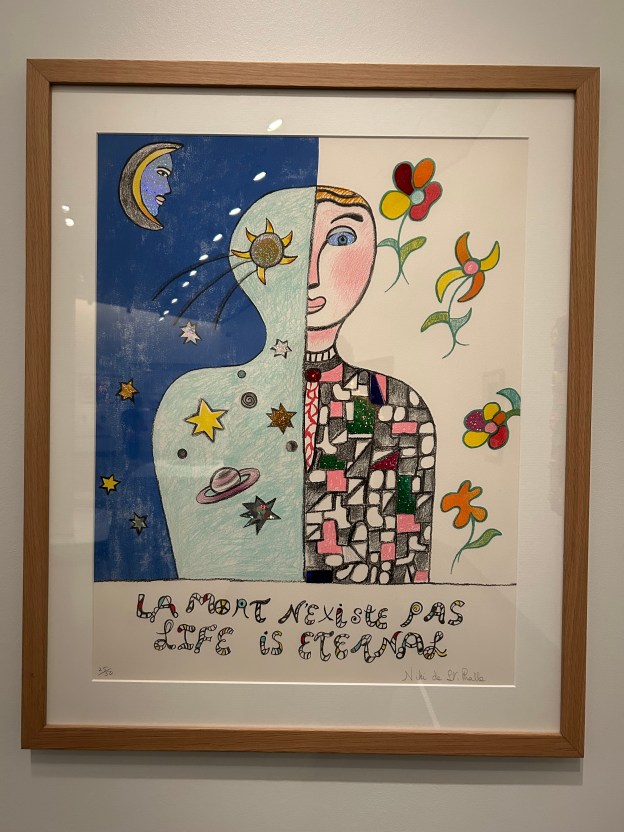
So then, perhaps what I appreciated the most about Niki de Saint Phalle’s later works was as much the longevity of their creation as it was their brilliant colors and joyous expressions. These are works which are meant to last so that generations of people will see them and perhaps in their forms feel a sense of their creator’s joy. I certainly felt that, even now 22 years after Saint Phalle’s death. I took one photo in the exhibit, of a color lithograph she made with a dualistic figure, on the one side with a human face and body and on the other the human frame surrounded by planets, moons, and stars. Beneath the dual figure Saint Phalle wrote in French and English, “La mort n’existe pas / Life is eternal.” I believe through our joy, no matter how childlike it may be, we can live on even after death. As St. Paul wrote, “Rejoice! Your kindness should be known to all.” (Phil. 4:4–9)


[1] Yes, there’s a great deal of problems with that new society’s foundations in the conquest and colonization of this continent.


Niki de Saint Phalle: Rebellion and Joy is on view in the Bloch Building at the Nelson-Atkins Museum of Art from 27 April through 21 July 2024. More information can be found here.