Monthly Archives: August 2024

A Keepsake

This week, I take you along on an investigation I undertook recently into a family heirloom from World War II. — Click here to support the Wednesday Blog: https://www.patreon.com/sthosdkane


This week, I take you along on an investigation I undertook recently into a family heirloom from World War II.


Of all the bad things that came out of the flood which struck my family home two weeks ago, there were several intriguing finds in old boxes, chests, and crates that hadn’t been opened in several years. Two days after the flood, I finally got around to opening my Donnelly great-grandparents’ blanket chest, which held most of the surviving physical records of their lives. It was deeply dolorous to lose these pieces of their memory, and to know that while we will have photographs of these artifacts going forward, most of the artifacts themselves were ruined by the sewage that flooded into our basement.

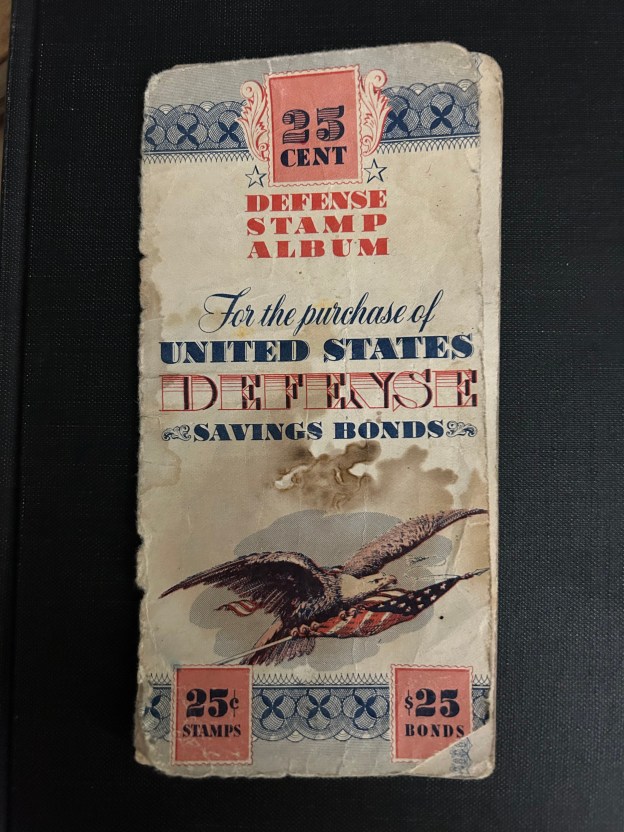
One of these artifacts that caught my eye was an album of United States Defense Savings Bond Stamps dating from likely 1942. These were printed for civilians to purchase and collect 25¢ stamps which they could then turn in after the war at their local post office for savings bonds which could then accrue value over time. My great-grandmother Ruth Donnelly bought this stamp album when she was living in Glendale, Arizona where my great-grandfather was stationed when the Imperial Japanese Navy attacked Pearl Harbor. He was a cavalryman, just a few years out of Rockhurst College, my alma mater as well. When the war began, the U.S. Army decided to not send the cavalry overseas with their horses, seeing how poorly the Polish Cavalry fared against the German Wehrmacht in 1939, and being too tall to serve in the tank corps he was reassigned to the infantry.

I’ve often wondered what it was like for my Donnelly great-grandparents when he was away in the Army during both World War II and Korea. When I used to volunteer at the Kansas City Irish Center at its old location in the lower level of Union Station, I’d often find myself in that grand old building later in the evening and would walk up into the great hall and think about them there when he deployed. That was during my high school years when the Afghanistan and Iraq Wars were at their height and reports & stories of deployments, reunions, and the planes returning fallen servicemen and women were a frequent fixture on NPR and on the morning & evening news.

Of all the artifacts that we recovered then, I decided it would be good to see if I could turn in the stamps my great-grandmother, or G.G. as my cousins & I called her, for anything today. Surely, over 80 years they would have gained some monetary value. My first stop was to my local bank branch, where I took them to the counter and with a smile explained my unusual visit. The tellers who were working that afternoon gathered at the window to look at the album, having never seen its kind before. One read the fine print and suggested that I needed to go to the local post office first and see if the Postal Service still would collect these stamp albums in exchange for savings bonds. After all, if the coins and bills of the U.S. Dollar don’t expire, then why should this stamp album that could be exchanged for savings bonds expire?[1]

With this in mind, I drove from my bank branch to the nearest post office and joined the queue. The postal clerk there was just as surprised to see this album as the bank tellers were. She had never seen an album like this before and suggested I should go to the Kansas City Main Post Office at Union Station where there might be some veteran postal workers who would have possibly exchanged these albums for savings bonds near the turn of the millennium. That made sense to me, and following the trail further I drove downtown to Union Station. At the moment there is a major exhibition from the Walt Disney Company honoring the studio’s centenary, so Disney music is echoing from the loudspeakers all around the building where once they would have announced arriving and departing trains. The Main Post Office moved about 20 years ago across Pershing Road to its current place in Union Station after the old post office building was converted into the Kansas City IRS regional offices.

My last visit to the Main Post Office for more than just buying stamps or dropping off letters was in the hot summer of 2012 when I got my passport photo taken there. It was at the same time that the Opening Ceremonies of the Summer Olympics were underway in London, though they weren’t televised live in the U.S., instead being shown in primetime later on NBC. I always laugh when I look at that passport photo: I wore a suit and tie and between the over-exposure of the image and the buckets of sweat on my face I looked quite silly.

This visit to the Main Post Office was greeted by the same voice of surprise from the clerk as the three other people who I’d taken this album to so far. I explained what I knew about it, that it was likely 80 to 82 years old, and that I wanted to see if the stamps inside could be exchanged for savings bonds still. I opened it to show the clerk that my G.G. had only collected $2 worth of stamps, so it wasn’t a full album. He wasn’t sure what was the best answer and retreated to the offices behind the counter, returning a few minutes later with the name, address, and phone number of a stamp auction house in town that I could consult for a better answer.In short, I could not exchange these stamps for savings bonds anymore. The people who would know how to do that were long since retired from the Postal Service. After three stops, I was ready to hear this, and returned home, where I called the auction house and spoke with its owner. He explained that these stamps have some collectable value, but nothing of any real significance. At the end of the day, while the capitalist in me was disappointed, I was overall pleased with the result of this research. I called my grandmother to tell her the news, saying that this stamp album would make a nice keepsake for future generations to find again, and if this Wednesday Blog is also lost, to research again. Who knows, maybe in another century it might end up on Antiques Roadshow.[2]


[1] United States Federal Reserve FAQs, accessed 27 August 2024. https://www.federalreserve.gov/faqs/currency_12768.htm#:~:text=No%2C%20you%20do%20not%20have,of%20when%20it%20was%20issued.

[2] I hope the set decoration of that show still keeps that eternal 1980s & 90s feel in the 2120s.

The Flood

In the last week, I’ve learned about the impermanence of things after a flood struck our house. — Click here to support the Wednesday Blog: https://www.patreon.com/sthosdkane


In the last week, I’ve learned about the impermanence of things after a flood struck our house.


I had just finished writing last week’s blog post titled “Olympic Optimism” when I started to hear the beeping noises around our house. This usually was a sign that the power was being tripped in some place, or that one of our smoke or carbon dioxide detectors needed new batteries. I checked outside, it’d been raining for a while so perhaps the power lines behind our house had suffered some damage. Seeing nothing in the back, I turned to my left toward the door to our basement garage and opened the door.

Our garage tends to flood anytime there’s a heavy rain, but it will barely be enough water to cover the soles of our boots. Still, it’s often enough water to require work cleaning up the mess. We live in an old house; it’s century mark will come in two years, and the stone walls of our basement garage, common for houses here in Kansas City built through the middle of the last century, tend to seep water when it rains like that. This time though, there was something different about the water that I saw, for it could not have rained so much as to produce a flood some 8 inches deep to the point that the car charging in our basement was partially submerged. I shouted to my Mom, who was finishing her lunch as we prepared to go out for the afternoon, and she came over to me quickly at the sound of concern in my voice. The sight of it all gave me a sort of thrill at first, as I thought about how dramatic this all looked. 

I gently walked down several steps, not touching the water itself as I was sure there could be live wires submerged in that pond. I looked past the car and saw our trash and recycling bins on their backs floating in the surf. The entire basement was submerged, no part of it beneath that 8 inch mark was dry. I returned up the stairs, and went into my room where I kept a pair of snow boots that rise to a bit below the knee, and laced those up, figuring they were better than my usual shoes and went out onto our block to see what the damage was elsewhere.

As it turned out, the entire block on our side of the street had flooded. The city engineers arrived a while later and confirmed that the water main which they had replaced a year before had broken and flushed all of this sewer water into our basements on the downhill side of the block. The further down the hill, the worse it got. When we have disasters like this on my block, we develop a sense of solidarity. I remember the microburst of high winds, thunder, and rain in Spring 2018 that struck our street and toppled many of the trees on this block, crushing several cars beneath them, and causing considerable damage all around. We all banded together, and even some friends from neighboring blocks came to ours, as we learned which guys in which houses kept chainsaws handy. This time, we frequently wandered into the street at the same time, conferring how the damage looked in each other’s basements. There were other houses that had it a lot worse than us, for one our driveway neighbors’ basement was finished until this flood. Yet it wasn’t a difference between mopping up an inch of water in ours compared to several inches in theirs.

The damage from this flood was severe, destroying nearly everything that was on the floor. Thankfully, as of writing the car was deemed to be safe by its manufacturer, but so many other things were lost in the flood. Some of the last physical memories of my Donnelly great-grandparents were lost as my great-grandfather’s blanket chest partially flooded. I took photos of all the pictures we had to throw out, my eyes were the last ones to look upon the originals. Hereafter, we will have my digital copies, but it’s still not the same experience. My Dad lost plenty of power tools that he had collected over the last three decades and beyond. Many of my Mom’s personal mementos, her crafting goods, and gardening tools were lost as well. There was an old heavy wooden side table that my Dad bought in college which was ruined, and some wooden stools that I remembered from our first years in Kansas City that were also deemed unsafe. I found camp photos from my Boy Scout years in the 2000s that needed to be thrown away, all ruined by the flood.

In the days after I found myself drained of energy, beleaguered by a sense of uncertain loss. All of these things, I suppose, were tangible memories that I expected would survive until their materials degraded. We historians are able to study far older objects than the ones lost in this flood because they have survived long after their makers have returned to dust. Just two months ago, I was sitting in the Department of Manuscripts at the Bibliothèque nationale de France’s Richelieu building in Paris holding a volume that contained André Thevet’s handwritten translation of the Travels of Benjamin of Tudela. For the first time in the five years that I’ve studied Thevet, I got to feel paper on which he wrote his own name, on which the impressions of his hand and his thoughts could be seen. Thevet himself is long gone, his tomb in the Convent des Cordeliers likely destroyed during or after the French Revolution, yet there in that grand room I was able to touch something he touched, something upon which he left a part of himself with his words and ideas.

Any hope of experiencing that with these objects left by my great-grandparents, grandparents, parents, and by my younger self that were on the lowest level of storage in our basement are now gone. The experience spoke to me of the impermanence of the physical world, how as Persephone said to Orpheus in the Jim Henson retelling, “everything dies.” This past weekend, I found myself yearning for my childhood again, hoping that I might restore in my mind some of the memories of these artifacts that they might imprint themselves in my thoughts before my memory of them slips away. I could remember how those two wooden stools, light brown in color, felt when I sat on them for too long doing my homework or during meals. I could remember taking that camp photo with the couple hundred other Scouts from around Greater Kansas City and beyond, and how we all gave at least a half-hearted effort at the official photo before giving our all at the silly picture to come. The flood widened the gulf between this present time and all those things which embodied the memories of my past and my family’s past going back to the turn of the Twentieth Century. It made 2024 feel far more removed from 1924 than I’ve yet felt.The one good thing to come out of this flood, if anything, is that we can start anew and learn from the mistakes that led to such widespread damage this time. I expect there will be a next time, that same water main breaks at least once a year, though this is the first time it flushed sewage into our basements. I suspect we will not store anything on our basement floor ever again. Everything will be raised off the floor by at least 10 inches or more. I even suggested installing metal ramps strong enough to hold the car so that it too would never be susceptible to a flood like this again. That is the way of things: we are a reactive people; we see a problem and we don’t prioritize it until it hurts us. I wish we could be more proactive and avoid more of these problems, yet the trials and tribulations of life require that we learn from our experiences, and how can we measure the good moments of life if we haven’t experienced the bad?


Olympic Optimism

In celebration of the last few weeks of the Summer Olympics in Paris, I want to write to you about the optimism that the Olympics embody. — Click here to support the Wednesday Blog: https://www.patreon.com/sthosdkane


In celebration of the last few weeks of the Summer Olympics in Paris, I want to write to you about the optimism that the Olympics embody.


I’m an optimist at heart. I think that’s what has gotten me through these last 10 years of graduate school, and what keeps me going through the hard times we find ourselves in. Every two years, my optimism is renewed by the staging of the Olympic Games, summer and winter. Each Olympiad resides in my memory in its own different way, the character of the host city and the joy of the individual athletes shining through the broadcast of the games. Here in the U.S., the Olympics are actually the one big thing that I think of when I watch NBC, while Rio 2016 was a rare Olympiad that I missed most of being in London at the time with the events at odd hours for Europe. The Olympics reinforce that optimism that we humans can truly work together for our mutual betterment. We have the potential to grow beyond what Carl Sagan called “our adolescence as a species” dominated in the last two centuries by nationalism, division, war, and genocide toward a better future where societies work for the betterment of all.

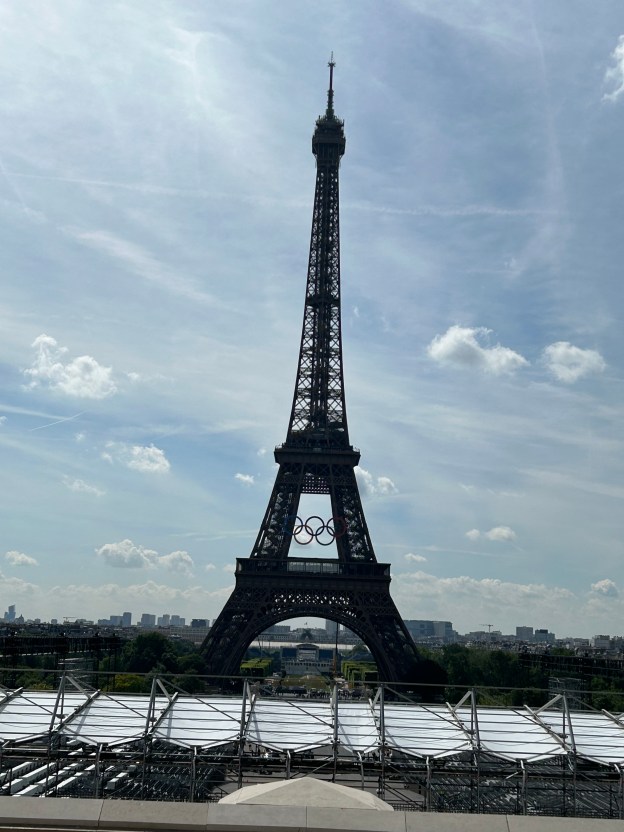
This year, I was in Paris a short while before the games began and got to see aspects of the Olympiad in preparation. The rings were mounted on the north face of the Eiffel Tower in early June when I visited the Musée national de la marine at Trocadéro, and all around the city the lavender-colored placards advertising directions to Olympic venues were hung in the metro. It gave me a sense of what it might be like to be in this city a few weeks later when the games began. Paris is a city which has such a long history of both oppression and liberation that it speaks better than many others to the collective human experience. It truly was a wonderful city for this Olympiad to be held at a time of tremendous pessimism and conflict around our globe.

I set up alerts on the Paris Olympics app on my phone for Team USA and Team Ireland, and for several specific events which I wanted to follow, especially the Fencing, I was a saber fencer in my pre-teen years for a while. While I wanted to support my own national team and the national team of my ancestral homeland, I still cheered on whoever was competing at a given moment. I like to say often that it’s better to have a wide margin of victory when I have a team in the competition: I’d rather see my Cubs win by 5 or 6 runs than by 1 run in a late season or playoff game. Yet, when I’m happy to see the competition itself and see these athletes perform their best on a stage watched by billions, I love seeing a tight race. For me then, as much as I love seeing Team USA march into the Opening Ceremony, or in this year’s case float down the Seine on their boat as the second-to-last to launch from Pont d’Austerlitz, I love even more the moment when the national flags join together and march toward the podium following the Olympic flag. All nations united in a common cause empowered by their hope and joy.There’s a song that was composed for the Rugby World Cup, which is just as pertinent here, World in Union, set to Holst’s Jupiter theme from The Planets which ought to be sung here too. The idea that every two years we all can join together, for several weeks, and form that very same world in union is what fuels my optimism that our days of division and strife are impermanent. I recognize the realists who say that we need to focus solely and whole-heartedly on the trials of our time, the wars and oppression happening in our midst; yet we should also keep this hope in mind that we might one day grow beyond war and beyond feeling the need to oppress each other. There should be as many diplomats and negotiators offering a chance at peace as there are soldiers carrying on the fight because at the end of any war there will be peace again, and the form that that peace takes will determine if any other wars will follow on.


Dúlra

This week, how it’s good to pause and notice the ways we supersede older things with the new while benefiting from the old all the same. — Click here to support the Wednesday Blog: https://www.patreon.com/sthosdkane

This week, how it’s good to pause and notice the ways we supersede older things with the new while benefiting from the old all the same.


One thing I seek to understand the most about the Irish language is how different external influences have changed the language. I first learned the word nádúr before learning dúlra. Both words mean the same thing on a broad level: they both refer to the concept of nature. Yet nádúr comes from the Latin nātūra with the early medieval monks. It was an import to Ireland that arrived with Christianity and the Latin alphabet, a Roman concept of nature that perhaps fits better in the classical sense of civilization than the Gaelic model which was highly developed around forts and homesteads rather than cities or towns. I’ve often challenged my students to consider that while civilization at its core refers to cities, the ways in which it has developed around the globe differ in their own methods.

Take, if you will, the different origins of writing. Whereas our own Latin alphabet derives from a Mediterranean sphere of the written word whose roots trace back to Egyptian hieroglyphs, the history of writing in East Asia goes back to the earliest forms of writing in ancient China on the oracle bones. In the countries whose writing systems derive from this Chinese source, they still largely use logographic or syllabic forms of writing while there is a greater diversity of form among the descendants of these old Egyptian hieroglyphs. We, the Greeks, and Cyrillic writers, have devised alphabets in which both consonants and vowels are written out. Other cultures that have adopted this Mediterranean tradition of writing only write the consonants, as in Arabic and Hebrew. Still others have syllabic systems in which individual written characters represent a syllabic sound: a consonant and vowel combination.

Each system is equal in its utility, and each represent the diversity of human experiences with their own worlds. They are each their own response to a common question. So it is with nātūra and dúlra, one is a Latin way while the other a Gaelic one. Nature, in this Latin perception is quite monolithic and abstract in my view; I’m thinking of Lucretius’s book De rērum nātūra, or On the Nature of Things, whose title I’ve surely ripped off a good many times in the last fifteen years. We can talk about nature this and nature that, yet we need further context to properly understand what is meant by nature. It could be a reference to the non-human world, places untouched by civilization. That certainly fits the Renaissance perception of nature which I study. Or it could stand in for instinct and feeling. My Instagram feed was filled earlier this week with videos of people who have pet panthers and tigers for some reason. Sure, they may seem like big, cute kittens but unlike domesticated cats (Felius cattus) these animals don’t have generations of domestication and breeding to be willing to live around humans like their smaller distant cousins do. So, pets they may be, but they are still pets that could, and quite likely will, rip your face off if given the chance.

What I like about dúlra is that it comes from another Irish word, dúil, which is a very abstract concept in English yet specific in that it refers to the most fundamental aspects of one’s nature. Dúil can be used to refer to the elements of one’s existence, or to a creature as something created. In English we have several words that all generally refer to other fauna: there’s animal, the most common one which has the Latin anima meaning “spirit” at its core, creature, which sounds slightly more menacing yet at the same time speaks to the thing’s nature as a created being, and finally beast which comes into English through French from the Latin bēstiawhich implies a strong sense of danger in its name. These three words offer a gradient of distinction from humanity, and even a scale by which we humans have judged each other. Dúil then fits closer to the English word creature in the sense that a creature is created and is constituted of elements which allow it to exist.

Are these elements then immutable, or can they change with their experiences? There is a story in the March/April 2024 issue of Smithsonian Magazine by conservation journalist Ben Goldfarb about the negative impacts that roads are having on the forests of the American West. In many places roads were the forward guard of civilization, along those roads came the hunters and loggers, the miners and sightseers all of whom transformed these forests to better fit that classical view of a civilized and maintained wilderness that isn’t truly wild. Today, Goldfarb writes, in the contiguous United States “it is impossible to travel further than 22 miles (35 km) from the nearest road.” Think about that for a moment: in the Lower 48 states, which occupy an area of 3,119,884.69 mi2 (8,080,464.3 km2), you can’t go very far from running into a road. I’ve often noticed how if you look at a road map of the 48 states you’ll see how tightly packed the roads are in the eastern half of the country, and once you go out further west they are still there but often more in a clear grid pattern. Goldfarb describes how Idaho’s Nez Perce-Clearwater National Forests have a road density which exceeds that of New York City even.

These roads then are not natural to the landscape, and those which were built on older Native American footpaths and trade routes are now so widened and imprinted upon the landscape as to make them less thoroughfares through the woods and more barriers for the denizens of the woods going straight through their home turf. Think of Arthur Dent’s exasperation at waking up in his comfortable English house to find a bulldozer outside his front door ready to pull the house down to build a bypass. The same goes for the bears and birds and deer and all the other wild things that live in this continent’s forests.

Roads often stand for a level of sophistication and civility which hearkens back to the Romans, whose roads famously all led to Rome. Like the Roman coloniae which reshaped the great forests of Northern and Western Europe two millennia ago, our own settlements changed this continent in a way which better reflects the aspirations of one society seeking to assert their sense of civility and right upon all others they encounter. Roads are tangible symbols of empire which aid the movement of goods and people from one place to another. They tie this continent together in its most fundamental way, before the railways or airways brought us even closer together. Yet Goldfarb makes a good point: at what cost have we strung these ribbons of highway across the North American continent?

The suggestion which Goldfarb describes is pulling out less used roads, old timber roads no longer operated by the companies who built them, and letting the wilderness restore itself. At first, I was hesitant to support this cause, after all how else would I, a city guy, be able to venture out west into the woods to see nature and admire the wonders of the Rockies? Yet as I read his article which features conservationists in Idaho and Montana, I began to see his point. These roads are destructive, and perhaps the better way to see nature, to experience dúlra in its fullness on this continent is to pull out some of these more remote roads, let the brush take over again, and force any would-be visitors to hike in and out. Let it be a reminder that whenever we are in that world that we are guests in someone else’s house.

In the coming weeks, I hope to write more about this question of mine of what exactly makes us human? What is the dúil at the core of our existence? And how can we understand our own dúil, our own essence, in a way which coexists with all other life rather than living above all others as some sort of self-appointed superior? Perhaps that famous line in the Book of Genesis where God commissions Adam and Eve as stewards of the Earth ought to be understood not as “having dominion over nature” but “tending to the balance of nature.” As humanity becomes more urbanized, as civilization becomes more city-orientated, perhaps we will see the land around our cities return to the wild. The Australian mammalogist, paleontologist, environmentalist, conservationist, explorer, and science communicator Tim Flannery argues this could be the case. To conclude his book Europe: A Natural History, Flannery describes a future around 2100 where most of Europe’s human population live in cities and the open land between them has been turned into wildlife reserves, national parks, and restored to its primeval forests. As long as we can assure that our food supplies, fresh drinking water, and sanitation persist if not improve, and that overcrowding doesn’t become too much of a problem in these cities then I have little issue with this idea.

It is interesting to me that even in the context of the word dúlra there is a clear distinction between that and humanity, that dúlra represents the essence of the non-human world, something far less orderly than what we’ve created. It doesn’t necessarily follow laws in the same manner as nātūra, laws whose order can be discerned with careful examination. There is something pure to the chaotic origins of life in this word dúlra, and that’s something I appreciate.