Monthly Archives: October 2024

The Face

This week, I have a spooky short story for you, based on an experience I had over the summer. — Click here to support the Wednesday Blog: https://www.patreon.com/sthosdkane Photo: an empty corridor in the Paris Métro as seen by the author on the evening when this spooky story takes place.


This week, I have a spooky short story for you, based on an experience I had over the summer.


The second evening since my colleagues had left town now arrived, I made my way down into the caverns of the metro to cross Paris from Opéra to the Maison de la Radio. The journey should only take 30 minutes, during which time I knew I would be surrounded by people, it was the rush hour after all. Yet one thing was certain about this journey: none of us would intentionally make eye-contact with each other. That is one of the great, universal, cardinal rules of public transport systems. To look into the eyes of a stranger who was stuck sitting or standing beside you in close quarters was to break some great pact of collective anonymity. I kept to this rule as well as I could, having learned it as a child and improved within its bounds in my teenage and young adult years.

That is what struck me the most about the face that I saw peering at me from ahead. At first, I thought I must’ve been seeing things, yet then I looked at it more closely and saw its eyes gazing back at me in an unbroken stare. Whose face was this that would be so flagrant in their regard for the social order of the metro? I turned away quickly and restored my gaze on the linear route map on the upper section of the walls of the carriage. It was just above the twin doors which stood before me. I was positioned in the center of the train’s vestibule, holding onto the vertical pole as all of the seats were taken, and if I could’ve taken one for myself it would’ve served little purpose, as I was alighting in only a few stops.

I looked back in the corner of my eye and saw those eyes piercing their way through the stifling air back at me. A shiver ran down my spine, and the hairs on the back of my neck stood on end, someone really was watching me, someone here on this train. I looked up at the map again, we were only just arriving at Miromesnil. I knew I could transfer here, but it would take me out of my way, and I needed to get closer to the Maison de la Radio if I was going to have time for dinner before my concert. At Miromesnil, I looked to see if the face I’d seen was one that alighted, perhaps to transfer to Line 13 or to the streets of the 8th Arrondissement above. The doors closed as soon as they opened, and we were off southwest again toward the intersection of l’Avenue de Franklin Roosevelt and les Champs-Élysées. I feared turning to look again, those eyes could well still be there staring at me. They didn’t look friendly, I’d convinced myself. They were eyes that stood out for how sharp their whites appeared against the brown of their pupils, like a milky sea surrounding a distinct island of mahogany. It seemed unnatural in the greenish light I saw them in, a light produced by the electronic lighting on the train.

At Alma – Marceau, I knew I could transfer to the RER C, which would take me to my final destination, but I stuck to my plan, in spite of the eyes that I was sure still gazed at me. Did their owner long to know more about me? Did they think me foolish, or could they see through the sport-coat and sweaty dress shirt that I’d been wearing for several days? I let the doors close on the Alma – Marceau platform without alighting, and watched as the station flew past us until the darkness of the Line 9 tunnel overwhelmed the green light illuminating the train again. 

There they were! The eyes! Gazing at me from behind, I thought. I felt tired, weary of feeling like I had to look over my shoulder to see who this person was, like the unknown figure who’d sit behind me at Mass when I would feel too self-conscious to turn around and see who it was. That would require I acknowledge them, say “hello” or what you will. Here though, the sign of peace was not turning to acknowledge this figure standing behind me, rather to acknowledge that I could see someone’s eyes there staring at me in the window yet not turn and interrupt their privacy in so public a place by looking into them myself. So, there I stood, trying my hardest not to turn as Orpheus did and lose the love which I felt for that vaunted, phantom privacy.

At Trocadéro, I alighted with relief, and walked down the platform following the signs for Line 6. I pulled out my phone and searched in the metro’s app for my route again, confirming I would need to take Line 6 only one stop to Passy. I walked up a flight of stairs and down another, noting the Trocadéro ticket lobby was surely nearby, before I descended onto the Line 6 platform for trains terminating at Place de la Nation. I didn’t notice anyone familiar from the Line 9 train on the platform and breathed a sigh of relief. I thought about buying a bottle of water from the vending machine on the platform to help calm my nerves, but thought better of it, remembering I was hopefully heading to dinner before my concert. 

A minute later, the train arrived, its light green signage mirroring the color scheme of the Paris Metro overall. I watched it arrive, and boarded in the penultimate carriage, which I found moderately full. I had plenty of room on either side of me as I again chose to stand, keeping myself upright with the aid of the vertical pole in that train’s rear vestibule. I watched the doors close and lock, and the train begin to move, picking up speed with a good rhythm from the tracks below us.

As we reached the tunnel my relief turned to horror, there was that face again, those eyes piercing my soul with their weary look, as if the weight of a life lived well yet not to its fullest sang a plaintive hymn from their gaze. Was that what I feared about them the most? That they seemed to be tired, forlorn? Something else caught my attention though, without many other people around me, logically there wouldn’t be anyone else in this carriage’s end vestibule who was on my last train. I looked back at those eyes with trepidation and let out an audible laugh as the train flew out of the tunnel from beneath Trocadéro and onto the elevated line that took Line 6 over the Seine and along the western edge of the Champ du Mars. 

Those eyes were my eyes, their piercing stare was my piercing stare, that weary gaze was my weary gaze. I saw myself in the window this whole time and feared what I saw. I feared the figure who was trying to make it through one day to the next without causing too much trouble for himself. I was scared of failure and restless in this self-enforced frugality of expression. 

I saw the platforms of Passy station appear alongside the train, and alighted onto the platform, descending down the stairs, and out toward the banks of the Seine.
On Pauses

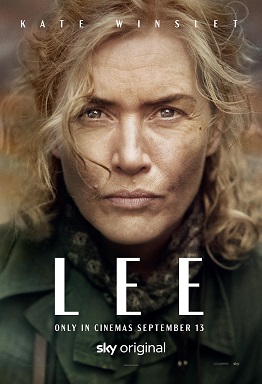
This week, some words about silence in communication. — Click here to support the Wednesday Blog: https://www.patreon.com/sthosdkane Photo: the poster for the new film "Lee" which is discussed in this episode.


This week, some words about silence in communication.


In my current job, one thing that is often challenging for new hires is learning how to operate our radios. In general, personal radios are the same no matter where you go, albeit with different features added to higher-end models like screens telling you which channel it’s tuned to. I found our radios to be one of the easier parts of the job to adapt to, I have experience working with radios from my time in the Boy Scouts for one. Yet I wish when teaching people how to use radios for the first time we would talk about how we communicate on a most basic level. We use all of our senses to communicate but especially our sight and hearing. 

Sound is the purest medium of communication for us humans: we talk with one another by emitting sounds from our mouths and receiving them with our ears. There’s a whole genre of performance these days called “spoken word” which annoys me because that’s the purest and most fundamental form of communication, let alone art, that we have. Rather, it should be called speakingtalking, or if you want to be fancier oratory. It’s only since we began to read silently that this distinction between speech and writing has grown. From what I remember hearing, the first significant reader to read silently was St. Augustine of Hippo, though that could be apocryphal.

Beyond sound there’s visual communication. In my job when we’ve talked about backup plans should our radios no longer be functional or useful I’ve suggested, perhaps a tad jocularly, that we should resort to semaphore flags, or some sort of similar if more rudimentary system. I have the semaphore Wuthering Heightssketch from Monty Python’s Flying Circus in mind when making this suggestion, but still, it’s always worth considering. In writing we are stuck having to express the full range of emotions and meanings in a manner that is limited by letters, words, and symbols on a physical surface. Emojis now help in more popular parlance to express the emotion behind our texts and social media posts, yet there again I often get annoyed when I see the bubbly and bucolic emojis used in places where they seem unfit, as though a contemporary expectation is that we all are using a string of emojis at the ends of our sentences because everyone else is doing it. I removed the emojis placed by default on a happy birthday message that Facebook suggested I send to a friend because they aren’t a necessary part of my communication. I use the period, or full stop for my non-American readers, at the ends of my texts because that’s how I end a sentence unless it’s interrogatory or exclamatory in nature.

As you can see, I have more to say about visual communication, especially the written word, because that is my own medium. I also dabble in photography, and have embraced Instagram for this reason, yet again I feel less need to take selfies everywhere I go because I can far more honestly demonstrate my presence in a place through writing. On my Instagram stories, I decided about a decade ago when I first opened my account that I would always format my captions with a highlighted blue background and white text as a way of saying, however subtly, to my readers that these are my words. I’ve kept to that, though this is the first time I’ve acknowledged that practice.

In either of these senses, hearing or sight, should we lack one we have to rely even more on the other to understand our surroundings and what others are trying to express. I’ve learned a hard lesson that my nonfiction writing benefits greatly from firm clarity over the opacity that I prefer as I unravel the story in my fiction. The same occurs when using radios: these are devices which allow an individual to communicate with others from a distance sight-unseen. The words we speak into our radios then need to be crystal clear for the people listening to understand what we are trying to say. I like to think of the mission controllers in Houston or Star City who have relayed intricate strings of numbers up to astronauts and cosmonauts beyond our planet to help them complete their missions and return home safely. It gives me a thrill to try to be that clear on my radio, and to be comfortable with that level of clarity when speaking into it.

Yet beyond these two senses, we have minds which are experiencing all of the things that our senses relay to it. We see more than just the messages other people display or transmit, and we hear more than just talk. Our minds are capable of parsing through all of this and making meaning out of it to orientate us in our lived worlds. This summer when I was back in London, I knew I was in a very public setting in close proximity to about 10 other people when I took the new Elizabeth line from the Docklands to the West End one Sunday afternoon, yet I also knew from experience and from seeing the people around me that no one would think anything if I pulled out the book I’d just bought, Michael Palin’s Erebus, and start reading it. Sure, everyone around me could see what I was reading if they wanted, but in that moment it was perfectly alright to do that because it was an unspoken part of life on the trains of the British capital that people pass the time by reading, so long as those readers don’t then share what they’ve just read with the strangers seated or standing about them.

On Friday afternoon last week, I went to one of the local cinemas to see the new film Lee staring Kate Winslet as Lee Miller, one of the great photographers and war correspondents of the last World War. I bought my ticket knowing it was going to be a stellar performance from Winslet, yet I was struck just as much by the dialogue as I was by the pauses written into the script. In one scene, one such pause propelled the story forward far more than any other moment in the whole film, connecting the postwar framing narrative together with the main story being told. That’s the beauty of theatre and film: it’s a medium where the written script is interpreted by actors who we see and hear, and so these two senses are unified to bring these characters and stories to life. This film, like its contemporary Freud’s Last Session which I saw earlier this year, had the feel of a play, and could probably work as such though the realism of Lee is that it takes the audience along with the photographer as she witnesses the destruction of Europe and the horrors committed by the Nazis in the wake of their fall from power in 1944 and 1945.

These silent moments are something that I find can be expressed more in my narrative writing, a style I usually use writing fiction, where I’m writing dialogue as well as the connecting tissue giving those words spoken by the characters their place in the world of the story. In real life we can express nearly as much with a look as we can with a word. This setting of Britain, Occupied France, and Germany in World War II is a potent one for telling stories, after all so many movies continue to be made about that war even as we move ever further from those years. I wonder if in the twenty-first century when we are so connected by our technology, how are our innate communicative abilities adapting to our newfound world? When I was little it was a big deal to see a copy of a foreign newspaper available for sale here in Kansas City; you could maybe buy a copy of the Sunday Times at Barnes & Noble in the magazine section, but they wouldn’t always have it available. Today though, we have people from all around the globe talking at once.

What is it we aren’t saying amid all the cacophonic chaos of our modern social media?


On Editing

This week, I want to write to you about the revealed joys found in the experience of editing. — Click here to support the Wednesday Blog: https://www.patreon.com/sthosdkane


This week, I want to write to you about the revealed joys found in the experience of editing.


I spent most of last Thursday editing a chapter I’m contributing to a new book about Shakespeare’s play The Tempest. My contribution argues that the bard was inspired in his descriptions of Caliban and the play’s island setting by André Thevet’s accounts of Tupinambá beliefs and the role of magic in their society, and the sense of Brazil as the archetype of the insular natural world across the sea at the turn of the seventeenth century. There’s a lot in its 32 pages, and it’s been a good effort on my part since I first saw the call for papers for this book two years ago. I wrote the first draft between March and June of this year both here at home in Kansas City, and while I was on my European trip this June; I spent most of my time in the San Francisco International Airport G Concourse United Club writing paragraphs for this chapter. 

Until last Thursday, I’d only edited it on my computer. This is a far faster way to edit text, it allows me to work as I’m reading through the draft. This method is still relatively new to me, I feel fortunate that I was taught to write by hand first and to edit with pen and paper. That’s been more challenging with my dissertation, in Binghamton I didn’t own a printer and because I could never figure out how to use the university printers, I relied heavily on the local print shop across the road from the University to print anything I needed. That meant then that up until the sixth or seventh draft I never saw it on paper, always on the computer screen for both economical and environmental reasons.

The week before last Thursday, when I returned to my Tempest chapter after finishing several other major projects, I found myself thinking that it could benefit my editing if I printed this document out at least for my last full read through before sending it off to the editor. So, returning to it just before noon on Thursday, I decided to print draft 4 of the full document, all 34 pages of it. As it turned out, there was something heartwarming about editing this chapter with pen and paper. Sure, I knew I’d save myself time by editing it while I was reading it on my computer, but I’ve found more and more that if I really need to work on a sentence, I’ll have to copy it out of the draft and into a separate document where I can look at it on its own separate from the rest of the text. This works, and this is what I often end up doing, but it’s not a problem I have reading lines on a printed page. I find I can read faster when reading something printed rather than something digitized, and now that I’m doing so many more things than just writing and editing my dissertation, moving towards these postdoctoral projects, I’m finding that I’m returning to how I read and wrote before I fully adopted all this technology.

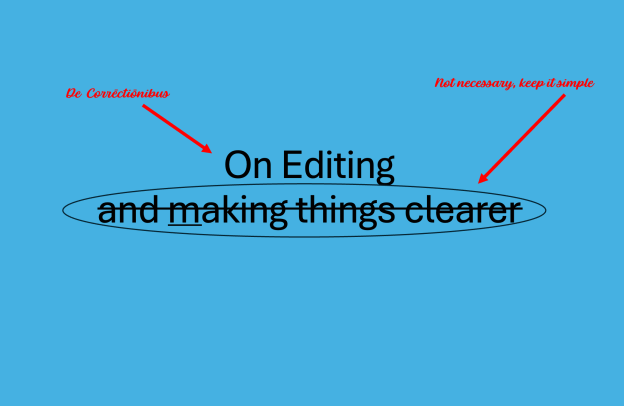
Even though I now edit using more review bubble comments and review tracking on Microsoft Word or Google Docs than the old shorthand symbols that I learned in my elementary school English classes, I could still return to them with an ease that felt native to my sensibilities and origins as a writer and a reader. I even left the odd marginal note on draft 4 of my Tempest chapter should anyone else ever find this printed copy to see some of the things I was referencing in the additions and changes I made to this draft.

One of the greatest lessons I’ve yet learned about writing came from a policy writer who at the time worked for the offices of the European Union in Brussels. He came to the University of Westminster for a couple of days in March 2016 to run a policy writing workshop for all of us who were interested. I joined in and wrote a brief about a hypothetical crisis along the Danube between Hungary, Croatia, and Serbia (I think). While I’m less likely to become a professional political policy writer anytime soon, the most impactful thing he taught us was to leave whatever it is we’re writing aside once we’re done with a draft and return to it later. Like a good dough, our writing needs to rise for a while before we return to it and work on it some more. I took a week between finishing draft 4 and returning to it to complete the edits that make up draft 5 of this Tempest chapter, and I’m certain the finished draft benefits from that gap. It’s something I do here with the Wednesday Blog on those weeks when I’m able to write things in advance. The words you’re reading, or hearing, now were written on Thursday afternoon about an hour after I sent draft 5 off to the editor. I’ll return to them sometime on Tuesday, October 15th, and read through them again when I record them for the podcast.

The Wednesday Blog podcast actually grew out of my editing sessions for the blog. You see, I traditionally edit by reading my writing aloud; if it doesn’t make sense to my ear then it needs to be rewritten. Nearly three years ago then, at the end of November 2021, I decided one night after dinner to start recording those read-throughs and release them as a podcast version of my blog. Of course, the version you get in your podcast player each week is more polished than the first draft, but with these essays I usually don’t need to do as many edits. This is a different style of writing than my academic work, less formal, and more personal.

Editing also reminds me to express what I’m thinking in a clearer way. An early lesson in teaching that I received, and nearly all of my lessons in teaching have been on the job while I’m teaching, was to speak to my audience in their own language. This is a no-brainer when it comes to speaking French in Paris, or German in Vienna, yet what I mean here is speaking to your audience in a way that they’ll understand. I like to use the words they’ve just used in my answers. This is a grammatical thing in Irish where instead of having words for yes or no we instead say the positive or negative of the verb in question. I’ve begun doing this in my English too: responding not only with a yes or a no but with a yes, I do or yes, I can, or no, I don’t understand. Clarity is the best friend of writing and good communication. A common comment I get from editors is that what I’m trying to say is just under the surface or not quite clear yet. This is a symptom of how I developed my writing voice first in poetry and plays and later in short stories and now factual and highly researched non-fiction blog posts and academic essays. It’s been a weakness in my writing up until now that I’ve had a hard time getting over, but I think I may have figured it out by closely reading what I’ve already done with those comments up on a screen where I can clearly see them as I read.

Sometimes the thesis or plot of what I’m writing will change significantly in the edit. There are times where my original argument simply doesn’t work, and I need to adjust drastically to save the essay or story. This happened early on with this Tempest chapter, and I’m glad I saw the flaws in my original approach as early as I did because it made the chapter I’ve written in the five drafts since all the stronger. While that may be frustrating at first, I love the way that things work when all the pieces of the story or all the sources behind the thesis line up. I love how a good edit can inspire me to keep writing and get closer to my record average of writing 1000 words per hour. This is more possible outside of my academic writing where I often stop to consult a source to make sure I’m getting it right, but even there when I can write with a great fluidity, and I know what I’m trying to say it reminds me why I do what I do.


Correction: in my initial publication of this blog post I miswrote my average writing speed as “1000 words per minute,” when I meant to say “1000 words per hour.” I’m not Lt. Cmdr. Data.

An Equine Etymology

This week, I discuss the two Irish words for the horse, and what they tell us about the history of the Irish language. — Click here to support the Wednesday Blog: https://www.patreon.com/sthosdkane


This week, I discuss the two Irish words for the horse, and what they tell us about the history of the Irish language.


The word that we’re taught in Irish classes, in fact the word which is listed in the 1959 English-Irish Dictionary for the English word horse is capall. I like this word; it sounds to me like the clopping of a horse’s hooves on stone. Yet it actually derives from the Latin caballus, a word borrowed into Latin from the Gaulish *kaballos that gradually replaced the Classical Latin equus in late antiquity.[1] Capall then is a relative of the French chevalas well as the Welsh ceffyl. Yet Irish also has another word for horse, each, which fell out of use in favor of capall at some point in the past. Even still, each survives in words deriving from the concept of horsemanship, or equestrianism if you prefer Latin roots over the former’s Germanic ones.

How then did capall replace each, and when might Irish have come into contact with the Latin caballus that did this deed? T. F. O’Rahilly argued in the 1930s that capall may be one of several Brittonic loan words in Irish, owing to its similarities to the Welsh ceffyl.[2] I’m less sold on this idea myself, as it presumes that capallentered Irish earlier than the arrival of Christianity, though it does speak to the presence of interisland trade between the Britons and Gaels in the Iron Age.

Each derives from the Proto-Celtic *ekwālos, itself a descendant of the Proto-Indo-European *h1ékwos. Other Celtic languages derived words for horse from this root, including the Welsh word cyfeb referring to a mare in foal and ebol referring to a colt or a foal. Gaulish appears to have had the word epos for horse, existing alongside the aforementioned *kaballos, which in turn appears similar to the Gallo-Roman horse goddess Epona. 

Each remains the more common Scottish Gaelic word for horse to this day, which to me rules out a possible Norman introduction, as the influence of Norman French was felt in both Ireland and Scotland in the twelfth century. Rather then, considering the Welsh connection to their word ceffyl, it seems to me that capall was introduced to Ireland by the Roman monks who brought Christianity to the Gaels in the fifth and sixth centuries. In the stories of St. Patrick, the holy man studied for the priesthood not in his native Britain but in Gaul, where again this Latin word caballus found its origins.

The recurring problem with this question is one of sources. I am trained to study texts looking for answers to historical quandaries. In the case of Irish, few textual sources from before the coming of Christianity survive. We have an idea of what life was like in Ireland before St. Patrick’s mission through the ancient epics and stories that have survived and been embellished down the generations, yet there is something lost deep within our past that could only survive as the faintest whisper of a thought in our memory.

How then do we address older stories in the historical narrative? In my mind, I am able to separate these stories from the factual accounts which I study in the same way that I am able to delineate the different spheres of the scientific from the spiritual. It doesn’t matter to me if there was never a man named Amergin Glúingel whose song on the eve of the Milesian invasion of Ireland to wrest control of the land from the Tuatha Dé Dannán, led to a peaceful division of that island home between the two peoples. What matters instead is that the story tells us to seek peace rather than war, dialogue instead of revenge as Amergin’s brothers sought in their invasion. I don’t use these stories in my research, yet I’d gladly tell them beyond the analytical sphere of my writing.

Yesterday morning, I read in the Guardian the analysis of one nostalgia expert that we historians are often drawn to study the past because of a yearning to experience a time different from our own. This story was written in the context of the 25th anniversary of the computer game Age of Empires II, which I too played in my youth. From my vantage, I see myself very much as one of the wider diasporas that came from the homelands of my ancestors. I grew up with far more connections to the Irish diaspora here in America, and so have come to know myself more as an Irish American than by any other appellation. At the heart of that sense of being Irish American is the sense that even if we today are well at home in America, our families came here as exiles, deoraithe in Irish, and in some sense, we feel that weight even today generations later.

There is a sense that something is lost when one is ever yearning for the land of their ancestors, the lives they might have lived. I’ve been to the town around which most of my paternal ancestors came, Newport, County Mayo, and I was struck on the one hand by how many of the people were the spitting images of their cousins that I’ve known in Chicago, and on the other hand how as beautiful the country around Clew Bay is I’d much prefer the city over living there. For me then, I’ve turned to the language, to Gaeilge, as a way of keeping that connection with our roots alive and flourishing like some great tree amid the physical and spiritual droughts of the world today.

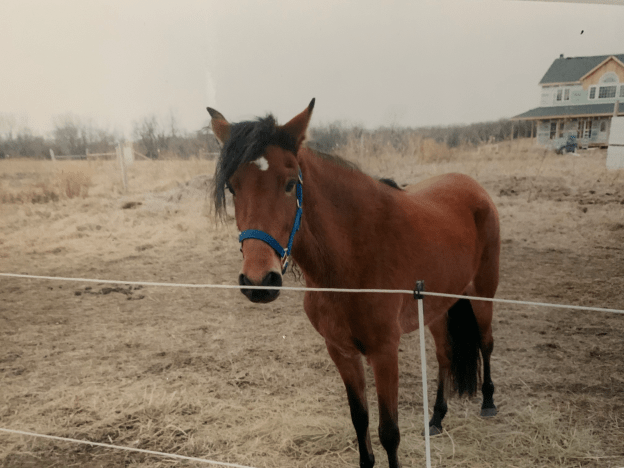
My eye as a historian is drawn to finding the roots of the things that I come across, both in my studies and in my curiosities. It struck me then to see in my Fócloir Gaeilge-Béarla that different equine words in Irish retained traces of this older word for the horse: each. In my likely forlorn search for some trace of the oldest roots of the Irish language, and by extension of my own ancestors, I feel the need to understand where these two words come from. Horses are important in their own way, albeit replaced in most uses by cars, trains, and airplanes today. Despite moving to a farm when I was six in order to have horses, I don’t think I’ve ridden a horse in at least 15 years, if not a full score. When you ride a horse, you are working with the horse to move about the world. Wherever you look, the horse will wander that direction. It’s key to remember that the horse is more than just a vehicle, it is a living being with thoughts and wishes all its own.

Having two words for this animal show that the perceptions of it have changed down the generations. This word each today is used to describe people or activities which relate to horses in the same way we use the word equine in English. That English word however derives from the Latin equus, while each is a relative of the same generation as the Latin. Meanwhile, capall is the horse as the everyday being: the beast of burden, the bearer of riders, and yes the friend. As with most things concerning the origins of the Irish language, I can’t yet say for certain when or how capall entered the language though I am more certain that each was already there if only because I know that equus predates caballus in Latin, and because the most innate relationship humanity can have with a horse, as the rider, is reflected in Irish with the word eachaí

There is much we can learn from our past, and how we lived within nature and alongside other natural things in those distant days. I do hope we can learn more as we continue on in our lives on this Earth.


[1] The use of the asterisk in these Gaulish, Proto-Celtic, and Proto-Indo-European words denote that they are theoretical reconstructions.

[2] Myles Dillon, “Linguistic Borrowing and Historical Evidence,” Language 21, no. 1 (1945): 12–17, at 13. (JSTOR)


On October Baseball

This week, a great celebration commences in our national pastime. — Click here to support the Wednesday Blog: https://www.patreon.com/sthosdkane


This week, a great celebration commences in our national pastime.


Several years ago, near the start of the podcast version of my Wednesday Blog, I wrote two of my favorite stories in this continuing publication of mine about my love for baseball at the beginning of the 2022 season. I seem to remember even playing a poor rendition of Take Me Out to the Ballgame on the digital keyboard provided on GarageBand, where I do all my recording and editing. Don’t worry, I’m not planning on doing that again.

Today, I want to write instead about my joy at how this postseason is beginning. The 2024 season had plenty of potential for my beloved Chicago Cubs and my adopted second-favorite team the Kansas City Royals, and while the Cubs didn’t quite make it far enough to earn a wild card spot, the Royals did in spite of themselves. This is being released on the morning of Game 2 of the Wild Card series, following a 1-0 Royals win in Baltimore against the Orioles. So, should the Royals win again today they will advance to face the Yankees, a matchup that brings to mind the stories my Mom likes to tell of watching the Royals teams of the ‘80s face up against the Bronx Bombers in the American League playoffs.

Meanwhile in the National League the team that excites me the most in these Wild Card series is the San Diego Padres, a perennial favorite of the last four years to win the World Series. Their resounding 4-0 win at home over the Atlanta Braves last night in Game 1 proved to be a good alternative to the Vice Presidential Debate that was occurring at the same time from CBS News’s headquarters in New York. You might think it odd that someone as politically engaged as me would choose to watch a ballgame over a debate, and yes, I started the 8 pm hour watching Governor Walz of Minnesota and Senator Vance of Ohio face off on CBS, but as soon as the first question concerning the increasing odds of war between Israel and Iran occurred, I decided to seek some escapism.

There are a lot of things that we all are worried about today, and with good reason. Whereas for most of my life I’ve looked to the future with eagerness, today I’m scared about the future and what we are doing to ourselves. Over the weekend, I watched an episode of the PBS documentary series In Their Own Words about Jim Henson in which he said his inspiration for creating his 1980s children’s television show Fraggle Rock was to make something that could inspire world peace. To paraphrase the visionary creator of the Muppets, Henson believed the best chance we have at solving our problems is to speak to the youth who aren’t already jaded by the weariness of life and are more willing to imagine a good future. He spoke to the inner child in all of us, a part of me that I’ve found slinking back from the foreground as the world seems evermore scary and dangerous.

Even when I don’t have a team in the playoffs, and let’s face it as a Cub and Royal fan that’s most years, I still religiously watch the baseball playoffs because I love this sport. It’s the sport my parents introduced me to as a kid watching Sammy Sosa, Kerry Wood, and the great Cubs of the late ‘90s and early 2000s skirt so close to the glory of winning the World Series in 1998 and 2003. It’s the one sport that I played with even the remotest success. It’s a sport that I shared with generations of my family that I understood, and today it’s a nice antidote to the weekends of American football, which let’s face it I get but still don’t really understand. Baseball is one of those core things that makes me feel more American, and one of the parts of American life that I missed the most when I lived in England.

Locally here in Kansas City I feel that the Royals have lost some of their connection with the community in the wake of their failed bid to get a renewal on the stadium sales tax here in Jackson County, which would help them to fund a new stadium along Truman Road in the Crossroads neighborhood. I was one of those voters on the fence who wanted to support a downtown stadium but were really unhappy with the plan they laid out and repeatedly changed in the days and weeks leading up to the vote. Since the playoffs began, I found it harder to put on my Royals hat when going out. I’m having a hard time putting my faith in an organization that doesn’t seem to want to trust the city it represents. I hope this Royals playoff run, 10 years after their monumental and near triumphant 2014 run will revive some of that jubilation that I felt in Kansas City that year. I remember during the World Series that year driving down 47th Street in the Plaza and nearly everyone out walking down the sidewalks was wearing Royal blue jerseys and hats, and I even saw Commissioner of Baseball Bud Selig’s motorcade parked outside the Classic Cup Café at 47th and Central. I want to feel that kind of community spirit again in Kansas City, where the team and the city are open with each other and working together in a productive manner.

So, who am I picking to win the World Series this year? Well, even though we’re down to the last handful of teams, and even though I have a horse in the race this time around, it’s still too hard for me to say. I want the Royals to win again, that’s for sure, though were they not playing against the Orioles I’d be excited for Baltimore’s chances this year. In the National League though it’s a two horse race for me between the Dodgers and the Padres. While Los Angeles has one of the greatest baseball players of our time – Shohei Ohtani – on their team, the Padres have been red hot in the second half of the season, and I stand by my long held claim that the weekend I spent in San Diego in 2021 was one of the best I’ve had in the last few years. What I want to see most is amazing baseball that makes me want to watch the guys on the field play more and more and more; and by the end of this month to long for March and Spring Training.

Writing this tells me one thing for certain: even when I’m trying to celebrate something I love as much as baseball, the muddied waters of the world still appear, yet even then I remain hopeful of better tomorrows.


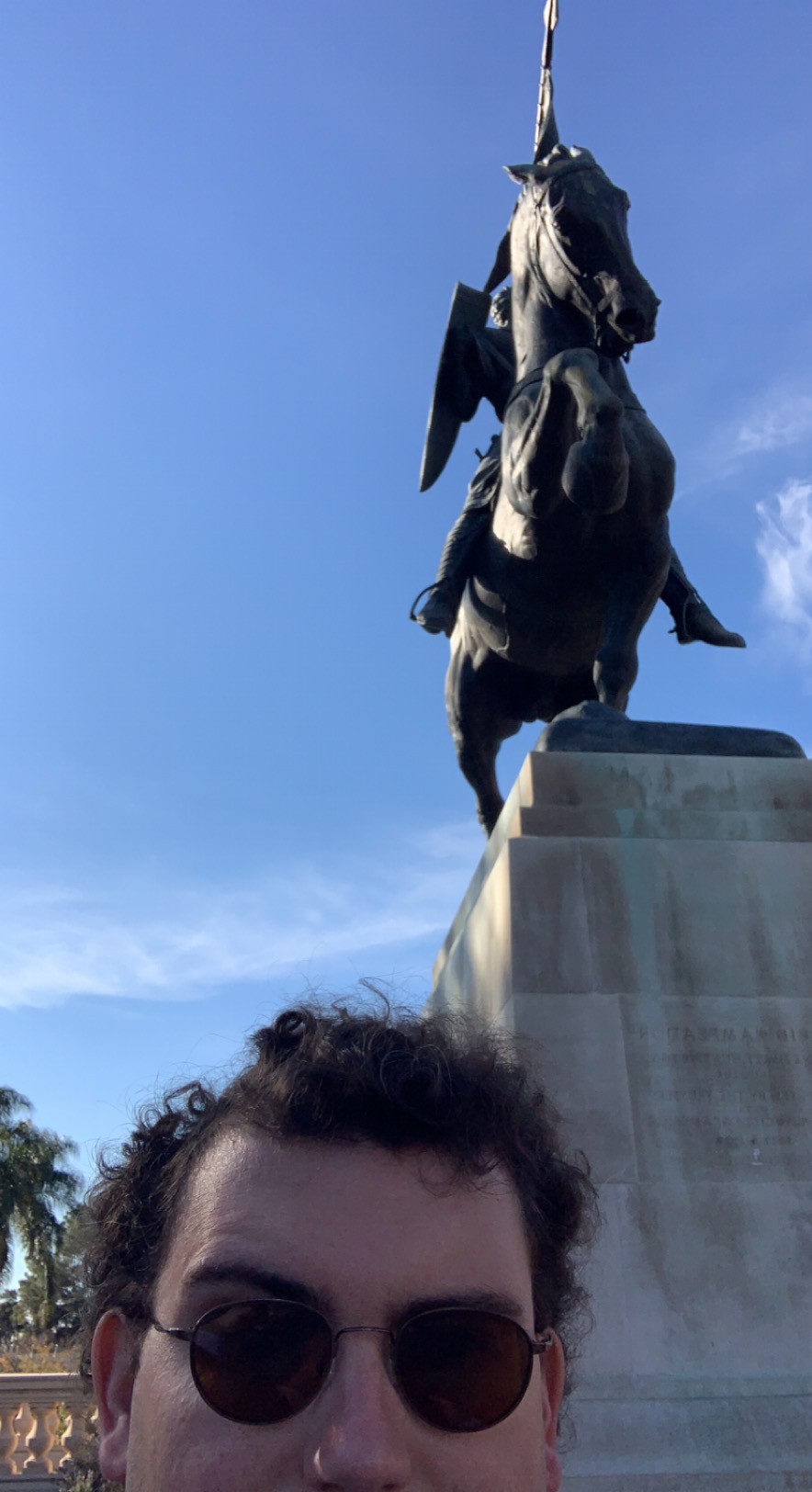
A selfie I took beneath the statue of El Cid in Balboa Park’s Plaza de Panama in San Diego on Halloween 2021.