How distractions can be beneficial or detrimental, from a certain point of view.—Click here to support the Wednesday Blog: https://www.patreon.com/sthosdkaneI recommend you now listen to: On PausesA link to the WBEZ Chicago story referenced in this episode.
How distractions can be beneficial or detrimental, from a certain point of view.
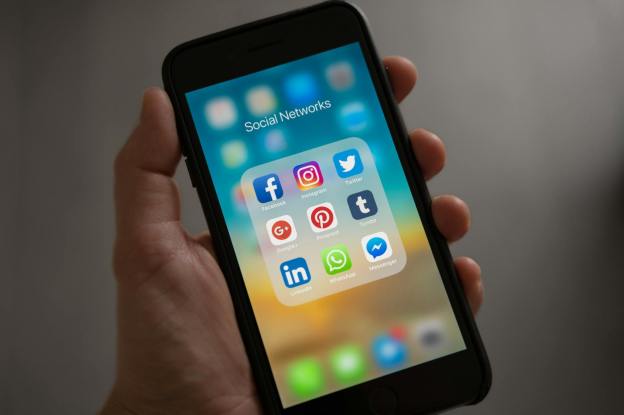
On February 21st, a story appeared on the WBEZ Chicago website with reactions to Illinois Governor J.B. Pritzker’s proposal to restrict cellphone use in all public and charter school classrooms. Mine was the first generation of students to have access to cellphones, and from day 1 it was a noticeable distraction for everyone in the room when someone brought their phone to class. Whether looking at the teacher who was trying to do their job in spite of a new topic to chide students over, or to the other students who see that one of their fellows is challenging the classroom’s authority so brazenly, to the student carrying the phone who now had a ready means of ignoring the teacher and missing out on the lesson, phone use is a problem for all.
In all honesty, I’ve been that student from time to time. In some classes it wasn’t a cellphone as much as it was a computer or a tablet that distracted me from the lesson or lecture at hand. In other cases, it was the unavoidable glow of the screen in the row in front of me shopping for shoes or looking at Spring Break trip ideas that drew my attention away from the topic at hand. Looking back, I recognize a noticeable drop in my attention and focus when these technologies began to enter the classroom, just as I notice now how I stopped reading nearly as many books once I discovered YouTube.
The idea of the distraction is often subjective; sure, in the classroom the student is supposed to be paying attention to the instructor, yet beyond that setting what are all the trappings of life but distractions from other facets which to varying degrees we ignore? This isn’t inherently a bad thing. Considering how troubled our times are fast becoming I have made a point of trying to find happy things to look at every day, and in some instances, I send these along to friends who I hope will benefit from smiling at something no matter how inconsequential.
In WBEZ’s report on student reactions to the Governor’s proposal to ban phones from classrooms the reactions were mixed. Some reactions speak to concerns about staying in touch with parents during the school day, especially in case of safety issues. I understand this point, it speaks to the reality that we’ve allowed ourselves to live in an increasingly dangerous society, and to that danger we need resources to mitigate it all while ignoring the underlying problems. We can distract ourselves from addressing gun violence, yet the shootings will continue all the same.
In my own experience the best classroom settings were those where the students either were mature enough to not pull their phones out in class or where they didn’t have their phones with them at all. In a recent substitute teaching job, I found that I was not only competing with student apathy toward following a sub’s instructions but that I also had to compete with students watching all manner of videos on their phones from Netflix and YouTube to TikTok, Instagram, and Snapchat. I simply can’t compete with these bright screens, and as most schools don’t inform their substitutes of any school policies (which allows students to abuse those policies when a sub is in the room), I’m at a tremendous disadvantage in that position.
Today, as I write this blog post I have one conference presentation I need to write and an article submission that I need to revise. The former needs to be done in the next month and the latter by June 1st. In short: I have things I need to be doing right now, yet I can be more flexible with these extended deadlines and keep the Wednesday Blog going for another week. This publication of mine may seem like a sort of distraction to some of my colleagues, yet I feel it is a tremendous opportunity for me to write about topics that I have ideas about which my research doesn’t cover. After I write and record this blog post I will take full advantage of the good weather today (sunny with a high of 65ºF / 18ºC) and go for a long walk this afternoon. After that, I might look at these two projects again. As I said earlier in this paragraph: I have time to wait on both of them.
Returning to the topic at hand: whereas in my teenage years I found it empowering to have a school-issued laptop which I could use in class, today I yearn more for the days before that technology became so accessible to me for the sole reason that I could focus more on the moment at hand. Perhaps the greatest distraction that we’ve created for ourselves is our indefatigable busyness that keeps us moving at full speed whenever we’re awake. We fear boredom because we haven’t allowed ourselves to spend enough time surrounded by the silence that it brings. I wrote about this in October in the context of pauses in the dialogue of the Kate Winslet film Lee. I don’t know if I have any suggestions for systemic change this week, merely advice that each of us ought to look at what we think is most important for our lives and our enrichment. We only have so much time around, so the best thing we can do is to use it wisely.
This week, talking through three terms I’ve historically had trouble understanding: epistemology, ontology, and teleology.—Click here to support the Wednesday Blog: https://www.patreon.com/sthosdkane
This week, talking through three terms I’ve historically had trouble understanding.
A major turning point in my life came at the end of 2014 when I decided to drop my philosophy major to a minor and not take the final class that I needed to complete that major. The class in question was Continental Philosophy, and it remains one of those decisions that I regret because it closed some doors for me in the long run even while it seemed like a reasonable decision in the short term. A year later, now working on my master’s degree in International Relations and Democratic Politics at the University of Westminster, I was reminded daily that I really should’ve just taken that last class because so much of what we were studying was based in continental philosophy.
I initially pursued a triple major in History, Philosophy, and Theology and a double minor in French and Music at Rockhurst University. I was quite proud of the fact that up to that point in my seven completed semesters at Rockhurst that I’d been able to juggle those three majors and the two minors while still having an active and fulfilling social life on campus. I went into Rockhurst with several vague ideas of what I might want to do with these degrees when I was finished; notably I remember both considering doing a Ph.D., likely in History, and possibly going from Rockhurst either into the Jesuit novitiate or into a diocesan Catholic seminary to become a priest. The first four years of Catholic seminary is comprised of that philosophy bachelor’s degree, so it felt like a good idea to undertake that at Rockhurst and keep the door open.
Now ten years after I would’ve finished my undergraduate with that philosophy degree, I realize that even as I continued to consider holy orders that I may well have properly begun to close that door in my early twenties, not feeling that the priesthood was the right fit for me in spite of what many people have said. Even then, most of the other professions that I’ve considered have been shrinking in one way or another in my lifetime. It feels here as in so many other aspects of my life that I was born at a high point in our society’s capacity to consider the arts, humanities, and even the sciences and that as I’ve gotten older that capacity has diminished time and again. Even while I continue to be frustrated to remain in these wilderness years, I nevertheless continue to learn and to grow in my understanding of what is possible for me to do in my career.
In the last seven years I’ve reasserted myself as a historian first and foremost, settling into the Renaissance as my period of study in late 2017 and gradually shifting from considering the history of Englishwomen’s education to the history of translation to now the history of natural history. Yet all of these disciplines lie under the common umbrella of intellectual history. My manner of writing the history I craft tends to speak toward French notions of mentality and perception, while the economics I still occasionally encounter in my work speak to Max Weber’s notions of capitalism as a broader Cross-Channel enterprise including Brittany and Normandy alongside England, Picardy, Flanders, and the Dutch Republic. I’m beginning to try out a new method of writing history that draws on the natural sciences to better understand the animals and other natural things described by my Renaissance cosmographers and natural historians.
Amid all of this, three words continue to appear, three words which I have often had trouble remembering their meaning. These three are epistemology, ontology, and teleology. In spite of my training in Ancient Greek, I still have trouble keeping these three apart. They represent three central tenants of philosophy which help make sense of how we understand things. It may not sound like the strongest topic for a riveting podcast episode, but for those of you listening bear with me.
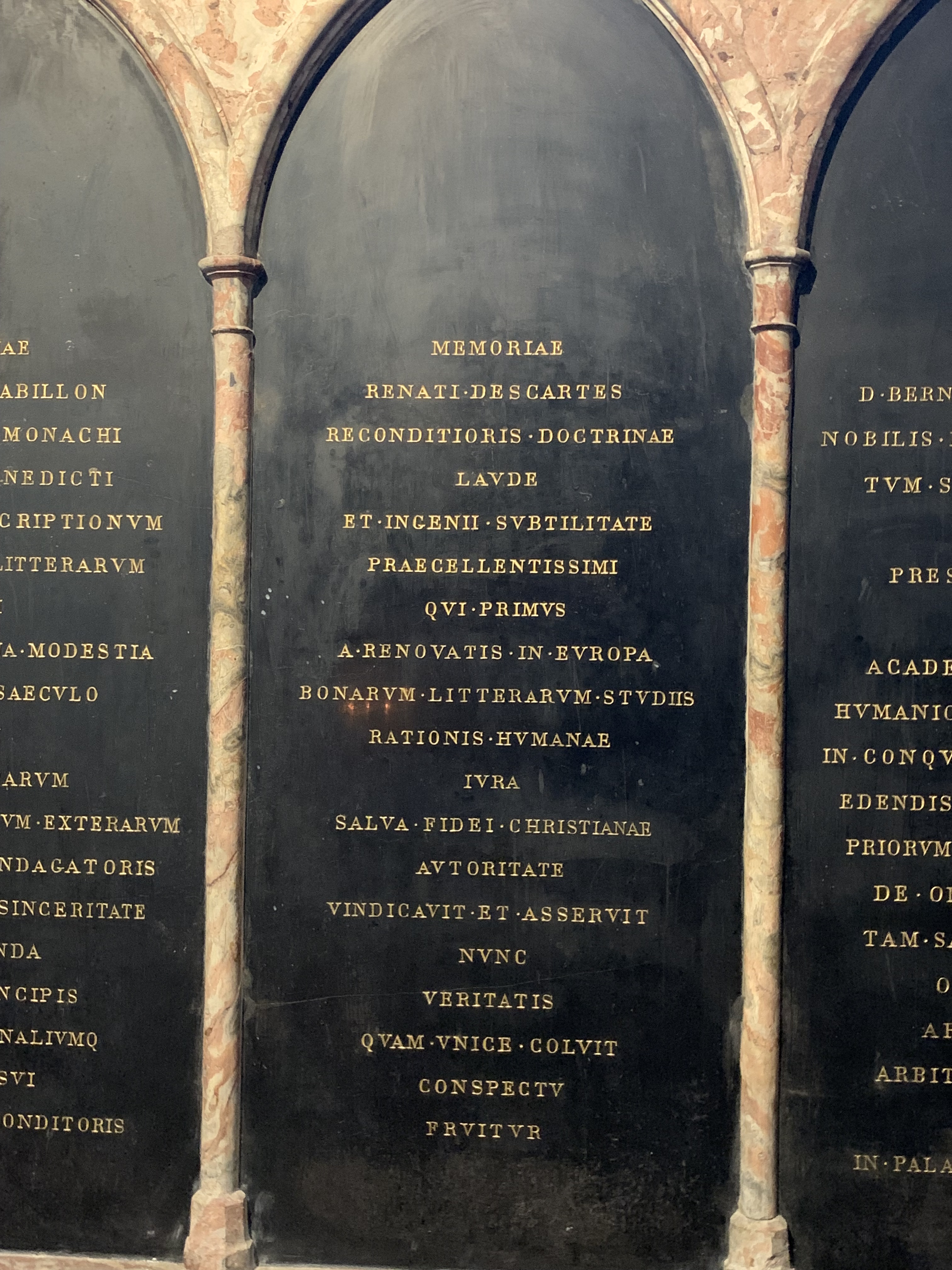
Descartes’s tomb, photo by the author.
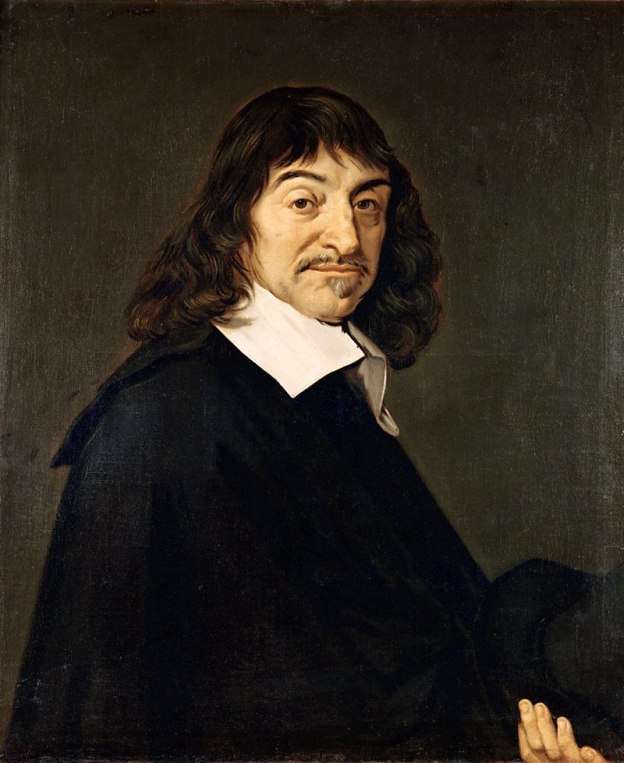
Epistemology is the theory of knowledge. It distinguishes things which are justified from mere opinions. This theory of knowledge considers propositions about facts, practices which form knowledge, and familiarity with an object thus allowing the subject to know it. This word episteme in Greek (ἐπιστήμη) translates into English as both knowledge and science. Science itself is a word which at its core refers to knowledge, for the root Latin verb sciō means “to know.” We know for instance that we exist because we can recognize our existence, in Descartes’s famous words “I think, therefore I am.” I made a point of visiting Descartes’s tomb in the Abbey Church of St. Germain-des-Prés when I was in Paris in October 2023 because so much of my own philosophy is Cartesian in its origins. I reject the principle that we could be living in a simulation on the grounds that based on what we can know and perceive we are not inclined to accept such a suggestion.
The second of these words is ontology, a branch of metaphysics dealing with the nature of being. This word derives from the present participle of the Greek to-be verb εἰμί. I stand by my assertion that the life we are living is real because we can recognize it in large part because the best explanation that I’ve found for the course our history has taken is reliant on us having the freedom to decide the courses of our own lives. This free will explains how a society can seem to take steps backward even while the chaos those retreats cause is to the society’s detriment. The method which I am developing in my research to understand the nature of historical animals using modern scientific research is ontological in character. I can test if this method will work by applying it to particular individual animals who appear in the historical record and determining their true character by a process of eliminating candidate species until the animal’s own species is determined. In this search for the nature of these animals I hope to prove that the historical past, before the development of the scientific method in the seventeenth century, is valuable to the natural sciences as a means of understanding the longer-term nature of other animals during the period in which human influence upon nature was growing toward the Anthropocene which we find ourselves in today.
I like to think of ontology in the linguistic context of how the copular to be verb appears in our literature. Think, for instance, of how God is identified in the Bible. In the story of the burning bush, the Divine is referred to as “I Am that I Am,” or rather the purest expression of existence. For this reason, when I was an undergraduate in my theology major, I began to refer to God as the Divine Essence owing to the root of essence in the Latin copular verb. English recognizes a far wider set of states of being than does Irish. Where in English I might say “I am sad,” in Irish I would say “sadness is upon me,” or “Tá brón orm.”
The third of these words is teleology. This is the explanation of phenomena in terms of their purpose rather than the manner of their invention. Τέλος (telos) is the Greek word for an end, an aim, or a goal. The purpose of something’s existence then is at focus here. I do question this idea that we have a specific purpose in life, perhaps because mine has not gone quite how I expected. In my Catholicism, the most teleological concept we retain is the idea of a vocation either to holy orders, marriage, or to the single life. The teleology at play here speaks to some sense of destiny which I feel stands in opposition to our free will. Perhaps there is some purpose to life, at its initial conception in the first moments that matter began to form in the void that became our Universe, yet I do not believe that I can perceive any intended influence beyond the flick of the first domino at the Big Bang. We may not even be sure that the Big Bang was the beginning of everything, after all there had to be energy to build up to cause such a tremendous explosion in the first place. In a theological view I would point to the Incarnation of Jesus as an example of telos in our history, I am a Catholic after all. My lingering question is where should that theological teleology interact with the other ways of knowing?
I’ve written here before about my view that belief and knowledge are two distinct yet interrelated things. One must believe in one’s senses to know, yet there are things in which one can believe without knowing which one cannot know without believing. The prime example of this is God; “I believe in One God,” it’s something I say every week at Mass in the Creed, “Credo in unum Deum,” in the Latin original of our Roman Missal. Yet God alone is a tremendous challenge to know because God is both paradoxical and far greater than the extent of my knowledge. For this reason, we had the Incarnation, as we recite in the Creed:
“I believe in one Lord Jesus Christ,
The Only Begotten Son of God,
Born of the Father before all ages.”
For God to be knowable God needed to come down to our human level in the person of Jesus, God the Son. This was Jesus’s telos, to be known, to be heard, and as we believe restore faith in God and cleanse humanity of original sin. Here there is a collision of belief and knowledge, where something clearly happened about 2,000 years ago because a new profusion of faith occurred, beginning in Judaea and spreading around the Mediterranean World in the Roman Empire and beyond to become Christianity. That new religion adapted to fit the cultures it encountered, so as to be more acceptable to its new converts. Today that collision continues in the Eucharist, the most sacred of all seven sacraments, in which we Catholics alongside our Orthodox brothers and sisters believe that God becomes flesh again in the sacramental bread and wine. Can we know that it happens? Not by any scientific measure, yet something does happen. That something is perceptible through belief, and it is the Great Mystery of the Faith that has kept me in the Catholic Church in spite of the ecclesiastical politics and divisions of our time.
My Irish Gaelic ancestors understood Christianity in their own way, aspects of which survive into the present day. That collision of belief and knowledge looks to some lingering folk belief, or superstition if you will, that I’ve inherited of particular days in the calendar when the worlds of the living and the dead could collide. We see this most pronounced in the old Gaelic calendar on Samhain, which developed through Catholicism into Halloween, the Day of the Dead, and All Souls’ Day around the beginning of November. I see All Saints’ Day fitting into this as well, after all the Saints are our honored dead all the same. Likewise, Bealtaine, the celebration of the coming of Summer at the beginning of May is also the Catholic celebration of the Crowning of Mary, something I attended at Rockhurst on several occasions.
What in all of this can I actually know? I know the stories that have survived from before St. Patrick and the coming of Christianity to my ancestors 15 centuries ago, even if those stories are Christianized in some way or another. I know this just as much as I know that Jesus existed in the first century CE because there are effects of these stories in the lives and histories that are remembered down the generations. If these stories have any teleology, it’s to teach us lessons about life that our ancestors learned so that we might not have to face the same trouble all over again. The folly of humanity is that we are resistant to having a clear purpose or end to our aims. Through our free will we know that there are always many options to choose between.I don’t know if I made the right choice in dropping that philosophy major at the last moment. In many respects, it was a poor decision. I learned from that experience and many others in my early life to stick with things until their conclusion. This learning is something that has been tested to grow beyond mere opinion through belief into something that is verifiable. When I look at my prospects in my doctoral program, I always decide to stick with it because I don’t yet know what my prospects will be like once I’ve earned it, something that I do know having 2 master’s degrees and a bachelor’s degree to my name. I have gained a great deal of epistemic experience through all these memories that have informed the nature of my character. Yet where they lead I cannot say, for the purpose of my life is something I continue to decide day by day.
This week, how numbers are both a universal language and symbols representing deeper meaning.—Click here to support the Wednesday Blog:https://www.patreon.com/sthosdkane
This week, how numbers are both a universal language and symbols representing deeper meaning.
Consider, if you will, what meaning a number holds if unaffixed to an object for calculation or counting? What does six mean if disassociated from the rest of its sentence? Some numbers are recognizable for their meanings due to the broader cultural connotations held by those definitions. A learned reader who sees 3.14 written on a page will recognize that as the first three digits of the value of π, yet without the decimal a Midwesterner will recognize 314 as the telephone area code for the City of St. Louis. Similarly, while 23 holds significance as Michael Jordan’s jersey number to millions if not billions of us who remember the greatest Bull play around the millennium, to others 23 is just another prime number.
Numbers in themselves can only exist beyond the abstract if they account for something. The life is blown into the Music Man’s best known song by the “76 Trombones”; Professor Harold Hill’s exhortation to the people of River City, Iowa would’ve fallen flat if he called on them to raise the funds and enthusiasm for “76” alone. Perhaps the patriotic connotation of that number, 1776 was the year of this country’s birth, might’ve stirred some hearts, but a number alone cannot bring a parent to tears quite as well as hearing their child blow the life out of a trombone for the first time.
It generally annoys me to hear numbers be used with minimal context. I don’t always know what the speaker is referring to when I hear a given number, and in that instance while mathematics may be the universal language the way we use it requires greater linguistic framing. Language can readily transform numbers that otherwise would be subordinated into defined objects of their own. Consider the penny; on the one hand it is merely 1/100th of a dollar in this country or 1/100th of a pound in the U.K. Yet a penny saved is a penny earned, and if Poor Richard’s maxim is to be believed a penny in itself is something beyond its diminutive status in hard currency. The value of the penny has shrunk a tremendous amount in the last century to the point that for the last quarter-century it’s cost the U.S. Mint more to make an individual penny than the value of the penny itself.
The penny is in a less stable place today because of inflation and our society’s transition toward digital currency. How often do you see products priced at 1¢ in stores anymore? With all electronic payments for things, no coins or banknotes are needed to complete the transaction. The unfortunate incident of coming up a few pennies short when paying for something is no longer a problem unless your card is denied. Yet for the cash-users among us losing the penny means they can no longer aim for exactness when paying for things. If a product is priced at $4.99 and you give the cashier a $5 bill you won’t get that penny back. I’d probably shrug it off, but still, I’d feel a twinge of unfulfillment and a residual sense that that shop now owes me money, even if it’s practically worthless. There lies the one great flaw in this plan: the penny is so ingrained in our culture; it’s been one of our coins since independence and even before then pennies go back to Charlemagne’s denarius (thus why in pre-decimal Britain and Ireland the penny was abbreviated d.) The Carolingian denarius of the 8thcentury CE was in turn borrowed from the Roman denarius which was introduced during the Second Punic War (218-201 BCE). So, the penny has been around far longer than most other coins we use here in the United States, and its name transcends this country where it represents 1 cent. The penny still gets used in Britain as the 1 pence coin, there even that word pence is another plural which is synonymous with our pennies.
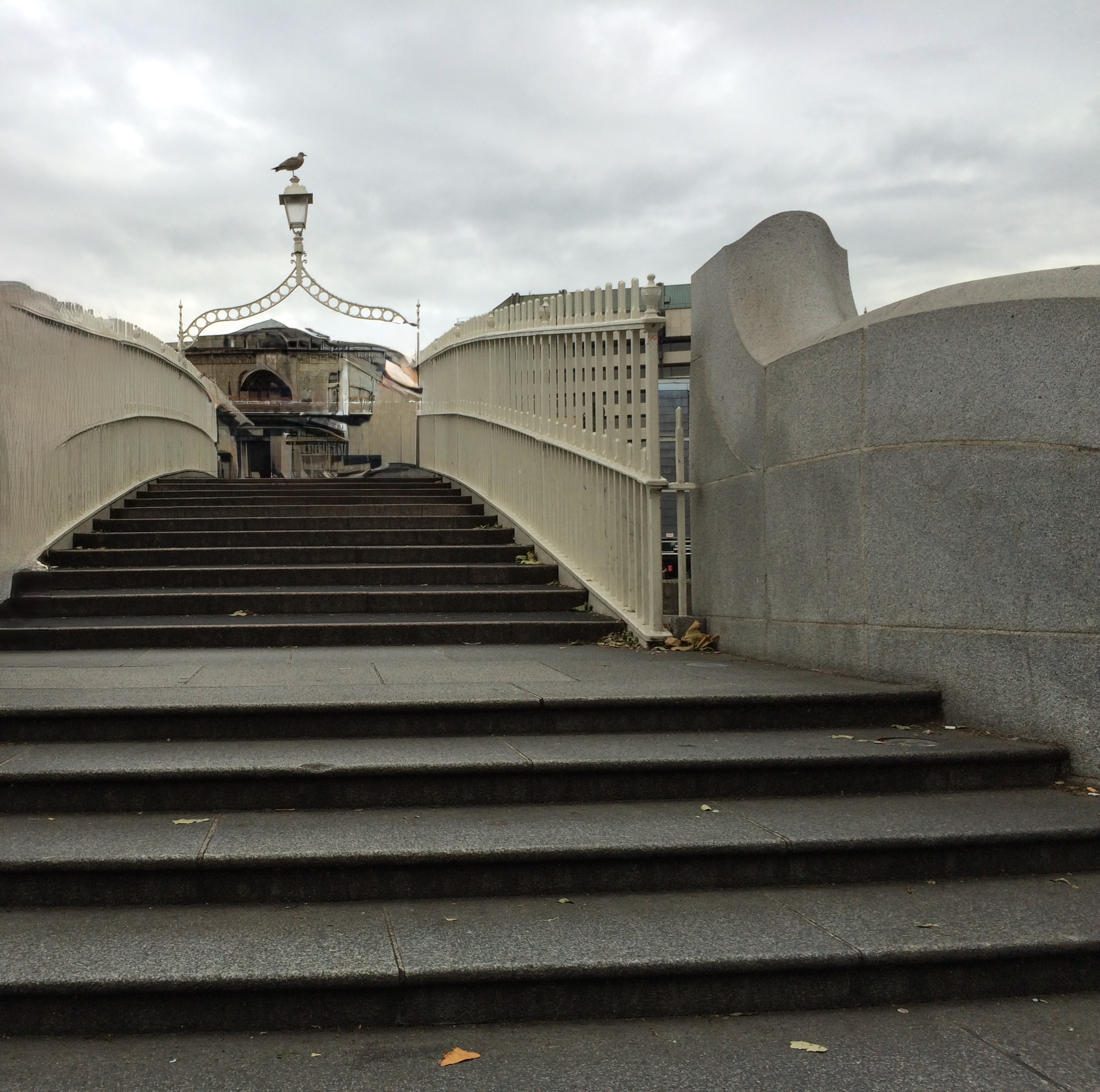
My photo of the Ha’penny Bridge from August 2016.
In older songs and stories, we still remember when the penny was valuable enough to be subdivided into ha’pennies, or half a penny. At that time, the British penny was worth 1/240th of a pound, in a pre-decimal system that was replaced in 1970 with the current pound-pence system. Dublin’s Ha’penny Bridge is named for the tolls that used to be collected to cross it. Even smaller denominations of the pre-decimal pound such as the farthing (1/4d.), and half farthing (1/8d.) were also minted. Clearly then the penny had more value in the past than it does today. I was struck when I moved to London in 2015 how you could still find goods for sale in the groceries priced less than £1, especially bread. That is almost unheard of in my own country anymore. I think this also speaks to a broader transition in the way we think away from older pre-decimal systems toward ones that work better for computers. After all, the primary method by which we interact with numbers anymore is through our computers who tend to do most all of the calculations for us.
One effect of that shift is that fractions now feel less practical. I was taught fractions in school well before being taught about decimal places in what now feels like one of these pre-decimal holdovers. To an extent I still think in fractions, perhaps thanks to our continued use of the quarter (1/4th) among the coins of the US dollar or the weighing of meat in fractions of a pound. Fractions on their own require that they represent a portion of another number, they cannot exist independently. ¾ is three-quarters of something, yet again here context is key. A musician will look at that fraction and read it as ¾ time, or a 3 beat measure where the quarter note gets the beat. Yet again there: this refers to a quarter note. That musical note may be the default note that gets played, with the ascending and descending scales of note length from that point, yet it still is ¼ of the length of a whole note. I love how in English we’ve mixed Latin and Germanic terms together to describe quarters, halfs, wholes, and such. This word quarter is Latin in origin, coming from the ordinal number fourth in that language: quartus. A quarter then is a fourth of an object.
I remember learning my fractions in school, and I still use them a great deal in my daily life. They’re practical when I know the total number of objects I’m dealing with and when I need to subdivide those objects to ensure maximum efficiency or spread. If I have 4 slices of bread left and I know I won’t be able to make it out of the house for a day or so because of snow, I’ll portion those slices out, so I don’t run out until I have the next loaf in hand. For tangible things that exist in the physical world comparing them as fractions (that is dividing the portion by the whole) helps me understand the numbers I’m dealing with.
Yet again, the quotient produced by that division, the result of that fraction is almost always written in decimals. I think of decimals as a product of the development of the metric system in the late eighteenth century. They are fundamentally more rational, and easier to program into a computer. Rather than asking a computer to translate from the more human fraction one can instead speak to the computer in its own language and let it do its computations faster and more efficiently. Today then, I use decimals far more than fractions. What’s more, each decimal number can exist independently of any other figure. 0.25 is simply 0.25, it’s not inherently a quarter of something else. When I see that price tag of $4.99 in the shop, I think of it as just a hair below $5, and am willing to hand over a $5 bill despite that being worth more than the product I’m buying. If I get my penny back or not is less of a concern, after all in this decimal mindset the penny is almost worthless, so what’s the bother if I lose a few cents here or there? Consider that sentence again though: a penny is a cent, or 1 percent of a larger number, namely $1. Even here when contemplating the penny as 1 cent or $0.01 it is still 1/100th of a dollar. Sure, eventually losing those pennies in every transaction will add up, but it’s going to take long enough that it doesn’t register as a problem for me.
Percentages are another sort of number that’ve grown in importance in my thinking in recent years. We mostly encounter percentages in tipping these days. There’s a tender balance here between tipping a percentage digitally or a whole dollar depending on the initial value of the bill of sale. When doing my own mental math, if I get a rough idea of what 20% of something will be I might decide to round up to the nearest whole dollar when writing a tip on a receipt. Yet those tip screens we see at nearly every business changes the dynamic slightly. Instead of leaving room for that rounding up they offer us the exact sum of 20% of the total bill down to the nearest cent. There’s something lifeless yet efficient about this. This is a number to be sure, yet it represents something human and social that ought to be seen in that light rather than just numerically.Mathematics is the purest language, it’s the one most often looked to as a solution for how we might communicate with other intelligent life who surely wouldn’t know how to speak any of our human languages. Yet all numbers are infused with emotion and have a myriad of deeper meanings than the sum of their parts. In balancing budgets, we could just look at the numbers and cut where seems fitting, yet there is always a human side to every budget line. Each cut is something taken away from someone, a potential line of funding removed that otherwise would’ve contributed to someone’s livelihood and helped them make something new and exciting. Numbers can and do reflect people, and they always have. They can exist in both the abstract as just numbers and the real as representations of people and objects. More often than not, we see them in the latter context. The mathematician is warranted to consider the human in their calculations, lest they clip one cent too many and leave too many of us people without the values we need to survive and thrive in this world we’ve built for ourselves.
This week, I discuss how my experience working with genealogy databases helped prepare me to be a professional researcher.
—
Click here to support the Wednesday Blog: https://www.patreon.com/sthosdkane
This week, I discuss how my experience working with genealogy databases helped prepare me to be a professional researcher.
One of the things that struck me about the history that I liked to read as a child was that few of my own ancestors’ names appeared in those books. I remember sitting up late at night in my elementary school years reading these fifty or sixty year old children’s histories of the Vikings and the Romans and imagining the illustrations to life. I could convince myself that I could hear, even on the softest level, the oars of the longships pushing with the current of the Thames as the ropes that tied their sterns to the pillars of the old Roman London Bridge grew taught. I’d return to my regular school day the following morning, to Mass and eight hours of classes introducing me to everything from basic mathematics to orthography and English grammar to music, yet when we had our hour in the school’s library the books I knew to search for were the histories.
My elementary school, St. Patrick’s in Kansas City, Kansas, was founded in 1949 and most of the history books dated from the late ‘40s and early ‘50s, by modern standards they were historical artifacts in themselves. Moving forward I didn’t have access to the same kind of library after my middle school years, my high school had a “media center” that functioned like a library, yet I never remember finding books to read there. So, one of the first places that I went on arriving at Rockhurst University in August 2011 was the upper floor of the Greenlease Library to wander around with my new friends and see what books lived there. I made great use of that library during my four years at Rockhurst, and before the pandemic continued to occasionally check books out with my alumnus privileges.
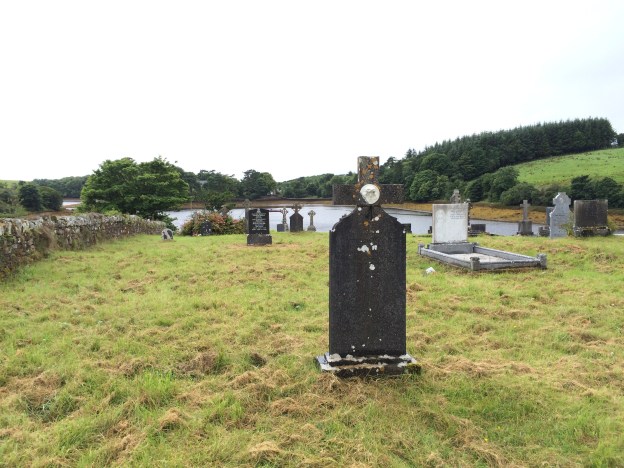
Yet when I was probably 8 or 9, on one trip back to Chicago my grandmother Mary Lou Kane gave me a book about Irish folklore, and I began to hear stories about my family’s history from her and other relatives. I’d known our ancestors were Irish for as long as I could remember, I was 7 when my grandfather’s aunt Catherine McDonnell died; she was one of the last immigrants and probably the last native Irish speaker in our family. Just before my 10th birthday on a trip to England I met my Welsh cousins who introduced me to that side of my maternal family. We kept in contact writing letters back and forth every now and again.
This all led to my formal introduction to genealogy when I was 13. At that point I talked my way into starting as a volunteer at the institution then known as the Irish Museum and Cultural Center, now the Irish Center of Kansas City. The director at the time thought I was 16 but let me stay after I showed I could be responsible. There were days where I was the only one in the little office we had in the lower level of Union Station, and among my responsibilities was to help the frequent visitors with genealogy questions about their own Irish ancestors. I became familiar with the different genealogical databases around then and steadily built up a good knowledge of where to look for what sorts of records and had the occasional success finding a long-lost relative for someone. I continued volunteering at the Irish Center until around my 19th birthday, when now an undergraduate at Rockhurst with a growing list of clubs on top of my three majors and two minors I stopped volunteering at the Irish Center.
I’ve had a fair bit of luck with researching my own family history. My own database is built upon the work of several relatives on both my paternal and maternal sides who did a lot of the initial research. What I’ve done is to fill in some of the gaps and to elaborate on the circumstances of these people’s lives. This has come into handy here and there, I was fortunate enough to visit the building where my Finnish 4th great grandfather worked as the town judge in the southwestern port town of Rauma in the mid-nineteenth century. Moreover, my Dad wouldn’t have his Irish citizenship through descent were it not for the research done by myself and several others that helped find his grandparents’ birth certificates.
My one genealogy position as an adult that I undertook was as a volunteer in the genealogy reading room of the National Archives’ Kansas City regional office. I regularly attended to this position for a good year and a half while I was beginning my M.A. in History at UMKC. It was fun at times, though in many other occasions it could become quite dolorous as the cases I was often presented with were unsolvable or restricted in some ways or another. I left that position as my work at UMKC began to grow, around the time I started writing my second M.A. thesis in fact.
All this research that I’ve undertaken for myself and others in genealogy helped prepare me for my work as a professional historian where so much of what I do is search through databases looking for archival sources that will offer the glimpses into the past that I need to write my work. At some point once I feel confident that I’ve done enough historical research to earn my first professorship I intend to turn to the boxes of family papers collected by long-time Wednesday Blog reader Sr. Mary Jo Keane, one of my grandfather’s cousins, whose research is the foundation of what I know about my paternal family in Mayo. When she died, I took those boxes with me with the intention of writing some sort of family history like the one she intended to write in her last years.
We often talk in the historical profession about history from below as one of the newer genres of history-writing. I’ve liked this idea since I first heard about it, and in some sense, I’ve tried writing from the perspective of the animals which are at the heart of my professional research to varying success. Genealogy is often history from below because as much as we may hope to find some famous ancestor––at one point Ancestry.com claimed to prove my relations to several famous people––it really ought to be a recognition of who our family has been in the generations that we can still find. It is a supplement to memory even as that living memory of our past fades. At Kane family funerals I would often learn something new about the immigrant generation in my family, my great-grandparents, that would explain their lives just a bit more. Those stories turn these people from just being figures on paper into memories that have some of the color and life of those illustrations in my childhood history books. I want to know more about my family’s past to understand how I fit into our world today with its progress and troubles all the same. In the first half of the last century that generation lived through world wars, the Irish War for Independence and Civil War, the Great Depression, and a global pandemic. And through it all they took the bold step of leaving home and starting a new life for our family in Chicago. That life was the one I was born into at the end of the last century, and even after my parents & I moved to Kansas City that life in Chicago still forms the bedrock of my life and perception of things today. None of this would be nearly as personal or as impactful if I knew nothing about the ancestors I never met. It’s thanks now to all this research in genealogy that they live on in my memory today.


 Wednesday Blog by Seán Thomas Kane