
Monthly Archives: March 2025

On Translation

This week, how I take nuance and particularity into account in my efforts as a translator.—Click here to support the Wednesday Blog: https://www.patreon.com/sthosdkane


This week, how I take nuance and particularity into account in my efforts as a translator.


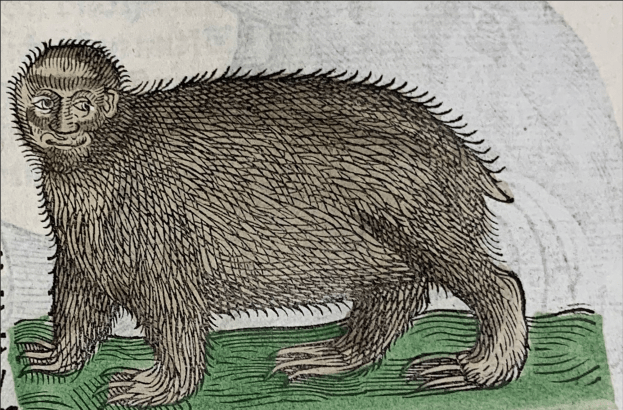
When I chose to study André Thevet (1516–1590) and the three-toed sloth in August 2019 I did so because I already knew French and the need to learn a new language was less pressing than if I’d chosen to study another source in the history of natural history. I chose Thevet because it was practical, and I chose the sloth because the thought of being a sloth historian made me laugh. From the first day working on Thevet, I found that my understanding of his books was heightened when I took the time to type out my own translations of his text. Thevet wrote in Middle French that is native to the middle decades of the sixteenth century. I arrived at this project very familiar with Early Modern English, the contemporary form of this language to Thevet’s time, as my history master’s thesis delt with sources in that chronological variety of English from Thevet’s generation and the one just before. I’ve never had much trouble understanding the most prolific author of Early Modern English literature, Shakespeare, but I think I’ve had a tolerance for varieties in speech that’s allowed for me to try to think beyond my own millennial Midwestern metropolitan American English and be willing to understand the likes of Shakespeare from a young age.

So, when I began translating passages from Thevet’s Singularitez de la France Antarctique for my own professional use in my dissertation, I decided that as long as I was translating that book I might as well translate it with the intention of sharing Thevet’s words beyond the scholarly analysis and critique which lie at the heart of my work as a historian. This first draft is built around the 1558 French edition published by Christophe Plantin (c. 1520–1589) in Antwerp and contains footnotes drawn from the 1878 French edition by Paul Gaffarel published in Paris, two Brazilian Portuguese translations by Sergio Amado (1978) and Estêvão Pinto (1944, using the 2018 reprint), and the partial 1986 English translation by Arthur Stabler and Roger Schlesinger which contains only Thevet’s North American chapters.

I finished the first draft of this translation in Summer 2023 and am now looking ahead toward the second draft which is the next stage of the project, and I hope the last one before I feel confident in formally writing to the publishing editors whose press sales agents I’ve spoken with about this project at conferences over the last two years. The second draft will consist of two main stages. First, I will cross-reference my translation and the 1558 Antwerp edition on which it is primarily based with the 1557 first and 1558 second editions published in Paris by Maurice de la Porte, two Venetian editions translated into Italian by Giuseppe Horologgi and published by Gabriel Giolito de’ Ferrari (c. 1508–1578) in 1561 and 1584, and the 1568 full English translation by Thomas Hacket published in London by Henry Bynneman. Second, I will seek to make my translation more understandable for a 21st century English-speaking reader while endeavoring to preserve Thevet’s particular mannerisms and voice, a writing style with which I’ve become quite familiar in the last 6 years to the point that I can now confirm at least two French translated manuscripts in the Bibliothèque nationale’s collections in Paris are verifiably written by Thevet. He had a way of writing that’s unmistakable.

These two competing axes create a binary star system around which my translation revolves. On the one hand, I want to be true to the original text, to preserve the author’s voice and something of their spirit which remains in those words. On the other hand, I need to make my efforts readable for my own contemporaries. Thevet and his contemporaries are notorious for long run-on sentences that would make Hemingway shake his head in earnest frustration. Where do I break up a long sentence while preserving its overall integrity? Furthermore, at what point should I decided to remove the bracketed notations of page breaks in the original text? There the 1558 Antwerp edition is most fully evident as its pagination has several quirks that make it stand out from the 1557 & 1558 Paris editions. At this point, Plantin published books with folio numbers rather than page numbers, so the first two pages were in fact folios 1 recto (1r) and 1 verso (1v). These names refer to the custom that scribes traditionally started writing on the back side of the vellum (recto in Latin) and then flipped the skin over once ready to continue writing on the verso, or opposite side. In several instances the folio numbers actually decrease in the book, notably in Thevet’s chapter on the sloth, which makes the footnotes on that core element of my research particularly confusing if you’re paying close enough attention. So, in summation the inclusion of the page breaks with the folio numbers keeps my translation grounded in Plantin’s edition, however that may break up the text in an uncomfortable way for some readers.

Ultimately, I am not the author of this book, merely a herald relaying it on for our time. My voice is there in the handful of introductory chapters I’ve written to go along with this book. These chapters describe Thevet as a reader of travel literature and place his accounts of the Americas beyond what he himself saw in Brazil in the context of their French and Spanish sources. I see my efforts in this as a means of introducing the reader to Thevet, a man who today exists on the furthest margins of the popular imagination of the First Age of Exploration in the English-speaking world. Thevet remains present in academic circles, there were at least four papers presented at this weekend’s annual meeting of the Renaissance Society of America in Boston which discussed Thevet, mine included. I hope this book will be useful to fellow academics and perhaps will entice curious readers to learn more about this man who I’ve spent the last 6 years of my life getting to know.I find myself drawn as much to the effort of a translator as I do to the work of a historian these days. We live in such a fractious time when reasoned debate and earnest discourse is riddled with dangers and seemingly improbable to undertake. I feel as though I’m constantly translating my thoughts and character for others to understand me. It’s why I enjoyed my time in Boston because that city has a large enough Irish American population that when I’d tell my name to a cashier to put on a carry-out order they’d actually spell it in the proper Irish manner; this never happens in Kansas City. That said, I felt that I had to translate my expectations and personal limits to be able to live even for just a few days in a city as expensive as Boston where I was often paying double what I’d normally pay at home in restaurants. In translating I recognize that each of us think in slightly different ways and see the world in which we all live in just as unfamiliar terms to one another. Difference enhances our common humanity and elevates our manner to something greater than ourselves.
We, Irish Americans

This week, to conclude what I’ve been saying.—Click here to support the Wednesday Blog: https://www.patreon.com/sthosdkane—Sources:%5B1%5D “Signs,” Wednesday Blog 1.10.[2] “On Servant Leadership,” Wednesday Blog 6.15.[3] Percy Bysshe Shelley, “Ozymandias,” Poetry Foundation.


This week, what does it mean for my community to call ourselves Irish Americans?


When I was applying for universities for my undergraduate studies, I was thrilled that one university allowed me to write in my own answer for “race or ethnicity.” I took out my pen and wrote down “Irish.” That university, Rockhurst, is the one which I chose and attended throughout my undergraduate years, and it remains the one that I list today before the others. Rockhurst holds a special place in my heart because it is so intrinsically linked with the Irish American community here in Kansas City, and it is one of those anchors that’s tethered me to this community where I’ve been able to make my own impact and presence.

That adjective I chose to write however is perhaps more complicated. I am not Irish by birth but by descent, though one generation too far removed to qualify for Irish citizenship in that manner. Still, Irish is a better descriptor of me than the generic American white, a category which my people were only accepted into for the sake of preserving the flimsy-footed tableau that is racism in America. When I moved to London, I was surprised to be confronted with three categories of white to choose from rather than the monolith I was used to. I technically qualified for all three: I have both Irish and British ancestry, yet I am from a country other than those two. I marked the box for White Irish as long as I was living and studying there because it felt the truest to my nature. Yet again, I am not Irish per se; rather I am Irish American, a member of one of the larger camps within the diaspora created out of the centuries of trouble caused by English and later British colonialism in Ireland. In this perspective, my people are victims of colonization, yet here in America we are the colonizers. So, amid all these tangled webs of identity and nature what are we, Irish Americans?

It is notable to me that in France there is no particular legal sense of identifying oneself as anything other than French. Trevor Noah put this well when he spoke about an immigrant who was granted French citizenship by President Macron after a tremendous act of heroic bravery in saving the life of a child. Yet when I’m in France, I find that if people are confused about my name I go toward my heritage to explain why it’s not your typical Anglo-American name, that my family comes from Ireland instead. I hear a similar tone from the varied generations of nativists in this country, even in the writings of President Theodore Roosevelt, a man who I overall admire a great deal, who wrote in opposition to us persisting as “hyphenated Americans.” This country ought to be a melting pot where all of the immigrants and their descendants shed away their own national and ethnic trappings in favor of becoming one people with one common identity. Yet again, I find this perspective runs contrary to my own lived experience.

To be an Irish American means to remember the place where our ancestors came from, and to remember their struggles as they sought to live their lives first at home and later in this place their newly adopted home. To be an Irish American is to remember that we too were the immigrants not that long ago and to offer a warmer welcome to the newcomers than our ancestors often received. For me, to be an Irish American is to have roots in two countries, better reflecting the interconnected and global nature of our world. Yet at the end of the day, we are Americans. In Ireland, I refer to myself as “an American cousin,” with a slight nod to that infamous play of 1865. The Ireland that many of us know is the Ireland of our grandparents and great-grandparents, the Ireland of the revolutionary generation and the twentieth century when our families left to come to this country. The Ireland of 2025 is still the same country, yet it has grown with the last generations into something that many of us find incongruent with our expectations. It is less an island than ever before with more outposts of the global world on its shores.

Our experiences greeting this global world are different because we encountered it here in America rather than in Ireland. We relate to all the peoples of the Earth through our friendships, rivalries, and mutual circumstances with the other diasporic immigrant groups in this country. I’ve wondered for a long while, including in this outlet if we are slowly with each new generation becoming less Irish Americans and more deeply rooted in other tribes in this country. We tend to be more religious than our cousins in Ireland, and as there are less Catholic schools and parishes that are explicitly Irish are we then becoming Catholic Americans more than Irish Americans? Or are we contributing to a general secularization of that larger white American demographic resulting in both our ethnicity and our religion fading into the background of our identities as ordinary Americans trying to survive in an ever more chaotic world? The key here is that our community is diversifying between political persuasions and regional identities and an overall willingness to remain connected to the lives and histories and passions of our ancestors.

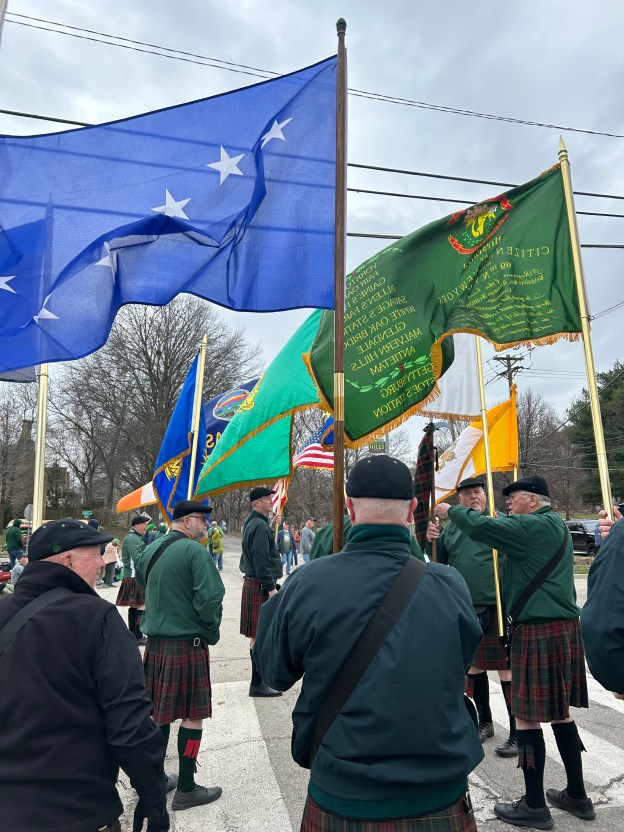
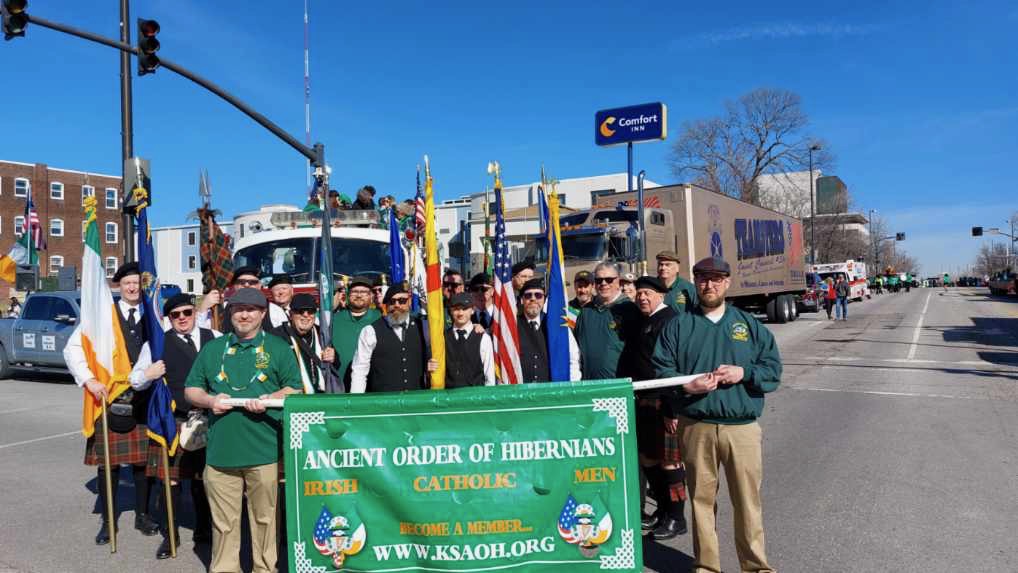
I for one have kept in touch with all of that because I believe it is intrinsic to understanding who I am. My Dad grew up under the same roof as his grandmother who came to this country from Mayo in 1920, and the fact that my parents chose to name me Sean demonstrated to me that this history was an important part of who I am even before I really began to understand what it all meant. For the record, I decided to add the fada to my name (Seán) when a little before my 10th birthday I learned that’s how it is spelled in Irish. I’ve devoted a great deal of time to learn the Irish language even though it’s not all that useful here in America because I know that it’s what my family once spoke, and in order to better understand them and by extension myself as well, I decided I ought to use one of my talents and learn it.This week we celebrated St. Patrick’s Day with our usual parades here in Kansas City. I marched in two this year, the warm-up parade on the Saturday before here in my neighborhood of Brookside and the big parade down Broadway in Midtown Kansas City on the holy day itself. Normally, I end the big parade and the holy day itself rather annoyed at how the old caricatures of Irishness and Irish Americanness persist along the route both in the parade and among the spectators. And while I did see some of that, I was more focused on marching with my brothers in the Fr. Bernard Donnelly Division of the Ancient Order of Hibernians (AOH). Many of us continued the celebration of our brotherhood and our common heritage later that day and it proved to be one of the better, and sunnier, St. Patrick’s Days that I’ve experienced in a long time. We, Irish Americans persist in our stubborn identity because we’ve built our communities in this country around our roots. It defines us distinctly from our fellow Americans, and with all good intentions demonstrates to our cousins across the water that we haven’t forgotten about them.


The Divine Essence

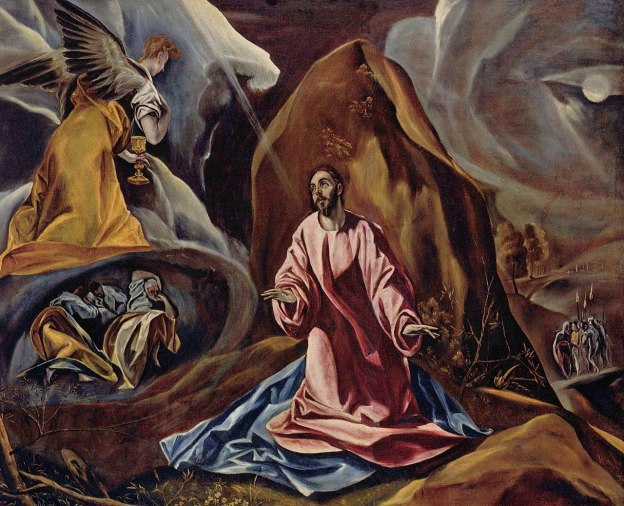
Art: Studio of El Greco, “Agony in the Garden,” (1590) oil on canvas, 102 x 131 cm, Toledo Art Museum, Toledo, Ohio, USA, ⁠National Gallery, London⁠.

This week, a meditation on the Name of God.—Art: Studio of El Greco, "Agony in the Garden," (1590) oil on canvas, 102 x 131 cm, Toledo Art Museum, Toledo, Ohio, USA, National Gallery, London.Click here to support the Wednesday Blog: https://www.patreon.com/sthosdkane


This week, a meditation on the Name of God.


At the start of Advent last November, I picked up a little blue book after Mass as an Advent lectio divina guide for the coming weeks. I’d done this several times before in Advent and Lent, the two holy seasons of preparation in Christianity, yet this time I actually read that little blue book and kept up with it each day through Christmas. By the end of it I was looking forward to being done with this one part of my nightly routine before bed, the time when I was able to sit and read the daily reflection. I wasn’t sure then if I would pick up the little black book when it appeared at my parish the weekend before Ash Wednesday, and yet when it was there, I took a copy home.

This year’s little black book offers reflections on St. John’s Gospel, the most spiritual in focus of the evangelists. Several aspects of the readings have caught my attention, usually out of a curiosity concerning the grammar or translation of the biblical text. On one early day, the reflection was on John’s recounting of the arrest of Jesus in the Garden of Gethsemane. This recounting contradicts the three other Gospels in that Jesus asks the soldiers to let his disciples go, rather than the disciples taking flight in fear of the soldiers. It is more self-sacrificial, following the prophetic undertones of the Gospel overall. Not only does this vital moment of arrest in the Passion narrative take place in a Garden, akin to the Garden of Eden where humanity’s fall into sin occurred, but it is also here where Jesus revealed Himself as God the Son. Quoting here from the New American Bible:

[4] Jesus, knowing everything that was going to happen to him, went out and said to them, “Whom are you looking for?”[5] They said to him, “Jesus the Nazorean.” He said to them, “I AM.” Judas his betrayer was also there with them. [6] When he said to them, “I AM,” they turned away and fell to the ground. [7] So he again asked them, “Whom are you looking for?” They said, “Jesus the Nazorean.” [8] Jesus answered, “I told you that I AM. So if you are looking for me, let these men go.”

(John 18: 4–8)

In this passage the omniscience of God is first revealed, followed by the humility of God the Son as merely one among them, “the Nazorean.” Here though the omnipotence of God as the Divine Essence, existence in its purest form as “I AM,”[1] before showing such mercy toward the soldiers at making it clear he was in their power and would surrender to them yet asking for mercy from them for his friends, his disciples who not being omniscient were very much afraid as any of us would be. It is the third part of this passage, the identification of God that I wish to focus on here.

The Name of God is known as the Tetragrammaton after the four Hebrew letters which comprise that Name. These are the four holiest letter combinations out there. The Name of God is too sacred to write in Judaism, and considering Hebrew is an abjad lacking written vowels it’s not entirely certain how this Name was originally pronounced before that prohibition.[2] This prohibition extends in some traditions to not even writing the word God, as it is capitalized as the common Name of God in regular parlance. I grew up capitalizing this word in reference to the Abrahamic God, who I do believe is the Creator and One True God, I don’t just recite the Nicene Creed every week at Mass to do it; and yes, this capitalization is in line with the tradition of capitalizing proper nouns in all of the languages I speak and write. Yet I’ve never really thought of God as a name, rather it’s a title in the same way that Christ is a title and Jesus the name. I’ve had some students over the years who won’t write God out, instead writing “G-d” out of respect for this title, which I think is fair. For the sake of my readers, I won’t include the Hebrew Tetragrammaton here, you can look it up on your own.

What I’m more interested in is how the Tetragrammaton was translated from Biblical Hebrew into the other languages in which I’ve read the Bible. There are really four such languages: English, Latin, Koine Greek, and Irish. 

I was first introduced to the Bible and to my Catholic faith through English, I was born in the second generation after the vernacular Mass was allowed largely replacing the older Tridentine Mass said in Latin. The New American Bible (NAB) which I read from a few paragraphs back is the translation that I grew up with, and the one which I use in all aspects of my life. It was also developed during Vatican II as the approved English biblical translation for the United States. In Ireland, Australia, and New Zealand the Jerusalem Bible (JB) is the translation used, while in Great Britain the English Standard Version – Catholic Edition (ESV-CE) is used. 

I was introduced to the Latin Vulgate and Greek New Testament and Septuagint in high school and college and today I own a copy of the Greek New Testament published by the German Bible Society (Deutsche Bibelgesellschaft). Both are key sources for the English translations that I grew up with, alongside the Hebrew Tanakh itself. I chose St. James Academy for my high school years largely because they offered Latin, and while the fact that Latin remains the official language of the Roman Catholic Church, I was more interested in reading classical Roman literature. Likewise, the first of the two Ancient Greek classes I’ve taken was at St. James under the direction of our Latin teacher Bob Weinstein. That class was focused on Classical Attic Greek from democratic Athens of the 5th century BCE. In college at Rockhurst I made the 5 century leap forward to the Koine Greek of the 1st century CE when I studied Biblical Greek under Professor Daniel Stramara. I wasn’t the best student, yet I was fascinated by that class and would love someday to study Latin and Greek more fully. It would certainly be a benefit to my research.

Finally, while I’ve known of the Bíobla Naofa, the approved Irish translation of the Bible, for a long while, I only bought one in the last year. Irish is an odd language for me that feels untouched by the embrace of vernacular piety for me as by the time the Vatican II Council occurred between 1962 and 1965 my family largely spoke English, though the last generation of native Irish speakers were still around. For me then the Bíobla Naofa is as much a study tool as it is an aspiration of piety. I keep mine on my desk the easier to reference when I’m curious how a particular word or phrase is translated into Irish. The Bible is a good source if you want to see how common biblical names are translated from one language to another. It’s how I know that the Irish biblical tradition predates the Anglo-Norman invasion of 1169 because St. John is called Naomh Eoin, not Naomh Seán. My name is an Irish rendering of the French name Jean, while Eoin is an older rendering of the Latin and Greek name Ioannes, which is also the parent of the French Jean. The Evangelist is thus known by the same name today as the Celtic monks knew him in the early medieval period when the Irish cultural influence on Europe was at its peak.

Returning then to the Tetragrammaton, when I read this passage from St. John’s Gospel that evening, I was curious to see how it was translated from the original Koine Greek into Latin and Irish. Translation is a funny business, it’s not ever as simple as going word-by-word and replacing the original language’s text with the target language’s equivalent. There’s far more nuance to each language and its dialects to allow for this. I’ve learned this in my efforts to translate André Thevet’s 1557 book Les Singularitez de la France Antarctique from Middle French into Modern English. The last English translation was written in 1568 and is thus in Early Modern English from the generation just before William Shakespeare. Thanks to the bard Early Modern English is still fairly familiar to many of us, myself included, yet it is still different from how this language sounds and is written today. To make the first draft of my translation I brought together a composite of the 1558 Antwerp French edition, the 1568 London translation, the 1878 Paris French edition, and the 1944 and 1978 Brazilian Portuguese translations to create an accurate and modern English translation fitting for the 21stcentury.[3] All this is to say that translation is far more complicated than just taking the original text and interpreting each word on its own. The words work together within the ecosystem of the phrase.

I was curious then to see if the English “I AM THAT AM” was perhaps clunkier than the Greek. This full phrase is familiar to me especially from the Burning Bush story in the Book of Exodus (Ch. 3), in which Moses meets God in a burning bush. This scene is beautifully retold in the 1998 animated film The Prince of Egypt which is a classic from my childhood. The four words we have mirror the four letters of the Tetragrammaton in the original Hebrew, yet these four words are reduced to two in Greek. In John’s telling Jesus’s response “I AM,” is written in the original Koine Greek as “ἐγώ εἰμι,” (John 18:5) with the full phrase in the Septuagint’s retelling of the burning bush story written as “ἐγώ εἰμι ὁ ὤν,” (Exodus 3:14) or I am the Being. I feel this final word ὤν is essential here. It is the present active participle of the Greek copular verb εἰμι. In a sense, it is saying that God is existence itself, the essence behind the Cosmos and all Reality itself. One translation of ὤν in the Liddell, Scott, Jones Ancient Greek Lexicon (LSJ) is the English word fact.

This is adopted into Latin somewhat, as the Vulgate is drawn so much from the Greek Bible, where the Name of God is rendered as “Ego sum qui sum,” whence we received the English “I AM THAT AM.” Yet because Latin doesn’t have a similar present active participle for the copular verb sum, the reuse of the indicative present active form sum is necessary. The English present participle of be is being, yet replacing the second am in the name with being doesn’t work grammatically in this language.

I was pleasantly surprised to see the Irish translation of this phrase for how simple it is. The Greek ἐγώ εἰμιwas translated as “Is mise é,” a phrase which I’d usually translate back into English as “I am he.” On an immediate level this is profound in its everyday character. This is something I’d say when someone asks “An bhfuil tú Seán?” Yet on a deeper level it speaks to Irish’s ability to express emphasis in a manner unfamiliar to English. The first person pronoun in Irish is , this is the translation of both the English I and me. Yet the -seending tacked onto it expresses extra emphasis on the pronoun. The closest we can get in English, or at least in my American English, to this is saying “me too,” or perhaps capitalizing ME and adding an exclamation mark behind it (or several if you’re one of those people who are overly fond of exclamatory sentences). So, God’s existence is expressed in Irish in the emphatic, as something to be shouted from the rooftops in wonder all while reflecting the priority Irish gives to all of us to be worthy of emphasizing no matter how mighty or small we may be. The Irish translation of the full Name from Exodus is “Is mé an te atá ann,” which is closer in meaning to the Greek ἐγώ εἰμι ὁ ὤν, translating into English as “I am the one who is.” Again, this speaks to the ability of Irish to interpret the existence of God as the essence of reality.

In my undergraduate years when I started to think deeply about the Tetragrammaton & the Name of God, I settled on the idea that the best way to describe God without limiting God in human terms was to focus on God as the essence of life. In this way, I began to refer to God in my theological studies as the Divine Essence, in an attempt to better reflect this truth that God is omniscient, omnipotent, and omnipresent. The Divine Essence rises above any limitations of human terminology or senses of gender that weigh down even the word God, which is traditionally masculine in English and its fellow Indo-European languages. I’d rather see God in God’s fullness existing beyond gender, the better “to see the Face of God,” to quote Jean Valjean’s last words in the musical adaptation of Victor Hugo’s Les Misérables.I’ve had trouble with this thinking in the last few years, because how should I begin to approach God in these terms in prayer? How can I seek any sort of personal connection to God when I’ve devoted such effort to seek to understand God in such abstract terms by stretching language as far as it will go without breaking? This Lent that is where I stand, and where I am uncertain. Looking at the story of the Garden of Gethsemane told in John’s Gospel in this year’s little black book, I noticed that while Jesus revealed His true Nature, he also identified himself as mere “Jesus the Nazorean,” a human and God all the same. That human nature is approachable, personable. I remember how in the Ignatian Examen one is called to think of one sitting with Jesus while one reflects on their day. This is a starting point, and a good point of departure for reflection this Lent.


[1] In my Catholic tradition we capitalize this phrase as the name of God.

[2] See Richard Elliott Friedman, The Exodus: How it Happened and Why it Matters, (New York: HarperOne, 2017) for more on this. I really enjoyed reading this book a year ago.

[3] NB: I used a 2018 reprint of the 1944 Brazilian Portuguese translation.


Homeownership

This week, a few words on homeownership.—Click here to support the Wednesday Blog: https://www.patreon.com/sthosdkane


This week, a few words on homeownership.


For most of my adult life I never really thought that I’d ever own my own house whether through the pure economics of trying to buy a house in the neighborhoods that I like here in Kansas City or in the other cities I’ve applied for jobs in. There have been the odd moments though when homeownership seemed within reach, as a sort of mirage just on the edge of my vision. In these instances, the circumstances that would’ve allowed me to buy a home faded away, yet by getting that taste of the possibility of it this future still feels probable.

The arguments for homeownership are financial, having a stake in the local economy through your home value, and aspirational of having control over your future in this fortress that you can truly make your own. To every man his castle, right? I do have ideas for a dream home, ways I’d decorate it, ways I might even add onto it. There are ways that I could modernize one of the century old homes here in Brookside to be more energy efficient, to run on renewable power, and to feel futuristic for even the 2020s. I want to have lots of color in my home, whether in patterned tilework or in the art that I’d hang on the walls. I also want to have a room set aside as a library for the practicality of needing to store all my books, yet also as a place to work.

There are days when I still sometimes think about the houses I considered buying. Now it’s as if I’m remembering the memory of these places where I was thrilled to imagine myself living. That hope at the heart of all of this is what keeps me engaged and actively trying to move my career forward. Today, writing this it’s hard to imagine me owning a house as my professional life continues to exist in its malaise waiting for things to happen. I’d rather not be so rooted in one place as the potential for my life to wander from place to place is too good to let pass by.

To this end, Jennifer Denbow, a Professor of Political Science at Cal Poly, San Luis Obispo made a very strong case for renting or even condo ownership in her recounting of her family’s struggles to buy a home in their city in an article in the February 2025 issue of Commonweal. I usually don’t underline text in magazines, the better to preserve the physical artifact for someone else to read. Yet in this instance, I was drawn to Professor Denbow’s affirmation that living in a multifamily development allows the “building of community and solidarity,” something much needed today. The investment here is in the community itself, less in the property which can drive individuals to support restrictive housing policies which keep the housing stock low and house prices high.

In my experience the reality of this community and solidarity depends upon the people living in close proximity with one another. I knew many of my fellow tenants in my building in London, yet I knew them far better than I did my downstairs neighbors in Binghamton. In London we had more in common, all of us were students––a mix of undergrads and postgrads––and all of us were new to that city and learning about it as we lived in it together. The same could be said for my dormmates at Rockhurst and during my summer study abroad session at Westminster. We became fast friends through our mutual situations and interests. This common bond is necessary if any solidarity is to be achieved.I suppose homeownership for me is one of those standards of American life that wavers in and out of range for me. I might buy a house or a condo someday, but it’s never been a guarantee. I know the sorts of places that I like in the cities where I want to live. Where the next year or two will take me remains uncertain.