Author Archives: seanthomaskane

Unknown's avatar

About seanthomaskane

I am a PhD student studying the history of Renaissance natural history focusing on French accounts of Brazil. Chicago born, longtime KC resident, SUNY Binghamton grad student.

The Puzzle of the Source Material used by my Primary Sources

Title page of Pliny’s Natural History. Source: Wikimedia Commons, uploaded by user LDove (2018).

This is a rare blog post that deals directly with my day job. For those of you who aren’t aware, I’m currently a PhD Student in History at Binghamton University. I study sixteenth century French natural history discussing Brazil, drawing particularly from the works of André Thevet (1516–1590) and Jean de Léry (1536–1613). As such, my main primary sources are pretty straightforward: Thevet’s Les Singularitez de la France Antarctique (1557) and Cosmographie Universelle (1575) and Léry’s Histoire d’un voyage fait en la terre du Brésil (1578) form the backbone of my work. But beyond those sources is another layer of source material that those two authors used to ground their own writing. In the case of natural history, Renaissance Natural History is largely founded on Pliny’s Natural History (published 77–79 CE) and Aristotle’s works on natural philosophy and zoology, in particular his History of Animals (4th c. BCE).

Thankfully, I came into this project already fairly familiar with Pliny, having used his Natural History in a project on classical geography and the legacy of the voyages of Pytheas of Massalia (c. 350–306 BCE) in my undergrad. I’ll admit I’m less familiar with Aristotle outside of his works on ethics, but luckily for me and all other scholars there are plenty of resources available today that can give you everything from a quick citation to a thorough discussion of Aristotle. My two favorite are the Loeb Classical Library side-by-side Greek-English translations and the Perseus database provided by Tufts University. These are often the best resources I’ve found, and have in a sense made buying copies of these classical texts unnecessary, which my budget appreciates.

That said, in the context of Renaissance Natural History how much should I really be using these twentieth and twenty-first century editions of these classical sources? If I really want to be accurate to the period I’m writing about, I ought to be using sixteenth-century editions of both authors. The easiest and most accurate way to do this would be to figure out which editions were used by my authors and look for copies of those that have been digitized and are available online. But more often than not it’s not that easy to figure out which editions exactly were used. The secondary literature about Renaissance editions of Pliny and Aristotle provide some clues as to how the early printed editions differ from our modern edited ones, both in the original languages and in translation, but those articles and books don’t quite take the runner to home plate.

The best guide then seems to be using the examples and patterns set by other books that I know for sure were owned and read by these authors and use those to guess at which editions of Pliny and Aristotle they would most likely have known. One good lead for Thevet at least appears to be the fact that he had a connection to the court of François I (r. 1515–1547) who like Thevet came from the provincial city of Angoulême. This means if there’s a specific edition noted as being present in François I’s library, then that might be a good lead to follow to see what Thevet was reading. Looking at the nine books known to have been owned by Thevet, curiously all of them were in French, none in Latin. Generally, I’ve taken this to mean that he probably preferred to read in his native language, so he may have preferred a French translation of both Pliny and Aristotle rather than reading editions in Latin and Greek.

At the end of the day as much as I see a profound benefit in using these sixteenth-century editions of Pliny and Aristotle to really establish my research in the natural history being written in the Late Renaissance, I’m still going to keep my modern edited versions of those same classical works handy. After all, they’re much easier to search than any sixteenth-century version, so if anything the modern editions will continue to prove to be good road maps to help me navigate through their centuries old forbearers.


Beethoven’s Ghost

Ludwig van Beethoven, Piano trio in D Major, op. 70, no. 1, musical autograph.

Over the weekend I took a break from my usual work and TV schedule and decided to watch something on the PBS streaming app. I ended up choosing the latest episode of Scott Yoo’s series Now Hear This which has been airing as a part of PBS’s long time arts show Great Performances. I wrote about Yoo’s episode on Mozart a few months ago, and this iteration’s focus on Beethoven likewise did not disappoint. The premise of the episode was essentially Yoo and friends renting out an old Gilded Age mansion in the Berkshires and recording Beethoven’s Ghost Trio (op. 70, no. 1). At the same time, in the Halloween spirit of the weekend when this episode aired, the ghost of Hr. Beethoven himself appeared to listen to his music being played once again. Yet alongside the great composer also appeared the ghost of Dr. Sigmund Freud, who it turned out, had been offering psychoanalysis to the ghosts of dead composers since his own demise in 1939.

At first, I have to admit, I laughed at the idea that Freud interviewing Beethoven would fill the biographical aspect of this episode. It made sense, but it seemed like a silly idea. But as the show went on, I found the premise not only believable but it made Beethoven himself seem more endearing and modern. Now for both of these to occur, I have to admit that I do tend to believe in the possibility of the supernatural. Writing as a Catholic, I believe in an afterlife, and that likely both gentlemen in question are currently in residence there. What’s more, I’ve always thought that one of the things I’d love to do after I died would be to sit down and talk to some of these famous people: Beethoven, Lincoln, Frederick Douglass, among all my own relatives I’d be dying to meet.

By the time the episode ended I really liked the idea of having the ghosts of historical figures interviewing each other as a way of describing their biographies. Sure, it’s corny, but it works. I remember a few years ago KCPT (Kansas City PBS) had a program that they ran with the KC Public Library where Crosby Kemper, then the library’s director, would interview figures from Kansas City’s past: whether they be President Truman, Buffalo Bill Cody, some of the great jazz band leaders, or Boss Tom Pendergast. In many ways, the format that Yoo and friends came up with having Freud’s ghost interview Beethoven’s ghost fits that same model.

Then again, one final question arises from the grave: are they Freud’s ghost and Beethoven’s ghost, or are they just simply Freud and Beethoven? What’s the difference between a potential remnant of a deceased soul and the person they once were? And if there is a difference, does that mean that experience makes all of us who we are?

The Voice of American Music

Growing up there always seemed to be a few specific genres of hymns that’d be sung at Mass: the really traditional Latin hymns that go back into the Middle Ages, the eighteenth and nineteenth century hymns, often of Lutheran or Methodist origin that we Catholics had adopted, without necessarily acknowledging their sources, and the newer hymns written by the likes of the St. Louis Jesuits or those that came out of the spiritual and Gospel tradition native to this country. Often, my experiences performing music, whether singing or playing, was pretty well focused on church music and on the other hand on traditional Irish music, which I started learning when I was 13.

It strikes me how much our common musical language here in the United States can bridge gaps that we ourselves aren’t yet quite ready to leap across ourselves. My own experiences coming from a Midwestern Irish American Catholic family are entirely different from many of the people I work with today on so many different levels, but at the core of it all there seems to be this same common musical language that subconsciously unites us.

One of my favorite YouTube videos lately is of the great cellist Yo-Yo Ma performing “Going Home” from Dvorak’s 9th Symphony for the New American Arts Festival. Ma begins his contribution by telling the story of Dvorak’s time teaching music to his American students before his own return to Europe, and how the Czech master told them not to copy his style but to go out and listen to all the different music around them and create their own style from that. Out of those students and their students came Duke Ellington, George Gershwin, and Aaron Copeland, three of the great American composers of their day.

I often find myself thinking of how I could embody this country in a particular sound, or in a sonic landscape that could immediately transport me as I listen to one part of this country or another. When I wrote my trio sonata for flute, violin, and cello, I set the first three movements in a very Irish tone. The first movement was an entirely original jig, with the flute taking the part that I’d normally play with my tin whistle. The second movement ended up being my version of Dvorak’s “Going Home”, this time a setting of the Irish air “An Gaoth Aneas,” known in English as “The South Wind,” the third movement ended up being a setting of the jig “Merrily Kiss the Quaker’s Wife,” which has a really fun second part to it.

The fourth movement though was again something new. But unlike the first three movements, which told their story with an Irish voice, the fourth movement was set in America, and to tell that story I tried to emulate the voice that Aaron Copeland composed in, built off the sound of American folk tunes, their very particular twang that certainly has some Irish roots but has changed with all the other influences on music in this country. I wrote that fourth movement with the spirituals and originally Methodist hymns I’ve sung at Mass all my life in mind, and compared to the rest of the piece it has a very different sound.

There’s a related but still different sound in the musical landscape of the American West, something born out of both old cowboy songs from the nineteenth century as well as both twentieth century Hollywood soundtracks to the great Westerns, including my personal favorites, the contributions of Ennio Morricone’s to the genre through his scores for Sergio Leone’s spaghetti westerns A Fistful of Dollars, For a Few Dollars More, The Good, The Bad, and the Ugly, and of course Once Upon a Time in the West. Still more interesting to me is that this western soundscape has been picked up in recent decades by the continued popularity of Country music, though admittedly it’s a genre I’m personally not nearly as fond of as many of my fellow Americans.

When I think of one particularly American instrument, it’s honestly the trumpet. Sure, this is something that was invented in Europe and is used in all sorts of contexts outside American music, but the trumpet nevertheless plays a central role in two particular musical genres that speak volumes to me personally. The first is the frequent use of the trumpet to represent the solemn dignity of the republic, as a calling card for our country as the first modern representative government. It’s something I hear particularly in the film music of John Williams, especially in his scores for Lincoln and Amistad.

This particular sound blends into the use of the trumpet as a stand in for the military as well, seen especially well in Williams’s score to Saving Private Ryan or in Jerry Goldsmith’s score for the film Patton and Elmer Bernstein’s mix of military motifs with Keystone Cops silliness in his score for Stripes. The trumpet, it’s simple yet pronounced call, seems to me to symbolize the idealized nature of this republic, and its classical legacy with the same instrument often being used in sword and sandal films to stand in for Republican Rome.

The other great genre that uses the trumpet to tremendous effect is my favorite genre created in this country: jazz. When I was first really learning about jazz as an adolescent I specifically remember thinking that I was less interested in what I saw as that boring piano jazz that my Dad liked to listen to on NPR. Instead, I wanted to hear the exciting stuff written for trumpets and trombones and horns.

I’ve since grown to love piano jazz, as my students can tell you from listening to Duke Ellington, Count Baisie, and Jon Batiste before the start of my classes every Friday (when I can get the sound in the classroom to work), but I still have a knack for wanting to hear trumpet. I’ve gotten to see Wynton Marsalis play live twice now, the first time with the Abyssinian Gospel Choir when they played his Abyssinian Mass at the Kauffman Center in Kansas City about 7 years ago, the second time when he played with Jazz at Lincoln Center in a Christmas concert at the Midland Theatre in 2015 or 2016. Jazz trumpet especially lends itself to Latin Jazz, another part of this country’s and more broadly these continents’ musical landscape that speaks directly to the soul of what it means to be American.

One of these days, I’d like to try to blend the traditional Irish music that I play with jazz, to see what sorts of neat sounds come out of it. What sort of language will be sung by those instruments when they come together. Maybe if I try my hand at composing again I’ll make an effort at it. Oh, and if you’re looking for recordings of my sonata I’m afraid you’re out of luck, it’s yet to be performed, though I’m open to offers there.

Being Nice and the Metaverse

In the Star Trek series set during the 24th century one of the greatest inventions known to humanity is the holodeck, a room in a building or on a starship where one can recreate anyone, anything, or any setting in a virtual reality using holographic projectors. The technology itself is very optimistic in whether we’ll ever get quite that far along with virtual reality, but it’s a neat idea. If anything today, the holodeck reminds me most of Mark Zuckerberg’s idea for the metaverse. It’s a proposed virtual reality where people can escape from their everyday lives even for just a few minutes and be someone else. Software like this has been around for a long time, I remember a few years ago trying out the program Second Life, without much success. That said, as unsuccessful as my foray into that virtual world was, I nevertheless stayed up all night trying to make it work.

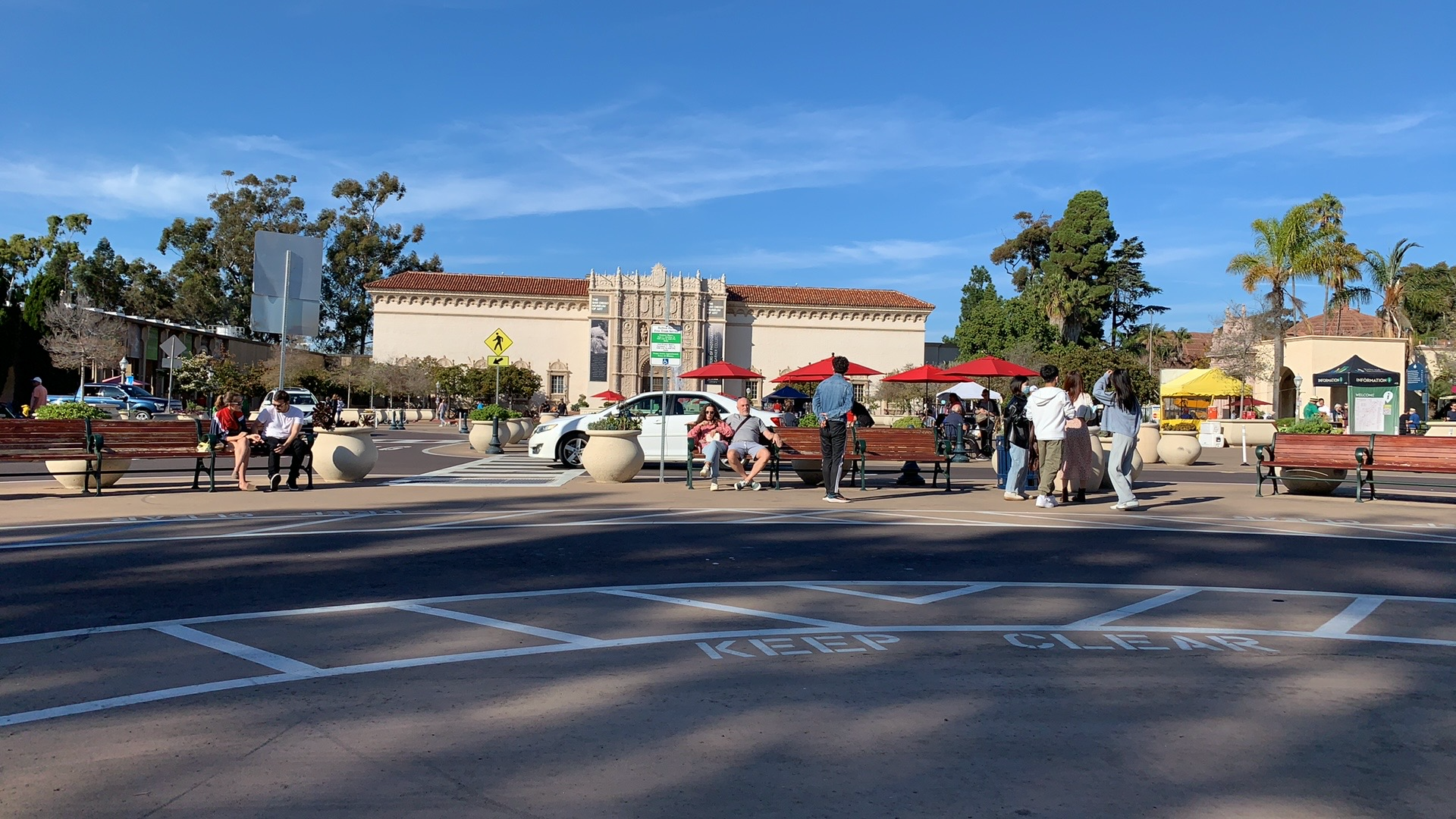
Charles M. Blow wrote an opinion piece in the New York Times last weekend criticizing the idea of the metaverse for denying us some basic elements of our own humanity, in particular our abilities to socially interact and on a more fundamental level to live in the moment. Yesterday evening, a full fourteen hours ago, I sat on a park bench beneath the statue of El Cid in the Plaza de Panama in San Diego’s Balboa Park. I could’ve spent that time checking my social media accounts on my phone, the most widely available version today of what could become Zuck’s metaverse. Instead though I took that forty minutes spent on that bench enjoying the sights around me, listening to the other visitors, to the intoxicating rhythms of the music being played live in the plaza, the sounds of the classic cars parading by on a beautiful Sunday evening in one of the most beautiful cities in this country.

The metaverse can offer solitary people like me a chance to live another life from the comfort of our own homes. And as much as another life is always an alluring prospect, why else daydream, I have the life I’ve been lucky enough to lead. My story is yet to be fully written, so why would I open a new virtual blank slate and start writing all over again?

Twelve Hours of Mask Wearing

This evening I had the opportunity to travel from my usual place of business in Binghamton, NY to the sunny port city of San Diego on the far side of the country and this continent. It was my first time flying on a full transcontinental route; coming from the Midwest I’ve benefitted from living almost halfway between Atlantic and Pacific until now. The experience was largely uneventful, though I’m humbled by the fact that this continent across most of which I’ve now driven (as far to the east as Boston, as far to the west as the Great Salt Lake) could be crossed in the same amount of time it would normally take me to drive west from Kansas City to that place in western Kansas where I’ve found myself within sight of the tallest clouds rising off the Rockies just west of Denver. I spent the flight reading a compelling story, checking my preferred flight tracking app, and listening to Planetary Radio. 

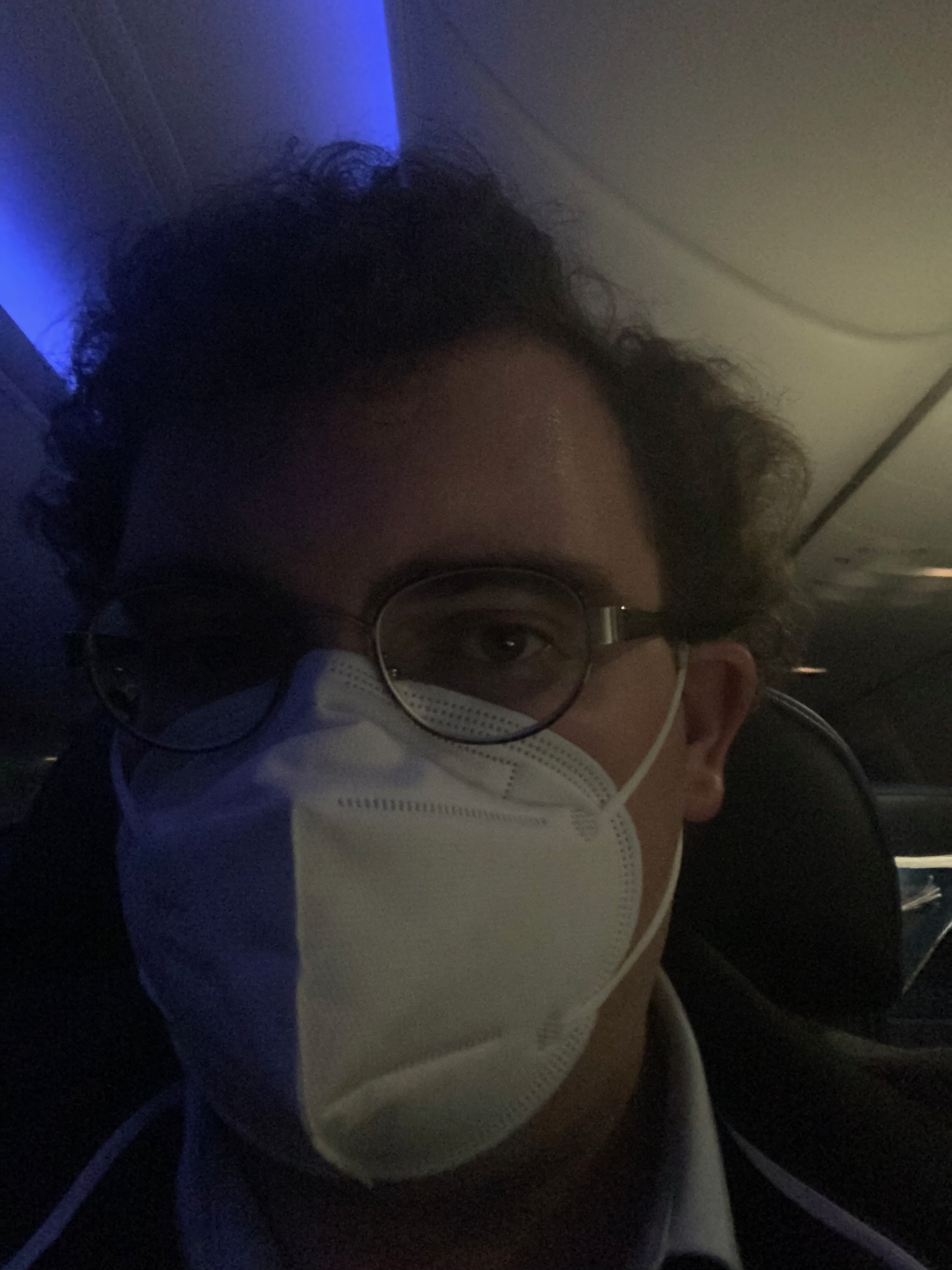
But the greatest physical reminder of this flight and this entire day will be the pain in my ears and the sides of my head from wearing this KN95 face mask for so long. I dearly hope we climb out of this hole of a pandemic we’ve dug ourselves into, and that my fleeting escapes from mask wearing as I took a drink of water would be signs of a future when we won’t have to wear these masks to travel. And yet, I worry that our relatives and neighbors who cry wolf about these masks so forcefully that events meant to be dull, like school board meetings, become events rife with danger, that these our fellow Americans are the ones whose actions will only keep these mask mandates in place longer. After all, we’d be further out of this continuing crisis if we were as a country more fully vaccinated. Being triple-vaccinated against COVID-19 myself, I know I’m probably safe, but the best way to ensure that is the case both for myself and for all the people around me on this plane from the oldest passenger to the youngest infant are safe as well.

I worry that in the fear-mongering of the last decades we’ve lost a sense of communal spirit. We’ve become suspicious of our neighbors who once we could trust. Any statement deserves to be questioned, so I ask you now: what went wrong? When did we choose to fear others before learning to appreciate them? And why don’t we lower our pride for even a minute and let ourselves lower our guard?

We have a lot of problems facing us today. Step one clearly will mean that we’ll have to at least start by looking each other in the eye and at the very least saying hello. It’s a start.

I don’t think I’m in New York anymore.

Shucks!

If there was a word that could fully express a sense of regular melancholy at yet another well laid plan turning out poorly, it is my favorite expression of this sort of sighing shrug of the shoulders: shucks! It’s a word that seems well suited to resignation and repeated failure, one that speaks to the lovable loser in all of us.

I often use “shucks” to mean many of these things. It’s a way of expressing a sense of humility in the face of great odds. It is the sort of Charlie Brown inside of me, the guy who’s just living his life despite all the failures and problems that come his way. Shucks then is a word that seems friendly and warm, a relief when I’d want to cry out in frustration.

All that said, while researching this favorite of exclamations, I learned its etymology comes from a portmanteau of two of English’s more ordinary and yet colorful words. It’s a combination of two of this language’s oldest terms, the noun shit and the verb fuck. It turns out then, that my favorite melancholic exclamation originally had both a fecal and a sexual connotation. Shucks!

Connectivity

“We were both thinking about food”

I often find myself trying to balance staying connected with my family and friends all around the globe and staying connected with the people I’m with in a given moment. Beyond even face-to-face conversations, even when I’m alone I find myself sometimes struggling to focus on one thing at a time and not let my mind drift towards looking up this or that thing, or to any of my social media accounts, while a routine moment in a TV show or more importantly in my work passes by.

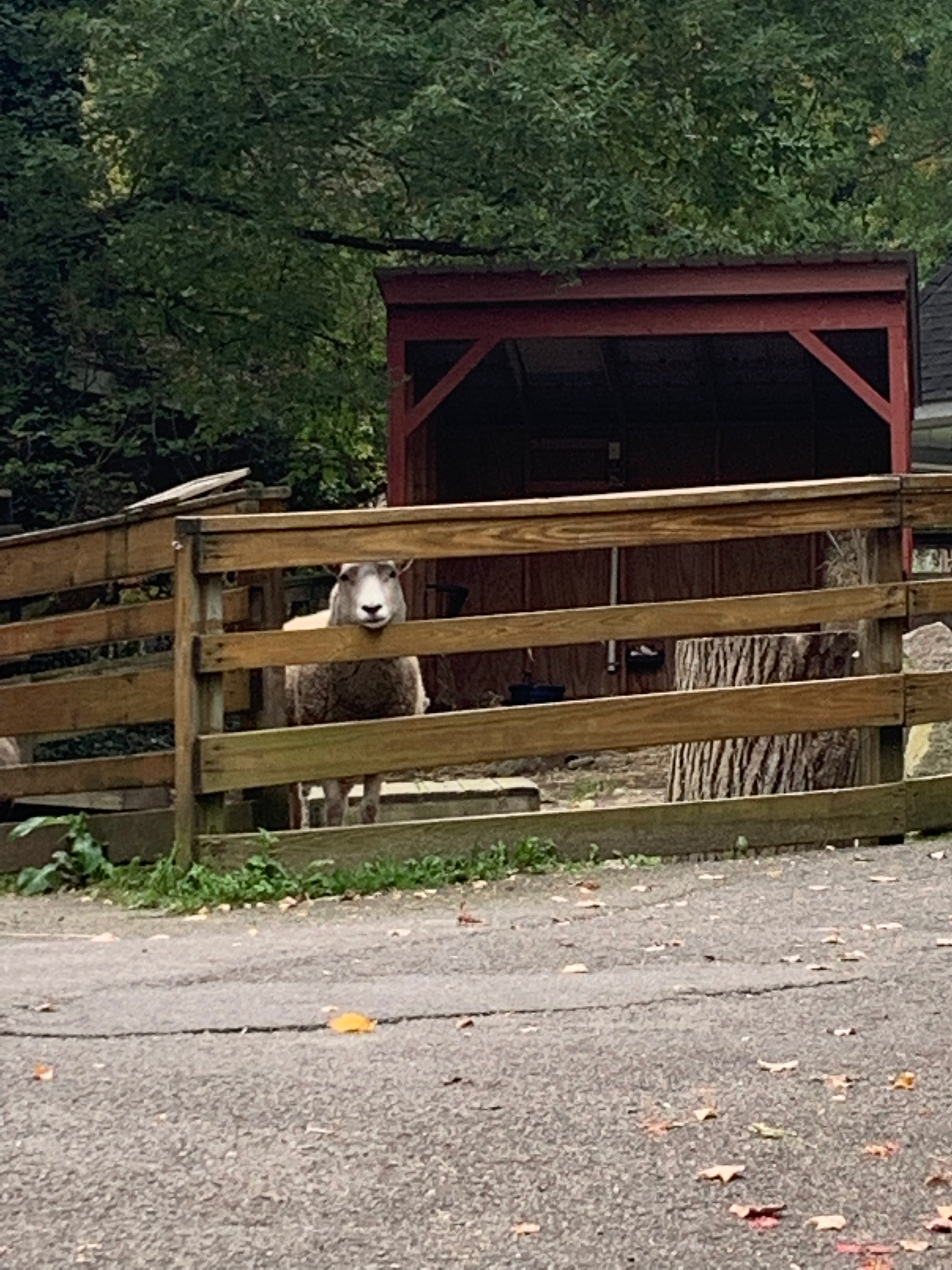
Still, there are times when I make a strong effort at being present in the moment in which I’m living. I realized last night that I still hadn’t posted a photo of one of the sheep staring through a fence at me at the Ross Park Zoo here in Binghamton that I had taken on Sunday afternoon, with a humorous caption about the pair of us both thinking about food at once bringing chuckles to the fore for a few who would read it. While I wanted to put that picture out there on my Instagram story, in that particular moment I was far more focused on enjoying hanging out with one of my best friends who I don’t get to see all that often.

I think the question of connectivity comes down to a question of purpose: why are we in the situation where we’re in public among family and friends yet still hooked to every ping and notification that emanates from our phones? I’ve balanced that out by usually keeping my phone on silent, and severely limiting which notifications come through to buzz my wrist on my smartwatch. If the person who those notifications are meant to attract is me, then they don’t need to be heard by anyone else around me.

Further, when I’m in a situation where I really do need to focus on what’s going on in the room, say in a class or a concert or at a religious service, then I’ll turn on the “Do not disturb” feature on my watch and let any notifications that come through queue up on my phone where I can look through them after that event is finished. I’ll often do the same thing if I’m out for a meal with family or friends; in that moment they deserve my attention, not the device in my pocket.

I do think these devices serve an important purpose for all of us today. Contrary to the opinions of some eye-rollers who are my senior, I do remember a time before much of this connectivity. I remember how hard it was when I was little to call my Mom on the phone when she was traveling for work overseas. I still do write letters, on occasion, and enjoy sending postcards to a handful of people when the idea makes itself known to me. But I certainly wouldn’t go back to a life before smartphones and smartwatches.

I think as with most of these new technologies, we’re still in a sort of Wild West phase, when there are less set guidelines or rules to how all this technology impacts our lives and how we in turn use that same technology. As the devices improve, as they become more advanced, more precise in their capabilities, I think we too will refine their usage. We’re not quite to the point of replacing a smartphone or smartwatch with the communication badges found in the Star Trek shows set in the 24th century, which are almost like speaker phones in that they can be heard by people around the wearer, but those people seem to have learned to ignore conversations to which they aren’t privy when the need arises. For now, when I’m taking a phone call in public I will use my headphones, in this case a set of Air Pods, which I’m proud to say contrary to common practice I’ve yet to misplace.

We’ll get there eventually. For now though, do me a favor and turn that ringer on silent during events, and keep the speaker phone conversations to a minimum in public.

Party over Country

Over the last week I’ve read a number of editorials in the New York Times and Washington Post about the longterm implications of the January 6th attack, written by such a diverse group of political writers as the Jamelle Bouie and Robert Kagan, which argue that as close as we came to a full constitutional crisis, to an actual attempted coup, the events of this January can best be understood as a prelude to what might well happen in four years when the next Presidential election results are certified by Congress.

To say that this is a depressing reading topic is putting it mildly. The implications of Kagan’s essay and Bouie’s frequent editorials about January 6th and Trumpism reflect the very real fear that we may be seeing the greatest threat to American democracy since the Civil War playing out in front of us today. An October 2nd article by the New York Times Editorial Board makes an even clearer case, bringing in the new evidence brought to light by General Mark Milley about how serious that attack was to the stability of our global security presence, whose calls to his Chinese counterpart have struck a cord on how serious January 6th really was.

At the heart of all of these editorials and essays is one common theme. At this point in our history, 234 years after the Constitutional Convention, our republic has reached a point where many of its citizens, and notably many of its elected officials on all levels, have begun to put their party, and in particular their own political ambition, over their country. There is a clear path forward to ensure another January 6th doesn’t happen again, but the political will doesn’t seem to be there especially among Republican office holders. Robert Kagan, a political thinker with whom I generally disagree, makes a profound point in writing that Republican officials like Senator Mitt Romney of Utah, while opposing Trumpism in public, have continued to “balk” at the opportunity to actually do what is needed to preserve both the republic and our democratic form of government in the face of what is fast becoming the next great attempt by the Trumpists to subvert the electoral process.

I too am a party player. I’m a registered member of the New York Democratic Party, and yes while I have voted for a Republican candidate in one instance, I’ve otherwise solidly only voted Democrat. Generally too, I’d say the last Republican President who I would’ve considered supporting was President Eisenhower, though even then my vote would’ve gone for Stevenson in both 1952 and 1956. Looking even further back, the last Republican President I would’ve actively voted for would probably have been Theodore Roosevelt in 1904. All that said, as solidly Democratic as my voting record is, I vote on policy, not on party, and generally at this point in our history the Democrats in their own diversity of opinions tend to reflect my views better than the Republicans. There simply hasn’t been a Republican candidate since that one county commissioner who I voted for when I was 18 that I’ve actually agreed with more than their Democratic challenger.

I’ve been thinking a lot about how strong loyalties tend to be among certain groups, tribes, teams, companies, and parties in this country. It’s interesting to think about how we might be best friends with someone but we can’t talk about certain topics with them because of all the hot air that comes up whenever it’s mentioned. Different sports come to mind here. I can well remember what it was like being the only Cub fan surrounded by Cardinal fans on my floor in Corcoran Hall freshman year of college at Rockhurst. It also happened to be the last time to date that the Cardinals won the World Series. This fierce loyalty has played out in our politics too: people who are politically inclined are usually either Democrats or Republicans; they’ll vote blue or red and hardly ever switch to the other team. And when they do switch sides, is it a sign of being open to new ideas or of someone who can’t be trusted because they can’t be loyal? As long as we think of our political rivals as the enemy, our whole form of government is in danger of collapse. Democracy relies on compromise to survive.

Let’s take another angle on this. We Americans have an unusual devotion to our flag. You can drive from coast to coast and see American flags everywhere, not just outside government facilities, but in front of private businesses, and even outside people’s homes. Every time there’s a sporting event from little league to the majors we always start by standing up, hatless, with our hands on our hearts for the playing, or more often singing, of the national anthem. Whenever a veteran or their family is introduced as an “honor family” or something along those lines at that same event, everyone gives them a standing ovation, as they’ve deserved.

But how honest is a person’s patriotism when if you don’t stand for whatever reason you may have, or you begin to ask questions that are deemed unpatriotic and are harshly rebuked for not being as patriotic as you should be? How honest can a person be when they’re being threatened? I worry here that the obligatory nature of these mandatory public acts of patriotism are diluting what it really means to be patriotic, to love this country and its core ideals. I worry that making the act of being patriotic, of say unquestioningly supporting the military, making this sort of act of devotion something that is required of any good American citizen is dangerous because it eliminates critical thought and the opportunity to ask the necessary questions to make our country a better place and our political system better suited to our electorate. What’s more, I worry this forced, unquestionable patriotism opens the door to a future where it will not only be socially damaging to question the need for patriotism but even life threatening. Further, as we glorify the military as the one thing that can’t be questioned, we open the door for the military to be the only real authority in this country that would be accepted by both parties in the case of a full scale constitutional crisis.

I’m frankly glad that the Joint Chiefs didn’t send the National Guard or the Army into DC sooner on January 6th. Like the Roman Republic before us, our military’s headquarters, the Pentagon, lies across the river from our capital city, far enough away from the center of civilian political power that it can’t threaten it. As far as I’m concerned, the day when we do see tanks and soldiers rolling across the Arlington Memorial Bridge into the District will be our Rubicon. The die will be cast as it was for Caesar and his legions, and there will be no going back to the republic as we knew it.

I think the example of the Roman Republic is a good one to bring my main point home. We certainly aren’t at the point where we’ll have a Caesar coming to the rescue of the republic with the military backing him. But I do think our zealous devotion to political party, in many cases over the best interests of the country, the republic, and the people as a whole, is similar to the military reforms of Gaius Marius (c. 157–86 BCE) which led to the Roman legions becoming far more loyal to their generals than to the Roman Republic itself. This set the stage for the civil wars that would destroy their republic in Caesar’s time a few decades later. I can’t say who our Marius is, but it certainly seems that millions of Americans are now more loyal to individual politicians and the parties they lead than to the republic itself. The last time this happened our forbearers fought a brutal four-year Civil War. I can only hope that our leaders in Washington will have the courage and the honor to do the right thing and preserve both the Union and the representative government it has represented all these generations.

Time Travel

Today after passing a major milestone in my work, my comprehensive exam, I find myself reflecting on what it took to get me to this point. What would I say to myself from Spring 2019 when I was getting that acceptance letter into the History PhD program from Binghamton amid all the other rejections?

I remember one particular moment when I was standing at my bus stop on a cold windy February morning, the Winter Sun carving with its jagged coldness into my bare face and hands. On that particular morning I received the fifth of ultimately six rejection letters. It was one I expected, to be honest, but it still hurt like all the others did. At that moment I remember thinking, “If I get turned down by all seven I’ll find something else, it’ll hurt for a long time, but I’ll figure things out.” Today though, after finally passing my comps, an experience that was overall almost as stressful as the admissions process, I feel like were I able to talk to myself from two years ago, I’d probably say, “Don’t worry, it’ll all work out in the end. Take whatever win you can, and stand on that because trust me, this doesn’t get any easier.”

Looking at where I’m at today, now halfway through my fifth semester of the PhD, with the end of my work here hopefully closer in sight than the beginning, I do feel proud about what I’ve accomplished. It’s a big deal to make it this far, no matter how challenging it’s been. If anything, I’ve come to understand where my strengths and weaknesses lie, to understand myself and both my limits and potentials better than I ever have before.

As it happens, the day after that spell at the bus stop when the rejection letter arrived via email, I got my first acceptance letter in from Binghamton. It was St. Valentine’s Day, and as worn down as I was by the whole process of applying for doctoral programs at that point, I still celebrated in my own way, knowing that I’d be continuing in this career in academia. Today feels a lot like that day, it’s a moment when I have reason to celebrate, but also a moment when I need to stop and think about all the things that led to today. How can I make these sorts of really important events run smoother in the future? And how can I succeed in what I’m doing from here on out?

That’s the beauty of life, there’s always something new out there to explore, and the potential futures can seem boundless.

Humility in Leadership

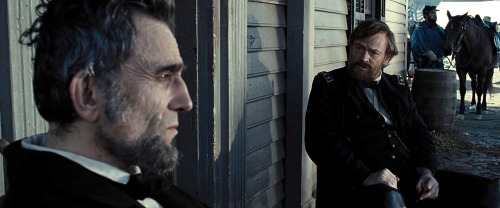
On Sunday evening while I was watching the Chiefs game, I found myself putting that contest in the background and focusing instead on YouTube on my phone. One of the first recommended videos was a clip from the 2012 Steven Spielberg film Lincoln starring Daniel Day-Lewis as the 16th President. In the clip, Lincoln sits on a porch with General Grant talking about how to handle the Confederate surrender in the coming days at the end of the Civil War. It struck me, in light of all the examples of leadership we’ve seen in the last four years in this country, how humble Lincoln was in that moment, how plain and honest his directions to Grant that the Confederate soldiers should be allowed to go home.

I’ve been entrusted with a number of leadership roles throughout my life, from serving as a two-term Senior Patrol Leader in my Boy Scout troop (Troop 1, Kansas City, KS), to most recently being entrusted with heading the committee as President of the Graduate History Society here at my university. Over the years I’ve learned that as much as having the power of an office can be alluring, I’m more interested in being an equal partner with the people who’ve entrusted me with that job. I don’t know if I’d say I’m a good leader, after all there’s more to leadership than trying to be a nice guy and someone who’s easy to work with, but I try to do my best every day.

Something that’s often talked about in terms of the long memory of leadership is legacy, what will people remember your term in office for? I wonder about that with all the work I’m doing here in my twenties. When they do write my obituary in however many decades from now, what will they say about the things I did at this point in my life? Looking back on the last six years, the years after I graduated from Rockhurst with my BA, I see a life that wasn’t nearly as stable as I’d like it to be, a transitory life where I moved from Kansas City to London, back to Kansas City, and eventually now to Binghamton. It’s been a time when I’ve moved even more frequently between jobs and dreams of what I want my future to be like.

Yet now, in 2021, I feel like I’m on the verge of some of my best writing, some of my best work. Much of that will not be possible without the support of my family and friends, and you kind readers as well. I do feel constantly tired, and I always seem to have a lot to do, but I figure if I get one thing done at a time eventually the entire puzzle will be finished, no matter how frustrating the puzzling will be in the process.

I’ve always looked up to Lincoln as someone I’ve respected since I was very little. Maybe that’s something I learned at a young age living in Illinois, but of all the presidents from the 18th and 19th centuries, I always felt like Lincoln was the one who I’d like to sit down and talk to. God willing I won’t have to experience all the pain he went through in his life, both personal and through his service as President during the Civil War. Whitman’s description of him as the captain of a ship in stormy seas is fitting for the man who seemed to have aged nearly 20 years in just 4. Still, there’s something about the man, the leader, that seems much more understandable to me than many others in our history.