Author Archives: seanthomaskane

Unknown's avatar

About seanthomaskane

I am a PhD student studying the history of Renaissance natural history focusing on French accounts of Brazil. Chicago born, longtime KC resident, SUNY Binghamton grad student.

Donald Trump and the slow death of American Federalism

US flag

Today the world was flabbergasted and disgusted with our President once again. This time it was not due to his bullish techniques for getting in the front of a group picture, nor his obscene rudeness towards our closest European allies, nor even his disregard for the basic fundamental principles that all humans deserve equal treatment and rights. Far from that, today Donald Trump decided, for whatever reason, to do away with the safety mechanism that would at least temper the oncoming tide of climate change and preserve the planet that we’ve called home for millions of years. But that does not seem to matter to Donald Trump, the human epitome of ego.

He does not seem to care that withdrawing from the Paris Climate Deal will have disastrous effects for all humanity for generations to come. All he cares about is that “America receive a fair deal.” He is a businessman who has never had to deal with the realities of the world; he is a man who has never been fit to serve as President, and frankly is even less fit to do so today.

Climate change is a very real and present danger to humanity, to all of us living on Earth. We have developed our civilisations, our industries, our technologies in a manner that until recently has had a careless attitude. We have raped the Earth of its natural riches, leaving its soils forever changed, its seas void of so much vibrancy and life, and its air thick and soupy with the fumes of our industrial might.

Eventually, in the long run, humanity will inevitably outgrow this our nest, but until that day comes in the future we are stuck here. For the time that we have left on Earth we must do our best to maintain it, to keep it fresh and clean. Anyone who has maintained their own house without the help of servants will know what it means to keep the house in order. Judging from his biography, and his attitude towards the rest of humanity, I doubt Donald Trump has ever been in our shoes.

I have found myself on a daily basis pronouncing my embarrassment at the President’s actions to friends both overseas and here within our borders. My shame at seeing that most self-serving of men occupying the People’s House is far beyond anything I have ever experienced.

Setting aside the climate for one moment, though to be honest that is nigh impossible to do, as everything else is reliant on the climate’s continued health and survival, there is one other more directly American issue at hand here. For the past four months, Donald Trump has done pretty much what he promised to do, to bring stark change to Washington; but the changes that have come about in his time in office have been hardly positive. For one thing the long standing norms of the American body politick are finding themselves being forcibly changed, in many respects against their will. States like California, New York, Massachusetts, and Illinois, long considered key supporters of federalism, in comparison with the likes of Texas, Arizona, Kansas, and most of the South, are now finding their long held faith in Washington to be suddenly, and dramatically unfounded.

What Donald Trump has done is nothing short of contribute to the process of nailing together the coffin of federalism in the United States. Our country has always been an odd fit, some parts more willing than others to play along with the idea of federalism. Trump, a New Yorker, has played into the hands of the anti-federalist extremists on both the left and right, particularly the Tea Party Republicans in Congress and in the respective State Capitols around the country. When the State governments choose to ignore the needs of all their constituents, instead focusing on the demands of a few, we the citizens look to the Federal Government to back us up and defend our rights. Yet now both a majority of State Governments and the Federal Government are controlled by the same faction within the Republican Party that has cried foul at the regulations set up by big government to ensure the continued prosperity of a majority of Americans.

Their self-serving agenda has seen that this country elect one of the least qualified Presidents in its history, and that this country’s legislative electoral process be so mangled that they the small-government “we serve ourselves” far-right Republicans will be mathematically guaranteed to win for many elections to come. Now the rest of us who are not being served by this narrow-mindedness amongst those in power are left to look to the lowest levels of our government, to our cities, for protection and aid. Cities like New York, Chicago, D.C., Boston, San Francisco, Los Angeles, Seattle, Portland, and Kansas City are our last refuge in this our darkest hour. For the time being, while the current faction of Republicans remains in charge of the rest of our government, we must rely on our big-city mayors and our city councils to do what they can to ensure our cities remain safe for American democracy and multiculturalism.

As a European American male, I am a part of the least threatened demographic in the country, yet as an American I am a part of the most threatened demographic of all; for when one American’s inalienable rights are threatened, then the rights of all the rest of us are threatened as well. The day when we return to saying otherwise is the day when we, the United States of America, the nation of immigrants, of opportunity, of possibility, will be the day when we lose our national spirit.

The Pope and the President

Embed from Getty Images

Today a rather oddly stacked meeting took place in the splendid halls of the Apostolic Palace in the Vatican. It was a meeting between two men who could not have possibly been more ideologically or culturally opposed to each other. Yet there they were, Pope Francis and President Trump standing side-by-side. Their meeting was a diplomatic affair, in part to appease the conservative Catholic base that had aided Trump in winning the presidency in November 2016.

I was unsurprised when a few weeks ago the news broke that Trump would be visiting Pope Francis in the Vatican, after all every American president since Eisenhower had made a visit to the Holy See to meet with every pontiff since Pope Saint John XXIII. Yet I found myself hoping, even praying, that Pope Francis would bend traditional diplomatic protocol ever so slightly and arrange for his meeting with the new president not in the splendour of the Apostolic Palace where all the temporal power and wealth of the Church is to be found. Rather, I hoped the Holy Father would invite the President to meet him in one of the Vatican’s charitable centres, perhaps in the homeless shelter that Pope Francis opened in January of this year, or in one of the city-state’s soup kitchens.

If there is one trait that the current United States President does not understand, let alone practice, it is humility. During his visit to the Eternal City he should take the time to visit the Basilica of Saint Lawrence outside the Walls (San Lorenzo fuori le Mura). It was here in the third century that Saint Lawrence, a martyr of the Early Church, was buried. When asked by the Prefect of Rome to hand over all the riches of the Church to the Imperial Treasury, Lawrence responded by gathering all of the poor and destitute who had benefited from the Church’s charity and brought them together to line the street leading to the centre of the old Christian Quarter.

When the Prefect returned, Lawrence announced that he had gathered the riches of the Church together in one place for the Prefect to view. Lawrence then led the Prefect down the street, showing him the great mass of people before him, announcing, “These are the riches of the Church.” For his efforts, Saint Lawrence was grilled alive, yet his message rings just as resoundingly now as it did eighteen centuries ago.

Donald Trump is a fairly successful man. He’s done well for himself crafting a business empire based primarily on his name brand. Yet his brand of gaudy luxury cannot compare to that which is truly worthwhile in life. I have found that as much as wealth, power, and prestige can bring me happiness in the short term, it does not bring me long-term fulfilment. I have found some other qualities, love, charity, compassion, and a general sense of goodwill to be the true key to happiness.

I have seen what power can do to people, and know all to well that I want as little as possible to do with it. All I want in life is to be with the people I love, to see that they fare well, and to ensure that the generations to come have a better life than I could possibly imagine. While having some wealth can certainly contribute to this, enough to ensure that in the confines of our economic system my family will not have to worry, that money ought to always be of secondary importance to all of us. We need money to live, but we should not live for money. Unfortunately for him, and for the rest of us it seems that President Trump has yet to figure that out.

Embed from Getty Images

The Constancy of the Modern

Embed from Getty Images

If we can learn anything from history, it is that our story has always been acted out and subsequently recorded by people, not unlike us. Each successive generation has done their part to immortalise their greatest tales through stories, both oral and written, into the collective memory of society. As time has passed, each generation of historians has endeavoured to best tell these stories of their predecessors in a way which their own generation can well understand. To the historians of the Renaissance, the millennium immediately proceeding their own time quickly gained the pejorative name the Dark Ages, while its architecture was equally appallingly disparaged as Gothic.

To the Renaissance and subsequent Enlightenment historians, the time to hearken back to with all glory was that of Classical Antiquity, of Greece and Rome. The intervening millennium in between the Fall of Rome in 476 CE and the rebirth of classical learning in the Italian city-states in the late fifteenth century was merely a setback in the onward march of human progress. It was a setback defined by religious fervour and superstition, when science was equated to wizardry and the light of literacy confined to only a select class of clerics and aristocrats.

Each generation of historians has strived to understand the past both in the light of their own times and in the understanding of how those in the past understood themselves. Yet for the analytical nature of the study of history in our present scientifically-centred age to be properly propped up, contemporary historians must continue to classify and divide history into particular periods, places, and categories. Political history must remain distinct from cultural history and social history, while the aforementioned Renaissance must somehow be understood as different from the Medieval period that came before it.

What is most striking is the division of the discipline into broad spans of time, particularly concerning European history. One has a choice of diving deep into the past with Ancient history, a concentration primarily focused upon the Mediterranean world from the earliest communities to the fall of the Western Roman Empire in 476 CE. Or perhaps one would prefer to study Medieval History, focusing on Europe during the ten centuries between the aforementioned fall of the Western Roman Empire and the eventual fall of the Eastern Roman Empire in 1453.

Or, if that does not suit one’s fancy, one could try one’s hand at Early Modern History, covering the period of time between the turn of the sixteenth century to the French Revolution. While modern, this period still has its fair share of the medieval about it to make it more remote. Then there are the modernists, those whose focus is squarely on recent European history, the stuff that has happened since the fall of the Ancien Régime in 1792 and the rise of modern European liberal democracy through the nineteenth and twentieth centuries.

What this model of understanding European history is founded on is the old Renaissance understanding that Europe will always be dominated by the legacy of Rome; therefore all European history must be understood in relation to the glories of the Roman Empire. The medieval is a giant leap backwards in the ruins of the once great imperial edifice, while the rise of modernity marks the return of European society to its former Roman glory. The other thing that this model is focused on is we modern man. Since it was first devised in the seventeenth century, this understanding of history has always held modernity as the pinnacle of human achievement, at least to that point.

The term modern itself comes from the Late Latin modernus, an adjectival modification of the Classical Latin adverb modo, meaning “just now.” Modernus in turn developed into the Middle French moderne by the fourteenth century, indicating that something similar to our understanding of the present time as modern was in use as early as what we would now call the Late Middle Ages. True, to my generation devices like the digital tablet, electric car, or the ability to make videocalls are decidedly modern, our grandparents could equally have said the same fifty years ago for the television, jet airplane, and IBM 7080 computer were equally modern to their own time. Likewise for our great-grandparents the very idea of a subway, car, or airplane on its own was incredibly modern.

The way I see it, the term modern is the hour hand on the clock of time; it is the pointer that marks where we are on the cycle that is human history. Just as Edward III was a modern monarch for his own time so too Elizabeth II is for ours. Likewise, while Geoffrey Chaucer may well have been seen as a modern writer for his day and age, working into the late hours of the night in his rooms within the edifice of London’s Aldgate, so too someone like me is all too modern for my own time. Though I write so often about the past, and do my best to draw connections between what has been and what is present, I cannot help but understand the people, places, and things that have already come and gone through the lens of my own times, of my modernity.

Therefore to define ourselves as modern is not to make us anymore unique than our predecessors. Rather, to do so we not only continue on the legacies of their respective modernities, and write our own story, always utilising this most constant of chronological labels.

“We care for our own kind.”

IsolationismWith a rise in nationalism worldwide, we have also seen a rise in isolationism from both the extreme right and extreme left. In my view, nationalism and isolationism are blood brothers, and will always go hand-in-hand. In fact, the only way in which an isolationist nationalist government would ever consider interacting with its neighbours would be either through coercion or full force of arms. This is the world that was seemingly far better known in a time now past, a time when it was far more likely for the likes of Germany, France, and Britain to go to war with each other rather than sit around the negotiating table and work out their differences peacefully. Today, in Western Europe and North America we have known this sort of negotiated peace since 1945. It is a peace that has led to my father and I never having had to go to war, unlike the generations before us.

While the political structure established in the wake of the Second World War and expanded with the fall of the communist states in Eastern Europe, has led to unforeseen stability, prosperity, and international goodwill amongst its participants, the trials of the 2000s and 2010s have shaken that stability to its core. From the War on Terror launched by the United States in response to the Attacks of September 11th to the Great Recession, faith in liberal democracy and in capitalism are at an all time low.

I can’t blame those who do not trust the current political and economic systems, after all at least economically capitalism is structured to benefit most those with the most capital, leaving the rest to try and catch up. But when catching up to the wealthy is increasingly nigh impossible, it is understandable that some would be left dissatisfied with the system.

There is one effect of all this pain and negativity being felt around the world that can only have disastrous consequences for us all. I was reminded recently of an old saying, “We take care of our own kind” that one might have heard in generations past. With this comes the idea that we should stick to the social, political, religious, and ethnic groups to which we belong, that I as a middle class Irish American Catholic Democrat should not have anything to do with anyone who is not like me.

This is isolationism in its purest form, isolationism not on a national level but on a local house-by-house level. It means that I should sever all ties with my best friends, who are from Bulgaria, Finland, Venezuela, and Ecuador. It means that my neighbourhood, which is pretty well mixed between Protestants, Catholics, and Jews ought to be sorted out, and that each of us be given our own couple of streets to live on. It means that as a Democrat I should stay as far away from any Republicans, and that we should keep to ourselves so as to ensure we do not step on each other’s toes and cause any trouble.

I’ll be frank; I can’t possibly do any of that. I respect, admire, and in a way love my friends too much to send them packing, and my neighbourhood is better off because of its religious diversity. Furthermore, having seen the divisiveness of the 2016 election, I know all to well that if we Democrats do not talk with our Republican relatives, friends, and neighbours that we will not be able to heal the wounds of division that have wrecked our country so horribly.

But considering those words, “We take care of our own kind,” I am left thinking even more; and you know what, I think I can actually agree with this. It’s best to only care for people like you; it’s best to only be friends with people like yourself. The most optimal way to live one’s life is to solely live it with likeminded people around. After all, that way there won’t be nearly as much conflict within social groups. So yes, I’ll take care of my own kind, after all I’m human, and it is my duty as a human to care for the rest of humanity.

Isolation, and its bedfellow nationalism, serve no real purpose, and in the end are self-cannibalising; because isolationists forget that we do share that one common bond, our humanity, through which we can never fully cast each other asunder. So, let’s take better care of each other and get over that idea that our differences are bigger than what brings us together.

The Problem with our Politics

Embed from Getty Images

Political parties and politics do serve a purpose in the betterment and stability of society, no matter how unstable they may seem. A political party is a tool by which people of a common perspective can organise and promote their principles and philosophy with one voice. These parties in turn have the ability to take that philosophy to the pinnacle of government and power and propose it as policy, should said party be elected into office. Yet when party comes before public the political process shows signs of putridity and decay.

Today there are a variety of party systems in use around the globe; often they are organised based upon the number of parties they allow for. Here in the United States, the political process operates on a two-party system, yet throughout Europe most polities operate on a multi-party system. Likewise, in some states one will find a dominant party system, which is essentially a one-party state yet with the trappings of a two-party or multi-party state. Each system does justice to its respective society, as only that party system which adheres to the framework of its respective society can properly do justice to its public. Yet in some cases the frameworks set up in some cases generations ago to keep the wheels of government well oiled and turning have proven themselves to be susceptible to rust and degradation.

If anything is going to halt the Republican Party’s march towards dominance in all branches of the Federal Government, it will be this principle that politics unbounded from the public need will always be overwhelmed by the public will. If the Republicans want to maintain their overwhelming majority in the House of Representatives in the 2018 General Election, they need to cast astray the bull that they let into the china shop at 1600 Pennsylvania Avenue N.W. They must disassociate themselves from Trumpism and all its baggage. If the Republicans want to stay in power they should move swiftly with the transference of power from the current President towards the next guilt-free individual on the Order of Succession.

And yet, in a somewhat comical way, the House Republicans will most likely stand by their man to the bitter end. Like a pompous captain remaining aboard his sinking ship they will be submerged into the muck and mire that spreads from the current President like a virus. It certainly seems to me that that infection is too wide spread in the halls of power in Washington for any executive change to be made prior to November 2018. Perhaps then it is up to the Democrats to take the advantage and not only expel one of the greatest embarrassments to ever befall this country from that house across from Lafayette Square, but to also regain a more sizeable position in the House from which their own philosophy can shine.

The politics of the present are all too embittered by a bad case of food poisoning. Those in power more often than not seem poisoned by the power they wield, and the personal prosperity it proposes to offer. They have proven themselves to be far too unworthy of the position of public servant through their venomous guile, their lack of transparency, and their blatant disregard for the public will. If we are not careful, this poison could sink not only the current political parties, but the entire ship of state as well. The act of preserving the body politick is a duty not just of those in positions of power, but of all citizens, all persons with a vested interest in the continued goodwill and wellbeing of the body politick. It is just as much our responsibility to reform our political processes, as it is the responsibility of those in power.

If this reform is to be successful, it must be done without violence, but through discussion, debate, and dialogue. This reform must be on all levels and must include all individuals with a desire to take part. We must craft our political society in the image of the public that it serves; otherwise that political society will only grow to serve itself. Should that happen, we will be right back were we are now, and I doubt that would be anyone’s preferred outcome.

Everyone Has a Place in the House of God

Courtesy of WCLKPhoto: WCLK-FM.
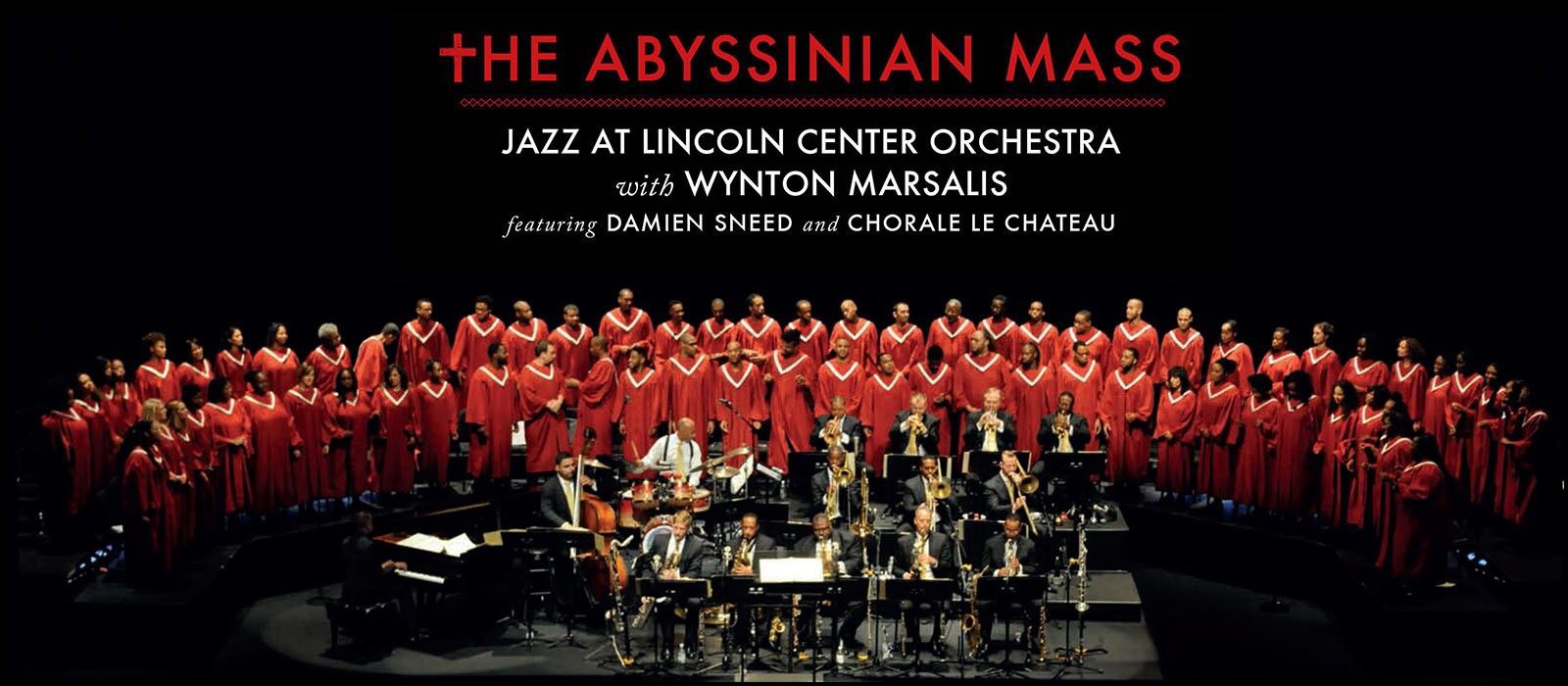
This evening while driving across Kansas on the way to a cousin’s graduation in Hays, I took the opportunity to listen to one of my favourite works of sacred music, Wynton Marsalis’ Abyssinian Mass. Performed by the Jazz at Lincoln Center Orchestra, led by Marsalis himself, and Le Chorale Chateau, conducted by Damian Sneed, the Abyssinian Mass is a thrillingly poignant work of sacred devotion to God.

One particular element of the Abyssinian Mass that stands out from most other Mass settings is the inclusion of a sermon, a lesson, taught by the minister at the Abyssinian Baptist Church in Harlem. The message, and following hymn, is simple: everyone has a place in the House of God. Everyone.

I have not written much on my faith of late in part out of my own annoyance for the obnoxiously vocal religious right in my own country and elsewhere around the globe. Those who preach a gospel of hate and hellfire give religion a bad name. My faith is founded on the belief, as a Catholic, that the Divine is inherently good and loving; that all evil exists solely out of the gift of free will, and the subsequent misguided decisions made by a variety of actors over the ages.

Yet though a Catholic I find that I cannot help but accept, and encourage those practises and beliefs in other traditions which are also founded on this same positive outlook on the Divine, this same understanding that God is Love. As this Protestant minister said, and as the choir sang, “Everyone has a place in the House of God!” Yes, yes, yes!

So then, I must beg the question, if all of us have a place in the House of God, if we share even this sole beautiful inheritance, then why do we constantly seek to find those things which divide us? Why do we continue to argue that one group, one people is greater than another? Why do we constantly stab ourselves in the back with jealousy, deceit, fear, and overthinking when we could be so kind to each other?

I say we try it out, we try being nice to one another. It may be a small thing, it may even be mildly unrealistic, but you never know it might just work.

What is citizenship?

16179019_10210642139022398_8265398912556879037_o

Photo: Cole Gibson

In our present time of political upheaval around the globe, the central questions of any political society are once more in the foreground. Central to these is the question of what it truly means to be part of a political society, to play one’s part in this comedy we call politics. In most constitutional countries today, the citizen, the most basic piece in the larger puzzle that is the body politick, fulfils this role. What does it mean to be a citizen, and furthermore, what is citizenship, the state of being a citizen? Citizenship is an old concept, one that can be traced back to the earliest polities, from the Ancient Greek πόλις to the varying degrees of Roman citizen, through concepts of medieval subjecthood, to the Renaissance and modern understandings of citizenship within the Westphalian empires and nation-states that have been the norm in the West since the mid-seventeenth century.

Today our definitions of citizenship are primarily two-fold, founded upon both ius sanguinis and ius soli. Jus sanguinis is the understanding that one’s legal status as a citizen is based solely upon one’s ancestry, one’s blood. As an American citizen who has at times, and will certainly again, prefer to live overseas in the U.K., should any of my future children be born beyond the borders of the United States, they will automatically be United States citizens, having inherited that citizenship from me, their father. However, should they be born in the United Kingdom, the children of a permanent resident of that country, they will have also inherited British citizenship through ius soli, having been born on British soil.

These two sub-classifications of citizenship are straightforward enough, and reasonable means to define what makes a person a citizen. Yet a citizen is not just an individual who happens to have either been born in one country, born to a parent from a country, or who has resided in a particular country for an extended period of time. A citizen is also an active participant in their government. The chief way a citizen can partake in politics, can wield the power that comes with their citizenship, is through voting. Without the right to vote, citizenship is but a muted title, a lame duck of a word.

Here in the United States, the most fundamental definition of who can vote simply considers age and time spent in a particular state. In most cases, an American citizen can vote in their state if they are 18 years of age and have resided in that state for at least 90 days. Yet politicians who see their only hope of maintaining power resides in further limiting who amongst the citizenry can vote have begun to pass legislation restricting voting rights from a wide swath of citizens. In Missouri, a citizen must present a state issued ID card when arriving at their voting precinct, yet that state issued ID card can only be granted to the citizen by the state if that citizen can a.) prove their citizenship, and b.) prove their residency. In order to prove one’s citizenship, one either must present a valid birth or naturalisation certificate, or a valid U.S. Passport to the D.M.V. Furthermore; one must prove that one does live at one’s legal voting address. The latter can be arranged, through the presentation of a utility or car bill, or even a bank statement, yet the former is far more complicated to find, particularly if the citizen in question was born in another state.

These laws have been written to “combat voter fraud”, yet there has been hardly any such voter fraud anywhere in the United States in the past twenty years. What these entirely unnecessary laws do accomplish is to restrict voting rights to a select few, to a smaller portion of the population. This is one of many symptoms of our ailing democracy, of our democracy that is sickened and addicted to the power of the almighty dollar. The same politicians that have instituted these voter suppression laws are also the ones who stand to gain the most from having a smaller electorate. Their political power rests squarely on the broad shoulders of their own special interests, cemented through bribery and intimidation alike. This is why sensible gun control legislation has not passed in Congress, despite the string of mass shootings and domestic terror attacks that have plagued this country. This is why the United States does not lead the nations of the world in combatting climate change, in keeping to the standards set in the Paris Climate Agreement. This is why an entire generation of Americans are left in severe debt and often unable to find work upon earning their Bachelor’s degrees. This is why the House Republicans voted to take federal health insurance from 20 million Americans. The voice of the citizen has been overwhelmed by the voice of the special interest.

Our democracy is under threat of becoming a plutocratic oligarchy, a nation governed by a class solely defined by their wealth. Sure, any American can make it to the top, but so long as that American is of European descent, and is willing to do anything it takes to earn more money. The dignity of the citizen is being replaced by the pessimistic wolfish piracy of an unscrupulous few that never outgrew their days of playground bullying. We the citizens should continue to make ourselves heard, we must continue to protest, to march, to call our elected officials, to tweet them, to write to them, to visit their offices and make ourselves heard. But most importantly, come Election Day, we must go out and vote! Without our voting rights were are not citizens but merely voiceless sheep being led about at the whims of a small few.

If our democracies are going to make it through this present time of political upheaval, we the citizens of those democracies must ensure that our voices are not silenced, not muffled by the wealthy and powerful. A person who has nothing to their name, not even a penny, should still have the right to vote; after all that person is a citizen of the country they were born in. Whether we like it or not, we are all subject to the ebbs and flows of the political process. It is up to us to ensure we control that tide, lest it sweep over us and leave us for dead.

On the Defence of Universal Suffrage

voting-without-rights-leads-to-the-right-to-vote-photo-u1

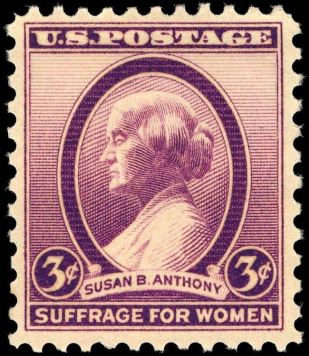
The German comedian Henning Wehn once said, “Once one is an immigrant, and away from one’s home, one tends to become a bit more patriotic.” And boy, I can tell you this is true. Only after I moved to the United Kingdom did I learn to play the Star Spangled Banner on the piano. Yet at the same time, as an immigrant, or a resident foreign alien as I was officially known, I began to fully appreciate what it’s like to have no political rights. I didn’t have the right to vote, nor the right to petition my Member of either the British Parliament or the European Parliament. Though I was a member of British society, and resident of the City of London, in political terms I was without expression.

On the other hand here in the United States, in Missouri, I am a citizen. And as a citizen I know that I hold a big responsibility to my country, and to my state; the duty to play my part in our government at every election, to cast my ballot and offer my voice in favour of those candidates whom I see as most able to lead our society in public office. I learned from my experiences as a foreigner during the Brexit vote what it was like to be politically voiceless in a time of the utmost importance. I would not wish it on anyone, and dread the thought of the right to vote being further restricted here in our own country.

Yet that is what has happened, when through intrigue and misleading propaganda a majority of voters here in Missouri chose to approve a law which limits the right to vote through excessive Voter ID requirements. While the sentimental concerns of those crying wolf about voter fraud make a fine performance, they bear little credence from the realities of our electoral process. The individuals and factions who have cried foul on voter fraud are also the ones who will benefit the most from having a smaller electorate. They fear democracy because they know it will weaken their power, their status, despite the fact that it will help the rest of us out a great deal.

I long to live in a society where all people are respected, where equality is the watchword and happiness the means by which we measure the value of our lives. Since the election in November we have seen a rise nationwide in hate crime, a rise in racial tensions and religious violence. We have watched as the Democrats and Republicans have drifted ever further apart from each other and from the people at large. I hold a Master’s degree in Political Science, yet to be frank I hardly read the American political news anymore, it’s just too depressing. Each day as one bit of information or another comes through to me either via the papers that I read or over television or radio, I find myself evermore frustrated and wanting to act.

Here then is how we can surmount the latest obstacles placed in the way of our democratic process. We must act! We must take part in our government if it is to remain a democracy. A strong and stable democracy can only live, thrive, and survive if the people raise their voices and vote. Yet more than that we must protest, we must march, we must peacefully assemble and demand that our rights be respected, remind the politicians who are in it for their own interests that they too are citizens, just like us. They are responsible to us, to our needs, to our demands. This new Voter ID law is merely a roadblock, one which can be overcome in time through legislation, yet for now one which must be addressed and surmounted within the bounds of the law as it stands. We must find a way to turn this law, which is designed to curtail voting rights for some amongst us, into a mere bit of ink on paper, something so baseless in the realities of our state, and its laws that it cannot possibly be followed. Let’s play along by their rules, and bend them to our will. After all, a true democracy should follow the will of the people, not those in office.

How Fox’s Reaction to the Bill O’Reilly Scandals are Systematic of What is Wrong in Our Society

In American society, beyond all the kind words and gentile thoughts, there is one thing that is king: the Almighty Dollar. One is not important enough to be considered at the top of the game unless one is rich. As a result, when a scandal or issue comes up, while hypocrites on all sides will try to degrade their opponent on grounds of morality or sensibility, all that really will matter in the end is how much the culprit in the case can bring in as revenue.

Just minutes ago the news broke that after a series of sexual harrasment allegations, Rupert Murdoch’s American-based media arm 21st Century Fox would not be welcoming top bill Fox News host Bill O’Reilly back onto their network. “After a thorough and careful review of the allegations, the Company and Bill O’Reilly have agreed that Bill O’Reilly will not be returning to the Fox News Channel,” read a statement quoted by NPR’s Colin Dwyer. Yet that thorough and careful review only came to a close not after the first sexual harrasment claim was published, nor after the following claims became known. Rather, the people at 21st Century Fox chose to wait until O’Reilly’s show, The O’Reilly Factor, had lost a significant number of its advertising sponsors.

Once again the Almighty and practically Sacred Dollar won out over the health, safety, and well-being of the women who O’Reilly had harrassed. Between the hyprocisy of organisations like 21st Century Fox actually claiming to care about it’s female employees and on-air guests, and the sheer lunacy that something as abstract and impersonal as a decrease in revenue would matter more to executives, I wonder how social change will really be able to come about in a society as plutocratic as ours. Ours is a society wrecked with illness, a society that has begun to rot, for the day when we started to care more about pocketbooks than people was the day when we as a society began to lose our sense of purpose and being. We should be ashamed enough to try and do something about it, to make things better for the next generation to come. Yet as long as the present system benefits a few there will be little reason for them to want to make things fairer and more humane.

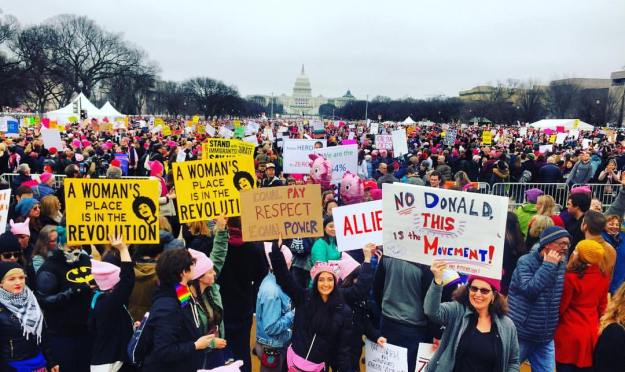
There are pleanty of calls for reform, for progressive change coming from many levels of society. Millions of people around the globe marched for women’s rights in January of this year, and this coming Saturday many more will march in defence of science on Earth Day in cities across the country. The people most harmed by the current system, especially those most worried about what the latest President might do now in office, have made their voices heard. But are those voices being heard in the boardrooms and offices of the executives? Consider the cheap shot that Pepsi took to reach out to my generation through that infamous TV ad involving Kendall Jenner and a protest. Apparently if we all buy Pepsi then all of our societal woes will be solved. Perfect! Yet still the socially conscious focus of Pepsi’s protest ad was less so on the protest and more on a self-absorbed celebrity trying to sell a soda that frankly isn’t all that healthy. The focus was entirely on them and not us.

Such wide societal divides are not the least bit healthy, and can often lead to a breakdown of the social institutions intended to keep the peace between varying classes, institutions, ethnicities, races, religions, etc. As this widening gulf continues to grow the level of respect that the parts of society have for each other continues to lessen. Our society’s obsessive focus on material wealth is holding us back, keeping us from reaching our full potential. We see multi-million and billion dollar investments in major league teams yet at the same time budget cuts to our education, healthcare, and infrastructure. The new crowd of super-rich who have populated positions of power in Washington continue to propose policies that not only hurt their greatest supporters amongst the working class, but also cause great harm to the country as a whole.

While Bill O’Reilly is just one person in a country of over 300 million, his disregard for the wellbeing of the women around him kn the workplace is one more example of inequality in this country. What’s more, the fact that his employers at 21st Century Fox waited to cut ties with him until their revenue streams were hurt is even more shameful. As long as profits come before people we as a society are seriously unwell.

The Dream Has Come True

Embed from Getty Images

Unlike most things in my life, I cannot pinpoint a specific moment, date, or even year when I was first cognisant of being a Cubs fan. That is one part of my life that seems to have always been there. I was born in December 1992 in suburban Chicagoland to a father from the North Side, specifically from Rogers Park and a mother from Kansas City, MO, yet with North Side roots from her Swedish American grandmother, and life long White Sox fan, from Andersonville. In 1992, the Cubs finished fourth in the National League East with a 78-84 record below Pittsburgh, Montréal, and St. Louis and a ways above the New York Mets and their rivals in Philadelphia.

By that time there had been at least three different sides of my family who had settled in Chicago, primarily on the North Side. My Swedish-born third great-grandfather Victor Larsson Lindblad, an ancestor of my mother, was in Chicago by the time of the 1871 Fire, having settled in Andersonville. Ten years later, on my father’s side, my second great-grandfather John Newman settled in Chicago, where he married his wife Frances in 1892, and where their eight children were born between 1893 and 1908. At the turn of the Twentieth Century my grandmother Mary Lou’s grandparents and father moved to Chicago, eventually making their way up to the North Side as well. Finally, in 1914 my great-grandfather Thomas Keane arrived from Ireland (his surname would change to Kane in 1917), initially living on Superior across from the Cathedral, and later moving to Argyle and finally Rogers Park with his wife, my great-grandmother who came to Chicago in 1920. If any one city were said to be the cradle of my family in America, it would have to be Chicago.

I vaguely recall my grandparents mentioning the 1945 World Series. My grandfather was only 15 at the time, while my grandmother was a mere 13 when that incident with the goat took place at Wrigley Field. I never heard them talk about it, presumably it was either too superstitious for good Irish Catholics like themselves, or just a sore subject. That said, out of the two of them my Grandma was the big Cubs fan. As a young child when I was visiting them in their suburban condo, I would often be with her in the kitchen while she cooked watching the Cubs on her small TV, the rabbit ears fully extended to catch the signal from WGN. My Dad recalled how she would more often than not be in attendance at Wrigley on Ladies’ Days with so many other North Siders to cheer on our team. Even as she neared the end of her life, and her health began to go, she would ask for the Cubs game to be put on the TV in her room.

In the summers, my parents and I would go out on Lake Michigan on a sailboat that they co-owned named The Arctic Tern. Our most frequent destination would be a point along the lakeshore that had a good view of Wrigley Field. There we would tune our radio to WGN and listen to Ron Santo and Pat Hughes calling the game. 1998 was one of the biggest years of my childhood in the world of sport: the Bulls concluded their final threepeat, and the Cubs made it into the playoffs for the first time in my life. That was an electric summer, one when the Cubs made headlines for both their pitching and their hitting. While I still have the Tribune‘s poster honouring Sammy Sosa’s record 66 home runs that season, I can remember far better Kerry Wood’s 20 strike out game on May 6 against Houston. What a year that was!

Embed from Getty Images

1998 may stick out so well in my memory thanks to what happened the following year. In June 1999 my parents and I left Chicagoland, moving onto a farm in Kansas City, KS. To say that that was a nutty idea would be accurate. Despite now being 500 miles away, we could still watch the Cubs most days on Superstation WGN, and continued to closely follow our team, despite now slowly gaining a new allegiance to the Kansas City Royals. The funny thing about being both a Cubs and a Royals fan is that it is remarkably easy to support both teams, after all they hardly ever play against each other. Nevertheless, my position has always been that the Cubs will come first, ahead of the Royals in my book.

In the Summer of 2000 I had just finished First Grade and was playing Coach Pitch baseball on the aptly named Pied Piper Pest Control Team at the Wyandotte County Sports Association fields in Kansas City, KS with a bunch of my classmates from St Pat’s School. At about the same time there was a TV commercial that kept appearing during the shows that my cousins and I would watch that showed a young boy using a big baseball bat, either coloured red or blue, and suddenly gaining the talent and strength of either Mark McGwire of the Cardinals or Sammy Sosa of the Cubs. I can tell you one thing for certain about that May, I really wanted that bat, because as the new kid at school I needed every opportunity I got to impress. Plus, as a 7 year old Cub fan how could I not want to be able to hit the ball like Sammy Sosa? To put it simply, I never got the bat, and probably for the better as I only ever hit the ball once in my entire one-season career as a left fielder for the Pied Piper Pest Control coach pitch team.

By the time the Cubs began getting hot again in 2003 I was used to watching them play from afar. That Spring I actually attended my first game at Wrigley Field on 23 April 2003, a monumental day in my life, yet one that I remember as being slightly boring and long. We sat in the bleachers, far enough away from home plate that it was very hard for me to see anything that was going on there. The Cubs ended up losing that game that few probably remember to the Padres 2-0. As 2003 progressed it seemed more and more likely that the Cubs were on fire and ready for another playoff run. Sure enough, in their 128th season the Cubs won National League Central with an 88-74 record.

Embed from Getty Images

That Fall was one that I will never, never forget. In the Divisional Series the Cubs faced off against the Atlanta Braves, a strong team, yet one whom the Cubs beat 3 games to 2 at Turner Field. As the Pennant race came along, I was more excited than I had been in years for the Cubs, who now faced the Florida Marlins. The Marlins seemed like a surmountable team, one that the Cubs could take. To me, the Cubs were nigh invincible, the team that was destined to win the 2003 World Series, to end the 95 year drought. I was always so excited to see Sammy Sosa, Moises Alou, Aramis Ramírez, Kerry Wood, Mark Prior, and Matt Clement take to the field. My Dad would tell so many stories about the great Cubs of 1969, of Ernie Banks, Ron Santo, and Billy Williams; how they electrified Chicago with their fun style of play, and how they led the National League until the last moments of the Pennant race. Like the ’69 Cubs, the ’03 Cubs were equally electric, but fell short of their goal. Some blame Steve Bartman for putting the team off of their mojo, but as far as I’m concerned, the tension of the moment got to the guys on the field, and the Cubs collapsed back into obscurity for the next couple of years.

Embed from Getty Images

As time has gone on, players have come and gone. Sammy Sosa left the Cubs with only a little controversy in 2004. For a while in the late 2000s Derek Lee seemed like the top guy on the field at Wrigley, his prowess as a baseball player taking him so far as to be referred to as “General Lee” on more than one occasion by my fellow Wheaton native James Belushi during WGN’s broadcasts of the “Chicago Civil War,” aka the annual Cubs-Sox Series. Lee left the Cubs in 2010, but not before playing a roll in the next big playoff run, this time in 2008. It was the centenary of the last Cubs World Series victory. Surely the stars were properly aligned, surely the saints and angels in Heaven were pulling for the words “World Series Champions” to be emblazoned on the Wrigley Field Marquee. Surely this was our year. With the hopes of millions on their shoulders, the 2008 Cubs did all they could but were swept by the Dodgers in 3 games in the Divisional Series. I finished 2008 less focused on the world of sport than on my Sophomore Year in High School, which was ongoing at the time with all its exuberant fun.

As the 2010s started up, my focus, like that of many Cubs fans switched towards Hockey, as the Chicago Blackhawks began their dynastic series of Stanley Cup victories. I had just returned from Dublin in June 2010 when Patrick Kane (no known relation) scored the winning goal in overtime of Game 6 against Philadelphia. 2011 marked the first season without Ron Santo doing the commentary on WGN Radio, a huge loss in my book. In 2012, Kerry Wood retired from professional baseball, having returned to the Cubs the year prior to finish his career back in the Friendly Confines. In 2013 the Blackhawks won their second of three Stanley Cups thus far in the 2010s. I found out the good news a few hours later when I woke for class in London where I was on a three-week summer study abroad course.

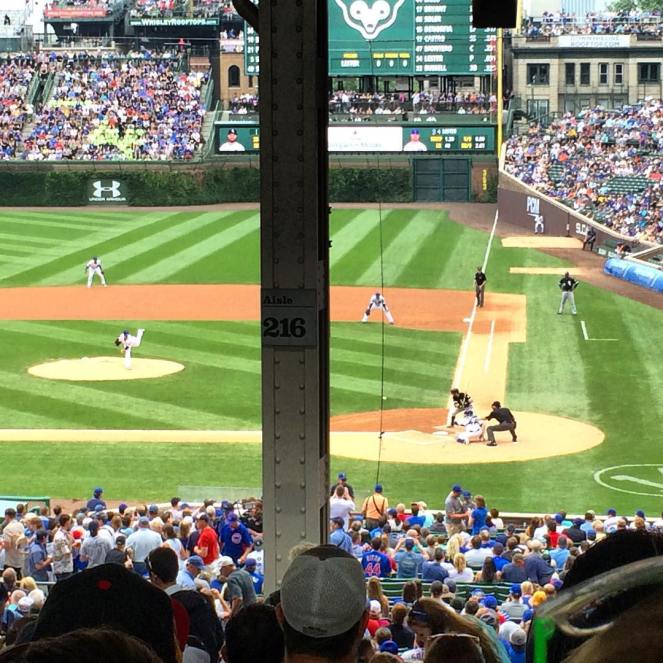
2014 and 2015 were years dominated in my house by the Kansas City Royals, who after 29 years of being fairly unannounced in Major League Baseball stunned the country by beating Oakland in the thrilling 2014 Wild Card Game, silencing the A’s top ace, Jon Lester, early in the game. The ’14 Royals went on to the World Series, but lost out to the San Francisco Giants in Game 7 leading to heartbreak for many here in Kansas City. 2015 saw a revival amongst many of the “smaller” MLB teams, including the Cubs who powered their way through the season, having acquired Lester from the A’s in the offseason. My Dad and I were lucky enough to get to go up to Chicago on 11 July to see the Cubs play the White Sox, whose starter Chris Sale outdid Lester, leading the South Siders to a 5-1 victory.
lester-cubssox-2015

Jon Lester pitching against the White Sox. Photo: Seán Kane

In September 2015 I left home and moved to London, missing out on the playoff excitement, which was greater than any other year for my family as both the Cubs and Royals had made it past the regular season. The Cubs came into the playoffs as the second wild card, finishing the regular season in 3rd place 3 games behind St. Louis and 2 games behind Pittsburgh. In the Wild Card Game, led by Jake Arrieta’s pitching, the Cubs ploughed through the Pirates in Pittsburgh in the ’15 Wild Card Game, leading to a memorable attack by baseball bat on a water cooler in the Pirates dugout. In the Divisional Series, the Cubs fulfilled one of the life-long dreams of most fans, especially those of us alumni of Rockhurst University, whose student body has traditionally been primarily made up of St. Louisians. Despite being 4,000 miles away, and unable to watch the game on TV in England, I saw the final few innings as the Cubs easily trounced their longtime rivals the St. Louis Cardinals at Wrigley Field. After years of supporting the underdog, I couldn’t help but smile. The joy of ’15 was quickly extinguished however, as the Mets came through and left the Cubs behind in a 4 game sweep on their way to the World Series. The Royals had fared better, having beaten Houston and Toronto in their drive to retain the American League Pennant. They met the Mets in the World Series, winning the crown for Kansas City in extra innings in Game 5 at Citi Field in Queens. I sat at my desk for the entire four hour fifteen minute game, watching the pixilated images being transmitted from my parents’ house in Kansas City.

As the 2016 season came around, I had a feeling that this could be the year. Every morning from March onwards, as soon as I would wake up in my basement flat in Central London, I would check the Cubs score on my phone, and as the months passed things only got better. By the time I returned home to the U.S. at the end of August 2016, it was clear that the Cubs would be in the playoffs yet again, and even clearer that they would go into playoff baseball with the best record in the Major Leagues. I watched the National League Wild Card Game between San Francisco and the New York Mets quietly from the upper level of an Italian restaurant near the Moscone Center in San Francisco, keeping an eye on who would be the ones that the Cubs would face in the Divisional Series. After a marathon Wild Card Game that saw a stellar pitcher’s duel between San Francisco’s Madison Bumgarner and New York’s Noah Syndergaard, the Californians won out with a three-run home run in the ninth inning.

The Divisional Series saw another round of amazing pitchers’ duels, this time between the likes of Jon Lester and Johnny Cueto in Game 1, and Jake Arrieta against Madison Bumgarner in Game 3. The Cubs moved past San Francisco after four games, and looked south towards the Los Angeles Dodgers who beat the Washington Nationals in their series 3 games to 2 in their Divisional Series. Like the Giants, the Dodgers are one of the best teams in the National League, and always a fun team to watch. As the Cubs took them on I couldn’t help but be thoroughly impressed by the Dodgers. Game 6 of the series, played at Wrigley Field, turned into one of the greatest nights of my life. It was the night when, in 2 hours 36 minutes the Chicago Cubs went from being the team who hadn’t won a Pennant since “the year we dropped the bomb on Japan” to National League Champions. It was a night like no other, a night when to so many millions of us it truly seemed possible that our team, our Chicago Cubs were truly capable of winning the World Series.

Embed from Getty Images

The Cubs might have seemed destined to win the 2016 World Series, after 108 years of waiting, but they had a major road block in their way. While the Cubs had lit up the National League all summer long, Cleveland had seen a resurgence, taking the American League by storm and silencing all opposition, beating David Ortiz and the Boston Red Sox 3 games to none, and the red hot Toronto Blue Jays 4 games to 1. Both Cleveland and Chicago came into the World Series with all the momentum they would need to win it all. In the end, it came down to endurance. I watched all seven games in a dreamlike state of mind, joking that this must be some sort of existential crisis for the natural order of things, after all this World Series wasn’t between a heavy weight like the Giants and Yankees, nor between the Red Sox and Cardinals. This was a World Series between Chicago and Cleveland, two flyover teams. We had not won a World Series since 1908, they had not won one since 1948. All that that did was give this series more umph, to make it a World Series for the Ages.

While I and many others just wanted a nice and tidy victory to cap off the World Series for the Cubs, the game had more twists and turns than anyone could have expected. From the Cubs giving up a 5-1 lead in the fifth, to Rajai Davis’ two-run home run that tied things up in the eighth at 6-6, I frankly was saying more Rosaries than anything else. Just when things seemed bleakest for the Cubs, when they had lost their momentum, and at least to some that goat was getting in the way again, the Heavens opened up, and the game was stopped for rain. 17 minutes later and the Cubs started over, taking things from a 6-6 tie in the 9th to a stunning 8-7 victory in the 10th. As it happens, the 2016 League MVP, Ben Zobrist had been with the Royals in ’15 for their World Series run. Now not only had he won two World Series in the same number of years, but he lived the dream of all Cubs fans, being a lifelong fan who had helped the Cubs win the World Series.

Embed from Getty Images

In the aftermath of the night of 2 November 2016 I was left speechless, in a state of jubilant shock. All my life, all my Dad’s life, all my grandparents’ lives we had waited for this to happen. For over a century the North Side of Chicago had waited to raise the World Series Banner once more at Wrigley Field, to stand before the world and cheer on our team, no longer just another easy team to beat. To me, it seemed fitting that the Cubs would win the World Series on All Souls’ Day of all days. For now, we have the best team in baseball, and today when they bring the Commissioner’s Trophy home to Wrigleyville they will surely do so in front of a crowd of millions. Wednesday night I actually found the view of the Cubs celebrating on the field in Cleveland to not have the emotional power that I expected to have. Instead, that power was with the fans who had gathered at the corner of Clark and Addison outside Wrigley Field. And as the screen on that famed Marquee changed to the words “CUBS WIN!” and “WORLD SERIES CHAMPIONS” the roar of the North Side could surely be heard around the world.

As 2016 comes to a close, and 2017 stands on the horizon, the Chicago Cubs have a new future in store. They could well continue to be a winning team for a few more years, so long as this current roster stays at Wrigley. I also have a new future, though perhaps a nostalgic one, as I prepare to leave Kansas City to undertake the work for my Doctorate. On my list are two universities back in my hometown, two institutions that, should I be accepted, would give me the chance to return to Chicago and cheer on the Cubs as I always have, albeit from not nearly as far away. The past is certainly a good thing to remember, but it is the present in which we live, and the future to which we are going. Today, as the Sun shines, and my Win flag flies at my door, I can’t help but look back at the Cubs of yesteryear, of their three World Series Championships: 1907, 1908, and 2016. But all the same, I can’t help but gaze into the future, when perhaps I, or my descendants, will get to celebrate another Cubs World Series victory. The Dream has come true.

Embed from Getty Images