Author Archives: seanthomaskane

Unknown's avatar

About seanthomaskane

I am a PhD student studying the history of Renaissance natural history focusing on French accounts of Brazil. Chicago born, longtime KC resident, SUNY Binghamton grad student.

In Support of the Sioux

I am an American in the sense that I was born in the United States of America, but I am not an American in the sense that my ancestors come from here. By blood I am as much a colonist of this country as were my first ancestors who came here over three hundred years ago. By right of ius soli under natural law I am an American, but by right of ius sanguinis under that same natural code I am, in composite, European, after all all of my ancestors come from Europe, primarily from Northern, and in part from Western Europe.

Under this natural ius sanguinis, which in my book trumps all other laws of inheritance, if one is to look for a true, and pure American, one should not turn to someone like me, nor even our President. Rather, turn to the most marginalised, most detracted and forgotten of all Americans, the original Americans.

For the past many months, a number of oil companies and big banks have been pushing the Dakota Access Pipeline across the American continent, like an axe cleaving a body in two down its spine. I am opposed to this pipeline on environmental grounds, primarily due to the lack of foresight by the companies involved in its construction. After all we are only a few years, if not decades away from green energies from solar panels to wind mills to new-fangled hydroenergies taking the place of oil as our main fuel source. We have the technology and the means to construct energy producing mechanisms that are both efficient and clean to use.

I am equally opposed to the Dakota Access Pipeline because of the horrendously negative effects it has had, and will continue to have upon the Native peoples through whose lands it crosses. This pipeline is yet another good idea for those in the boardroom, that ignores those who it most effects. Its design and planning ignores the fact that the seemingly empty lands of the Great Plains are in fact not empty at all, not the Great American Desert of Zebulon Pike’s proclaiming, but rather a land long occupied, long called home by a great many peoples.

So many of us Americans at some point or another played Cowboys vs. Indians as children. So many of us grew up seeing our Native Americans neighbours as less than human, mere sideshow attraction, once a noble race of barbarians now outdone by the progress that is the United States of America. We grew to disregard the Native Americans, believing that we did not need an excuse to take their homes, wrench their children’s cultures from their hearts, trample on their freedoms, and destroy their lives as if they never mattered in the first place. This has been just one expression of the systemic racism and xenophobia that infects our society like the Plague, that racism known at some point to all who are not the perennial W.A.S.P.s. We strive for better, through our founding documents, through the inspirational words of our greatest leaders, through our democracy and its most cherished institution of citizenship, yet of course those of colder hearts amongst us have found every rat’s hole, every crevice in the law which they could manipulate to their own ends, and to the detriment of all others.

For over five hundred years we the European Americans have inflicted the greatest, most unspeakable wrongs upon the Native Americans. Through conquest we have driven them from the most fertile parts of this continent to the most arid. We have built our society against them, and refused them entry into it. We have forced them onto reservations and left them for dead.

Today, as the Dakota Access Pipeline is being carved across the Great Plains, crossing the Missouri and Mississippi Rivers, we are not only putting the Native American peoples, like the Standing Rock Sioux in danger, we are putting ourselves in danger. Should the Dakota Access Pipeline leak, as it surely will at some point in the future, after all it is manmade, it will poison the rest of the Mississippi-Missouri River Drainage Basin, which includes the waters of 31 states.

Let us change the narrative of Native American history for the better. Let us stop the Dakota Access Pipeline and all future projects that disregard the rights of any American, whether Native or otherwise. Let us embrace the true meaning of citizenship, that all citizens are equal under the law. By civil law I am an American, just as the members of the Standing Rock Sioux are Americans. By natural law I cannot help but recognise and embrace that this continent, America, from the Arctic to Tierra del Fuego, was the land of the Native Americans first. I honour their rights, and offer my voice and pen in support of them, my fellow Americans.

What evils we inflict upon one American, we inflict upon all of us. We are all Americans.

Reflection on a Year Overseas

London – Eleven months and eleven days ago I moved from Kansas City, Missouri, USA to London, England. Eleven months and eleven days ago I left home and went on a great adventure that has forever changed the way I see myself, and the world. In the past I have said that one of the best ways to begin to know oneself is to understand the places from whence one comes. And, while time away has given me a greater appreciation for all the trappings and comfort of home, it has also given me the chance to explore some of the places from whence my own ancestors came: particularly in Ireland, in England, and in Finland.

As a historian, but perhaps more importantly as an American, this was a rare opportunity that very few of my fellow countrymen could ever hope to achieve. On the last Friday of May 2016, I quite possibly became the first descendant of my third great-grandparents, Juho Heikki and Anna Sophia Kuivaniemi, to return to their hometown of Rauma, Finland since 1879. On the other hand, I followed in the footsteps of my grandparents and was able to walk the roads and visit the town of Newport, County Mayo where my grandfather’s parents were born, and visit the nearby cemetery at Burrishoole Friary where the ancestors of so many of my relatives are buried. So many names from America are carved into those tombstones, yet here on the shores of Clew Bay they are in their original setting.

Yet perhaps most importantly over the past year I have had my beliefs, my understandings, my very philosophy of life and nature challenged time and again by friends and colleagues alike. I am eternally grateful to them all for those discussions, for those opportunities to think anew, opportunities which one day will lead me to act anew. Those beliefs, those views of mine which held water remain, while others have been left by the wayside, abandoned after much debate and discussion. I hope I am all the wiser for the people that I have met, and the great friendships that have been forged. We come from such different corners of the world, with different backgrounds, different views, different languages, yet respect abounds amongst us far more than contempt.

Next week I will at long last be returning home, to Kansas City, Missouri, in the heartland of the United States. I will return to the heat and humidity, and the allergies. Yet I will also be returning to my family, to many friends old and young. I am excited to be coming home once again, and looking forward to being surrounded by all those familiar things, sights, sounds, and smells. I did not realise it until I had been away, that even the softest sensory detail can be missed. Whether it be the sound of the wind whirling through the branches of the trees, or the familiar voices on NPR’s All Things Considered set to the backdrop of Kansas City at sunset, its streets filled with cars heading to and fro. In London I found that on winter nights, when the sky was clear and the street lamps glowed in a distinctly mechanical way, I missed hearing the familiar voice of Kai Ryssdal on Marketplace coming over the radio as I’d often hear at a similar time of night back home.

Yet I return to a country on edge, a country that has seen so much anguish, so much anger, and so much fear over the last year. The signs have been about for a while now. Since President Obama was elected in 2008 nearly every racist, closeted or not, has come out of the woodwork and ensured that the rest of us would have to hear their nonsensical cacophony rattling on. We could ignore racism as the rantings of the mad if it were not for the reality that words plant seeds, seeds sprout actions. Once again, around the world bigotry seems to be in fashion like it was in the 1920s and 1930s. There is always someone available for people to hate or fear. As Woody Allen put it in a recent interview with Catherine Shoard of The Guardian,

It’s in the nature of people to have someone to scapegoat. If there were no Jews in the world they would take it out on blacks. If no blacks, they’d move over to Catholics. No Catholics? Something else. Finally, if everyone is exactly the same, the left-handed people would start killing the right-handed people. You just need an other [on whom] to vent your hostility and frustration.

I know that bigotry has been around for a long time, and probably will still be around long after I’m dead, but I honestly did not really experience it until when I was at least around thirteen or fourteen. I remember some of the boys at school using the word Jew as an insult, which didn’t make sense to me, as I had always gotten along well with my Jewish friends and neighbours. I also never really had anything against African Americans, but after years of hearing from my classmates and friends that “Troost was dangerous,” I was less willing to go to the African American neighbourhoods east of Troost Avenue in Kansas City, MO. Subconsciously or not, I was accepting a racist ideology that I consciously abhorred.

Perhaps the best example of my reaction to bigotry comes from a strange experience that I had when I was fourteen, where an individual who I was working with at the time told me to my face, “I don’t like Catholics” knowing very well that I was a Catholic. I was shocked by this, not necessarily because he was saying that he didn’t like me because of my religion, but more so because his dislike for Catholics simply didn’t make any sense. Over the years as I have been exposed to a variety of opinions and ideas, and I have found myself adopting some similar views, whether it be a dislike for one particular nationality, or religion, or political philosophy, or a preference for a particular country over another. Yet each of these blanket opinions have been swiftly overturned as soon as I have met someone who fits into one of those categories.

How can I say that I hate someone or fear someone simply based upon their nationality, religion, politics, or even based upon the colour of their skin? It makes no sense. Bigotry of all kinds makes absolutely no sense!

I am proud of who I am. I am proud to be Seán Thomas Kane, or Seán mac Tómas Ó Catháin as it is in Irish. I am proud to have been born in Chicagoland, and to have lived most of my life in Kansas City. I am proud to be my parents’ son, and my grandparents’ grandchild, a nephew of my aunts and uncles, a cousin of my cousins, godson of my godparents, and a friend to all my friends. I am proud to be of Irish, English, Welsh, Finnish, Swedish, and Flemish descent. I am proud to be an American citizen. I am proud to have been a resident of the City of London for the past eleven months and eleven days. I am proud to be a historian, a writer, a filmmaker, an occasional musician and sketch artist. I am proud to be a Catholic.

But beyond all of these categories and more within which I fit, I am most proud, and most humbled to be human. We are all unique, we are all different, yes, as the crowd shouted up to Brian, “We are all individuals!” But most important of all is that we are all human. If we consider less what separates us and more what we have in common then surely we will be nicer to each other, and have better lives. If those in my country screaming against immigrants, African Americans, Muslims, Latinos, and all others considered what they have in common with the rest of us then surely they would think twice about their words and actions.

I am not proposing any sort of edifiable change, any sort of reform for our prisons, our city planning, our law codes, or our schools, all that will come next. What I am proposing is the essential necessity for any reform to happen. We must have a change of heart. We are all human.

TopGear and Revolution

In 1783, the Thirteen American Colonies were officially recognised as free and independent states by their former mother country, the United Kingdom. Initially, each of the thirteen states were autonomous to the extent that they were effectively separate countries, united only in a weak document called the Articles of Confederation. The power vacuum left with the departure of the British colonial authorities led to a worryingly unstable situation across all Thirteen American States. Stability in government was only restored with the Constitution of 1787, the binding document which created the Federal Government of the United States, effectively creating the system of government that has kept the United States relatively stable, despite one civil war, ever since.

A similar revolution has occurred in the BBC’s hit motoring show TopGear, with the departure of the old order, led by the trio of Jeremy Clarkson, Richard Hammond, and James May, who have gone to Amazon Prime Video. In their wake, the BBC has chosen a wide array of new hosts, led by Chris Evans, to take over one of their greatest hits. Having seen the first episode, Evans, American presenter Matt LeBlanc, and their fellow presenters, who frankly are more like corespondents than full time hosts, have truly put TopGear through a revolution.

The same old skeleton exists within, but the show itself is well removed from its predecessor. This new TopGear is like the Thirteen American States in the period of the Articles of Confederation; it is in a period of transition and still trying to figure out how to exist without its former presenters. Evans, LeBlanc, and the others have the same light hearted attitude to their work on TopGear that Clarkson, Hammond, and May had before, but at the moment it just does not seem to be as funny. With the former trio, I knew to expect that odd, somewhat nonsensical, at times pointless humour. As a result, I reviled in it, often with a big smile on my face for the entire hour long programme. With Evans, LeBlanc, et cetera, I laughed on occasion. Simply put, I am not familiar with these new hosts, and do not know what to expect.

Perhaps in a few weeks, once more of the current season of TopGear is broadcast, I will  be able to appreciate the new presenters, and new format better. At the moment, I am looking forward  to the first episode of The Grand Tour, Clarkson, Hammond, and May’s new programme, which will be released on Amazon Prime Video this coming Autumn. As to the next episode of TopGear: yeah sure, I’ll watch it. This new TopGear has undergone a revolution, but it still has a long way to go until it leaves the shadow of its predecessor and enter into its own spotlight.

The Dawn of Summer

What follows is an excerpt from my upcoming travelogue, whose working title is The Great American Basset Hound. No basset hounds were harmed, or have even at this point been involved in the writing of this excerpt, or indeed any other part of the upcoming volume. Enjoy!

                   -Seán Kane.

Friday 8 April 2016 came about two hours later than the previous day, as my alarm was set for the much more leisurely hour of eight rather than its far more rushed predecessor of six. I breakfasted with Kristiina in the empty hotel dining room, as the majority of our group had already left for their first meeting of the day at the International Crisis Group. Kristiina had chosen to not attend that particular talk, as she wanted to get some rest and get the most out of the main event of the day, a visit to the European Parliament. We had a quiet breakfast of waffles, frankfurters, and croissants, passing the time with small talk, the very nature of which seemed to be our way of avoiding thinking about our respective journeys that day: hers to London in the afternoon and mine to Annecy just before eleven.

I had everything well planned, and at the chosen time was ready to leave our hotel at Place de Sainte-Catherine for the journey across Brussels to Zuidstation/Gare du Midi. At around 09:45 I said goodbye to Kristiina, turned in my room key, and headed out the door, pulling my suitcase with briefcase mounted atop behind me, as the cobblestones did not work well with all four wheels. I felt a sense of excitement, a sense of anticipatory joy at seeing my parents again for the first time in four months. This was the longest stretch of time that I had been away from them in my life, the longest since we had hugged, or sat together, or ate together. Yet also I felt a pang in my heart, a longing for my friends who would be returning to London that afternoon. Perhaps the perfect possibility would have been if both my parents and my friends could be together, but at least in this instance that was not to be.

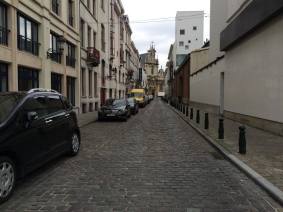
Sainte-Catherine Bruxelles

Looking towards Place de Sainte-Catherine in Brussels.

I walked through Place de Sainte-Catherine towards De Brouckère metro station, where I descended down the steps quite clumsily with my suitcase, briefcase, and umbrella in hand. At first I tried to use the fancy larger ticket gates, which are intended for those who have luggage and the handicapped, but I could not figure out how to make them work. Instead, I turned to the normal gates, and passed through fairly easily into the station proper. I was quite surprised to not see any soldiers in De Brouckère station that day, as there had always been at least two or three on patrol there every other time I had gone through that particular station. Soon though I was faced with a problem, as I had forgotten which metro line was the one to take to Zuidstation/Gare du Midi. Remembering that I had taken a direct train going to De Brouckère the day prior, I knew that I would find the proper train eventually, but still I was faced with a bit of an odd conundrum. Eventually though I came upon a bit of luck, and was soon on the T3 prémetro tram heading southbound.

To digress briefly, the public transport system in Brussels is a good model for what my city, Kansas City, could do. A system made up in part of trams (streetcars in American English), but equally reliant on buses and commuter rail could do wonders for Kansas City, bringing more people and business into the city itself, and quite possibly reducing the need for parking in places like downtown. The prémetro idea, namely having the trams move underground for part of their route and operate as a part of the metro alongside the subway lines is a smart way to better connect one’s varying modes of public transport, while saving money by allowing the local transport authority to avoid having to pay for heavy rail services like a subway. This will also reduce the need for private cars along the tram routes, equally leading to both more pedestrians and lower rates of road congestion within the city.

I quickly descended on the escalator, and went down a further set of stairs onto the platform, where the Tram 3 arrived about three minutes later. Boarding, I soon found myself hoping beyond hope that no one else would board and try to sit around me, as my bags were so big that I feared they would only cause trouble between my fellow passengers and I. Thankfully for me, that did not happen, and in large part due to the recent terror attacks in Brussels, the three stations (Bourse, Anneessens, and Lemonnier) between De Brouckère and Gare du Midi were closed. As a result, the journey only took a mere eight minutes, and as we passed along the single track between the darkened platforms at Lemonnier, I began to prepare myself mentally and physically for the journey up from the metro and into Gare du Midi. Then a sudden lurch came as the tram suddenly, and forcefully stopped in its tracks in the tunnel, whose darkness penetrated the hearts of all on-board, leaving everyone still, fearful of what was to come to pass. After a minute we started on our way again, with no reason given to what I assumed must have been some sort of animal moving across the tracks in front of the tram’s headlights, startling the driver into his sudden cessation of travel and apparent use of the emergency brake.

About two minutes later we arrived at Gare du Midi. I stood as the tram entered the station, taking my suitcase, briefcase, and umbrella firmly in hand, nearly falling over in the process as we came to a halt and the doors opened. I passed the people on the platform waiting to get on-board and walked up a short flight of stairs towards an escalator which took me into the shopping centre attached to Gare du Midi. I was surprised to find the ticket gates open, and anticipating that this crevice might merely be temporary, I slipped through, removing myself from the Brussels Metro into, as P.T. Barnum put it “The Land of Egress.” Having egressed into the mainline railway station, I began searching for a signboard which would tell me which platform I needed to go to to catch my first train, a Thalys train to Paris Gare du Nord, which was due to depart in about thirty minutes at 10:43.

Soon I found a screen hanging just above a large doorway leading onto the main concourse, which showed my train as departing from Platform 5B. Looking around, I found another sign, which pointed towards the international ticket office and Eurostar security lines as the site of the otherwise elusive Platform 5B. I walked down another long, dark corridor, which seemed to have been built with an antagonistic spirit towards the Sun above, yet hidden by the thick concrete of the platforms above. As I walked along my way I saw one final police checkpoint with two armed officers standing guard on the platforms above. My mind began to plan ahead, considering that it was entirely possible they would ask for my papers, thus I reminded myself where my passport and ticket were. In front of me was a man carrying two oversized suitcases, which attracted the attention, though only slightly, of the guards. However after a couple words they let the man pass, and it was my turn to step forward. To my surprise they completely ignored me, and I walked swiftly and smoothly through the checkpoint, heading up the ramp to the platform above.

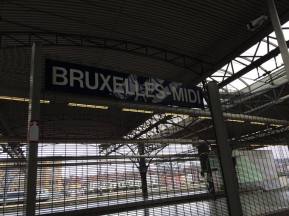
Bruxelles-Midi

Brussels-Midi Railway Station

The architecture of Brussels-Midi is quite interesting, different from some of the grand old railway stations in London and Paris, but truly a hub of activity for the railways of Belgium, the Netherlands, northwestern Germany, and northeastern France. Rather than have a grand long arched glass roof that is suspended between the two side walls of the platforms, the glass roof at this particular station is more like that at Kansas City’s Union Station, one which is made up of many smaller arches, thus giving the station ceiling more of a wave-like feel. The station itself does not necessarily have the charm of Paddington or Gare de Lyon, but it does have the practicality and methodical feel of much of post-war Brussels. At 10:23 on the dot my train arrived, its deep red paint matching the equally luxurious opera red interiors. I was surprised to see the train already filled with passengers, having not realised that Brussels was not the first stop on its route. Rather, this particular train had started in Cologne, then travelled through Aachen and Liège before arriving in the Belgian capital.

Initially I was scheduled to fly from Brussels to Geneva, meeting my parents in at the Swiss airport only two hours after their own flight from London had arrived at that lakeshore alpine city. However on Holy Tuesday, the 22nd of March, I awoke to some of the worst news one can ever wake up to. Two nail bombs had gone off at Brussels Airport in the departures hall, while a third bomb was detonated in Maelbeek metro station in the European Quarter of the city. In total, thirty-two people were killed by the ruthless barbarity of these extremists. As I readied myself for that day’s class, I kept a close eye on my TV, watching as more and more information arrived in London from the Belgian capital. Immediately, I began to reconsider my route from Brussels to Annecy, knowing that if the airport itself was bombed then the odds were pretty high that I would not be able to fly through that same airport two weeks later.

As it turned out, my intended flight did go out of Brussels, however I was not on it, and my ticket was cancelled. I did not want to step foot in that same hall where a mere two weeks prior such violence and sorrow was wrought. I did not want to walk amongst those ghosts of people who by right should still be warm to the touch, still laughing and smiling, playing and singing. I did not want to stand there and take in the macabre spectacle. I chose a different road to France, one with less sadness, with less pain.

After allowing for those passengers getting off in Brussels to do so, I boarded the train and took my place: Car 26, Seat 76. The seats on Thalys are perhaps the most comfortable seats on any train that I have yet travelled on, and I was in second class. At 10:43 on the dot our train began to move out of Brussels, heading south at high speed towards Paris. I spent the hour and twenty-two minutes that it took for us to arrive at Paris Gare du Nord writing the second half of my account of my previous two days in the Belgian capital, finishing the majority of the work in about an hour and ten minutes, thus giving me ample time to be ready to jump off the train and run to the metro station beneath Gare du Nord.

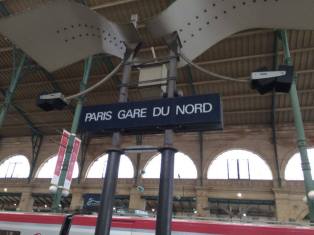
Paris Gare du Nord

“… run to the metro station beneath Gare du Nord.”

While I greatly appreciate the excellent service provided by SNCF, the French national railway company, I spent the better part of the next hour in a panicked rush. I had a mere forty-five minutes to transfer between Gare du Nord and Gare de Lyon. While this would not have been much of an issue had I been using one of the normal metro lines to get from A to B, I had to take the RER D line, a double-decker suburban line that only runs through Gare du Nord about once every twenty minutes. In short, I made it to my train on Platform 7 at Gare de Lyon with two minutes to spare, having just barely gotten on board the train before they closed the doors.

I had requested a seat on the upper level of the train, wanting to have a good view of the French countryside as I traversed that country from the plains around Paris in the north to the Alps in the south. I soon found my seat, No. 105 in Car 7, and soon met the gentleman sitting in No. 104. I figured he had a reservation for that seat, and forgetting my French, I somehow convinced him to get up and move to another seat about two rows back; though I have a feeling he simply wanted a row to himself. I quickly set my briefcase down on the seat next to mine, took out my iPad, portable keyboard, and headphones, and ticket, before removing my overcoat and placing it, my umbrella, and briefcase in the racks above my seat. As I sat down I realised my huge mistake, as I had originally intended to drop off my suitcase in the luggage racks at the end of the car, then drop off my briefcase, overcoat, and umbrella above my seat, then without taking anything out of my briefcase walk up to the café car and get lunch. However, with my iPad, keyboard, and headphones out in the open I figured I had might as well just bring them with.

I first walked towards the front of the train, but soon found myself at a dead end. Turning around, I walked through Cars 6, 5, and 4 before coming upon the Café in Car 3. By this point we were ten minutes out of Paris, and the line in the Café were at least ten people long with only one person working behind the counter. I took my place at the back of the line and waited for a good thirty minutes before ordering a Croque Monsieur and a bottle of Vittel water. Now walking back towards the front of the train, my sandwich on its plate balanced atop my electronics, the bottle and plastic cup in my right hand, whose fingers also had the highly important job of opening all of the doors between my seat and the café, I was stopped by a conductor who asked to see my ticket. “Il est à ma place,” I said, still slightly shaky on remembering my French.

“Comment?” he replied.

“Parlez-vous anglais?” I asked, accepting linguistic defeat. He nodded. “My ticket?” He nodded again. “It’s at my seat. voiture sept, place cent-cinq,” I said, switching back to French for the bit that I knew for certain how to say in that moment of intense hunger and mindlessness caused by the anxiety of my fast transfer.

“Ah, d’accord,” he said nodding and moving onto the next person. I breathed a sigh of relief and moved on through the three cars that were between my seat and I, at last returning to that place I sought out most of all at that point in time: my seat, where I enjoyed a delicious sandwich and watched three hours of a new BBC documentary on the House of Stuart’s time on the thrones of the Three Kingdoms of England, Scotland, and Ireland in the Seventeenth Century. It was at this point that I suddenly remembered that it was Friday, a day when I usually decline to eat meat, partially out of religious observance, partially out of consideration of my usually meat-filled diet and an attempt at improving my health. By this point I had had a frankfurter at breakfast, and a Croque Monsieur, which includes ham, for lunch. In that minute of realisation I thought of a new interpretation of the argument which I had used the Friday prior, that because it was the Liturgical Season of Easter, I could rejoice the Resurrection by eating meat on a Friday. Recognising the fact that this was quite a stretch of reasoning, I moved on and spent the next three hours moving my eyes back and forth between the documentary on my iPad and the fields, hills, and mountains that the TGV flew by at 300 kph (186 mph).

At 16:29 I at long last arrived in Annecy, a city, which to me appeared to still be in the Waterloo of its winter. I left my seat ten minutes prior to our arrival, and was down at the train door, ready and waiting our arrival at the platform when we at long last came to a halt and the door opened. I jumped out of the train, letting my suitcase and briefcase go ahead of me. Then rushing along the platform with the crowd, I soon saw my Mom’s red hair and my Dad’s old Cubs hat in the distance, standing behind a pillar out of the wind. I rushed up to them with a huge, broad smile on my face, and at long last was able to give them that much needed hug, that long sought-after embrace. Our Alpine Reunion had come. I was with my parents again.

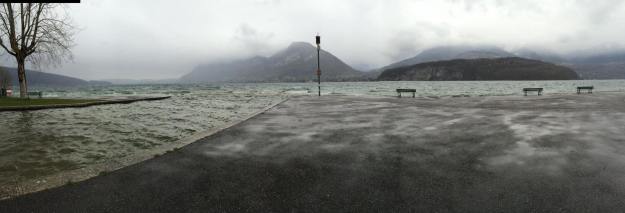
Lake Annecy 8 April 2016

Lake Annecy, “which to me appeared to still be in the Waterloo of its winter.”

Drunkards and Drums

The night was long, and sleep far from possibility. From two until three I was awake, hearing loud and clear a parade of drunken revellers on Rue Claude Pouillet singing loudly and clearly the opening song from The Lion King. While that alone would have been fine to sleep to, they also had drums. For an hour the steady beat of the drum, the ratatataping of some old soldier’s rhythmic march, though more of a dance than a straight march, kept me wide awake, hearing every beat, every word, every misguided note. For fifteen minutes a man, standing perhaps on one of the balconies above the rue, would shout down, “Silencez, s’il vous plâit! / Quiet, please!” Over and over again the poor fellow made his declaration known, “Silencez, s’il vous plâit! Silencez, s’il vous plâit! Silencez s’il vous plâit!”

At some point, though admittedly I do not know when, the drums went quiet, the chorus having moved along to some other quarter of the city. I felt my eyelids begin to gain the weight of sleep once again, and soon all was nought.

The second alarm came sooner than expected. I was quick to answer it, turning it and the other six that were to follow after it. I stood, taking my time regaining my bearings. The room was brighter than I had expected, letting me know immediately that it would be a bright day. I hurriedly got ready to leave, packed the last of my things, and was out the door by 09:25.

Descending the staircase I left the key in my hotesses’ post box, and walked down onto the street in front of the building, where to my surprise I saw the kind woman herself walking towards me from the west end of Rue Claude Pouillet, where she had parked her car behind les Passages Pasteur. We talked for a few minutes, and bidding our farewells, I turned to walk back towards Pont Battant and across Le Doubs to Gare Viotte, where I would catch the first of five trains on the long journey back to London.

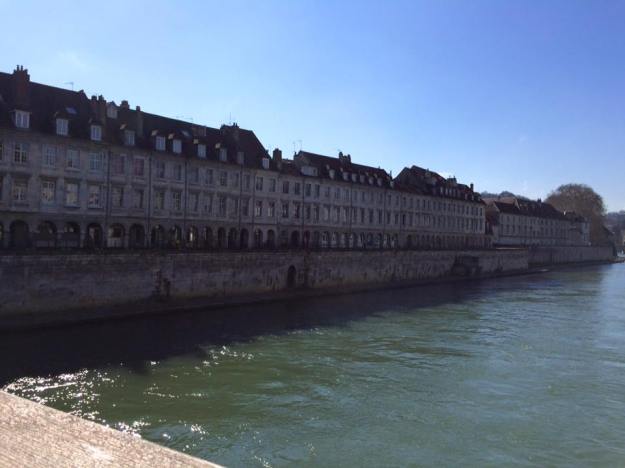
Le Doubs au matin

Le Doubs in the morning

The walk up to Gare Viotte was somewhat of a challenge. I knew that I was running low on cash, so the tram was out of the question. In any case, I knew that I would be sitting on trains, trams, planes, and in the tube for upwards of eight hours, so I figured that it would be better to have these last fifteen minutes in Besançon available for walking.

After about ten minutes I left the main city, walking up along Vauban’s old battlements, the earthwork and masonry defences built to ensure the preservation of French royal control over Besançon and Franche-Comté against any possible threat in the last few generations before the French Revolution. Once over the first series of battlements, I continued on a bridge which went over an old stone moat, now a bypass. On the bridge were two women, each walking their dog, both of which were small, excited, and exuberantly happy to be out in the Sun. As I approached the women parted ways, one heading south towards Besançon, the other north towards Gare Viotte. The joyous dog who went with its mother northwards towards the Gare bounced along, its tail wagging, its ears rebounding with each step. Pure joy has never been so expressed nor seen in my life.

As I entered Gare Viotte, I stopped off at a small café, where I bought a blueberry muffin and a bottle of water for breakfast. Then writing my farewell message to Eve, I went down in the elevator towards the concourse leading to the platforms beyond. My first train, a regional connecting service, departed from Voie (Platform) F, which was two platforms away from the main station building. I quickly ascended onto the platform and boarded my train. I found the seats full, the car packed with commuters and travellers alike. I pushed my suitcase up against one of the glass walls, and took hold of a bar, ensuring that I would not fall from the sudden change in acceleration when we left the station.

We pulled out of Besançon Gare Viotte soon thereafter, at first travelling at a slow pace, passing houses, shops, businesses; leaving a small city all unto its own self, a place where 100,000 people lived, and worked. I looked on as Friday continued in Besançon, while for me it was a uniquely transient day, not really any particular day of the week. Rather this day would remain unique in my mind henceforth to the end.

After about sixteen minutes we arrived at the TGV station on the outskirts of Besançon. I was ready to disembark from the commuter train as soon as we arrived, and was one of the first out onto the platform, knowing that my transfer window between trains was small indeed. Comparing my next train number with the trains listed on the monitor, I soon found that I would be on the TGV service to Paris-Gare de Lyon. The thought occurred to me that I would probably be wasting time today, that I could have just taken the Eurostar from Paris-Gare du Nord rather than flown back from Lyon-Saint-Éxupery. With this in mind, I eagerly awaited the arrival of the TGV, knowing that it would be my first experience on the famed high-speed service.

When the train arrived, I found myself rather confused. My ticket was for a seat in Voiture (Car) 6, so figuring that it would be near the back of the train I had moved to the far end of the platform. To my surprise, however, I soon found that the back of the train was made up of the First Class cars, with Second Class further forward. I quickly moved up, and at first entering Car 5, I soon found that there would not be an obvious way to walk between the cars, as there is on the British and American trains. So, I quickly exited the train again, and running back towards First Class, I asked one of the conducters “Où est la Voiture 6? / Where is Car 6?” The conductor pointed back towards Second Class, offering a brief “Là bas / Over there.”

I ran back towards Second Class and found Car 6 ahead of Car 5 in the order. I boarded, and was greeted by the highly ordered nature of the SNCF, the French railways. The lower numbered seats were all on the bottom level, while the higher numbered seats were up on the upper deck. My own seat, No. 26, was on the bottom, and so I was quick to walk through the open glass doors to where my seat was to be found. Once there I soon realised that I should have disposed of my suitcase at the entrance to the cabin, and returned to take care of the baggage. Returning to the seat, I took my place at the window, and prepared myself for a 40 minute journey through Franche-Comté, what in the Middle Ages was a part of the Duchy of Burgundy.

The man who sat next to me was older, with grey hair and a grey beard. We did not talk, but were able to have plenty of room to each of us on our short journey to Dijon. I found myself inspired by the countryside, by the verdant fields, the distant Alpine foothills, by quiet villages and busy autoroutes.

Soon I began to plan out my disembarking from the train. I knew that I wanted to be ready to leave as soon as we came to a stop at Gare de Dijon. I had planned to begin collecting my things when we were five minutes out of the station. As the first half-hour began to pass, the gentleman next to me seemed to have the same idea as me, and both of us stood and passed back through the cabin towards the luggage racks, where we collected our suitcases. Then waiting in the entry corridor in front of the lavatories, we watched as our train rolled smoothly into Dijon.

I was amazed at how the world seemed to move, yet it appeared as though we were standing still. The speed at which our train moved made it seem as though the only immovable objects on the ground were the twin rails, upon which our TGV glided into Dijon, its wheels making hardly an audible sound as we slowed and came to a stop at the platform closest to the exit. I disembarked, and parting ways with the grey-haired man, I quickly descended the ramp into the main concourse of the station.

My next train was also a TGV, this time going to Montpellier. I would be leaving it at the first major stop, Lyon Gare de Part-Dieu. My train was not due to arrive for another thirty minutes, so I figured that I could stand on the platform and take in some of the air for a while. As I walked along the concourse, going towards my next platform, I saw a poster for the historic site at Alesia, a place known well to me from so many renditions of Caesar’s life and his conquest of Gaul. Alesia was the final Gallic stronghold to fall to Caesar’s legions in 52 BCE. It’s defender, a Gallic king named Vercingetorix, has long since become a symbol not only for French independence, but also for all of the ancient Celtic peoples of Western Europe.

My train arrived early, and I was quick to find Voiture 16, where I was due to take Seat 22, another window seat. As the car’s door opened, I waited while those passengers disembarking in Dijon did so, before I took my turn entering the car. I soon found my seat still occupied, by a young woman, perhaps only a year or two different in age from me. She was quite occupied, painting her nails with a deep red hue. The sharp smell of the nail polish penetrated my senses, and made for a rather unexpected welcome aboard this second TGV.

I had decided that it would be best if I kept my being a foreigner less obvious, preferring to not work on anything in English while onboard. Rather, I watched another episode of Sir David Attenborough’s Life of Mammals series for the BBC. She certainly noticed, and I could just barely see her occasional glances towards my iPad as a series of herbivores graced the screen, from the smallest Pikas to the largest Giraffes and Elephants.

This was a far longer journey, about an hour-and-a-half in length, and I planned to only have my iPad out for the first hour to hour-and-fifteen minutes of the trip. I knew from the start that I wanted to be ready to go at least five minutes before the train reached Lyon, knowing all to well that the next two stages of my journey would be the most complicated and challenging. So, following the herbivore episode, I listened to a brief segment of Gluck’s Orphée et Eurydice, then returned my iPad to its place in my suitcase.

It was then that I first caught sight of the Rhône, that grandest of rivers in the south of France, over which Hannibal had marched his armies over two millennia ago on their way to Italy. All of the rivers which I had thus far beheld on this trip, Le Doubs, and the Saône flow into the Rhône. The Rhône is to this half of France what the Mississippi is to the Midwestern and Southern United States.

We followed the course of the Rhône south, at last crossing it and coming into our next port of call, Lyon Gare de Part-Dieu. I watched from the entryway as we entered a busy corner of the station. Next to me were three women, one older, respectable, with a kind face, another busy, ready to go to work, and a third with the appearance of a punk rocker, her headphones covering her ears and hair, blasting heavy metal out for all to hear. She wore a bull-ring through the central cartilage of her nose.

Within five minutes we were stopped, and I disembarked the last of my three SNCF trains for the day. I stood on the platform for the longest of moments, unsure as to where the exit was. The flow of the foot traffic was confused, erratic, and unable to accurately gauge. Eventually I decided to walk to the right, and soon found myself on a long ramp going down into the main concourse of the station. Along the ramp were a number of posters for the new The Jungle Book film, or Le Livre du Jungle, which includes the great Chicagolander Bill Murray in its cast as Baloo the Bear.

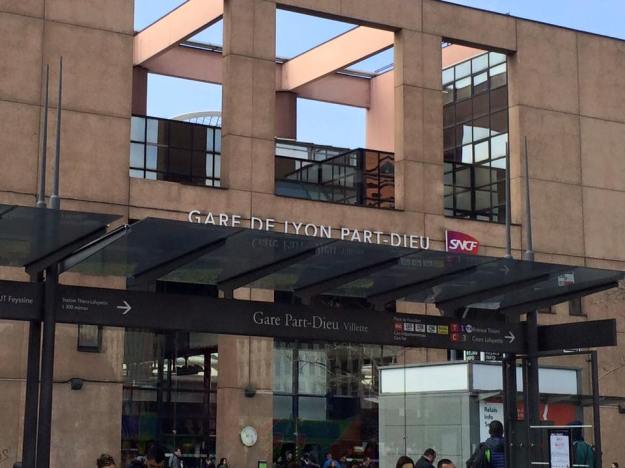
Gare de Lyon Part-Dieu

Gare de Lyon Part-Dieu

There I found the busiest railway station that I had thus far seen on my travels in Europe. There seemed to be no sense in the people, who walked in many disorderly fashions around the very ordered layout of the station. I made it my purpose to find the sign for “L’Éxpress de l’Aéroport / Airport Express,” which I knew would lead me to my last bit of ground transportation in France, the Rhône Express. I soon found what I was looking for, and followed the signs out of the front doors of the station onto the pavement beyond. There a number of newspaper hawkers attempted to sell their goods to me, though I simply continued on my course, not stopping to respond, nor giving them any attention. They seemed confounded by my negligence of them, but I could not understand what they said.

I crossed a series of tram tracks, and walked to the second platform from the entrance to Gare de Part-Dieu. There a tram, painted in deep red with the words Rhône Express painted in white atop the red, sat waiting its 13:15 departure for Aéroport de Saint-Exupéry. While I already had a ticket for the tram, I could not find a way to collect it. So, I quickly bought a second ticket and boarded the tram.

At 13:15 on the dot we departed Gare de Part-Dieu, heading out of Lyon towards the airport. In many respects I found Lyon to be quite similar to what Kansas City will be like, or rather what I imagine Kansas City might be like, in fifty years time. It is a city of similar size, in a similar place in its country. Once we in Kansas City are able to build up our streetcar system, rebuild our airport, and return our city to its status as a great American destination, it certainly could be known as the Lyon of the Midwest. As we pulled into the Gare de l’Aéroport, I knew all to well that I wanted to return to Lyon and give it a proper visit.

The airport seemed nicer, more inviting on Friday than it had on Wednesday, though the lack of freezing rain may be able to account for this. I walked out of the station and up into Terminal 1, where I grabbed a quick lunch, a couple slices of pizza, as unfortunately I wasn’t able to find any Friday-appropriate food on my then budget. I quickly ate, and now with a full stomach made my way along the long walk to Terminal 3, where I would board my flight back to London.

At Luton I disembarked, and bade farewell to the French couple who I had shared Row 9 with on our EasyJet flight from Lyon. I made a speedy route into the terminal building and up to the customs checkpoints. Being enrolled in the Trusted Traveller programme, I was able to go through the E-Passport Gates, which are normally reserved for European, Swiss, and European Economic Area Citizens. The process was smooth, swift and easy to comprehend, and soon I was heading to the bus stand, awaiting the coach that would take my fellow passengers and I to Luton Airport Parkway railway station some ten minutes drive away.

We arrived at Luton Airport Parkway much quicker than I had expected, unloaded in an equally speedy manner, and soon I was going through the ticket barriers, a concept which I have found is primarily British, as neither the French nor Germans utilise them in their railway stations. As I made my long way over the station to Platform 1, I ran into an American woman who had been on my flight from Lyon. We chatted for a few minutes before our train arrived, and soon I was hurtling south on a brand new Thameslink train to St Pancras Station.

This journey now nearing its end, I would take one flight back to England, then another train down to St Pancras. From there it would be back into the Underground to my neighbourhood. I had deeply enjoyed my time in Besançon, and had truly fallen for Franche-Comté. I was cheered in my departure by the fact that in less than a month I would be returning to this alpine region in the east of France. In one month I would find myself speaking French once more. In one month I would see my parents again.

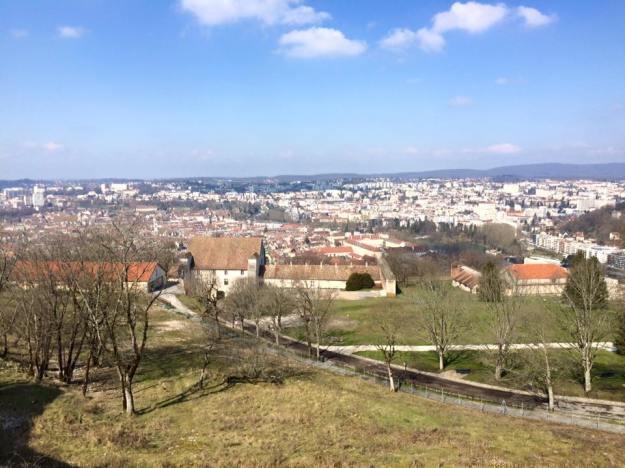
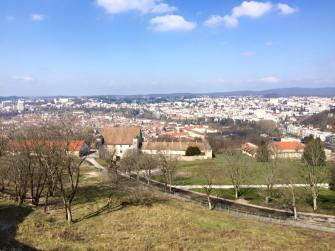
Besançon from the Citadelle

Besançon

A Day in Besançon

Morning came much quicker than I had expected. No sooner had I closed my eyes than I found their lids parting once more as the sunlight peaked into my room through the curtained windowed-doors, which led onto the balcony. I turned over and looked at my watch: 07:18. Returning to my position I thought about getting up, but my body declared otherwise and my eyelids closed once more for what seemed only a moment. When I checked the time again I found that it was 08:45. Still though the motivation for waking was not there. With a breath the time had jumped forward to 10:30 and I found myself standing, walking over to the lavatory to ready for the day.

Dressing quickly, wanting to be out the door by 11:00, I met that goal and made my way down the old worn great wooden stairway. The building showed its age, its having been repurposed on a number of occasions. It’s sixteenth century walls serving countless roles over its long life. When this building was first built, Besançon was controlled by Charles V, Holy Roman Emperor and King of Spain, the Habsburg grandson of Charles the Bold, last Duke of Burgundy. This region had for many centuries since the Treaty of Verdun in 843 been Burgundian, not French.
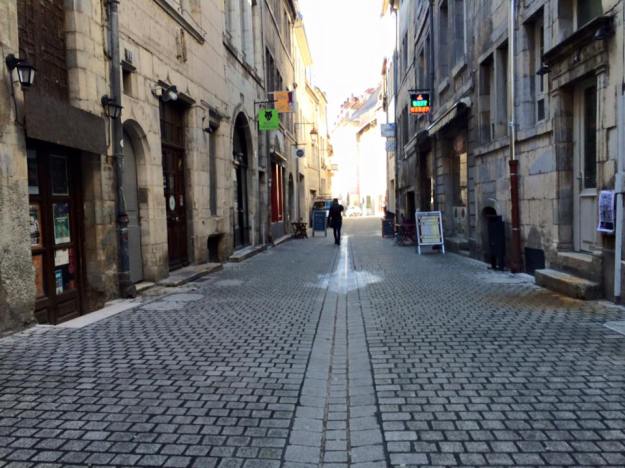
Rue Charles Pouillet

Rue Claude Pouillet

I had three places on my list to see on Thursday: the birthplace of Victor Hugo, the Musée du Temps, and the Citadelle. As I walked down Rue Claude Pouillet, I noticed a large church across Pont Battant. Walking over the bridge, I chose to try and enter the church, wanting to see what a traditional French parish church looked like. I walked up to the church of Sainte-Madeline, and found the side door on the right unlocked and open. Upon entering I was greeted by a stiff coldness which went right at my bones, as if trying to rattle the skeleton within. The church was grand, baroque in architecture, made of the finest stone. The new Vatican II altar echoed the revival of France after the horrors of the Second World War with the flames of the phoenix running up the side of the dark stone monolith.

As I walked towards the Joseph Altar, I heard someone moving to my right in the closest side chapel to the high altar. There I found a woman laying flowers in vases beneath an altar for those who had died in the War.. The altar beneath which the flowers stood was dedicated to a pair of medieval bishops, perhaps even saints.
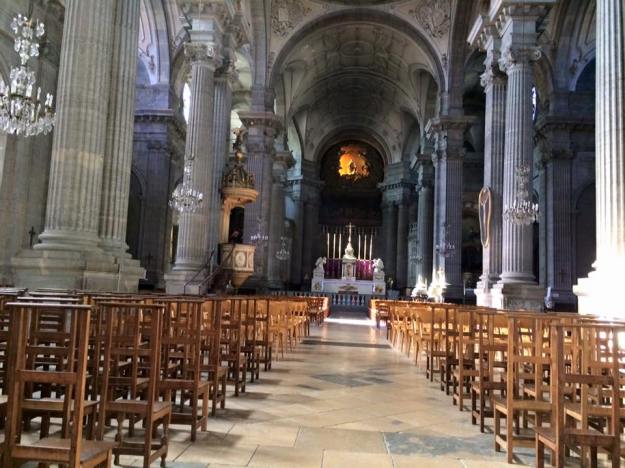
L'Église de la Madeline

L’Église de la Madeleine

Leaving the church, I could feel the stillness of the sanctified space, as if I were being watched by generations of the city’s dead. I made my way out of the church and back onto the street, Rue de la Madeleine, which led back onto the Pont Battant and south to the Grande Rue.

Besançon is a lucky city. It survived the rage and destruction of the Second World War relatively unscathed by the bombs. The city’s streets echoed with centuries of history, for in all honesty these same streets have remained practically as they had been when they were first built centuries ago. Only the newer installations, the Galeries Lafayette and Passages Pasteur chief among them showed those tell-tale signs of twentieth century construction.

I made my way south along the Grande Rue, the main street in Besançon. Luckily all three of my destinations for the day were located along this rue, thus ensuring that there would be little chance of my getting lost in a foreign city in a foreign country. Though my French existed, it was not nearly as good as Eve’s, who spoke it with such fluency that at times I wondered if she had ever spoken another language.

Besançon was still quiet, even at its busiest hours. There were hardly any cars, vans, or trucks moving about on the streets. The Gendarme made their rounds on bicycles, as locals and tourists alike wandered about the winding streets and lanes of this old city. The Grande Rue certainly was the widest of the streets, though it still would be counted as a small one-way alley by Midwestern standards. Every few blocks the street to lead into a grand square, such as Place du 8 Septembre, where I was astonished to find an Irish Pub called Madigan’s. Not only did my amusement arise from the fact that there was an Irish pub in this furthest corner of France, but that it would share the surname of my undergraduate French professor at Rockhurst. At last I came upon the Musée du Temps, at about noon. Entering under the grand archway which led to an inner courtyard, I found the glass doors to the museum off to the left of the court. I entered and strode up to the ticket counter, behind which stood a tall woman with lighter brunette hair. “Je voudrais visiter le musée / I would like to visit the museum,” I said.

She replied that the museum would be closing in ten minutes for lunch and that I should return around “quatorze heures,” two ‘o clock. I said “Merci,” and turned, walking back out into the courtyard and to the Grande Rue beyond. I decided to see if I could see both Hugo’s birthplace and the Citadelle before 14:00, hoping then that I would be able to return to the Musée du Temps before meeting Eve at a café at teatime.

I made my way further along the Grande Rue, passing by shops of so many varieties. I suddenly found myself standing in front of an old building whose face bore a bronze memorial honouring it as “la maison natale de Victor Hugo / the birthplace of Victor Hugo.” I entered, and was greeted by the sight of a pile of backpacks on the floor next to the reception desk alerting me to the presence of a school group in the museum. Approaching the front desk, I paid the €2.50, received an English audio guide, and began the tour. The building had been entirely renovated in the last fifty years, it’s distinctly modern feel slightly off-putting, at least considering that I had expected to see an old home whose features had not changed since that cold 26 February in 1802 when the great writer was born.
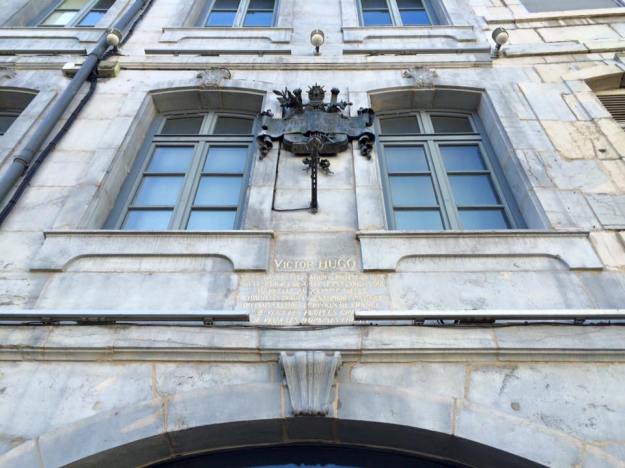
La Maison Natale de Victor Hugo

La maison natale de Victor Hugo / The Birthplace of Victor Hugo

Instead of being a museum which focused entirely upon his life, the Maison Natale gave more focus to those pursuits which Hugo held close to his heart. It had an entire gallery devoted to freedom of speech and of the press, and to those who worked to aid the poor throughout the Francophonie. All of this was neatly tied into the story of Hugo’s life and work. His colourful characters connected to their modern counterparts without so much as a stitch to be seen. The bust of Napoléon III placed just so that it would forever stand in front of a cartoon from a 1982 edition of Le Monde discussing the dangers of press censorship.

I proceeded through this first gallery, listening to as much as I wanted to on the audio guide, which gave me a sense of direction, an understanding of the purpose of the museum. I proceeded into the next room, which was a reconstruction of what the house might have looked like at the turn of the nineteenth century. There was an antique rocking horse in the corner, as if left there by a young Victor, the wooden animal still awaiting its master’s return. Across the room were a series of portraits of Hugo’s parents, his father the Napoleonic general, his mother the woman of culture, his godfather, a man hounded by Napoléon’s regime. From there I walked into the penultimate room, a narrow affair which was dominated by a semi translucent sheet of glass, upon which was printed a famous image of Hugo with his family and friends in his salon in Paris around the 1860s. Behind the glass stood three nineteenth century chairs, as if to represent ones which the occupants of the picture might have themselves sat upon.

On the opposite wall hung a world map, likewise printed onto glass. On it were the countries which Hugo had either visited himself, or had extensive contact with. One such was the United States, whose own struggles with slavery led to Hugo offering his full outspoken support for the Abolitionist cause some ten years prior to the outbreak of my country’s horrible Civil War. On a side note, during the American Civil War, the favourite book of many soldiers on both sides was Hugo’s masterpiece Les Misérables, which was first published in Brussels, as Hugo was in exile from his homeland at that point.

The final room was more of a converted closet. It seemed bigger than it actually was, in part because the two end walls were entirely glass windows, one looking out onto the Grande Rue, the other onto the stairs which led up from the reception room to the exhibition. On the wall opposite the door hung a series of two bookshelves, upon which live a collection of Hugo’s works, in many different languages. These books were donated to the museum by foreign students and teachers, attending classes at one of the many local universities and institutes. There I saw at least ten copies of Les Misérables in nearly as many languages.

I left the Maison Natale forthwith, and continued on my walk down the Grand Rue, or rather up it as the street began to climb up the face of Mont Saint-Étienne, upon which stands the Cathedral of Saint-Jean, itself once below the older Cathedral of Saint-Étienne, which was destroyed during the French conquest of this region, Franche-Comté under Louis XIV in the late seventeenth century. As I climbed higher, I found myself suffering very much from the rise in altitude. Being very much a lowlander, having lived my entire life below 1000 feet, I have found altitude to always be a challenge. As I passed the Cathedral, I made my way further up the slope, first walking along the street, then up a series of stairways which were carved into the rock of the hillside. I stopped at the top of the first stairway to look down to the east towards le Doubs as it began its curve around the Boucle of the city. Having regained my breath, I chose to continue my long march up the side of Mont Saint-Étienne to the gates of the Citadelle.

It took nearly fifteen minutes, after which I was horribly out of breath, but at long last, sweaty, exhausted, but accomplished I made it to the first gatehouse. A sign was posted in the window of a ticket booth informing visitors that the ticket office had moved 100 metres further up the hill in the second gatehouse. So I began to climb again, passing by a large fenced off area, which was home to a flock of Darwin’s Rhea, a rare large South American flightless bird that is midway between an Emu and an Ostrich. Continuing up the hill, I made it at long last to the second gatehouse, where the ticket office and gift shop stood. There I paid the €8.50 for my ticket and, now being rather hungry, I chose to go across the way to the gift shop to see if there was anything small that I could buy for a snack. I soon realised my misfortune, for finding nothing there, I also had managed to end up on the wrong side of the gate itself, and was now outside of the ticketed part of the Citadelle. I quickly returned into the gift shop, and showing my ticket to the man behind the desk, I said “Je visitais la boutique” to his chuckles.

The Citadelle is a magnificent piece of seventeenth century military engineering. It’s walls rise up out of the hillside to not only defend the city below from attack, but also to impress upon the Comtois people themselves that they were no longer franche or free of French royal authority. I walked through another gate and found myself in what was the central pair of courtyards in the fortress. To the right I found a restaurant, which became my first port of call. I enjoyed a delicious selection of local sausages for lunch, and soon was back on my way to explore more of Vauban’s masterpiece. I decided to climb the stairs that led up to the walls, along what was called le chemin de reine (the Queen’s walk). At the top of the wall I was greeted by a large French tricolour flag, waving proudly as ever in the Alpine breeze. Across the Citadelle on the opposite parapet waved the grand blue flag of the European Union, its circle of yellow stars visible from a significant distance.

I walked along the wall as far as I could go, getting a bird’s eye view of the entire Citadelle. On the other side of the wall I had a spectacular vantage of le Doubs as it flowed past the Boucle of Besançon and around a great hill which stood directly opposite Mont Saint-Étienne and the Citadelle. When designing the fortifications, Vauban chose to raise the elevation of Mont Saint-Étienne so that it would be higher than the surrounding hills, thus saving it from any chance of aerial bombardment, at least before the dawn of modern military aviation in the First World War.

This slideshow requires JavaScript.

The Citadelle gave off the impression of being something old, yet surprisingly fresh and new. Despite being constructed some three hundred years ago, it was under renovation, as a new Biosphere was being built at the far end of the Zoo at the back of the complex. The fortifications now seemed less a seventeenth century construction and more a part of the hillside. It was as if they had never been built, but rather had been carved out of the rock. Such a geological marvel as this could not go unnoticed, yet from my observations from atop the rampart, it seemed as though those who walked in its shadow did not notice the Citadelle above. In fact, as I later discovered, the Citadelle was not the only human engineering feat undertaken on Mont Saint-Étienne. In the Twentieth Century a number of road tunnels were dug into the rock, connecting the eastern and western approaches to the Boucle of Besançon. Alongside these, a railway line ran parallel to the street in the shadow of the Citadelle far below it’s rocky expanse.

After about twenty minutes I descended from the rampart and made my way towards the Musée Comtois, which is dedicated to the history of the Franche-Comté region. A uniquely alpine area, Franche-Comté has seen influences not only from France but also from its neighbours in Germany and Switzerland. I quickly began to hear the differences in the Franche-Comté accent, such as their preference for a revoir, pronounced “á voix” rather than the au revoir, pronounced “eau voix” as I had learnt it. I actually quite like the Franche-Comté accent, as it feels quite natural and in some ways pleasant to the ear.

The Musée Comtois is home to many artefacts from throughout the region, its grandeur celebrating the traditions of the people themselves, less so the customs of the rich. One particular display showed the sort of pottery which one would find on a dinner table in Franche-Comté from the neolithic age to the present.

I made a quick procession through the Musée Comtois, leaving within about 15 minutes, as I knew the main attraction in the Citadelle would take around an hour to see. On the way there I stopped in at the exhibition detailing Louis XIV’s conquest of Franche-Comté and the construction of the Citadelle by Vauban in the seventeenth and eighteenth centuries. Oddly the museum staff had chosen Handel’s Water Music as the soundtrack for the exhibit, and while Handel certainly is of the right generation, I felt that someone like Lully or Charpentier would be more fitting for an exhibit about le Roi Soleil.

I could not help but notice the elegance of the clothes of the seventeenth century gentlefolk, whose images graced the walls of the exhibition. The fine lines of their coats, the stockinged and knee-breeched legs, the elegant hats with feathers gracefully announcing themselves like those of some grand Versailles peacock. I admired and dreamed of how my own time and place in history would look if we dressed as well as this.

Leaving the Vauban exhibition, I found myself confronted with what I had hoped I would not see. The largest exhibition in the Citadelle, the Musée de la Résistance et la Déportation was closed for renovations. So, I decided to see the Zoo, which was housed in the back of the Citadelle. Within minutes I was confronted by a pride of Asian Lions, all of whom turned to look at me, with one even standing as I entered the Zoo. I was certainly frightened, knowing that these lions could well be lethal if given the chance, but I had a feeling of eager daring do which led me down a dark, covered path along the lion enclosure.

The lions displayed an air of nobility, of grace. They are the ultimate cats, the fullness of feline dignity and grandeur. While I was concerned by their approach, I also felt a sense of respect for their honour, their dignity. They were beautiful creatures, their coats looking as healthy as possible, their slender muscular bodies gracefully curving and straightening with each motion of the body. Beauty knows no beast lest it have an understanding of the lion, for with the lion beauty finds its most natural form.
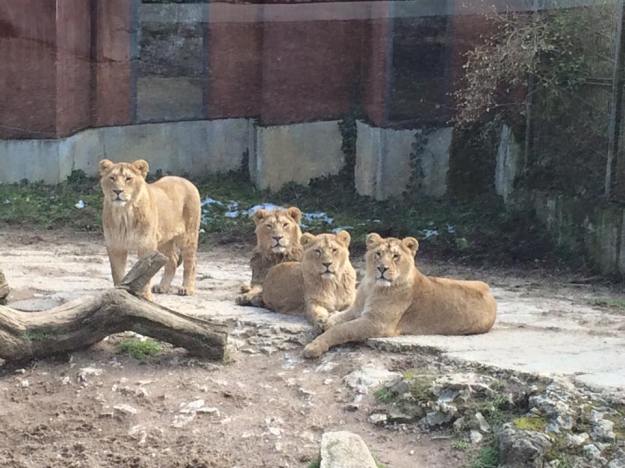
Les lions asiens

Asian Lions

I passed a sleeping mongoose, and then came upon a large enclosure, my path protected by thick plexiglass and metal walls. Every few feet there was a monitor hanging on the top of the wall showing what appeared to be an empty room, where presumably some large animal slept.

Then I saw it, up and moving. It’s coat sent signals of warning, of danger, of the fact that it was willing to be a threat, and I was quiet, careful not to make any sudden movements. There, not more than fifteen feet in front of me stood a full sized adult Siberian tiger. I watched as it walked to and fro in its enclosure, and hoped beyond hope that it would not look at me, for I truly was afraid of it. I felt like a spy who had suddenly walked into some secret room as I stood there, motionless, my camera recording the tiger’s movements back and forth around a large boulder. It turned my way, but did not appear to see me as the lions had. I held my breath, looked at my watch and seeing that it was fifteen minutes until two, I decided to make my retreat.
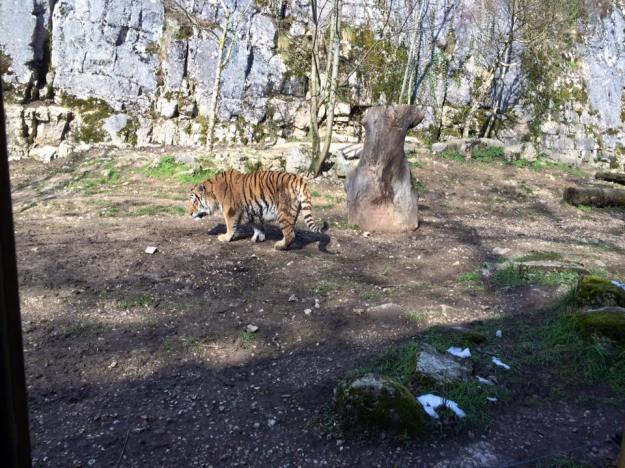
Le tigre siberien

The Siberian Tiger

Quietly, steadily, without a sound I walked out of the tiger’s viewing area, and past the lions who all now were laying down on the ground, sleeping as any cat would do in the afternoon. I quickened my pace as I left the Zoo, and walked out of the Citadelle, stoping to buy a commemorative coin, honouring Vauban’s work on the complex. Within five minutes I was out of the front gate and making my way down the front of Mont Saint-Étienne, past the Cathedral and along the Grande Rue.

In the shadow of the Cathedral I came upon an old Roman column, then I looked up at the arch which the column supported. Curious, I crossed the street and found a plaque explaining the history of the arch. It was known as the Porte Noire, the Black Gate, by the local Bisontins, yet for me this arch was an amazing moment, the first time I had come face-to-face with a monument dedicated to one of my favourite Romans, the great stoic philosopher and Emperor Marcus Aurelius.

I later learnt that Besançon is in fact one of the oldest cities north of the Alps. Known in the ancient world as Vesontio, it was first recorded in 58 BCE in Book I of Caesar’s Commentarii de Bello Gallico. In the Middle Ages, the city’s name shifted from Vesontio to Besontino, then to Bisontion, and finally to Besançon. Linguistically this makes perfect sense. Of all the consonants, the letters V and B are closely connected. Consider the fact that in the Cyrillic alphabet the letter В represents the English and French “V”. Likewise, as can be seen in all of the Romance languages, there is often a softening of the suffix “-tion” to a sound closer to the French “-çon”. Thus Vesontio was able to fluidly develop into Besançon.
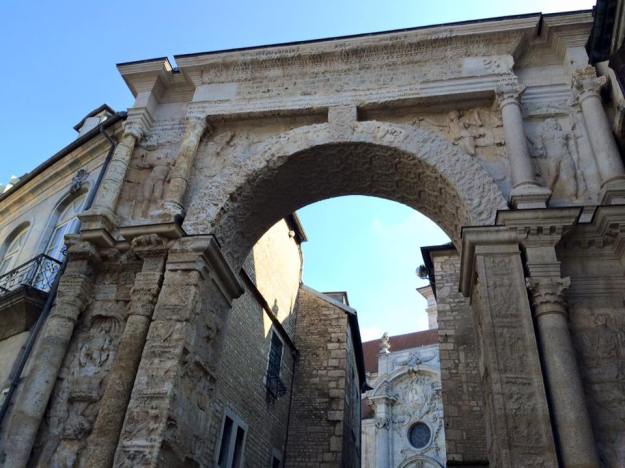
La Porte Noire

La Porte Noire – built in honour of Marcus Aurelius.

I walked along the Grande Rue, past Hugo’s house, to the Musée du Temps, which was now, at 14:10, reopened. Once inside I found the reception hall filled with a camera crew, presumably there to film something for the local tourist board. I walked past them, bought my ticket, and made my way into the museum itself. On the ground floor were two rooms, the first home to a collection of paintings by local artists, the second home to an old clockwork and a great model of Besançon at the turn of the eighteenth century. I looked closely and saw Rue Claude Pouillet, and the building within which my apartment today exists. With a smile I walked back to the main staircase, and proceeded up into the main museum.

The Musée du Temps tells the story of how the Bisontins invented the most accurate clocks in Europe. In fact, as Eve had told me at dinner the night before, many modern Bisontins commute to work each day to Switzerland, which is not far at all to the southeast, there lending their talents to the famed Swiss watchmakers. While the museum was interesting, I was more focused upon my own pressing need to keep to schedule. I walked amongst a large collection of clocks and watches, climbed the stairs to see the pendulum and great views of the city from the tower, and saw some fantastic tapestries depicting the life and accomplishments of Charles V, Holy Roman Emperor and King of Spain, who was once the imperial master of Besançon, then a Free City of the Holy Roman Empire.

With time running short, I made my way back towards the centre of Besançon along the Grand Rue, passing over the Pont Battant alongside the tram, and arriving at last at Kaffe Öst, which sits along the Quai facing le Doubs on the north bank of the river. There Eve was waiting for me, having just finished her last class and exam as a student in the city. We talked for a while about the usual things, before another American woman turned to address us.

She was wearing a University of Virginia sweater, and her accent immediately reminded both Eve and I of home. She introduced herself as Hannah, a teaching assistant at one of the local lycée, or high schools. The three of us began to talk about jobs, teaching, and our own academic careers. Like me, Hannah had majored in Religious Studies as an undergraduate, though she had hardly focused on Catholicism. Hannah and I were in a similar situation, both of us waiting to hear back from prospective employers back home. She hoped to teach at one of a number of different elementary schools both on the east coast and further inland.

After about thirty minutes, Eve had to leave, while Hannah and I stayed put, continuing our conversation about our respective Religious Studies programmes. After ten minutes, she also had to go, telling me that she was going to the Gare to meet a friend. I quickly replied that I too had to go up there to collect my Carte Jeune, and tickets for Friday’s journey back to Lyon. Without further ado, we collected our things, paid our bills to the kind proprietor, and made our way around the corner and up the street, stopping briefly in the Church of the Madeline, which I had gone into that morning, yet ironically Hannah had yet to step foot in. Following that stop, we walked north, up a hill to Gare Viotte, Besançon’s central station. In front of the station stands a beautiful, solemn monument to those who died fighting in the World Wars. The circle is lined by iron walls, with the names of the dead carved into the iron, the collections of names coming together into the figures of the soldiers. At the centre of the circle stands a large stone sculpture, of similar nature to the Martin Luther King, Jr Monument in Washington, dedicated to the Resistance.

We passed over a road, which lay in a deep moat, cut into the hillside by Vauban’s workers as a defensive fortification for the city, and entered the gare. There Hannah and I parted ways, after only having met not even an hour before. She went towards the signboards to see when her friend’s train would be arriving. I walked to the left, towards the ticket office. Eve had recommended that I speak directly with a ticket clerk, asking for one who spoke English, as I would not be able to collect the Carte Jeune from the machines in the main hall. After 30 minutes of trying to confirm my identity, the ticket clerk was at last able to print out my tickets and carte jeune, giving both to me. A box remained empty on the Carte Jeune, which was printed on the same card stock as the train tickets themselves. The box was meant to be filled with an official photo of myself, and I set about immediately finding ways to print such a photo.

I walked across the station to an empty photo booth, and tried my best to figure out how to work it. Unable to succeed in this endeavour, I decided to search the city for a photo shop where I could get such a photo taken and printed for my Carte Jeune. However, Eve assured me that as long as I had some form of photo ID on me, I would be fine.

With that I returned to the apartment, and quickly found myself drifting off to sleep. I awoke about two hours later, close to 20:00, and decided that if I was going to get dinner I had better do so soon.

I was up and out of the door by 21:00, figuring that I was running late for dinner, even by French standards. The streets of Besançon were changed, quite different from before during the daytime hours. The people seemed slightly different as well. What few tourists had been walking about during the day were now nowhere to be seen. The white limestone walls of the buildings now seemed less friendly and more threatening than before. The streets were populated by long faces, by the unnatural lines and figures of people preoccupied by their nighttime reveilles. My eyes too were unsure of what they were seeing, though perhaps that may be more due to my poor eyesight, combined with my mildly intense hunger, which cut at my stomach like a dull tooth wanting to bite into the flesh yet lacking the energy to do so.

I walked back through Place de la Révolution and down a street, heading south, always knowing where I was. At the next cross-street I turned west, walking back to the Grande Rue, figuring that I would be able to find a restaurant that seemed fairly nice, and that I could be sure would serve French cuisine, rather than that of any other country, along that street and around the squares on its route.

At Place du 8 Septembre, I had a look around. I had seen a number of restaurants around the square during my previous walks along the Grande Rue, so I figured that I would be bound to find somewhere to eat. I walked in the direction of Madigan’s Pub, Besançon’s Irish Pub, and turned right at the next corner. There I found a fairly quiet, clean, nice looking restaurant called Le Royal. I had a look at the menu and decided that it would suit my preferences well.

Le Royal was a sleepy sort of restaurant. It’s large wooden bar covered most of the left wall of the room, with a series of booths and tables on the right hand side. I was greeted by one of the two men who were working there that evening, and was led to a table near the back end of the bar. On the back wall I could see the Liverpool v. Manchester United match which was happening back in England. I set my coat down on the chair, and took a seat across from it on the booth. The waiter went back to the bar, and retrieved a menu for my perusing. After about five minutes I was ready, and ordered the chicken escalope in a forestiers sauce with frites on the side and a glass of water to drink.

Having at this point been in France for just over a day, I had come to the honest conclusion that, when properly prepared, it’s hard to not enjoy the local cuisine. In the case of my dinner, well it was sublime. The chicken was perfectly prepared, while the forestiers sauce, as I soon discovered contained mushrooms, which I have in the past avoided out of concern for my health. However it all generally tasted pretty good! Likewise the frites were fantastic, perfect in my opinion. I ate at my usual pace, and was done well before the gentleman sitting behind me, who had arrived just before I had. I payed the bill and was on my way back through the nocturnal streets of Besançon.

L'Escalope du Poulet dans la sauce forestiers avec les frites

Escalope du Poulet dans la sauce forestiers avec des frites.

Journeying through Fog

The heavy grey clouds besieged the earth with a feeling of antique passion and modern chemicals combined. As I sailed from this grey blanket, soaring above the French countryside, I had my first glimpse of an old land. This country had been home to the Ancient Gauls, distant relations of my own ancient Gaelic ancestors. Caesar had once marched his legions through this region, Rhône-Alps, while further south along the Rhône some two hundred years before Caesar, Hannibal the great Carthaginian general had crossed the Rhône with his massive army, war elephants and all, on their epic march across the Alps to Italy.

We landed suddenly, as though Aéroport de Saint-Exupéry were hidden in some obscure pocket of the countryside. It seemed as though it were an island of the modern world amidst the ancient green Gallic pastures. Sitting on the aisle, I was one of the first to stand, one of the first to collect my luggage from above, one of the first to disembark down the stairs and out onto the tarmac. As I stood on the top of the stairs, I beheld the line of my fellow passengers proceeding into the terminal. It looked as though we were passengers on some great Interwar flight, struggling to keep the cold, the wind, and the rain out of our skins, struggling to remain warm.

Saint-Exupéry was under heavy construction when I arrived. The airport is certainly a mix of mid-Twentieth Century architecture, presumably built for the Olympic Games, though it feels far more like an ’80s, ’90s, or 2000s edifice in many respects. After waiting about five minutes at Customs, my passport was stamped, and I was on my way along the fifteen minute walk down the winding corridors that led out of customs and to the Arrivals Hall. As my ride had yet to arrive, I proceeded upstairs into the main terminal for lunch.

There I began to use my French, which had been cultivated and prepared for this very moment for four years. Approaching the counter of a café in a food court I took a breath. “Bonjour, je voudrais le Parisien.”

“Parisien, ok,” came the matter of fact reply. “€4.20.”

I paid with a €5 and proceeded to an empty table where I was greeted by the splendidity that is the world of French sandwiches. A Parisien is a ham and butter on a baguette, something which I adored from that first introductory moment. Having finished I went exploring, walking down the terminal towards the entrance for the Rhône Express, the tram which goes into Lyon, terminating at Gare de Part-Dieu. I was supposed to be taking that tram to Part-Dieu, then boarding a TER train for Besançon Gare de Viotte, but all came to nought the evening previously with an email.

Having spent an hour wandering around my little corner of the old City of London and the big Sainsbury’s in Whitechapel, I had just returned to my semi-underground flat with a large steel funnel for siphoning off shampoo into the 70 ml bottle that I had bought for my carry-on bag. As I was doing the siphoning, an alert came through on my phone from SNCF about my journey from Lyon Part-Dieu to Besançon Viotte. I was surprised to subsequently discover that my train had been annuler, cancelled, because of a grève nationale, national strike by the railway workers.

Having finished my siphoning, I returned to my desk and took a closer look at the problem. Sure enough, I had a train ticket for Wednesday evening, but the corresponding train had been cancelled. Looking at later trains, I found that none would get me to Besançon before 22:30 or 23:00, or even before 06:20 the following day. So, I checked the bus schedule. Again, nothing. Declaring that I would not find myself spending a night in Lyon, I decided to go a bit far from my comfort zone and see what else was possible, even mentally considering hiring a private helicopter to take me to Besançon. Instead I found a website called BlaBlaCar.

Despite the rather odd, seemingly haphazard name, I was able to book a ride from Lyon to Besançon for a mere €12.30, which meant that I earned back a full Euro from the refunded train ticket! So, I would be riding in the car of a complete stranger for the entire 2.5 hours from Central Lyon to Besançon. But, things became ever more complex. Our negotiations led me to my sitting in Aéroport de Saint-Exupéry for about an hour, as my driver, Émilie, had agreed to pick me up there rather than having me come into Lyon to meet her.

Aéroports de Lyon

Lyon-Aéroport de Saint-Exupéry

I waited for a while on the broadwalk outside the entrance to Terminal 3, though as the freezing rain got heavier, I decided it would be rather intelligent if I waited indoors, seeing as I was still getting over a cold that had befallen my body two weeks prior. At about 17:15 Émilie arrived in her Renault Clio, and I found myself climbing in the back seat of a suitably small French car. Along with me were two other passengers, a woman in front whose name I never caught, and another woman in back with me named Éloise.

We swiftly proceeded out of the airport and onto the autoroute. Once on course, Émilie chatted with me briefly, asking why I was in France, how long I would stay, what I was doing in London, and finally where my ancestors came from, or at least that’s what I thought she asked. My response was quite matter-of-fact, “Irlande,” I stated quickly, to which she replied in English, “Why are you going to Besançon?”

“O!” I exclaimed, laughing internally, “Je visite une amie qui vient ma ville / I’m visiting a friend who is from the my city.”

“Ok” was the reply, as Émilie turned back around to focus on the road. The drive was pleasant, with a fine soundtrack of French music from the CD player, and those same verdant plains that I witnessed from the air. The soil of France truly has not changed much from its medieval and ancient past. Only the mechanisms by which we humans transverse that soil have changed. We may well have followed an ancient road, yet it was perhaps one of the best paved roads that I have ever been on. Not a bump, not a pothole in sight for over 100 miles.

After about an hour we stopped at a rest area. We still had about an hour and a half to go before we would arrive in Besançon, but we certainly were in the neighbourhood. The rest area was not like any that I have been to in the United States. It outdid even the finest Illinois Tollway Oases. The building was structured like a cabin, its high roof peaking some hundred feet over our heads. Its floors looked as though they were cleaned halfway through the day. The countertops were of the finest material, so much so that I could see my reflection perfectly in them like with the marble countertops at Harrods or Selfridges. While the women went their way, I made a quick stop to pick up a litre bottle of Evian, with the sincere hope of curing my horrible cough, which had been the one blemish, like an off-key horn attempting to play the Vorwärts drängend at the end of the First Movement of Mahler’s First Symphony, the Titan with the rest of the orchestra.

While waiting for the others, I got the chance to marvel at the building with Éloise. She asked how I was enjoying France, which received a “C’est un bel pays / It’s a beautiful country” in response. It seemed as though we were close in age, though I did not inquire too much about her or the others in the car.

After a smoke, Émilie was ready to return to the road. We made our way up into the foothills of the Alps as the Sun began to set. I found myself seeing more and more vehicles from elsewhere in the European Union further to the east, semi-trucks from Austria, private cars from just across the borders in Swabia and Switzerland, as well as trucks and vans from as far away as the Czech Republic. Then came the van from England carrying crates of bottled beer to Continental customers.

Around 20:00 we at last arrived in Besançon. I left Émilie and company at a car park on the eastern side of the Boucle, the old town which is aquatically bounded on three sides by Le Doubs. Walking to the northwest, I made my way along a street, passing by the tram, and into Place de la Révolution, the central square of Besançon. There I heard what sounded like a Midwesterner talking at full speed on the phone in English with a fellow American. Knowing immediately that it was my friend Eve, I decided to see if she would notice as I walked past. She didn’t, so I figured I’d leave it for a rather funny story in 30 minutes when we met for dinner.

I made my way through the square, keeping to the north side, passed Pont Battant, and walked down Rue Claude Pouillet, keeping an eye on the building numbers above the doors. Arriving at No. 25, I made the call to my hostess, who came down and welcomed me into the building. She was a kind woman, very warm hearted and full of good advice. After showing me the room and lavatory, she departed, and I set my things down, taking a quick breath before heading back downstairs to Rue Claude Pouillet and Place de la Révoultion beyond. There was Eve, still on the phone with her American contact. I made my presence known to her with a wave, then walked over to the restaurant where we would be dining, La Coudée, and had a look at the menu on the board outside the windows. As her call began to wind down I returned.

Eve hung up the phone, and a great broad smile appeared on her face. “Hi, Seán! You made it!”

“Eve! It’s so good to see you again! How are you?”

“Good, good,” she said, leading me towards La Coudée. “I’m glad you found the place.”

“Well, my apartment is just down that street there,” I said pointing towards the narrow passage that is Rue Charles Pouillet.

“O wow, so you’re basically in the centre of Besançon then!” She said, excited.

“Absolutely, it’s a great spot!” I replied, smiling as we entered the restaurant.

“Une table pour deux, s’il vous plâit,” Eve said to the hostess as we entered. She led us to a table to the left of the door, a big mirror behind it spanning the entire area of the wall.

Eve took a quick break and returned after five minutes. We talked about home, about baseball, about our classes and the stress of finishing the semester. For Eve, the end was nigh, with a final exam in French Literature the following morning. For me the end was still a month away, though the coursework nearly finished. As we looked over the menu Eve, whose French is far superior to my own, helped me figure out what I was going to order. Being an American who at this point had been on the road for nearly ten hours, I was craving a burger, and so I ordered the Burger de maison, house burger.

As our food was being prepared the conversation turned to family. I answered Eve’s questions about my own family, which she knows, at least in part back in Kansas City. She was highly enthusiastic about the largeness of my extensive Irish Catholic clan, which at this point numbers somewhere around 30 persons. This of course contributed to her expected confusion at the old game of Who’s Who when it came to keeping my kin in order mentally.

The burger was fantastic! A great mix of French and American cooking. The owner, an older soft spoken man of slender build who exuded saintly kindness and generosity came over to our table with a smile. He and Eve were acquainted, and they conversed happily in French as we ate. She introduced me as the son of the couple who she had brought to that restaurant back in September, all of which I remembered from hearing my Mom’s tales of Besançon as they drove back to Anncey after their day trip here last September.

I chose a chocolate cake for dessert, and we continued to discuss life back home. Eve would be leaving France on Sunday. She would have one week back in Kansas City before returning to her studies at Knox College in Galesburg, Illinois, a small railway town which sits along the junction of the BNSF and Union Pacific railroads as they wind their way across the plains towards Chicago to the east. I finished my dessert with speed, as Eve had to be on her way on the tram back to her lodgings. I paid the fair sum of €18 for my sumptuous dinner, and left with the cheery cries of “Bonsoir” exchanged between the owner, Eve, and I.

Eve led me across the square to the Révolution tram station, discussing sites that I could see in Besançon the following day. We agreed to meet for coffee after she finished her French Literature final exam, and parted ways with the customary French bise, the twin kisses on the cheeks. I walked back across the square and down Rue Claude Pouillet, stopping for a moment to detour down a close to what appeared to be a quay along the riverbank. From the quay I watched as the lights of the town twinkled on the current, as Le Doubs continued to flow, as it always does, downstream towards the Saône, into the Rhône and at last near Arles the current escapes into the Mediterranean. The fresh Alpine air filled my lungs with a sense of joy, having left thick, soupy congested London for greener fields, if only for a few days.

I returned to my apartment, called my Mom, and spent the last hour of the evening watching the first episode of Sir David Attenborough’s Life of Mammals on the BBC iPlayer before saying my evening prayers and dousing the lamps. Sleep came quickly, descending upon me like the heavy grey clouds which kept watch over the fields of France that night.

Le Doubs au nuit

“From the quay I watched as the lights of the town twinkled on the current, as Le Doubs continued to flow…”

Travels in the Franche-Comté

Besançon from the Citadelle

Besançon

From 9 to 11 March 2016 I had the opportunity to travel to the French city of Besançon, the capital of the Franche-Comté Region which lies in the east of France along the norther border of Switzerland. Franche-Comté is a beautiful region, a county with so much history, and so many traditions.

Over the following three days, I will be publishing my account of my trip to Besançon, entitled Travels in the Franche-Comté. I hope you will find it an enjoyable read. Included in each chapter will be photos which I took during my time in that beautiful small city.

Otters and International Relations

Sea Otters

Sea Otters (Photo: WeaselGang (Tumbler))

As surprising as it may sound, I find some distinct similarities between the world of otters and the academic field of International Relations. Otters live in small groups, with the mothers nursing their pups. Much of the study of otters comes out of just how they behave when confronted with other otters who they do not already know. International Relations is similar, only there are more theories. I imagine if given the opportunity scholars would be overly willing to come up with a theory relating to otters, perhaps it could be called Otterism, or even odder than that, if the theory only dealt with adult otters the theory could be called Post-Pupism.

Then again, the very understandings that we have of otters, their communal lives, and their personalities are constructivist in nature. So, at least one theory of International Relations can have a role to play in the world of otters.

On Service

Over the weekend I have been thinking about how my three main academic foci, these being History, Theology, and Politics, can intersect and cooperate. I find it far easier to find the intersection of History with Politics, after all much of my work has been in the realm of Political History. That only leaves the gap between Politics and Theology.

Earlier this evening I realised that it is Martin Luther King, Jr day back home in the United States. Dr King’s lifework was a direct human embodiment of the correlations between Theology and Politics. While I firmly support maintaining the separation of Church and State, and preserving the secular nature of American politics, as dictated in the early years of our republic, I recognise one vital theme which flows within the hearts of both disciplines: that of service.

Good theology centres on themes of selfless service. To quote the Gospel of John, “Greater love has no one than this, that one lay down [one’s] life for [one’s] friends.” In this case, as is more common, the laying down of a life is not actual martyrdom, but rather sacrificial service, a giving up of some liberty or possession or individual possibility for the good of another or of the whole community.

Good politics in turn is founded upon a similar principle. To devote one’s life to public service is not only a great choice but also a great sacrifice. Once one has chosen to align one’s individual interests fully with those of the public, one loses a degree of independence yet gains a greater appreciation for others. Marcus Aurelius writes in his Meditations, “Let no act be done without a purpose, nor otherwise than according to the perfect principles of art.” (Med. IV:2). As an actor on the political stage, be sure to have a reason as to one’s presence on that stage, but let that reason be founded upon one’s role as a citizen, a “member of a civil community.” (Med. III:7).

As Marcus Aurelius writes, “Nothing is evil which is according to nature” (Med. II:17), so too with good theology and good politics. One might say that some policies, such as support for same-sex marriage is contrary to nature, yet I disagree with that assessment, after all if nature is an element of the divine, accepting that all that is natural was created by a Divine Essence far in the past, through what science has called the Big Bang, then one cannot say with verity that anything non-artificial, that is anything not made by humans, is contrary to nature.

Nature is something which is too vast a concept to truly define in a few words, though we certainly have come up with ways to explain elements of it. Among these are theology; an  explanation of nature’s relationship with the Divine, and politics; an explanation of how human societies can organise and survive in light of the whimsical manner of nature.

Perhaps the best manner in which one can act for the good of nature, and the good of others is through public service. In this way theology and politics do intersect in a common purpose: the betterment of individual lives, and the promotion of common liberties.