Category Archives: History

Inferno

A while ago, I began reading Dante's Divine Comedy. So, over the next three weeks I will be writing my own reflections on each of its three parts. This week then, I begin with the Inferno. — Click here to support the Wednesday Blog: https://www.patreon.com/sthosdkane — Dante: Inferno to Paradise, https://dantedocumentary.com The Blues Brothers, "Everybody Needs Somebody to Love and Sweet Home Chicago," https://youtu.be/FrLZoQUl2mQ?si=g9rLDM6ZPM7tXJ97 Molly Fischer, "The Tyranny of Terrazzo: Will the millennial aesthetic ever end?", The Cut: New York Magazine, (3 March 2020), https://www.thecut.com/2020/03/will-the-millennial-aesthetic-ever-end.html Ian McKellen's performance in Macbeth "Tomorrow, tomorrow, and tomorrow" speech (5.5.17–28): https://youtu.be/4LDdyafsR7g?si=3qgAmsaKW6oKJKXq


A while ago, I began reading Dante’s Divine Comedy. So, over the next three weeks I will be writing my own reflections on each of its three parts. This week then, I begin with the Inferno.


Three years ago marked the 700th anniversary of the death of the great Italian poet Dante Alighieri, the author of the Divine Comedy, whose Tuscan dialect is widely regarded as foundational for the modern standardized Italian language taught today. I will write at length about language standardization in the future, if I haven’t already, yet today, dear Reader, I wish to address his Commedià itself. Around the time of his great anniversary, the Center for Medieval and Renaissance Studies (CEMERS) at my university held a variety of lectures concerning Dante. In one such instance, I became critically self-aware of the fact that I was likely one of the few people in the room who had not read the work.

I finally got around to reading the Commedià in the last month when a new two-part documentary on the life of Dante aired on PBS. I realized then that even though I hadn’t read his magnum opus, I still knew a great deal about it because of how closely tied it is to my Catholic culture. The concepts of Hell, Purgatory, and Heaven as I grew up understanding them have clear support from Dante’s vision of these three realms. Yet like Dante, my own vision of these three is just as drawn from far older classical and biblical sources. He recognized the importance of connecting the beliefs of his own age with those that they replaced.

This is a point I made in conversation with a friend and fellow historian: Dante was a man of his own time. In his moment, it is fitting to see the great classical heroes, philosophers, and poets resting on the outer most layers of the Inferno because they had no introduction to God during their lives. Even more unsettling is his placement of the Prophet Muhammad within the eighth circle’s ninth bolgia as one of the “Sowers of discord.” Again, this fits in Dante’s own time and place, living at the same time as the Crusaders lost Acre in 1291, nine years before when the Commedià is set.

The Inferno is proof of four great truths which I wish to discuss in the remainder of this week’s post. The first of these is that faith often requires trust in more tangible things that one can see and touch and most importantly imagine. This past weekend on Trinity Sunday, I was moved by how my pastor––Fr. Jim Caime, SJ––described his relationship with the Trinity in his own prayer life. I believe in the Trinity, though what draws me towards that belief at this moment in my life is an appreciation for the mystery of the Trinity. It’s funny there, I appreciate the mystery of the most important doctrines of the faith yet when it comes to things that are more tradition than anything else, my faith is still built on a foundation that is strikingly tangible in its nature. At times I’ve thought that superstition might stick with me more because it’s something that is more tangible and everyday than some of the more metaphysical elements of my Catholic faith. Faith needs to be lived in “to live, thrive, and survive” in the words of the great Elwood Blues.

Second, I’m not a fan of iconoclasm. Culture is built by individuals yet adopted by communities. We live in a present moment which is layered upon the past. In those layers we can see bygone moments, years, decades, generations, centuries, millennia, and ages when our past thought something they made was worth cherishing even for a moment. Everything from the eternal grace of the great monuments of human endeavor, and our striving for greater truths is just as central to these ringed layers that form our culture as are the passing fads that come and go year by year. An article I read over the weekend in New York Magazine‘s style outlet The Cut about the millennial aesthetic that has defined the tastes of my generation in the last decade asked if “the tyranny of terrazzo” will ever end. The article concludes with a foreboding of the dominance of bright yellow among the style choices of our successors, Generation Z. I for one felt a similar sense of dread the last time I went clothes shopping at Target only to discover everything in the menswear section was geared to younger generations than my own. I continue to shop at Macy’s when I’ve gotten a nice paycheck and Costco when my parents are around with their membership.

If you’ll pardon that digression, the iconoclastic spirit would burn down the terrazzo of my generation’s invention and inspiration and would replace the soft hues with new and reactive bright colors. It would respond to decades of slow burning negotiation and working within the status quo with a fierce clamor to fight and resist even if the odds aren’t in your favor that your resistance will do you any good in the long run. I’ve been there and found that sort of thinking didn’t accomplish much and so settled for Dr. Franklin’s approach to change, make friends with as many people as possible and nudge them to do things you think important. In this light, my vote tends to be cast for more moderate candidates than my own views, and I’ll freely admit my own views on issues have changed with my own changing sense of frustration and irritation towards others whose voices are perhaps projected louder than necessary through social media.

So, I appreciate how Dante kept the voices and spirit of the pre-Christian past alive in his Inferno, that he was guided by the great poet Virgil, whose Aeneid I became quite familiar with in my senior year Latin IV class (Grātiās tibi agō, Bob Weinstein). It never seemed strange to my faith that the old faiths of Europe or any other religions could also exist within our understanding of Heaven, Hell, and all the rest. Again, Dante was a man of his time and his place, so to fit in the great heroes of Ancient Greece and Rome into his vision of the afterlife is only natural. Iconoclasm only harms us and our posterity by robbing all of us of the riches of our past and the finest parts of the great human inheritance. The iconoclast’s tradition to destroy what came before will only lead to their own destruction in turn by their posterity. Third, as powerful some may be in life it is the writers who will preserve their memories for eternity. Chaucer and Dante both preserved the memories of their enemies in a way that has led to the survival of those men’s names. Yet their names are not spoken kindly, so the world would do well to heed the power of the pen. They can live long beyond their memory ought to have otherwise. While more ancient stories began and lived for generations told orally and remembered from that recitation, we now in our learned state require things be written if they are to be remembered. In Shakespeare’s words, written for the Scottish King to utter upon news of his wife’s death:

She should have died hereafter;

There would have been a time for such a word.

— To-morrow, and to-morrow, and to-morrow,

Creeps in this petty pace from day to day,

To the last syllable of recorded time;

And all our yesterdays have lighted fools

The way to dusty death. Out, out, brief candle!

Life’s but a walking shadow, a poor player

That struts and frets his hour upon the stage

And then is heard no more. It is a tale

Told by an idiot, full of sound and fury

Signifying nothing. (Macbeth 5.5.17–28)

The writer helps human memory survive long after each generation is gone. Before our carbon dating or genetic coding of the remains of beings now dead, writing remains the original technology by which we recorded our nature and taught our learning, and dare I say our wisdom, to those who come after us.

Fourth, I admired how Dante cast himself as both observer and listener to the plight of the damned. In every circle he chose to stop and ask the souls he encountered their names and to tell him about their lives and why they were where they ended up. This more than anything else is a model we ought to emulate, as I’ve written before here, we ought to listen to each other more. I believe this would solve a fair number of the problems we face in our lives. Pope Francis’s message from the balcony after his election eleven years ago echoed this sentiment when he simply asked that we pray for him as he began this new ministry in his life. This is something that I want to get better at; I am so used to my own solitary company that I often have to consciously remind myself to make smaller gestures of gratitude toward the people around me.

Dante often offered to speak to the loved ones of those who he recognized on his journey through Hell or to pray for their souls. Yet where I saw the greatest pity was at the bottom circle when he beheld the three great traitors of his world being devoured by the heads of the Devil: Judas Iscariot, Brutus, and Cassius. After reading this Canto, I wondered if the Inferno were to be written by an American who might be our three great traitors? Yet here my own beliefs divert from Dante’s, as I find it distasteful to say with any authority what the spirituality of anyone else might be.

I recently finished listening to the most recent Star Was anthology book From a Certain Point of View: Return of the Jedi which is a collection of stories told from the perspectives of minor characters who appear in the film in question. One of the last stories was the main one I was looking forward to the most. It was from the eyes of Anakin Skywalker after his redemption from 23 years living under his evil alter ego as Darth Vader. What struck me here was that despite everything Anakin did in his life, the Force and his best friend Obi-Wan Kenobi, whose force ghost beckoned him into the next life, forgave him. I don’t claim to have any authority over whether one person or another ended their life in one state or another because of the power of forgiveness. Forgiveness is a deep expression of love that we ought to express and inhabit more. Forgiveness it isn’t something that necessarily came naturally. Most of the bullies I faced in my childhood got a silent response from me later in life. I’m not proud of how I’ve reacted to certain people and situations in a way that echoes my own fear and anger, because I know I can do better. Fear isolates us from love, after all.

As I continue reading, I’m eager to see how Dante grapples with forgiveness and with the love that fuels it. I for one am eager to climb from the depths of Hell alongside Dante and Virgil onto the slopes of Mount Purgatory, a cantica which I expect I might allow myself to read in my usual pre-bedtime hour. I chose to spare my dreams of the Inferno, figuring I give myself enough nightmares of my own invention as it is.

Next week then, I will write to you about the Purgatorio and Dante’s climb towards the climax of his literary life.
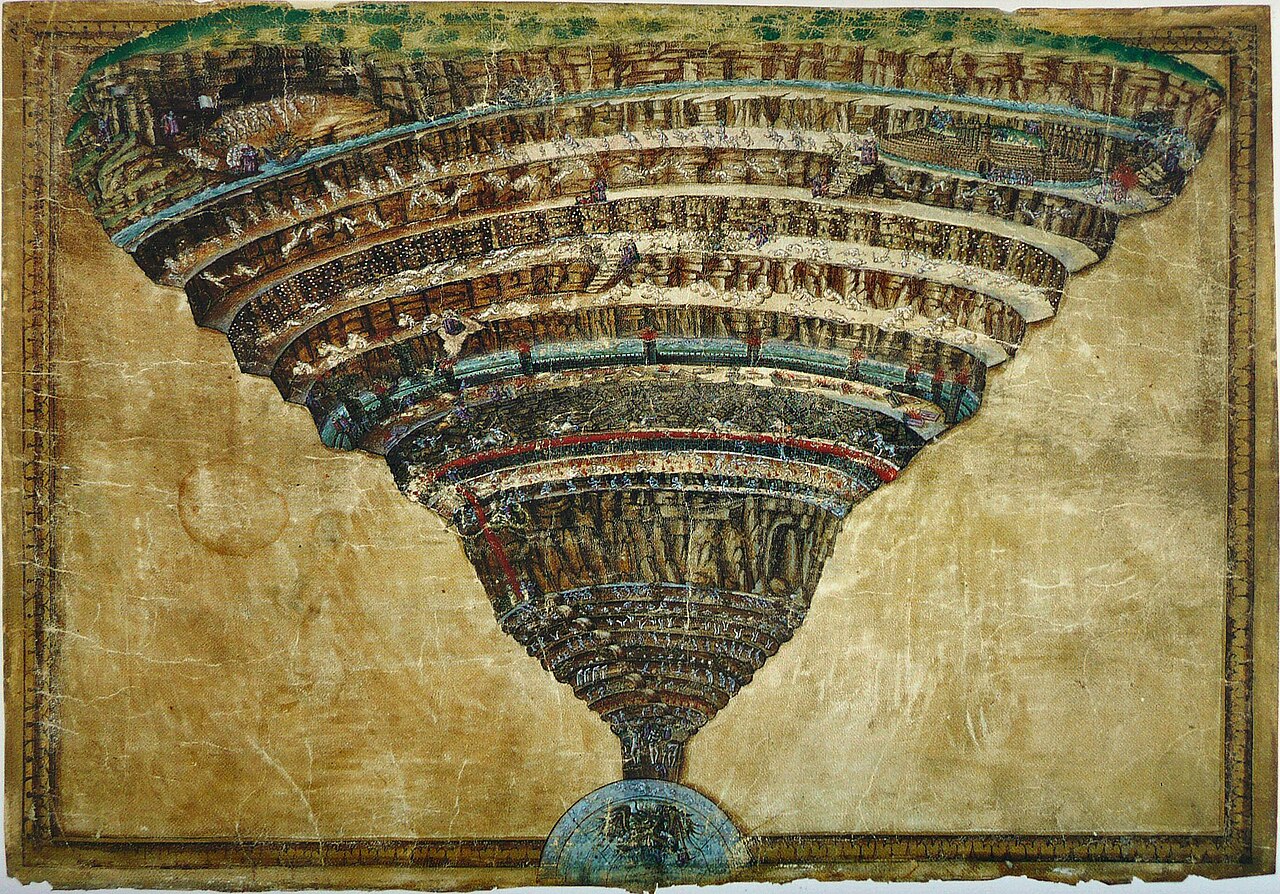

Dante’s vision of the circles of Hell.
Eclipse simulation using Stellarium

The Eclipse

This Monday, North America experienced its second total solar eclipse in the last decade. — Click here to support the Wednesday Blog: https://www.patreon.com/sthosdkane


This Monday, North America experienced its second total solar eclipse in the last decade.


I remember being over-the-moon excited when we began preparing for the Total Solar Eclipse in August 2017. Several weekends before the eclipse, my parents and I drove north from Kansas City into the path of totality to scout out possible places where we might travel on Eclipse Day to see the phenomenon for ourselves. Eclipse Day 2017 also happened to be my first day as a history graduate student at the University of Missouri-Kansas City. That morning a sudden summer thunderstorm rolled through Kansas City and as the day continued the clouds persisted in our skies. When the moment of totality arrived around 12:55 pm on 21 August, we watched it through darkened clouds and heard the birds and insects around us revert to their nocturnal states and songs.

I was excited to have experienced a total solar eclipse yet disappointed that I wasn’t able to see it. So, when the prospect of traveling for this week’s total solar eclipse appeared, I seriously considered going afield to Texas to observe it. That trip didn’t end up working out because of a series of scheduling conflicts, and so instead seeing that the cloud forecast across North America called for most places along the path of totality to be obscured, I decided to stay here in Kansas City and observe our partial solar eclipse. At its greatest extent, the April 2024 solar eclipse reached about 90.5% totality. I was able to see that extent, yet the feel of it was quite different than 100% totality from seven years ago. We were watching Everyday Astronaut and the Planetary Society’s live broadcast from the Society’s Eclipse-o-rama event in Fredericksburg, Texas while observing the eclipse here at home, and what they experienced was far more dramatic than what we observed. I do regret not travelling for this eclipse, yet at the same time in the circumstances as they fell, I’m glad I chose to stay home all the same.

This concept of an eclipse is one that speaks to me both astronomically, as a big space nerd, historically, and linguistically. Eclipses are phenomena that have made their mark on the psyche of more than just us humans, note how the birds began singing their twilight songs when the Moon passed in front of the Sun. I have never put much theological potency into eclipses because we have been able to predict their occurrences with increasing accuracy for generations now. Religion, in many ways, relies on our perceptions of things. Some see in an eclipse a threat to divine order in the Cosmos. This view reminds me of Mozart’s final opera, near to my favorite of his works, Die Zauberflöte (The Magic Flute) in which the Queen of the Night is defeated by Sarastro, the high priest of the Temple of the Sun. Sarastro proclaims victory for the good and right, singing: 

Die Strahlen der Sonne

Vertreiben die Nacht.

Zernichtet der Heuchler

Erschlichende Macht.

The rays of the sun

Drive away the night.

Destroyed  is the hypocrites’  

Surreptitious power.

(Source: Aria-Database.com, trans. Lea Frey)

Sarastro’s triumphant finale in Die Zauberflöte sung by Josef Greindl with the RIAS Symphonie-Orchester Berlin.

The divine hand is better seen in the wisdom of devising a manner to mathematically ascertain the revolutions of these celestial orbs, to borrow the title of Copernicus’s magnum opus, De revolutionibus orbium coelestium. In our ability to ascertain our surroundings, and to make sense of nature we see a loving design.

Still, knowledge of the movements of the Sun, planets, moons, and stars across our night skies have had their impact in our history. During his fourth voyage, on 1 March 1504, after 9 months stranded in Jamaica, Christopher Columbus (1451–1506) used his knowledge of eclipses from an almanac he brought with him written by the Castilian Jewish astronomer Abraham Zacuto (1452 – c. 1515) to inspire the Taíno caique of that part of Jamaica to give Columbus’s men food and provisions. Columbus wrote in his journals that he pointed at the Moon and told the Taíno that “God caused that appearance, to signify his anger against them for not bringing the food” to Columbus and his men.[1] Several years ago then, when discussing this story with a friend and fellow Renaissance historian, I decided to use the Stellarium astronomy program to simulate this lunar eclipse as Columbus and those with him in Jamaica saw it. Our ability to track the movements of these celestial orbs is good enough that our computers can show exactly what was visible in the night sky (baring any atmospheric data) at any moment in the past or future.

My simulation of the March 1504 Lunar Eclipse as seen from St. Ann’s Bay, Jamaica using Stellarium.

This ability to calculate the dates and locations of eclipses came in handy when researchers look at mentions of eclipses in ancient literature to seek to date the events of the stories. Plutarch and Heraclitus both argued that the Odyssey contains “a poetic description of a total solar eclipse,” which astronomers Carl Schoch and P.V. Neugebauer proposed matched an eclipse which occurred over the Ionian Sea on 16 April 1178 BCE, though a more recent article in the Proceedings of the National Academy of Sciences by Constantino Baikouzis and Marcelo O. Magnasco offer doubts concerning this proposition owing to the difficulty of finding exact matches in spite of centuries of the Odyssey‘s transmission through the oral tradition before it was written.[2] Still, that eclipses are so readily discernible and measurable with our mathematics speaks to the potential that they could be used to date moments long remembered only in heroic literature like Odysseus’s return to Ithaca in Book 20 of the Odyssey (20.356-57). In this effort, where others divine gods, we make tools out of the Sun and Moon to better understand ourselves.

The way we describe an eclipse speaks to our culture’s relationship with the phenomenon. Our Modern English word derives from the same word in Old French, which developed from the Latin eclīpsis, which in turn was borrowed from the Ancient Greek ἔκλειψις (ékleipsis), which comes from the verb ἐκλείπω (ekleípō)meaning to abandon, go out, or vanish.” Eclipse eclipsed the Old English word āsprungennes, which derives from the past participle of the verb āspringan, meaning “to spring up, to spread out, to run out, to cease or fail.” As an adjective, āsprungen meant that something was defunct or deficient, so perhaps this sense of an eclipse meant that it seemed for a moment as though the Sun had run out of energy and ceased to burn? Again, this speaks to the idea that nature had limits as humanity does, to an older understanding of nature from the perspective of a limited human lifespan. 

In Irish, there is the Hellenic word éiclips, yet there’s an older Gaelic word which means the same thing, urú. Now, usually students of the Irish language will learn of urú in the context of Irish grammar, an urú or eclipsis is one way that Irish handles both consonant clusters and situations when one word ends in a vowel and the following word begins with another vowel. So, in that sense the word gets eclipsed by this urú which preserves some of the integrity of the language. Yesterday’s eclipse then was less an urú focail (word eclipse) and more a urú gréine (solar eclipse). That both the Sun and the words we speak in Irish can be eclipsed makes this astronomical phenomenon all the more ordinary and measurable. 

We use this word eclipse beyond astronomy in many cases; it seems to me today that the old guard of the Republican Party has been eclipsed by an orange political pulsar whose violent rhetoric and chaotic behavior have eaten away at their party’s support in these last 8 years, not unlike a pulsar discovered by NASA’s Swift and Rossi X-Ray Timing Explorer satellites in 2007. An eclipse is something wonderous to behold yet ordinary in how readily we can predict when they will appear. They have given us a great deal of cultural qualifications that continue to influence how we see our world.

On Monday then, when the sky began to darken as the Moon passed in front of the Sun, I noticed that the color spectrum that I’ve always known began to change. Before my eyes the colors seemed to take on a sort of metallic glow, as if the light which illuminated them was shifting into a spectrum that seemed unnatural to the natural world I’ve known. The Sun is fundamental to how we understand the world around us. Its light is what illuminates our senses, and without it, or even with partial changes to its glow, we would find ourselves observing a very different world.


[1] Christopher Columbus, “The Fourth Voyage,” Select Letters of Christopher Columbus: With Other Original Documents Relating to the Four Voyages to the New World, trans. and ed. R. H. Major, (London: Haklyut Society, 1847), 226.

[2] Constanino Baikouzis and Marcelo O. Magnasco, “Is an eclipse described in the Odyssey?” Proceedings of the National Academy of Sciences 105, no. 26 (2008): 8823–8828, nn. 1, 12–14.


The Columbian Exchange

The Columbian Exchange Wednesday Blog by Seán Thomas Kane

This week, I want to talk a bit about how the period I study resonates in our everyday lives through the foods we eat. — Click here to support the Wednesday Blog: https://www.patreon.com/sthosdkane


This week, I want to talk a bit about how the period I study resonates in our everyday lives through the foods we eat.


(Sound of a grill lighting.)

This week, I thought I’d record an idea that I’ve had for a while. Originally, this demonstration was going to be filmed for a course I taught last summer, but it didn’t get developed in time. So, on Tuesday afternoon when I was looking at the story I was developing for this week and saw how little I’d finished of it, thanks to my other work taking up a greater amount of my time than expected, I returned to this idea. So, here’s a synopsis of me grilling a couple burgers and talking about it.

First, I get the ground chuck burger patties out of the freezer. (frozen patties hitting the plate) Buying in bulk and freezing the beef helps keep costs down.

“Now the seasoning that I usually use for this, Lawry’s, has salt, sugar: definitely something which appeared through the Columbian Exchange from Madeira to the Caribbean and Brazil, and the spices are paprika and turmeric: those are also important with the trade connections in the 16th & 17th centuries, onion, corn starch, and garlic. So, this seasoning is certainly a part of it. This seasons the beef which is European in origin using spices that come from all around the globe.”

“And now, I’ll season these.” –– The seasoning adds flavor to what otherwise is just a frozen piece of bland-tasting beef. Meat seasonings are more common in Texas barbecue, where they take the form of rubs. When I’m making brisket, I will use a big meat rub from Joe’s Kansas City Barbecue to enhance the meat’s flavor.

“Now, of course you could top your burger with garnish, with tomatoes which come from Mexico, or lettuce, which is more ubiquitous, onions, which are European in origin, or mustard, ketchup (which is tomato sauce & sugar, I’m less fond of that). The point is that the burger has a great deal of different sources to it, many of which go back to the Columbian Exchange, elements of which are traceable back to Europe as well as the Americas. And then of course, you eat your burger with fried potatoes, with French fries (chips if you’re British.) Potatoes come from Peru and were introduced to other places from there, or sweet potatoes which also come from South America. I’ve read that sweet potatoes were sometimes called Taíno potatoes after the native people of the Caribbean, yet they were also used by the Tupinambá of Brazil who I study.”

After the grill heated up to around 650ºF (343ºC), which on this very windy evening took about 15 minutes, I took the patties outside and dropped them on the grill. (Sizzling sound)

Once I had the patties on the grill, I returned to the kitchen to prepare the cheese, to cut the cheese if you will. For this meal, I’m using two different types of cheese. On one burger I have an Irish cheddar and on the other a Mexican blend that’s mostly made up of Monterey Jack and White Cheddar. I discovered my love for the Monterey Jack burger at our local Tex-Mex restaurant, where the burger on the menu is made with Monterey Jack cheese. The flavor is distinctive and a nice change of pace. I also like putting provolone, parmesan, and mozzarella on my burgers, though in that instance to go full Italian burger I also enjoy including marinara sauce. I discovered this type of burger at a famous burger restaurant in Cambridge, Massachusetts, across the street from Harvard’s Houghton Library, called Mr. Bartley’s Burger Cottage, where this Italian burger was named the Dr. Fauci Burger on the menu.

“Alright, time to flip.”

“Now, of course none of this would’ve been possible without the transatlantic trade connections that developed after Columbus’s first voyage in 1492. The beef in these burgers come from cattle which replaced the bison which existed previously out here on the Great Plains, and there’s some debate about whether bison should replace beef all over again. So, maybe in 10 or 20 years’ time if I do this all over again, I’ll be doing it with bison instead of beef.” While I made my speech to the microphone, the timer went off on my watch telling me the patties were done cooking. “And now, the timer’s gone off. Let’s take these off. So, these are looking pretty good. There’s the cheddar one, and now my Monterey Jack one.”

“But now, if you’ll excuse me, ladies and gentlemen, I want to eat. Bye, bye.”


Leadership

I've long wondered about what kind of leader I want to be. This week a coalescing of those ponderings. — Click here to support the Wednesday Blog: https://www.patreon.com/sthosdkane


I’ve long wondered about what kind of leader I want to be. This week a coalescing of those ponderings.


Leadership is one of the great qualities which we yearn for today, particularly in this country agreement among our leaders on the same basic principles of democracy and integrity. We seek the same fundamental truths even while truth is far more diffuse a concept than ever before. To take the first step towards this restoration we need to begin talking to each other again and really work towards rebuilding our mutual understanding of who we are and what we want out of our Union.

Throughout my life I’ve looked up to certain types of leaders: a citizen like Abraham Lincoln, a unifier like Eleanor Roosevelt, and a servant like Pope Francis. Each of these figures took their own stands in their own circumstances of time and place and worked to their own ends, and in some respects they were successful. 

I’ve been humbled to serve as a leader at varying moments and in several capacities and my own efforts are often rewarded by how I can connect with the people around me. I make a point of working with people, of listening to their ideas and trying to incorporate them into something all of us working together can be proud of.

Today then, I want to present to you a paper that I wrote at the end of my time as a Master’s Student at the University of Missouri-Kansas City in November and December of 2018. I presented this paper “Erasmus’s Enchiridion militis Christiani and the Humanist Knight in early-sixteenth-century England” at the American Catholic Historical Association’s 2019 annual meeting, co-current with the American Historical Association conference at the old Stevens Hotel, now the Hilton, on South Michigan Avenue in Chicago on Friday, 4 January 2019. I hope this offers two visions of leadership from the Renaissance, one rooted in Erasmus’s Christian Humanism which hearkens towards the social justice-rooted morality of my own Catholicism, and from the realpolitik of Niccolò Machiavelli in his timeless book The Prince.


Erasmus’s Enchirdion militis Christiani (The Handbook of the Christian Knight) was one of the most popular books of its day in Western and Central Europe; translated into eight languages between 1519 and 1542. Its most popular and widely disseminated edition was that published by Johann Froben in Basel in 1518. The Enchiridion‘s enduring popularity throughout the first half of the sixteenth century is a testament to its relevance at a time when Europe was witnessing tremendous social and religious upheaval through the Reformations of Luther, Calvin, and Henry VIII. The Enchiridion was intended to be a guide for Europe’s many princes, kings, and lesser lords on how to be good moral rulers, how to be “soldiers of Christ” as the title states. Through this role as a guide for good governance, the Enchiridion can be seen as a Christian Humanist equivalent to Machiavelli’s The Prince as a guide in Renaissance political philosophy. In considering the Enchiridion‘s role as a book of political philosophy, this study will consider both the 1518 Froben edition[1], and the 1523 Alnwick manuscript[2], the earliest known English translation of the Enchiridion, from which all quotes derive.

Originally written in 1502, the Enchiridion was said to be inspired by an unpleasant evening that Erasmus experienced in the castle of a knight recorded as “John the German.”[3] The knight’s wife begged Erasmus to write a treatise offering her husband guidance on better manners, thus resulting in the Enchiridion.[4] While the Enchiridion was first published in 1503 by Maartens in Antwerp[5] it did not achieve widespread fame until its first publication by Froben in 1515.[6] The Enchiridion‘s philosophical inspirations come from a number of different sources, both Biblical and Classical, from Moses, Solomon, and David to Julius Caesar and his nephew Augustus to the heroes of the Iliad and the Aeneid. While this work takes great influence from Platonic philosophy, it nevertheless bathes Platonism in a deep bath of Christian theology before allowing it to enter into the main work.

As a work of Christian Humanism, the Enchiridion contains a thorough retelling of the many morality stories found in the Bible. It appears, through the wording of the Biblical quotes in Froben’s Latin edition, that Erasmus used his own revised translation of the New Testament throughout the Enchiridion, which had been published by Froben in its most widely read form in 1516.[7] Nevertheless, Erasmus draws just as heavily from the Old Testament, looking at Moses, David, and Solomon as good and worthy models for the Christian knight of his day. For Erasmus, a Christian ruler should follow closely the teachings of the Church and its Old Testament forbearers. Countering Machiavelli’s view that the two safest manners for a prince to control a population is to either “destroy them or reside there,”[8] Erasmus argued that it is a “grete obomynation … if a man forsake his fynge or theiss lorde [Christ].”[9] For Erasmus, temporal power was secondary to spiritual wellbeing, arguing later in the same chapter of the Enchiridion that the death of the soul is far more consequential than the death of the body, as the death of the soul “is extreme misery,”[10] even greater than bodily death. The key difference here is that Machiavelli wrote as a politician, while Erasmus set his words to paper as a theologian. 

The disparity between the political realities of early sixteenth century Italy and the theological expectations on morality at the same time are stark. Erasmus’s chief concern is the wellbeing of the soul, while Machiavelli’s is the accumulation of power and its subsequent preservation. Erasmus’s knight is a moralist, while Machiavelli’s prince is a pragmatist. Yet where Machiavelli’s vision of rulership is often shown as a testament to the various leaders in Italy during the Italian Wars, Erasmus’s shows the theological ideal of a Christian Humanist ruler, akin in character to Plato’s philosopher kings who should rule in a conjunction between “political power and philosophical intelligence.”[11] Both Erasmus and Machiavelli reference Moses as fine examples of leadership, the former spending the first chapter of his Enchiridion discussing Moses’s role as leader of the Hebrews and his loyalty to God’s will and light[12], while Machiavelli names Moses alongside Cyrus, Romulus, and Theseus as “the most excellent”[13] of princes. While Machiavelli considered striking Moses from this list because he was “a mere executor of things, that were made ordained by God,”[14] and thus less a prince in his own right and more a vassal for a Higher Power, he nevertheless respected Moses’s leadership of the Hebrews and saw him as an equal to Cyrus, Romulus, and Theseus through his deliverance of the Hebrews out of slavery.[15]

Erasmus’s Enchiridion makes great use of Platonic philosophy, referring back to the Athenian academic’s teachings time and again in his work. Erasmus noted in the fifth chapter of his Enchiridion, entitled “Off the dyusitue of affeccions” that Plato and the later Stoics both saw  “philosophy to be nothing else but a remembrance of Deth.”[16] Interestingly, in Froben’s 1518 Latin edition this line reads, “with nothing else [Plato] thinks Philosophy however to be a meditation of death.”[17] The differences in meaning between the words remembrance and meditation is striking. While they are synonyms, the former appears to have changed in meaning over the centuries, becoming today a manner of meditation about a person or event that takes place only after that person has died, while a meditation can happen when they are still living. For the translator of the Alnwick Manuscript, this difference does not appear to have been as profound, and by and large it would appear that, at least in that translator’s eyes, remembrance and meditation are a good pair of cognates. 

Machiavelli’s text looks at death as an inevitability and in many cases a means to an end, especially for men who “forget more quickly the death of the father than the loss of their inheritance.”[18] In Machiavelli’s view, while the living may mourn the dead, they celebrate in the riches left behind by the deceased and seek to improve their own fortunes off of the demise of their fathers. Machiavelli accepts that this degree of swift respect for the dead is tantamount to theft, yet he dismisses any degree of moral ambiguity by noting how common and easy the practice can be, writing, “it is always easy to find cause to take away property,” and “anyone who lives by theft will always find reasons to occupy the things of others.”[19] For Erasmus, death is a moment of great spiritual significance, one to be taken seriously in securing the sanctity of one’s soul; yet for Machiavelli, death is a moment of great personal significance, one to be taken seriously in securing one’s fortune and power from the deceased, whether they be one’s father or another.

If philosophy is merely a meditation on death, as Erasmus argued, then what is life but a march towards that inevitable fate and, if one is fortuitous enough, Heaven, which “is promysed to hym that fighteth swftely.”[20]The Humanist Knight, therefore, should strive to fight their battles with speed, and in doing so keeps in mind the prospect of eternal life in Heaven, and end the suffering of those whom they are fighting sooner. Fighting should only be a last resort, as the Humanist Knight should consider their moral and spiritual wellbeing before taking up arms against another. The promise of Heavenly reward drives the Humanist Knight, sending them into their world with the purpose of ensuring their own moral wellbeing and salvation. One’s soul should be “refresshed with manna from heven and with water that kame oute of the harde Rock,”[21] consuming the heavenly donation and fortifying oneself so that “neither strength neither hie / nor lowe : nor no other Creature shall seperat us from the love of god which is Christ [Jesus].”[22] In this sense, Erasmus argued that the rewards of mortal riches and conquests should not come before the spiritual rewards awaiting the Humanist Knight, faithful to Christ, in Heaven.

In contrast, Machiavelli argued in favor of prolonged war, if only to secure a prince’s authority over their own people and supremacy over their adversaries. A prolonged war, according to Machiavelli, is sometimes necessary to secure the authority of the prince against threats both foreign and domestic, and while one might lose some territory, or even some cities, as in the case of Philip V of Macedon, yet the loss of a few cities ranks lower as a threat to the stability and security of a prince’s power.[23] For Machiavelli, Philip V was a strong leader because he acted when others would have passively watched as events unfolded in front of them. He stands as a good example of the Machiavellian prince, as he was willing to make sacrifices of his cities and territories, their populations included, in order to preserve his power. In contrast, for Machiavelli a bad prince is one who loses “their principalities after so many years of rulership not because of fortune but because of their own sloth.”[24] The Machiavellian prince is an active ruler, directing their supporters on the ground with a tenacity that is matched in the Humanist Knight by the latter’s desire to ensure the purity of their soul, despite the devilish business of the titular Enchiridion, not only a handbook but also a hand dagger.

Both the Machiavellian Prince and the Humanist Knight have agency, the chief difference is in how they use it. For the Prince, their agency is best utilized through the fortifying of oneself and one’s possessions to weather any future assaults or other attempts at threatening the Prince’s standing. The Prince acts only to ensure the stability of their power and its continued vitality, standing on one’s own two feet rather than with the support of another. As Machiavelli wrote, the only sure way to preserve one’s power is through one’s own “virtue” or “power”, depending on the translation.[25] The use of the word virtù for both “virtue” and “power” in Italian is striking, showing the intense relationship between one’s morality and one’s authority. With virtue and power standing hand-in-hand, Machiavelli’s perspective comes clearer to light. He is writing not just as a pragmatist, but also as a political veteran of his times, advising princes how to seek virtue, much like Erasmus’s advice to the Humanist Knight, only Machiavelli’s idea of virtue is clothed in the unstable trappings of the Italian Wars that raged throughout his life and deeply affected the world of the Italian city states.

For Erasmus, virtue comes from God, and is shared by all humanity; thus, Erasmus writes to the Humanist Knight “thow shalt be able to do all thing in the power of God”[26] but in order to do this the Knight must “take hede that thow be a member of the body”[27] It is interesting here that the Alnwick manuscript translator of the Enchiridion does not conjugate thow shalt be as thow shalt art or thow shalt beest as was used in some dialects of Early Modern English. This particular pair of lines in the Alnwick manuscript do not match exactly the Latin in Froben’s edition, where in English the Knight can do all things “in the power of God” in Latin they will be able to achieve the same “in capite”, who is identified in the previous sentence as Christ. Two points can be taken from this, firstly that Early Modern English verb conjugations inherited the structures of their Germanic roots, moving the conjugation onto the modifiers as in German and Old English. Thus, the verb appears as thow shalt be rather than thow shall art, which mirrors this verb’s Modern descendant you should be. Secondly, the translator of the Alnwick manuscript rephrased and adapted the text to fit the expectations of an English-speaking audience, especially when translating from a language with more fluid word order like Latin to one with strict rules like English.

The relationship between the Humanist Knight and the Machiavellian Prince shows the diverging perspectives of Renaissance Humanists on both sides of the Alps. Whereas Italy was embroiled in war between rival city states supported by distant powers, fueling the pragmatic political philosophy of The Prince, the political structures of Northern Europe remained largely stable, with the old kings, princes, and magnates ruling over the continent. Erasmus’s Humanist Knight seeks power, but only through the blessing and support of God. Thus, the Humanist Knight must remain a moral and upright person, standing firm in the warm glow of God’s grace. While the Prince believes he will find victory through his own exploits and prowess as both a politician in the government of his principality, and as a commander on the battlefield, the Knight believes that victory is “putt hole in the handes of God and by hym in our handes.”[28] The greatest difference between the Knight and the Prince is their understanding of virtue. For the Knight this comes from God’s favor of one’s good deeds, while for the Prince it results from political stability. 

What can be seen in Erasmus’s Enchiridion and Machiavelli’s Prince are two very different views of the role of the ruler and the source of that ruler’s power. This reflects the differing political situations between Italy and Northern Europe in the early sixteenth century, when both authors were writing. Furthermore, when translated into English in the form of the Alnwick manuscript, the Enchiridion offers the modern reader not only an idea of what the ideal knight was for Erasmus and the manuscript’s translator through the translator’s interpretation of Erasmus, but also an image of the role of the faith in the promulgation of Humanist values amongst the English gentry and aristocracy in the first decades of the sixteenth century.


Thank you for bearing with an admittedly unusual Wednesday Blog this week. This idea began somewhat differently than it ended. I hope to return to this topic of leadership again and write about Pope Francis’s vision of the servant leader which I find quite compelling.


[1] Desiderius Erasmus, Enchiridion militis Christiani cum alijs quoru[m] Catalogum pagellae, (Basel: Johann Froben, 1518), http://www.mdz-nbn-resolving.de/urn/resolver.pl?urn=urn:nbn:de:bvb:12-bsb10164787-8.

[2] “A compendus tretis of the sowdear of Christ called enchiridion which Erasmus Roteradame wrote unto a certen courtear & Frende of his,” [1523], Additional Manuscripts, 89149, British Library, London.

[3] Anne M. O’Donnell, S.N.D., “Rhetoric and Style in Erasmus’s Enchiridion militis Christiani,” Studies in Philology, Vol. 77, No. 1: (Winter 1980), 26-49, at 30.

[4] Brian Moynahan, William Tyndale: If God spare my Life: A Story of Martyrdom, Betrayal, and the English Bible, (London: Abacus, 2003), 26-27.

[5] Judith Rice Henderson, “Language, Race, and Church Reform: Erasmus’ ‘De recta pronuntiatione’ and ‘Ciceronianus’, Renaissance and Reformation / Renaissance et Réforme, Vol. 30, No. 2: (Spring / Printemps 2006), pp. 3-42, at 8.

[6] Diane Shaw, “A Study of the Collaboration Between Erasmus of Rotterdam and His Printer Johann Froben at Basel During the Years 1514 to 1527,” Erasmus of Rotterdam Society Yearbook, Vol. 6: (1986), pp. 31-124, at 35.

[7] Erasmus, Novum Instrumentum omne, (Basel: Johann Froben, 1516), http://www.mdz-nbn-resolving.de/urn/resolver.pl?urn=urn:nbn:de:bvb:12-bsb11059002-1.

[8] Niccolò Machiavelli, Il libro del principe, (Florence: Bernardo di Giunta, 1532), 7a, http://catalogue.bnf.fr/ark:/12148/bpt6k852526w; the original Italian reads “tal che la più sicura a via è, spegnerle, ó habitarvi.”

[9] “A compendus tretis of the sowdear of Christ called enchiridion which Erasmus Roteradame wrote unto a certen courtear & Frende of his,” [1523], Additional Manuscripts, 89149 f.3v (1:140-141), British Library, London. In the Latin, “Quantus pudor, quanta penè publica humani generis execratio, cum à duce principe deficit homo?”

[10] “A compendus tretis,” BL Add. MS 89149 f.5v (1:235-6). In Froben’s Latin edition this reads as “At animam mori, infelicitatis extremæ est,” Erasmus, Enchiridion militis Christiani, (Basel: Froben, 1518), 6.

[11] Plato, Republic 5.473d in Plato in Twelve Volumes, Vols. 5 & 6 trans. Paul Shorey, (Cambridge, MA: Harvard University Press; London, William Heinemann Ltd., 1969) in the original Greek, δύναμίς τε πολιτική καὶ φιλοσοφία.

[12] “A compendus tretis,” BL Add. MS 89149 f.1v-f.9r (1:1-397); Froben’s: Enchiridion, 1-9.

[13] Machiavelli, Il libro del principe, 7b, “li più eccellenti.”

[14] Machiavelli, “E benché di Moisè non si debbe ragionare, essendo stato un’mero esecutore delle cose, che gli erano ordinate da Dio.”

[15] Machiavelli, “Era adunque necessario à Moise trovare il Popolo d’Israel in Egitto schiano, et opresso da gli Egittii: accioche quelli, per usare di servitù, se disponessino à seguirlo.”

[16] “A compendus tretis,” BL Add. MS 89149 f.28v (5:39-41)

[17] Froben’s Enchiridion, 30, “cum nihil aliud putat esse Philosophiam, cumque mortis meditationinem.”

[18] Machiavelli, Il libro del principe, 26a, “per che gli huomini dimenticano più tosto la morte del padre, che la perdita del patrimonio.”

[19] Machiavelli, “Di poi le cagioni del torre la robba non macono mai,” and “e sempre colui, che comincia à vivere con rapina, truova cagioni d’occupare quel d’altri.”

[20] “A compendus tretis,” BL Add. MS 89149 f.5r (1:208); Froben’s Enchiridion, 5, “Cœlum promittitur strenue pugnanti.

[21] Machiavelli, f.10v (2:114-115); Froben’s Enchiridion, 12, “quam esset manna cœlesti, et aqua de petra scatente refectus.”

[22] Machiavelli, f.18v (2:554-556); Froben’s Enchiridion, 20, neque fortitudoneque altitudo, neque pfundum, neque cretura alia, poterit nos se parare à charitate dei, quæ est in Christo Iesu.” This is a quote from Romans 8:38-39. The Greek original reads οὔτε δυνάμεις, οὔτε ὔφωμα, οὔτε βάθος οὔτε τις κτίσις ἐτέρα δυνήσεται ἠμᾶς χωρίσαι ἀπὸ ἀγάπης τοῦ θεοῦ τῆς ἐν Χριστῶ Ἰησοῦ. The Vulgate and Erasmus’s Novum Instrumentum differ in their translations of the Greek, in the Vulgate, neque fortitudoneque altitudo, neque profundum, neque cretura alia poterit nos separare a caritate Dei, quæ est in Christo Jesu” while in Erasmus’s NIOneque futuraneque altitudo, neque profunditas, neque ulla cretura alia, poterit nos separe a dilectione dei, quæ en in Christo Iesu”. The NASB translates this verse as “… nor powers, 39 nor height, nor depth, nor any other created thing, will be able to separate us from the love of God, which is Christ Jesus…” The NIO leaves out neque fortitudo, jumping from neque futura to neque altitudo.

[23] Machiavelli, Il libro del principe, 38.

[24] Machiavelli, “Per tanto questi nostri Principi; i quali molti anni erano sta ti nel loro Principato, per haverlo di poi perso; non accusino la fortuna, ma la ignavia loro.”

[25] Machiavelli, Il libro del principe, 38b, “Et quelle difese solamente sono buone, certe, et durabili; che dipendono da te proprio, et da la virtù tua.” 

[26] “A compendus tretis,” BL Add. MS 89149 f.8r (1:367); Froben’s Enchiridion, 9, “et omnia poteris in capite.”

[27] BL Add. MS 89149 f.8r (1:366); Froben’s Enchiridion, 9, “Tu modo cura ut sis in corpore.”

[28] “A compendus tretis,” BL Add. MS 89149 f.8r (1:373); Froben’s Enchiridion, 9, neuticibus à fortuna pendeat victoriased eaomnis in manu sita sit deiac per eum nostris quoquibus in manibus.”


How to Know the Unknown

How to Know the Unknown Wednesday Blog by Seán Thomas Kane

This week I want to talk about how we can recognize the existence of unknown things. — Click here to support the Wednesday Blog: https://www.patreon.com/sthosdkane

This week I want to talk about how we can recognize the existence of unknown things.


At the beginning of the month when I was preparing for my copyright post, I looked into an old interest of mine that had always been there, yet wasn’t quite active in the last few years, the effort by an organization called Thank You Walt Disney to restore the building that his first studio, Laugh-O-Gram, occupied at 31st & Forest here in Kansas City called the McConahay Building. To this end, I made a detour by the old building one afternoon on the way back from the central post office at Union Station and saw a good deal of work underway on that block, and after some back and forth I found a book written by some members of that organization called Walt Disney’s Missouri that I requested from the Kansas City Public Library.

I found Disney’s early years in Marceline, Chicago, and Kansas City quite familiar; his passion and drive to create art and tell stories in a new and inventive way using the skills and talents he developed over those early years remind me deeply of many of the ideas and projects I’ve worked on since my high school days. The sky truly is the limit in this mindset. I find the young Walt Disney to be a familiar face, someone who is quite relatable to all of us who have adopted Kansas City as our canvas for the many things we create.

Yet Kansas City is not like many other great American cities, for unlike New York, Los Angeles, or even Chicago we aren’t on a shoreline, we don’t look out onto an endless expanse of water far out to the horizon. Instead, we have the vast sightlines of the prairies and Great Plains extending out from our city in every direction. The astounding sunsets that glowed across the prairies out to the west of our old family farm are some of the great images of my childhood that will forever be burned into my memory.

When I was reading about Disney returning to Marceline, Missouri as an older man, I felt intensely familiar with the setting having grown up in the Midwest; familiar with the vast scale of the prairie that overwhelms me in how small it makes me, and the few built-up edifices of our civilization feel amid the tall grass Prairie. Our interventions only emptied this landscape and rebuilt it anew with the farms & ranches that have largely replaced the native roots. We have changed this landscape to suit ourselves, and yet this landscape remains its own because its fundamental character is too distinct for us to fully comprehend in our vision of a normal inspired by the great woodlands and old colonies of the East Coast and even older cultivated and measured forests and farmland growing around the ancient generational villages and towns of Europe.

My research focuses on the unknown entities that were too far-fetched to be imagined on the edge of the European imagination, particularly animals whose proportions were exaggerated to a degree that set them and the world they inhabited apart from the well-known and measured Mediterranean World at the heart of the European cosmos. This question of how we can begin to describe the unknown has stood out to me for a while and it’s something that both thrills and scares me at the same time. I feel a profound sense of humility thinking of all the things that we don’t know that exist beyond our world, whether they be lifeforms deep in the still largely unexplored oceans or entities deep in the void of Space. Yet I love stopping to think of these things and the endless horizon they represent as it gives me a sense of things still to accomplish.

Imagine, dear reader if you will, what it would be like to witness something you never before knew appear before your own eyes, or even those things which you do know about but only in stories and fables happening in real life. Shakespeare asked his audience to use their imaginations to fill in the breadth and depth of his world. In the prologue of Henry V, the Chorus asks the audience to imagine that the actors on the stage might

“on this unworthy scaffold bring forth 

so great an object. Can this cockpit hold 

the vasty fields of France? Or may we cram

within this wooden O the very casques

that did affright the air at Agincourt?

O pardon, since a crooked figure may

attest in little place a million,

and let us, ciphers to this great account,

on your imaginary forces work.

Suppose within the girdle of these walls

Are now confined two mighty monarchies,

Whose high upreared and abutting fronts         

the perilous narrow ocean parts asunder.”

Henry V, Prologue 11–23

Our imaginations are perhaps our greatest assets, after all we call ourselves Homo sapiens, wise humans. We pride ourselves on our capacity for thought, on our ability to imagine possibilities for ourselves and our posterity. We need the unknown to give us hope that there will be something new to discover tomorrow, for even if that new thing is familiar to others, it will still invoke wonder in us. Hope is what the greatest human endeavors are built upon, the hope that even if a cause seems doomed in the short term that someday it will succeed.

I feel this sense of potential success is central to my nature. I grew up with this hopeful maxim from three sources, my Catholic faith in things inexplicable, my Irish heritage informed by the experiences of generations who hoped for home rule and justice under a colonial government, and more light-heartedly from my lifelong passion for the erstwhile lovable losers, the Chicago Cubs. Robert Emmet perhaps put it best in his speech from the dock that he knew someday his epitaph would be written, someday someone yet unknown to him in 1803 would be able to judge his efforts towards Irish independence. “Let my character and my motives repose in obscurity and peace, till other times and other men can do them justice. Then shall my character be vindicated; then may my epitaph be written.” 

We cannot truly know what our future will hold, though we can predict what variable futures might come to exist. I wonder if a young Walt Disney would have imagined the man he would become, and how his name would be known by what surely is a majority of humanity alive today, 123 years after his birth. All of that was unknown in his childhood, just as all the things that will happen tomorrow and every day after that are still to a certain degree unknown to us today. That might be the closest we come to touch the unknown, to recognize its ambiguous feel, yet while that fine cloth of silk might seem somewhat familiar in its unfamiliarity, we ought to always remember that it extends far enough from our view and beyond all our horizons into infinity. There is, and likely will always be, more unknowns than knowns in the Cosmos.

A historian restores things forgotten from the vast silk threads of the unknown and weaves those fibers back into the great tapestry of human knowledge. I just started reading a book yesterday which does this with the understanding that religion and science have always been at odds when it comes to the age of the Earth. Perhaps I will write about that book, Ivano Del Prete’s On the Edge of Eternity: The Antiquity of the Earth in Medieval & Early Modern Europe in this publication later this year. That, good people, remains well and truly among those strands of the great yet smooth silky unknown sea which lies behind us, beyond our vision as the Greeks understood the future to be. The future is perhaps more unknown to us than the past because we at least have means and methods to uncover the past we’ve long forgotten and left behind, whereas the future remains unwritten and daunting to behold.

Perhaps that is why I chose to become a historian, because I find a comfort in imagining and reading about the past that is absent when I imagine the future. There is some truth there that the future I behold is colored in the same hues as my present, which I know will not be realized as the future will certainly be its own creation, inspired by our current moment yet distinct from it all the same. The characters who grace this “kingdom for a stage” will have taken their last bow by the time many of these events I imagine in the future occur; and at the culmination of the future lies the greatest unknown of all, one about which we tell many stories and ascribe many tenants, all to humanize it and make it more familiar.Our memories keep past ideas, people, places, and things alive in our knowledge. I hope the people at Thank You Walt Disney are successful in restoring the McConahay Building which housed Disney’s Laugh-O-Gram Studio so that the memory of that time when so many creative minds, so many animators, lived in this city is preserved; so that Kansas Citians in the present and unknown future remember that art can be created here, and dreams first imagined here can grow into wonders for all humanity to behold.


Sixty Years

This week on the Wednesday Blog, recognizing the sixtieth anniversary of the assassination of President Kennedy. — Click here to support the Wednesday Blog: https://www.patreon.com/sthosdkane

This week on the Wednesday Blog, recognizing the sixtieth anniversary of the assassination of President Kennedy.


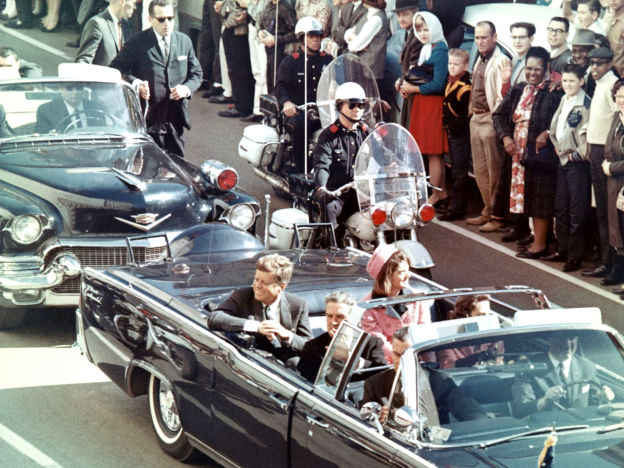
Bill Clinton was the first president who I can remember, and like many other millennials my perspective on the Presidency is shaped by his two terms in office. Yet beyond the immediate I always knew several other presidents: Lincoln (as I often write), Washington, Truman, and Kennedy. Of all of these, John Kennedy is the most complicated; he was the first Irish American Catholic to be elected to the White House and his picture was still pretty common in houses even into the turn of the millennium. His term is remembered most nostalgically of all the presidencies of recent memory for how short it was and abruptly it ended.

As much as I always knew who the Kennedy brothers were, I also knew that Dallas was the city where President Kennedy died. When I first visited in my adolescent years, I made a point of going to visit Dealey Plaza and see where it all happened. Every year on this day I find myself thinking of what happened there 29 years before I was born. It’s strange how much events that are relatively removed from my own lifetime still have such an impact on how I see things. For me the recent past still goes back to the turn of the twentieth century when the world that I was born into in the Midwest was being created. So, as far as the assassination of President Kennedy is from my own life, those 29 years still have never felt that distant.

Today, this particular anniversary is striking to me because it is becoming more distant. 1963 is now a full 60 years removed from our own time, and as I look ahead the middle of this century seems closer than I ever imagined before. The passage of time could well drive people to fear for their own mortality, and to a certain extent I find those thoughts enter my mind now and again. Yet when I worry about my future it’s less that I will lose something of myself with the passing years and more that the memories I’ve grown up hearing and those I’ve written for myself will become ever more remote from my lived experience.

For the last several years I’ve found myself caught by a faint memory of a sort of reddish glow. I’ve known it originated at some point in the early 2000s, about 20 years ago for those who are counting, yet beyond that I could only speculate. I figured there might’ve been some phase of interest in Renaissance Italy in the books or documentaries my parents were reading or watching around that time, yet I couldn’t remember any specifics. Then, several weeks ago, I remembered some faces along with that red glow and it occurred to me that what I’ve been longing for was a particular day, Thanksgiving Day 2003.

That year, my Kane grandparents and great-aunt Sr. Therese came down to Kansas City to attend my Webelo bridge-crossing ceremony when I graduated into the Boy Scouts. They patiently followed my parents and I around town, attending a weeknight fencing lesson of mine (I used to fence saber), and joining all of my maternal Kansas City relatives for Thanksgiving dinner at the farmhouse that my parents built. We lived on 34 acres of land in western Kansas City, Kansas and one thing we all miss about that house is the view to the west out the back windows. The sunsets were gorgeous. That Thanksgiving was a clear day with light clouds in the sky and as dinner was nearing completion, I remember sitting with my grandparents and Sister (that’s what we all called my great-aunt) in the living room with something on the TV, but our eyes were drawn to the sunset out the window.

The backside of our house was all one big room, to the right was the kitchen, in between the kitchen table, and to the left the living room, and in the kitchen, we had these beautiful imported red Italian wooden cabinets which my parents saw on This Old House and bought in a stall at the Merchandise Mart before we left Chicago. The beautiful shades of red that I remember are of the sunset shining off of those cabinets, a true marriage of nature and craft that I hope I will never forget.

My Kane grandparents and Sister are all gone now, the only ones in the room at the time that memory occurred who were alive when President Kennedy was killed, yet for all of us that moment marked our time as one of uncertainty. Now, as an adult I appreciated Jack Kennedy still, yet I would’ve rather voted for his younger brother Bobby. I see more of the nuance in those colors even when as a child on Thanksgiving 2003 all I saw was bright light that made me uncomfortable.

Sixty years isn’t that long, and yet to an extent it really is. Sixty years before President Kennedy’s assassination the country was recovering from President McKinley’s assassination, a bleak start to the twentieth century in a moment of triumph and seeming progress. It’s all about where we stand in the great cycle of years. I like the old adage that the Greeks saw time differently from us, that they stood looking towards the past with the future behind them. We don’t know what will happen in the future and our pasts and those of our parents and grandparents really shape our worlds in far greater ways than we can often imagine.


The End of an Era

This week on the Wednesday Blog, my perspective on the last century and a half as a time of tremendous change. — Click here to support the Wednesday Blog: https://www.patreon.com/sthosdkane

This week on the Wednesday Blog, my perspective on the last century and a half as a time of tremendous change.


On my first day in London this October I walked from the British Museum, my first stop in the capital, to Charing Cross Road where I made my way into Foyles, my favorite bookstore in that city. Foyles has a wider variety of titles than I’ve seen in most bookstores, and especially titles that catch my attention time and again. I didn’t plan on walking out with a new book, and I stuck to that plan, yet I saw several books which I’ve since acquired in other ways since I got home (I do kind of feel bad about that.) I didn’t pack for this trip with new acquisitions in mind, leaving little room for anything new in my luggage.

Still, I loved wandering through the aisles and shelves of Foyle’s and catching up on the latest that the British publishing industry has to offer, five years after my last visit to that island. Here in the United States, I see some reviews of books printed in Britain, usually in the New York Times or through interviews on NPR, but by and large I’d cut myself loose from the British press that I read, listened to, and watched throughout my adult years. Unlike previous trips back to London, a city that became a home-away-from-home for me in 2015 and 2016, I felt like I’d missed a great deal and had a lot of new things to discover on this trip.

One book that caught my eye several times was Michael Palin’s new book Great-Uncle Harry: A Tale of War and Empire which tells the story of the author’s own great-uncle Harry Palin whose life saw the end of an era and the beginning of our own tumultuous time. Harry Palin was working on a farm on the South Island of New Zealand when Great Britain and its Empire entered the First World War in August 1914 and enlisted with the New Zealand Expeditionary Force, one-half of the famed Australian and New Zealand Army Corps (ANZACs). The elder Palin survived the Gallipoli Campaign and for a while on the Western Front until he died during the Battle of the Somme in 1916. 

Two weeks after seeing Great-Uncle Harry on the shelves of Foyles I was reminded of it by something else and bought a copy of the audiobook on Audible to listen to, read by the author, in the car on my way to and from the school where I currently work. The life and story of Harry Palin animated my drives to and from the school where I now work over the last two weeks and left me both inspired to think about the end of the nineteenth century, a period in our recent history that I’ve always been fascinated by, and horrified by what became in the twentieth century.

I chose to not study the end of the nineteenth century and turn of the twentieth century professionally because of the looming specters of the World Wars ever on the horizon of my memory of those moments in history. Harry Palin’s story reminded me of what I love about that period as much as at the end of his life what horrifies me about the experiences of his generation.

The world that existed in 1914 was one which had a continuity with the generations that came before it. There were some major shifts, the revolutions at the end of the 18th century and in 1848 come to mind, yet none of those in Europe were permanent. The needle of change wavered throughout the century leading up to the First World War. All of that changed as old institutions, which had long weathered the storms and basked in the sunshine of Europe’s history now collapsed under the tides of change released by the hands of their own officials. That war is perhaps the greatest example of hubris among any political leaders yet seen in our long history. Men who thought they could expand their empires, enhance their prestige and honor by waging war against each other instead lost their crowns and left millions dead in the wake of the conflict they unleashed.

When I read histories of this period, I often want to shout at the characters to look out, to be wary of what is coming; for in a Dedalian way I worry we can become too complacent and hawkish yet again. Our caution is well learned, now after a century which saw two world wars and countless other conflicts born from those furnaces. In the wake of the first war a great instability allowed for experimentation to occur. This is a natural thing, something I see in the Renaissance and Wars of Religion (the period which I study) yet in the context of the twentieth Century it marks something far darker. This experimentation in politics and economics led to a further world war in which the three new dominant ideologies –– communism, liberal democracy, and fascism –– collided. Out of it, fascism fell but not before taking millions with it, and a cold war simmered which defined the rest of the century.

In my own life, a further reduction in the formalization of conflicts has played itself out. Now instead of great armies facing off in large-scale battles like those known in the world wars, or even the proxy wars fought by the superpowers we see violence wrought through terrorism. The front lines are not so far away when the threat of violence, whether foreign or domestic could be around the corner. Our children practice for the possibility of an active shooter in our schools because such an incident has happened time and again, and I’ve internalized the reality that in my profession I’m likely to experience such an attack as long as I continue to teach.

I go to places like Foyles to get away from these worries and horrors, to discover new ideas and ways of looking at the world that I was previously unaware of. On this trip, it occurred to me several days before my return to London that I was left bereft of worries, a feeling of calm that I hadn’t felt in a very long time. It almost left me feeling a loss for something I’d long known. I chose to work on a time period further removed from the present to have a refuge in my work from the horrors of the recent past that shaped my world; yet this is still my world, our world, and for as many problems as it has there is a lot that I feel nostalgic for about the century now passed. Even as I write now in 2023 and will likely be remembered as a voice of the twenty-first century, I will always think of myself just as connected to the twentieth, in which I was born and during which a great many of my formative memories occurred.

It occurs to me now that as much as we live in a continuation of the new era born out of the First World War, perhaps the general crisis we find ourselves in now, from the wars my country fought throughout my teens and twenties to the climate crisis we now witness, is bringing us into an even newer era. I hope it will be better than the last, and that maybe this time we’ll find a way to live up to the highest ideals of our predecessors.


Historic Range

This week on the Wednesday Blog, why our conversations about ecology and culture are grounded in loss. — Click here to support the Wednesday Blog: https://www.patreon.com/sthosdkane

This week on the Wednesday Blog, why our conversations about ecology and culture are grounded in loss.


Over this past weekend I was in Denver for a cousin’s wedding, a joyous event on Sunday evening that was beautiful to be a part of. Besides the two evening events on Saturday and Sunday I had the weekend to myself to spend some time in one of my favorite cities in the United States. My first stop on Saturday morning then was to my old favorite Denver haunt, the Museum of Nature and Science in City Park. Longtime readers of the Wednesday Blog will remember this museum from my two-part post from the pre-podcast days of June 2021 titled “Sneezing Across the West,” in which I described my return to this museum as an adult 22 years after visiting as a young child.

The Denver Museum of Nature and Science excels in its collection of dioramas, scenes from the natural world of taxidermied animals in their own habitats recreated in several halls on two floors for the public to experience a snapshot of wild life in its element. These dioramas capture my attention today far more than most paleontological exhibits, as while I enjoy seeing the dinosaurs and their fellow fossils, I’m now more drawn to the recreations of modern lifeforms, particularly mammals, that dioramas offer.

The DMNS’s koalas.

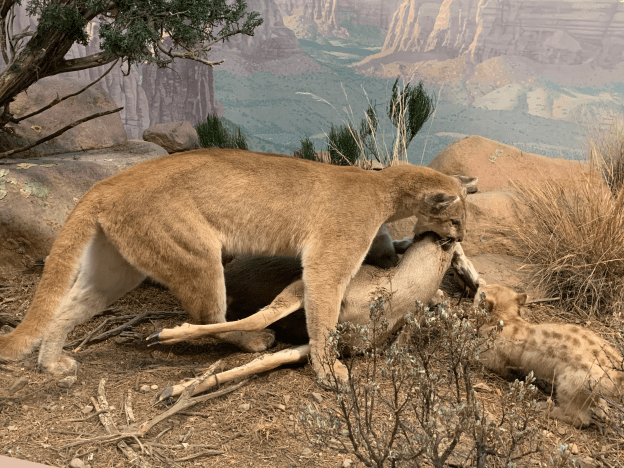
On this Saturday morning stroll through the museum, I stopped in front of a display of a puma, North America’s famed mountain lion, one of our more enigmatic megafaunal predators. I haven’t seen any mountain lions in the wild, though on one occasion a decade ago while hiking to a cave to shoot an ill-fated short film adaptation of Plato’s Allegory of the Cave in Pike National Forest I could swear our party was being watched from the ridgeline several hundred feet above us by a puma. I’ve only ever seen and encountered pumas in zoos and museums, behind wire fencing or glass. I got to know the resident puma in the Ross Park Zoo in Binghamton rather well, to the point that it would slow blink at me as I approached it, a sign among domestic cats of acceptance.

With my own limited experiences of pumas in the wild, it struck me to see the ubiquitous line on the diorama’s plaque which read “Historic Range” on the key to a map which showed how most of this continent was once puma country. I paused in my stroll at that point, and it occurred to me that our entire narrative of conservation and the preservation of human diversity in North America goes back at some point to a story of historic loss and the subsequent poverty for certain pieces in the continent’s ecology. For one thing, we lack large predators in much of North America west of the Rockies today, so especially in the great eastern woodlands the deer population is often higher than it ought to be.

Still, there is this core truth to our continental story, let alone the collective history of our hemisphere which tells of a black mark in our soil dividing the present age born in imperial colonialism and the time which came before. Like the K-T Boundary which can be seen in rock strata dividing the fossilized remains of creatures who lived at the time of the dinosaurs below in the Cretaceous Period and in the Tertiary Period after the asteroid impact which saw the demise of those reptiles 66 million years ago, this line demarcates a clear beginning of a modern world in the Americas warts and all. Before the arrival of Europeans into each distinct region of the Americas, each valley even, life on these continents developed in a very different manner, responding to circumstances which existed perfectly well without all the new flora, fauna, and bacteria which my European forebearers introduced after 1492.

I’ve always felt grief at the idea that so much of the life on these continents once flourished and now lies far diminished, shadows of their former selves. We could say that nature has been lost in the drive for conquest, to paraphrase a key point in Betty Meggers’s 1996 book Amazonia: Man and Culture in a Counterfeit Paradise, in our desire to realign nature around us to fit our own interests, we replace a tortured ecosystem with a corrupted egosystem which pales in comparison to its former glory. Nature is something we can try to control yet never fully overcome, for in spite of ourselves we remain a part of the natural world we seek to command to our will. Like Cnut in his greatest legend, we cannot command the tide to turn, nor can we even really ask, we can only observe and embrace the patterns of nature as they have developed over eons.

On Sunday, I turned from the beauty of the natural world to the beauty of the artistic world. That morning I paid my first visit to the Denver Art Museum, and was astounded by the seven stories of galleries, each designed around not only the art they contained but with strategically placed windows which opened the objects within to the cityscape and distant peaks of the Front Range and the Rocky Mountains beyond. I was most moved by the gallery containing art from the Old West, the period in my own home region’s history just before my ancestors arrived in places like Iowa, Kansas, Minnesota, Nebraska, and North Dakota at the turn of the last century. At the peak of what we call the Wild West, most of my ancestors who were living in the United States were farmers in Bureau County, Illinois, today located along Interstate 80 and the BNSF line that Amtrak’s Southwest Chief rolls along each day from Chicago to Los Angeles.

I grew up with a very romantic view of the Old West, of the cowboys and ranches, the wide open spaces of the prairies and the wild mountain landscapes of the Rockies which I visited as a child in the 1990s and early 2000s on annual summer trips to a dude ranch in Pike National Forest (the same property where I shot that film in 2013). Like many kids at that age, at the height of my love for the Old West, I wanted to be a cowboy paleontologist, pairing that historical fascination with my equally powerful love for dinosaurs. While I was in Binghamton, I enjoyed driving the 75 miles west to Corning, New York to visit the Rockwell Museum which specializes in this same American Western art, in order to get a taste there in the East not only of my childhood love for the West, but a sense of my own home region as it once was, a slight pill for my ever-present homesickness. Yet while the Rockwell Museum highlighted the effects of Manifest Destiny and westward expansion on the Native Americans and Mexican settlers who were already there, topics I’ve taught about in the U.S. History survey courses I’ve TAed before, it wasn’t until I wandered through that gallery on the 7th floor of the Denver Art Museum that I really began to understand how the romantic adventure stories of my childhood were also laments of the conquest of the world known and loved by the people who were already here.

On my way to Denver on Friday evening, I read a story in Smithsonian Magazine about the donation made by the Choctaw in the 1840s to help my own people, the Irish, during the Great Hunger caused by the potato blight that struck Europe at the time. I’d known about that donation for many years ever since I read about it in an Irish history book titled The Famine Ships when I was in middle school. Yet this article telling of two Choctaw students using an Irish Government program to travel to UC Cork to study and coming into direct contact with people whose lives and history were impacted by such unexpected generosity generations ago. My 3rd and 4th great grandfathers Keane were the ones who lived during An Gorta Mór, and on the Irish side of my mother’s family, my Irish 4th great grandparents came to America in the same decade after participating in the 1848 Young Irelander Rebellion. Like the Irish participants in the Smithsonian article, I too feel some of the kindness offered to my ancestors in one of their greatest times of need.

This empathy helps me to see less of the romance in the art from the Old West depicting the lonely native warrior standing proud and defiant against the conqueror, and more of the common cost of colonization which both my own ancestors in Ireland and the native peoples of these continents have faced down the generations. We all have our historic range, like the pumas in my life, we all have the limits to our modern lives cast in iron by the will of others seeking to control far further than their own borders. Denver today holds some of that Old West spirit that once defined it and Colorado at its core, yet the many voices which have written that city’s history and continue to define its present and future remain strong. In the Museum of Nature and Science I noticed how the remaining older exhibits were monolingual, with plaques written only in English, while all of the newer materials there and in the Art Museum are bilingual in English and Spanish.

We can learn from each other, and perhaps even restore some of the memory of our histories if we learn to listen to each other speak in our own words. The relationships we have with our relatives, friends, and neighbors alike will change with time, yet it is up to us what those changes will be.

The Power of Personality

The Power of Personality Wednesday Blog by Seán Thomas Kane

This week on the Wednesday Blog, a look back 200 years to another time of great political change in the United States. — Click here to support the Wednesday Blog: https://www.patreon.com/sthosdkane

Next week, I will be teaching about the Era of Good Feelings and the elections of the 1820s which saw the rise of the Second Party System in my Eighth Grade United States History classes. The Era of Good Feelings was a period of political transition between the two-party politics of the Early Republic between the Jeffersonian Democratic-Republicans and the Federalists led by Alexander Hamilton and John Adams towards the Democratic Party founded by Andrew Jackson and the Whigs founded by remnant Federalists and anti-Jacksonians. This era is so named because it saw one major political party, the Democratic-Republicans, dominate American politics after the decline of the Federalists after the War of 1812. The President of the late 1810s and early 1820s, James Monroe, and his successor John Quincy Adams sought to ensure party politics would never return, yet those hopes soon proved futile.

I’ve long enjoyed reading about John Quincy Adams, the eldest son of the second President, John Adams. The younger Adams had many qualities that I admire in a public servant: a great intellectual talent, a Ciceronian love of rhetoric, the patience of a great diplomat, and an openness to change for the benefit of new ideas. Adams was an early abolitionist and supporter of women’s suffrage fifty years before the passage of the 13th Amendment and a century before the 19th Amendment became law. Adams even tried to found a national university and a national observatory, as well as get the United States to adopt the metric system. 

Sadly, none of these things happened during his administration, which ended in failure when his old political rival of 1824, General Andrew Jackson, returned with a populist fervor that elevated the Tennessee planter to the Presidency in 1828. This week as I’ve been making my slides for next week, I’m struck by the clarity of choices in the Election of 1828, and how those choices were between an incumbent who ran on policy and a firebrand outsider who ran on personality. It’s a familiar election narrative, yet it provoked a new conclusion about our current political stalemate between 2023’s Democrats and Republicans than what I had considered before.

Whereas the far-right of the Republican Party has a loud and defiant outsider candidate to rally behind to promote their vision of America, no other faction in either the Republican or Democratic Parties have the same kind of clear leadership. The parties are in a moment when few unifying voices can be heard, when there is always something about the current roster of politicians that leaves more voters choosing between “the lesser of two evils” rather than for a candidate they genuinely like.

Now, I’m biased in this monologue that I’m writing this week: I would have gladly voted to reelect John Quincy Adams in 1828, and not just because I don’t care for Andrew Jackson. Adams is one of my favorite presidents for all the reasons I included above; and his status as one of the fathers of the Whig Party, a preeminent predecessor of the modern Republican Party, shows how party philosophy changes with each successive generation. Still, while many in his day and now might discount the idea that John Quincy Adams had a strong political personality, I suggest we look to the politics of the early republic to find a guide out of our current quagmire.

Having a political figure who can unite a broad coalition behind their own banner, someone who is well liked by a majority of the voting public, is a way to move out of a period of uncertainty and nigh political chaos into a restored stability. The recent political history of the United States has elevated some who could fit this model, yet the extreme levels of bile flung by one faction at another leaves any sense of partisan unity, or better yet partisan magnanimity, far from certain. This leader should be able to bring this wide coalition together yet be humble enough to practice servant leadership, and remember they are in their role as President to help and guide the American people.

The great challenge of our time is to find a common purpose where we have long seen what divides us. It is a challenge which I know we can overcome, a hope which I believe we can realize.

“Oppenheimer” and Sound

"Oppenheimer" and Sound Wednesday Blog by Seán Thomas Kane

This Monday, I went to see the new Christopher Nolan film about the life and work of J. Robert Oppenheimer, the leader of the team that invented the atomic bomb. —— Click here to support the Wednesday Blog: https://www.patreon.com/sthosdkane

This Monday, I went to see the new Christopher Nolan film about the life and work of J. Robert Oppenheimer, the leader of the team that invented the atomic bomb.

I have grown up in the shadow of the twentieth century; I was born near the beginning of its last decade and to a degree always knew much of the broad strokes of the century’s history in the United States. The first decade of my life was a time of optimism and hope, the Cold War had just ended a year before I arrived, life seemed to be good, and to me everything was a wonder to behold. I knew the story of how we got to that point, the broad strokes of American history more broadly and of the history of my home city of Chicago more particularly from as far back as I can remember thinking of such things. I knew a world where the threat of nuclear war was a thing in the past, a nightmare that never came to pass now that the Soviet Union had fallen, and America & the rest of humanity had survived the long nightmare of the Cold War.

In many ways, Christopher Nolan’s new film Oppenheimer tells that story that I grew up knowing, of American determination to overcome seemingly insurmountable obstacles with a can-do attitude that won this country its independence, the good guys our Civil War, and a transcontinental union of states that promised liberty, democracy, and peace to all who lived within it. In the years since of course I’ve learned the hard truths of this country’s history, all the people whose lives, hopes, and dreams were thrown by the wayside in the name of our national progress. I still believe in the dream of that progress, ever the optimist, yet that optimism is tempered by the realism that life in this country has never been fair or equitable for all of us. 

For all of the tropes of the great man that the film Oppenheimer plays with, it still tells a story of one man and his colleagues, his fellow theoreticians, engineers, and scientists working in a moment pushed along by the uniformed protectors of that progress to use their brilliance to craft something that could harness the pure energy of the Cosmos to be the ultimate weapon to end what was then the ultimate war imaginable.

Christopher Nolan is famous for his use of sound to tell his stories. Of all his films, the one that before Oppenheimer which touched me the most was Interstellar, which used the minimalist score composed by Hans Zimmer to describe what it might be like for humans to soar past our solar system and to far distant stars at sub-light speeds with little chance yet an enduring hope of returning home to the ones they loved ever again. I watched Interstellar on a transatlantic flight in January 2016 on the way back to London where I was then living from Chicago-O’Hare. That flight was entirely at night, thanks to the long winter nights in the Northern Hemisphere, and so for a few hours before we landed just before dawn at Heathrow, my entire world was Interstellar, which left my jet lagged mind far more confused than usual the rest of the day in my flat.

Zimmer’s score for Interstellar, in particular the great theme “No Time for Caution” pulses with the clockwork rhythm of time itself, a telling motif for a film all about the complexities of spacetime that a non-expert such as myself can hope to understand yet often fall short of grasping. In Oppenheimer there are rhythmic, chronic beats, there is a great pulse that underscores the most pivotal moments of the film, yet where Nolan uses sound itself, less so music, contributes to a compelling, and all-consuming story of the beginning of something with great promises of both wonders and terrors alike.

One of my new favorite music YouTubers talking about what makes Interstellar’s music so good.

I watched Oppenheimer in IMAX, though not on 70 mm film as no such cinemas within a 400 mile radius of Kansas City are showing it on anything but digital prints. Sitting where I was on the right-hand aisle, I perhaps got more of the sound from that side than the left, or the perfect sound that one would find in the center of the room; and in my humble opinion, most cinemas have their sound far too loud in general nowadays anyway. Yet I still felt awed by the way that the sound consumed everything else that I could feel, see, and yes hear when it fitted the story. This matched the great silences, not lead-ins to a horror jump scare, but meditations on the numinous echoes of something approaching the divine in the power wielded by that American Prometheus as Dr. Oppenheimer has been called.

In the Summer of 2016, a few months after that flight into the world of Interstellar, I traveled to Vienna, one of the most beautiful cities I’ve ever visited, and the first stop I made after arriving in the Innere Stadt was at the Haus der Musik, the second music museum I’d visited during my time in Europe after the Finnish Sibeliusmuseum in Turku. Yet unlike the Finns, this Viennese institution included an entire floor dedicated just to sound, the Klangsmuseum, where sound was visualized using colors on the walls. I began to connect ripples I’d seen all my life in water with the sounds I heard that day, which has proven useful. As I’ve gotten older, and my love for music to concentrate during the day has led me to use in-ear headphones more and more, my hearing has probably taken a slight dampening, leading to me not necessarily hearing less overall but instead noticing the vibrations of sound more and actually feeling sound in my body while I’m hearing it.

So, for me sound is not just something I experience with one sense, my hearing, but with my sense of touch as well. It’s one of the things that a live concert can give the listener that a recording can’t always provide. Whenever I hear a familiar opera in a theatre, I am usually struck a little unexpecting at the physical sound the timpani makes during the overture, and the way the sets creak and reflect sound back towards the singers and out to us the audience. I have learned how to judge without particular precision how far away a lightning strike is by listening for the gap before the thunderclap and the length that thunder echoes about the world around me as well as within me when it’s a particularly close one.

The world that Dr. Oppenheimer created felt removed for much of my life, for the man who said of himself “Now I am become Death, the destroyer of worlds” created a means of mass destruction which after 1945 has never been used in war. For much of my life, the threat of nuclear weapons seemed to be something consigned to a past when our ideologies kept us apart, spurred our distinct methods of innovation, and made enemies out of onetime uneasy allies. Yet today, as other powers rise to a level of strength and aggression that they could challenge the record of nuclear weapons, I’ve found myself worried about it in recent years for the first time in my life. I’ve found in my professional experience that it takes several attempts for a lesson to settle into the learner’s mind, it took me three tries to learn both Latin and Irish to really understand both languages and how they work. All this made Oppenheimer less a film about an event firmly in the past, something perfect to borrow a grammatical term for things that have happened and are in the past, but more something which tells an imperfect story of events with continuing resonances in the soundscape of our world today.

I may have grown up in the shadow of the twentieth century, yet I and my generation will have a great effect on the events of the twenty-first. I hope that we can learn the lessons of the century that came before us, and use Dr. Oppenheimer’s achievements not to create deterrents through the threat of mutually assured destruction but to establish human cooperation out of our mutual interest in surviving to live in a future to come.