Over the last three years I have consistently worked in the background of my dissertation research and all the other things I’m doing, including this blog, on translating one of my dissertation’s most important primary sources from Middle French into Modern English. That book, André Thevet’s Les Singularitez de la France Antarctique was initially published in 1557 and then translated into English only 11 years later in 1568 by a man named Thomas Hacket. However, since 1568 Hacket’s translation has been the only one that English-speaking readers wanting to explore Thevet’s Singularites have had available to them.
There are some partial translations out there, most notably Roger Schlesinger and Arthur Stabler’s 1986 book André Thevet’s North America: A Sixteenth-Century View, yet Hacket’s remains the only full translation into English. So, not only is the work I’ve been doing helpful for my own research, yet it is also groundbreaking in reopening that dusty door that leads into Thevet’s life and work for a great many English-speaking readers and scholars. It’s my hope that people find my translation of The Singularites of France Antarctique both useful and fascinating to read, as it offers a window into a worldview that in some cases makes sense while in others appears far out of place in our own world.
I have always had a fascination with and love for languages. As long as I can remember I’ve had memories, and many of those memories are of long hours engrossed in one language or another, like many of my relatives taking watches apart to see how they work I often do the same with language, learning how each grammar and mode of thinking developed in a common lineage and dialogue with its neighbors and relations. My own language studies began with Latin, which I first tried to learn 20 years ago as a 10 year old, though it wasn’t for another four years until I started high school at St. James Academy that I really began to understand what I was looking at. Around the same time, I also started studying Irish in the evenings at the Irish Center of Kansas City. Both languages are ones that I still study, and enjoy reading, speaking, and writing.
In the years since, I’ve learned French to a level that when I’m there I can go about my life in France without using English. Translating Thevet’s Singularites has really helped with that, as three years of intense reading of his Singularites really gave me a strong impression on how French, albeit in an older form, works. One of the big differences with my translation of the Singularites is that I took a lot of time to consult page-by-page several modern Portuguese translations of his work published in 1978 by Eugenio Amado and in 2018 by Estêvão Pinto. Thanks to their common Latin heritage, and to the general use of Spanish around me for much of my life, I find reading Portuguese and Spanish to not be very difficult at all.
There are languages out there which I can read, and to a degree write in, but cannot speak very well. Portuguese and Spanish fall into this group, as does Ancient and Modern Greek. I studied Classical and Koine Greek, two ancient variants, in high school and college at Rockhurst, yet I just don’t have the training or experience with either forms of Greek to be as comfortable or confident in Greek as I’d like. Eventually, I do want to spend the time to learn Ancient Greek as well as Biblical Hebrew, yes at some point I’d like to study the Bible in the way that I’ve studied the works of the humanists from the fifteenth and sixteenth centuries.
I’ve also here and there studied Bulgarian, Mandarin Chinese, Māori, and Egyptian Hieroglyphs. Again, all of these came out of pure curiosity on my part, and while I’m unable to speak the first three or properly read the latter, I do know a thing or two about each. Thanks to my work with Bulgarian, I can read the Cyrillic alphabet, and I do remember a few things, though I haven’t used any of it in quite a while. During the opening ceremony of the Beijing Winter Olympics last year, I ran through what I could remember from my Mandarin Chinese class in the Spring semester of 2017, and found that I still had the pronouns, some verbs, and a handful of nouns, which was more than I expected. In past years I’ve found I can make out text in various Polynesian languages because of the time I spent in 2014 and 2015 learning about how Māori works. Egyptian Hieroglyphs are another animal. I found my curiosity with Ancient Egypt reignited in the Summer of 2019, and pursued the task of learning how to read this most ancient of script with a passion. I can make out some characters, and I remember a fair bit about how the various forms of the Ancient Egyptian language fit in with its Coptic descendants.
Last week, I found myself reading about the Coptic language and its various dialects. I was most interested in how older pharaonic Egyptian place names and terms had survived the millennia into the Coptic that persists today in Egypt and among the Coptic diaspora. It struck me how because the Coptic alphabet is modeled after Greek, I could read most Coptic words, and where there were unfamiliar letters all I needed to do was look to the Demotic script used alongside the more formal Hieroglyphs, and I’d find the source of those letters. Each of these languages are vehicles for the perspective of a particular people at a particular time and place in the long human story. They allow us to get closer to understanding how other people see their own world, and their place in it.
Thevet often referred to his own people as “Christians” and less frequently as “our Europe.” He lived at a time when the older idea of Christendom––comprising of Syriac, Greek, and Latin churches that traced their roots back to classical antiquity––began to fade away with the triple influences of the collapse of the last vestiges of the Roman Empire in Constantinople, the Protestant Reformations, and the beginning of the First Age of Exploration. This Christendom steadily became known in the sixteenth century as Europe, and eventually with the establishment and flourishing of transoceanic European settler colonies as the West. Reading Thevet’s works, looking through his eyes, I now understand how he saw his own world at least a little better.
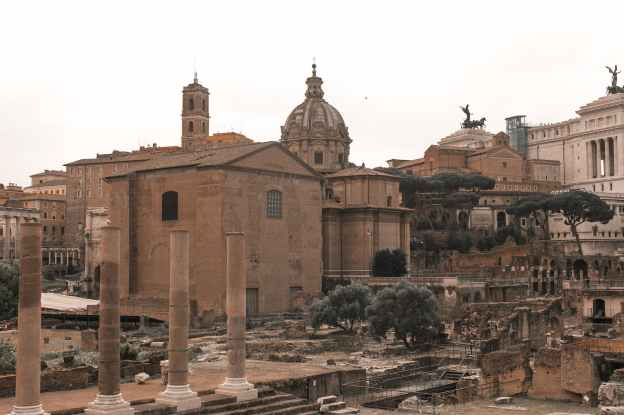
This coming Friday will mark the 2,776th anniversary of the traditional date for the founding of the City of Rome.
Click here to support the Wednesday Blog: https://www.patreon.com/sthosdkane
I find it interesting as an adult that my first understanding of my own religion, explained to me by my Mom when I was little, was that “we are Roman Catholics.” Even at that point, when I must’ve been no more than five years old, I knew what Rome was, I can remember my thoughts from that moment as clear as day: I pictured in my mind a map of the Italian peninsula descending from the Alps down into the Mediterranean. Whether that map was my memory of the globe in my grandparents’ home next to their collection of the 1979 edition of the World Book Encyclopedia, or of some other map I had seen I can’t say for sure. Rome, with all its antiquity, has had a hold over my imagination just as it has over the collective imaginations of those of us in the European and American orbits since its fall.
Several years later, after we’d moved to Kansas City, and I continued my schooling at St. Patrick’s in Kansas City, Kansas, I checked a book on Ancient Rome out of the school library. As I remember it, it was one of the few history books in color, most of them had been donated when the school first opened in 1949 and were by modern standards rather outdated. Still, I had this book in my bag that had a wonderful colored picture of the greatest extent of the Roman Empire in the reign of Hadrian during the 2nd century CE. I had looked over it several times already before this particular memory took place, but when one afternoon I was denied entry into an after school club, I think a geography bee club perhaps, I found myself sitting on the bench in front of the school’s office, reading that book.
My ancestors, the Irish Gaels, were never conquered by Rome. There were likely Roman merchants visiting the Leinster coast during the imperial period, after all the western boundaries of the Roman Empire were across the Irish Sea in Wales, but Roman influence didn’t fully arrive until after the Western Roman Empire had already collapsed in the form of missionaries like St. Patrick who introduced Christianity, the Latin alphabet & language, and fostered a new sense of European connectivity for my people that has never left. For me conversations of heritage are always complicated. Yes, I am an Irish American with roots going deep into that island’s past beyond what’s considered historical, but so much of the culture I’ve lived in and embraced comes from Europe’s classical past: from Greece & Rome, that I feel a strong bond if not in blood, then in civilization to those continental cultures.
When I teach Western Civilization or European History I, or whatever you want to call the intro class that covers European history from Bronze Age Greece to the Reformation, I make a point of trying to define civilization as being inherently tied to the concept of the city. Mapping civilizations is like charting the stars in the sky, with each city glowing bright like those lights in the heavens, at the heart of their own civilizations. In antiquity this ideal makes sense, for the city-state was the most common type of polity. Rome was a city-state governed by its own balance between an aristocratic Senate and an Assembly representing the rest of the People that in turn ruled over an ever growing empire of subjected peoples until at last it became too much for the standing political order in Rome to control and 150 years of civil wars lead to a Principate, rule by the Princeps, the First Citizen, in this case Augustus Caesar and his heirs and successors who we today know as the Emperors.
Today, I look at Roman history and see several ideals that every generation since its conception has espoused. On the one hand there’s the model of the Caesar as the best sort of leader. The Caesars who ruled Rome from Augustus’s elevation in 31 BCE to Constantine XI Paleologos’s death at the Fall of Constantinople in 1453 CE have their heirs and imitators in all the Kaisers, Tsars, and Emperors to rule in Europe and its erstwhile American colonies since, as well as in kings like Louis XIV, le roi soleil, who like Augustus fashioned himself the Sun at the center of all his domain. Yet on the other hand I see the republican ideal of citizen government espoused before the Principate, lauded by men like Cicero and the Gracchi yet never fully realized by anyone then or since.
I would rather emulate that republican ideal of citizenship, refashioned in a modern sense with the blending of republicanism with democracy. The founders of the United States saw in their new republic a revival of the best of Rome, emulating their ancient heroes in law, government, and architecture. One needs only wander around the National Mall to find all the classical buildings one’s heart could ever desire to see how our new Rome on the banks of the Potomac has come to be. Yet in all honesty, as much as Washington fits this idealized model of a republican Rome reborn, with even the great headquarters of our Department of Defense across the Potomac beyond the confines of the capital in the Pentagon, not unlike Rome’s ancient Campus Martius, experience has taught me that the greatest modern inheritor of the symbols of the Roman Republic in its art & architecture can be found in Paris, a city whose grand boulevards and monumental architecture built during and after the Revolution of 1789 are alive with the symbols and spirit of Roman republicanism. This is in part thanks to one of the great Romanophiles of the last 250 years, Napoléon Bonaparte, whose reign as First Consul and later Emperor of the French sought to create a new Rome in his own day, albeit in the transitional model of Julius Caesar whose reign at least nominally sought to preserve the Republic yet established the foundations for the Empire that Augustus, his adoptive son, created.Today the meaning of the republic has changed so dramatically that I doubt Cicero or even the Gracchi would approve; and as much as I look up to so many of those old Roman republicans as people who I appreciate and enjoy reading, I firmly believe we’re better off without all the trappings of what was inherently a limited and oligarchical Roman Republic. I would rather live in a modern democratic republic, one where social welfare, tradition, and the markets were kept in balance. So, on this the 2,776th anniversary of the founding of the City of Rome, I’m worried to see the reactionaries among us pulling us backward toward that oligarchy that initially established our own Republic here on the far side of the Atlantic almost 240 years ago. The Roman Republic fell because its leaders misdiagnosed the sickness and killed the patient, ignoring the needs of the people for their own power & wealth. Rome continues to provide us lessons today. We should listen to them.
Eight years ago, when I was a masters student in International Relations & Democratic Politics at the University of Westminster in London a question was posed in one of my first semester classes by the professor who asked “are we inherently good or bad?“ I raised my hand among the few in the room who argued that we are inherently good. That, at heart, we have evolved to trust one another, and to be kind, not only to our own tribe, our own community, but of those outsiders to whom we are in some way connected, as we are with our pets, or in human terms as we are with peoples from around the globe whom we come to meet on a personal level.
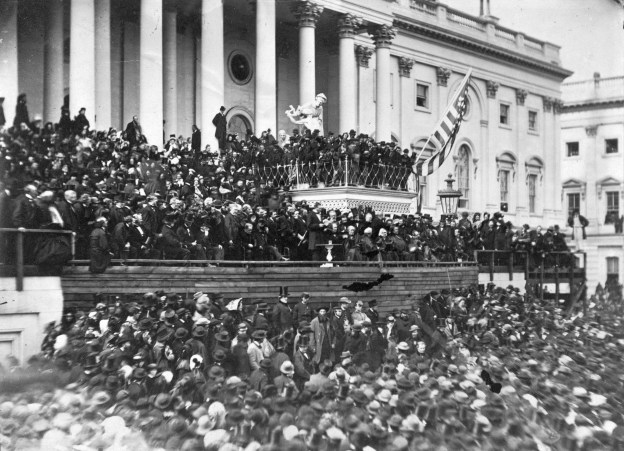
It occurs to me when thinking about some of the great and good figures in recent human history, and even going back several centuries, if not several millennia, that a great many of those figures were killed, their lives ended in acts of evil, in moments of malice. When President Lincoln gave his second inaugural address in March 1865, and called for us to “bind up the nations wounds” and to progress forward with the now immortal words that I have surely used on many occasions here on the Wednesday Blog,
“With malice toward none, with charity for all, with firmness in the right as God gives us to see the right, let us strive on to finish the work we are in, to bind up the nation’s wounds, to care for him who shall have borne the battle and for his widow and his orphan, to do all which may achieve and cherish a just and lasting peace among ourselves and with all nations.”
Yet there on the balcony above Mr. Lincoln in the famous photograph of his second inaugural address that depicts not only the president, but the crowd as well, one can just discern the face of John Wilkes Booth, the man who would assassinate Mr. Lincoln a little over a month later on Good Friday. Clearly then, Mr. Lincoln’s, message of reconciliation & reconstruction, not only of the nation’s infrastructure but also for the government to be more just, put pressure upon the nation’s heart to recognize that when we say all men are created equal that we mean everybody. Clearly that message didn’t resonate with his assassin. So where was the inherent goodness in John Wilkes Booth?
I think if we are to describe some innate human goodness to all of us, then we ought to recognize that it exists deep within us. We are like the strata that make up Earth’s geology, each layer representing a different age, era, or epoch in the long history of our planet in our own lives; our experiences with each passing moment add layers one atop the other, until as Aristotle wrote 23 centuries ago, we become truly wise through our lived experiences. So, our innate goodness must exist be deep within. I’m reminded of the line at the heart of the Return of the Jedi, the third film of the original Star Wars trilogy, in which Luke Skywalker tells everyone around him that he knows there’s still good in Darth Vader, despite all the evil that the fallen Jedi had committed. C.S. Lewis remarked in the final book of his Narnia series, that the eldest of the children who are the central characters in the Chronicles of Narnia, Susan, did not return to Narnia for the last battle, because she no longer believed in Narnia, for she had grown up and “put away childish things” to quote Saint Paul. Yet the best of us, or so our great allegories seem to tell us, have never really forgotten that childlike innocence, though some have never really been able to experience it, after all not everyone has the same happy childhood.
I believe that at the end of the day, the best way that we can truly find our goodness, our kind nature, is in the simple fact that at some point along the way we all want to be loved, and I would imagine for the most of us we all want to love others. I often wonder in the vein of Machiavelli‘s Prince if I do things out of a desire purely to love others, or out of a desire to make myself feel good, or out of a desire for others to love me? And which of these three is perhaps lesser than the others or is there a lesser and a greater, or are these three perhaps all equals? Is it okay to be selfish it for the right cause? I don’t know.
There certainly should be limits to vanity, I for one am not terribly fond of taking selfies, nor do I really care for watching videos of other people watching videos. Still, as many of the self-help people will say some degree of self-love is a good thing, and to paraphrase the old saying that appeared carved in the mantle above the great doorway at the ancient Library of Alexandria, “know thyself,” one should be able to love oneself before one truly begins to appreciate the people around them and by extension world in which they live. So perhaps it ultimately comes down to one’s environment if we live in a world where you’re taught that negative news and emotions and violence ought to be glorified then that’s the kind of stuff we are going to do. However, if we look at the world as a place full of beauty and wonder, and if we find a way to appreciate the great variety of humanity and nature at large and the incomprehensibility of the Cosmos, then I think we can truly begin to define ourselves by our inherent goodness again. What a wonder it is to be a part of our human family.
I had a restless night on board the Auto Train, from the flashing lights to my right as the curtains in my roomette with the rocking of the train, to the audible voices in the corridor beyond, to the frequent bumps and lurches on the rails. Still, after about 7 hours I decided to get up, shower, and get dressed for the day ahead. I had breakfast in the dining car as we crossed the James River and rolled through Richmond, Virginia. That capital city was radiant in the morning sun.
Crossing the James River.
At 9:30, a good half-hour ahead of schedule, we pulled into the northern terminus of the Auto Train in Lorton, Virginia, a suburb of Washington, DC nestled in the hills near the Potomac. I stepped down onto the platform soon after, collected my car, and drove into the Virginia morning bound for my main stop of the day. Virginia is one of the two oldest English colonies in North America, founded in 1607 with the establishment of Jamestown. The Puritans of New England, better known as the Pilgrim Fathers, didn’t arrive until 13 years later in 1620. Whereas the Puritans established a theocracy in the North, here in the South the Virginians established a plantation society focused on wealth and farming.
The plantations of Virginia inspired the culture and social order of the rest of the South down into the present. In some ways, these plantations are akin to the ranches of the Southwest and haciendas of the old Spanish colonies because they are all focused on the same overarching thing: using the land for its profits.
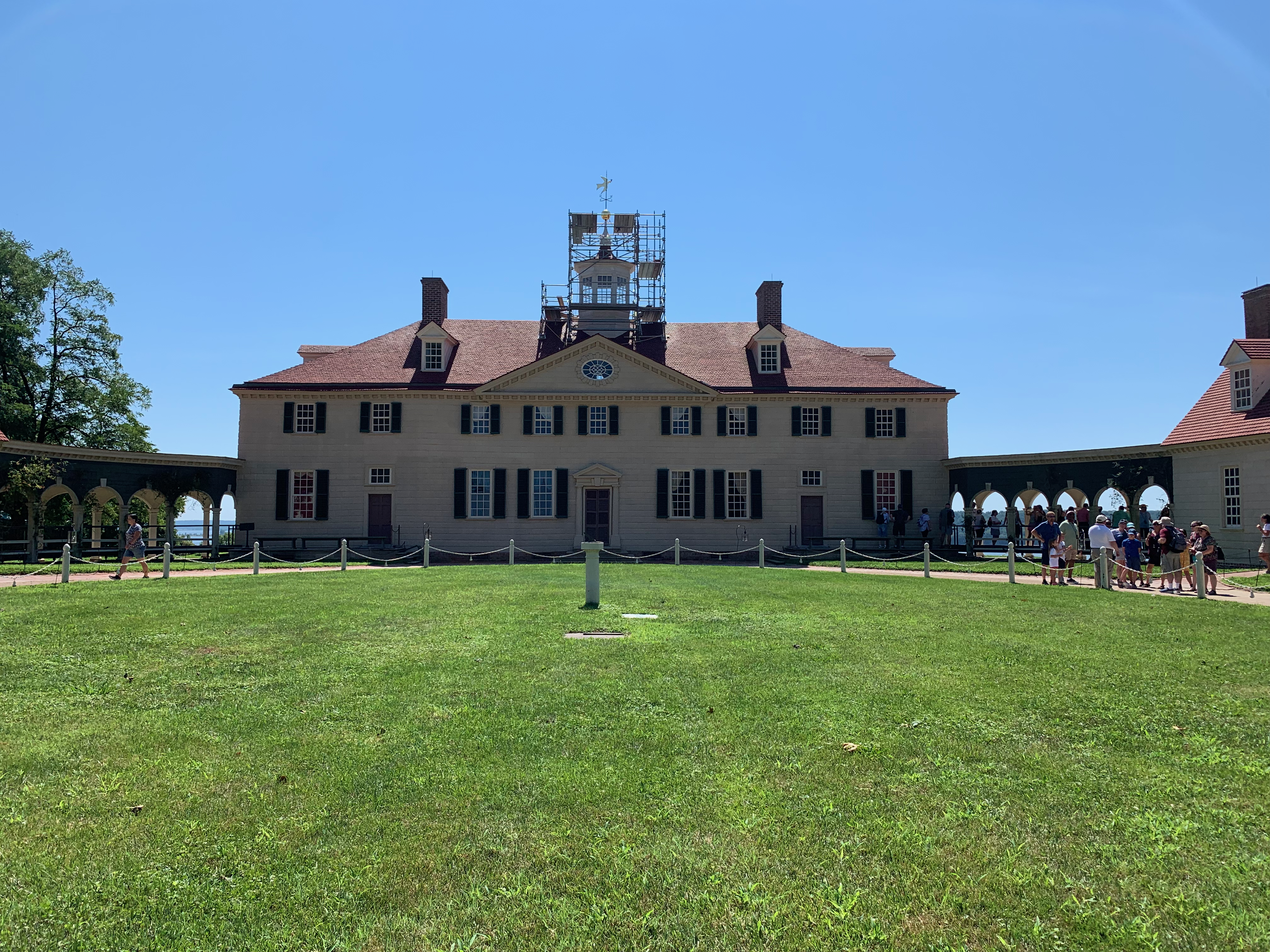
It was one such plantation that I was driving towards that morning as I passed Fort Belvoir, Mount Vernon, the home of the first President of the United States: George Washington. I’ve spent a lot of time in DC compared to the rest of the East Coast, but in all those trips I’ve never made it out to Mount Vernon, largely because I haven’t had a car on most of those trips to make the journey, or because I just couldn’t fit it into a busy schedule. So, upon seeing how close the Auto Train station in Lorton is to Mount Vernon I knew I had to fit a stop in.
Mount Vernon.
Mount Vernon sits on high ground overlooking a bend in the Potomac about 15 miles downriver from Washington, DC. The mansion house itself was first built by Washington’s father Augustine Washington in 1734 on land that the Washington family had owned since 1674. George Washington began inheriting parts of the estate in 1754 before becoming its sole owner in 1761. The image of himself that he most wanted to be remembered by, that of Farmer George, is best realized there at Mount Vernon, which has been carefully and diligently restored to its appearance in 1799, the year of Washington’s death, by its current owners the Mount Vernon Ladies’ Association.
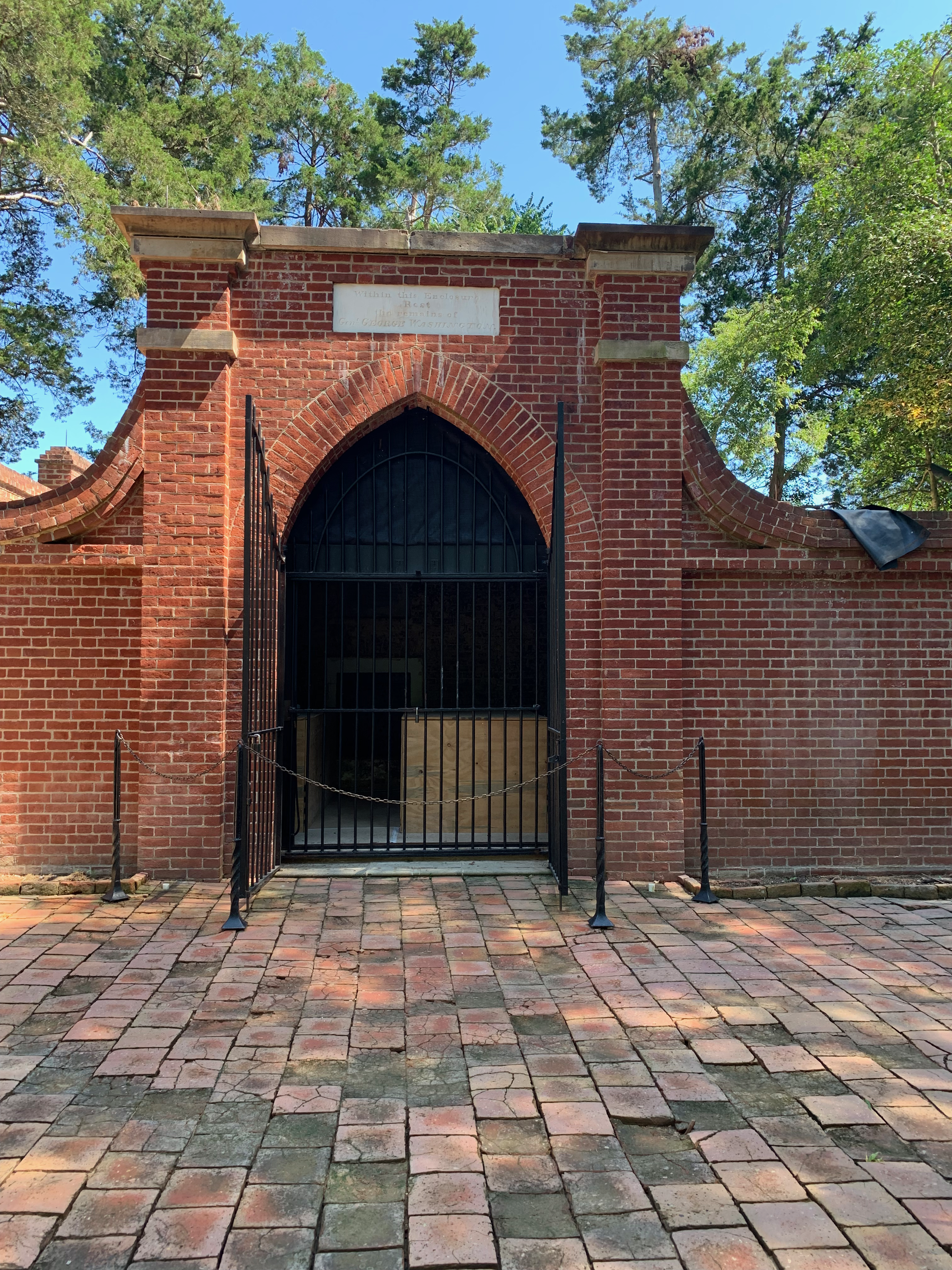
Washington’s Tomb.
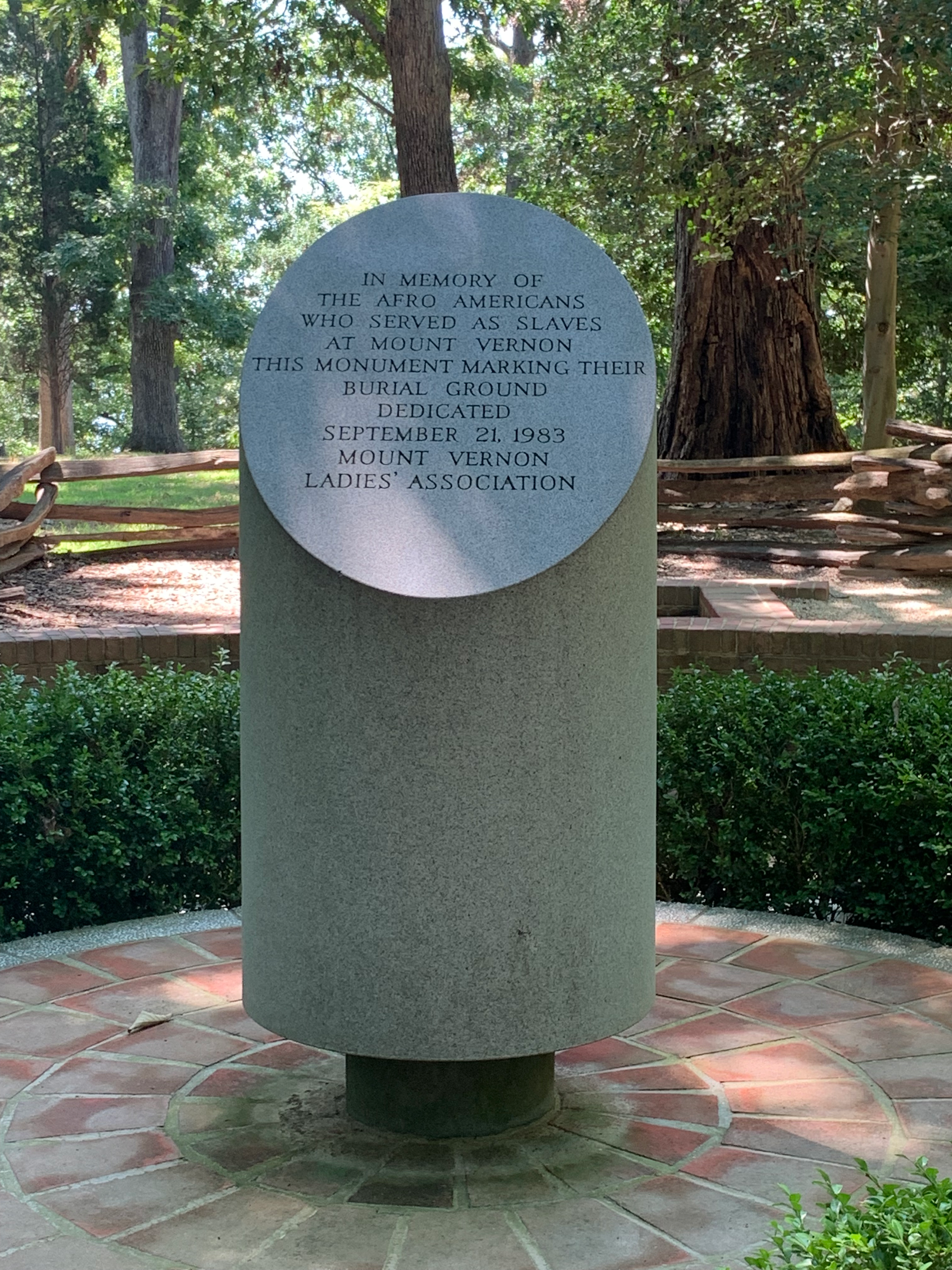
Arriving on the grounds I first made my way towards Washington’s tomb, wanting to see as much of the outdoor things to see there in the morning before the afternoon heat index well over 100ºF set in. At one point there was talk of burying Washington in the crypt beneath the rotunda of the US Capitol building, yet ever the one to avoid grandiosities Washington instead insisted on being buried in a new vault on Mount Vernon, the place he loved more than any other. His tomb is fittingly simple, a vault with an iron gate in which he and his closest family are buried. Outside of it are two obelisks which mark the graves of other Washington relatives who died in the 19th century. A short walk from Washington’s grave is another memorial marker, this one honoring the enslaved African Americans who worked on Mount Vernon. Both were somber sights to behold, the former a tomb of a man who did so much in his day to establish the precedents of our government still in place, the latter a marker of horrendous evils inflicted by that same man upon those who he relied on.
One of the great highlights for me was that afternoon when I took a guided tour of the Mount Vernon mansion, a Palladian structure that has been often used as a model for many later neo-colonial buildings to the point that the layout and interiors seemed almost familiar to me. In some respects, it reminded me of the big farmhouse that I grew up in from the front hall to the social rooms on the ground floor, which in my old house were largely all one big room, to the formal dining room off to the side. On the upper level the idea of having guest bedrooms is something that was very real to me, as we had more sleeping space for guests in that farmhouse than we had for ourselves, though there was only 1 guest bedroom in the place. On the upper level I saw the room where Washington died, restored according to a painting from the 1830s that used eyewitness testimony to be accurate to how the room had looked 30 years before.
After the deaths of George and Martha Washington and their immediate relatives Mount Vernon fell into disrepair, owing in part to changes in the plantation economy and soil exhaustion in those well-settled parts of Virginia. I was touched to learn how the estate was honored and protected by both sides during the Civil War, being one of maybe only a handful of places considered neutral. This saved and preserved Mount Vernon from meeting the same fate as many of its peers throughout the South which were often burnt and ransacked by the passing armies.
I left Mount Vernon after a good 6 hour visit and made my way northwest across northern Virginia to my hotel for the night near Dulles Airport. In general, when it comes to a bigger city like DC, if I have my car with me, I usually prefer to find hotels that are outside of the center but close to a train or metro line so that I can leave my car in a park-and-ride for the day and go into town, while not having to pay downtown hotel or parking rates. I had some ideas of going into DC on this trip, perhaps to visit the National Zoo, but ended up choosing not to, instead staying out near Dulles both that evening due to exhaustion from travel and the poor sleep the night before, and out of an eye for budgetary frugality.
The following day I did make one tourist stop at the National Air and Space Museum’s Udvar-Hazy Center, a massive hangar near Dulles that houses the Smithsonian’s impressive aircraft and spacecraft collection. There’s an old Air France Concorde in there, as well as the Enola Gay, the B-29 that dropped the atomic bomb on Hiroshima on 6 August 1945. The Space Shuttle Discovery is also housed there, in its own wing of the hangar surrounded by other spacecraft, including John Glenn’s Friendship 7, and a collection of German, American, and Soviet rockets. They even have Chuck Yeager’s Glamorus Glennis, a Bell X-1 in which Yeager became the first human to break the sound barrier in 1947, traveling at Mach 1. I wandered around these feats of human ingenuity and engineering so excited to see each and every one of them. But I knew I needed to be moving again, back on the road north, hopefully to make good time in reaching that night’s hotel.
I left Dulles at around 13:30 that afternoon, driving around the western and northern sides of the Capital Beltway to I-95 and aiming my car northeast along that great artery of the Interstate system that parallels the Atlantic coast from Miami to Maine. Today though I would only be passing through four states, Virginia, Maryland, Delaware, and Pennsylvania. As I was driving through Baltimore, taking the Fort McHenry Tunnel under Baltimore Harbor, I decided to adjust my route a bit and not go straight to my hotel in suburban Philly but instead to make a stop at Pat’s the King of Steaks in South Philadelphia because “it’s on the way.” I made it to Pat’s just after 5 pm, as the glow of the evening sun seemed to be like twilight as it shone between the old brick buildings around the intersection of S. 9th St, Wharton St, and E. Passyunk Ave.
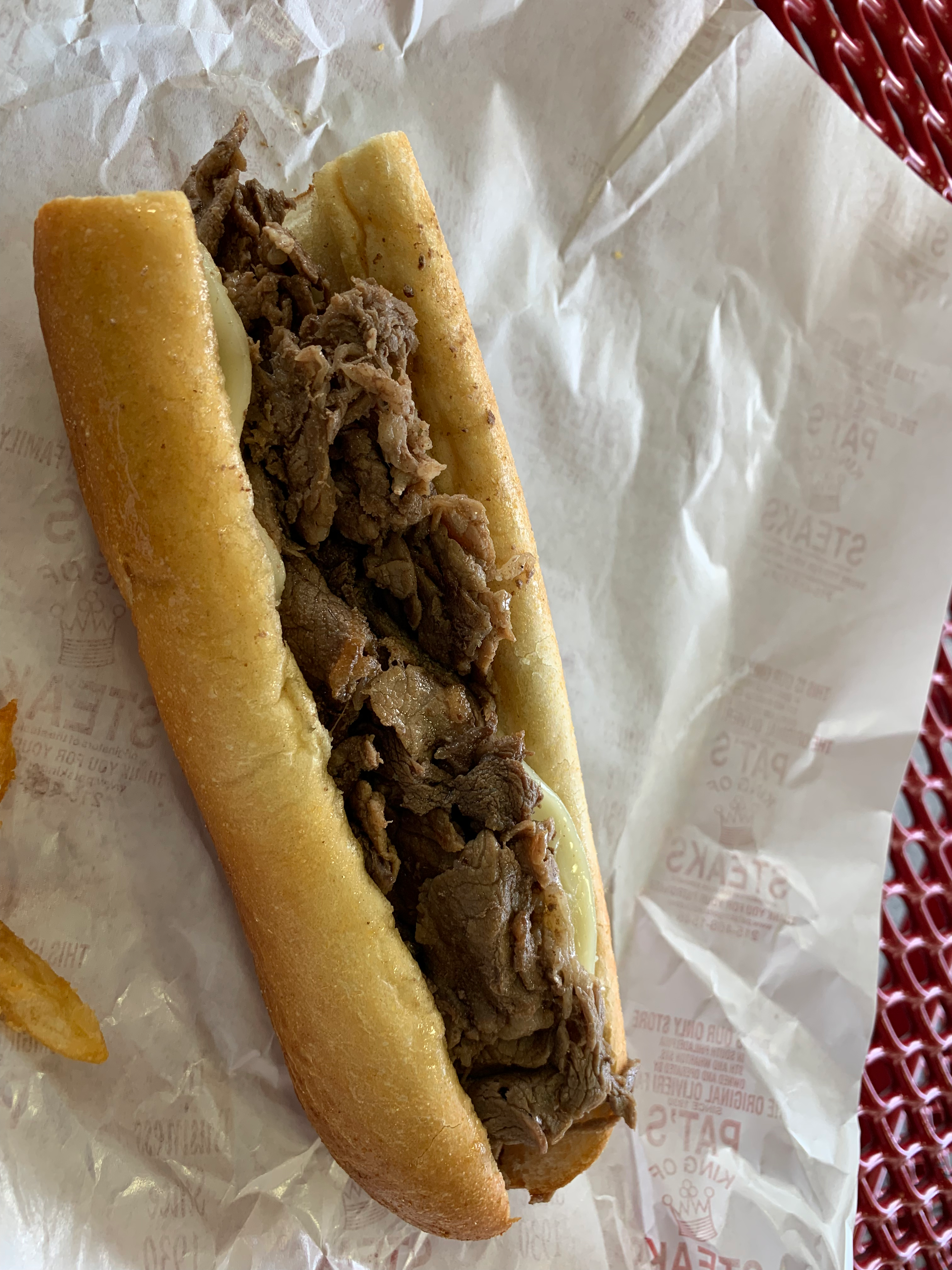
Provelone without
The last time I was in Philadelphia in October 2019 I made my first visit to Pat’s after it was suggested to me as the best option for a cheesesteak by the park rangers at Independence Hall. I found it to be as good as I was told, a wonderful steak sandwich that was one of the easiest meals I’d yet found to order. In my case, I get the “Provolone without,” that is a provolone cheesesteak without onions. On this visit I was happy to be able to have Pat’s again after the pandemic kept me from traveling throughout the East for much of 2020 and 2021. These sorts of steak sandwiches, invented by working class immigrants and their children in the big old cities like Chicago and Philly are a real wonder for American cuisine. I’d compare the influence of the cheesesteak to that of the Italian Beef, a Chicago invention that is more slowly expanding in reach beyond that lakeside metropolis to be known and loved throughout the US.
While waiting at a traffic light near the old docks on Columbus Boulevard, I looked off towards the banks of the Delaware River at the great wharf buildings that were once the beating heart of that city’s international trade. It was through one such building that my 2nd great-grandfather Edward Maher arrived in this country in 1878, receiving an honorable discharge from the British Merchant Navy in which he had served for several years. Though I don’t know which wharf or which dock was the one that witnessed his arrival in America, I felt that the sorry pair I spied that evening in their faded grandeur could well serve as proxies for the spot where that one of my own ancestors first set foot on these shores.
The idea to stop at Pat’s on the way into Philly was good from a geographic perspective, but as soon as I’d left Pat’s and made my way back onto I-95, I quickly found that from a time and traffic perspective that it wasn’t my finest moment. I crawled through Philly that evening, making it to my overnight hotel after an hour of bumper-to-bumper traffic. By then I was just as exhausted as the night before, and not in the mood to try or do anything fancy. So, I sat down on the sofa in my hotel room, turned the TV to WHYY (Philadelphia’s PBS station) and spent the evening watching Nature and NOVA, two of my favorite shows on the air.
The next morning, I woke early, and quickly packed up my things, checking out of the hotel by 8:45. I made it to the 9:10 train at the Norristown Transportation Center with a good 15 minutes to spare, enough time to buy a new Key Card, the local transit smart card issued by SEPTA (the Southeastern Pennsylvania Transportation Authority) and boarded the regional service bound for the Center City. The plan that day was pretty simple: I wanted to visit the Academy of Natural Sciences, my favorite stop on my last trip to Philly in 2019, and then get back out to my car in Norristown to begin the last leg of the trip with a drive up to Binghamton. As luck would have it, nothing went wrong with the trip that day. I made it into Philly by 10:00 am, and walked from Suburban Station to the Academy in good time, arriving about 5 minutes after they opened their doors for the day.
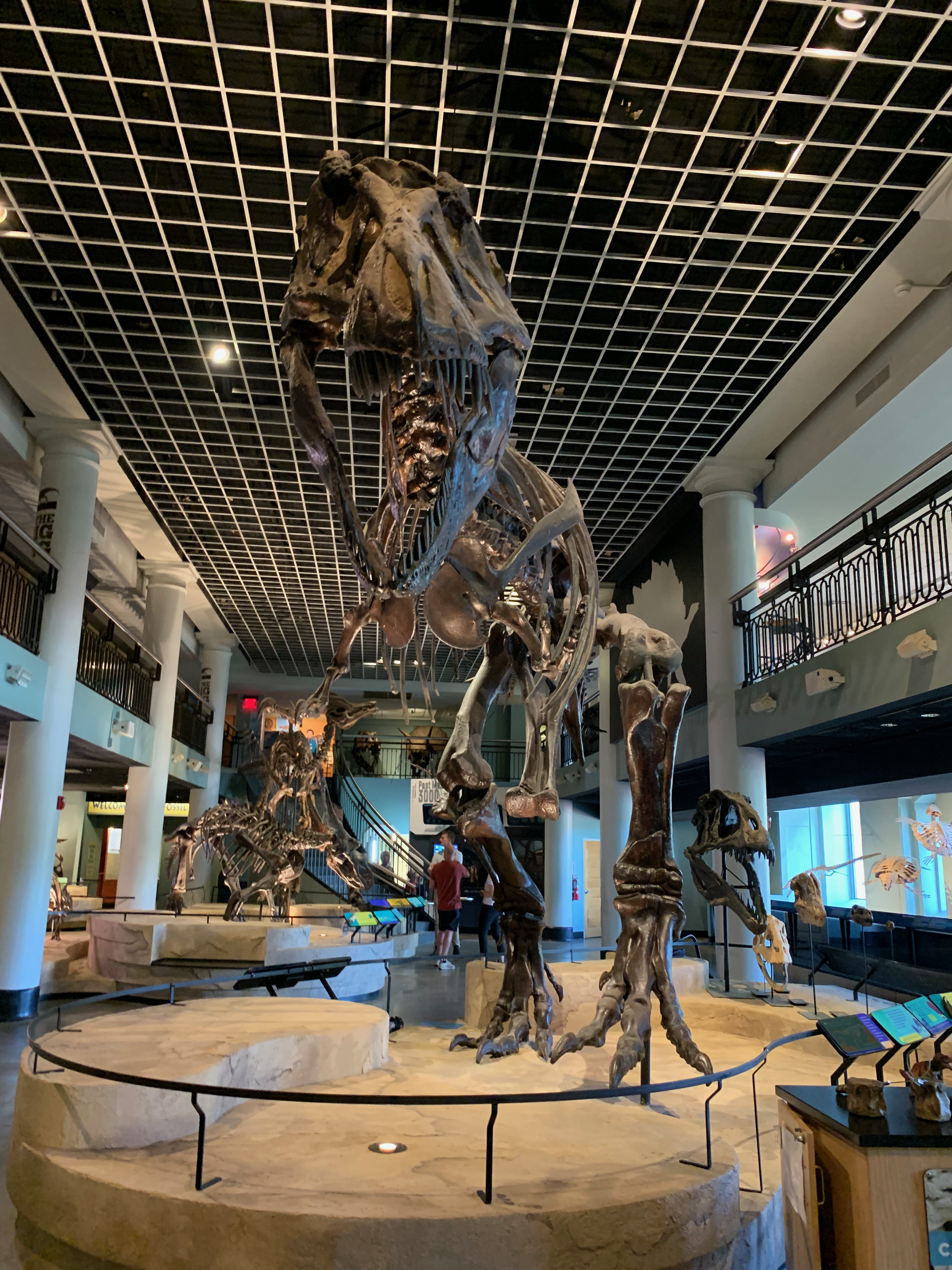
The Dinosaur Hall.
The Academy of Natural Sciences is, in my humble opinion, the best natural history museum in the East. When it comes to natural history museums, I’m especially fond of the dioramas, the displays of taxidermied animals on naturalistic backdrops, of which the Academy has plenty spread out across 3 floors. Their dinosaur collection is smaller than either the American Museum in New York or the Smithsonian’s in Washington, but when it comes to dioramas Philly has them both beat in how they’re laid out and how intimate they seem. This is especially true compared to the ones in New York where the rooms are so dark that it almost feels hard to really get an appreciation for the animals on display. My two favorite natural history museums in the US are my “home museum” the Field Museum in Chicago, and the Denver Museum of Nature and Science, both of which ought to be the poster children, or better yet the type species of American natural history museums in how they set the standard that other museums ought, in again my humble opinion, to follow.
While I was at the Academy, I noticed there was a film crew in the dinosaur hall. I looked to see who was on camera and was surprised to find it was British documentary filmmaker Dan Snow. My general rule when running into famous people is to treat them like anyone else, give them their space, and don’t disrupt what they’re doing. How would you feel if you were working, and some random guy walked up to you and started chatting? I later had a very short but pleasant exchange with him on Twitter about seeing him there. Nice guy.
I wandered around the halls of the Academy of Natural Sciences for a good two hours, just soaking all of it in. When I first agreed to come to Binghamton for my PhD, one of the big things I agreed to myself was that I’d take advantage of being so close to so many wonderful cities with astounding museums to visit as many of them as I could. Because of the pandemic I haven’t been able to be as thorough at that promise as I would’ve wanted, but I’m confident in the future as I find my way into better jobs that I’ll be able to afford the odd weekend trip to see places such as this.
From the Academy I went down into the subway under Market Street and took the trolley to 30th Street, exiting at Philadelphia’s grand Amtrak terminal, where I had a quick lunch of a chicken teriyaki bento box and looked into how to get back to my car in Norristown. I could either wait an hour and catch the same train I took that morning back out to the suburbs, or I could take a timelier route on Philly’s L and interurban services and get there far sooner. Naturally then, I chose the latter, returning to the subway to catch the L to 69th Street, where I transferred to the Norristown High Speed Line, a 13.4 mile (21.6 km) interurban that runs by, among other things, Villanova University. So, at 12:40 I found myself back in my car in the Norristown Transportation Center’s garage, quickly writing out some postcards and setting my navigation system to take me north to my final stop on this Longest Commute, my place of work itself, Binghamton, New York.
The last leg of the trip was the shortest, a mere 2.5 hours between Norristown and Binghamton along the Northeast Extension of the Pennsylvania Turnpike (Interstate 476) to the northern edge of the Wyoming Valley just outside of Scranton and then a quick jump up Interstate 81 and across the New York border to the Susquehanna valley and Binghamton. I finally arrived at my apartment at 4:30 pm on Thursday, 11 August, a full 14 days after leaving home.
Elements of this trip have been in the back of my head for a while. Over the past few years, I’ve considered driving back to Binghamton via DC or Philly, having usually done so via Cleveland or Pittsburgh. There are places in all these cities that I’ve wanted to see for a long time, wishes that my younger self had that I’m finally fulfilling. This longest commute took me through 14 states (Missouri, Illinois, Kentucky, Tennessee, Florida, Georgia, South Carolina, North Carolina, Virginia, Maryland, Delaware, Pennsylvania, & New York). The trip in full saw me travel 3,022 miles (4,863 km) across much of the Midwest, South, and Northeast of this country.
So, that’s it. That’s the story. To those of you who have been listening and reading over the last 3 weeks, from the bottom of my heart thank you, thank you, thank you. This episode, no. 39, marks the end of Season 1. I started The Wednesday Blog on a whim one morning after a sleepless night in March 2021 after I decided I wanted to write something personal and non-academic for a change. At the time I said I’d stick with it as long as it was fun and not tedious. Well, that first run of 38 blog posts set the stage for the podcast, which I started on another whim after dinner one night in November 2021. About halfway through the first season of the podcast, I decided I’d call the season over after a max of 40 episodes, to try and keep things even with the number of blog posts I published before the podcast started. So, here we are. I hope “The Longest Commute” has been as fun for you to hear as it was for me to experience and later write.
This week, introducing my research into the introduction of the three-toed sloth to European science in the 1550s. I'll be giving a public talk about my work at the Kopernik Observatory and Science Center in Vestal, NY on Friday, 29 April 2022 at 8 pm Eastern, 7 pm Central.
You can find a link to the YouTube broadcast here:
https://youtu.be/70lJ0NmT8Kw
Also here's a link to the Kopernik Observatory's website:
https://www.kopernik.org
You’ve heard me talk at length about a fair number of topics on this podcast, and those of you who have been reading my blog now for the 60 straight weeks that I’ve been writing it will perhaps know parts of me a bit better than some. This week I want to talk to you about something that’s personal yet also professional, it’s the project I’m staking my career on at this early stage––my dissertation. The big document I’m writing now is called “Trees, Sloths, and Birds: Brazil in Sixteenth Century Natural History.” It tells the story of how those three groups––the trees, sloths, and birds––were introduced to European natural history by a French cosmographer named André Thevet (1516–1590) in his 1557 book The Singularites of France Antarctique. It’s been a fun project to write so far after years of research and nearly a year of fighting to get it approved. At the moment, I have the first two chapters written and the next two, the sloth chapters, in the works.
So, naturally this seemed like a good time to stand up in front of a crowd and announce my intent to study the history of the natural history of sloths to all the world. This Friday, 29 April, at 8 pm Eastern I’ll be giving a public talk about my sloth research called “Close Encounters of the Three-Toed Kind: How Unknown Life was Named in the First Age of Exploration”. I’ve got to admit, I’m going out on a big limb here, and not lazily or slowly either. On Friday evening I’ll be introducing not only my research about the three-toed sloth’s role in cementing the strangeness of American zoology in European eyes but arguing for the recognition of what we today call the Age of Exploration, the period that began when Columbus stumbled on the Bahamas in 1492, as in fact the First Age of Exploration. The reason for this is straightforward: 61 years ago, humanity entered a Second Age of Exploration at the moment when the first human left the Earth’s atmosphere and entered Space beyond. Yuri Gagarin’s monumental first spaceflight is a moment that ought to be marked as the beginning of a new age in the human story, one where we began to move, however slowly, towards venturing out of our home and into our planetary neighborhood at the very least, our stellar neighborhood in the long run.
I don’t think it’s anachronistic to say the way Thevet and his contemporaries understood the sloth in 1555 and 1556 is similar to how we might well understand life that’s new to us that our explorers in the coming years might well encounter on other worlds. In Thevet’s time the Americas, these continents, were seen as an alien world by the Europeans, it was as foreign, as strange as they could imagine. In their efforts to make sense of what they saw and who they encountered in those first generations of contact the European explorers often either gave names familiar to them to that American life they encountered, as with the sloth, or they adopted local indigenous names for the life of these continents, as in the case of many of the local peoples they met. All of the states in my home region, the Midwest, bear indigenous-derived names, largely drawn from the names of local peoples who the French encountered and traded with during the seventeenth and eighteenth centuries.
The main theme of my talk will be about the meaning of names, their importance and intrinsic value to the named and the one doing the naming. In the first fifty years of its inclusion into European natural history the three-toed sloth went by several names. Thevet first recorded it in 1557 as the haüt, a Middle French phonetic spelling of the Tupinambá name for the creature, itself derived from the sloth’s cry which Thevet described as like “the mournful sigh of a small child.” Haüt also appeared in Conrad Gessner’s entry for the sloth in his 1567 Thierbuch, a German translation of his History of Animals, first published in Latin before Thevet’s visit to Brazil in the 1550s. Yet Gessner himself gave the sloth a more scientific name, Arctopithecus, meaning “bear-like ape” out of an effort to identify it by its physique, or how at least Thevet described its physique in his writing and a woodcut of the animal in his Singularites. Another French writer, Jean de Léry (1536–1616) who visited Brazil after Thevet left in 1556 and 1557 called the animal a Hay, with a closer phonetic spelling to the modern Aí. Yet it was the Portuguese who first called this animal a sloth, namely the Spanish Jesuit missionary St. José de Anchieta (1534–1597), whose letters to his Jesuit superiors describe the animal as a preguiça in Portuguese, a sloth in English.
Another epithet Thevet gave to the sloth in his 1575 book the Universal Cosmography referred to it as “the animal that lives only on air” because during the 26 days that he kept one in captivity he never saw it eat or drink. Therefore, in Thevet’s logic, the sloth must only nourish itself on the air surrounding it. How Thevet didn’t realize the animal was probably terrified from being brought indoors, and likely was starving and dry for thirst baffles me. Still, the idea that Thevet believed he had found an animal in this alien world of America that “lives only on air” meant that the sky was truly the limit for the possibilities of American life. Thevet’s own Twilight Zone contributed to the groundwork for the notion of alien worlds that persisted in speculation and fiction into the present day, beyond the bounds of his own Age of Exploration, which I might argue ended with the competing Amundsen and Scott expeditions to the South Pole in 1911, or perhaps with the gradual end of the old colonial empires over the last century. So, if you’re in the Southern Tier of New York this Friday and want to hear me talk about sloths come up to the Kopernik Observatory and Science Center in Vestal, New York. The talk begins at 8 pm on Friday, and if the skies are clear, as hopefully they will be, we should have some wonderful opportunities for some stargazing after I wrap up my show. And for those of you who are listening from afar you can watch me take the stage live on YouTube. The link is in the show notes.
This week, I want to talk about some reasons that I see for why we Americans are so deeply divided. You can find the editorial by Charles M. Blow that inspired this episode here.
A few evenings ago, I read an editorial by the frequent New York Times contributor Charles M. Blow about what he called the first signs of the next civil war looming on the horizon. Blow’s argument boils down to the idea that today’s political actors on the right who accept our most recent former President’s Big Lie that the 2020 Election was somehow stolen are themselves inheriting rhetoric from former Vice President, and Senator from South Carolina John C. Calhoun. Calhoun has often been called the father of secession, the one who laid the rhetorical and political groundwork for eleven southern states to leave the Union in open rebellion, launching a Civil War in 1861, 11 years after Calhoun’s death, that would lead to around 720,000 American deaths. Just as today the Trumpist faction feeds on this Big Lie of their own creation, so too the secessionists of the nineteenth century made their fateful decision to embark on the conflict that my friend and fellow historian of Midwestern extraction Josh Kluever recently termed the “Treasonous Southern Enslavers’ Rebellion” on the basis of an even bigger lie, one that contends that there are varying degrees of humanity, some better than others, and that those degrees are understood on an arbitrary designation based on phenotype: distinctions in skin color.
If the Trumpist argument has any merit it’s that it’s a reaction to a sense that some Americans feel left behind by the dominant forces in our culture and society today. As much as being American implies that we are all one people, one culture, in the same way that old caesaropapist rhetoric would cry that under the banner of the emperor of the day there was “One God, One Emperor,” so too the idea that the United States is “one nation indivisible” makes it entirely evident that we are expected to be unified not only politically but culturally and socially as well. The great façade of this line from our Pledge of Allegiance is that we have never truly been “one nation” in any more of a sense than we share some common cultural and social bonds brought about in part through the spread of American dominance on this continent through westward expansion, phantom dreams of manifest destiny, and frequent generational rallying calls of “America First,” embodied in the idea of the melting pot that boils down all of us ethnic descendants of immigrants and makes us one common people: Americans. The South, in its misguided attempt at going it alone in the 1860s, has long recognized that it has a distinct culture from the rest of the country. We in the Midwest too are different from our cousins in the Northeast, even if we generally come from the same immigrant roots as our fellow Americans in New England or the Mid-Atlantic states. Then there’s the great gulf between the east and West, which falls somewhere in the Great Plains. During my recent visit to San Diego I mentioned to my family back in Kansas City that if any part of this country could even remotely think about successfully seceding from the Union it would be California, which is geographically so remote from the still largely eastern center of power and wealth in this country that as American as it does feel, it still seems foreign enough to my Midwestern senses as to be mistaken for a foreign country.
The greatest fault that our collective popular history has perpetuated is by smoothing out the surfaces of our past to make an easy to digest collective etiological story, a creation myth of this most artificial of countries born out of a series of settler colonies founded by the English in the seventeenth and eighteenth centuries on the Atlantic coast. Unlike the majority of countries around the globe, the United States is not a nation, it is a political collection of peoples living together in the same region of the globe. A nation is something far more ancient, its members share not only a common political leadership but common heritage going back centuries if not millennia. The purest examples of nationhood are countries like Iceland that have had little immigration to its shores, and thus a fairly stable population for generations.
Considering this, by my estimation there are few nations today, instead many countries, states which represent the interests of the peoples who live in those places. Those peoples are often either native to those areas or varying degrees of newcomers. Yet the degree to which people are either native or newcomer is itself vague, after all would the old Bay Staters be considered at this point after 400 years of settlement on the shores of Massachusetts Bay native to that part of the world? Or are they, like the descendants of the Ulster Scots who were brought to Ulster in the same century still relative newcomers to the places that they have called home for generations?
Here in the United States, we often highlight the English and Dutch colonial heritage of our country while demoting the French, Spanish, and Russian colonial heritages of other regions beyond the old Thirteen Colonies. Our holidays commemorating the colonial period, notably Thanksgiving, commemorate the founding of one English colony on Cape Cod, and even the history behind that commemoration is flimsy at best. It struck me when I was walking through the Museum of Us, San Diego’s renamed anthropology museum in Balboa Park, that the most basic understanding of “us” as the intended audience of the museum’s exhibits are Anglo-Americans. I feel a sort of secondary connection to this idea of “us” as Anglo-Americans, after all I have old colonial ancestry on my Mother’s side going back to seventeenth-century Connecticut, and eighteenth-century Maryland and Pennsylvania, but I see myself far more in light of my more recent and familiar status as a third-generation Irish American. What was especially profound about this particular definition of “us” in San Diego’s anthropology museum was that it was being used in a city that was founded not by the English or later American settlers but by the Spanish in 1769. Sure, there were exhibits that included the stories of the local indigenous peoples, notably the Kumeyaay, but they were always the object of focus not the subject describing the object. In the process of conquest by the United States during the Mexican-American War of the 1840s, not only were the Amerindians living in the West and Southwest subjugated and demoted to second-class citizens in their own home, so too were the Californios, Nuevomexicanos, and Tejanos, the descendants of the Spanish colonists who settled in their northernmost American colonies and would later become regional identities in a newly independent Mexico after 1821.
Similar patterns can be seen among the French of the Mississippi Basin; it’s noteworthy that Homer Plessy of Plessy vs. Ferguson fame was seen as a free person of color within the French and Spanish racial contexts, while to the Americans any hint of African ancestry deemed him to be legally black. If you want to understand why the fight for racial justice is so complex consider that firstly race is an artificial concept that was created to promote a colonial order of hierarchy, and secondly that out of these ideas of race entire notions of identity and community have developed that are very real, very powerful, and frankly beautiful. Just because I don’t feel any affinity for my legal identification as white doesn’t mean that my relatives, friends, and neighbors who identify as black aren’t in any way unjustified in being proud of being black.
Secessionist rhetoric had power in the nineteenth century because of how new the Union was. Remember how Lincoln introduced his Gettysburg Address, noting that he spoke “four score and seven years” after the Declaration of Independence from the British Empire was made in 1776. Speaking only 87 years after the conception of this idea of a country called America, populated by a people called Americans, it makes sense that some in the South would feel far closer to their identities as South Carolinians, Georgians, and Virginians among others. Yet it is interesting to me that the President of the Confederacy, Jefferson Davis, was born in Kentucky but served from Mississippi, both states that were created by the United States out of territories controlled by the Federal Government after the signing of the Federal Constitution in 1787. In short, Davis’s claim to some innate loyalty to his state before any loyalty to the Union was far less well founded than that of the father of secession, John C. Calhoun of South Carolina. I’ve written before about how I argue that the moment that the United States became more important than the individual states themselves was when the United States Congress began admitting new states to the Union west of the Appalachians that hadn’t existed before the Revolution. The first thirteen states created the Union, yet the Union created nearly every state that would follow its own founding, save a few holdouts with preexisting governments that elected to join the Union, whether by popular demand like Texas or by coup and minority rule like Hawaii.
Today though, secessionist rhetoric is less well founded on the idea that the states have some precedence over the Union and more on the idea that the power of the Union relies on the states’ and by extension the voters’ full faith in the credit and authority of the Union itself. No institution exists without that most fundamental level of trust that it can do what it sets out to do. Historically, governments have been able to hold power through a combination of force of arms and public support. This is at the heart of what Machiavelli argued about how a good prince ought to govern in the sixteenth century. The definition of what it means to be American is inherently exclusive, it relies on this identity created out of the twin foundation myths of Jamestown and Plymouth. Because of this we have seen a continual multigenerational struggle to expand that definition to become inherently inclusive, that it might embrace not only the English heritage of the oldest colonies that eventually contributed to the foundation of the United States but all the other identities, whether indigenous, colonial, or immigrant that best express the intricate mosaic of what it means to be an American.
If we do have a second civil war, whether on the battlefield or in the destabilization of the authority of the ballot box, it will be because we don’t recognize the interests and needs of our myriad of different Americans. I agree with Mr. Blow that the efforts of activists and politicians on the right in the last year to take control of government at the local level, whether on school boards or in local election boards, better reflects the true battleground of this second civil war. Yet I’d take that argument one step further and say that the fact that this focus has been so intent on assuming authority over the most local of political offices reflects more than anything else how at the local level we are still divided into our own nations, whether they be as Southerners, Northeasterners, Midwesterners, or Westerners, or whether it’s even more particular that we truly define ourselves by our towns and cities, or even by our neighborhoods and blocks. The homogenization inherent in the narratives constructed around being American over the last 245 years brews conflict with this hyperlocal level of identity that is inherent not only in we the American people, but in all humanity no matter who we are.
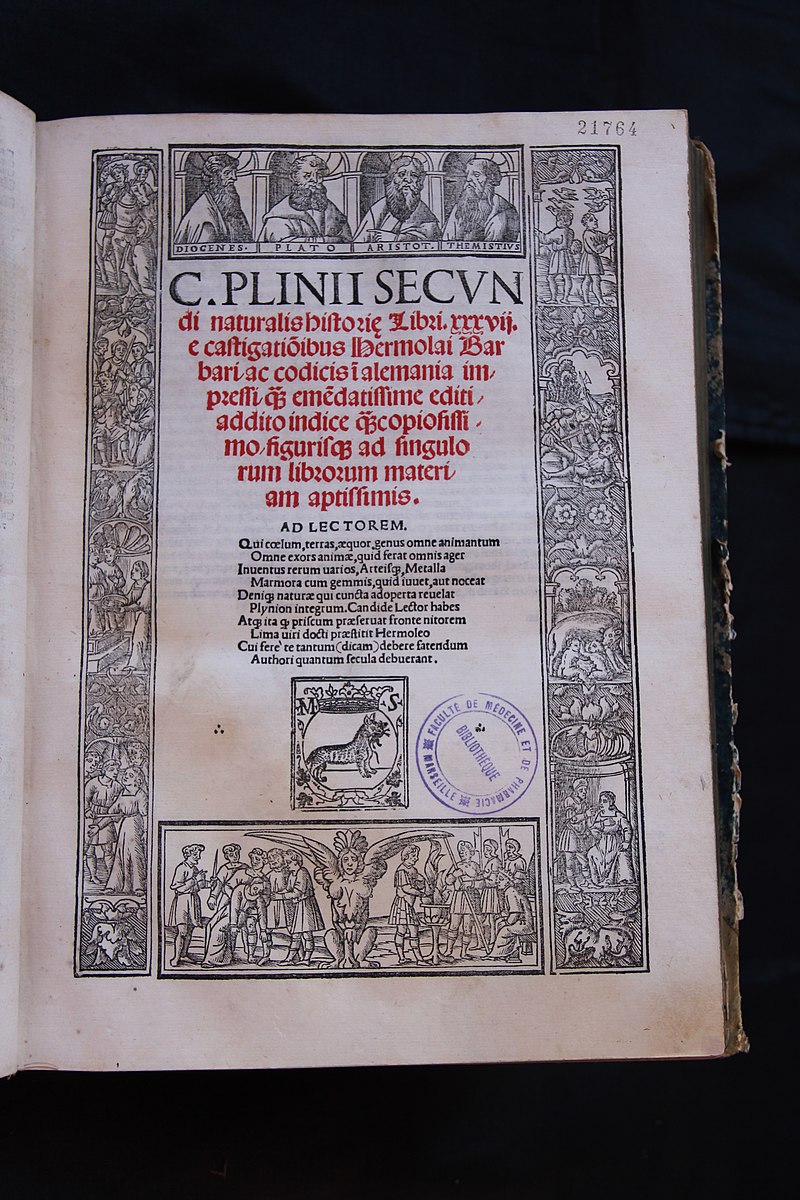
Title page of Pliny’s Natural History. Source: Wikimedia Commons, uploaded by user LDove (2018).
This is a rare blog post that deals directly with my day job. For those of you who aren’t aware, I’m currently a PhD Student in History at Binghamton University. I study sixteenth century French natural history discussing Brazil, drawing particularly from the works of André Thevet (1516–1590) and Jean de Léry (1536–1613). As such, my main primary sources are pretty straightforward: Thevet’s Les Singularitez de la France Antarctique (1557) and Cosmographie Universelle (1575) and Léry’s Histoire d’un voyage fait en la terre du Brésil (1578) form the backbone of my work. But beyond those sources is another layer of source material that those two authors used to ground their own writing. In the case of natural history, Renaissance Natural History is largely founded on Pliny’s Natural History (published 77–79 CE) and Aristotle’s works on natural philosophy and zoology, in particular his History of Animals (4th c. BCE).
Thankfully, I came into this project already fairly familiar with Pliny, having used his Natural History in a project on classical geography and the legacy of the voyages of Pytheas of Massalia (c. 350–306 BCE) in my undergrad. I’ll admit I’m less familiar with Aristotle outside of his works on ethics, but luckily for me and all other scholars there are plenty of resources available today that can give you everything from a quick citation to a thorough discussion of Aristotle. My two favorite are the Loeb Classical Library side-by-side Greek-English translations and the Perseus database provided by Tufts University. These are often the best resources I’ve found, and have in a sense made buying copies of these classical texts unnecessary, which my budget appreciates.
That said, in the context of Renaissance Natural History how much should I really be using these twentieth and twenty-first century editions of these classical sources? If I really want to be accurate to the period I’m writing about, I ought to be using sixteenth-century editions of both authors. The easiest and most accurate way to do this would be to figure out which editions were used by my authors and look for copies of those that have been digitized and are available online. But more often than not it’s not that easy to figure out which editions exactly were used. The secondary literature about Renaissance editions of Pliny and Aristotle provide some clues as to how the early printed editions differ from our modern edited ones, both in the original languages and in translation, but those articles and books don’t quite take the runner to home plate.
The best guide then seems to be using the examples and patterns set by other books that I know for sure were owned and read by these authors and use those to guess at which editions of Pliny and Aristotle they would most likely have known. One good lead for Thevet at least appears to be the fact that he had a connection to the court of François I (r. 1515–1547) who like Thevet came from the provincial city of Angoulême. This means if there’s a specific edition noted as being present in François I’s library, then that might be a good lead to follow to see what Thevet was reading. Looking at the nine books known to have been owned by Thevet, curiously all of them were in French, none in Latin. Generally, I’ve taken this to mean that he probably preferred to read in his native language, so he may have preferred a French translation of both Pliny and Aristotle rather than reading editions in Latin and Greek.
At the end of the day as much as I see a profound benefit in using these sixteenth-century editions of Pliny and Aristotle to really establish my research in the natural history being written in the Late Renaissance, I’m still going to keep my modern edited versions of those same classical works handy. After all, they’re much easier to search than any sixteenth-century version, so if anything the modern editions will continue to prove to be good road maps to help me navigate through their centuries old forbearers.
This may not necessarily be a post that will be on a topic that’s familiar to most of you, the 30 or so people who occasionally read these posts, but it’s something that’s important to me. The ability to communicate well, and efficiently, is paramount. It’s ultimately going to be key to solving all of our problems, to making life better for everyone. I truly believe if we could, or rather would, actually sit down and talk with someone we have a disagreement with, chances are we’d find enough common ground to begin sorting our problems out.
But this post isn’t about solving humanity’s big problems, and I’m going to try to refrain from my usual upbeat optimistic conclusions that I’ve noticed I tend to write. Because this evening I want to write about a topic I’ve been interested in for nearly 20 years, one that I’ve struggled with and studied, and am only now really feeling like I’ve confidently mastered: Latin.
Latin is a language that I’ve been fascinated by for a very long time. In part, I’ll admit it’s an attraction to the prestige it embodies: the language of the Romans, and of my Church. It’s been a constant piece of the intellectual and cultural fabric of European and now Atlantic civilization (that’s another idea I’m working on) for millennia. It’s also a highly logical language, a systematic language governed by a set of rules that, once explained, make pretty good sense. Moreover, it’s the ancestor of a number of humanity’s most widely spoken languages, and has directly influenced many, many others, including English. It’s taken three tries now, but I’ve made sense of the language well enough now to feel confident not just repeating the declensions and conjugations that I’ve memorized, but understanding the intricacies of their meaning, and in so doing, to have a better idea at understanding how Latin works.
Latin has also come to reflect the people who have written in it and spoken it over the generations, particularly in their preferences in word order and writing. I’ve often thought, considering that word order isn’t as important in Latin, after all the word endings provide the meaning, couldn’t a native Irish speaker go ahead and speak Latin using a verb, subject, object order and be decently-well understood just as much as a speaker using the classical Ciceronian order of subject, object, verb? Yet there’s one thing that does survive from the ancient world in faint traces that was revived later than other customs in written Latin, something that is still not universally adopted: the macron.
Macrons: the flat line over a vowel sometimes seen in Latin writing, as well as the first family of France, is something that I believe to be fundamental in properly understanding Latin. Sure, my medievalist friends will say, it wasn’t used in Medieval Latin, so we (Medieval and Renaissance historians & scholars, myself included) don’t need to memorize the macrons. But for me, it’s the macrons that have been one of the best tools to help me make sense of Latin. It’s answered the question for me of how a Latin speaker might differentiate between līber, “a child” (lī pronounced like Lee) and liber, “a book” (li pronounced like literature). It helps me make sense of the difference between a 1st declension nominative singular noun (the subject form) and a 1st declension ablative singular noun (a slightly more complicated form).1 The macron makes everything clear.
This is a good explanation from a far better Latin scholar than me about the use of macrons (the apex).
Without the macron, the meaning of a sentence can be understood, but with much more difficulty. This particular idea makes perfect sense to me because of my work with my primary ancestral language, Irish. In Irish, there are two types of vowels, long and short. The long vowels are represented by a fada over the vowel, essentially an acute accent (accent aigu en français). This is how an Irish speaker knows when reading my name that they’re in fact reading about a guy named Seán and not something that’s old (sean). The presence of the fada isn’t just to make the language look cool (which it also does), but it has a very real impact on the pronunciation and meaning of the word as a whole.
I think it’s best not to think of Irish vowels with fada or Latin vowels with macrons as just variant forms of those vowels but instead as entirely different vowels all together. The á in Seán is an entirely different sound, and thus ought to be seen as an entirely different letter to the a in sean. In the same way, that ī in līber is a different character, and a different sound from the i in liber.
We don’t have these same written variations of our vowels in English. We just have the 5 vowels, occasionally 6, which are supposed to represent all of the vowel sounds that English uses, in all national and regional Englishes around the globe, and in all of their local varieties. In my own accent, I can count at least 3 different sounds that each of the vowels represent. Granted, English wasn’t always like this, macrons were also used in Old English, and through generations of linguistic change, immigration, and English’s constant adoption of foreign words the language has become the exceedingly complicated, often irregular form of communication it is today. Not only is my English influenced by the most basic form of the language studied and spoken here in North America, but there’s also hints of Irish in there as well as the strong British, German, and Nordic influences in my English from all those immigrants who settled in my home region, the American Midwest, in the 19th and 20th centuries, including some of my other ancestors from England, Finland, Flanders, Sweden, and Wales.2
In English, we’ve chosen complexity in spelling as it relates to the spoken language over a 1-to-1 matching of the written language with the spoken language. Why? My best guess is it’s to preserve the unity of English. This keeps it so that all English speakers are generally spelling their words in the same way, between the two main written forms of English (UK & Commonwealth, and US English). For the most part, it’s worked for English, and I wouldn’t recommend moving away from the current model for the exact reasons why it exists; more on that at a later date.
But returning to Latin, if students trying to learn this language, famous for its now generally unspoken nature, really want to give themselves a good chance of succeeding in learning it, then those of us familiar with Latin, whether as students or as teachers, should embrace the macron even more than it already is, and use it throughout all our written Latin. Up until recently, it was challenging especially on computers with English keyboards to type any sort of accented vowels or consonants, but the technology has advanced enough that it’s readily possible today for most keyboards to make things work. On my Mac, I can hold down any of the vowel keys until a box pops up on the screen indicating each accent that can be put on that vowel. I then just have to choose them by number. So, for līber, when it comes to the ī, all I have to do is hold down the i key and press 4, et voilà, I’ve got myself an ī. We should do ourselves, and Latin itself, a favor, after all the easier we make learning this language, the more likely people are going to want to keep learning it.
I like Latin, it’s orderly, and when it’s explained well it can make a lot of sense. All of my Latin teachers to date have done a wonderful job explaining it, sometimes though it takes a bit more maturity to make sense of things. In general, I think we tend to have trouble in the English-speaking world understanding grammar. Let’s face it, our own language has so many contradictions that often English speakers don’t even really understand the rules of English grammar all that well. One of these days, I want to write a little book, a libellus in Latin, that can provide at least what I see as some of the more important rules in English, that’ll allow English to make more sense for the average speaker.
Today though, in my Latin studies (Wheelock, Ch. 20), I learned to my delight that the word frūctus means both fruit and profit. Frankly, those two make sense together, after all what are profits but the fruits of our labors. For the rare admirer of Star Trek out there who might be reading this, it came to mind that if I ever get the chance to write for them on a future Trek TV show involving the Ferengi of DS9 fame, I’d want to have a particularly smart-ass human academic offer a Ferengi a bowl of fruit (frūctus), after all the sole goal in the life of a Ferengi is the acquisition of profit (frūctus). A Latin pun set in an imagined version of the 24th or 25th century CE somewhere out in Space. I wonder what Cicero would make of it?
1 For the sake of the narrative flow, the ablative basically is the form that distinguishes a myriad of ways a noun relates to the rest of the sentence not covered by the nominative (subject), genitive (possessive), dative (indirect object), and accusative (direct object). I’m going to let the Latin teacher who runs the Latin Tutorial channel on YouTube explain it in this playlist:
2 What can I say, I’m an American.
CORRECTION: 18 March 2021, added pronunciations of līber and liber.
Of all the great writers of the sixteenth century Renaissance, Erasmus of Rotterdam was perhaps the most prolific. Born in the Burgundian Netherlands in 1466, Erasmus came to be known across Europe as one of the greatest minds of his time. Widely considered to be the father of Christian Humanism, Erasmus made close friendships and contacts with a variety of humanist intellectuals, clerics, and politicians in his day.
Now here in the United States, outside of academic circles Erasmus far less well known than he is in Europe. Here he is overshadowed by people like Martin Luther, Henry VIII, Leonardo, and Sir Thomas More. It was actually through Sir Thomas More that I came to know about Erasmus. More and Erasmus were widely considered to be best friends, and Erasmus stayed on a number of occasions for months at a time in the More house in London. For all of his intelligence and prowess as a speaker of Dutch, German, Latin, and Greek, Erasmus refused to learn English, and as such when More was out of the house at work, Erasmus would be left with More’s family who at first didn’t speak Latin.
According a story told in John Guy’s book A Daughter’s Love, a link to which can be found in the description below, Erasmus was so annoyed waiting for Thomas More to come home from work that he wrote his book The Praise of Folly, in Latin the Moriae Encomium, whose title was a pun on the More family name. This book, written in a time of intense boredom became a best seller in its time and contributed to Erasmus’s fame across Europe.
Erasmus’s life corresponded to the invention and spread of the printing press across Europe from its invention by Johannes Gutenberg in Strasbourg, in what is today France. Many of Erasmus’s books survive in their original sixteenth century printed editions, which can today be found in libraries and archives around the globe. Many are even available online as digitised PDFs that can be downloaded and read anywhere. Erasmus is especially famous for working with the Swiss printer Johann Froben, whose printshop in Basel produced some of the finest surviving early editions of Erasmus’s works.
One of Erasmus’s greatest accomplishments is his updated Latin translation of the New Testament, the second half of the Christian Bible. Being one of the greatest scholars of Ancient Greek in his day in Western Europe, Erasmus took some of the oldest and most genuine Greek manuscripts of the New Testament and brought them together into one solid Greek text, which Froben then printed side-by-side with Erasmus’s new Latin translation. Erasmus intended to help enrich the spiritual lives of Western Christians who, at the time of its publication in 1516, still used the Latin Vulgate Bible translated in the fifth century CE by St. Jerome. Yet his New Testament caused controversy in his day, and was one of the reasons that most of Erasmus’s works were banned by the Catholic Church during the Counter-Reformation that began in the late-sixteenth century.
For all his talents, Erasmus was not known for being the most sociable man. He hated dancing, was a hypochondriac, and his letters are filled with his grumblings about this thing or that. Nevertheless, Erasmus took time to respond to those friends for whom he held affection, such as Sir Thomas More and his children, or to the English scholar John Colet.
Erasmus died in July 1536 in Basel after falling ill from dysentery. He was buried in Basel Minster, and while his body faded away, his memory lived on in the many scholars across Europe and in the Americas who he influenced. Today in 2018, the University of Toronto Press has published 86 volumes of Erasmus’s collected works, including the thousands of known letters that he wrote to correspondents as grand as the Holy Roman Emperor Charles V and as humble as Margaret Roper, the talented English humanist and daughter of Erasmus’s best friend Sir Thomas More.
Renaissance Humanism was a philosophical tradition that came out of the reemergence of ancient Greek and Latin philosophy initially in the fourteenth and fifteenth centuries in Florence, that then spread out across Western Europe, impacting the philosophical, theological, and in some cases political outlook of intellectuals and scholars across Europe and in the overseas European colonies during the sixteenth and into the seventeenth century.
Humanism largely drew inspiration from the writings of Plato, a new turn in the long history of contention between Platonist and Aristotelian philosophy. Prior to the rise of Humanism, a number of Aristotelian philosophical traditions including Scholasticism were prevalent in Europe’s universities, based especially at the University of Paris. Humanism was as much a reaction to the complexities of Scholasticism as it was an attempt to renew the philosophical traditions of the pre-Christian Roman Empire.
Humanism in Italy largely drew on this pre-Christian Greek and Roman literary tradition, turning to ancient authors like Plato, Cicero, and Virgil for inspiration. Italian Humanism did not consider connecting and implementing Humanism in a religious setting to be quite as an imperative, instead seeing Humanism itself as a guide to good, virtuous living. Nevertheless, these same Humanist currents found their way into works of political realism like Machiavelli’s The Prince, which in a very humanist manner cites pre-Christian examples of good princes alongside their Christian counterparts.
In Northern Europe, Humanism took a different turn. There Humanism was most greatly impacted by the works of the Dutch humanist Desiderius Erasmus of Rotterdam, who created a variant of Humanism distinct from that discussed in Italy, that has become known as Christian Humanism. Christian Humanism intended to merge the lessons of Ancient Greek and Roman philosophy with the morals and teachings of pre-Reformation Christianity, what today is Roman Catholicism, in an effort to promote a new understanding of what made for a good, virtuous, life.
Erasmus’s Christian Humanism was particularly well received in England, where early English humanists like John Colet and William Grocyn introduced it to the centres of English learning at Oxford and Cambridge. They in turn taught a young Thomas More to read and write Greek. Today More is widely considered to be the most prolific English humanist of the sixteenth century. Through the letters of both Erasmus and More, as well as many other Humanists, we can see how they saw their own world, and what they wanted to accomplish with their new philosophical tradition, which today we call Renaissance Humanism.














 Wednesday Blog by Seán Thomas Kane