Category Archives: Renaissance

A landline telephone in a classroom.

Electronic Signals

This week, the coalescence of my thoughts over the last few months about how the way we communicate today in 2025 is so rooted in our technology.—Click here to support the Wednesday Blog: https://www.patreon.com/sthosdkane


This week, the coalescence of my thoughts over the last few months about how the way we communicate today in 2025 is so rooted in our technology.


For most of my life I tended to write a lot of ordinary quotidian things out by hand on paper either in notebooks, on notepads, or on the backs of receipts, envelopes, or whatever paper I had around. I kept up a good cursive hand and used it on a regular basis. Yet in the last decade technology has caught up to the humble notepad; a decade ago when I was living in London and trying to write out ideas for my first round of graduate essays on my phone’s Notes app while I was on the train or walking about, I often found that app in particular drained my phone’s battery at a considerable and worrisome rate. Then again, that particular smartphone tended to die if the battery dropped below 40 percent, so it had a bad battery. Still, that led to me continuing with the practice of keeping notes and scribblings in little notebooks or on notepads that I carried with me in a pocket. 

It’s funny then that it’s only now in 2025 that I notice how little I write these same notes anymore by hand; in 2021 when my Mom came to visit me in Binghamton, she brought me a couple of notebooks emblazoned with pictures of various national parks on their covers, a new trend in notebooks that began around then. I was a little taken aback by this gift because by that point I’d largely done away with handwritten notes all together. In fact, my Binghamton years launched me head-first into doing as much as possible on the computer so that I’d have less paper and books to carry back and forth between Upstate New York and Kansas City. Like printed books over digital ones, when I returned to Kansas City I began to write handwritten notes again. This is largely thanks to my employers at the Kauffman Center for the Performing Arts; in our department we still carry around paper performance notes on our shifts. When I started, I was surprised to realize that at some point in the last 5 years I’d stopped carrying a pen with me on a daily basis. Since then, in April 2023, I’ve always had a pen in my pocket.

The pandemic reinforced our digital communications in ways which pushed us firmly forward toward more frequent videocalls and texting to the detriment of the telephone in particular. Most of my friends and family tend to prefer text messages over phone calls, especially among my fellow millennials, to the point that I often second-guess myself as to whether I should try calling someone in the first place. Is a phone call intrusive, whereas a text message is like a telegram or a letter? It can be replied to in the recipient’s own time, though with a text the response time is usually expected to be faster than with a letter that’ll take days to arrive, or even an email, which I see as slightly more formal. Since the invention of Samuel Morse’s electrical telegraph in 1838, our communications have moved into a realm of electricity which was foreign to our conversations and our lives beyond lightning strikes and the daily shocks one gets in a dry climate.

This Spring then, when I was regularly on videocalls–usually over Zoom–with friends, colleagues, and family alike a thought occurred to me that all of our communications are being translated down to electrical signals being sent over wires from one person’s device to another. Those messages, no matter the content, all buzz and fizzle through our wireless data signals and across our telephone wires, through our data centers and bouncing off our satellites all to better communicate to anyone whether on the planet or high above us in orbit or beyond. It’s made us all so much closer to one another. Today, I’m regularly in contact with people in North America, Europe, and Asia and that contact is often almost as instantaneous as if we were together in the same room. It’s what makes my solitary life feel lived in community with the people I like. And yet it’s also spoiled us for the slower communication of the written letter or even the face-to-face conversation that started all these “words, words, words” as Hamlet says that we “might unpack my heart with words.” We communicate to do just that: to speak our thoughts and to live in the strange and beautiful worlds we build around ourselves. So often now, those conversations are not only occurring with the aid of the electrical signals pulsing about our minds telling us how to react and what to say and do, but also through their extracorporeal currents which connect us through our technology across vast distances to one another.

You are listening to my voice filtered by the microphone and my audio editing software being transmitted to anyone with an internet connection. While naturally we aren’t supposed to hear it, as my hearing isn’t quite as good as it should be, I can now hear the differences between sound frequencies in a finer detail yet to the point that if two voices are speaking with the same frequency, I only hear ringing at that frequency and no words or other noise. This was demonstrated to me with dramatic and terrifying effect several years ago when I was nearly t-boned by a Kansas City fire engine roaring along at full speed because I didn’t hear its siren, which wails at the same frequency as the particular section of the 1st movement of Tchaikovsky’s Violin Concerto that I was listening to in my car at the time. So, when you hear my voice what you’re hearing is an electronic recording of my voice being transmitted to you. Often, I sound higher pitched on the recording even by just a half-step, than I do to my ears when I’m doing the recording. I’m a tenor, so I’m okay with that. Still, it’s noticeable especially if I record later in the day or at night, or if I’m nervous.

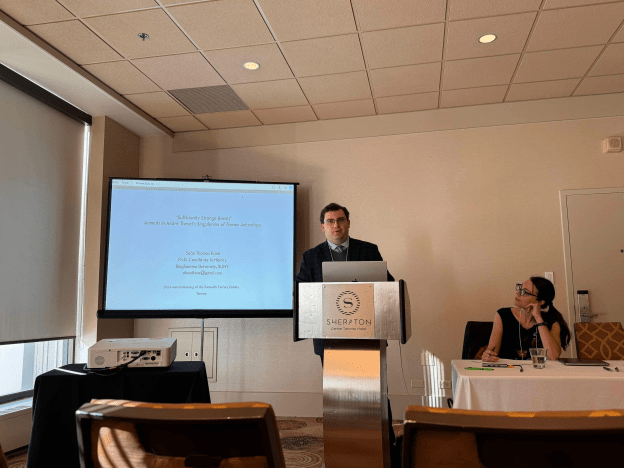
After I began my graduate studies in History back in August 2017, I started making a practice of recording any conference presentation or invited lecture I gave. I’d usually only make a sound recording, not wanting to deal with a camera. This way too, if someone missed a talk and wanted to see it, I could lay the slides over the recording in iMovie and turn it into a video to send around. This has turned into a wonderful tool for listening to changes in my voice over the years. Yet it’s also interesting now because I not only use this tool for recording the actual performance but also the rehearsals as well, and sometimes when I’m editing papers. I gave a lightning talk last week that was part of a webinar hosted by the Graduate Student Advisory Committee of the Renaissance Society of America about animal intelligence titled “Animals Adapting to Changes in Nature: Perceptions of Animal Intelligence in the Renaissance?” The paper itself was pretty quick and easy to write; it maybe took me an hour to make the first draft several months ago. Yet I began recording rehearsals and making edits after each one up to the minutes before I went live on Thursday morning. I was a bit nervous when I presented, so in the end the cool and practiced pace I’d planned with a mid-range voice ended up being a minute faster than expected and closer to my upper register. When I’ve thought about what to do if anyone asked to hear this talk after the fact, I’ve considered possibly sending out my last rehearsal recording from an hour before the performance, after all many speakers would in decades past make a separate recording of their lectures & speeches from the actual live reading. Yet to keep it authentic to the talk as it went ahead, I also feel inclined to send out the one that I gave on Thursday morning to the 16 other panelists and organizers on the call and the 35 attendees listening in from around the globe. This question gets to the heart of my talk because I made the case that André Thevet’s sloth showed signs of intelligence by refusing food it didn’t want to eat and not falling to the same bad practices as the Frenchmen who captured it or the native Tupinambá who were more familiar with it. Those practices, human faults one might say, include indecision.

Rather than flip a coin or pick another method of choosing, I’m instead going to play for you now the last rehearsal recording for one very simple reason. The main benefit of my recording of the actual talk is that it ought to have captured the organizer’s introduction and the questions that followed my presentation. Yet, my phone’s microphone couldn’t pick any of that up because my computer’s sound output was going into my headphones. So, without any more gilding the lily here are my thoughts on Renaissance sloths adapting to changes in nature, brought to you through a most electronic form of communication.

~

Animals Adapting to Changes in Nature:

Perceptions of Animal Intelligence in the Renaissance?

I want to begin by thanking the members of the RSA Graduate Student Advisory Committee for holding these lightning talks and accepting my proposal among the speakers today. When considering this question of animal intelligence, I’m drawn back to the Aristotelian notions of the animal sensitive soul in contrast to the human rational soul; Erica Fudge put it well, writing that animals can feel, perceive, and move, yet humans are the only natural beings to express intellect.[1] Animals were used as stand-ins for humans in allegory and vivisection, and an over-exertion of passion could drive a human into a state of animality, yet the human was understood to be fundamentally different because of our facilities of reason developed through experience over one’s lifetime.[2]

Newly encountered American animals played a disruptive role in this dynamic. Anatomically, many such animals defied European expectations for their size, or their chimerical character appearing as a composite of unrelated creatures known to exist in the wider Mediterranean World. Chief among these in my research is the three-toed sloth which was described by the French cosmographer André Thevet (1516–1590) in his 1557 book Les Singularitez de la France Antarctique. There are many different aspects of Thevet’s sloth which allowed it to stand out as a singularity among singularities from its appearance as a bear-like ape to its vocalizations “sighing like a little child afflicted with sorrow” to its general disregard by the indigenous Tupinambá people who explained aspects of its manner to Thevet.[3] I’ve written and spoken extensively about this, I know several of you have heard me talk about Thevet’s sloth at a number of conferences in the last several years. Today though, I want to discuss something I haven’t addressed yet in all these presentations; namely the signs in Thevet’s text which point toward some sense of the sloth’s intelligence.

The sloth’s intelligence is seen in its abstention from eating the food Thevet provided it. Thevet wrote “I kept it well for a space of 26 days, where I knew that it never ate or drank, but was always in a similar state.”[4] This reaffirmed Thevet’s assertion that “this beast has never been seen to eat by a living human,” either by the Tupinambá or the French.[5] This abstention from eating could well be understood as a sign of the sloth’s lack of a rational soul which would know to eat; yet I think it is better to perceive the sloth’s abstinence as an active choice made by an animal who didn’t favor the food it was offered. Thevet wrote that “some believe that this beast lives solely on leaves of a tree named in [the Tupi language] Amahut,” which is one of the Cercopia species known to live along the Brazilian coast.[6] Yet a 2021 sloth behavioral study published in the journal Austral Ecology has proven that this claim is less grounded in the genus’s actual experience.[7]

Perhaps the sloth can be best contrasted with the dogs which killed it at the end of that 26-day captivity, or even with the accused descent from humanity by first the Tupinambá and later the French in accusations of cannibalism. Unlike the humans who occupy these stories from France Antarctique who so often fall so far from their rationality to eat each other, the sloth simply refused to eat at all. This small creature, taken from its forest home and left in the care of an unfamiliar human who didn’t know what to feed it, chose to preserve its nature and not eat what was foreign to it. The sloth adapted to changes in the nature around it and expressed an intelligence perhaps more elevated than the humans who captured it. I’m drawn to one of the most poignant lines in Montaigne’s essay “Des cannibales” in which the erstwhile political animal himself wrote “I think there is more barbarity in eating a man alive than in eating him dead; and in tearing by tortures and the rack a body still full of feeling.”[8] In all of the variations on his sloth account, Thevet published this same story twice first in the Singularitez of 1557 and later in the Cosmographie Universelle of 1575, the dominant sense I get from Thevet’s text is one of befuddlement at an animal that defied his expectations in so many ways. In the tradition of animal allegories from Aesop to Renyard the Fox the sloth fills the role of an exotic oddity, a stranger in the canon of European natural history which didn’t quite fit any mold available. Even after Thevet’s sloth was christened by Conrad Gessner an Arctopithecus in 1560 and by Carolus Clusius as an Ignavus in 1605, this fact that it refused to eat or drink what Thevet offered it for 26 days remained a constant in its story. I see in the sloth a sign of intelligence beyond expected human norms and rules which rendered it exceptional. Any assimilation of the sloth was an artifice laid over its character, a colonial imposition. Still, its abstinence fit the framework of the sensitive soul, reflecting a delicate sensitivity toward things it found unfamiliar.

~

How does a 450 year old sloth’s intelligence have any bearing on the electronic signals which carry our communications in this new century? I wouldn’t have been able to study Thevet’s sloth in the way I have without the internet and all our technology. So much of my work is with digitized primary sources, mostly printed books, that I do almost all of my research on the computer. It’s a rare occurrence that I get to go into an archive to look at a source in the flesh. Yet I think there’s another interpretation we can take here: like the sloth we choose how much we are in touch with each other, how much of our lives are spent with our phones in our hands. My weekly screen-time report tends to fall in the 3 hour range per day. Yet I’m not only checking my social media accounts or texting with people on my phone, but I’m also reading books and writing notes and ideas down on my phone or using the camera to try and capture an artful reflection of the lived world around me. Recently on Instagram I saw another person’s screen-time report say they spend 14 hours on their phone per day, which is essentially the entirety of my waking hours. To me that is unhealthy to an extreme. Yet that’s how that individual has chosen to live their life.

I know that no matter where I end up, I will remain connected to others through our technology. Somedays I do miss the slower pace of sending letters or calling family and friends on the phone as things were when I was a child. I’d rather talk with someone face-to-face or voice-to-voice than text. As I wrote in January, I feel that we’ve allowed texting to take the place that videocalls were supposed to hold in the 21st century. We’re not constantly talking to people over monitors beyond Zoom calls that are scheduled and with that pre-arrangement more formal than the quotidian string of text messages. Today, I do have a notepad on my desk, one that was given to me among the materials of a workshop I attended at the École des Hautes-Études en Sciences Sociales in Paris last summer. It’s gotten some use, yet one year later I’m still only halfway through the gridded pages. As with so much of life in general, I feel that I’m trying to find a balance between the digital and the manual, between life online and life in this place where I find myself in a given moment. All I know for certain is that over all else, I long for connection.


[1] Erica Fudge, Brutal Reasoning: Animals, Rationality, and Humanity in Early Modern England(Cornell University Press, 2019), 13.

[2] Fudge, 17.

[3] Thevet, Singularitez (Antwerp, 1558), 99r.

[4] Thevet, Singularitez (Antwerp, 1558), 99v–98r.

[5] Thevet, Singularitez (Antwerp, 1558), 99v.

[6] Thevet, Singularitez (Antwerp, 1558), 98r.

[7] Gastón Andrés Fernandez Giné, Gastón Andrés, Laila Santim Mureb, and Camila Righetto Cassano, “Feeding ecology of the maned sloth (Bradypus torquatus): Understanding diet composition and preferences, and prospects for future studies,” Austral Ecology 47 (2022): pp. 1124–1135, at p. 1132.

[8] Michel de Montaigne, “Of Cannibals,” in The Complete Essays of Montaigne, trans. Donald M. Frame, (Stanford University Press, 1965), 155.

A Sense of Purpose

This week, the third in several scribblings about my research: how studying Thevet and his world fulfills a need to find purpose in life.—Click here to support the Wednesday Blog: https://www.patreon.com/sthosdkane


This week, the third in several scribblings about my research: how studying Thevet and his world fulfills a need to find purpose in life.


Throughout my graduate education the need for new work to compliment, correct, or add to old work has remained a constant theme. It’s critical to our profession, otherwise why devote our time and talent to studying the past if we’re merely rehashing something already said in the generations of our profession’s own history? I passed through the first five of years of my graduate education without that purpose or that drive, and I think it’s what kept me behind some of my colleagues in achievement. Yet when I found something to make my own, a historical topic upon which to pitch my tent and make myself known, I took that chance. Still, I wasn’t entirely sure what value studying Thevet actually brought to the profession. He is an important figure of middling influence in the development of Renaissance natural history, one whose contributions have often been reduced to laughable exemplars of a time before the scientific study of zoology developed. A secondary approach I take to Thevet is to view his work in light of the great contributions to natural history of the great minds of the Enlightenment, active two centuries after the cosmographer, who are often the next great mile marker in the long road that is the history of natural history.

Of these Enlightenment naturalists, the Comte de Buffon (1701–1788) acknowledged the better parts of what Thevet wrote and adopted those as mile markers in his own natural histories. I think Thevet often appears in the eighteenth century because the center of European thought had shifted by that time from Italy, the radiant heart of Renaissance humanism, to France and so the likes of Buffon and Humboldt would’ve been familiar with Thevet as he was one of the more prominent French naturalists whose books were available. Thevet’s notoriety in his own century lay predominately in the transalpine republic of letters, most famously with his Zurich-based admirer Conrad Gessner (1516–1565) who was personally responsible for elevating Thevet’s natural history beyond the original editions to a broader consciousness by including Thevet’s animals in his own Icones animalium and Icones avium omnium of 1560 and his German Thierbuch of 1562. While Thevet’s Singularitez was translated into Italian by the Venetian Giuseppe Horologgi in an edition published by the eminent Venetian printer Gabriele Giolito de’ Ferrari (1508–1578) with the title Historia dell’India America detta altramente Francia Antartica, that volume didn’t carry over the woodcuts which Thevet included in the first edition published in Paris by Maurice de la Porte in 1557 that were copied for Christophe Plantin’s 1558 edition published in Antwerp. This says to me that these pictures didn’t fit the purpose of Giolito’s edition; they especially didn’t fit the sorts of books he anticipated selling Thevet’s alongside. As such, without the pictures Thevet’s work doesn’t seem to have carried as much weight in Italy and is instead better remembered in its original French.

When I was first searching for copies of the Singularitez in August 2019, I initially downloaded a copy of the 1878 Paul Gaffarel edition of the book, which while of great utility especially in its footnotes, isn’t as important as any of the original 1557 or 1558 editions published in Paris and Antwerp to my research. These are the core sources for my work; in particular I used a copy of the 1558 Plantin edition published in Antwerp as my main source for my translation. I can make the case that the Plantin edition is more important in the context of Thevet’s natural history, as it’s the same edition that Gessner acquired and used as the basis for his inclusion of the sloth and toucan in his 1560 pair of Icones books, however in all truth I ended up working with that edition because it was the first one that I found from the sixteenth century. Unlike the two Paris editions (1557 & 1558), Plantin’s edition was not intended for a domestic French audience. The most recent effort of mine toward the publication of my translation was to translate the different royal and imperial privileges and letters to patrons of each translator in order to fully place my own translation within the varied contexts in which each of these contemporary editions existed. It’s interesting to see Thomas Hacket’s 1568 English translation be dedicated to Sir Henry Sidney, who was a major player in the Elizabethan conquest of Ireland and in the early English colonial enterprise. In contrast, Horologgi’s translation begins with a letter to his patron, Paolo Giordano I Orsini (1541–1585), the Duke of Bracciano and like Sidney a noted military man. Thevet himself dedicated his book to Jean de Bertrand, Cardinal of Sens (r. 1557–1560), and in doing dedicated it to the French national cause within which one can best understand the whole French expedition in Brazil.Thevet sought a sense of purpose in his life built upon the travel books he loved to read. He made himself a character in those books, a cosmographer who could be trusted to tell the truth of the faraway because he had seen it with his own eyes. The logic of this always made good sense to me, after all the authority of the historian lies in our expertise and familiarity with our sources. In my case, I’ve found a sense of purpose in my life built upon the travel books I loved to read, and I’ve built my career on my expertise in Thevet’s works. We need to have a sense of purpose in what we do to find life rewarding. I’ve done jobs that’ve been for the money and sure they’ve kept the lights on, but they haven’t been nearly as fulfilling as my research and teaching, which I love doing. The people I’ve met in academia are among my favorite anywhere, fellow experts with whom I can discuss historical topics with a sense of mutual respect and admiration. That’s what I want in my life more than anything else, that community that comes from our profession and a sense of purpose in what we do.


Close Encounters of the Three-Toed Kind

Close Encounters of the Three-Toed Kind Wednesday Blog by Seán Thomas Kane

This week, introducing my research into the introduction of the three-toed sloth to European science in the 1550s. I'll be giving a public talk about my work at the Kopernik Observatory and Science Center in Vestal, NY on Friday, 29 April 2022 at 8 pm Eastern, 7 pm Central. You can find a link to the YouTube broadcast here: https://youtu.be/70lJ0NmT8Kw Also here's a link to the Kopernik Observatory's website: https://www.kopernik.org

You’ve heard me talk at length about a fair number of topics on this podcast, and those of you who have been reading my blog now for the 60 straight weeks that I’ve been writing it will perhaps know parts of me a bit better than some. This week I want to talk to you about something that’s personal yet also professional, it’s the project I’m staking my career on at this early stage––my dissertation. The big document I’m writing now is called “Trees, Sloths, and Birds: Brazil in Sixteenth Century Natural History.” It tells the story of how those three groups––the trees, sloths, and birds––were introduced to European natural history by a French cosmographer named André Thevet (1516–1590) in his 1557 book The Singularites of France Antarctique. It’s been a fun project to write so far after years of research and nearly a year of fighting to get it approved. At the moment, I have the first two chapters written and the next two, the sloth chapters, in the works.

So, naturally this seemed like a good time to stand up in front of a crowd and announce my intent to study the history of the natural history of sloths to all the world. This Friday, 29 April, at 8 pm Eastern I’ll be giving a public talk about my sloth research called “Close Encounters of the Three-Toed Kind: How Unknown Life was Named in the First Age of Exploration”. I’ve got to admit, I’m going out on a big limb here, and not lazily or slowly either. On Friday evening I’ll be introducing not only my research about the three-toed sloth’s role in cementing the strangeness of American zoology in European eyes but arguing for the recognition of what we today call the Age of Exploration, the period that began when Columbus stumbled on the Bahamas in 1492, as in fact the First Age of Exploration. The reason for this is straightforward: 61 years ago, humanity entered a Second Age of Exploration at the moment when the first human left the Earth’s atmosphere and entered Space beyond. Yuri Gagarin’s monumental first spaceflight is a moment that ought to be marked as the beginning of a new age in the human story, one where we began to move, however slowly, towards venturing out of our home and into our planetary neighborhood at the very least, our stellar neighborhood in the long run.

I don’t think it’s anachronistic to say the way Thevet and his contemporaries understood the sloth in 1555 and 1556 is similar to how we might well understand life that’s new to us that our explorers in the coming years might well encounter on other worlds. In Thevet’s time the Americas, these continents, were seen as an alien world by the Europeans, it was as foreign, as strange as they could imagine. In their efforts to make sense of what they saw and who they encountered in those first generations of contact the European explorers often either gave names familiar to them to that American life they encountered, as with the sloth, or they adopted local indigenous names for the life of these continents, as in the case of many of the local peoples they met. All of the states in my home region, the Midwest, bear indigenous-derived names, largely drawn from the names of local peoples who the French encountered and traded with during the seventeenth and eighteenth centuries.

The main theme of my talk will be about the meaning of names, their importance and intrinsic value to the named and the one doing the naming. In the first fifty years of its inclusion into European natural history the three-toed sloth went by several names. Thevet first recorded it in 1557 as the haüt, a Middle French phonetic spelling of the Tupinambá name for the creature, itself derived from the sloth’s cry which Thevet described as like “the mournful sigh of a small child.” Haüt also appeared in Conrad Gessner’s entry for the sloth in his 1567 Thierbuch, a German translation of his History of Animals, first published in Latin before Thevet’s visit to Brazil in the 1550s. Yet Gessner himself gave the sloth a more scientific name, Arctopithecus, meaning “bear-like ape” out of an effort to identify it by its physique, or how at least Thevet described its physique in his writing and a woodcut of the animal in his Singularites. Another French writer, Jean de Léry (1536–1616) who visited Brazil after Thevet left in 1556 and 1557 called the animal a Hay, with a closer phonetic spelling to the modern . Yet it was the Portuguese who first called this animal a sloth, namely the Spanish Jesuit missionary St. José de Anchieta (1534–1597), whose letters to his Jesuit superiors describe the animal as a preguiça in Portuguese, a sloth in English.

Another epithet Thevet gave to the sloth in his 1575 book the Universal Cosmography referred to it as “the animal that lives only on air” because during the 26 days that he kept one in captivity he never saw it eat or drink. Therefore, in Thevet’s logic, the sloth must only nourish itself on the air surrounding it. How Thevet didn’t realize the animal was probably terrified from being brought indoors, and likely was starving and dry for thirst baffles me. Still, the idea that Thevet believed he had found an animal in this alien world of America that “lives only on air” meant that the sky was truly the limit for the possibilities of American life. Thevet’s own Twilight Zone contributed to the groundwork for the notion of alien worlds that persisted in speculation and fiction into the present day, beyond the bounds of his own Age of Exploration, which I might argue ended with the competing Amundsen and Scott expeditions to the South Pole in 1911, or perhaps with the gradual end of the old colonial empires over the last century. So, if you’re in the Southern Tier of New York this Friday and want to hear me talk about sloths come up to the Kopernik Observatory and Science Center in Vestal, New York. The talk begins at 8 pm on Friday, and if the skies are clear, as hopefully they will be, we should have some wonderful opportunities for some stargazing after I wrap up my show. And for those of you who are listening from afar you can watch me take the stage live on YouTube. The link is in the show notes.

The Puzzle of the Source Material used by my Primary Sources

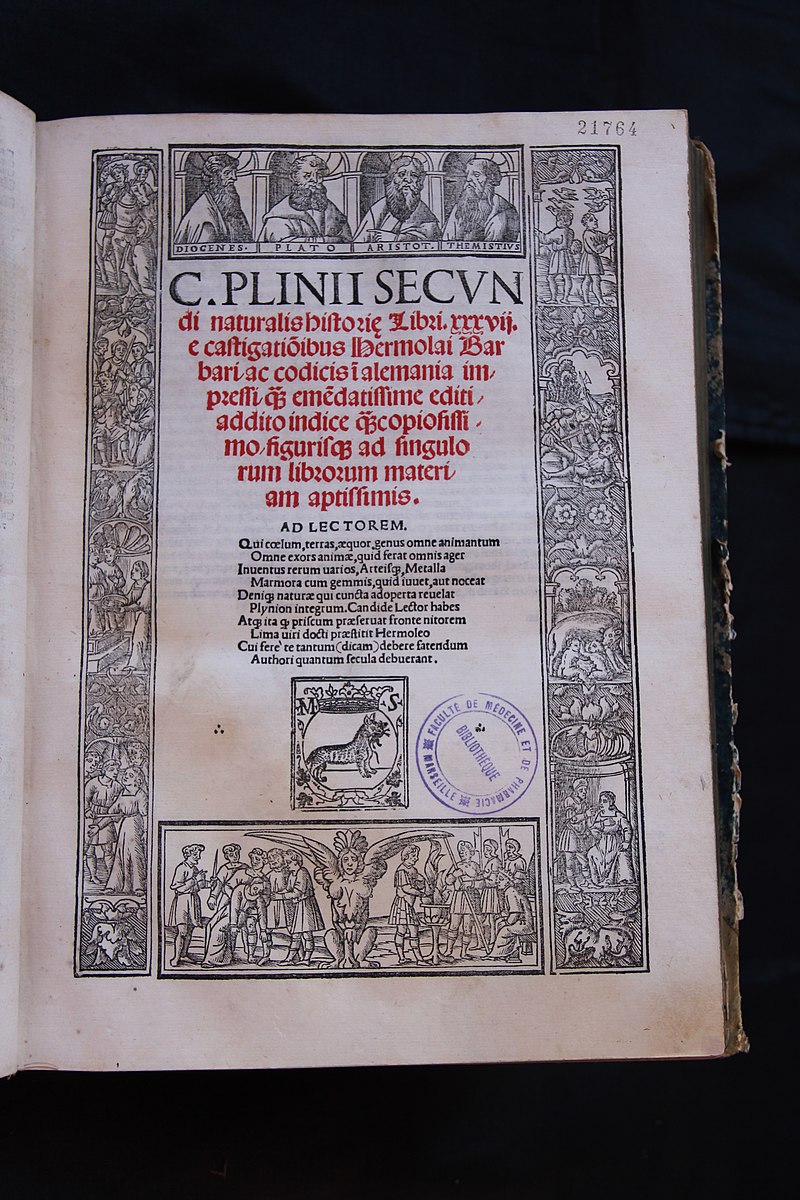
Title page of Pliny’s Natural History. Source: Wikimedia Commons, uploaded by user LDove (2018).

This is a rare blog post that deals directly with my day job. For those of you who aren’t aware, I’m currently a PhD Student in History at Binghamton University. I study sixteenth century French natural history discussing Brazil, drawing particularly from the works of André Thevet (1516–1590) and Jean de Léry (1536–1613). As such, my main primary sources are pretty straightforward: Thevet’s Les Singularitez de la France Antarctique (1557) and Cosmographie Universelle (1575) and Léry’s Histoire d’un voyage fait en la terre du Brésil (1578) form the backbone of my work. But beyond those sources is another layer of source material that those two authors used to ground their own writing. In the case of natural history, Renaissance Natural History is largely founded on Pliny’s Natural History (published 77–79 CE) and Aristotle’s works on natural philosophy and zoology, in particular his History of Animals (4th c. BCE).

Thankfully, I came into this project already fairly familiar with Pliny, having used his Natural History in a project on classical geography and the legacy of the voyages of Pytheas of Massalia (c. 350–306 BCE) in my undergrad. I’ll admit I’m less familiar with Aristotle outside of his works on ethics, but luckily for me and all other scholars there are plenty of resources available today that can give you everything from a quick citation to a thorough discussion of Aristotle. My two favorite are the Loeb Classical Library side-by-side Greek-English translations and the Perseus database provided by Tufts University. These are often the best resources I’ve found, and have in a sense made buying copies of these classical texts unnecessary, which my budget appreciates.

That said, in the context of Renaissance Natural History how much should I really be using these twentieth and twenty-first century editions of these classical sources? If I really want to be accurate to the period I’m writing about, I ought to be using sixteenth-century editions of both authors. The easiest and most accurate way to do this would be to figure out which editions were used by my authors and look for copies of those that have been digitized and are available online. But more often than not it’s not that easy to figure out which editions exactly were used. The secondary literature about Renaissance editions of Pliny and Aristotle provide some clues as to how the early printed editions differ from our modern edited ones, both in the original languages and in translation, but those articles and books don’t quite take the runner to home plate.

The best guide then seems to be using the examples and patterns set by other books that I know for sure were owned and read by these authors and use those to guess at which editions of Pliny and Aristotle they would most likely have known. One good lead for Thevet at least appears to be the fact that he had a connection to the court of François I (r. 1515–1547) who like Thevet came from the provincial city of Angoulême. This means if there’s a specific edition noted as being present in François I’s library, then that might be a good lead to follow to see what Thevet was reading. Looking at the nine books known to have been owned by Thevet, curiously all of them were in French, none in Latin. Generally, I’ve taken this to mean that he probably preferred to read in his native language, so he may have preferred a French translation of both Pliny and Aristotle rather than reading editions in Latin and Greek.

At the end of the day as much as I see a profound benefit in using these sixteenth-century editions of Pliny and Aristotle to really establish my research in the natural history being written in the Late Renaissance, I’m still going to keep my modern edited versions of those same classical works handy. After all, they’re much easier to search than any sixteenth-century version, so if anything the modern editions will continue to prove to be good road maps to help me navigate through their centuries old forbearers.

People of the Renaissance: Erasmus of Rotterdam (1466-1536)

Of all the great writers of the sixteenth century Renaissance, Erasmus of Rotterdam was perhaps the most prolific. Born in the Burgundian Netherlands in 1466, Erasmus came to be known across Europe as one of the greatest minds of his time. Widely considered to be the father of Christian Humanism, Erasmus made close friendships and contacts with a variety of humanist intellectuals, clerics, and politicians in his day.

Now here in the United States, outside of academic circles Erasmus far less well known than he is in Europe. Here he is overshadowed by people like Martin Luther, Henry VIII, Leonardo, and Sir Thomas More. It was actually through Sir Thomas More that I came to know about Erasmus. More and Erasmus were widely considered to be best friends, and Erasmus stayed on a number of occasions for months at a time in the More house in London. For all of his intelligence and prowess as a speaker of Dutch, German, Latin, and Greek, Erasmus refused to learn English, and as such when More was out of the house at work, Erasmus would be left with More’s family who at first didn’t speak Latin. 

According a story told in John Guy’s book A Daughter’s Love, a link to which can be found in the description below, Erasmus was so annoyed waiting for Thomas More to come home from work that he wrote his book The Praise of Folly, in Latin the Moriae Encomium, whose title was a pun on the More family name. This book, written in a time of intense boredom became a best seller in its time and contributed to Erasmus’s fame across Europe.

Erasmus’s life corresponded to the invention and spread of the printing press across Europe from its invention by Johannes Gutenberg in Strasbourg, in what is today France. Many of Erasmus’s books survive in their original sixteenth century printed editions, which can today be found in libraries and archives around the globe. Many are even available online as digitised PDFs that can be downloaded and read anywhere. Erasmus is especially famous for working with the Swiss printer Johann Froben, whose printshop in Basel produced some of the finest surviving early editions of Erasmus’s works.

One of Erasmus’s greatest accomplishments is his updated Latin translation of the New Testament, the second half of the Christian Bible. Being one of the greatest scholars of Ancient Greek in his day in Western Europe, Erasmus took some of the oldest and most genuine Greek manuscripts of the New Testament and brought them together into one solid Greek text, which Froben then printed side-by-side with Erasmus’s new Latin translation. Erasmus intended to help enrich the spiritual lives of Western Christians who, at the time of its publication in 1516, still used the Latin Vulgate Bible translated in the fifth century CE by St. Jerome. Yet his New Testament caused controversy in his day, and was one of the reasons that most of Erasmus’s works were banned by the Catholic Church during the Counter-Reformation that began in the late-sixteenth century.

For all his talents, Erasmus was not known for being the most sociable man. He hated dancing, was a hypochondriac, and his letters are filled with his grumblings about this thing or that. Nevertheless, Erasmus took time to respond to those friends for whom he held affection, such as Sir Thomas More and his children, or to the English scholar John Colet.

Erasmus died in July 1536 in Basel after falling ill from dysentery. He was buried in Basel Minster, and while his body faded away, his memory lived on in the many scholars across Europe and in the Americas who he influenced. Today in 2018, the University of Toronto Press has published 86 volumes of Erasmus’s collected works, including the thousands of known letters that he wrote to correspondents as grand as the Holy Roman Emperor Charles V and as humble as Margaret Roper, the talented English humanist and daughter of Erasmus’s best friend Sir Thomas More.

What was Renaissance Humanism?

Renaissance Humanism was a philosophical tradition that came out of the reemergence of ancient Greek and Latin philosophy initially in the fourteenth and fifteenth centuries in Florence, that then spread out across Western Europe, impacting the philosophical, theological, and in some cases political outlook of intellectuals and scholars across Europe and in the overseas European colonies during the sixteenth and into the seventeenth century.

Humanism largely drew inspiration from the writings of Plato, a new turn in the long history of contention between Platonist and Aristotelian philosophy. Prior to the rise of Humanism, a number of Aristotelian philosophical traditions including Scholasticism were prevalent in Europe’s universities, based especially at the University of Paris. Humanism was as much a reaction to the complexities of Scholasticism as it was an attempt to renew the philosophical traditions of the pre-Christian Roman Empire.

Humanism in Italy largely drew on this pre-Christian Greek and Roman literary tradition, turning to ancient authors like Plato, Cicero, and Virgil for inspiration. Italian Humanism did not consider connecting and implementing Humanism in a religious setting to be quite as an imperative, instead seeing Humanism itself as a guide to good, virtuous living. Nevertheless, these same Humanist currents found their way into works of political realism like Machiavelli’s The Prince, which in a very humanist manner cites pre-Christian examples of good princes alongside their Christian counterparts.

In Northern Europe, Humanism took a different turn. There Humanism was most greatly impacted by the works of the Dutch humanist Desiderius Erasmus of Rotterdam, who created a variant of Humanism distinct from that discussed in Italy, that has become known as Christian Humanism. Christian Humanism intended to merge the lessons of Ancient Greek and Roman philosophy with the morals and teachings of pre-Reformation Christianity, what today is Roman Catholicism, in an effort to promote a new understanding of what made for a good, virtuous, life.

Erasmus’s Christian Humanism was particularly well received in England, where early English humanists like John Colet and William Grocyn introduced it to the centres of English learning at Oxford and Cambridge. They in turn taught a young Thomas More to read and write Greek. Today More is widely considered to be the most prolific English humanist of the sixteenth century. Through the letters of both Erasmus and More, as well as many other Humanists, we can see how they saw their own world, and what they wanted to accomplish with their new philosophical tradition, which today we call Renaissance Humanism.

What was the Renaissance?

The Renaissance is one of those terms that is commonly known but its meaning is not necessarily as ubiquitous. The word Renaissance comes from renaissance, which itself comes from the verb renaître, meaning to be “reborn”. Thus, Renaissance refers to a cultural rebirth. There have been many renaissances throughout history, from the artistic, literary, and musical powerhouse of the Harlem Renaissance of the early twentieth century, and the Carolingian Renaissance that saw the revival of ancient learning in the court of Charlemagne in Aachen, modern Germany, to the renaissance that my adopted city, Kansas City, is experiencing today.

]The Renaissance that I’m talking about was the originator of the term, the period between the late fourteenth century to the late sixteenth century in Western Europe. It was a time when the pre-Christian knowledge and writings of ancient Greece and Rome, long considered lost began to be reintroduced into Western and Central European society. These works came both from the Eastern Mediterranean, with the influx of Greek scholars into Italy, especially to Florence, after the fall of Constantinople and the Byzantine Empire in 1453, and from old monastic libraries, long locked away and forgotten.

During the Renaissance, scholars rediscovered and began to study and write about such classical authors as Lucretius, who proposed the existence of the atom in his work On the Nature of Thingsin the first century BCE. The Renaissance also saw the adaptation of the works of the Ancient Roman architect Vitruvius, whose models have been used ever since.

While the Renaissance started in Italy and is most famous for the exploits of the Italian artists, writers, and musicians of the period, it spread northward across the Alps into the rest of Europe, changing the cultural landscape of France, Germany, Spain, Portugal, the modern Netherlands and Belgium, Dernmark, Sweden, Norway, Poland, Czechia, Hungary, as well as England, Scotland, and Ireland.

Some of the greatest Renaissance artists whose work is still admired today include Michelangelo, Botticelli, Leonardo, Bruni, Holbein, and Drürer. The Renaissance also saw the creation of a number of great works of literature, from Machiavelli’s The Prince, to Sir Thomas More’s Utopia, Erasmus’s Praise of Folly, and Rabelais’sGargantua and Pantagruel.

The period saw great progress in Europe in the sciences as well, with the first modern works of natural history such as Gesner’s Gart der Gesundheit and Vesalius’s On the Fabric of the Human Body, an astoundingly accurate book on human anatomy. At the same time Tycho Brahe and Nicolas Copernicus making great advances in astronomy, determining the place of Earth in the Solar System and, in the case of Copernicus, coming to the conclusion through a though experiment that the Solar System was heliocentric, thus that everything revolved about the Sun, rather than geocentric as had previously been thought.

The Renaissance also saw the beginning of the European explorations to the far ends of the planet, with men like Columbus becoming the first European since Leif Eriksson to set foot in the Americas, and Magellan the commander of a fleet that became the first to circumnavigate the globe. On a less sunny side, the Renaissance coincided with the beginning of the European colonial conquests of the Americas, Africa, and parts of south and southeast Asia.

This is the period in history that I’ve chosen to study, I find the social changes during the Renaissance to be particularly fascinating. Today we can learn a great deal from the Renaissance as we undergo a similar period of change, in some ways turning away from the ideals and values first put in place by these “new thinkers” and through this “rebirth” of classical Greek and Roman culture over five hundred years ago now.