
The Tale of the Geyer Witch
Katherine Blanner
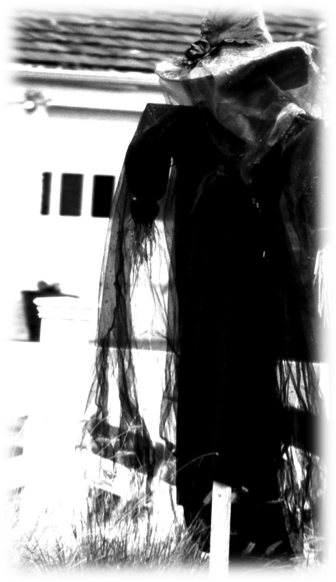 Fall is the most fanciful season, some say, since the leaves are falling in bliss, as if bewitched by the earth. To some degree, however, there is an aura of frightening whimsy. The air grows colder daily as the grains ripen, bearing their tended fruits. The overcast days bring fog and rain, followed by a sweet petrichor, replenishing the earth and the hearts of its people. Hearths are burning bright to ward off the frigidity, warmth emulating from every humble home along the unpaved road.
Upon the road lived people, each in a spacious house, of heart and hearth. These townsfolk lived simply of Geyer, raising their crop and their family in a Christian manner. Each attended weekly church in a small cobbled church, encased by a cemetery of their beloved.
Lying in this cemetery, in a grave whose headstone is mid fractured, is a woman. A humble bread maker, who lived and loved in the mid eighteen hundreds, had false indictments placed upon her innocence.
Upon the road of Geyer, recessed within the woods, lived a maiden of fair age, nearly twenty-three. She had not yet wed, and found company in her three pups, which she fed well and trained continuously to protect her delicacy.
Nightingale Caruthers, as she was dubbed, dedicated an acre of her land to the cultivation of wheat. When the crop was thick and bountiful, she gathered it by hand, accompanied by her dogs. Grinding it in a miniscule mill, she baked it into marvellous pastries and symphonious bread. She sold it in a shop, out of her home, her first floor dedicated to handmade crafts and bakery. Her upstairs was her home, where she resided, cared for herself and her pets.
As the year drew on, crows and pests of flight persistently consumed the yield of her field. Time and time again did she try to solve this problem, but to no avail was a solution procured. However, Nightingale noticed that when she ventured out to the field to shoo away the marauders, they fled from the mere sight of her. Her brain conjured up a novel idea, to create an artificial rendition of herself.
Later that night, she searched through her old clothing; she had much, casting them this way and that before locating a tattered dress from her formative years. She stuffed it with straw, sewed it shut like a pillow and fastened it to a tomato stake to give a vertical appearance. “Something is missing,” she muttered to herself, her only audience her three dogs, and they did not understand a word of articulation. Frantically circling her bedchamber, she came upon an unattractive broad brimmed conical hat. Her grandmother had brought it to the colonies from England, the gift of a wicked, bestowed to keep harm away. Nightingale placed the headgear atop the stick supporting her bloated dress.
Beneath the cerulean moon shadow, she could make out the grotesque image of a fiendish crow, pecking at her wheat. Out she went, stabbing her inhuman exemplification into the earth next to the bird, scaring him off. Trudging back to her house, she could not help but think of all the needed assistance she would need to keep her shop open, with such a high yielding of grain due to her brilliant invention. Tomorrow, she would post a notice regarding employment in her shop on the town’s church’s door, for it was Sunday in the morning.
Only one responded to her ad, a lively young girl by the name of Peregrine. Her eyes were sharp and intelligent, but her face was plagued by a beaklike nose. Nightingale undertook her as an apprentice, showing her the craftsmanship involved in the handiwork of baking bread. Peregrine learned swiftly, working frequently for compensation.
A week into the job, Peregrine was troubled immensely by the unwavering noir figure in the field. She approached her superior quizzically, “Who is that standing in the back?” Nightingale nodded to the window in which the figure was visible, proud of her work, “That is my crop protector. It’s inanimate. It scares away the crows.” “You should call it a scare-crow,” jested Pere. Nightingale did not respond, only raised one eyebrow in realization. Her scarecrow, she relished in the capricious peculiarity of the newfound noun, could benefit the other gardens and crops on Geyer.
With the harvest imminently nearing, Nightingale reasoned that she might create these in early celebration of the approaching ingathering. She created several out of her old dresses, barbing them in odd hats, tam o’ shanters, caps, bonnets, trilbies, and various other head gear. None were as terrific as her broad brimmed pointed hat, however. That evening, she placed one in each field, ones of soybeans, corn, wheat, barley, and even modest vegetable gardens yielding ocher pumpkins and chartreuse gourds. Upon sunrise these farmers shall be enthralled, thought Gale to herself. Satisfied, she ventured down the dusty road with her hands tight against her meatless frame. It was a frigid October, and the harvest moon was shrouded by sporadic clouds, making the air seem even icier.
The next morning, Nightingale awoke content; Tuesday mornings were commonly tranquil. Adjusting to the day, she began to make out some angered jibber jabber amongst her neighbours. Perhaps their squabbling over scarecrows, contending which one is better, she thought. Of course, her unworldly ignorance was incorrect. Her fellow inhabitants of Geyer were wholly appalled by these odd staked dolls, thinking them spawned from the underworld and placed in their yards as punishment for their sins.
“Witchcraft!” accused Peregrine. The apprentice singled out her innocent superior commander.
The folk rallied together. Gathered around the home of Nightingale, Peregrine politely knocked on the witch’s door. No unlocking of the deadbolt. In the silence, a farmer, pitchfork in one hand and scarecrow in another, ventured round the back in fury. Struck by the ominous figure cloaked in black with the conical hat occupying the field, he seized, falling prostrate in fright, resulting in pains in his left upper appendage. The majority of the mob ventured round, too, and found Gale nourishing her canines, the pets growing burlier by and by. The dogs attacked initially, grimacing, sharp fangs bare, to the townsfolk. Nightingale called off her protectors, thinking the confrontation a sociable one.
Two wiry men, sturdy from hurling bundles of straw, clutched her by the arms. Kicking and screaming, they dragged the witch into her minute shop, and questioned her. There was no established town jury, nor an available lawyer for miles, so her neighbours accused her.
“Peregrine,” one said, summoning the apprentice, “has made a claim that you are a witch. Do you deny?”
“A witch… while, that’s preposterous….” Gale replied.
“The girl says your dolls are voodoo. Have you been conjuring with the devil?”
“No,” she stated honestly.
“Transport her to the cell,” stated the man. If you were to deny witchcraft after a claim was made, death by hanging was the punishment. The gallows were to be hung for the first time.
All Hallows Eve, the witch perished.
She was not hung. Before her death, the apprentice, Peregrine, visited her. Silence ensued for a few moments, Gale uttering the initial words.
“Why?” She asked.
“I can’t say I know,” cried Pere through heaving sobs and mournful tears. “I don’t know what I was thinking. I simply thought your scarecrows were witchcraft.”
“For she who repents is forgiven. You have nothing to mourn for. I was ignorant and foolish to place those scarecrows in the fields to begin with. ‘Tis my fault, not yours.” With this, Nightingale drew a final breath, and exhaled raggedly, all air leaving her as her soul evacuated her body.
After the death of Gale, Peregrine convicted and admitted herself to witchcraft, withstanding the blame for the frightful scarecrows.
The road of Geyer is a pleasant road, paved, lined with ancient maples and birches and oaks whose leaves litter the ground in the autumn solstice. In recompense for the wrongful conviction of Nightingale Caruthers, the current residents of Geyer place scarecrows affront their homes for the Halloween festivities, some cheerfully decorated, whereas most take a dour and authentic approach.
Nevertheless, it is said that one can still find the three of the witch’s dogs in front of their immortal residence, protecting the house on all occasions.

 Wednesday Blog by Seán Thomas Kane