Category Archives: Music

An Election Year Independence Day

An Election Year Independence Day Wednesday Blog by Seán Thomas Kane

This week, I’m writing to you with this week’s holiday in mind, with some of my aspirations and hopes for America. — Click here to support the Wednesday Blog: https://www.patreon.com/sthosdkane

This week, I’m writing to you with this week’s holiday in mind, with some of my aspirations and hopes for America.


While I have colonial ancestors who settled New Haven, Connecticut and Newark, New Jersey, and who at the time of the American Revolution were living in Pennsylvania, Maryland, and North Carolina, I more closely associate with my recent immigrant ancestors. I’m one of those hyphenated-Americans who holds onto elements of a culture and identity that transcends the Atlantic and provides connections not only to this country but to the places where my ancestors came from. One aspect of the political philosophy of American nationalism that I don’t agree with says that you have to conform to a particular American identity when you come here. My ancestors did that, to varying degrees, and I’m more American than anything else, yet it’s all those other elements that give our Americanness its richness of character.

So, when I think of the music that embodies the soul of America, it’s music written by a fellow hyphenated-American, Aaron Copland, the dean of American classical music. When I tried my hand at musical composition in college, I wrote a four-movement trio sonata that told the story of a voyage from Ireland to America by St. Brendan and his monks in the sixth century. My addition to the fable was to have the tone of the music switch from being very Irish in the first and second movements to taking after Copland’s sound in the third and especially the fourth movement as they reached this side of the water. I’ve long wanted to write a blog post all about my admiration for Copland’s music, but thanks to the copyrights on his recordings I’m waiting for a few more decades. For now, go listen to Appalachian Spring and Rodeo after you’re done listening to, or reading, this.

Copland’s music speaks to me now in 2024 especially as we approach an election year. This is the most sacred task that we American citizens fulfill in our obligations to our republic: we do our duty by voting for whom we want to represent us on all levels of government, and on the host of ballot measures found further down-ballot. This election feels far more pivotal than any we’ve seen in my lifetime. For context, I was born exactly one month before the elder President Bush stood aside for President Clinton. While I may have disagreed with the policies of both Presidents Bush, they still seemed to be decent men. It’s hard to say that this year about one of the two candidates who flooded Thursday night’s debate on CNN with so many half-truths and outright lies that the network did nothing to check live on air. I was baffled watching it to think that the network’s executives and news directors didn’t choose to lay out better safeguards considering this is the same man whose rhetoric and refusal to admit his loss in 2020 led to the storming of the Capitol on January 6th, 2021.

When I think of a President who I want leading our country, I think of Copland’s Fanfare for the Common Man.I want someone who best represents the best ideals of America, someone who can speak with all of us and for all of us. I hope for someone who can work with Congress and the states to execute legislation that will lead to an overall improvement in our national well-being. I was disappointed to see the President perform so poorly during the debate on Thursday, yet of our choices this year he is the closest to embodying that ideal of the common man.

This year’s election is not politics as usual, there are deep intrinsic questions at stake over the future of our country and what sort of government we want to have. I was deeply unsettled to read the transcript of David Brooks’s recent interview with Steve Bannon, who Brooks called a Trotsky-figure for the MAGA movement. From the interview, and from the way Bannon positioned himself as a leader of that movement, he made it clear that there is no room for communication with their political opponents, who Bannon termed in a far more affrontive manner as their enemies. That is the most essential element of good government, something that all the great political philosophers recognized: we need to be able to communicate with each other and grow together as one body politick made up of a great many parts. I’ve seen the same problem on the left as on the right, a disinterest in listening and in compromising to achieve a higher ideal or a common good that will benefit everyone. Yet the greater threat is coming from the faction who’ve gained enough sway that they now control their party and their leader is again a candidate for the Presidency.

This Independence Day, Americans around the globe will celebrate the invention of our republic from an ideal written on paper during a hot and humid Philadelphia summer 248 years ago. I’ve heard it said that that was the first time that anyone thought to write down the idea that “all men are created equal.” Think about that for a moment: that was the first time that the notion of universal equality, or better universal equity, had ever been considered. The President is the President, and I respect him for serving in that office as I feel respect for the office itself. It is a monument to self-sacrifice when done well, and a trap of self-aggrandizement when the oath is taken for the wrong reasons. Yet when a sitting President leaves the office on Inauguration Day, they may still be Former President, but they are now again just another citizen who’s offered to carry that mantle in the relay until the next candidate will take it up.

The burdens of preserving, protecting, and defending the Constitution of the United States are greater than one person can carry on their own. The office holder ought to have us, we the people who come first in the Constitution, supporting them as long as they keep their oath, and do their duty for as long as their term lasts. It is a humbling thing to serve in such an august role. It is something that truly should not be taken lightly, or brought on by a candidate for any other reason than for service.

The Promise of Hope

Last week, the 7th of May 2024, marked the 200th anniversary of the premiere of Ludwig van Beethoven's Symphony No. 9. Today then, I want to talk with you about the hope which runs through that Ode to Joy. The recordings of Beethoven's Ninth Symphony heard in this episode came from the 1956 album by the ProMusica Symphony Orchestra and Chorus under the direction of Jascha Horenstein and are free to use under the Public Domain Mark 1.0 Universal label and can be found in full at archive.org. — Click here to support the Wednesday Blog: https://www.patreon.com/sthosdkane

Last week, the 7th of May 2024, marked the 200th anniversary of the premiere of Ludwig van Beethoven’s Symphony No. 9. Today then, I want to talk with you about the hope which runs through that Ode to Joy.


Last time on the Wednesday Blog, I wrote to you in what I hoped would appear to be an optimistic tone that still acknowledged the troubles and trials I find before me, and to an extent I think that worked. While I did not intend to write a sequel to that post, this week’s topic is one which fits well enough, and which I feel quite fervent about as to warrant mention here in the Wednesday Blog.

I began to explore the world of classical music around the time I started high school. Quite honestly, my big introductions were the music of George Gershwin and the original cast album of Phantom of the Opera. Yet around that time I was introduced to an ensemble called the William Baker Summer Singers and joined them for the 2008 season when we performed Beethoven’s Ninth in Grace & Holy Trinity Cathedral in Downtown Kansas City. I was not the best singer by a long shot, still very new to the whole experience, yet it was the start of my off-and-on tenure singing with choirs around Kansas City.


The first measures of the 1st Movement

Beethoven’s Ninth thunders into life with the opening measures of its first movement, as though the hope and joy which makes this piece so famous is born from something elemental deep beneath the ground, rising out and toward the audience with the orchestra as its first voice. This then makes the chorus out to be some even deeper root of the spirit of this work, its power growing throughout the first three movements leading up to the tremendous clamoring second movement. I’ve always imagined the second movement told the story of a fast paced and clattering horse and rider making their way through fields and farms to pass on good news to some learned recipient.

The third movement is far softer than the first, yet again it speaks to something grand as yet only being revealed to the audience. There is a sense in the third movement of a fundamental truth as of yet untold, whose voice could raise both the living and the dead to new heights of human dignity and grace. Through music, Beethoven captured the full spectrum of human aspiration and expressed our innate confidence in our own abilities to improve our lives. It reminds me of the “Et incarnatus est” movement in Beethoven’s Missa Solemnis, which is written in the Dorian mode, giving it a distinct feeling of rising from a deep ether into the light of a new day. The Missa Solemnis was also written in 1824, premiering on the 7th of April of that year.


The 3rd Movement’s climax

I hear something inherent in Beethoven’s optimism, that even with all the troubles of his life there near its end he could still dream that we might become better versions of ourselves. The tempo marker for the first movement Allegro ma non troppo e un poco maestoso (Quick but not too much and a little majestic) might well be a good motto for life; a good life ought to be taken at a fair pace, yet not too fast, and with some majesty for one’s nature. We can hope for something better because we are born with minds capable of dreaming of better tomorrows.

At the heart of the Ninth Symphony and in particular its choral fourth movement is a fairly simple melody, one that I learned quickly during my time rehearsing it. That melody has taken on a life of its own beyond Beethoven’s original composition and become something ubiquitous in many respects. There are two church hymns set to its tune in the hymnal we use in my current parish choir, “Joyful, Joyful, We Adore Thee,” and the slightly more modern, yet traditionally formal, “Joyful, Joyful, We Adore You.” What I love about this melody is that it is easy to learn, easy to adapt, and so upbeat.


The Ode to Joy theme from the 4th Movement

The words which Beethoven set to that tune were written by the German poet Friedrich Schiller (1759–1805) in the summer of 1785. They are an outgrowth of the Enlightenment and the fervent calls for acknowledging our common humanity that grew from this reassessment of our relationship with Nature. Those words speak volumes to me, that joy makes brothers and sisters of us all, revealing our original state of nature to us amid all the nebulous fog of our lived expectations. It’s easy to forget that beneath all the mantles of identity we hoist upon ourselves that we are all the same in our life and yes in our mortality.

There is a deep promise here that with hope we can accomplish tremendous things. Hope alone will not solve our problems, we will always need to act to improve ourselves and our communities. True hope, pure and fulfilling hope, is such that it requires we all act together to our common benefit, that we think of each other more than of ourselves. I have such a hope in humanity, after all I’ve seen moments in my own life and in our history in which we’ve come together to work for a higher purpose than any one of us. Again, quoting from Schiller’s poem:

“Seid umschlungen, Millionen!
Diesen Kuß der ganzen Welt!”

            “Be embraced, all ye millions!

            With a kiss for all the world!”

This promise of hope is something that is sacred because it offers us a chance at redemption no matter how terrible the things we may have done. There is something truly divine about it, that we can become better versions of ourselves not in spite of who we’ve been but rather because we are willing to improve who we are and how we live with our neighbors.

That is a promise that I hope we can fulfill.


The recordings of Beethoven’s Ninth Symphony heard in this episode came from the 1956 album by the ProMusica Symphony Orchestra and Chorus under the direction of Jascha Horenstein and are free to use under the Public Domain Mark 1.0 Universal label and can be found in full at archive.org.


Mirrors

This week on the Wednesday Blog, how I've learned to deal with stage-fright and in some cases overcome it. — Click here to support the Wednesday Blog: https://www.patreon.com/sthosdkane

For a few years starting when I was thirteen, I took lessons in traditional Irish music from a good friend named Turlach Boylan who is quite talented on the flute, tin whistle, and mandolin and plays locally in sessions. I had potential but never really got there, in part because I didn’t practice as much as I should’ve, yet also in part because I kept running up against a sort of translucent wall of my own self-consciousness. After a while when we were both around during sessions, Turlach would invite me to come join the circle and play with the other musicians. I’d try but often when I’d hear someone else playing with me, I would burst into a big smile and have a very hard time playing my tin whistle with the group.

There’s something about playing an instrument with a group of people in such a loose and lively manner as in a trad session that has been hard for me. This week I read a story in Commonwealabout the joyous experience of all the craic that goes on in the trad sessions that the author, Commonweal‘s managing editor Isabella Simon, had joined in New York City. It made me think more that perhaps in that context my fear was less a shock at the fact that I was playing with other people but the worry that I’d mess things up, play the wrong note, or not know the jigs, reels, polkas, waltzes, and airs they were playing. As Ms. Simon wrote the talent of a session player is judged not in their virtuosity but “by whether the listeners are tapping their feet.” That clicked for me because that is how I approach teaching and lecturing, the expertise and skill that I exhibit in the classroom is a big part of the puzzle, yet it is one half of the whole picture which is best filled out by a comfort and ease with entertaining my audience and keeping them engaged.

I’ve found that difficult the last few days as I’m starting my new teaching job, sometimes I’m not sure my messages are getting across, especially when I have to shout over a room of excited students. Still, it’s not an unfamiliar lesson for me. One story I’m sure I’ve told on this blog before is about an icebreaker presentation that I gave in my Junior Year AP English class in high school, where our teacher asked all of us to bring in baby pictures of ourselves that she could hang up on the back wall of her classroom. When I got up to present my own picture, I let slip that I had considered bringing in a picture of a monkey to say that “I was a very hairy baby,” a line I think I partially stole (lovingly indeed) from Father Ted‘s milkman episode. Still, the picture I showed to the class was of a very large ancient tree on the grounds of Canterbury Cathedral with my Dad and I barely seen near the base sitting on a park bench. My classmates laughed at the whole routine, and I returned to my seat at the end of it feeling really good about myself; my fear that they’d all be laughing at me was avoided by telling the joke rather than being the joke.

In my teaching, I like to keep things loose, to have more of an improvisational style that changes to fit the room. That worked well at the university level and is kind of working here with the middle schoolers, but with more guidance from myself to make sure they’re doing what they need to be and getting the correct information about the day’s subject in the moment. I tend to not have the same kind of stage-fright that I used to, I can usually get up in front of a crowd and say what I need to, yet I do judge the room every time. There have been moments when I’ve started talking and I can immediately tell most of the people in the room either don’t care or actually are sitting there against their will. In those cases, I keep things brief. If I can play around with an audience though I’ll have more fun and will weave different stories together.

I love music, from the structured virtuosity of a fine orchestra like our own Kansas City Symphony to the fluid vitality of an Irish traditional session and all the great jazz in between. I love how it can express things that mere words could not annunciate. Yet where Irish music shines is in its ability to keep that conversation, no matter how joyous or sad, beyond one tune and into the next. In that moment the memories of generations of musicians can be heard, their voices echoed in the instruments and songs of their students which keep this rich tradition alive and well.

The lesson I’ve learned in all of this, which Ms. Simon’s story clarified for me, is that all life is a performance, and in the moments when I can relax and see past the mirror in my mind, I’ll be okay. In all the things I’ve tried for personal enrichment, from learning French and Irish to learning how to skate on ice after the Pyeongyang Olympics in 2018 to standing on stage in front of a full house, I’ll be okay as long as I don’t think about the fact that I’m putting myself out there too much, taking that risk of ridicule. My stage-fright will only ever be experienced by me and me alone. And at the end of the day if I’m comfortable with my own performance, if I play to the internal audience as well as the external, then I’ll be happy. To paraphrase something the gentlemen of the Monty Python troupe once said, “we only write jokes that we think are funny.” In those sessions, I’m playing not just for my own ear, but to be a part of a circle of friends united by our common musical language, at ease with each other’s company, rejoicing evermore in that fine moment.

Context is Key

This week on the Wednesday Blog, I want to air a pet peeve of mine about stories taken out of context. — Click here to support the Wednesday Blog: https://www.patreon.com/sthosdkane

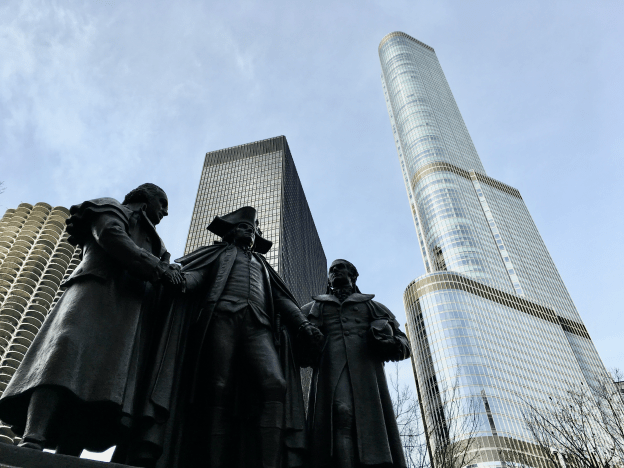
In late December 2017, during one of my family’s regular Christmas trips back to Chicago, my Dad and I were walking along Wacker Drive (upper, not lower) past the Herald Square Monument on the northwest corner of Wabash and Wacker. The monument depicts George Washington with two of the principal financial backers of the Continental Army during the Revolutionary War, Robert Morris and Haym Salomon. I took a picture of the monument with the Trump Tower looming in the background, a pairing of two presidents who in many ways could not be more different in character from one another. My Dad suggested I should learn more about the monument before posting my picture and get the full context of why it’s there in the first place.

As it turns out, the inscription on the monument’s base “The Government of the United States which gives to bigotry no sanction, to persecution no assistance, requires only that they who live under its protection should demean themselves as good citizens in giving it on all occasions their effectual support,” was what made my picture seem so poignant in the first place, and likely had the same effect on many pocket photographers who had walked by in the years since 2016 with their smart phones at the ready to capture the world as they saw it.

That inscription, I learned later that day when we returned to our hotel, was from a letter President Washington sent to the Jewish congregation of the Turo Synagogue in Newport, Rhode Island affirming their religious liberty and emancipation from any separate law code contrary to the custom in most western countries at the time. The context fit the story I was hoping to tell with my picture, yet I was appreciative of the advice to learn more about that monument before making a statement of my own with its picture.

I have many pet peeves, most of which I don’t talk about out of respect for everyone else. I’d rather be known as someone who has positive things to say rather than a complainer, and in those moments when I find myself overly melancholic or acting in a “woe is me” manner, I tend to annoy myself a fair bit. So, it takes a lot for me to want to say anything terribly negative, yet this matter of context is key to something that does bother me. I am annoyed when stories are taken out of the context in which they were created. 

This usually doesn’t happen with novels or movies or TV shows, except now with the deluge of memes using images and moments from these stories to express emotions. I do see this trend played out more in music where the original story of a song might not be as familiar to the people listening to it, yet they sing the words all the same. Context provides so much more color and energy to a story that turns it from a linear narrative with a beginning, middle, and end into a vibrant world crafted by a storyteller that began as a mere idea in their mind.

Pulling a story out of its original context robs the listener of a chance to appreciate the whole depth of the yarn being spun, to see every last fiber of that tapestry being brought together in a great work of art that is inspired by the ideas of its creator. When we break ourselves off from the context of life, we lose a great deal of the beauty of the Cosmos around us. This is why we can sit back and do too little to help our planet as the climate crisis grows ever dire day by day. Last week, several researchers from the University of Copenhagen’s Niels Bohr Institute reported their findings that the Atlantic’s currents could stop moving this century, as soon as 2025, due to rising sea temperatures; earlier in the week the National Weather Service also reported that water temperatures over 100ºF (38ºC) were recorded for the first time off the Florida coast. The currents feed the very life we have evolved to depend on and to be an integral part of. By focusing just on our own story, we have lost the context of the greater world of stories that ours inhabits.

Here in the Midwestern United States the weather tends to move in cycles with some wet years followed by some dry years. In my adult life we’ve seen three wet cycles so far, with heavy flooding on the Missouri River around the years 2011, 2015, and 2019. Since 2019 we’ve been in a drier spell, with some seasonal thunderstorms but not the great floods of years past; yet these last two summers the Midwest has been inundated with flood after flood, striking different regions at different times. Over the 4th of July weekend, there were rainfalls in Chicago that dropped as much as 8.96 inches (22.76 cm) of rain on the western Chicago suburbs of Berwyn and Cicero. A few weeks later on 14 July, Kansas City experienced a storm line that produced minimal tornadoes, what we’re more used to here, but instead a line of storms over 40 miles (64 km) long from north to south which produced winds reaching at least 75 if not 80 mph (120.7–128.7 km/h) winds that brought down trees throughout Kansas City, knocking out power lines and leaving much of the metro in the dark. 

I for one am used to thunderstorms, they’re quite exciting to be frank, yet this one scared me more than any other I’ve watched from the safety of a well-built house. What scared me most was that the windswept rains reminded me of video I’d seen of the Category 1 hurricanes that hit the East Coast every Fall. To me, this proved that the story I’d been hearing my whole life about the weather here in the Midwest was truly changing, that it was not a couple of bad years followed by a return to milder weather. The baking summer heat that followed that Friday afternoon storm, which last week left portions of Kansas City reading heat indices of over 120ºF (49ºC), was the flip side of the same story we heard in December when the extreme Arctic cold winds that swept down from Canada and locked much of the continent in an ice box settled on Kansas City. That weekend we were treating our garage like an air lock, closing the interior house door and making sure everyone who was going outside had all their skin covered before opening the garage door to the -30ºF (–34ºC) blistering wind to go shovel out our driveway of snow and lay down kitty litter (our preferred road salt) to try and break up some of the ice that had formed.

Without the full context, we cannot see the future we are creating for all life on Earth. Visitors to my favorite place on Earth, Chicago’s Field Museum, will likely go see their fossil halls, an exhibit now called Evolving Planet, in order to see the famed dinosaurs––and especially SUE the Tyrannosaurus Rex––who live in those galleries. I love going in there for many reasons, which if I haven’t written about before on the Wednesday Blog, I’ll be sure to write about the next time I visit. Yet, the Evolving Planet exhibit ends with a counter showing the number of species that have on average gone extinct over the course of any given day. The later in the day you leave that exhibit, the higher the number is. In all our other problems, and especially in all our distractions, we forget that we need all the other life that evolved on this planet with us. We forget that their stories are important to understanding our own.I know a great deal more about the history of the Turo Synagogue after stumbling into Sam Aronow’s Jewish History series on YouTube just before Christmas in 2021. Learning other peoples’ histories allows us to have a better appreciation for the entire tapestry of humanity. For me, it presented a greater sense of respect in President Washington’s words engraved in the base of the Herald Square Monument at the corner of Wacker and Wabash. That context only strengthens the story of our national experiment at citizen-led representative government, now nearing its 250th anniversary.

“Oppenheimer” and Sound

"Oppenheimer" and Sound Wednesday Blog by Seán Thomas Kane

This Monday, I went to see the new Christopher Nolan film about the life and work of J. Robert Oppenheimer, the leader of the team that invented the atomic bomb. —— Click here to support the Wednesday Blog: https://www.patreon.com/sthosdkane

This Monday, I went to see the new Christopher Nolan film about the life and work of J. Robert Oppenheimer, the leader of the team that invented the atomic bomb.

I have grown up in the shadow of the twentieth century; I was born near the beginning of its last decade and to a degree always knew much of the broad strokes of the century’s history in the United States. The first decade of my life was a time of optimism and hope, the Cold War had just ended a year before I arrived, life seemed to be good, and to me everything was a wonder to behold. I knew the story of how we got to that point, the broad strokes of American history more broadly and of the history of my home city of Chicago more particularly from as far back as I can remember thinking of such things. I knew a world where the threat of nuclear war was a thing in the past, a nightmare that never came to pass now that the Soviet Union had fallen, and America & the rest of humanity had survived the long nightmare of the Cold War.

In many ways, Christopher Nolan’s new film Oppenheimer tells that story that I grew up knowing, of American determination to overcome seemingly insurmountable obstacles with a can-do attitude that won this country its independence, the good guys our Civil War, and a transcontinental union of states that promised liberty, democracy, and peace to all who lived within it. In the years since of course I’ve learned the hard truths of this country’s history, all the people whose lives, hopes, and dreams were thrown by the wayside in the name of our national progress. I still believe in the dream of that progress, ever the optimist, yet that optimism is tempered by the realism that life in this country has never been fair or equitable for all of us. 

For all of the tropes of the great man that the film Oppenheimer plays with, it still tells a story of one man and his colleagues, his fellow theoreticians, engineers, and scientists working in a moment pushed along by the uniformed protectors of that progress to use their brilliance to craft something that could harness the pure energy of the Cosmos to be the ultimate weapon to end what was then the ultimate war imaginable.

Christopher Nolan is famous for his use of sound to tell his stories. Of all his films, the one that before Oppenheimer which touched me the most was Interstellar, which used the minimalist score composed by Hans Zimmer to describe what it might be like for humans to soar past our solar system and to far distant stars at sub-light speeds with little chance yet an enduring hope of returning home to the ones they loved ever again. I watched Interstellar on a transatlantic flight in January 2016 on the way back to London where I was then living from Chicago-O’Hare. That flight was entirely at night, thanks to the long winter nights in the Northern Hemisphere, and so for a few hours before we landed just before dawn at Heathrow, my entire world was Interstellar, which left my jet lagged mind far more confused than usual the rest of the day in my flat.

Zimmer’s score for Interstellar, in particular the great theme “No Time for Caution” pulses with the clockwork rhythm of time itself, a telling motif for a film all about the complexities of spacetime that a non-expert such as myself can hope to understand yet often fall short of grasping. In Oppenheimer there are rhythmic, chronic beats, there is a great pulse that underscores the most pivotal moments of the film, yet where Nolan uses sound itself, less so music, contributes to a compelling, and all-consuming story of the beginning of something with great promises of both wonders and terrors alike.

One of my new favorite music YouTubers talking about what makes Interstellar’s music so good.

I watched Oppenheimer in IMAX, though not on 70 mm film as no such cinemas within a 400 mile radius of Kansas City are showing it on anything but digital prints. Sitting where I was on the right-hand aisle, I perhaps got more of the sound from that side than the left, or the perfect sound that one would find in the center of the room; and in my humble opinion, most cinemas have their sound far too loud in general nowadays anyway. Yet I still felt awed by the way that the sound consumed everything else that I could feel, see, and yes hear when it fitted the story. This matched the great silences, not lead-ins to a horror jump scare, but meditations on the numinous echoes of something approaching the divine in the power wielded by that American Prometheus as Dr. Oppenheimer has been called.

In the Summer of 2016, a few months after that flight into the world of Interstellar, I traveled to Vienna, one of the most beautiful cities I’ve ever visited, and the first stop I made after arriving in the Innere Stadt was at the Haus der Musik, the second music museum I’d visited during my time in Europe after the Finnish Sibeliusmuseum in Turku. Yet unlike the Finns, this Viennese institution included an entire floor dedicated just to sound, the Klangsmuseum, where sound was visualized using colors on the walls. I began to connect ripples I’d seen all my life in water with the sounds I heard that day, which has proven useful. As I’ve gotten older, and my love for music to concentrate during the day has led me to use in-ear headphones more and more, my hearing has probably taken a slight dampening, leading to me not necessarily hearing less overall but instead noticing the vibrations of sound more and actually feeling sound in my body while I’m hearing it.

So, for me sound is not just something I experience with one sense, my hearing, but with my sense of touch as well. It’s one of the things that a live concert can give the listener that a recording can’t always provide. Whenever I hear a familiar opera in a theatre, I am usually struck a little unexpecting at the physical sound the timpani makes during the overture, and the way the sets creak and reflect sound back towards the singers and out to us the audience. I have learned how to judge without particular precision how far away a lightning strike is by listening for the gap before the thunderclap and the length that thunder echoes about the world around me as well as within me when it’s a particularly close one.

The world that Dr. Oppenheimer created felt removed for much of my life, for the man who said of himself “Now I am become Death, the destroyer of worlds” created a means of mass destruction which after 1945 has never been used in war. For much of my life, the threat of nuclear weapons seemed to be something consigned to a past when our ideologies kept us apart, spurred our distinct methods of innovation, and made enemies out of onetime uneasy allies. Yet today, as other powers rise to a level of strength and aggression that they could challenge the record of nuclear weapons, I’ve found myself worried about it in recent years for the first time in my life. I’ve found in my professional experience that it takes several attempts for a lesson to settle into the learner’s mind, it took me three tries to learn both Latin and Irish to really understand both languages and how they work. All this made Oppenheimer less a film about an event firmly in the past, something perfect to borrow a grammatical term for things that have happened and are in the past, but more something which tells an imperfect story of events with continuing resonances in the soundscape of our world today.

I may have grown up in the shadow of the twentieth century, yet I and my generation will have a great effect on the events of the twenty-first. I hope that we can learn the lessons of the century that came before us, and use Dr. Oppenheimer’s achievements not to create deterrents through the threat of mutually assured destruction but to establish human cooperation out of our mutual interest in surviving to live in a future to come.

Classics

This week I'm discussing what the word "classical" means to me in musical as well as historical and political terms. — Click here to support the Wednesday Blog: https://www.patreon.com/sthosdkane

During my high school years in Kansas City, I would often listen to either NPR or 1660 AM, the local classical music station, on my 30 minute drive south to St. James Academy. In those years I continued to embrace Classical Music, especially opera, as an art form that remains a particular passion of mine, even to the point of several ill-fated attempts at composing.

Still, it strikes me that our term classical has a rather complicated set of meanings and uses. In the musical sense, it’s used to refer to the most highbrow of our genres, the rare musical tradition that still sees performances of music composed within the last 400 years rather than the decade-based music that usually makes the Pop and Rock charts. Classical Music tends to embrace the trappings of old European and American elite while also providing a gateway for the rest of us to enter that refined space and hear the radiant melodies and harmonies that have been the soundtrack for generations.

I began to explore Classical Music in my middle school years, like many Americans my introduction to this wide scope of music was through jazz and Gershwin’s blending of the classical and jazz orchestras. I’ve been wanting to write a blog post all about my appreciation for Gershwin’s music, though my continuing uncertainty regarding copyright law has kept me from ever publishing it or trying to record a podcast version of it. From Gershwin I jumped backwards to Mozart, Beethoven, and the other big names before settling both in the Baroque world with Lully and in the realm of the Romantics with the likes of Johann Strauss II, Verdi, Wagner, and Mahler. Today, I still love the music from all of those composers, yet I’m also drawn to more recent works written by the likes of Debussy, film music that fits in the 20th Century late Romantic tradition embodied by Prokofiev and the German film composer Gottfried Huppertz, who longtime Wednesday Blog readers and listeners will remember is the composer of the score for Fritz Lang’s 1926 science fiction film Metropolis

In the last couple of years, I’ve returned to my first unwitting introduction to classical music through the film music of the likes of John Williams and Elmer Bernstein and found myself drawn to electronic-classical compositions of Vangelis, which inspired the theme for the Wednesday Blog, and the choral classical-crossover albums of Christopher Tin and 2022’s The Moons Symphony written by Amanda Lee Falkenberg. I’ll gladly spend an afternoon listening to Jerry Goldsmith’s themes for the various Star Trek series and Mr. Williams’s compositions for Star Wars as much as I’ll choose to hear a Mozart piano concerto or Bernard Lallement’s Missa Gallica.

I’ve long thought that classical music saw its greatest innovation in the last century when its venue diversified from the concert hall alone to include the sweeping compositions that breathe life into films. Film music to me fits in the long tradition of ballet music. This comes out of the great silent film tradition of a century ago which reached its zenith in the late 1920s with epics like the original Ben-Hur and Phantom of the Opera films as well as with Metropolis and the other great German expressionist films. Sound film took some of the storytelling need off of the music as now the characters on screen could too be heard, yet the power of music in film was already clear. I relish the chance to hear the Kansas City Symphony perform a concert of film music, because even when it’s disassociated from the pictures that score was originally created to accompany that score often holds up on its own as a concert piece.

It is interesting then to consider that within the world of Classical Music the term “classical” generally only refers to a short span of musical composition within the long history of the wider “classical” genre. The Classical Period in music matches up with the Neo-Classical Period in art, architecture, and literature that ran from around 1750 to 1820. This period includes great composers like Gluck, Haydn, Mozart, Beethoven, and Schubert, all of whom worked in Vienna the beating heart of Europe’s music industry in this period. Yet by this definition the word classical implies a separation from the present, clear limits to its scale and span, and an air of antiquity.

In many other contexts the term classical refers to the far older Classical Antiquity of European History, the centuries during the height of Greek and later Roman civilization from around the 8th century BCE to the 5th century CE. When I write about the classics in my work, I am most often referring to people and ideas conceived during this 13-century long span of time. The classical fathers of Western philosophy––Socrates, Plato, and Aristotle––continue to be required reading in modern philosophy studies, while Aristotle and Pliny the Elder have a foundational role in my own discipline in the History of Natural History. Those two, Aristotle and Pliny, were central influences for the naturalists who defined the Americas in the sixteenth century, people like the focus of my dissertation André Thevet, as well as Gonzalo Fernández de Oviedo and José de Acosta who both wrote natural histories of the Spanish Americas, and Conrad Gessner & Carolus Clusius whose works were written about distant worlds from the comfort of their own homes back in Europe.

Classical is a tricky word because it can be interpreted as something which is removed from common life. It stands apart from popular things because of its high status. I’m often struck by the adoption of mannerisms and norms from the classical music world in popular music, there was one concert I attended nearly a decade ago where the musicians on stage went from dancing in circles playing their violins to suddenly, briskly, taking chairs and sitting in a neat orchestral row in them as though playing the part yet ever with a wink and a nod about it. There has been a general loosening of expectations and normalities in our culture, a sort of reaction to the manners of past generations. I tend to see our present moment as responding to the norms of the 1980s and 1990s, politically we are in a period of unstable transition from the Reagan Conservativism and Clinton centrism of the 80s and 90s, though that needle continues to move forward in time and it does feel now that American conservativism and liberalism now seems to be working in response to the policies of the Bush and Obama Administrations as our youngest generation of voters now were born after the Millennium. I’m happy to see more classical musicians on social media releasing short videos of their performances, rehearsals, and daily practice for all to see. That’s one way for the classical to remain vibrant in the present moment. Still, it worries me that today in 2023 classical and jazz tend to be the exception in popular performance compared to pop, rock, and country.

Essay Writing

Photo by picjumbo.com on Pexels.com

I’m at a rather fun point in my doctoral studies. Today, I get to spend my days working on my dissertation and serving as a Teaching Assistant for a class. In my TA duties here at Binghamton, I’ve been assigned two sections of 25 students each, so when they submit essays, I find myself grading 50 of those in the course of a few days. It’s a lot of work, and in the moment the grading inspires a variety of emotions in me, from joy at a wonderfully written essay to disappointment at one that could’ve done better with just a little more effort.

One of the greatest boons to my work as a teacher is that now, after 12 years in college and 27 years overall as a student, I’ve finally made sense of how to write an essay. This word, used so often in academic writing, never really clicked for me. I knew I was supposed to write a research paper that had a introduction, body, and conclusion, but never really got the structure my teachers and professors were going for beyond that. It took my own transition from student to teacher for me to really understand that an essay is an extended argument. 

It also took for me to start studying Renaissance French Humanism and Natural History for me to really understand the origins of the essay with Michel de Montaigne’s 1580 book of Essays, where the term originated. These were reflections on a variety of topics, from children’s education to cannibalism and everything in between. My own Wednesday Blog is in some ways a nod to Montaigne in format. Montaigne’s essays sought to describe his world as he saw it and understood it, in all its rich detail and complexity.

In the academic essays that I write, from the quick 3 to 5 page papers I used to write for my undergrad history classes at Rockhurst to my dissertation, which in many aspects is itself a long essay, all have the same core structure and spirit. Yes, at its barest bones the essay is made up of an introduction, body, and conclusion, but there’s so much more rich detail to a good essay than just that. 

This semester it really occurred to me that the introduction ought to be made up of three main things: something to catch the reader’s attention, a thesis statement laying out the essay’s argument, and a brief summary of the main points with some context in the existing literature included if you’re writing on a graduate or professional level. Any of my colleagues reading or listening to this will either find their eyes are glazing over here or are instead laughing that I only really figured this out this late in the game as I was writing my dissertation.

The body is more than just the main points of the essay, it’s the real meat of the work, the rich quotes and analyses of the sources, the connections made to other works in all their intricate splendor, the quotable lines that help the essay stick in the reader’s memory and look forward to reading more of your work in the future. I still would say though that the thesis remains more important than the body, after all the body isn’t going to make sense without a strong central argument, a beating heart at the core of the entire work. I often tell my students this and have even begun advising them to underline their thesis statements to help them keep that heart in mind as they continue to flesh out the rest of their written creation.

Finally, there’s the conclusion. It’s a summary of the main points of the essay, a restating of the thesis with the memory of the body fresh in the reader’s mind. The conclusion is a chance to leave your reader with a really strong impact from your essay, something to find them wanting more. 

For a while now I’ve often thought of the essay as a form functioning for scholarship and literature as the symphony functions for music. In both cases there are different styles and methods of elevating the pure form into an art that reflects the writer or composer’s personality and craft, that leaves the audience feeling something different, something that they can best describe as emblematic of that work’s author. In symphonic music there are clear distinctions between the classical composers like Haydn & Mozart and the romantic composers like Beethoven & Brahms. Sometimes, the best way to end an essay is to borrow an idea from the romantic symphonies and even the romantic operas of composers like Gounod and Wagner: let the main themes finish and then have a sigh to really round things off. If you listen to the finale of Wagner’s Götterdammerung, you’ll hear this very sigh, as if all the energy built up in the composition over the last few hours is nearly extinguished but has one last breath. If you can write an essay like that then bravo.

I’m writing this in the midst of an extensive round of edits to my dissertation, going line by line making corrections, clarifications, and all around tightening down my work until it really just elevates the core form of my thesis. In the last year since I started writing this dissertation, I’ve learned a great deal about how to do this job, and I hope I will in future avoid some of the great pitfalls that I’ve caught myself up in time and again in my studies.If you’re a fellow academic, or interested in academic writing, I highly suggest you go listen to my friend Kate Carpenter’s podcast Drafting the Past, which is all about the process of writing history. It’s a wonderful service to the profession that Kate’s doing. Enjoy your week!

Creatures of Habit

Photo by Jeremy Bishop on Pexels.com

This week, how we tend to stick to the same things over our lives.

I’m writing this week’s blog post substantially later than I usually do. This past week has been very uncomfortable for me, first with a bout of food poisoning last Tuesday and Wednesday, and now with the continuing aftereffects of it still in my system. So, at a time like this when I feel physically terrible, I often find myself returning to the same old routines and manners that I’ve practiced my entire life. There’s something comforting in watching an old episode of Bill Nye the Science Guy all these years later because it’s nostalgic as well as staying educational.

Last night I found myself craving some good music, the soaring melodies and rich harmonies found in opera. I ended up listening to a couple of things including the Queen of the Night’s second aria “Der Hölle Rache kocht in meinem Herzen” from Mozart’s Magic Flute. For all the hellfire innate in the words––the title translates to “Hell’s vengeance boils in my heart”––there’s one line near the end that caught my eye, “Alle Bande der Natur.” At the moment I thought of “Bande” as in “bonds” or more metaphorically “customs” when in fact it really means “bonds” as in “connections.” So, in my elementary level German I translated “Alle Bande der Natur” as “all bonded by Nature” or that it was a matter of instinct and habit.

My misinterpretation of the German text there brought me to think a bit more about habit and instinct. What sets us off to do what we do? Why for example do some people eat each thing on their plate in turn rather than mix the flavors together? Or why does my cat like to extend her claws when she’s happily being petted?

Instinct is a survival mechanism. If you recognize you’re in a bad situation, you’ll probably do your best to get out of it. That goes back to the days when our distant ancestors were hunted as prey by other larger animals. Perhaps the urge to laugh at other people’s misery, embodied in my youth by America’s Funniest Home Videos and today by a good portion of the content on Instagram and the “Hold My Beer” subreddit, comes from a similar primal satisfaction that it’s not me who’s getting his leg gnawed off by a lion today.

As long as we’re tuned into our own natures, we’re bound to avoid some of the pitfalls that inspired that particular metaphor and survive. I learned the hard way to avoid bad food this past week and am still suffering the consequences now eight days later. On the other hand, my pup Noel learned in which house her best friend the black lab Henry lived and liked to stop and sit at the bottom of his stairs to see if he’d come out to play. We create habits out of experience and grow as a consequence.So, the moral of the story, the greatest lesson to learn here: to quote the Two-Thousand-Year-Old Man himself, “never run for a public bus, there’ll always be another.”

The Voice of American Music

Growing up there always seemed to be a few specific genres of hymns that’d be sung at Mass: the really traditional Latin hymns that go back into the Middle Ages, the eighteenth and nineteenth century hymns, often of Lutheran or Methodist origin that we Catholics had adopted, without necessarily acknowledging their sources, and the newer hymns written by the likes of the St. Louis Jesuits or those that came out of the spiritual and Gospel tradition native to this country. Often, my experiences performing music, whether singing or playing, was pretty well focused on church music and on the other hand on traditional Irish music, which I started learning when I was 13.

It strikes me how much our common musical language here in the United States can bridge gaps that we ourselves aren’t yet quite ready to leap across ourselves. My own experiences coming from a Midwestern Irish American Catholic family are entirely different from many of the people I work with today on so many different levels, but at the core of it all there seems to be this same common musical language that subconsciously unites us.

One of my favorite YouTube videos lately is of the great cellist Yo-Yo Ma performing “Going Home” from Dvorak’s 9th Symphony for the New American Arts Festival. Ma begins his contribution by telling the story of Dvorak’s time teaching music to his American students before his own return to Europe, and how the Czech master told them not to copy his style but to go out and listen to all the different music around them and create their own style from that. Out of those students and their students came Duke Ellington, George Gershwin, and Aaron Copeland, three of the great American composers of their day.

I often find myself thinking of how I could embody this country in a particular sound, or in a sonic landscape that could immediately transport me as I listen to one part of this country or another. When I wrote my trio sonata for flute, violin, and cello, I set the first three movements in a very Irish tone. The first movement was an entirely original jig, with the flute taking the part that I’d normally play with my tin whistle. The second movement ended up being my version of Dvorak’s “Going Home”, this time a setting of the Irish air “An Gaoth Aneas,” known in English as “The South Wind,” the third movement ended up being a setting of the jig “Merrily Kiss the Quaker’s Wife,” which has a really fun second part to it.

The fourth movement though was again something new. But unlike the first three movements, which told their story with an Irish voice, the fourth movement was set in America, and to tell that story I tried to emulate the voice that Aaron Copeland composed in, built off the sound of American folk tunes, their very particular twang that certainly has some Irish roots but has changed with all the other influences on music in this country. I wrote that fourth movement with the spirituals and originally Methodist hymns I’ve sung at Mass all my life in mind, and compared to the rest of the piece it has a very different sound.

There’s a related but still different sound in the musical landscape of the American West, something born out of both old cowboy songs from the nineteenth century as well as both twentieth century Hollywood soundtracks to the great Westerns, including my personal favorites, the contributions of Ennio Morricone’s to the genre through his scores for Sergio Leone’s spaghetti westerns A Fistful of Dollars, For a Few Dollars More, The Good, The Bad, and the Ugly, and of course Once Upon a Time in the West. Still more interesting to me is that this western soundscape has been picked up in recent decades by the continued popularity of Country music, though admittedly it’s a genre I’m personally not nearly as fond of as many of my fellow Americans.

When I think of one particularly American instrument, it’s honestly the trumpet. Sure, this is something that was invented in Europe and is used in all sorts of contexts outside American music, but the trumpet nevertheless plays a central role in two particular musical genres that speak volumes to me personally. The first is the frequent use of the trumpet to represent the solemn dignity of the republic, as a calling card for our country as the first modern representative government. It’s something I hear particularly in the film music of John Williams, especially in his scores for Lincoln and Amistad.

This particular sound blends into the use of the trumpet as a stand in for the military as well, seen especially well in Williams’s score to Saving Private Ryan or in Jerry Goldsmith’s score for the film Patton and Elmer Bernstein’s mix of military motifs with Keystone Cops silliness in his score for Stripes. The trumpet, it’s simple yet pronounced call, seems to me to symbolize the idealized nature of this republic, and its classical legacy with the same instrument often being used in sword and sandal films to stand in for Republican Rome.

The other great genre that uses the trumpet to tremendous effect is my favorite genre created in this country: jazz. When I was first really learning about jazz as an adolescent I specifically remember thinking that I was less interested in what I saw as that boring piano jazz that my Dad liked to listen to on NPR. Instead, I wanted to hear the exciting stuff written for trumpets and trombones and horns.

I’ve since grown to love piano jazz, as my students can tell you from listening to Duke Ellington, Count Baisie, and Jon Batiste before the start of my classes every Friday (when I can get the sound in the classroom to work), but I still have a knack for wanting to hear trumpet. I’ve gotten to see Wynton Marsalis play live twice now, the first time with the Abyssinian Gospel Choir when they played his Abyssinian Mass at the Kauffman Center in Kansas City about 7 years ago, the second time when he played with Jazz at Lincoln Center in a Christmas concert at the Midland Theatre in 2015 or 2016. Jazz trumpet especially lends itself to Latin Jazz, another part of this country’s and more broadly these continents’ musical landscape that speaks directly to the soul of what it means to be American.

One of these days, I’d like to try to blend the traditional Irish music that I play with jazz, to see what sorts of neat sounds come out of it. What sort of language will be sung by those instruments when they come together. Maybe if I try my hand at composing again I’ll make an effort at it. Oh, and if you’re looking for recordings of my sonata I’m afraid you’re out of luck, it’s yet to be performed, though I’m open to offers there.

Katherine Blanner on Ed Sheeran

Katherine Blanner writes the Books to Read column for The Tern.

Katherine Blanner writes the Books to Read column for The Tern.

Red-headed British pop culture sensation Ed Sheeran is captivating the hearts of society through his two albums X and +. Sheeran began his music career with various EPs and self-composed tracks released on the Internet. The song “A Team” led to his popular debut. It is the combination of immense guitar talent, high vocal range, poetic lyrics, and overall adorableness that have skyrocketed Sheeran to the tops of the charts.

Each one of his songs has a unique beat deriving from a lovingly played acoustic guitar. It is his passion for the audible experience that contributes to the overall pleasantry of his musical opus, distinctly setting him apart from other artists. He composes his music as though the melody and rhythm have been inscribed upon his soul, weighing upon his heart until it has been conveyed in a ballad sung by his vocally rich pipes.

In addition to acoustic excellence, his poetic only elevates his harmonious quality. It is known that love in mankind’s greatest struggle, toyed by each human within his or her heart, as it distinctly leads to mortal happiness. Sheeran has, as conveyed through his lyrics, exceptional knowledge of such. He has loved, struggled, and reflected immensely. This can be reasonably inferred from nearly all of his songs, particularly “Tenerife Sea,” which appears on X: “We are surrounded by all of these lies/ And people who talk too much/ You got the kind of look in your eyes/ As if no one knows anything but us/ Should this be the last thing I see/ I want you to know it’s enough for me/ ‘Cause all that you are is all that I’ll ever need/ I’m so in love, so in love…” In this, Sheeran captures the universal human desire to love perfectly despite mortal imperfection. His words are more than mere “feelings” atop fluff, but rather a painful acknowledgement of broken hearts, triumph, and the deliberate willing of the good of another. Perhaps it is not that modern music has to be a reflection of society—indifferent, skewed, and ignorant of matters of the heart—but rather embracing of the blessings and skirmishes of life and love, as Ed Sheeran has conveyed through his music.

His brilliance is perfectly accompanied by his overall preciousness. A full-faced, stocky, tattooed, scruffy ginger is not precisely what has been previously noted as “hot.” However, the combination of his melodic sentimentality and cuddly appearance has made him outwardly charming.

It is the permutation of unparalleled aptitude, romanticism, and charm that has plummeted Ed Sheeran to the popular culture spotlight, redefining the way his audience considers the world.