Category Archives: Life

Speed Limits

This week, some moderation in Maverick’s “need for speed.” — Click here to support the Wednesday Blog: https://www.patreon.com/sthosdkane


This week, some moderation in Maverick’s “need for speed.”


I’ll admit that I have never seen Top Gun nor the recent sequel. My best familiarity with the film is that I once had dinner at the Kansas City Barbeque restaurant on Harbor Drive in San Diego where they filmed one of the scenes in that film. At the time I was living in Binghamton, NY and out west for the 2021 meeting of the Sixteenth Century Society and excited to see somewhere named “Kansas City Barbeque” in walking distance of my meetings. The sauce had a vinegary feel to it. Still, that “need for speed” that Tom Cruise’s character Maverick appears to have in the film is something that I can get in some regards.

I’ve been driving for close to twenty years now. When I was little I always wanted to drive the family car. To put a stop to this pestering, my Mom said, “You can drive when you can see over the wheel and reach the pedals at the same time.” Well, that happened when I was ten, and I quickly moved from being in the trailer with my Dad while we bailed hay in the summers on the farm we moved to in Piper, Kansas to driving the truck. It was one of the first really smart things I ever did. I got my learner’s permit when I was 14, my restricted driver’s license when I was 15, and my full driver’s license when I was 16 on St. Stephen’s Day 2008.

In those first few years that I was licensed I, like many teenagers, was thrilled at being able to drive fast. I learned to drive on highways before learning to drive on narrower city streets and country lanes, as I was driving daily between our farm and my high school, St. James Academy, a 30 minute journey south along K-7 on the western edge of Greater Kansas City. I have many stories from those early years driving that surely will make good blog posts in future, so I won’t tell all of them here. I learned early how to drive with greater caution in ice and snow, and in one instance did slide off a highway interchange ramp going from I-635 southbound to I-35 southbound in icy conditions. All the same, I got a sense of thrill from driving.

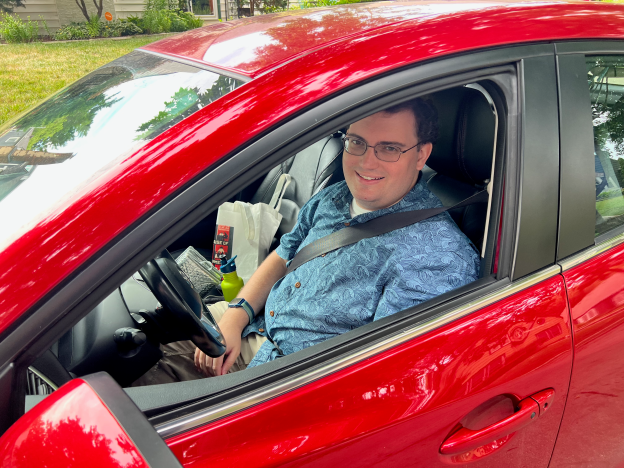
And yet, I wasn’t one who liked road trips all that much, something which changed out of necessity when I started making my 14 long drives east & west between Kansas City and Binghamton between August 2019 and December 2022. These long drives changed how I drive, and made me highly aware of what my car, which I’ve lovingly named the Mazda Rua, because it’s a red Mazda 3, does in certain circumstances. One of the greatest feelings when driving is when I get the sense that I can control the motions of my car with only the slightest movements, and when there’s a sense of connection between my thoughts and my car with my arms and hands as the conduits for that connection. In Binghamton, especially when I was teaching online and didn’t have many places to go to get out of my apartment, I would take long drives in every direction, just driving as far as I felt like I wanted to in a day and turning around. In one instance I made it east on I-86 (NY-17) as far as Hancock, NY in the Upper Delaware Valley, while in another I drove up the western shore of Cayuga Lake almost to the New York State Thruway at which point I decided to turn around and return to Binghamton for the night. I’d spend this time on the road listening to podcasts or audiobooks and exploring the world around me in ways I otherwise wouldn’t have done. I now know a great deal more about the Southern Tier and Finger Lakes than I ever would’ve otherwise simply by spending a weekend day driving around seeing what’s out there.

I’ve always known the speed limit to be more of the mark at which traffic tends to go, a number to aim for yet ideally not cross too much. Here in Kansas City, it felt reasonable to drive maybe 5 mph (8 km/h) over the speed limit but not much more than that. When I arrived in New York State, I was told by people I met there that it’s normal to go 10 mph (16 km/h) over the speed limit, and so I tried my best to keep up with the pace of traffic. It was even worse during my Longest Commute when while driving in Florida along I-10, I-75, and Florida’s Turnpike from Destin to Orlando when the traffic was moving closer to 20 mph (32 km/h) over the speed limit, and again I felt the need to keep up if only for my own safety. What struck me the most was that after the Pandemic the average pace of traffic in Kansas City has risen to 10 mph over the posted speed limit not only on the highways but in some cases on the larger city streets as well. I followed along at first, trying not to be run off the road by the more aggressive drivers tailgating me the entire way on Southwest Trafficway from Westport Road to 31st Street, for example, yet I knew that even then I would not have the reaction times I wanted and needed to be able to stop for the odd jaywalking pedestrian or animal, or other obstacle that fell into the street. Like that time a couple of years ago when I was driving on I-470 out to Lee’s Summit when I had to dodge a sofa that fell out of the back of a truck in the middle lane.

This stands in stark contrast to my experiences in other countries where the speed limits are adhered to as they are posted. As much as approaching a roundabout at 70 mph (112.65 km/h) in Milton Keynes was startling to say the least, the fact that my friend who was driving kept strictly to the national speed limit (and was driving a Tesla that has the breaking ability to slow down enough to make it to that roundabout) was a relief, if a bit of an anomaly in my driving experience. In some instances the posted speed limits don’t always make sense to me. In 2010, I was walking down a road in Gleann Cholm Cille, County Donegal, where the posted speed limit was 80 km/h (50 mph), which seemed far too fast for the width of the road in question. Now having driven in Canada, it seems even more silly considering the 401 Freeway which is the main highway in Ontario has a posted speed limit outside of cities and work zones of 100 km/h (62 mph). In what way does it make sense then for an old bóthar, a proper country cow-path in Donegal, to have a speed limit that’s only just lower than one of the highest trafficked highways in Canada? 

All of this got me thinking about how I drive here in America, and after I returned from this summer’s European tour, I found myself spending less time pressing down the accelerator and more time coasting; less time aiming for 30 or 35 mph (48 or 56 km/h) and more time enjoying and observing the neighborhoods around me, safely breaking for pedestrians, and not hitting animals.

On August 31st, the California Senate passed Senate Bill 961 which will require all new vehicles model year 2030 and beyond to have technology installed which will alert drivers if they are going more than 10 mph (16 km/h) over the speed limit. How this alert will function––an alarm bell, a verbal warning from the car’s computer, a vibration in the steering wheel, a slight electric shock to the hands––remains uncertain. Yet this bill made the national news because, like Wisconsin’s seatbelt requirement passed in 1962, it presages any federal legislation on the same speed limit technology. I know many people will be upset or angry about this legislation and will say that speeding is their right as an American, or whatever they will. I am in favor of the idea yet uncertain about the execution. For one, the 10 mph warning line ought to take local conditions into account, is the traffic around you going faster than 10 mph over the speed limit, and for all of us who will likely not be driving new model cars in 2030, how long until this law has such widespread effect as to be practical? Until earlier this year my Dad was driving a 1962 Ford F100 truck as his everyday car. My Mazda Rua is now 10 years old, yet it has always had a built in feature in the navigation system that will warn me I’m crossing the speed limit by turning the white speed limit sign on the screen red.

With all that I’ve written here about slowing down on the city streets, I still would probably drive faster on highways on intercity long drives, within reason of course. Today I don’t drive on the highways much, in fact I have a knack for actively avoiding the highways most of the time and taking the city and suburban street grid wherever I need to go in Jackson and Johnson Counties. Anywhere beyond that and I’ll usually have to get on a highway to at least cross the Missouri or Kansas Rivers. My point is that the circumstances of driving really will always depend on the moment in which I’m in. Here on my street, I’m happy to drive closer to 15 mph (24 km/h) instead of the 25 mph (40 km/h) speed limit. Perhaps the best we can do short of installing technology in cars that will slow them down to the speed limit, is doing the European thing of installing speeding cameras along all of our highways, roads, and streets which will send tickets by mail to anyone caught speeding. Here in Kansas City, Missouri our red light cameras were turned off in 2015 after the Missouri Supreme Court ruled them to be a privacy violation. These camera systems wouldn’t require officers writing tickets on the side of a busy street or highway. All that said, I don’t feel optimistic that the nigh libertarian political climate of either Kansas or Missouri will go for this.

That then leaves our speeding up to the individual drivers collectively creating a speed for the flow of traffic. I could say that this will help at least keep vehicles moving at roughly the same speed which will in turn keep everyone involved safe, but that again ignores the full impact of the human factor, my interpretation of chaos theory which I wrote about last week. At the time of writing, chaos might well be the best adjective for describing the streets and highways of Greater Kansas City. And that is proof, dear reader, that leaving the speed up to the individual drivers isn’t going to work.


The Flood

In the last week, I’ve learned about the impermanence of things after a flood struck our house. — Click here to support the Wednesday Blog: https://www.patreon.com/sthosdkane


In the last week, I’ve learned about the impermanence of things after a flood struck our house.


I had just finished writing last week’s blog post titled “Olympic Optimism” when I started to hear the beeping noises around our house. This usually was a sign that the power was being tripped in some place, or that one of our smoke or carbon dioxide detectors needed new batteries. I checked outside, it’d been raining for a while so perhaps the power lines behind our house had suffered some damage. Seeing nothing in the back, I turned to my left toward the door to our basement garage and opened the door.

Our garage tends to flood anytime there’s a heavy rain, but it will barely be enough water to cover the soles of our boots. Still, it’s often enough water to require work cleaning up the mess. We live in an old house; it’s century mark will come in two years, and the stone walls of our basement garage, common for houses here in Kansas City built through the middle of the last century, tend to seep water when it rains like that. This time though, there was something different about the water that I saw, for it could not have rained so much as to produce a flood some 8 inches deep to the point that the car charging in our basement was partially submerged. I shouted to my Mom, who was finishing her lunch as we prepared to go out for the afternoon, and she came over to me quickly at the sound of concern in my voice. The sight of it all gave me a sort of thrill at first, as I thought about how dramatic this all looked. 

I gently walked down several steps, not touching the water itself as I was sure there could be live wires submerged in that pond. I looked past the car and saw our trash and recycling bins on their backs floating in the surf. The entire basement was submerged, no part of it beneath that 8 inch mark was dry. I returned up the stairs, and went into my room where I kept a pair of snow boots that rise to a bit below the knee, and laced those up, figuring they were better than my usual shoes and went out onto our block to see what the damage was elsewhere.

As it turned out, the entire block on our side of the street had flooded. The city engineers arrived a while later and confirmed that the water main which they had replaced a year before had broken and flushed all of this sewer water into our basements on the downhill side of the block. The further down the hill, the worse it got. When we have disasters like this on my block, we develop a sense of solidarity. I remember the microburst of high winds, thunder, and rain in Spring 2018 that struck our street and toppled many of the trees on this block, crushing several cars beneath them, and causing considerable damage all around. We all banded together, and even some friends from neighboring blocks came to ours, as we learned which guys in which houses kept chainsaws handy. This time, we frequently wandered into the street at the same time, conferring how the damage looked in each other’s basements. There were other houses that had it a lot worse than us, for one our driveway neighbors’ basement was finished until this flood. Yet it wasn’t a difference between mopping up an inch of water in ours compared to several inches in theirs.

The damage from this flood was severe, destroying nearly everything that was on the floor. Thankfully, as of writing the car was deemed to be safe by its manufacturer, but so many other things were lost in the flood. Some of the last physical memories of my Donnelly great-grandparents were lost as my great-grandfather’s blanket chest partially flooded. I took photos of all the pictures we had to throw out, my eyes were the last ones to look upon the originals. Hereafter, we will have my digital copies, but it’s still not the same experience. My Dad lost plenty of power tools that he had collected over the last three decades and beyond. Many of my Mom’s personal mementos, her crafting goods, and gardening tools were lost as well. There was an old heavy wooden side table that my Dad bought in college which was ruined, and some wooden stools that I remembered from our first years in Kansas City that were also deemed unsafe. I found camp photos from my Boy Scout years in the 2000s that needed to be thrown away, all ruined by the flood.

In the days after I found myself drained of energy, beleaguered by a sense of uncertain loss. All of these things, I suppose, were tangible memories that I expected would survive until their materials degraded. We historians are able to study far older objects than the ones lost in this flood because they have survived long after their makers have returned to dust. Just two months ago, I was sitting in the Department of Manuscripts at the Bibliothèque nationale de France’s Richelieu building in Paris holding a volume that contained André Thevet’s handwritten translation of the Travels of Benjamin of Tudela. For the first time in the five years that I’ve studied Thevet, I got to feel paper on which he wrote his own name, on which the impressions of his hand and his thoughts could be seen. Thevet himself is long gone, his tomb in the Convent des Cordeliers likely destroyed during or after the French Revolution, yet there in that grand room I was able to touch something he touched, something upon which he left a part of himself with his words and ideas.

Any hope of experiencing that with these objects left by my great-grandparents, grandparents, parents, and by my younger self that were on the lowest level of storage in our basement are now gone. The experience spoke to me of the impermanence of the physical world, how as Persephone said to Orpheus in the Jim Henson retelling, “everything dies.” This past weekend, I found myself yearning for my childhood again, hoping that I might restore in my mind some of the memories of these artifacts that they might imprint themselves in my thoughts before my memory of them slips away. I could remember how those two wooden stools, light brown in color, felt when I sat on them for too long doing my homework or during meals. I could remember taking that camp photo with the couple hundred other Scouts from around Greater Kansas City and beyond, and how we all gave at least a half-hearted effort at the official photo before giving our all at the silly picture to come. The flood widened the gulf between this present time and all those things which embodied the memories of my past and my family’s past going back to the turn of the Twentieth Century. It made 2024 feel far more removed from 1924 than I’ve yet felt.The one good thing to come out of this flood, if anything, is that we can start anew and learn from the mistakes that led to such widespread damage this time. I expect there will be a next time, that same water main breaks at least once a year, though this is the first time it flushed sewage into our basements. I suspect we will not store anything on our basement floor ever again. Everything will be raised off the floor by at least 10 inches or more. I even suggested installing metal ramps strong enough to hold the car so that it too would never be susceptible to a flood like this again. That is the way of things: we are a reactive people; we see a problem and we don’t prioritize it until it hurts us. I wish we could be more proactive and avoid more of these problems, yet the trials and tribulations of life require that we learn from our experiences, and how can we measure the good moments of life if we haven’t experienced the bad?


Utopia Lost

This week, I have a short story for you that I wrote three years ago after the death of a dear friend. — Click here to support the Wednesday Blog: https://www.patreon.com/sthosdkane


This week, I have a short story for you that I wrote three years ago after the death of a dear friend.


How does one convince a civilization to accept it’s moved beyond the known and into an entirely unknown and new age? How does one convince oneself of this terrifying and very real fact? It takes loss, grief, and sorrow for humanity to recognize and embrace change, world wars, revolutions, or sudden bouts of violence to remind us that time continues ever onward. Yet for me, one guy living in this world moving along, strong, pulsing like the tempo in the fourth movement of Shostakovich’s Fifth Symphony, it takes something even more personal for me to admit one act in my life is ending, and that after a turbulent period of intermission that another will shortly begin. It often takes moving out of my skin, out of the comforts of my upper middle-class normality, my tree-lined block in my beautiful neighborhood in the heart of my city, out into places I’d never really desired to visit. And yet, after she died, I found the need to flee far from home, like Gilgamesh seeking a cure for death itself in the lands beyond the water.

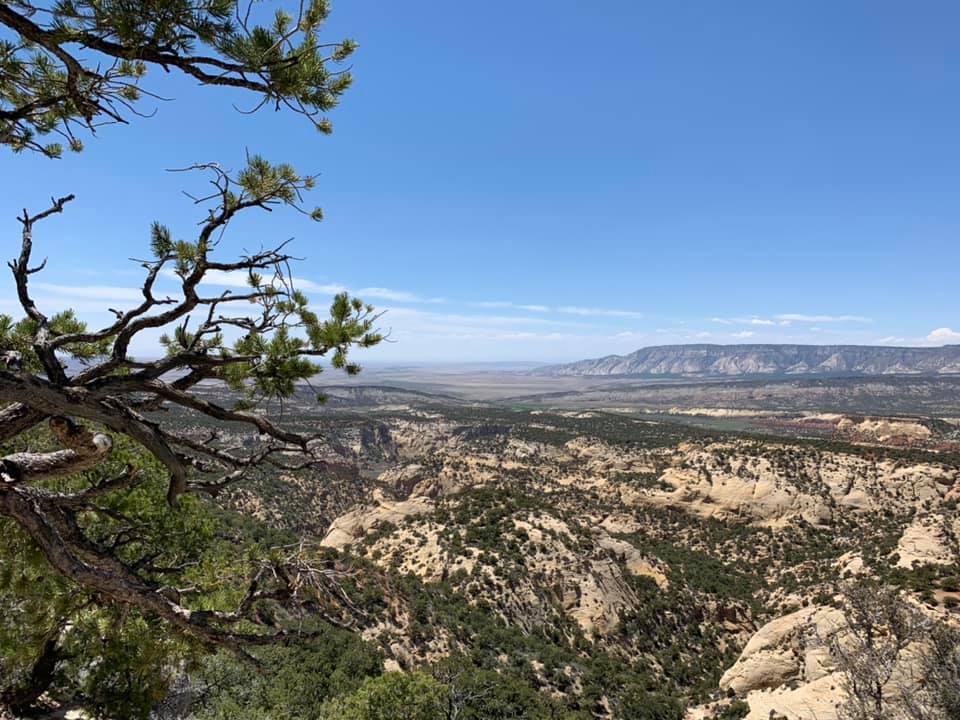
These thoughts danced through my mind as I stood atop the rim of a canyon, a thousand miles from home, in the high deserts of the Colorado Plateau, exposed and in the open; a danse macabre moving out of place in the desert setting of a Dali or Georgia O’Keeffe painting. I was struck by the silence of the scene, the extreme quietude that reminded me of many a hymn and prayer the Jesuits and Franciscans alike offered about finding God in all things. Nature certainly is God’s canvas, just as van Gogh understood it when he painted his own vision of that Creation, and just as I, a guy trying to understand grief had heard but never fully appreciated until I saw it for myself. The starkness of the desert, the browns, greys, and dusty oranges, seemed so different from the many shades of green, the vibrant spectrum of flowers that decorate the parks and gardens of my city. Yet it was there, in that environment, so far from home, that I felt drawn to. I’d been in the desert before, in Arizona, and found it lacking in beauty, seeming to be hostile, dangerous by nature, unbefitting for someone of my origins or health. Yet this desert, as alien as it was to me, seemed gentler in a way, less severe, more textured in its variety. Here where the Yampa River flows into the Green River, on federally protected land, the wilderness seemed to sing with all its resplendent harmony. Nature cried out on the wind as if to Elijah in a whisper, in its own language, its own song. I could recognize it, but I had a hard time understanding it. I, a city guy, knew only the manicured nature of my urban homeland. I knew the landscape that had been remade in the image of the Eastern cities and their European forebearers, a landscape of verdant trees and gardens which conquered the native prairie grasses in the wake of the settlers who conquered the native peoples who had called those prairies home.

I knew my home was artificial, and so it was not fit to help me through my sorrows. When she died, laying there on the veterinarian’s table, her face was calm, at peace; she looked as though she were having the best of dreams. Long suffering from a lack of tears, even when I wanted them, I felt as if I cried enough to fill the stormy Atlantic and more. She was my dearest of friends, the one who was always first to comfort me, the one who would go on adventures with me through the parks and along the trails. She was my companion at the sidewalk cafés, her with her water bowl and a couple treats, me with my tea and a pastry or two. Neither of our lives would’ve been possible without our artificial world, we were both born in an industrial, global, civilization, created out of the migrations of countless dogs and people from throughout the globe who would carry out a few begats until we were born in our own times. Yet even then, in her long life, her sixteen years of naps and treats and play, she saw our world change again from that industrial world of our forebearers into a world of the digital, a world where ideas were spread not on paper but on screens, where her favorite toys would inevitably come not only from the local pet shop and groomers, but often from some distant warehouse, a distribution center built to cater to the needs of millions, even billions of “consumers,” as we’d become known. To them, we were just numbers, her existence was acknowledged by the fact we purchased from the dog section, but her gifts inevitably were counted among my numbers. We’d created this world where if we really wanted to, and had the means, we could ensure that we would never wont for anything again. We’d created a world where instead of settling for the same old cooking shows that she loved to watch (she knew the names of all the foods), we could now tune into cooking shows from Europe, as I learned French, hoping she might pick those food words up too. I dreamed of a reality where we would always be together, where she would be as wonderful and dear a friend to my kids in the coming decades as she has been to me. Yet time marches on, and with it we age. Unlike Gilgamesh, I knew I couldn’t stop death, like the Swedish knight, I knew even if I kept the game going, eventually Death would reach checkmate, yet in my dreams at least she was still with me, still snoring next to me every night, still leading me from one blade of grass to another around the neighborhood as she sniffed for traces of her dog friends’ adventures.

In my dreams then, I hoped I might hear a familiar pattering of her paws on the rocks leading to the canyon rim, only to turn about and see her trotting over to me, tail wagging with glee. Perhaps a part of me truly believed if I went out into the desert, I might just see her again, if only in a greater clarity in my mind’s eye, in my memories. I stood there on the canyon rim, and listened to the silence, hoping dearly she was coming, wishing she could’ve seen that sight as I was seeing it that day. I could hear her snorting, and smelled that she needed a bath, something she was often proud of, though never appreciative of when she was bathed. Yet I knew, all too well, I wouldn’t see her again until I too had crossed the water, however distant that day would be. As much as I spent our days together worrying about the world around us, and what might well be beyond what we know, she spent those same days curious about few things, simple things, but most of all she was sure about love, and its importance and meaning. I understood it in those last moments before she died as she kissed my face for a final time. It was clear to me that as much as I could speak French when in Paris or Montréal, so too I could communicate with her, by letting her do “gross” things like jump on my chest and kiss my chin, or listen to her growl and whine at me, to let her have her say. I would reply each time, telling her “I love you,” and meaning it. Even if I was leaving the house to shovel the snow in the winter, I would look her in the eyes and say, “I love you,” so that she knew it well. She was as innocent as she was mischievous, her favorite game was running around the house with the end of a roll of toilet paper in her mouth, decorating the rooms and halls with that ribbon of white. It annoyed my family to no end, but I could see she was having so much fun doing it.

The desert, a place I traditionally thought of as dead, hot, lonely, seemed full of life, and while I could not see birds fluttering around the far rim of the canyon, I knew they were there. I could feel the breeze as if it were in part propelled across the chasm by the fluttering of many little pairs of wings beyond. It was as though they were singing their own hymn to being alive, to the radiant Sun in the blue sky, to the scrub and the rocks laid down there over millions of years. This place had seen many ages even before the coming of the first humans. To it, my little artificial urban island in the seas of prairie grass must have seemed both a cute human attempt at recreating nature in humanity’s own image, and a threat to the current vitality of the wilderness itself. Far overhead, the trails of passenger jets remained the only sign of the civilization beyond the canyonland before me. Sitting in those planes, focused on evading humanity’s worst bogeyman, a specter named boredom, the passengers surely didn’t notice what wilderness was below them, and if they did look out the windows, from 30,000 feet they would well have been at a loss to truly appreciate what they were speeding over on their way to the great cities of this country and beyond.

I thought of Elijah, hearing the Voice of God in the faintest whisper of the wind, and imagined what the Divine might say to me. Quickly though, unlike other daydreamed dialogues, I found myself at a loss for imagined words and banter, unsure of how to speak for such a concept as an omnipotent and omniscient God. Maybe then that’s the real beauty of Elijah’s experience, he heard God in a whisper because we humans can’t really understand what it even means to hear such a Voice. I tried fantasizing about it even more though, doggedly not wanting to give up too easily, and found myself afraid, scared at the idea of even hearing such words, the power and presence they would command would be the same that creates realities. The idea itself was but a micro fraction of a particle of a grain of sand when compared to the consequences of the Divine. My importance was duly minute, yet without my imaginations would I really recognize any of this? Would I hold out hope that my dog recently deceased would appear to me wanting to play there on the canyon rim knowing all I know about how this reality operates? In the great cosmic totality, I began to wonder how much her life really had meant. A little eleven-pound dog, who couldn’t put on a fierce face to anyone, or serve as much of a herder. If anything, she was best at being a friend, the best of friends. 

If her life had any consequence, I realized, it was in loving everyone and everything she met, in that unblemished innocence, that unconditional affection for life itself. She served as a role model of sorts for all the rest of us, especially for me, having lived with her for so many years. Even someone as little as her could plant a seed of love and charity in the minds of others that one day could restore the Utopia that seemed lost to me at her death. I stood there as the day continued on, and through the setting of the Sun, and watched as Venus, the evening star, rose overhead, bearing behind it the curtain of darkness that is the twilight and eventual nightfall. I was soon laying on my back on the canyon rim, not caring about the dust or the bugs, just awestruck at the sights above me as one star after another appeared in the darkening sky. The ancients believed the dead could be found among the stars, though my own ancestors passed down a belief of an earthly paradise on an island of eternal youth, something which as skeptical and scientific our world becomes, I still find myself believing in. If for nothing else, that light in the darkness of even the emptiest of cloud covered nights has kept me warm company in my thoughts. From that far distant island I thought I could hear her calling, her bark and wagging tail inviting me to come, but in my own time, not too soon. Even in this most dystopian of days, I thought, tears streaming down my cheeks again like on the day she died, there is still hope to be found, utopia restored, after all behind every cloud glows the light of some distant star. I laid there looking up into the starry night, through my tears singing a song I used to sing to her, hoping, believing, knowing somewhere she was listening.

Someday, however soon or far, I knew I’d see her again, once the boatman calls upon me. Funny enough, for someone who enjoys life as much as I do, the simple belief that I will see my dearest and sweetest of friends again is enough for me to look forward to that reunion across the water on the far shore.


An Election Year Independence Day

An Election Year Independence Day Wednesday Blog by Seán Thomas Kane

This week, I’m writing to you with this week’s holiday in mind, with some of my aspirations and hopes for America. — Click here to support the Wednesday Blog: https://www.patreon.com/sthosdkane

This week, I’m writing to you with this week’s holiday in mind, with some of my aspirations and hopes for America.


While I have colonial ancestors who settled New Haven, Connecticut and Newark, New Jersey, and who at the time of the American Revolution were living in Pennsylvania, Maryland, and North Carolina, I more closely associate with my recent immigrant ancestors. I’m one of those hyphenated-Americans who holds onto elements of a culture and identity that transcends the Atlantic and provides connections not only to this country but to the places where my ancestors came from. One aspect of the political philosophy of American nationalism that I don’t agree with says that you have to conform to a particular American identity when you come here. My ancestors did that, to varying degrees, and I’m more American than anything else, yet it’s all those other elements that give our Americanness its richness of character.

So, when I think of the music that embodies the soul of America, it’s music written by a fellow hyphenated-American, Aaron Copland, the dean of American classical music. When I tried my hand at musical composition in college, I wrote a four-movement trio sonata that told the story of a voyage from Ireland to America by St. Brendan and his monks in the sixth century. My addition to the fable was to have the tone of the music switch from being very Irish in the first and second movements to taking after Copland’s sound in the third and especially the fourth movement as they reached this side of the water. I’ve long wanted to write a blog post all about my admiration for Copland’s music, but thanks to the copyrights on his recordings I’m waiting for a few more decades. For now, go listen to Appalachian Spring and Rodeo after you’re done listening to, or reading, this.

Copland’s music speaks to me now in 2024 especially as we approach an election year. This is the most sacred task that we American citizens fulfill in our obligations to our republic: we do our duty by voting for whom we want to represent us on all levels of government, and on the host of ballot measures found further down-ballot. This election feels far more pivotal than any we’ve seen in my lifetime. For context, I was born exactly one month before the elder President Bush stood aside for President Clinton. While I may have disagreed with the policies of both Presidents Bush, they still seemed to be decent men. It’s hard to say that this year about one of the two candidates who flooded Thursday night’s debate on CNN with so many half-truths and outright lies that the network did nothing to check live on air. I was baffled watching it to think that the network’s executives and news directors didn’t choose to lay out better safeguards considering this is the same man whose rhetoric and refusal to admit his loss in 2020 led to the storming of the Capitol on January 6th, 2021.

When I think of a President who I want leading our country, I think of Copland’s Fanfare for the Common Man.I want someone who best represents the best ideals of America, someone who can speak with all of us and for all of us. I hope for someone who can work with Congress and the states to execute legislation that will lead to an overall improvement in our national well-being. I was disappointed to see the President perform so poorly during the debate on Thursday, yet of our choices this year he is the closest to embodying that ideal of the common man.

This year’s election is not politics as usual, there are deep intrinsic questions at stake over the future of our country and what sort of government we want to have. I was deeply unsettled to read the transcript of David Brooks’s recent interview with Steve Bannon, who Brooks called a Trotsky-figure for the MAGA movement. From the interview, and from the way Bannon positioned himself as a leader of that movement, he made it clear that there is no room for communication with their political opponents, who Bannon termed in a far more affrontive manner as their enemies. That is the most essential element of good government, something that all the great political philosophers recognized: we need to be able to communicate with each other and grow together as one body politick made up of a great many parts. I’ve seen the same problem on the left as on the right, a disinterest in listening and in compromising to achieve a higher ideal or a common good that will benefit everyone. Yet the greater threat is coming from the faction who’ve gained enough sway that they now control their party and their leader is again a candidate for the Presidency.

This Independence Day, Americans around the globe will celebrate the invention of our republic from an ideal written on paper during a hot and humid Philadelphia summer 248 years ago. I’ve heard it said that that was the first time that anyone thought to write down the idea that “all men are created equal.” Think about that for a moment: that was the first time that the notion of universal equality, or better universal equity, had ever been considered. The President is the President, and I respect him for serving in that office as I feel respect for the office itself. It is a monument to self-sacrifice when done well, and a trap of self-aggrandizement when the oath is taken for the wrong reasons. Yet when a sitting President leaves the office on Inauguration Day, they may still be Former President, but they are now again just another citizen who’s offered to carry that mantle in the relay until the next candidate will take it up.

The burdens of preserving, protecting, and defending the Constitution of the United States are greater than one person can carry on their own. The office holder ought to have us, we the people who come first in the Constitution, supporting them as long as they keep their oath, and do their duty for as long as their term lasts. It is a humbling thing to serve in such an august role. It is something that truly should not be taken lightly, or brought on by a candidate for any other reason than for service.


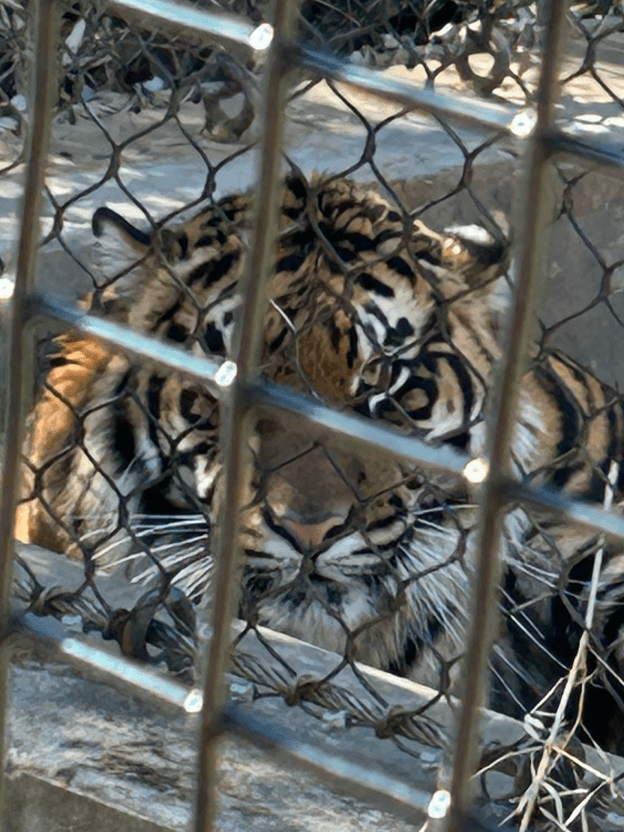
A tiger staring at the camera through two fences.

A Tiger in the Sun

This week, I have a short story for you, in the style of an Irish aisling, a dream narrative, about a tiger basking in the warm February sun. — Click here to support the Wednesday Blog: https://www.patreon.com/sthosdkane


This week, I have a short story for you, in the style of an Irish aisling, a dream narrative, about a tiger basking in the warm February sun.


On a sunny, warm, and blustery day in February I left my desk in the afternoon for a walk at the city zoo. You could never really know how many warm days you’d have in February on the prairies, a time of snow, cold, and gray skies. I showed my member’s pass at the gate to the clerk and strolled between the polar bear’s wide enclosure and the lorikeets’ walk in cage towards the penguin house where I often liked to stand quietly and watch the birds waddle and swim about. There was something wistful about these penguins today, their black and white feathers glowing with a renewed exuberance from the lengthening days outside. I’d seen these penguins in all seasons, confined to their Antarctic chamber with many good places to swim, enclosures, and crevices that even I hadn’t seen. Worlds still unfamiliar to my eyes yet already known to my imagination which saw places where these birds could play and rest away from human eyes.

I left the penguins and began to walk further into the zoo towards the Asian and Australian animals who I hadn’t seen in my last few afternoon visits. I’d read that a new pair of Sumatran tigers had been brought to the zoo from another facility on the West Coast where they’d been born into captivity. These animals it seemed had a comfortable life, if confined as they were from the wilds their ancestors had once known. My walk took me past the alligators still hidden indoors and the camels who wandered about the edges of their sandy glade looking for new grass and leaves to eat. 

After passing the pelicans I came to a grand sign displaying a portrait of a tiger, in all its majestic ferocity. The entry to this Asian walkway was marked by a fleeting glimpse of another red, black, and white animal whose furry legs and tail darted behind a wall to my left. I walked onward and rounding the wall met a red panda on a stroll within the confines of its fenced enclosure. I stopped to look at the red panda who climbed a gangway that’d been set up for its enrichment and admired its ease of movement, the jolly grace of its demeanor. Yet still, the hairs on the back of my neck stood tall, alert. I knew the tigers dwelt behind me, yet they could’ve been anywhere in their terraced enclosure. I turned and caught the yellow eyes of a cat staring back at me, its orange nose wreathed in a beard striped black, orange, and white. This new tiger was smaller than I imagined, perhaps little older than a cub. It lay there on its side like my own cat often does, finding a nice place at the highest point in its home with the sun’s rays glittering down upon its neck and back between the barren branches of the cottonwood grove which towered above both feline and me.

I stood stock still, my nature sensing some intrinsic danger in my situation despite the double layers of fencing between us. This was a tiger after all, a hunter who if in the mood would gladly seek prey from either myself or its red panda neighbors across the path. Who was I to say I was any finer a creature than this one, who was lounging the afternoon away in the warm winter sun. It had no need of work or time; no economy or politics furrowed its brow. Here was a creature free of all our worldly concerns in its terraced enclosure. I would soon have to leave this tiger and continue on my way. My walk in the zoo was merely a distraction from my labors, an escape from the small walled enclosure of my desk where Sisyphean work awaited my attention. What time did I have to lay out in the sun and cherish the day? I walked on, my body moving back towards my work, yet my imagination remained. I dreamed as I walked of adventures I might have, greater escapes from my work, and of absconding for more than an afternoon from worry.

As I rounded the corner past the lower terrace of the tiger’s enclosure my phone began to ring. I pulled it from my pocket and caught myself seeing the number, “213, who’s calling me from Los Angeles?” I answered, looking up towards where the tiger lounged high above me. “Hello?”

            “Hello, I’m calling you about your application for the archivist position at the Space Science Center.”

            “Oh yes, how may I help you?” I asked reflexively, a knot building in my throat worried at what word might come next after so many rejections.

            “We would like to offer you the position here, if you’re still interested.”

            I caught myself in my jubilation, remembering I was in public, “Oh!” I cried, “what wonderful news!”

            “So, you’ll take it?”

            “Yes,” I stopped myself from being too exuberant, “It would be an honor to work with all of you there.”

            I thought I heard a smile from the other end of the phone. “I’m glad to hear that. Can you be here later this week to start?”

            “Later this week?” I asked, stopping in my tracks near the entrance to the kangaroos’ enclosure.

            “Yes, we’d like you to take over the work from our outgoing archivist who’s retiring at the end of this week.”

            I looked at my watch, it was nearly 3 ‘o clock in the afternoon. “Well, it’s Monday now, I can be there on Friday morning if that’d be alright with you.”

            “That’d be fine,” the herald of good news replied over the phone. “We’ll see you on Friday morning here in Pasadena.”

            “Thank you again!” I said as I heard the phone on the other end hang up. “Friday, Friday morning in Pasadena. I need to start packing,” I turned from the kangaroos and was about to walk past the building ahead when I remembered that path was closed for winter renovations. I turned back again towards the gate and strolled through; my head held higher than before with a newfound exuberance. Soon I wouldn’t be scraping by just as a freelancer, my four part-time jobs would have to go. Now, I could really earn enough to begin living my life.

I passed the Australian birds in their walk-through enclosure and was amused to see they were all standing stock still on various fenceposts. One squawked at the world, in what seemed to me a jubilant chord of praise for the wonderous afternoon sun.

If I was going to be in California on Friday morning, I would need to leave at dawn tomorrow. I could drive to Denver on Tuesday and stay at my cousin’s house there, if he’ll have me, and then cross the Rockies and the high deserts on Wednesday. I’d driven most of that route before one summer vacation several years ago, but the Rockies in winter would surely be an entirely different challenge than they are to cross in summer. The last time I drove through the Eisenhower Tunnel that bored its way beneath the Continental Divide I waited to use my breaks for just a few seconds too long on the western side and nearly ignited them in their furious efforts to slow my car down as it pulled into a parking spot along a creek in the village of Silverthorne. Should I get my snow tires out then, and have those on in case the interstate was slick up in the mountains? But I wouldn’t need them once I reached Utah where the high deserts would surely be dry, and possibly still hot despite it being February.

Once in Utah, even if my tank was nearly full, I would still stop in Green River, the last town before nearly 125 miles of open desert to ensure I wouldn’t run out of fuel on that other most dangerous part of the trip. I’d avoided that part of the interstate last time, taking a smaller high mountain pass through Central Utah. This time though there was no avoiding the desert. Once I made it to the junction with Interstate 15, I could turn south and make my way to my second overnight stop in Las Vegas. I figured I might not be the only traveler passing through Sin City who wasn’t there to gamble or for the spectacle. Then at last, on Thursday, I would finish with the last leg of the drive southwest across the California border and to Pasadena where my future awaited me. Work, to be sure, was something that drove me forward, the aspiration that I might make something of myself, that I might better my stars and spend my days doing something that both kept the lights on and fulfilled my dreams.

Like the tiger, I would perhaps have time to rest in the sun, to enjoy the afternoons on a park bench near the science center. Surely in California, I would never have to shovel snow again, or scrape the ice off my car in the cold January mornings. Wasn’t California where that tiger was born? I thought about that for a moment as I walked along the path. To my left the local kangaroo mob lounged and grazed on the grasses of their meadow. A kangaroo stood and stared at me. I warily watched it, silently snapping a photo of it with my phone, and continued on my way, keeping ever a respectful distance from those remarkable creatures.

But what of my cat? How would she fare the long voyage west? Would she appreciate so much time in the car? She’d never been one for car rides even to her vet just a few blocks away. Perhaps she’d rather stay with my parents, they always enjoyed her company and she theirs. She was surely napping now too, finding a sunbeam somewhere near a south-facing window where she could enjoy this lovely day like her far larger yet far distant cousin. It would be a great change for my cat, as much as it was for me. We’d have to travel light, perhaps I could send for the rest of my belongings, especially my books, after we settled into our new abode. 

I paused at the southern gate leaving the kangaroo enclosure. Before me one of the camels stopped its grazing to stare back at me as I stood there, deep in thought. I could see my life in California well. I’d probably get a space in the basement of the science center, somewhere with no natural light where they kept their records. My domain would exist in the deep darkness there, somewhere I could make my own. Maybe I’d be far enough away from the rest of the staff or the general public to bring a radio in and listen to baseball games during the season like my grandmother used to do in her kitchen. There’d always be a part of me that would yearn for home of course, for the prairies and woodlands of the Midwest. Who would I be without this place that I came from? What would my life be like so far from everyone I know and love? Could I really separate myself off, devote my working hours to a place where few would understand what it meant to be from here, where few would understand me?

My mind returned to that tiger lying there in the sun, content with its lot in life. There was a creature that could try to hunt and prowl, perhaps it did so in its dreams. What are dreams but the longings of the subconscious? I’d always been a dreamer, an imaginer of wonders near and far from the truth. Do dreams then tell the truth, or is there such a thing as truth in the surreal realm which we imagine? I remembered a story I read as a child, from P.L. Travers’s original Mary Poppins novel, of a scene in which the roles were reversed and all the animals of London Zoo were gawking at the humans in the cages. Was fantasy so different from reality that it could not be informed by the real but instead kept unreal? 

I felt I had to return to that being whose yellow eyes had so deeply captured my thoughts that even now as I planned the monumental voyage of these coming days, a week spent crossing half a continent in winter, I couldn’t shake the image of those deep yellow eyes. I followed the path back towards the tiger sign that greeted visitors to the Asian footpath and ignored the red pandas in all their charm and found my captor laying there still. Those eyes caught mine again, and they seemed to recognize me from only a few minutes before. In those eyes I saw a truth that life was meant to be enjoyed, to be lived, yet in my eyes I was sure the creature could only see fear and wonder. Without these fences we both knew those yellow eyes would be a death sentence for me and that my power was devised in only the most artificial of means. The tiger was the real power, the true monarch of our shared domain. And yet it blinked at me, slowly, a signal that my own cat offers when it feels comfortable around me. Could this tiger feel at ease in its enclosure or is its ease perhaps from its inherited knowledge that nature gave it the upper hand over feeble, clawless, scaleless, featherless, furless me.

I didn’t feel the need to speak, this tiger could understand my expressions. I gazed into those eyes deeper, feeling my thoughts free fall into that yellow sea of potent grace. Did these eyes envision things like mine did? Could this tiger see things unknown to it in its dreams? Could it imagine a Creator? Would I still feel such a connection when I retired from my native place to that basement archive where surely, I would spend my waking hours? I wasn’t sure that the adventure of it all would be worth the query, yet I felt my nature pull me towards exploring further and deeper. I heard a noise from before me, a deep hiss emanating from a striped sea of orange, black, and white. The tiger had enough of my gaze, and with a hiss told me enough, “move along, leave me be.”

I backed out from the tiger’s view and turned away, looking to the red panda who seemed unfazed by the hissing hunter across the way. Move along indeed. In this adventure I’ll learn more about myself, and what I am capable of. When I reach the end of the line on this drive, when I arrive in California, there will surely be many new possibilities and wonders to behold. How often had I experienced a warm, sunny day in February here on the prairies? Wonderous things remained for me to find beyond my desk. I walked back to the front gate of the zoo and felt something new inside of me glow with confident glee at the thought of all that was to come.


Inferno

A while ago, I began reading Dante's Divine Comedy. So, over the next three weeks I will be writing my own reflections on each of its three parts. This week then, I begin with the Inferno. — Click here to support the Wednesday Blog: https://www.patreon.com/sthosdkane — Dante: Inferno to Paradise, https://dantedocumentary.com The Blues Brothers, "Everybody Needs Somebody to Love and Sweet Home Chicago," https://youtu.be/FrLZoQUl2mQ?si=g9rLDM6ZPM7tXJ97 Molly Fischer, "The Tyranny of Terrazzo: Will the millennial aesthetic ever end?", The Cut: New York Magazine, (3 March 2020), https://www.thecut.com/2020/03/will-the-millennial-aesthetic-ever-end.html Ian McKellen's performance in Macbeth "Tomorrow, tomorrow, and tomorrow" speech (5.5.17–28): https://youtu.be/4LDdyafsR7g?si=3qgAmsaKW6oKJKXq


A while ago, I began reading Dante’s Divine Comedy. So, over the next three weeks I will be writing my own reflections on each of its three parts. This week then, I begin with the Inferno.


Three years ago marked the 700th anniversary of the death of the great Italian poet Dante Alighieri, the author of the Divine Comedy, whose Tuscan dialect is widely regarded as foundational for the modern standardized Italian language taught today. I will write at length about language standardization in the future, if I haven’t already, yet today, dear Reader, I wish to address his Commedià itself. Around the time of his great anniversary, the Center for Medieval and Renaissance Studies (CEMERS) at my university held a variety of lectures concerning Dante. In one such instance, I became critically self-aware of the fact that I was likely one of the few people in the room who had not read the work.

I finally got around to reading the Commedià in the last month when a new two-part documentary on the life of Dante aired on PBS. I realized then that even though I hadn’t read his magnum opus, I still knew a great deal about it because of how closely tied it is to my Catholic culture. The concepts of Hell, Purgatory, and Heaven as I grew up understanding them have clear support from Dante’s vision of these three realms. Yet like Dante, my own vision of these three is just as drawn from far older classical and biblical sources. He recognized the importance of connecting the beliefs of his own age with those that they replaced.

This is a point I made in conversation with a friend and fellow historian: Dante was a man of his own time. In his moment, it is fitting to see the great classical heroes, philosophers, and poets resting on the outer most layers of the Inferno because they had no introduction to God during their lives. Even more unsettling is his placement of the Prophet Muhammad within the eighth circle’s ninth bolgia as one of the “Sowers of discord.” Again, this fits in Dante’s own time and place, living at the same time as the Crusaders lost Acre in 1291, nine years before when the Commedià is set.

The Inferno is proof of four great truths which I wish to discuss in the remainder of this week’s post. The first of these is that faith often requires trust in more tangible things that one can see and touch and most importantly imagine. This past weekend on Trinity Sunday, I was moved by how my pastor––Fr. Jim Caime, SJ––described his relationship with the Trinity in his own prayer life. I believe in the Trinity, though what draws me towards that belief at this moment in my life is an appreciation for the mystery of the Trinity. It’s funny there, I appreciate the mystery of the most important doctrines of the faith yet when it comes to things that are more tradition than anything else, my faith is still built on a foundation that is strikingly tangible in its nature. At times I’ve thought that superstition might stick with me more because it’s something that is more tangible and everyday than some of the more metaphysical elements of my Catholic faith. Faith needs to be lived in “to live, thrive, and survive” in the words of the great Elwood Blues.

Second, I’m not a fan of iconoclasm. Culture is built by individuals yet adopted by communities. We live in a present moment which is layered upon the past. In those layers we can see bygone moments, years, decades, generations, centuries, millennia, and ages when our past thought something they made was worth cherishing even for a moment. Everything from the eternal grace of the great monuments of human endeavor, and our striving for greater truths is just as central to these ringed layers that form our culture as are the passing fads that come and go year by year. An article I read over the weekend in New York Magazine‘s style outlet The Cut about the millennial aesthetic that has defined the tastes of my generation in the last decade asked if “the tyranny of terrazzo” will ever end. The article concludes with a foreboding of the dominance of bright yellow among the style choices of our successors, Generation Z. I for one felt a similar sense of dread the last time I went clothes shopping at Target only to discover everything in the menswear section was geared to younger generations than my own. I continue to shop at Macy’s when I’ve gotten a nice paycheck and Costco when my parents are around with their membership.

If you’ll pardon that digression, the iconoclastic spirit would burn down the terrazzo of my generation’s invention and inspiration and would replace the soft hues with new and reactive bright colors. It would respond to decades of slow burning negotiation and working within the status quo with a fierce clamor to fight and resist even if the odds aren’t in your favor that your resistance will do you any good in the long run. I’ve been there and found that sort of thinking didn’t accomplish much and so settled for Dr. Franklin’s approach to change, make friends with as many people as possible and nudge them to do things you think important. In this light, my vote tends to be cast for more moderate candidates than my own views, and I’ll freely admit my own views on issues have changed with my own changing sense of frustration and irritation towards others whose voices are perhaps projected louder than necessary through social media.

So, I appreciate how Dante kept the voices and spirit of the pre-Christian past alive in his Inferno, that he was guided by the great poet Virgil, whose Aeneid I became quite familiar with in my senior year Latin IV class (Grātiās tibi agō, Bob Weinstein). It never seemed strange to my faith that the old faiths of Europe or any other religions could also exist within our understanding of Heaven, Hell, and all the rest. Again, Dante was a man of his time and his place, so to fit in the great heroes of Ancient Greece and Rome into his vision of the afterlife is only natural. Iconoclasm only harms us and our posterity by robbing all of us of the riches of our past and the finest parts of the great human inheritance. The iconoclast’s tradition to destroy what came before will only lead to their own destruction in turn by their posterity. Third, as powerful some may be in life it is the writers who will preserve their memories for eternity. Chaucer and Dante both preserved the memories of their enemies in a way that has led to the survival of those men’s names. Yet their names are not spoken kindly, so the world would do well to heed the power of the pen. They can live long beyond their memory ought to have otherwise. While more ancient stories began and lived for generations told orally and remembered from that recitation, we now in our learned state require things be written if they are to be remembered. In Shakespeare’s words, written for the Scottish King to utter upon news of his wife’s death:

She should have died hereafter;

There would have been a time for such a word.

— To-morrow, and to-morrow, and to-morrow,

Creeps in this petty pace from day to day,

To the last syllable of recorded time;

And all our yesterdays have lighted fools

The way to dusty death. Out, out, brief candle!

Life’s but a walking shadow, a poor player

That struts and frets his hour upon the stage

And then is heard no more. It is a tale

Told by an idiot, full of sound and fury

Signifying nothing. (Macbeth 5.5.17–28)

The writer helps human memory survive long after each generation is gone. Before our carbon dating or genetic coding of the remains of beings now dead, writing remains the original technology by which we recorded our nature and taught our learning, and dare I say our wisdom, to those who come after us.

Fourth, I admired how Dante cast himself as both observer and listener to the plight of the damned. In every circle he chose to stop and ask the souls he encountered their names and to tell him about their lives and why they were where they ended up. This more than anything else is a model we ought to emulate, as I’ve written before here, we ought to listen to each other more. I believe this would solve a fair number of the problems we face in our lives. Pope Francis’s message from the balcony after his election eleven years ago echoed this sentiment when he simply asked that we pray for him as he began this new ministry in his life. This is something that I want to get better at; I am so used to my own solitary company that I often have to consciously remind myself to make smaller gestures of gratitude toward the people around me.

Dante often offered to speak to the loved ones of those who he recognized on his journey through Hell or to pray for their souls. Yet where I saw the greatest pity was at the bottom circle when he beheld the three great traitors of his world being devoured by the heads of the Devil: Judas Iscariot, Brutus, and Cassius. After reading this Canto, I wondered if the Inferno were to be written by an American who might be our three great traitors? Yet here my own beliefs divert from Dante’s, as I find it distasteful to say with any authority what the spirituality of anyone else might be.

I recently finished listening to the most recent Star Was anthology book From a Certain Point of View: Return of the Jedi which is a collection of stories told from the perspectives of minor characters who appear in the film in question. One of the last stories was the main one I was looking forward to the most. It was from the eyes of Anakin Skywalker after his redemption from 23 years living under his evil alter ego as Darth Vader. What struck me here was that despite everything Anakin did in his life, the Force and his best friend Obi-Wan Kenobi, whose force ghost beckoned him into the next life, forgave him. I don’t claim to have any authority over whether one person or another ended their life in one state or another because of the power of forgiveness. Forgiveness is a deep expression of love that we ought to express and inhabit more. Forgiveness it isn’t something that necessarily came naturally. Most of the bullies I faced in my childhood got a silent response from me later in life. I’m not proud of how I’ve reacted to certain people and situations in a way that echoes my own fear and anger, because I know I can do better. Fear isolates us from love, after all.

As I continue reading, I’m eager to see how Dante grapples with forgiveness and with the love that fuels it. I for one am eager to climb from the depths of Hell alongside Dante and Virgil onto the slopes of Mount Purgatory, a cantica which I expect I might allow myself to read in my usual pre-bedtime hour. I chose to spare my dreams of the Inferno, figuring I give myself enough nightmares of my own invention as it is.

Next week then, I will write to you about the Purgatorio and Dante’s climb towards the climax of his literary life.


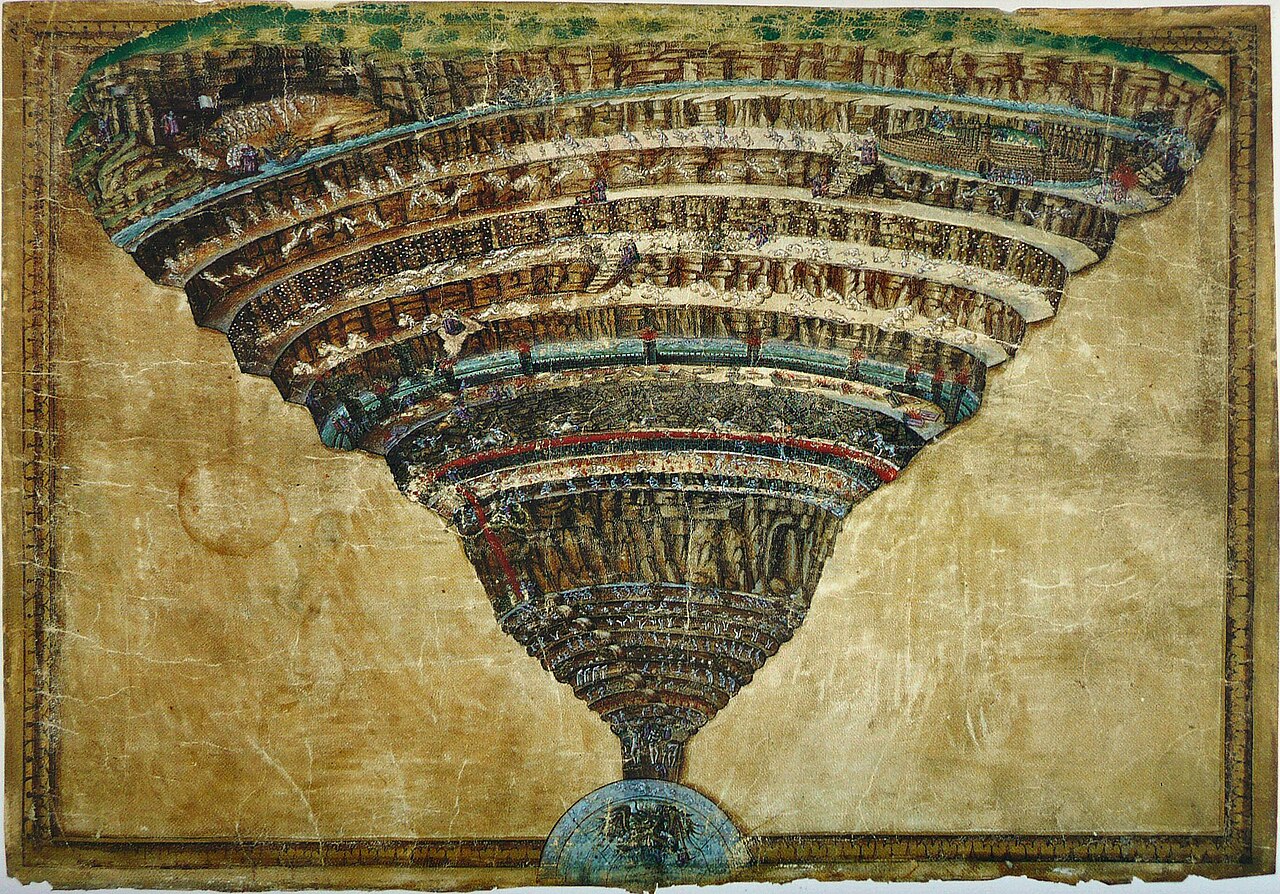
Dante’s vision of the circles of Hell.

The Promise of Hope

Last week, the 7th of May 2024, marked the 200th anniversary of the premiere of Ludwig van Beethoven's Symphony No. 9. Today then, I want to talk with you about the hope which runs through that Ode to Joy. The recordings of Beethoven's Ninth Symphony heard in this episode came from the 1956 album by the ProMusica Symphony Orchestra and Chorus under the direction of Jascha Horenstein and are free to use under the Public Domain Mark 1.0 Universal label and can be found in full at archive.org. — Click here to support the Wednesday Blog: https://www.patreon.com/sthosdkane

Last week, the 7th of May 2024, marked the 200th anniversary of the premiere of Ludwig van Beethoven’s Symphony No. 9. Today then, I want to talk with you about the hope which runs through that Ode to Joy.


Last time on the Wednesday Blog, I wrote to you in what I hoped would appear to be an optimistic tone that still acknowledged the troubles and trials I find before me, and to an extent I think that worked. While I did not intend to write a sequel to that post, this week’s topic is one which fits well enough, and which I feel quite fervent about as to warrant mention here in the Wednesday Blog.

I began to explore the world of classical music around the time I started high school. Quite honestly, my big introductions were the music of George Gershwin and the original cast album of Phantom of the Opera. Yet around that time I was introduced to an ensemble called the William Baker Summer Singers and joined them for the 2008 season when we performed Beethoven’s Ninth in Grace & Holy Trinity Cathedral in Downtown Kansas City. I was not the best singer by a long shot, still very new to the whole experience, yet it was the start of my off-and-on tenure singing with choirs around Kansas City.


The first measures of the 1st Movement

Beethoven’s Ninth thunders into life with the opening measures of its first movement, as though the hope and joy which makes this piece so famous is born from something elemental deep beneath the ground, rising out and toward the audience with the orchestra as its first voice. This then makes the chorus out to be some even deeper root of the spirit of this work, its power growing throughout the first three movements leading up to the tremendous clamoring second movement. I’ve always imagined the second movement told the story of a fast paced and clattering horse and rider making their way through fields and farms to pass on good news to some learned recipient.

The third movement is far softer than the first, yet again it speaks to something grand as yet only being revealed to the audience. There is a sense in the third movement of a fundamental truth as of yet untold, whose voice could raise both the living and the dead to new heights of human dignity and grace. Through music, Beethoven captured the full spectrum of human aspiration and expressed our innate confidence in our own abilities to improve our lives. It reminds me of the “Et incarnatus est” movement in Beethoven’s Missa Solemnis, which is written in the Dorian mode, giving it a distinct feeling of rising from a deep ether into the light of a new day. The Missa Solemnis was also written in 1824, premiering on the 7th of April of that year.


The 3rd Movement’s climax

I hear something inherent in Beethoven’s optimism, that even with all the troubles of his life there near its end he could still dream that we might become better versions of ourselves. The tempo marker for the first movement Allegro ma non troppo e un poco maestoso (Quick but not too much and a little majestic) might well be a good motto for life; a good life ought to be taken at a fair pace, yet not too fast, and with some majesty for one’s nature. We can hope for something better because we are born with minds capable of dreaming of better tomorrows.

At the heart of the Ninth Symphony and in particular its choral fourth movement is a fairly simple melody, one that I learned quickly during my time rehearsing it. That melody has taken on a life of its own beyond Beethoven’s original composition and become something ubiquitous in many respects. There are two church hymns set to its tune in the hymnal we use in my current parish choir, “Joyful, Joyful, We Adore Thee,” and the slightly more modern, yet traditionally formal, “Joyful, Joyful, We Adore You.” What I love about this melody is that it is easy to learn, easy to adapt, and so upbeat.


The Ode to Joy theme from the 4th Movement

The words which Beethoven set to that tune were written by the German poet Friedrich Schiller (1759–1805) in the summer of 1785. They are an outgrowth of the Enlightenment and the fervent calls for acknowledging our common humanity that grew from this reassessment of our relationship with Nature. Those words speak volumes to me, that joy makes brothers and sisters of us all, revealing our original state of nature to us amid all the nebulous fog of our lived expectations. It’s easy to forget that beneath all the mantles of identity we hoist upon ourselves that we are all the same in our life and yes in our mortality.

There is a deep promise here that with hope we can accomplish tremendous things. Hope alone will not solve our problems, we will always need to act to improve ourselves and our communities. True hope, pure and fulfilling hope, is such that it requires we all act together to our common benefit, that we think of each other more than of ourselves. I have such a hope in humanity, after all I’ve seen moments in my own life and in our history in which we’ve come together to work for a higher purpose than any one of us. Again, quoting from Schiller’s poem:

“Seid umschlungen, Millionen!
Diesen Kuß der ganzen Welt!”

            “Be embraced, all ye millions!

            With a kiss for all the world!”

This promise of hope is something that is sacred because it offers us a chance at redemption no matter how terrible the things we may have done. There is something truly divine about it, that we can become better versions of ourselves not in spite of who we’ve been but rather because we are willing to improve who we are and how we live with our neighbors.

That is a promise that I hope we can fulfill.


The recordings of Beethoven’s Ninth Symphony heard in this episode came from the 1956 album by the ProMusica Symphony Orchestra and Chorus under the direction of Jascha Horenstein and are free to use under the Public Domain Mark 1.0 Universal label and can be found in full at archive.org.


The Art of Joy

This past weekend, the Nelson-Atkins Museum of Art debuted a new retrospective exhibit on the life and work of Franco-American artist Niki de Saint Phalle. One of her great initiatives was to express rebellious joy in her art, especially later in her career. — Click here to support the Wednesday Blog: https://www.patreon.com/sthosdkane


This past weekend, the Nelson-Atkins Museum of Art debuted a new retrospective exhibit on the life and work of Franco-American artist Niki de Saint Phalle. One of her great initiatives was to express rebellious joy in her art, especially later in her career.


I wasn’t familiar with the name Niki de Saint Phalle (1930-2002) before the Nelson-Atkins Museum of Art announced they would be hosting the first American retrospective exhibition of her work, yet having seen aspects of it, particularly her Nanas, I find that I do remember seeing these around here and there. The exhibit begins with her early work, highlighting her tirs paintings (1961–63) which involved her shooting paint-filled collages of popular material objects each with their own cultural meanings, until they bled their paint out. I found these hard to appreciate, the violence at the core of these pieces and the claustrophobic nature of their assemblages filled me with a sense of dread.

Yet, it was the latter two thirds of the Saint Phalle exhibit which I returned to, the section radiating and erupting in light and color in a manner that felt welcoming and brilliant as though it were made to bathe in the warm rays of the Sun. These portions of the gallery were filled with her Nanas (1964–73) and other works in the same style. Saint Phalle created her Nanas as an evocation of the power of women, often drawing from ancient fertility figurines like the Venus of Willendorf, today housed at the Museum of Natural History in Vienna. Even the serpentine figures which I would normally be wary of felt warm and cheering.

So, what then is it about Saint Phalle’s work and this dramatic change between her early creations in the 1960s and 1970s to her later works in the 1980s, 1990s, and early 2000s that the latter ones feel so different? In my two visits thus far I’ve gotten a sense that early on she was fighting back against oppressive forces and that her resolve was to take hold of the ancient model of fighting violence with violence, while later once she felt liberated from these old shadows, as much as she could’ve been, she began to create in a spirit of wonderous joy.

I’ve had a hard time with joy lately, and I’m usually the eternal optimist. In many respects, I feel my emotions have had a softening in the last year and a half out of fatigue more than anything else. After I finished my teaching job in the Fall, I could not feel much for a good two weeks; I was so tired that Christmas came and went with only a passing acknowledgement from me. I gave every last drop of my enthusiasm and optimism in that job, knowing that I would have to do no less if I wanted to do that job justice. Joy then, the emotion that I felt even in the darkest and most terrifying days of the pandemic as I dreamed of better tomorrows, is something distant from me even now.

Yet I prefer to be optimistic, to live joyfully, rather than to be consumed by the trends of pessimism and destruction that are well in vogue now. There are horrific things happening in our world every single day, and I applaud those who are fighting to stop those horrors from spreading. The great fight of our time is one to defend democracy in a year when it is very well and truly under threat. It might seem naïve to some, yet I feel it is my vocation to try to keep a positive outlook and remind the people around me of all the good things we’re fighting for. What good is war if we give up any hope of finding peace again? Like Saint Phalle, I see joy in color and light. Where years ago, I would want to keep the shutters closed on my windows today I love having the sunlight dance between their opened gates and radiate an exuberance that reminds me of St. Francis wandering the fields around Assisi 800 years ago. There are great horrors in our world, and we need heroes who will face them and restore them to their box, yet we also need people to remind us of the good times so that we have a reason to envelop that darkness in light.

In the arts, the greatest periods in recent American history of optimism and joy are the New Deal and the Great Society, two moments when the political will to make life better for all Americans translated into an artistic awakening which sings the spirit of the times. The New Deal policies of President Franklin Delano Roosevelt responded to a time of great pessimism and trouble for America and the globe, when at the heart of the Great Depression he and his brain trust found ways to invigorate society through economic and financial reforms as well as new funds for the arts that had not been known at any time before. Here in Kansas City, we look to the paintings of our local artist Thomas Hart Benton (1889–1975) to evoke the regionalist style of the day, or nationally to the works of Georgia O’Keefe, Edward Hopper, and Grant Wood. I often associate O’Keefe’s art with the bright colors and lights of the desert Southwest, a region that was conquered by the United States from Mexico in 1848 yet not fully realized into our national mentality until after World War II.

For me, the great voice of this optimism is Aaron Copland, whose music evokes the same regional influences of the painters just mentioned. A long standing question in American classical music is how best do we define our national voice? I say we here because the compositions created in this country live or die by the audience’s appreciation. I found it fitting then when I read that the Kansas City Symphony’s first European tour, happening this August, will include performances of Copland’s Third Symphony in Berlin and Hamburg alongside performances of the works of three other great American composers: Bernstein, Gershwin, and Ives. In Copland’s music there’s a sense of the enduring youth of this country, the optimism of a new society building itself from these foundations.[1]

I love how the third symphony uses his famed Fanfare for the Common Man as a central theme, this idea that while in other countries fanfares would be reserved for only the great and the good descending down to our common level on their golden escalators, in our country that fanfare is open to anyone who is willing to live their best life. We are all capable of greatness as long as we live within that brilliant sunlight that so dominates the most optimistic periods in our art.

The greatest challenge that we humans have ever received is to love one another, to be kind and generous with our compassion, and to work for the betterment of all of us. I see that message fading somewhat today, its brilliance drowned in the neon glow of our own individualism and aspirations for fame and riches. It runs contrary to our culture as it has developed that we ought to prefer charity over transactionalism, that we ought to be kind to each other for no other reason than because it’s the right thing to do. I worry that this is lost amid all the revolving cycles of fads and trends that catch our attention for but a moment only to be overshadowed by the next.

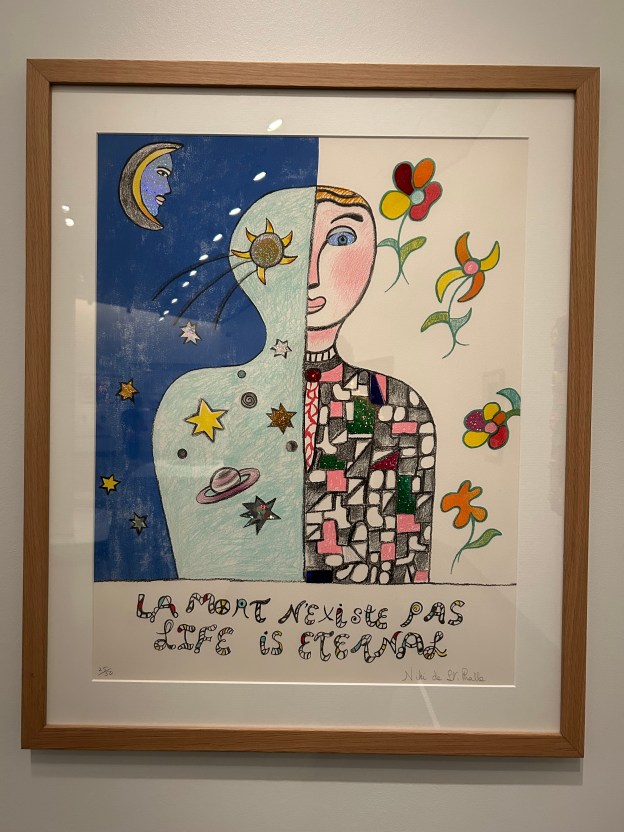
So then, perhaps what I appreciated the most about Niki de Saint Phalle’s later works was as much the longevity of their creation as it was their brilliant colors and joyous expressions. These are works which are meant to last so that generations of people will see them and perhaps in their forms feel a sense of their creator’s joy. I certainly felt that, even now 22 years after Saint Phalle’s death. I took one photo in the exhibit, of a color lithograph she made with a dualistic figure, on the one side with a human face and body and on the other the human frame surrounded by planets, moons, and stars. Beneath the dual figure Saint Phalle wrote in French and English, “La mort n’existe pas / Life is eternal.” I believe through our joy, no matter how childlike it may be, we can live on even after death. As St. Paul wrote, “Rejoice! Your kindness should be known to all.” (Phil. 4:4–9)


[1] Yes, there’s a great deal of problems with that new society’s foundations in the conquest and colonization of this continent.


Niki de Saint Phalle: Rebellion and Joy is on view in the Bloch Building at the Nelson-Atkins Museum of Art from 27 April through 21 July 2024. More information can be found here.

Is Cash Still King?

Over the last week, I've been thinking about how much I still use cash, and what that says about my lifestyle as a whole. Guests: Alex Brisson, New York City Elizabeth Duke, Kansas City, MO George Vial, County Donegal, Ireland — Click here to support the Wednesday Blog: https://www.patreon.com/sthosdkane


Over the last week, I’ve been thinking about how much I still use cash, and what that says about my lifestyle as a whole.


One of the chief ways that ordinary people would interact with their government was through the coins or banknotes in their pocket. We get to know the faces on our currency better for that role than for the things they did that got them printed onto dollar bills or Euro coins. Many were probably more familiar with the late Queen because her face was on the currency in the United Kingdom and all the Commonwealth realms more so than in any other fashion.

Yet, in the last five years, my cash usage has dropped significantly from a high around the mid-2010s when I used it more than my cards. Today, when I go to the bakery or when I buy concert tickets, I do so digitally. I prefer to use contactless payments on my phone over any other for the ease of use, and the security of not having to pull out my wallet in public. Still, I realized early on last week that this was a question better answered by more than one mind.

So, to answer this question, I turned to my Patreon supporters (only $5 a month at patreon.com/sthosdkane) to ask them how much they still use cash.

One of my Patreon supporters who agreed to talk to me this week was regular Wednesday Blog film expert, Alex Brisson who offered a few thoughts of his own from his home in New York City.

How much do you still use cash?

SK: When I moved to Binghamton, when I was going out there to go look at an apartment in May of that year, my Dad gave me $50 in $5 bills and said “Go, drive to Binghamton,” we were in Niagara Falls, “go, drive to Binghamton and find an apartment and be back here by tomorrow to catch the train to Toronto.” And that was the last time I ever used cash for tolls. Traditionally, I’d use cash for tolls, taxis, and really small family run Chinese restaurants. So, let me ask you then: how much do you still use cash?

AB: Almost not at all, extremely rarely. Unless it’s an arcade game that only takes cash, or once in a while the street hot dog vendors in New York only take cash, which is a big mistake in my view, and sometimes there’ll be one cart that takes card next to one that takes cash will get all the business. I’m making constant financial transactions; I’m buying things every day. New York City is just a big shopping mall. I use Apple Pay the huge majority of the time, unless a place doesn’t accept it.

SK: Yeah, it’s much more secure than even using your card. You don’t have to pull your wallet out, and also the encryption of the card number helps.

AB: Yeah, and also there are those machines that can steal your card number going around, so Apple Pay is more secure against those, though Apple Pay might be just as easily compromised, I don’t know. Definitely, money has gone from being a physical, gold-backed thing but now money is purely digital.

One of my Patreon supporters is closer to home, and we were able to do an in-person interview. – “Hi, Mom!” – “Hi, Seán!”

SK: How much do you still use cash?

ED: Very little. I carry maybe $20 for an emergency, but I rarely use cash.

SK: How much do you still use cash?

GV: Not as much as I would like to.

That’s George Vial, who spoke to me from his home in County Donegal, Ireland.

SK: So, you would prefer to use it over card?

GV: Compared to using it over card, the inaccessibility of getting to an ATM is probably the biggest drawback. Today, I had to pay a guy working on a car, and to find an ATM that would dispense the amount took two different trips, so I eventually got him the money. It would’ve been easier if he had taken a bank card, but that was the first time I used cash in almost two weeks.

Do you prefer cash over card or vice versa?

SK: So, you prefer cash over card, I get that. When you’re in the US do you use cash or card more than in Ireland?

GV: I use more cash than card in America, and vice versa in Ireland for one simple reason: Euros don’t fit in the wallet, they were never designed for wallets, and the amount of coins over here is too much. If you go out with €100 your trousers are falling down by the end of the day.

SK: Yeah, I stopped carrying a coin purse. The trouser leg didn’t look right with that in there. What do you think are the benefits to your preferred payment method? You talked about a couple of the drawbacks of using cash in Ireland, what are some of the benefits?

GV: The benefits of cash are that you stick to what you have. When you do digital payments you tap your card, while in America it’s still a lot of swiping. Here there are no minimums to how much you can spend by tapping, so you spend more freely, whereas with cash if you have €200 in your pocket that’s how much you can spend.

SK: Do you prefer cash over card or vice versa?

ED: I prefer to use a card or to actually use Apple Pay so I don’t have to pull something out of my bag. Although, at restaurants in the US you have to give them your card and they take it away from you to run it whereas in Europe they run your card for you there at the table.

SK: I’m starting to see more places in the US where they do have the portable card reader that they bring around, or even the big chain restaurants that has the machine at the table that you can play games on and also use to pay at the end.

~

AB: Money has gone from being a physical, gold-back thing, and I guess the gold is still somewhere, and now money is just a number on a screen.

SK: So, the value of the money has gone fully abstract then, in the last 120 years. So, now instead of being valued off gold it’s an abstract concept. So, what do you think are the benefits to your preferred payment method?

AB: Mainly that I no longer carry a wallet. I have my phone and there’s a little pouch on the back where I carry my cards. I’ve consolidated the things that I carry in my pocket, and as a man in New York City your pockets are prime real estate. Another one is the convenience of my phone being my payment method. Unlike cash, it can’t get wrinkled or blow away or you can’t really steal my Apple Pay. It doesn’t have to be replaced all that frequently like a credit card does, and because it’s contactless it’s safer in terms of transmission of germs and things. During the pandemic we realized we’re passing around all that dirty cash. The main people here who use cash are homeless people because they need you to give them cash, but if you don’t have cash on you then you circumvent that, which is kind of a low thing to say. And, also unlike with cash not carrying around a finite amount of it I can access all of my funds potentially, not instantly but nearly instantly if I shuffle things around.

What do you think are the benefits to your preferred payment method?

SK: So, then do you see any benefit to using cash over card?

ED: I suppose if you don’t want your purchase tracked then that’d be a benefit, or if you’re going to a farmers’ market, but even those will take cards. There are a few places that are cash only but they’re few and far between now.

SK: And inflation has impacted that now, because you have to use more cash to buy stuff now. I remember when I was little you could get a candy bar at a gas station for less than a dollar, and now it’s probably close to $2.

SK: What do you think are the benefits to your preferred payment method?

ED: It’s more secure,  if my wallet were stolen I could stop the card immediately, any of the cards I carry. The same cards work globally, so I can travel and not make many changes. It’s the convenience and the security, although I will say back when I carried cash I had a budget for discretionary spending per month. With a card it’s much harder to do that. It’s really easy to spend more with a card.

SK: When I lived in London, I found it was very beneficial to only use cash if I could because I could control my spending, whereas with my card and contactless it was very easy to buy stuff.

ED: It’s something we all need to figure out how to manage our lives now. I spend a lot more time in the bank app on my phone than I used to.

SK: I found that when I went overseas this most recent time in October that I’d get Pounds and Euros out but this time I used my card everywhere, so I never needed to stop by an ATM, and that was bizarre, even going into the Tube in London, like with OMNY in New York, I just used my phone to get in, and that’s a new thing just within the last 5 years. In New York, you used to have the MetroCard instead.

AB: You’re right, because the Apple Pay and credit card transcend borders. You can use it anywhere in the world. You don’t have to convert your cash.

SK: That was a huge realization, because I realized when I got there that I forgot to get cash out, so I started paying for things with my Apple Pay and quickly realized that I wouldn’t need to get cash out at all. I got to Brussels and paid for my first croissant and thought, “wait a second, I don’t need to get cash out here.” Yeah, that was a big benefit to it. Then, do you think cash will fully ever disappear?

Do you think cash will ever fully disappear?

SK: Yeah, so you’re doing the mental math and figuring you’re borrowing from a future paycheck to pay for this. Do you think cash will ever fully disappear?

GV: I know they’re going to try, the banks of the world, but I don’t think it will. All it will do is create more of a digital black market, so it’s everything from the criminal black market to paying all of the little cash transactions of paying the babysitter or paying the car guy which they’ll be able to monitor, so they should just leave cash as it is.

SK: So, cash in Europe it’s coming out of the European Central Bank (ECB), whereas here it’s coming out of the Federal Reserve and the Mint, while when you’re doing a card payment it’s going through Visa, MasterCard, or Discover, or American Express, or take your pick. Do you see a way that it could be problematic that those particular financial corporations would have that much of a role in our everyday monetary transactions whereas previously it was a public enterprise that was managing it?

GV: Oh, yeah absolutely because it’s throwing the control of our money to these for-profit corporations, it’s totally wrong, and we know behind the scenes the amount of charges, there’s a meme going around talking about how to spend $100 locally, yet to spend that $100 digitally the amount of transactions and fees that go on makes it all very convoluted. I’m not a fan of the big companies tracking our money.

SK: Yeah, I absolutely get that.

AB: My immediate answer is that I’m not properly educated enough to truly venture a guess at that, that said it does feel realistic to think that you could have a post-cash society. That feels very feasible in my mind at least. There’s also this aspect that you only print so many dollars, or that you could track that digitally anyway. I bet we’re shipping a lot of gold and huge stacks of dollar bills from place to place, I bet there are people who are spending time counting money. And we’re handing over a lot of our societal things to computers these days, yet this is a logical usage of this.

SK: I only hesitate with that in 2 points: Jackson County, Missouri’s systems were hacked with a ransomware attack, and the systems were shut down for a while. Having all of your money going through computer systems leaves them up to attack in that sort of hack. Secondly, having your money going through a computer system means that every transaction you make is processed by a financial institution like Visa, so they are getting a cut or have some arbitrary control over the transaction. So, does that give them too much power?

AB: There’s also the data tracking aspect of this too. The thing you were saying about how it could be hacked and disappear is true for any form of currency. There’s an episode of The George Lopez Show where his mom keeps all of her money in a safe under her bed and there’s a house fire and all of it burns. So, is there a truly safe form of currency? I think the answer is no, there’s not. You can hope that each version is more secure, at least digitally there’s a record of its existence. So, if your bank gets hacked then there’s a record of what the bank owes you. Digital money then might be more secure. It’s truly hard to say. It’s scary, the new digital world is scary in a general way, I would say, and things are changing so rapidly. The minds of this generation, and all who are alive right now are struggling to keep up with it all.

SK: Do you think cash will ever fully disappear?

ED: Maybe. It’s expensive for countries to print bills or mint coins, I don’t know. I wonder what the percentage of people are that use cash? You can’t use cash at the new Kansas City Current stadium (CPKC Stadium). So, the more places that refuse to take cash the less we’ll see people using it.

SK: Some countries that I’ve heard about that have dropped cash all together, like Sweden, it’s because the Kronor there has so little value that you’d have to use a lot of it. During my four hours at Arlanda Airport in Stockholm, I paid 200 or 300 kr for a burger there at Max’s Burgers, I thought that was a lot but it’s actually around $10. So, will inflation impact how much cash we use?

SK: Because cash is controlled by the Treasury, with card transactions those are all done through the big companies, does that give those companies too much power over our national economy or our global economy if they’re the middleman in every transaction?

ED: I know bank transfers are still monitored by the Federal Reserve. Cash was just the vehicle to exchange for goods and services, right? So, you’re still doing that exchange, it’s just happening in a contactless or a low-contact manner.

Is cash still king? I don’t think so. I could see how it might return to its former position of prominence if we had massive technological failures, yet that seems remote and unlikely. I do agree with George about the need to have better monitors on the financial institutions that house and monitor all of our digital transactions, though. I wonder if the cultural role that cash plays as our symbol of prosperity will change? This, like many questions I consider here on the Wednesday Blog, remain uncertain in their answers.


The Essence of Being

This week, to begin Season 4 of the Wednesday Blog podcast, I want to talk about what it means to exist. I know, small topic for a Wednesday. — Click here to support the Wednesday Blog: https://www.patreon.com/sthosdkane


This week, to begin Season 4 of the Wednesday Blog podcast, I want to talk about what it means to exist. I know, small topic for a Wednesday.


Two weeks ago, I started teaching a new class that I’m calling Bunrang Ghaeilge, Beginner Irish. The students come from my fellow members of the Fr. Bernard Donnelly Division of the Ancient Order of Hibernians and their relatives, and in the first two weeks we’ve progressed slower than I initially expected yet we’re still progressing through the materials. The first verb which I taught my current students in English translates as to be, yet in Irish as two forms: is for a more permanent being and  in a more impermanent circumstance. In the moment I explained this difference by noting how I say is as Chicago mé (I am from Chicago), as in I was born in the Chicago area, but I say tá mé i mo chónaí in Kansas City (I live in Kansas City). We don’t have this distinction in English, either between the permanent and impermanent versions of the to be verb or in the clear distinction between where you’re from at birth and where you currently live; that distinction is far more subtle in English.

At the same time, I am learning Italian for a trip this summer, my own version of the Grand Tour, and on the Busuu app where I’m learning Italian they taught that I should say sono di Chicago però abito a Kansas City,as in I was born in Chicago, but I inhabit today in Kansas City. This distinction between a place that is central to our essence, the place where we were born, and the place where we now live seem important, yet it flies in the face of the American sense of reinvention that we can make ourselves into whomever we want to be. It’s struck me when I’ve met people who would rather see themselves as from the place where they currently live than the place where they were born. That is a different view from my own, born out of different lived experiences and different aspirations.

This word essence developed from the Latin word essentia, which the 1st century CE Stoic philosopher Seneca wrote was coined by the great orator Cicero as a translation of the Greek word οὐσία (ousia), a noun form of the Ancient Greek verb εἰμί (eimi), meaning “to be.” (Sen., Ep. 58.6) It refers to an innate idea that the ultimate goal of philosophy and learning in general is to better understand the self; the most famous inscription in the ancient Temple of Apollo at Delphi read γνῶθι σαυτόν (gnōthi sauton), or “know thyself.” I add to that goal the aspiration that one can improve oneself. 

This time of year, I find myself thinking more and more about what it means for me to be an Irish American. This past weekend we celebrated St. Patrick’s Day, a day of great celebration for the global Irish diaspora and our cousins back in Ireland as well. I’ve written before here about how my communities’ immigrant connections to Ireland often predate the current century, if not the twentieth century as well and how we are in many respects far more American than Irish. In recent years, I began to refer to myself in this subject as an American cousin, after all as much as I have Irish roots and I come from an Irish family, I’m an American and have lived an American life to date. I’m not as far removed from Ireland as many I know, yet this year marks the 110th anniversary of my great-grandfather Thomas Kane’s arrival in America.

There’s something about being Irish American which doesn’t quite fit neatly into any of the official boxes. In Ireland, to be Irish is to be from Ireland or to be a close enough descendant that you qualify for Irish citizenship, like my father does. In America, there’s a sense that the old stereotypes of Irish immigrants are fair caricatures to still uphold, especially on our communities’ holiday in much the same way that the sombreros are donned on Cinco de Mayo. Yet there’s a lot more to it. On both sides of the Atlantic, our communities have the same deeply intertwined connections between families near and far, friends in common, and a sense of nostalgia that I see especially strong among those of us born in America.

Perhaps the Irish language can offer the best answer here. In Irish, I’ll say to Irish people, as I wrote a few paragraphs ago, “Is col ceathrair Meiriceánach mé.” Yet the official Irish name for us Irish Americans is “na Gael-Meiriceánigh”, or Gaelic Americans. I think this speaks to something far older and deeper than any geographic or political connections. We come from common ancestors, share common histories and stories that wind their way back generations and centuries even. We are who we are because of whom we’ve come from. I hope to pass this rich legacy in all its joys and struggles onto the next generation in my family; perhaps I dream of those not yet born hoping they’ll be better versions of my own generation. I hope they’ll still feel this connection to our diaspora like I do even as we continue on our way along the long winding road of time further and further from Ireland.

I am the child of my parents, the grandchild of my grandparents, and great-grandchild of my great-grandparents. In so many ways, I am who I am today because of those who’ve come before me. The geography of my life was written by them, by a choice among other immigrants from County Mayo my ancestors found their way to Chicago instead of Boston, New York, or Philadelphia. My politics reflect my ancestors’ views as well, in the Irish context the legacies of the Home Rule Crisis of 1912-1916, the Easter Rising of 1916, the War of Independence of 1919-1921, and the Civil War of 1922-1924 all have as much of a presence in my political philosophy as does their American contemporaries: the Progressive Era and its successor in the New Deal coalition. Yet I am my own person, and from these foundations I’ve built my own house in as much of an image of the past as it is a hope for the future.

What does it mean then to be ourselves? We hear a great deal today about how people identify, in a way which seems to be a radical departure from older norms and expectations both in the English language and in how we live. We constantly seek answers to all of our questions because we anticipate that all of our questions can be answered, yet the mystery of being is one of my great joys. I love that there are always things which I do not know, things with which I’m unfamiliar and uncertain. This is where belief extends my horizons beyond what my knowledge can hold, a belief born from the optimistic twins of aspiration and imagination. I know that the essence of my being, the very fundamental elements of who I am, draw far more from these twins than any other emotion. I am what my dreams make of me, I see my world with eyes colored by what my mind imagines might be possible; and in that possibility I find the courage to hope for a better tomorrow.