Category Archives: Life

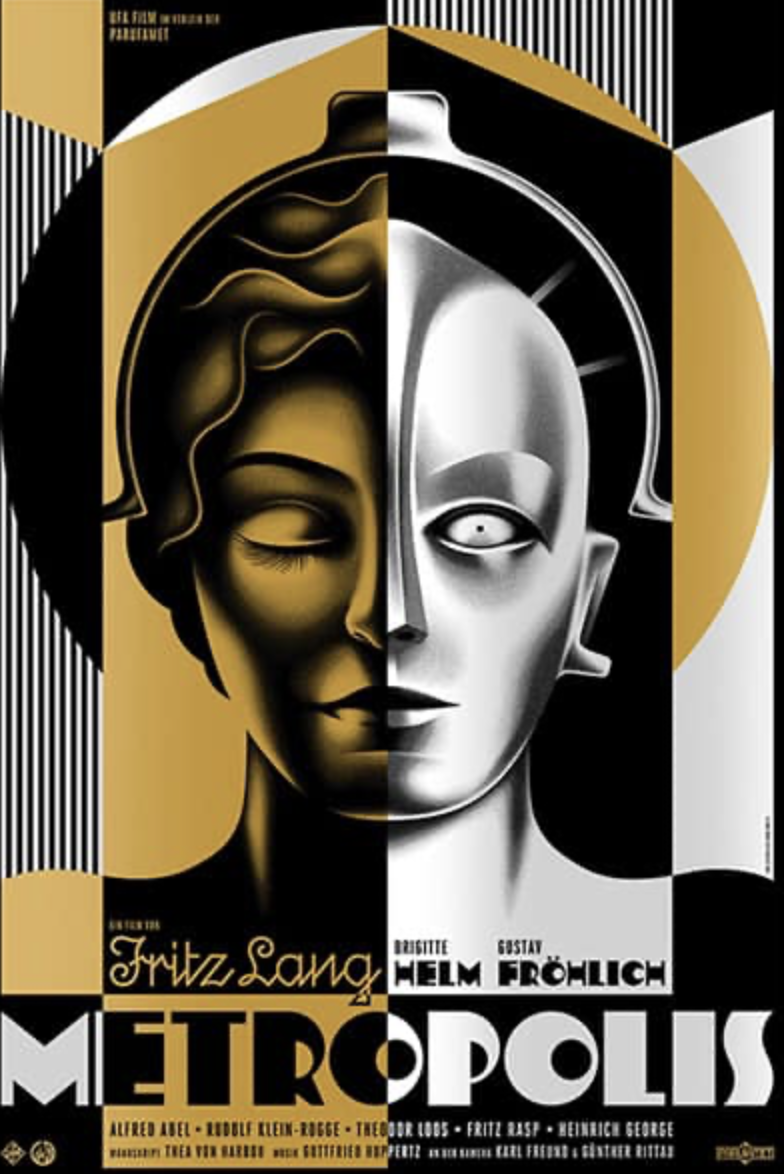
Metropolis

When I returned home to Kansas City about a month ago, I saw an email from the Nelson-Atkins Museum of Art that the Tivoli Cinema, which since 2020 has been housed in the Nelson’s auditorium, would be holding two showings of Fritz Lang’s 1927 silent masterpiece Metropolis. I jumped at the opportunity and immediately bought a ticket for the opportunity to watch this film on a big screen with an audience around me. So, this past Sunday afternoon I showed up for the matinee screening and was even more dazzled by the experience than I’d expected.

I had seen Metropolis once before when it was on Netflix about a decade ago. I remember feeling a bit wary of the film and its story when I first watched it that time. Now I know that watching a movie as monumental as this one on a screen as small as my laptop does a disservice to the whole experience. Metropolis was made to be seen on the big screen with a live orchestra, or at least a live organist, adding a whole extra dimension of music to this already vivid story. In the case of this weekend’s showings, Metropolis was accompanied by a 2010 recording of the original Gottfried Huppertz score performed by Berlin Radio Symphony Orchestra conducted by Frank Strobel. I’ve since played that recording again on iTunes while grading essays this week and have felt just as profoundly moved by it as I was in the theatre on Sunday.

It occurred to me while listening to that album again this week that as much as this score is a film score, listening to it on its own it feels far more like ballet music. In the past I’ve written about how I feel that ballet and silent film share similar characteristics born out of their mutual need for wordless expression to tell their stories. As I listened to Huppertz’s score without seeing the images in front of me I found myself thinking back to each particular scene in Metropolis as I’d seen them the day before. Yet in the moment as I sat in the third row of the Atkins Auditorium watching this spectacle unfold before me, I felt that Metropolis was more operatic than balletic in its very character. These were actors performing at a time when the quantity of film influences were far fewer on their lives thanks to the relatively recent invention of motion pictures, film at that point was only about 40 years old. 

In Metropolis I saw echoes of Wagner and Strauss as well as hints of the future, all the films and television shows that would follow it. There is a scene near the beginning of the film’s first act, the 45-minute prelude, where a shift change of the underground workers occurs that seemed strikingly similar to several scenes from the new Star Wars: Andor series released on Disney+ this Fall. Don’t worry, no spoilers here. There are many elements of Metropolis that certainly have been influential, look no further than the Machine-Man, the poster child of Metropolis that wreaks havoc on the city and nearly destroys it and all who live within it. There perhaps we see the ancestor of Doctor Who‘s cybermen, Star Trek‘s Borg, or Alicia Vikander’s character in Ex Machina.

In the last few days, I read in Variety that there’s a TV series remake of Metropolis in the works for Apple TV+. While I’m normally hesitant about remakes of classic films or shows, the new Star Trek: Strange New Worlds which sees the adventures of the original 23rd century USS Enterprise before it was captained by James T. Kirk, has made the idea more amenable to me, though that’s likely because Strange New Worlds does the whole reboot idea perfectly. I’m most curious to see how Apple TV+’s new Metropolis will depict the city of tomorrow. In 1927 Fritz Lang’s original film used the great art deco skyscrapers of New York built of brick and steel as his model. Will this new series seek to depict the sort of futuristic architecture that I’ve collected on my architecture Pintrest board, filled with gentle curves, evocative colors, and dramatic lines? That remains to be seen.

Metropolis was a gripping film to see, and while long, with some aspects perhaps a bit old fashioned to our tastes, notably the over-the-top heart-gripping that happens throughout that made the crowd around me laugh from time to time, it still has my attention caught even now a few days later. Silent films speak to us in a way that their talking counterparts created after 1927 simply don’t. They tell stories in different ways, adjusting their style to fit the technical limitations of their time. I’ve always been drawn to silent films for this reason, and perhaps I’m drawn to ballet for much the same reason. After all, Chaplin was as much a dancer as he was a slapstick comic. Metropolis is a testament to the time and place in which it was made, Weimar Germany in the 1920s. In Joh Fredersen, the master of Metropolis I see Henry Ford, both in his character and in his physical appearance. I see fears about extremism on all fronts, and a call for unity and dialogue in the face of anger. I wonder what the new Metropolis will be like?

Essay Writing

Photo by picjumbo.com on Pexels.com

I’m at a rather fun point in my doctoral studies. Today, I get to spend my days working on my dissertation and serving as a Teaching Assistant for a class. In my TA duties here at Binghamton, I’ve been assigned two sections of 25 students each, so when they submit essays, I find myself grading 50 of those in the course of a few days. It’s a lot of work, and in the moment the grading inspires a variety of emotions in me, from joy at a wonderfully written essay to disappointment at one that could’ve done better with just a little more effort.

One of the greatest boons to my work as a teacher is that now, after 12 years in college and 27 years overall as a student, I’ve finally made sense of how to write an essay. This word, used so often in academic writing, never really clicked for me. I knew I was supposed to write a research paper that had a introduction, body, and conclusion, but never really got the structure my teachers and professors were going for beyond that. It took my own transition from student to teacher for me to really understand that an essay is an extended argument. 

It also took for me to start studying Renaissance French Humanism and Natural History for me to really understand the origins of the essay with Michel de Montaigne’s 1580 book of Essays, where the term originated. These were reflections on a variety of topics, from children’s education to cannibalism and everything in between. My own Wednesday Blog is in some ways a nod to Montaigne in format. Montaigne’s essays sought to describe his world as he saw it and understood it, in all its rich detail and complexity.

In the academic essays that I write, from the quick 3 to 5 page papers I used to write for my undergrad history classes at Rockhurst to my dissertation, which in many aspects is itself a long essay, all have the same core structure and spirit. Yes, at its barest bones the essay is made up of an introduction, body, and conclusion, but there’s so much more rich detail to a good essay than just that. 

This semester it really occurred to me that the introduction ought to be made up of three main things: something to catch the reader’s attention, a thesis statement laying out the essay’s argument, and a brief summary of the main points with some context in the existing literature included if you’re writing on a graduate or professional level. Any of my colleagues reading or listening to this will either find their eyes are glazing over here or are instead laughing that I only really figured this out this late in the game as I was writing my dissertation.

The body is more than just the main points of the essay, it’s the real meat of the work, the rich quotes and analyses of the sources, the connections made to other works in all their intricate splendor, the quotable lines that help the essay stick in the reader’s memory and look forward to reading more of your work in the future. I still would say though that the thesis remains more important than the body, after all the body isn’t going to make sense without a strong central argument, a beating heart at the core of the entire work. I often tell my students this and have even begun advising them to underline their thesis statements to help them keep that heart in mind as they continue to flesh out the rest of their written creation.

Finally, there’s the conclusion. It’s a summary of the main points of the essay, a restating of the thesis with the memory of the body fresh in the reader’s mind. The conclusion is a chance to leave your reader with a really strong impact from your essay, something to find them wanting more. 

For a while now I’ve often thought of the essay as a form functioning for scholarship and literature as the symphony functions for music. In both cases there are different styles and methods of elevating the pure form into an art that reflects the writer or composer’s personality and craft, that leaves the audience feeling something different, something that they can best describe as emblematic of that work’s author. In symphonic music there are clear distinctions between the classical composers like Haydn & Mozart and the romantic composers like Beethoven & Brahms. Sometimes, the best way to end an essay is to borrow an idea from the romantic symphonies and even the romantic operas of composers like Gounod and Wagner: let the main themes finish and then have a sigh to really round things off. If you listen to the finale of Wagner’s Götterdammerung, you’ll hear this very sigh, as if all the energy built up in the composition over the last few hours is nearly extinguished but has one last breath. If you can write an essay like that then bravo.

I’m writing this in the midst of an extensive round of edits to my dissertation, going line by line making corrections, clarifications, and all around tightening down my work until it really just elevates the core form of my thesis. In the last year since I started writing this dissertation, I’ve learned a great deal about how to do this job, and I hope I will in future avoid some of the great pitfalls that I’ve caught myself up in time and again in my studies.If you’re a fellow academic, or interested in academic writing, I highly suggest you go listen to my friend Kate Carpenter’s podcast Drafting the Past, which is all about the process of writing history. It’s a wonderful service to the profession that Kate’s doing. Enjoy your week!

Suspending Disbelief

I’ve always been someone who has a hard time focusing on the world around me in the immediate aftermath of leaving a cinema. The story played out before my eyes in rich and large visual colors and resounding about my ears in the surround sound systems used in modern cinemas is entrapping and beguiling to say the least. Every film I have ever gone to see, that I can remember, has been met by this same internal thought process as soon as the picture ends and I wander back out into the lobby. I imagine myself in the story, in its settings, walking and talking with its characters. I guess I’ve always been a bit of a day dreamer.

I’ve also been a storyteller for much of my life. Much of those energies that were once spent inventing fabulous fables of remote realities and fantasies in my youth are now often spent trying to think through my professional writing, both here at The Wednesday Blog and in my research. Still, I do like to daydream from time to time. I find it helps me focus on the good things in life. Those dreams are less extraordinary than they used to be, they are populated less by characters from the books and films I enjoy than by my own hopes for the future, however domestic and ordinary those hopes may be.

In recent months as I’ve allowed more of the dolor of our times creep into my thoughts, I’ve found my ability to daydream has become less and less pronounced. Maybe that’s what C. S. Lewis meant in The Last Battle when he said that of all the Pevensie children, the only one not to return to Narnia in its last days was Susan because she had grown up and didn’t believe in those stories anymore. Yet this fading ability to daydream has left me somewhat bereft. I find I’m less able to write when I can’t imagine a happy future. I’m less able to tell the stories I know both recent and quite ancient when I can’t imagine my own near and distant future. So, I hold onto that need for dreams, and do my best to keep that fire of my imagination alive despite the troubles of our time and the worries seemingly inherent in adulthood.

Over the last few weeks since I returned to Binghamton, I decided to watch a series of films that I loved as a child but hadn’t seen in full for at least a decade. Yet now with the extended editions of The Lord of the Ringson HBO Max I figured it’d be fun to see them again, and not only to remember them as I knew them years ago, but to relive those stories as an adult with everything that I know now guiding my eyes and ears through that modern epic. I often like to think of these sorts of stories that I enjoy, whether they be Tolkien’s legendarium or the near future of Star Trek, along the same general continuum of time and thought. Yet I quickly found myself asking the question, “how can these stories of a far distant past fit into what I know of the world and its origins?” The rational thinker in me posed a fundamental question about suspending disbelief.

So, how do I rationalize these stories of some ancient primordial past just before the dawn of human memory when we weren’t the only such people to walk this Earth? That after all is the setting of The Lord of the Rings, a time long lost when the Earth was young. There are plenty of old stories that tell of an age when humans lived alongside more supernatural creatures, whether they be the monsters and demigods of Greek mythology or the Tuatha Dé Dannán of the distant Irish mythic past. Tolkien set his stories in this same vein, they are a modern recreation of those old myths, those old epics & sagas that he loved so much. And those stories come from a different world than our own, one where the long history of the Earth cannot be explained by evolution or science, but where all things are created through divine music, described in the opening of Tolkien’s Silmarillion.

I for one do feel that there’s still a way to balance the old stories with the new. Our modern narrative for the creation of the Universe, of which the creation of the Earth and all life upon it is but a small verse, is yet another one of these stories. Yet among all the stories our modern one, our new one, is grounded in an understanding of the rational roots of Creation; it sings less of God and angels, supernatural spirits guiding the world into being, and more of Creation urging itself into existence through the very energy that burns at the heart of all things. I still think there’s room for these old stories in our new one, there’s room for us to acknowledge and embrace ancient interpretations of how we came to be in that we are richer for knowing what our ancestors thought and believed.

Tolkien’s stories are beautiful in their own way. They echo the great myths and sagas of the myriad cultures of Europe. They remind me of the Penguin translations of the old Irish myths that I read as a boy and could recite from memory today. Suspending disbelief allows us to let ourselves go from our lives, even for a few moments, and experience something incredible that we otherwise would not. 

As The Return of the King finished on the evening of Labor Day, I found myself wondering what different characters from the Star Trek series would think of The Lord of the Rings and its characters. What would Spock make of the elves and their similar anatomy to his own Vulcans? What would Worf make of the fierce warriors of Rohan steeped in their honor charging to certain death before the walls of Minis Tirith? What can I learn from these two different yet similar stories of people trying to make their world a better place? I think the answer lies in the question. I’m drawn to stories such as The Lord of the Rings and Star Trek because they offer hope even in the darkest of times. The Hobbits prove that even the smallest among us can save the world, and Star Trek offers us today a vision of a better tomorrow that may still come. And if I need to suspend disbelief, if I need to shake the scales of my worldly cynicism from my eyes in order to see those two hopeful lights in the darkest night, then it’s worth doing.

A Trek Among the Stars

I first started watching Star Trek a month before the first waves of the pandemic hit the U.S. early in 2020. I knew a fair bit about the characters of the different series and some of the overarching stories, so when Star Trek: Picard was released in February 2020 I figured I wanted to see what it was all about. Thus began the next two years of my life in terms of TV viewing. Since then, I’ve gone all in and seen the entirety of the first two seasons of Picard, with a third coming in February 2023, as well as all seven seasons of The Next GenerationDeep Space Nine, and Voyager, all four seasons of Enterprise, and what’s so far been released of Lower Decks, and Strange New Worlds. I’m now watching the original series, Star Trek starring William Shatner, Leonard Nimoy, and DeForest Kelly that aired between September 1966 and June 1969 on NBC.

Like with the other Trek series, I’ve found the characters relatable and enjoyable to watch. I’ve also found some of the futuristic settings and technologies depicted on the show inspirational to my own imagination as a storyteller. Yet I’ll freely admit I find this series harder to get excited about compared to the later Trek series released in the ’80s,’90s, and 2000s, perhaps because this original Star Trek sought to depict the future of the late 23rd century as the 1960s dreamed it might be, whereas the later series looked to the late 24th century as the ’80s, ’90s, and 2000s aspired it to be. Being a child of the ’90s and 2000s, that post-Cold War worldview fits my own far more closely than the background surrounding the Original Series during my parents’ childhood in the ’60s.

Still, when I do get into an episode of the first of these shows, I often find I do like the stories. They’re in the same spirit as other mid-century sci-fi shows that I’ve always admired like The Twilight Zone or the older William Hartnell era Doctor Who serials. What’s more, the vibrant colors used to light the sets of Star Trekalways catch my eye in a way that keeps me focused on the action of the story.

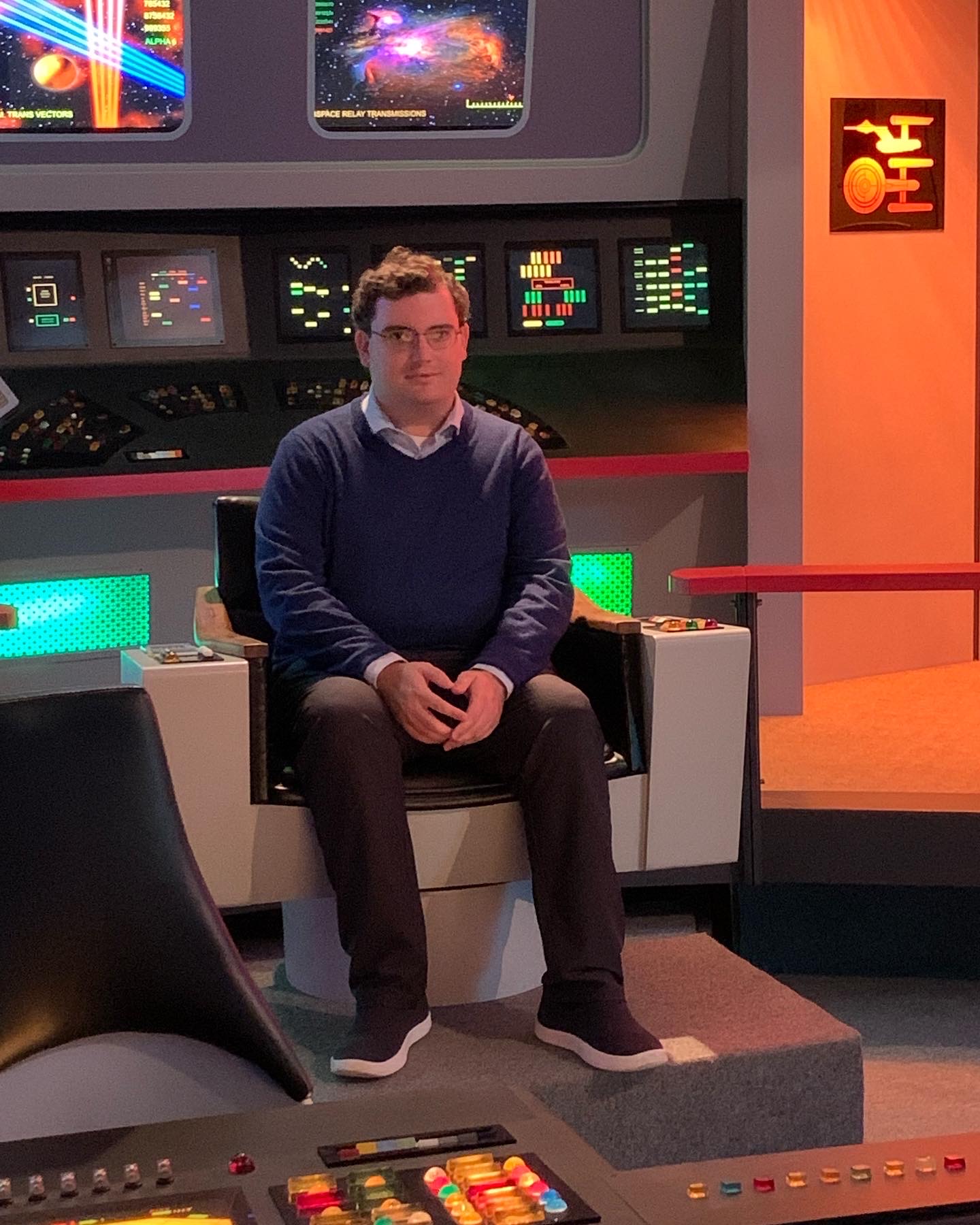
So, a few months ago when I learned there was a recreation of the sets of the Starship Enterprise in a building in Ticonderoga, New York, I knew I had to pay a visit. I arranged things with my good friend Alex Brisson, and we made a weekend trip out of it, visiting the Star Trek: The Original Series Set Tour around noon on Saturday, 17 September. The sets were built by a local guy named James Cawley, who interned on the production of Star Trek: The Next Generation at Paramount. Over the intervening years, the team in Ticonderoga have built with meticulous detail the sets of that original Enterprise as they appeared on the soundstages at Desilu Studios in the late ’60s. In many ways, the tour is both an opportunity for fans to experience walking on board the Enterprise as much as it is for film and TV buffs like myself to see what a TV set from the ’60s would have looked like.

When we walked on the bridge and saw all the stations set out in their circle, the captain’s chair in the center of the room, most of the people in our tour were hushed, a sense of respect among us. I got a chance to sit in the chair, as did everyone there, and I’ll admit the picture of me sitting there looks a fair bit deer-in-headlights as I couldn’t decide what to focus on with so much around me to see. For me, the original Trek isn’t necessarily the show that I prefer the most, that’d have to be Deep Space Nine with Next Generation and Voyager close behind it, but it spoke to a common thread in my life over the past two years as I’ve continued with my own work and studies while in the evenings taking an hour or two to watch another story set a few centuries down the line.

I think the thing that has kept me so interested in Star Trek is how aspirational it is. Unlike so many other futuristic films and shows out there, in the stories told here humanity has figured out how to get out of our cycles of violence and greed and work with the best parts of our nature to achieve the closest we could ever come to returning to Paradise here in our own mortal lives. They are stories that say, “no matter how bad things may be now, no matter how much the pandemic and all the other troubles that came out of it have become, there’s always hope.” 

I’ve always been one to trust in the fundamental goodness of humanity, it’s an idea that really does have some deep roots in my Catholic faith, as well as in my lived experiences. I’ve been fortunate to live the life I’ve led so far, in the places I’ve lived and with the people I’ve known, family and friends who I’ve loved. The seeds of a better future are laid in that fertile soil of hope. Had I grown up in the midst of the wars that my country waged over the last 20 years in Afghanistan and Iraq or in a country with less opportunities for success than my own, my worldview would likely be quite different. Yet if we are going to ever get out of this mire we’ve been in for so long, our adolescence as a species as Carl Sagan put it in his novel Contact, then we’ve got to let our hope for a better tomorrow guide us just as much as our cynicism and bad memories of past wrongs guide us now.

In the future that Star Trek depicts humanity finally begins to overcome our faults in the last half of the current century when first contact between humans and an alien species, in this case Vulcans, occurs. Our technology, and their helping hand (however hesitant it may be) moves humanity up from an age of nation states and superpowers battling each other for supremacy and resources on Earth and into a new age where humanity is one small island in the great ocean of Space, learning to live amid our galactic neighbors, and finally contributing to the creation of a Federation of Planets in the mid 22nd century that brings about a new Golden Age of sorts not just to us on Earth but to many other worlds floating in this cosmic sea.

It’s fiction, I’m well aware of that. It’s a collection of stories dreamed up by writers and showrunners over the past six decades that could very well remain stories in our cultural memory. But maybe there is some room for our future to be more peaceful, more prosperous, and more equitable than our present is or our past ever has been. In the decades since Star Trek first premiered in 1966 so many technologies inspired by the shows have become realities from tablets to personal communicators to now virtual reality taking the place of the holodecks and holosuites of the Next Generation, Deep Space Nine, and Voyager. I’ve been drawn to these stories because they came at just the right time for me. I began watching Voyager in the long dark winter of 2021 when I was preparing for my Comprehensive Exams. That winter, being so far from home and so isolated by the continuing pandemic, I found the story of a lone ship lost 70,000 light years from home to resound with my own situation. These are stories that laud curiosity and teamwork, and while just stories with the odd bizarre plot or weekly new alien with different nose ridges, they offer us a vision of what our world could be like.

Why not give that future a try?

Physical Books or Electronic Books

Photo by Janko Ferlic on Pexels.com

Welcome to Season 2 of the Wednesday Blog Podcast!

There’s a Thomas Jefferson quote that has stuck with me since the first time I saw it in the room at the Library of Congress that houses his first donation to that institution: “I cannot live without books.” It’s something I think of from time to time, looking around the office here in my apartment at the tall bookshelves lined with volumes covering topics from astronomy to ancient literature in Latin and Greek to Catholic theology to history, politics, and fiction. I collect books, largely to read but also because I love the potential that books hold; all the stories they have waiting to be revealed page by page.

Over the last few years, I’ve found myself more and more gravitating towards electronic books on Kindle, Google Play, and all the academic e-book hosting sites that I use for my research and teaching. E-books are just easier to carry. I can have an entire library right there on my phone for me to choose from when I’m having dinner alone in a restaurant here in Binghamton or when I’m tired of listening to podcasts or reading magazines on a long flight. E-books also make stories more accessible. There’s a now rare novel written by the actor Andrew Robinson about his character Elim Garak from Star Trek: Deep Space Nine called A Stitch in Time that I often see people complaining about how hard to find it is in paperback. Yet I was able to download it in just a few minutes on Google Play and read it cover to cover in a few days. 

Kindle now even has a feature where if you have the book on their app and the recording of it on Audible you can listen to some segments of it when you’re driving and then your location in the e-book will update with your progress in the audiobook. I haven’t used it yet, there’s a biography I’m listening to now about the explorer and scientist Alexander von Humboldt (1769–1859) that I could probably also be reading on the Kindle app on my phone when I have a free minute during office hours or at dinner, but I’m also enjoying just listening to it while driving around the hills here in Broome County, New York.

As an author, at least with the three books I’ve self-published to date (all available on Amazon) I usually prefer people buy the paperback versions because I’ll get more in royalties out of those than out of the e-book copies. Still, as a reader I admit I would often choose the e-book on a given day over the paperback solely for the convenience.

One thought that keeps coming to mind for me returns me to my own childhood and those wonderful mysterious days spent in the small library that my parents collected in our house in Wheaton when I was little. That same library came with us down to Kansas City and consumed our then-unfinished basement. At one point we had probably around 10,000 books in that collection of all sorts and stripes. Today, though I also picture not only my younger self but my own future children, if I’m so lucky, and ask “if I choose to go with e-books over physical ones, will my children have the same experiences I had pulling the odd book from the shelf because it looks interesting and flipping through it?” Those experiences of lounging around just flipping through books as a young child was instrumental in making me who I am today. There are so many stories that I read that way. Even now I sometimes like going into a library just to wander and see what I’ll find. 

On a recent visit to the Bartle Library at my university I had a specific book in mind that I was looking for, Gerald of Wales’s 1188 book the Topography of Ireland, which has been useful for my dissertation. Yet after I found it, I noticed another book next to it that seemed intriguing. It was bound in a blue cover, and called the Annals of Connacht, the westernmost of the four ancient provinces of Ireland, my ancestors’ home province. I pulled it off the shelf and flipped it open, quickly figuring out how to navigate its pages. Soon then, I looked up first my ancestors’ old parish, Burrishoole in County Mayo, and secondly, I looked up my own family name, Ó Catháin, to see what was in there. Both Burrishoole and Ó Catháin had entries, the former was less insightful to me than the latter, for it turned out there was a guy with my exact name who lived in Connacht in the 1520s, another Seán mac Tomás Ó Catháin. Maybe he was an ancestor of mine, it’s possible even though there are big gaps in the records during the height of the colonial period.

I could have stumbled upon that same collection of annals online and have done just that many a time with old books such as the Annals of Connacht, yet it doesn’t have quite the same feeling of accomplishment as finding that book in the flesh, holding it in my hands. I’ve joked that I deal with my primal desire as a human to hunt in two ways: firstly I hunt for food in the grocery store, and secondly I hunt for books in the library. Yeah, I know, it’s pretty corny. And while hunting for books in a library surely wouldn’t compare to hunting for a living animal in a forest, matching your wits against its own, I can say that hunting for books online can be more frustrating than hunting for books in person. When on foot in a library all you really need to worry about is that the library’s catalog system is accurate, when online you also have to figure out how to communicate with the various computer systems that are making your e-book hunt possible. 

Earlier this year when I was searching for import records and ships logs from the French port of Rouen between 1500 and 1567 for my research I found myself dealing with a third layer of complexity: a computer system that can’t actually read the original 500-year old handwritten documents, meaning you just have to hope that whoever imported the document into the system typed enough information into the computer that you can find what you’re looking for. On that one count: the easier legibility of e-books over printed ones, the easier transmission of their stories and information, and the fact that we can now share knowledge around the globe as fast as our data streams will carry that information gives me good reason to prefer e-books. But still, I want my future kids, if I’m so lucky, to have that experience of pulling books from my shelves and wandering through them, discovering that same love of reading that I’ve had all these years.

The voice of Thomas Jefferson was provided by Michael Ashcraft, voice actor extraordinaire. You can learn more about his work by visiting his website here.

Creatures of Habit

Photo by Jeremy Bishop on Pexels.com

This week, how we tend to stick to the same things over our lives.

I’m writing this week’s blog post substantially later than I usually do. This past week has been very uncomfortable for me, first with a bout of food poisoning last Tuesday and Wednesday, and now with the continuing aftereffects of it still in my system. So, at a time like this when I feel physically terrible, I often find myself returning to the same old routines and manners that I’ve practiced my entire life. There’s something comforting in watching an old episode of Bill Nye the Science Guy all these years later because it’s nostalgic as well as staying educational.

Last night I found myself craving some good music, the soaring melodies and rich harmonies found in opera. I ended up listening to a couple of things including the Queen of the Night’s second aria “Der Hölle Rache kocht in meinem Herzen” from Mozart’s Magic Flute. For all the hellfire innate in the words––the title translates to “Hell’s vengeance boils in my heart”––there’s one line near the end that caught my eye, “Alle Bande der Natur.” At the moment I thought of “Bande” as in “bonds” or more metaphorically “customs” when in fact it really means “bonds” as in “connections.” So, in my elementary level German I translated “Alle Bande der Natur” as “all bonded by Nature” or that it was a matter of instinct and habit.

My misinterpretation of the German text there brought me to think a bit more about habit and instinct. What sets us off to do what we do? Why for example do some people eat each thing on their plate in turn rather than mix the flavors together? Or why does my cat like to extend her claws when she’s happily being petted?

Instinct is a survival mechanism. If you recognize you’re in a bad situation, you’ll probably do your best to get out of it. That goes back to the days when our distant ancestors were hunted as prey by other larger animals. Perhaps the urge to laugh at other people’s misery, embodied in my youth by America’s Funniest Home Videos and today by a good portion of the content on Instagram and the “Hold My Beer” subreddit, comes from a similar primal satisfaction that it’s not me who’s getting his leg gnawed off by a lion today.

As long as we’re tuned into our own natures, we’re bound to avoid some of the pitfalls that inspired that particular metaphor and survive. I learned the hard way to avoid bad food this past week and am still suffering the consequences now eight days later. On the other hand, my pup Noel learned in which house her best friend the black lab Henry lived and liked to stop and sit at the bottom of his stairs to see if he’d come out to play. We create habits out of experience and grow as a consequence.So, the moral of the story, the greatest lesson to learn here: to quote the Two-Thousand-Year-Old Man himself, “never run for a public bus, there’ll always be another.”

Art

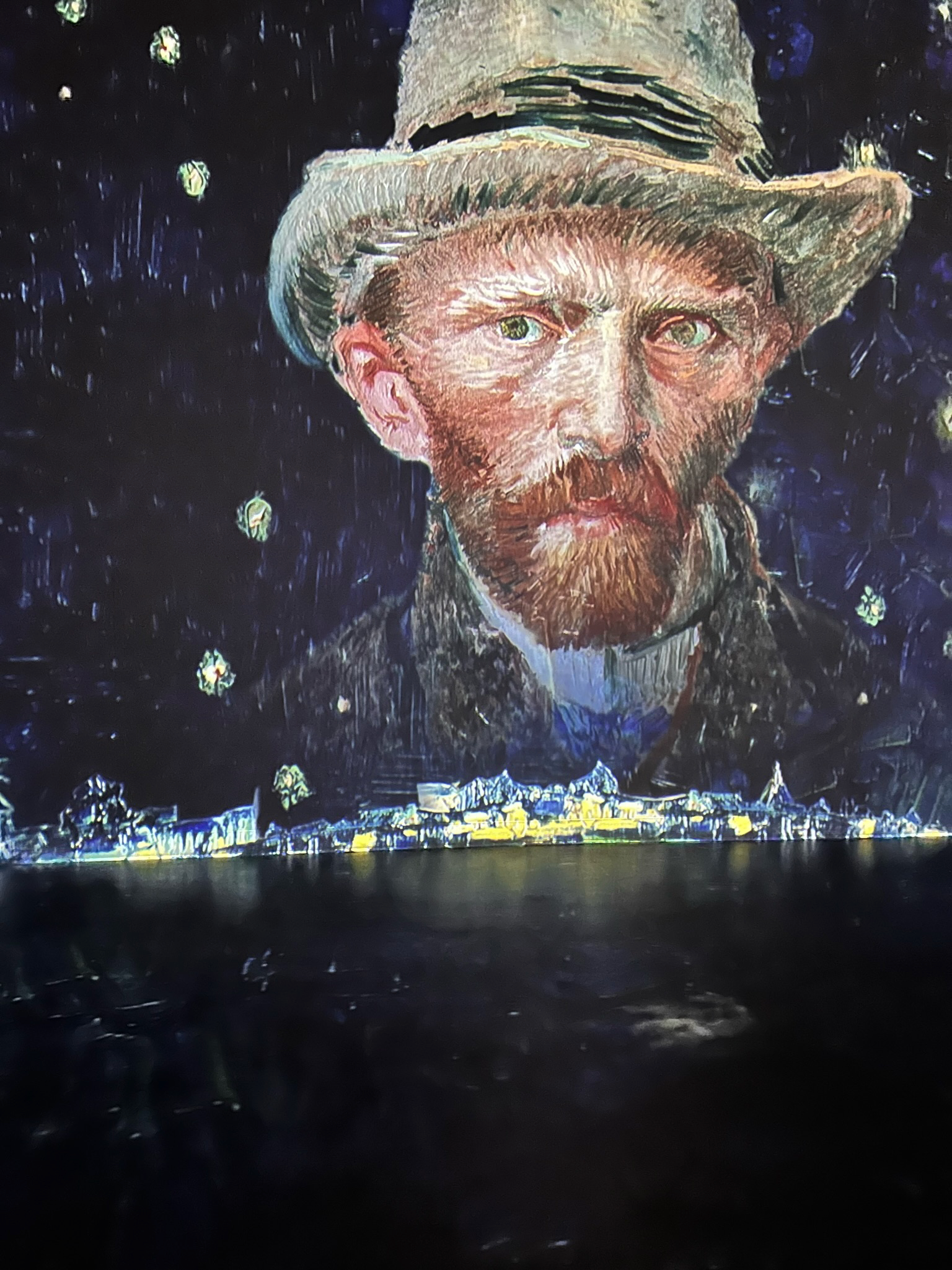
Photo: Tom Kane at Immersive Van Gogh Kansas City
This week, how art impacts how we see the world around us. ~~~ Immersive Van Gogh: https://www.kansascityvangogh.com Claude Monet, Boulevard des Capucines, (1873): https://art.nelson-atkins.org/objects/17852/boulevard-des-capucines George Caleb Bingham's Catalog: https://www.binghamcatalogue.org Thomas Hart Benton's art at the Nelson-Atkins: https://art.nelson-atkins.org/people/2320/thomas-hart-benton/objects "Hard Times Come Again No More" by The Chieftains and Paolo Nutini: https://youtu.be/uPqjQTkEA6g

On Sunday, I went with my parents to see the Immersive Van Gogh exhibit that’s been touring around the globe for the past few years. I first heard about it when I was in Paris in May 2018 and thought about going to see it there but ended up not paying a visit to it then. So, the following year when it was announced that Immersive Van Gogh would be coming to Kansas City, I jumped on the opportunity and bought tickets for my family to attend. 

Then the world changed in what now seems like a prolonged moment as the COVID-19 Pandemic took hold around the globe. The exhibit opening was delayed in Kansas City, and it began to slip from my mind for the next couple years as the storms that shadowed the last few years of the 2010s burst into the troubled times that have been the hallmarks of the 2020s thus far.

So, after years of anticipation when I finally entered the Immersive Van Gogh exhibit this past Sunday afternoon I was awed to experience it, the sights and sounds combined for a truly awe-inspiring experience. We entered the gallery as Edith Piaf’s “Je ne regrette rien” burst over the speakers to the bright yellow hues of the fields of Provence as observed 140 years ago by the artist’s eyes. I took a seat on the floor with my back to a mirror-covered pillar and watched as the images danced across the walls and floor surrounding me.

The exhibit inspired a question: does our art influence how we perceive the world around us, and as a historian more importantly does the art of past generations influence how we today perceive the light and color and nature of past periods? Take the Belle-Époque, the age of the Impressionists like Monet and Post-Impressionists like Van Gogh, do we understand and think of the daily reality of that period in a way that is colored by the works of those artists? There is a Monet painting in the Nelson-Atkins French collection here in Kansas City of the Boulevard des Capucines which dates to 1873. It shows the hustle and bustle of the French capital in a manner that is both of its own time and seemingly timeless in how modern it appears. This extends in my own mind to the point that I’ve imagined the same scene whenever I’ve happened to walk down that same boulevard in the last few years.

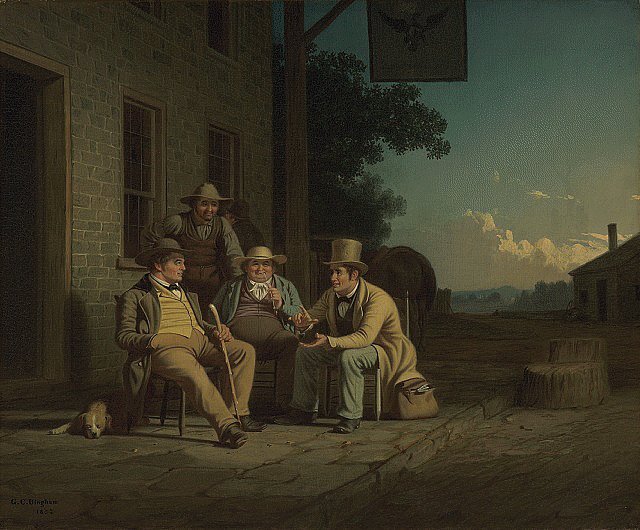
On the other hand, the images that exist of Kansas City from the nineteenth century are largely dominated by black-and-white photographs and the odd painting by the likes of our first great local artist George Caleb Bingham (1811–1879). So, for how many of us are our ideas of say the Civil War largely just in black and white even though the reality was in the same vibrant color as we see now today? Even in my own life, I’ve found that there’s a slight hint of faded color in my memories of earliest days of my life, perhaps influenced by the technology available in the color photography of the 1990s which is noticeably less radiant than the colors available today in our digital images.

George Caleb Bingham, Canvassing for a Vote, 1852, (92.71 x 105.41 cm), Nelson-Atkins Museum of Art

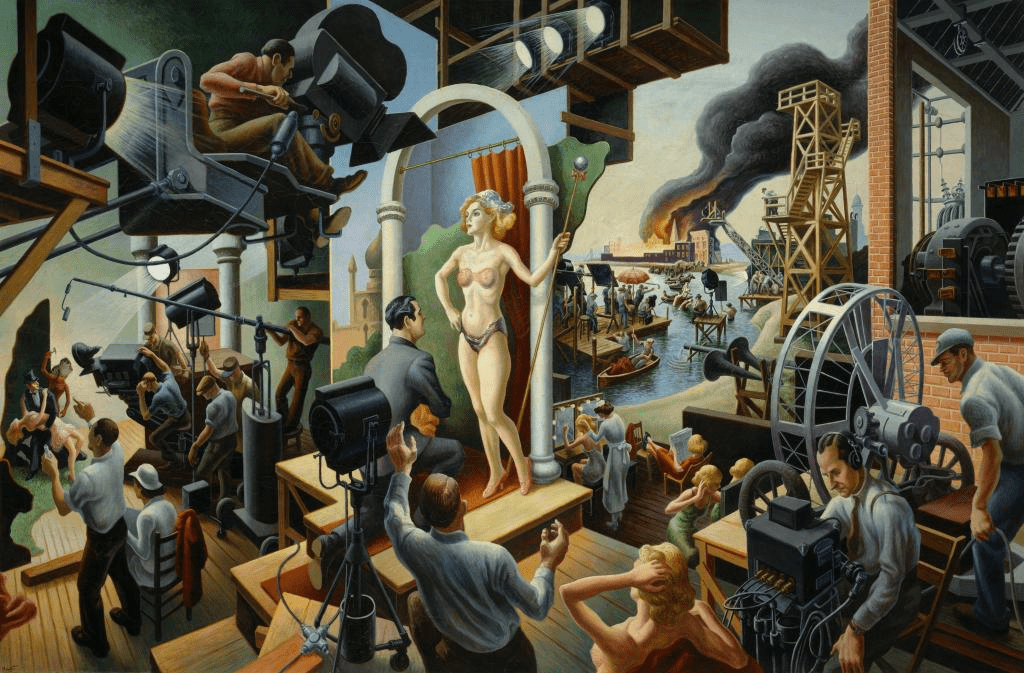
Art at its most fundamental level is a means of communication. It transmits memories from the creator, a historian of their own sort, to their patrons in posterity. Whether that art is expressed in painting or sculpture, sketching or cartoons, music or poetry, theatre or film, and in every form of literature both fiction and non-fiction alike, it is still at its core a transmission of knowledge and information. Through art the dead are able to speak to us still. In art we can experience something of the world that others live, that they see and hear and think. In the paintings of Thomas Hart Benton (1889–1975), in my opinion the greatest Kansas City artist to date, we can see echoes of American life as he understood it in the first half of the twentieth century. I can truly say that his art has influenced how I understood the Depression, World War II, and the Postwar years in a way that is best described by the fact that having grown up in Kansas City going to the Nelson and the Truman Library I saw his art far more often than many other Americans might well have. Through his paintings, Benton communicated ideas about what it means to be American, and the place of the Midwest in general and this part of Missouri in particular in the wider fabric of this diverse country of ours.

Thomas Hart Benton, Hollywood, 1937-1938, (156.53 x 227.01 cm), Nelson-Atkins Museum of Art

So, what sort of message will we in the 2020s leave for future generations? What do we want to communicate to them? In the last couple of weeks, I’ve been thinking of the Stephen Foster song “Hard Times Come Again No More.” Written in 1854 at a time when my home region was embroiled in the Border War known more commonly as Bleeding Kansas, one of the last preludes to the American Civil War of the 1860s, I’ve always thought of “Hard Times” as a song not of the nineteenth century but of the Great Depression, something that I could imagine being sung by farmers fleeing the Dust Bowl here in the prairies for new lives elsewhere. Still, the fact that the stories surrounding that song can speak to different times with common troubles speaks to the power of art. Maybe it’s high time we restore “Hard Times” to the charts, after all what better description of the present could there possibly be?

Childhood

My Mom and I, Thanksgiving 1997
This week, reflections on childhood, from my own personal experience.

One of my favorite types of daydreams is to imagine my current self talking to my younger self. It could be me as a junior in high school or me watching off to the side as my three- and four-year-old self began to conceive of the world around me. I can remember what my younger self was thinking in any given time so the “script” if you want to call it that is one of the easiest ones to write. And in the past, as is still the case today, I often wonder about my future self, who I’ll become as I continue in my life, who I’ll meet, where I’ll live, who I will be in my future. 

A couple of weeks ago I found myself thinking about all this for a good three hours while I was flying east from Kansas City to Newark on my return trip to Binghamton from a wonderful Easter weekend at home. As I watched the prairies of the Midwest give way to the deep cloud covered Appalachians, I kept thinking about who I dreamed I would become when I was at varying stages of my life. Would my six-year-old self whose life changed dramatically when he moved with his parents from Chicago to Kansas City be proud of how my 29-year-old self has found a way into a career where he still looks back at what he loved to think about as a kid? Would my moody teenage self be happy knowing that he was still going to be single at the end of the following decade? And what about my more recent past? Would the Seán who lived in London for a year and learned so much about the world in those months abroad, would he be proud or scared at how tough the next seven years of his life were going to be?

I wonder, and maybe this is a conversation better posed to psychologists, are we still the same people who we were as kids? Or do we transform or change the shape of our personality through our lived experiences, through our joys and sorrows? I remember thinking about myself more simplistically as a child, a time when the things that I was proud to be a part of conjured up images like the Space Shuttle or other marvels of the modern world. As I learned more about myself, I found more and more things that were new to me that I could attach myself to, that I could find some connection to. My interest in Ancient Rome was born out of a conversation with my Mom when I first remember hearing my Church called Roman Catholic. I knew where Rome was (I memorized the globe at a very early age) so the idea that I was a part of something so rooted to something so ancient was thrilling. 

Similar things happened at a time that I can’t pin down when I began to understand and listen to the stories about my Irish ancestors. It’s funny, I remember only one person from that generation, my grandfather’s Aunt Catherine who died in 2000 when I was seven. I remember her accent puzzling me, but I bet if I sat with her today, I’d be able to understand her perfectly well now that I’ve got nearly 30 years of listening to people from Mayo under my belt. On my Mom’s side I have only one memory of my great-grandmother, my GG as I always called her. I must have been very young, but I remember waking up from a nap in what’s now the computer room in my grandmother’s house in Kansas City and going out into the living room where she was sitting with my grandmother. All I remember her saying was “Hi, Seán.” When I told my Mom about this memory recently she said she must have carried me out because my GG died before I could walk, meaning this could well be one of my very first memories.

Still, when I think back to all those moments as if looking down the long string of a double bass, I wonder if the guy whose eyes saw those moments, whose ears heard those sounds, whose nose smelled those smells (for good or bad) was the same guy who I am today? If I can say anything definitive, it’s that the one constant among all those memories isn’t necessarily how they were framed or what I was thinking or feeling in each moment. It’s that the same internal monologue was going in the same voice that I still think in today. A few weeks ago, I wrote about the first time I recognized my conscious thoughts, something that a lot of people said was a profound idea. I asked if that for me was the moment best described as “In the beginning” for me, with everything else I ever have come to know or will come to know happening afterwards in the order that I discovered those things? Today I want to add onto that dogpile of a question and ask, which part of my past is most influencing my present, and by extension my future? I think the best way to look at answering this question is through the lens of nostalgia.

The truth is I’m not sure which reflections of my past that live on in my memory is the one that I’m most nostalgic for. There are echoes of all of those shadows in my life and my work today, the deep passion for natural history and the natural world in general that drove my six-year-old self whose favorite places in the world included the Field Museum and the Brookfield Zoo, or the teenage reflection who loved his Latin classes more than any other and really wanted to be doing better at it but just didn’t have the patience to stop overthinking things. I think those teenage loves drove me into my adulthood, after all as much as I loved spending my time in London’s Natural History Museum it was the British Museum that I dreamed working at when I decided to do either a Classics or a History PhD in 2016. It took me a few years to get into a program, by which time I’d settled not on Ancient Rome but on the Renaissance, before building my own field from the ground up, as a kid with my childhood would tend to do, to become a Historian of Renaissance Natural History.

As it happens, this whole idea of a hyper-individualized vision of a historical timeline, beginning with a person’s first consciousness about something could be useful in my work. After all, one of the great debates in the history of how the Americas were approached by Europeans during the Renaissance is whether it’s right to say they “encountered” or “discovered” these continents. I usually prefer to say “encountered” seeing as there were already generations of people reaching back into the Ice Age who had called these continents home. Still, if we think about this question less in the scope of all of human experience and more in the limited view of how one set of humans, one branch of the family isolated from others by circumstance understood the Americas when they reached those shores in 1492 then the word “discover” coming from the Latin “discooperiō” meaning “to expose” or “to lay bare” then the word does fit the experience of the many peoples of Europe in first learning of the existence another series of worlds across the Ocean Sea that they came to call America. But our history is the history of the creation of our modern world, a global world defined by shrinking borders and a growing sense that we’re all in this together, and for that world this isolated story of one perspective “discovering” the fact that other people had already made it to first base merely makes the discoverer a shortsighted pitcher. Without all the caveats and framing, the idea doesn’t work. It speaks to the warning that it’s best not to think of whole groups of people in the same context that we’d use to think of just one guy.

So, with that out of the way, do I think my younger self would be proud of who I am today? In some ways, yes, after all I’m sticking to doing something that I love despite a great deal of the odds and the circumstances of our world in 2022 seeming to be stacked against me making a living out of being a Historian of Renaissance Natural History. I may not be working at the Field Museum or at one of the other wonderful natural history museums in this country or beyond, but I’d say that’s still a possibility. Nonetheless, I imagine that teenage Seán would be a bit more forlorn knowing he’d still be single all these years later. Teenage moodiness can cast a shadow even from the confined distance of your memories. I think the moral here, if there is one, is that there’s always room for improvement, right? And at the end of the day, as my undergrad self the triple major in History, Philosophy, and Theology with double minors in French and Music would like to say, “Anything is possible.” So, if I could go for three and a half years without a lunch break trying to earn 3 majors and 2 minors in 4 years then I can get a job doing something I love and maybe figure out the personal life while I’m at it too.

The Artist

This week I'm reflecting on the 2011 Best Picture winner "The Artist" and introducing a new segment to The Wednesday Blog in an interview with my friend Alex Brisson about the film. Alex Brisson's website: https://www.alexbrisson.com Star Trek: The Original Siblings Podcast: https://stosibspod.buzzsprout.com Brissflix: https://www.alexbrisson.com/brissflix The musical interlude in this episode comes from "April Showers" recorded by Gene Rodimich's Orchestra in 1922. Listen to the full version here: https://freemusicarchive.org/music/Antique_Phonograph_Music_Program_Various_Artists/Antique_Phonograph_Music_Program_04072015/April_Showers_-_Gene_Rodemichs_Orchestra/

This Week: Alex Brisson joins me for a conversation about The Artist

Last week after finishing my daily Jeopardy! viewing I decided to turn to Netflix for the first time in a while and see what was on my watchlist that I hadn’t touched recently. Perhaps the inclination to turn to Netflix instead of my more frequent streaming services, notably Paramount+ and PBS, might well have been urged by the recent poor market performance of the streaming giant following its first poor quarterly performance in its history. Still, there are many wonderful shows and movies to watch on Netflix, and one in particular caught my attention. 

I first saw The Artist back in 2011 when it was playing in the theatres. I went with a group of friends from Rockhurst to see it at the now old Tivoli Cinema in the Westport neighborhood of Kansas City, and for whatever reason the people I went with decided we would get there about halfway into the film, something which annoyed me because this was one that I really wanted to see. We took our places in the back row of the theatre with about 40 minutes left in the 90-minute picture. I enjoyed what I saw but felt cheated at not getting to see the entire thing, and for whatever reason I never got around to going back to the Tivoli to see it again in full. So, when I saw it was on Netflix a few years ago now I saved it to my watchlist and then never got back to it. Therefore, last week when I saw The Artist would be leaving Netflix that very night, I decided to not overthink it for once and pressed play.

What followed was everything I hoped for. Longtime readers of this blog will know I’m a fan of silent films, old friends will remember I even made a few in high school, which honestly was as much due to the poor quality of the sound that my video camera could record at the time in the late 2000s and early 2010s. I’ve written in the past in this blog about how Charlie Chaplin’s The Gold Rush touched me and spoke to me of a loneliness I truly can relate to now in grad school, and I think that blog post speaks to the unspoken power of silent films to sing directly to human emotions through visual cues only. The visual metaphors that abound in The Artist are loud and clear, as if shouting from the rooftops, yet they are iconic in their heritage from the theatre and ballet, art forms that served as some of the roots of silent film itself.

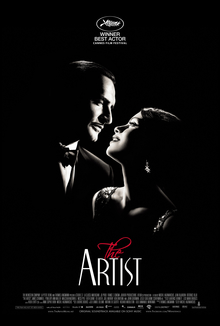
The Artist tells the story of a Douglas Fairbanks type of leading man, George Valentin, played artfully by Jean Dujardain, whose career playing the same mustachioed hero over and over again is eclipsed by the coming of sound in 1927. Into the scene walks the young extra Peppy Miller, played joyfully by Bérénice Bejo, whose own career takes off as Valentin’s descends. Valentin has many opportunities to maintain his triumph through the transition to sound, yet his fear of change and his pride make him tumble from the heights of stardom like Icarus at the roaring heat of the Sun’s rays melting the wax on his silent wings.

The film’s message is one of emotional turmoil in distress, Valentin falls as far as he can in life, almost to the grave itself, yet he continues to have people around him who love and care deeply for him. Among them first and foremost is Jack, his beloved dog and quite likely best friend, played terrifically by Uggie, a Parson Russell Terrier, who stayed with Valentin through thick and thin, even saving his life on the odd occasion. I want to pause for a minute here and acknowledge some of the discussion that was going on in 2011 about giving Uggie recognition for his work on The Artist, even perhaps an Honorary Oscar. One quote that made me do a spit take with laughter from a spokesman at the BAFTAs (British Academy of Film and Television Arts) was quoted in The Daily Telegraph as saying that Uggie wasn’t eligible because he wasn’t “a human being” and because of “his unique motivation as an actor was sausages.” I will say, I bet if we didn’t need to work for wages to survive there’d be many a person out there who might consider a good sausage a nice reward for a day’s work. Speaking of that, I need to add some brats to my shopping list …

Anyway, The Artist is special in that it was a silent film made 84 years after the development of talking pictures. It is also one of the few fully black-and-white pictures to be made in the last few decades. Another one of note that I quite liked was the 2020 David Fincher film Mank about Herman J. Mankiewicz and the creation of Citizen Kane in 1939 and 1940. As such The Artist is a silent film made with 84 years of extra technical know-how. From what I could tell as a silent film buff the creators of The Artist did a great deal to make it authentic to the period it sought to depict from the lighting to the camera angles, to the profound metaphors through set design, such as the moments when Valentin finds himself looking into mirrors and seeing what he’s become or the way in which the creators seemed to be using new yet old-looking ways of telling their story.

When sound does appear in The Artist it’s as if an alien invasion has commenced. George Valentin’s first contact with sound comes halfway through the film in the form of a series of defiant noises that terrify the silent star. Later though once comfortable with it the sound returns and becomes embedded in the world of The Artist as something ordinary and wonderful at the same time. 


This week I’m reflecting on the 2011 Best Picture winner “The Artist” and introducing a new segment to The Wednesday Blog in an interview with my friend Alex Brisson about the film.

Alex Brisson’s website: https://www.alexbrisson.com

Star Trek: The Original Siblings Podcast: https://stosibspod.buzzsprout.com

Brissflix: https://www.alexbrisson.com/brissflix

The musical interlude in this episode comes from “April Showers” recorded by Gene Rodimich’s Orchestra in 1922. Listen to the full version here.

Homo Sapiens

A particularly bumbling specimen of the species.
This week, a bit of self-reflection. The Man from Earth website The Man from Earth trailer

On Monday last week, I sat down to watch the 2007 film The Man from Earth for the second time. You may remember hearing or even reading my reflections provoked by that film. I said I’d probably watch the sequel, The Man from Earth: Holocene soon, and well I did just that. Compared to the original, Holocene lacks some of the powerful dialogue, and the gripping storytelling. The Man from Earth felt like it was a story being told in real time, while Holocene, its sequel, seemed more like a TV pilot that was turned into a feature. Both films feature some wonderful actors that I recognize from the many Star Trek series I’ve seen in the last few years, notably John Billingsley and Richard Riehle in the first film, and the great Michael Dorn himself makes a wonderful appearance in the second film.

If I were to draw any deep arguments out of the second film, Holocene, it would be something to do with how we identify ourselves. We humans call ourselves Homo sapiens, a scientific designation that we’ve given to ourselves to distinguish us from our hominid cousins including the Neanderthals. Homo is Latin for human; it is the genus which represents all hominids as a subset of primates. Sapiens on the other hand is more interesting. It is a Latin participle based on the 3rd conjugation verb sapiō, sapere which is used to mean many things from “to taste,” “to have flavor,” to the more innate concept of being able to sense or discern things, all of which is necessary for knowledge. Homo sapiens then means we distinguish ourselves from our hominid cousins by our abilities to understand ideas. Now there’s evidence today that other early humans could think and create in ways that are similar to us, evidence for example that Neanderthals created art of some sort in ancient Europe, so in many ways the fact we designate we humans as Homo sapiens is as much a way of patting ourselves on the back as anything else.

This brings me back to The Man from Earth: Holocene. It’s a film that introduces the core conflict when a group of inquisitive undergrads start to wonder about their professor who they soon realize is the same 14,000-year-old man from the first film. Only now he’s begun to age in slow but noticeable ways. This film made me question the idea that we are Homo sapiens for the personifications of humanity in this film, the four students seeking the truth about their professor, make a series of terrible decisions that prove as book smart as they might be they are clueless to so many other factors of life. Homo sapiens indeed.

In my own research I study the introduction of Brazilian flora and fauna into European natural history through the writings of several French explorers dating to the 1550s through the 1580s. And while I came into my research thinking I would have some fun writing about sloths and parrots and dyewood trees, I have found that the story I’m trying to tell is as much a warning to our present and our future as it is anything mundane about Renaissance natural history. There is a theory, an idea that is introduced late in The Man from Earth: Holocene called the Anthropocene, a concept that is widely discussed today which argues that human interventions and influence upon nature have become so great that we have shifted the course of Earth’s natural development from the Holocene, the current geological epoch defined by our planet’s warming by the Sun over the past 11,650 years, making for the perfect conditions for the development of life as we know it today into a new geological epoch where we humans, the Anthropoi in Greek, are now the prime movers of Earth’s natural course. In the film this becomes an understated note of caution, yet in my own research I find the Anthropocene to be a fundamental piece of the story of the European exploration, conquest, and colonization of the Americas largely ignored until recently.

We call ourselves discerning, we call ourselves wise, and yet we allow our own demands on nature to outstrip what nature can provide. It’s a curious balance we need to maintain, one which I am just as guilty of destabilizing as anyone else. It’s curious to me that we call ourselves wise when we think of all we have done with our home. We are one of maybe only a handful of species (leaving room here for other hominids at least) that has created beautiful art and weapons of mass destruction all with the same innate tool: our brains. We have just as much an ability to love as to fear, and in a given day I think it’s safe to say we act on those emotions without often really realizing it. 

Through it all we’ve survived and thrived on this planet of ours. There are 7.9 billion of us today, and while our population growth is a marvel of our ingenuity and ability to adapt to everything that this planet has had to offer so far, our own exponential growth may be the thing that drives the planet to the point of no longer being able to care for us the way we have been. If we don’t eat, we starve, yet if we eat too much we will run out of food and then starve. As the Man from Earth himself said in the first film, it’s the species that live in balance with nature that survive.

I argue in my dissertation that the Anthropocene really began when two different gene pools of life, one Afro-Eurasian the other American intersected in a large scale for the first time in thousands of years following Columbus’s accidental stumbling on land and people on this side of the Atlantic in 1492. That was the moment when human endeavors began to triumph over natural barriers, when a new global world was first conceived out of the collective products of a series of old worlds on every inhabited continent. It’s fair to call ourselves sapiens, discerning and wise, for the fact that it was humans who bridged that gap through innovation and technology. Yet it’s also fair to say that it was humans too whose innovation and technology created the great climate crisis we find ourselves in now. While the pessimists among us would end the story there, in a way that is in vogue to do these days, I want to continue the story, to contribute a verse to the poetry of life and say to you here and now today that it will be our innovation and technology, our discerning and wise nature that will figure out a way out of this crisis and that will lead us to adapt again to a new life in this new world we’ve created in our own image.

The Man from Earth speaks to me of the potential of humanity and of how at the end of the day we’re still just telling each other the same sorts of stories around a campfire. Like our ancient ancestors before us we see what we know and imagine what could be out there beyond the light of our knowledge. Unlike our ancestors we today are comfortable in a world we’ve created for ourselves, or at least some among us are comfortable in that world. We don’t need to innovate quite so greatly as past generations; we can let our minds become lazy and unimaginative. Like the big wigs from every time just before a storm we can be content and let the tides overcome us, but some among us will be hit more fiercely by those tides than others, and they’ll be the ones to stand up and say we can do better for ourselves. We will always stumble and fall, like those four characters from The Man from Earth: Holocene but we will always find a way of getting back up.

At the end of the day, we’ve created this new world where we are at its center, the keystone species around which all others exist in a new balance. I personally find that balance more precarious than I’d like, and personally I’d rather not be the one holding the entire balance of nature up like some modern Atlas. Yet over generations of decisions for good or ill this is what we’ve decided to do, and who we’ve decided to become. All we can do now is live up to the task and make the burden less strenuous for our descendants.