Category Archives: Life

The Fog of Time

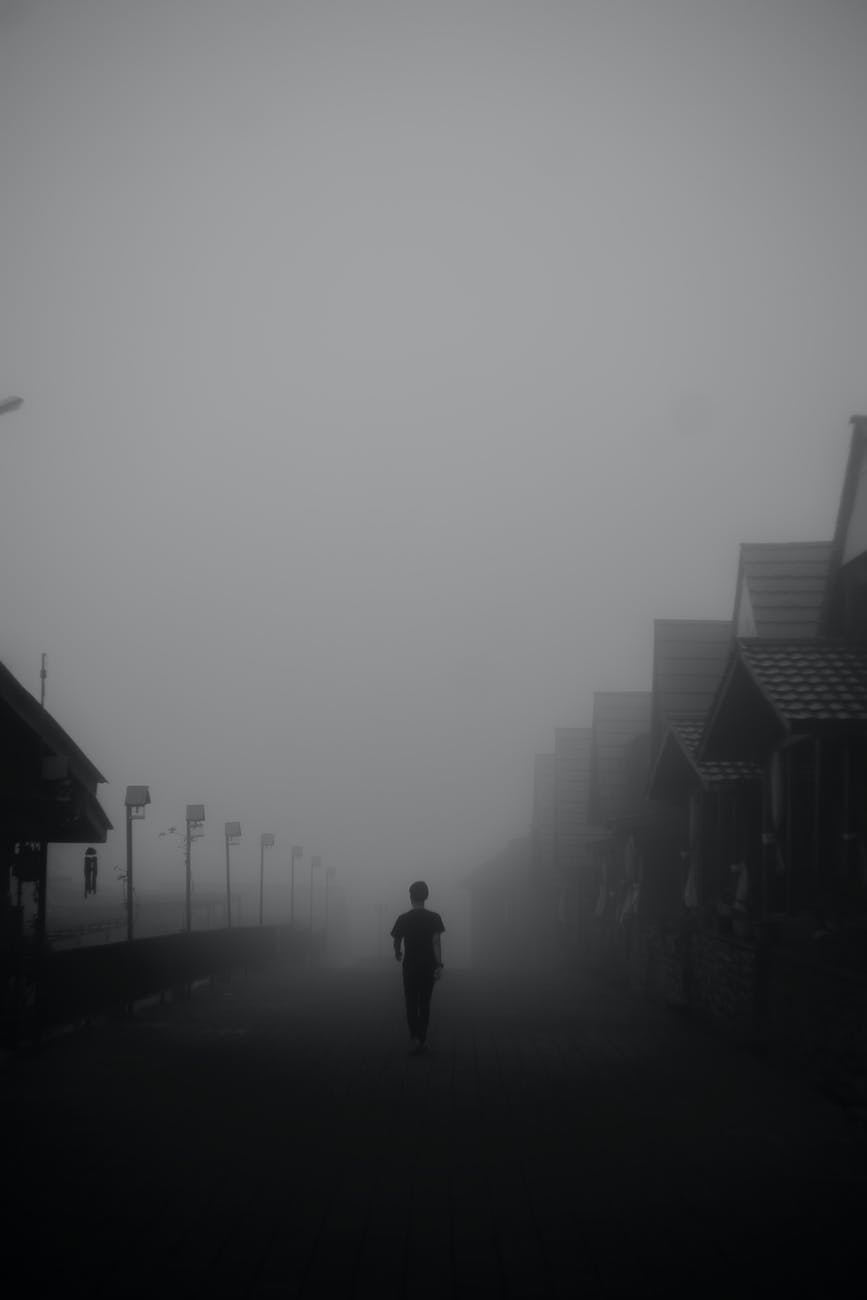
Photo by wsdidin on Pexels.com
This week, some thoughts inspired by the Jerome Bixby written 2007 science fiction film The Man from Earth. The Man from Earth website The Man from Earth trailer

When I was an undergrad, I watched a lot of really neat films and TV shows. It was something that sticks out to me from those years as distinct, something that I’ve continued and recreated from time to time as my mood allows it. In the Fall of 2013 I saw a movie on Netflix that peeked my curiosity called The Man from Earth that I’d never really forgotten. It’s not really an action-packed story in the modern sense, no rather it’s 90 minutes of dialogue, discussion, good old fashioned storytelling about a professor who is leaving his job, home, and friends after 10 years. The reason: because he’s learned over the 14,000 years of his life that that’s a good policy to do every decade or so. Yep, John Oldman, the Man from Earth himself, is a Cro-Magnon.

For some of you hearing or reading this the plot of The Man from Earth will be all too familiar to you. It became something of a quiet hit among certain crowds. One reviewer called it “intellectual sci-fi” even. While I was home over one of my recent breaks from working on my dissertation I bought an HD copy of it on YouTube figuring I’d like to re-watch this particular classic of my early 20s again. It took me a few months but on Monday night this week while I was keeping an eye on my students’ term papers streaming in before the 11:59 pm deadline I sat down and watched The Man from Earth all over again.

What stands out to me the most about my memories of watching this film for the first time nine years ago is how it unsettled me a bit, as it did the expert characters on the screen. The very idea seems counter to all that experience has taught us. “People die!” as the goddess Persephone cries to Orpheus in another film I purchased on YouTube. Yet somehow in the logic of The Man from Earth the title character, Dr. John Oldman had been able to live for 140 centuries and still after all that time appear to be only around 35.

This time I came away from my second viewing of The Man from Earth thinking less about the literal story and more about the ideas it proposes. For one thing I found myself thinking of the perspective that such a man would have of nature and reality. My own perspective is fundamentally framed by my upbringing, it’s conditioned by the powerful forces of my Catholic faith, my Irish American traditions, my personal ethics, and by my upbringing learning about Creation as both an Act of God and scientifically the product of a Big Bang and billions and billions of years of evolution. 

On the other hand, John Oldman––the fourteen thousand year old Cro-Magnon––reflects and recognizes a different sort of perspective, one born out of the entirety of human experience, one where the world began as what was knowable from the furthest reaches of the light from the nearest campfire inside a cave. For him, the Big Bang and all the creation stories we’ve been telling ourselves could well have happened after his first memories, his first inklings of reality and existence. To him those were all things that were learned over time, and their existence only became tangible once they were learned. If you think about it no one really knows things before they begin to have that first spark of an idea that those things could be possible. Today, I believe that anything is possible. That belief is grounded in my faith in an omnipotent and omniscient Divinity, yet it’s also equally held up by the course of human intellectual history, of how we keep finding out more and more things are real, and by extension at the edge of our knowledge that more and more things are possible. How wonderous is that?!

On Sunday evening, in honor of Yuri’s Night, an annual celebration held around 12 April to commemorate Yuri Gagarin’s first spaceflight, the first time a human left our home planet, I decided to watch a space-themed film. Last year I was lucky enough to join the global livestream party and hear all sorts of neat panelists talk about the past, present, and future of Space exploration. This year though that wasn’t an option, so I improvised and put on the 1982 classic The Right Stuff. For those of you who aren’t familiar with it, this is a film celebrating the Mercury 7 astronauts, the first Americans to leave the Earth and among them the first humans to orbit our planet. The Right Stuff begins with Chuck Yeager’s triumphant 1947 flight that proved the sound barrier (Mach 1) could be broken. Before he flew his Bell X-1 faster than the speed of sound no one was entirely sure it could be done. It pushed the edge of our knowledge out of a pure hope that supersonic travel could be possible.

Maybe then on a human scale we should think of our place in the history of the Cosmos less as a story beginning with the Big Bang, which as scientific as it is does bear some resemblance in how its story is told to the other great Creation stories out there, and more with that first human spark that signaled to our conscious thoughts that we exist. Maybe the beginning of the human story ought to be around a campfire in a cave somewhere, or maybe this leaves room for multiple human stories, each threads that broke off from one another until as it is in our present time there are 7.9 billion such threads living, all vibrant and emotional and passionate each in their own way.

When I think back to my beginnings, to what I can ascertain as my first definite memory that I can remember, that first moment when I could recognize my own internal narrative that keeps me going even now, I think of a day trip my parents and I took when I was around 3 or so from our home in the Chicago suburbs to the farm where my Mom’s grandfather grew up in Sheffield, Illinois. I remember sitting in the back seat, on the passenger side watching out the window as we drove by new suburbs, new neighborhoods were being built as we drove west. For me so much that I consider etiological, that I consider as origin-stories to my own, whether they be Genesis or the Big Bang or the many stories keeping my ancestors’ memories alive even when the people involved are long dead, all of those come after that moment in my own memory. So, to my own individual, my own personal recollection of history, of reality, of the Cosmos in all its wonder, all of that comes after that one moment that I can remember from 27 years ago.

What does this mean for how we understand our place in nature? I think if it changes anything, it ought to follow another line of wisdom from The Man from Earth, that the species that lived in balance with nature tended to be the ones who survived. Maybe we need to balance ourselves with our worlds. What I mean to say is maybe we should allow room for our own individual views of things while acknowledging there’s a greater truth to be found in the collective knowledge and wisdom of humanity. There is an inherent fog surrounding our understanding of time, after all we can only ever really see what’s happening right in front of us at any given moment. We can remember with growing haziness what happened in the past, and we can yearn for possible futures that are equally fuzzy in our imaginations today.

This time around I was delighted to see that a sequel was made called The Man from Earth: Holocene back in 2018. It stars the same actor, David Lee Smith, as John Oldman. I think I might watch it tomorrow, and who knows maybe you’ll hear more from me about this story next week. For now, keep imagining because that’s what allows for the improbable to become the possible.

The Man from Earth (2007) trailer

Beethoven’s Ghost

Ludwig van Beethoven, Piano trio in D Major, op. 70, no. 1, musical autograph.

Over the weekend I took a break from my usual work and TV schedule and decided to watch something on the PBS streaming app. I ended up choosing the latest episode of Scott Yoo’s series Now Hear This which has been airing as a part of PBS’s long time arts show Great Performances. I wrote about Yoo’s episode on Mozart a few months ago, and this iteration’s focus on Beethoven likewise did not disappoint. The premise of the episode was essentially Yoo and friends renting out an old Gilded Age mansion in the Berkshires and recording Beethoven’s Ghost Trio (op. 70, no. 1). At the same time, in the Halloween spirit of the weekend when this episode aired, the ghost of Hr. Beethoven himself appeared to listen to his music being played once again. Yet alongside the great composer also appeared the ghost of Dr. Sigmund Freud, who it turned out, had been offering psychoanalysis to the ghosts of dead composers since his own demise in 1939.

At first, I have to admit, I laughed at the idea that Freud interviewing Beethoven would fill the biographical aspect of this episode. It made sense, but it seemed like a silly idea. But as the show went on, I found the premise not only believable but it made Beethoven himself seem more endearing and modern. Now for both of these to occur, I have to admit that I do tend to believe in the possibility of the supernatural. Writing as a Catholic, I believe in an afterlife, and that likely both gentlemen in question are currently in residence there. What’s more, I’ve always thought that one of the things I’d love to do after I died would be to sit down and talk to some of these famous people: Beethoven, Lincoln, Frederick Douglass, among all my own relatives I’d be dying to meet.

By the time the episode ended I really liked the idea of having the ghosts of historical figures interviewing each other as a way of describing their biographies. Sure, it’s corny, but it works. I remember a few years ago KCPT (Kansas City PBS) had a program that they ran with the KC Public Library where Crosby Kemper, then the library’s director, would interview figures from Kansas City’s past: whether they be President Truman, Buffalo Bill Cody, some of the great jazz band leaders, or Boss Tom Pendergast. In many ways, the format that Yoo and friends came up with having Freud’s ghost interview Beethoven’s ghost fits that same model.

Then again, one final question arises from the grave: are they Freud’s ghost and Beethoven’s ghost, or are they just simply Freud and Beethoven? What’s the difference between a potential remnant of a deceased soul and the person they once were? And if there is a difference, does that mean that experience makes all of us who we are?

The Voice of American Music

Growing up there always seemed to be a few specific genres of hymns that’d be sung at Mass: the really traditional Latin hymns that go back into the Middle Ages, the eighteenth and nineteenth century hymns, often of Lutheran or Methodist origin that we Catholics had adopted, without necessarily acknowledging their sources, and the newer hymns written by the likes of the St. Louis Jesuits or those that came out of the spiritual and Gospel tradition native to this country. Often, my experiences performing music, whether singing or playing, was pretty well focused on church music and on the other hand on traditional Irish music, which I started learning when I was 13.

It strikes me how much our common musical language here in the United States can bridge gaps that we ourselves aren’t yet quite ready to leap across ourselves. My own experiences coming from a Midwestern Irish American Catholic family are entirely different from many of the people I work with today on so many different levels, but at the core of it all there seems to be this same common musical language that subconsciously unites us.

One of my favorite YouTube videos lately is of the great cellist Yo-Yo Ma performing “Going Home” from Dvorak’s 9th Symphony for the New American Arts Festival. Ma begins his contribution by telling the story of Dvorak’s time teaching music to his American students before his own return to Europe, and how the Czech master told them not to copy his style but to go out and listen to all the different music around them and create their own style from that. Out of those students and their students came Duke Ellington, George Gershwin, and Aaron Copeland, three of the great American composers of their day.

I often find myself thinking of how I could embody this country in a particular sound, or in a sonic landscape that could immediately transport me as I listen to one part of this country or another. When I wrote my trio sonata for flute, violin, and cello, I set the first three movements in a very Irish tone. The first movement was an entirely original jig, with the flute taking the part that I’d normally play with my tin whistle. The second movement ended up being my version of Dvorak’s “Going Home”, this time a setting of the Irish air “An Gaoth Aneas,” known in English as “The South Wind,” the third movement ended up being a setting of the jig “Merrily Kiss the Quaker’s Wife,” which has a really fun second part to it.

The fourth movement though was again something new. But unlike the first three movements, which told their story with an Irish voice, the fourth movement was set in America, and to tell that story I tried to emulate the voice that Aaron Copeland composed in, built off the sound of American folk tunes, their very particular twang that certainly has some Irish roots but has changed with all the other influences on music in this country. I wrote that fourth movement with the spirituals and originally Methodist hymns I’ve sung at Mass all my life in mind, and compared to the rest of the piece it has a very different sound.

There’s a related but still different sound in the musical landscape of the American West, something born out of both old cowboy songs from the nineteenth century as well as both twentieth century Hollywood soundtracks to the great Westerns, including my personal favorites, the contributions of Ennio Morricone’s to the genre through his scores for Sergio Leone’s spaghetti westerns A Fistful of Dollars, For a Few Dollars More, The Good, The Bad, and the Ugly, and of course Once Upon a Time in the West. Still more interesting to me is that this western soundscape has been picked up in recent decades by the continued popularity of Country music, though admittedly it’s a genre I’m personally not nearly as fond of as many of my fellow Americans.

When I think of one particularly American instrument, it’s honestly the trumpet. Sure, this is something that was invented in Europe and is used in all sorts of contexts outside American music, but the trumpet nevertheless plays a central role in two particular musical genres that speak volumes to me personally. The first is the frequent use of the trumpet to represent the solemn dignity of the republic, as a calling card for our country as the first modern representative government. It’s something I hear particularly in the film music of John Williams, especially in his scores for Lincoln and Amistad.

This particular sound blends into the use of the trumpet as a stand in for the military as well, seen especially well in Williams’s score to Saving Private Ryan or in Jerry Goldsmith’s score for the film Patton and Elmer Bernstein’s mix of military motifs with Keystone Cops silliness in his score for Stripes. The trumpet, it’s simple yet pronounced call, seems to me to symbolize the idealized nature of this republic, and its classical legacy with the same instrument often being used in sword and sandal films to stand in for Republican Rome.

The other great genre that uses the trumpet to tremendous effect is my favorite genre created in this country: jazz. When I was first really learning about jazz as an adolescent I specifically remember thinking that I was less interested in what I saw as that boring piano jazz that my Dad liked to listen to on NPR. Instead, I wanted to hear the exciting stuff written for trumpets and trombones and horns.

I’ve since grown to love piano jazz, as my students can tell you from listening to Duke Ellington, Count Baisie, and Jon Batiste before the start of my classes every Friday (when I can get the sound in the classroom to work), but I still have a knack for wanting to hear trumpet. I’ve gotten to see Wynton Marsalis play live twice now, the first time with the Abyssinian Gospel Choir when they played his Abyssinian Mass at the Kauffman Center in Kansas City about 7 years ago, the second time when he played with Jazz at Lincoln Center in a Christmas concert at the Midland Theatre in 2015 or 2016. Jazz trumpet especially lends itself to Latin Jazz, another part of this country’s and more broadly these continents’ musical landscape that speaks directly to the soul of what it means to be American.

One of these days, I’d like to try to blend the traditional Irish music that I play with jazz, to see what sorts of neat sounds come out of it. What sort of language will be sung by those instruments when they come together. Maybe if I try my hand at composing again I’ll make an effort at it. Oh, and if you’re looking for recordings of my sonata I’m afraid you’re out of luck, it’s yet to be performed, though I’m open to offers there.

Summer 2021 Podcast Recommendations

With the last weeks of the Summer break from the Academic Year coming to an end, I thought it would be fun to offer those of you who still read these posts a few podcast suggestions that I regularly listen to throughout the week. These may do a decent job at giving you a general idea of my own interests as they stand at the time of writing.

Planetary Radio

I first found this podcast in early 2020 just before the current pandemic began, and have made it a regular staple of my weekly radio and TV diet. It’s something that I make a point of listening to, if not on its usual Wednesday release, then by the end of the day on Thursdays. Hosted by Mat Kaplan, this is the official podcast of the Planetary Society, a space advocacy organization of which I am a proud member.

Planetary Radio, new releases every Wednesday.

A People’s History of Kansas City

A People’s History of Kansas City is always a wonderful solution for homesickness. I first started listening to it during my first year in Binghamton, I believe in early 2020. Some of my fondest memories listening to this podcast are of the time I was driving back to Binghamton from Albany Airport down I-88 (NY) and listening to a gripping story about the Guadalupe Centers here in KC, or more recently when on the way to and from a Royals game I listened to a couple episodes about Disney’s Kansas City roots and the post-contact history of the Missouria, the people for whom the Missouri River and the State of Missouri are named. I always look forward to hearing an episode of A People’s History, and occasionally even hearing people who I know personally get interviewed on this show (it helps being a historian).

A People’s History of Kansas City is off for the Summer.

Real Humans by Gina Kaufmann

Staying with the Kansas City, and KCUR, theme for a minute I want to suggest Gina Kaufmann’s latest project, Real Humans. It’s a shorter podcast, the episodes rarely seem to go over 20 minutes, but it addresses ordinary people here in KC and how the world we’re living in is impacting their lives. I’ve enjoyed what I’ve heard of this new 2021 release so far, and am looking forward to more stories brought by the host of KCUR’s old 10 am show Central Standard.

Real Humans by Gina Kaufmann, new episodes on Sundays

Star Talk Radio

I’ve been a fan of Dr. Tyson’s for a while now, having first really heard about him in my undergraduate Astronomy class at Rockhurst. This is essentially a radio version of his talk show that aired for a while in the mid-2010s on National Geographic’s cable channel. Essentially it’s Dr. Tyson and his friend Chuck Nice discussing whatever the topic of the week is with their guest. It’s admittedly been harder to get engaged in this podcast than others, but it’s a good one nonetheless.

Star Talk Radio, new episodes premiere on Mondays at 18:00 CT/19:00 ET.

Mission: Interplanetary

I think I first subscribed to this podcast either during PlanetFest this past February or during this year’s Yuri’s Night celebration in April. Either way, this has become one of my favorites for the interesting topics involving human Space exploration that are covered in each episode. The hosts, astronaut Cady Coleman and scientist & author Andrew Maynard are a lot of fun to listen to on either a long drive or a long walk around the neighborhood.

Mission: Interplanetary, off for the Summer. New episodes expected this Fall.

Ologies with Alie Ward

Ologies has topped most of the Apple Podcast charts this Summer and for good reason. I first found it one afternoon this Spring after a fun visit to the Helzberg Penguin Plaza at the Kansas City Zoo when I decided I wanted to find a podcast about penguins. Lo and behold, Ologies had an episode entitled “Penguinology,” with an expert in those antarctic sea birds, and from that point on I was hooked. I’ve really enjoyed listening to the various guest experts on this show, and while it’s a longer one it makes for good listening when you have a free 90 minutes to spare.

Ologies with Alie Ward, new episodes on Tuesdays.

Overheard at National Geographic

Overheard is a podcast that I found fairly early on in my current run of frequent podcast-listening, which all largely began with A People’s History and Planetary Radio. I’ve been a subscriber to National Geographic Magazine for quite a while now, and when I saw that Nat Geo had a podcast I figured it’d be a good one to listen to. At first it was hard to get engaged with it, the early stories I heard weren’t ones that I was all that interested in, but more and more I’ve come to really enjoy it. A recent episode involved that I loved an anthropological study of surviving Nahua-speaking communities in Mexico. Overheard has gone from being one that I’d occasionally listen to to a show that I look forward to every week.

Overheard at National Geographic, new releases on Tuesdays.

Sidedoor

From one Washington scientific institution to another, Sidedoor is a podcast from the Smithsonian that I only found a little over a month ago after my day trip to D.C. to visit a special exhibit at the Smithsonian American Art Museum (SAAM) about Alexander von Humboldt (1769-1859). Sidedoor has so far had really engaging stories that I’ve thoroughly enjoyed, and it’s inspired me more than ever to make it back to D.C. to visit the collections that get a mention on the podcast, in particular an upcoming special exhibit at the old Arts & Industries Building called Futures that sounds like it’ll be really neat.

Sidedoor, new episodes every Tuesday resuming in the Fall.

Gates McFadden InvestiGates: Who do You Think You Are?

One big change in my life that came about the same time as the start of the pandemic was my decision to try watching Star Trek again. I started this time with Picard and have since moved onto The Next Generation, Deep Space Nine, and am currently watching Voyager as well as the new episodes of Lower Decks. Considering a good portion of my free time tends to be spent watching Trek, after all there’s so much to praise about those shows and films, I’ve been on the look out for a good Trek podcast to listen to on a weekly basis. So, when I read on Twitter that The Next Generation‘s own Gates McFadden (Dr. Crusher) would be launching a podcast where she interviewed her fellow Trek stars, I figured I’d give it a go. To be honest I’ve really enjoyed listening to a pair of friends who I know for their performances on screen talk for an hour, or sometimes two, about their lives.

Gates McFadden InvestiGates: Who do you think you are?, new episodes on Wednesdays.

Conclusion

As you can see, I’ve got a lot of different podcasts that I tend to listen to on a weekly basis, and yeah I make time for them. There are a number of other ones that I’m looking in to, notably the Sisters in Strange podcast co-hosted by my cousin Chelsea Dunn and the Star Trek: The Original Siblings podcast co-hosted by my good friends Alex and Sami Brisson, the latter of which I’ll get to once I actually watch the original Star Trek series.

I’ve even considered providing narration of these blog posts as a sort of podcast, a service which is an option if I ever decide to give it a go. At the moment though I’m happy to just have people read what I’ve decided to write about.

Want change? Make it profitable

This week I’ve decided to write a poem. Writer’s block has determined it’s not quite the right time for me to try and express my thoughts on this topic or any topic in full sentences. Enjoy!

Change is going to come

eventually, or so we hope.

But if it is to come

then it must be for everyone.


So, how do we make such potential possible?

Simple, indeed.

Make that change profitable

and what makes the markets sing

So too will change it bring.


A change has to come

eventually we’ll figure things out,

but if we really want change,

we’re going to have to admit

that someone’s going to make a profit off of it.

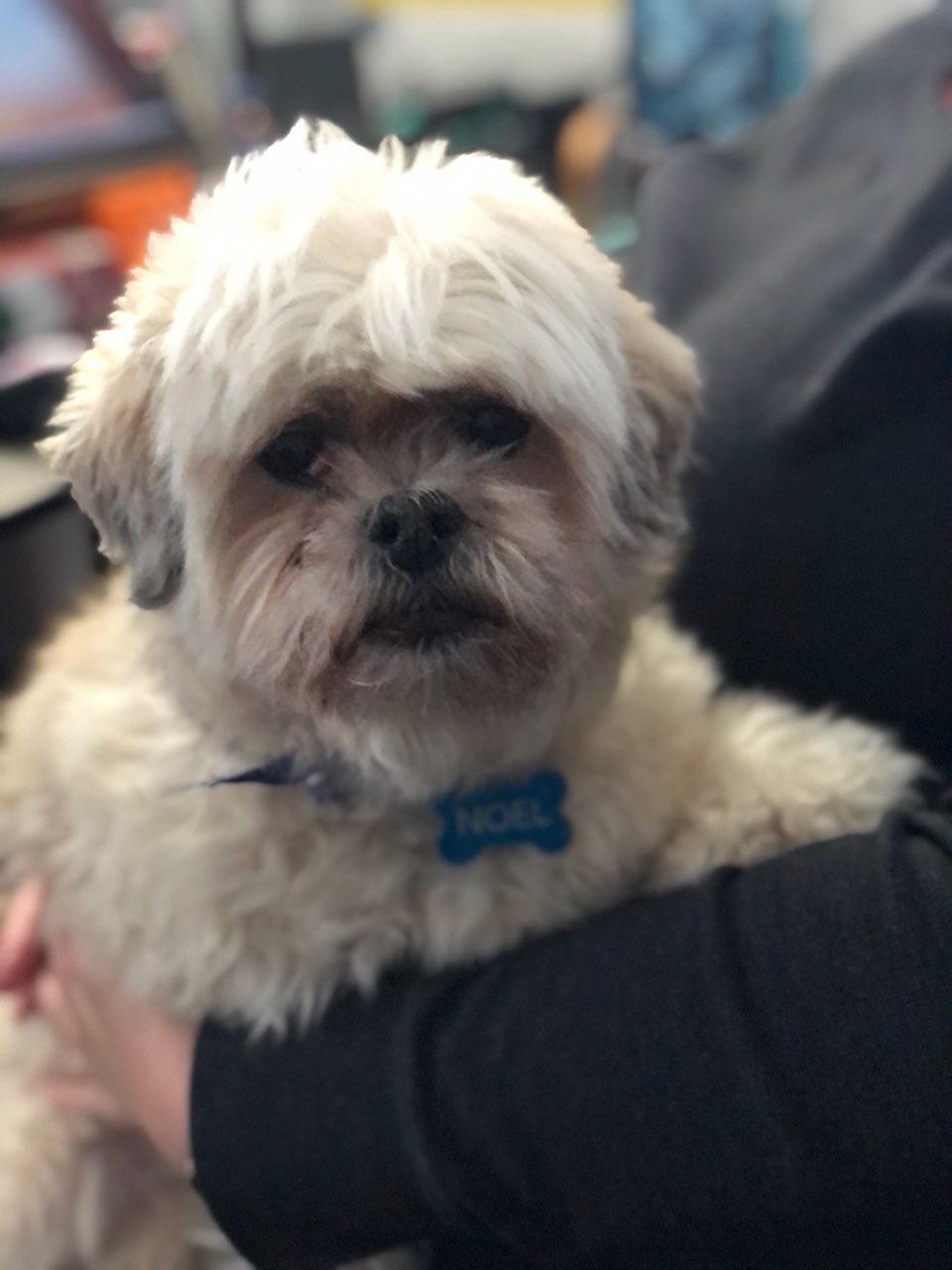
Goodbye, Noel

Oh, my sweet little pup,

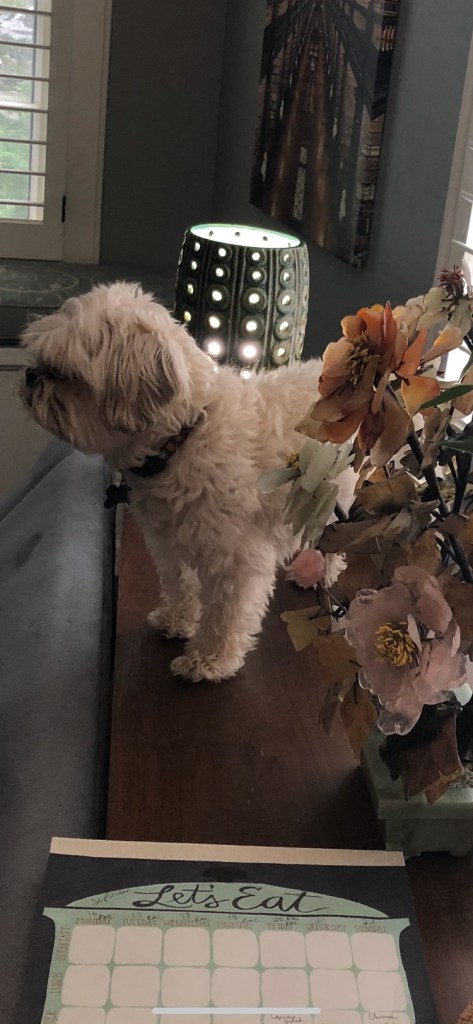
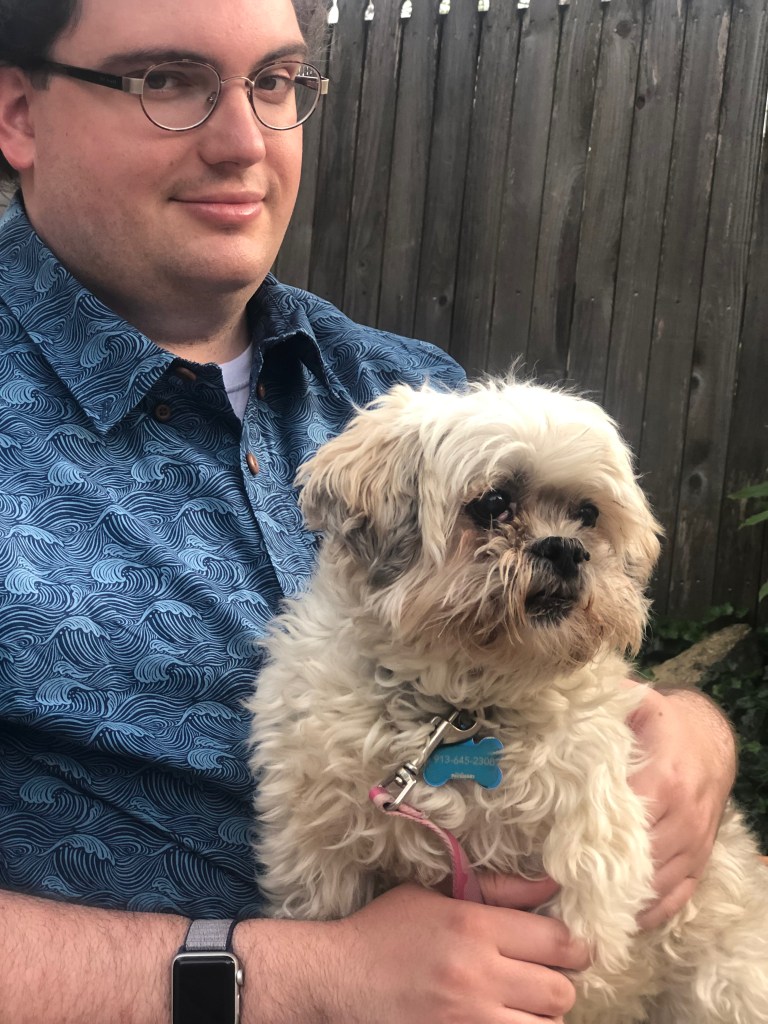
I remember when I first met you sixteen years ago on a warm summer’s day. You were little more than a month old, and more excited than anyone can fathom at new people coming to your front door. For those first two years you lived with my cousins, until your first sickness, when you came to recover with my parents and I. Living with you over these past fourteen years has taught me so much. I have learned the patience to live with someone with as boundless energy as you, to accept the fact that you are going to need my help from time to time, but more than anything else, I’ve learned that unconditional love exists. I learned that from you, little Noel.

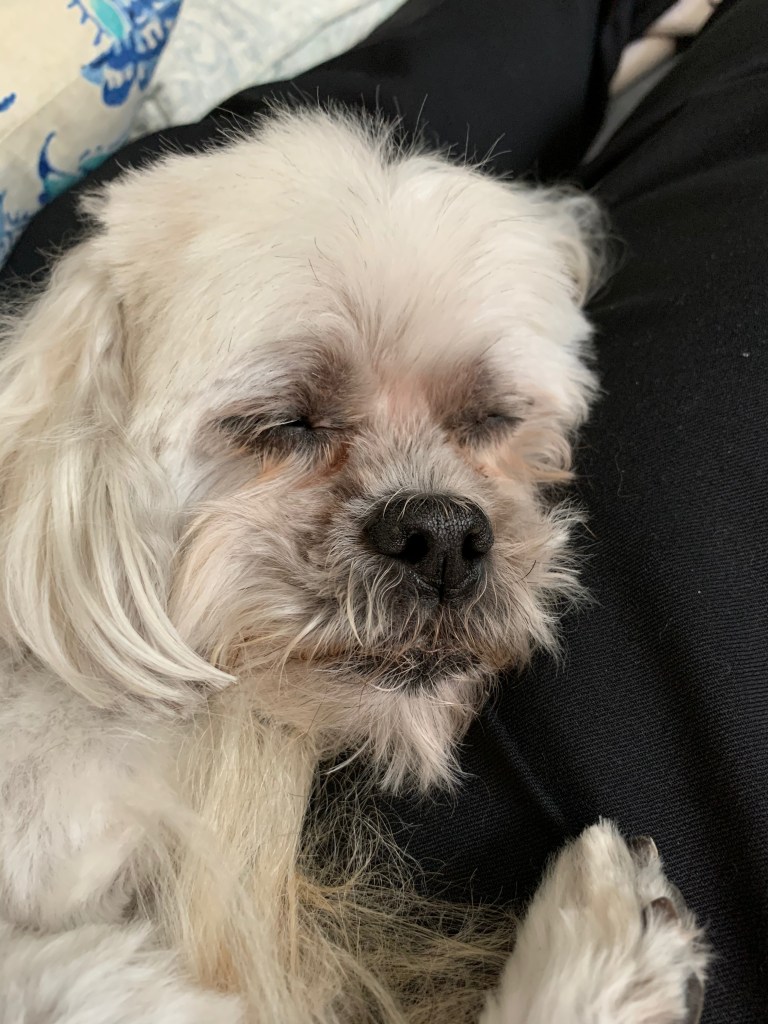
The years have gone by and we’ve grown closer than I thought possible. I don’t remember exactly when you moved full time from sleeping in your box to sleeping on my bed with me, but that’s been something that every night both of us have looked forward to. I remember many fond moments laying there next to you, listening to you snore, hearing you bark in your sleep and run in your dreams, your legs moving about as you lay on your side. I remember one night in the summer of 2014 or 2015 when you were so happy that you rolled over onto your back and began to sing into the darkness.

As my life has taken me away from home over the last four years, I’ve treasured every moment that I’ve had with you. My friends and family from places that you might well have never heard of know your name and your face, and everyone who I’ve spoken to about you has smiled when I’ve told them stories of your life. My silly dog, you’ve had your moments when you’ve caused my parents and I grief, but you’ve truly become a member of the family, so I guess it’s fair to say that comes with the territory.

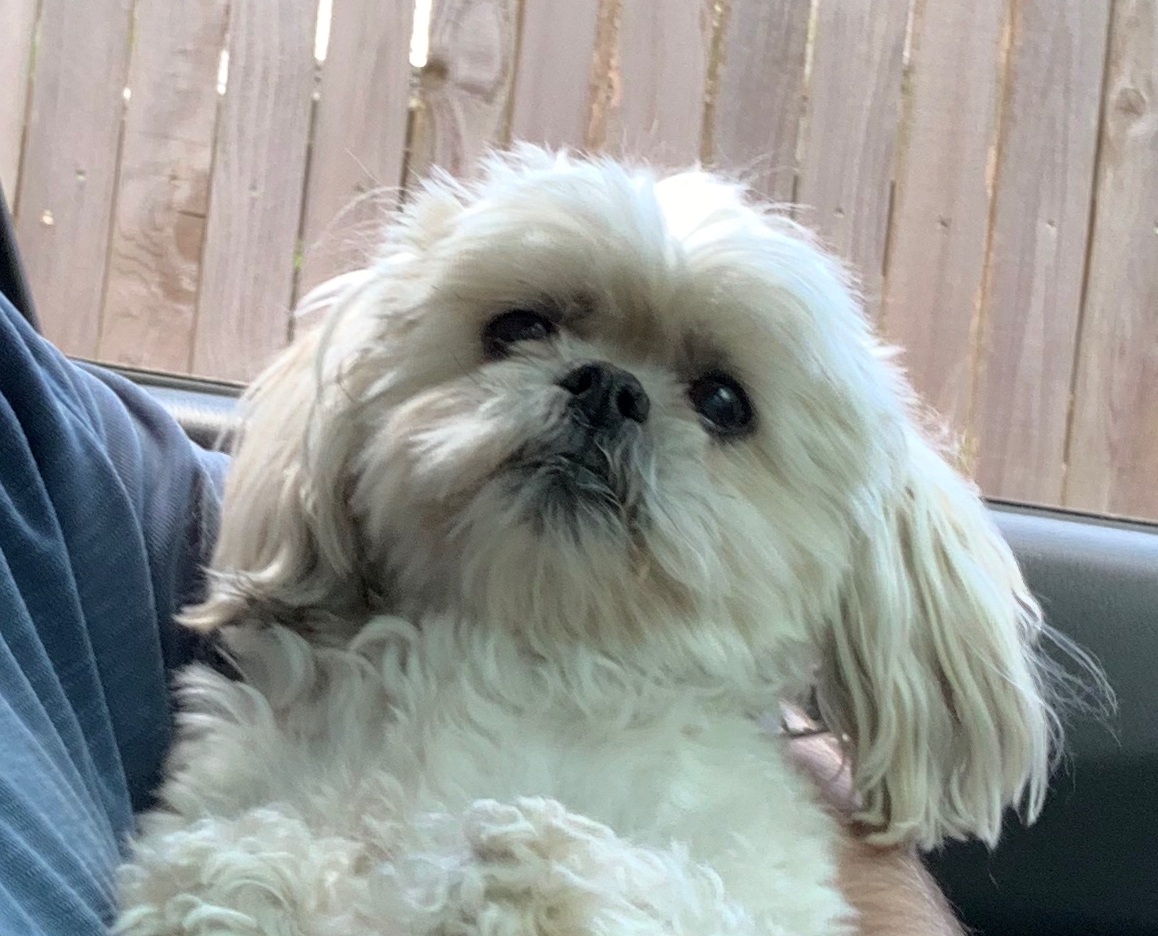
Every time I’ve had to leave you to go back to London or Binghamton it’s been hard. I wanted so badly for you to come with me when I left for my doctorate this past August, but it seemed better for you and your health that you stayed behind with my parents at home. Some of my sweetest memories of you, sweet pup, have been those first days after I’ve returned home after a long trip. Perhaps the best was my first morning waking up in our bed after moving back from London when I opened my eyes to find you laying there a nose-length away staring back at me. If dogs can smile, you were smiling then.

I’ve loved every one of your kisses, regardless of hygiene. My days were made whole when I’d walk through our front door in the afternoons to be greeted by you. I hope I’ve matched your affections as best I can, though I know they could never reach the levels which your heart ascends to every day. You, dear Noel, have walked with me from my youth to my adulthood, you’ve been there to comfort me when I’m sad, always jumping up next to me and offering reassuring wet dog-kisses on my chin.

But now as your health wains, I find it so very hard to say goodbye. You are a treasure who always has a place deep in my heart. I don’t know if it’ll happen, but I hope I will see you again one day, my darling little girl. Slán go fóill, goodbye for now, my sweet Noel.

2005 – 2021

A Gift from St. Nicholas

‘Twas the morn of good Christmas and all through the house

All the creatures were stirring except for the mouse

The stockings were stuffed by the chimney with care,

by good St. Nicholas who lately was there.

The children ran down to the hearth two-by-two

Their parents behind with smiles too

And there next to the tree they found

a pile of presents, packages all around;

The children ran up and each took their own

As the parents saw a small pair of packages laid just so

But there were no toys nor games

No gifts within, but coal just the same

And Mom and Dad unwrapped theirs with dread

to see their coal lying in their hand’.

A note was found in Mom’s pack’

And there spoke St. Nick right back

“To you and many others this gift I give

a reminder of the year you’ve lived

for you wouldn’t wear a simple mask

to protect your kids and neighbors right back

And now 300,000 are dead, no thanks to you

so here’s this gift, a reminder new.”

Then Dad in a rage went to his truck

and took an arm from the rack;

he marched up to the North Pole

where many a grump stood also

and there they shot good St. Nick

right in the back;

“They had rights,” or so the talking head said

And now good St. Nicholas joined the COVID dead.

The Luxury of Stress, or the Adrenaline Rush of Fear

2020 began for me with a long drive east: Kansas City to Pittsburgh to New York. I drove the first leg in 15 hours, arriving just before midnight on a Friday, and spent the next day wandering through the Carnegie Museums of Art and Natural History in Downtown Pittsburgh, which was the main reason for that particular stopover. That Sunday however was characteristic of how the year that this would become. I woke up around 4 am on Sunday, early enough that I hoped I could be in Manhattan for lunch. As I made a quick donut stop near Pittsburgh Airport, I checked the travel updates for the Pennsylvania Turnpike, and was shocked to discover that it was blocked in both directions just east of Pittsburgh due to a fatal multi-vehicle accident that had happened about an hour before. So, realizing that I’d have to take an alternate route, I plugged one into the navigation system in my car and made my way into one of the most eventful days of driving in my lifetime.

The route on that snowy Sunday morning in January

For the first 3 hours of the 6 that I’d have to drive that day, I was largely on US-22, a smaller rural highway, which heads east out of Pittsburgh across Pennsylvania toward the Jersey Shore. Normally I prefer to stick to the interstates for the lack of stoplights, and at that hour of the night for the lack of traffic. In this instance though I quickly found myself crawling my way across the Appalachians in a blizzard with next to no visibility. I passed semitrucks that were sliding backwards down the inclines on this normally reasonable, yet now snow-packed, highway. I’m pretty sure I passed a plow or two even, continuing onward, only really able to see where I was going thanks to the car’s navigation. Only after 7:30 am or so did the snow clear and I was able to enjoy an otherwise uneventful drive to the long-term parking garage that I frequent near Newark Airport when I drive to New York City.

Like the rest of 2020, thus far, I was nearly stressed to my limit in the early hours of that morning. This year has been one for the record books, a right old annus horibilis to borrow a term from the Queen. At the same time that I was dodging stuck semis in the Pennsylvania mountains, this country’s leaders were saber-rattling and threatening war with Iran. We were lucky to have missed that cataclysmic fiasco of a war, though I doubt we’ll know the full details of how we missed it for a few years to come. Since then we’ve seen the rise of the greatest pandemic in a century, a near economic depression, irate armed citizens occupying government buildings over their economic and social fears, the murders of many other citizens of this country by authorities, and the largest protests this country has seen in a long time. Throughout all of this, the response of those in charge hasn’t helped to ease tensions one bit, both publicly and privately for a great many of us.

Yet unlike that early morning in January, I now feel like I have the luxury to think about it, and to stress about it. That morning, I did not have that luxury, or perhaps I had too strong of a fear-driven adrenaline rush to stress about it. After all, if I thought too hard about how terrifying of a situation I was in, I would’ve made a mistake and gone off the side of the road, not knowing what that’d bring: a field, a hill, a house, the edge of one of the mountains? If I’d let my stress take over then, I can’t be sure I’d be able to write this today. Yet in the months since I’ve been largely secluded from the world, first in my apartment in Binghamton, NY, and for the last two months in my parents’ house in Kansas City, MO. Like all of us, I’ve had a lot of extra time on my hands to think, to consider how I want my life to go forward, and to stress and worry about our world, and how it’ll either improve or wreck our future.

The stress has certainly got to me, and there have been more occasions than usual of late where I’ve had real trouble working through it. It’s left me irritable, quick to anger, and generally in a sour temper. I could probably take all this sour stress and make one of those sourdough starters that so many people started doing this Spring. I’ve always found it hard to hear the memories and feel the emotions of the best days of my life over the obnoxious clamoring of the worst memories. Lately it’s been harder than ever, but I’ve tried my best to cherish the best moments of my life and my time at home. 

This past weekend in particular had so many wonderful moments. On Friday, the executives at my Mom’s company decided to give all of their employees Juneteenth off. So, that morning for the first time in at least 21 years my parents and I together went to the Zoo. When I was little, I loved going to the Brookfield Zoo near our home in suburban Chicagoland with them and have cherished those memories ever since. Now, after living in Kansas City for 21 years, we finally went as a family to the Kansas City Zoo, a place that I usually visit at least once a week on my own when I’m home. We didn’t see everything we wanted to see, but we left truly happy. 

The Kansas City Zoo’s new Elephant Expedition Enclosure. The photo is my own.

Later that evening after dinner we drove up to my alma mater Rockhurst University at 52nd & Troost and took part in the Juneteenth Prayer Service that stretched for 10 miles all along Troost. This was a prayer service like no other, less silent meditation, or communal rosary, and more a celebration of the hope that our community on both sides of the dividing line feels that change is in the air. I sat there on a stone wall for an hour and watched as countless cars drove by, their drivers honking their horns, people waving, children singing from the back windows.

On Saturday we went to one of my aunt’s houses for a small backyard gathering. I always treasure the times that I have with my family, the whole crowd. Just sitting there with people whose company I enjoy, people who I’ve known my whole life, and experiencing the madness of our current world from the perspectives of their stories, jokes, and worries made everything seem better for a little bit. Sunday was similar, Father’s Day, a quiet celebration this year at home with my parents. My Mom and I made brunch for the three of us, brioche French toast and eggs, before spending the afternoon watching soccer and reading June’s National Geographic. This was followed by a quiet small gathering in Roanoke Park.

I was reminded of all of this, and in particular of that terrifying snowy morning on US-22 east of Pittsburgh on Sunday evening when we watched last year’s release A Beautiful Day in the Neighborhood, starring Tom Hanks as Mr. Rogers. In part, the film’s Pittsburgh setting triggered those memories, and my thoughts on that January Saturday evening that I’d live in Pittsburgh if I got a job there, and how much fun I had at the Carnegie Museums. Yet more than that, the kindness which Mr. Rogers exuded in his life and work reminded me that this stress doesn’t have to be permanent, and that the best of memories should be the ones I treasure. I can still vaguely remember seeing him on WTTW in Chicago in the ’90s, and even a little bit on KCPT after we moved here to KC at the turn of the millennium. At the time I don’t really remember knowing what to make of the guy. Yet today, as an adult with far more responsibility to my community, our future, and to myself, I feel like if I were to try to learn from anyone in my own work as an educator, it’d be him.

Why I enjoyed Netflix’s “The Two Popes”

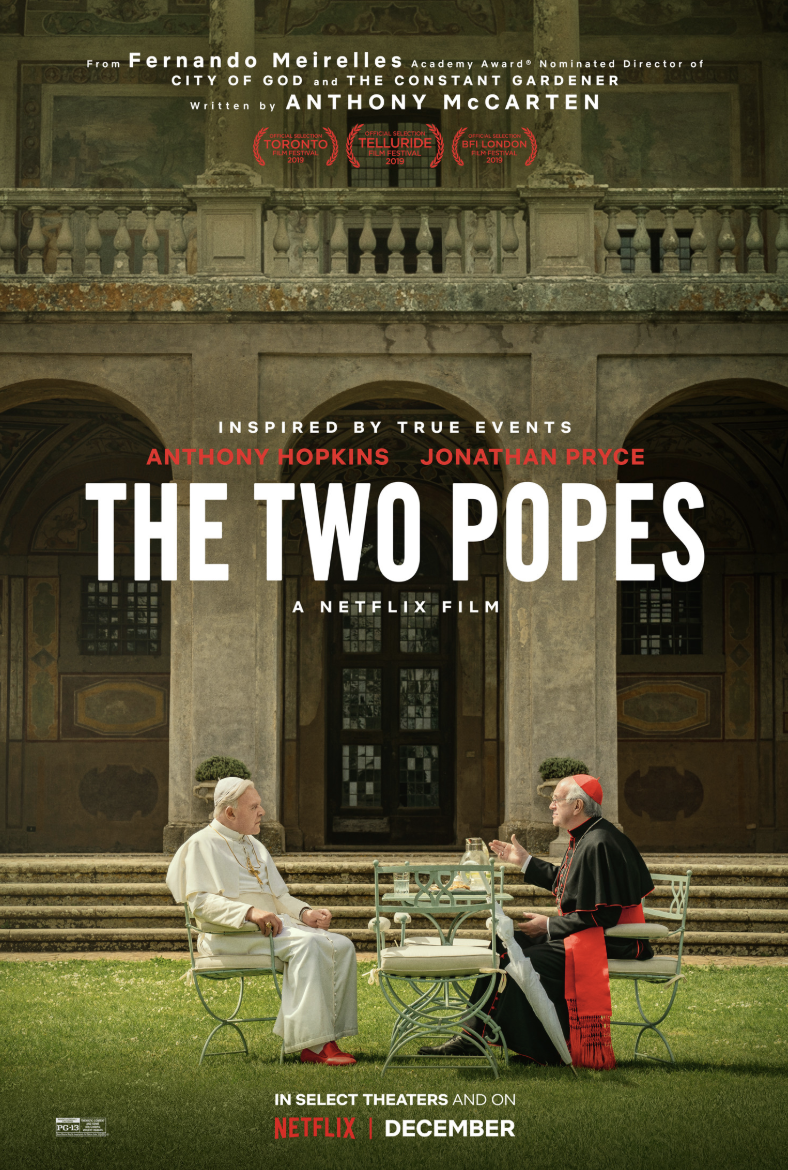
Two Popes posterNetflix’s new two-hour film The Two Popes starring Jonathan Pryce as Pope Francis and Sir Anthony Hopkins as Pope Emeritus Benedict XVI is theatre, pure and simple. It falls into one of the most classic sorts of plays, a dialogue between two men with similar positions yet very different experiences. While not all the conversations that make up The Two Popes may have happened, according to an article in America, the story that they tell on the screen is beautifully rendered and exceptionally human in its content.
The film begins with the Papal Conclave of 2005 at the death of Pope, now Saint, John Paul II, when then Cardinal Josef Ratzinger was elected as the new Supreme Pontiff, taking the name Benedict XVI. The conflict between Benedict and the reformist cardinal Jorge Maria Bergoglio, the current pope, is made clear from the first moment. Moreover, the two characters are framed as foils for each other: Benedict is removed from the world while Francis is fully a part of it; Benedict is traditional while Francis is less keen on pomp and grandeur of the Papacy and the Church in general; Benedict says he is disliked when observing how Francis seems to make friends with just about anyone he meets.

It is important to understand that while this film tells a story inspired by the recent events of the lives of two of the most important men in our lifetimes, it is nonetheless a story meant to entertain and give the audience a message of hope for redemption, peace, and a willingness to accept change even if it may not be the change we expected. In that sense The Two Popes has a bit of the same spirit that has enriched many a story down the centuries. There’s a sense in this film that if two people with opposing perspectives sit down and talk about their disagreements, that eventually they’ll reach some sort of common understanding, or at least mutual respect. Both Popes come to respect each other out of a mutual understanding of their imperfect humanity, that both men have made mistakes in their lives, yet they still have striven to do good.

The Two Popes does not hold back on the problems facing the Catholic Church today. It acknowledges the scandals and errors that continue to plague the Church now at the start of the 2020s. Yet it takes those scandals, those errors, those misjudgments, and it uses them to breath even more life into these two characters. I enjoyed this film because it’s a well written bit of theatre, depicted beautifully on the screen. The Two Popes, and in particular Pryce and Hopkins’s performances, do what any good bit of writing is supposed to do: make the audience think.

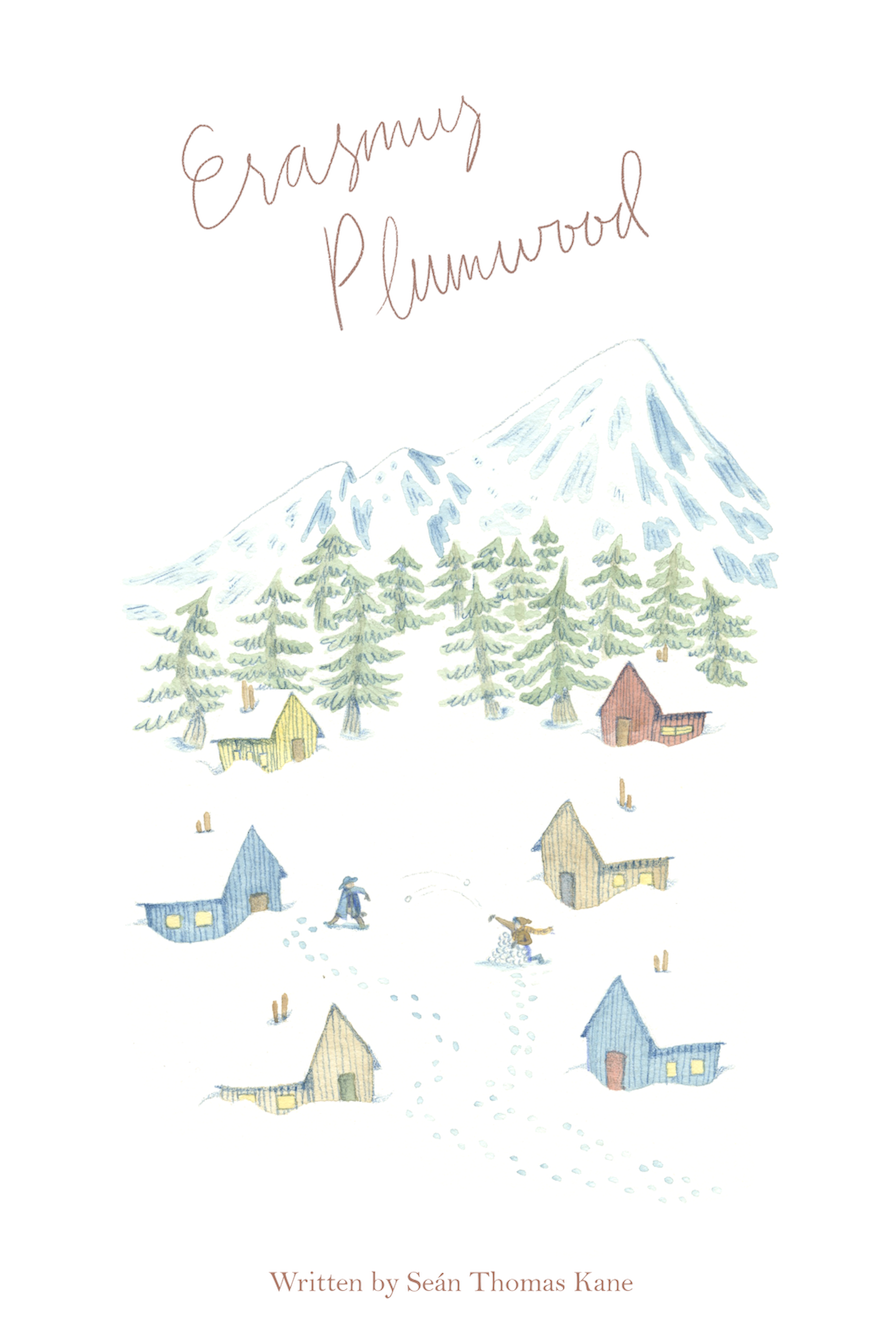
“Erasmus Plumwood” is now available!

Screen Shot 2018-09-10 at 22.45.56CDT

I am happy to announce that my latest book Erasmus Plumwood is now available for purchase on Amazon in both paperback and Kindle formats! You can purchase yours today by clicking on the book cover at the top of this article or by clicking here.