Category Archives: Reviews

Homo Sapiens

A particularly bumbling specimen of the species.
This week, a bit of self-reflection. The Man from Earth website The Man from Earth trailer

On Monday last week, I sat down to watch the 2007 film The Man from Earth for the second time. You may remember hearing or even reading my reflections provoked by that film. I said I’d probably watch the sequel, The Man from Earth: Holocene soon, and well I did just that. Compared to the original, Holocene lacks some of the powerful dialogue, and the gripping storytelling. The Man from Earth felt like it was a story being told in real time, while Holocene, its sequel, seemed more like a TV pilot that was turned into a feature. Both films feature some wonderful actors that I recognize from the many Star Trek series I’ve seen in the last few years, notably John Billingsley and Richard Riehle in the first film, and the great Michael Dorn himself makes a wonderful appearance in the second film.

If I were to draw any deep arguments out of the second film, Holocene, it would be something to do with how we identify ourselves. We humans call ourselves Homo sapiens, a scientific designation that we’ve given to ourselves to distinguish us from our hominid cousins including the Neanderthals. Homo is Latin for human; it is the genus which represents all hominids as a subset of primates. Sapiens on the other hand is more interesting. It is a Latin participle based on the 3rd conjugation verb sapiō, sapere which is used to mean many things from “to taste,” “to have flavor,” to the more innate concept of being able to sense or discern things, all of which is necessary for knowledge. Homo sapiens then means we distinguish ourselves from our hominid cousins by our abilities to understand ideas. Now there’s evidence today that other early humans could think and create in ways that are similar to us, evidence for example that Neanderthals created art of some sort in ancient Europe, so in many ways the fact we designate we humans as Homo sapiens is as much a way of patting ourselves on the back as anything else.

This brings me back to The Man from Earth: Holocene. It’s a film that introduces the core conflict when a group of inquisitive undergrads start to wonder about their professor who they soon realize is the same 14,000-year-old man from the first film. Only now he’s begun to age in slow but noticeable ways. This film made me question the idea that we are Homo sapiens for the personifications of humanity in this film, the four students seeking the truth about their professor, make a series of terrible decisions that prove as book smart as they might be they are clueless to so many other factors of life. Homo sapiens indeed.

In my own research I study the introduction of Brazilian flora and fauna into European natural history through the writings of several French explorers dating to the 1550s through the 1580s. And while I came into my research thinking I would have some fun writing about sloths and parrots and dyewood trees, I have found that the story I’m trying to tell is as much a warning to our present and our future as it is anything mundane about Renaissance natural history. There is a theory, an idea that is introduced late in The Man from Earth: Holocene called the Anthropocene, a concept that is widely discussed today which argues that human interventions and influence upon nature have become so great that we have shifted the course of Earth’s natural development from the Holocene, the current geological epoch defined by our planet’s warming by the Sun over the past 11,650 years, making for the perfect conditions for the development of life as we know it today into a new geological epoch where we humans, the Anthropoi in Greek, are now the prime movers of Earth’s natural course. In the film this becomes an understated note of caution, yet in my own research I find the Anthropocene to be a fundamental piece of the story of the European exploration, conquest, and colonization of the Americas largely ignored until recently.

We call ourselves discerning, we call ourselves wise, and yet we allow our own demands on nature to outstrip what nature can provide. It’s a curious balance we need to maintain, one which I am just as guilty of destabilizing as anyone else. It’s curious to me that we call ourselves wise when we think of all we have done with our home. We are one of maybe only a handful of species (leaving room here for other hominids at least) that has created beautiful art and weapons of mass destruction all with the same innate tool: our brains. We have just as much an ability to love as to fear, and in a given day I think it’s safe to say we act on those emotions without often really realizing it. 

Through it all we’ve survived and thrived on this planet of ours. There are 7.9 billion of us today, and while our population growth is a marvel of our ingenuity and ability to adapt to everything that this planet has had to offer so far, our own exponential growth may be the thing that drives the planet to the point of no longer being able to care for us the way we have been. If we don’t eat, we starve, yet if we eat too much we will run out of food and then starve. As the Man from Earth himself said in the first film, it’s the species that live in balance with nature that survive.

I argue in my dissertation that the Anthropocene really began when two different gene pools of life, one Afro-Eurasian the other American intersected in a large scale for the first time in thousands of years following Columbus’s accidental stumbling on land and people on this side of the Atlantic in 1492. That was the moment when human endeavors began to triumph over natural barriers, when a new global world was first conceived out of the collective products of a series of old worlds on every inhabited continent. It’s fair to call ourselves sapiens, discerning and wise, for the fact that it was humans who bridged that gap through innovation and technology. Yet it’s also fair to say that it was humans too whose innovation and technology created the great climate crisis we find ourselves in now. While the pessimists among us would end the story there, in a way that is in vogue to do these days, I want to continue the story, to contribute a verse to the poetry of life and say to you here and now today that it will be our innovation and technology, our discerning and wise nature that will figure out a way out of this crisis and that will lead us to adapt again to a new life in this new world we’ve created in our own image.

The Man from Earth speaks to me of the potential of humanity and of how at the end of the day we’re still just telling each other the same sorts of stories around a campfire. Like our ancient ancestors before us we see what we know and imagine what could be out there beyond the light of our knowledge. Unlike our ancestors we today are comfortable in a world we’ve created for ourselves, or at least some among us are comfortable in that world. We don’t need to innovate quite so greatly as past generations; we can let our minds become lazy and unimaginative. Like the big wigs from every time just before a storm we can be content and let the tides overcome us, but some among us will be hit more fiercely by those tides than others, and they’ll be the ones to stand up and say we can do better for ourselves. We will always stumble and fall, like those four characters from The Man from Earth: Holocene but we will always find a way of getting back up.

At the end of the day, we’ve created this new world where we are at its center, the keystone species around which all others exist in a new balance. I personally find that balance more precarious than I’d like, and personally I’d rather not be the one holding the entire balance of nature up like some modern Atlas. Yet over generations of decisions for good or ill this is what we’ve decided to do, and who we’ve decided to become. All we can do now is live up to the task and make the burden less strenuous for our descendants.
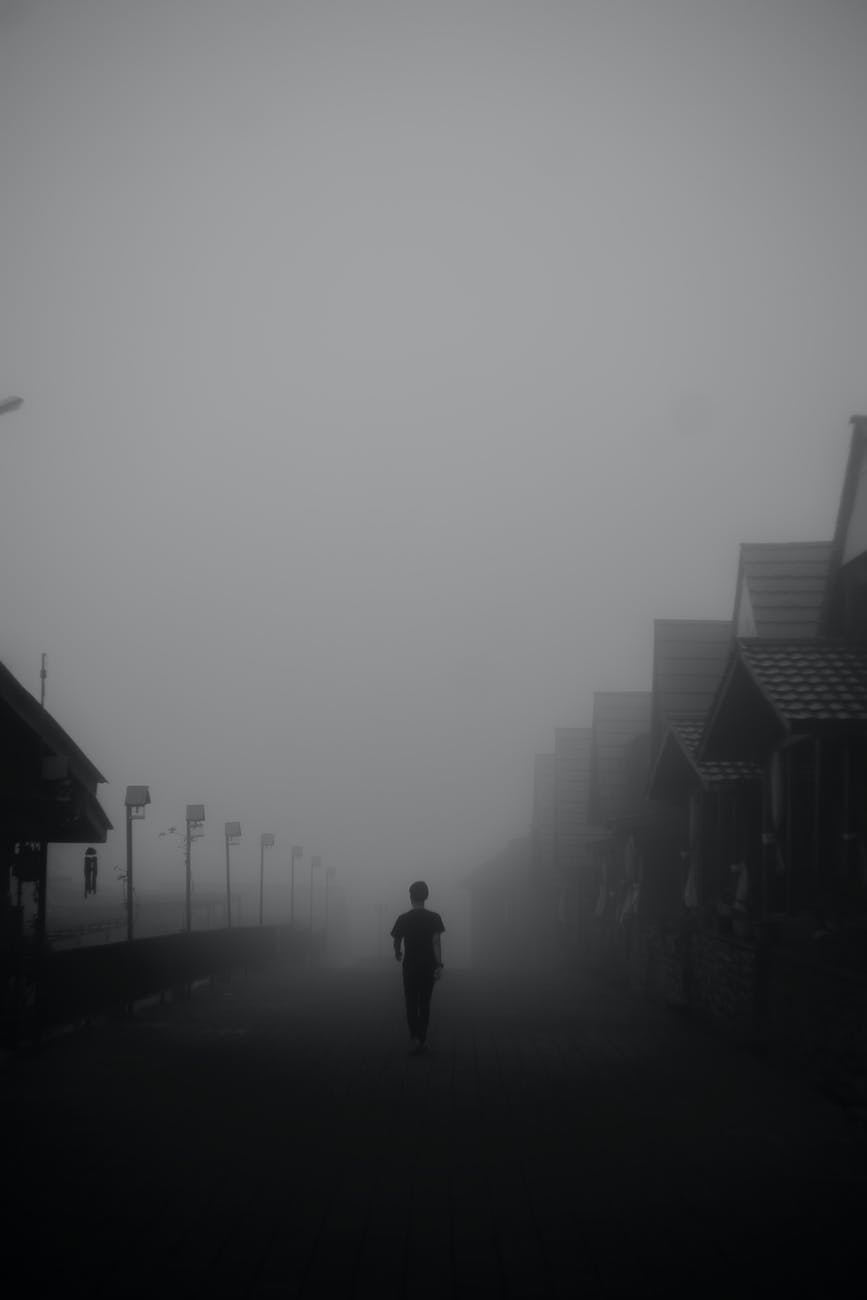
The Fog of Time

Photo by wsdidin on Pexels.com
This week, some thoughts inspired by the Jerome Bixby written 2007 science fiction film The Man from Earth. The Man from Earth website The Man from Earth trailer

When I was an undergrad, I watched a lot of really neat films and TV shows. It was something that sticks out to me from those years as distinct, something that I’ve continued and recreated from time to time as my mood allows it. In the Fall of 2013 I saw a movie on Netflix that peeked my curiosity called The Man from Earth that I’d never really forgotten. It’s not really an action-packed story in the modern sense, no rather it’s 90 minutes of dialogue, discussion, good old fashioned storytelling about a professor who is leaving his job, home, and friends after 10 years. The reason: because he’s learned over the 14,000 years of his life that that’s a good policy to do every decade or so. Yep, John Oldman, the Man from Earth himself, is a Cro-Magnon.

For some of you hearing or reading this the plot of The Man from Earth will be all too familiar to you. It became something of a quiet hit among certain crowds. One reviewer called it “intellectual sci-fi” even. While I was home over one of my recent breaks from working on my dissertation I bought an HD copy of it on YouTube figuring I’d like to re-watch this particular classic of my early 20s again. It took me a few months but on Monday night this week while I was keeping an eye on my students’ term papers streaming in before the 11:59 pm deadline I sat down and watched The Man from Earth all over again.

What stands out to me the most about my memories of watching this film for the first time nine years ago is how it unsettled me a bit, as it did the expert characters on the screen. The very idea seems counter to all that experience has taught us. “People die!” as the goddess Persephone cries to Orpheus in another film I purchased on YouTube. Yet somehow in the logic of The Man from Earth the title character, Dr. John Oldman had been able to live for 140 centuries and still after all that time appear to be only around 35.

This time I came away from my second viewing of The Man from Earth thinking less about the literal story and more about the ideas it proposes. For one thing I found myself thinking of the perspective that such a man would have of nature and reality. My own perspective is fundamentally framed by my upbringing, it’s conditioned by the powerful forces of my Catholic faith, my Irish American traditions, my personal ethics, and by my upbringing learning about Creation as both an Act of God and scientifically the product of a Big Bang and billions and billions of years of evolution. 

On the other hand, John Oldman––the fourteen thousand year old Cro-Magnon––reflects and recognizes a different sort of perspective, one born out of the entirety of human experience, one where the world began as what was knowable from the furthest reaches of the light from the nearest campfire inside a cave. For him, the Big Bang and all the creation stories we’ve been telling ourselves could well have happened after his first memories, his first inklings of reality and existence. To him those were all things that were learned over time, and their existence only became tangible once they were learned. If you think about it no one really knows things before they begin to have that first spark of an idea that those things could be possible. Today, I believe that anything is possible. That belief is grounded in my faith in an omnipotent and omniscient Divinity, yet it’s also equally held up by the course of human intellectual history, of how we keep finding out more and more things are real, and by extension at the edge of our knowledge that more and more things are possible. How wonderous is that?!

On Sunday evening, in honor of Yuri’s Night, an annual celebration held around 12 April to commemorate Yuri Gagarin’s first spaceflight, the first time a human left our home planet, I decided to watch a space-themed film. Last year I was lucky enough to join the global livestream party and hear all sorts of neat panelists talk about the past, present, and future of Space exploration. This year though that wasn’t an option, so I improvised and put on the 1982 classic The Right Stuff. For those of you who aren’t familiar with it, this is a film celebrating the Mercury 7 astronauts, the first Americans to leave the Earth and among them the first humans to orbit our planet. The Right Stuff begins with Chuck Yeager’s triumphant 1947 flight that proved the sound barrier (Mach 1) could be broken. Before he flew his Bell X-1 faster than the speed of sound no one was entirely sure it could be done. It pushed the edge of our knowledge out of a pure hope that supersonic travel could be possible.

Maybe then on a human scale we should think of our place in the history of the Cosmos less as a story beginning with the Big Bang, which as scientific as it is does bear some resemblance in how its story is told to the other great Creation stories out there, and more with that first human spark that signaled to our conscious thoughts that we exist. Maybe the beginning of the human story ought to be around a campfire in a cave somewhere, or maybe this leaves room for multiple human stories, each threads that broke off from one another until as it is in our present time there are 7.9 billion such threads living, all vibrant and emotional and passionate each in their own way.

When I think back to my beginnings, to what I can ascertain as my first definite memory that I can remember, that first moment when I could recognize my own internal narrative that keeps me going even now, I think of a day trip my parents and I took when I was around 3 or so from our home in the Chicago suburbs to the farm where my Mom’s grandfather grew up in Sheffield, Illinois. I remember sitting in the back seat, on the passenger side watching out the window as we drove by new suburbs, new neighborhoods were being built as we drove west. For me so much that I consider etiological, that I consider as origin-stories to my own, whether they be Genesis or the Big Bang or the many stories keeping my ancestors’ memories alive even when the people involved are long dead, all of those come after that moment in my own memory. So, to my own individual, my own personal recollection of history, of reality, of the Cosmos in all its wonder, all of that comes after that one moment that I can remember from 27 years ago.

What does this mean for how we understand our place in nature? I think if it changes anything, it ought to follow another line of wisdom from The Man from Earth, that the species that lived in balance with nature tended to be the ones who survived. Maybe we need to balance ourselves with our worlds. What I mean to say is maybe we should allow room for our own individual views of things while acknowledging there’s a greater truth to be found in the collective knowledge and wisdom of humanity. There is an inherent fog surrounding our understanding of time, after all we can only ever really see what’s happening right in front of us at any given moment. We can remember with growing haziness what happened in the past, and we can yearn for possible futures that are equally fuzzy in our imaginations today.

This time around I was delighted to see that a sequel was made called The Man from Earth: Holocene back in 2018. It stars the same actor, David Lee Smith, as John Oldman. I think I might watch it tomorrow, and who knows maybe you’ll hear more from me about this story next week. For now, keep imagining because that’s what allows for the improbable to become the possible.

The Man from Earth (2007) trailer

Beethoven’s Ghost

Ludwig van Beethoven, Piano trio in D Major, op. 70, no. 1, musical autograph.

Over the weekend I took a break from my usual work and TV schedule and decided to watch something on the PBS streaming app. I ended up choosing the latest episode of Scott Yoo’s series Now Hear This which has been airing as a part of PBS’s long time arts show Great Performances. I wrote about Yoo’s episode on Mozart a few months ago, and this iteration’s focus on Beethoven likewise did not disappoint. The premise of the episode was essentially Yoo and friends renting out an old Gilded Age mansion in the Berkshires and recording Beethoven’s Ghost Trio (op. 70, no. 1). At the same time, in the Halloween spirit of the weekend when this episode aired, the ghost of Hr. Beethoven himself appeared to listen to his music being played once again. Yet alongside the great composer also appeared the ghost of Dr. Sigmund Freud, who it turned out, had been offering psychoanalysis to the ghosts of dead composers since his own demise in 1939.

At first, I have to admit, I laughed at the idea that Freud interviewing Beethoven would fill the biographical aspect of this episode. It made sense, but it seemed like a silly idea. But as the show went on, I found the premise not only believable but it made Beethoven himself seem more endearing and modern. Now for both of these to occur, I have to admit that I do tend to believe in the possibility of the supernatural. Writing as a Catholic, I believe in an afterlife, and that likely both gentlemen in question are currently in residence there. What’s more, I’ve always thought that one of the things I’d love to do after I died would be to sit down and talk to some of these famous people: Beethoven, Lincoln, Frederick Douglass, among all my own relatives I’d be dying to meet.

By the time the episode ended I really liked the idea of having the ghosts of historical figures interviewing each other as a way of describing their biographies. Sure, it’s corny, but it works. I remember a few years ago KCPT (Kansas City PBS) had a program that they ran with the KC Public Library where Crosby Kemper, then the library’s director, would interview figures from Kansas City’s past: whether they be President Truman, Buffalo Bill Cody, some of the great jazz band leaders, or Boss Tom Pendergast. In many ways, the format that Yoo and friends came up with having Freud’s ghost interview Beethoven’s ghost fits that same model.

Then again, one final question arises from the grave: are they Freud’s ghost and Beethoven’s ghost, or are they just simply Freud and Beethoven? What’s the difference between a potential remnant of a deceased soul and the person they once were? And if there is a difference, does that mean that experience makes all of us who we are?

Summer 2021 Podcast Recommendations

With the last weeks of the Summer break from the Academic Year coming to an end, I thought it would be fun to offer those of you who still read these posts a few podcast suggestions that I regularly listen to throughout the week. These may do a decent job at giving you a general idea of my own interests as they stand at the time of writing.

Planetary Radio

I first found this podcast in early 2020 just before the current pandemic began, and have made it a regular staple of my weekly radio and TV diet. It’s something that I make a point of listening to, if not on its usual Wednesday release, then by the end of the day on Thursdays. Hosted by Mat Kaplan, this is the official podcast of the Planetary Society, a space advocacy organization of which I am a proud member.

Planetary Radio, new releases every Wednesday.

A People’s History of Kansas City

A People’s History of Kansas City is always a wonderful solution for homesickness. I first started listening to it during my first year in Binghamton, I believe in early 2020. Some of my fondest memories listening to this podcast are of the time I was driving back to Binghamton from Albany Airport down I-88 (NY) and listening to a gripping story about the Guadalupe Centers here in KC, or more recently when on the way to and from a Royals game I listened to a couple episodes about Disney’s Kansas City roots and the post-contact history of the Missouria, the people for whom the Missouri River and the State of Missouri are named. I always look forward to hearing an episode of A People’s History, and occasionally even hearing people who I know personally get interviewed on this show (it helps being a historian).

A People’s History of Kansas City is off for the Summer.

Real Humans by Gina Kaufmann

Staying with the Kansas City, and KCUR, theme for a minute I want to suggest Gina Kaufmann’s latest project, Real Humans. It’s a shorter podcast, the episodes rarely seem to go over 20 minutes, but it addresses ordinary people here in KC and how the world we’re living in is impacting their lives. I’ve enjoyed what I’ve heard of this new 2021 release so far, and am looking forward to more stories brought by the host of KCUR’s old 10 am show Central Standard.

Real Humans by Gina Kaufmann, new episodes on Sundays

Star Talk Radio

I’ve been a fan of Dr. Tyson’s for a while now, having first really heard about him in my undergraduate Astronomy class at Rockhurst. This is essentially a radio version of his talk show that aired for a while in the mid-2010s on National Geographic’s cable channel. Essentially it’s Dr. Tyson and his friend Chuck Nice discussing whatever the topic of the week is with their guest. It’s admittedly been harder to get engaged in this podcast than others, but it’s a good one nonetheless.

Star Talk Radio, new episodes premiere on Mondays at 18:00 CT/19:00 ET.

Mission: Interplanetary

I think I first subscribed to this podcast either during PlanetFest this past February or during this year’s Yuri’s Night celebration in April. Either way, this has become one of my favorites for the interesting topics involving human Space exploration that are covered in each episode. The hosts, astronaut Cady Coleman and scientist & author Andrew Maynard are a lot of fun to listen to on either a long drive or a long walk around the neighborhood.

Mission: Interplanetary, off for the Summer. New episodes expected this Fall.

Ologies with Alie Ward

Ologies has topped most of the Apple Podcast charts this Summer and for good reason. I first found it one afternoon this Spring after a fun visit to the Helzberg Penguin Plaza at the Kansas City Zoo when I decided I wanted to find a podcast about penguins. Lo and behold, Ologies had an episode entitled “Penguinology,” with an expert in those antarctic sea birds, and from that point on I was hooked. I’ve really enjoyed listening to the various guest experts on this show, and while it’s a longer one it makes for good listening when you have a free 90 minutes to spare.

Ologies with Alie Ward, new episodes on Tuesdays.

Overheard at National Geographic

Overheard is a podcast that I found fairly early on in my current run of frequent podcast-listening, which all largely began with A People’s History and Planetary Radio. I’ve been a subscriber to National Geographic Magazine for quite a while now, and when I saw that Nat Geo had a podcast I figured it’d be a good one to listen to. At first it was hard to get engaged with it, the early stories I heard weren’t ones that I was all that interested in, but more and more I’ve come to really enjoy it. A recent episode involved that I loved an anthropological study of surviving Nahua-speaking communities in Mexico. Overheard has gone from being one that I’d occasionally listen to to a show that I look forward to every week.

Overheard at National Geographic, new releases on Tuesdays.

Sidedoor

From one Washington scientific institution to another, Sidedoor is a podcast from the Smithsonian that I only found a little over a month ago after my day trip to D.C. to visit a special exhibit at the Smithsonian American Art Museum (SAAM) about Alexander von Humboldt (1769-1859). Sidedoor has so far had really engaging stories that I’ve thoroughly enjoyed, and it’s inspired me more than ever to make it back to D.C. to visit the collections that get a mention on the podcast, in particular an upcoming special exhibit at the old Arts & Industries Building called Futures that sounds like it’ll be really neat.

Sidedoor, new episodes every Tuesday resuming in the Fall.

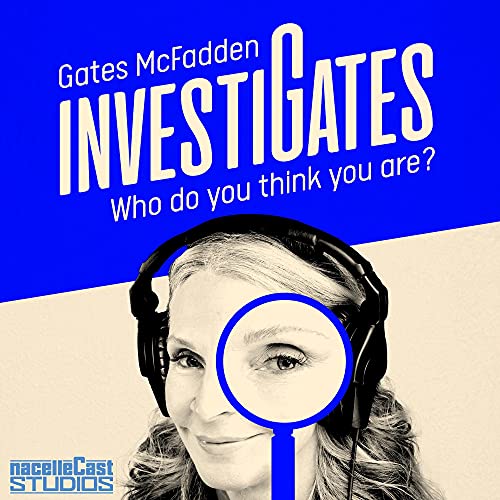
Gates McFadden InvestiGates: Who do You Think You Are?

One big change in my life that came about the same time as the start of the pandemic was my decision to try watching Star Trek again. I started this time with Picard and have since moved onto The Next Generation, Deep Space Nine, and am currently watching Voyager as well as the new episodes of Lower Decks. Considering a good portion of my free time tends to be spent watching Trek, after all there’s so much to praise about those shows and films, I’ve been on the look out for a good Trek podcast to listen to on a weekly basis. So, when I read on Twitter that The Next Generation‘s own Gates McFadden (Dr. Crusher) would be launching a podcast where she interviewed her fellow Trek stars, I figured I’d give it a go. To be honest I’ve really enjoyed listening to a pair of friends who I know for their performances on screen talk for an hour, or sometimes two, about their lives.

Gates McFadden InvestiGates: Who do you think you are?, new episodes on Wednesdays.

Conclusion

As you can see, I’ve got a lot of different podcasts that I tend to listen to on a weekly basis, and yeah I make time for them. There are a number of other ones that I’m looking in to, notably the Sisters in Strange podcast co-hosted by my cousin Chelsea Dunn and the Star Trek: The Original Siblings podcast co-hosted by my good friends Alex and Sami Brisson, the latter of which I’ll get to once I actually watch the original Star Trek series.

I’ve even considered providing narration of these blog posts as a sort of podcast, a service which is an option if I ever decide to give it a go. At the moment though I’m happy to just have people read what I’ve decided to write about.

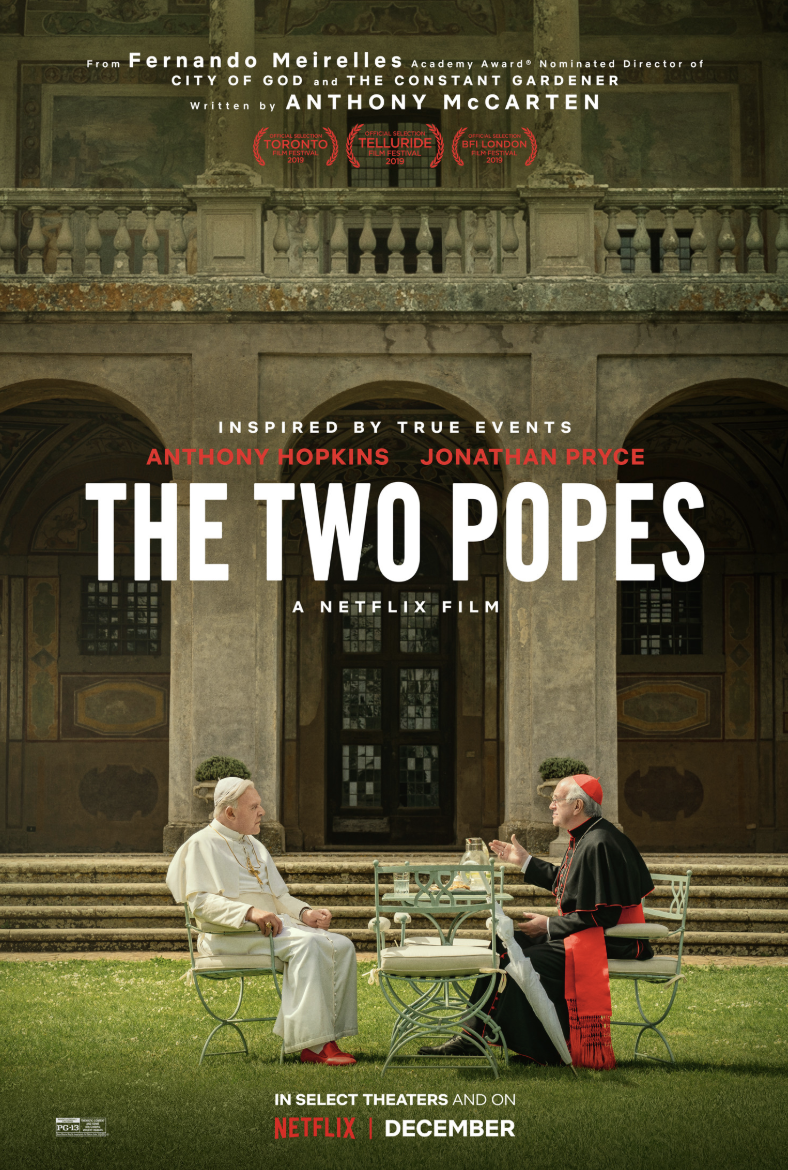
Why I enjoyed Netflix’s “The Two Popes”

Two Popes posterNetflix’s new two-hour film The Two Popes starring Jonathan Pryce as Pope Francis and Sir Anthony Hopkins as Pope Emeritus Benedict XVI is theatre, pure and simple. It falls into one of the most classic sorts of plays, a dialogue between two men with similar positions yet very different experiences. While not all the conversations that make up The Two Popes may have happened, according to an article in America, the story that they tell on the screen is beautifully rendered and exceptionally human in its content.
The film begins with the Papal Conclave of 2005 at the death of Pope, now Saint, John Paul II, when then Cardinal Josef Ratzinger was elected as the new Supreme Pontiff, taking the name Benedict XVI. The conflict between Benedict and the reformist cardinal Jorge Maria Bergoglio, the current pope, is made clear from the first moment. Moreover, the two characters are framed as foils for each other: Benedict is removed from the world while Francis is fully a part of it; Benedict is traditional while Francis is less keen on pomp and grandeur of the Papacy and the Church in general; Benedict says he is disliked when observing how Francis seems to make friends with just about anyone he meets.

It is important to understand that while this film tells a story inspired by the recent events of the lives of two of the most important men in our lifetimes, it is nonetheless a story meant to entertain and give the audience a message of hope for redemption, peace, and a willingness to accept change even if it may not be the change we expected. In that sense The Two Popes has a bit of the same spirit that has enriched many a story down the centuries. There’s a sense in this film that if two people with opposing perspectives sit down and talk about their disagreements, that eventually they’ll reach some sort of common understanding, or at least mutual respect. Both Popes come to respect each other out of a mutual understanding of their imperfect humanity, that both men have made mistakes in their lives, yet they still have striven to do good.

The Two Popes does not hold back on the problems facing the Catholic Church today. It acknowledges the scandals and errors that continue to plague the Church now at the start of the 2020s. Yet it takes those scandals, those errors, those misjudgments, and it uses them to breath even more life into these two characters. I enjoyed this film because it’s a well written bit of theatre, depicted beautifully on the screen. The Two Popes, and in particular Pryce and Hopkins’s performances, do what any good bit of writing is supposed to do: make the audience think.

Nolan’s “Dunkirk” – An Abstract Tribute

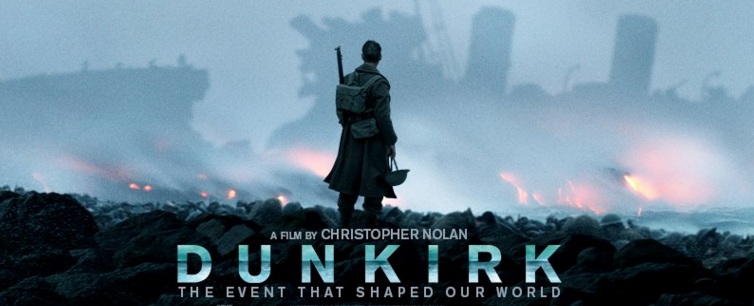
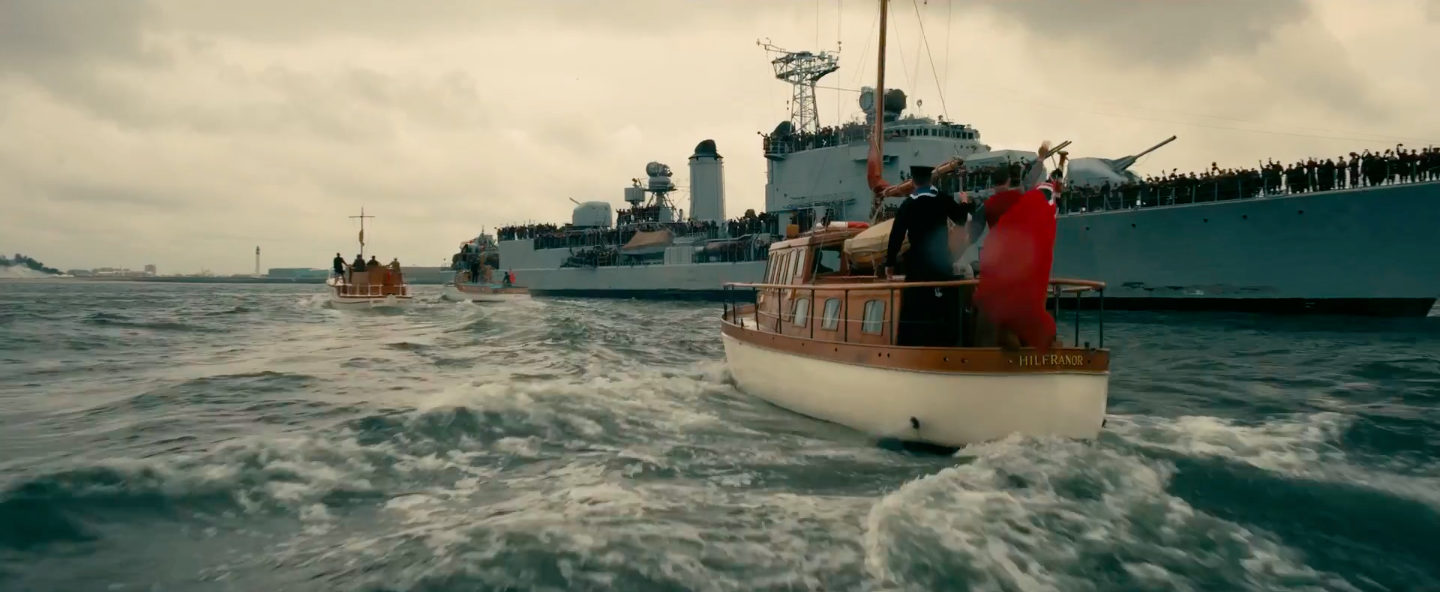
dunkirk-christopher-nolan-trailer-images-75

Credit: Christopher Nolan [found at Cinemavine.com])

What I found especially gripping about Christopher Nolan’s latest film, a retelling of the Miracle at Dunkirk, was that each of the individual people in the story were not the main character. That role was filled by the seemingly indomitable human spirit, and will to survive and struggle ever onwards. Dunkirk might well be one of the most defining moments of the Twentieth Century for Britain, and quite possibly as well a crucial turning point for the whole world.

The film follows three main groups: the soldiers on the beaches, the sailors both civil and naval crossing the Channel, and the RAF in the air trying to keep the fighters and bombers of the Luftwaffe from wrecking further havoc to the men stuck at Dunkirk and the ships trying to ferry them to the safety of home, a mere 26 miles away. Though the plot is not in itself chronological, it nevertheless helps tie together each disparate group, connecting their experiences in a spiritual fashion as each come ever closer to the film’s climax.

For British and Commonwealth viewers this film will certainly reinforce that Dunkirk Spirit, that steely determination that even in the darkest of hours Britain and her sister countries will never surrender. I became quite emotional when, after witnessing the sense of doom the soldiers on the shore felt for a good hour, the hodgepodged fleet of little ships arrived in the waters off of Dunkirk. This moment, though one of the darkest hours in British history is also equally one of the most inspiring to have transpired in that island nation’s long story.

For American viewers this film should give us pause. In our present hour of immense internal divisions, of political unrest and civil discontent we should consider what it would mean for us as one people to come together for a cause we all knew to be necessary for the continued survival of our country and the liberty it’s Constitution assures. In this hour of great uncertainty we should be looking not to what divides us but what can unite us.

Hans Zimmer’s score is a welcome change from his usual set of loud brass, excessive strings, and choirs primarily singing “Ah” for far too many measures. While loud, this score adds to the energy of the film, and in a musical sense is largely understated. The music helps bring the viewer into the picture, onto the beach, aboard the small boats and naval ships, and in the cockpits of the Spitfires high above in the air. I really appreciated the echoes of Elgar’s Nimrod that played over the final scene as Britain and her forces came to rest aground again and prepare for the inevitable Battle of Britain to come.

Overall, I thoroughly enjoyed this film, and just a few minutes prior to sitting down to write this review I told my writing partner Noel that I have to go back and see this again soon. Dunkirk is a film that triggers both the conscious and sub-conscious, that calls upon one’s entire emotional and physical self. It is one of a number of films that are to me the new “talkies”; they address not only our visual and aural senses, but our emotional senses as well. I have a feeling there will be many more films like Dunkirk to come.

dunkirk-movie-trailer-christopher-nolan-screencaps-

TopGear and Revolution

In 1783, the Thirteen American Colonies were officially recognised as free and independent states by their former mother country, the United Kingdom. Initially, each of the thirteen states were autonomous to the extent that they were effectively separate countries, united only in a weak document called the Articles of Confederation. The power vacuum left with the departure of the British colonial authorities led to a worryingly unstable situation across all Thirteen American States. Stability in government was only restored with the Constitution of 1787, the binding document which created the Federal Government of the United States, effectively creating the system of government that has kept the United States relatively stable, despite one civil war, ever since.

A similar revolution has occurred in the BBC’s hit motoring show TopGear, with the departure of the old order, led by the trio of Jeremy Clarkson, Richard Hammond, and James May, who have gone to Amazon Prime Video. In their wake, the BBC has chosen a wide array of new hosts, led by Chris Evans, to take over one of their greatest hits. Having seen the first episode, Evans, American presenter Matt LeBlanc, and their fellow presenters, who frankly are more like corespondents than full time hosts, have truly put TopGear through a revolution.

The same old skeleton exists within, but the show itself is well removed from its predecessor. This new TopGear is like the Thirteen American States in the period of the Articles of Confederation; it is in a period of transition and still trying to figure out how to exist without its former presenters. Evans, LeBlanc, and the others have the same light hearted attitude to their work on TopGear that Clarkson, Hammond, and May had before, but at the moment it just does not seem to be as funny. With the former trio, I knew to expect that odd, somewhat nonsensical, at times pointless humour. As a result, I reviled in it, often with a big smile on my face for the entire hour long programme. With Evans, LeBlanc, et cetera, I laughed on occasion. Simply put, I am not familiar with these new hosts, and do not know what to expect.

Perhaps in a few weeks, once more of the current season of TopGear is broadcast, I will  be able to appreciate the new presenters, and new format better. At the moment, I am looking forward  to the first episode of The Grand Tour, Clarkson, Hammond, and May’s new programme, which will be released on Amazon Prime Video this coming Autumn. As to the next episode of TopGear: yeah sure, I’ll watch it. This new TopGear has undergone a revolution, but it still has a long way to go until it leaves the shadow of its predecessor and enter into its own spotlight.

“United Passions” a Decent Work of Fiction

The film United Passions was an interesting one to see. Unfortunately for the filmmakers and FIFA, the main financial backers of this film, the release of United Passions in the United States has coincided with the arrests of a number of high ranking officials at FIFA on corruption charges. In light of those arrests, it’s hard to look at a film such as United Passions in a positive light, considering its fairly uplifting portrayal of recently resigned FIFA President Sepp Blatter. But for many of us in Europe and North America, it can be hard to view Mr. Blatter, and his predecessors in a positive light. In this sense, United Passions has lost a significant amount of credibility despite barely being screened anywhere in Europe or North America. In fact, only ten cinemas are showing the film here in the United States.

However, the filmmakers made certain to include a brief preface, stating that United Passions is to be seen as a work of “dramatic fiction.” In short, it is an interpretation of events, but not an official history, certainly not an exact record of what happened. Critics have claimed that FIFA’s backing of the film forced the filmmakers to depict a more positive image of the world football federation, thus enforcing this film’s status as propaganda.

The declaration that this film is dramatic fiction makes sense when one considers the fact that British born-New Zealander Sam Neill was chosen to play former Brazilian FIFA President João Havelange, and Englishman Tim Roth was likewise chosen to play the aforementioned Mr. Blatter, a native of Switzerland. In my own opinion, had the filmmakers wanted this piece to be taken as a work of meticulous history, they would have cast a Brazilian to play Havelange and a Swiss actor to play Blatter.

However, as a work of fiction, I would certainly say that the filmmakers made good decisions in the realm of casting. Gérard Depardieu, who played FIFA’s third president Jules Rimet, Neill, and Roth were at the centre of the film, and did a pretty good job in their roles.

With all that said, some certainly do see this film as FIFA’s attempt to preserve the image and legacy of at least these three of its past presidents. As a viewer, I admired these figures attempts at making soccer a global affair, not just the sport of Europe. Perhaps this film’s biggest image problem comes from allowing its subject to also play the role of main financial backer.

The photography was very good, reflecting the style of camerawork that has become the norm in both French and British cinema. The sound was also well done. In cinematic terms, the biggest flaw with this film is its script, which was sometimes hard to follow, with frequent cases of bulky dialogue.

Overall, I would rate United Passions as being just another period piece. It’s nothing special, and when the time comes that those FIFA officials who already have been, and have yet to be arrested are put on trial, I have little doubt that this film will already be forgotten.

Mein bester Feind, a somewhat uncertain tale

This evening, when looking for something new to watch on Netflix, a four-year old tragic comedy, set during the Second World War, came up, Mein bester Feind, or in English My Best Enemy. To begin, I generally approach any sort of comedy involving the Holocaust with caution. Something as dreadful as the Shoah should not be made light of. That said, Mein bester Feind is a different sort of tale than your average comedy. I found it to be more of a pipedream about what could have been possible, had the right circumstances come into line. And yet, this combination of tragedy and comedy, of dark drama and Wodehouse-esque silliness was charming in a surreal sort of way. The Nazis in this film appeared comical in their greed for a priceless four-century old drawing by Michelangelo. Their greed was almost reminiscent of the Nazis in the wartime Three Stooges shorts. Here Larry, Curly, and Moe taking on Göring, Hitler, and “the rest of the gang” on the high seas of the Atlantic. In conclusion, if you want to watch Mein bester Feind, go ahead and watch it. But watch it with some caution. Then again, at least I got to practise my German a bit!

Katherine Blanner on Ed Sheeran

Katherine Blanner writes the Books to Read column for The Tern.

Katherine Blanner writes the Books to Read column for The Tern.

Red-headed British pop culture sensation Ed Sheeran is captivating the hearts of society through his two albums X and +. Sheeran began his music career with various EPs and self-composed tracks released on the Internet. The song “A Team” led to his popular debut. It is the combination of immense guitar talent, high vocal range, poetic lyrics, and overall adorableness that have skyrocketed Sheeran to the tops of the charts.

Each one of his songs has a unique beat deriving from a lovingly played acoustic guitar. It is his passion for the audible experience that contributes to the overall pleasantry of his musical opus, distinctly setting him apart from other artists. He composes his music as though the melody and rhythm have been inscribed upon his soul, weighing upon his heart until it has been conveyed in a ballad sung by his vocally rich pipes.

In addition to acoustic excellence, his poetic only elevates his harmonious quality. It is known that love in mankind’s greatest struggle, toyed by each human within his or her heart, as it distinctly leads to mortal happiness. Sheeran has, as conveyed through his lyrics, exceptional knowledge of such. He has loved, struggled, and reflected immensely. This can be reasonably inferred from nearly all of his songs, particularly “Tenerife Sea,” which appears on X: “We are surrounded by all of these lies/ And people who talk too much/ You got the kind of look in your eyes/ As if no one knows anything but us/ Should this be the last thing I see/ I want you to know it’s enough for me/ ‘Cause all that you are is all that I’ll ever need/ I’m so in love, so in love…” In this, Sheeran captures the universal human desire to love perfectly despite mortal imperfection. His words are more than mere “feelings” atop fluff, but rather a painful acknowledgement of broken hearts, triumph, and the deliberate willing of the good of another. Perhaps it is not that modern music has to be a reflection of society—indifferent, skewed, and ignorant of matters of the heart—but rather embracing of the blessings and skirmishes of life and love, as Ed Sheeran has conveyed through his music.

His brilliance is perfectly accompanied by his overall preciousness. A full-faced, stocky, tattooed, scruffy ginger is not precisely what has been previously noted as “hot.” However, the combination of his melodic sentimentality and cuddly appearance has made him outwardly charming.

It is the permutation of unparalleled aptitude, romanticism, and charm that has plummeted Ed Sheeran to the popular culture spotlight, redefining the way his audience considers the world.