Category Archives: Television

A picture of the great clock at Kansas City Union Station at night.

The Poetics of Finality

The Poetics of Finality Wednesday Blog by Seán Thomas Kane

This week, some words on endings.—Click here to support the Wednesday Blog: https://www.patreon.com/sthosdkane


This week, some words about endings.


On the morning of Flag Day, I went to the Linda Hall Library with my parents to see the classic 1951 science fiction film The Day the Earth Stood Still. I knew about this film, but this was my first time seeing it. Beside the story, what struck me most about this film was its tone, pacing, and overall character. After I finished my other two events of the day, the Plaza No Kings Rally where I watched the crowd of 11,000 people rally for democracy, and Mass that afternoon, I returned home tired yet eager to find that same tone. I went looking for it in Rod Serling’s classic series The Twilight Zone. Released between 1959 and 1964 in its first incarnation, this series had scared me a bit the previous times I’d sat down to watch an episode or two. It has an air of fear to it that is reminiscent of the reasons why I generally stay away from horror films. And yet on closer inspection, Serling’s stories tell something that is far less frightening than I first imagined because it’s a theme with which I’m all too familiar.

I came to indirectly know more about Mr. Serling when I moved to his hometown, Binghamton, New York, to undertake my doctoral studies in August 2019. His image isn’t all over town, but it’s a visible reminder of Binghamton’s history and place in the fabric of American culture. In fact, much of the stories that I’ve now watched in The Twilight Zone fit the character of that interior part of the Northeast where I lived from August 2019 to December 2022 quite well. In some ways, not too much of the built environment has changed from Serling’s day 60 years ago. Still, I noticed time and again how the optimism of that postwar era had faded. The same town was there, but some of the energy it once knew was long gone. Having lived my life to date in Chicago, Kansas City, and London, all cities with layers of history and memory, I’ve seen how the current generations have chosen to craft their own layer. 

London is a city that holds mementos to its ancient and medieval past while largely built in the form of its eighteenth, nineteenth, and twentieth century growth at the height of the British Empire. Yet today there are enough futuristic buildings and settings in the capital that it was used as a setting standing in for the space-age galactic capital of Coruscant in the latest Star Wars series Andor. I delighted in seeing familiar places from the Barbican Estate and Canary Wharf in the show.

Chicago has some of the same American character of Binghamton and the Northern states as a whole, a common history. Yet Chicago is the powerhouse of this country, the beating heart of our transportation network, the real crossroads of this nation. Where other industrial cities in the Great Lakes faltered in the 1970s, 1980s, and 1990s Chicago instead continued to power on for its sheer size and the diversity of its industry. Today, it has a very particular character which I believe makes it the most American city this country has to offer for its marriage of American settler culture and all the different indigenous, migrant, and immigrant communities that make America the patchwork of peoples in one great republic that it is.

Kansas City meanwhile saw more of the downturn for its smaller size and some of its traditional industries haven’t translated as well into the current information revolution. Kansas City once thrived as another great railway hub: the Gateway to the Southwest as the last major Midwestern metropolis along the Santa Fe Railroad as it drove across the prairies toward New Mexico, Arizona, and Southern California. Today, our interstate highways direct traffic through Kansas City more from Texas, Colorado, the Dakotas, Iowa, Minnesota, and points east than in the old northeast-to-southwest alignment of the rails. Recently while I was in downtown Kansas City, I remarked on how underwhelmed I felt visiting there for the first time after the business and thrill of going with my parents down to the Loop on weekends when we still lived in Chicago. Kansas City however has seen a renaissance of its own in the last twenty-five years that has filled in many of the gaps left by urban renewal and restored this city’s vitality. That more than anything else made my move to Binghamton a tremendous culture shock: going from a growing city to one that was a shadow of its former self struggling to invest in its future.

For every Twilight Zone episode there seems to be a fearsome unknown menace looming over the story; something that the character can perceive the effects of yet can’t quite see. Yet if there is any common thread to this menace it’s that it is a fear of the unknown. In the original pilot that launched the Twilight Zone, titled “The Time Element,” Serling’s rational psychoanalyst foil to the main character trapped in his dreams concludes through his logic that his dreams that he goes back in time from 1958 to Pearl Harbor on December 6th, 1941 could not be real because any incident that happened in this dreamed 1941, if real, would impact the patient as he lived in 1958. Yet reason is proven unequipped to address the irrational, how can it explain what it intrinsically is not? I’ve argued time and again here in the Wednesday Blog that this is where there exists room for belief in a life lived rationally. Still, having watched a fair number of Mr. Serling’s stories now, I think I can say something to this menace’s true character.

There is an intrinsic fear that comes with knowledge of seeing that we do have an ending. On a biological level, our bodies can only continue working for so long. We drift apart from our lives as they were in one moment or another, apart from friends who we admired and loved in a given moment, apart from jobs that consumed our waking and sleeping thoughts, apart from situations which challenged us to become better versions of ourselves. Yet, all those lived moments will continue on in our memory, at least for a time. I was stunned to find how well I could remember very particular moments of minute detail earlier this year when prompted by a sudden and wonderful realization about how I want to live in my life to come. Even the smallest of details that my senses perceived were there, locked away. The antidote to any fear is joy, and for me it was the most radiant joy I’ve felt in years which unlocked those memories for me of moments which led to that jubilation. Still, fear in moderation is a good counsel, a wise friend. It’s what makes me watch for traffic when I’m crossing the street here in Kansas City, or that advises me to make certain decisions over other ones at a very fundamental level to keep me alive. This is one interpretation of what the infamous tree in Genesisportended: that once humanity ate its fruit we would never again be able to be innocent from seeing flaws in the beauty of nature and in the beauty of ourselves.

Over the weekend then, I went to see the new Stephen King film The Life of Chuck starring Tom Hiddleston as Charles Krantz. I particularly grew to like young Chuck’s grandfather played by Mark Hamill. If I were to compare Stephen King’s writing to any other American storyteller of the last century it would be Rod Serling. Both tell stories of this same menacing fear. Yet in King’s Life of Chuck, the monster who’s revealed in the last scene is far more familiar, ordinary, and known to us all that I saw it less as a menace and more as a companion. There is intense poetry in both Serling’s Twlight Zone and King’s Life of Chuck around endings. They tell us that the finality of moments in our lives and of our lives all together give our lives greater meaning and purpose. I’ve found in the various projects and events I’ve helped organize that we get more done when we have goals we’re trying to achieve and a timeline by when we want to achieve those goals. I often work better when I have deadlines because if I begin to feel impatient at how long something might take, I know there’s an end date to look forward to. I feel that about little things but not the big ones, not the experiences that’ll one day make for good stories or about my life itself.

I for one don’t want to live forever, I worry that’d take some of the meaning out of my life. I would like to be remembered for my writing, for being a good person, for the history I research and leave for generations of graduate students to muddle through in their coursework. On a recent digital security Zoom call that I attended we were asked to search our names on several search engines and see what came up. Should there be anything we didn’t want searchable we could then get that removed. I was delighted to see that after my website, social media profiles, and various conference programs came page after page filled with essays published here on The Wednesday Blog. I suppose that’s one benefit of writing this weekly for the last four years: my thoughts written here will be remembered at least by the search engines. Yet I think the Wednesday Blog will have more meaning when I decide to set it aside and turn my staff to other facets of “my so potent art” to borrow from Prospero. Because then anyone who is curious enough to glance through these pages will be able to see them in their totality and know these essays are artifacts of the time when they were written in the early 2020s at a time of my life of doctoral study that feels so very close to ending.

This is not the last time you’ll hear from me on the Wednesday Blog, rather I’ve decided to end my weekly publication of this blog at the end of the current season. This is Season 5 of the podcast, or Book 6 of the blog itself. I feel that it’s had a wonderful run, and it’s been a great outlet for me while I’m biding my time as my career slowly begins. Yet now, I’ve got a lot more writing to do from new research papers to submit for peer-review to book reviews that it’ll be nice to take this off my docket. This is the 25th issue of this season, and I have a further 15 issues planned before the end. Thank you to all my readers over the last four years and all my listeners over the last three. I hope this will be an ending worthy of your curiosity.

Suspending Disbelief

I’ve always been someone who has a hard time focusing on the world around me in the immediate aftermath of leaving a cinema. The story played out before my eyes in rich and large visual colors and resounding about my ears in the surround sound systems used in modern cinemas is entrapping and beguiling to say the least. Every film I have ever gone to see, that I can remember, has been met by this same internal thought process as soon as the picture ends and I wander back out into the lobby. I imagine myself in the story, in its settings, walking and talking with its characters. I guess I’ve always been a bit of a day dreamer.

I’ve also been a storyteller for much of my life. Much of those energies that were once spent inventing fabulous fables of remote realities and fantasies in my youth are now often spent trying to think through my professional writing, both here at The Wednesday Blog and in my research. Still, I do like to daydream from time to time. I find it helps me focus on the good things in life. Those dreams are less extraordinary than they used to be, they are populated less by characters from the books and films I enjoy than by my own hopes for the future, however domestic and ordinary those hopes may be.

In recent months as I’ve allowed more of the dolor of our times creep into my thoughts, I’ve found my ability to daydream has become less and less pronounced. Maybe that’s what C. S. Lewis meant in The Last Battle when he said that of all the Pevensie children, the only one not to return to Narnia in its last days was Susan because she had grown up and didn’t believe in those stories anymore. Yet this fading ability to daydream has left me somewhat bereft. I find I’m less able to write when I can’t imagine a happy future. I’m less able to tell the stories I know both recent and quite ancient when I can’t imagine my own near and distant future. So, I hold onto that need for dreams, and do my best to keep that fire of my imagination alive despite the troubles of our time and the worries seemingly inherent in adulthood.

Over the last few weeks since I returned to Binghamton, I decided to watch a series of films that I loved as a child but hadn’t seen in full for at least a decade. Yet now with the extended editions of The Lord of the Ringson HBO Max I figured it’d be fun to see them again, and not only to remember them as I knew them years ago, but to relive those stories as an adult with everything that I know now guiding my eyes and ears through that modern epic. I often like to think of these sorts of stories that I enjoy, whether they be Tolkien’s legendarium or the near future of Star Trek, along the same general continuum of time and thought. Yet I quickly found myself asking the question, “how can these stories of a far distant past fit into what I know of the world and its origins?” The rational thinker in me posed a fundamental question about suspending disbelief.

So, how do I rationalize these stories of some ancient primordial past just before the dawn of human memory when we weren’t the only such people to walk this Earth? That after all is the setting of The Lord of the Rings, a time long lost when the Earth was young. There are plenty of old stories that tell of an age when humans lived alongside more supernatural creatures, whether they be the monsters and demigods of Greek mythology or the Tuatha Dé Dannán of the distant Irish mythic past. Tolkien set his stories in this same vein, they are a modern recreation of those old myths, those old epics & sagas that he loved so much. And those stories come from a different world than our own, one where the long history of the Earth cannot be explained by evolution or science, but where all things are created through divine music, described in the opening of Tolkien’s Silmarillion.

I for one do feel that there’s still a way to balance the old stories with the new. Our modern narrative for the creation of the Universe, of which the creation of the Earth and all life upon it is but a small verse, is yet another one of these stories. Yet among all the stories our modern one, our new one, is grounded in an understanding of the rational roots of Creation; it sings less of God and angels, supernatural spirits guiding the world into being, and more of Creation urging itself into existence through the very energy that burns at the heart of all things. I still think there’s room for these old stories in our new one, there’s room for us to acknowledge and embrace ancient interpretations of how we came to be in that we are richer for knowing what our ancestors thought and believed.

Tolkien’s stories are beautiful in their own way. They echo the great myths and sagas of the myriad cultures of Europe. They remind me of the Penguin translations of the old Irish myths that I read as a boy and could recite from memory today. Suspending disbelief allows us to let ourselves go from our lives, even for a few moments, and experience something incredible that we otherwise would not. 

As The Return of the King finished on the evening of Labor Day, I found myself wondering what different characters from the Star Trek series would think of The Lord of the Rings and its characters. What would Spock make of the elves and their similar anatomy to his own Vulcans? What would Worf make of the fierce warriors of Rohan steeped in their honor charging to certain death before the walls of Minis Tirith? What can I learn from these two different yet similar stories of people trying to make their world a better place? I think the answer lies in the question. I’m drawn to stories such as The Lord of the Rings and Star Trek because they offer hope even in the darkest of times. The Hobbits prove that even the smallest among us can save the world, and Star Trek offers us today a vision of a better tomorrow that may still come. And if I need to suspend disbelief, if I need to shake the scales of my worldly cynicism from my eyes in order to see those two hopeful lights in the darkest night, then it’s worth doing.

A Trek Among the Stars

I first started watching Star Trek a month before the first waves of the pandemic hit the U.S. early in 2020. I knew a fair bit about the characters of the different series and some of the overarching stories, so when Star Trek: Picard was released in February 2020 I figured I wanted to see what it was all about. Thus began the next two years of my life in terms of TV viewing. Since then, I’ve gone all in and seen the entirety of the first two seasons of Picard, with a third coming in February 2023, as well as all seven seasons of The Next GenerationDeep Space Nine, and Voyager, all four seasons of Enterprise, and what’s so far been released of Lower Decks, and Strange New Worlds. I’m now watching the original series, Star Trek starring William Shatner, Leonard Nimoy, and DeForest Kelly that aired between September 1966 and June 1969 on NBC.

Like with the other Trek series, I’ve found the characters relatable and enjoyable to watch. I’ve also found some of the futuristic settings and technologies depicted on the show inspirational to my own imagination as a storyteller. Yet I’ll freely admit I find this series harder to get excited about compared to the later Trek series released in the ’80s,’90s, and 2000s, perhaps because this original Star Trek sought to depict the future of the late 23rd century as the 1960s dreamed it might be, whereas the later series looked to the late 24th century as the ’80s, ’90s, and 2000s aspired it to be. Being a child of the ’90s and 2000s, that post-Cold War worldview fits my own far more closely than the background surrounding the Original Series during my parents’ childhood in the ’60s.

Still, when I do get into an episode of the first of these shows, I often find I do like the stories. They’re in the same spirit as other mid-century sci-fi shows that I’ve always admired like The Twilight Zone or the older William Hartnell era Doctor Who serials. What’s more, the vibrant colors used to light the sets of Star Trekalways catch my eye in a way that keeps me focused on the action of the story.

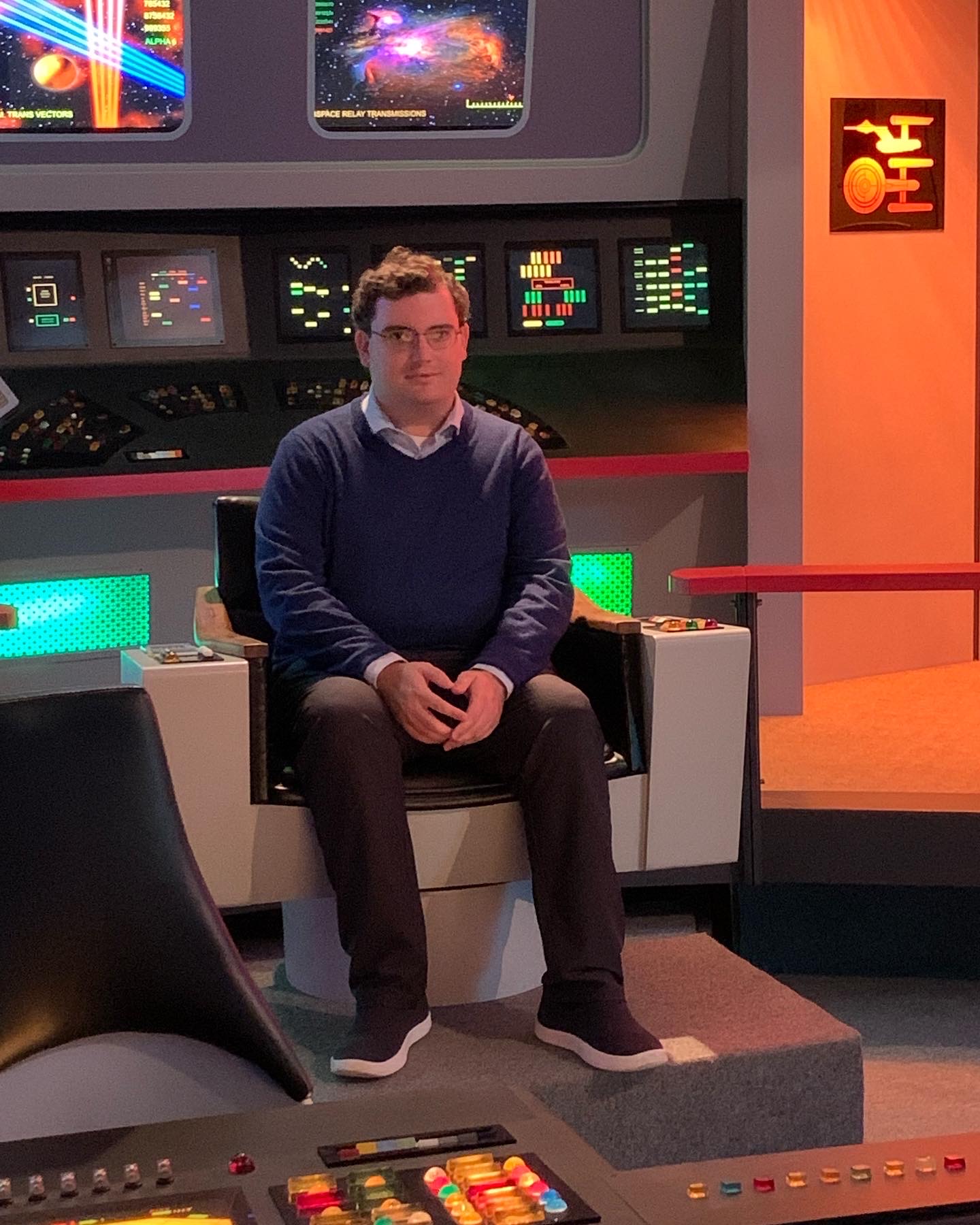
So, a few months ago when I learned there was a recreation of the sets of the Starship Enterprise in a building in Ticonderoga, New York, I knew I had to pay a visit. I arranged things with my good friend Alex Brisson, and we made a weekend trip out of it, visiting the Star Trek: The Original Series Set Tour around noon on Saturday, 17 September. The sets were built by a local guy named James Cawley, who interned on the production of Star Trek: The Next Generation at Paramount. Over the intervening years, the team in Ticonderoga have built with meticulous detail the sets of that original Enterprise as they appeared on the soundstages at Desilu Studios in the late ’60s. In many ways, the tour is both an opportunity for fans to experience walking on board the Enterprise as much as it is for film and TV buffs like myself to see what a TV set from the ’60s would have looked like.

When we walked on the bridge and saw all the stations set out in their circle, the captain’s chair in the center of the room, most of the people in our tour were hushed, a sense of respect among us. I got a chance to sit in the chair, as did everyone there, and I’ll admit the picture of me sitting there looks a fair bit deer-in-headlights as I couldn’t decide what to focus on with so much around me to see. For me, the original Trek isn’t necessarily the show that I prefer the most, that’d have to be Deep Space Nine with Next Generation and Voyager close behind it, but it spoke to a common thread in my life over the past two years as I’ve continued with my own work and studies while in the evenings taking an hour or two to watch another story set a few centuries down the line.

I think the thing that has kept me so interested in Star Trek is how aspirational it is. Unlike so many other futuristic films and shows out there, in the stories told here humanity has figured out how to get out of our cycles of violence and greed and work with the best parts of our nature to achieve the closest we could ever come to returning to Paradise here in our own mortal lives. They are stories that say, “no matter how bad things may be now, no matter how much the pandemic and all the other troubles that came out of it have become, there’s always hope.” 

I’ve always been one to trust in the fundamental goodness of humanity, it’s an idea that really does have some deep roots in my Catholic faith, as well as in my lived experiences. I’ve been fortunate to live the life I’ve led so far, in the places I’ve lived and with the people I’ve known, family and friends who I’ve loved. The seeds of a better future are laid in that fertile soil of hope. Had I grown up in the midst of the wars that my country waged over the last 20 years in Afghanistan and Iraq or in a country with less opportunities for success than my own, my worldview would likely be quite different. Yet if we are going to ever get out of this mire we’ve been in for so long, our adolescence as a species as Carl Sagan put it in his novel Contact, then we’ve got to let our hope for a better tomorrow guide us just as much as our cynicism and bad memories of past wrongs guide us now.

In the future that Star Trek depicts humanity finally begins to overcome our faults in the last half of the current century when first contact between humans and an alien species, in this case Vulcans, occurs. Our technology, and their helping hand (however hesitant it may be) moves humanity up from an age of nation states and superpowers battling each other for supremacy and resources on Earth and into a new age where humanity is one small island in the great ocean of Space, learning to live amid our galactic neighbors, and finally contributing to the creation of a Federation of Planets in the mid 22nd century that brings about a new Golden Age of sorts not just to us on Earth but to many other worlds floating in this cosmic sea.

It’s fiction, I’m well aware of that. It’s a collection of stories dreamed up by writers and showrunners over the past six decades that could very well remain stories in our cultural memory. But maybe there is some room for our future to be more peaceful, more prosperous, and more equitable than our present is or our past ever has been. In the decades since Star Trek first premiered in 1966 so many technologies inspired by the shows have become realities from tablets to personal communicators to now virtual reality taking the place of the holodecks and holosuites of the Next Generation, Deep Space Nine, and Voyager. I’ve been drawn to these stories because they came at just the right time for me. I began watching Voyager in the long dark winter of 2021 when I was preparing for my Comprehensive Exams. That winter, being so far from home and so isolated by the continuing pandemic, I found the story of a lone ship lost 70,000 light years from home to resound with my own situation. These are stories that laud curiosity and teamwork, and while just stories with the odd bizarre plot or weekly new alien with different nose ridges, they offer us a vision of what our world could be like.

Why not give that future a try?

Beethoven’s Ghost

Ludwig van Beethoven, Piano trio in D Major, op. 70, no. 1, musical autograph.

Over the weekend I took a break from my usual work and TV schedule and decided to watch something on the PBS streaming app. I ended up choosing the latest episode of Scott Yoo’s series Now Hear This which has been airing as a part of PBS’s long time arts show Great Performances. I wrote about Yoo’s episode on Mozart a few months ago, and this iteration’s focus on Beethoven likewise did not disappoint. The premise of the episode was essentially Yoo and friends renting out an old Gilded Age mansion in the Berkshires and recording Beethoven’s Ghost Trio (op. 70, no. 1). At the same time, in the Halloween spirit of the weekend when this episode aired, the ghost of Hr. Beethoven himself appeared to listen to his music being played once again. Yet alongside the great composer also appeared the ghost of Dr. Sigmund Freud, who it turned out, had been offering psychoanalysis to the ghosts of dead composers since his own demise in 1939.

At first, I have to admit, I laughed at the idea that Freud interviewing Beethoven would fill the biographical aspect of this episode. It made sense, but it seemed like a silly idea. But as the show went on, I found the premise not only believable but it made Beethoven himself seem more endearing and modern. Now for both of these to occur, I have to admit that I do tend to believe in the possibility of the supernatural. Writing as a Catholic, I believe in an afterlife, and that likely both gentlemen in question are currently in residence there. What’s more, I’ve always thought that one of the things I’d love to do after I died would be to sit down and talk to some of these famous people: Beethoven, Lincoln, Frederick Douglass, among all my own relatives I’d be dying to meet.

By the time the episode ended I really liked the idea of having the ghosts of historical figures interviewing each other as a way of describing their biographies. Sure, it’s corny, but it works. I remember a few years ago KCPT (Kansas City PBS) had a program that they ran with the KC Public Library where Crosby Kemper, then the library’s director, would interview figures from Kansas City’s past: whether they be President Truman, Buffalo Bill Cody, some of the great jazz band leaders, or Boss Tom Pendergast. In many ways, the format that Yoo and friends came up with having Freud’s ghost interview Beethoven’s ghost fits that same model.

Then again, one final question arises from the grave: are they Freud’s ghost and Beethoven’s ghost, or are they just simply Freud and Beethoven? What’s the difference between a potential remnant of a deceased soul and the person they once were? And if there is a difference, does that mean that experience makes all of us who we are?

TopGear and Revolution

In 1783, the Thirteen American Colonies were officially recognised as free and independent states by their former mother country, the United Kingdom. Initially, each of the thirteen states were autonomous to the extent that they were effectively separate countries, united only in a weak document called the Articles of Confederation. The power vacuum left with the departure of the British colonial authorities led to a worryingly unstable situation across all Thirteen American States. Stability in government was only restored with the Constitution of 1787, the binding document which created the Federal Government of the United States, effectively creating the system of government that has kept the United States relatively stable, despite one civil war, ever since.

A similar revolution has occurred in the BBC’s hit motoring show TopGear, with the departure of the old order, led by the trio of Jeremy Clarkson, Richard Hammond, and James May, who have gone to Amazon Prime Video. In their wake, the BBC has chosen a wide array of new hosts, led by Chris Evans, to take over one of their greatest hits. Having seen the first episode, Evans, American presenter Matt LeBlanc, and their fellow presenters, who frankly are more like corespondents than full time hosts, have truly put TopGear through a revolution.

The same old skeleton exists within, but the show itself is well removed from its predecessor. This new TopGear is like the Thirteen American States in the period of the Articles of Confederation; it is in a period of transition and still trying to figure out how to exist without its former presenters. Evans, LeBlanc, and the others have the same light hearted attitude to their work on TopGear that Clarkson, Hammond, and May had before, but at the moment it just does not seem to be as funny. With the former trio, I knew to expect that odd, somewhat nonsensical, at times pointless humour. As a result, I reviled in it, often with a big smile on my face for the entire hour long programme. With Evans, LeBlanc, et cetera, I laughed on occasion. Simply put, I am not familiar with these new hosts, and do not know what to expect.

Perhaps in a few weeks, once more of the current season of TopGear is broadcast, I will  be able to appreciate the new presenters, and new format better. At the moment, I am looking forward  to the first episode of The Grand Tour, Clarkson, Hammond, and May’s new programme, which will be released on Amazon Prime Video this coming Autumn. As to the next episode of TopGear: yeah sure, I’ll watch it. This new TopGear has undergone a revolution, but it still has a long way to go until it leaves the shadow of its predecessor and enter into its own spotlight.

“The Story of the Jews”, Simon Schama’s Masterwork

Kansas City – When I first read that PBS would be broadcasting a new Simon Schama documentary, happy memories came to mind of his only pervious work that I have had the pleasure of seeing, The Power of Art. His latest documentary, which Andrew Anthony of The Observer also called “his greatest” was simply sublime storytelling. The series, which runs in 5 parts, covers Jewish history from the earliest instances in the archaeological record of there being a Jewish people in the Near East to the modern struggle of identity for those residing in Israel and Palestine, though where Israel ends and Palestine begins has been a matter of some confusion for a few generations now.

Image

Courtesy of the BBC.

As a historian-in-training I found Schama’s style of telling the story of his own people to be inspiring for my own goal of eventually telling the story of my own people, the Irish diaspora. Schama’s reasons for studying history as a profession, because “We are our story,” we are the source of the history that we, as historians, study. This is almost word for word my own chief reason for studying history. That is something that Schama seems to connect to with his latest documentary that many other historians fail to see, that history is nothing without being an inheritance from the past to the present. Schama’s way of telling the story of his faith made me, an Irish Catholic American, feel as though not only could I understand some elements of the Jews troubled history, with both of our peoples often being at the receiving end of some bigger power’s brutality, and with his frequent remarks on the Jewish sense of humour developed through centuries of oppression and exile. Yet, despite these, and many other, commonalities, the story that Schama tells is very much a Jewish one. The very fact that the Jews have made it through all they have is testament not only to the existence of God but also to the tenacity of the human will to survive.

Schama is at times whimsical bringing the viewer into his personal life at the synagogue and at the annual Seder, whilst at other points he brings the viewer into the darker, dolorous parts of what it means to be a European Jew in a community that is now a mere shadow of its former self. His visit to Lithuania, his family’s homeland, is one such moment. A particularly poignant point came when Schama proceeded to explain just how the Lithuanian Jews in a particular shtetl were rounded up, tortured, and killed en masse by the Nazis during the Holocaust. Likewise in its poignancy for me was the intense description that Schama used to conclude his telling of the story of the expulsion of the Jews from Spain by Queen Isabella, more famous today for sending Columbus to the Americas. He recounts how the Spanish king ordered his Christian subjects, “Not to harass or disturb the Jews in the process of packing up and selling off synagogues, and lands, and possessions. Get them out of here in peace and as quickly as possible, to which you want to say ‘How very considerate.'”

What sets Schama’s documentaries and books apart from many other historians is how dedicated to his work he has become. Especially in the case of The Story of the Jews, where Simon Schama invites us, the viewer, to join him on a journey into his own family history. It’s an invitation that I would highly recommend be accepted.

To watch Simon Schama’s The Story of the Jews online in the United States, please click on the following link.

Netflix’s “House of Cards” comes into its own

Image

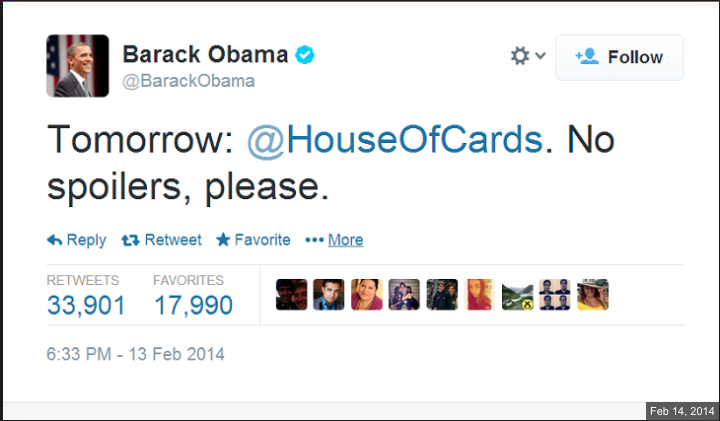
Don’t worry, there are no spoilers below.


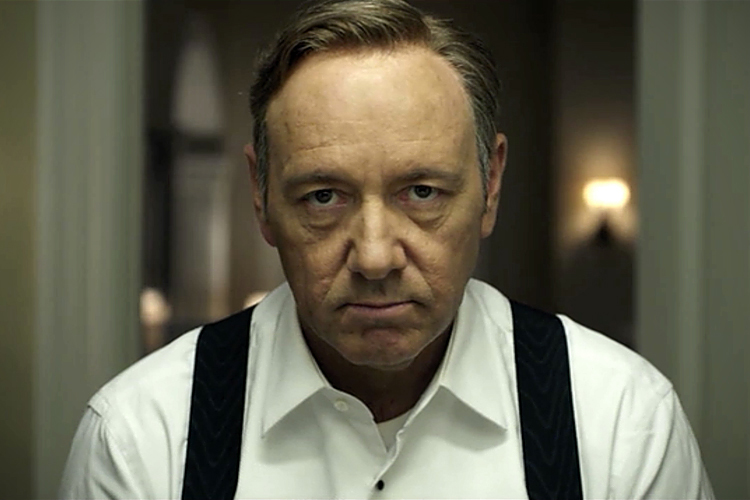
Kansas City – A few weeks ago I published my first review of a “television” show. I find it amusing that my first TV review should be of the first big-budget show to be produced and broadcast by an online-only broadcaster. In January, I wrote about how the first season of Netflix’s House of Cards, starring Kevin Spacey and Robin Wright as Congressman Frank Underwood (D-SC) and his wife Claire, related to its British parent.

Like the country in which it is set, this new American House of Cards needed a while to set itself up as an independent show. However, with the start of Season 2, Netflix’s masterpiece of drama truly set itself apart from its roots in Westminster. I found the second season to be far more thrilling than the first. The speed by which the action moved, balancing the need for both quick and slow plot lines, was exhilarating. There were quite a few moments over the past fortnight that I found myself sitting forward in my seat, gasping “Did they just do that?” My first season mulligan of “Well, I know how the BBC version went” quickly became defunct and resoundingly out of place in this truly American drama.

Image

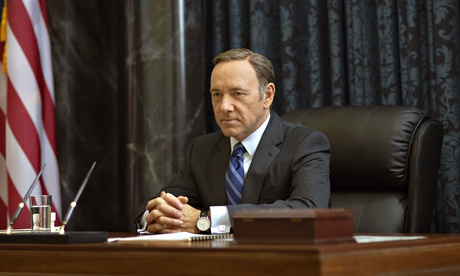
Kevin Spacey as Frank Underwood. Courtesy of “The Guardian”.

Spacey continues to refine and evolve in his role as Underwood, the epitome of the modern anti-hero, perhaps villain. He was able to balance out the ruthlessness and chessmanship of the political realm with the more mellow personal moments here and there throughout the season. I found myself amazed that even he as an actor going off of a script could keep up with the many twists and turns, the double and triple bluffs that lace the plot in such a fashion that they began to seem almost too fantastic for the politics of the reality (or at least I should hope, though perhaps naïvely, so).

Image

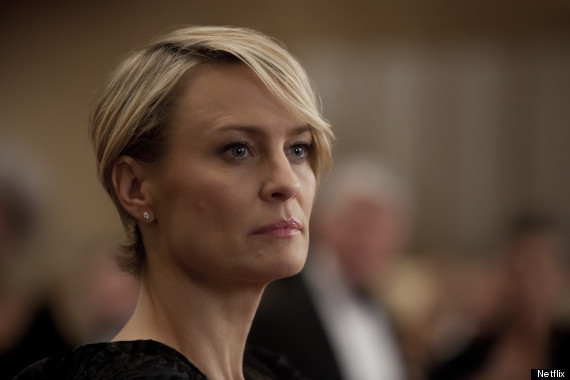
Robin Wright as Claire Underwood. Courtesy of “The Huffington Post”.

Complimenting her Golden Globe award from last month, Robin Wright’s performance as Claire Underwood continued to evolve just as much, if not even more than Spacey’s role as her husband. I found Claire much more likeable after a while in this season than I certainly did in Season 1, though the same characteristics that made me wary of her in the first season are certainly still present in her character. After seeing the second season, I find myself hoping, again perhaps naïvely, that Claire Underwood won’t turn out as Elizabeth Urquhart (the wife in the BBC series) did, as a sort of Lady Macbeth to counter Frank Underwood/Francis Urquhart’s Richard of Gloucester (Richard III).

Beyond the acting, the runaway golden winner here has to be the writers. Their work is truly a masterpiece of drama that certainly does a good job at expressing the emotions and desires of our time, especially in the political realm. Netflix’s House of Cards is a drama for our time, set in our time, featuring us, and calling upon us to ask ourselves how we feel about what we see in the mirror that the series offers the United States in 2014.

Washington and Westminster – Comparing both “House of Cards”

Image

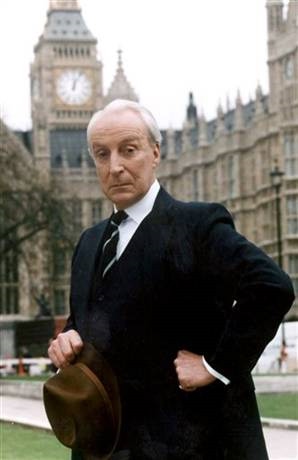
Ian Richardson as Francis Urquhart.
Courtesy of the Wikimedia Commons.

Kansas City – It was funny to me that last night as I finished watching Season 1 of Netflix political drama House of Cards, one of its leading stars, Robin Wright, won the Golden Globe for Best Actress for her part in the hit series. I was first introduced to the Netflix series through its inspiration, it’s daddy so to speak: the BBC’s 1990 miniseries of the same name. The BBC’s version was based upon the novel by Michael Dobbs in a script adapted by Andrew Davies. It starred acclaimed Scottish Shakespearean Ian Richardson as Francis Urquhart, MP a Machiavellian Tory chief whip and is set in the years following the fall of Thatcher’s government in the 1990s.

I was first attracted to Richardson’s House in large part by the leading actor’s grandfatherly charm, which prevailed over his on-screen persona for the majority of the original BBC miniseries (it had two sequels, To Play the King, and The Final Cut). Also I am a bit preferential to the parliamentary system over its presidential counterpart, which added into my interest in the British series. Richardson’s Urquhart is a charming aristocratic MP, who feels cheated by the Conservative Party when he was not chosen as her successor for the leadership. What follows is a reign of vengeance that easily rivals that of Shakespeare’s portrayal of Richard III. In fact, another area in which I was drawn to the series was in the subtle, though sometimes verbal, references to Shakespeare, with Urquhart being based upon Richard III whilst his wife rings more true of Lady Macbeth.

Image

Kevin Spacey as Frank Underwood.
Courtesy of Salon Magazine.

In comparison Kevin Spacey’s Congressman Frank Underwood (D-SC) lacks the charm that Richardson so gracefully portrays. What the two characters do share is a dramatic penchant for ruthlessness and determination to do whatever it may be that is on their minds at any given moment. Thus far, considering that only half of the American version has been broadcast, I would say the character closest to their British original would have to be Doug Stamper (Michael Kelly), Underwood’s Chief of Staff. He shares many traits with Urquhart’s Junior Whip, Tim Stamper, MP (Colin Jeavons). Both are loyal at first to their superiors, but as time goes on Stamper, MP begins to see how truly evil Urquhart’s intentions are, a plot development which I will be sorry to see missing from the second season of Netflix’s rendition.

Likewise in the Netflix adaptation, I will say that thus far my favourite characters in the Netflix series are Congressman Peter Russo (D-PN), played by Corey Stoll, and his Chief of Staff and girlfriend, Christina Gallagher (Kristen Connolly). They seemed the most personable of the entire cast to me, and after all it’s nice after a while to find a love story that is very honest and quite beautiful in how human it really is. To counter this I was left rather confused by the relationship between Frank and Claire Underwood, the leading couple, who frankly (pun intended) seemed, perhaps more so than Francis and Elizabeth Urquhart (Diane Fletcher), like having Gen. Patton and Field Marshal Rommel living happily married together. Both characters are outwardly kind and considerate, but inwardly ruthless and willing to go to any lengths, yes any lengths, to see their goals achieved.

At the same time as Robin Wright was accepting her award in LA, I found myself mostly thankful that the first series of this all-too interesting show was at last over. One major complaint that I have about American television is that there can at times be too much of it. Consider that the average British season will run for about 6 to 8 episodes, whilst the average American one runs for about 10 to 20. After a while, especially in the context that I was watching it in, to review it in comparison to the BBC’s original, I found myself emotionally exhausted by the many bumps in the road that Netflix’s House of Cards has to offer. For a programme like this, 13 episodes per season is just too long to watch in as short a span of time as I did (in about half a week).

And yet, I am looking forward to seeing how Season 2 carries on the threads from Season 1, hopefully bringing them together for a good conclusion. In short, Netflix’s House of Cards is good in its own right, but I would still prefer to listen to Francis Urquhart’s asides mixed with a sense of laughter at the world than here Frank Underwood’s complaints and Machiavellian strategies on how he’ll make his next move.