Category Archives: Politics

On Political Violence

This week, I feel compelled by this past weekend’s events to write about the follies of political violence. — Click here to support the Wednesday Blog: https://www.patreon.com/sthosdkane


This week, I feel compelled by this past weekend’s events to write about the follies of political violence.


On Saturday evening, I was making dinner for a friend and I to share when I received the first notification from the Washington Post that something had happened at a rally held by former President Trump in Pennsylvania. We first heard that that something was a shooting as we were starting dessert. The evening turned from genial conversation in my family’s dining room to tuning into NBC’s coverage to learn as much as we could at that early moment. What transpired, as far as I’m aware at time of writing, is that a single shooter firing from a nearby rooftop shot at the former President, striking him in the top of his right ear in what was clearly an assassination attempt. This is the first time an American President has been shot since Ronald Reagan’s assassination attempt in 1981, and so the first in my lifetime. We quickly saw the film of the former President being removed from the stage by the Secret Service, and only a little later did we see the actual shooting itself, albeit on RTÉ’s Instagram feed rather than on NBC.

Considering the level of senseless gun violence in this country, and the bellicose rhetoric of the former President and his allies, I’m not surprised that something like this happened. I remember well how the conservative press were using bull’s eye targets in their graphics on TV over the faces of Democratic elected officials whose seats they wanted to target in the 2010 Midterms, and how that contributed to the assassination attempt against Gabby Giffords, the former Representative of Arizona’s 8th congressional district. Things were toned down after that shooting thirteen years ago, but the rhetoric has increased in the years since, especially since 2015 when the 2016 Presidential primary races began.

I feel that political violence ought to be considered in the same vein as the concept of just war and the practice of capital punishment. Can we reasonably assert a right to use violence to influence the politics of a society? It has certainly been done time and time again. Just this Spring, I was engrossed in Apple TV’s recreation of the aftermath of the assassination of President Lincoln on 14 April 1865 in the series Manhunt. The Civil War is a good place to ponder these questions, when David Brooks of the New York Times interviewed Steve Bannon just before he reported to prison on charges of Contempt of Congress over his refusal to appear before the House Select Committee on the January 6 Attack, he brought up Lincoln’s call for restoring national unity in his second inaugural address, Bannon would not accept any such arguments, fixating instead on Lincoln’s decision to engage in the civil war with the rebellious southern states, referring to our 16th President as “a military dictator” for his actions and the actions of the military during that war.

I was deeply disturbed reading Bannon’s responses to these questions, because though we may both be Irish Americans who were raised in Catholic schools, I come from Illinois and have always seen Mr. Lincoln as a hero, as longtime readers and listeners to this publication are well aware. What disturbed me most was that this moment when these words of reconciliation, which matched what I’ve read of Lincoln’s plans postwar to engage fully in reconstruction rather than retribution, that Bannon’s reaction was belligerent and unwavering. 

For decades now the cries of “no compromise!” have rang out in our politics. I remember a friend in high school telling me that there are no moderates, only conservatives and liberals, and you are a friend to one side and an enemy to the other. I was shocked then too to hear such rhetoric from a friend because at that time we were on opposite sides. Political violence occurs because we allow ourselves to be riled up into a frenzy to the point that we believe it is justifiable to act violently against our neighbors, our countrymen and women, our fellow humans. I have a very hard time with the concept of a just war that is taught by my Church, though again in the context of the Union aims during the Civil War, I can readily see how preserving the Union and ending slavery were justified. I believe a just war needs a strong moral bedrock for it to be justifiable. We cannot run out crying “Deus vult! God wills it!” and proclaim any old brawl a just war.

The first time I was challenged to consider these questions was also in high school, about a year before that conversation mentioned in the last paragraph. In my sophomore year, I took a combined honors world history and world literature course, taught by two teachers in their first year. Our literature teacher assigned us to read Eli Wiesel’s novel Dawn, in which the main character, Elisha, is a Holocaust survivor who’s moved to the British Mandate of Palestine and joined the Irgun, a Jewish paramilitary group fighting to drive the British from the region to establish a Jewish state. The book covers the early morning hours when Elisha is preparing to execute a captured British officer, who is to be shot at dawn. My assignment was to write an essay of my own saying how I would have acted, would I have carried out the execution or would I have let the captive man live?

The essay I submitted was one of the rare essays I ever earned an F on. I wrote that to take a life is not in our rights but should be left to God alone, so I would not know how to make that decision. At sixteen, I tried to find a middle way, to fall back on my faith as a means of avoiding making such a tough decision. Today though I would choose to reprieve the captive, to let him live. When I visited the remains of the Dachau camp in the Munich suburbs in January 2020, I was struck by the thought that everyone involved, the captors and the captives, the murderers and the victims, were all at their core humans, and at one point in their lives they were all innocent, helpless, and defenseless as infants. Since then I’ve noticed more of this in people I pass on the street, where just as I still in some ways imagine myself as I was when I first recognized my own consciousness as a very young child, so too I can readily imagine others in those perhaps purer moments of life before we are weighed down by our anger and fears and pain, by our suffering and sorrow and grief.

So often, political violence is unnecessary and unwarranted; a choice made by someone on their own, an inflection point in history when the decisions of the individual can change the whole world for the worse. In more pop-culture questions about history, one will often hear people ask, “If you could go back in time and could stop Hitler or Stalin, would you kill them?” I for one prefer the way Hitler was handled on Doctor Who, when in the episode titled “Let’s Kill Hitler,” the man merely ended up being shoved into a closet.We will likely not know much more of the motives of the man who shot the former President on Saturday evening for some time, and the best thing we can do is let the investigation continue in its own pace. I do not wish death on anyone, that is a horrible thing to do. Even if the acts of some are so heinous that they may seem to be due such an extreme and ultimate punishment, I challenge you to consider what condemning or killing them would do? What benefit does it hold? And how would it change you?


An Election Year Independence Day

An Election Year Independence Day Wednesday Blog by Seán Thomas Kane

This week, I’m writing to you with this week’s holiday in mind, with some of my aspirations and hopes for America. — Click here to support the Wednesday Blog: https://www.patreon.com/sthosdkane

This week, I’m writing to you with this week’s holiday in mind, with some of my aspirations and hopes for America.


While I have colonial ancestors who settled New Haven, Connecticut and Newark, New Jersey, and who at the time of the American Revolution were living in Pennsylvania, Maryland, and North Carolina, I more closely associate with my recent immigrant ancestors. I’m one of those hyphenated-Americans who holds onto elements of a culture and identity that transcends the Atlantic and provides connections not only to this country but to the places where my ancestors came from. One aspect of the political philosophy of American nationalism that I don’t agree with says that you have to conform to a particular American identity when you come here. My ancestors did that, to varying degrees, and I’m more American than anything else, yet it’s all those other elements that give our Americanness its richness of character.

So, when I think of the music that embodies the soul of America, it’s music written by a fellow hyphenated-American, Aaron Copland, the dean of American classical music. When I tried my hand at musical composition in college, I wrote a four-movement trio sonata that told the story of a voyage from Ireland to America by St. Brendan and his monks in the sixth century. My addition to the fable was to have the tone of the music switch from being very Irish in the first and second movements to taking after Copland’s sound in the third and especially the fourth movement as they reached this side of the water. I’ve long wanted to write a blog post all about my admiration for Copland’s music, but thanks to the copyrights on his recordings I’m waiting for a few more decades. For now, go listen to Appalachian Spring and Rodeo after you’re done listening to, or reading, this.

Copland’s music speaks to me now in 2024 especially as we approach an election year. This is the most sacred task that we American citizens fulfill in our obligations to our republic: we do our duty by voting for whom we want to represent us on all levels of government, and on the host of ballot measures found further down-ballot. This election feels far more pivotal than any we’ve seen in my lifetime. For context, I was born exactly one month before the elder President Bush stood aside for President Clinton. While I may have disagreed with the policies of both Presidents Bush, they still seemed to be decent men. It’s hard to say that this year about one of the two candidates who flooded Thursday night’s debate on CNN with so many half-truths and outright lies that the network did nothing to check live on air. I was baffled watching it to think that the network’s executives and news directors didn’t choose to lay out better safeguards considering this is the same man whose rhetoric and refusal to admit his loss in 2020 led to the storming of the Capitol on January 6th, 2021.

When I think of a President who I want leading our country, I think of Copland’s Fanfare for the Common Man.I want someone who best represents the best ideals of America, someone who can speak with all of us and for all of us. I hope for someone who can work with Congress and the states to execute legislation that will lead to an overall improvement in our national well-being. I was disappointed to see the President perform so poorly during the debate on Thursday, yet of our choices this year he is the closest to embodying that ideal of the common man.

This year’s election is not politics as usual, there are deep intrinsic questions at stake over the future of our country and what sort of government we want to have. I was deeply unsettled to read the transcript of David Brooks’s recent interview with Steve Bannon, who Brooks called a Trotsky-figure for the MAGA movement. From the interview, and from the way Bannon positioned himself as a leader of that movement, he made it clear that there is no room for communication with their political opponents, who Bannon termed in a far more affrontive manner as their enemies. That is the most essential element of good government, something that all the great political philosophers recognized: we need to be able to communicate with each other and grow together as one body politick made up of a great many parts. I’ve seen the same problem on the left as on the right, a disinterest in listening and in compromising to achieve a higher ideal or a common good that will benefit everyone. Yet the greater threat is coming from the faction who’ve gained enough sway that they now control their party and their leader is again a candidate for the Presidency.

This Independence Day, Americans around the globe will celebrate the invention of our republic from an ideal written on paper during a hot and humid Philadelphia summer 248 years ago. I’ve heard it said that that was the first time that anyone thought to write down the idea that “all men are created equal.” Think about that for a moment: that was the first time that the notion of universal equality, or better universal equity, had ever been considered. The President is the President, and I respect him for serving in that office as I feel respect for the office itself. It is a monument to self-sacrifice when done well, and a trap of self-aggrandizement when the oath is taken for the wrong reasons. Yet when a sitting President leaves the office on Inauguration Day, they may still be Former President, but they are now again just another citizen who’s offered to carry that mantle in the relay until the next candidate will take it up.

The burdens of preserving, protecting, and defending the Constitution of the United States are greater than one person can carry on their own. The office holder ought to have us, we the people who come first in the Constitution, supporting them as long as they keep their oath, and do their duty for as long as their term lasts. It is a humbling thing to serve in such an august role. It is something that truly should not be taken lightly, or brought on by a candidate for any other reason than for service.


Lacrimosa

Today, one week after this city's great triumph and great tragedy, I've decided to reflect on the week now passed. — Click here to support the Wednesday Blog: https://www.patreon.com/sthosdkane

Today, one week after this city’s great triumph and great tragedy, I’ve decided to reflect on the week now passed.


One of my favorite speeches of Peter Capaldi’s run on Doctor Who came at a moment when the Doctor finds himself in the middle of a war-game just beginning. On the one side are an alien species beginning their invasion of Earth, on the other the humans fighting for survival as we do. In a powerful bit of oration, Capaldi’s Doctor cries out that none of this conflict would happen if we would just sit down and talk with each other. I think of this scene often when I’m reading news analysis of our current moment in American history. We are at a point where we so vastly disagree with each other over the very facts of our nature and our world that we only talk with people with whom we agree.

Now there’s a key semantic note here: we talk to people with whom we disagree, yet we often only talk withpeople with whom we agree. One week ago, this city was filled with millions of people talking, cheering, laughing, and dancing with each other in our moment of jubilee. One week ago, this city basked in the bright, warm mid-February sky. 

I didn’t go downtown for the parade, instead choosing to watch the first hour of it at home before going to my parish church for Ash Wednesday Mass and a delightful afternoon walk on that warm day at the Kansas City Zoo. While I was at the Zoo, riding on the Sky Safari chairlift on the way back from seeing the chimpanzees, I heard over the staff radio that something was happening at the parade. A few seconds later one of my best friends, a regular Wednesday Blog reader no less, texted me about a shooting at Union Station. By the time I returned to ground at the other side of the chairlift near the cheetah enclosure I knew enough that I chose to cut my zoo visit short and return to the assured safety of home.

At that point, we didn’t know if the shooting, still ongoing, was a terror attack or a fight gone wrong. It turned out to be the latter, yet in the process 22 bystanders were injured and 1 bystander, Lisa Lopez-Galvan, was killed. Her name is now etched into the memory of this city. She is by no means the first Kansas Citian to be killed in a shooting in the past year, each Sunday at Mass my parish prays for the victims of gun violence killed in the past week, ultimately reading 184 names in the 12 month course of 2023. Still, this was the first time that such a shooting happened with elected officials from the Governors of Kansas and Missouri to the Mayor of Kansas City to State and County legislators from throughout our region were all present. There are reports of Chiefs coach Andy Reid and players from the team helping comfort other revelers shocked by the sudden shooting and leading many to safety within Union Station itself.

At the time of writing the Kansas City Police Department has reported that the two suspects in this shooting are juveniles who got into an argument at the end of the Super Bowl Rally and started firing at least one, if not two, weapons. These individuals weren’t talking with each other but instead were talking to each other. The circumstances of the laws which govern our society here in Missouri contributed to this situation, and I hope that the experience inspires change in the hardest of hearts in Jefferson City and Topeka. 

That evening, feeling shocked and dumbed by the experience of seeing our jubilee transform into a living nightmare I wanted to do something, anything that could help. At dinner, I compiled a list of all of the Members of Congress who represent the Kansas City Metropolitan Area with their DC office phone numbers and posted it to my Instagram story and Facebook profile. The following morning then, I dialed the three numbers of my Congressman Emmanuel Cleaver, and Senators Josh Hawley and Eric Schmitt. I spoke with a staffer for the Congressman and left messages with the senators’ offices.

  • Sen. Hawley (R-MO): (202) 224-6154
  • Sen. Schmitt (R-MO): (202) 224-5721
  • Sen. Moran (R-KS): (202) 224-6521
  • Sen. Marshall (R-KS): (202) 224-4774
  • Rep. Cleaver (D-MO): (202) 225-4535
  • Rep. Alford (R-MO): (202) 225-2876
  • Rep. Graves (R-MO): (202) 225-7041
  • Rep. Davids (D-KS): (202) 225-2865
  • Rep. LaTurner (R-KS): (202) 225-6601

In each case, echoing what Jason Kander, a local veteran and sometime Democratic political candidate, said on Wednesday night, asked each official to consider the repeal of a law called the Protection for Lawful Commerce in Arms Act (PLCAA) which prohibits lawsuits against the gun industry over damages caused by their products. The judicial system is something which ensures consumer safety. Without this safeguard, we are at far greater risk as a society, and we’re a society with a government that has checks and balances built into our very DNA! Those checks and balances only really work if the different branches of government, and the people who choose those in government, talk with each other about the issues of the day which in some cases can determine life or death.

As the week drew to a close, I set into a new task and worked a good 21 hours this weekend at the Kauffman Center in what was truly a wonderful antidote to the grief I felt after the events midweek. To me it seemed that many people choose to come see the Kansas City Ballet’s production of Peter Pan for the escapism that the boy who never grows up embodies. We did our part, however small, to help heal our city and restore some of that jubilant spirit to our lives. Even so, on one of those nights after a long shift I drove home down Main Street and stopped at the Pershing Road light just before midnight. Even then, days later, with St. John of the Cross’s dark night of the soul feeling ever present around me at that scene, the red and yellow confetti still gently fell as it had on Wednesday morning.

On Saturday afternoon, I attended with my parents and grandmother a rally held by the gun control organization Moms Demand Action in Washington Square Park, located across Main Street from Union Station. It is a site I know best as the annual home of the Kansas City Irish Festival’s arts area, where among other works of great imagination, I talked myself out of buying a beautiful painting of the USS Enterprise-Dfrom Star Trek: The Next Generation during the last festival over Labor Day weekend. The speakers at that rally included Moms Demand Action organizers, Missouri State Representatives, Jackson County Legislator Manny Abarca IV, and our mayor Quinton Lucas. All of the speeches I heard were stirring, and like my relations there I felt the same call to action, even as the same confetti fell around us blown on the wind from the west across the park.

Writing this on Monday night just before bed, I’m surprised to think that by the time you read this blog it will have only been 1 week, a mere 7 days, since our jubilee became our nightmare in the place where our city celebrates great triumphs. To me, this last week has felt more like two weeks, the emotions have been too great to be contained by a single week alone. I sit here, writing, hoping these words speak with you, while listening to Alan Gilbert and the New York Philharmonic’s 2015 performance of Verdi’s Requiem. It seems to be the best soundtrack for this week’s edition of the Wednesday Blog, something which evokes the inherent conflict and paradox of human experience and human emotions. Giuseppe Verdi was, after all, noted for his anti-clerical views, yet his spirituality can be heard in every note of this great Mass of the Dead.

I thought briefly on Wednesday about what I would say if I were in the room with the two suspects in this shooting. Yet after a few moments, after all the anger, all I felt was sorrow that they made their decisions which led to the nightmare they wrought. When I listen to the Lacrimosa in Verdi’s setting, I think not only of Ms. Lopez-Galvan, but of those individuals as well who caused her death. How can we heal if we cannot recognize each other’s humanity? This prayer then, the words which Verdi set to music, as Mozart and Berlioz did before him, speak to both the victims and the perpetrators:

Lacrimosa dies illa

Qua resurget ex favilla

Judicandus homo reus.

Huic ergo parce, Deus:

Pie Jesu Domine,

Dona eis requiem. Amen.

Full of tears will be that day

When from the ashes shall arise

The guilty man to be judged;

Therefore spare him, O God,

Merciful Lord Jesus,

Grant them eternal rest. Amen.

Postscript

Dear Reader, this is now the second week in a row that I’ve released a follow up to the weekly edition of the Wednesday Blog, a sign perhaps that this format does not quite work as well for current news as I might wish. About 20 hours after I wrote this week’s post and an hour after I sent the recording off to Spotify to be published at midnight Central Time, I read a story from KSHB, Kansas City’s NBC affiliate which confirmed the two main suspects’ names, their charges, and some of their testimony from their own hospital beds where they are recovering from their own gunfire.

What struck me the most about this story, which has since been updated with more information and a mugshot of the suspect whose bullet killed Ms. Lopez-Galvan, is that the man in question’s testimony shows some sense of remorse. Quoting from the article written by KSHB’s news staff, “‘Just pulled a gun out and started shooting. I shouldn’t have done that. Just being stupid,’ Mays said.” Knowing some of the humanity of this suspect speaks to me of how broadly this shooting has hurt so many.


Leadership

I've long wondered about what kind of leader I want to be. This week a coalescing of those ponderings. — Click here to support the Wednesday Blog: https://www.patreon.com/sthosdkane


I’ve long wondered about what kind of leader I want to be. This week a coalescing of those ponderings.


Leadership is one of the great qualities which we yearn for today, particularly in this country agreement among our leaders on the same basic principles of democracy and integrity. We seek the same fundamental truths even while truth is far more diffuse a concept than ever before. To take the first step towards this restoration we need to begin talking to each other again and really work towards rebuilding our mutual understanding of who we are and what we want out of our Union.

Throughout my life I’ve looked up to certain types of leaders: a citizen like Abraham Lincoln, a unifier like Eleanor Roosevelt, and a servant like Pope Francis. Each of these figures took their own stands in their own circumstances of time and place and worked to their own ends, and in some respects they were successful. 

I’ve been humbled to serve as a leader at varying moments and in several capacities and my own efforts are often rewarded by how I can connect with the people around me. I make a point of working with people, of listening to their ideas and trying to incorporate them into something all of us working together can be proud of.

Today then, I want to present to you a paper that I wrote at the end of my time as a Master’s Student at the University of Missouri-Kansas City in November and December of 2018. I presented this paper “Erasmus’s Enchiridion militis Christiani and the Humanist Knight in early-sixteenth-century England” at the American Catholic Historical Association’s 2019 annual meeting, co-current with the American Historical Association conference at the old Stevens Hotel, now the Hilton, on South Michigan Avenue in Chicago on Friday, 4 January 2019. I hope this offers two visions of leadership from the Renaissance, one rooted in Erasmus’s Christian Humanism which hearkens towards the social justice-rooted morality of my own Catholicism, and from the realpolitik of Niccolò Machiavelli in his timeless book The Prince.


Erasmus’s Enchirdion militis Christiani (The Handbook of the Christian Knight) was one of the most popular books of its day in Western and Central Europe; translated into eight languages between 1519 and 1542. Its most popular and widely disseminated edition was that published by Johann Froben in Basel in 1518. The Enchiridion‘s enduring popularity throughout the first half of the sixteenth century is a testament to its relevance at a time when Europe was witnessing tremendous social and religious upheaval through the Reformations of Luther, Calvin, and Henry VIII. The Enchiridion was intended to be a guide for Europe’s many princes, kings, and lesser lords on how to be good moral rulers, how to be “soldiers of Christ” as the title states. Through this role as a guide for good governance, the Enchiridion can be seen as a Christian Humanist equivalent to Machiavelli’s The Prince as a guide in Renaissance political philosophy. In considering the Enchiridion‘s role as a book of political philosophy, this study will consider both the 1518 Froben edition[1], and the 1523 Alnwick manuscript[2], the earliest known English translation of the Enchiridion, from which all quotes derive.

Originally written in 1502, the Enchiridion was said to be inspired by an unpleasant evening that Erasmus experienced in the castle of a knight recorded as “John the German.”[3] The knight’s wife begged Erasmus to write a treatise offering her husband guidance on better manners, thus resulting in the Enchiridion.[4] While the Enchiridion was first published in 1503 by Maartens in Antwerp[5] it did not achieve widespread fame until its first publication by Froben in 1515.[6] The Enchiridion‘s philosophical inspirations come from a number of different sources, both Biblical and Classical, from Moses, Solomon, and David to Julius Caesar and his nephew Augustus to the heroes of the Iliad and the Aeneid. While this work takes great influence from Platonic philosophy, it nevertheless bathes Platonism in a deep bath of Christian theology before allowing it to enter into the main work.

As a work of Christian Humanism, the Enchiridion contains a thorough retelling of the many morality stories found in the Bible. It appears, through the wording of the Biblical quotes in Froben’s Latin edition, that Erasmus used his own revised translation of the New Testament throughout the Enchiridion, which had been published by Froben in its most widely read form in 1516.[7] Nevertheless, Erasmus draws just as heavily from the Old Testament, looking at Moses, David, and Solomon as good and worthy models for the Christian knight of his day. For Erasmus, a Christian ruler should follow closely the teachings of the Church and its Old Testament forbearers. Countering Machiavelli’s view that the two safest manners for a prince to control a population is to either “destroy them or reside there,”[8] Erasmus argued that it is a “grete obomynation … if a man forsake his fynge or theiss lorde [Christ].”[9] For Erasmus, temporal power was secondary to spiritual wellbeing, arguing later in the same chapter of the Enchiridion that the death of the soul is far more consequential than the death of the body, as the death of the soul “is extreme misery,”[10] even greater than bodily death. The key difference here is that Machiavelli wrote as a politician, while Erasmus set his words to paper as a theologian. 

The disparity between the political realities of early sixteenth century Italy and the theological expectations on morality at the same time are stark. Erasmus’s chief concern is the wellbeing of the soul, while Machiavelli’s is the accumulation of power and its subsequent preservation. Erasmus’s knight is a moralist, while Machiavelli’s prince is a pragmatist. Yet where Machiavelli’s vision of rulership is often shown as a testament to the various leaders in Italy during the Italian Wars, Erasmus’s shows the theological ideal of a Christian Humanist ruler, akin in character to Plato’s philosopher kings who should rule in a conjunction between “political power and philosophical intelligence.”[11] Both Erasmus and Machiavelli reference Moses as fine examples of leadership, the former spending the first chapter of his Enchiridion discussing Moses’s role as leader of the Hebrews and his loyalty to God’s will and light[12], while Machiavelli names Moses alongside Cyrus, Romulus, and Theseus as “the most excellent”[13] of princes. While Machiavelli considered striking Moses from this list because he was “a mere executor of things, that were made ordained by God,”[14] and thus less a prince in his own right and more a vassal for a Higher Power, he nevertheless respected Moses’s leadership of the Hebrews and saw him as an equal to Cyrus, Romulus, and Theseus through his deliverance of the Hebrews out of slavery.[15]

Erasmus’s Enchiridion makes great use of Platonic philosophy, referring back to the Athenian academic’s teachings time and again in his work. Erasmus noted in the fifth chapter of his Enchiridion, entitled “Off the dyusitue of affeccions” that Plato and the later Stoics both saw  “philosophy to be nothing else but a remembrance of Deth.”[16] Interestingly, in Froben’s 1518 Latin edition this line reads, “with nothing else [Plato] thinks Philosophy however to be a meditation of death.”[17] The differences in meaning between the words remembrance and meditation is striking. While they are synonyms, the former appears to have changed in meaning over the centuries, becoming today a manner of meditation about a person or event that takes place only after that person has died, while a meditation can happen when they are still living. For the translator of the Alnwick Manuscript, this difference does not appear to have been as profound, and by and large it would appear that, at least in that translator’s eyes, remembrance and meditation are a good pair of cognates. 

Machiavelli’s text looks at death as an inevitability and in many cases a means to an end, especially for men who “forget more quickly the death of the father than the loss of their inheritance.”[18] In Machiavelli’s view, while the living may mourn the dead, they celebrate in the riches left behind by the deceased and seek to improve their own fortunes off of the demise of their fathers. Machiavelli accepts that this degree of swift respect for the dead is tantamount to theft, yet he dismisses any degree of moral ambiguity by noting how common and easy the practice can be, writing, “it is always easy to find cause to take away property,” and “anyone who lives by theft will always find reasons to occupy the things of others.”[19] For Erasmus, death is a moment of great spiritual significance, one to be taken seriously in securing the sanctity of one’s soul; yet for Machiavelli, death is a moment of great personal significance, one to be taken seriously in securing one’s fortune and power from the deceased, whether they be one’s father or another.

If philosophy is merely a meditation on death, as Erasmus argued, then what is life but a march towards that inevitable fate and, if one is fortuitous enough, Heaven, which “is promysed to hym that fighteth swftely.”[20]The Humanist Knight, therefore, should strive to fight their battles with speed, and in doing so keeps in mind the prospect of eternal life in Heaven, and end the suffering of those whom they are fighting sooner. Fighting should only be a last resort, as the Humanist Knight should consider their moral and spiritual wellbeing before taking up arms against another. The promise of Heavenly reward drives the Humanist Knight, sending them into their world with the purpose of ensuring their own moral wellbeing and salvation. One’s soul should be “refresshed with manna from heven and with water that kame oute of the harde Rock,”[21] consuming the heavenly donation and fortifying oneself so that “neither strength neither hie / nor lowe : nor no other Creature shall seperat us from the love of god which is Christ [Jesus].”[22] In this sense, Erasmus argued that the rewards of mortal riches and conquests should not come before the spiritual rewards awaiting the Humanist Knight, faithful to Christ, in Heaven.

In contrast, Machiavelli argued in favor of prolonged war, if only to secure a prince’s authority over their own people and supremacy over their adversaries. A prolonged war, according to Machiavelli, is sometimes necessary to secure the authority of the prince against threats both foreign and domestic, and while one might lose some territory, or even some cities, as in the case of Philip V of Macedon, yet the loss of a few cities ranks lower as a threat to the stability and security of a prince’s power.[23] For Machiavelli, Philip V was a strong leader because he acted when others would have passively watched as events unfolded in front of them. He stands as a good example of the Machiavellian prince, as he was willing to make sacrifices of his cities and territories, their populations included, in order to preserve his power. In contrast, for Machiavelli a bad prince is one who loses “their principalities after so many years of rulership not because of fortune but because of their own sloth.”[24] The Machiavellian prince is an active ruler, directing their supporters on the ground with a tenacity that is matched in the Humanist Knight by the latter’s desire to ensure the purity of their soul, despite the devilish business of the titular Enchiridion, not only a handbook but also a hand dagger.

Both the Machiavellian Prince and the Humanist Knight have agency, the chief difference is in how they use it. For the Prince, their agency is best utilized through the fortifying of oneself and one’s possessions to weather any future assaults or other attempts at threatening the Prince’s standing. The Prince acts only to ensure the stability of their power and its continued vitality, standing on one’s own two feet rather than with the support of another. As Machiavelli wrote, the only sure way to preserve one’s power is through one’s own “virtue” or “power”, depending on the translation.[25] The use of the word virtù for both “virtue” and “power” in Italian is striking, showing the intense relationship between one’s morality and one’s authority. With virtue and power standing hand-in-hand, Machiavelli’s perspective comes clearer to light. He is writing not just as a pragmatist, but also as a political veteran of his times, advising princes how to seek virtue, much like Erasmus’s advice to the Humanist Knight, only Machiavelli’s idea of virtue is clothed in the unstable trappings of the Italian Wars that raged throughout his life and deeply affected the world of the Italian city states.

For Erasmus, virtue comes from God, and is shared by all humanity; thus, Erasmus writes to the Humanist Knight “thow shalt be able to do all thing in the power of God”[26] but in order to do this the Knight must “take hede that thow be a member of the body”[27] It is interesting here that the Alnwick manuscript translator of the Enchiridion does not conjugate thow shalt be as thow shalt art or thow shalt beest as was used in some dialects of Early Modern English. This particular pair of lines in the Alnwick manuscript do not match exactly the Latin in Froben’s edition, where in English the Knight can do all things “in the power of God” in Latin they will be able to achieve the same “in capite”, who is identified in the previous sentence as Christ. Two points can be taken from this, firstly that Early Modern English verb conjugations inherited the structures of their Germanic roots, moving the conjugation onto the modifiers as in German and Old English. Thus, the verb appears as thow shalt be rather than thow shall art, which mirrors this verb’s Modern descendant you should be. Secondly, the translator of the Alnwick manuscript rephrased and adapted the text to fit the expectations of an English-speaking audience, especially when translating from a language with more fluid word order like Latin to one with strict rules like English.

The relationship between the Humanist Knight and the Machiavellian Prince shows the diverging perspectives of Renaissance Humanists on both sides of the Alps. Whereas Italy was embroiled in war between rival city states supported by distant powers, fueling the pragmatic political philosophy of The Prince, the political structures of Northern Europe remained largely stable, with the old kings, princes, and magnates ruling over the continent. Erasmus’s Humanist Knight seeks power, but only through the blessing and support of God. Thus, the Humanist Knight must remain a moral and upright person, standing firm in the warm glow of God’s grace. While the Prince believes he will find victory through his own exploits and prowess as both a politician in the government of his principality, and as a commander on the battlefield, the Knight believes that victory is “putt hole in the handes of God and by hym in our handes.”[28] The greatest difference between the Knight and the Prince is their understanding of virtue. For the Knight this comes from God’s favor of one’s good deeds, while for the Prince it results from political stability. 

What can be seen in Erasmus’s Enchiridion and Machiavelli’s Prince are two very different views of the role of the ruler and the source of that ruler’s power. This reflects the differing political situations between Italy and Northern Europe in the early sixteenth century, when both authors were writing. Furthermore, when translated into English in the form of the Alnwick manuscript, the Enchiridion offers the modern reader not only an idea of what the ideal knight was for Erasmus and the manuscript’s translator through the translator’s interpretation of Erasmus, but also an image of the role of the faith in the promulgation of Humanist values amongst the English gentry and aristocracy in the first decades of the sixteenth century.


Thank you for bearing with an admittedly unusual Wednesday Blog this week. This idea began somewhat differently than it ended. I hope to return to this topic of leadership again and write about Pope Francis’s vision of the servant leader which I find quite compelling.


[1] Desiderius Erasmus, Enchiridion militis Christiani cum alijs quoru[m] Catalogum pagellae, (Basel: Johann Froben, 1518), http://www.mdz-nbn-resolving.de/urn/resolver.pl?urn=urn:nbn:de:bvb:12-bsb10164787-8.

[2] “A compendus tretis of the sowdear of Christ called enchiridion which Erasmus Roteradame wrote unto a certen courtear & Frende of his,” [1523], Additional Manuscripts, 89149, British Library, London.

[3] Anne M. O’Donnell, S.N.D., “Rhetoric and Style in Erasmus’s Enchiridion militis Christiani,” Studies in Philology, Vol. 77, No. 1: (Winter 1980), 26-49, at 30.

[4] Brian Moynahan, William Tyndale: If God spare my Life: A Story of Martyrdom, Betrayal, and the English Bible, (London: Abacus, 2003), 26-27.

[5] Judith Rice Henderson, “Language, Race, and Church Reform: Erasmus’ ‘De recta pronuntiatione’ and ‘Ciceronianus’, Renaissance and Reformation / Renaissance et Réforme, Vol. 30, No. 2: (Spring / Printemps 2006), pp. 3-42, at 8.

[6] Diane Shaw, “A Study of the Collaboration Between Erasmus of Rotterdam and His Printer Johann Froben at Basel During the Years 1514 to 1527,” Erasmus of Rotterdam Society Yearbook, Vol. 6: (1986), pp. 31-124, at 35.

[7] Erasmus, Novum Instrumentum omne, (Basel: Johann Froben, 1516), http://www.mdz-nbn-resolving.de/urn/resolver.pl?urn=urn:nbn:de:bvb:12-bsb11059002-1.

[8] Niccolò Machiavelli, Il libro del principe, (Florence: Bernardo di Giunta, 1532), 7a, http://catalogue.bnf.fr/ark:/12148/bpt6k852526w; the original Italian reads “tal che la più sicura a via è, spegnerle, ó habitarvi.”

[9] “A compendus tretis of the sowdear of Christ called enchiridion which Erasmus Roteradame wrote unto a certen courtear & Frende of his,” [1523], Additional Manuscripts, 89149 f.3v (1:140-141), British Library, London. In the Latin, “Quantus pudor, quanta penè publica humani generis execratio, cum à duce principe deficit homo?”

[10] “A compendus tretis,” BL Add. MS 89149 f.5v (1:235-6). In Froben’s Latin edition this reads as “At animam mori, infelicitatis extremæ est,” Erasmus, Enchiridion militis Christiani, (Basel: Froben, 1518), 6.

[11] Plato, Republic 5.473d in Plato in Twelve Volumes, Vols. 5 & 6 trans. Paul Shorey, (Cambridge, MA: Harvard University Press; London, William Heinemann Ltd., 1969) in the original Greek, δύναμίς τε πολιτική καὶ φιλοσοφία.

[12] “A compendus tretis,” BL Add. MS 89149 f.1v-f.9r (1:1-397); Froben’s: Enchiridion, 1-9.

[13] Machiavelli, Il libro del principe, 7b, “li più eccellenti.”

[14] Machiavelli, “E benché di Moisè non si debbe ragionare, essendo stato un’mero esecutore delle cose, che gli erano ordinate da Dio.”

[15] Machiavelli, “Era adunque necessario à Moise trovare il Popolo d’Israel in Egitto schiano, et opresso da gli Egittii: accioche quelli, per usare di servitù, se disponessino à seguirlo.”

[16] “A compendus tretis,” BL Add. MS 89149 f.28v (5:39-41)

[17] Froben’s Enchiridion, 30, “cum nihil aliud putat esse Philosophiam, cumque mortis meditationinem.”

[18] Machiavelli, Il libro del principe, 26a, “per che gli huomini dimenticano più tosto la morte del padre, che la perdita del patrimonio.”

[19] Machiavelli, “Di poi le cagioni del torre la robba non macono mai,” and “e sempre colui, che comincia à vivere con rapina, truova cagioni d’occupare quel d’altri.”

[20] “A compendus tretis,” BL Add. MS 89149 f.5r (1:208); Froben’s Enchiridion, 5, “Cœlum promittitur strenue pugnanti.

[21] Machiavelli, f.10v (2:114-115); Froben’s Enchiridion, 12, “quam esset manna cœlesti, et aqua de petra scatente refectus.”

[22] Machiavelli, f.18v (2:554-556); Froben’s Enchiridion, 20, neque fortitudoneque altitudo, neque pfundum, neque cretura alia, poterit nos se parare à charitate dei, quæ est in Christo Iesu.” This is a quote from Romans 8:38-39. The Greek original reads οὔτε δυνάμεις, οὔτε ὔφωμα, οὔτε βάθος οὔτε τις κτίσις ἐτέρα δυνήσεται ἠμᾶς χωρίσαι ἀπὸ ἀγάπης τοῦ θεοῦ τῆς ἐν Χριστῶ Ἰησοῦ. The Vulgate and Erasmus’s Novum Instrumentum differ in their translations of the Greek, in the Vulgate, neque fortitudoneque altitudo, neque profundum, neque cretura alia poterit nos separare a caritate Dei, quæ est in Christo Jesu” while in Erasmus’s NIOneque futuraneque altitudo, neque profunditas, neque ulla cretura alia, poterit nos separe a dilectione dei, quæ en in Christo Iesu”. The NASB translates this verse as “… nor powers, 39 nor height, nor depth, nor any other created thing, will be able to separate us from the love of God, which is Christ Jesus…” The NIO leaves out neque fortitudo, jumping from neque futura to neque altitudo.

[23] Machiavelli, Il libro del principe, 38.

[24] Machiavelli, “Per tanto questi nostri Principi; i quali molti anni erano sta ti nel loro Principato, per haverlo di poi perso; non accusino la fortuna, ma la ignavia loro.”

[25] Machiavelli, Il libro del principe, 38b, “Et quelle difese solamente sono buone, certe, et durabili; che dipendono da te proprio, et da la virtù tua.” 

[26] “A compendus tretis,” BL Add. MS 89149 f.8r (1:367); Froben’s Enchiridion, 9, “et omnia poteris in capite.”

[27] BL Add. MS 89149 f.8r (1:366); Froben’s Enchiridion, 9, “Tu modo cura ut sis in corpore.”

[28] “A compendus tretis,” BL Add. MS 89149 f.8r (1:373); Froben’s Enchiridion, 9, neuticibus à fortuna pendeat victoriased eaomnis in manu sita sit deiac per eum nostris quoquibus in manibus.”


On the Cannibals

This week on the Wednesday Blog, looking back to a Renaissance philosopher to try and make sense of the present. — Click here to support the Wednesday Blog: https://www.patreon.com/sthosdkane

This week on the Wednesday Blog, looking back to a Renaissance philosopher to try and make sense of the present.


I was in my 8th grade year when Hamas took control of Gaza, and throughout my childhood as much as my own country was at war in Afghanistan and Iraq in what our government called the “War on Terror,” I knew of Israel and Palestine as a set of nations that had been in some state of war since the foundation of the State of Israel in 1948. To hear then last week that Hamas had attacked Israel, starting a new war at the end of the Jewish high holy days filled me with a grief I thought had been lost in the jaded and bruised reactions of my conscience after decades of hearing of atrocities here at home and abroad. At one point in my life, I thought of war as a sort of grand adventure, of the glory that men like Theodore Roosevelt and Winston Churchill looked to in combat. I never chose to serve, nor would I have likely been allowed to because of my health, though as I grew up, I found the very idea of war, let alone the idea of taking another person’s life to be anathema and horrific to behold.

The Catholic Church has a theory of just war, which argues that in the case of most need, when no other option is available that war is the only solution available to a good and morally upright people. I for one have trouble with this theory, though I do see how it could make sense. I’d rather negotiate for as long as possible, try to find common ground with a potential enemy in the same way that I try to speak to those I interact with on a daily basis in their own language. Yet sometimes it does come down to this question of whether after all the negotiating and the impasses that have resulted if fighting is justified?

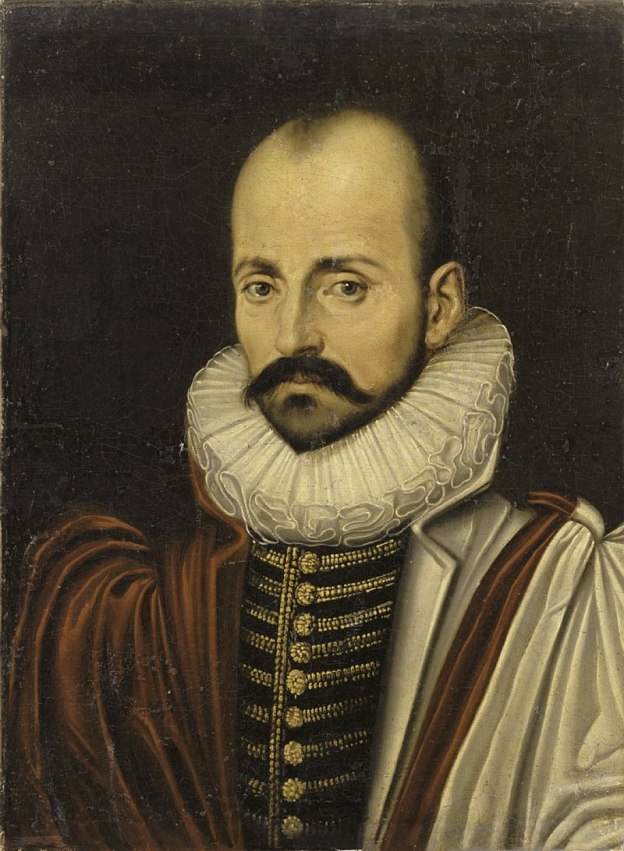
In 1580, the French humanistic philosopher Michel de Montaigne, the first great essayist, published in his first volume of Essays one such document titled “Des cannibales,” or in English “On the Cannibals.” In it, Montaigne spoke about a Tupinambá man from Brazil who he met in Rouen, the great port in Normandy where most of France’s trade with Brazil was based. Montaigne described how the Tupinambá became famous in his time for their cannibalism, rituals which were an intrinsic part of their culture that made them seem alien to his own, and dreadful in their otherworldliness.

Yet Montaigne saw also in the Tupinambá something of a reflection of his own world. 1580 saw France embroiled in the Wars of Religion, which lasted nearly 40 years and cost the French people a great many lives across several generations. Montaigne retired from public life in the civil service in part out of disgust for how the course of French history had gone, disgust that Frenchmen were not just killing fellow Frenchmen but torturing them and bringing ruin onto their families and communities all in the name of religion.

Religion is a tricky thing in human cultures. Most religions today are intended to give their believers a guide to living a good and true life; the greatest commandment which Jesus offers in the Gospels is to “love the Lord, your God, with all your heart, with all your being, with all your strength, and with all your mind, and your neighbor as yourself.” (Luke 10:27, NAB) I’m a practicing Roman Catholic, as a priest once said to me “I’m practicing, I’m still learning how to do it right,” and at the end of the day the best any of us can do is try to be good people, to make something positive and impactful of our lives, even if it is only a small impact on our immediate friends and families. I am religious for many reasons which perhaps someday I will write about here. 

Yet I am also a skeptic, much like Montaigne whose essays reflect this uncertainty about life, humanity, and established norms. Montaigne’s skepticism reflected the empiricism that was born in the following decades of the Scientific Revolution and flowered 150 years later during the earliest stirrings of the Enlightenment as much as it came from the humanism of his own time during the Renaissance. Montaigne challenged his readers, his fellow Frenchmen amid their own bloodletting, to save their cries of barbarity for the Tupinambá lest they also “call that barbarism which is not common to them” at the same time. Montaigne thought it more barbarous to “eat men alive than feed upon them when dead.” The way in which this war is being prosecuted by Hamas, while they hold clear grievances, loses any sense of moral justice when, as Montaigne charged his countrymen, they “mangle by tortures and torments a body full of lively sense, wresting him in pieces.” The horrors of this war then, in all their wanton cruelty, show this twisted version of the human character in its fullest expression.

When I thought more about the war after it began last week, and as I thought of what I could write about it, about the renewal of this long simmering conflict in lands thought to be holy by three of our species’s largest religions, I was drawn to Montaigne’s words again, especially after reading reports from a journalist friend about the killings of infants and children by Hamas still defenseless in the earliest verses of their song.

What worries me is this idea of religious war, fighting “under pretense of piety and religion” in Montaigne’s words, remains in my own Catholicism. I know there are some who adopt the image and iconography of the Crusaders of old to battle against what they see as the wickedness and snares of evil, desecrations against what they hold most dear. Theirs is a faith limited to only a few, a scarce number that will surely only grow within their own families. When one says, to quote Handel’s Messiah “if God be for us, who can be against us?” it is very hard to argue, let alone change the mind of those who see God on their side. That is a faith limited to only the most elect, denying the promises of salvation to “our neighbors and fellow citizens” who instead receive scorn at the least, torture, death, and dismemberment at the worst.

I worry about how large this war will become. It is not like the other sudden conflicts that Israel has found itself in throughout its young history as a modern nation-state. This is a war fought against a terrorist organization with clear backing from another power in the region. Will that power leave the shadows or be attacked directly by Israel to stop the flow of weapons and funds that at time of writing is likely going to Hamas? And if so, how far will the Israeli Defence Force go to defeat Hamas before they lose their own moral standing? This is why I do not care for the idea of just war; taken too far with too much emotion driving one’s judgement a just war can quickly become unjust and the warriors fighting in the defense of their own kind could resort to brutality like their foes “that exceeds them in all kinds of barbarism.” So, in the last week when I’ve been at Mass, when I’ve led my classes at my Catholic school in prayer, my thoughts have been on the victims of this war, the fighters who see their actions as their best and only recourse, and on the faint glimmer of hope that peace will someday return to the Israeli and Palestinian peoples. In an age when terror is as potent a weapon as any other, I hope those able to see an end to this war will find a way to start talking with each other again. Until then, just as Montaigne wrote 443 years ago, so too today we find ourselves “not sorry we note the barbarous horror of such an action, but grieved, that prying so narrowly into their faults, we are so blinded in our own.”


The translation of Montaigne’s Essays used here is based off of John Florio’s 1603 first English edition of the Essayes, or Morall, Politike, and Militaire Discourses of Lord Michell de Montaigne published in London.

The Power of Personality

The Power of Personality Wednesday Blog by Seán Thomas Kane

This week on the Wednesday Blog, a look back 200 years to another time of great political change in the United States. — Click here to support the Wednesday Blog: https://www.patreon.com/sthosdkane

Next week, I will be teaching about the Era of Good Feelings and the elections of the 1820s which saw the rise of the Second Party System in my Eighth Grade United States History classes. The Era of Good Feelings was a period of political transition between the two-party politics of the Early Republic between the Jeffersonian Democratic-Republicans and the Federalists led by Alexander Hamilton and John Adams towards the Democratic Party founded by Andrew Jackson and the Whigs founded by remnant Federalists and anti-Jacksonians. This era is so named because it saw one major political party, the Democratic-Republicans, dominate American politics after the decline of the Federalists after the War of 1812. The President of the late 1810s and early 1820s, James Monroe, and his successor John Quincy Adams sought to ensure party politics would never return, yet those hopes soon proved futile.

I’ve long enjoyed reading about John Quincy Adams, the eldest son of the second President, John Adams. The younger Adams had many qualities that I admire in a public servant: a great intellectual talent, a Ciceronian love of rhetoric, the patience of a great diplomat, and an openness to change for the benefit of new ideas. Adams was an early abolitionist and supporter of women’s suffrage fifty years before the passage of the 13th Amendment and a century before the 19th Amendment became law. Adams even tried to found a national university and a national observatory, as well as get the United States to adopt the metric system. 

Sadly, none of these things happened during his administration, which ended in failure when his old political rival of 1824, General Andrew Jackson, returned with a populist fervor that elevated the Tennessee planter to the Presidency in 1828. This week as I’ve been making my slides for next week, I’m struck by the clarity of choices in the Election of 1828, and how those choices were between an incumbent who ran on policy and a firebrand outsider who ran on personality. It’s a familiar election narrative, yet it provoked a new conclusion about our current political stalemate between 2023’s Democrats and Republicans than what I had considered before.

Whereas the far-right of the Republican Party has a loud and defiant outsider candidate to rally behind to promote their vision of America, no other faction in either the Republican or Democratic Parties have the same kind of clear leadership. The parties are in a moment when few unifying voices can be heard, when there is always something about the current roster of politicians that leaves more voters choosing between “the lesser of two evils” rather than for a candidate they genuinely like.

Now, I’m biased in this monologue that I’m writing this week: I would have gladly voted to reelect John Quincy Adams in 1828, and not just because I don’t care for Andrew Jackson. Adams is one of my favorite presidents for all the reasons I included above; and his status as one of the fathers of the Whig Party, a preeminent predecessor of the modern Republican Party, shows how party philosophy changes with each successive generation. Still, while many in his day and now might discount the idea that John Quincy Adams had a strong political personality, I suggest we look to the politics of the early republic to find a guide out of our current quagmire.

Having a political figure who can unite a broad coalition behind their own banner, someone who is well liked by a majority of the voting public, is a way to move out of a period of uncertainty and nigh political chaos into a restored stability. The recent political history of the United States has elevated some who could fit this model, yet the extreme levels of bile flung by one faction at another leaves any sense of partisan unity, or better yet partisan magnanimity, far from certain. This leader should be able to bring this wide coalition together yet be humble enough to practice servant leadership, and remember they are in their role as President to help and guide the American people.

The great challenge of our time is to find a common purpose where we have long seen what divides us. It is a challenge which I know we can overcome, a hope which I believe we can realize.

Context is Key

This week on the Wednesday Blog, I want to air a pet peeve of mine about stories taken out of context. — Click here to support the Wednesday Blog: https://www.patreon.com/sthosdkane

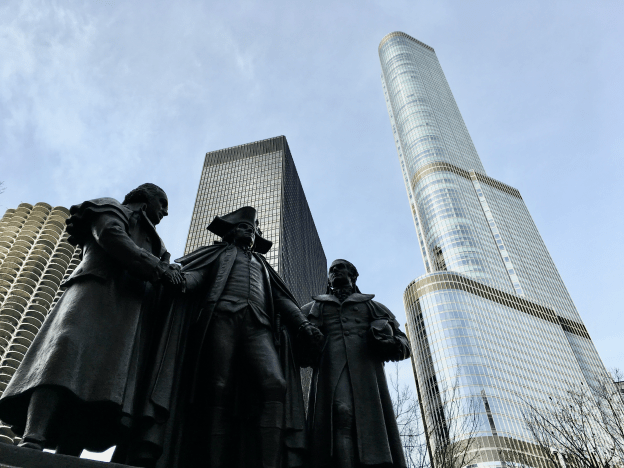
In late December 2017, during one of my family’s regular Christmas trips back to Chicago, my Dad and I were walking along Wacker Drive (upper, not lower) past the Herald Square Monument on the northwest corner of Wabash and Wacker. The monument depicts George Washington with two of the principal financial backers of the Continental Army during the Revolutionary War, Robert Morris and Haym Salomon. I took a picture of the monument with the Trump Tower looming in the background, a pairing of two presidents who in many ways could not be more different in character from one another. My Dad suggested I should learn more about the monument before posting my picture and get the full context of why it’s there in the first place.

As it turns out, the inscription on the monument’s base “The Government of the United States which gives to bigotry no sanction, to persecution no assistance, requires only that they who live under its protection should demean themselves as good citizens in giving it on all occasions their effectual support,” was what made my picture seem so poignant in the first place, and likely had the same effect on many pocket photographers who had walked by in the years since 2016 with their smart phones at the ready to capture the world as they saw it.

That inscription, I learned later that day when we returned to our hotel, was from a letter President Washington sent to the Jewish congregation of the Turo Synagogue in Newport, Rhode Island affirming their religious liberty and emancipation from any separate law code contrary to the custom in most western countries at the time. The context fit the story I was hoping to tell with my picture, yet I was appreciative of the advice to learn more about that monument before making a statement of my own with its picture.

I have many pet peeves, most of which I don’t talk about out of respect for everyone else. I’d rather be known as someone who has positive things to say rather than a complainer, and in those moments when I find myself overly melancholic or acting in a “woe is me” manner, I tend to annoy myself a fair bit. So, it takes a lot for me to want to say anything terribly negative, yet this matter of context is key to something that does bother me. I am annoyed when stories are taken out of the context in which they were created. 

This usually doesn’t happen with novels or movies or TV shows, except now with the deluge of memes using images and moments from these stories to express emotions. I do see this trend played out more in music where the original story of a song might not be as familiar to the people listening to it, yet they sing the words all the same. Context provides so much more color and energy to a story that turns it from a linear narrative with a beginning, middle, and end into a vibrant world crafted by a storyteller that began as a mere idea in their mind.

Pulling a story out of its original context robs the listener of a chance to appreciate the whole depth of the yarn being spun, to see every last fiber of that tapestry being brought together in a great work of art that is inspired by the ideas of its creator. When we break ourselves off from the context of life, we lose a great deal of the beauty of the Cosmos around us. This is why we can sit back and do too little to help our planet as the climate crisis grows ever dire day by day. Last week, several researchers from the University of Copenhagen’s Niels Bohr Institute reported their findings that the Atlantic’s currents could stop moving this century, as soon as 2025, due to rising sea temperatures; earlier in the week the National Weather Service also reported that water temperatures over 100ºF (38ºC) were recorded for the first time off the Florida coast. The currents feed the very life we have evolved to depend on and to be an integral part of. By focusing just on our own story, we have lost the context of the greater world of stories that ours inhabits.

Here in the Midwestern United States the weather tends to move in cycles with some wet years followed by some dry years. In my adult life we’ve seen three wet cycles so far, with heavy flooding on the Missouri River around the years 2011, 2015, and 2019. Since 2019 we’ve been in a drier spell, with some seasonal thunderstorms but not the great floods of years past; yet these last two summers the Midwest has been inundated with flood after flood, striking different regions at different times. Over the 4th of July weekend, there were rainfalls in Chicago that dropped as much as 8.96 inches (22.76 cm) of rain on the western Chicago suburbs of Berwyn and Cicero. A few weeks later on 14 July, Kansas City experienced a storm line that produced minimal tornadoes, what we’re more used to here, but instead a line of storms over 40 miles (64 km) long from north to south which produced winds reaching at least 75 if not 80 mph (120.7–128.7 km/h) winds that brought down trees throughout Kansas City, knocking out power lines and leaving much of the metro in the dark. 

I for one am used to thunderstorms, they’re quite exciting to be frank, yet this one scared me more than any other I’ve watched from the safety of a well-built house. What scared me most was that the windswept rains reminded me of video I’d seen of the Category 1 hurricanes that hit the East Coast every Fall. To me, this proved that the story I’d been hearing my whole life about the weather here in the Midwest was truly changing, that it was not a couple of bad years followed by a return to milder weather. The baking summer heat that followed that Friday afternoon storm, which last week left portions of Kansas City reading heat indices of over 120ºF (49ºC), was the flip side of the same story we heard in December when the extreme Arctic cold winds that swept down from Canada and locked much of the continent in an ice box settled on Kansas City. That weekend we were treating our garage like an air lock, closing the interior house door and making sure everyone who was going outside had all their skin covered before opening the garage door to the -30ºF (–34ºC) blistering wind to go shovel out our driveway of snow and lay down kitty litter (our preferred road salt) to try and break up some of the ice that had formed.

Without the full context, we cannot see the future we are creating for all life on Earth. Visitors to my favorite place on Earth, Chicago’s Field Museum, will likely go see their fossil halls, an exhibit now called Evolving Planet, in order to see the famed dinosaurs––and especially SUE the Tyrannosaurus Rex––who live in those galleries. I love going in there for many reasons, which if I haven’t written about before on the Wednesday Blog, I’ll be sure to write about the next time I visit. Yet, the Evolving Planet exhibit ends with a counter showing the number of species that have on average gone extinct over the course of any given day. The later in the day you leave that exhibit, the higher the number is. In all our other problems, and especially in all our distractions, we forget that we need all the other life that evolved on this planet with us. We forget that their stories are important to understanding our own.I know a great deal more about the history of the Turo Synagogue after stumbling into Sam Aronow’s Jewish History series on YouTube just before Christmas in 2021. Learning other peoples’ histories allows us to have a better appreciation for the entire tapestry of humanity. For me, it presented a greater sense of respect in President Washington’s words engraved in the base of the Herald Square Monument at the corner of Wacker and Wabash. That context only strengthens the story of our national experiment at citizen-led representative government, now nearing its 250th anniversary.

The Potential of America

The Potential of America Wednesday Blog by Seán Thomas Kane

This week, the Wednesday Blog is coming out a day early in honor of our Independence Day. — Click here to support the Wednesday Blog: https://www.patreon.com/sthosdkane

I am certainly not an expert on the American Revolution, though I am a recipient of its fruits, my life one small result of its effects. The revolution echoed a time in our past when people of all classes in thirteen of the British colonies along the East Coast took up arms to defend what they saw as their inalienable rights against the forces of an overbearing imperial power. The union that came out of the revolutionary generation between those colonies, then independent states, and now federally united in one country is a testament to the marriage of idealism and realism in politics which proclaims that all of us can participate in our government, and moreover have a right and a duty to do so.

Our history has seen this country’s fortunes ebb and flow between prosperity and adversity. There are times when the United States has seen its great successes echo optimism and others when our internal divisions, sown from even before the Revolution, find division among us yet again. In the last twenty years we’ve seen ourselves into a deep abyss in which our factions and parties have driven us further apart from one another than we have seen in a good while. Bad news sells far better than good news. Many of our stories, both ancient and modern, have told of how fear is a quick and easy source of power and strength. Yet at the end that fear will only last for so long, and those who sought to use it will be left powerless and afraid.

I’m saddened this Fourth of July to look at our country and see just how forlorn our dreams have become amid the churning fury of all our rage. There are many victims in our country, victims whose lives over generations were torn apart by the greed, vice, and rage of others who sought power over them. I’m saddened to see how the symbols of all the hope and aspiration that this country represents are being used today by those who seek to exclude many of us from this country’s full bounty.

America truly is a country of near limitless possibility. We have so much potential as a country made up of an infinite diversity of people in infinite measures whose common roots only stretch back a few generations. Lin Manuel Miranda put it well in his musical Hamilton when he called this country a “great unfinished symphony” for there is so much about our culture that remains unwritten, in our future compared to other older societies. We certainly share a common heritage with those older societies, yet by our own geographic isolation and breadth we Americans have forged our own path divergent from that heritage.

I believe that so many of the problems we face today are born out of deep mistrust leading us to refuse to talk with one another, let alone listen to one another. Amid all the troubles of the present moment a bright future awaits us for my generation and Generation Z behind us are proving to be more active in our civic life, more willing to go out and vote, more concerned for the future than prior generations have as a whole seemed to be. There are proposals out there to reform society in order to fix many of the great problems that continue to plague us, reforms that probably could work, if only they were considered by those in power.So, on this Independence Day, I invite you to not only look to the past, to the Revolution and the Founding Fathers, but to look to the future as well, to all that we may yet accomplish in this young century.

Draft at the Station

Last Friday, I took Amtrak's Missouri River Runner from Independence to Kansas City's Union Station to see how the NFL Draft was affecting public transit in & around the Station. Click here to support the Wednesday Blog: https://www.patreon.com/sthosdkane

The following post is a transcript of the audio from the podcast episode this week. I strongly advise you listen to this one rather than just reading it. Thank you, and enjoy!

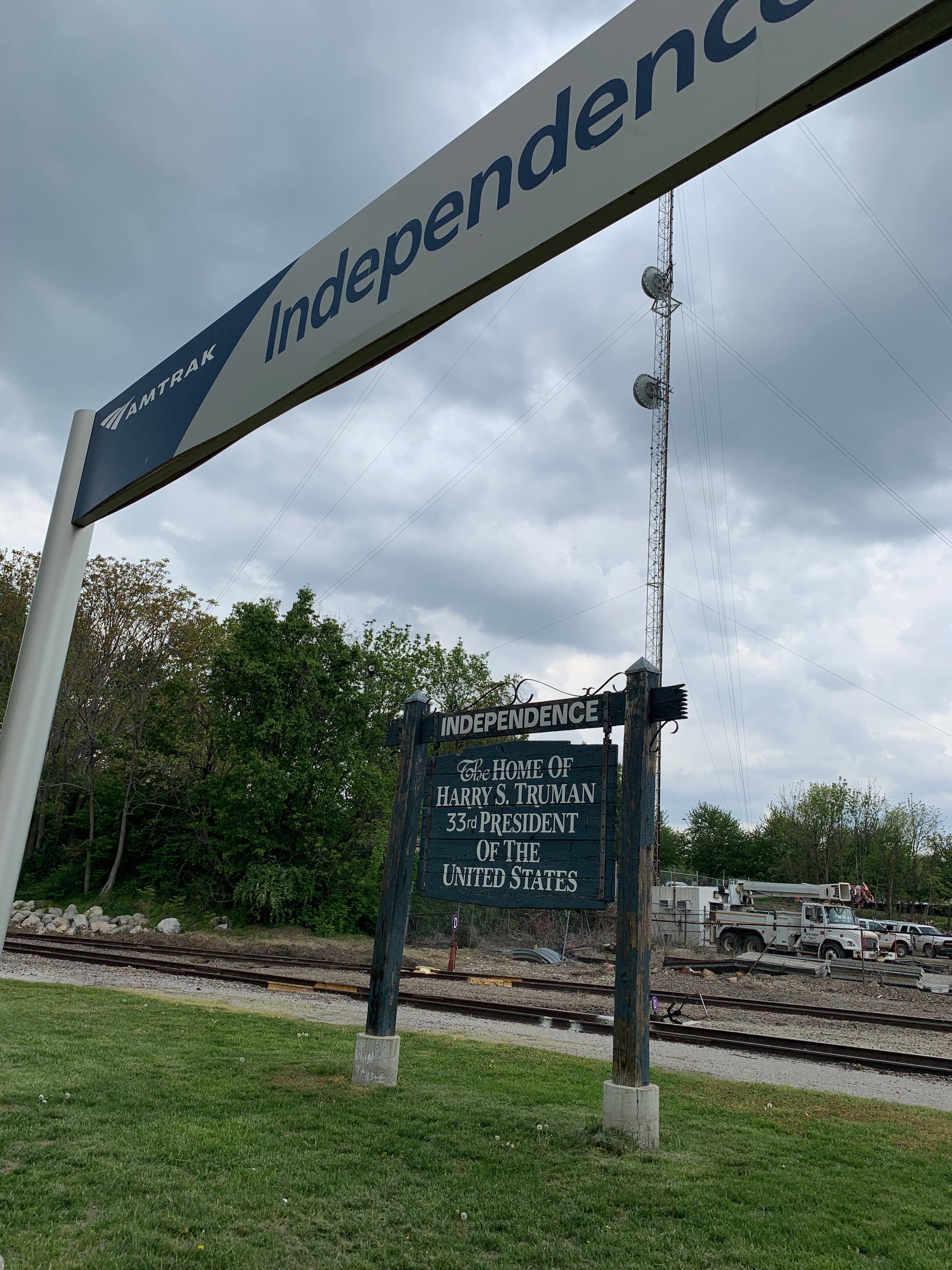
Independence, Missouri: hometown of President Truman.

“I’m at Independence Station, the only person here, the station house is locked, looks like it’s been abandoned for a while. I’m about 50 minutes early for my train, nothing here, no seats. We’ll see how this adventure goes!”

That was on Friday, 28 April 2023 just after 12:30 pm on a cloudy but calm day in Independence, Missouri, one of the eastern suburbs of Kansas City. I got a ride out there so I could try taking Amtrak’s Missouri River Runner service into Kansas City’s Union Station located just south of Downtown. Normally, arriving at Union Station is a moment of awe and wonder at the grandeur of that Beaux Arts station, built in 1914, one of the great reminders of the time when trains were the fastest and most comfortable way to cross North America. Last weekend though Union Station hosted the NFL Draft, a big event where all 32 professional teams in the top American Football league on the planet gather to pick who among the top prospects from the college teams across the U.S., they want to offer contracts to and invite to start their professional careers with those teams. That about sums it up. I’ve known about the Draft for most of my life and have so far spent the better part of the past thirty years not caring about it.

This year though is different, the Draft has landed squarely in the center of my city. Union Station has been a stage for many important moments in my life, from my first volunteer job at the Kansas City Irish Center back in 2006 to the place where I began several trips back to my original hometown of Chicago onboard Amtrak’s Southwest Chief to birthday lunches and dinners at Pierpont’s and Harvey’s and even a date. So, for me it feels personal to have that most public of spaces be taken over for the biggest, richest, pro sports league in the country for the whole weekend.

“It’s now begun to rain. Some church bells ringing. According to the Amtrak app the train is about 10 minutes out from Lee’s Summit, which is about 20 minutes down the line from here further to the southeast. Here I am, hiding underneath the overhang of the roof of this station that’s still deserted.”

An empty platform under a gray sky.

As I waited a long Union Pacific freight train passed by the station on the further of the two tracks in front of the platforms. [train recording] It was carrying carriage upon carriage of double-stacked cargo containers that had come from one of the many ocean ports to the south and east of Kansas City, marked with the logos of a number of different cargo shipping companies including the Taiwanese Evergreen Group, whose container ship got stuck in the Suez Canal last year. At this point I was joined by a Salvadorean trainspotter who came down to the platform to take some videos of the train. We talked for a few minutes, or rather spluttered back and forth not speaking each other’s languages. I really need to properly learn Spanish one of these days.

“I happened to just meet a rather friendly Salvadorean gentleman who’s here for a conference. Charming. Oh, my Spanish is so terrible, and using French didn’t help. Train’s on time now, should be here in about eight minutes.”

Those eight minutes turned into 10 minutes as the River Runner arrived at 13:30 rather than 13:26, which by my book is alright when it comes to Amtrak delays.

[Sound of the Missouri River Runner arriving in Independence]

The Missouri River Runner approaches!

I let a handful of passengers disembark before telling the conductor my name, which he recognized from his passenger list, and boarded. The best thing about Amtrak’s service is even in coach on these state-run smaller services the seats really are quite comfortable. Plus, if you just want something to eat to keep you going, you’ll be able to find something in the café car. I was so thankful to buy a bag of really salty chips in there, my lunch for the day. There were probably about 30 other people on the train, most of them traveling into Kansas City from points east in Missouri, but some were on board going to the Draft.

On board the River Runner in coach class.

[Missouri River Runner ambient noise]

This meant that once we arrived at Union Station 20 minutes later, the passengers who disembarked were a good mix of excited at seeing the station taken over by the NFL and frustrated that the station was closed off for its original use, to welcome rail travelers into Kansas City.

The Amtrak platform at Union Station was occupied by a force of about 10 Homeland Security officers, who stared at us emotionless as we disembarked. We were directed by the Amtrak conductors to walk down the platform towards its western end and then to use a gate in the fence separating the railyard from the parking lot beyond. In that parking lot were more Homeland Security officers, stern faced and resolute. They didn’t need to tell anyone not to cross them or try to enter the station, it was pretty clear that wouldn’t be received lightly. Despite the emails that Amtrak sent out every so often in the days before the trip about how the arrival procedure would go there was still some confusion among the passengers as to where we were being taken. I tried to help, having studied the plans as thoroughly as I could to make sure I did what I needed for this trip to happen without a hitch.

Arriving at Union Station walking from the platform to the shuttle trolley party bus

“Well, it’s going to 25th St, it’s south of here, it’s going down here, past Broadway, and to the left.”

Amtrak Police officers then guided us towards a set of shuttles, in fact trolley party buses, that would take us to the drop off point at 25th and Jefferson, one block west of the IRS building’s Broadway entrance.

At this point, I should say that this whole idea began a few months earlier. I thought about going to the Chiefs’ Super Bowl Rally in February by train, catching the River Runner either in Lee’s Summit or Independence, again just to see what would happen when it got to Union Station, but on that cold, windy February Wednesday I forgot all about it and took the Main Street Max bus downtown with my Dad. On our return trip we got stuck in Midtown for a good two hours waiting for a southbound Main Street bus to pass us. A part of the plan, and the risk, of this Friday’s adventure would be seeing whether the Ride KC city buses would be running on schedule & on route or even running at all.

This time, I’d done more of my homework, so I knew if the buses weren’t running on time or at all, which in my experience as a former bus commuter in Kansas City is sometimes possible, I could be home in around 2 hours on foot. Sure, it’s a 6 mile walk south from 25th Street to my home in Brookside, but I had my best gym shoes on and lots of water available if needed.

Thankfully, I only had to wait for about 10 minutes before a southbound Main Street Max bus arrived at the stop on Broadway at 25th Street. I didn’t get any audio of this, my goal was to get on board and not be left behind or somehow make what was turning out to be the best possible situation into one that I’d come to regret.

I boarded my bus at 14:15 and was at my local stop without any trouble or problems. All that remained was a delightful walk home through the tree-lined streets of Brookside listening to the birdsong and fountains in my neighbors’ front yards.

[Audio from my walk home from the bus]

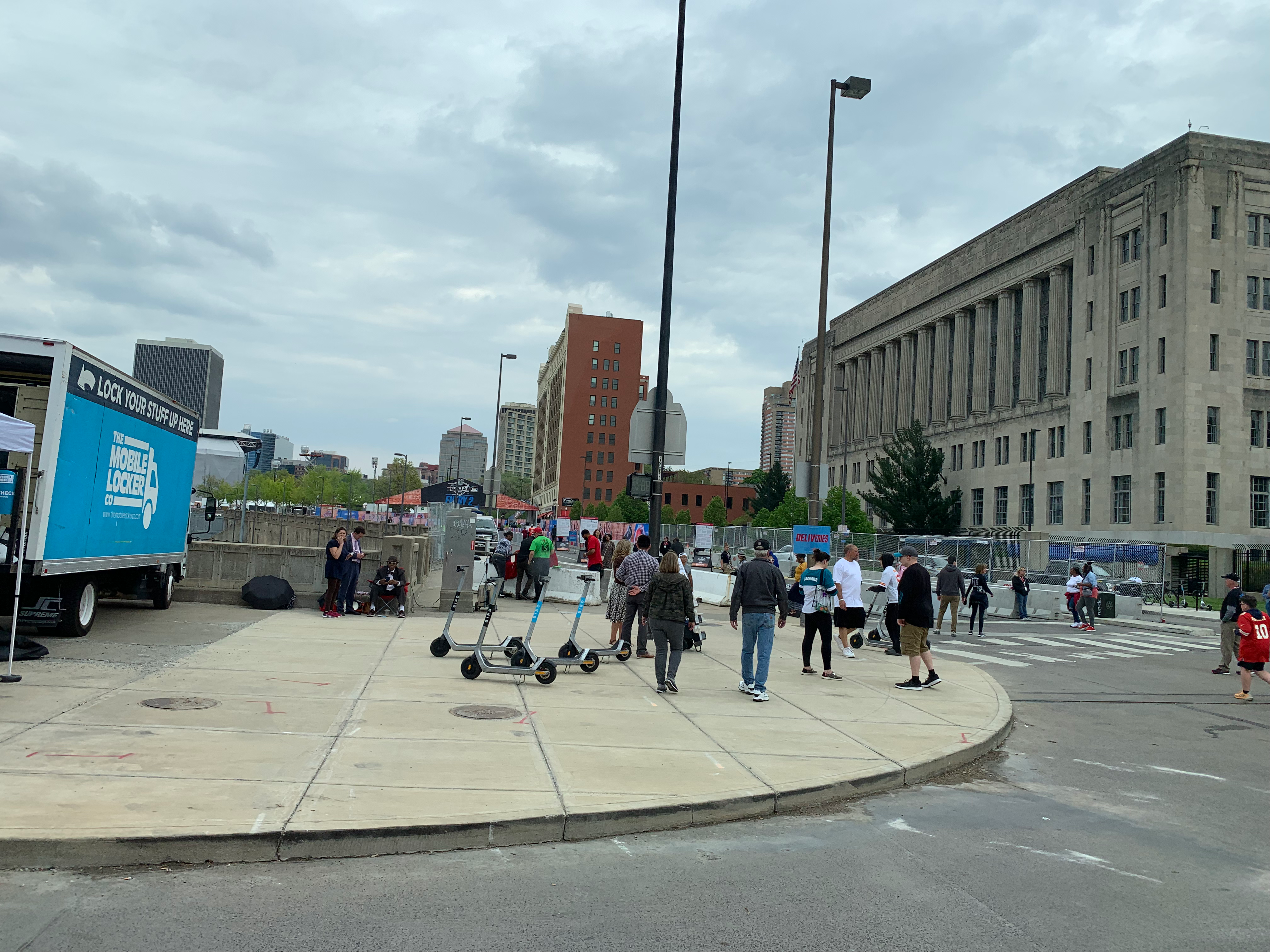
So, as it turned out, things worked out. One big difference I noticed between today and the Super Bowl rally a few months ago was the crowd control on Pershing Road and around Union Station all together was much stronger. I guess I could put it down to the NFL paying for stricter security than the City of Kansas City did, plus I read a story earlier this week that KCPD still owes the 350 officers who worked and managed the crowds during the Super Bowl Parade & Rally their overtime pay 73 days later. Not having thousands of people, myself included, walking down the middle of Pershing Road and Broadway to try to get out of that crowd that some have numbered up to 1 million people at the Super Bowl Rally really helped keep traffic flowing, and keep the public transportation network moving.

Far less chaotic on Pershing Rd. during the NFL Draft than it was during the 2023 Chiefs Super Bowl Rally.

I’m still frustrated, as were many of my fellow Amtrak passengers, that the Union Station organization sees itself less as a transportation hub, which the station was built for, and more as a big center for the city and a tourist attraction. I like all the things that Union Station has to offer, yet I think it would be better for our city if we increased our focus on the rail services that the station was built for and improved those services to be more frequent, and more useful for everyone in this metro. I’m glad that I chose to take a train into the station rather than try to get a train out of the station during the NFL Draft, for while I was able to disembark on the platform and board my city bus to go home all in the course of 20 minutes, the departing passengers were told to be at the platform 2 hours before their trains left, and were given trailers to wait in or else they’d have to sit outside in folding chairs with few amenities to speak of. It’s a solution, but it’s not great.

So, I’d consider Friday’s adventure to be a success. Truly, the only part of it that didn’t quite go to plan was my decision to leave home when I did, it took me far less time to be driven to Independence Station than I thought it would. Otherwise, I’m surprised to say it all worked. Would I do it again? Sure.

Some celebratory chocolate mudslide ice cream from the Tillamook Dairy in Oregon after the adventure was at an end.

Ab urbe condita

This coming Friday will mark the 2,776th anniversary of the traditional date for the founding of the City of Rome. Click here to support the Wednesday Blog: https://www.patreon.com/sthosdkane

I find it interesting as an adult that my first understanding of my own religion, explained to me by my Mom when I was little, was that “we are Roman Catholics.” Even at that point, when I must’ve been no more than five years old, I knew what Rome was, I can remember my thoughts from that moment as clear as day: I pictured in my mind a map of the Italian peninsula descending from the Alps down into the Mediterranean. Whether that map was my memory of the globe in my grandparents’ home next to their collection of the 1979 edition of the World Book Encyclopedia, or of some other map I had seen I can’t say for sure. Rome, with all its antiquity, has had a hold over my imagination just as it has over the collective imaginations of those of us in the European and American orbits since its fall.

Several years later, after we’d moved to Kansas City, and I continued my schooling at St. Patrick’s in Kansas City, Kansas, I checked a book on Ancient Rome out of the school library. As I remember it, it was one of the few history books in color, most of them had been donated when the school first opened in 1949 and were by modern standards rather outdated. Still, I had this book in my bag that had a wonderful colored picture of the greatest extent of the Roman Empire in the reign of Hadrian during the 2nd century CE. I had looked over it several times already before this particular memory took place, but when one afternoon I was denied entry into an after school club, I think a geography bee club perhaps, I found myself sitting on the bench in front of the school’s office, reading that book.

My ancestors, the Irish Gaels, were never conquered by Rome. There were likely Roman merchants visiting the Leinster coast during the imperial period, after all the western boundaries of the Roman Empire were across the Irish Sea in Wales, but Roman influence didn’t fully arrive until after the Western Roman Empire had already collapsed in the form of missionaries like St. Patrick who introduced Christianity, the Latin alphabet & language, and fostered a new sense of European connectivity for my people that has never left. For me conversations of heritage are always complicated. Yes, I am an Irish American with roots going deep into that island’s past beyond what’s considered historical, but so much of the culture I’ve lived in and embraced comes from Europe’s classical past: from Greece & Rome, that I feel a strong bond if not in blood, then in civilization to those continental cultures.

When I teach Western Civilization or European History I, or whatever you want to call the intro class that covers European history from Bronze Age Greece to the Reformation, I make a point of trying to define civilization as being inherently tied to the concept of the city. Mapping civilizations is like charting the stars in the sky, with each city glowing bright like those lights in the heavens, at the heart of their own civilizations. In antiquity this ideal makes sense, for the city-state was the most common type of polity. Rome was a city-state governed by its own balance between an aristocratic Senate and an Assembly representing the rest of the People that in turn ruled over an ever growing empire of subjected peoples until at last it became too much for the standing political order in Rome to control and 150 years of civil wars lead to a Principate, rule by the Princeps, the First Citizen, in this case Augustus Caesar and his heirs and successors who we today know as the Emperors.

Today, I look at Roman history and see several ideals that every generation since its conception has espoused. On the one hand there’s the model of the Caesar as the best sort of leader. The Caesars who ruled Rome from Augustus’s elevation in 31 BCE to Constantine XI Paleologos’s death at the Fall of Constantinople in 1453 CE have their heirs and imitators in all the Kaisers, Tsars, and Emperors to rule in Europe and its erstwhile American colonies since, as well as in kings like Louis XIV, le roi soleil, who like Augustus fashioned himself the Sun at the center of all his domain. Yet on the other hand I see the republican ideal of citizen government espoused before the Principate, lauded by men like Cicero and the Gracchi yet never fully realized by anyone then or since. 

I would rather emulate that republican ideal of citizenship, refashioned in a modern sense with the blending of republicanism with democracy. The founders of the United States saw in their new republic a revival of the best of Rome, emulating their ancient heroes in law, government, and architecture. One needs only wander around the National Mall to find all the classical buildings one’s heart could ever desire to see how our new Rome on the banks of the Potomac has come to be. Yet in all honesty, as much as Washington fits this idealized model of a republican Rome reborn, with even the great headquarters of our Department of Defense across the Potomac beyond the confines of the capital in the Pentagon, not unlike Rome’s ancient Campus Martius, experience has taught me that the greatest modern inheritor of the symbols of the Roman Republic in its art & architecture can be found in Paris, a city whose grand boulevards and monumental architecture built during and after the Revolution of 1789 are alive with the symbols and spirit of Roman republicanism. This is in part thanks to one of the great Romanophiles of the last 250 years, Napoléon Bonaparte, whose reign as First Consul and later Emperor of the French sought to create a new Rome in his own day, albeit in the transitional model of Julius Caesar whose reign at least nominally sought to preserve the Republic yet established the foundations for the Empire that Augustus, his adoptive son, created.Today the meaning of the republic has changed so dramatically that I doubt Cicero or even the Gracchi would approve; and as much as I look up to so many of those old Roman republicans as people who I appreciate and enjoy reading, I firmly believe we’re better off without all the trappings of what was inherently a limited and oligarchical Roman Republic. I would rather live in a modern democratic republic, one where social welfare, tradition, and the markets were kept in balance. So, on this the 2,776th anniversary of the founding of the City of Rome, I’m worried to see the reactionaries among us pulling us backward toward that oligarchy that initially established our own Republic here on the far side of the Atlantic almost 240 years ago. The Roman Republic fell because its leaders misdiagnosed the sickness and killed the patient, ignoring the needs of the people for their own power & wealth. Rome continues to provide us lessons today. We should listen to them.