Category Archives: Catholicism

On Conversion

This week, I spoke with a friend who converted to Catholicism as an adult about her conversion and how she relates to the Catholic Church as a whole.—Click here to support the Wednesday Blog: https://www.patreon.com/sthosdkane


This week, I spoke with a friend who converted to Catholicism as an adult about her conversion and how she relates to the Catholic Church as a whole.


The Catholic Church in 2025 stands at a crossroads in the shadow of our late Pope Francis when the world at large has fallen into so many new wars, conflicts, and when fearmongers are the loudest voices in so many countries and governments. It was striking then when Pope Leo XIV began his Urbi et Orbi address, his first public address as pontiff, last Thursday with the words “peace be with you.” To achieve that peace, one needs to allow one’s heart and soul to open to the possibility of peace and of dialogue with both our innermost selves and the world around us. Faith gives an avenue for this dialogue which has provided a moral foundation for generations. Biblical scholar Richard Elliott Friedman made the case in his book The Exodus: How It Happened and Why It Matters that the faith of Moses and the Hebrews evoked in Exodus was the first faith recorded which preached love for neighbor and love for oneself. It was the first time in human history that a religion sought to elevate humanity and dignify us as children of God made in the Image of God.
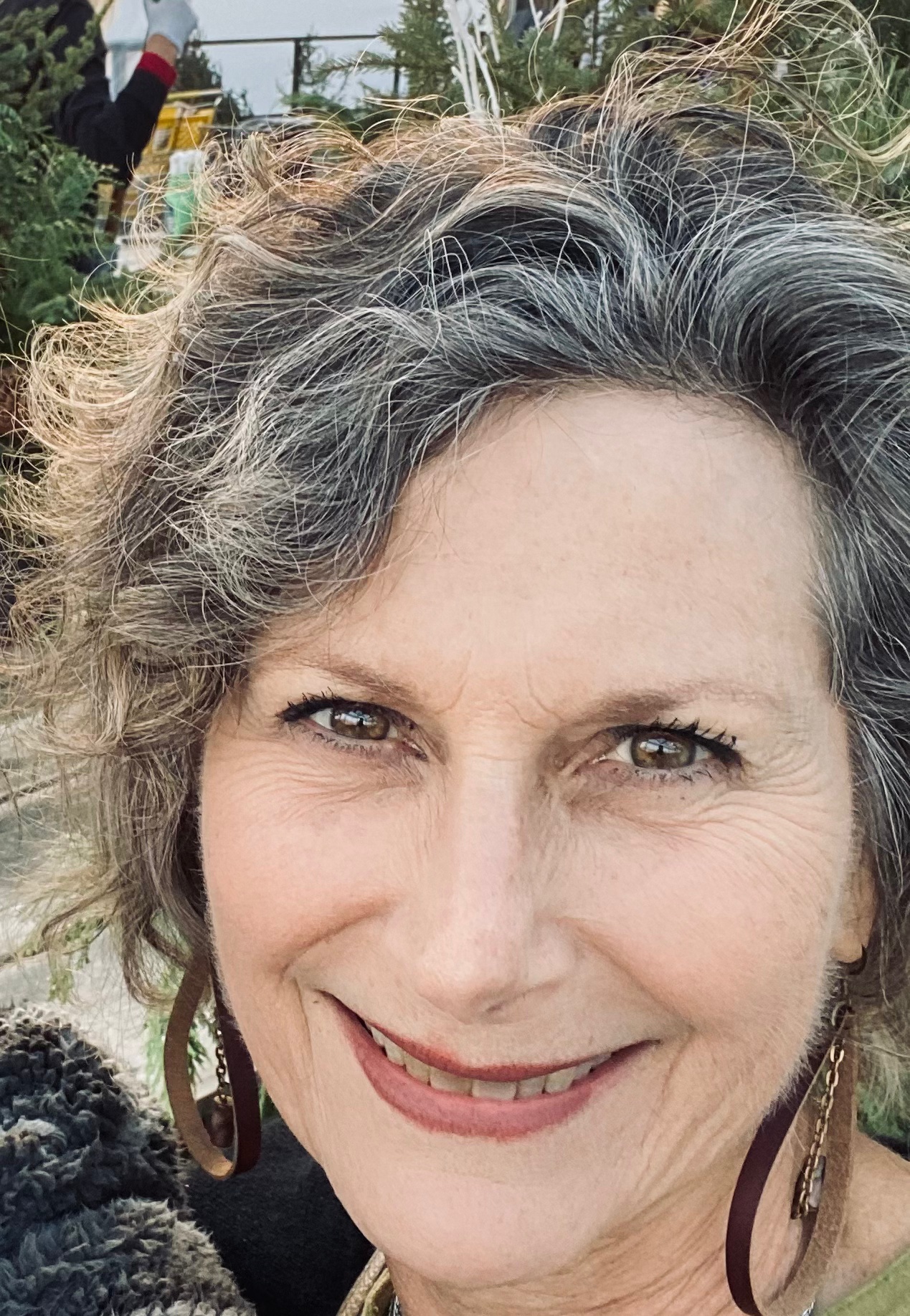
Kim Meyer

I’ve long considered this topic of conversion; in fact, I’ve often noticed how different the perceptions of our shared religion are between cradle Catholics like myself and converts to the Church. My own Catholicism is built on fifteen centuries of believers in my family going back to my distant early medieval Irish ancestors who in the fifth century surely noticed when St. Patrick made his pilgrimages up the holy mountain on the southern shore of Clew Bay, a mountain that towers over the townlands where my ancestors lived for thousands of years that now bears the saint’s name as Croagh Patrick. I asked my friend, Dr. Kim Meyer, if she could tell me more about her perceptions of her faith and our shared religion. A convert to Catholicism who grew up in a secular suburban Kansas City family with Lutheran and Methodist roots, Kim told me about how she found her faith through the most horrific experience of her life as a journalism student at Kansas State University reporting on the activities of a cult in Abeline, Kansas in 1977. Kim described it as “a really dark, dark time and my editors had people in the room with me when I was editing it because I was terrified. It was several months of terror.” After one particularly intense night of terror during her investigations in Abeline when she felt she “was terrified for my soul and I started praying to God, and my Mom had given me a penny of the 23rd Psalm on it, but I was so scared that I couldn’t remember the Lord’s Prayer so I kept rubbing this penny saying, ‘God, if you exist, save me until morning.’ It was really a horrible, horrible, terrifying experience. The next morning, I was still praying and the sun came up, and I realized that the sense of evil was no longer present.” Kim described how she went to several local religious leaders to tell them her story, including the cult leaders, but the only one who listened was the local Catholic priest at St. Andrew’s Parish in Abeline, Monsignor Alfred Wasinger.

This speaks to something that I’ve known, and that has led to little conversions of my own often from one plan or ambition to another. We are drawn to people who appreciate our humanity and who listen to us as this priest listened to Kim at the darkest moment in her life. That’s something that Pope Leo was famous for before his papacy; in all the reports of his life he’s often referred to as a good listener. This draw to a faith that listens to its people is what drew Kim to the Jesuits. More than just thinking of herself as a convert, Kim said she doesn’t “think of myself as a Catholic first. There’s still so much tradition and so much politicking around Catholicism that I find deeply offensive, but the Jesuits’ critical thinking, open spirit, missionary focus, all of that, and it’s the same theology for both, and it’s all about how we practice, and I’m not into the way how some sects of Catholicism practice.” For her, the Jesuits are “really trying to walk the Way of Jesus. It’s literally the Way of Jesus. Some people want to walk the way of Paul or the way of the most recent Pope, but they forget it’s really all about Jesus.” 

Converts like Kim have more of an opportunity to find “the beauty of questioning and the opportunity to discover their faith.” This questioning has marked my faith for most of my life, yet even more so in my adult years as I moved on from my Jesuit undergraduate university and onto graduate and doctoral programs outside of the Church. Whereas my faith is so deeply rooted in millennia old traditions and inheritances embodied in the last century by the various neighborhood parishes that my family called home in Chicago and Kansas City, Kim’s faith seems to fly above that tradition, seeking a closer connection with God through the mysteries of Catholicism and our belief that God opens us to a wider world of possibilities. In Kim’s words, “once I came to believe that God loves me and God is in every person, and I really believed in it that the world wasn’t really the same.” It is notable that of those old neighborhood parish churches, Kim and my parish, St. Francis Xavier in Kansas City is the only one left open. Unlike the others it has adapted with the changing demographics of its home neighborhood, which a few generations ago was largely Irish American, and now caters to Kansas City Catholics seeking Ignatian spirituality. St. Francis was one of the fastest growing parishes in Kansas City during the pandemic, in large part because of its Jesuit affiliation. However, due to a variety of factors the Jesuits left the parish at the end of July 2024 and transferred its leadership to the Diocese of Kansas City-St. Joseph, leading to an uncertain moment for a parish that stands out in this city for its openness and Ignatian spirituality. Kim noted that “Last year we didn’t know what the transition away from being Jesuit would look like, and our community is just as Ignatian as it has ever been.”

Because of this, Kim said she feels more closely connected to the Jesuits than to the Church as a whole. I’ve been struck in the two years since I met Kim how much her outward approach to others reflects this deep well of her faith. I felt in our conversation that we could relate in that depth, though I do not outwardly project my own beliefs in the same way she does, preferring to take a rational approach to life. Yet that rationality has its limits, as I’ve written here in the Wednesday Blog before. Faith and a conversion to accepting the possibility of the improbable is necessary to be open to new and unknown things both in the furthest fringes of our knowledge and at home in our understandings of ourselves. Like anything, there is a blind spot closest to home and that self-reflection and introspection is necessary to live a full and enriching life.

With the election of Pope Leo, the Cardinals embraced this period of self-reflection for the Church in full. They chose a pope who embraced synodality in his Urbi et Orbi address and who said he would continue the efforts of Pope Francis all while seeking to build bridges between the increasingly disparate factions and camps in the Church. The Pope’s humanity shows in his imperfections, in his poor history of dealing with the sex abuse scandals, something familiar to many of us in our own bishops and local leadership. Kim’s approach to life, her mentality born from her Catholic faith has led her to think “’what would Jesus do?’ and that means looking at each person and trying to see God inside of them, and that’s each person.” This stands in contrast to “‘what is the right thing,’ which has less clarity and less consistency in the secular world. Because if you think right vs. not right, where you draw that line is a lot more subjective in the secular world.” The greatest way toward conversion, she said, is prayer. “Pray with others, go find somebody you trust as a spiritual mentor. Stretch yourself and pray. Find ways that you praise that you never imagined.” Both of us pray the Ignatian Examen in our own ways, as Kim said “Prayer changes over time. What I do in my prayer time changes from one season to the next.”Just as May brought us a new Pope and each passing day new things to worry about in politics, the economy, and in ordinary life, so too this conversation told me that the place where one’s spirit is resting will change with time. It may float along in the river of our life, following the currents where they take it, yet it will be there for an opportunity to pray to announce itself. In the wider world we hear messages of people seeking connection with something greater than themselves; it’s a part of our social nature. We do these things to find connection with other people and to grow in those connections as we were born to do. These are all conversions, all transformations of ourselves which can reawaken something dormant that will lead to us living fuller and richer lives. A conversion can reawaken the self to their spirit and spiritual need for connection to something greater than themselves through God as love.

On Names

Season 4 Finale: This week, to celebrate Christmas I’ve decided to write a bit about naming conventions that I’ve come across, and to explain why I use my full name professionally. Nollaig shona daoibh | Merry Christmas! — Click Here to Support the Wednesday Blog: https://www.patreon.com/sthosdkane


Season 4 Finale: This week, to celebrate Christmas I’ve decided to write a bit about naming conventions that I’ve come across, and to explain why I use my full name professionally.


In American culture middle names have a bad reputation. They’re most famously used in our childhoods to scold us, and in adulthood they most often appear in legal matters. A writer naming non-descript American characters John Booth or Lee Oswald might get away with it but include their middle names Wilkes and Harvey and you have two of the most notorious assassins in American history. Most accused or convicted murderers in our legal system tend to be known in the press by their full names: first, middle, and last. There’s an odd cadence to it when these people are identified by the police or the courts. It’s one of the more common times when middle names get used.

I go by my full name professionally. On my website, in my email signature, and in every conference program and academic publication that I’ll ever appear in I’m identified as Seán Thomas Kane. Trust me, I didn’t intend to draw any connection between myself & the men mentioned in the last paragraph who killed two Presidents who I’ve always looked up to. In my case, the use of my middle name has a different sort of significance. In my extended family I often get called Seán T., in part because I have many relatives who are named Thomas, one of whom goes by T. among the family. Whether intentional or not, my parents gave me one of the most traditional Irish names they could have. Irish names are traditionally patronymic, meaning the person is so-and-so, son or daughter of so-and-so, descendant, son, or daughter of so-and-so. Those last names (or surnames if you aren’t American) that begin with O’ refer to families who are descended from a specific person who lived centuries ago. The ones that begin with Mc however are Anglicizations of the Irish word mac, meaning “son” of a specific person who lived centuries ago. My father’s name is Thomas, so in Irish my name is Seán mac Tomás, or Seán, son of Thomas. Kane is an Anglicization, or better an English phonetic rendering of the Irish name Ó Catháin, pronounced two different ways depending on where you’re from in Ireland (for those reading this, listen to the podcast to hear those two pronunciations.) Cathán was a more common Irish given name in the Early Middle Ages and derives from the word cath meaning battle.

This was in the back of my mind when I decided to start going by my full name professionally. It was 9 March 2016 and I had a few hours without much to do while waiting for a car to pick me up at Lyon-Saint-Exupéry Airport on my way to the eastern French city of Besançon, the capital of the Franche-Comté region and a city which Caesar mentioned in his book about the Gallic Wars (De Bello Gallico 1.38). That cold and rainy Wednesday in March there was a national railway strike in France and I ended up booking a back seat of a Renault Clio driven by a Frenchwoman who spoke little English alongside two other Frenchwomen who again spoke little English from Saint-Exupéry Airport outside of Lyon to Besançon, a good 4 hour drive. Right before they arrived though, I was on Facebook posting an update about my trip and thinking about how I wasn’t entirely sold on sticking with Seán Kane as my name professionally, after all when you search Seán Kane on Google you get a fair handful of results. There on Facebook I noticed that my friend Luis Eduardo Martinez, a fellow graduate student in International Relations and Democratic Politics at the University of Westminster, and a gentleman who I consider a good friend to this day, used his middle name professionally. I felt inspired and changed my name on my Facebook profile from Seán Kane to Seán Thomas Kane then and there standing in the airport parking lot.

Where the last paragraph took place.

This proved to be even more advantageous when the Renault carrying the three Frenchwomen arrived as the driver stepped out and proved that the way Seán is spelled makes little sense to a monolingual French speaker. I remembered when I started studying French at Rockhurst University and we chose French names to use in class how I immediately was discontented with being called Jean alone, as I’d rather be called Jean-Thomas because that’s essentially a French translation of my name coming from Irish. So, I suggested that she call me “Seán-Thomas” which was heard as “Jean-Thomas.” Et voilà, that’s how it all got started. For the record: the Irish name Seán is in fact just an Irish spelling of the twelfth century Norman French pronunciation of that French name Jean, which is also the source of the English name John. You can hear the connections better in an English accent than in my own American one where the oh sound in John has shifted closer further forward in the mouth.

This wasn’t the first time I’d changed my name on my Facebook profile. For a while in high school, I went by my Irish name, Seán Ó Catháin, and that was the name on my early membership cards with the Ancient Order of Hibernians. Yet as much as I was inspired by the Gaelic revival and wanted to do my part to restore our ancestral language, I found that it was impractical to use in America and that deep down I do identify more with Kane than Ó Catháin because that’s the name my grandparents, my dad, and most of my paternal relatives use. Kane itself began as a misspelling by the U.S. Army draft sergeant processing my great-grandfather Thomas Keane when his number was drawn in 1918. He enlisted and served as an artilleryman in France and eventually became an American citizen as Thomas Kane because the sergeant told him if he wanted that first e added back into Keane on his papers he would have to go back to the back of the line and start the process over again. 

So, to answer a question I often get in Kansas City: no, I’m not related to any other Kanes in this city except my Dad, and in fact outside of my Dad and his brother’s family all of my living paternal relatives who share our family name on either side of the Atlantic spell it Keane. I suppose I could change mine back to that one, I suspect my granddad’s cousin and longtime Wednesday Blog reader Sr. Mary Jo Keane would’ve approved of that, yet at this point the name dispute feels moot especially considering the Keane spelling only goes back another generation or two to about the 1850s before which in the official British government records written in English my great-grandfather’s great-grandfather’s name was written as Thady Caine. In Irish his name would’ve been Tádhg Ó Catháin, and we know he spoke Irish as his first language. So, what was his name? I’m honestly not sure.

I like how different naming conventions reflect different cultures in their own ways. Our Irish patronymic system is really more Gaelic than Irish, after all it’s the same system that’s used by our Scottish Gaelic speaking cousins and it mirrors a very similar system used in Welsh. In fact, my Welsh ancestors’ family name was Thomas, which derives from the Welsh ap Tomos. Fitting, eh?

When I teach about the Vikings I like to bring up the Norse patronymic system too and explain that Leif Erikson (as we call him in English) was actually Leifr Eiríksson in Old Norse, and that following this tradition as it’s today practiced in Iceland were I born there, or should I someday immigrate to that island republic I’d probably start going by an Icelandic version of my name: Jón Tómasson, dropping the Ó Catháin/Kane family name all together in regular use there to better fit Icelandic society while still retaining it outside of Iceland. I see this as similar to how patronymics are used in Russian, where Tolstoy’s tragic character Ivan Ilyich is known by his first and middle name and not by his first and family names Ivan Golovin as we’d do in the English-speaking world. There, for the record, Seán mac Tomás would translate as Иван Томасaвич (Ivan Tomasavich).[1] In a hypothetical blending of cultures where Irish speakers interacted more with French speakers in North America than with English speakers I could see our patronymic system developing into the French system of having double names, thus why when I still published a French translation of my C.V. I would write my name as Seán-Thomas with the hyphen which I don’t use in English.

Another set of naming systems that I’ve encountered that I appreciate are those originating on Iberia where the family names of both the mother and father are included. My same friend Luis Eduardo Martinez’s full name, and the name I first read when I met him in September 2015 is Luis Eduardo Martinez Mederico. In this Spanish naming custom, his father’s family name appears first followed by his mother’s family name. This is opposite to the Portuguese where the maternal family name precedes the paternal one. So, in the Spanish custom my name would be Seán Thomas Kane Duke, while in the Portuguese custom it would be Seán Thomas Duke Kane. My parents and I actually refer to our family as the Duke-Kane Family, and we’ve joked about what my life would’ve been like if I’d been given both family names at birth in that order. I often conclude that including the East Yorkshire name Duke alongside Kane would’ve made me sound more English.

Then there are the professional names like Smith or Miller. These derive from the first bearer’s profession, so Jefferson Smith had an ancestor somewhere in the distant unwritten past of that Frank Capra film’s imagination who was a blacksmith. Today, on Christmas, we celebrate someone who has such a name, that being Jesus. I get annoyed with my fellow Americans who see “Christ” as Jesus’s last name because it’s not a name at all but a title in the first stage of becoming a name. This name as we understand it ought to be written in English as Jesus the Christ, from the Greek Ἰησοῦς Χριστός through the Latin Iesus Christus, but that word Χριστός is merely a Greek translation of the Hebrew word māšiah (מָשִׁיחַ), which again is usually rendered in English as Messiah, the name of Handel’s most famous oratorio and what Brian certainly wasn’t (he was a very naughty boy.) This is a kingly title, fitting with our view in Christianity of Jesus as priest, prophet, and king appears most prominently this time of year in the Feast of Christ the King, something we celebrate in the Catholic Church at the Liturgical New Year, which was 24 November this year.

Jan van Eyck’s depiction of Christ the King from the Ghent Altarpiece (1426)

A brief digression here: this past Feast of Christ the King I learned that the official name of the day is the Solemnity of Our Lord Jesus Christ, King of the Universe. While that last title might sound overly grandiose in the twenty-first century it actually comes from Ancient Mesopotamia, where the most powerful monarchs of those city states as far back as Sargon of Akkad (r. c. 2334–2284 BCE) claimed this as their imperial title: šar kiššatim, which actually meant King of Kish, the primate of all Mesopotamian cities and according to the older Sumerian King List it was the first city to crown its kings following the Great Flood. So, in essence this title places Jesus, a humble carpenter who was incarnate as God the Son as the true “King of Kings (forever, and ever) and Lord of Lords (for ever and ever)” to quote from the Handel.

Now, back to that rendering Christ as Jesus’s last name. In his lifetime, Jesus was known as Jesus of Nazareth, and in earlier times Christians were known as Nazarenes (Acts 24:5). This word is still used to describe Christians in Hebrew in the form notsrí (נוֹצְרִי) and in Arabic with naṣrāniyy (نَصْرَانِيّ). Thus, he was known more by a locator name than by a last name in the modern American sense. Furthermore in John’s Gospel, St. Philip referred to Jesus as “Jesus, son of Joseph, from Nazareth.”[2] So, in the culture in which Jesus was born he would’ve been known most fully in this way rather than with any last name that we may recognize. It’s important to remember that Jesus’s ministry took place 2,000 years ago, and contrary to some popular belief he didn’t speak English. English wasn’t even a language then, though an older form of Irish was around, just probably not heard as much in Galilee or Judaea.

So, let me conclude with the bits that seem to have started as identifiers that came at the end of people’s names before there were family names in the sense that we use them today. These are often locators of where the person in question was from. In the case of Leonardo da Vinci, da Vinci merely refers to the fact that Leonardo was born in the Tuscan commune of Vinci. These particles of place tend to denote nobility in some names, see the French, Spanish, and Portuguese de, the Italian de’ and di, and the German von. However, I see the utility in having this locator in someone’s name to make it clear that even though they’re a Booth they’re not related to every other Booth around. That way a random John Booth living in 1865 would’ve had less trouble because of his more infamous counterpart’s scheming that Good Friday. I’d ask though, in my own case whither would such a locator in my name identify? Where would it refer to? Would it stick just with me, saying that my original hometown is Wheaton, Illinois, so I’d be Seán Thomas Kane of Wheaton? Or would it go back to the origins of my particular Kane/Keane/Caine/Ó Catháin family in the Derryhillagh townland outside of Newport, County Mayo, in Ireland? In Irish the way this would be written would either be with a different Irish preposition ó (yep, there are at least two of these), or with the preposition as. In my Irish as I speak it, I say as in this context more than ó, as in to say “Is as Meiriceá mé,” or “I am from America.”

We don’t do these in Irish names, in part because of our patronymic system which does a fine job on its own. Sometimes when I’m writing stuff in Latin and I want to adopt the style of the Renaissance humanists who I read in my research I’ll try to Latinize my name with one of these locators, rendering my hometown of Wheaton, Illinois by using the name of the Roman goddess of what, Ceres, and essentially making a town name from there. Thus, Wheaton becomes Ceresia. The tricky thing is that when I’m translating my name into Latin, something that was done in academia more into the nineteenth century but is almost never done today, I have a conundrum of whether to start from Kane or from Ó Catháin. I for one don’t like how a Latinized Kaniussounds, so instead I do go from Ó Catháin and use Cahanius, or Ioannes Thomae Cahanius Ceresius in full.

Names are important, and they say as much about the person who bears them as the people who named that person and the culture to which they belong. I’ve played around with my own name a fair bit, as you’ve seen. Today I’m more used to being called Seán-Thomas in French than in English, though the latter has happened more and more. I’ve even noticed that people have started calling me Thomas seeing that name and recognizing it faster than they do Seán, especially with the fada on the a. I smile and acknowledge them, after all I’m happy to be mistaken for my Dad. Looking forward, should I be fortunate enough to name my own children I’ll say these two things: first I’m not the one who’ll be pregnant with them for nine months, so I shouldn’t get first call on their names, and second there’s that Irish tradition that offers a simple answer to this conundrum. Will my first-born son be named Thomas as well then? Yeah, maybe. We’ll have to wait and see how this poorly named lifetime membership with one of the dating apps works out for me. I certainly hope I’m not putting my name out there for the rest of my life, though you can bet I’ll be using that lifetime membership joke for as long as I can.

Nollaig shona daoibh a léithoirí rúin! | Merry Christmas, dear readers!


[1] NB: I’m using Russian as the example here because that’s the one I’m more familiar with. No political inclinations toward the Kremlin in their invasion of Ukraine are intended.

[2] John 1:45 (New American Bible), see more here.


Inferno

A while ago, I began reading Dante's Divine Comedy. So, over the next three weeks I will be writing my own reflections on each of its three parts. This week then, I begin with the Inferno. — Click here to support the Wednesday Blog: https://www.patreon.com/sthosdkane — Dante: Inferno to Paradise, https://dantedocumentary.com The Blues Brothers, "Everybody Needs Somebody to Love and Sweet Home Chicago," https://youtu.be/FrLZoQUl2mQ?si=g9rLDM6ZPM7tXJ97 Molly Fischer, "The Tyranny of Terrazzo: Will the millennial aesthetic ever end?", The Cut: New York Magazine, (3 March 2020), https://www.thecut.com/2020/03/will-the-millennial-aesthetic-ever-end.html Ian McKellen's performance in Macbeth "Tomorrow, tomorrow, and tomorrow" speech (5.5.17–28): https://youtu.be/4LDdyafsR7g?si=3qgAmsaKW6oKJKXq


A while ago, I began reading Dante’s Divine Comedy. So, over the next three weeks I will be writing my own reflections on each of its three parts. This week then, I begin with the Inferno.


Three years ago marked the 700th anniversary of the death of the great Italian poet Dante Alighieri, the author of the Divine Comedy, whose Tuscan dialect is widely regarded as foundational for the modern standardized Italian language taught today. I will write at length about language standardization in the future, if I haven’t already, yet today, dear Reader, I wish to address his Commedià itself. Around the time of his great anniversary, the Center for Medieval and Renaissance Studies (CEMERS) at my university held a variety of lectures concerning Dante. In one such instance, I became critically self-aware of the fact that I was likely one of the few people in the room who had not read the work.

I finally got around to reading the Commedià in the last month when a new two-part documentary on the life of Dante aired on PBS. I realized then that even though I hadn’t read his magnum opus, I still knew a great deal about it because of how closely tied it is to my Catholic culture. The concepts of Hell, Purgatory, and Heaven as I grew up understanding them have clear support from Dante’s vision of these three realms. Yet like Dante, my own vision of these three is just as drawn from far older classical and biblical sources. He recognized the importance of connecting the beliefs of his own age with those that they replaced.

This is a point I made in conversation with a friend and fellow historian: Dante was a man of his own time. In his moment, it is fitting to see the great classical heroes, philosophers, and poets resting on the outer most layers of the Inferno because they had no introduction to God during their lives. Even more unsettling is his placement of the Prophet Muhammad within the eighth circle’s ninth bolgia as one of the “Sowers of discord.” Again, this fits in Dante’s own time and place, living at the same time as the Crusaders lost Acre in 1291, nine years before when the Commedià is set.

The Inferno is proof of four great truths which I wish to discuss in the remainder of this week’s post. The first of these is that faith often requires trust in more tangible things that one can see and touch and most importantly imagine. This past weekend on Trinity Sunday, I was moved by how my pastor––Fr. Jim Caime, SJ––described his relationship with the Trinity in his own prayer life. I believe in the Trinity, though what draws me towards that belief at this moment in my life is an appreciation for the mystery of the Trinity. It’s funny there, I appreciate the mystery of the most important doctrines of the faith yet when it comes to things that are more tradition than anything else, my faith is still built on a foundation that is strikingly tangible in its nature. At times I’ve thought that superstition might stick with me more because it’s something that is more tangible and everyday than some of the more metaphysical elements of my Catholic faith. Faith needs to be lived in “to live, thrive, and survive” in the words of the great Elwood Blues.

Second, I’m not a fan of iconoclasm. Culture is built by individuals yet adopted by communities. We live in a present moment which is layered upon the past. In those layers we can see bygone moments, years, decades, generations, centuries, millennia, and ages when our past thought something they made was worth cherishing even for a moment. Everything from the eternal grace of the great monuments of human endeavor, and our striving for greater truths is just as central to these ringed layers that form our culture as are the passing fads that come and go year by year. An article I read over the weekend in New York Magazine‘s style outlet The Cut about the millennial aesthetic that has defined the tastes of my generation in the last decade asked if “the tyranny of terrazzo” will ever end. The article concludes with a foreboding of the dominance of bright yellow among the style choices of our successors, Generation Z. I for one felt a similar sense of dread the last time I went clothes shopping at Target only to discover everything in the menswear section was geared to younger generations than my own. I continue to shop at Macy’s when I’ve gotten a nice paycheck and Costco when my parents are around with their membership.

If you’ll pardon that digression, the iconoclastic spirit would burn down the terrazzo of my generation’s invention and inspiration and would replace the soft hues with new and reactive bright colors. It would respond to decades of slow burning negotiation and working within the status quo with a fierce clamor to fight and resist even if the odds aren’t in your favor that your resistance will do you any good in the long run. I’ve been there and found that sort of thinking didn’t accomplish much and so settled for Dr. Franklin’s approach to change, make friends with as many people as possible and nudge them to do things you think important. In this light, my vote tends to be cast for more moderate candidates than my own views, and I’ll freely admit my own views on issues have changed with my own changing sense of frustration and irritation towards others whose voices are perhaps projected louder than necessary through social media.

So, I appreciate how Dante kept the voices and spirit of the pre-Christian past alive in his Inferno, that he was guided by the great poet Virgil, whose Aeneid I became quite familiar with in my senior year Latin IV class (Grātiās tibi agō, Bob Weinstein). It never seemed strange to my faith that the old faiths of Europe or any other religions could also exist within our understanding of Heaven, Hell, and all the rest. Again, Dante was a man of his time and his place, so to fit in the great heroes of Ancient Greece and Rome into his vision of the afterlife is only natural. Iconoclasm only harms us and our posterity by robbing all of us of the riches of our past and the finest parts of the great human inheritance. The iconoclast’s tradition to destroy what came before will only lead to their own destruction in turn by their posterity. Third, as powerful some may be in life it is the writers who will preserve their memories for eternity. Chaucer and Dante both preserved the memories of their enemies in a way that has led to the survival of those men’s names. Yet their names are not spoken kindly, so the world would do well to heed the power of the pen. They can live long beyond their memory ought to have otherwise. While more ancient stories began and lived for generations told orally and remembered from that recitation, we now in our learned state require things be written if they are to be remembered. In Shakespeare’s words, written for the Scottish King to utter upon news of his wife’s death:

She should have died hereafter;

There would have been a time for such a word.

— To-morrow, and to-morrow, and to-morrow,

Creeps in this petty pace from day to day,

To the last syllable of recorded time;

And all our yesterdays have lighted fools

The way to dusty death. Out, out, brief candle!

Life’s but a walking shadow, a poor player

That struts and frets his hour upon the stage

And then is heard no more. It is a tale

Told by an idiot, full of sound and fury

Signifying nothing. (Macbeth 5.5.17–28)

The writer helps human memory survive long after each generation is gone. Before our carbon dating or genetic coding of the remains of beings now dead, writing remains the original technology by which we recorded our nature and taught our learning, and dare I say our wisdom, to those who come after us.

Fourth, I admired how Dante cast himself as both observer and listener to the plight of the damned. In every circle he chose to stop and ask the souls he encountered their names and to tell him about their lives and why they were where they ended up. This more than anything else is a model we ought to emulate, as I’ve written before here, we ought to listen to each other more. I believe this would solve a fair number of the problems we face in our lives. Pope Francis’s message from the balcony after his election eleven years ago echoed this sentiment when he simply asked that we pray for him as he began this new ministry in his life. This is something that I want to get better at; I am so used to my own solitary company that I often have to consciously remind myself to make smaller gestures of gratitude toward the people around me.

Dante often offered to speak to the loved ones of those who he recognized on his journey through Hell or to pray for their souls. Yet where I saw the greatest pity was at the bottom circle when he beheld the three great traitors of his world being devoured by the heads of the Devil: Judas Iscariot, Brutus, and Cassius. After reading this Canto, I wondered if the Inferno were to be written by an American who might be our three great traitors? Yet here my own beliefs divert from Dante’s, as I find it distasteful to say with any authority what the spirituality of anyone else might be.

I recently finished listening to the most recent Star Was anthology book From a Certain Point of View: Return of the Jedi which is a collection of stories told from the perspectives of minor characters who appear in the film in question. One of the last stories was the main one I was looking forward to the most. It was from the eyes of Anakin Skywalker after his redemption from 23 years living under his evil alter ego as Darth Vader. What struck me here was that despite everything Anakin did in his life, the Force and his best friend Obi-Wan Kenobi, whose force ghost beckoned him into the next life, forgave him. I don’t claim to have any authority over whether one person or another ended their life in one state or another because of the power of forgiveness. Forgiveness is a deep expression of love that we ought to express and inhabit more. Forgiveness it isn’t something that necessarily came naturally. Most of the bullies I faced in my childhood got a silent response from me later in life. I’m not proud of how I’ve reacted to certain people and situations in a way that echoes my own fear and anger, because I know I can do better. Fear isolates us from love, after all.

As I continue reading, I’m eager to see how Dante grapples with forgiveness and with the love that fuels it. I for one am eager to climb from the depths of Hell alongside Dante and Virgil onto the slopes of Mount Purgatory, a cantica which I expect I might allow myself to read in my usual pre-bedtime hour. I chose to spare my dreams of the Inferno, figuring I give myself enough nightmares of my own invention as it is.

Next week then, I will write to you about the Purgatorio and Dante’s climb towards the climax of his literary life.


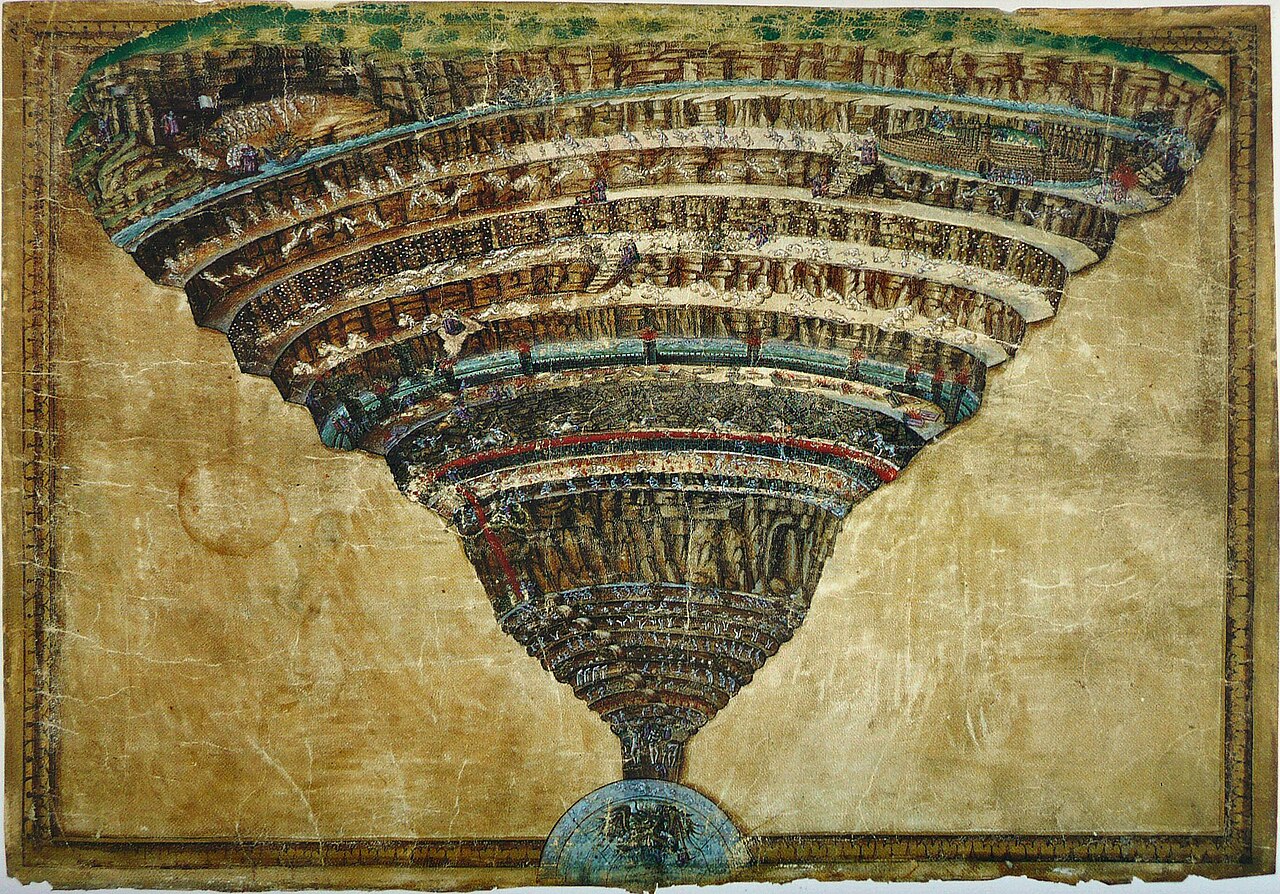
Dante’s vision of the circles of Hell.

Holy Week

It's Holy Week in Western Christianity (Catholicism and Protestantism), so some words about that. Click here to support the Wednesday Blog: https://www.patreon.com/sthosdkane

Some years I find Lent and the arrival of Easter just kind of happens without much ceremony or pomp. In our culture Christmas is the more notable holiday, the one that we travel for and take time off work for. Christmas is what defines our academic calendar, our Winter Break is essentially just the time we get off for Christmas and New Year’s. Yet theologically Easter is the more important of the two holidays.

This past Sunday during the Palm Sunday Mass at my local parish, I found myself deeply moved by the traditional recitation of the Passion Story from St. Matthew’s Gospel. From where I sat in the back row of the choir I could feel the trio of voices, two of our parishioners and our pastor, echoing off the walls of the church and moving about the packed congregation. I’ve been preparing for Holy Week a bit longer than usual this year because I’ve got a small part in the Masses on Palm Sunday, Holy Thursday, and during the Easter Vigil with the choir, so perhaps that contributed as well. Still, at a time when I’m unsure about my own faith in a way that would seem strange to my younger self a decade ago, Holy Week this year really does have a great deal of deeper meaning to me than I expected five weeks ago.

This week culminates in the Easter Triduum, three days of interconnected liturgies beginning on Holy Thursday with the commemoration of Jesus’s Last Supper, continuing on Good Friday with the Passion Service, and concluding at sunset on Holy Saturday with the Easter Vigil Mass. I’ve long found the Holy Thursday Mass to be my favorite, not just of the Triduum but of the entire year. For me, the mystery of the Eucharist is perhaps the most inspiring and compelling part of my faith that has continued regardless of the doubt and skepticism with which I’ve approached so many other aspects of reconsidering what I believe. One of the greatest lessons I ever heard in all my now 27 years of schooling was from Dr. Daniel Stramara, Professor of Theology at Rockhurst University, who explained that in the old Nicene Church of the Roman Empire, while in the Latin Rite the old Roman legalistic tradition persists in seeking answers to every question under the Sun, in the Greek Rite the prevailing opinion was open to mystery, to not having all the answers. I know I won’t really understand how “the biscuit turns into Jesus” to quote Craig Ferguson, one of my favorite comedians and all-time favorite late night host, yet that’s okay with me. It remains a mystery, and I trust in the long Tradition of our sacraments that there is deeper meaning in the Eucharist.

Good Friday was once described to me by my high school theology teacher Sebastian D’Amico as the one day of the year when we Catholics don’t celebrate, after all the Mass is a celebration of our faith. Good Friday is a somber day. Traditionally I’ve tended to attend the 3 pm Stations of the Cross service rather than the Passion Service later in the evening. The Stations of the Cross is a series of prayers which follow the path of Jesus from the Last Supper to the Crucifixion and eventually to the Resurrection that you’re taught very early on in Catholic school. Still, in the last decade I’ve probably returned for the Passion Service that evening on more occasions than not. Some years that service is so deeply moving, while in others I leave it feeling frustrated or downtrodden. I think of Good Friday as a sort of wild card in that way, it’s a day that has huge significance. It reminds me of other days in the year that mark the anniversaries of the deaths of relatives and loved ones, and historical figures who I have a great fondness for, curiously including President Lincoln who was shot on Good Friday 1865 of all days and died on the following morning on Holy Saturday.

With that segue Holy Saturday is a newer commemoration for me. I didn’t start going to the Easter Vigil Mass on an annual basis until just 2018 but have since found it a tremendously rewarding experience. The same mystery involved in the humble awe of Holy Thursday and the mournful remembrance of Good Friday trumpets itself on Holy Saturday in all the splendor of 2,000 years of liturgical tradition and precedent. I’m excited to serve my parish in this year’s Vigil Mass as one voice in the choir. 

The first of the nine readings said at that Mass always comes from Genesis 1, the Creation stories, which I will likely write about here in the Wednesday Blog at some point. I think of the Biblical Creation in the context of the opening verse of St. John’s Gospel, “in the beginning was the Word,” which with all its original Greek meaning also speaks to me of the idea that this vision of Creation first occurred through the voice, perhaps even as Tolkien wrote in his Silmarillion through song. Now of course, I don’t believe that the Universe was created in six days, I accept the idea of the Big Bang and cosmic evolution. There was a recent awe-inspiring episode of NOVA that talked about the raw energy that came before and propelled the Big Bang, which to me seems like a profound reflection of our own older traditional beliefs of the beginning, of Creation, though I’m not saying we can prove the existence of God, that again is best left to a whole separate week.

I’m looking forward to the rest of Holy Week this year, and I hope it will be a time of reflection and inspiration.

Ash Wednesday

Today is Ash Wednesday, the start of Lent. Some thoughts about that. Click here to support the Wednesday Blog: https://www.patreon.com/sthosdkane

In past years when I’ve written columns and devotionals around this time of year recognizing the beginning of Lent, they’ve been on some levels joking (I once referred to this season as the past tense of to lend) while on others they’ve been overly serious and solemn. There’s certainly room for both angles. This year, I feel a little less strongly moved by the whole experience, yes, I know we’re approaching a time of great meaning and purpose, yet in my mind that’s overwhelmed by the onset of what hopefully will be better Spring weather this week. 

As I’ve gotten older, I’ve found that the passing of the seasons impresses me differently than it used to. When I was first learning the names of the months and seasons in school, I noticed the changes quite profoundly. The first of each month was a moment of regard. Today though, month by month passes as one after another in a parade ever blending with its compatriots into one great cyclical mass of the year. I notice today more so the changing of the weather than I do the months or even the seasons. I notice the waves of warm air coming out of the southwest fighting against the cold air pushing down from the northwest. I notice now how each passing rain and snow leads either towards the warmth of summer or the cold of winter. For me the year is far more a day-by-day affair now than anything else.

So, where does that leave the liturgical year, the cycles around which my faith orbits? Honestly, I’m not sure. Perhaps because I had the opportunity to attend Catholic schools for much of my life the Catholic feast days and holidays stood out to me more at one time than they do now. The highest holy days, the Easter Triduum, Christmas, and of course the Irish feast days of Saints Patrick, Brigid, and Columcille stand out the most for me today, days when I can imagine my present moment lining up neatly with memories of my past and of the generations who came before me.

If Ash Wednesday has any potency for me today it’s in its reminder that we’re all mortal, and yes, at some point our lives are going to end. It’s a reminder of our limits, in body if possibly not in mind. I’ll go to Mass and get the ashes on my forehead as I’ve done for as long as I can remember, and yes, I’ll do the Catholic fasting (one large meal with two small meals, no meat), and I’ll likely be a bit grumpy about the whole affair. Ash Wednesday is a reminder of our lives on this Pale Blue Dot, to blend Carl Sagan’s humanism with Catholic theology. We’re all a part of this our home planet, forever tied to it, no matter how far we and our descendants might travel from its surface.A holy day like Ash Wednesday is a reminder of our worldliness, and how that world which we cherish and which we have helped build is as fragile, as mortal as we are. The ashes of the palm branches from last year’s Palm Sunday are from this same world that we are. It’s an honesty that can’t be beat or diluted, we are who we are. That’s what I’ve got this week.

Examen

Photo by Tony Wills CC BY-SA 3.0
This week, a bit of Jesuit word play. Photo by Tony Wills CC BY-SA 3.0

I’m proud to say that I’m Jesuit educated, I earned my Bachelor’s in History and Theology with minors in French and Philosophy from Rockhurst University in Kansas City. My time at Rockhurst was one of the most formative periods in my life, a time when I feel like I really did grow into the adult I’ve become from the teenager that I was when I arrived for move in day my Freshman Year. One of the great things that the Jesuits promote is self-awareness, understanding how we exist amid the Cosmos, how we are who we are. A daily exercise of this sort of self-awareness is the Examen, a meditation devised by St. Ignatius of Loyola, the founder of the Jesuits, almost 500 years ago now.

I’ve tried doing the Examen at different points in my life, pausing during the day, most often before bed, to reflect back on the day I just lived, the highs and the lows, and offering my gratitude for all of those experiences. Naturally though there are distractions all around, whether my phone announcing new messages or the sound of a dog barking outside, or even my own thoughts about what it is I’m actually trying to do. The word examen stuck out to me yesterday, I know it as the French word for an exam, and I had a sneaking suspicion that it was originally a Latin word, after all it has that classic Latin prefix ex- included.

When I turned to my favorite Latin dictionaries, I found sure enough that the word exāmen is of Latin origin, coming from a combination of the prefix ex- and the verb agō meaning “I drive”, with the -men suffix added to render exagō a noun. Thus, exagmen becomes exāmen. Still, the meaning of this word, or rather its particular uses strike me as amusing. It is not only an examining of conscience in the Jesuit sense, but also a means of balancing something. Yet there’s a third meaning that came up, exāmen has been used to refer to exāmen apium, a swarm of bees.

At first, I’m not entirely fond of the idea of an examination of conscience having anything in common with a swarm of bees; perhaps there’s some lingering misgivings from my own childhood experiences being stung by bees (both occasions were my fault). Still, the idea that the Latin name for a group of bees, like how we might say a flock of birds or a herd of bison, would be an exāmen is curious to me. It seems as though the idea is that when we do examine our consciences, or when we consider something as fully as possible, we ought to be able to get into every little crevice of that question like a swarm of bees can.

This phrase exāmen apium is used by a number of ancient Roman authors, yet in every moment while that phrase literally means a swarm of bees it often seems to herald bad omens, whether it be a swarm of bees appearing on a standard or on the statues of an emperor or in the middle of a market. So, how can we interpret this to be more than just an odd Roman connection between bees and Jesuit meditations? Think of what might be the best thing to do after getting such an omen; rather than stand idly by and let “fate” take its course, why not instead stop, and think about what you have done to receive such a warning, and what you can do to change how things are going? One of the great disservices that our civilization’s heritage has given to us is a belief in fate, that things are decided and there’s nothing we can do to fix them. Nothing could be further from the truth! It’s up to us to examine our lives and figure out where we’ve gone wrong, and then to do the hard thing and fix our problems.

That is what at the end of the day the Examen means to me. It’s an opportunity to become a better version of myself, a reassessment that, when I don’t forget about it, happens every day.

Human or Man?

In English should we say that Jesus "became human" or "became man"? Join me as I work through the history of the Nicene Creed and how this most pivotal of beliefs was interpreted first by the Greek speaking Church Fathers who wrote the Creed, later by the Latin speaking Catholic Church, and today by us English speakers. You can read a transcript of the full episode here. Written, read, and produced by Seán Thomas Kane. © Seán Thomas Kane, 2021.

On Saturday I took the opportunity to go to 4:00 pm Mass at my home parish here in Kansas City, MO while I was in town for Thanksgiving. It was wonderful getting to see the place again, and even though it’s only been 3 months since I left town for the semester a part of me doubted I’d actually see these places that are so dear to me anytime soon.

During the Nicene Creed as I recited the words I’ve known at least since freshman year of high school, the proclamation of the Faith, kind of a Pledge of Allegiance that we Catholics still have mostly in common with our Orthodox and Protestant cousins, I noticed something that made perfectly good sense but I hadn’t thought of yet. A friend who was standing near me said that Jesus “became human” instead of “became man.” It caught me off guard for a number of reasons. Firstly, the official English translation that we use in the US does use the older word “man” rather than the newer “human” but secondly, I had a feeling from what I could remember of the Latin translation that our English one is more closely based on that “human”, “homō” in Latin, might actually be the noun used.

That evening I made a point of going to the source. I looked up the Creed in Latin and sure enough the line there is “et homō factus est,” which I’d translate in my schoolroom Latin as “and he was made human.”1

The one catch here is that the Creed wasn’t originally written in Latin but in Greek. So, in order to get to the original meaning and intent of the Church Fathers at the Council of Nicaea (325) that wrote the Creed we still say nearly 17 centuries later, I’d need to call up my admittedly elementary and rusty knowledge of Greek. Unlike Latin, which I studied all through my high school years, have picked up again twice since, and use professionally on a regular basis as a historian of Renaissance natural history, I haven’t been lucky enough to use much of my Greek. I took Classical Greek in my senior year of high school after finishing my last required math credit the summer before, and then took a semester of Koine Greek (aka New Testament Greek) in my sophomore year of undergrad at Rockhurst. So yeah, my Greek is rusty. I can still read the alphabet pretty well and I know enough about etymologies that I can get by, but I never really got it the way I got Latin or French.

Still, I was determined to spend at least a few minutes of my Saturday evening at home working through this question: what was the original Greek line that the Latin translator rendered as “et homō factus est“?2 I went to a pretty reliable source that has both the Latin and Greek versions and started scouring the Greek, figuring I was either looking for one of two words: ἄνθρωπος (anthropos) meaning human or ᾰ̓νήρ (anḗr) meaning man.3

One of the big tricks that I’ve learned after now a few years of working with sixteenth-century printed books that are often not in English is the quickest way to find a particular word you’re looking for is basically to just focus on finding that word, don’t pay too much attention to the rest of the text. Once you’ve found the word you’re looking for then go and read the rest of it to put that word into context.

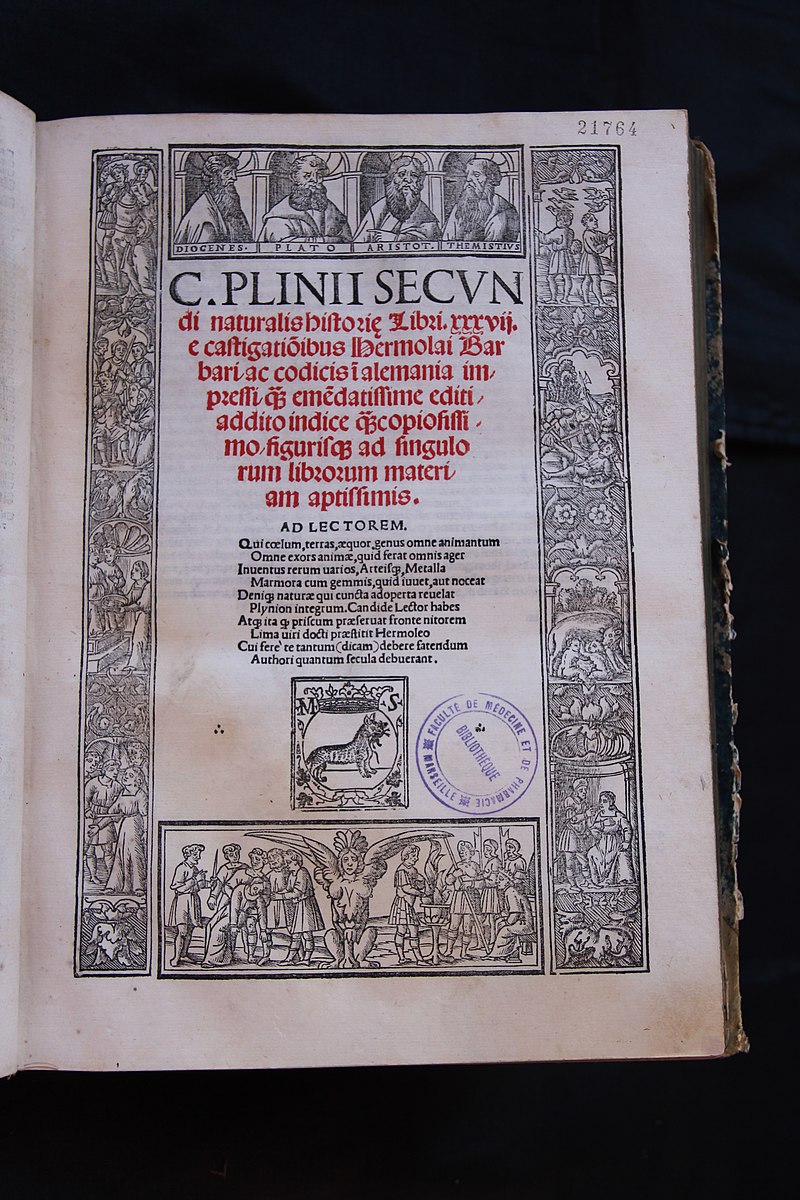
One example of a 16th century printed book that I’ve worked with.

Anyway, back to the story.

So, I scanned through the Greek original version of the Nicene Creed and was left stumped. I couldn’t find either ἄνθρωπος or ᾰ̓νήρ anywhere. I began to wonder if there was some third Greek word for human or man that I didn’t know about, and knowing what I do know about Greek there being three words for the same concept isn’t at all out of the question. Looking for clues, I turned then to the previous line, “and by the Holy Spirit was incarnate of the Virgin Mary”. In the Latin this appears as “Et incarnātus est, ex Spirītū Sānctō ex Marīā Virgine“. A great trick for any researcher working in a second or third language, or better yet one that they have a passing familiarity with is to always keep an eye out for personal names or other proper nouns: those will usually be more prominent, and when it comes to the BVM (Māter Deī, Θεοτόκος [Theotókos]) you can bet her name will be prominent. Sure enough, I quickly found mention of a Μαρίας τῆς Παρθένου (Marias tés Parthenou) meaning the Virgin Mary and kept looking along that line for something that resembled either ἄνθρωπος or ᾰ̓νήρ. Two words over came my answer: a fittingly long Greek verb ἐνανθρωπήσαντα (enanthrōpōpésanta).

I quickly returned to my favorite English-Greek dictionary and found the root form of the verb in question, ἐνᾰνθρωπέω (enanthrōpéō), meaning “to put on human/man’s nature,” or more essentially “to become human/man.” The only job left to do was to take out that clunky slash and acknowledge which noun, ἄνθρωπος or ᾰ̓νήρ was at the heart of that verb. As it turned out, and as you can see, it’s ἄνθρωπος.

Thus, to the best of my efforts as a scholar and translator, and as you can see, I’d argue that in English saying that Jesus “became human” works, perhaps even better than “became man”. Why? Well, remember that English has changed a lot as a language in the past century. We have so many more people and ideas using this language than ever before, and to be honest while the English noun man began as both a word meaning males in both gender and sex (ever a complicated series of terms) and our entire species in general, it has steadily come to lose that second, neuter meaning in favor of solely being a masculine noun. Neil Armstrong’s first words when he stepped onto the Moon’s surface in 1969 were “it’s one small step for man, one giant leap for mankind.” For a guy in 1969 that worked. But for the astronauts that will be setting foot on the lunar surface again in the next few years with the Artemis program, I firmly believe that man won’t cut it anymore.

A few years ago, I wrote a blog post that was a predecessor to this now weekly Wednesday Blog about why I prefer to say “you guys” rather than “y’all”. Long story short: I’m not a Southerner, and I’ll fully admit when I hear “y’all” I don’t tend to think of much besides the people who drug our country into a Civil War 160 years ago because they couldn’t accept the fact that it was morally corrupt to own other human beings. The fact that their heirs are still fighting against racial equity in this country makes my case for me. In that same blog post I also argued that we should move away from the word mankind, and towards something that more closely reflects a more gender neutral word for our species: humanity. On a small side note here (in a paragraph begun with a side note) I don’t like humankind because it combines the very Germanic -kind with the very Latin human. Instead, Latin gives us the word humanity, derived from the Latin hūmānitās. Let’s use that instead. It works, and frankly as we do become far more globally interconnected (which, guys, really isn’t a bad thing at all), it translates far better than humankind ever will.

All this said, getting back to the main point after a brief stop in the politics and history of American English, I think it’s actually a lot better and more profound to refer to Jesus as God becoming human instead of God becoming man. It means that Jesus came to be among all of us, to be one of all of us. I’ve written before in an academic setting about why I believe it’s flawed to refer to God in gendered terms: gender is cultural, it’s fundamentally human, and it keeps the blinders on us to the extent that we can’t make a true effort at seeing, and by seeing hopefully we can get closer to understanding the fullness of God. From there, I’ll leave the writing about how to understand the fullness of God to the theologians and clergy.


Footnotes

  1. Why the difference between the official “became” and “was made” in my translation of the Latin passive verb factus est? Factus est is the passive perfect 3rd person singular form of the verb faciō, which my old stalwart dictionary William Whitaker’s Words translates into the English verbs “do, make, create; acquire; cause, bring about, fashion; compose; accomplish.” So, while “became” is more poetic, “was made” is more accurate to the verb in question. But, theologically was Jesus the passive recipient of the blessing of being made human? After a significant amount of time for what I thought would be a short search I found an entry in the Liddell, Scott, and Jones Ancient Greek Lexicon (LSJ) on the Perseus database that listed the original Greek verb that was translated into Latin as factus est, namely ἐνανθρωπήσαντα, as an aorist participle singular active masculine verb in the accusative case. So basically, while the Latin factus est is in the perfect passive voice (meaning it’s describing an event that fully happened to the subject in the past), the Greek verb is an event that happened in the past without any time specified as to when it happened (kinda like a French passé simple?) This alone shows the complexity of trying to translate from Greek into Latin and then by extension into English. One final note here: while the Greek verb grammatically has a masculine gender (see above in this oversized footnote) I’d stress that that gender designation is referring to Jesus who it’s generally accepted was biologically male. In the process of trying to figure out how the Greek verb in question (ἐνανθρωπήσαντα, in case you forgot) was conjugated, I found an interesting article from the Orthodox Christian Studies Center at Fordham University discussing how best to translate this very verb in the Nicene Creed from the Greek original into English. So, to return to the original question that led me to write this footnote that would outrun the Gettysburg Address in length: the fact that Jesus in the Latin was apparently the passive recipient of his humanity, given to Him by the Holy Spirit is more or less a “it’s the best we can do” translation from the original Greek where Jesus actively “became human”. So, in English while the best translation from the Latin is “was made” human, when taking the Greek into account the official Catholic “became” human works a lot better, because it recognizes that at the end of the day Jesus and the Holy Spirit are consubstantial with the Father, meaning they all share the same Substance, i.e. they are all One. “Three Persons in One God” as my notes from my undergrad freshman Honors Christianity I notes say.
  2. For my fellow grammar constables out there, yes I put the quotation mark outside the quotes. There’s a reason for that, it’s not a part of the quote so I don’t see why it should be included in the quotes. I’m going to write another blog post about this eventually.
  3. For my Greek friends and all Greek scholars out there: to my understanding ᾰ̓νήρ is the Ancient Greek word for “man.” To my understanding the more familiar and modern word άνδρας is descended from the accusative singular (direct object form) of ᾰ̓νήρ.

Why I enjoyed Netflix’s “The Two Popes”

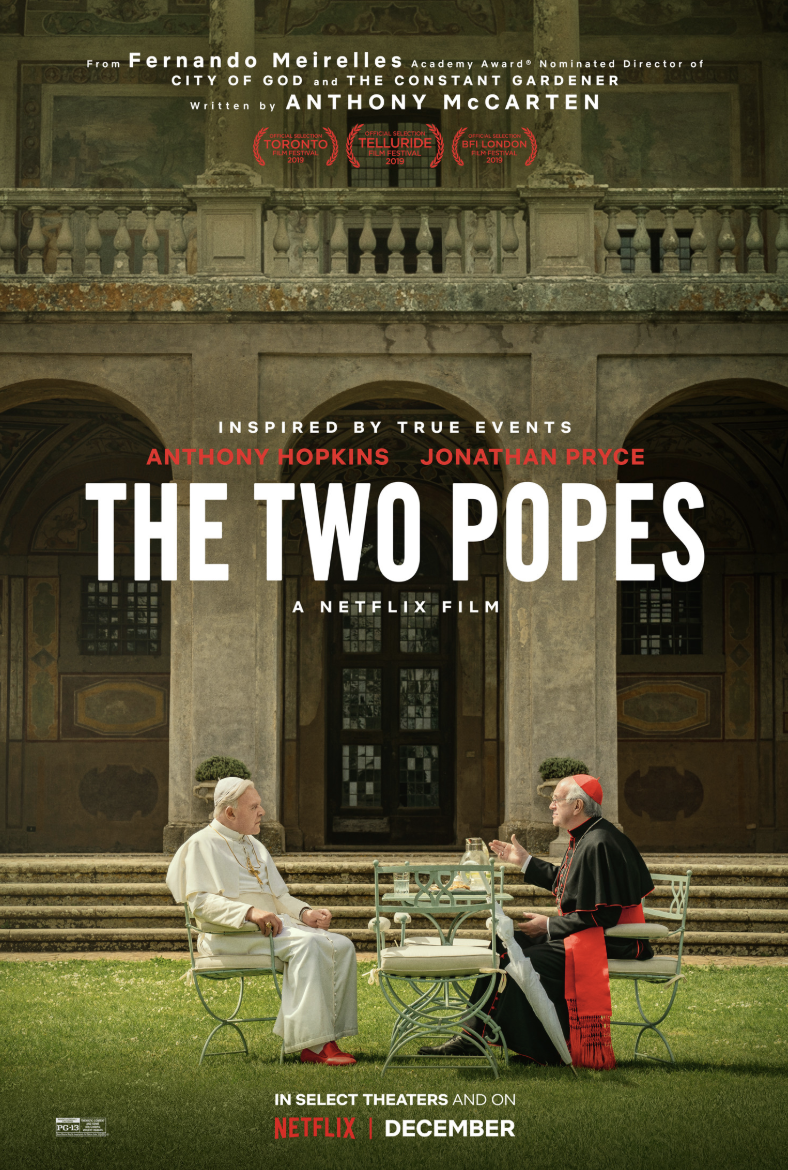
Two Popes posterNetflix’s new two-hour film The Two Popes starring Jonathan Pryce as Pope Francis and Sir Anthony Hopkins as Pope Emeritus Benedict XVI is theatre, pure and simple. It falls into one of the most classic sorts of plays, a dialogue between two men with similar positions yet very different experiences. While not all the conversations that make up The Two Popes may have happened, according to an article in America, the story that they tell on the screen is beautifully rendered and exceptionally human in its content.
The film begins with the Papal Conclave of 2005 at the death of Pope, now Saint, John Paul II, when then Cardinal Josef Ratzinger was elected as the new Supreme Pontiff, taking the name Benedict XVI. The conflict between Benedict and the reformist cardinal Jorge Maria Bergoglio, the current pope, is made clear from the first moment. Moreover, the two characters are framed as foils for each other: Benedict is removed from the world while Francis is fully a part of it; Benedict is traditional while Francis is less keen on pomp and grandeur of the Papacy and the Church in general; Benedict says he is disliked when observing how Francis seems to make friends with just about anyone he meets.

It is important to understand that while this film tells a story inspired by the recent events of the lives of two of the most important men in our lifetimes, it is nonetheless a story meant to entertain and give the audience a message of hope for redemption, peace, and a willingness to accept change even if it may not be the change we expected. In that sense The Two Popes has a bit of the same spirit that has enriched many a story down the centuries. There’s a sense in this film that if two people with opposing perspectives sit down and talk about their disagreements, that eventually they’ll reach some sort of common understanding, or at least mutual respect. Both Popes come to respect each other out of a mutual understanding of their imperfect humanity, that both men have made mistakes in their lives, yet they still have striven to do good.

The Two Popes does not hold back on the problems facing the Catholic Church today. It acknowledges the scandals and errors that continue to plague the Church now at the start of the 2020s. Yet it takes those scandals, those errors, those misjudgments, and it uses them to breath even more life into these two characters. I enjoyed this film because it’s a well written bit of theatre, depicted beautifully on the screen. The Two Popes, and in particular Pryce and Hopkins’s performances, do what any good bit of writing is supposed to do: make the audience think.

Four Months Later

Screen Shot 2019-11-25 at 11.24.45EST

The simplest way of saying it is that even though I’ve already been in graduate school for the better part of the last four years, I was not prepared for the intensity of work that I have found myself undertaking over the last sixteen weeks. It has now been four months since I left Kansas City for the crown jewel of the State University of New York’s system, Binghamton University. I started on the back foot, as my intended research project became unviable a full two weeks before my departure. Yet I have taken that setback as a good reason to move forward, with resolve, to stay on track and on schedule, and to find another topic to focus my research on.

As most teenagers do, I felt ashamed about the things I had been passionate about as a young child. So many things that I looked back on with joy were simply not “cool enough,” not something that I would want to share with my friends. Yet after starting my undergraduate degree at Rockhurst in 2011, I began to allow myself to open up to those same passions and interests from my earliest years. That said, until now I did not allow topics like zoology, or travel, or natural history to become my primary professional focus; I stayed in the same areas that I fell into in high school and as an undergrad, in politics, theology, and philosophy, and ran with those, completing one bachelor’s and two master’s degrees in that same purely anthropocentric and theocentric vein.

Yet in August, as I found myself without a research topic, the most fundamental part of a Ph.D. in History, I decided to take the initiative and try and incorporate some of those childhood interests into my research. Today, I am beginning what hopefully will be a career-launching research project looking into how Renaissance travel narratives served as vehicles for the transmission of new scientific information, specifically about zoology, from the Americas to the reading public in Europe. I decided to incorporate those old topics that I have always loved to learn about, whether from books or in museums or at zoos, and frame the history that I am writing around them.

The greatest lesson so far since arriving in Binghamton has been in patience. Having landed in a town that frankly I would never choose to live in if not for the university, I have begun to learn how to be patient with my surroundings, to bide my time and work so that I can eventually move on to greener pastures, ideally in a metropolitan city of at least 1.5 to 2 million people. I have also had to shed off the last trappings of my childhood and teenage fear of criticism, which has certainly limited my success in the past. Having a good 400 pages to read per week, I have struggled to properly prepare myself in such a way that I feel confident to discuss the topics at hand, many of which, such as Hippocratic medicine, I have little background in.

I believe that all bad things that happen in our lives eventually boil down to fear, our fear of the unknown, our fear of others, our fear of ourselves even. By beginning to learn how to be patient, how to deal with criticism, I am confronting many of those deepest fears that held me back in the past. I know for a fact that I’m not nearly over many of them, after all some fear is a good thing, otherwise I might try to pet the mountain lion at the Binghamton Zoo, and frankly I’d rather keep both of my hands. Still, a little wise individual, in one of the greatest sagas to be produced in our time, once said that “the greatest teacher fear is.” I certainly believe it.

Equality under the Law

Words and phrases are powerful tools, and the emotions that we attach to particular words only begin to stick once certain actions are taken based upon the intent of those words. In the United States the debate over the issue of abortion has long been controlled by the social conservatives on the right. Predominately made up of Conservative Protestants and Catholics, this odd faction have united in their opposition to predominately two main issues: the rights of women to control their futures outside of the will of powerful men, and the rights of people to express their love beyond the traditional Judeo-Christian bounds of love between one man and one woman.

This odd couple has been successful in framing the abortion debate as one between those righteous who support the right of all who are conceived to be born, and thus declaring themselves to be Pro-Life. By declaring themselves, the anti-abortion factions, to be Pro-Life, they have categorically deemed their counterparts, those who support women’s abortion rights, to be little more than misguided homicidal individuals. To correct these tendencies towards abortion, the Pro-Life camp has advised women to let their pregnancy go through, and to protect the innocent life that comes out of the mother’s womb. The first of many ironies and issues with this is that the people in positions of power most likely to offer that advice are either men, or women who follow the advice of those men regardless of what might be best for themselves.

A number of years ago, while writing for Examiner.com’s Kansas City Catholic column, I published an opinion piece calling out the anti-abortion movement as not necessarily pro-life, but more simply pro-birth. After writing that article calling out the hypocrisy of people who are so adamant to protect the fetus, but are content with capital punishment, and who refuse to support “socialist” policies like universal healthcare, and matching the minimum wage to the living wage, among others, I actually received a fair number of threats from readers. Today, knowing and recognizing the infractions being committed against women’s rights by state legislatures from coast to coast, including my own state of Missouri, I cannot sit by silently and watch.

In this country we allow the most despicable of speech because if we limited one type of speech then all free speech would equally be threatened. In this country the same social conservatives who oppose abortion have argued that we cannot have even the most basic control on gun sales because it would threaten all rights to own guns. The bills being passed in the state legislatures, that will certainly be used to challenge the legality of the Supreme Court’s 1973 Roe v. Wade ruling are not just wrong, they are excessively so. They directly target a particular group of citizens based upon their biological sex and make it harder, if not nigh impossible to have a viable livelihood in a number of states. Like the recent set of voter ID laws that target minority voters, limiting their basic right of participation in government, these anti-abortion laws offend the very concept of equality under the law upon which the sociopolitical life of our country is built.

Earlier this week, when the Governor of Alabama signed that state’s bill into law, she expressly noted the religious undertones that have fueled the anti-abortion movement. As long as we have freedom of religion in this country, we cannot have any direct influence from any one religion upon our government at any level. If a law such as this anti-abortion law, which is openly influenced by the religious beliefs of the aforementioned Conservative Protestants and Catholics, becomes official, then the rights of all other people of faith in this country are infringed upon.

If we are going to allow one faith to be practiced freely, all other faiths must have the same protections. Yet it is counter to the very core of Christianity, a faith in a God of Charitable Love, to use our religion to restrict the rights of others. The malice that fuels these bills is a threat not only to women, but to everyone else in this country who doesn’t fit into the narrow vision of goodness that the anti-abortion crowd yearns for.