Category Archives: Astronomy

The North American Tour

The North American Tour Wednesday Blog by Seán Thomas Kane

This week, some words on the places I visited and the people I met on this North American Tour I finished on Sunday. — Click here to support the Wednesday Blog: https://www.patreon.com/sthosdkane


This week, some words on the places I visited and the people I met on this North American Tour I finished on Sunday.
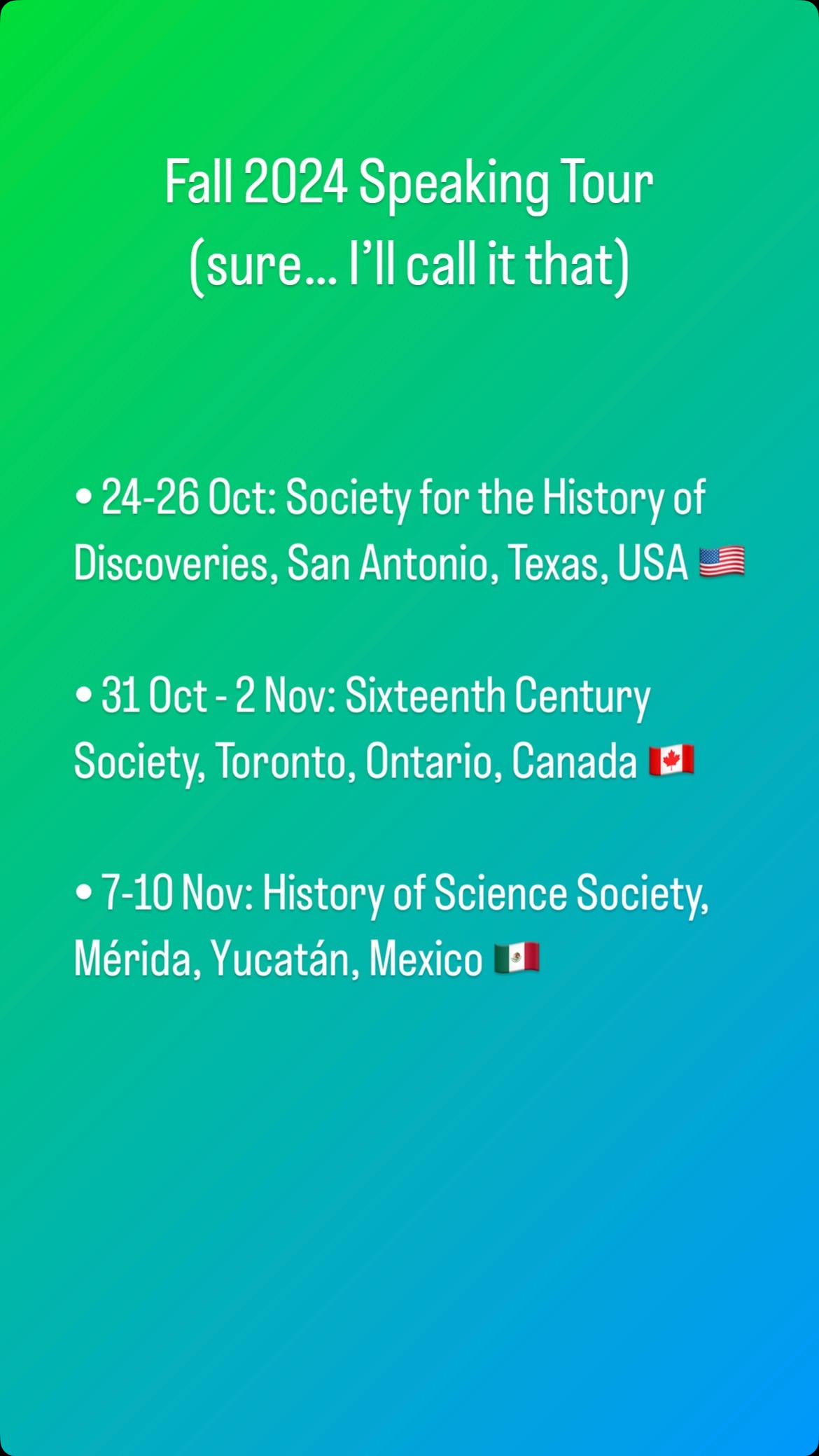

Earlier this year when I began to consider which conferences I would like to attend in Fall 2024, I knew from the start that my old stalwart of the Sixteenth Century Society would be top of the list. I was also interested in attending the History of Science Society’s conference for the first time after meeting a fair number of attendees from the 2023 meeting last year at my workshop in Brussels. Two conferences in two weeks is a fair amount of travel to undertake and money to spend. Yet there was more to be planned, for in midsummer I read a notice from the Society for the History of Discoveries about a special issue of their journal Terrae Incognitae about animals and exploration. I sent in a proposal which was accepted, leading to an outstanding offer to submit an article for the issue which I’m editing. So, knowing it would be good to meet the people of the SHD, I decided to submit a proposal to their conference as well.

If you’re keeping count, that means I went to three conferences in the last three weeks. I decided to call the series of talks my North American Conference Tour because this would take me not only to San Antonio but to Toronto and Mérida as well. I often thought about trying to do something like this where I visited two or three of the big continental countries in North America in short order; when I lived in Binghamton I fancied the idea of driving the 4 hours south to D.C. one day to sit in the gallery of the House of Representatives only to turn around soon after and drive back through Binghamton up Interstate 81 and across the St. Lawrence River to Ottawa to sit in the gallery of the Canadian House of Commons later that week. That never happened, in part because of the pandemic, yet I’ve undertaken similar trips in Europe on many an occasion so why would it be any more challenging here in North America?

The greatest challenge in this tour was that unlike stopping in Brussels, London, and Paris on a big European tour, I would need to fly between each of these cities and Kansas City in order to be where I needed to be in a prompt manner. I was excited by the prospect that all three of these cities could be reached in one way or another by direct flights from Kansas City. In the case of Mérida, the capital of Mexico’s Yucatan state, I would need to fly into Cancún and take the recently opened Tren Maya four hours east to Mérida to use that direct flight on Southwest. As it turned out though, I only had one direct flight throughout the entire tour. Southwest offers direct flights between Kansas City and San Antonio every other day, and they don’t fly that route on Wednesdays, so instead I flew to San Antonio with a couple hour connection at Lambert Field in St. Louis. Air Canada’s daily nonstop Toronto to Kansas City service only runs in a seasonal pattern and the season for that route ended 1 week before I was due to fly to the capital of Ontario, resulting in me having connections at the start and end of the trip in my original hometown at Chicago O’Hare. Then there was Mérida. I did seriously consider flying into Cancún rather than Mérida proper for the benefit of the direct flight. Yet the benefit of flying into Mérida itself and the still limited Tren Maya schedule meant I would still have to stay overnight in Cancún before flying home. So, I booked flights on United to Mérida through Houston Bush Airport which included an 8 hour layover on the way out and an 11 hour layover on the way home. I figured I could take advantage of the time in Houston in some way or another.

San Antonio
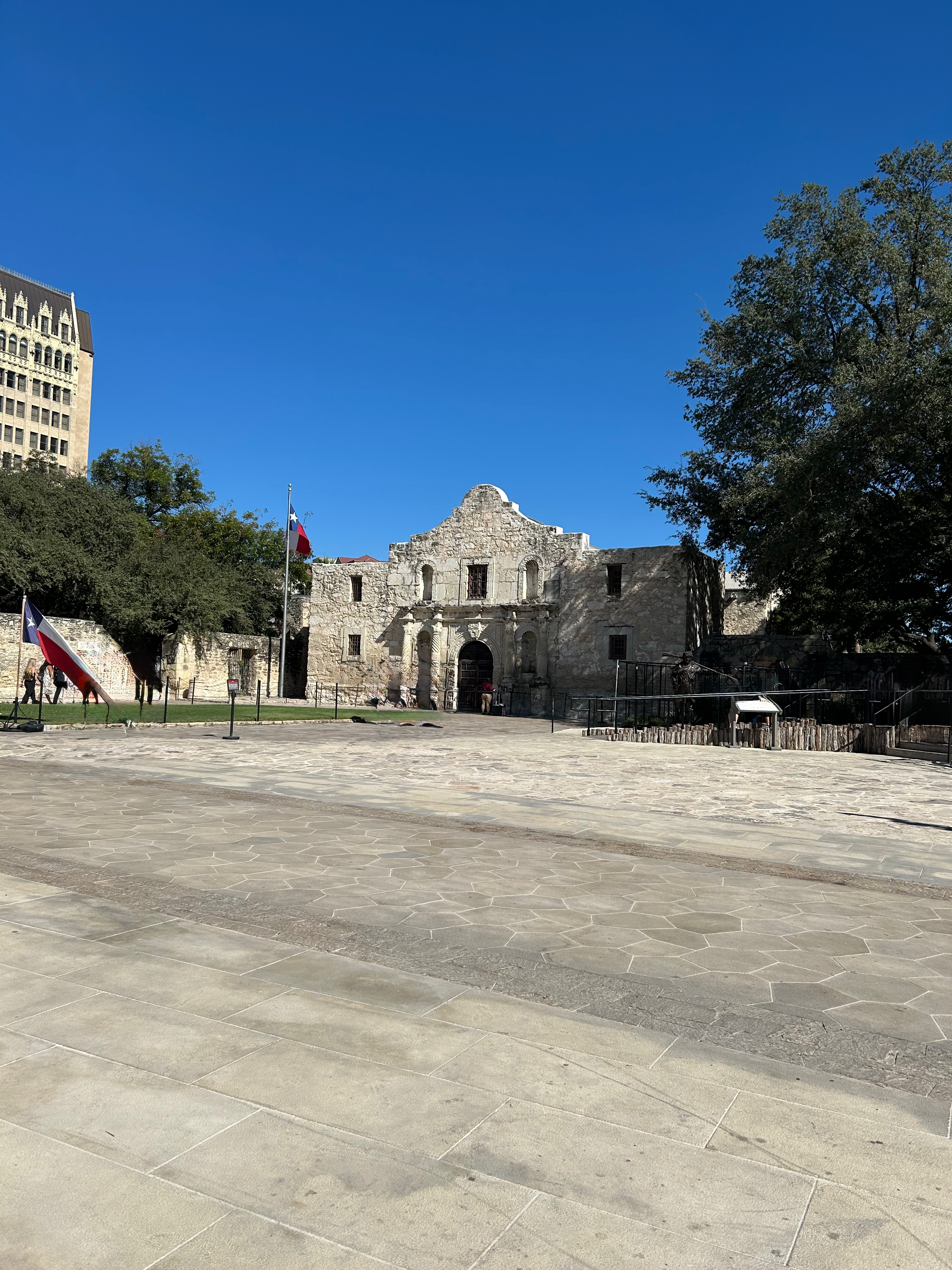
The Alamo

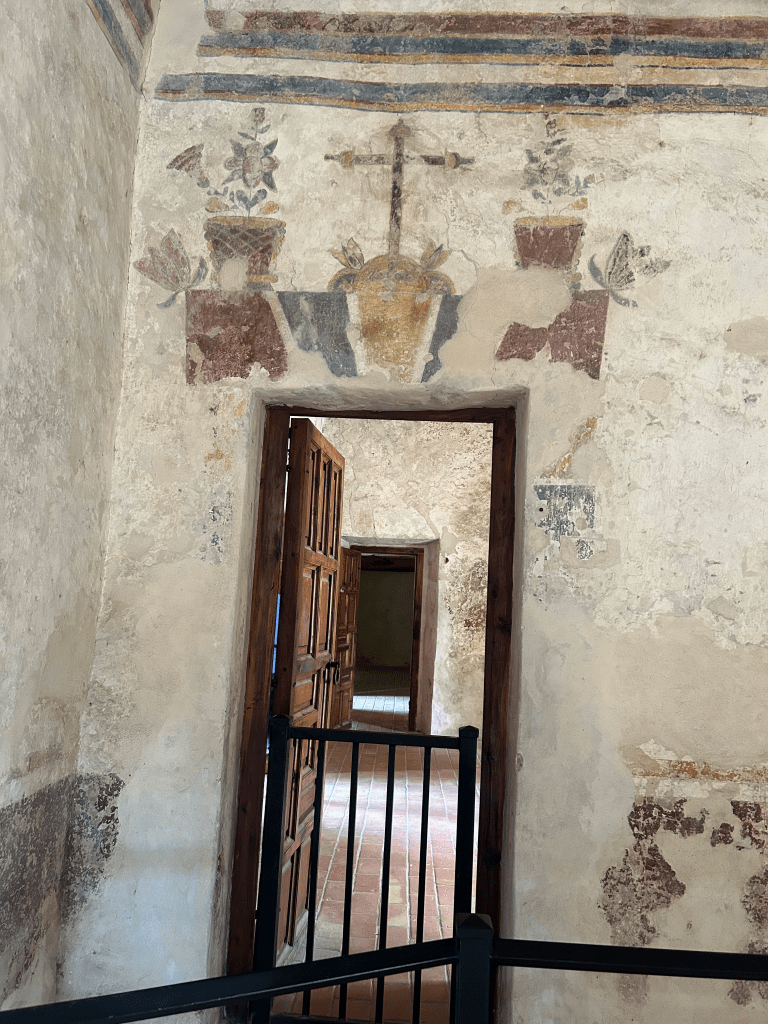
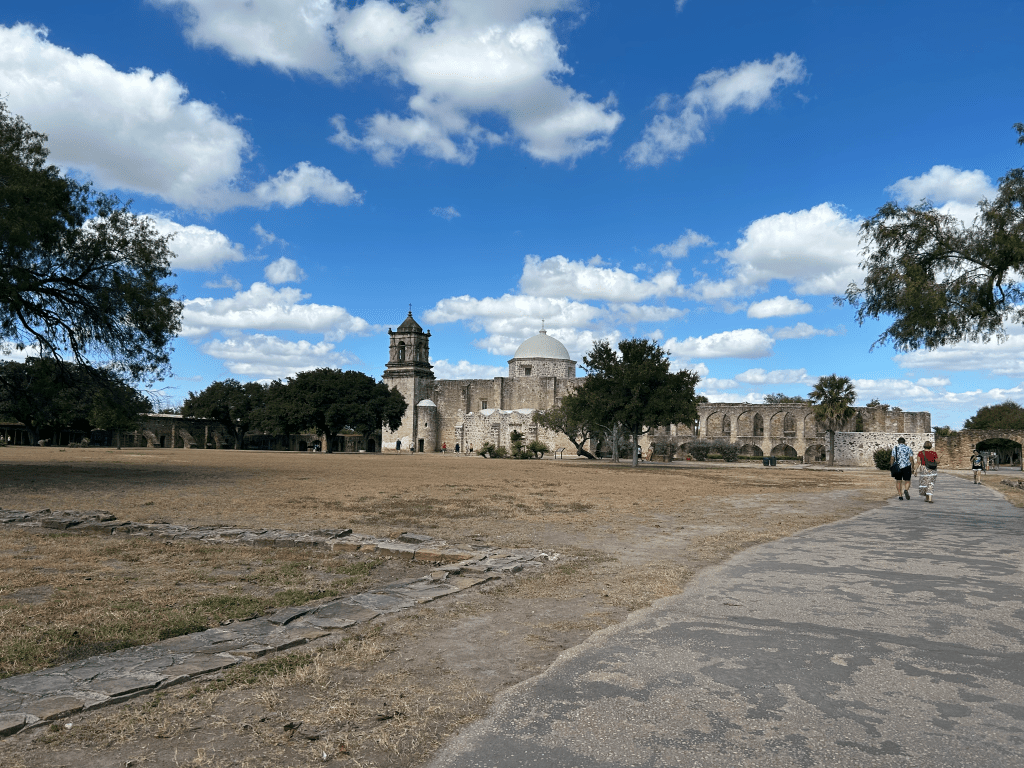
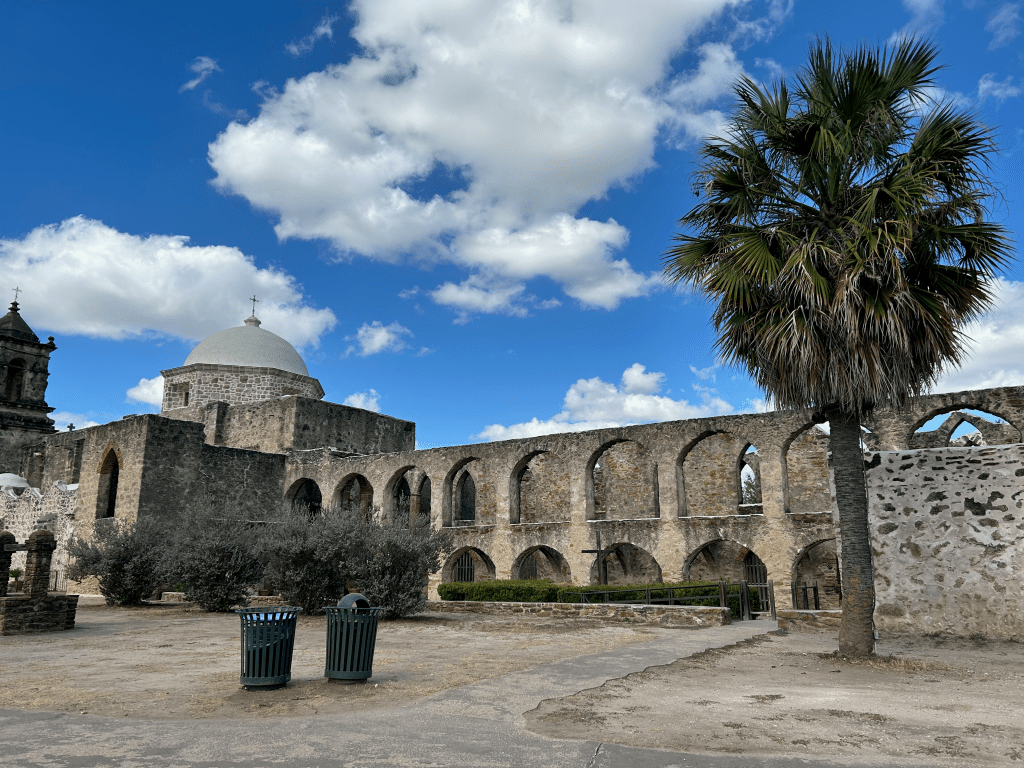
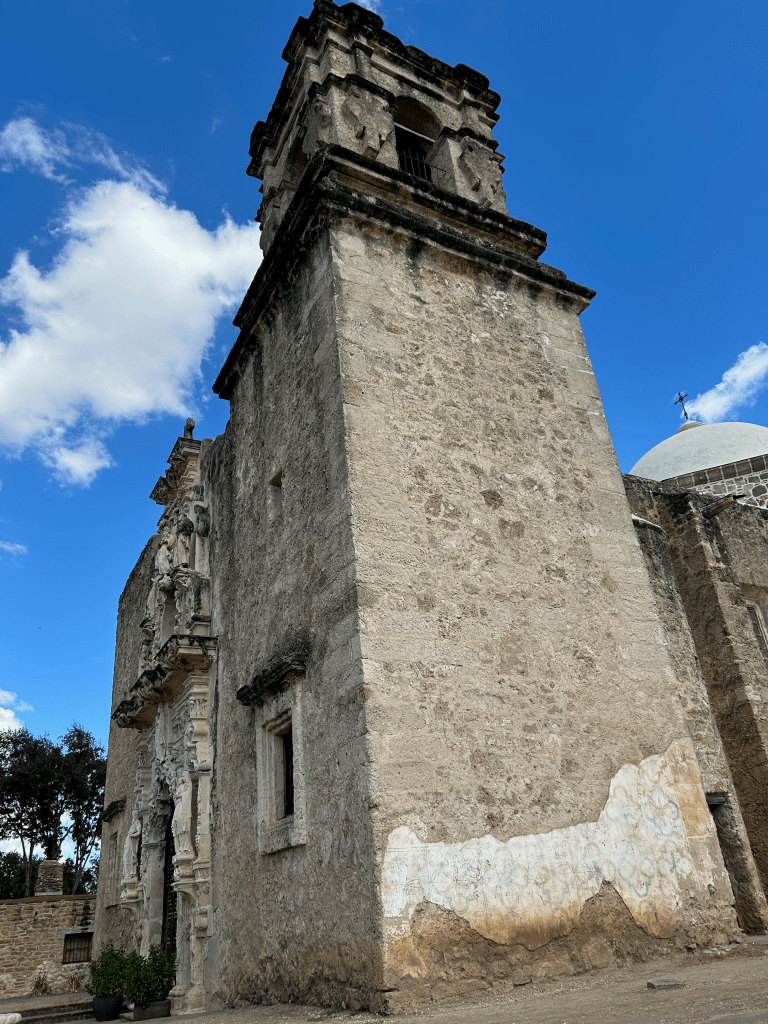
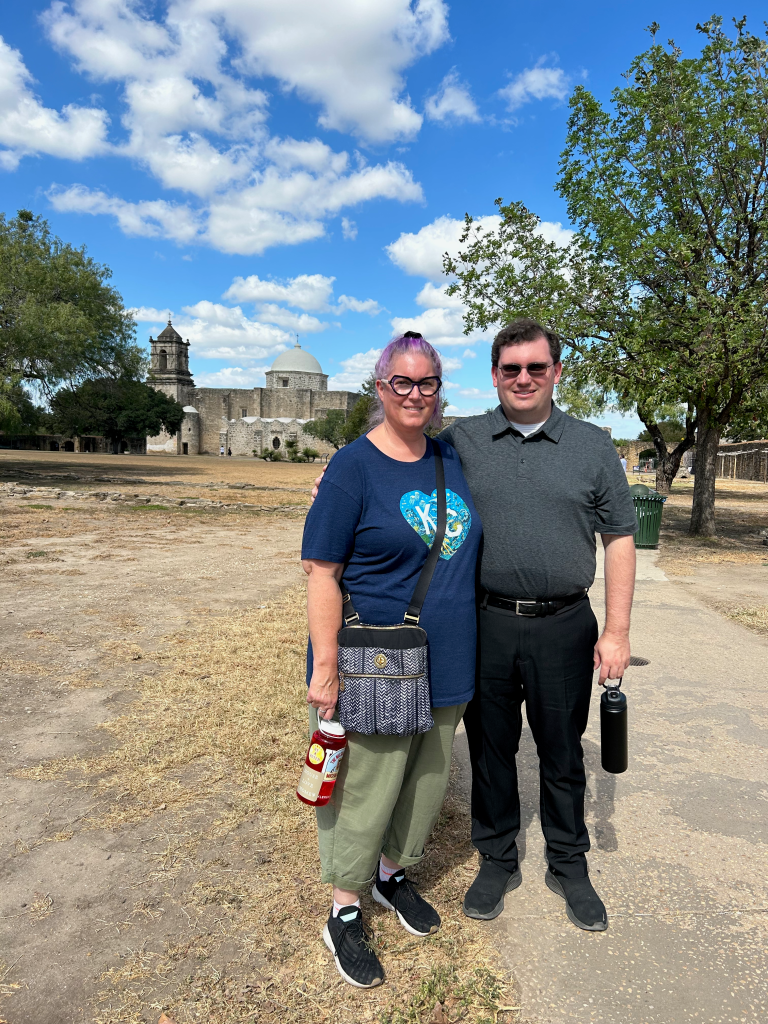
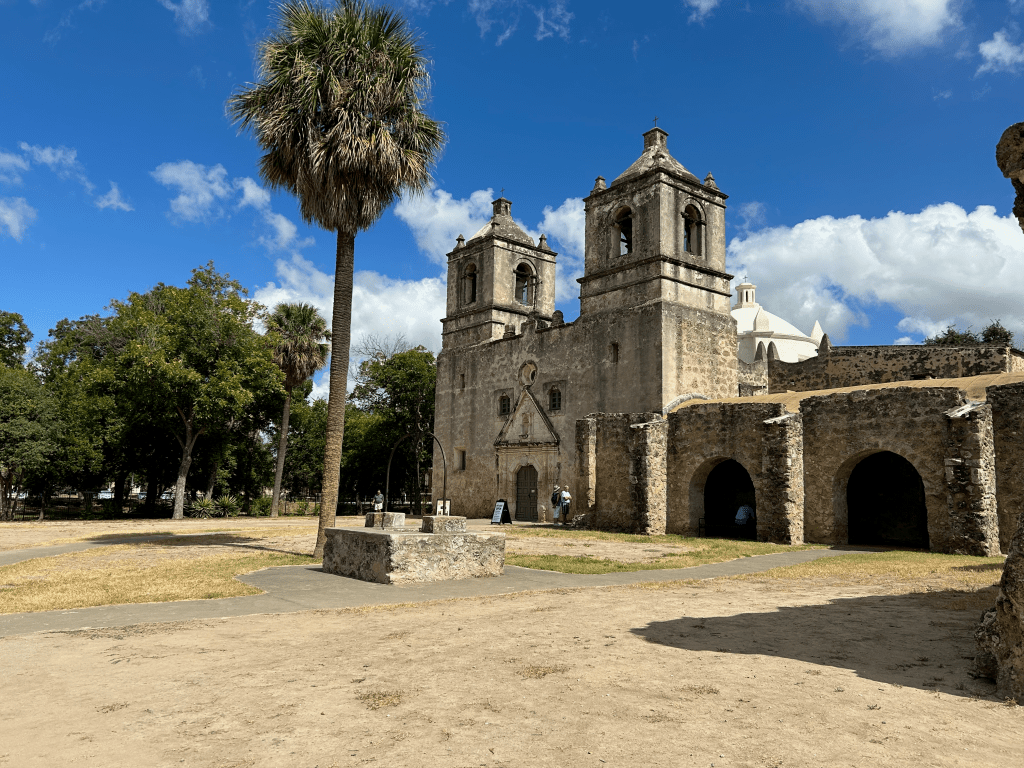
I traveled to San Antonio with my Mom, who jumped at the opportunity to spend a few days in that city. I’d only ever spent a few hours there about a decade ago when we were in Austin at my Mom’s office over her birthday weekend in May 2015. That visit to the Alamo City was cut short though by heavy rains and flooding. On this instance though, I fell in love with San Antonio. It often reminded me of the best parts of San Diego, another near-border city, yet it still felt closer to home both geographically and in its approachability. Before joining in the conference there at the Menger Hotel, we took a tour of the old Spanish missions south of downtown along the San Antonio River. 

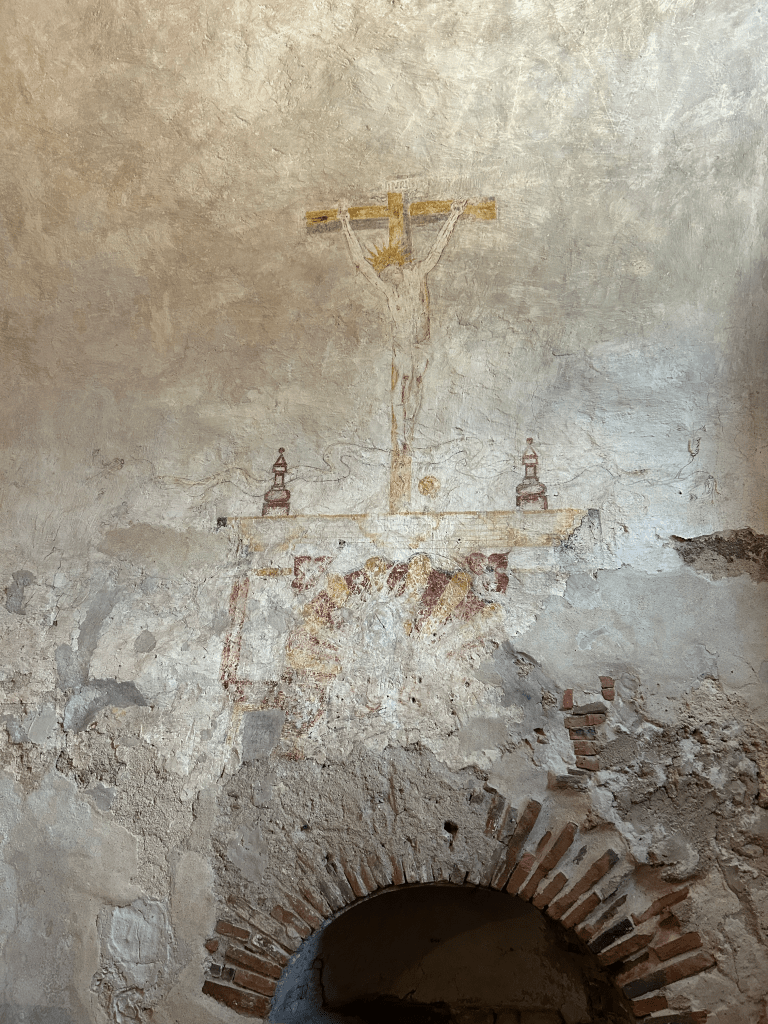
These four: Missions Concepción, San José, San Juan Capistrano, and San Francisco de la Espada brought the deep colonial history of this part of South Texas into focus. The tour guide explained that the Spanish decided to establish missions in Texas starting in 1715 in order to block French expansion from their new colony of Louisiane to the east along the Mississippi River. This was a full 200 years after the first Spanish conquistadores ventured north into Texas from their Viceroyalty of New Spain centered around Mexico City. The Franciscan missionaries who were sent north in the eighteenth century came from the Mexican city of Querétaro, some 740 miles (1,191 km) south by foot. Along with them came groups of colonists from the Canary Islands who were sent to establish a Hispanic presence around these missions alongside the majority indigenous population. The story of the Spanish colonization of Texas is a mixed one of both the story of the creation of a new ethnicity in the Tejanos, descendants of the Canarians and other Spanish colonists and the indigenous Texans including the Coahuiltecans, Payaya, and Pastia. Yet the other side of this story is the forced assimilation of these indigenous peoples to a new colonial way of life centered on the missions and their Catholic faith.
There is one more point I want to raise about the sudden Spanish urge to establish missions in Texas after 1715. This sudden colonial interest in Texas began after the War of Spanish Succession which was waged between 1701 and 1714 after the death of the last Habsburg monarch over the Spanish Empire, Charles II. Charles named Philip of Anjou, a grandson of Louis XIV of France as his heir, with Louis intending on having Philip succeed him as King of France as well, and uniting the French and Spanish Empires in a personal union. This terrified the Austrian Habsburgs, the Dutch Republic, and England & Scotland which in 1707 would unite to become the Kingdom of Great Britain. These opponents of the Bourbon succession of Philip of Anjou called themselves the Grand Alliance, and eventually won the war which was one of the first European wars to be fought in the Americas as well. In the peace that followed with the Peace of Utrecht, concluded by 1715, allowed Philip to keep the Spanish throne as King Philip V yet he had to renounce his claim to the French throne to ensure France and Spain would not unite in any fashion. Since 1715 then, the House of Bourbon-Anjou have held the title of King of Spain, in the process also unifying the older Crowns of Castile and Aragon save for several interregna during the Napoleonic invasion between 1808 and 1813, the First Spanish Republic of 1873-1874, the Second Spanish Republic of 1931–1939, and the Franco Regime which ruled from 1936 –1975.

With all this in mind if in 1715 France and Spain were newly ruled by members of the same family, why would it be as imperative for the Spanish to block the French from expanding further to the southwest out of the Mississippi Basin and into Texas? My suspicion may be that this intention was driven more by the fears of the viceregal officials in Mexico City than their royal counterparts in Madrid. Any of my eighteenth-century Latin American historian readers who may know the answer are invited to write in.
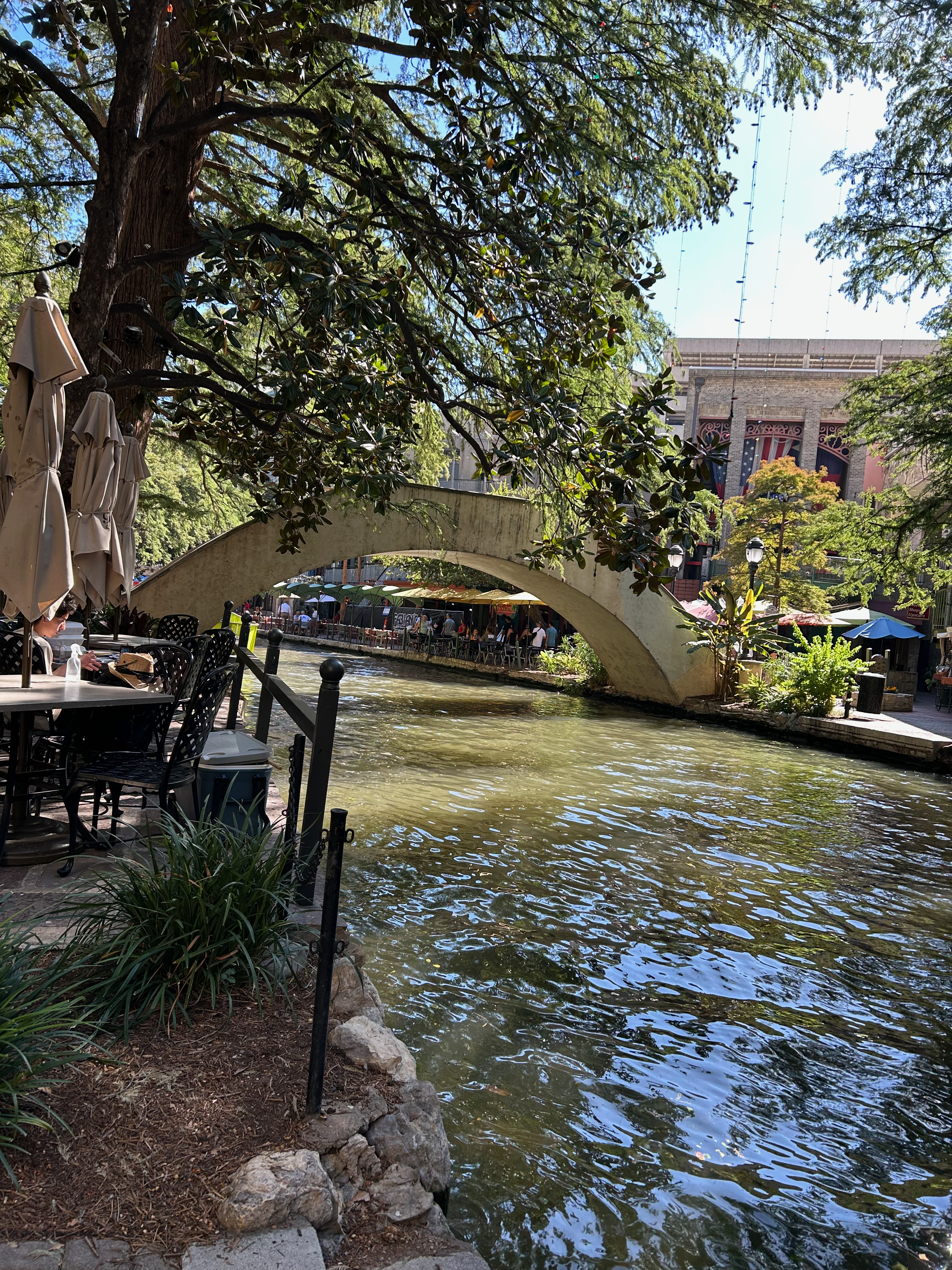
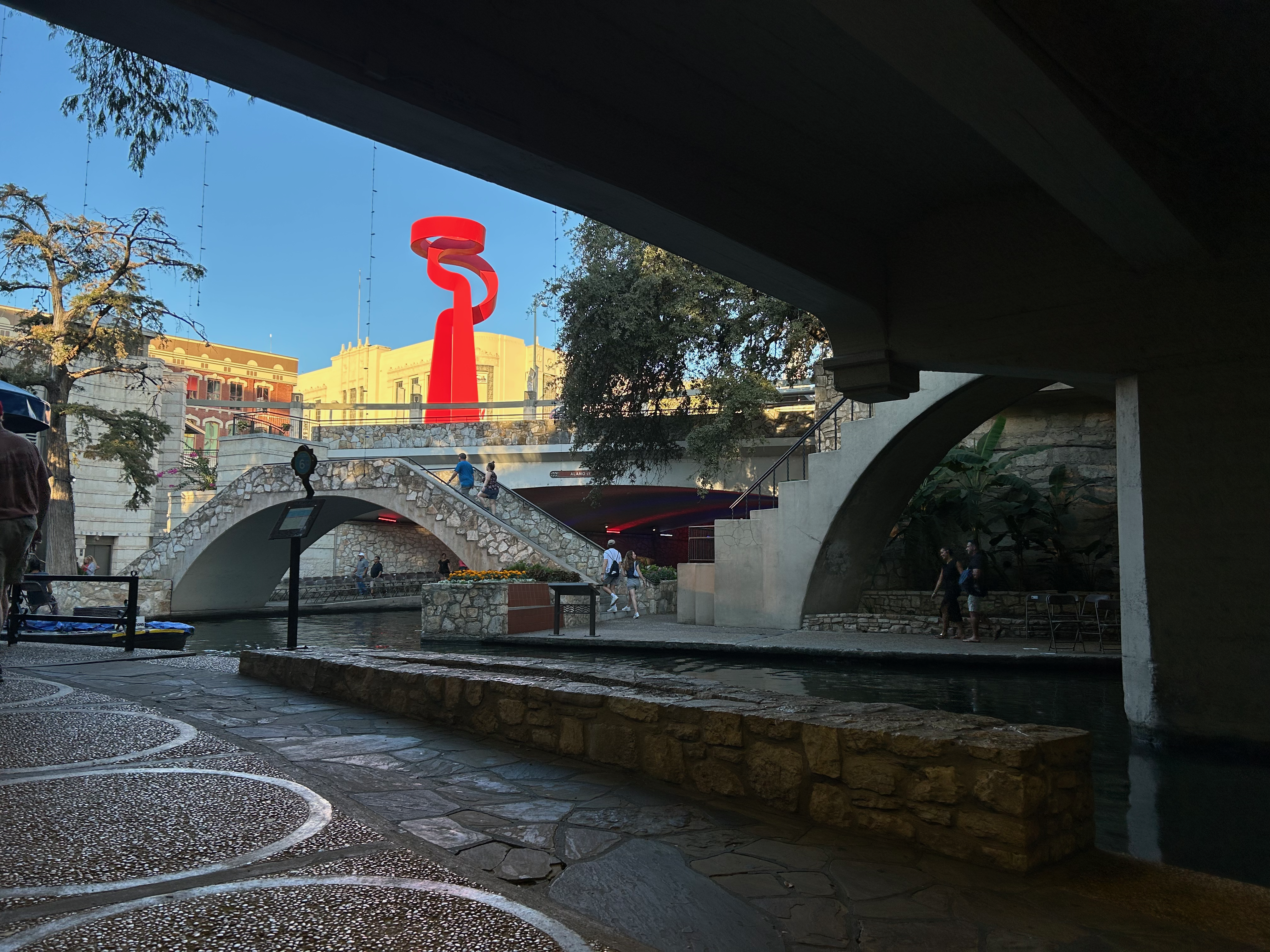
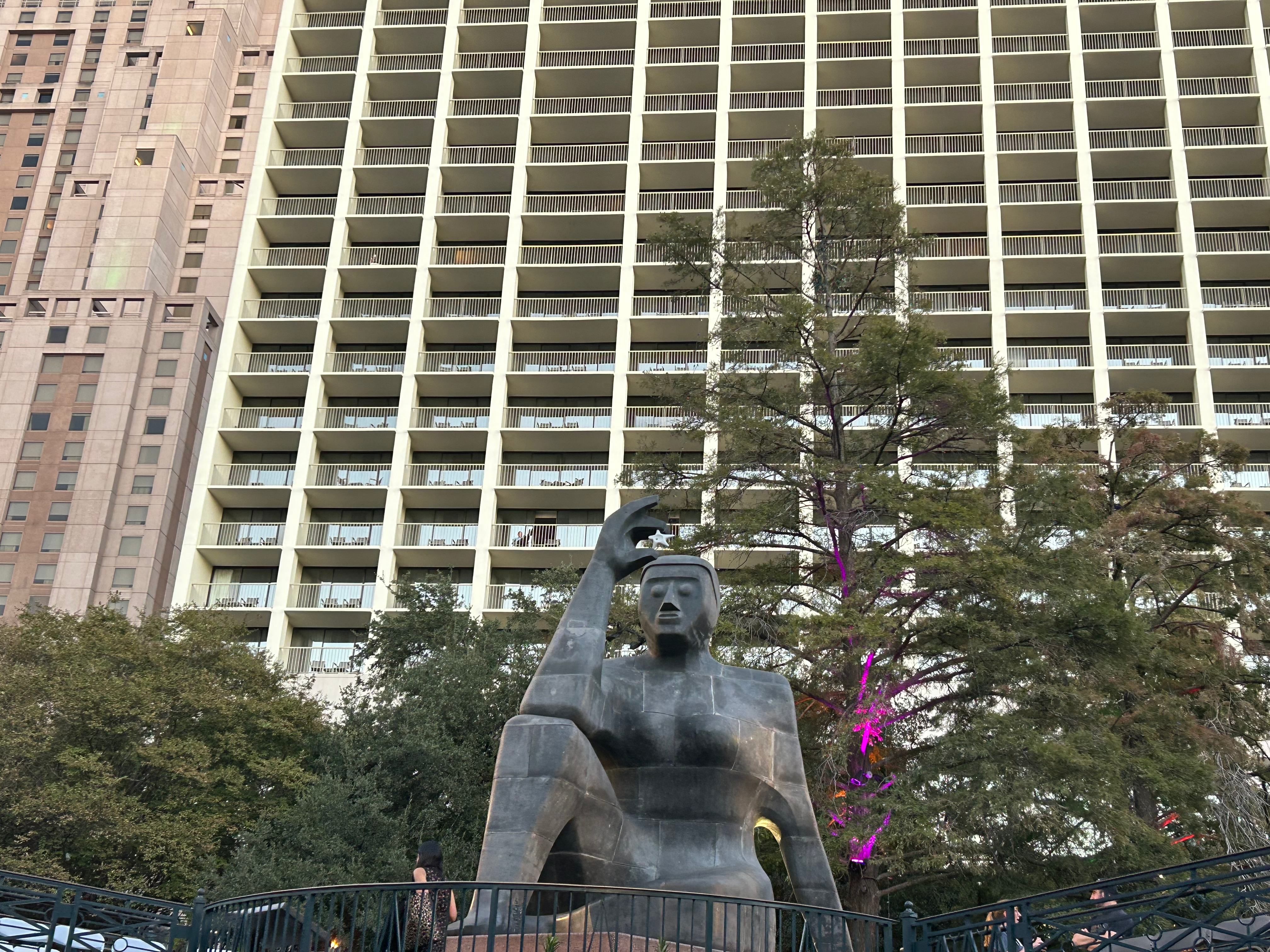
One of the finer parts of San Antonio is its river walk, which stretches along both banks of the San Antonio River through downtown and continues beyond the urban core as a series of foot and bike paths. We consistently saw mile markers for the river walk along our tour of the missions to the south of the urban core. Most evenings we walked from our hotel to the river and had dinner at one of the many restaurants that line its banks. My favorite of these meals were the enchiladas I had at the Original Mexican Restaurant, which was as touristy as it could get, I even paid a mariachi band to serenade my Mom with a song while we ate, yet it was still a delight.
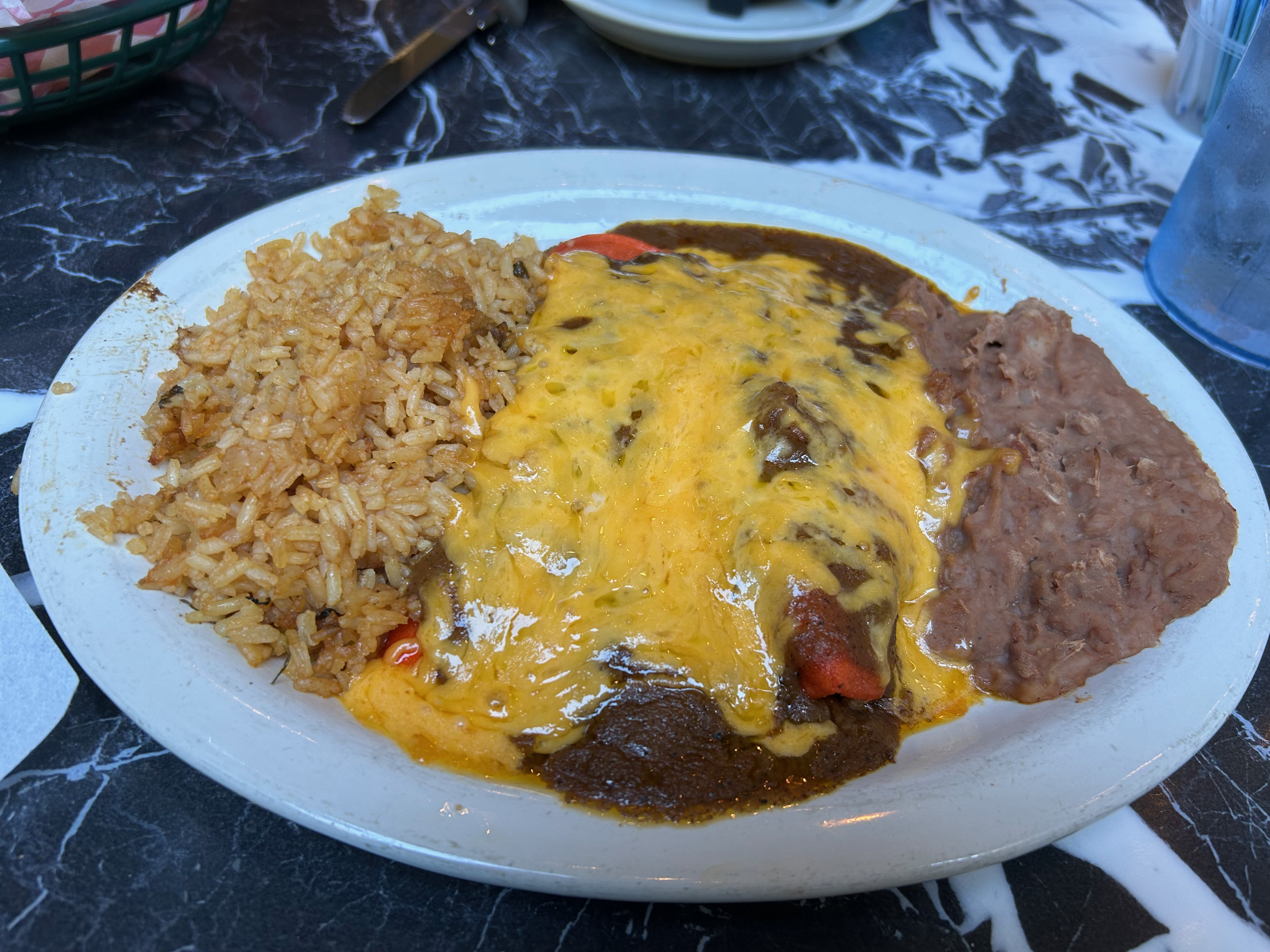
My enchiladas at the Original Mexican Restaurant

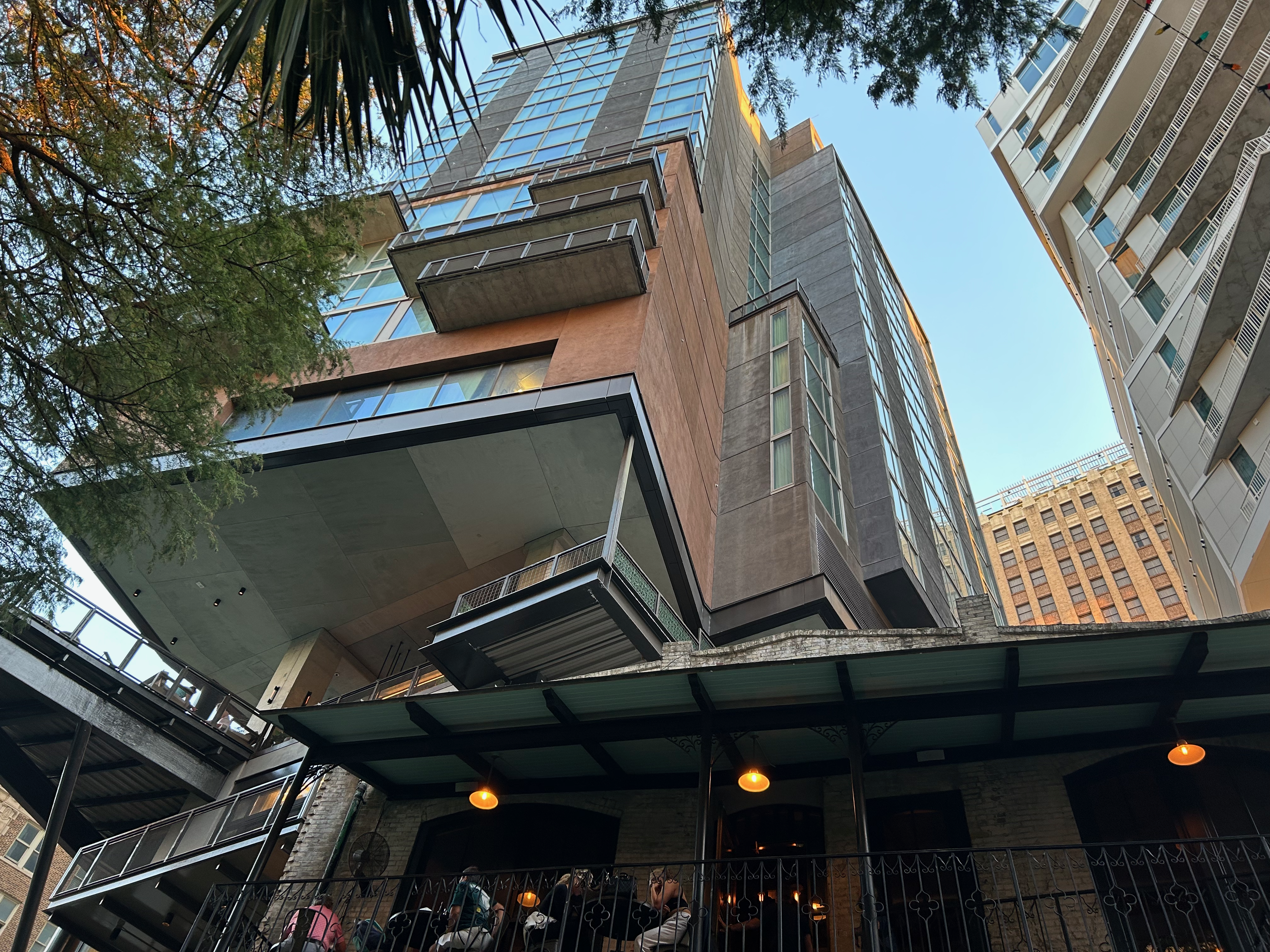
We stayed at the Menger Hotel, an old historic edifice of San Antonio that was built by William and Mary Menger, a pair of German immigrants who arrived in San Antonio in 1847, just three years after the Republic of Texas was annexed into the United States. They opened the hotel in 1859 hoping it would increase business for the family’s brewery. The hotel is located on Alamo Plaza next to the old Alamo mission, originally named the Mission of San Antonio de Valéro, and so was built on the battlegrounds of the Alamo. The plaza was largely under construction during our trip as a new Alamo Museum is being built. I was struck to find the street we crossed the last time we visited the Alamo was gone, replaced by a fully pedestrianized Alamo Plaza that will certainly improve the vibrancy of the neighborhood once the work is finished. Upon arrival we had lunch in the Menger Bar, famous as the place where Theodore Roosevelt gathered many of the men who would sign up to join his Rough Riders in 1898 to go fight in the Spanish American War in Cuba. The bar and the hallway just beyond it are full of T.R.’s relics.
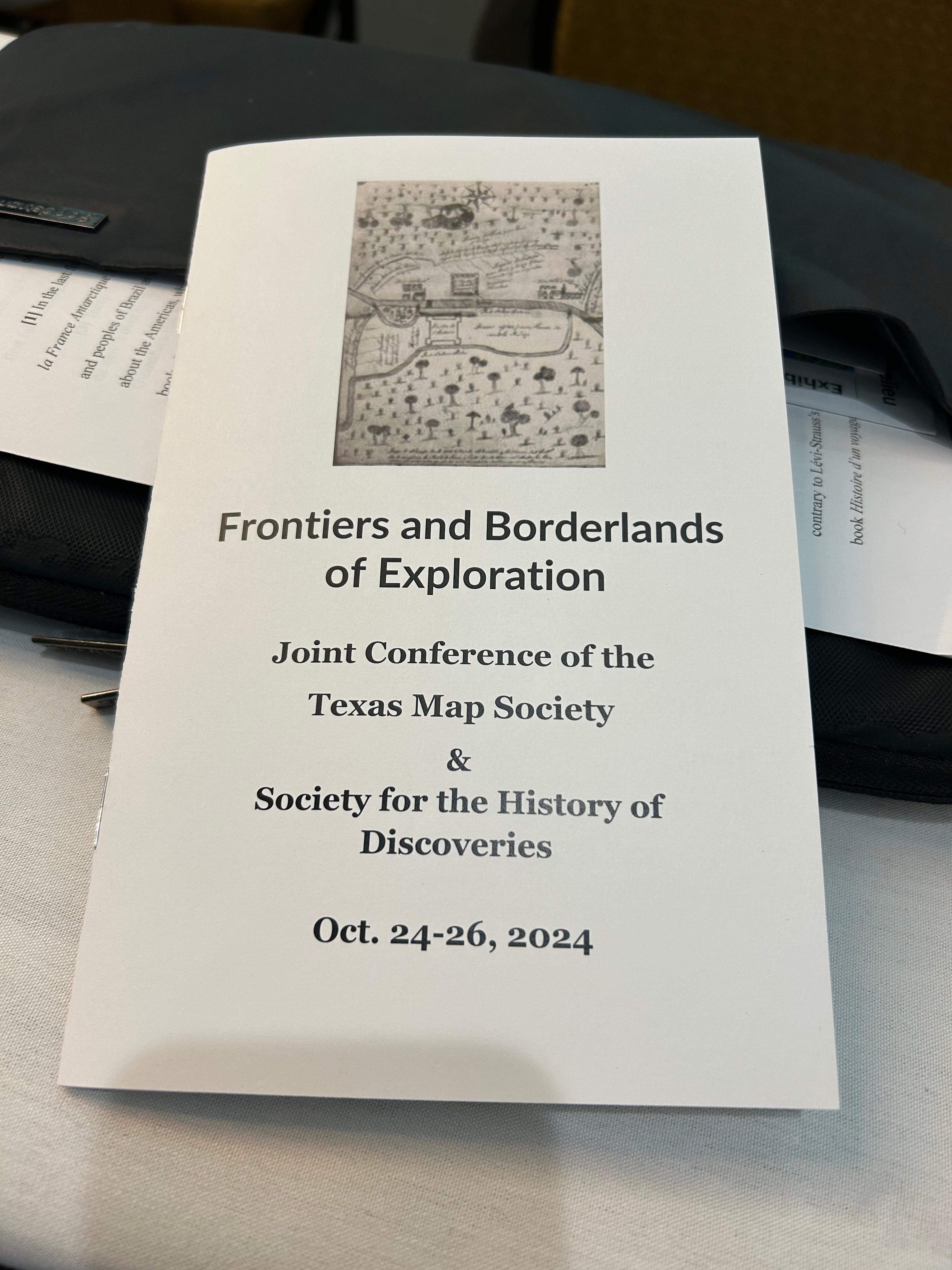
The Menger was host this year to the annual meeting of the Society for the History of Discoveries (SHD) which met alongside the Texas Map Society. I didn’t attend the Texas Map Society meeting on Thursday, instead choosing to go tour the missions with my Mom but was delighted to get to meet the other members of the SHD who I only knew to that point through our email correspondence. I presented on Saturday morning, mine was the first paper to be read that day. In my paper, I discussed how André Thevet tried to synthesize eyewitness testimony from two other explorers: Antonio Pigafetta’s account of Patagonia and Francisco de Orellana’s account of Amazonia with his own account of Brazil to create a full cosmography of the Americas as they existed at the time he wrote his Singularities of France Antarctique in 1557. In the sixteenth century, the word cosmography referred to the amalgamation of cartography, ethnology, geography, and natural history to craft as full a narrative about the known world as possible. As a part of my dissertation research, I translated Thevet’s Singularites from Middle French into Modern English and am now applying for postdoctoral fellowships that can help me finish the job of preparing to submit my translation for publication by an academic press.
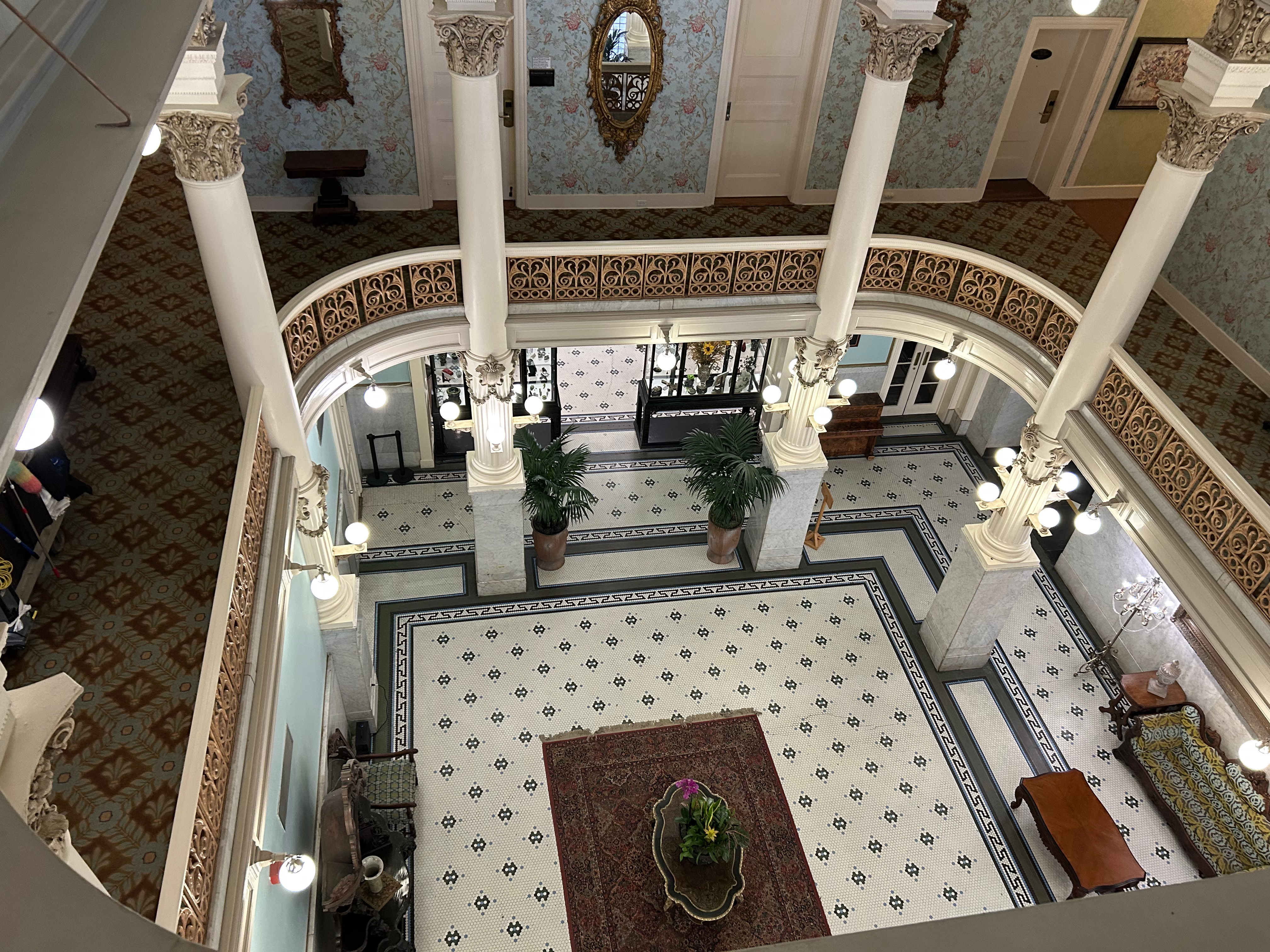
The Menger’s Victorian Lobby

I truly loved my time in San Antonio this Fall, and like the other two cities I visited for these three conferences I would’ve been happy to spend more time there. On Saturday evening, we drove north to Austin to see friends who I hadn’t seen since the recent pandemic. I was struck by the stark differences between San Antonio, the old Tejano city, and Austin the gleaming new metropolis driven by tech money. Still, on Sunday, 27 October we returned home on the only direct flight you’ll hear about in this week’s edition of the Wednesday Blog. I had two days at home, during which I worked both days, before heading out again.

Toronto
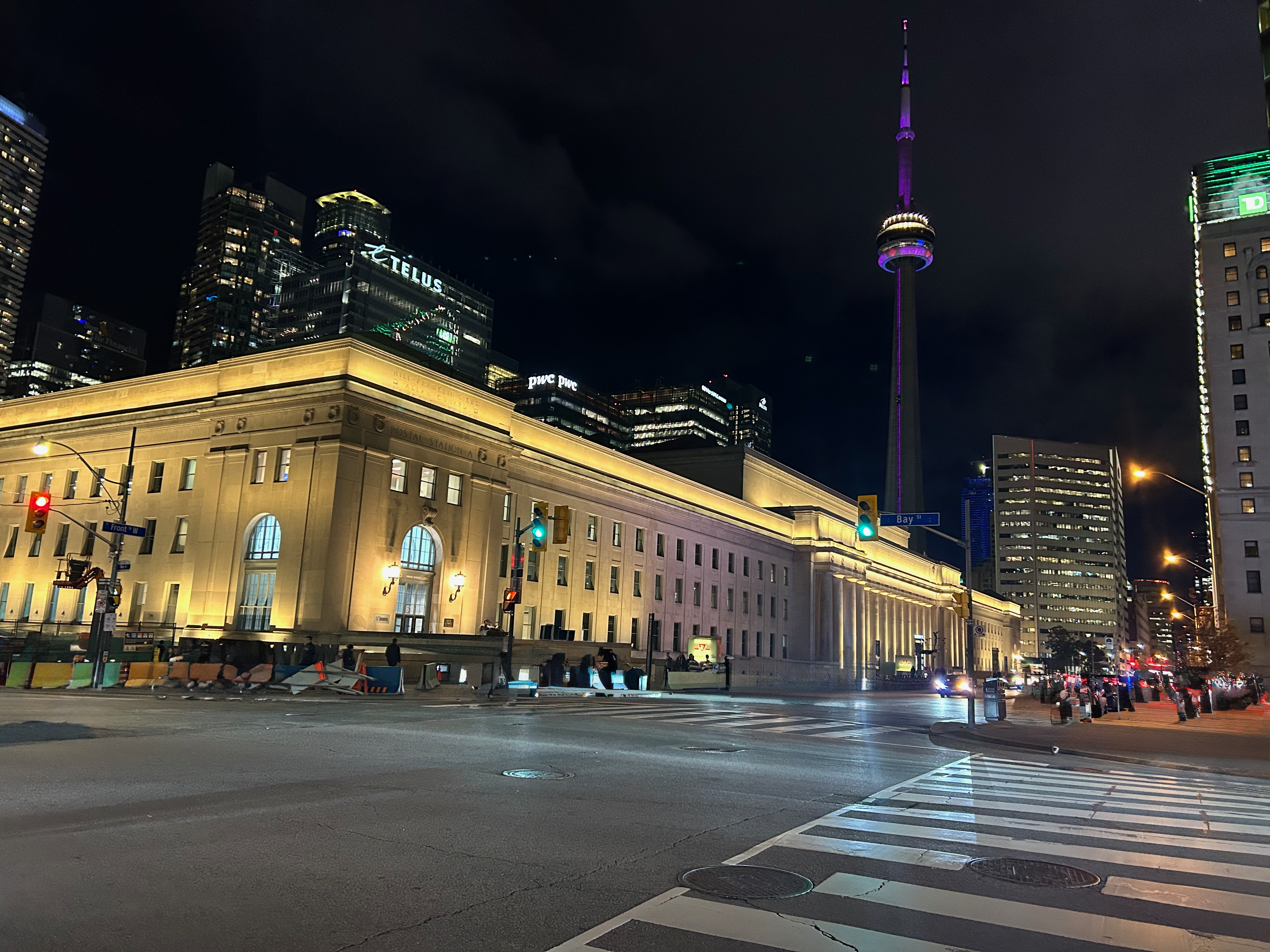
Toronto’s Union Station with the CN Tower looming behind it.

This time, I traveled to the Great Lakes region and back to one of my favorite cities that I hadn’t been able to visit since 2019. Toronto is not only the largest city in Canada today, it is also like San Antonio a crossroads, yet this is a place where Canada, the United States, and the many immigrant communities with ties to the Commonwealth and the old British Empire meet. I’ve often thought of Toronto as a city similar to my original hometown of Chicago, just cleaner and with a very different set of immigrant communities owing to Canada’s longer connections to Britain and the Empire than our own. I had a 4 hour connection in Chicago at O’Hare Airport, during which time I walked the full length of Terminals 1, 2, and 3, a good 5 km at least to pass the time. Terminal 1 retains its fine 1980s architecture, the soft whites, blues, grays, and blacks from its tile floor and steel frame still as it always has been. Terminals 2 and 3 however need some work. I was struck by how dark and drab Terminal 3 seemed; this is actually one reason why I fly on United instead of American, I would rather connect at O’Hare in Terminals 1 or 2 than in Terminal 3 just for the nicer architecture of Terminal 1.
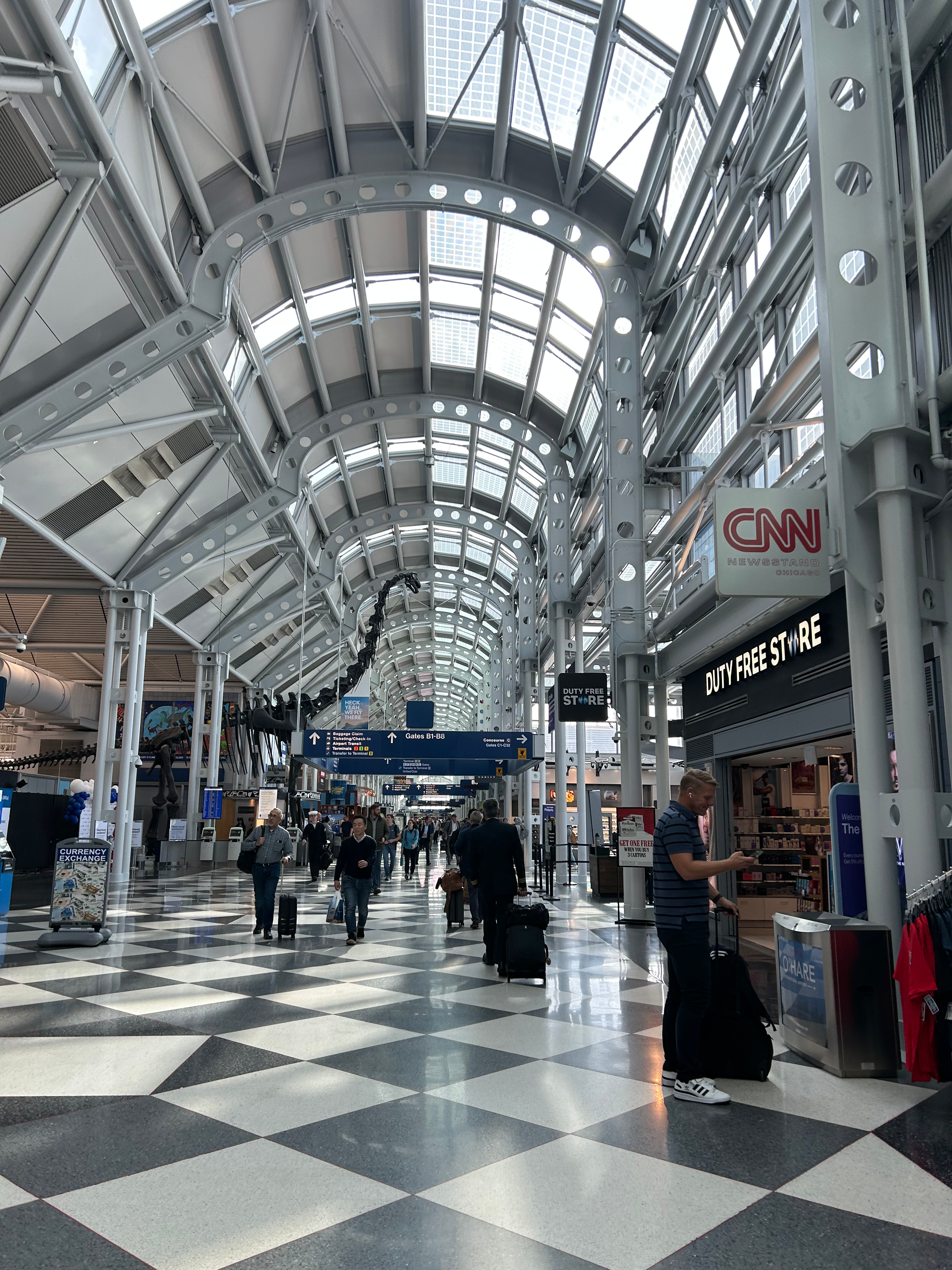
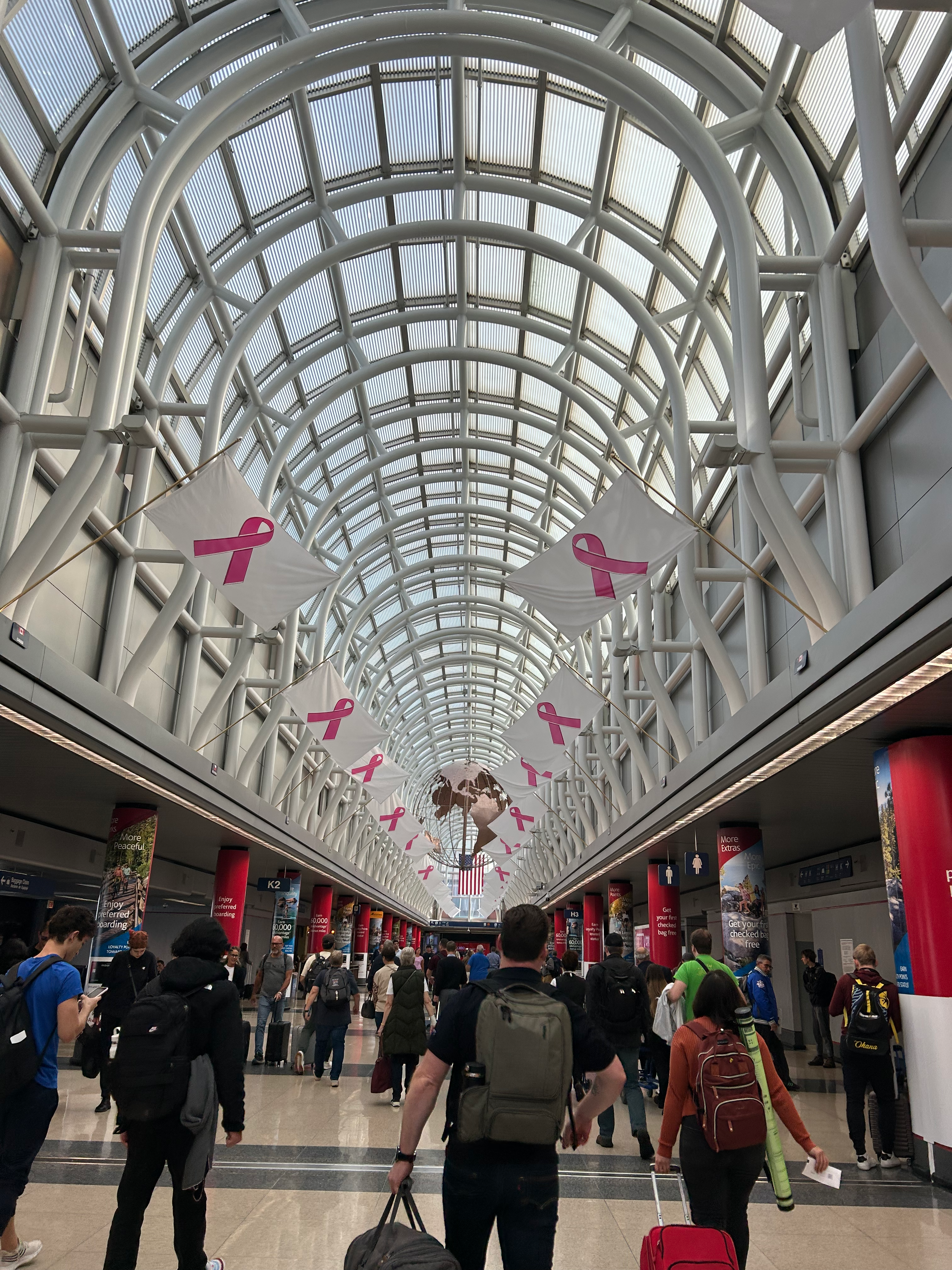
O’Hare Terminal 1 (left) and Terminal 3 (right).

I arrived in Toronto later in the evening on Wednesday, 30 October and took the UP Express train from Pearson Airport into Union Station, near which I was staying with a friend, Hariprasad Ashwene. Toronto reminded me more of Austin with its gleaming towers, though that is more of the North American standard that the urban core should have skyscrapers to make the most of what little land is available. The biggest thing about that city which struck me was that compared to my previous visit almost 5 years to the day beforehand, was how much warmer it was there. The last time I’d walked through Queen’s Park at the end of October it had been snowing. This time though, I only had to wear the sweater I’d brought on the last day of my trip when the warm weather that our continent had basked in began to fade. On the day I landed, Kansas City experienced its first rain in nearly 2 months, yet that rain came with high winds, thunderstorms, and tornadoes across the Great Plains and Midwest and resulted in both of my flights that day being quite bumpy with hard landings across the board. 
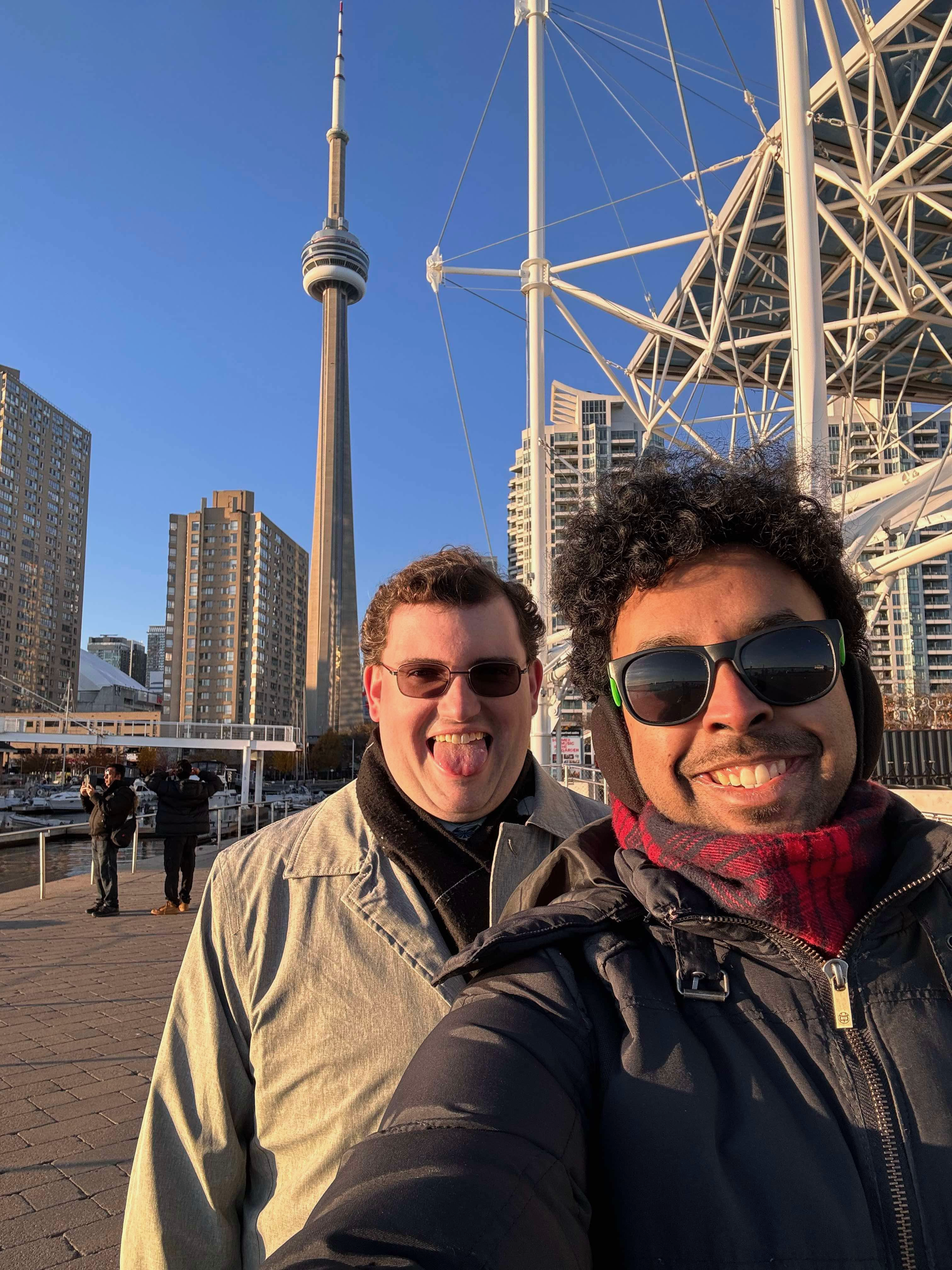
Hari Prasad and I on the lakeshore.

These are all clear signs of climate change, and it baffles me that we aren’t doing more about it. This trip, just like the San Antonio one, would have made a decent one by high speed rail. From Kansas City I would’ve again connected in Chicago before heading northeast to Toronto via Detroit. As it stood, I saw my second flight fly over the Ambassador and Gordie Howe Bridges connecting Detroit with Windsor, Ontario on that northeasterly route. To San Antonio, it would’ve required a connection probably in Fort Worth which seems to be Amtrak’s big future Texas hub based on the Federal Railroad Administration’s (F.R.A.) Amtrak Daily Long-Distance Service Study released in March of this year.

I traveled to Toronto to participate in the annual meeting of the Sixteenth Century Society (SCS), the one conference that I’ve attended year in and year out the longest. My first trip to the SCS was in 2019 when we met in St. Louis. That was also the last conference where I presented research derived from my History Master’s thesis written at the University of Missouri-Kansas City (UMKC). This time, I was presenting a very similar paper to the one I’d presented in San Antonio, only instead of looking at Amazonia and Patagonia I turned to specific animals which Thevet described in his Singularites that he himself did not see and try to trace the origins of what he wrote. 
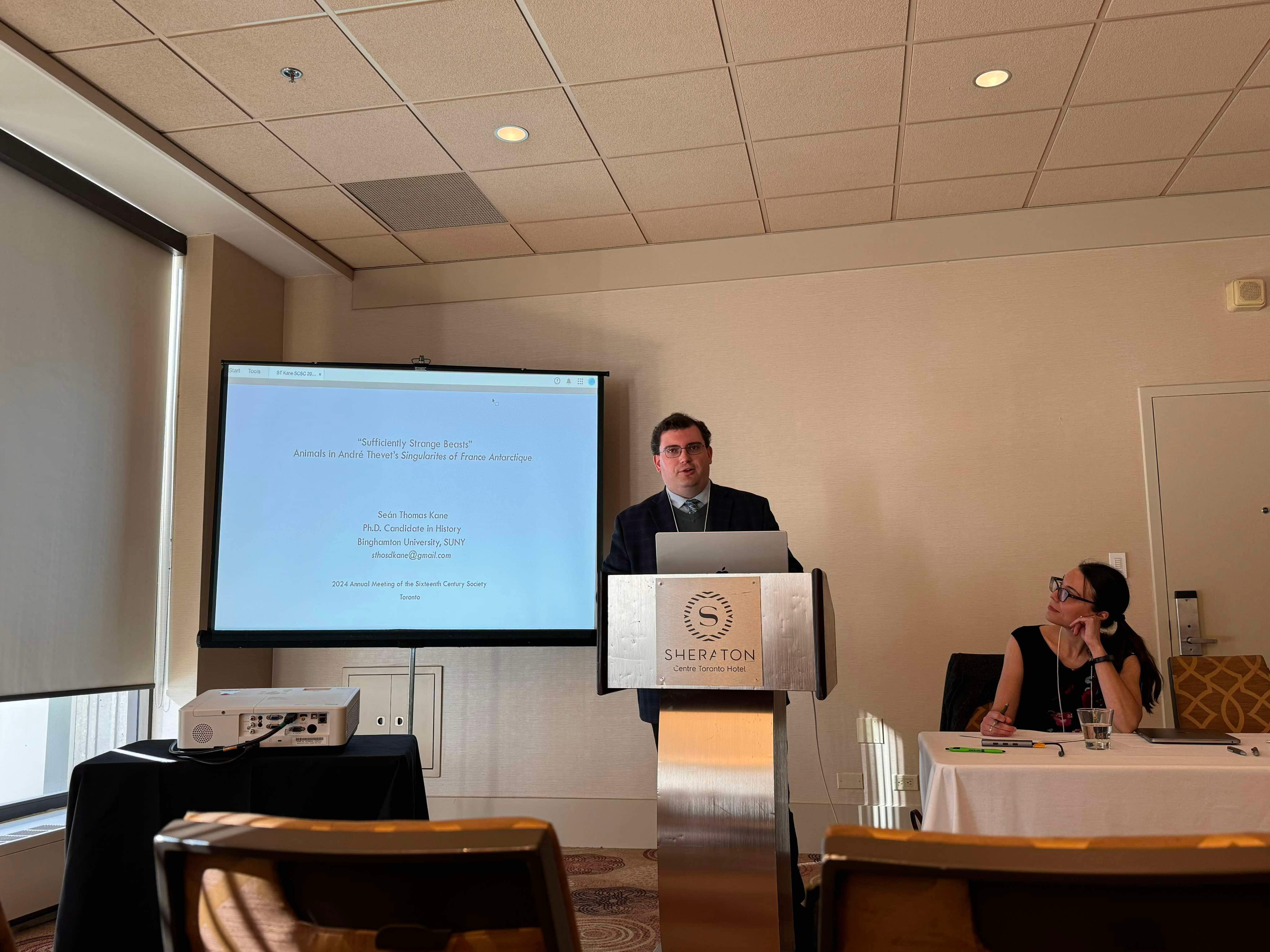
Speaking at the Sixteenth Century Society’s 2024 Conference at the Sheraton Centre Hotel in Toronto.

The first of these two was the manatee (Trichechus manatus), which Thevet described living in the Florida Straits. His manatee account was drawn directly from the one that appears in Book 13 of the Historia General y Natural de las Indias written in 1535 by the Spanish naturalist Gonzalo Fernández de Oviedo y Valdés (1478–1557). The second was an account of a wild and hairy American bull, what we today know as the American bison (Bison bison) which Thevet drew from Giovanni Battista Ramusio’s (1485–1557) recounting of Oviedo’s recording of the Relación written by the conquistador Álvar Núñez Cabeza de Vaca (c. 1488–1559). Cabeza de Vaca was one of only a handful of survivors of a failed Spanish expedition to explore and claim territories north of New Spain in the deserts and mountains of the Mexican-American borderlands. In San Antonio then I was delighted to hear a presentation given by a professor at Texas A&M Corpus Christi and one of his former students, a local high school history teacher earning his Ph.D. at the same university in secondary education, about a course the professor taught on Cabeza de Vaca’s travels in Summer 2020. I spoke with the high school teacher the following day about my own presentation that was coming up the following weekend in Toronto whether I was correct in placing Cabeza de Vaca’s bison sighting in South Texas near Corpus Christi Bay along the Nueces River. He did confirm that it was a probable place where that could’ve happened, and so armed with this new affirmation I gave what became one of my best public talks to date at the SCS. It turned out though that I missed one link in the chain, for Thevet’s bison picture originated in the 1555 Cronica de la Nueva España written by Francisco López de Gómara (1511 – c. 1566).
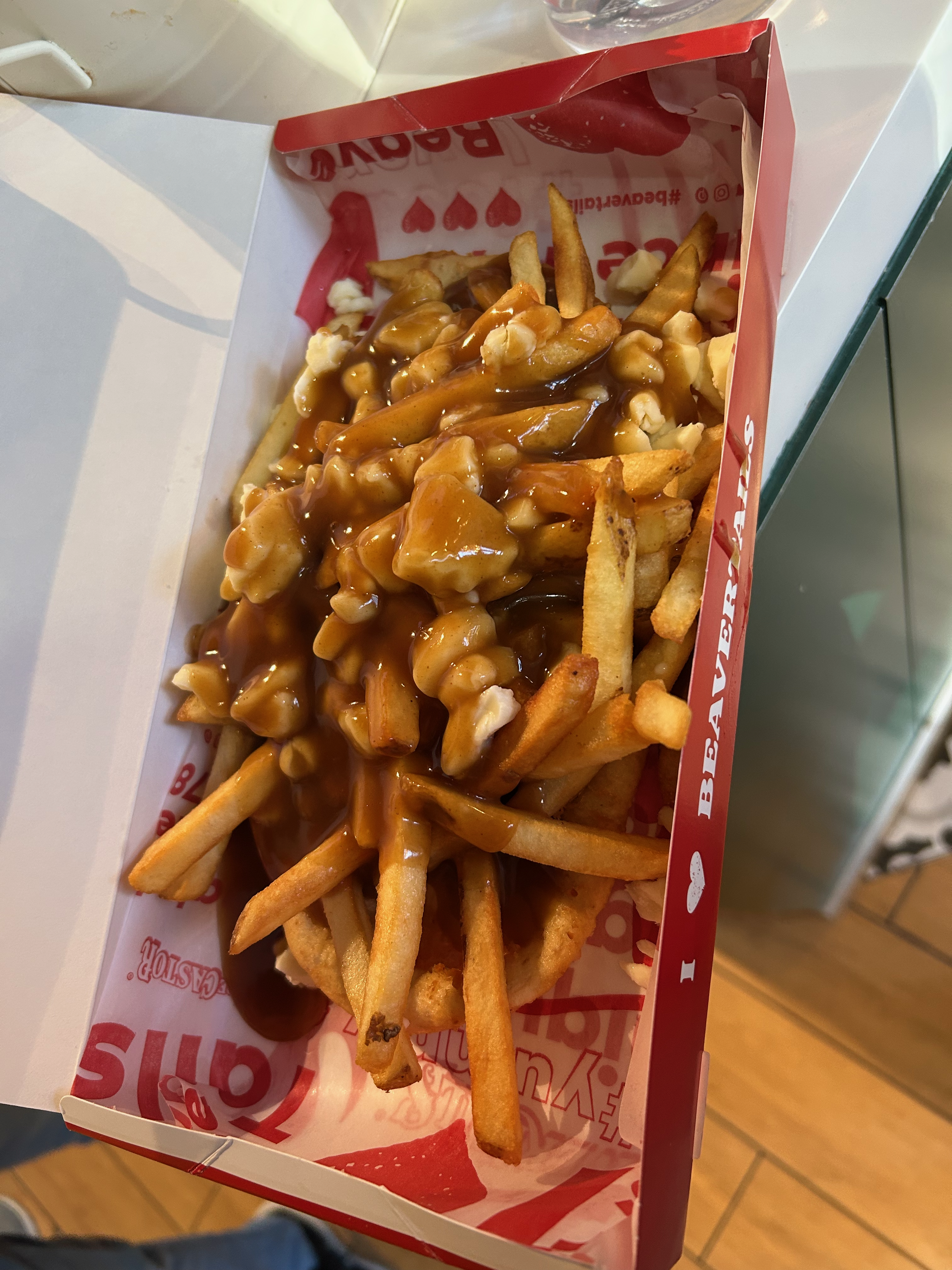
The famed poutail from Beaver Tails.

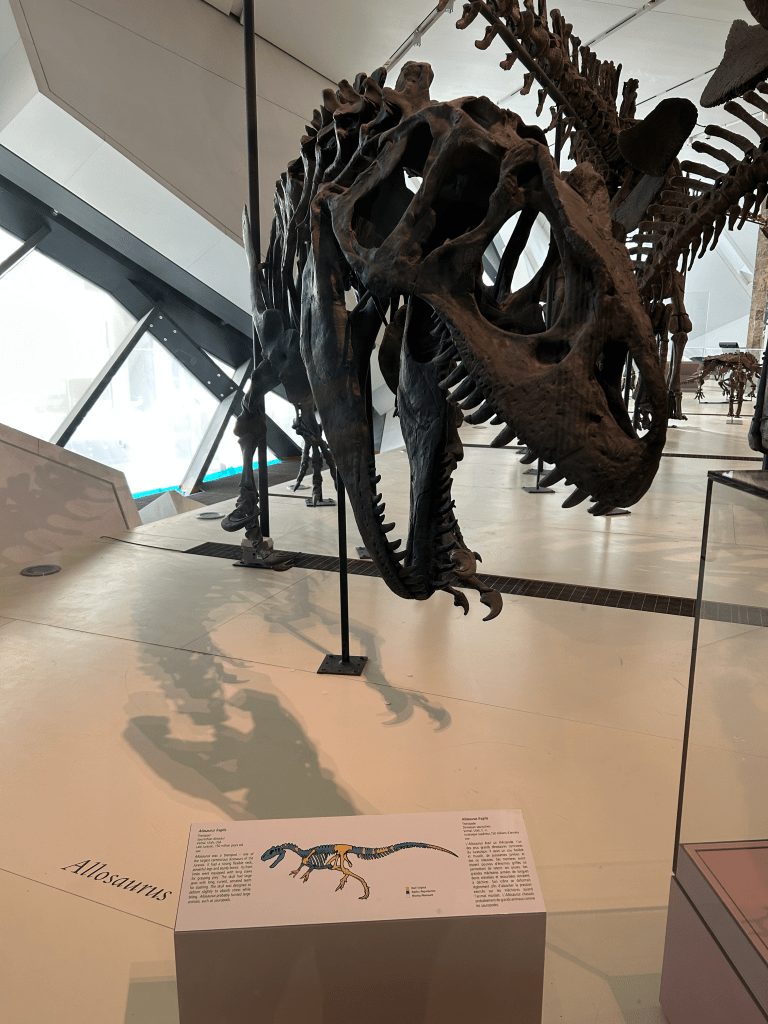
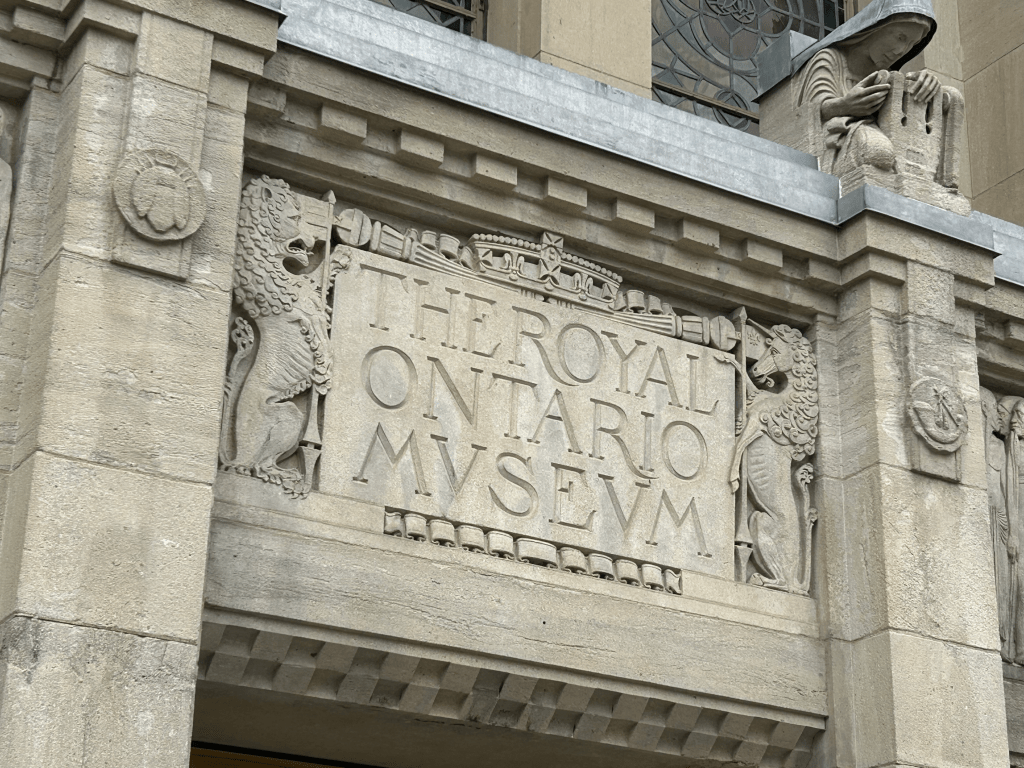
While in Toronto I took some time to enjoy that city. I visited the Royal Ontario Museum (ROM) on the morning of All Saints’ Day, the Friday of that week. The ROM is in my opinion one of the better museums in North America, and a good marriage of natural history with human history and archeology. I like how if you climb the stairs there you have to go past the paleontology and zoology portions to get up to the galleries exhibiting artifacts from human cultures past and present. It really demonstrates that we are all a part of this same natural world, no matter how unnatural our inventions may become. On Saturday, before my talk Hari Prasad and I visited the Art Gallery of Ontario (AGO), where the medieval and early modern European art and Canadian art are the two main highlights. That afternoon after presenting we spent a good bit of time walking along the lakeshore and seeing some of the natural beauty of that city. Lake Ontario is far narrower than Lake Michigan, and so whereas you can only really see the opposite shore from the top of the Sears, now Willis Tower, you can see Niagara and Upstate New York from the tops of Toronto’s highest lakefront towers, as they are just under 100 miles (161 km) to the south. I ate a lot of poutine in Toronto, though less than the last time I visited. I even tried a poutail from the ice cream shop called Beaver Tails on the Harbourfront, which was poutine placed atop a frybread baked into the shape of a beaver tail. It was good, though it did attract a large audience of birds.

My Torontonian visit was about the right length, and in the circumstances of the world as they were that week where my mind was less on the current moment in Canada and more on the next trip to Mexico and the election due to be decided in the days in between I was ready to be home.

Mérida
I left home again at 5:00 am on Wednesday, 6 November, knowing the overall result of our elections had taken a sorry turn that will only be fully understood after these next four years are over. Because of the result I didn’t want to travel that morning, rather I wanted to stay home and close to my family. I was distraught and in no mood for another adventure. Yet an adventure is what was in store, and I took the first flight out of Kansas City on United to Houston’s Bush Intercontential Airport at 6:30 that morning. I’m not sure if it’s because of the flight schedules between Kansas City and Houston on United or if it’s because of the ones between Houston and Mérida but I had excessively long connections on both my outbound and return flights on this trip. On the way out, I spent 8 hours in the United Club close to the gate where my Mérida bound flight left from that evening. I was delighted to see several familiar faces on my Mérida flight, a good half if not 2/3rds of the passengers on that flight were fellow historians on their way to the History of Science Society’s centennial conference at the Fiesta Americana Hotel in Mérida.

After we landed my inadequacies in Spanish made themselves well and clear from the first moment. I gave the driver who picked me up at the airport the wrong address, and ended up at a hotel 2 miles (3 km) from where I was supposed to be. I ended up getting an Uber to take me to the correct place, arriving there close to 21:30, and was able to get dinner from the hotel kitchen by 23:00. Exhausted, I had a quick sleep before waking early around 06:00 and walking the 5 minutes north to the Fiesta Americana where I exchanged 45 dollars for around 850 pesos, got breakfast, and met more people who like me were going on the Thursday tour of the Mayan city of Uxmal, whose ruins are about 45 minutes drive-time to the south of Mérida. Mérida is a Spanish colonial city built atop an older Mayan city named Ti’ho. The Cathedral of San Ildefeonso in the city’s central plaza was built using stones from the older Mayan pyramids that were once found here.
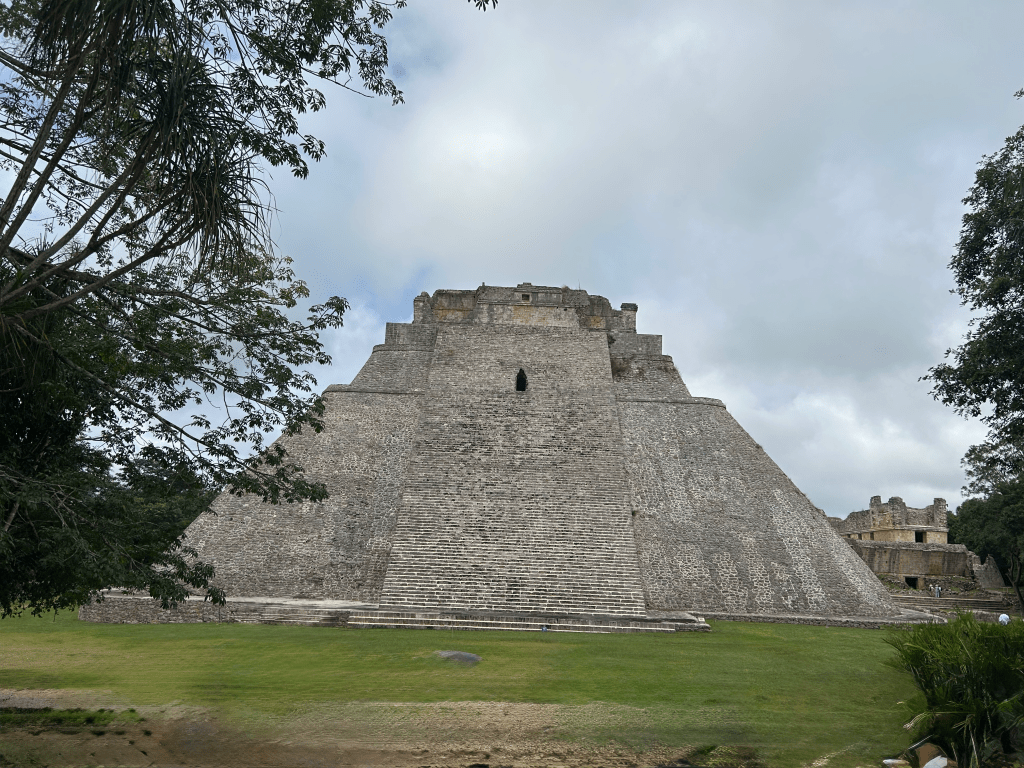
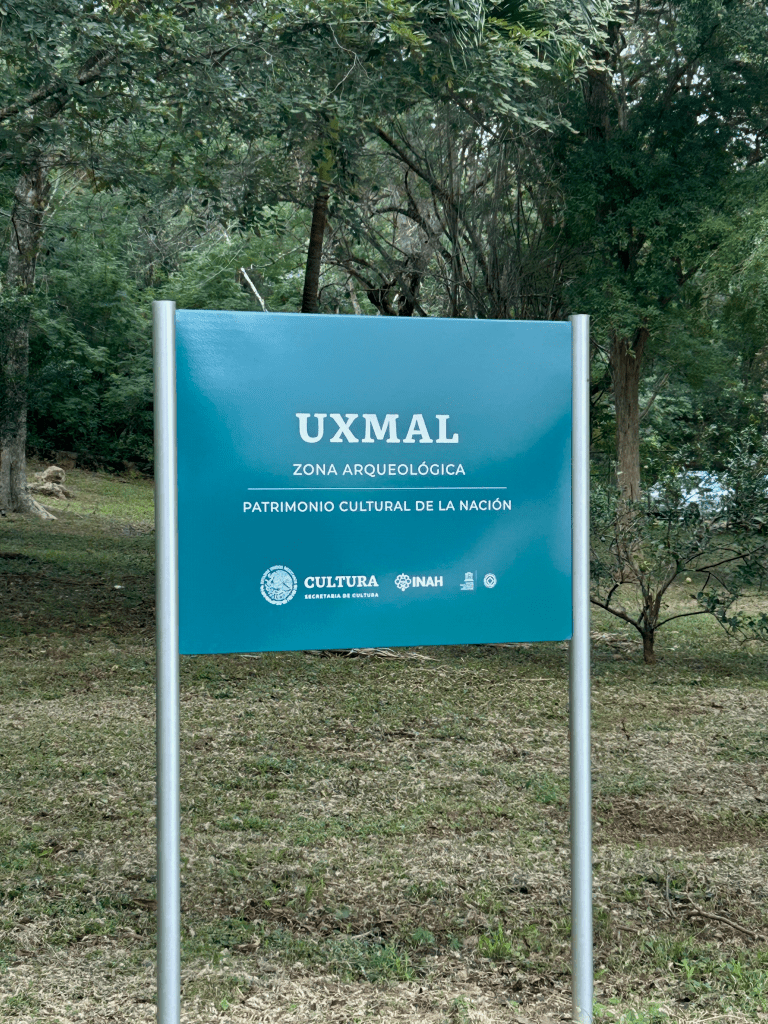
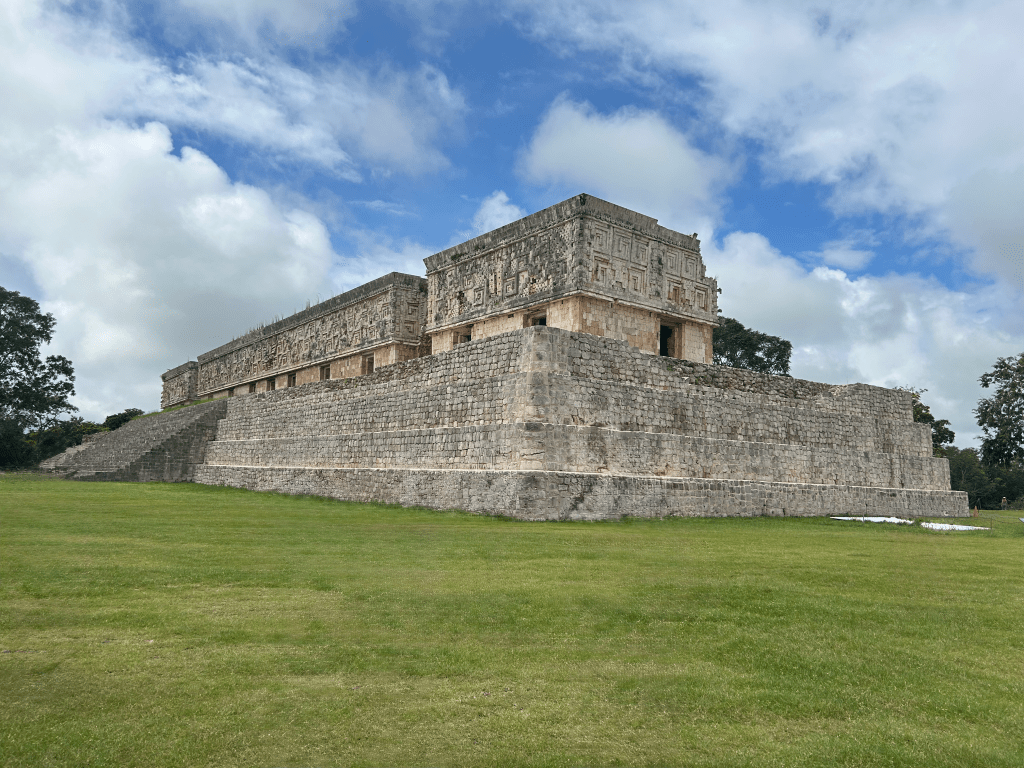
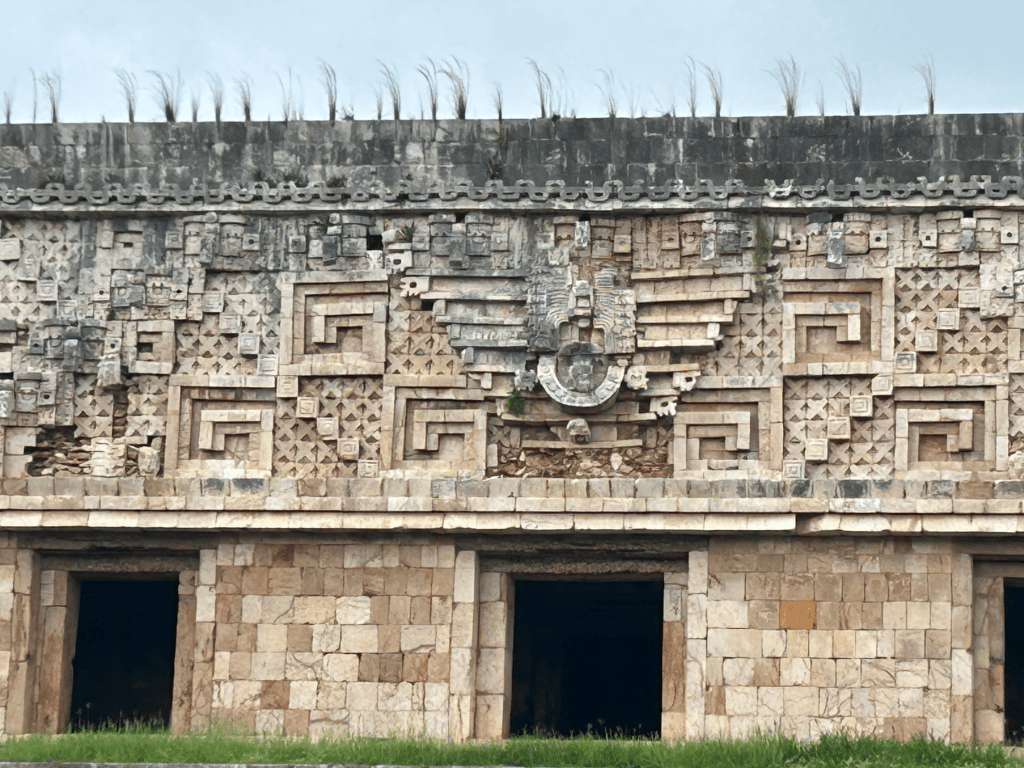
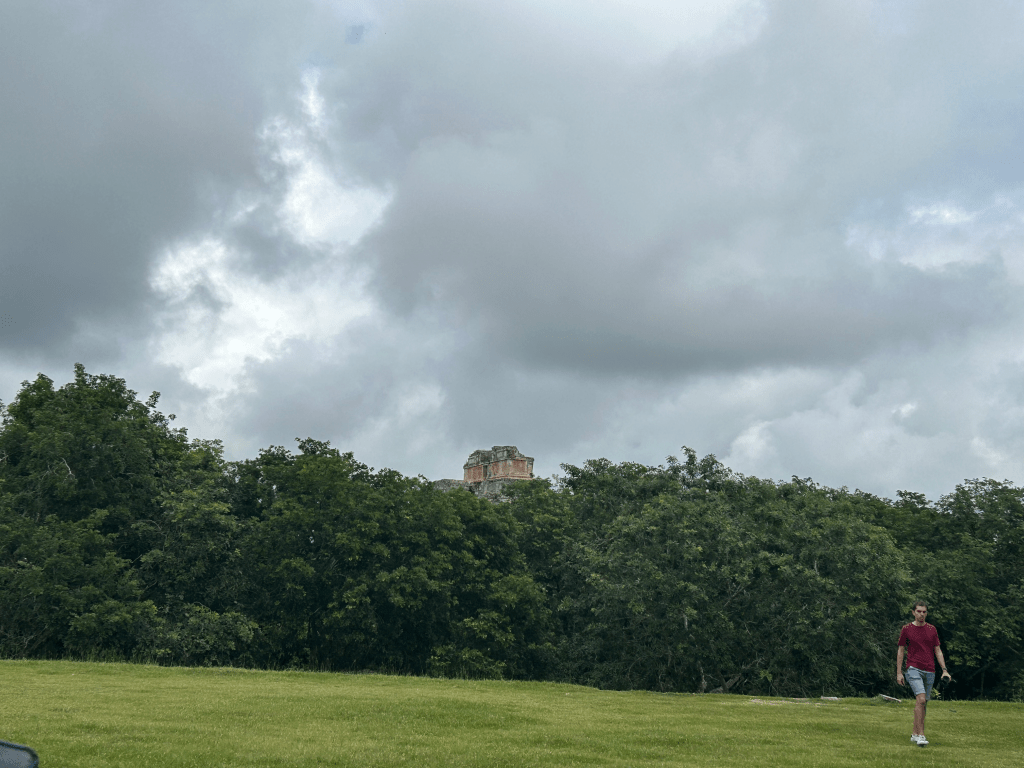
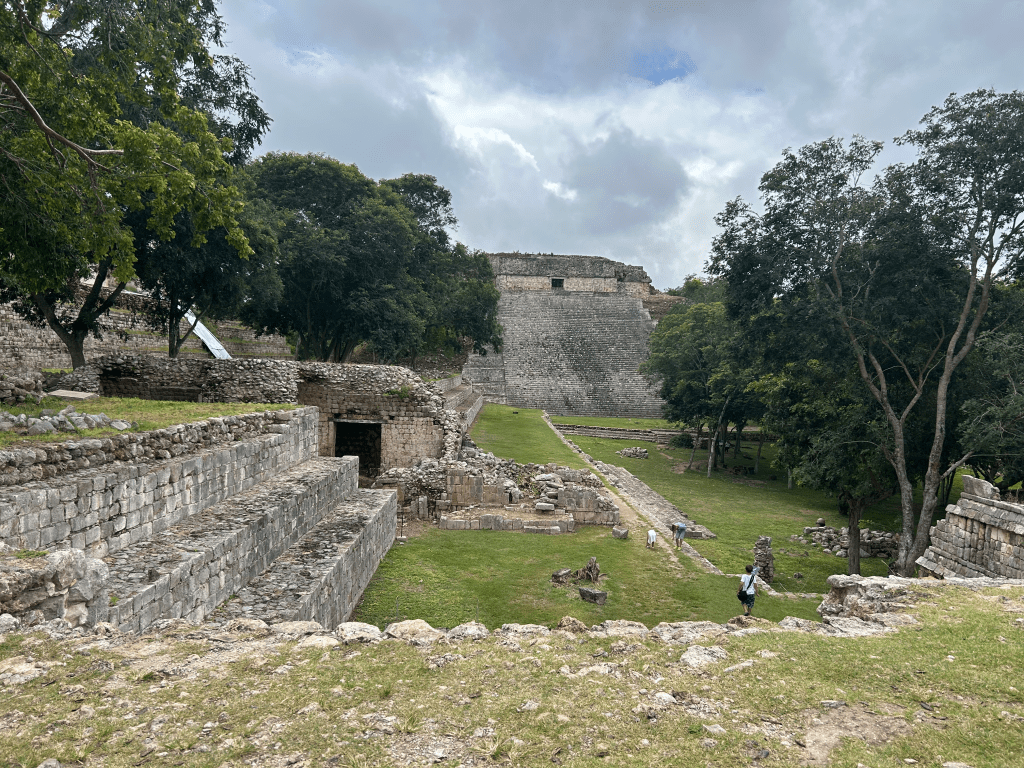
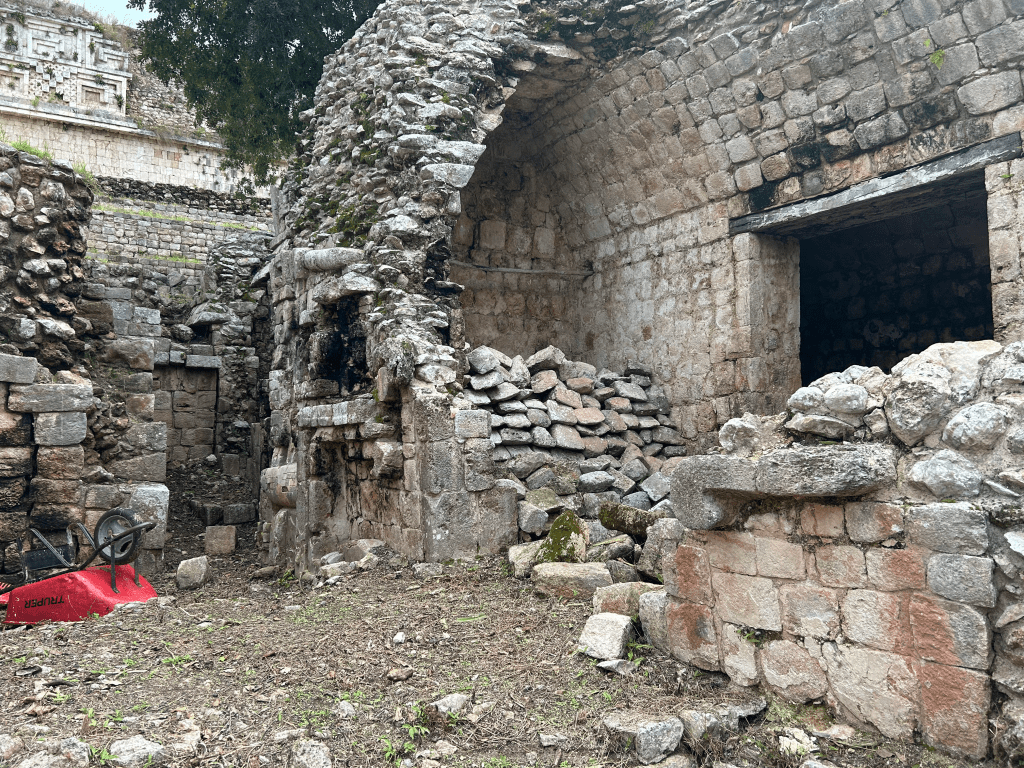
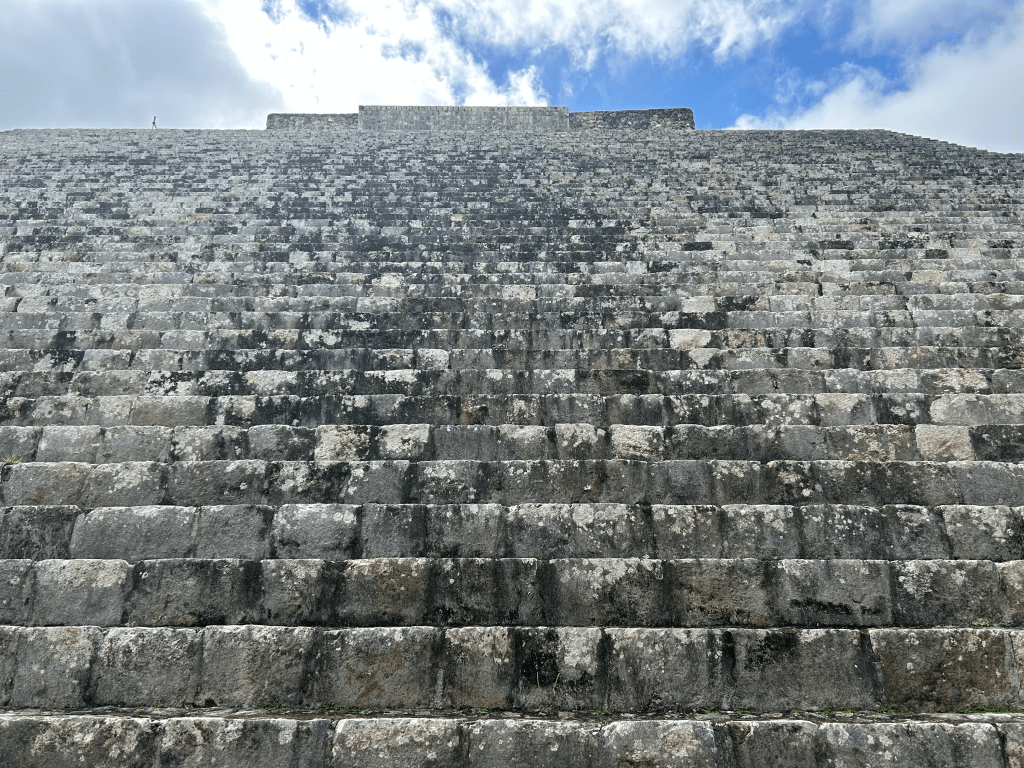
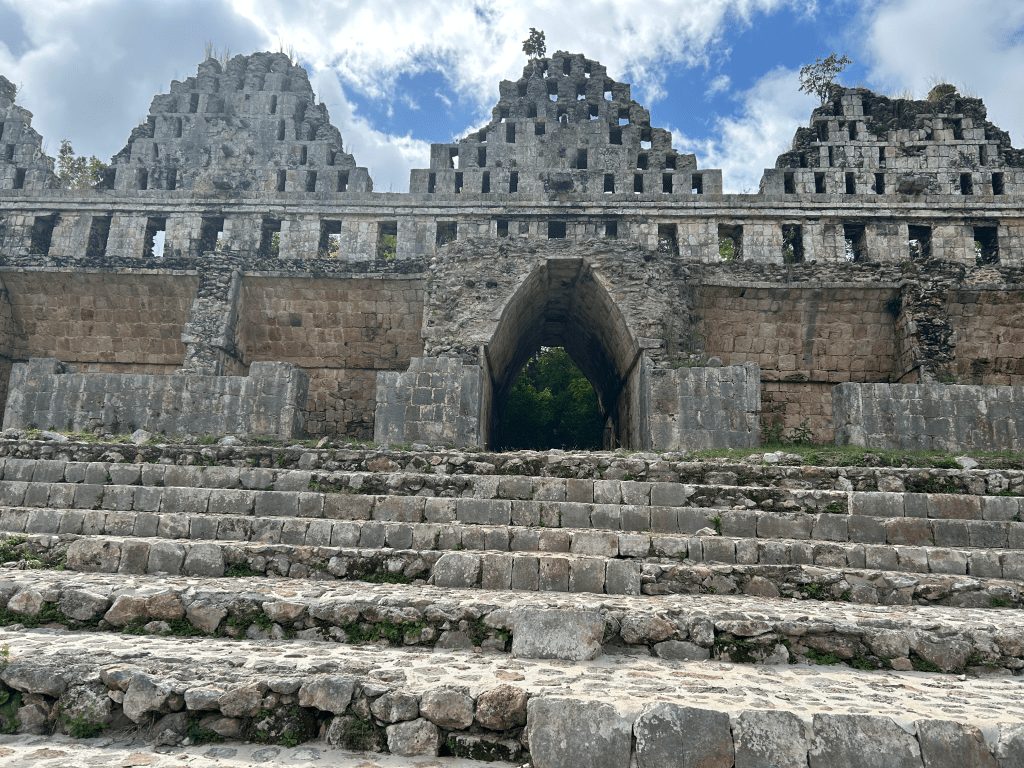
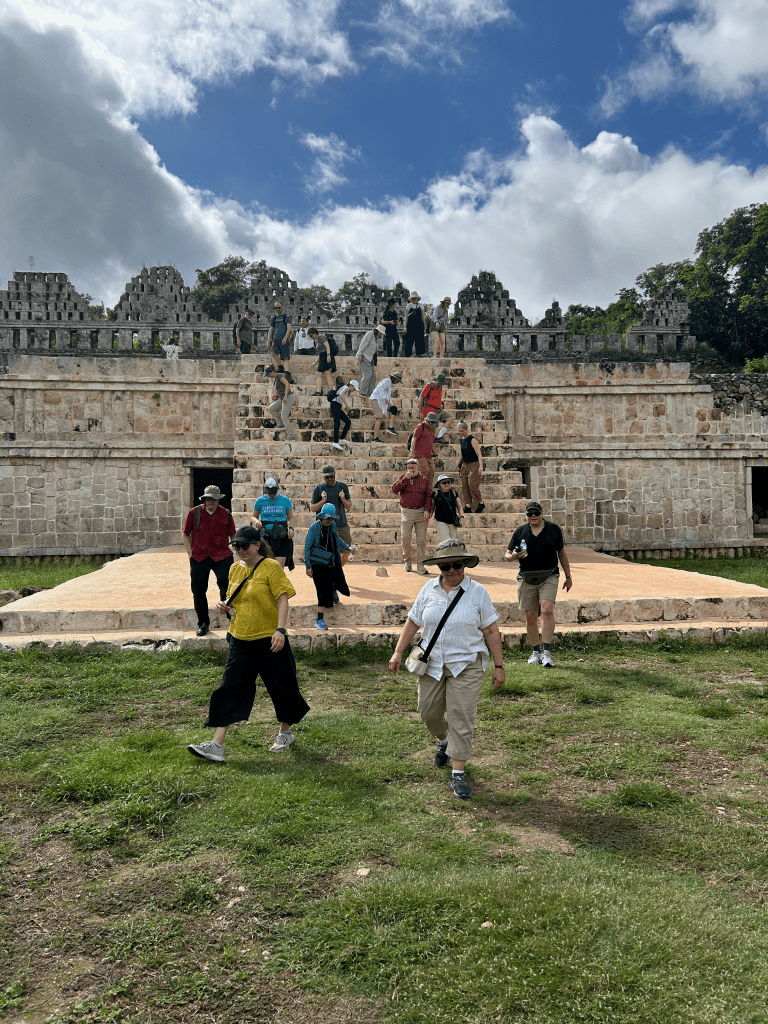
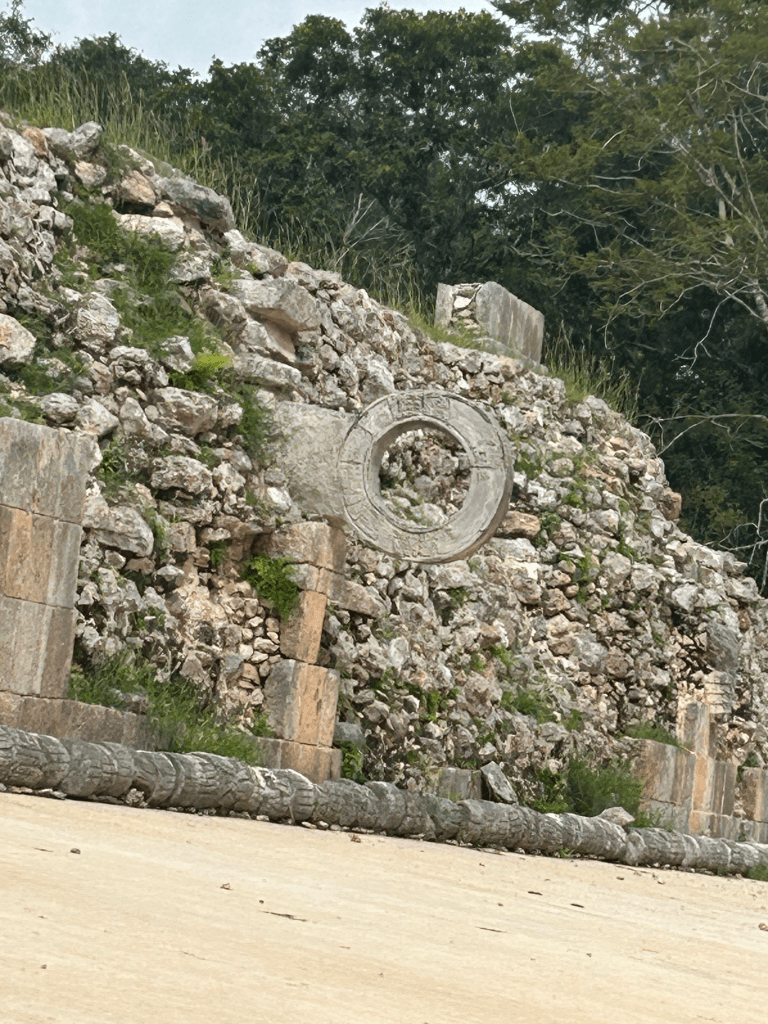
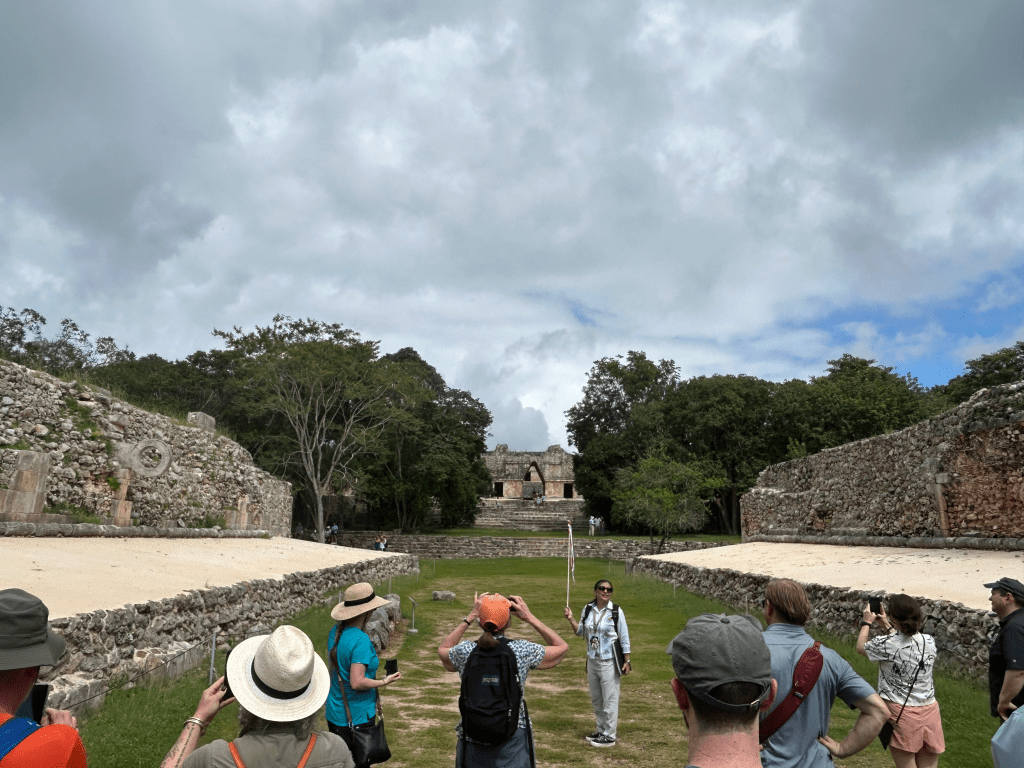
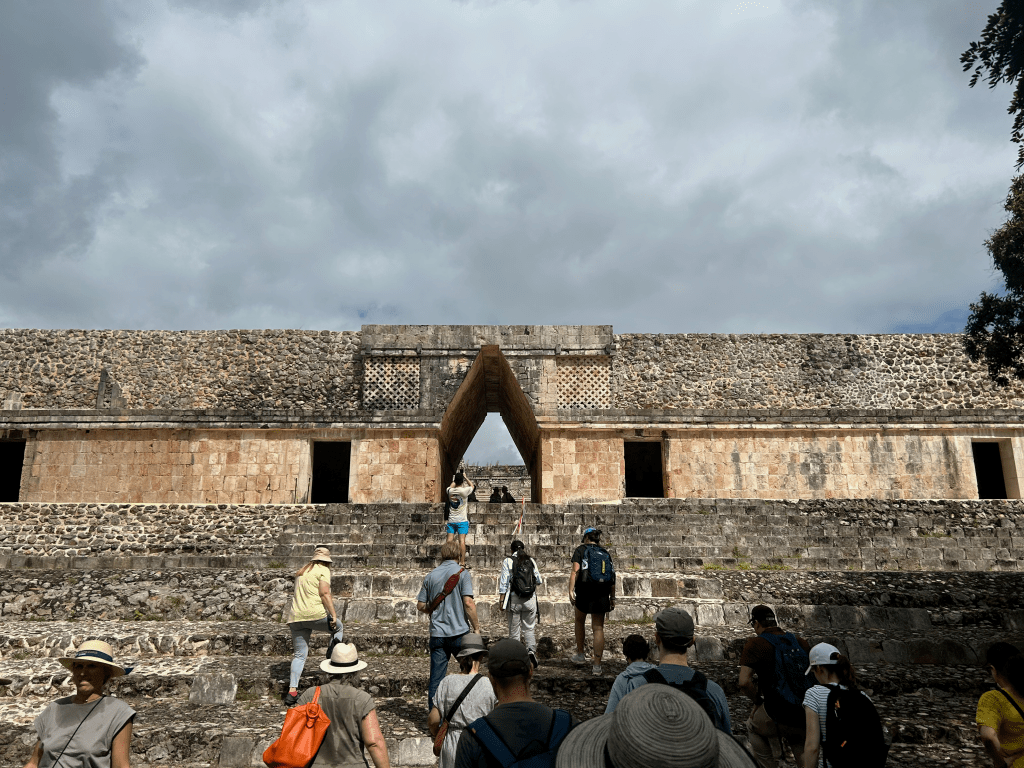
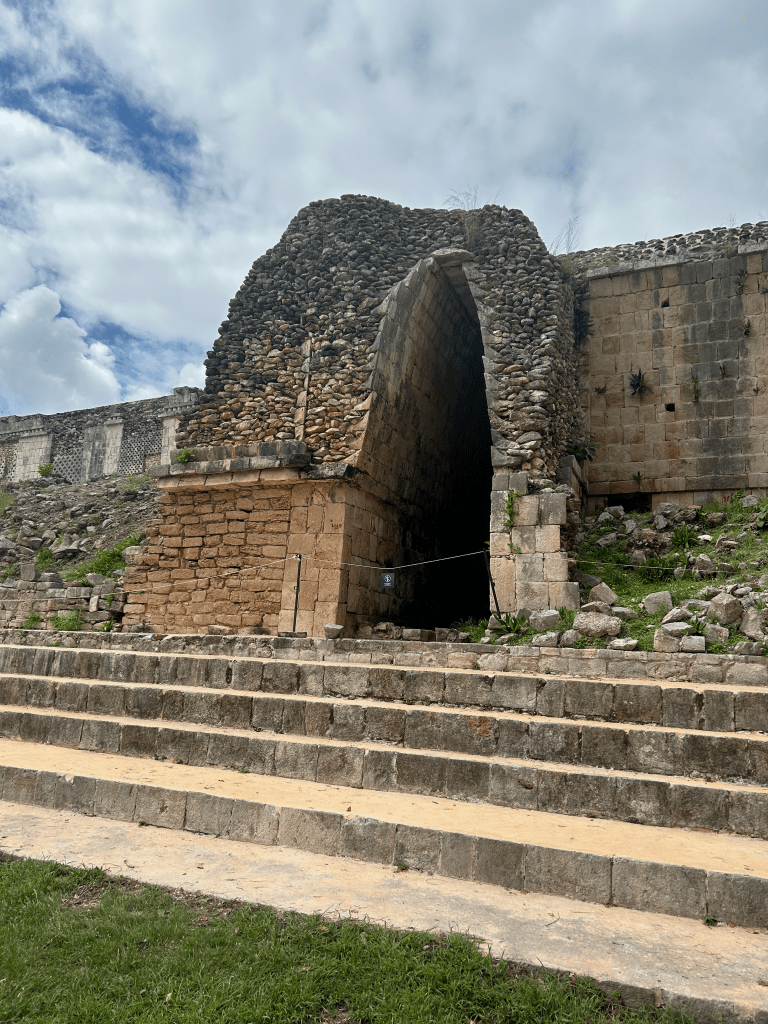
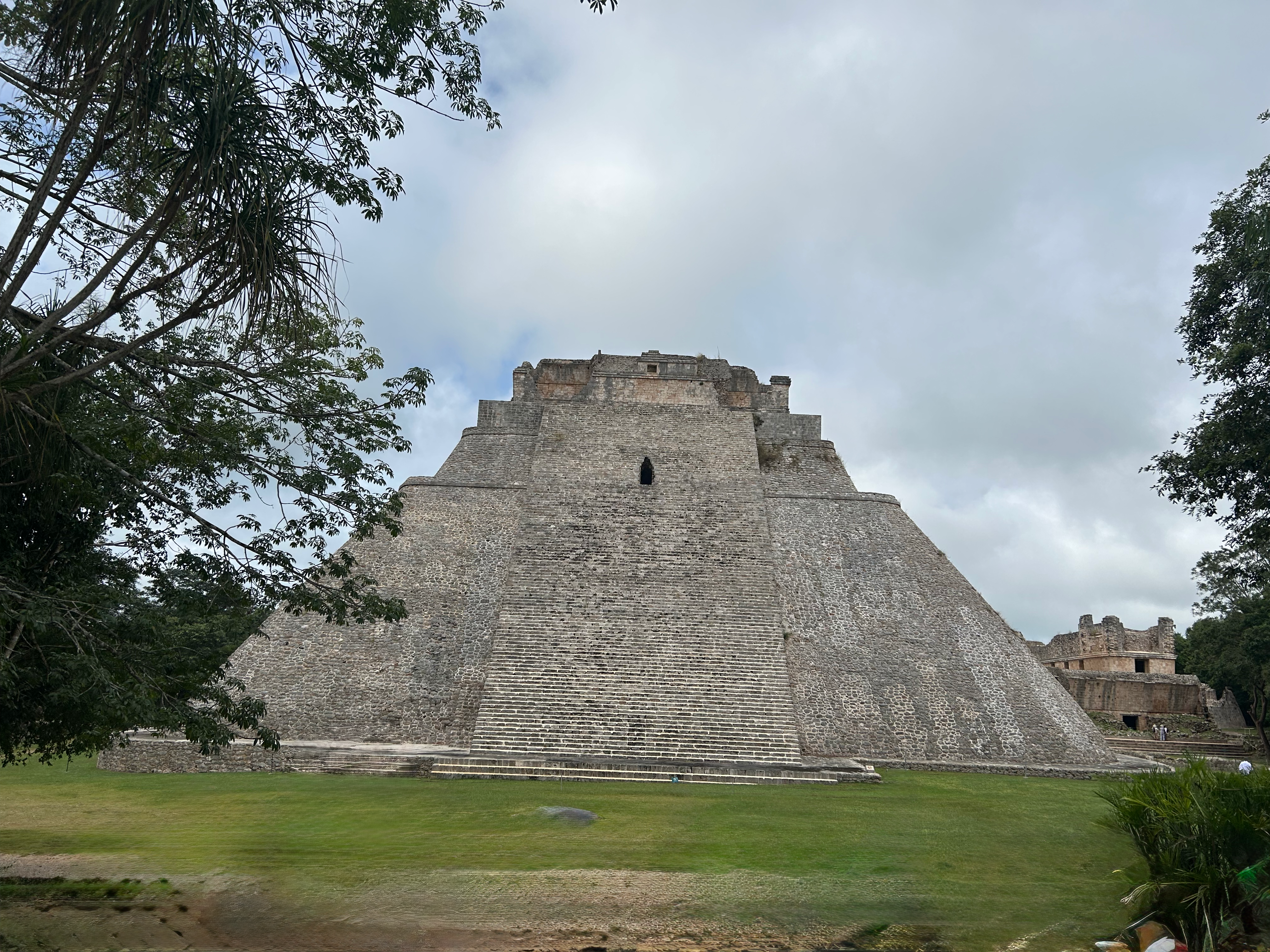
South of Mérida, Uxmal was a fascinating place to visit. This city once housed around 30,000 people, and its pyramids still rise above the jungle canopy. It was all that I hoped it would be and more, a monument to the ancestors of the people of the Yucatec Mayans who are still the majority population in the Yucatán State and in Mérida, its capital. The tour started with the Pyramid of the Magician, the great central monument of the site, after which we walked past the Palace of the Governors, and then to the High Pyramid and the South Pyramid before descending down the steps of the latter and walking to the Ballcourt dedicated in the year 901 CE by the city’s king Chan Chak K’ak’nal Ajaw where the old Mesoamerican ballgame was played. The pyramids here have a rounder shape than those at Chichen Itza, and the Pyramid of the Magician seems to be a series of temples built one atop the other.

I spent most of my time in Mérida either at the Fiesta Americana or at my hotel in the Paseo 60 complex, a few minutes’ walk to the south. I’d intended to venture out to visit some of the city’s museums, including the Gran Museo del Mundo Maya and see the older Spanish urban core, including going to Mass at the Cathedral, but as it happened after returning from Uxmal I didn’t get very far from the conference. This was my first visit to Mexico, and there was a lot there to get used to that was different from any other country I’ve yet been to. I was struck by how affordable everything was compared to the United States. At the time 1 dollar would get you about 20 pesos, and in general everything was much cheaper than in San Antonio or Toronto let alone in Kansas City. Still, seeing prices listed in hundreds and thousands of pesos was a bit of a shock to me at first. I was very careful to not drink the water, using bottled water to brush my teeth, and keeping my mouth shut tight while showering. Where in San Antonio and Toronto there was water available in pitchers for us to pour into our own glasses and bottles, in Mérida there were bottles of water at every break alongside the coffee and pastries. Yet beyond all of this the one thing I was most worried about among all the usual domestic concerns was the inability of the plumbing to take flushed paper. This turned out to be less of an issue than I expected, though for the sake of the sanity of this post I’ll leave that topic be.
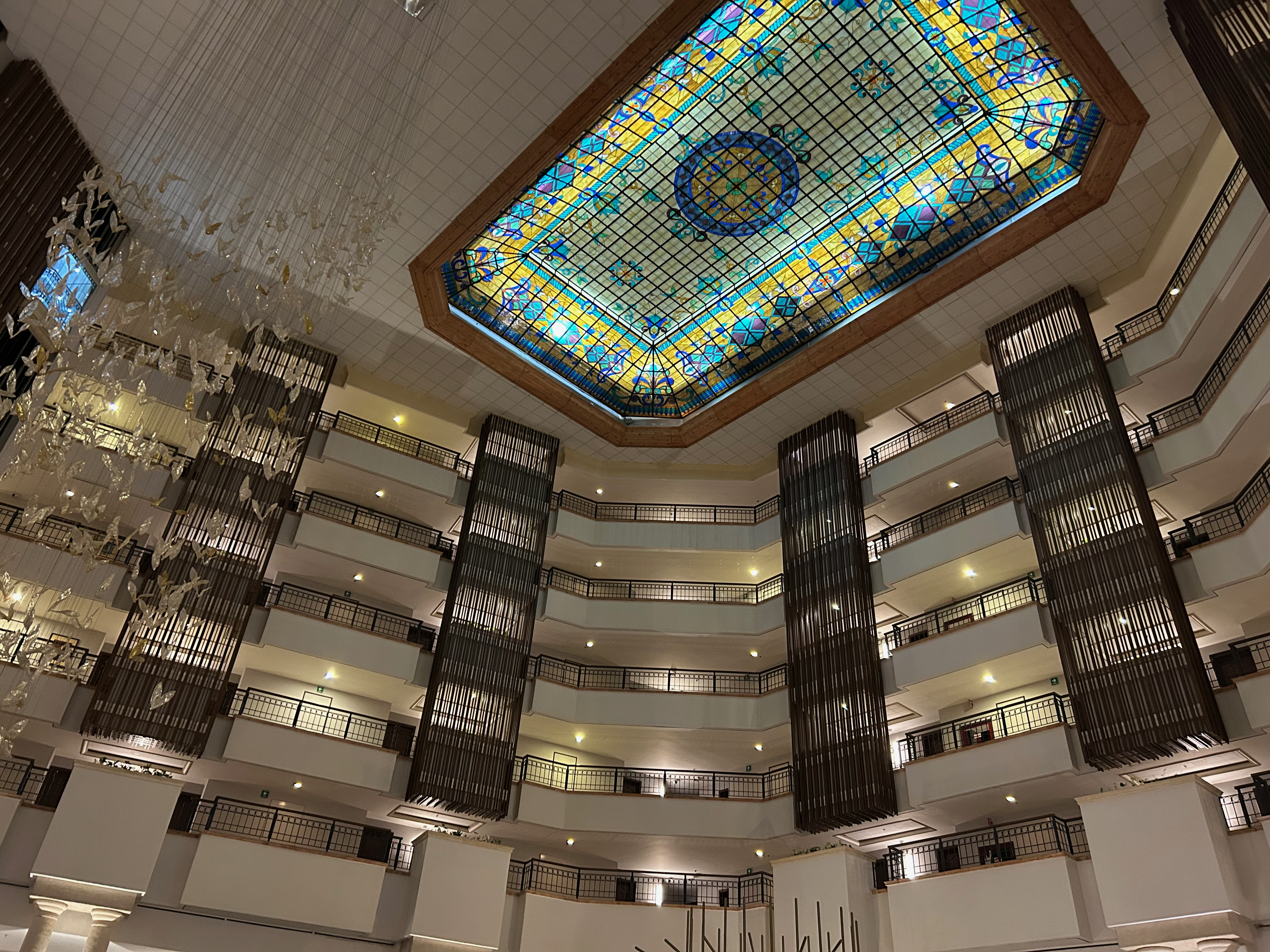
The Fiesta Americana Hotel in Mérida

This was my first visit to the History of Science Society’s (HSS) conference, and it certainly won’t be my last. I reconnected with several people who I’ve known off and on over the last five years in my doctoral studies and met many more people whose work I found fascinating and whose company I greatly enjoyed. I attended more sessions at this conference than at the Sixteenth Century Society, in part because two of the sessions I planned on attending at the SCS were cancelled. Perhaps this speaks to a stronger presence of early modern historians of science in the HSS than at the SCS, both conferences compete with each other as their meetings happen at the same time of year, opposite to the Renaissance Society of America’s annual conference in the Spring. Still, when I left Mérida, I found myself sad to leave these people, colleagues and friends, who I’d gotten to know in a few short days.

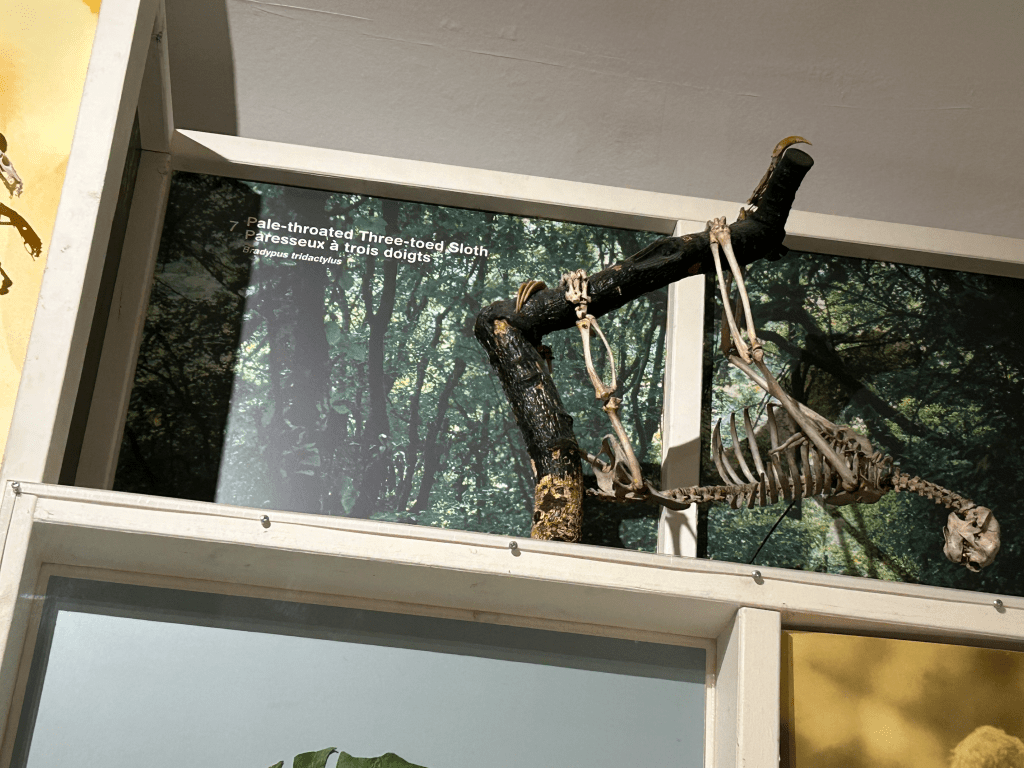
At the HSS, I presented a paper drawn from Chapter 3 of my dissertation which summarized my argument that Thevet’s eyewitness description of the southern maned sloth (Bradypus crinitus) reflected the gradual shift in the sixteenth century from humanism, a discourse centered on established learning from antiquity, toward the scientific developments of the seventeenth century. This then was my only presentation among the three conferences that was drawn from my dissertation rather than the introductory essays for my translation of Thevet’s Singularites. The SHD and SCS papers will likely end up in the same essay as they cover very similar topics to the point that in moments in between conferences when I’ve attempted to explain what each of them were about, and I couldn’t remember one or another of them. That however speaks as much to the number of presentations I was giving in short order: I knew I had the papers written, printed, and placed in the correct file folders and that the slides were ready to go. All I needed to do was run a couple of rehearsals beforehand and then read the papers on the day of. What ended up happening was a bit different, following from advice I received earlier this year I tried going off script a bit more than usual. At the SCS this worked really well, though I did end up going 3 minutes over my allotted 20. Meanwhile at the HSS, knowing I only had 15 minutes to present and that the recurring technical problems during our session had taken a minute or two from the presentations, I decided to end mine early cutting some comments about the philosophy of animal behavioral psychology that I’d brought in from David Peña-Guzmán’s book When Animals Dream: The Hidden World of Animal Consciousness.
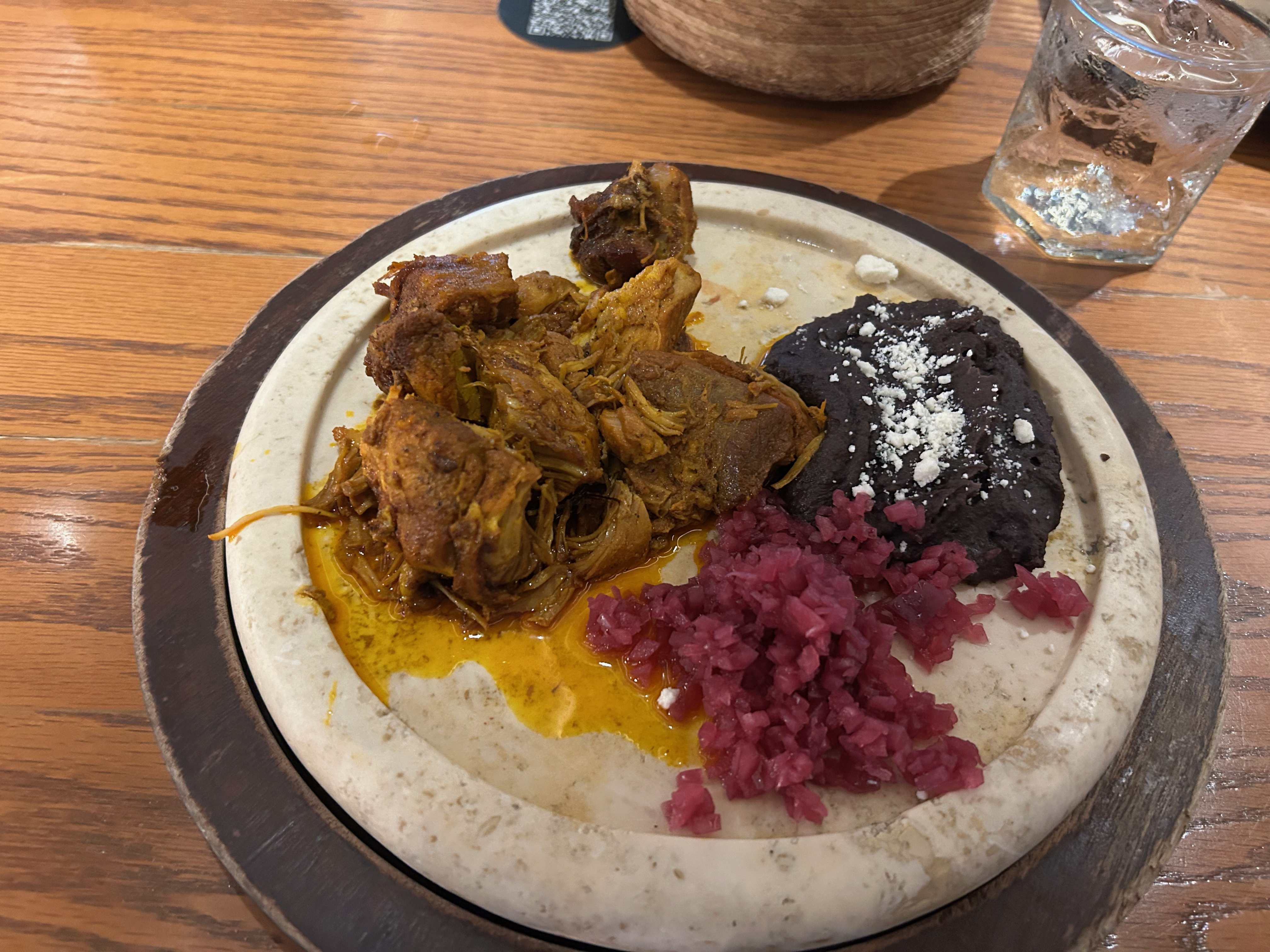
One of the Mayan dishes I ate while in Mérida was perhaps the most famous of these: cochinita pibil, a Yucatec barbecued pork.

Houston

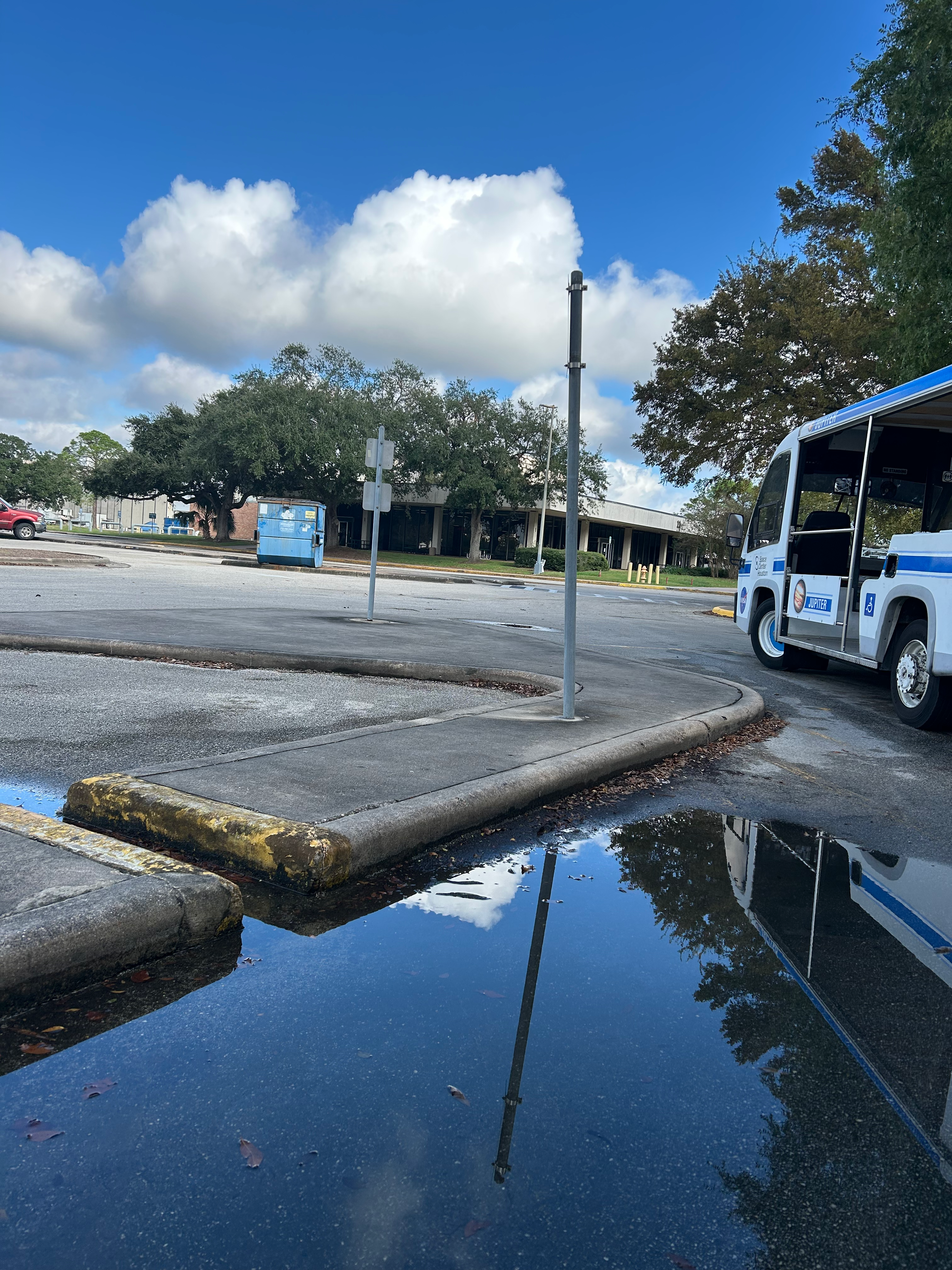
Houstonian Humidity. Photo taken from outside the Christopher C. Kraft, Jr. Mission Control Center at NASA’s Johnson Space Center.

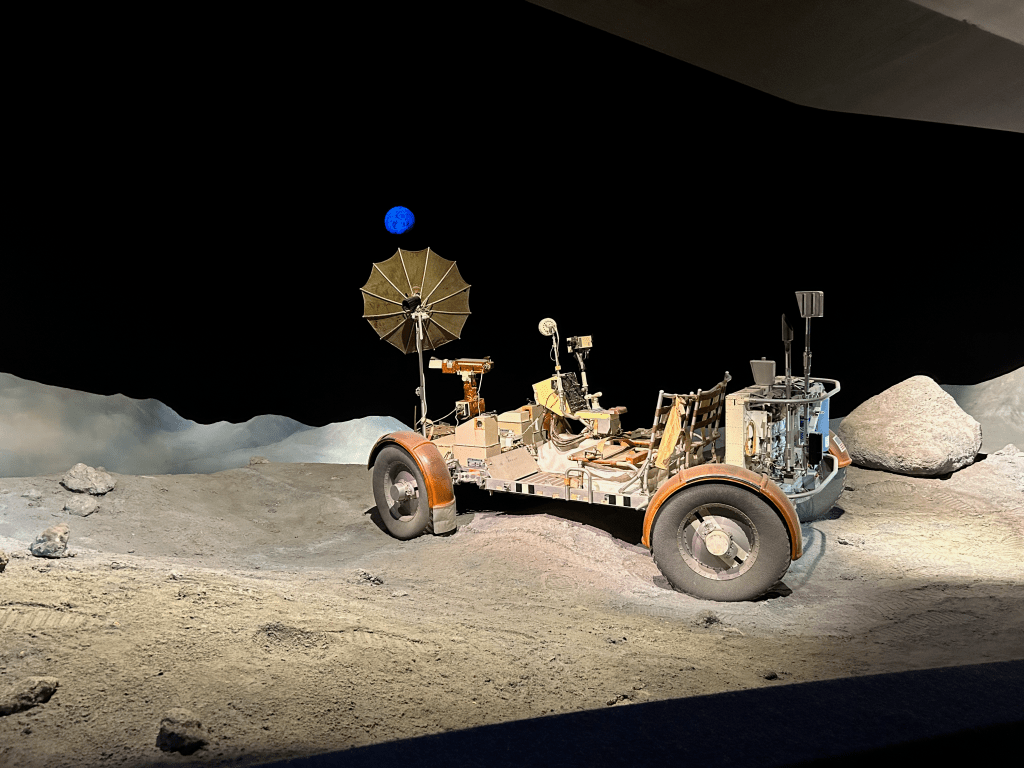
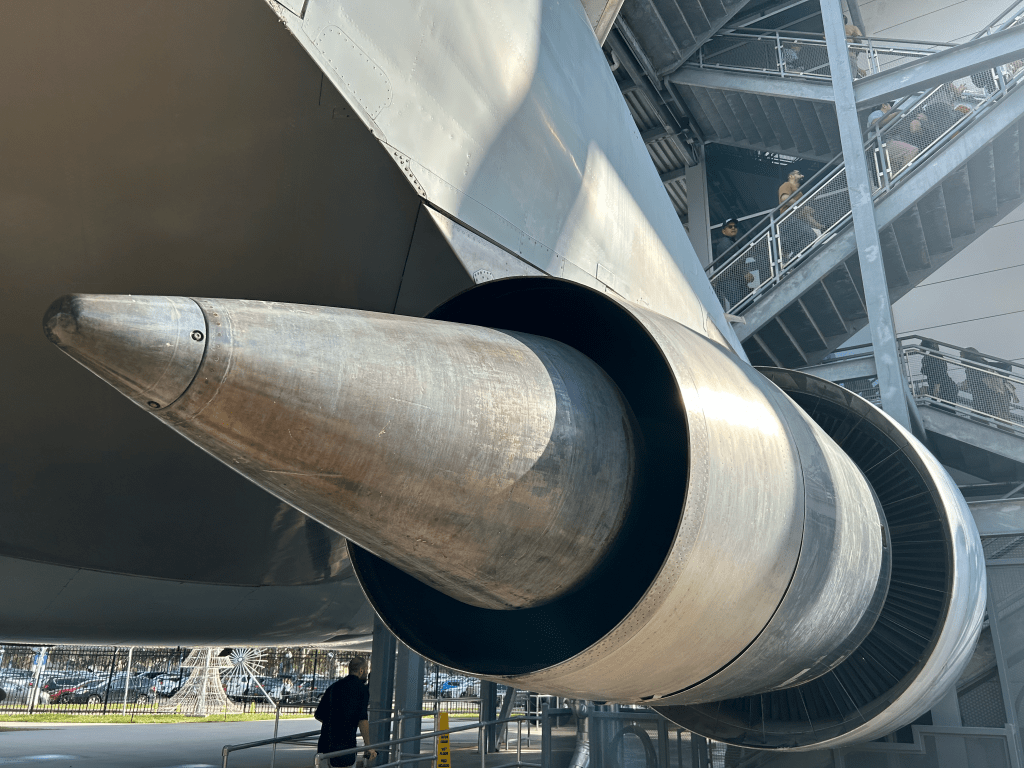
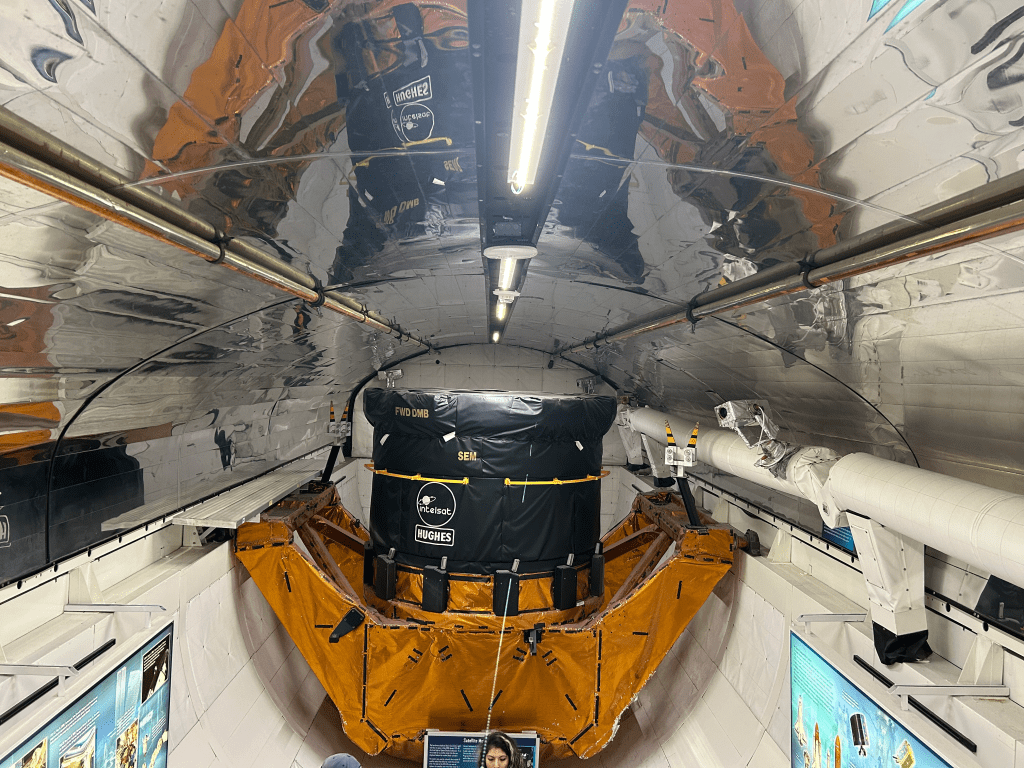
On the way home from Mérida I had an 11 hour layover at Houston Bush Airport again, and this time instead of staying in the United Club and working I decided to take the day to visit the Space Center Houston, the visitor’s center next to NASA’s Johnson Space Center. At the beginning of the year, I looked into visiting the Space Center and booking a VIP tour of the International Space Station’s Mission Control Center, and had the trip planned out and at a reasonable price but still ended up choosing to not go to save money, a wise decision seeing how 2024 has turned out. So, on Sunday, 10 November I rented a Volkswagen Jetta from Hertz and drove across Houston to the Space Center. It turned out to be a marvelous place to explore, at times in spite of the crowds of which there were more than I expected. My only comparisons to this are visits to the Smithsonian National Air & Space Museum in Washington and to the Kennedy Space Center Visitor’s Complex in Florida. The former is far more the museum like Space Center Houston, both very busy, while the latter is more like the other Central Florida theme parks, albeit a government owned theme park dedicated to space exploration.
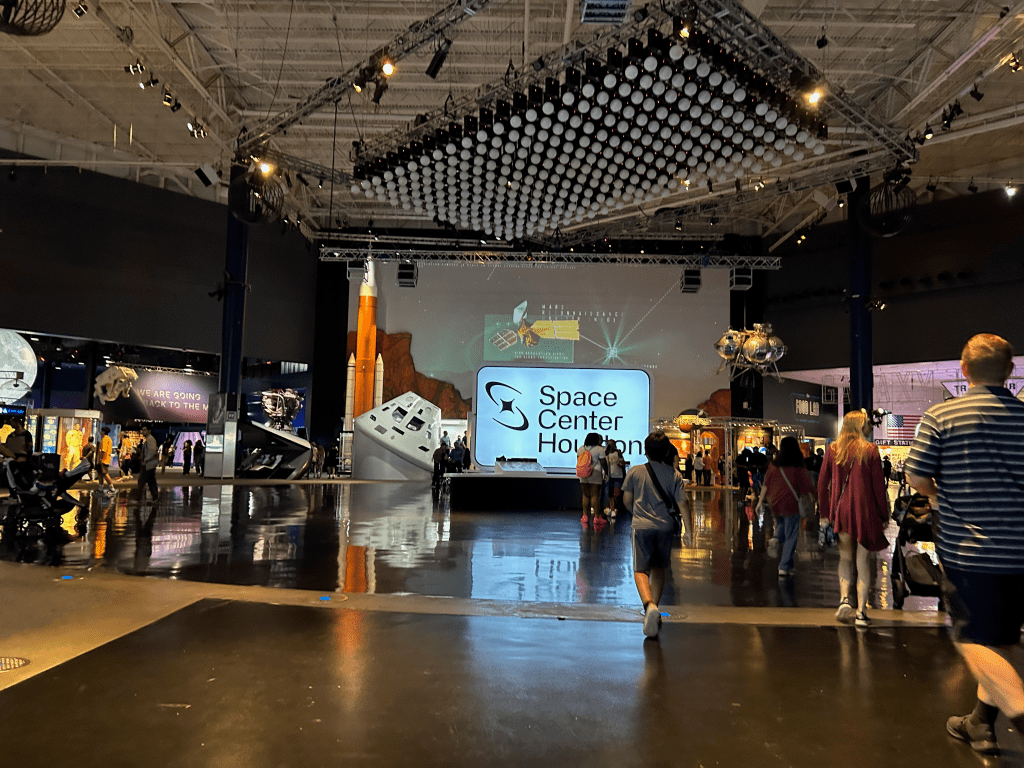
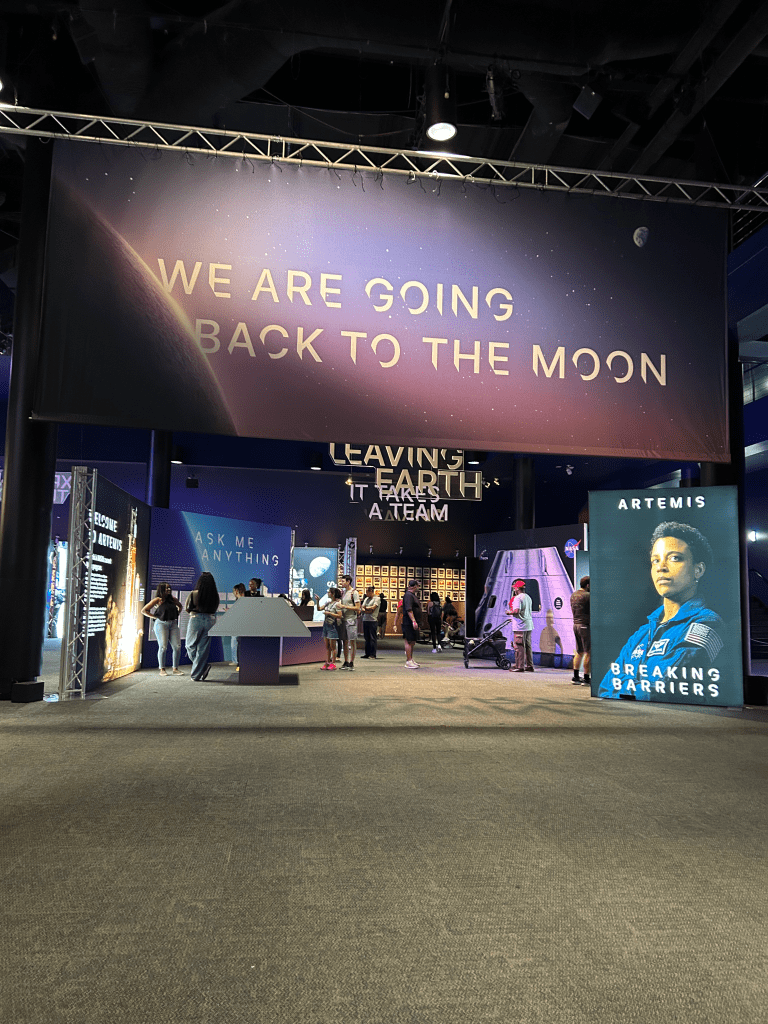
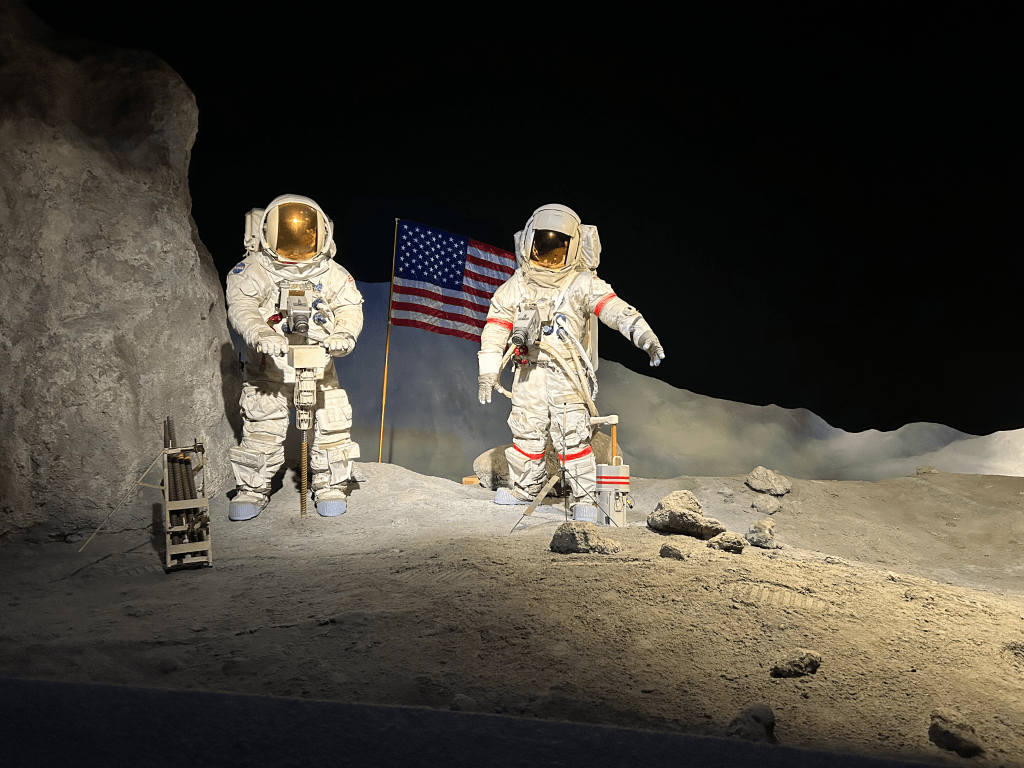
I arrived close to 12:30, a good 2 hours after landing, and was at first taken aback by just how busy the place was for a Sunday at midday. One part of that was that the Houston Texans weren’t playing until later in the day, which meant more locals and tourists for the visiting Detroit Lions were taking the midday hours to do some sightseeing. My first stop in the Space Center was the Artemis gallery displaying all things associated with NASA’s international program to return humans to the Moon for the first time since Apollo 17 landed in December 1972, almost 20 years to the day before I was born. There was a board where NASA invited members of the public to leave questions for the Artemis II astronauts, who are due to launch for the first crewed lunar orbit of the program no earlier than September 2025. I usually avoid these sorts of things, in a similar vein to why I like to avoid clicking on the ads on Google or any of my social media sites solely out of the enjoyment at seeing the big guy not getting my vote by engaging with their stuff. This time though was different, because as I’ve written before here on The Wednesday Blog, I worry that we may be going to Space for the wrong reasons: for profit, or glory, or conquest rather than for curiosity, or exploration, or hope that we might learn more about ourselves in finding what’s out there. My question then was this:

“How do you hope the Artemis missions will inspire humanity to become better versions of ourselves?”

This speaks to something that’s at the heart of what I do, of why I study the history of sloths in the 1550s. In that study I hope to find something about how Thevet interacted and reacted to the sloth he observed for 26 days that can tell me more about how he fit that sloth into his understanding of nature as a whole. In it beyond the study though, I hope I might learn something more about how to better interact with unfamiliar people, creatures, and things that I encounter in my life. Travel is the search for new things to know to enrich our lives by that experiential learning we do. The highlight of my visit to Houston on Sunday was touring the rooms that house the Apollo Mission Control Center where the first contact between our first human explorers to set foot on another world were first received by humans here on Earth. I know this room all too well, in fact I wonder if my fondness for the white tile aesthetic that I used to see in grocery stores or even some school classrooms isn’t in fact drawn from fond memories watching recordings of those TV broadcasts from 20 July 1969 when Apollo 11 made its landing on the lunar surface. I learned years ago to keep my camera out of my hands for most of my life and to let myself experience these moments that I have with my own eyes, and so while I did take 11 photos of the Apollo Mission Control Center while in the viewing gallery, I refrained from switching my camera to record video of the experience like many around me did. I’d rather remember those moments spent watching as the critical moments of the Moon landing played out in front of me and preserve them, however imperfectly, within my own memory that those moments get tinted with nostalgic yellowing like old paper as they age. I in fact found myself looking around Mission Control searching for all the parts of it that I know from the Apple TV+ show For All Mankind, which is one of my favorite new shows of the last five years and features Mission Control as one of its primary settings.
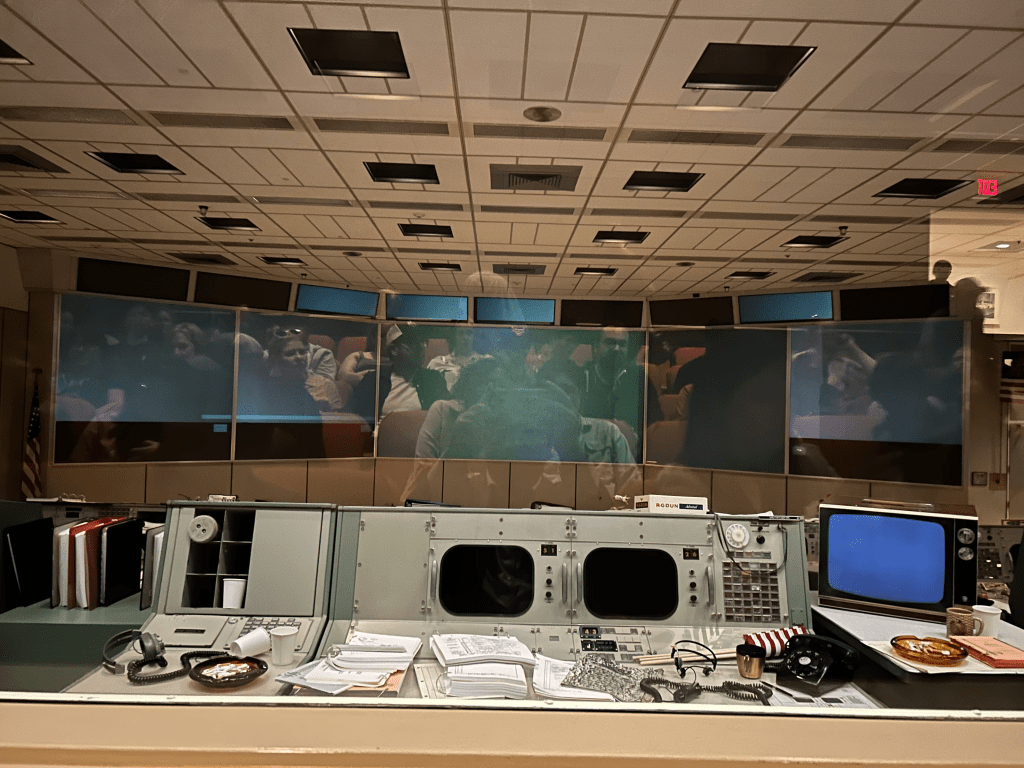
At the end of the day, in spite of any other troubles or annoyances that beset me, and there were some of those, I was still happy that I took the opportunity to visit the Space Center and see where one of the great vehicles of hope that remain in these dark years does its work. We may find that our best solutions to our climate crisis and to the multitude of human crises from our nigh insatiable greed or our unholy cruelty we inflict upon one another and ourselves may find a balm in reaching out and exploring our Solar System and those of other stars. I’m an optimist, even if my optimism is covered by all the debris of our pessimistic time. I hope that when Artemis II successfully orbits the Moon, and Artemis III lands humans on the Moon to establish the first lunar permanent outpost of our species that we will celebrate these accomplishments as things undertaken for all humanity and not for one nation or tribe. Our troubles today, I hope, are signs that we are beginning to move out of what Carl Sagan called our adolescence as a species and into the years when our future will really begin to look bright again.

In spite of all these troubles, this North American Tour gave me reason to hope that my future, and our future as a whole, has such great promise and opportunity if only we keep working for it and never give up the fight.

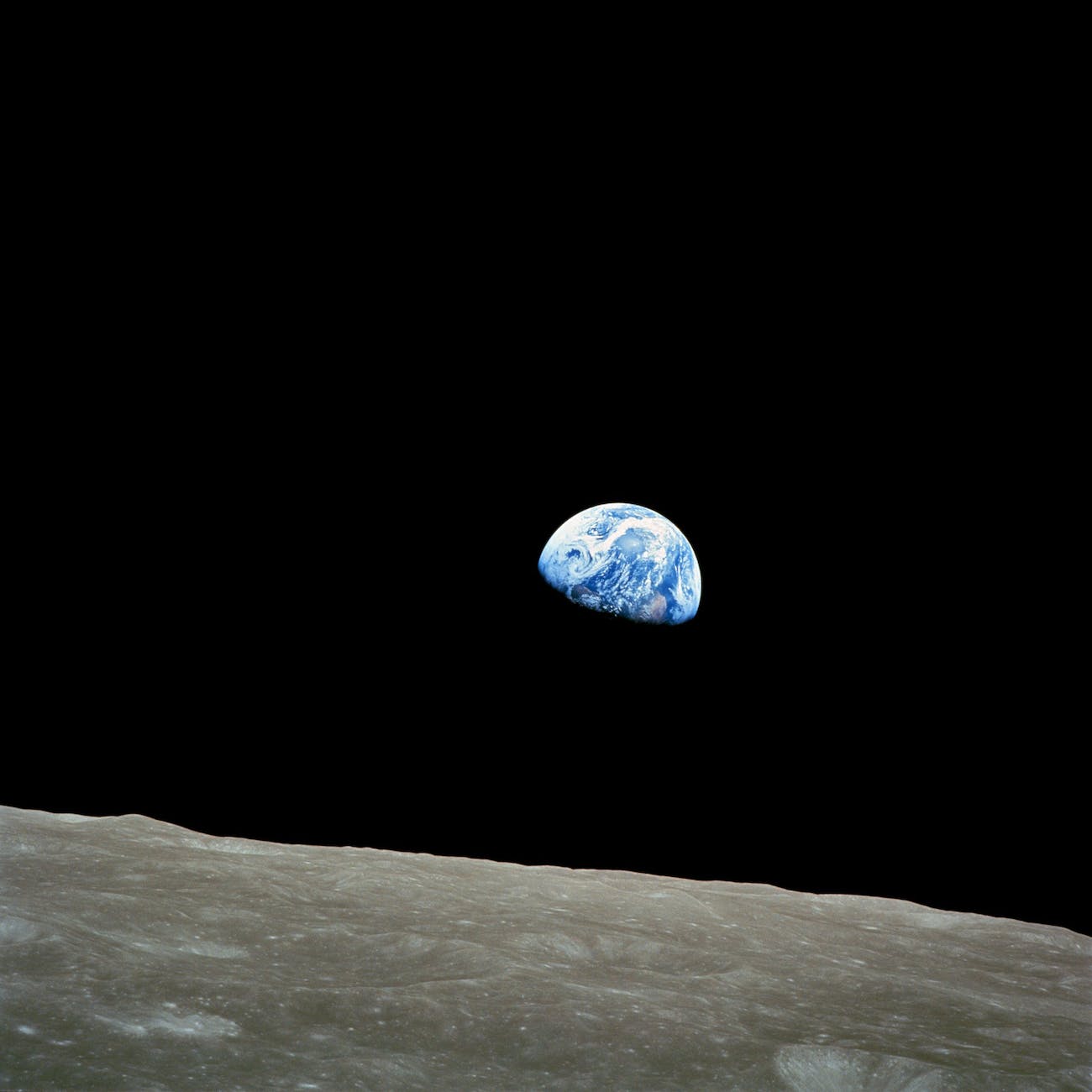
In Toronto watching the birds. Photo: Hari Prasad.

Supplementing Human Nature

Supplementing Human Nature Wednesday Blog by Seán Thomas Kane

This week, how technology enhances and supplements human nature. — Click here to support the Wednesday Blog: https://www.patreon.com/sthosdkane

This week, how technology enhances and supplements human nature.


Just before the New Year began, I paid a visit to the new aquarium at the Kansas City Zoo, a new favorite haunt of mine. Because the high holiday week between Christmas and New Year’s Day was in full force, we were joined by a sizable crowd curious at what this new aquatic construction might contain. This was my third visit to the new Sobela Ocean Aquarium, so while some of the wonder had faded, I was still fascinated to see some of these creatures up close and in person.

Amid all the fish though I paused in front of a shark, caught in thought about its method of propulsion. How is it that this animal is able to glide so smoothly through its space with so few motions of its fins when we need to move our legs for each step? Our language for motion itself is biased towards human propulsion, we move forward step-by-step, pace by pace. There is little sensible movement that the human body can make without moving our arms or legs. Other life forms––floral and faunal––have other means of moving about their world, yet for us and most life that we find sensible there’s an inherent reliance on feet, legs, and even arms to move.

As I stood there, I thought about Prometheus, the titan in Greek mythology who formed all mortal life out of clay saving humans for last. Yet when he came to creating humans, he found he had used all the claws, fangs, furs, scales, feathers, and fins that he had, leaving humanity more naked and exposed than any other species. To rectify this the cunning Prometheus guided humanity towards wisdom and stole fire from Zeus “which, unknown to Zeus, he had hidden in a stalk of fennel,” wrote Pseudo-Apollodorus in the Bibliotheca (1.7.1). In the Abrahamic traditions, humanity’s original sin was to eat from the tree of knowledge of good and evil and to question God. Zeus punished Prometheus for his theft by chaining him up onto the side of Mount Elbrus where each day an eagle was sent by Zeus to eat out his liver, which would grow back only to be eaten again the following day.

Plato wrote in his book the Protagoras that humanity supplemented our standing and raised ourselves above other life by adopting the creative power demonstrated by Prometheus, whose name means “forethought” in Greek. Our use of techne (τέχνη), our skill and inventiveness, drove us to create not only with our hands like other animals do but with our minds as well. Mel Brooks’s 2000 Year Old Man joked that as soon as one of his pet cave chickens walked through a fire and cooked itself, he and his companions realized that cooked meat tasted good. So too with most things, we can discover wonders with the things we’ve made for ourselves. Today the human eye extends far beyond that of any other known life. 

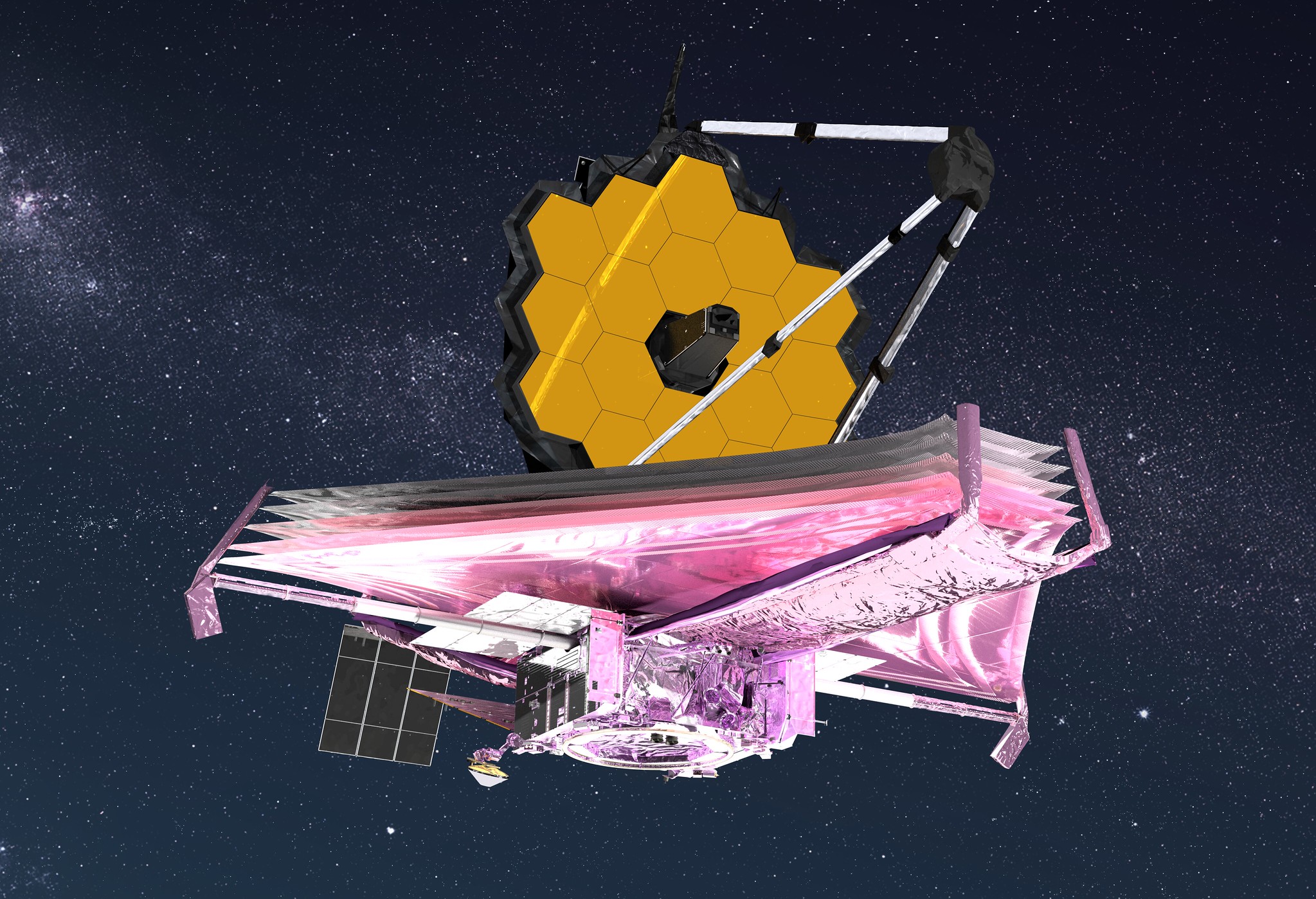
This weekend I went to see an IMAX film called Deep Sky about the James Webb Space Telescope (JWST) which launched from the European Space Agency’s spaceport in French Guiana on Christmas Day 2021 and six months later began transmitting images back to Earth of the earliest moments in the Universe’s long story. There are glimpses of light, whisps of dust, and clouds of matter that were unknown to humanity until just now yet predate our evolution by billions of years. We can now see that, well beyond what our own evolved eyes can see. Yet is our nature evolved only to perceive certain things with our senses, only those things we can immediately touch, smell, taste, hear, and see? Knowledge could be a sense of its own, one which perceives further using supplements from technology and reliance on other people alike. Yet knowledge is what sorts through all the signals coming from our senses and, well, makes sense of them.

Yesterday afternoon on our drive back to Kansas City from seeing that film at the St. Louis Science Center I awoke in the front passenger seat of the family car to see a snowplow in the lane next to us. I watched as it drove past us and was at first startled by what I thought I saw, a man hanging onto the back of the plow moving at 70 mph (112.6 km/h) only to blink again and see that what I thought was a man hanging on for dear life was actually an assortment of things hanging down from over the rim of the back of the plow that holds the road salt, with a large box in the back near the middle that my sleepy brain mistook collectively for a person.

Knowledge could be a sense of its own yet unlike the others I can’t say if it contributes its own information to the assortment that is our understanding of the world around us. Everything enters our mind through our senses, I saw those images captured by the Webb Telescope just as I’ve heard, read, and seen retellings of the ancient myths of Prometheus and stories of Genesis time and again. In some ways then, the reflective pause that I experienced watching that shark two weeks ago was less a reaction to the shark itself and more a realization of my own human nature in contrast to the shark’s. I may be able to dream, and often do, of flying or floating distances without moving my arms or legs yet those visions remain encased in my mind, thoughts to return to in my sleep or in those quiet moments fit for daydreaming.

And yet those same thoughts are what propel us as a species forward. We supplement our human nature with those thoughts, and work through the questions they raise until we have solutions which can make our lives better. I have always lived with this understanding that human history is one of overall general progress, that our finest minds are always finding ways to improve the human experience, to raise humanity’s stars so that we can hold onto that dream, that belief which is fundamental to human nature that we can better ourselves and the lives of future generations.

We offer these thoughts and all their creations as our inheritance to posterity, that they may make of what we left unfinished something even more wondrous than what we and our forbearers aspired to.


Genetic Engineering

Photo by Pixabay on Pexels.com

This July, while I was preparing for the Longest Commute, I made my usual pre-trip browse of the audiobooks available on Audible that I might be interested in listening to during the long hours in the car. On this particular trip I had even more driving time than usual to listen to books, podcasts, and music as I made my way through the varied scenery of the Midwest, South, and Northeast. I already had a biography of the German naturalist Alexander von Humboldt on my listening list, and there were other books I’d downloaded for previous long drives that I had yet to touch such as a memoir by actor Cary Elwes about his time making The Princess Bride. But I wanted something that related to the trip itself, something to get me even more excited about the things I’d be seeing along the way.

I settled on an Audible original called The Space Race which tells the history of NASA and Roscosmos from the launch of Sputnik 1 in 1957 up into our current generation of public and private spaceflight agencies and companies competing and cooperating in our continued reach for the stars. The whole story was narrated by Kate Mulgrew, an actress I know best from her role as Captain Kathryn Janeway on Star Trek: Voyager and seeing her name on the billing was among the reasons why I chose this particular thing to listen to. I won’t call it a book, it was more of a series of radio shows with a combination of narration, talking heads, and scenes set in the next century.

Those scenes, the ones set in the future are the ones I want to talk to you about today. They posit that the only way humans can ever hope to reach a habitable planet orbiting our closest neighboring star, Alpha Centauri, would be by a generational ship, one where the original passengers’ grandchildren would be the ones to set foot on that planet, and would only be possible through genetic engineering to ensure that those humans who made it there would be well suited to the environment they found and would soon call home, after all any trip that takes three generations to complete would have no path of return.

I for one am eager to see humanity reach beyond Earth and our Moon towards Mars and beyond. We have the potential to do really tremendous things, to learn so much from those experiences about our universe and about ourselves. Why else would TV series and films like the ones from Star Trek be so intriguing to me? They offer us a vision of a future where our introduction to our cosmic neighborhood makes us better people and ushers in a veritable golden age here on Earth. Why would that not be a thrilling prospect?

I listened to the last few scenes of The Space Race while I was driving east along I-10 in the Florida Panhandle, and the moment when they acknowledged that in the world of their story that genetic engineering would be necessary for such a voyage, I felt chills. So, let me ask you this question: if the purpose of exploration at any scale is both extroverted and by equal measures introspective, if the curiosity at the heart of any exploration is a part of what makes us human, then to what lengths should we go to satisfy that curiosity? Should we go as far as to transform our very genetic code, the most essential biological parts of who we are?

This is a question I really worry about. I’m as much an everyday explorer as anyone else, yet there are limits for me as to how far I’m willing to go to satisfy my curiosity; I don’t know that I would want to push myself to such a point that I’d be willing to change who I am just to see over the next horizon. We are who we are because of so many complex and intricate pieces to our identities. Untangle any of those threads and are we still the same person? It makes logical sense that future explorers would consider adapting themselves to the environment of the planet they’re seeking to visit, yet among the things that make us human are our roots to this our home planet. What would the humans who first set foot on that alien world be like if they have no memory of their own world?

If we are to engineer ourselves in any way to adapt to life as a spacefaring or interplanetary species, then let it be technological rather than biological engineering. Let’s create the habitats we would need to survive on Mars so that we can travel to other worlds as ourselves and not as some engineered offshoot of humanity growing ever distant from the source. Let’s take with us our collective memory of all our triumphs and our faults. Let’s bring our stories & music, our proclivities & our imperfections with us for they are what make us human.

And if our explorers should meet anyone out there who is just as curious about the unknown as we are then let them meet us as we are. Let them see us for who we are. Let them see both our problems and our possibilities.

Galileo, Galileo

Photo by Juan Martin Lopez on Pexels.com

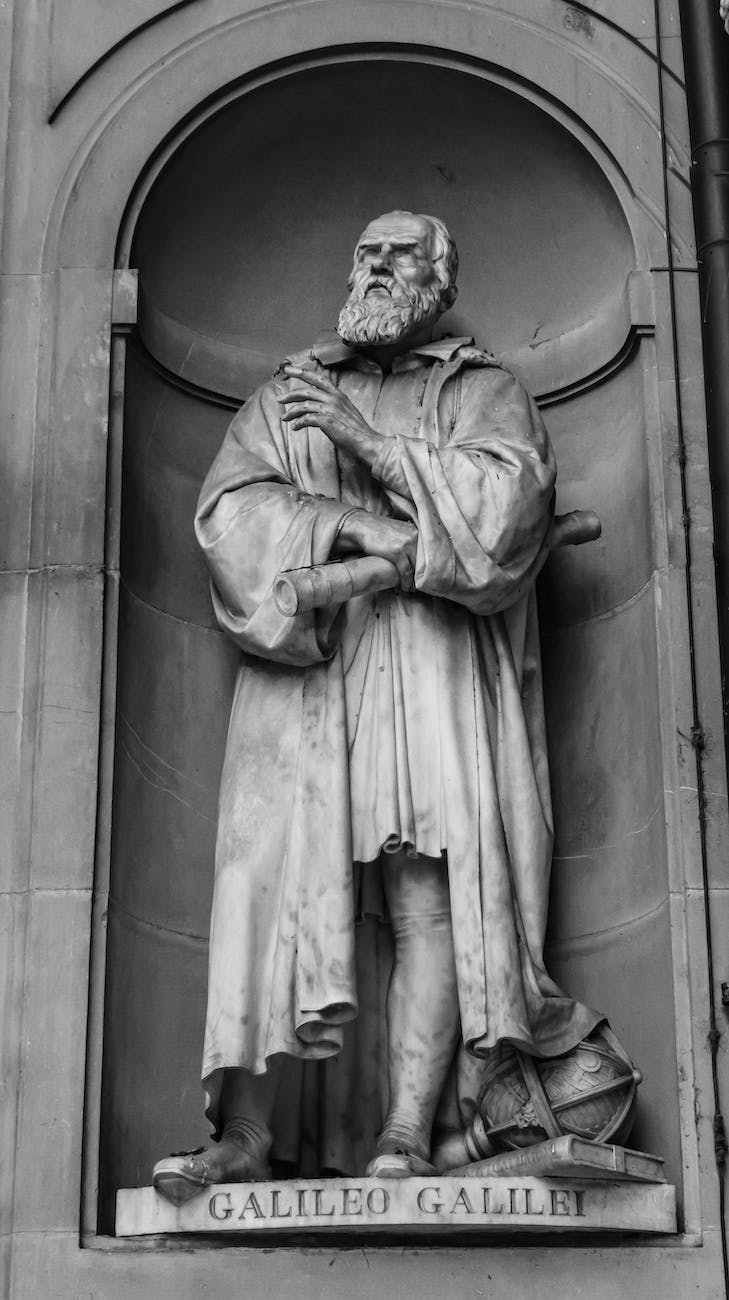
If there are any reasons why I find myself drawn to Galileo, this distant Italian astronomer who lived 400 years ago it’s that we have two things in common: we’re both stubborn and occasionally grumpy. I’ve known the basics of Galileo’s story for most of my life; he was an astronomer who was born in Florence and worked in the Venetian Republic at the University of Padua who was one of the first to use a telescope to look out into the night sky, making him the first to observe the Galilean moons of Jupiter, collectively named today for the man himself. His support of Copernicus’s heliocentric model––that the Earth revolves around the Sun––contributed to his falling out with the Papacy and his eventual arrest and trial by the Roman Inquisition who put him under house arrest for the last few decades of his life.

Of course, the real story isn’t quite that simple, after all many of his opponents agreed in principle with what he was arguing, they just didn’t like how he argued it. Still, Galileo’s contributions to science and to human knowledge of our cosmos overall are undeniable. In the last few weeks, I’ve thought about Galileo quite a bit as Jupiter has come the closest to Earth in its orbit for the first time in decades. I got a good look at Jupiter both through a telescope and with my own eyes on Friday night a few weeks ago up at the Kopernik Observatory and even was able to take a better-quality picture of it than I’ve gotten before with my phone.

Jupiter as seen with an iPhone camera on the 4th Friday in September at the Kopernik Observatory in Vestal, NY. Photo: Seán Kane.

I see in Galileo an inspiration of sorts because of the things he did. He was able to prove that the Moon wasn’t perfectly spherical by observing the shadows of the crater walls (what he called mountains) on the lunar surface. Using those shadows, the effects of the lunar geography, Galileo could prove the existence of something he otherwise wouldn’t have been able to see. It’s like how when it rains the best way to actually see the raindrops falling on your head is to look at them with a dark background like a tree or a darker-colored house. Otherwise, the water droplets will blend in with the ambient colors surrounding them. Likewise, we can see the Moon and the planets because it’s the light of our Sun shining on them that is reaching us here. The Moon doesn’t light itself up, nope, nor does the Earth, rather it’s the Sun that naturally does the job.

Here lies an interesting development in this story: the Sun lights up the Earth during the day, but the Earth is now still lit up at night. Only a few generations ago our ancestors figured out how to use electricity to light up our lives and turn the darkness of night into something new entirely. As long as I can remember I’ve been fascinated by this idea, that even at night some places are well lit. I wonder today if our cities might even be built with night in mind, if there’s more artistry in the architecture when the buildings are lit up by electricity rather than by the Sun’s rays? Certainly, we have more control over how our buildings are lit in this context rather than during the daytime. One of my favorite ways to experience a museum is after dark when all the lighting being done has been devised by an exhibit designer trying to control all aspects of how the exhibit is lit through their own lighting patterns. The British Museum does a really awe-inspiring job with lighting the Parthenon Marbles in such a way that their great shadows climb up the walls of their room making them seem even larger-than-life than they already are.

Still, in Galileo’s day before electric lighting they could see more of the night sky. It’s a sign of the world that we live in that it wasn’t until my 28th year that I actually saw the band of the Milky Way up in the night sky. Even in my youth growing up on the farm on the western edge of the Kansas City metro I never saw it. I think seeing the night sky in all its splendor gives us a chance to reconnect with our past before our industrialized modern world, to reconnect with the lights that illuminated our ancestor’s nights and memories. I’ve talked before here about how profound it seemed to me to be able to see light from Vega that had left that star when I was a child, well the same is true for seeing the same moons of Jupiter that Galileo first saw in 1610 from his telescope in Padua.

As winter approaches here in the Northern Hemisphere we’ll get to see a lot more of the night sky. The days are already here when the sun is setting in Binghamton during dinner time. The fall chill is in the air. It amazes me that October is already upon us, after all it feels like we were just in August; but then again, I probably say the same thing a few times every year. When I was little and first learning the names of the months in school, I remember being given worksheets that included pictures for each month to personify that time the better to remember it by. March was shown as a lion, April as a storm cloud, and May as a flower. In the Fall, September was a tree having reached its fullest bloom after the summer heat, and October was a collection of fallen leaves surrounding a Jack-o-Lantern.

I wonder how Galileo would’ve personified those months, or if he even would’ve thought of doing that? The month of my birth, December, is often associated with the beginning of the Holidays, in my tradition of Christmas specifically. Yet it’s also often thought of as the beginning of winter even though the worst of the winter cold and snows don’t come until January. Yet the seasons here in North America are different than those in Europe; in fact, I found that our months and seasons make more sense in Britain than they do in America where the weather changes at a more expected time than its fluctuations here in America allow. In my Midwestern home I’ve experienced Halloweens in the snow and Halloweens in summer conditions. In my year living in London though, admittedly now a heat island, when it got cold in October it stayed cold until March.

How different then is our world from Galileo’s? How much has our industry and development changed the world we live in? And how different will the world be at the end of this century from the world I knew as a child at the end of the last century? These are all questions I’m going to leave you with today.

To Gaze into the Past

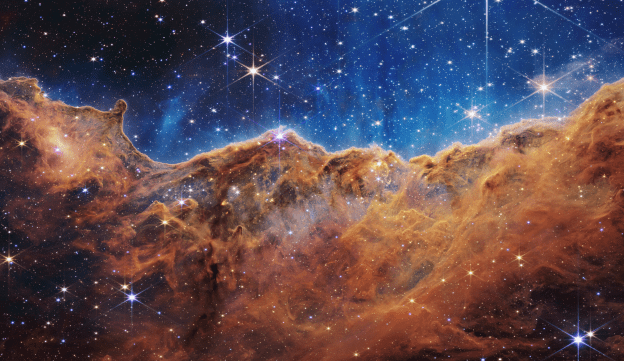
“Cosmic Cliffs” on the Carina Nebula, NASA JWST, Public Domain.
This week, some inspiration from the first images taken by the James Webb Space Telescope. You can view all of these images at: https://webbtelescope.org/news/first-images/gallery

Historians like me spend our working days trying to understand past generations, to see their worlds through their eyes and to interpret that world in a way that’s understandable to our modern audiences. I for one would love to see the sloths that my dissertation focuses on as they lived in their own time and place 467 years ago. Better yet, I would love the opportunity to sit down and chat with such greats as Abraham Lincoln, Benjamin Franklin, Eleanor Roosevelt, or Hypatia of Alexandria just to hear these great minds of their own times speak as regular people without all the pretenses, titles, and theories that we frame their lives within our histories.

Unfortunately, as far as I know the time machine hasn’t been successfully built yet, and time travel even by slingshoting an object around a sun hasn’t been attempted yet. Give it a few centuries, maybe. My conversation with Mr. Lincoln will have to wait. Yet there are ways we can gaze back into the past that are possible today. If you’re reading or listening to this at night go outside and look up at the stars and see what you can find up there. Maybe even use a star chart app on your phone to figure out which stars you’re looking at. Once you’ve done that see how many light years distant they are from us on Earth. That light took quite some time to reach us, meaning that that light left those distant stars years, decades, or even centuries or millennia ago.

Last summer I wrote about my profound sense of awe at gazing up towards the light radiating out from the star Vega while sitting on the rim of the Split Mountain Canyon in the Utah side of Dinosaur National Monument. What struck me most was that Vega is 25 light-years away from Earth, meaning that that light left that star when I was still a small child in a moment of my life I look back on quite fondly. What’s more, I knew I could return to the same spot 25 years later in 2046 with my children, if I’m so lucky in the future, and show them the light that left that star on the night when I went up there with my Dad back in 2021.

The same idea is central to how we ought to understand the immensity of space. Einstein is responsible for the development of the idea of spacetime, that time itself is a dimension alongside the others we might already recognize. I often think about this when I’m daydreaming, imagining observing the passage of time in a very small scale by watching the light move across the walls of a room however slowly as the day goes by. This past Halloween evening I sat with a fellow sixteenth-century historian in San Diego’s Waterfront Park and looking out towards San Diego Harbor to the west stared at the sunset as it seemed to almost faintly radiate up and down as it slowly set below the horizon. In that moment I knew I could begin to understand the passage of time just as I learned at a young age to comprehend the passage of space in the form of physical objects moving across the landscape, like cars driving along an open highway.

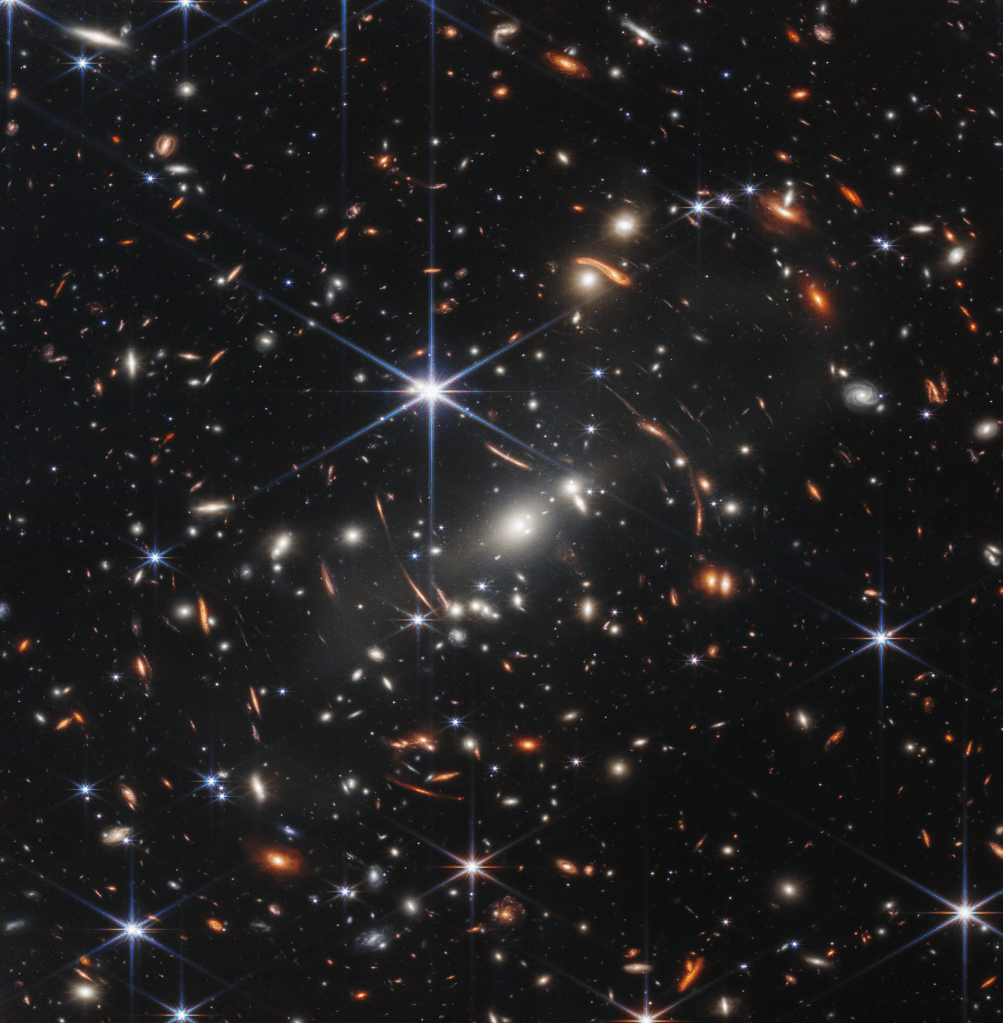
So, this week’s breaking news from NASA Goddard of the reveal of the first five images taken by the James Webb Space Telescope out in orbit of the Earth was a profoundly beautiful moment for me. Webb captured our first images of galaxies as they existed a mere 4.6 billion years ago. Those same galaxies could look very different today, yet their light has only just reached us across the vastness of Space. That image, Webb’s First Deep Field, was released on Monday evening by the White House after NASA offered a preview of the five images to the President and Vice President. Lucky them!

Webb’s First Deep Field, NASA JWST, Public Domain.

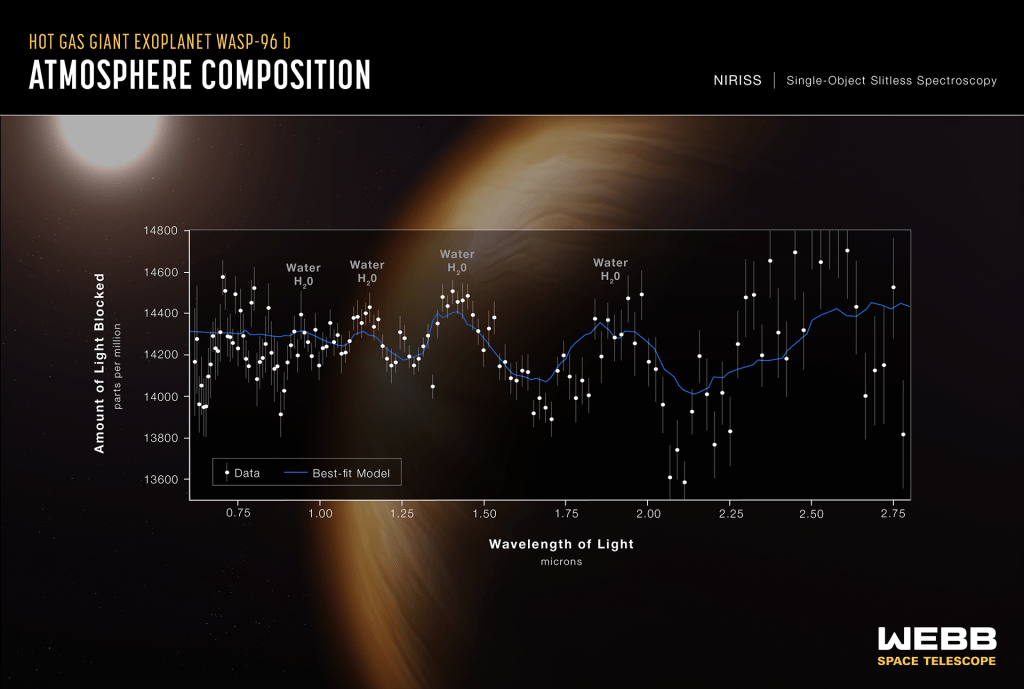
As profound as that deep field is, I was struck more by the potential offered by another one of Webb’s images, the second image released to the public which shows the atmospheric composition of an exoplanet called WASP-96 b, which is about 1,120 light-years from Earth. WASP-96b’s atmosphere confirms the presence of water on that planet’s surface, a sign of potential life on that planet’s surface. This is the part of Webb’s mission I’m the most excited about, its potential to help us in our endeavors to find out whether we’re alone in this vast Universe of ours, or if we’re one planet among many populated and teeming with intelligent, thinking, and innovative people.

I can’t help but mention the picture, which is probably my favorite on an aesthetic level, that being the image of the “Cosmic Cliffs” of the Carina Nebula, a stellar nursery located roughly 7,600 light-years distant from Earth. The vibrant colors of the Carina Nebula even unseated Thomas Wilmer Dewing’s 1904 painting The Lute from the coveted role of my computer’s background, at least for now.  A closer nebula to Earth, the Southern Ring Nebula, was also photographed. This time though instead of a stellar nursery this nebula surrounds a dying star in its cloudy sphere. Even more profound are the quintet of galaxies captured by Webb from some 290 million light-years away, old enough that its light was contemporaneous with the end of the Carboniferous Period and beginning of the Permian Period here on Earth, well before even the evolution of the first dinosaurs.

On a side note: the Carboniferous room in the Evolving Planet exhibit at the Field Museum remains my favorite room in that collection; I’ve always loved those trees.

The images released by the Webb team and broadcast Tuesday from NASA Goddard represent 25 years of combined efforts from a whole host of scientists and engineers at space agencies around the globe working together to achieve a common goal. By expanding our knowledge of the universe around us we are also demonstrating to ourselves and our descendants that it is possible to work across national divides, to achieve common goals. When we do pull ourselves out of our current string of interrelated crises and societal problems it will be because we’ve finally decided to work together as one humanity for the betterment of all of us.

We have an opportunity now to gaze into the past, to see light coming from stars that may well have died long ago. Yet with their light memories of their existence remains. With that light we’re reminded not only of what once was both out there and here on our home planet, but also of what could be in our future, of a time when maybe we will explore further afield, spread out from our home not as conquerors but as explorers. Stay curious.

How Space Exploration Can Unite Us

How Space Exploration Can Unite Us Wednesday Blog by Seán Thomas Kane

In this episode I argue that we should consider Space exploration as a way of uniting humanity around a common cause in what otherwise is a time when we seem far more divided.

My Dad woke me up just before 6 am on Christmas morning to watch the long-anticipated launch of the James Webb Space Telescope (JWST) from the European Space Agency’s spaceport in French Guiana. Over the past few months, I’d heard and read a great deal about Webb, the engineering behind it, and the mission it has been sent on to travel to the Lagrange 2 point about 1 million miles, or 1.5 million kilometers, from Earth. Once there, Webb will serve as our newest set of eyes on the stars and planets far removed from our own. It will even be able to detect the chemical composition of the atmospheres of distant exoplanets, which could provide us with far better leads than ever before to finding life on distant worlds.

In this last week of 2021, during the Christmas season, a generally happy time of the year, I’ve got to admit there are a lot of problems facing us that are sure to dominate the year to come. The COVID pandemic continues and has recently flooded humanity with a new wave powered by the omicron variant, leaving us scared and worried during the holiday season. The tensions that have boiled over in the last few years in this country, social unrest born out of decades of dissatisfaction, disenchantment, and the pressures of our lives in this Second Gilded Age have brought we Americans closer to the brink than we’ve been in quite some time. Globally, we can’t bring ourselves to do enough to combat climate change, the greatest existential threat humanity has yet faced. Still, the familiar tempo of the drumbeats rises quicker and quicker as the Ukrainians prepare for a potential invasion from Russia, and tensions continue to simmer in the waters between China and Taiwan. Both of these regional wars could well draw my country, the United States, and our allies in, cycling further and further until that simmering pot comes to a boil in the form of another world war.

Meanwhile civil wars, famines, and the other children of fear torment people around the globe in nearly every country, some worse than others. The 2020s have thus far proven to be one of the darkest decades in recent memory, with many of its woes being fruits born from the troubles of the 2010s, 2000s, and the century prior.

Yet alongside all of this, I still have hope that we, humanity, will see ourselves through these threats, that somehow, someway we’ll survive as we have now for so long. It’s interesting to me how the same story, human history, can be told in so many different ways. I was brought up learning the story of human progress, of ingenuity and invention from the Promethean discovery of fire to the digital age in which we now live. It’s a story that has a happy ending, that believes we will eventually overcome our sins and the ghosts that have haunted our waking days as much as our dreams of a better tomorrow. The question I’m left with now, as an adult prone to daydreaming rather than a child without a responsibility to make something of myself, is how do we achieve that future? How do we make tomorrow better than today or all the yesterdays in our collective memory ever have been?

I suggest we look to the potential of what Webb can tell us about the Universe around us. We are after all made of stardust, as Carl Sagan was famous for saying, and at the end of the day it is to that stardust that we will return. The exploration of Space has the potential to be truly revolutionary to our story. If done right, it could be the catalyst that pushes our boulder over the hill, letting us the eternal Sisypheans we are, out of the Hadean turmoil we’ve been in for as long as we can remember. By realizing we are not alone in the Universe, that there are others out there who like us have struggled and fallen time and time again yet still found the strength within them to rise up and build civilizations in their own images, to leave legacies for others to remember them by. We have the potential to overcome our troubles: war, hunger, poverty, ignorance. Let’s set those drums aside and sit down and talk to one another, get to know one another, and learn from each other. Let’s realize that we’re more alike than different, no matter who we are, where we’re from. We may speak different languages, and by extension think in slightly different ways, we may have different incentives for our actions, but at the end of the day we’re all still human.

On the Sunday of Christmas weekend, a date I know as St. Stephen’s Day, I read a thoughtful editorial in the Washington Post by the conservative columnist George Will called “National conservatives and racial identitarians have a common enemy: Individualism”. While I didn’t agree entirely with his argument, and while in general Mr. Will and I only agree on a small number of things (in particular our mutual love of baseball) the main thesis of this column made good sense to me, that here in the United States individuality and the ability of the individual to express their self has fallen by the wayside in many circles in favor of a degree of collective identity on both sides of the political spectrum. The focus has fallen so much on what divides us that we’ve lost sight of how we are really so alike. 

We are all Scrooges as long as we stay in our camps and refuse to venture out into the no man’s land between them. There are past wrongs that need to be delt with, crimes that have yet to be punished, I would be naïve to deny that. At the same time, we need something to bring us together, to break these circles of violence that have been carried out since the time immemorial, embodied in stories like the primordial Fall from Paradise described in the Abrahamic religions. At this point, it’s fair to say we’re in a time when revolutions and counterrevolutions born out of a spirit of vengeance are far more in vogue than any belief in a common humanity. Yet through the fog of war that we allow the dragons of our imagination to breathe out into our world, there are still those among us who send missions beyond Earth with hopes that knowledge will broaden our horizons and increase our knowledge of not only the Universe around us but of ourselves as well. This Second Age of Exploration offers us the chance to unite around a common purpose of bettering ourselves, of elevating humanity above that fog and into a new age in our history when we can achieve all those lofty ideals we continue to set ourselves from each generation to the next.

Summer 2021 Podcast Recommendations

With the last weeks of the Summer break from the Academic Year coming to an end, I thought it would be fun to offer those of you who still read these posts a few podcast suggestions that I regularly listen to throughout the week. These may do a decent job at giving you a general idea of my own interests as they stand at the time of writing.

Planetary Radio

I first found this podcast in early 2020 just before the current pandemic began, and have made it a regular staple of my weekly radio and TV diet. It’s something that I make a point of listening to, if not on its usual Wednesday release, then by the end of the day on Thursdays. Hosted by Mat Kaplan, this is the official podcast of the Planetary Society, a space advocacy organization of which I am a proud member.

Planetary Radio, new releases every Wednesday.

A People’s History of Kansas City

A People’s History of Kansas City is always a wonderful solution for homesickness. I first started listening to it during my first year in Binghamton, I believe in early 2020. Some of my fondest memories listening to this podcast are of the time I was driving back to Binghamton from Albany Airport down I-88 (NY) and listening to a gripping story about the Guadalupe Centers here in KC, or more recently when on the way to and from a Royals game I listened to a couple episodes about Disney’s Kansas City roots and the post-contact history of the Missouria, the people for whom the Missouri River and the State of Missouri are named. I always look forward to hearing an episode of A People’s History, and occasionally even hearing people who I know personally get interviewed on this show (it helps being a historian).

A People’s History of Kansas City is off for the Summer.

Real Humans by Gina Kaufmann

Staying with the Kansas City, and KCUR, theme for a minute I want to suggest Gina Kaufmann’s latest project, Real Humans. It’s a shorter podcast, the episodes rarely seem to go over 20 minutes, but it addresses ordinary people here in KC and how the world we’re living in is impacting their lives. I’ve enjoyed what I’ve heard of this new 2021 release so far, and am looking forward to more stories brought by the host of KCUR’s old 10 am show Central Standard.

Real Humans by Gina Kaufmann, new episodes on Sundays

Star Talk Radio

I’ve been a fan of Dr. Tyson’s for a while now, having first really heard about him in my undergraduate Astronomy class at Rockhurst. This is essentially a radio version of his talk show that aired for a while in the mid-2010s on National Geographic’s cable channel. Essentially it’s Dr. Tyson and his friend Chuck Nice discussing whatever the topic of the week is with their guest. It’s admittedly been harder to get engaged in this podcast than others, but it’s a good one nonetheless.

Star Talk Radio, new episodes premiere on Mondays at 18:00 CT/19:00 ET.

Mission: Interplanetary

I think I first subscribed to this podcast either during PlanetFest this past February or during this year’s Yuri’s Night celebration in April. Either way, this has become one of my favorites for the interesting topics involving human Space exploration that are covered in each episode. The hosts, astronaut Cady Coleman and scientist & author Andrew Maynard are a lot of fun to listen to on either a long drive or a long walk around the neighborhood.

Mission: Interplanetary, off for the Summer. New episodes expected this Fall.

Ologies with Alie Ward

Ologies has topped most of the Apple Podcast charts this Summer and for good reason. I first found it one afternoon this Spring after a fun visit to the Helzberg Penguin Plaza at the Kansas City Zoo when I decided I wanted to find a podcast about penguins. Lo and behold, Ologies had an episode entitled “Penguinology,” with an expert in those antarctic sea birds, and from that point on I was hooked. I’ve really enjoyed listening to the various guest experts on this show, and while it’s a longer one it makes for good listening when you have a free 90 minutes to spare.

Ologies with Alie Ward, new episodes on Tuesdays.

Overheard at National Geographic

Overheard is a podcast that I found fairly early on in my current run of frequent podcast-listening, which all largely began with A People’s History and Planetary Radio. I’ve been a subscriber to National Geographic Magazine for quite a while now, and when I saw that Nat Geo had a podcast I figured it’d be a good one to listen to. At first it was hard to get engaged with it, the early stories I heard weren’t ones that I was all that interested in, but more and more I’ve come to really enjoy it. A recent episode involved that I loved an anthropological study of surviving Nahua-speaking communities in Mexico. Overheard has gone from being one that I’d occasionally listen to to a show that I look forward to every week.

Overheard at National Geographic, new releases on Tuesdays.

Sidedoor

From one Washington scientific institution to another, Sidedoor is a podcast from the Smithsonian that I only found a little over a month ago after my day trip to D.C. to visit a special exhibit at the Smithsonian American Art Museum (SAAM) about Alexander von Humboldt (1769-1859). Sidedoor has so far had really engaging stories that I’ve thoroughly enjoyed, and it’s inspired me more than ever to make it back to D.C. to visit the collections that get a mention on the podcast, in particular an upcoming special exhibit at the old Arts & Industries Building called Futures that sounds like it’ll be really neat.

Sidedoor, new episodes every Tuesday resuming in the Fall.

Gates McFadden InvestiGates: Who do You Think You Are?

One big change in my life that came about the same time as the start of the pandemic was my decision to try watching Star Trek again. I started this time with Picard and have since moved onto The Next Generation, Deep Space Nine, and am currently watching Voyager as well as the new episodes of Lower Decks. Considering a good portion of my free time tends to be spent watching Trek, after all there’s so much to praise about those shows and films, I’ve been on the look out for a good Trek podcast to listen to on a weekly basis. So, when I read on Twitter that The Next Generation‘s own Gates McFadden (Dr. Crusher) would be launching a podcast where she interviewed her fellow Trek stars, I figured I’d give it a go. To be honest I’ve really enjoyed listening to a pair of friends who I know for their performances on screen talk for an hour, or sometimes two, about their lives.

Gates McFadden InvestiGates: Who do you think you are?, new episodes on Wednesdays.

Conclusion

As you can see, I’ve got a lot of different podcasts that I tend to listen to on a weekly basis, and yeah I make time for them. There are a number of other ones that I’m looking in to, notably the Sisters in Strange podcast co-hosted by my cousin Chelsea Dunn and the Star Trek: The Original Siblings podcast co-hosted by my good friends Alex and Sami Brisson, the latter of which I’ll get to once I actually watch the original Star Trek series.

I’ve even considered providing narration of these blog posts as a sort of podcast, a service which is an option if I ever decide to give it a go. At the moment though I’m happy to just have people read what I’ve decided to write about.

Stargazing and the Future

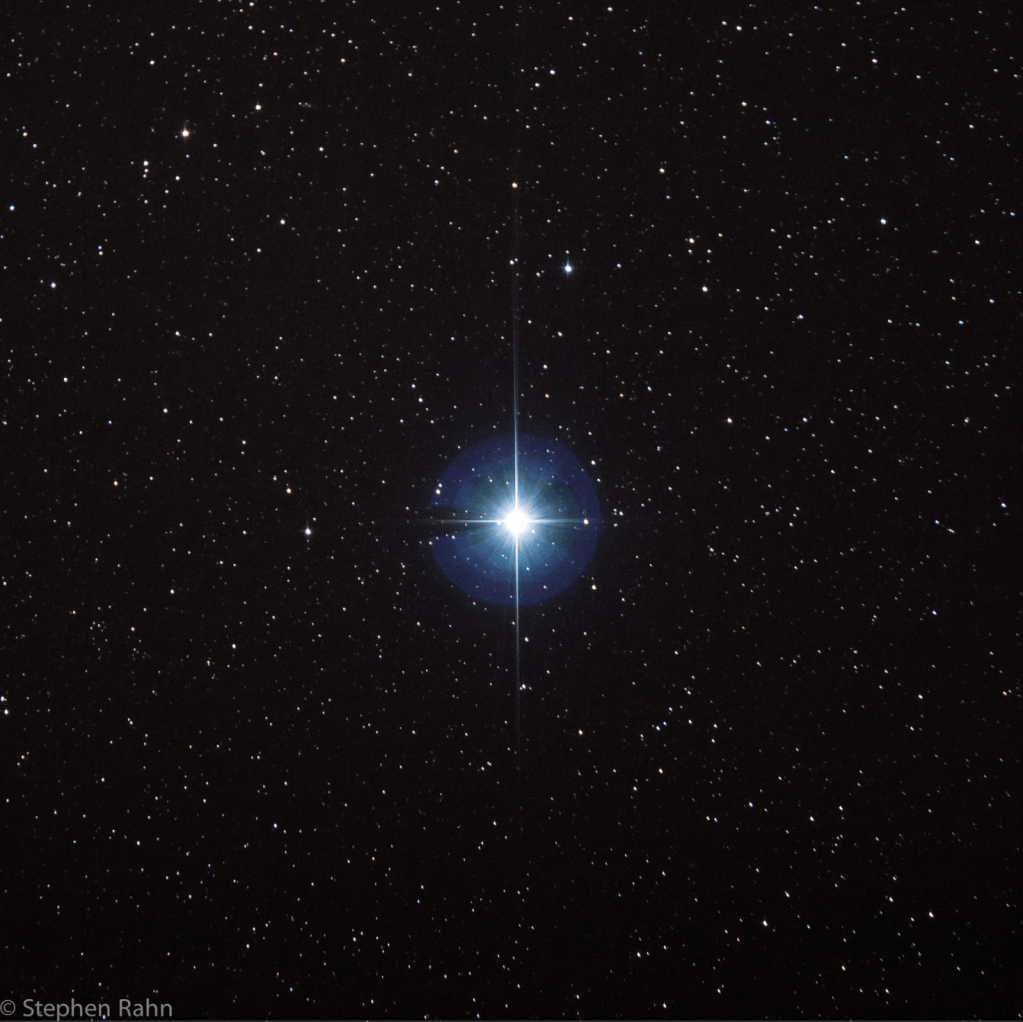
Vega, photo by Stephen Rahn.

For some reason, whenever I spend time at night outside stargazing, I find myself thinking about how timeless the experience is. How I could be anywhere on the Earth and still probably be able to see at least some of the same stars up above me in the night sky. It’s a beautiful and humbling thought, but as much as the starlight itself often takes years to reach the Earth, so too I find myself thinking in those moments about how in years to come, I may well be able to see the same old sight. Yet then, in ten or twenty years when, if I’m lucky enough to be a parent, I might be sitting out on a hillside somewhere looking up in the night sky with my kid or kids, I’ll be seeing light that might well have left those stars at the time I’m writing this now.

The whole concept of light years, that the light of distant stars takes years to travel to Earth, and that one can measure distance in light years, is such a neat way to understand things, let alone a beautiful correspondence between space and time, in what tends to now be called spacetime. One of my favorite stars, Vega, is 25 light years away, meaning the light from Vega that I saw that night recently overlooking the Green River in Dinosaur National Monument left that star when I was 3 years old, right at the beginning of my consistent memories. Like a postcard stuck in a long delivery loop, a postcard sent in 1996, that light which glowed from Vega’s face reached my vision as a memory of a time now seeming well past.

When the light glowing from Vega’s surface today, in 2021, is seen by stargazers here on Earth, in 2046, I will be 54, living a life built on the memories of 2021, just as much as it will be on the more distant echoes of 1996, yet I’ll be as much the same person yet still very different from who I am today. Who knows what thoughts and context will go through my mind then, ideas that will be descendants of those that crossed my mind a few weeks ago when I sat back in the high desert and stared up at Vega well into the night.