Category Archives: Baseball

Bad Practices in Baseball Broadcasting

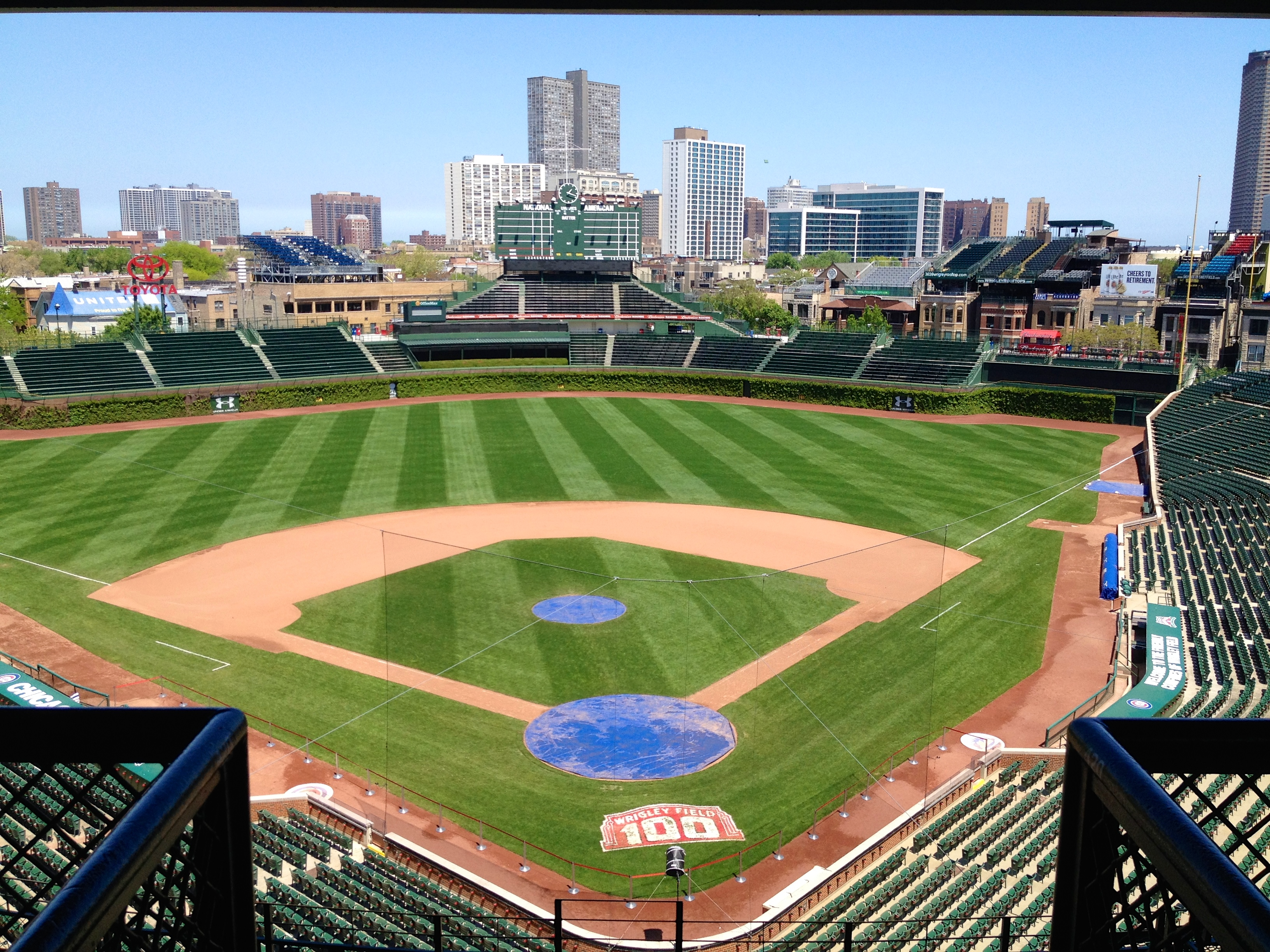
Wrigley Field from the press box.

Bad Practices in Baseball Broadcasting Wednesday Blog by Seán Thomas Kane

This week, how baseball broadcasting today is a tale in what not to do. All musical performances included are my own.

As you’ll have gathered from last week’s episode, I’m a big baseball fan. I always have been, and probably always will be. Baseball was the first sport I watched as a kid, the first I played (Kindergarten T-Ball), and the one that I have spent the most time watching both in the stadium and at home on TV. Growing up in the 90s and 2000s baseball was one of a handful of things that were just normal to have on the TV or the radio during the day in the background. No matter which major league city you were in, the local team or teams would probably be on the airwaves on any given Spring or Summer afternoon or evening. 

As a lifelong Cub fan, I was lucky after my parents & I moved to Kansas City in June 1999 to be able to still watch the Cubs live on WGN’s national superstation. Those broadcasts became one real big constant in my young life, something I even introduced to my cousins on occasion during those long summers in the early 2000s when I spent the day at their house. They were all Royals fans first and foremost, but I distinctly remember one particularly exciting game from Wrigley when we all were buzzing with excitement in front of the TV watching an especially close day game, cheering & celebrating when the Cubs won with a walk-off home run in the bottom of the 9th.

That all began to change in the early 2010s when baseball began to move from the ubiquitous over-the-airwaves channels to special sports channels that you either got through your cable package or that were only available at special request. The Cubs left WGN in 2015, and one of my last day-to-day links with my original hometown went with the last of those broadcasts. I didn’t notice it at first, in September 2015 I moved across the water to London to do a master’s degree in International Relations and Democratic Politics at the University of Westminster, and only rarely got to see baseball at the odd American restaurant in the British capital. When I returned to the U.S. the following year the Cubs were almost always on MLB Network or any of the other regular baseball broadcasters, mostly ESPN and Fox Sports. It was 2016, the year when the drought was finally lifted (see last week’s episode for an emotional recounting of the night of Game 7). In the following years I was able to see the Cubs fairly regularly on national TV, and the Kansas City Royals, my favorite American League team on the local Fox Sports Kansas City broadcasts on a daily basis, but as the 2010s ended all that began to change yet again.

Around the same time as the beginning of the pandemic in this country in March 2020 the news broke that Fox was selling their Fox Sports division as a part of the Disney acquisition of 20th Century Fox. The Federal Trade Commission ruled that Disney couldn’t control Fox Sports and ESPN, that’d be a monopoly, so Fox Sports was up for grabs to the highest bidder. That bidder turned out to be Sinclair, America’s shadiest right-wing owned media conglomerate, the Hearst of the 21st century, the true Charles Foster Kane. I wasn’t happy from the beginning about this; Sinclair had been caught red handed making their local news anchors read a prepared statement that sounded way too much like propaganda for my liking, and nearly anything they touched seemed to be weaponized to benefit their own ideals and mission. So, when Sinclair announced that the Fox Sports naming rights had been sold to Bally’s, the casino chain, I wasn’t totally surprised. One thing to get out of the way: I’m fine with legalized sports betting, I’m just annoyed with how gaudy and grotesque its advertising often tends to be, and frankly I don’t want any part in it. What frustrated me the most was that as a part of the deal Sinclair decided to get greedy, as robber barons are known to do, and raise their rates to the point that Fox Sports, now Bally Sports, was cut from most TV providers’ channel listings, especially from streaming TV providers like YouTube TV and Sling. For the first time in my life, I couldn’t watch baseball, whether the Cubs or the Royals, on local TV.

I recognize that this isn’t a serious societal problem on its own. Having professional baseball off the airwaves for a good portion of the population isn’t going to cause people to starve or to lose their homes or their jobs; it isn’t a matter of public education or human rights. Compared to those problems this is insignificant. Culturally though, in a country that is largely isolated from the global sports market, baseball remains our national past-time. It’s something that developed as our country grew, a sport that came into its own after the Civil War with teams that have existed as long as some communities in this country have. My own Chicago Cubs have an old heritage in professional baseball dating back to around 1870. They joined the National League at its founding in 1876 and have stuck around in the same city ever since. For the first 30 to 40 years professional baseball was seen by spectators in the stands and reported on in the newspapers. In the next few decades with the invention of radio it was broadcast around the country alongside sports like boxing to homes and businesses from Atlantic to Pacific. Following World War II it began to be seen on TV screens, with greats like Jack Brickhouse calling games from the press box at Wrigley Field. Some of my fondest memories of baseball are the most mundane ones, like the times I’d sit in my grandparents’ kitchen watching the Cubs with my grandmother, or the summer evenings in recent years when my parents and I would sit around in our living room in Kansas City watching as the Royals played fun small ball, outwitting heavy-hitting teams with their base running, base stealing, and excellent fielding. Memories like those are what companies like Sinclair are burying deep in the ever-receding past.

A year ago, Sinclair announced they’d have a streaming service ready to go for the 2022 baseball season called Bally Sports+ (because every streaming service is called “so and so +” for some reason). The report said it would cost around $23 a month, or $184 per baseball season, including Spring Training and the playoffs (March-October). This would cater to people like me who don’t have traditional cable packages, owing to their exorbitant prices around $80-120 a month, and would fill the void that Sinclair themselves created to gouge the market during the 2020 and 2021 seasons. Well, Spring Training has begun for 2022 and Bally Sports+ is nowhere in sight. I was lucky enough on Monday afternoon this week to catch a Royals Spring Training game against the Angels but that feels more like a chance encounter than a solid resolution to the problem.One potential solution would be to build off the legal exception that the 1922 Supreme Court Case Federal Baseball Club v. National League made for Major League Baseball to be exempt from the Sherman Antitrust Act, the very act which opened the door for Sinclair to buy Fox Sports over Disney’s objections. In the present case, I’d argue that baseball is an exception to the rule because it’s a deep-rooted part of American culture. As such it ought to be available to watch over-the-air, exempt from any special cable or streaming packages, exempt from being hogged by the greedy arms of broadcasting conglomerates like Sinclair. Unlike the NFL, baseball’s closest competitor, Major League Baseball’s season doesn’t lend itself well to having an all-national broadcast schedule. We’re talking about 24 weeks between April and the end of September with 162 games being played by 30 teams, or 2,430 games in a season. A solely national broadcast system like the NFL’s simply wouldn’t work for the MLB. Instead, local broadcasts should be prioritized, and broadcasting companies should be incentivized to put the viewers first. The alternative, if baseball isn’t easy for people to watch on a regular basis, is for the sport to decline in popularity, something that hurts companies like Sinclair anyway. I only hope that Sinclair’s executives realize it’s to their benefit to let people watch baseball at a fair price.

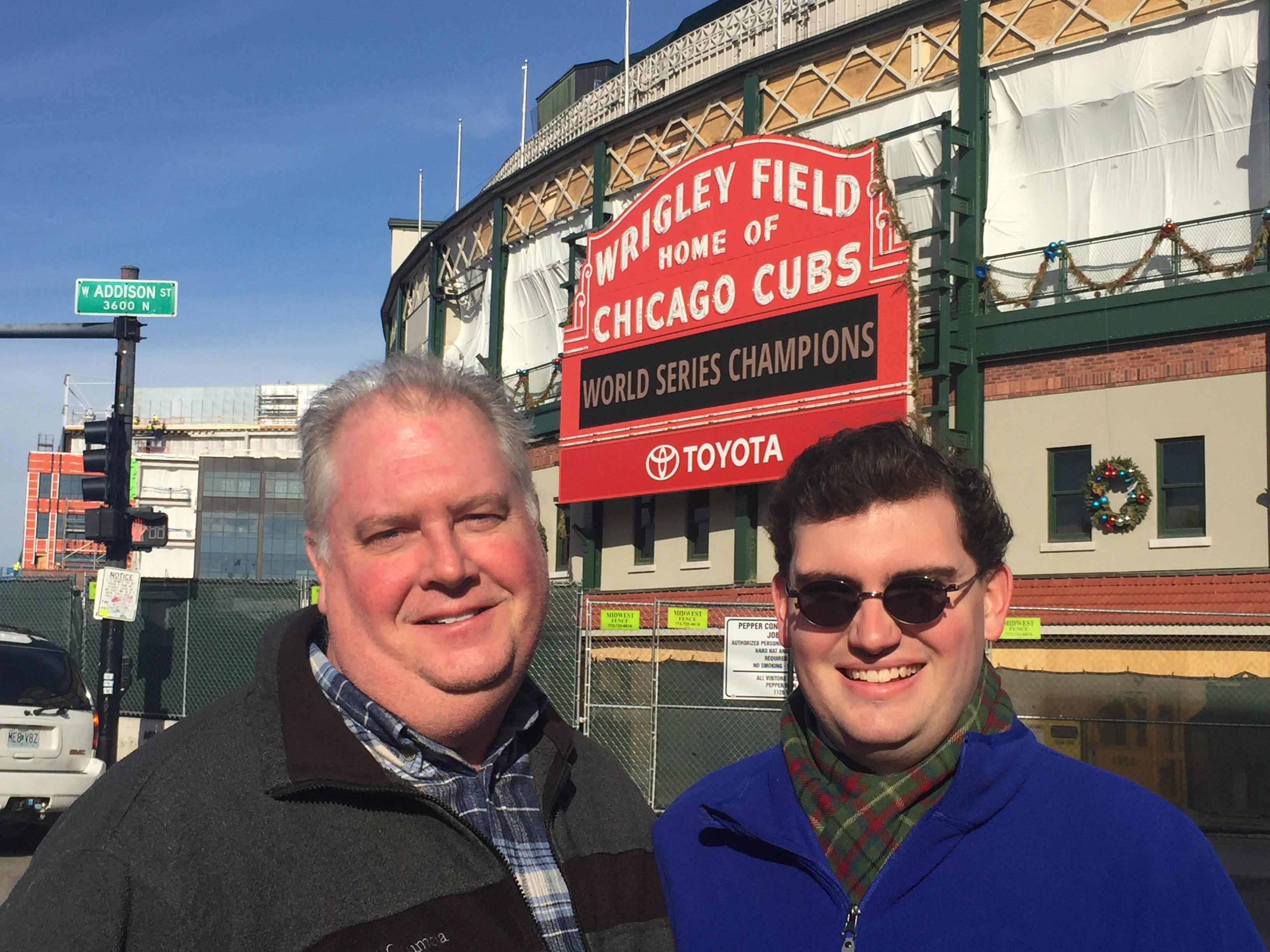
My Dad and I in front of the Wrigley Field Marquee in December 2016

The Dream Has Come True

Embed from Getty Images

Unlike most things in my life, I cannot pinpoint a specific moment, date, or even year when I was first cognisant of being a Cubs fan. That is one part of my life that seems to have always been there. I was born in December 1992 in suburban Chicagoland to a father from the North Side, specifically from Rogers Park and a mother from Kansas City, MO, yet with North Side roots from her Swedish American grandmother, and life long White Sox fan, from Andersonville. In 1992, the Cubs finished fourth in the National League East with a 78-84 record below Pittsburgh, Montréal, and St. Louis and a ways above the New York Mets and their rivals in Philadelphia.

By that time there had been at least three different sides of my family who had settled in Chicago, primarily on the North Side. My Swedish-born third great-grandfather Victor Larsson Lindblad, an ancestor of my mother, was in Chicago by the time of the 1871 Fire, having settled in Andersonville. Ten years later, on my father’s side, my second great-grandfather John Newman settled in Chicago, where he married his wife Frances in 1892, and where their eight children were born between 1893 and 1908. At the turn of the Twentieth Century my grandmother Mary Lou’s grandparents and father moved to Chicago, eventually making their way up to the North Side as well. Finally, in 1914 my great-grandfather Thomas Keane arrived from Ireland (his surname would change to Kane in 1917), initially living on Superior across from the Cathedral, and later moving to Argyle and finally Rogers Park with his wife, my great-grandmother who came to Chicago in 1920. If any one city were said to be the cradle of my family in America, it would have to be Chicago.

I vaguely recall my grandparents mentioning the 1945 World Series. My grandfather was only 15 at the time, while my grandmother was a mere 13 when that incident with the goat took place at Wrigley Field. I never heard them talk about it, presumably it was either too superstitious for good Irish Catholics like themselves, or just a sore subject. That said, out of the two of them my Grandma was the big Cubs fan. As a young child when I was visiting them in their suburban condo, I would often be with her in the kitchen while she cooked watching the Cubs on her small TV, the rabbit ears fully extended to catch the signal from WGN. My Dad recalled how she would more often than not be in attendance at Wrigley on Ladies’ Days with so many other North Siders to cheer on our team. Even as she neared the end of her life, and her health began to go, she would ask for the Cubs game to be put on the TV in her room.

In the summers, my parents and I would go out on Lake Michigan on a sailboat that they co-owned named The Arctic Tern. Our most frequent destination would be a point along the lakeshore that had a good view of Wrigley Field. There we would tune our radio to WGN and listen to Ron Santo and Pat Hughes calling the game. 1998 was one of the biggest years of my childhood in the world of sport: the Bulls concluded their final threepeat, and the Cubs made it into the playoffs for the first time in my life. That was an electric summer, one when the Cubs made headlines for both their pitching and their hitting. While I still have the Tribune‘s poster honouring Sammy Sosa’s record 66 home runs that season, I can remember far better Kerry Wood’s 20 strike out game on May 6 against Houston. What a year that was!

Embed from Getty Images

1998 may stick out so well in my memory thanks to what happened the following year. In June 1999 my parents and I left Chicagoland, moving onto a farm in Kansas City, KS. To say that that was a nutty idea would be accurate. Despite now being 500 miles away, we could still watch the Cubs most days on Superstation WGN, and continued to closely follow our team, despite now slowly gaining a new allegiance to the Kansas City Royals. The funny thing about being both a Cubs and a Royals fan is that it is remarkably easy to support both teams, after all they hardly ever play against each other. Nevertheless, my position has always been that the Cubs will come first, ahead of the Royals in my book.

In the Summer of 2000 I had just finished First Grade and was playing Coach Pitch baseball on the aptly named Pied Piper Pest Control Team at the Wyandotte County Sports Association fields in Kansas City, KS with a bunch of my classmates from St Pat’s School. At about the same time there was a TV commercial that kept appearing during the shows that my cousins and I would watch that showed a young boy using a big baseball bat, either coloured red or blue, and suddenly gaining the talent and strength of either Mark McGwire of the Cardinals or Sammy Sosa of the Cubs. I can tell you one thing for certain about that May, I really wanted that bat, because as the new kid at school I needed every opportunity I got to impress. Plus, as a 7 year old Cub fan how could I not want to be able to hit the ball like Sammy Sosa? To put it simply, I never got the bat, and probably for the better as I only ever hit the ball once in my entire one-season career as a left fielder for the Pied Piper Pest Control coach pitch team.

By the time the Cubs began getting hot again in 2003 I was used to watching them play from afar. That Spring I actually attended my first game at Wrigley Field on 23 April 2003, a monumental day in my life, yet one that I remember as being slightly boring and long. We sat in the bleachers, far enough away from home plate that it was very hard for me to see anything that was going on there. The Cubs ended up losing that game that few probably remember to the Padres 2-0. As 2003 progressed it seemed more and more likely that the Cubs were on fire and ready for another playoff run. Sure enough, in their 128th season the Cubs won National League Central with an 88-74 record.

Embed from Getty Images

That Fall was one that I will never, never forget. In the Divisional Series the Cubs faced off against the Atlanta Braves, a strong team, yet one whom the Cubs beat 3 games to 2 at Turner Field. As the Pennant race came along, I was more excited than I had been in years for the Cubs, who now faced the Florida Marlins. The Marlins seemed like a surmountable team, one that the Cubs could take. To me, the Cubs were nigh invincible, the team that was destined to win the 2003 World Series, to end the 95 year drought. I was always so excited to see Sammy Sosa, Moises Alou, Aramis Ramírez, Kerry Wood, Mark Prior, and Matt Clement take to the field. My Dad would tell so many stories about the great Cubs of 1969, of Ernie Banks, Ron Santo, and Billy Williams; how they electrified Chicago with their fun style of play, and how they led the National League until the last moments of the Pennant race. Like the ’69 Cubs, the ’03 Cubs were equally electric, but fell short of their goal. Some blame Steve Bartman for putting the team off of their mojo, but as far as I’m concerned, the tension of the moment got to the guys on the field, and the Cubs collapsed back into obscurity for the next couple of years.

Embed from Getty Images

As time has gone on, players have come and gone. Sammy Sosa left the Cubs with only a little controversy in 2004. For a while in the late 2000s Derek Lee seemed like the top guy on the field at Wrigley, his prowess as a baseball player taking him so far as to be referred to as “General Lee” on more than one occasion by my fellow Wheaton native James Belushi during WGN’s broadcasts of the “Chicago Civil War,” aka the annual Cubs-Sox Series. Lee left the Cubs in 2010, but not before playing a roll in the next big playoff run, this time in 2008. It was the centenary of the last Cubs World Series victory. Surely the stars were properly aligned, surely the saints and angels in Heaven were pulling for the words “World Series Champions” to be emblazoned on the Wrigley Field Marquee. Surely this was our year. With the hopes of millions on their shoulders, the 2008 Cubs did all they could but were swept by the Dodgers in 3 games in the Divisional Series. I finished 2008 less focused on the world of sport than on my Sophomore Year in High School, which was ongoing at the time with all its exuberant fun.

As the 2010s started up, my focus, like that of many Cubs fans switched towards Hockey, as the Chicago Blackhawks began their dynastic series of Stanley Cup victories. I had just returned from Dublin in June 2010 when Patrick Kane (no known relation) scored the winning goal in overtime of Game 6 against Philadelphia. 2011 marked the first season without Ron Santo doing the commentary on WGN Radio, a huge loss in my book. In 2012, Kerry Wood retired from professional baseball, having returned to the Cubs the year prior to finish his career back in the Friendly Confines. In 2013 the Blackhawks won their second of three Stanley Cups thus far in the 2010s. I found out the good news a few hours later when I woke for class in London where I was on a three-week summer study abroad course.

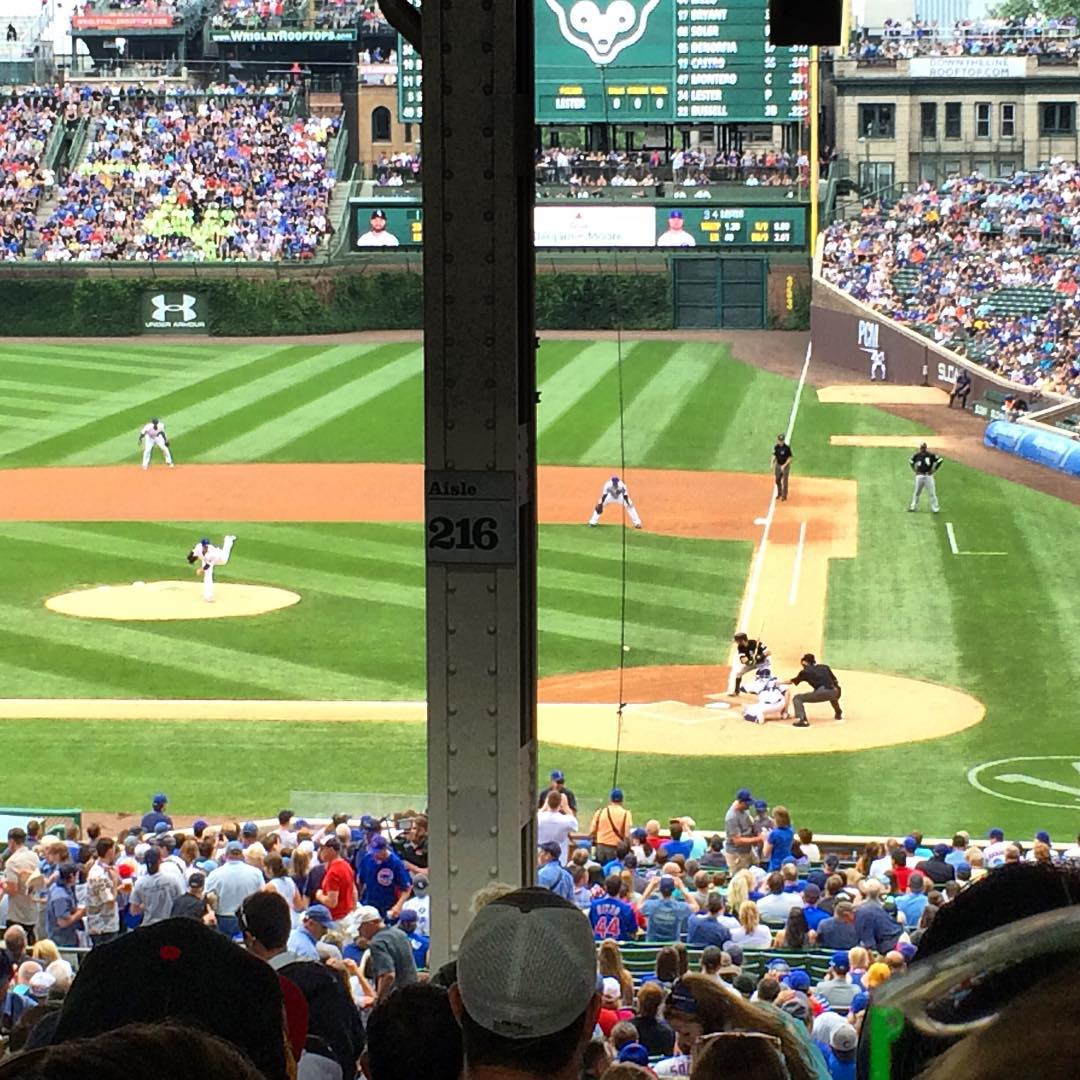
2014 and 2015 were years dominated in my house by the Kansas City Royals, who after 29 years of being fairly unannounced in Major League Baseball stunned the country by beating Oakland in the thrilling 2014 Wild Card Game, silencing the A’s top ace, Jon Lester, early in the game. The ’14 Royals went on to the World Series, but lost out to the San Francisco Giants in Game 7 leading to heartbreak for many here in Kansas City. 2015 saw a revival amongst many of the “smaller” MLB teams, including the Cubs who powered their way through the season, having acquired Lester from the A’s in the offseason. My Dad and I were lucky enough to get to go up to Chicago on 11 July to see the Cubs play the White Sox, whose starter Chris Sale outdid Lester, leading the South Siders to a 5-1 victory.
lester-cubssox-2015

Jon Lester pitching against the White Sox. Photo: Seán Kane

In September 2015 I left home and moved to London, missing out on the playoff excitement, which was greater than any other year for my family as both the Cubs and Royals had made it past the regular season. The Cubs came into the playoffs as the second wild card, finishing the regular season in 3rd place 3 games behind St. Louis and 2 games behind Pittsburgh. In the Wild Card Game, led by Jake Arrieta’s pitching, the Cubs ploughed through the Pirates in Pittsburgh in the ’15 Wild Card Game, leading to a memorable attack by baseball bat on a water cooler in the Pirates dugout. In the Divisional Series, the Cubs fulfilled one of the life-long dreams of most fans, especially those of us alumni of Rockhurst University, whose student body has traditionally been primarily made up of St. Louisians. Despite being 4,000 miles away, and unable to watch the game on TV in England, I saw the final few innings as the Cubs easily trounced their longtime rivals the St. Louis Cardinals at Wrigley Field. After years of supporting the underdog, I couldn’t help but smile. The joy of ’15 was quickly extinguished however, as the Mets came through and left the Cubs behind in a 4 game sweep on their way to the World Series. The Royals had fared better, having beaten Houston and Toronto in their drive to retain the American League Pennant. They met the Mets in the World Series, winning the crown for Kansas City in extra innings in Game 5 at Citi Field in Queens. I sat at my desk for the entire four hour fifteen minute game, watching the pixilated images being transmitted from my parents’ house in Kansas City.

As the 2016 season came around, I had a feeling that this could be the year. Every morning from March onwards, as soon as I would wake up in my basement flat in Central London, I would check the Cubs score on my phone, and as the months passed things only got better. By the time I returned home to the U.S. at the end of August 2016, it was clear that the Cubs would be in the playoffs yet again, and even clearer that they would go into playoff baseball with the best record in the Major Leagues. I watched the National League Wild Card Game between San Francisco and the New York Mets quietly from the upper level of an Italian restaurant near the Moscone Center in San Francisco, keeping an eye on who would be the ones that the Cubs would face in the Divisional Series. After a marathon Wild Card Game that saw a stellar pitcher’s duel between San Francisco’s Madison Bumgarner and New York’s Noah Syndergaard, the Californians won out with a three-run home run in the ninth inning.

The Divisional Series saw another round of amazing pitchers’ duels, this time between the likes of Jon Lester and Johnny Cueto in Game 1, and Jake Arrieta against Madison Bumgarner in Game 3. The Cubs moved past San Francisco after four games, and looked south towards the Los Angeles Dodgers who beat the Washington Nationals in their series 3 games to 2 in their Divisional Series. Like the Giants, the Dodgers are one of the best teams in the National League, and always a fun team to watch. As the Cubs took them on I couldn’t help but be thoroughly impressed by the Dodgers. Game 6 of the series, played at Wrigley Field, turned into one of the greatest nights of my life. It was the night when, in 2 hours 36 minutes the Chicago Cubs went from being the team who hadn’t won a Pennant since “the year we dropped the bomb on Japan” to National League Champions. It was a night like no other, a night when to so many millions of us it truly seemed possible that our team, our Chicago Cubs were truly capable of winning the World Series.

Embed from Getty Images

The Cubs might have seemed destined to win the 2016 World Series, after 108 years of waiting, but they had a major road block in their way. While the Cubs had lit up the National League all summer long, Cleveland had seen a resurgence, taking the American League by storm and silencing all opposition, beating David Ortiz and the Boston Red Sox 3 games to none, and the red hot Toronto Blue Jays 4 games to 1. Both Cleveland and Chicago came into the World Series with all the momentum they would need to win it all. In the end, it came down to endurance. I watched all seven games in a dreamlike state of mind, joking that this must be some sort of existential crisis for the natural order of things, after all this World Series wasn’t between a heavy weight like the Giants and Yankees, nor between the Red Sox and Cardinals. This was a World Series between Chicago and Cleveland, two flyover teams. We had not won a World Series since 1908, they had not won one since 1948. All that that did was give this series more umph, to make it a World Series for the Ages.

While I and many others just wanted a nice and tidy victory to cap off the World Series for the Cubs, the game had more twists and turns than anyone could have expected. From the Cubs giving up a 5-1 lead in the fifth, to Rajai Davis’ two-run home run that tied things up in the eighth at 6-6, I frankly was saying more Rosaries than anything else. Just when things seemed bleakest for the Cubs, when they had lost their momentum, and at least to some that goat was getting in the way again, the Heavens opened up, and the game was stopped for rain. 17 minutes later and the Cubs started over, taking things from a 6-6 tie in the 9th to a stunning 8-7 victory in the 10th. As it happens, the 2016 League MVP, Ben Zobrist had been with the Royals in ’15 for their World Series run. Now not only had he won two World Series in the same number of years, but he lived the dream of all Cubs fans, being a lifelong fan who had helped the Cubs win the World Series.

Embed from Getty Images

In the aftermath of the night of 2 November 2016 I was left speechless, in a state of jubilant shock. All my life, all my Dad’s life, all my grandparents’ lives we had waited for this to happen. For over a century the North Side of Chicago had waited to raise the World Series Banner once more at Wrigley Field, to stand before the world and cheer on our team, no longer just another easy team to beat. To me, it seemed fitting that the Cubs would win the World Series on All Souls’ Day of all days. For now, we have the best team in baseball, and today when they bring the Commissioner’s Trophy home to Wrigleyville they will surely do so in front of a crowd of millions. Wednesday night I actually found the view of the Cubs celebrating on the field in Cleveland to not have the emotional power that I expected to have. Instead, that power was with the fans who had gathered at the corner of Clark and Addison outside Wrigley Field. And as the screen on that famed Marquee changed to the words “CUBS WIN!” and “WORLD SERIES CHAMPIONS” the roar of the North Side could surely be heard around the world.

As 2016 comes to a close, and 2017 stands on the horizon, the Chicago Cubs have a new future in store. They could well continue to be a winning team for a few more years, so long as this current roster stays at Wrigley. I also have a new future, though perhaps a nostalgic one, as I prepare to leave Kansas City to undertake the work for my Doctorate. On my list are two universities back in my hometown, two institutions that, should I be accepted, would give me the chance to return to Chicago and cheer on the Cubs as I always have, albeit from not nearly as far away. The past is certainly a good thing to remember, but it is the present in which we live, and the future to which we are going. Today, as the Sun shines, and my Win flag flies at my door, I can’t help but look back at the Cubs of yesteryear, of their three World Series Championships: 1907, 1908, and 2016. But all the same, I can’t help but gaze into the future, when perhaps I, or my descendants, will get to celebrate another Cubs World Series victory. The Dream has come true.

Embed from Getty Images

Baseball

Kansas City – Like many others here in North America, the dominant sport of my youth was baseball. As a child, I could have easily listed off the starting lineup for the Chicago Cubs, my hometown team, just as easily as I could have told you who was President at the time. Baseball dominated my summers, with the evenings often spent at CommunityAmerica Ballpark in Kansas City, Kansas, home of the Kansas City T-Bones of the independent Northern League, and later the American Association.

Today, when I look at baseball often what first come out of my mouth is a sigh. For me, the classic image of baseball is that period between the 1930s and 1960s when some of the greatest classic players took to the field. Even when the Cubs were doing well in 1998 and 2003, my mental image of the national pastime was in black and white, unlike basketball which has always been in colour.

In the intervening years since the Cubbies last nearly made it to the World Series, just under 11 years ago at the time of my writing this editorial, my views on the sport have changed slightly. For one thing, I find that baseball is a bit of an odd duck in the sporting world. To an extent, it appears to try and mimic the game-length of american football, while having very distinct roots in sports such as rounders and cricket, which take far longer to play in their traditional forms.

So, I say why not make the structure of baseball more like cricket? Looking at the structure of the game, each game lasts for 9 innings, unless there’s a tie. In that case you could be there all night. The longest baseball game that I’ve sat through went to the 21st inning, ending at 2.00 am, with the T-Bones losing at the end to Fargo.

Each game is a part of a series, in large part a holdover from past decades when intercity travel in North America was quite a challenge. Each series traditionally lasts for 3 games. So, why not slightly change the way that scores are measured? Instead of going per-game, why not go per-series?

For example, say the Cubs play the Nationals over 4th of July weekend in Washington. The series begins on the afternoon of Friday, 4 July, a game the Cubs win 7-2 over the Nationals. Game 2 is on the evening of Saturday, 5 July, a game which the Nationals win 13-0. Game 3, the final game of the series, takes place at noon on Sunday, 6 July. Game 3 is won by the Nationals with a score of 2-1. Therefore, under my proposed system, the Nationals would win the series 2-1, with the runs standing at 16-8. So, the score would be shown as follows: WSH 2/17 – 1/8 CHC.

The runs would only matter in regards of who wins the series if at the end of 9 innings in Game 3 both teams are tied. So, let’s say that with the Nationals vs Cubs example, at the end of the 9th inning in Game 3 the teams are tied at 1-1. The umpires would then go to the total number of runs from the series, which in this revised scenario would be:

G1: CHC 1/7 – 0/2 WSH

G2: CHC 1/0 – 1/13 WSH

G3: CHC 1/1 – 1/1 WSH =

CHC 1/8 – WSH 2/15.

The Nationals would win the series because they scored more runs over the course of the series. You will notice that in this tie-breaker scenario, Game 3 is not counted under the games won side of the score (Games won / Runs.) This is because neither team technically won Game 3, leaving it uncounted in the overall score.

What would this do for the overall flow of the game? For one thing, it would allow for end-of-series games to end quicker, allowing for the teams to be on the road faster if needs be, while also ensuring for fans with children that their Sunday afternoon baseball wouldn’t keep their sons or daughters out too late on a school night. At the same time, it would give more meaning to the series, which I feel has lost quite a bit of meaning over the years. It could also give more impetus to batters to work on scoring more runs earlier in the series, as that would better insure their team from losing on runs at the series’ end.

On top of that, this system could simplify league standings, eliminating the need for having teams be 1/2 a game back from another team. In this model, the teams’ standings would be shown based upon their overall series performance. Ties on the series record side would be resolved with the number of runs scored. If we use the current Cubs record using the official rules of baseball, they stand as follows:

Team     W     L     PCT     L10     STRK

CHC     38    48   .442       6-4       L2

Now, if we use the same system for this series-based record, the Cubs record stands as:

Team     W     L     PCT     L10     STRK

CHC     12    16   .430       5-5       L1

You will notice that I do not include the “games behind” category in the above charts. If this series method were to be implemented it would include a “series behind” category. I simply did not have time to translate the seasons of all of the teams in the National League Central from the current game based system to my series based system.

In general, this series based system is more of a mild Monday afternoon brain teaser, and what I’d call an interesting exercise to consider. Whether any of the world’s baseball leagues will ever implement such a system is yet to be determined, however I will say that it would add another layer of excitement to the national pastime.

What’s to come in March

Kansas City – March is always a big month on the calendar. It’s the Trinitarian month, the month when the activities of Winter begin to give way to their Summer counterparts. It’s a month of change. Often, for my fellow Catholic and Orthodox Christians, March is completely consumed in one of the holiest seasons of the year: Lent.

If you want to know my views on Lent, don’t worry, I’ll be brief: Yes, if it is in your tradition do observe it! I take a more simple route compared to some of my fellow Catholics: no meat on Fridays, and fasting on Ash Wednesday and Good Friday. This means only 2 big meals and 1 small meal on those days, and no meat. Also, key is the giving up of something which you feel can keep you from Christ. I tend to take this more spiritually than physically, meaning that I don’t give up sweets or chips (fries). Rather, in the past few years I’ve given up negative emotions and mentalities such as hate, irrational fear, and this year excess and unnecessary worry. Yes, I haven’t always been successful with these: hate was simpler to give up than irrational fear, but I find it to be a good exercise in self control, which is a habit that is necessary in any and every social setting.

A huge part of this is foregoing the self, not focusing on one’s own person as much, and instead focusing that energy upon the wellbeing of society in general. We should try to challenge ourselves to forgo having “I” at the top, favouring “We” instead. Many Christian mystics have argued that the first step towards a fuller relationship with the Divine is to forgo one’s own self in favour of the will of another, in this case God.

Now that’s sorted out, onto some of the articles you can expect to find on this website in the coming weeks.

Image

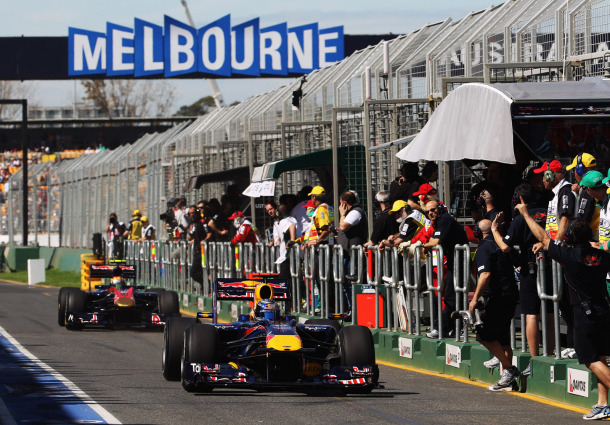
Courtesy of Red Bull Racing

Thursday evening for us in the States (Friday morning for Europe and the Middle East, and Midday Friday for Australia and New Zealand) marks the start of the official race schedule for the 2014 Formula 1 World Championship! This weekend’s Australian Grand Prix, taking place at Albert Park in Melbourne, is sure to be a thriller. With longtime contender Mark Webber out of the running, the starting grid will seem a bit more empty, and without the old V8 engines it’ll certainly be a wee bit quieter, but undoubtedly it’s bound to be an eventful and exciting race weekend from the capital of Victoria. I’ll begin my coverage of it on Friday afternoon with thoughts on the Practice sessions, continuing Saturday and Sunday with the qualifying and race results in due course.

One thing to make note of regarding Formula 1: considering that I’m writing from North America, most of these races take place in the middle of the night my time, as I’m on Central Time (March to October GMT -5, November to early March GMT -6) I’ll probably be posting my articles up to 24 hours after the actual events occurred, in part because I’ll be watching tape-delayed, and also because as much as I do enjoy F1, it’s not generally something that I’ll get up at 3 in the morning to see. Now, I will write on the races in Western Europe and the Americas closer to time, but I’ll let the lads at NBC Sports do the graveyard shift for the rest of us here in the States.

Next, and closer to home, is the start of the summer sporting season here in the US and Canada. In particular, I’m referring to Major League Baseball’s Spring Training and Major League Soccer’s season’s start. I highly recommend to anyone who enjoys baseball to watch the season opener between the LA Dodgers and Arizona Diamondbacks in Sydney, Australia. It’ll be broadcast as a double-header on Saturday 22 March at 3.00 and 22.00 CDT, and will be nationally broadcast in the United States on MLB Network. The Cubs’ home opener will be on 4 April vs the Phillies at 13.20 CDT, and will be broadcast as per tradition and reason on WGN (hopefully nationally as well.) The Royals’ home opener will also be on 4 April at 15.10 CDT and will be broadcast locally on Fox Sports Kansas City.

Major League Soccer began its 2014 season last weekend with much gusto! Though Sporting KC didn’t leave Seattle with a win, they still played quite well over the course of the 90 minutes. I was also glad to see the Vancouver Whitecaps give the New York Red Bulls a stunner, beating the Supporter’s Shield winner 4-1 on Saturday evening in Vancouver. Hopefully tonight Sporting KC can return home and play for a win over Mexico’s Cruz Azul in the CONCACAF Champions’ League. We’ll just have to see…