
Category Archives: Olympics

Olympic Optimism

In celebration of the last few weeks of the Summer Olympics in Paris, I want to write to you about the optimism that the Olympics embody. — Click here to support the Wednesday Blog: https://www.patreon.com/sthosdkane


In celebration of the last few weeks of the Summer Olympics in Paris, I want to write to you about the optimism that the Olympics embody.


I’m an optimist at heart. I think that’s what has gotten me through these last 10 years of graduate school, and what keeps me going through the hard times we find ourselves in. Every two years, my optimism is renewed by the staging of the Olympic Games, summer and winter. Each Olympiad resides in my memory in its own different way, the character of the host city and the joy of the individual athletes shining through the broadcast of the games. Here in the U.S., the Olympics are actually the one big thing that I think of when I watch NBC, while Rio 2016 was a rare Olympiad that I missed most of being in London at the time with the events at odd hours for Europe. The Olympics reinforce that optimism that we humans can truly work together for our mutual betterment. We have the potential to grow beyond what Carl Sagan called “our adolescence as a species” dominated in the last two centuries by nationalism, division, war, and genocide toward a better future where societies work for the betterment of all.

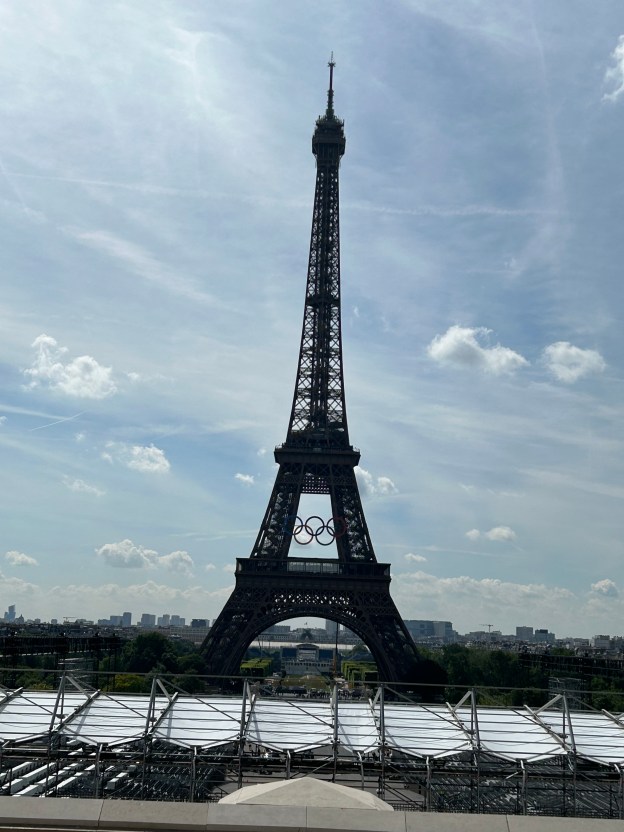
This year, I was in Paris a short while before the games began and got to see aspects of the Olympiad in preparation. The rings were mounted on the north face of the Eiffel Tower in early June when I visited the Musée national de la marine at Trocadéro, and all around the city the lavender-colored placards advertising directions to Olympic venues were hung in the metro. It gave me a sense of what it might be like to be in this city a few weeks later when the games began. Paris is a city which has such a long history of both oppression and liberation that it speaks better than many others to the collective human experience. It truly was a wonderful city for this Olympiad to be held at a time of tremendous pessimism and conflict around our globe.

I set up alerts on the Paris Olympics app on my phone for Team USA and Team Ireland, and for several specific events which I wanted to follow, especially the Fencing, I was a saber fencer in my pre-teen years for a while. While I wanted to support my own national team and the national team of my ancestral homeland, I still cheered on whoever was competing at a given moment. I like to say often that it’s better to have a wide margin of victory when I have a team in the competition: I’d rather see my Cubs win by 5 or 6 runs than by 1 run in a late season or playoff game. Yet, when I’m happy to see the competition itself and see these athletes perform their best on a stage watched by billions, I love seeing a tight race. For me then, as much as I love seeing Team USA march into the Opening Ceremony, or in this year’s case float down the Seine on their boat as the second-to-last to launch from Pont d’Austerlitz, I love even more the moment when the national flags join together and march toward the podium following the Olympic flag. All nations united in a common cause empowered by their hope and joy.There’s a song that was composed for the Rugby World Cup, which is just as pertinent here, World in Union, set to Holst’s Jupiter theme from The Planets which ought to be sung here too. The idea that every two years we all can join together, for several weeks, and form that very same world in union is what fuels my optimism that our days of division and strife are impermanent. I recognize the realists who say that we need to focus solely and whole-heartedly on the trials of our time, the wars and oppression happening in our midst; yet we should also keep this hope in mind that we might one day grow beyond war and beyond feeling the need to oppress each other. There should be as many diplomats and negotiators offering a chance at peace as there are soldiers carrying on the fight because at the end of any war there will be peace again, and the form that that peace takes will determine if any other wars will follow on.

Episode Untitled, or Humanity and What We Can Do About It

Episode Untitled, or Humanity and What We Can Do About It Wednesday Blog by Seán Thomas Kane

This week, an attempt at trying to suggest how we humanity can be better humans.

I had a grand piece planned out for this week: how we should come to notice our common humanity more, which I outlined while I was watching the Opening Ceremony of the Beijing Olympics last Friday, but the script that it turned into isn’t something I’m very proud of. It’s too American, too focused on capitalism setting us free, when really that hasn’t happened for millions if not billions of people around this planet. So, I’m writing this with no real goal in mind, just hoping it’ll go somewhere that I can record it and send it out to the twelve of you who listen to my podcast and the other handful of you who read my blog.

I’ve got to say, it’s hard coming up with something new every week. Sometimes when I’m on top of things I’ll have a running list of topics that I want to cover, and slowly make my way down that list. The intended post for this week fit into that model pretty well. But, whether it’s because of sleep deprivation, forgetfulness, or whatever else, I can’t remember where I put that list, so here we are ladies and gents! The big thing I wanted to get across in this week’s intended episode is that we really don’t need enemies, we don’t need rivals or there doesn’t need to be a battle between good and evil. All that builds community, sure, but it also builds mistrust and leaves us poorer in the long run. 

My beloved baseball team (Go Cubs) has a long-standing rivalry with our neighbors downriver, the St. Louis Cardinals, and while that rivalry has sometimes spilled over into actual brawls on the field it’s just a sports rivalry at the end of the day. Except that it’s grown beyond just being a sports rivalry. Rivalries like that can grow into actual hatreds, actual animosity, and that, ladies and gents, is what leads to us having full scale enemies. It’s silly, but it’s also human nature to follow the crowd, and if that crowd tells us to hate then that’s probably what we’ll end up doing.

So, what’s the point of me telling you this? Is it that hate is inherent? Nope. Is it because I made a commitment to write one of these things every week? Yep, and I’m going to make each one count. We follow the crowd, but we don’t necessarily have to follow bad advice. If we take the time to sit down and learn from each other, if we’re honest with each other we can probably solve our problems. The trick is actually meaning it. That’s something I’ve learned through all the toughening my skin’s gone through over the years that I’ve been in grad school, as jaded as I could easily become, every day I still need to remind myself what it is I care about, and why I keep doing what I do. 

If there’s anything I’d like to see happen in my time on this marble rolling around in the sky it’s some cooperation among us humans. Like the commentators at the New York Times did this weekend, I do tend to roll my eyes whenever I heard John Lennon’s song “Imagine” play during the Olympics opening ceremony. It’s lost its impact after the umpteenth time it’s been played in stadiums and games put on by dictators and bullies, in a moment of global solidarity that’s always co-opted into one big marketing campaign for some corporation or another. But as long as those guys listen to Lennon’s words, that’s John, not Vladimir, maybe we will achieve that world where there’s no war, no suffering, no hunger, and where everyone knows how to read.

The Olympics Return

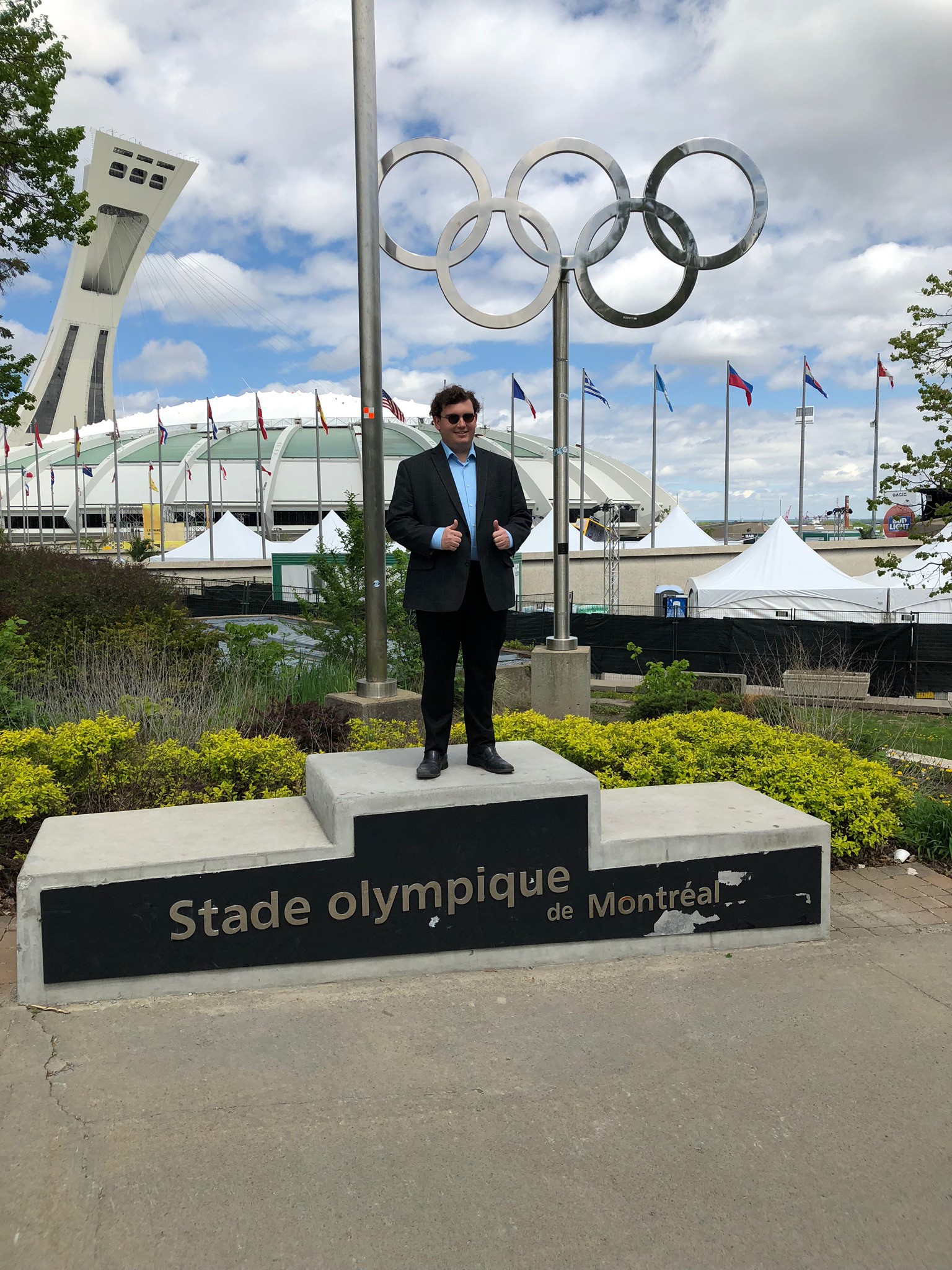
From my visit to the Stade olympique de Montréal in 2019

As surely nearly everyone reading this knows, the Olympics are back on after a year-long delay due to the ongoing pandemic. And the many, many people who have argued that the games should’ve been cancelled because of COVID have a pretty solid case, if I’m being completely honest. The best I can tell is that the games went on largely because of the financial loss that Tokyo and the International Olympic Committee (IOC) would lose, let alone all of the national broadcasters and corporate sponsors, if the games had ended up being called off. Marketplace’s report on the costs related to holding the games placed the estimated cost of the current Olympiad in Tokyo “at around $35 billion,” a figure substantially higher than the most recent Summer Olympics five years ago in Rio ($13 billion).

Still, while I can’t help but agree with the naysayers, that bringing the globe’s top athletes to one city, the capital of a country with very low COVID vaccination rates, was a bad idea all around, I’m still enamored with the games like I am every time that they occur. The first Olympics that I can remember, the one that caught my attention and never gave up, was Sydney 2000. As a young seven year-old living on the edge of Kansas City, I loved everything about the Olympics, from the amazing opening ceremony, to how clean the facilities looked, to the gobsmacking talent of the athletes themselves, the ones who make the Olympics the spectacle they are every time around. That year I can particularly remember the diving events more than anything else; diving remains one of my favorite Summer Olympic sports because of it.

By the time the Winter Olympics came around in 2002, hosted by Salt Lake City, I was excited to see the circus begin all over again. Only this time, it’d be in my own country, albeit a good two-days drive west of home. At about the same time as the Salt Lake games, I even enrolled in a local fencing school, thinking that maybe someday I might even make it up to that stage of competition. My days in the saber competitions were fairly brief, though recently I’ve wondered if maybe the foil would’ve been a better fit for me. It’s been interesting watching each Olympiad in the intervening decades: as a child I got to look up to the Olympians of the Sydney, Salt Lake, Athens, Turin, Beijing, and Vancouver games, while by the time London came around in 2012, I suddenly found myself the same age as most of the athletes.

In the years since, with Sochi, Rio, Pyeongchang, and now Tokyo, I’ve found an even greater appreciation for the Olympics watching as an adult. I don’t really expect I’ll ever end up competing in any Olympic event, at 28 I’m likely past my prime in most categories, but I still enjoy sitting back and watching hours of competition each evening, and being awestruck at the skill of these top athletes in their respective sports.

If anything, I really hope the IOC can figure out the big issues wracking the games, from the corruption, to the high cost of hosting, to issues of doping scandals, and return these games to being purely 16 days focused on the individual athletes and their talents. Any global sporting event is going to be a massive revenue source for broadcasters and corporate sponsors, so while I may raise an eyebrow every time one of the athletes from my country comes on the screen talking about their favorite sandwich from Subway, I usually dismiss it as just something they’ve got to do to be able to afford to compete at this level.

Proposals have been made in the last couple of years to have permanent Olympic host cities, say a rotating set of cities that could take turns hosting the games. Dr. Dave Amos, an Assistant Professor in the Department of City & Regional Planning at Cal Poly in San Luis Obispo, CA made a pretty good argument for this in 2018 on his excellent urban planning YouTube channel City Beautiful.

In his video, Amos argues that there should be 6 cities designated permanent hosts of the Games, with the Summer and Winter Olympics rotating between those 6. For the Winter Games they are Calgary, Turin, and Pyeongchang, while for the Summer Games they are Rio de Janeiro, Cape Town, and Sydney. Honestly, the argument makes a lot of sense, and would be a good solution to the problem of cost and how useful Olympic venues become following their run in the spotlight, as those six cities’ venues would be reused every few years.

I like the idea, though one of the big draws for me every time is getting to see the events in a different city. I’m loving the opportunity to learn a bit more about Tokyo and Japan in general this time around, just as I found myself reading quite a bit more about Pyeongchang and South Korea three years ago during the last Winter Olympics. I’m hoping, for example, to be able to be in LA during the 2028 Summer Olympics, I’d love at least once to see the games in person, to not only immerse myself in the Olympics as I can watching them on TV, but to be there in person surrounded by the whole experience. I imagine it’s similar to going to an F1 race instead of just watching it on TV. The race itself is better on TV, honestly, but the fan experience alone is worth the trip.

Still, if the IOC ends up choosing a permanent host city, or a set of permanent host cities, I’ll be excited to see who they choose, and will undoubtedly begin daydreaming about making the trip out to see the Olympics in person there someday. For now though, I’m content to sit in front of the TV and spend an evening watching the events in Tokyo from afar.