Category Archives: Travel

Sneezing across the West, Part 1

Click the Instagram logo above to follow my updates of this trip as they happen.

For many years now I’ve thought about the idea of taking a big road trip across the Western United States. For a while my idea was to drive from Kansas City up to Portland, Seattle, and Vancouver, before my focus shifted southward toward trying to go to the Monterey Bay Aquarium in central California. Last spring and early summer, in the midst of the first stages of the COVID lockdown, I began to plan what would be the trip of a lifetime.
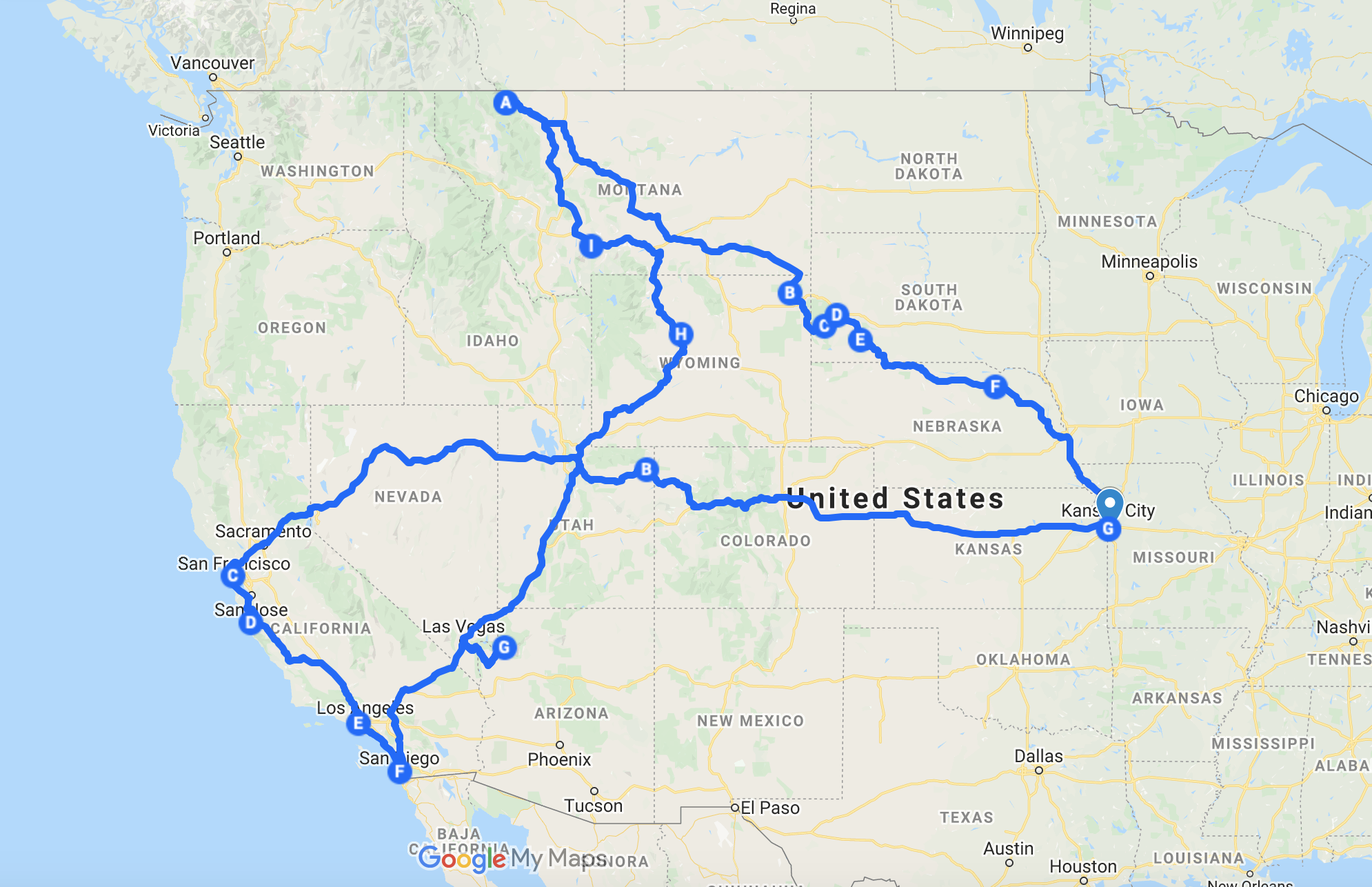
The Grand Western Tour, yet to be fully taken.

It was to be six weeks driving across the western states, beginning in Kansas City, going through Denver, then onto Salt Lake City, before crossing Nevada and driving down from the Sierras into California before finally making my triumphant arrival on the Pacific coast at the Golden Gate Bridge. From there, I was going to drive south along the Pacific Coast Highway to San Diego, before turning northeast on I-15 and heading out of California towards Las Vegas, with a detour to see the Grand Canyon, and a quick pass through Salt Lake again on the way into Wyoming.

The drive would then take me up through western Wyoming through some particularly noteworthy paleontology museums and fossil sites such as the Wyoming Dinosaur Center in Thermopolis, before entering Montana, passing through Bozeman toward Glacier National Park, the northernmost end of the route. From Glacier, I was going to turn onto the homestretch, driving southeast towards the Black Hills of South Dakota, and along US-20 in northern Nebraska with stops at the Agate Fossil Beds National Monument in northwestern Nebraska and the Ashfall Fossil Beds State Historic Park in northeastern Nebraska.

It was going to be a long drive, half of the summer, seeing as much of the American West as I could. Naturally, the plan was scaled down considerably, from a whirlwind 1.5 month odyssey to an 8 day tour of Colorado and Utah. As it turned out, my Dad was happy to join me on this trip, and has proved to be just as great a traveling companion as I remembered from our many family road trips in the Midwest and out to Colorado between the 1990s and 2010s.

We left Kansas City early on Saturday morning, 5 June, making it across the Great Plains on I-70 in Kansas and eastern Colorado without much trouble. We arrived in Denver around 16:00, making our way through the city streets to our hotel in the Capitol Hill neighborhood without too much trouble. After Chicago, Kansas City, and St. Louis, Denver is perhaps one of the cities that I’ve spent the most time in. From 1997 to 2005 my parents and I would pass through Denver on our way for a week up at a dude ranch in Pike National Forest. The Mile High City has served as a gateway to the Rockies for millions of tourists and locals alike, and it remains one of my favorite cities in this country.

While I’d hoped the trip would be a welcome break from regular life, an exciting adventure into a part of the country I’d wanted to get back to for a long while, I brought with me some of the troubles of regular mundane life, namely in a cold that was borne out of my allergies. I woke up on the morning of Wednesday, 2 June to find my throat had been dried out over that night by the ceiling fan in my bedroom in my parents’ house. I hoped the consequences wouldn’t be too bad, and certainly I’ve had worse iterations of this particular malady, but knowing it wasn’t COVID, especially considering I’ve already been vaccinated, I figured I’d be safe to travel, as long as I wore a mask whenever indoors or around other people besides my Dad. It’s meant that I’ve stuck out like a sore thumb in many of the smaller towns that we’ve stopped in for fuel and food, but for everyone’s sake, I’m fine with it. That being said, I was looking forward to seeing if the mountain air might help my sneezing go away quicker, which it could be said has worked. Nevertheless, this isn’t the most pleasant way to travel to say the least.

Denver

Denver remains one of my favorite American cities. It’s been so tightly connected to some of my favorite childhood memories, namely our annual family vacations in the Front Range, that it’s honestly one city I’d be happy to move to for work after I’ve finished my doctoral work in Binghamton. I’d trade the Appalachians for the Rockies any day. Like many of the cities and towns we’ve traveled through so far, Denver started as a frontier town, built by American settlers heading west into Colorado from the Midwestern and Northern states in the years just before the Civil War.

In some ways, it’s refreshing in an odd way to be in such a young city, yet a city that has it’s own sort of maturity. I’ve often thought that this may be how an Australian city like Melbourne feels. Even Kansas City feels a bit older than Denver. Sure, the modern City of Kansas City was founded by American settlers in 1839, but it was built near the site of an older French colonial trading post. Colorado may have its Spanish colonial heritage, but that seems to be much more strongly centered in the southern parts of that state near the border with New Mexico. The Denverites certainly have done better for themselves than we Kansas Citians have done, though that may be in part thanks to the prosperous mining economy and the immense natural beauty of the Front Range, both of which Kansas City’s own economic might and natural beauty aren’t easily or fairly comparable to.

I’d hoped to do a couple of things while we were in Denver, though my fairly constant sneezing kept our trips out of the hotel room slightly less frequent than I’d have hoped. That said, on the first night we were there we did go to an Indian restaurant on 6th Avenue, called Little India, which was a good remedy for my condition. I don’t have much of a toleration for spices of any sort, as many people who read this can attest to, but even the assuredly mild buttered chicken that I ate, with a cup of tea for good measure, were immensely helpful in trying to fight off this sneezing. That evening, well fed and ready for an evening in, we turned to our respective devices, my Dad to a book, myself to some reading about the local area, planning out our Sunday.
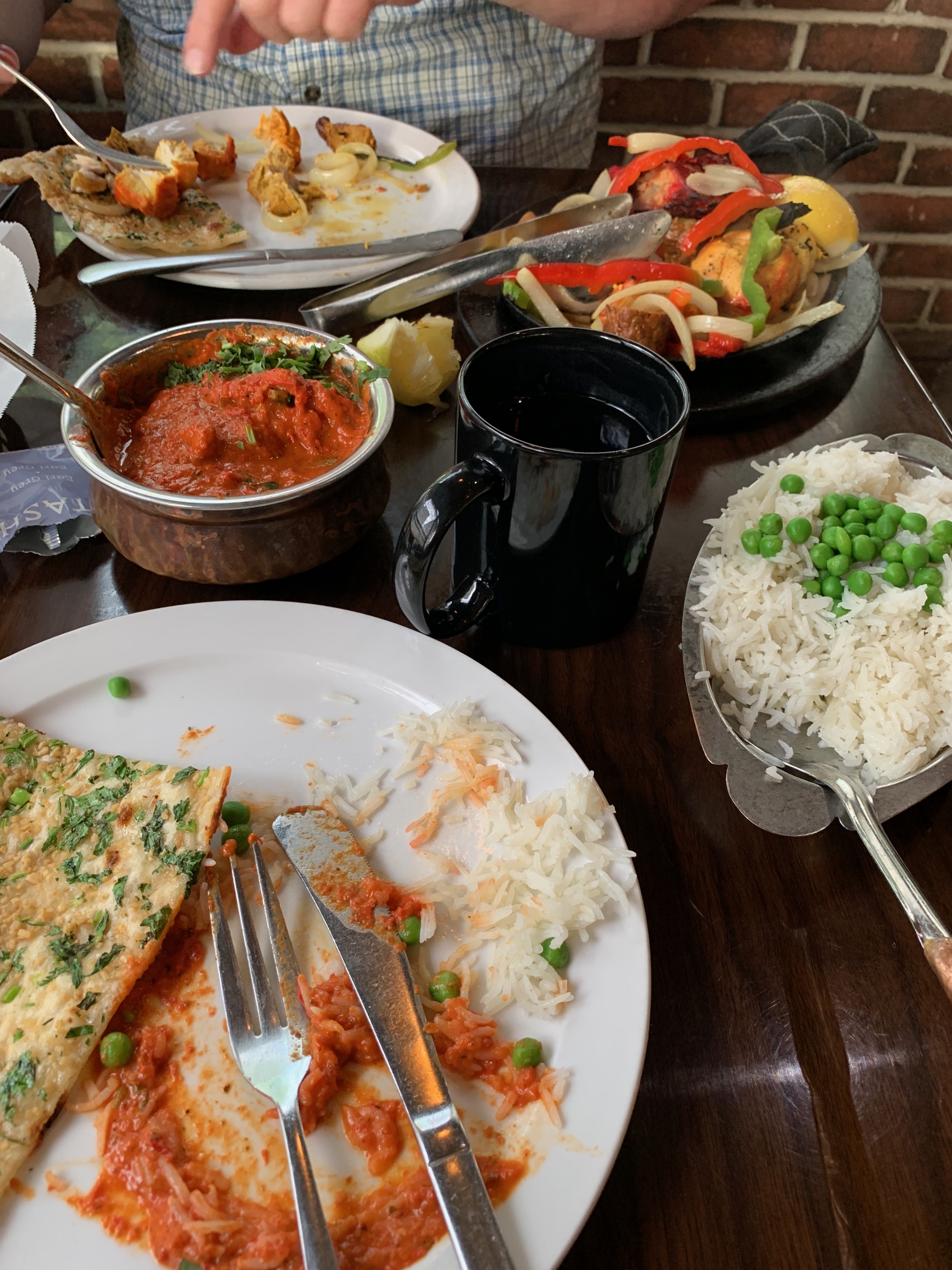
The following morning came early. We’d planned on going to the Corpus Christi Mass at St. Ignatius that morning, but discovered at dinner the evening before that because of the pandemic they were only taking RSVPs up to the Wednesday before each Sunday, so we ended up staying in. That said, we still woke up early on Sunday, 6 June, to watch the Formula 1 race from Baku, the Azerbaijani capital, with all its unexpected twists, turns, and tire failures that made it one of the more memorable races of the season thus far. After watching the race, I went out to a nearby grocery store to get some more tissues and a box of Earl Grey tea bags.

As lunchtime came around, we left the hotel for the day and drove up towards Downtown Denver to walk up the 16th Street Mall. It was a really nice day at first, though as the Sun came out from behind some clouds we felt like we were being cooked. As of when we left Kansas City, the weather still hadn’t gotten quite as hot as it has been on this trip, though I’ve heard it is just as hot back at home now as well, with temperatures regularly around 30ºC (86ºF) and above. It was nice being back in the heart of a major city again. For me, it’d been well over a year since I’d been in such a setting, in my case walking around Manhattan during the American Historical Association’s meeting in Midtown in January 2020. And while things aren’t yet “back to normal,” whatever that may mean, there was a sense of calm in the air that the pandemic was beginning to become a bad memory, that we were almost out of the woods.
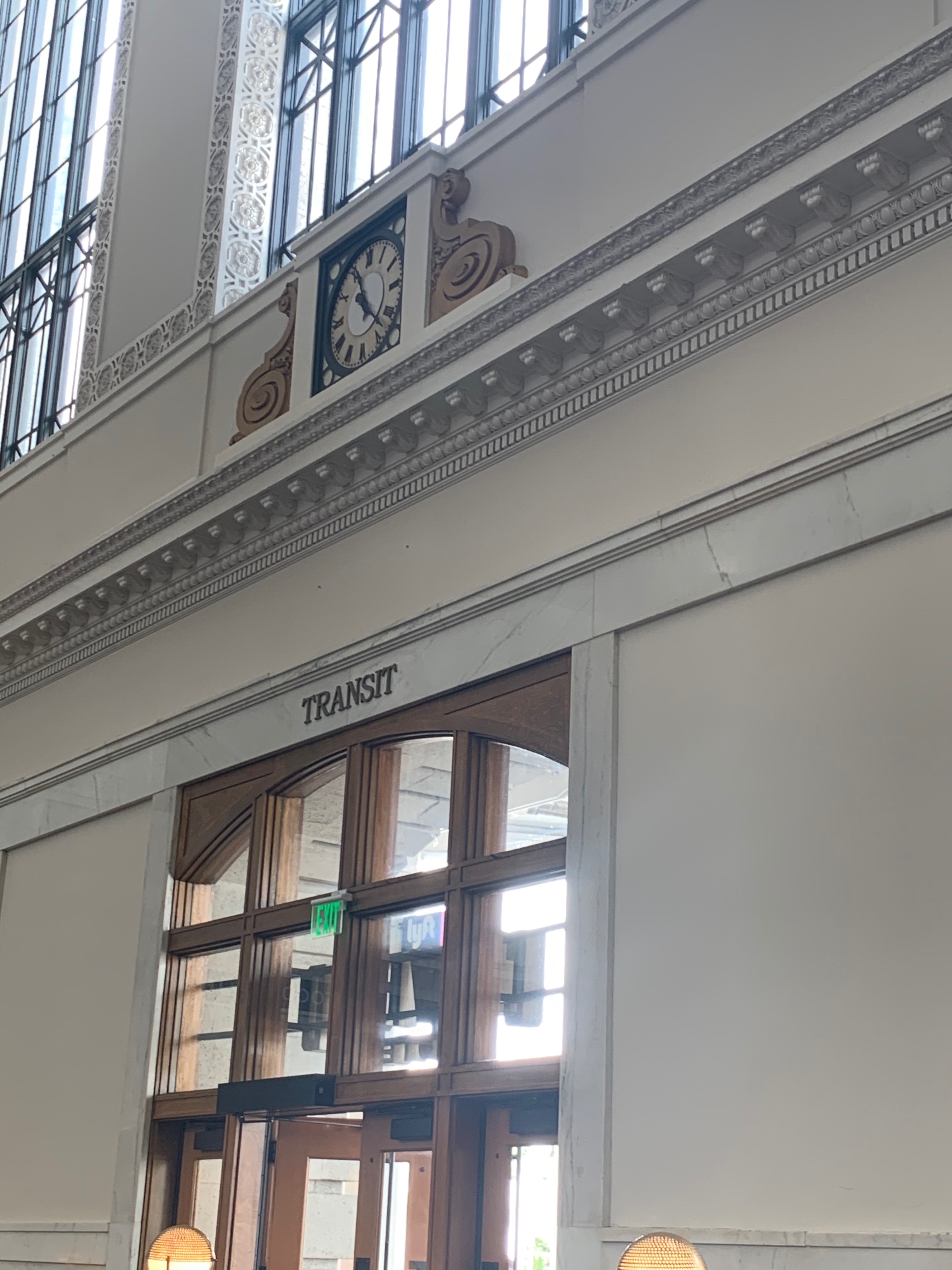
We walked up as far as Denver’s Union Station, the region’s main railway terminal, and a place that seemed like a good spot for meeting people for any meal of the day. I was impressed with the quality of Denver’s RTD light rail and commuter rail services that operate out of a beautiful modern train shed behind the station. It’d be nice if Kansas City can build a system like that someday. After leaving Union Station, we decided on getting lunch at the Smashburger location on 16th Street, a place where funnily enough I’d stopped for dinner the last time I was in Downtown Denver before a Rockies game in 2013. After a good lunch, and with time running out before our only truly scheduled event of the day, we made our way back to the car, which we’d parked at the southern end of the mall near the Colorado Capitol building.

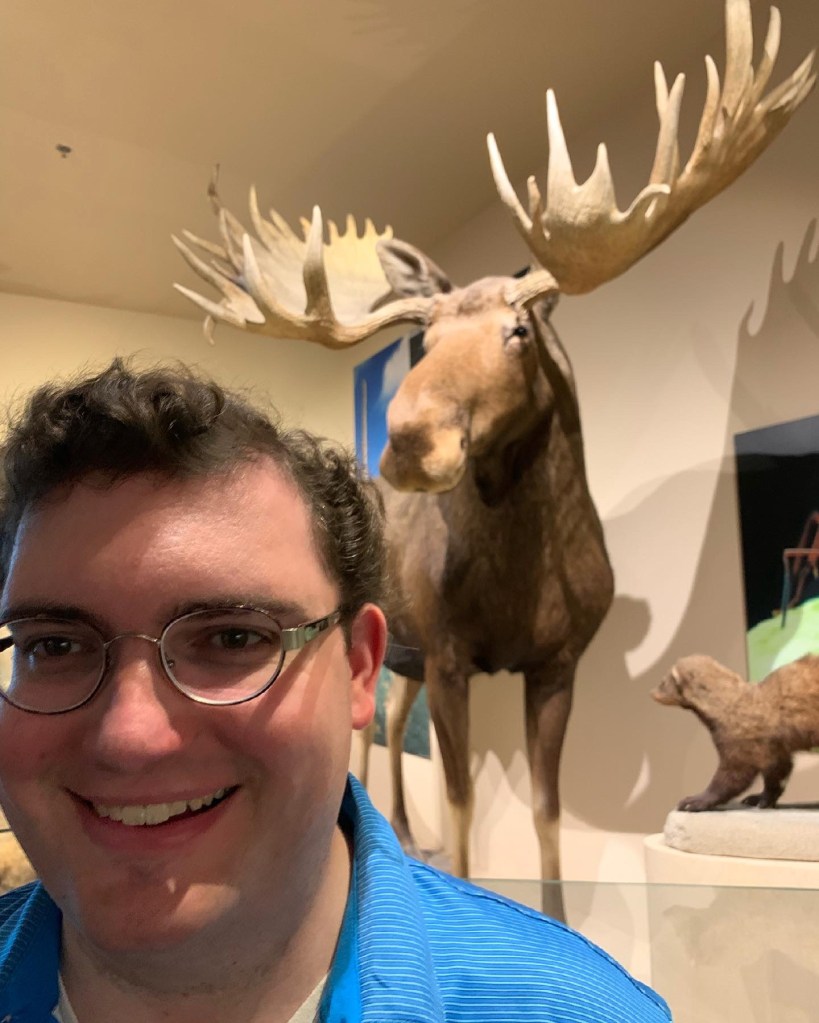
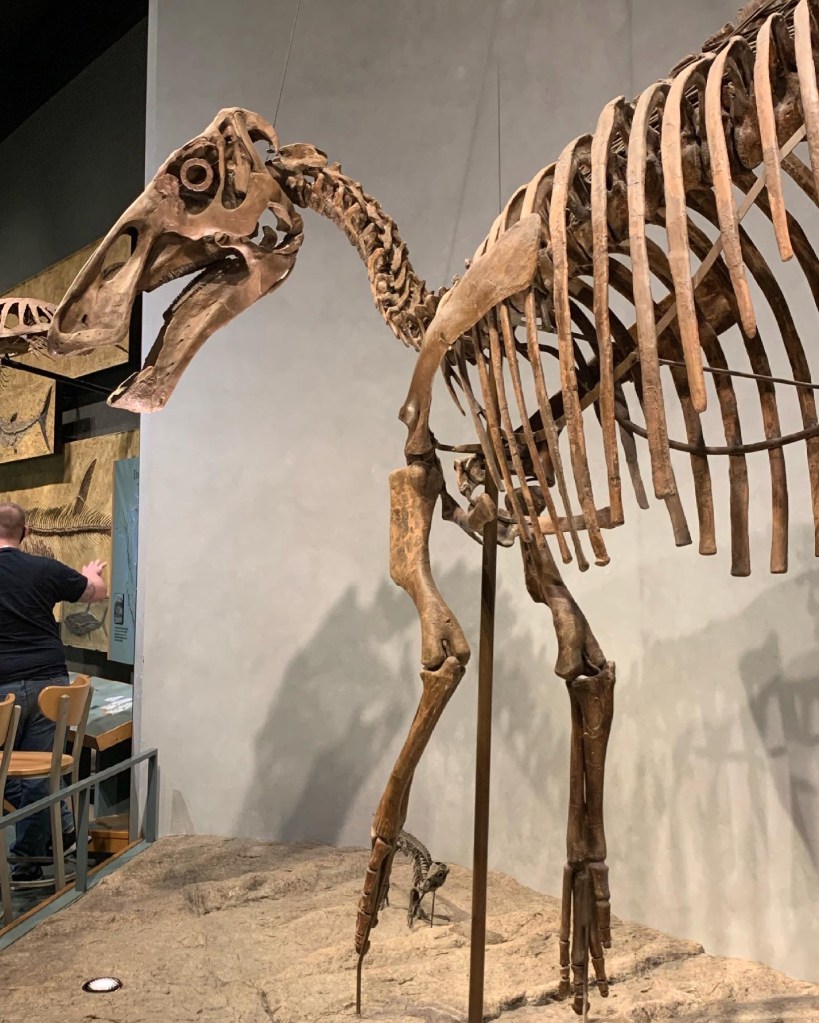
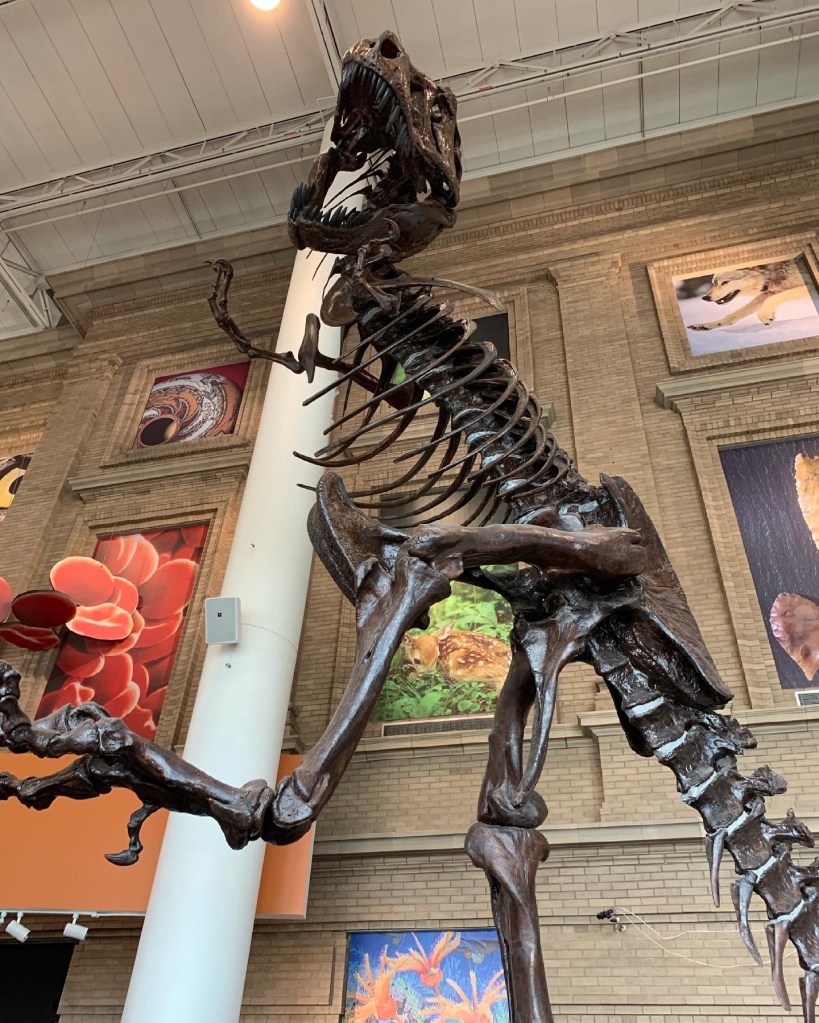
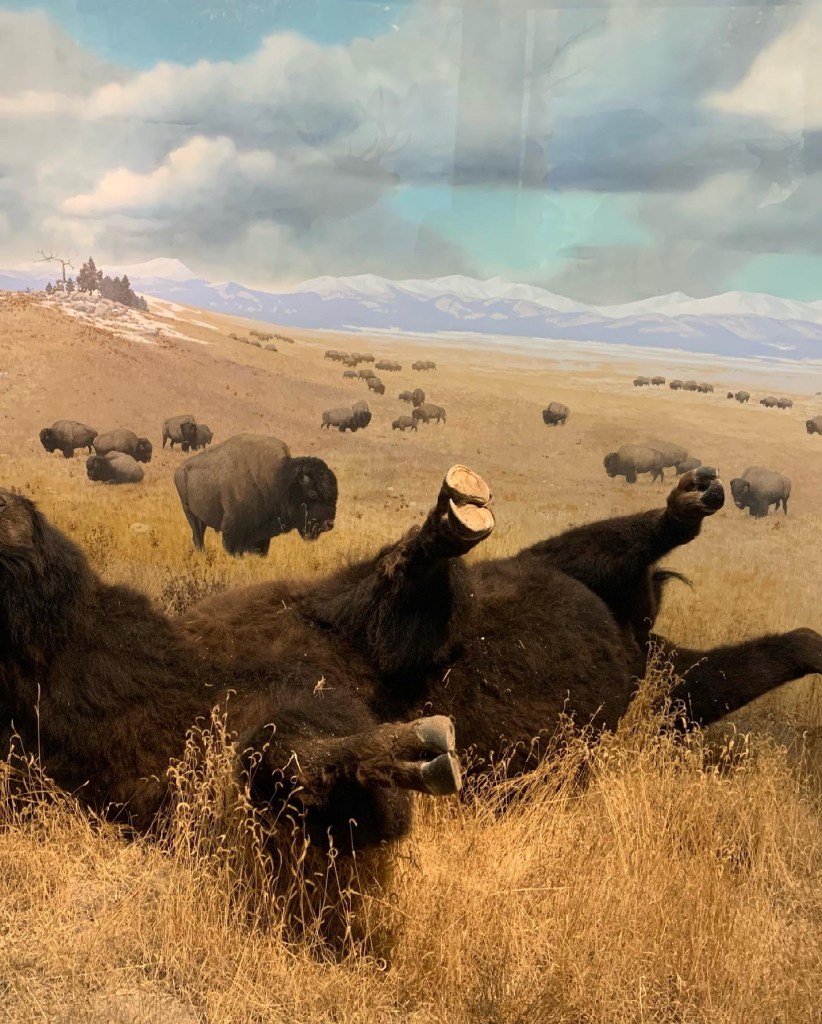
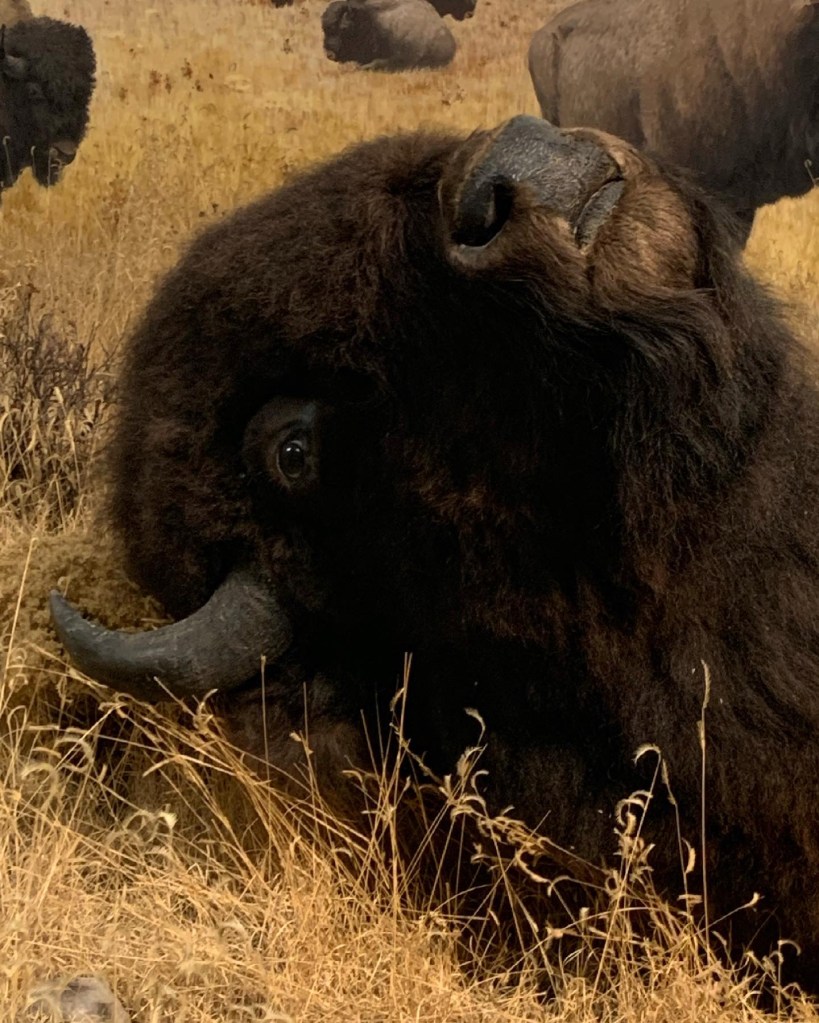
Our next destination was the Denver Museum of Nature and Science, one of the finest natural history museums in North America. We came here only once before in July 1999 when I was 7. I’d remembered the Tyrannosaurus Rex skeleton in the main lobby, and diorama halls on the 2nd and 3rd floors, but that was essentially it. The museum proved to live up to its excellent reputation, and is a clear sign of how important Western North America is to dinosaur paleontology, after all many of the best fossil beds around the globe can be found in the Western US and Canada. I was particularly struck by how this museum, while certainly gearing aspects of its displays to the youthful audience that most famously frequents natural history and science museums, also offered narratives and information about its collections that prompted further questions from my Dad and I about both the animals on display and on the displays themselves.

After leaving the museum, we drove back to the hotel and spent the evening resting up for the next day’s drive, which would prove the be the hardest yet. I spent the evening watching a really interesting documentary miniseries from NOVA called “Making North America,” which premiered in 2015, and discussed the geological, biological, and human histories of this continent. I figured it’d be a good refresher before we headed west through the Rockies and onto the Colorado Plateau, where many of these same themes would come directly into play in the landscapes we travelled through and the rocks we’d see along the way.
Dinosaur National Monument

I’ve always been fascinated by maps. When I was little, I used to spend hours in the back seat on road trips staring at maps, memorizing the routes of the Interstate highways, a trick that’s come in handy time and again, and looking for places I’d want to someday go. One of those places has always been Dinosaur National Monument, a vast upside-down T shaped area of federal land straddling the northernmost reaches of the Colorado-Utah border along the Green and Yampa Rivers.

I always thought it was neat that there was a national monument set aside specifically to preserve a place rich in fossil finds. Of course when I was little, I imagined that maybe, just maybe, Dinosaur National Monument might be some sort of real life, high altitude desert version of Jurassic Park, but as neat as that would’ve been, I doubt many of the cows we came across while driving through the parkland would’ve been allowed to graze free range there had the park also been home to the descendants of that T-Rex on display in the lobby of the Denver Museum of Nature and Science.

We left Denver around 08:00 on the morning of Monday, 7 June. This time I was behind the wheel, and my Dad taking the co-pilot duties. I made the arduous drive west out of Denver on I-70 through the Rockies. Over the last few years, I’ve gotten a fair amount of experience doing winter driving in the Appalachians around Binghamton, and in Central Pennsylvania, but even that doesn’t compare to the pressures of driving down I-70 through the Rockies for the first time.

I’d been on this route before, in July 2018 when my Mom drove us to a family reunion in Breckenridge, so I knew most of what to expect on the route, but I certainly wasn’t prepared to use my breaks when I should have. This came into particular note once we left the Eisenhower Tunnel at 11,158 ft (3401 m) and proceeded far downhill towards our exit at Silverthorne. I should have started breaking when we were leaving the tunnel, but waited about 10 seconds, by which point my Mazda was moving fast enough that its breaks were quite unhappy to be forced into hard service as I tried to slow us down enough to come to a stop at the base of the Silverthorne exit.

At that point, after stopping for fuel at a 7-11, we switched roles and my Dad drove for the rest of the day up CO-9 to US-40 in Kremmling, Colorado, at which point we continued on westward across the Continental Divide again at the Rabbit Ears Pass which led us down into the Yampa Valley, home to the resort town of Steamboat Springs. We spent much of the rest of the day’s drive in the Yampa basin, rising in elevation again as we made our way west of Craig, Colorado towards the canyons that characterize the Colorado side of of Dinosaur National Monument.

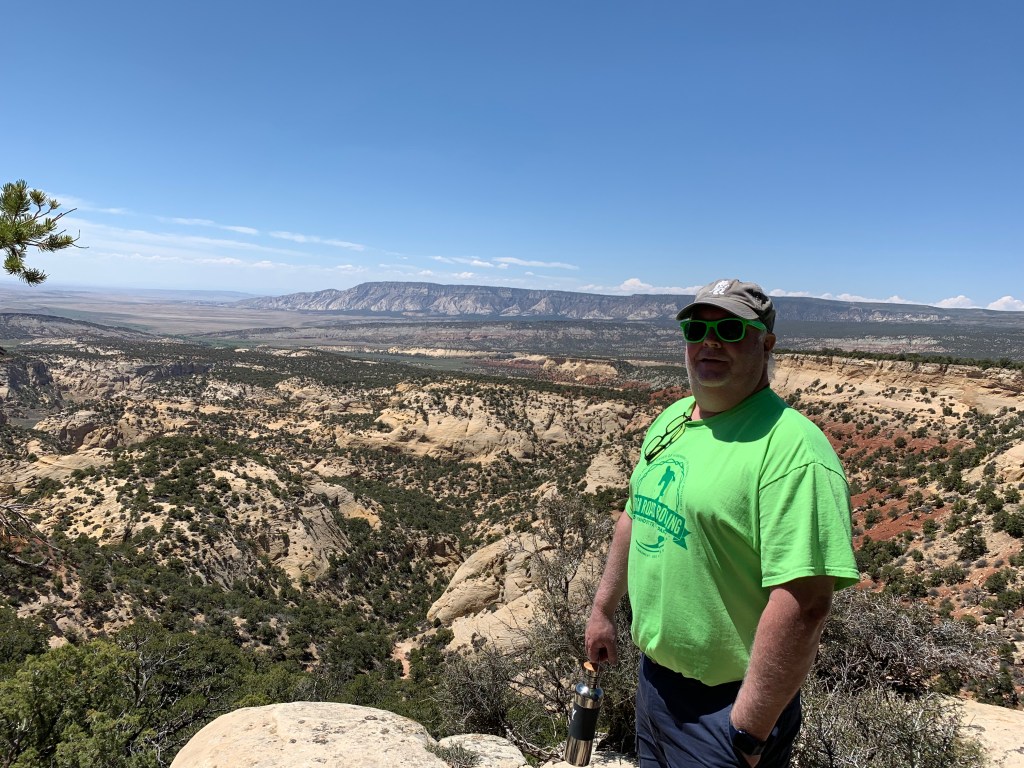
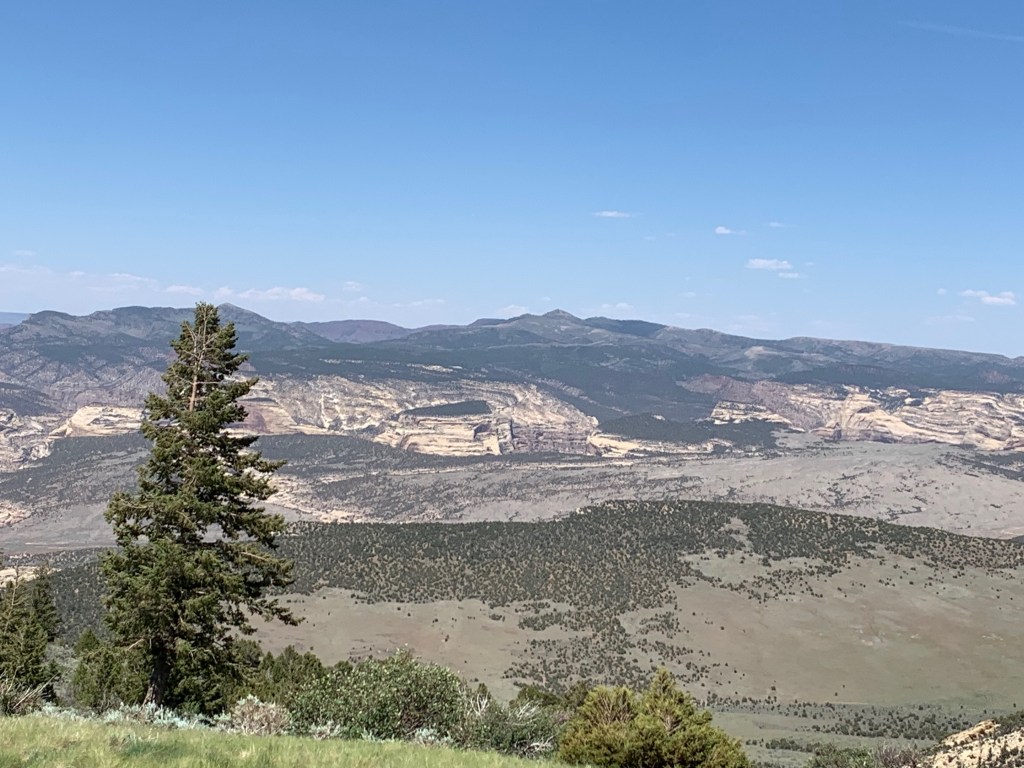
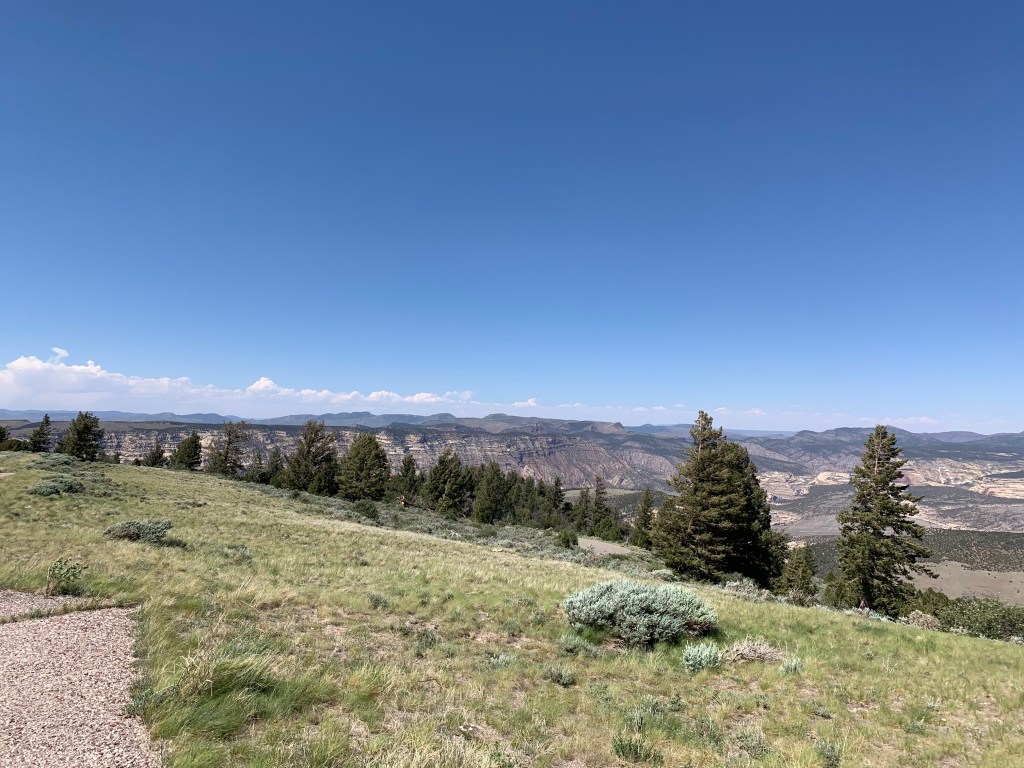
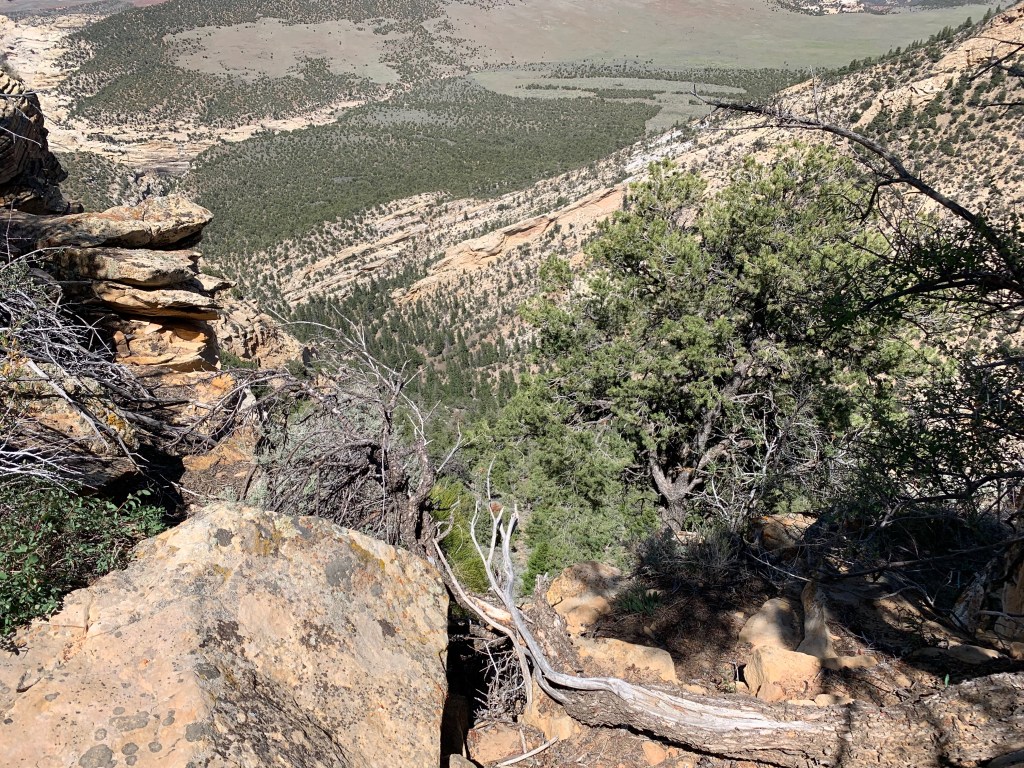
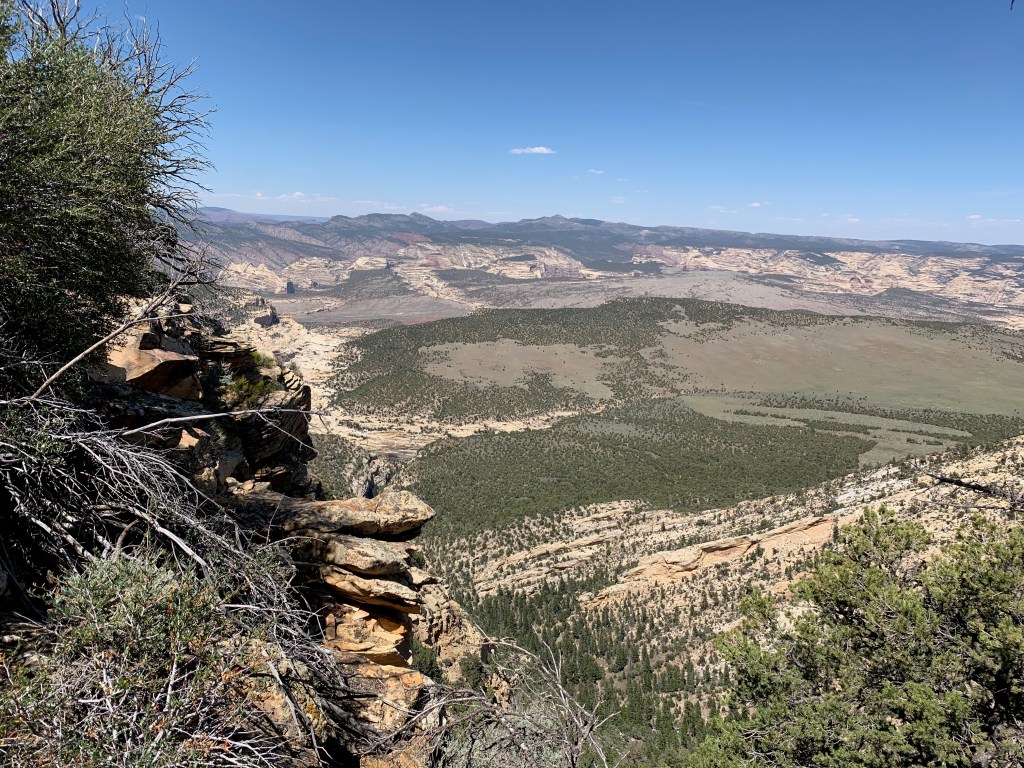
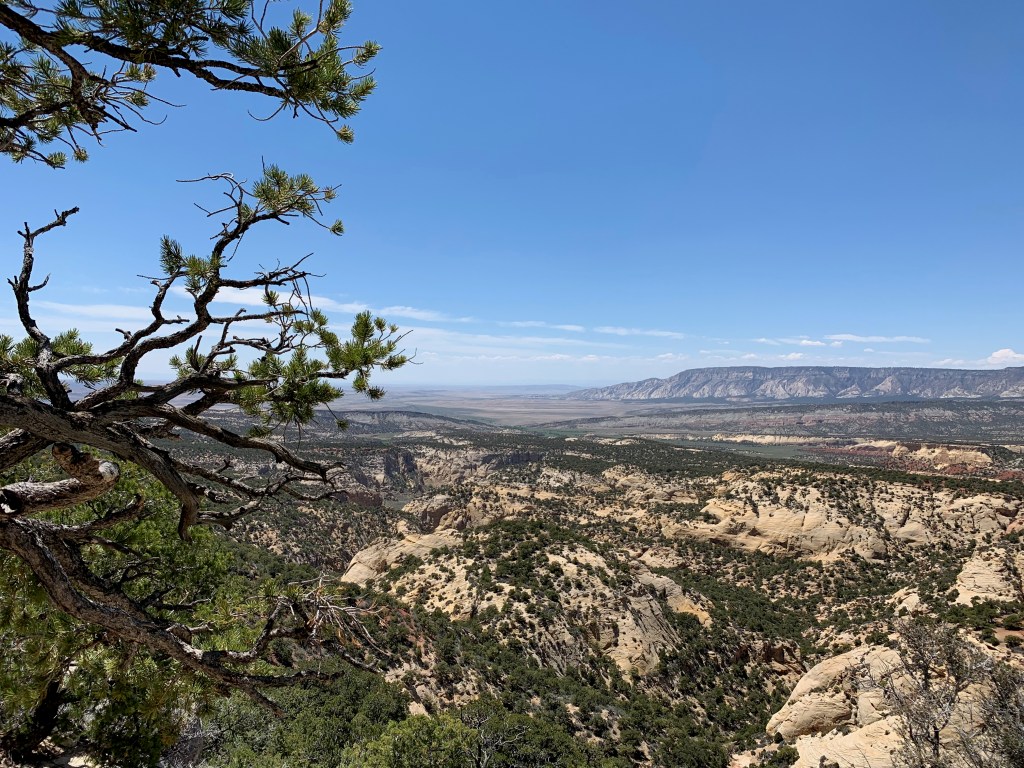
After a good two hours of driving from Steamboat Springs, we began to see roads and features shown on the official National Parks Service map of Dino as we’ve come to call that national monument. Soon, we came to the main road leading into the park’s Colorado side, and decided to go exploring and see what we could see. The road itself is 31 miles (50 km) long, and rises up to a point where I’m told you can see the confluence of the Yampa and Green Rivers and their respective canyons. While we didn’t make it quite to the end of the road, we did see some awe inspiring canyons and buttes rising and falling to the rim of the Unita Mountains to the north. I’d wondered if I might have flown over these very canyons before, on a 2018 flight from Oakland to Kansas City, something which may very well be possible considering the more recent flights undertaken on that route.

As much as we were awed by the natural beauty around us, my Dad was tired of driving, and I was ready to find a nice sofa to lay down on and see if my sneezing would subside. We made our way back out of the park, and drove again west on US-40 across the border into Utah to our hotel in the region’s main commercial center, Vernal. Our hotel room in Vernal turned out to be much nicer than the one in Denver. It seemed to be pretty new, and was your typical sort of national cookie-cutter room you’d expect from a national hotel chain. I personally prefer to stay in places like this, where I know what to expect in every room, after all it’s just where I’m going to sleep, and not the main attraction of the trip.

That evening, we had dinner at a local Italian restaurant, Antica Forma, which was actually better than I’d expected. My thinking about the local cuisine in the high deserts of northeastern Utah was some sort of a mix of Mexican food with your typical heavy meat and potatoes western American cuisine that you find in steakhouses. And while that sort of stuff was all around us, we didn’t end up trying much of it at all. Meals tend to be more of an afterthought for the two of us, something we eat, but usually something we decide on at the last minute, a far less appealing attraction than the natural landscapes or museums or galleries we travelled to see.

Our main reason for traveling to Dino was not only to see the famous fossil quarry, but also to spend an evening out under the stars with a telescope we borrowed from my Aunt Emily. We’d talked about going out into the monument that Monday night and setting up some chairs and the telescope on a turnoff along one of the main roads, but ended up deciding to stay in and rest up for the following evening. Instead, my Dad read his book and I watched the film The Dig starring Ralph Fiennes, a film about the discovery of the Sutton Hoo treasure in Suffolk in 1939.
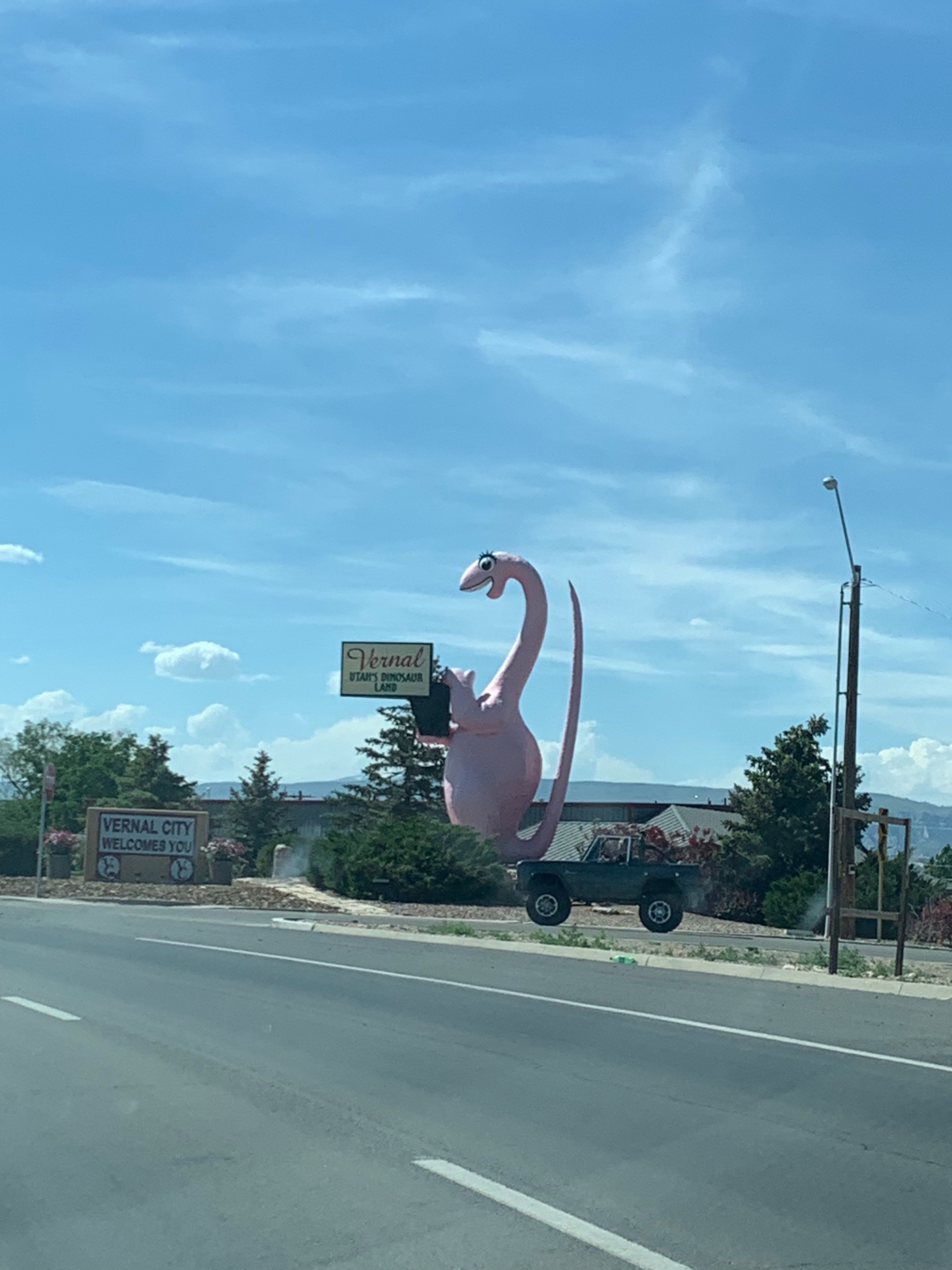
Vernal, Dinosaurland

The following morning, my Dad suggested I go to the local urgent care to see if the doctors there could suggest a more effective treatment for my sneezing than I’d been using to date. The visit proved enlightening. Not only did they confirm again that I didn’t have COVID (hurray!) but the PA prescribed a new medication which knocked out much of my symptoms almost immediately upon taking it. I was still sneezing, but now on a half-hour to fifteen-minute rotation, not on a 1 minute rotation.

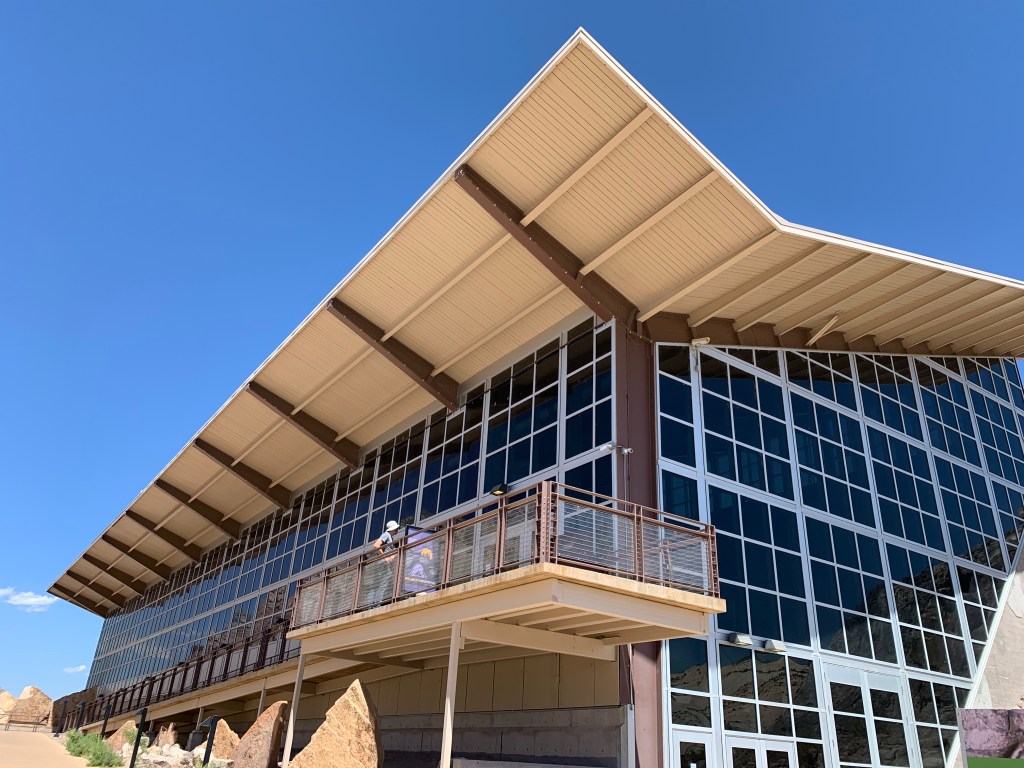
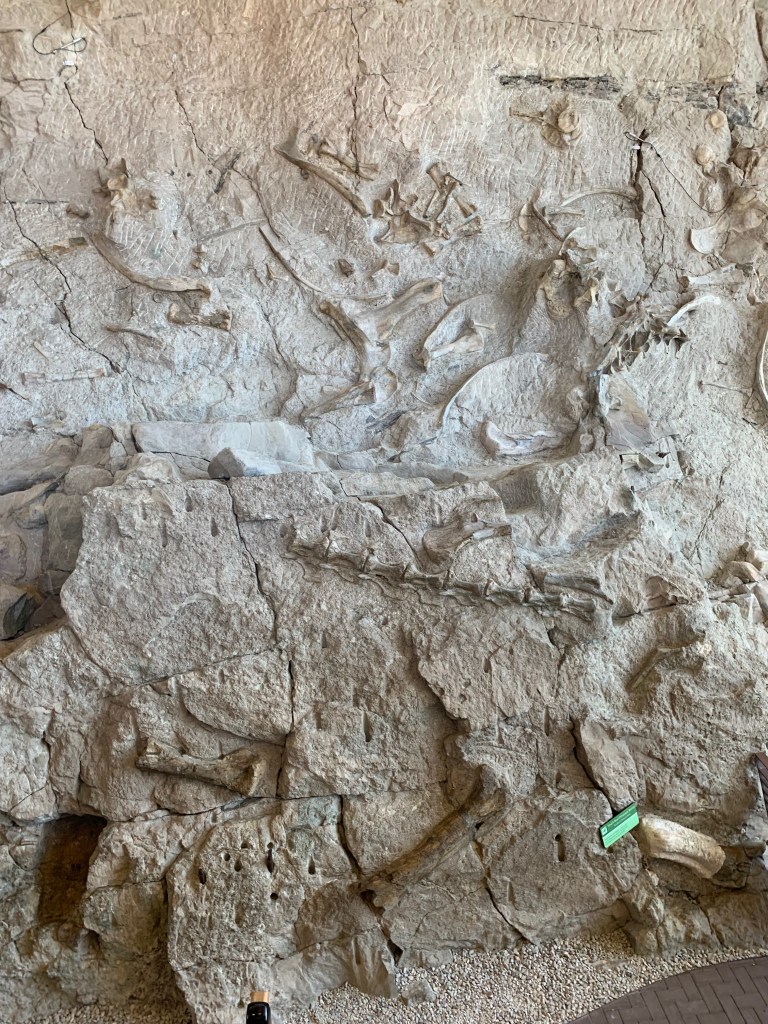
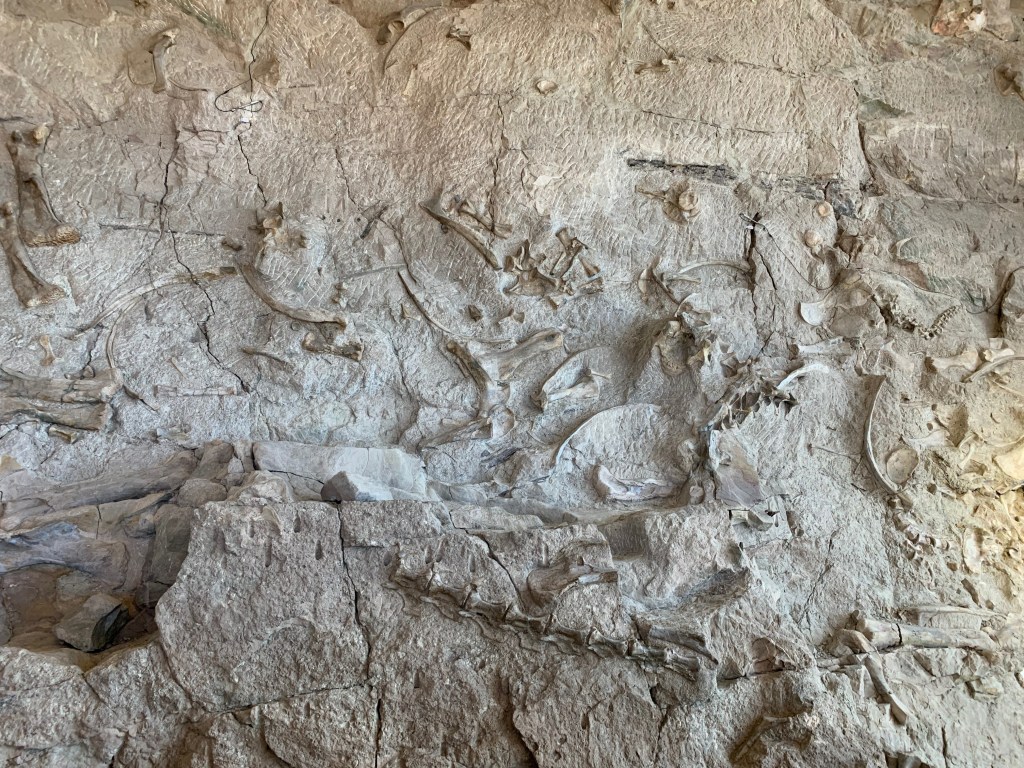
We then drove back out to the monument, this time to the main entrance on the Utah side, to visit the famed fossil quarry. I’d spent a lot of time in the weeks leading up to this trip learning the roads leading into the Utah side of the monument, learning the route so that when we drove it late at night in the dark we’d have less chance of getting lost along the way. That said, it was nice seeing these roads in person after looking at so many satellite images of them on Google Maps. Whereas the Colorado side seemed to be open to just about anyone to enter and drive around on the roads as they pleased, the Utah side was staffed with a gatehouse, where visitors were able to pay their entry fees for the park. I purchased an $80 America the Beautiful Pass, which grants the holder complimentary entry into all federal recreational lands, parks, and monuments during operating hours. This, plus our reserved timed tickets to visit the fossil quarry meant we were all set and ready to go when the open air zoo tram arrived to pick us and some other groups and families up at the visitors’ center for the mile drive up the hill to the fossil quarry.

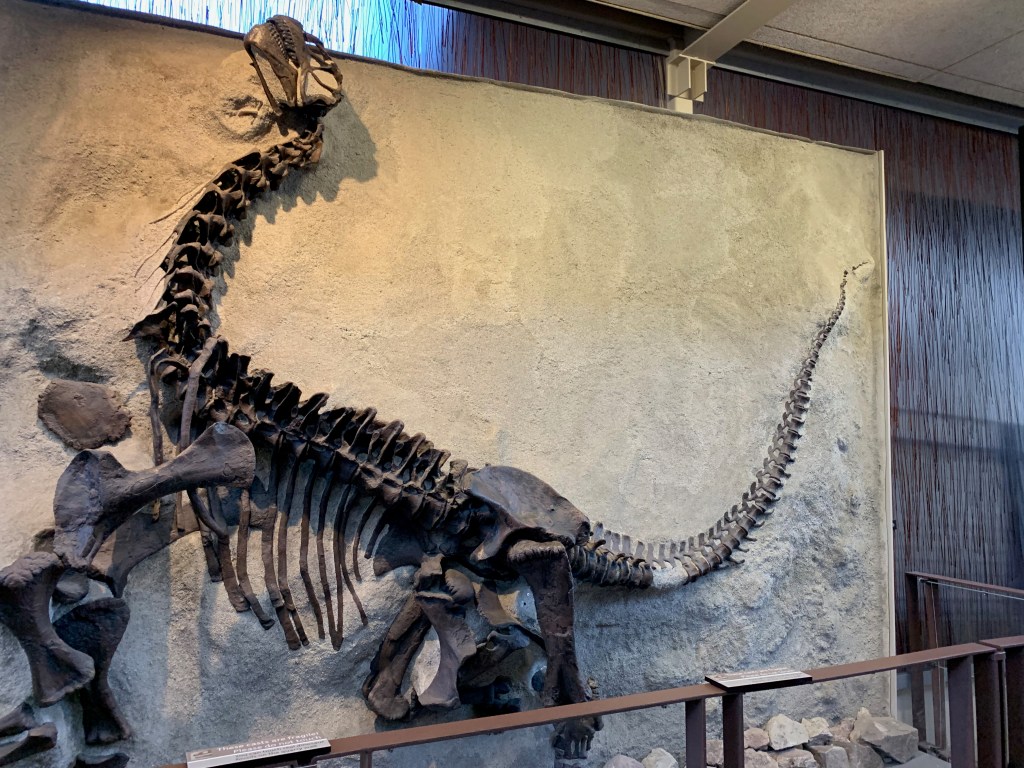
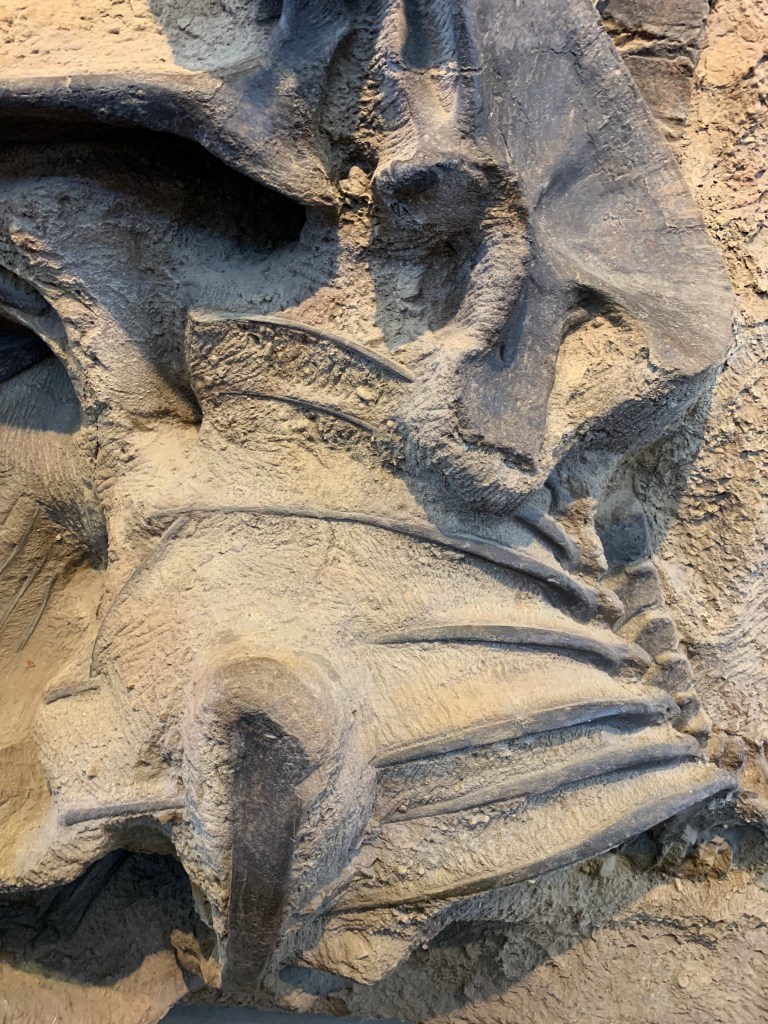
What amazed me the most about the quarry was how it was quite literally dug out of the rock. The building we were standing in, first built in the 1950s and recently renovated in 2011, was a beautiful glass and steel structure, sheltering the exposed fossils while keeping everything open to the views outside. And yet, in 1909 when the paleontologist Earl Douglass first arrived at the site of a fossil find in that distant part of Uintah County, Utah, the fossils we saw at our eye level were well beneath the surface, covered by tons of rock that has over the last 112 years been methodically removed to reveal more bones long forgotten. Many of the fossils dug up from Dino have made their way into some of North America’s finest natural history museums. Some, including those in Denver, New York, Pittsburgh, San Francisco, Toronto, and Washington, DC, I’ve had the opportunity of seeing on display over the years. It was exciting to be in the place where those fossils were discovered, to see the source so far from the great museums they now reside in, where they originally came from.
After visiting the fossil quarry we drove from the visitors’ center down the main road on the Utah side of the monument to see the petroglyphs at the Swelter Shelter, a rock outcrop along the road, UT-149. These petroglyphs, rock paintings, were made a thousand years ago by the ancient Fremont people, an Amerindian nation who lived on the Colorado Plateau up until around the beginning of the 14th century CE. Named for the Fremont River, which itself was named for the 19th century American explorer and military officer John C. Frémont, the conqueror of California, these people are only known through their archeological remains. The petroglyphs appear to show human figures with antlers, not unlike some ancient Celtic art, yet drawn in a manner fitting to the desert environment within which they were created. Ancient American art is one area that I’m woefully unfamiliar with, though hopefully I can rectify that eventually. A day not spent learning is a day wasted.
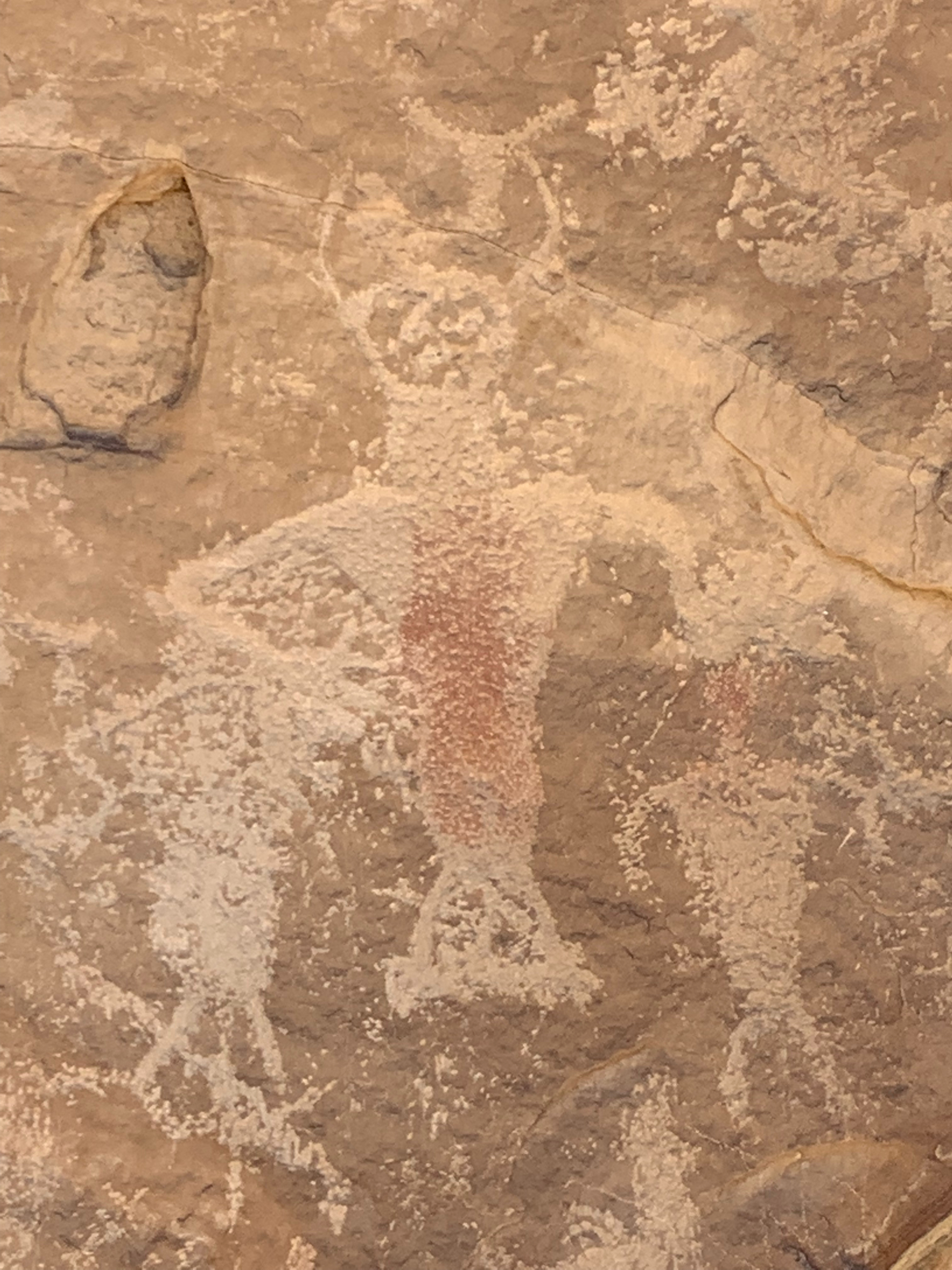
A Set of Petroglyphs made by the Fremont people

After viewing the petroglyphs, we drove further into the monument up UT-149 to see which of the two overlooks on the Utah side, Split Mountain and Green River, would work best for that evening’s stargazing. We first drove to the overlook above the Split Mountain campground and decided that the large mountain face just across the Green River from us might prove too much of an obstruction for our needs. After this, we turned around and drove to the next overlook, this one above the Green River campground to the south. The high rocks surrounding this one tended to be further away, and less obstructing of our sight-lines, so we figured we’d try that site out later at sunset.

Returning to Vernal, after lunch we settled in for a restful afternoon. Dad continued reading, and I watched part of Eisenstein’s classic 1938 film Alexander Nevsky; the Battle on the Ice scene came up as a suggestion on my YouTube home page. I moved from Nevsky to other fairly mindless shows, forgetting about the couple of months worth of National Geographic and Smithsonian Magazines I’d brought with me, having been forced to put them to the side while I read for my comprehensive exams this Spring. That evening, while my Dad had leftover pizza, I walked across the parking lot to a local Cantonese restaurant and picked up my own dinner.
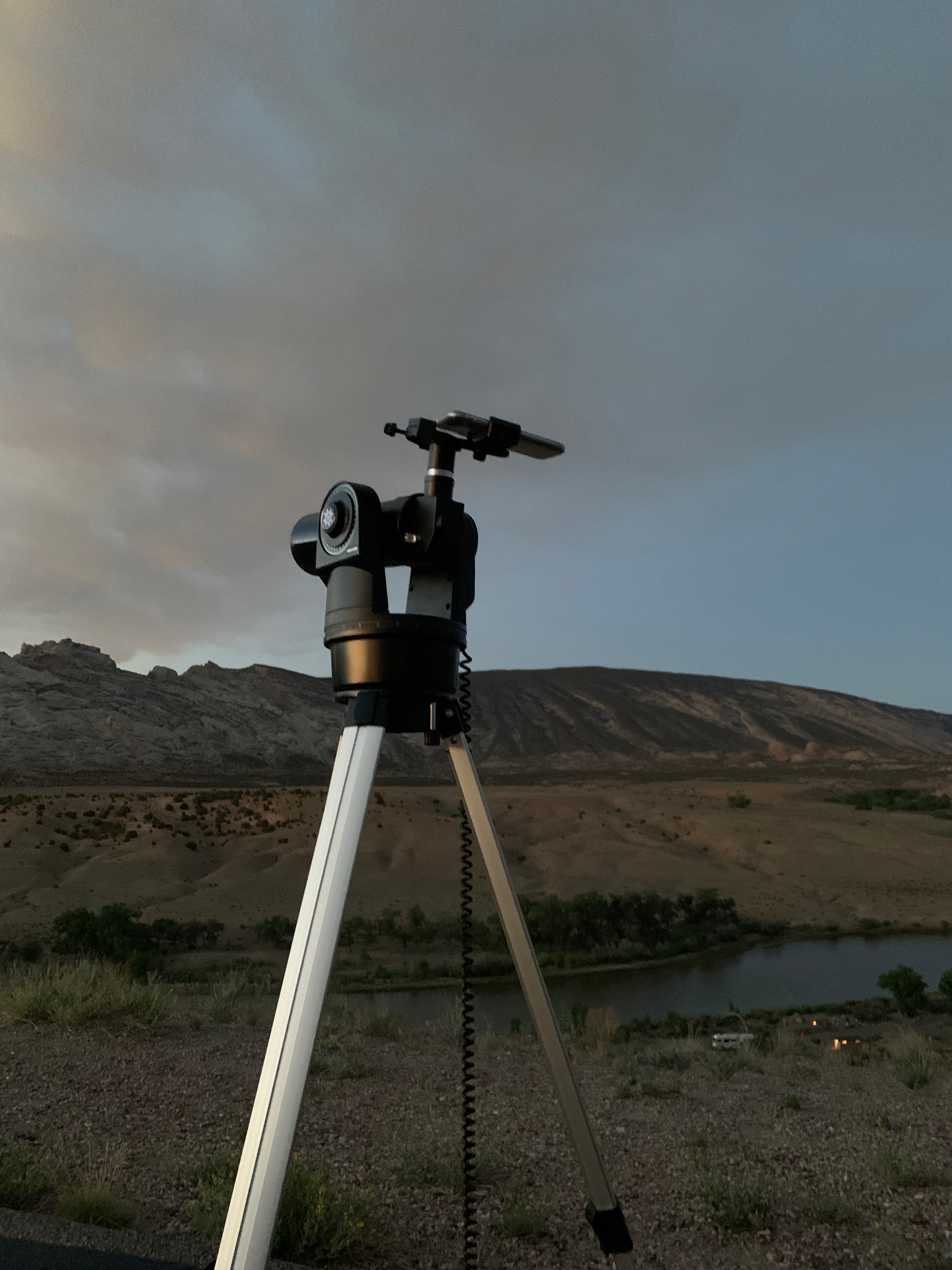
Being well fed, at 20:00 we got back into the car and made our way east out of Vernal toward the canyonlands of Dino beyond. The gatehouse was unoccupied as we drove past it, and up the road to the campgrounds beyond. We took our spot at the overlook above the Green River campground by 20:43, 2 minutes before official sunset, and set up the telescope, chairs, and cooler by 20:53, with just enough time to spare to watch the sunset in the west. Unfortunately, as we drove out of Vernal we were met by a line of whispy clouds that seemed to be moving west to east over the monument and our site. These clouds made the stargzing far less illuminative than we’d hoped, but we still saw far more than we normally would’ve at home in the city.

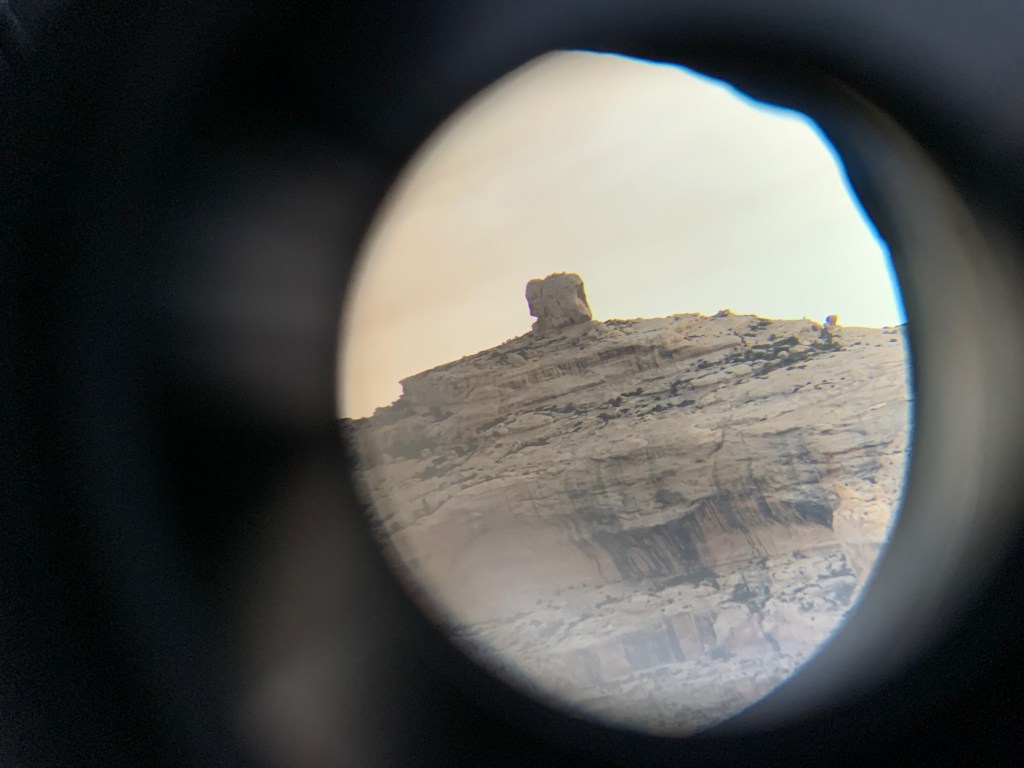
The first light to appear in the sky seemed to pop into sight like a gleaming beacon of hope on the western horizon colored with the orange glow of the setting Sun. I knew immediately what it was, Venus, the Evening Star, and celebrated its arrival with a couple quick pictures of it with my phone. We had another phone mounted atop the telescope’s view lens, hoping that’d help us position it better and maybe even take some pictures of the stars and planets we’d see, but the best we got were some photos of a rather square-shaped rock on the top of the far canyon wall.

That evening was marked by quiet conversation, long minutes staring up into the night sky at the brightest stars visible, Vega in particular. We were seated facing east, and Venus quickly descended below the horizion, itself marked by the distant ridge of a mountain range to the southwest, so we were less concerned about missing that beautiful sight than we might have been. As the night drew on, we saw more and more stars pop into our view high above us. Along with them were shooting stars, meteorites raining into the Earth’s atmosphere, and the occasional aircraft’s flashing lights appearing over the ridge of the Unitah Mountains. It was wonderful, yet at the same time we found ourselves wanting more. The cloud cover didn’t help us, and likely as this trip continues, we’ll find another time to sit back in the wilderness somewhere and look up at the night sky.

In those moments on Tuesday night, I found myself wondering who might be out there, sitting back on the top of a cliff on some distant planet looking up in their own night sky, perhaps even seeing Earth. To peer into the night sky is to see into the past, to see light that left the stars years before, light that took quite literal light years to travel to the point that it can be seen here on Earth. Yet to me looking up at the night sky is also a chance of looking into the future, a future where humanity is an interplanetary, if not interstellar species, one with peaceful, and mutually beneficial relations with species from planets throughout our Galaxy. I found the whole experience timeless, something that could very well be the same even if it takes me fifty years to do it again. I hope, and expect, it won’t be nearly that long at all.
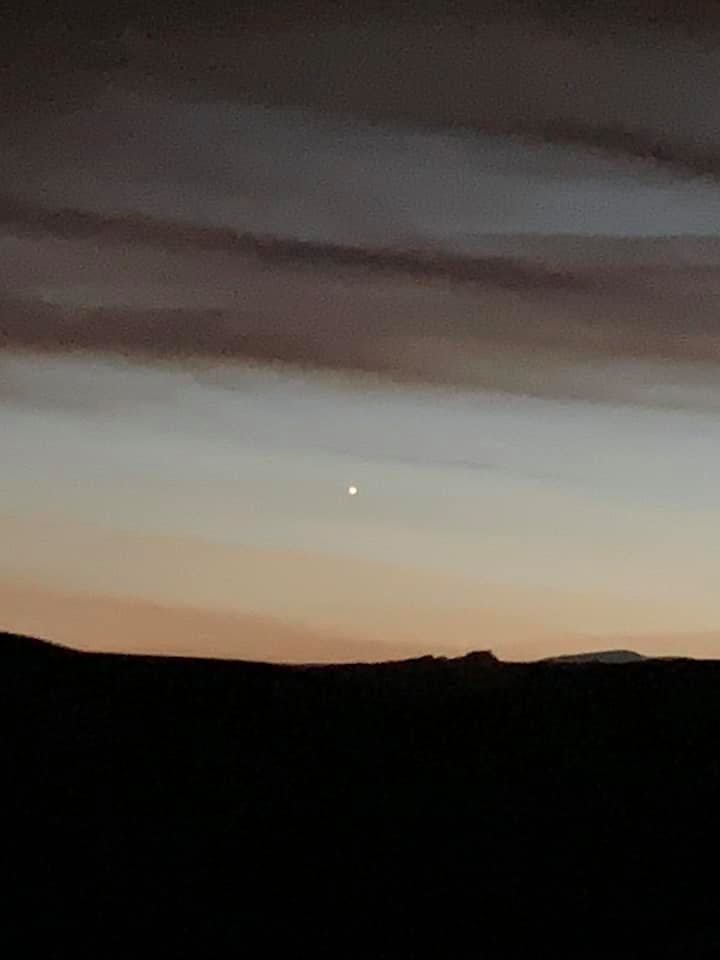
Venus in the Sunset

Next week: Part 2. Salt Lake City and Colorado National Monument.

Time Zones

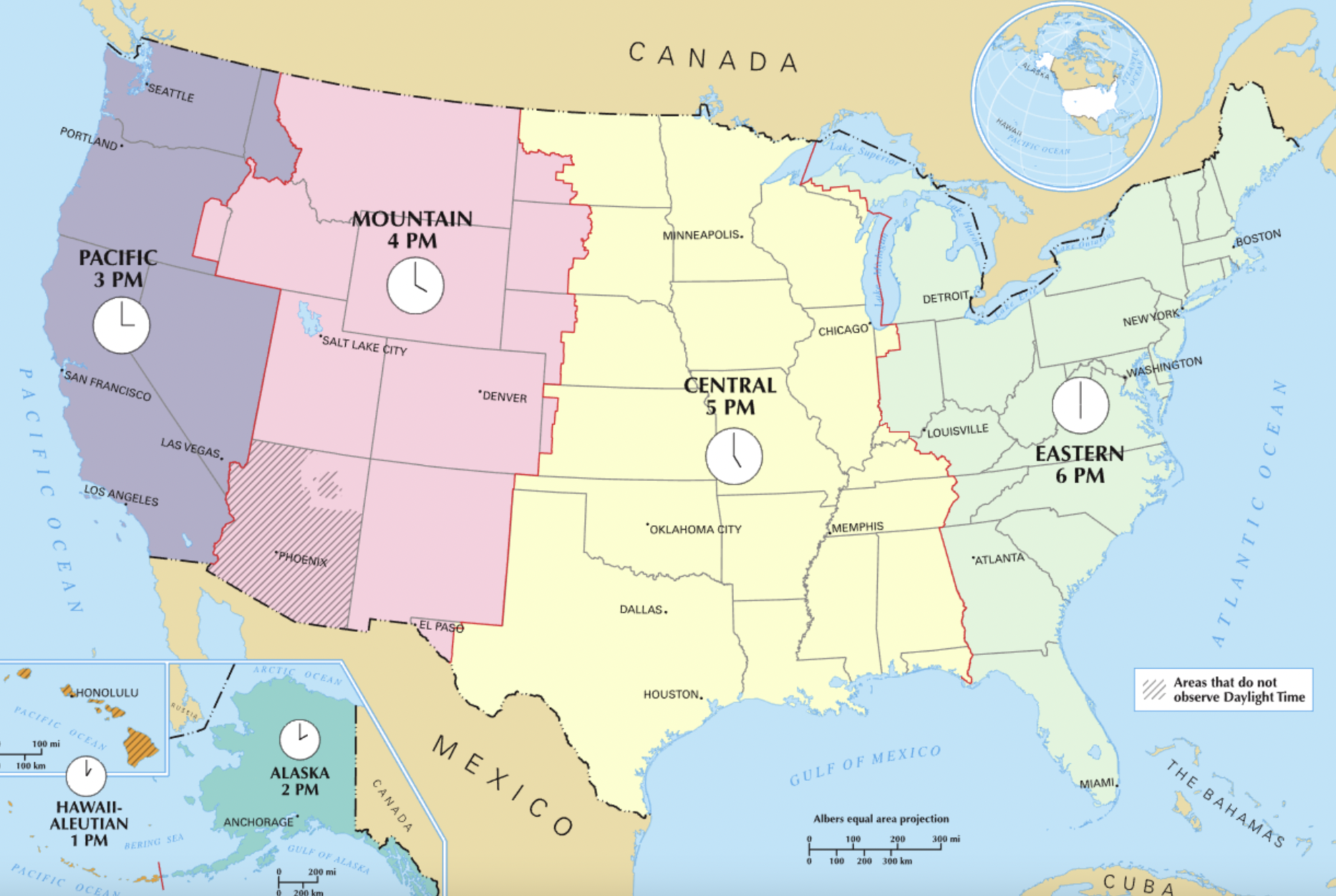
I’ve always been fascinated by how we understand the passage of time, from the older ideas of local solar time, to the nineteenth century adoption of standardized regional time zones, to now how most people I know seem to have at least one aspect of their life guided by the reality that they have to work with multiple time zones in a given day. Take my case: I work at a university located in New York, which is in North America’s Eastern Time Zone, but at the moment I’m staying with my parents in Kansas City, a city located in the Central Time Zone. This means that I have to keep an eye on the clock with a mind not only for the local time where I am, but the time as it is one hour ahead of me in New York.

As any Midwesterner from west of most of Indiana will tell you, any national TV or radio broadcast will always be announced in Eastern Time and Pacific Time, meaning that those of us in the Central Time Zone just have to subtract an hour from the listed broadcast time in the East to get our own broadcast time. And our friends out in the Mountain West just have to look at the Pacific broadcast time and add an hour to get their’s. What this means is that the listed broadcast times on any TV or radio show in the Continental United States relies on 35.8% of the population rarely ever sees national broadcasts listed in their own local time. Granted, the largest population centers in the country are on the coasts, but coming from the middle of the country, this has always been a bit of a sticking point for me.

Driving across the US, you’ll often come across the usual Welcome signs when entering new states, new counties, or new cities. In some places, particularly in the Rockies, each city’s welcome sign will include that city’s elevation where in the prairies it might include the population or the date that settlement was founded. Meanwhile, each state has its own at times unique welcome sign. I always enjoy seeing those, because it marks a real milestone on each of my long drives. My favorite welcome sign to date remains Colorado’s, though normally where I see it on I-70 at the Kansas/Colorado border the dominant colors in colorful Colorado are the golden brown of the Great Plains stretching off to an endless blue, though sometimes gray, sky.

Photo by the author. 26 July 2013.

Yet alongside all these welcome signs, and the signs advertising this country’s wonderful and often weird roadside tourist attractions, are the occasional signs you’ll pass by that announce that you’ve entered a new time zone. It baffles me that neither the Illinois nor the Indiana Departments of Transportation have put such signs on I-70 on their shared border just west of Terre Haute, where I usually will gain or lose an hour depending on the direction I’m driving between Binghamton and Kansas City. Still, these signs are always an even bigger marker of progress on a trip, a sign (pun intended) that you’ve moved not from one of the 50 states to another, but from one of the 6 continental North American time zones to another.1 It’s a rarer thing to do.

There is one thing about how this country is divided by time zone that does bug me, and that’s the eastern edge of my own native time zone in Indiana and up the middle of Lake Michigan. You see, back in the nineteenth century when these time zones were first being set up, the merchants and city leaders in Detroit wanted to be on the same time zone as the markets in New York and Toronto, so they got Michigan as a whole to be put in Eastern Time. Later, in the twentieth century, Indiana’s state government decided the majority of their state should also be on Eastern Time, probably because of Michigan’s decision, leaving the option of being on Central Time up to only the westernmost Hoosier counties. As a result, cities like Gary in Northwestern Indiana that are a part of Chicagoland are in Central Time, while the rest of the state is an hour ahead.

But geographically, that border between Eastern and Central Time should be further to the east. Geographically, Indiana and Michigan should be on Central Time, not Eastern. This would allow both states to be on the same time as the Midwest’s biggest markets in Chicago, while at the same time causing some problems for Detroiters driving across the border to Windsor, Ontario, or people commuting into Toledo, Ohio from Michigan. All that said, I do use the time change on the Illinois/Indiana border to my benefit when I’m driving in either direction across it. Going east, if I leave Kansas City at 07:00 CT, it means I can stop for dinner around 17:00 ET in Indianapolis, which if it were in Central Time would usually be an hour too far west (16:00 CT) for my usual dinner time. Going west, if I leave Binghamton at 07:00 ET, I can use the extra hour to get a little further along the drive, even making it as far as St. Louis, which is only 3.5 hours from Kansas City before 22:00 CT (23:00 ET).

Then there’s the issue of the seasonal time changes. In North America we call it Daylight Savings Time, while in Europe it’s called Summer Time. This means that over here the official time zone abbreviations change from CST in the cold months to CDT in the warm ones, while the UK’s time zone remains BST (British Standard Time/British Summer Time) all year round. I personally tend to agree with the people calling for us to just adopt Daylight Savings, i.e. Summer, Time all year round. It makes more sense, and even though it can be a pain to get up before dawn in the mornings in the Winter, that’s just a part of Winter. I always thought it was kinda neat, though I admit I never really have been a morning person, so my appreciation for any wake-ups before 08:00 are limited at best.

That said, even if one US state here in the Midwest or in the East did vote to switch permanently to Daylight Savings Time, as Missouri is currently considering, it would require every other state in that region to do so as well. Unlike Arizona, the most notable state to make this change, there are too many cities in the Midwest that are close, or cross to state borders. Some notable ones among these are Chicago, St. Louis, Kansas City, Cincinnati, Louisville2 Milwaukee, the Twin Cities, Omaha, the Quad Cities, Duluth-Superior, and Detroit.

Even today, the furthest eastern reach of Chicago’s suburban train network extends from the Central into the Eastern Time Zone with the South Shore Line in South Bend and Hudson Lake, Indiana. Imagine if Missouri’s bill was signed into law without the provision that Kansas agreeing to it as well. Every time someone crossed State Line Road here in Kansas City between the first Sunday in November and the second Sunday in March, they’d have to adjust their clocks by an hour. Because of this, if one Midwestern state decides to adopt Daylight Savings Time permanently, everyone else will have to follow along, or else it won’t work.

As you can see, just from the intricacies of it, I enjoy thinking about time zones. In a couple of months when I drive west from Kansas City on a vacation out to the Rockies, I’ll look forward to seeing that rare sign on I-70 in Western Kansas announcing my entry into Mountain Time. I know, it’s nerdy, but it’s something I enjoy thinking about.


Notes

1 The six continental North American time zones are: Atlantic, Eastern, Central, Mountain, Pacific, and Alaskan. You could also include Hawaiian-Aleutian because part of it does reach sections of the Alaskan mainland (I think), but that seems a bit of a stretch.

2 Yeah, Louisville is in Kentucky, but it’s borderline Midwestern.

Why We Need Explorers

I’ve always loved the idea of exploration. I remember on the evening of Sunday, 31 May 2015, I decided to take my dog Noel for a drive down State Line Road here in Kansas City. We kept going south until the Sun started to set, making it as far as about 300th Street. Lately, during my time in Binghamton this Spring, I made a point of doing some sort of weekend drive into the surrounding countryside, just choosing a cardinal direction and driving until I decided to turn around. I suppose it makes sense then that I’d end up training as a historian of Renaissance explorers and travelers in the Americas.

When I decided to write about this topic rather than another post about grammar (you’re welcome), I started wondering why is it that so many of our history’s greatest explorers and most pivotal encounters happened at times of great social unrest at home? Columbus’s world-defining 1492 voyage launched the most recent great Age of Exploration, which I would say lasted from 1492 to around 1800, 1 yet much of that same period is also characterized by a series of disastrous internal conflicts in Europe collectively known as the Wars of Religion and the later eighteenth century dynastic wars of succession, and the first truly global war, the Seven Years’ War (the French and Indian War here in English-speaking North America). Why would a civilization so focused on its own internal divides, the prejudices and hatreds of its own communities, polities, churches, and states, also want to invest so much time, effort, and capital in exploring places in what were ostensibly other worlds across vast hitherto impassable oceans?

I think one main reason was well expressed by a Bonnie Tyler song, originally from the 1984 film Footloose, that my friends and I happened to lovingly use for the theme tune of our YouTube series The Awesome Alliance (2008–2013), they needed a hero, someone ambitious and daring who was wiling to push the boundaries of what was believed possible and achieve something extraordinary. In these cases, the extraordinary is encountering previously unknown worlds.

I wonder what might have become of a Europe wracked by generations of successive wars, after all, it’s important to remember that many of the continent’s major powers were at war with each other before the Reformation and Wars of Religion began. At that point, the European wars were largely dynastic fights between royal families like the Habsburgs, the Valois, and the Tudors. Naturally then, once the Wars of Religion had generally fallen out of fashion after the disastrous Thirty Years’ War, Europe settled down into a familiar pattern of dynastic warfare, only now between the Habsburgs in Austria and Spain, the Bourbons in France and also in Spain, and Hanoverians in Britain.2

All throughout the sixteenth, seventeenth, and eighteenth centuries, with some very real continuations into the nineteenth and twentieth centuries (here lies another historical debate), explorers traveled from their homes to faraway places. Their travels inspired people to keep looking beyond what was known, to keep pushing the boundaries of knowledge and society. The diversity that characterizes our world today wouldn’t have been possible without the explorers of 500 years ago challenging the mould of their day.

Today, we need to continue to celebrate and fund our explorers, to embrace them. We need their efforts to inspire us to remind us that we can to amazing things. When we reach for the stars as our astronomers and astronauts do, we discover new horizons over which we can glimpse. And when we wander into a new city or country where we might not’ve been before, taken that road less traveled, we meet people who enrich our lives with their stories, their experiences, their memories.

Wherever my next trip takes me, off into some place I may not have been before, I hope it’ll be somewhere exciting, somewhere new. Once we’re past the pandemic, and travel is easier and safer again, I hope to use my time in Binghamton to visit more of the Northeast, to see the Green Mountains of Vermont or to visit Boston again for the first time in 20 years. Maybe, if my timing works out right, I can drive down to the Space Coast in Florida and see one of the Artemis mission launches in 2022 and beyond, and see that new class of astronauts begin their long voyage to establish the first human outpost on the Moon.

Eventually, I hope, we’ll have a new name for the Moon as we discover and settle on many other moons and the planets they orbit. The horizon continues eternally, and while chasing after it might seem quixotic, it only means there’s always another adventure to be had, another place to explore out there.

“Holding out for a Hero,” the “Awesome Alliance” theme song

Notes

1 My fellow historians will no doubt recognize the fertile ground for historiographical debate here. For the sake of the sanity of my readers, I’m going to leave that for a later publication.

2 This is a gross over-simplification of 17th and 18th century European political history, especially coming from someone who’s TAing a class called “Europe Since 1500” at the moment.

How to Plan for a Half-Transcontinental Road Trip

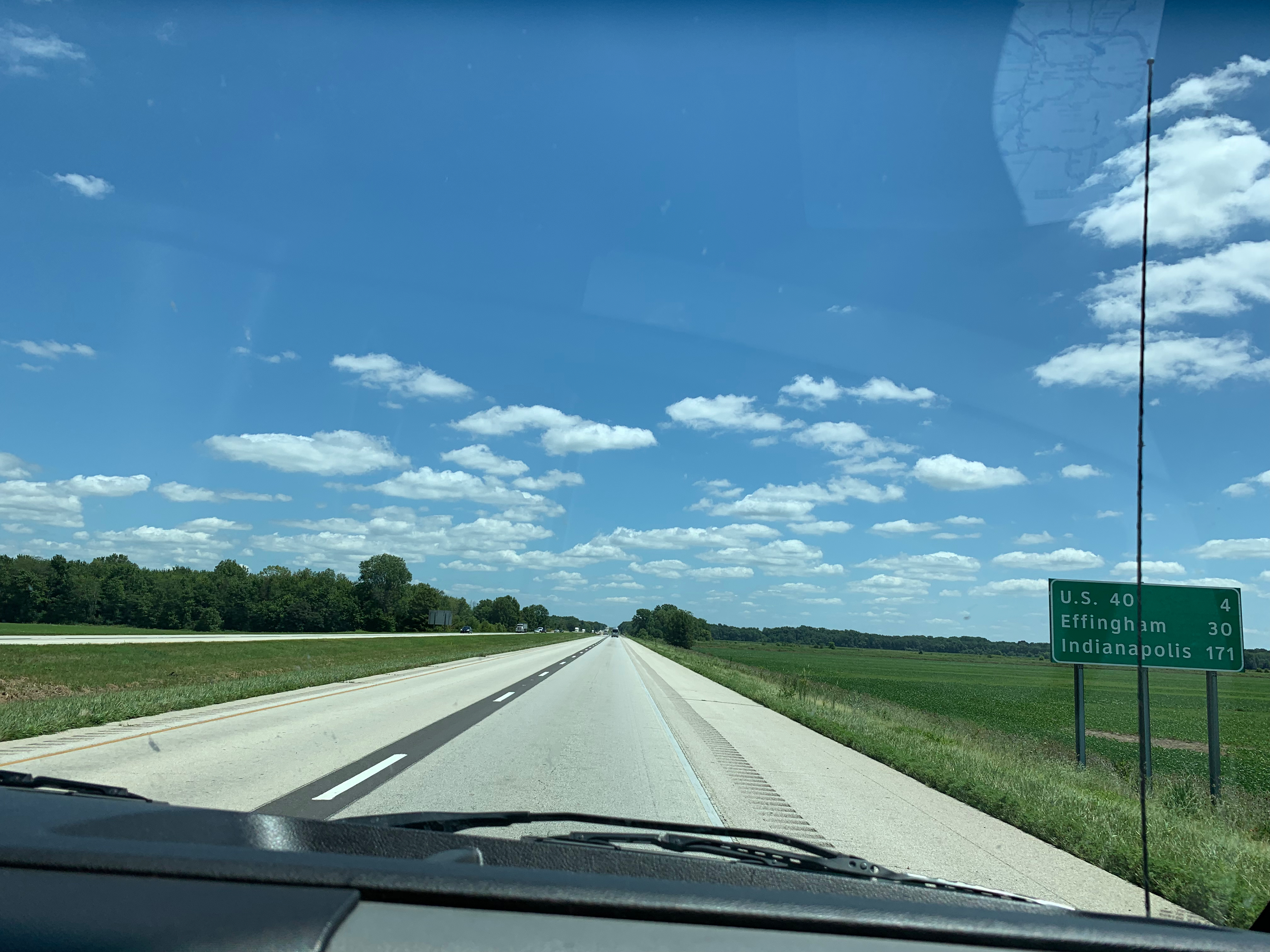
All “on the road” pictures were taken not while driving.

Growing up, road trips were a fairly common phenomenon. My parents and I would usually drive at least once a year between Chicago and Kansas City, and vice versa after we moved from the Windy City to the City of Fountains. In the 2000s we’d fairly often make the 3.5 to 4 hour drive east from Kansas City to St. Louis, and every summer in the first half of the 2000s we would drive across the Great Plains for a weeklong vacation at a dude ranch up in the Colorado Rockies. Road trips, then, were a pretty regular sort of thing to do.

However, in the last decade or so, our adventures beyond Kansas City have tended to be less on the highway and more on the rails or in the skies. It got to a point that the few road trips I’d end up doing would be rare instances that would increasingly become frustrating for how long they seemed to take. So, in February 2019 when I got accepted into the History PhD program at SUNY Binghamton in the rolling hills of New York’s Southern Tier, I knew immediately looking at the map that I’d have to make at least a couple road trips just to get there and back again.

Endurance

The thing is, as long as a 7.5 to 8 hour drive to Chicago or a 9 to 10 hour drive to Denver might seem, any drive to Binghamton was going to steamroll past those regional drives. Binghamton is 1,000 miles (1,609 km) as the crow flies from Kansas City, and on the road, the trip can be anywhere from 1,100 miles (1,770 km) to 1,500 miles (2,414 km) in length. This usually means that in full the drive itself will take between 18 and 21 hours, which itself requires an overnight stop. For me, when I was first sketching out how I was going to make these long drives, it was clear from the first moment that this was no small undertaking.

A transcontinental drive on any continent is something to be proud of. It requires a lot of planning, a good knowledge of your own endurance, of your car’s capabilities, and of the regions you’re going to be driving through. At the time of writing, it’s only just becoming possible to make such a drive in an electric car, meaning that most such road trips are going to be producing their own carbon footprint. I haven’t calculated exactly how much CO2 I’ve produced so far on these, but that is one big problem with road tripping that I’d like to resolve. Beyond the things you can control, before going on any such road trip you have to bear in mind the road conditions themselves.

In the next few days, the Biden-Harris Administration is supposed to be announcing a $2 trillion infrastructure plan as a part of their American Rescue Plan. The plan covers a wide range of different initiatives, all of which badly need more funding. Road repair is one such initiative, and trust me when I say the roads in many parts of the US that I’ve driven through need help. There are a number of places along the routes I use between Kansas City and Binghamton that have been so badly potholed and worn down that you have to be constantly vigilant for trouble. There’s even a stretch of I-88 in New York (not the same interstate as the tollway in Illinois) that has permanent signage warning drivers “Rough Road” ahead. Whoever is driving at any given moment can’t take their eyes off the road for a second, because you never know what could happen next.

Weather

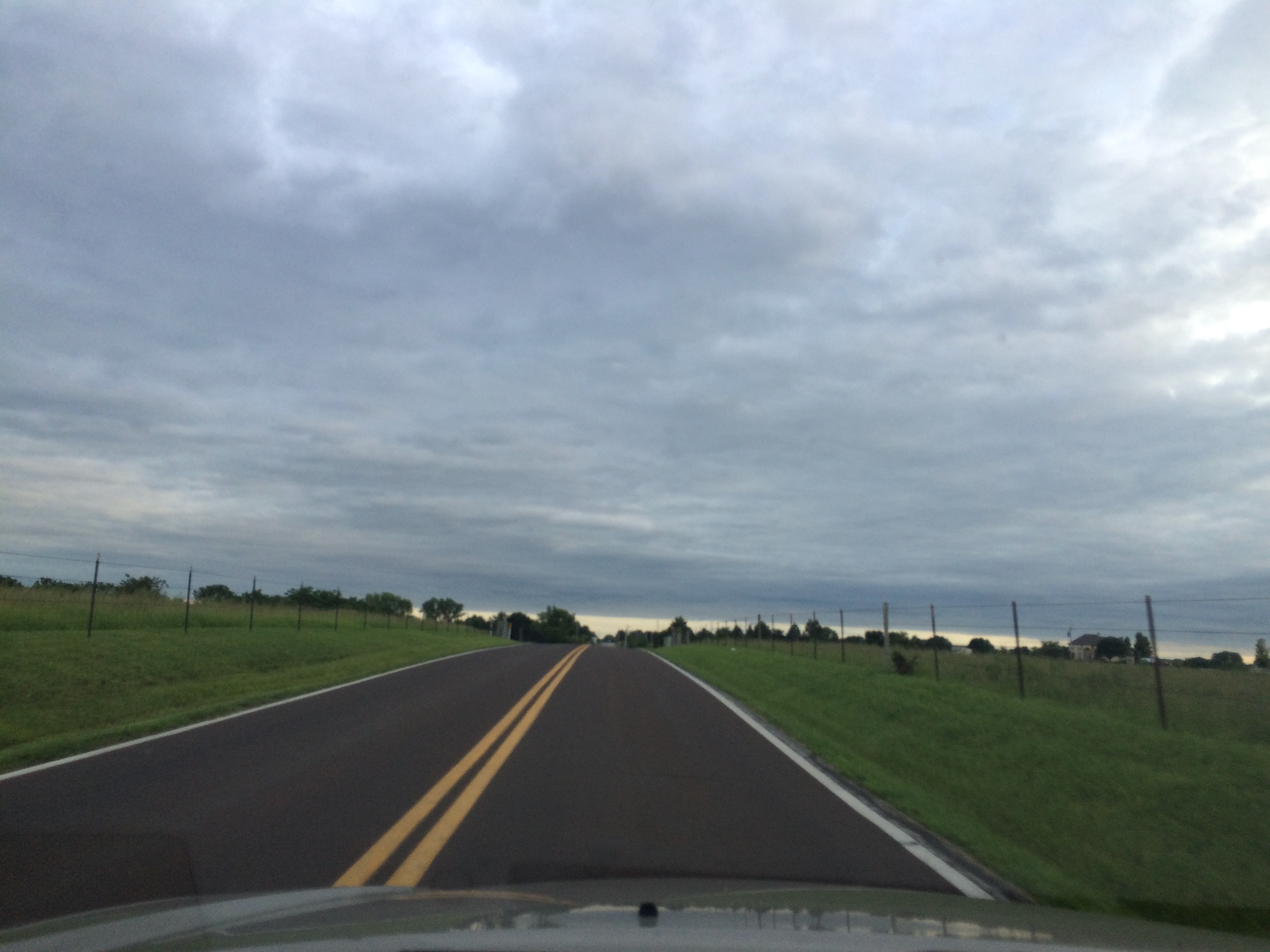
The most recent storm I encountered on the long drive west.

Another big issue to keep in mind is the weather. I usually will start monitoring weather forecasts in a couple of key cities I usually go through about a week before my planned departure date. Covering all the possible routes, these cities are Binghamton, NY; Erie, PA; Scranton, PA; Harrisburg, PA; Pittsburgh, PA; Columbus, OH; Indianapolis, IN; Chicago, IL; St. Louis, MO; and Kansas City, MO.

In the winter months (October to April) if there’s any chance of lake effect snow along Lakes Erie and Michigan, I’ll reroute further south, staying on I-70 after Columbus and eventually taking the Pennsylvania Turnpike to Harrisburg, PA before turning north on I-81 towards Binghamton. If there’s also really bad snow in the Appalachians in Pennsylvania, and lake effect snow in Chicago, Cleveland, or Erie, I might end up postponing the trip for a day or two to let the weather calm down again. In January 2020, midway through my long drive east I got caught up in a whiteout blizzard on US-22 east of Pittsburgh (you can read more about that here) in the predawn hours of that Sunday morning.

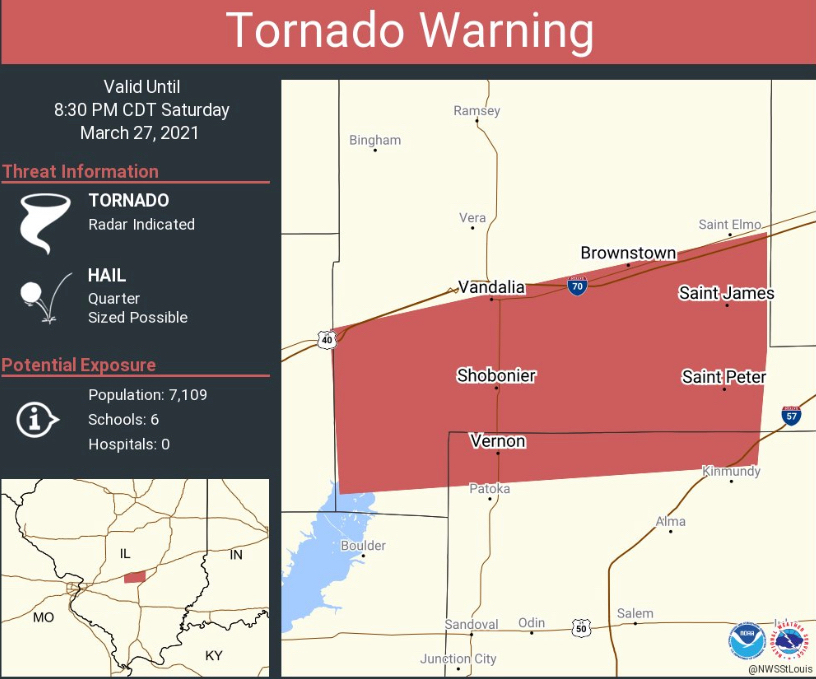
Snow and ice are worse problems for driving than rain is during the rest of the year. I’ve been lucky a couple of times. In August 2020 I had a near miss of a big derecho that wrecked widespread damage across Iowa, Illinois, and Indiana. I could actually see it off in the distance in my rear-view mirror when I was getting dinner in Indianapolis. And on day 1 of this most recent long drive west, 27 March 2021, I was less lucky with my timing, and drove right into a powerful thunderstorm with reported tornado activity between Mulberry Grove and Highland, IL.

As terrifying as the January 2002 blizzard in the Pennsylvania mountains was, this thunderstorm was worse. I made it out okay, with only 15 minutes added onto the total drive time, but to quote my favorite Lando Calrissian line from Return of the Jedi, “that was too close.”1 It was reminiscent of my first time doing a cross-country drive in August 2009 when on the way back from Dubuque, IA I was at the wheel when my parents and I hit a powerful late-summer thunderstorm an hour east of Des Moines. We ended up pulling over in Altoona, IA at a Culver’s until the storm passed.

Entertainment

When I was still too young to drive, and kept my place in the back seat of whichever car my parents owned at the time, I often found various ways to keep myself entertained. Among those that I haven’t carried over into my current long drives are watching movies on DVD. We had a screen and DVD player that could be strapped to the back of the front passenger seat’s head rest with velcro. As a driver, it’s not safe to be looking at much of anything besides the road. As I’ve gotten older I’ve found that I tend to get motion sickness whenever I try to read in the car, so on the rare occasions when I’m a passenger these days, that’s out of the question. Instead, the tried and true classic remains satellite radio, music, and audiobooks.

Generally, my first choice will be to listen to a good long audiobook, something that will keep me awake the entire way, a true page-turner. In the first two years of these drives to and from Binghamton, I’d listen to a lot of Star Wars books on Audible, which were usually action packed and entertaining enough to keep me going. On the most recent pair of drives (January and March 2021), I’ve been listening to President Obama’s new memoir A Promised Land. It’s a really fascinating book to listen to, narrated by the guy himself even, but as much as I enjoy hearing about economic or foreign policy (and I’m not being sarcastic there), after a couple hours on this most recent drive I noticed I was starting to get tired of it. So, at that point I’d switch over to what I call my “stay awake” playlists: a good combination of ABBA, Elton John, and more recently Hamilton.

I first compiled that particular playlist in the preparation for a 2 am departure from Binghamton to make a 5 am flight out of Wilkes Barre/Scranton Airport an hour south of Bing in NE Pennsylvania. It’s been especially helpful on the nighttime legs of my long drives, and formed much of the soundtrack for the last 2 hours of Day 1 of my most recent Long Drive West, and a good portion of the predawn hour of the drive on Day 2. On other occasions, like a shorter road trip I took in my first couple weeks after moving to Binghamton in August 2019, I’ll switch to satellite radio and listen to NPR, the BBC World Service, or maybe catch the Cubs, Royals, or Sporting KC if they’re on. As much as I want to listen to whatever it is I’m playing, the primary goal of that audio is to keep me awake and going. And, if all else fails, and I know it’s a good time, I’ll call my parents or a couple of really close friends to chat for 15 or 20 minutes.

Conclusion

Looking ahead, I anticipate I’ll continue to make these long drives at least until I’ve finished my PhD in Binghamton and to wherever my next job takes me. The COVID Pandemic has only heightened the need for these road trips, with most other modes of travel not really being as safe as I’d like in the last year or so. My original plan when I left for Binghamton in 2019 was to make these long drives at most four times per year: on either end of each semester in January, May, August, and December. The main reason for driving rather than flying or taking Amtrak is that I need the car on either end. In the future I’d gladly fly, make the trip in 4 to 8 hours instead of 18 to 21, or even take Amtrak once they’ve resumed dining car services on their transcontinental lines.

Moreover, I really want to help reduce my own carbon footprint, eventually replacing my 2014 Mazda 3 with an electric car, maybe in about 4 or 5 years. By then though, hopefully I’ll be in a situation where either I’ll be working here in Kansas City again and won’t need to drive cross-country to see my family, or I’ll be in a city with a strong enough public transit system that I won’t need to worry about having the car in one place or another like I do now.

All of that said, these road trips are fun. They’re adventures pure and simple. I never really know what’s going to happen on the road or on the stops I make along the way. In November 2019, I reached what I’d call a pretty special milestone when I drove my Mazda to within sight of the New York skyline and the Atlantic Ocean beyond. I cheered, I, a guy from flyover country, from the middle of the continent, had driven to the ocean. One of these days, I’ll complete the entire transcontinental drive, make it to the Golden Gate, and maybe even drive down the Pacific Coast Highway. On its own, the bragging rights involved, to be able to say that I’ve driven the same car from Atlantic to Pacific will be worth the trip.

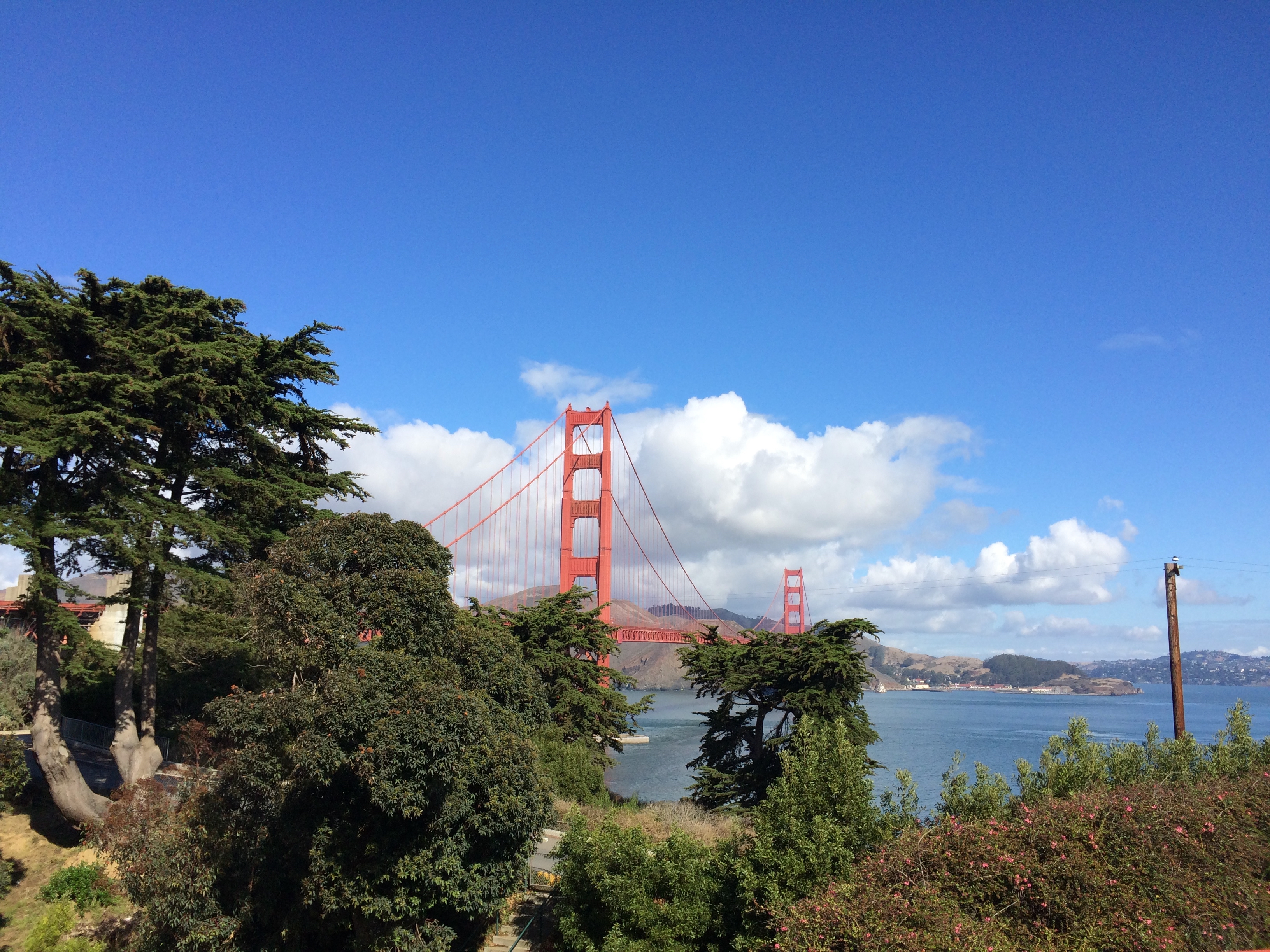
From my 2016 trip (flying) to San Francisco. One of these days, I’ll drive there.

Notes

1 Someone should really make a GIF of that particular line. I’ve been looking for one for a couple years now.


Corrections

Amended 1 April 2021 to reflect a more accurate dollar amount for the Administration’s Infrastructure Bill.

The Luxury of Stress, or the Adrenaline Rush of Fear

2020 began for me with a long drive east: Kansas City to Pittsburgh to New York. I drove the first leg in 15 hours, arriving just before midnight on a Friday, and spent the next day wandering through the Carnegie Museums of Art and Natural History in Downtown Pittsburgh, which was the main reason for that particular stopover. That Sunday however was characteristic of how the year that this would become. I woke up around 4 am on Sunday, early enough that I hoped I could be in Manhattan for lunch. As I made a quick donut stop near Pittsburgh Airport, I checked the travel updates for the Pennsylvania Turnpike, and was shocked to discover that it was blocked in both directions just east of Pittsburgh due to a fatal multi-vehicle accident that had happened about an hour before. So, realizing that I’d have to take an alternate route, I plugged one into the navigation system in my car and made my way into one of the most eventful days of driving in my lifetime.

The route on that snowy Sunday morning in January

For the first 3 hours of the 6 that I’d have to drive that day, I was largely on US-22, a smaller rural highway, which heads east out of Pittsburgh across Pennsylvania toward the Jersey Shore. Normally I prefer to stick to the interstates for the lack of stoplights, and at that hour of the night for the lack of traffic. In this instance though I quickly found myself crawling my way across the Appalachians in a blizzard with next to no visibility. I passed semitrucks that were sliding backwards down the inclines on this normally reasonable, yet now snow-packed, highway. I’m pretty sure I passed a plow or two even, continuing onward, only really able to see where I was going thanks to the car’s navigation. Only after 7:30 am or so did the snow clear and I was able to enjoy an otherwise uneventful drive to the long-term parking garage that I frequent near Newark Airport when I drive to New York City.

Like the rest of 2020, thus far, I was nearly stressed to my limit in the early hours of that morning. This year has been one for the record books, a right old annus horibilis to borrow a term from the Queen. At the same time that I was dodging stuck semis in the Pennsylvania mountains, this country’s leaders were saber-rattling and threatening war with Iran. We were lucky to have missed that cataclysmic fiasco of a war, though I doubt we’ll know the full details of how we missed it for a few years to come. Since then we’ve seen the rise of the greatest pandemic in a century, a near economic depression, irate armed citizens occupying government buildings over their economic and social fears, the murders of many other citizens of this country by authorities, and the largest protests this country has seen in a long time. Throughout all of this, the response of those in charge hasn’t helped to ease tensions one bit, both publicly and privately for a great many of us.

Yet unlike that early morning in January, I now feel like I have the luxury to think about it, and to stress about it. That morning, I did not have that luxury, or perhaps I had too strong of a fear-driven adrenaline rush to stress about it. After all, if I thought too hard about how terrifying of a situation I was in, I would’ve made a mistake and gone off the side of the road, not knowing what that’d bring: a field, a hill, a house, the edge of one of the mountains? If I’d let my stress take over then, I can’t be sure I’d be able to write this today. Yet in the months since I’ve been largely secluded from the world, first in my apartment in Binghamton, NY, and for the last two months in my parents’ house in Kansas City, MO. Like all of us, I’ve had a lot of extra time on my hands to think, to consider how I want my life to go forward, and to stress and worry about our world, and how it’ll either improve or wreck our future.

The stress has certainly got to me, and there have been more occasions than usual of late where I’ve had real trouble working through it. It’s left me irritable, quick to anger, and generally in a sour temper. I could probably take all this sour stress and make one of those sourdough starters that so many people started doing this Spring. I’ve always found it hard to hear the memories and feel the emotions of the best days of my life over the obnoxious clamoring of the worst memories. Lately it’s been harder than ever, but I’ve tried my best to cherish the best moments of my life and my time at home. 

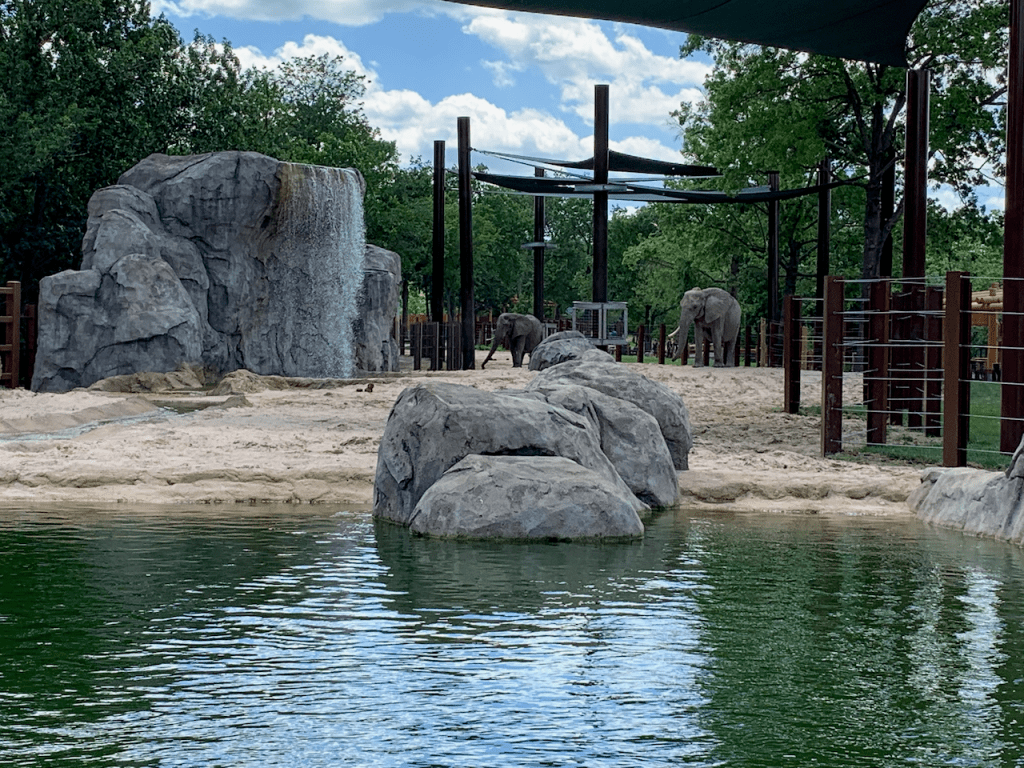
This past weekend in particular had so many wonderful moments. On Friday, the executives at my Mom’s company decided to give all of their employees Juneteenth off. So, that morning for the first time in at least 21 years my parents and I together went to the Zoo. When I was little, I loved going to the Brookfield Zoo near our home in suburban Chicagoland with them and have cherished those memories ever since. Now, after living in Kansas City for 21 years, we finally went as a family to the Kansas City Zoo, a place that I usually visit at least once a week on my own when I’m home. We didn’t see everything we wanted to see, but we left truly happy. 

The Kansas City Zoo’s new Elephant Expedition Enclosure. The photo is my own.

Later that evening after dinner we drove up to my alma mater Rockhurst University at 52nd & Troost and took part in the Juneteenth Prayer Service that stretched for 10 miles all along Troost. This was a prayer service like no other, less silent meditation, or communal rosary, and more a celebration of the hope that our community on both sides of the dividing line feels that change is in the air. I sat there on a stone wall for an hour and watched as countless cars drove by, their drivers honking their horns, people waving, children singing from the back windows.

On Saturday we went to one of my aunt’s houses for a small backyard gathering. I always treasure the times that I have with my family, the whole crowd. Just sitting there with people whose company I enjoy, people who I’ve known my whole life, and experiencing the madness of our current world from the perspectives of their stories, jokes, and worries made everything seem better for a little bit. Sunday was similar, Father’s Day, a quiet celebration this year at home with my parents. My Mom and I made brunch for the three of us, brioche French toast and eggs, before spending the afternoon watching soccer and reading June’s National Geographic. This was followed by a quiet small gathering in Roanoke Park.

I was reminded of all of this, and in particular of that terrifying snowy morning on US-22 east of Pittsburgh on Sunday evening when we watched last year’s release A Beautiful Day in the Neighborhood, starring Tom Hanks as Mr. Rogers. In part, the film’s Pittsburgh setting triggered those memories, and my thoughts on that January Saturday evening that I’d live in Pittsburgh if I got a job there, and how much fun I had at the Carnegie Museums. Yet more than that, the kindness which Mr. Rogers exuded in his life and work reminded me that this stress doesn’t have to be permanent, and that the best of memories should be the ones I treasure. I can still vaguely remember seeing him on WTTW in Chicago in the ’90s, and even a little bit on KCPT after we moved here to KC at the turn of the millennium. At the time I don’t really remember knowing what to make of the guy. Yet today, as an adult with far more responsibility to my community, our future, and to myself, I feel like if I were to try to learn from anyone in my own work as an educator, it’d be him.

Four Months Later

Screen Shot 2019-11-25 at 11.24.45EST

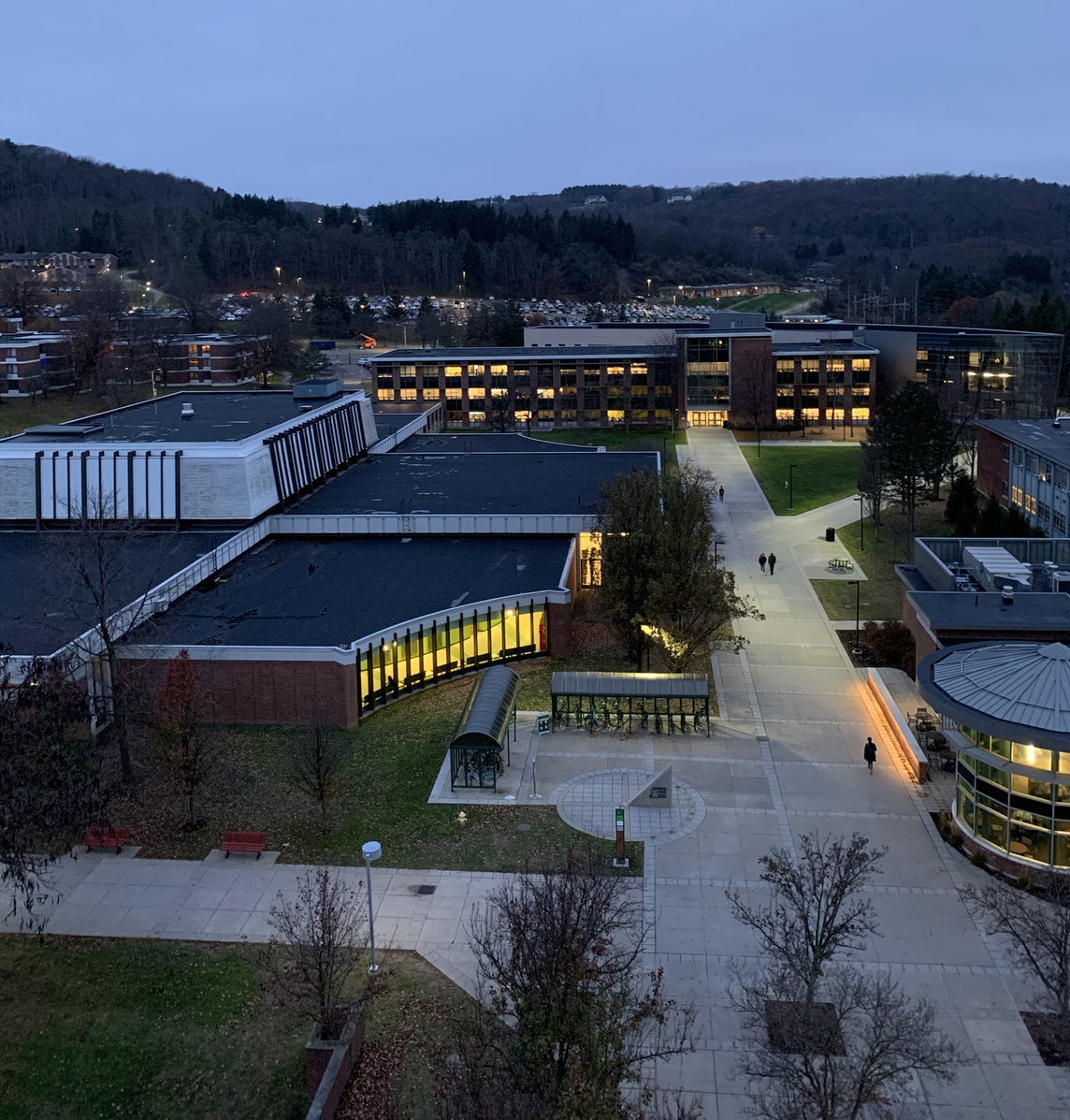
The simplest way of saying it is that even though I’ve already been in graduate school for the better part of the last four years, I was not prepared for the intensity of work that I have found myself undertaking over the last sixteen weeks. It has now been four months since I left Kansas City for the crown jewel of the State University of New York’s system, Binghamton University. I started on the back foot, as my intended research project became unviable a full two weeks before my departure. Yet I have taken that setback as a good reason to move forward, with resolve, to stay on track and on schedule, and to find another topic to focus my research on.

As most teenagers do, I felt ashamed about the things I had been passionate about as a young child. So many things that I looked back on with joy were simply not “cool enough,” not something that I would want to share with my friends. Yet after starting my undergraduate degree at Rockhurst in 2011, I began to allow myself to open up to those same passions and interests from my earliest years. That said, until now I did not allow topics like zoology, or travel, or natural history to become my primary professional focus; I stayed in the same areas that I fell into in high school and as an undergrad, in politics, theology, and philosophy, and ran with those, completing one bachelor’s and two master’s degrees in that same purely anthropocentric and theocentric vein.

Yet in August, as I found myself without a research topic, the most fundamental part of a Ph.D. in History, I decided to take the initiative and try and incorporate some of those childhood interests into my research. Today, I am beginning what hopefully will be a career-launching research project looking into how Renaissance travel narratives served as vehicles for the transmission of new scientific information, specifically about zoology, from the Americas to the reading public in Europe. I decided to incorporate those old topics that I have always loved to learn about, whether from books or in museums or at zoos, and frame the history that I am writing around them.

The greatest lesson so far since arriving in Binghamton has been in patience. Having landed in a town that frankly I would never choose to live in if not for the university, I have begun to learn how to be patient with my surroundings, to bide my time and work so that I can eventually move on to greener pastures, ideally in a metropolitan city of at least 1.5 to 2 million people. I have also had to shed off the last trappings of my childhood and teenage fear of criticism, which has certainly limited my success in the past. Having a good 400 pages to read per week, I have struggled to properly prepare myself in such a way that I feel confident to discuss the topics at hand, many of which, such as Hippocratic medicine, I have little background in.

I believe that all bad things that happen in our lives eventually boil down to fear, our fear of the unknown, our fear of others, our fear of ourselves even. By beginning to learn how to be patient, how to deal with criticism, I am confronting many of those deepest fears that held me back in the past. I know for a fact that I’m not nearly over many of them, after all some fear is a good thing, otherwise I might try to pet the mountain lion at the Binghamton Zoo, and frankly I’d rather keep both of my hands. Still, a little wise individual, in one of the greatest sagas to be produced in our time, once said that “the greatest teacher fear is.” I certainly believe it.

The Dawn of Summer

What follows is an excerpt from my upcoming travelogue, whose working title is The Great American Basset Hound. No basset hounds were harmed, or have even at this point been involved in the writing of this excerpt, or indeed any other part of the upcoming volume. Enjoy!

                   -Seán Kane.

Friday 8 April 2016 came about two hours later than the previous day, as my alarm was set for the much more leisurely hour of eight rather than its far more rushed predecessor of six. I breakfasted with Kristiina in the empty hotel dining room, as the majority of our group had already left for their first meeting of the day at the International Crisis Group. Kristiina had chosen to not attend that particular talk, as she wanted to get some rest and get the most out of the main event of the day, a visit to the European Parliament. We had a quiet breakfast of waffles, frankfurters, and croissants, passing the time with small talk, the very nature of which seemed to be our way of avoiding thinking about our respective journeys that day: hers to London in the afternoon and mine to Annecy just before eleven.

I had everything well planned, and at the chosen time was ready to leave our hotel at Place de Sainte-Catherine for the journey across Brussels to Zuidstation/Gare du Midi. At around 09:45 I said goodbye to Kristiina, turned in my room key, and headed out the door, pulling my suitcase with briefcase mounted atop behind me, as the cobblestones did not work well with all four wheels. I felt a sense of excitement, a sense of anticipatory joy at seeing my parents again for the first time in four months. This was the longest stretch of time that I had been away from them in my life, the longest since we had hugged, or sat together, or ate together. Yet also I felt a pang in my heart, a longing for my friends who would be returning to London that afternoon. Perhaps the perfect possibility would have been if both my parents and my friends could be together, but at least in this instance that was not to be.

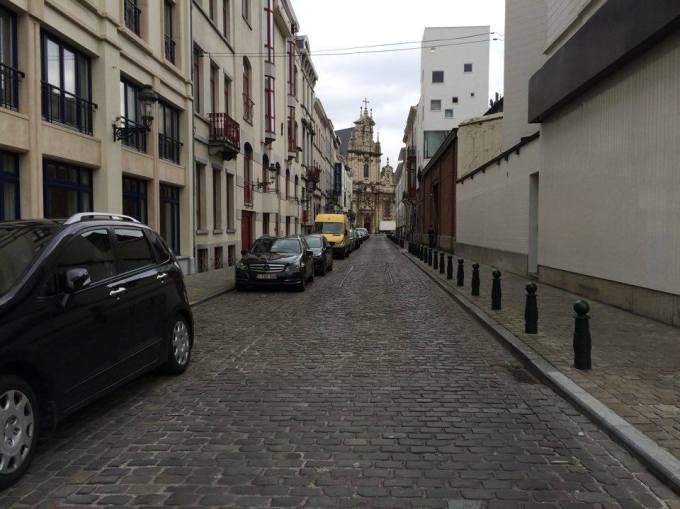
Sainte-Catherine Bruxelles

Looking towards Place de Sainte-Catherine in Brussels.

I walked through Place de Sainte-Catherine towards De Brouckère metro station, where I descended down the steps quite clumsily with my suitcase, briefcase, and umbrella in hand. At first I tried to use the fancy larger ticket gates, which are intended for those who have luggage and the handicapped, but I could not figure out how to make them work. Instead, I turned to the normal gates, and passed through fairly easily into the station proper. I was quite surprised to not see any soldiers in De Brouckère station that day, as there had always been at least two or three on patrol there every other time I had gone through that particular station. Soon though I was faced with a problem, as I had forgotten which metro line was the one to take to Zuidstation/Gare du Midi. Remembering that I had taken a direct train going to De Brouckère the day prior, I knew that I would find the proper train eventually, but still I was faced with a bit of an odd conundrum. Eventually though I came upon a bit of luck, and was soon on the T3 prémetro tram heading southbound.

To digress briefly, the public transport system in Brussels is a good model for what my city, Kansas City, could do. A system made up in part of trams (streetcars in American English), but equally reliant on buses and commuter rail could do wonders for Kansas City, bringing more people and business into the city itself, and quite possibly reducing the need for parking in places like downtown. The prémetro idea, namely having the trams move underground for part of their route and operate as a part of the metro alongside the subway lines is a smart way to better connect one’s varying modes of public transport, while saving money by allowing the local transport authority to avoid having to pay for heavy rail services like a subway. This will also reduce the need for private cars along the tram routes, equally leading to both more pedestrians and lower rates of road congestion within the city.

I quickly descended on the escalator, and went down a further set of stairs onto the platform, where the Tram 3 arrived about three minutes later. Boarding, I soon found myself hoping beyond hope that no one else would board and try to sit around me, as my bags were so big that I feared they would only cause trouble between my fellow passengers and I. Thankfully for me, that did not happen, and in large part due to the recent terror attacks in Brussels, the three stations (Bourse, Anneessens, and Lemonnier) between De Brouckère and Gare du Midi were closed. As a result, the journey only took a mere eight minutes, and as we passed along the single track between the darkened platforms at Lemonnier, I began to prepare myself mentally and physically for the journey up from the metro and into Gare du Midi. Then a sudden lurch came as the tram suddenly, and forcefully stopped in its tracks in the tunnel, whose darkness penetrated the hearts of all on-board, leaving everyone still, fearful of what was to come to pass. After a minute we started on our way again, with no reason given to what I assumed must have been some sort of animal moving across the tracks in front of the tram’s headlights, startling the driver into his sudden cessation of travel and apparent use of the emergency brake.

About two minutes later we arrived at Gare du Midi. I stood as the tram entered the station, taking my suitcase, briefcase, and umbrella firmly in hand, nearly falling over in the process as we came to a halt and the doors opened. I passed the people on the platform waiting to get on-board and walked up a short flight of stairs towards an escalator which took me into the shopping centre attached to Gare du Midi. I was surprised to find the ticket gates open, and anticipating that this crevice might merely be temporary, I slipped through, removing myself from the Brussels Metro into, as P.T. Barnum put it “The Land of Egress.” Having egressed into the mainline railway station, I began searching for a signboard which would tell me which platform I needed to go to to catch my first train, a Thalys train to Paris Gare du Nord, which was due to depart in about thirty minutes at 10:43.

Soon I found a screen hanging just above a large doorway leading onto the main concourse, which showed my train as departing from Platform 5B. Looking around, I found another sign, which pointed towards the international ticket office and Eurostar security lines as the site of the otherwise elusive Platform 5B. I walked down another long, dark corridor, which seemed to have been built with an antagonistic spirit towards the Sun above, yet hidden by the thick concrete of the platforms above. As I walked along my way I saw one final police checkpoint with two armed officers standing guard on the platforms above. My mind began to plan ahead, considering that it was entirely possible they would ask for my papers, thus I reminded myself where my passport and ticket were. In front of me was a man carrying two oversized suitcases, which attracted the attention, though only slightly, of the guards. However after a couple words they let the man pass, and it was my turn to step forward. To my surprise they completely ignored me, and I walked swiftly and smoothly through the checkpoint, heading up the ramp to the platform above.

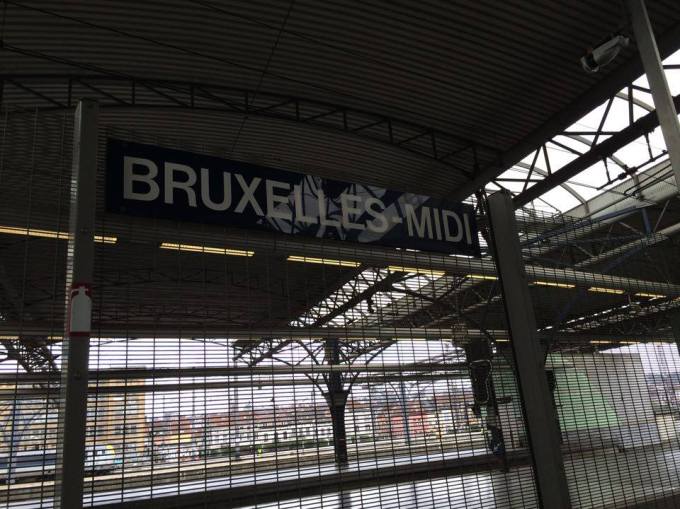
Bruxelles-Midi

Brussels-Midi Railway Station

The architecture of Brussels-Midi is quite interesting, different from some of the grand old railway stations in London and Paris, but truly a hub of activity for the railways of Belgium, the Netherlands, northwestern Germany, and northeastern France. Rather than have a grand long arched glass roof that is suspended between the two side walls of the platforms, the glass roof at this particular station is more like that at Kansas City’s Union Station, one which is made up of many smaller arches, thus giving the station ceiling more of a wave-like feel. The station itself does not necessarily have the charm of Paddington or Gare de Lyon, but it does have the practicality and methodical feel of much of post-war Brussels. At 10:23 on the dot my train arrived, its deep red paint matching the equally luxurious opera red interiors. I was surprised to see the train already filled with passengers, having not realised that Brussels was not the first stop on its route. Rather, this particular train had started in Cologne, then travelled through Aachen and Liège before arriving in the Belgian capital.

Initially I was scheduled to fly from Brussels to Geneva, meeting my parents in at the Swiss airport only two hours after their own flight from London had arrived at that lakeshore alpine city. However on Holy Tuesday, the 22nd of March, I awoke to some of the worst news one can ever wake up to. Two nail bombs had gone off at Brussels Airport in the departures hall, while a third bomb was detonated in Maelbeek metro station in the European Quarter of the city. In total, thirty-two people were killed by the ruthless barbarity of these extremists. As I readied myself for that day’s class, I kept a close eye on my TV, watching as more and more information arrived in London from the Belgian capital. Immediately, I began to reconsider my route from Brussels to Annecy, knowing that if the airport itself was bombed then the odds were pretty high that I would not be able to fly through that same airport two weeks later.

As it turned out, my intended flight did go out of Brussels, however I was not on it, and my ticket was cancelled. I did not want to step foot in that same hall where a mere two weeks prior such violence and sorrow was wrought. I did not want to walk amongst those ghosts of people who by right should still be warm to the touch, still laughing and smiling, playing and singing. I did not want to stand there and take in the macabre spectacle. I chose a different road to France, one with less sadness, with less pain.

After allowing for those passengers getting off in Brussels to do so, I boarded the train and took my place: Car 26, Seat 76. The seats on Thalys are perhaps the most comfortable seats on any train that I have yet travelled on, and I was in second class. At 10:43 on the dot our train began to move out of Brussels, heading south at high speed towards Paris. I spent the hour and twenty-two minutes that it took for us to arrive at Paris Gare du Nord writing the second half of my account of my previous two days in the Belgian capital, finishing the majority of the work in about an hour and ten minutes, thus giving me ample time to be ready to jump off the train and run to the metro station beneath Gare du Nord.

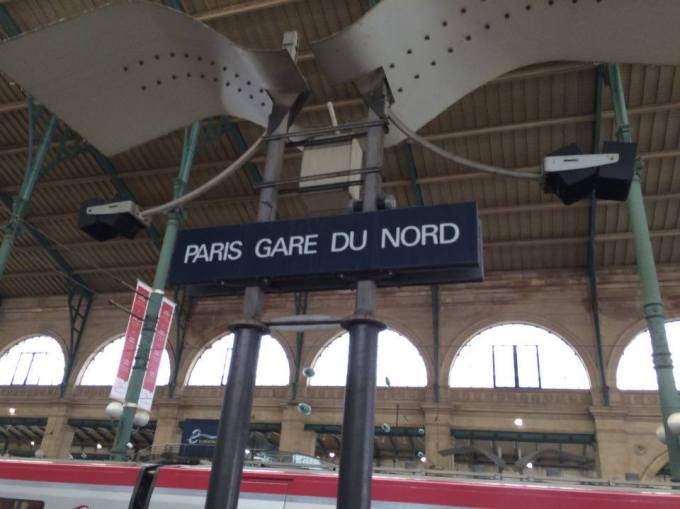
Paris Gare du Nord

“… run to the metro station beneath Gare du Nord.”

While I greatly appreciate the excellent service provided by SNCF, the French national railway company, I spent the better part of the next hour in a panicked rush. I had a mere forty-five minutes to transfer between Gare du Nord and Gare de Lyon. While this would not have been much of an issue had I been using one of the normal metro lines to get from A to B, I had to take the RER D line, a double-decker suburban line that only runs through Gare du Nord about once every twenty minutes. In short, I made it to my train on Platform 7 at Gare de Lyon with two minutes to spare, having just barely gotten on board the train before they closed the doors.

I had requested a seat on the upper level of the train, wanting to have a good view of the French countryside as I traversed that country from the plains around Paris in the north to the Alps in the south. I soon found my seat, No. 105 in Car 7, and soon met the gentleman sitting in No. 104. I figured he had a reservation for that seat, and forgetting my French, I somehow convinced him to get up and move to another seat about two rows back; though I have a feeling he simply wanted a row to himself. I quickly set my briefcase down on the seat next to mine, took out my iPad, portable keyboard, and headphones, and ticket, before removing my overcoat and placing it, my umbrella, and briefcase in the racks above my seat. As I sat down I realised my huge mistake, as I had originally intended to drop off my suitcase in the luggage racks at the end of the car, then drop off my briefcase, overcoat, and umbrella above my seat, then without taking anything out of my briefcase walk up to the café car and get lunch. However, with my iPad, keyboard, and headphones out in the open I figured I had might as well just bring them with.

I first walked towards the front of the train, but soon found myself at a dead end. Turning around, I walked through Cars 6, 5, and 4 before coming upon the Café in Car 3. By this point we were ten minutes out of Paris, and the line in the Café were at least ten people long with only one person working behind the counter. I took my place at the back of the line and waited for a good thirty minutes before ordering a Croque Monsieur and a bottle of Vittel water. Now walking back towards the front of the train, my sandwich on its plate balanced atop my electronics, the bottle and plastic cup in my right hand, whose fingers also had the highly important job of opening all of the doors between my seat and the café, I was stopped by a conductor who asked to see my ticket. “Il est à ma place,” I said, still slightly shaky on remembering my French.

“Comment?” he replied.

“Parlez-vous anglais?” I asked, accepting linguistic defeat. He nodded. “My ticket?” He nodded again. “It’s at my seat. voiture sept, place cent-cinq,” I said, switching back to French for the bit that I knew for certain how to say in that moment of intense hunger and mindlessness caused by the anxiety of my fast transfer.

“Ah, d’accord,” he said nodding and moving onto the next person. I breathed a sigh of relief and moved on through the three cars that were between my seat and I, at last returning to that place I sought out most of all at that point in time: my seat, where I enjoyed a delicious sandwich and watched three hours of a new BBC documentary on the House of Stuart’s time on the thrones of the Three Kingdoms of England, Scotland, and Ireland in the Seventeenth Century. It was at this point that I suddenly remembered that it was Friday, a day when I usually decline to eat meat, partially out of religious observance, partially out of consideration of my usually meat-filled diet and an attempt at improving my health. By this point I had had a frankfurter at breakfast, and a Croque Monsieur, which includes ham, for lunch. In that minute of realisation I thought of a new interpretation of the argument which I had used the Friday prior, that because it was the Liturgical Season of Easter, I could rejoice the Resurrection by eating meat on a Friday. Recognising the fact that this was quite a stretch of reasoning, I moved on and spent the next three hours moving my eyes back and forth between the documentary on my iPad and the fields, hills, and mountains that the TGV flew by at 300 kph (186 mph).

At 16:29 I at long last arrived in Annecy, a city, which to me appeared to still be in the Waterloo of its winter. I left my seat ten minutes prior to our arrival, and was down at the train door, ready and waiting our arrival at the platform when we at long last came to a halt and the door opened. I jumped out of the train, letting my suitcase and briefcase go ahead of me. Then rushing along the platform with the crowd, I soon saw my Mom’s red hair and my Dad’s old Cubs hat in the distance, standing behind a pillar out of the wind. I rushed up to them with a huge, broad smile on my face, and at long last was able to give them that much needed hug, that long sought-after embrace. Our Alpine Reunion had come. I was with my parents again.

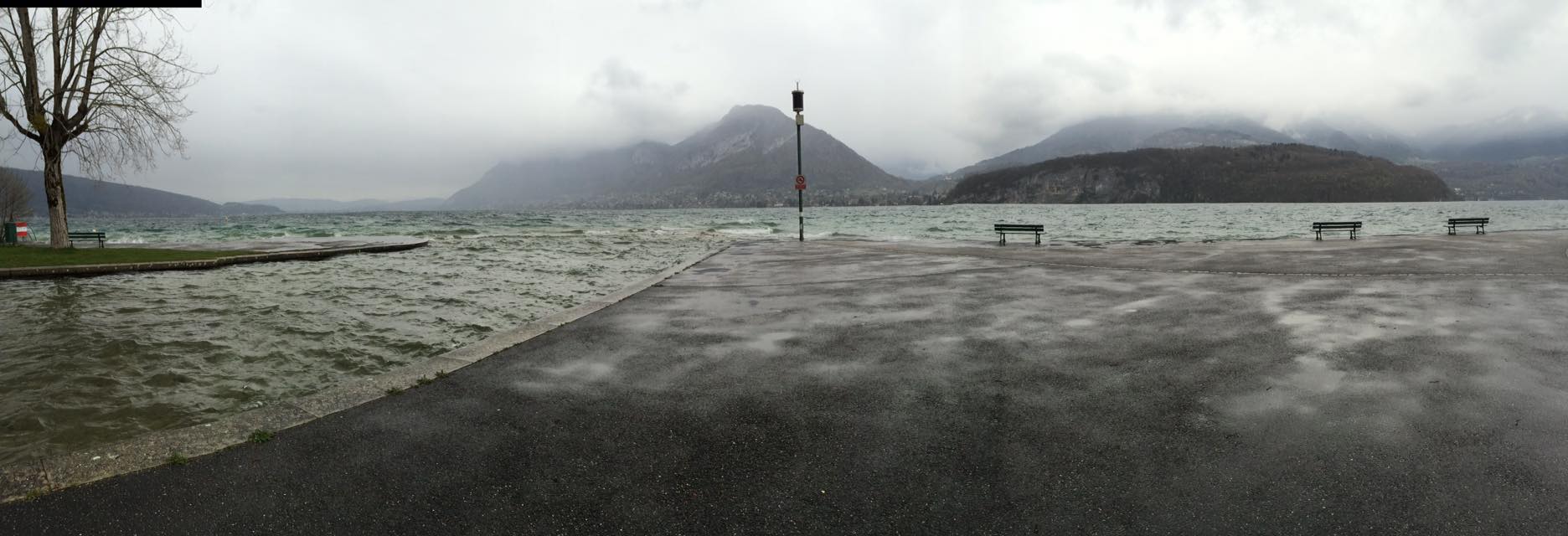
Lake Annecy 8 April 2016

Lake Annecy, “which to me appeared to still be in the Waterloo of its winter.”

Drunkards and Drums

The night was long, and sleep far from possibility. From two until three I was awake, hearing loud and clear a parade of drunken revellers on Rue Claude Pouillet singing loudly and clearly the opening song from The Lion King. While that alone would have been fine to sleep to, they also had drums. For an hour the steady beat of the drum, the ratatataping of some old soldier’s rhythmic march, though more of a dance than a straight march, kept me wide awake, hearing every beat, every word, every misguided note. For fifteen minutes a man, standing perhaps on one of the balconies above the rue, would shout down, “Silencez, s’il vous plâit! / Quiet, please!” Over and over again the poor fellow made his declaration known, “Silencez, s’il vous plâit! Silencez, s’il vous plâit! Silencez s’il vous plâit!”

At some point, though admittedly I do not know when, the drums went quiet, the chorus having moved along to some other quarter of the city. I felt my eyelids begin to gain the weight of sleep once again, and soon all was nought.

The second alarm came sooner than expected. I was quick to answer it, turning it and the other six that were to follow after it. I stood, taking my time regaining my bearings. The room was brighter than I had expected, letting me know immediately that it would be a bright day. I hurriedly got ready to leave, packed the last of my things, and was out the door by 09:25.

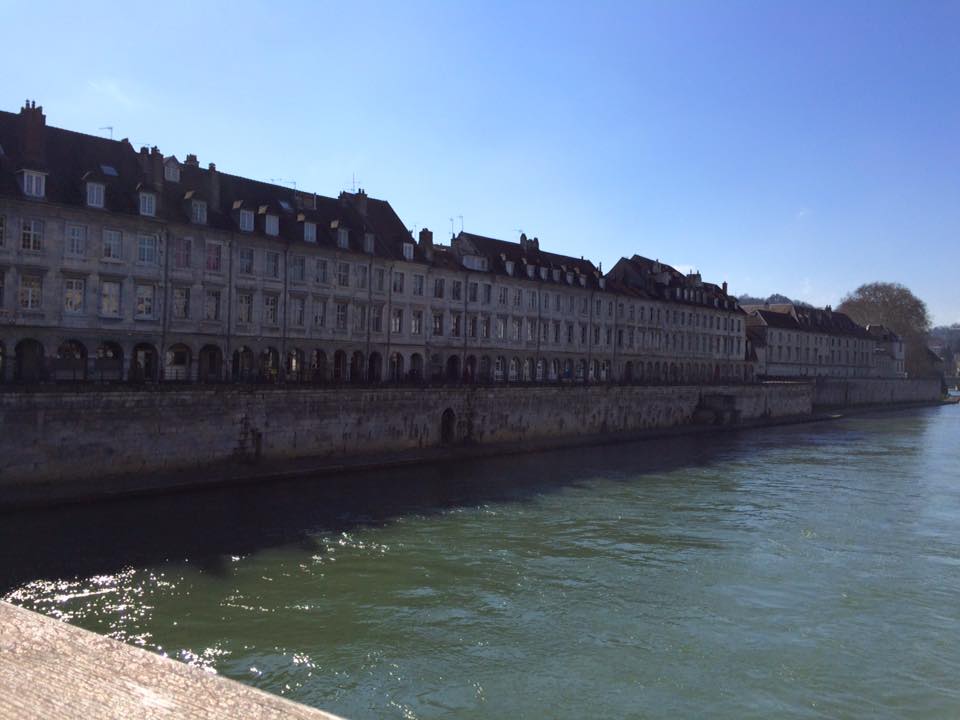
Descending the staircase I left the key in my hotesses’ post box, and walked down onto the street in front of the building, where to my surprise I saw the kind woman herself walking towards me from the west end of Rue Claude Pouillet, where she had parked her car behind les Passages Pasteur. We talked for a few minutes, and bidding our farewells, I turned to walk back towards Pont Battant and across Le Doubs to Gare Viotte, where I would catch the first of five trains on the long journey back to London.

Le Doubs au matin

Le Doubs in the morning

The walk up to Gare Viotte was somewhat of a challenge. I knew that I was running low on cash, so the tram was out of the question. In any case, I knew that I would be sitting on trains, trams, planes, and in the tube for upwards of eight hours, so I figured that it would be better to have these last fifteen minutes in Besançon available for walking.

After about ten minutes I left the main city, walking up along Vauban’s old battlements, the earthwork and masonry defences built to ensure the preservation of French royal control over Besançon and Franche-Comté against any possible threat in the last few generations before the French Revolution. Once over the first series of battlements, I continued on a bridge which went over an old stone moat, now a bypass. On the bridge were two women, each walking their dog, both of which were small, excited, and exuberantly happy to be out in the Sun. As I approached the women parted ways, one heading south towards Besançon, the other north towards Gare Viotte. The joyous dog who went with its mother northwards towards the Gare bounced along, its tail wagging, its ears rebounding with each step. Pure joy has never been so expressed nor seen in my life.

As I entered Gare Viotte, I stopped off at a small café, where I bought a blueberry muffin and a bottle of water for breakfast. Then writing my farewell message to Eve, I went down in the elevator towards the concourse leading to the platforms beyond. My first train, a regional connecting service, departed from Voie (Platform) F, which was two platforms away from the main station building. I quickly ascended onto the platform and boarded my train. I found the seats full, the car packed with commuters and travellers alike. I pushed my suitcase up against one of the glass walls, and took hold of a bar, ensuring that I would not fall from the sudden change in acceleration when we left the station.

We pulled out of Besançon Gare Viotte soon thereafter, at first travelling at a slow pace, passing houses, shops, businesses; leaving a small city all unto its own self, a place where 100,000 people lived, and worked. I looked on as Friday continued in Besançon, while for me it was a uniquely transient day, not really any particular day of the week. Rather this day would remain unique in my mind henceforth to the end.

After about sixteen minutes we arrived at the TGV station on the outskirts of Besançon. I was ready to disembark from the commuter train as soon as we arrived, and was one of the first out onto the platform, knowing that my transfer window between trains was small indeed. Comparing my next train number with the trains listed on the monitor, I soon found that I would be on the TGV service to Paris-Gare de Lyon. The thought occurred to me that I would probably be wasting time today, that I could have just taken the Eurostar from Paris-Gare du Nord rather than flown back from Lyon-Saint-Éxupery. With this in mind, I eagerly awaited the arrival of the TGV, knowing that it would be my first experience on the famed high-speed service.

When the train arrived, I found myself rather confused. My ticket was for a seat in Voiture (Car) 6, so figuring that it would be near the back of the train I had moved to the far end of the platform. To my surprise, however, I soon found that the back of the train was made up of the First Class cars, with Second Class further forward. I quickly moved up, and at first entering Car 5, I soon found that there would not be an obvious way to walk between the cars, as there is on the British and American trains. So, I quickly exited the train again, and running back towards First Class, I asked one of the conducters “Où est la Voiture 6? / Where is Car 6?” The conductor pointed back towards Second Class, offering a brief “Là bas / Over there.”

I ran back towards Second Class and found Car 6 ahead of Car 5 in the order. I boarded, and was greeted by the highly ordered nature of the SNCF, the French railways. The lower numbered seats were all on the bottom level, while the higher numbered seats were up on the upper deck. My own seat, No. 26, was on the bottom, and so I was quick to walk through the open glass doors to where my seat was to be found. Once there I soon realised that I should have disposed of my suitcase at the entrance to the cabin, and returned to take care of the baggage. Returning to the seat, I took my place at the window, and prepared myself for a 40 minute journey through Franche-Comté, what in the Middle Ages was a part of the Duchy of Burgundy.

The man who sat next to me was older, with grey hair and a grey beard. We did not talk, but were able to have plenty of room to each of us on our short journey to Dijon. I found myself inspired by the countryside, by the verdant fields, the distant Alpine foothills, by quiet villages and busy autoroutes.

Soon I began to plan out my disembarking from the train. I knew that I wanted to be ready to leave as soon as we came to a stop at Gare de Dijon. I had planned to begin collecting my things when we were five minutes out of the station. As the first half-hour began to pass, the gentleman next to me seemed to have the same idea as me, and both of us stood and passed back through the cabin towards the luggage racks, where we collected our suitcases. Then waiting in the entry corridor in front of the lavatories, we watched as our train rolled smoothly into Dijon.

I was amazed at how the world seemed to move, yet it appeared as though we were standing still. The speed at which our train moved made it seem as though the only immovable objects on the ground were the twin rails, upon which our TGV glided into Dijon, its wheels making hardly an audible sound as we slowed and came to a stop at the platform closest to the exit. I disembarked, and parting ways with the grey-haired man, I quickly descended the ramp into the main concourse of the station.

My next train was also a TGV, this time going to Montpellier. I would be leaving it at the first major stop, Lyon Gare de Part-Dieu. My train was not due to arrive for another thirty minutes, so I figured that I could stand on the platform and take in some of the air for a while. As I walked along the concourse, going towards my next platform, I saw a poster for the historic site at Alesia, a place known well to me from so many renditions of Caesar’s life and his conquest of Gaul. Alesia was the final Gallic stronghold to fall to Caesar’s legions in 52 BCE. It’s defender, a Gallic king named Vercingetorix, has long since become a symbol not only for French independence, but also for all of the ancient Celtic peoples of Western Europe.

My train arrived early, and I was quick to find Voiture 16, where I was due to take Seat 22, another window seat. As the car’s door opened, I waited while those passengers disembarking in Dijon did so, before I took my turn entering the car. I soon found my seat still occupied, by a young woman, perhaps only a year or two different in age from me. She was quite occupied, painting her nails with a deep red hue. The sharp smell of the nail polish penetrated my senses, and made for a rather unexpected welcome aboard this second TGV.

I had decided that it would be best if I kept my being a foreigner less obvious, preferring to not work on anything in English while onboard. Rather, I watched another episode of Sir David Attenborough’s Life of Mammals series for the BBC. She certainly noticed, and I could just barely see her occasional glances towards my iPad as a series of herbivores graced the screen, from the smallest Pikas to the largest Giraffes and Elephants.

This was a far longer journey, about an hour-and-a-half in length, and I planned to only have my iPad out for the first hour to hour-and-fifteen minutes of the trip. I knew from the start that I wanted to be ready to go at least five minutes before the train reached Lyon, knowing all to well that the next two stages of my journey would be the most complicated and challenging. So, following the herbivore episode, I listened to a brief segment of Gluck’s Orphée et Eurydice, then returned my iPad to its place in my suitcase.

It was then that I first caught sight of the Rhône, that grandest of rivers in the south of France, over which Hannibal had marched his armies over two millennia ago on their way to Italy. All of the rivers which I had thus far beheld on this trip, Le Doubs, and the Saône flow into the Rhône. The Rhône is to this half of France what the Mississippi is to the Midwestern and Southern United States.

We followed the course of the Rhône south, at last crossing it and coming into our next port of call, Lyon Gare de Part-Dieu. I watched from the entryway as we entered a busy corner of the station. Next to me were three women, one older, respectable, with a kind face, another busy, ready to go to work, and a third with the appearance of a punk rocker, her headphones covering her ears and hair, blasting heavy metal out for all to hear. She wore a bull-ring through the central cartilage of her nose.

Within five minutes we were stopped, and I disembarked the last of my three SNCF trains for the day. I stood on the platform for the longest of moments, unsure as to where the exit was. The flow of the foot traffic was confused, erratic, and unable to accurately gauge. Eventually I decided to walk to the right, and soon found myself on a long ramp going down into the main concourse of the station. Along the ramp were a number of posters for the new The Jungle Book film, or Le Livre du Jungle, which includes the great Chicagolander Bill Murray in its cast as Baloo the Bear.

Gare de Lyon Part-Dieu

Gare de Lyon Part-Dieu

There I found the busiest railway station that I had thus far seen on my travels in Europe. There seemed to be no sense in the people, who walked in many disorderly fashions around the very ordered layout of the station. I made it my purpose to find the sign for “L’Éxpress de l’Aéroport / Airport Express,” which I knew would lead me to my last bit of ground transportation in France, the Rhône Express. I soon found what I was looking for, and followed the signs out of the front doors of the station onto the pavement beyond. There a number of newspaper hawkers attempted to sell their goods to me, though I simply continued on my course, not stopping to respond, nor giving them any attention. They seemed confounded by my negligence of them, but I could not understand what they said.

I crossed a series of tram tracks, and walked to the second platform from the entrance to Gare de Part-Dieu. There a tram, painted in deep red with the words Rhône Express painted in white atop the red, sat waiting its 13:15 departure for Aéroport de Saint-Exupéry. While I already had a ticket for the tram, I could not find a way to collect it. So, I quickly bought a second ticket and boarded the tram.

At 13:15 on the dot we departed Gare de Part-Dieu, heading out of Lyon towards the airport. In many respects I found Lyon to be quite similar to what Kansas City will be like, or rather what I imagine Kansas City might be like, in fifty years time. It is a city of similar size, in a similar place in its country. Once we in Kansas City are able to build up our streetcar system, rebuild our airport, and return our city to its status as a great American destination, it certainly could be known as the Lyon of the Midwest. As we pulled into the Gare de l’Aéroport, I knew all to well that I wanted to return to Lyon and give it a proper visit.

The airport seemed nicer, more inviting on Friday than it had on Wednesday, though the lack of freezing rain may be able to account for this. I walked out of the station and up into Terminal 1, where I grabbed a quick lunch, a couple slices of pizza, as unfortunately I wasn’t able to find any Friday-appropriate food on my then budget. I quickly ate, and now with a full stomach made my way along the long walk to Terminal 3, where I would board my flight back to London.

At Luton I disembarked, and bade farewell to the French couple who I had shared Row 9 with on our EasyJet flight from Lyon. I made a speedy route into the terminal building and up to the customs checkpoints. Being enrolled in the Trusted Traveller programme, I was able to go through the E-Passport Gates, which are normally reserved for European, Swiss, and European Economic Area Citizens. The process was smooth, swift and easy to comprehend, and soon I was heading to the bus stand, awaiting the coach that would take my fellow passengers and I to Luton Airport Parkway railway station some ten minutes drive away.

We arrived at Luton Airport Parkway much quicker than I had expected, unloaded in an equally speedy manner, and soon I was going through the ticket barriers, a concept which I have found is primarily British, as neither the French nor Germans utilise them in their railway stations. As I made my long way over the station to Platform 1, I ran into an American woman who had been on my flight from Lyon. We chatted for a few minutes before our train arrived, and soon I was hurtling south on a brand new Thameslink train to St Pancras Station.

This journey now nearing its end, I would take one flight back to England, then another train down to St Pancras. From there it would be back into the Underground to my neighbourhood. I had deeply enjoyed my time in Besançon, and had truly fallen for Franche-Comté. I was cheered in my departure by the fact that in less than a month I would be returning to this alpine region in the east of France. In one month I would find myself speaking French once more. In one month I would see my parents again.

Besançon from the Citadelle

Besançon

A Day in Besançon

Morning came much quicker than I had expected. No sooner had I closed my eyes than I found their lids parting once more as the sunlight peaked into my room through the curtained windowed-doors, which led onto the balcony. I turned over and looked at my watch: 07:18. Returning to my position I thought about getting up, but my body declared otherwise and my eyelids closed once more for what seemed only a moment. When I checked the time again I found that it was 08:45. Still though the motivation for waking was not there. With a breath the time had jumped forward to 10:30 and I found myself standing, walking over to the lavatory to ready for the day.

Dressing quickly, wanting to be out the door by 11:00, I met that goal and made my way down the old worn great wooden stairway. The building showed its age, its having been repurposed on a number of occasions. It’s sixteenth century walls serving countless roles over its long life. When this building was first built, Besançon was controlled by Charles V, Holy Roman Emperor and King of Spain, the Habsburg grandson of Charles the Bold, last Duke of Burgundy. This region had for many centuries since the Treaty of Verdun in 843 been Burgundian, not French.

Rue Charles Pouillet

Rue Claude Pouillet

I had three places on my list to see on Thursday: the birthplace of Victor Hugo, the Musée du Temps, and the Citadelle. As I walked down Rue Claude Pouillet, I noticed a large church across Pont Battant. Walking over the bridge, I chose to try and enter the church, wanting to see what a traditional French parish church looked like. I walked up to the church of Sainte-Madeline, and found the side door on the right unlocked and open. Upon entering I was greeted by a stiff coldness which went right at my bones, as if trying to rattle the skeleton within. The church was grand, baroque in architecture, made of the finest stone. The new Vatican II altar echoed the revival of France after the horrors of the Second World War with the flames of the phoenix running up the side of the dark stone monolith.

As I walked towards the Joseph Altar, I heard someone moving to my right in the closest side chapel to the high altar. There I found a woman laying flowers in vases beneath an altar for those who had died in the War.. The altar beneath which the flowers stood was dedicated to a pair of medieval bishops, perhaps even saints.

L'Église de la Madeline

L’Église de la Madeleine

Leaving the church, I could feel the stillness of the sanctified space, as if I were being watched by generations of the city’s dead. I made my way out of the church and back onto the street, Rue de la Madeleine, which led back onto the Pont Battant and south to the Grande Rue.

Besançon is a lucky city. It survived the rage and destruction of the Second World War relatively unscathed by the bombs. The city’s streets echoed with centuries of history, for in all honesty these same streets have remained practically as they had been when they were first built centuries ago. Only the newer installations, the Galeries Lafayette and Passages Pasteur chief among them showed those tell-tale signs of twentieth century construction.

I made my way south along the Grande Rue, the main street in Besançon. Luckily all three of my destinations for the day were located along this rue, thus ensuring that there would be little chance of my getting lost in a foreign city in a foreign country. Though my French existed, it was not nearly as good as Eve’s, who spoke it with such fluency that at times I wondered if she had ever spoken another language.

Besançon was still quiet, even at its busiest hours. There were hardly any cars, vans, or trucks moving about on the streets. The Gendarme made their rounds on bicycles, as locals and tourists alike wandered about the winding streets and lanes of this old city. The Grande Rue certainly was the widest of the streets, though it still would be counted as a small one-way alley by Midwestern standards. Every few blocks the street to lead into a grand square, such as Place du 8 Septembre, where I was astonished to find an Irish Pub called Madigan’s. Not only did my amusement arise from the fact that there was an Irish pub in this furthest corner of France, but that it would share the surname of my undergraduate French professor at Rockhurst. At last I came upon the Musée du Temps, at about noon. Entering under the grand archway which led to an inner courtyard, I found the glass doors to the museum off to the left of the court. I entered and strode up to the ticket counter, behind which stood a tall woman with lighter brunette hair. “Je voudrais visiter le musée / I would like to visit the museum,” I said.

She replied that the museum would be closing in ten minutes for lunch and that I should return around “quatorze heures,” two ‘o clock. I said “Merci,” and turned, walking back out into the courtyard and to the Grande Rue beyond. I decided to see if I could see both Hugo’s birthplace and the Citadelle before 14:00, hoping then that I would be able to return to the Musée du Temps before meeting Eve at a café at teatime.

I made my way further along the Grande Rue, passing by shops of so many varieties. I suddenly found myself standing in front of an old building whose face bore a bronze memorial honouring it as “la maison natale de Victor Hugo / the birthplace of Victor Hugo.” I entered, and was greeted by the sight of a pile of backpacks on the floor next to the reception desk alerting me to the presence of a school group in the museum. Approaching the front desk, I paid the €2.50, received an English audio guide, and began the tour. The building had been entirely renovated in the last fifty years, it’s distinctly modern feel slightly off-putting, at least considering that I had expected to see an old home whose features had not changed since that cold 26 February in 1802 when the great writer was born.

La Maison Natale de Victor Hugo

La maison natale de Victor Hugo / The Birthplace of Victor Hugo

Instead of being a museum which focused entirely upon his life, the Maison Natale gave more focus to those pursuits which Hugo held close to his heart. It had an entire gallery devoted to freedom of speech and of the press, and to those who worked to aid the poor throughout the Francophonie. All of this was neatly tied into the story of Hugo’s life and work. His colourful characters connected to their modern counterparts without so much as a stitch to be seen. The bust of Napoléon III placed just so that it would forever stand in front of a cartoon from a 1982 edition of Le Monde discussing the dangers of press censorship.

I proceeded through this first gallery, listening to as much as I wanted to on the audio guide, which gave me a sense of direction, an understanding of the purpose of the museum. I proceeded into the next room, which was a reconstruction of what the house might have looked like at the turn of the nineteenth century. There was an antique rocking horse in the corner, as if left there by a young Victor, the wooden animal still awaiting its master’s return. Across the room were a series of portraits of Hugo’s parents, his father the Napoleonic general, his mother the woman of culture, his godfather, a man hounded by Napoléon’s regime. From there I walked into the penultimate room, a narrow affair which was dominated by a semi translucent sheet of glass, upon which was printed a famous image of Hugo with his family and friends in his salon in Paris around the 1860s. Behind the glass stood three nineteenth century chairs, as if to represent ones which the occupants of the picture might have themselves sat upon.

On the opposite wall hung a world map, likewise printed onto glass. On it were the countries which Hugo had either visited himself, or had extensive contact with. One such was the United States, whose own struggles with slavery led to Hugo offering his full outspoken support for the Abolitionist cause some ten years prior to the outbreak of my country’s horrible Civil War. On a side note, during the American Civil War, the favourite book of many soldiers on both sides was Hugo’s masterpiece Les Misérables, which was first published in Brussels, as Hugo was in exile from his homeland at that point.

The final room was more of a converted closet. It seemed bigger than it actually was, in part because the two end walls were entirely glass windows, one looking out onto the Grande Rue, the other onto the stairs which led up from the reception room to the exhibition. On the wall opposite the door hung a series of two bookshelves, upon which live a collection of Hugo’s works, in many different languages. These books were donated to the museum by foreign students and teachers, attending classes at one of the many local universities and institutes. There I saw at least ten copies of Les Misérables in nearly as many languages.

I left the Maison Natale forthwith, and continued on my walk down the Grand Rue, or rather up it as the street began to climb up the face of Mont Saint-Étienne, upon which stands the Cathedral of Saint-Jean, itself once below the older Cathedral of Saint-Étienne, which was destroyed during the French conquest of this region, Franche-Comté under Louis XIV in the late seventeenth century. As I climbed higher, I found myself suffering very much from the rise in altitude. Being very much a lowlander, having lived my entire life below 1000 feet, I have found altitude to always be a challenge. As I passed the Cathedral, I made my way further up the slope, first walking along the street, then up a series of stairways which were carved into the rock of the hillside. I stopped at the top of the first stairway to look down to the east towards le Doubs as it began its curve around the Boucle of the city. Having regained my breath, I chose to continue my long march up the side of Mont Saint-Étienne to the gates of the Citadelle.

It took nearly fifteen minutes, after which I was horribly out of breath, but at long last, sweaty, exhausted, but accomplished I made it to the first gatehouse. A sign was posted in the window of a ticket booth informing visitors that the ticket office had moved 100 metres further up the hill in the second gatehouse. So I began to climb again, passing by a large fenced off area, which was home to a flock of Darwin’s Rhea, a rare large South American flightless bird that is midway between an Emu and an Ostrich. Continuing up the hill, I made it at long last to the second gatehouse, where the ticket office and gift shop stood. There I paid the €8.50 for my ticket and, now being rather hungry, I chose to go across the way to the gift shop to see if there was anything small that I could buy for a snack. I soon realised my misfortune, for finding nothing there, I also had managed to end up on the wrong side of the gate itself, and was now outside of the ticketed part of the Citadelle. I quickly returned into the gift shop, and showing my ticket to the man behind the desk, I said “Je visitais la boutique” to his chuckles.

The Citadelle is a magnificent piece of seventeenth century military engineering. It’s walls rise up out of the hillside to not only defend the city below from attack, but also to impress upon the Comtois people themselves that they were no longer franche or free of French royal authority. I walked through another gate and found myself in what was the central pair of courtyards in the fortress. To the right I found a restaurant, which became my first port of call. I enjoyed a delicious selection of local sausages for lunch, and soon was back on my way to explore more of Vauban’s masterpiece. I decided to climb the stairs that led up to the walls, along what was called le chemin de reine (the Queen’s walk). At the top of the wall I was greeted by a large French tricolour flag, waving proudly as ever in the Alpine breeze. Across the Citadelle on the opposite parapet waved the grand blue flag of the European Union, its circle of yellow stars visible from a significant distance.

I walked along the wall as far as I could go, getting a bird’s eye view of the entire Citadelle. On the other side of the wall I had a spectacular vantage of le Doubs as it flowed past the Boucle of Besançon and around a great hill which stood directly opposite Mont Saint-Étienne and the Citadelle. When designing the fortifications, Vauban chose to raise the elevation of Mont Saint-Étienne so that it would be higher than the surrounding hills, thus saving it from any chance of aerial bombardment, at least before the dawn of modern military aviation in the First World War.

This slideshow requires JavaScript.

The Citadelle gave off the impression of being something old, yet surprisingly fresh and new. Despite being constructed some three hundred years ago, it was under renovation, as a new Biosphere was being built at the far end of the Zoo at the back of the complex. The fortifications now seemed less a seventeenth century construction and more a part of the hillside. It was as if they had never been built, but rather had been carved out of the rock. Such a geological marvel as this could not go unnoticed, yet from my observations from atop the rampart, it seemed as though those who walked in its shadow did not notice the Citadelle above. In fact, as I later discovered, the Citadelle was not the only human engineering feat undertaken on Mont Saint-Étienne. In the Twentieth Century a number of road tunnels were dug into the rock, connecting the eastern and western approaches to the Boucle of Besançon. Alongside these, a railway line ran parallel to the street in the shadow of the Citadelle far below it’s rocky expanse.

After about twenty minutes I descended from the rampart and made my way towards the Musée Comtois, which is dedicated to the history of the Franche-Comté region. A uniquely alpine area, Franche-Comté has seen influences not only from France but also from its neighbours in Germany and Switzerland. I quickly began to hear the differences in the Franche-Comté accent, such as their preference for a revoir, pronounced “á voix” rather than the au revoir, pronounced “eau voix” as I had learnt it. I actually quite like the Franche-Comté accent, as it feels quite natural and in some ways pleasant to the ear.

The Musée Comtois is home to many artefacts from throughout the region, its grandeur celebrating the traditions of the people themselves, less so the customs of the rich. One particular display showed the sort of pottery which one would find on a dinner table in Franche-Comté from the neolithic age to the present.

I made a quick procession through the Musée Comtois, leaving within about 15 minutes, as I knew the main attraction in the Citadelle would take around an hour to see. On the way there I stopped in at the exhibition detailing Louis XIV’s conquest of Franche-Comté and the construction of the Citadelle by Vauban in the seventeenth and eighteenth centuries. Oddly the museum staff had chosen Handel’s Water Music as the soundtrack for the exhibit, and while Handel certainly is of the right generation, I felt that someone like Lully or Charpentier would be more fitting for an exhibit about le Roi Soleil.

I could not help but notice the elegance of the clothes of the seventeenth century gentlefolk, whose images graced the walls of the exhibition. The fine lines of their coats, the stockinged and knee-breeched legs, the elegant hats with feathers gracefully announcing themselves like those of some grand Versailles peacock. I admired and dreamed of how my own time and place in history would look if we dressed as well as this.

Leaving the Vauban exhibition, I found myself confronted with what I had hoped I would not see. The largest exhibition in the Citadelle, the Musée de la Résistance et la Déportation was closed for renovations. So, I decided to see the Zoo, which was housed in the back of the Citadelle. Within minutes I was confronted by a pride of Asian Lions, all of whom turned to look at me, with one even standing as I entered the Zoo. I was certainly frightened, knowing that these lions could well be lethal if given the chance, but I had a feeling of eager daring do which led me down a dark, covered path along the lion enclosure.

The lions displayed an air of nobility, of grace. They are the ultimate cats, the fullness of feline dignity and grandeur. While I was concerned by their approach, I also felt a sense of respect for their honour, their dignity. They were beautiful creatures, their coats looking as healthy as possible, their slender muscular bodies gracefully curving and straightening with each motion of the body. Beauty knows no beast lest it have an understanding of the lion, for with the lion beauty finds its most natural form.

Les lions asiens

Asian Lions

I passed a sleeping mongoose, and then came upon a large enclosure, my path protected by thick plexiglass and metal walls. Every few feet there was a monitor hanging on the top of the wall showing what appeared to be an empty room, where presumably some large animal slept.

Then I saw it, up and moving. It’s coat sent signals of warning, of danger, of the fact that it was willing to be a threat, and I was quiet, careful not to make any sudden movements. There, not more than fifteen feet in front of me stood a full sized adult Siberian tiger. I watched as it walked to and fro in its enclosure, and hoped beyond hope that it would not look at me, for I truly was afraid of it. I felt like a spy who had suddenly walked into some secret room as I stood there, motionless, my camera recording the tiger’s movements back and forth around a large boulder. It turned my way, but did not appear to see me as the lions had. I held my breath, looked at my watch and seeing that it was fifteen minutes until two, I decided to make my retreat.

Le tigre siberien

The Siberian Tiger

Quietly, steadily, without a sound I walked out of the tiger’s viewing area, and past the lions who all now were laying down on the ground, sleeping as any cat would do in the afternoon. I quickened my pace as I left the Zoo, and walked out of the Citadelle, stoping to buy a commemorative coin, honouring Vauban’s work on the complex. Within five minutes I was out of the front gate and making my way down the front of Mont Saint-Étienne, past the Cathedral and along the Grande Rue.

In the shadow of the Cathedral I came upon an old Roman column, then I looked up at the arch which the column supported. Curious, I crossed the street and found a plaque explaining the history of the arch. It was known as the Porte Noire, the Black Gate, by the local Bisontins, yet for me this arch was an amazing moment, the first time I had come face-to-face with a monument dedicated to one of my favourite Romans, the great stoic philosopher and Emperor Marcus Aurelius.

I later learnt that Besançon is in fact one of the oldest cities north of the Alps. Known in the ancient world as Vesontio, it was first recorded in 58 BCE in Book I of Caesar’s Commentarii de Bello Gallico. In the Middle Ages, the city’s name shifted from Vesontio to Besontino, then to Bisontion, and finally to Besançon. Linguistically this makes perfect sense. Of all the consonants, the letters V and B are closely connected. Consider the fact that in the Cyrillic alphabet the letter В represents the English and French “V”. Likewise, as can be seen in all of the Romance languages, there is often a softening of the suffix “-tion” to a sound closer to the French “-çon”. Thus Vesontio was able to fluidly develop into Besançon.

La Porte Noire

La Porte Noire – built in honour of Marcus Aurelius.

I walked along the Grande Rue, past Hugo’s house, to the Musée du Temps, which was now, at 14:10, reopened. Once inside I found the reception hall filled with a camera crew, presumably there to film something for the local tourist board. I walked past them, bought my ticket, and made my way into the museum itself. On the ground floor were two rooms, the first home to a collection of paintings by local artists, the second home to an old clockwork and a great model of Besançon at the turn of the eighteenth century. I looked closely and saw Rue Claude Pouillet, and the building within which my apartment today exists. With a smile I walked back to the main staircase, and proceeded up into the main museum.

The Musée du Temps tells the story of how the Bisontins invented the most accurate clocks in Europe. In fact, as Eve had told me at dinner the night before, many modern Bisontins commute to work each day to Switzerland, which is not far at all to the southeast, there lending their talents to the famed Swiss watchmakers. While the museum was interesting, I was more focused upon my own pressing need to keep to schedule. I walked amongst a large collection of clocks and watches, climbed the stairs to see the pendulum and great views of the city from the tower, and saw some fantastic tapestries depicting the life and accomplishments of Charles V, Holy Roman Emperor and King of Spain, who was once the imperial master of Besançon, then a Free City of the Holy Roman Empire.

With time running short, I made my way back towards the centre of Besançon along the Grand Rue, passing over the Pont Battant alongside the tram, and arriving at last at Kaffe Öst, which sits along the Quai facing le Doubs on the north bank of the river. There Eve was waiting for me, having just finished her last class and exam as a student in the city. We talked for a while about the usual things, before another American woman turned to address us.

She was wearing a University of Virginia sweater, and her accent immediately reminded both Eve and I of home. She introduced herself as Hannah, a teaching assistant at one of the local lycée, or high schools. The three of us began to talk about jobs, teaching, and our own academic careers. Like me, Hannah had majored in Religious Studies as an undergraduate, though she had hardly focused on Catholicism. Hannah and I were in a similar situation, both of us waiting to hear back from prospective employers back home. She hoped to teach at one of a number of different elementary schools both on the east coast and further inland.

After about thirty minutes, Eve had to leave, while Hannah and I stayed put, continuing our conversation about our respective Religious Studies programmes. After ten minutes, she also had to go, telling me that she was going to the Gare to meet a friend. I quickly replied that I too had to go up there to collect my Carte Jeune, and tickets for Friday’s journey back to Lyon. Without further ado, we collected our things, paid our bills to the kind proprietor, and made our way around the corner and up the street, stopping briefly in the Church of the Madeline, which I had gone into that morning, yet ironically Hannah had yet to step foot in. Following that stop, we walked north, up a hill to Gare Viotte, Besançon’s central station. In front of the station stands a beautiful, solemn monument to those who died fighting in the World Wars. The circle is lined by iron walls, with the names of the dead carved into the iron, the collections of names coming together into the figures of the soldiers. At the centre of the circle stands a large stone sculpture, of similar nature to the Martin Luther King, Jr Monument in Washington, dedicated to the Resistance.

We passed over a road, which lay in a deep moat, cut into the hillside by Vauban’s workers as a defensive fortification for the city, and entered the gare. There Hannah and I parted ways, after only having met not even an hour before. She went towards the signboards to see when her friend’s train would be arriving. I walked to the left, towards the ticket office. Eve had recommended that I speak directly with a ticket clerk, asking for one who spoke English, as I would not be able to collect the Carte Jeune from the machines in the main hall. After 30 minutes of trying to confirm my identity, the ticket clerk was at last able to print out my tickets and carte jeune, giving both to me. A box remained empty on the Carte Jeune, which was printed on the same card stock as the train tickets themselves. The box was meant to be filled with an official photo of myself, and I set about immediately finding ways to print such a photo.

I walked across the station to an empty photo booth, and tried my best to figure out how to work it. Unable to succeed in this endeavour, I decided to search the city for a photo shop where I could get such a photo taken and printed for my Carte Jeune. However, Eve assured me that as long as I had some form of photo ID on me, I would be fine.

With that I returned to the apartment, and quickly found myself drifting off to sleep. I awoke about two hours later, close to 20:00, and decided that if I was going to get dinner I had better do so soon.

I was up and out of the door by 21:00, figuring that I was running late for dinner, even by French standards. The streets of Besançon were changed, quite different from before during the daytime hours. The people seemed slightly different as well. What few tourists had been walking about during the day were now nowhere to be seen. The white limestone walls of the buildings now seemed less friendly and more threatening than before. The streets were populated by long faces, by the unnatural lines and figures of people preoccupied by their nighttime reveilles. My eyes too were unsure of what they were seeing, though perhaps that may be more due to my poor eyesight, combined with my mildly intense hunger, which cut at my stomach like a dull tooth wanting to bite into the flesh yet lacking the energy to do so.

I walked back through Place de la Révolution and down a street, heading south, always knowing where I was. At the next cross-street I turned west, walking back to the Grande Rue, figuring that I would be able to find a restaurant that seemed fairly nice, and that I could be sure would serve French cuisine, rather than that of any other country, along that street and around the squares on its route.

At Place du 8 Septembre, I had a look around. I had seen a number of restaurants around the square during my previous walks along the Grande Rue, so I figured that I would be bound to find somewhere to eat. I walked in the direction of Madigan’s Pub, Besançon’s Irish Pub, and turned right at the next corner. There I found a fairly quiet, clean, nice looking restaurant called Le Royal. I had a look at the menu and decided that it would suit my preferences well.

Le Royal was a sleepy sort of restaurant. It’s large wooden bar covered most of the left wall of the room, with a series of booths and tables on the right hand side. I was greeted by one of the two men who were working there that evening, and was led to a table near the back end of the bar. On the back wall I could see the Liverpool v. Manchester United match which was happening back in England. I set my coat down on the chair, and took a seat across from it on the booth. The waiter went back to the bar, and retrieved a menu for my perusing. After about five minutes I was ready, and ordered the chicken escalope in a forestiers sauce with frites on the side and a glass of water to drink.

Having at this point been in France for just over a day, I had come to the honest conclusion that, when properly prepared, it’s hard to not enjoy the local cuisine. In the case of my dinner, well it was sublime. The chicken was perfectly prepared, while the forestiers sauce, as I soon discovered contained mushrooms, which I have in the past avoided out of concern for my health. However it all generally tasted pretty good! Likewise the frites were fantastic, perfect in my opinion. I ate at my usual pace, and was done well before the gentleman sitting behind me, who had arrived just before I had. I payed the bill and was on my way back through the nocturnal streets of Besançon.

L'Escalope du Poulet dans la sauce forestiers avec les frites

Escalope du Poulet dans la sauce forestiers avec des frites.

Journeying through Fog

The heavy grey clouds besieged the earth with a feeling of antique passion and modern chemicals combined. As I sailed from this grey blanket, soaring above the French countryside, I had my first glimpse of an old land. This country had been home to the Ancient Gauls, distant relations of my own ancient Gaelic ancestors. Caesar had once marched his legions through this region, Rhône-Alps, while further south along the Rhône some two hundred years before Caesar, Hannibal the great Carthaginian general had crossed the Rhône with his massive army, war elephants and all, on their epic march across the Alps to Italy.

We landed suddenly, as though Aéroport de Saint-Exupéry were hidden in some obscure pocket of the countryside. It seemed as though it were an island of the modern world amidst the ancient green Gallic pastures. Sitting on the aisle, I was one of the first to stand, one of the first to collect my luggage from above, one of the first to disembark down the stairs and out onto the tarmac. As I stood on the top of the stairs, I beheld the line of my fellow passengers proceeding into the terminal. It looked as though we were passengers on some great Interwar flight, struggling to keep the cold, the wind, and the rain out of our skins, struggling to remain warm.

Saint-Exupéry was under heavy construction when I arrived. The airport is certainly a mix of mid-Twentieth Century architecture, presumably built for the Olympic Games, though it feels far more like an ’80s, ’90s, or 2000s edifice in many respects. After waiting about five minutes at Customs, my passport was stamped, and I was on my way along the fifteen minute walk down the winding corridors that led out of customs and to the Arrivals Hall. As my ride had yet to arrive, I proceeded upstairs into the main terminal for lunch.

There I began to use my French, which had been cultivated and prepared for this very moment for four years. Approaching the counter of a café in a food court I took a breath. “Bonjour, je voudrais le Parisien.”

“Parisien, ok,” came the matter of fact reply. “€4.20.”

I paid with a €5 and proceeded to an empty table where I was greeted by the splendidity that is the world of French sandwiches. A Parisien is a ham and butter on a baguette, something which I adored from that first introductory moment. Having finished I went exploring, walking down the terminal towards the entrance for the Rhône Express, the tram which goes into Lyon, terminating at Gare de Part-Dieu. I was supposed to be taking that tram to Part-Dieu, then boarding a TER train for Besançon Gare de Viotte, but all came to nought the evening previously with an email.

Having spent an hour wandering around my little corner of the old City of London and the big Sainsbury’s in Whitechapel, I had just returned to my semi-underground flat with a large steel funnel for siphoning off shampoo into the 70 ml bottle that I had bought for my carry-on bag. As I was doing the siphoning, an alert came through on my phone from SNCF about my journey from Lyon Part-Dieu to Besançon Viotte. I was surprised to subsequently discover that my train had been annuler, cancelled, because of a grève nationale, national strike by the railway workers.

Having finished my siphoning, I returned to my desk and took a closer look at the problem. Sure enough, I had a train ticket for Wednesday evening, but the corresponding train had been cancelled. Looking at later trains, I found that none would get me to Besançon before 22:30 or 23:00, or even before 06:20 the following day. So, I checked the bus schedule. Again, nothing. Declaring that I would not find myself spending a night in Lyon, I decided to go a bit far from my comfort zone and see what else was possible, even mentally considering hiring a private helicopter to take me to Besançon. Instead I found a website called BlaBlaCar.

Despite the rather odd, seemingly haphazard name, I was able to book a ride from Lyon to Besançon for a mere €12.30, which meant that I earned back a full Euro from the refunded train ticket! So, I would be riding in the car of a complete stranger for the entire 2.5 hours from Central Lyon to Besançon. But, things became ever more complex. Our negotiations led me to my sitting in Aéroport de Saint-Exupéry for about an hour, as my driver, Émilie, had agreed to pick me up there rather than having me come into Lyon to meet her.

Aéroports de Lyon

Lyon-Aéroport de Saint-Exupéry

I waited for a while on the broadwalk outside the entrance to Terminal 3, though as the freezing rain got heavier, I decided it would be rather intelligent if I waited indoors, seeing as I was still getting over a cold that had befallen my body two weeks prior. At about 17:15 Émilie arrived in her Renault Clio, and I found myself climbing in the back seat of a suitably small French car. Along with me were two other passengers, a woman in front whose name I never caught, and another woman in back with me named Éloise.

We swiftly proceeded out of the airport and onto the autoroute. Once on course, Émilie chatted with me briefly, asking why I was in France, how long I would stay, what I was doing in London, and finally where my ancestors came from, or at least that’s what I thought she asked. My response was quite matter-of-fact, “Irlande,” I stated quickly, to which she replied in English, “Why are you going to Besançon?”

“O!” I exclaimed, laughing internally, “Je visite une amie qui vient ma ville / I’m visiting a friend who is from the my city.”

“Ok” was the reply, as Émilie turned back around to focus on the road. The drive was pleasant, with a fine soundtrack of French music from the CD player, and those same verdant plains that I witnessed from the air. The soil of France truly has not changed much from its medieval and ancient past. Only the mechanisms by which we humans transverse that soil have changed. We may well have followed an ancient road, yet it was perhaps one of the best paved roads that I have ever been on. Not a bump, not a pothole in sight for over 100 miles.

After about an hour we stopped at a rest area. We still had about an hour and a half to go before we would arrive in Besançon, but we certainly were in the neighbourhood. The rest area was not like any that I have been to in the United States. It outdid even the finest Illinois Tollway Oases. The building was structured like a cabin, its high roof peaking some hundred feet over our heads. Its floors looked as though they were cleaned halfway through the day. The countertops were of the finest material, so much so that I could see my reflection perfectly in them like with the marble countertops at Harrods or Selfridges. While the women went their way, I made a quick stop to pick up a litre bottle of Evian, with the sincere hope of curing my horrible cough, which had been the one blemish, like an off-key horn attempting to play the Vorwärts drängend at the end of the First Movement of Mahler’s First Symphony, the Titan with the rest of the orchestra.

While waiting for the others, I got the chance to marvel at the building with Éloise. She asked how I was enjoying France, which received a “C’est un bel pays / It’s a beautiful country” in response. It seemed as though we were close in age, though I did not inquire too much about her or the others in the car.

After a smoke, Émilie was ready to return to the road. We made our way up into the foothills of the Alps as the Sun began to set. I found myself seeing more and more vehicles from elsewhere in the European Union further to the east, semi-trucks from Austria, private cars from just across the borders in Swabia and Switzerland, as well as trucks and vans from as far away as the Czech Republic. Then came the van from England carrying crates of bottled beer to Continental customers.

Around 20:00 we at last arrived in Besançon. I left Émilie and company at a car park on the eastern side of the Boucle, the old town which is aquatically bounded on three sides by Le Doubs. Walking to the northwest, I made my way along a street, passing by the tram, and into Place de la Révolution, the central square of Besançon. There I heard what sounded like a Midwesterner talking at full speed on the phone in English with a fellow American. Knowing immediately that it was my friend Eve, I decided to see if she would notice as I walked past. She didn’t, so I figured I’d leave it for a rather funny story in 30 minutes when we met for dinner.

I made my way through the square, keeping to the north side, passed Pont Battant, and walked down Rue Claude Pouillet, keeping an eye on the building numbers above the doors. Arriving at No. 25, I made the call to my hostess, who came down and welcomed me into the building. She was a kind woman, very warm hearted and full of good advice. After showing me the room and lavatory, she departed, and I set my things down, taking a quick breath before heading back downstairs to Rue Claude Pouillet and Place de la Révoultion beyond. There was Eve, still on the phone with her American contact. I made my presence known to her with a wave, then walked over to the restaurant where we would be dining, La Coudée, and had a look at the menu on the board outside the windows. As her call began to wind down I returned.

Eve hung up the phone, and a great broad smile appeared on her face. “Hi, Seán! You made it!”

“Eve! It’s so good to see you again! How are you?”

“Good, good,” she said, leading me towards La Coudée. “I’m glad you found the place.”

“Well, my apartment is just down that street there,” I said pointing towards the narrow passage that is Rue Charles Pouillet.

“O wow, so you’re basically in the centre of Besançon then!” She said, excited.

“Absolutely, it’s a great spot!” I replied, smiling as we entered the restaurant.

“Une table pour deux, s’il vous plâit,” Eve said to the hostess as we entered. She led us to a table to the left of the door, a big mirror behind it spanning the entire area of the wall.

Eve took a quick break and returned after five minutes. We talked about home, about baseball, about our classes and the stress of finishing the semester. For Eve, the end was nigh, with a final exam in French Literature the following morning. For me the end was still a month away, though the coursework nearly finished. As we looked over the menu Eve, whose French is far superior to my own, helped me figure out what I was going to order. Being an American who at this point had been on the road for nearly ten hours, I was craving a burger, and so I ordered the Burger de maison, house burger.

As our food was being prepared the conversation turned to family. I answered Eve’s questions about my own family, which she knows, at least in part back in Kansas City. She was highly enthusiastic about the largeness of my extensive Irish Catholic clan, which at this point numbers somewhere around 30 persons. This of course contributed to her expected confusion at the old game of Who’s Who when it came to keeping my kin in order mentally.

The burger was fantastic! A great mix of French and American cooking. The owner, an older soft spoken man of slender build who exuded saintly kindness and generosity came over to our table with a smile. He and Eve were acquainted, and they conversed happily in French as we ate. She introduced me as the son of the couple who she had brought to that restaurant back in September, all of which I remembered from hearing my Mom’s tales of Besançon as they drove back to Anncey after their day trip here last September.

I chose a chocolate cake for dessert, and we continued to discuss life back home. Eve would be leaving France on Sunday. She would have one week back in Kansas City before returning to her studies at Knox College in Galesburg, Illinois, a small railway town which sits along the junction of the BNSF and Union Pacific railroads as they wind their way across the plains towards Chicago to the east. I finished my dessert with speed, as Eve had to be on her way on the tram back to her lodgings. I paid the fair sum of €18 for my sumptuous dinner, and left with the cheery cries of “Bonsoir” exchanged between the owner, Eve, and I.

Eve led me across the square to the Révolution tram station, discussing sites that I could see in Besançon the following day. We agreed to meet for coffee after she finished her French Literature final exam, and parted ways with the customary French bise, the twin kisses on the cheeks. I walked back across the square and down Rue Claude Pouillet, stopping for a moment to detour down a close to what appeared to be a quay along the riverbank. From the quay I watched as the lights of the town twinkled on the current, as Le Doubs continued to flow, as it always does, downstream towards the Saône, into the Rhône and at last near Arles the current escapes into the Mediterranean. The fresh Alpine air filled my lungs with a sense of joy, having left thick, soupy congested London for greener fields, if only for a few days.

I returned to my apartment, called my Mom, and spent the last hour of the evening watching the first episode of Sir David Attenborough’s Life of Mammals on the BBC iPlayer before saying my evening prayers and dousing the lamps. Sleep came quickly, descending upon me like the heavy grey clouds which kept watch over the fields of France that night.

Le Doubs au nuit

“From the quay I watched as the lights of the town twinkled on the current, as Le Doubs continued to flow…”