Category Archives: Wednesday Blog

How Fox’s Reaction to the Bill O’Reilly Scandals are Systematic of What is Wrong in Our Society

In American society, beyond all the kind words and gentile thoughts, there is one thing that is king: the Almighty Dollar. One is not important enough to be considered at the top of the game unless one is rich. As a result, when a scandal or issue comes up, while hypocrites on all sides will try to degrade their opponent on grounds of morality or sensibility, all that really will matter in the end is how much the culprit in the case can bring in as revenue.

Just minutes ago the news broke that after a series of sexual harrasment allegations, Rupert Murdoch’s American-based media arm 21st Century Fox would not be welcoming top bill Fox News host Bill O’Reilly back onto their network. “After a thorough and careful review of the allegations, the Company and Bill O’Reilly have agreed that Bill O’Reilly will not be returning to the Fox News Channel,” read a statement quoted by NPR’s Colin Dwyer. Yet that thorough and careful review only came to a close not after the first sexual harrasment claim was published, nor after the following claims became known. Rather, the people at 21st Century Fox chose to wait until O’Reilly’s show, The O’Reilly Factor, had lost a significant number of its advertising sponsors.

Once again the Almighty and practically Sacred Dollar won out over the health, safety, and well-being of the women who O’Reilly had harrassed. Between the hyprocisy of organisations like 21st Century Fox actually claiming to care about it’s female employees and on-air guests, and the sheer lunacy that something as abstract and impersonal as a decrease in revenue would matter more to executives, I wonder how social change will really be able to come about in a society as plutocratic as ours. Ours is a society wrecked with illness, a society that has begun to rot, for the day when we started to care more about pocketbooks than people was the day when we as a society began to lose our sense of purpose and being. We should be ashamed enough to try and do something about it, to make things better for the next generation to come. Yet as long as the present system benefits a few there will be little reason for them to want to make things fairer and more humane.

There are pleanty of calls for reform, for progressive change coming from many levels of society. Millions of people around the globe marched for women’s rights in January of this year, and this coming Saturday many more will march in defence of science on Earth Day in cities across the country. The people most harmed by the current system, especially those most worried about what the latest President might do now in office, have made their voices heard. But are those voices being heard in the boardrooms and offices of the executives? Consider the cheap shot that Pepsi took to reach out to my generation through that infamous TV ad involving Kendall Jenner and a protest. Apparently if we all buy Pepsi then all of our societal woes will be solved. Perfect! Yet still the socially conscious focus of Pepsi’s protest ad was less so on the protest and more on a self-absorbed celebrity trying to sell a soda that frankly isn’t all that healthy. The focus was entirely on them and not us.

Such wide societal divides are not the least bit healthy, and can often lead to a breakdown of the social institutions intended to keep the peace between varying classes, institutions, ethnicities, races, religions, etc. As this widening gulf continues to grow the level of respect that the parts of society have for each other continues to lessen. Our society’s obsessive focus on material wealth is holding us back, keeping us from reaching our full potential. We see multi-million and billion dollar investments in major league teams yet at the same time budget cuts to our education, healthcare, and infrastructure. The new crowd of super-rich who have populated positions of power in Washington continue to propose policies that not only hurt their greatest supporters amongst the working class, but also cause great harm to the country as a whole.

While Bill O’Reilly is just one person in a country of over 300 million, his disregard for the wellbeing of the women around him kn the workplace is one more example of inequality in this country. What’s more, the fact that his employers at 21st Century Fox waited to cut ties with him until their revenue streams were hurt is even more shameful. As long as profits come before people we as a society are seriously unwell.

The Dream Has Come True

Embed from Getty Images

Unlike most things in my life, I cannot pinpoint a specific moment, date, or even year when I was first cognisant of being a Cubs fan. That is one part of my life that seems to have always been there. I was born in December 1992 in suburban Chicagoland to a father from the North Side, specifically from Rogers Park and a mother from Kansas City, MO, yet with North Side roots from her Swedish American grandmother, and life long White Sox fan, from Andersonville. In 1992, the Cubs finished fourth in the National League East with a 78-84 record below Pittsburgh, Montréal, and St. Louis and a ways above the New York Mets and their rivals in Philadelphia.

By that time there had been at least three different sides of my family who had settled in Chicago, primarily on the North Side. My Swedish-born third great-grandfather Victor Larsson Lindblad, an ancestor of my mother, was in Chicago by the time of the 1871 Fire, having settled in Andersonville. Ten years later, on my father’s side, my second great-grandfather John Newman settled in Chicago, where he married his wife Frances in 1892, and where their eight children were born between 1893 and 1908. At the turn of the Twentieth Century my grandmother Mary Lou’s grandparents and father moved to Chicago, eventually making their way up to the North Side as well. Finally, in 1914 my great-grandfather Thomas Keane arrived from Ireland (his surname would change to Kane in 1917), initially living on Superior across from the Cathedral, and later moving to Argyle and finally Rogers Park with his wife, my great-grandmother who came to Chicago in 1920. If any one city were said to be the cradle of my family in America, it would have to be Chicago.

I vaguely recall my grandparents mentioning the 1945 World Series. My grandfather was only 15 at the time, while my grandmother was a mere 13 when that incident with the goat took place at Wrigley Field. I never heard them talk about it, presumably it was either too superstitious for good Irish Catholics like themselves, or just a sore subject. That said, out of the two of them my Grandma was the big Cubs fan. As a young child when I was visiting them in their suburban condo, I would often be with her in the kitchen while she cooked watching the Cubs on her small TV, the rabbit ears fully extended to catch the signal from WGN. My Dad recalled how she would more often than not be in attendance at Wrigley on Ladies’ Days with so many other North Siders to cheer on our team. Even as she neared the end of her life, and her health began to go, she would ask for the Cubs game to be put on the TV in her room.

In the summers, my parents and I would go out on Lake Michigan on a sailboat that they co-owned named The Arctic Tern. Our most frequent destination would be a point along the lakeshore that had a good view of Wrigley Field. There we would tune our radio to WGN and listen to Ron Santo and Pat Hughes calling the game. 1998 was one of the biggest years of my childhood in the world of sport: the Bulls concluded their final threepeat, and the Cubs made it into the playoffs for the first time in my life. That was an electric summer, one when the Cubs made headlines for both their pitching and their hitting. While I still have the Tribune‘s poster honouring Sammy Sosa’s record 66 home runs that season, I can remember far better Kerry Wood’s 20 strike out game on May 6 against Houston. What a year that was!

Embed from Getty Images

1998 may stick out so well in my memory thanks to what happened the following year. In June 1999 my parents and I left Chicagoland, moving onto a farm in Kansas City, KS. To say that that was a nutty idea would be accurate. Despite now being 500 miles away, we could still watch the Cubs most days on Superstation WGN, and continued to closely follow our team, despite now slowly gaining a new allegiance to the Kansas City Royals. The funny thing about being both a Cubs and a Royals fan is that it is remarkably easy to support both teams, after all they hardly ever play against each other. Nevertheless, my position has always been that the Cubs will come first, ahead of the Royals in my book.

In the Summer of 2000 I had just finished First Grade and was playing Coach Pitch baseball on the aptly named Pied Piper Pest Control Team at the Wyandotte County Sports Association fields in Kansas City, KS with a bunch of my classmates from St Pat’s School. At about the same time there was a TV commercial that kept appearing during the shows that my cousins and I would watch that showed a young boy using a big baseball bat, either coloured red or blue, and suddenly gaining the talent and strength of either Mark McGwire of the Cardinals or Sammy Sosa of the Cubs. I can tell you one thing for certain about that May, I really wanted that bat, because as the new kid at school I needed every opportunity I got to impress. Plus, as a 7 year old Cub fan how could I not want to be able to hit the ball like Sammy Sosa? To put it simply, I never got the bat, and probably for the better as I only ever hit the ball once in my entire one-season career as a left fielder for the Pied Piper Pest Control coach pitch team.

By the time the Cubs began getting hot again in 2003 I was used to watching them play from afar. That Spring I actually attended my first game at Wrigley Field on 23 April 2003, a monumental day in my life, yet one that I remember as being slightly boring and long. We sat in the bleachers, far enough away from home plate that it was very hard for me to see anything that was going on there. The Cubs ended up losing that game that few probably remember to the Padres 2-0. As 2003 progressed it seemed more and more likely that the Cubs were on fire and ready for another playoff run. Sure enough, in their 128th season the Cubs won National League Central with an 88-74 record.

Embed from Getty Images

That Fall was one that I will never, never forget. In the Divisional Series the Cubs faced off against the Atlanta Braves, a strong team, yet one whom the Cubs beat 3 games to 2 at Turner Field. As the Pennant race came along, I was more excited than I had been in years for the Cubs, who now faced the Florida Marlins. The Marlins seemed like a surmountable team, one that the Cubs could take. To me, the Cubs were nigh invincible, the team that was destined to win the 2003 World Series, to end the 95 year drought. I was always so excited to see Sammy Sosa, Moises Alou, Aramis Ramírez, Kerry Wood, Mark Prior, and Matt Clement take to the field. My Dad would tell so many stories about the great Cubs of 1969, of Ernie Banks, Ron Santo, and Billy Williams; how they electrified Chicago with their fun style of play, and how they led the National League until the last moments of the Pennant race. Like the ’69 Cubs, the ’03 Cubs were equally electric, but fell short of their goal. Some blame Steve Bartman for putting the team off of their mojo, but as far as I’m concerned, the tension of the moment got to the guys on the field, and the Cubs collapsed back into obscurity for the next couple of years.

Embed from Getty Images

As time has gone on, players have come and gone. Sammy Sosa left the Cubs with only a little controversy in 2004. For a while in the late 2000s Derek Lee seemed like the top guy on the field at Wrigley, his prowess as a baseball player taking him so far as to be referred to as “General Lee” on more than one occasion by my fellow Wheaton native James Belushi during WGN’s broadcasts of the “Chicago Civil War,” aka the annual Cubs-Sox Series. Lee left the Cubs in 2010, but not before playing a roll in the next big playoff run, this time in 2008. It was the centenary of the last Cubs World Series victory. Surely the stars were properly aligned, surely the saints and angels in Heaven were pulling for the words “World Series Champions” to be emblazoned on the Wrigley Field Marquee. Surely this was our year. With the hopes of millions on their shoulders, the 2008 Cubs did all they could but were swept by the Dodgers in 3 games in the Divisional Series. I finished 2008 less focused on the world of sport than on my Sophomore Year in High School, which was ongoing at the time with all its exuberant fun.

As the 2010s started up, my focus, like that of many Cubs fans switched towards Hockey, as the Chicago Blackhawks began their dynastic series of Stanley Cup victories. I had just returned from Dublin in June 2010 when Patrick Kane (no known relation) scored the winning goal in overtime of Game 6 against Philadelphia. 2011 marked the first season without Ron Santo doing the commentary on WGN Radio, a huge loss in my book. In 2012, Kerry Wood retired from professional baseball, having returned to the Cubs the year prior to finish his career back in the Friendly Confines. In 2013 the Blackhawks won their second of three Stanley Cups thus far in the 2010s. I found out the good news a few hours later when I woke for class in London where I was on a three-week summer study abroad course.

2014 and 2015 were years dominated in my house by the Kansas City Royals, who after 29 years of being fairly unannounced in Major League Baseball stunned the country by beating Oakland in the thrilling 2014 Wild Card Game, silencing the A’s top ace, Jon Lester, early in the game. The ’14 Royals went on to the World Series, but lost out to the San Francisco Giants in Game 7 leading to heartbreak for many here in Kansas City. 2015 saw a revival amongst many of the “smaller” MLB teams, including the Cubs who powered their way through the season, having acquired Lester from the A’s in the offseason. My Dad and I were lucky enough to get to go up to Chicago on 11 July to see the Cubs play the White Sox, whose starter Chris Sale outdid Lester, leading the South Siders to a 5-1 victory.
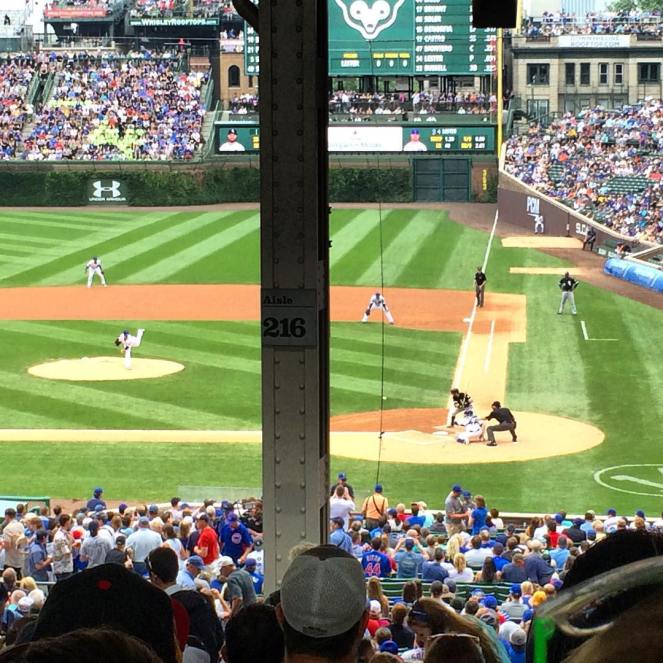
lester-cubssox-2015

Jon Lester pitching against the White Sox. Photo: Seán Kane

In September 2015 I left home and moved to London, missing out on the playoff excitement, which was greater than any other year for my family as both the Cubs and Royals had made it past the regular season. The Cubs came into the playoffs as the second wild card, finishing the regular season in 3rd place 3 games behind St. Louis and 2 games behind Pittsburgh. In the Wild Card Game, led by Jake Arrieta’s pitching, the Cubs ploughed through the Pirates in Pittsburgh in the ’15 Wild Card Game, leading to a memorable attack by baseball bat on a water cooler in the Pirates dugout. In the Divisional Series, the Cubs fulfilled one of the life-long dreams of most fans, especially those of us alumni of Rockhurst University, whose student body has traditionally been primarily made up of St. Louisians. Despite being 4,000 miles away, and unable to watch the game on TV in England, I saw the final few innings as the Cubs easily trounced their longtime rivals the St. Louis Cardinals at Wrigley Field. After years of supporting the underdog, I couldn’t help but smile. The joy of ’15 was quickly extinguished however, as the Mets came through and left the Cubs behind in a 4 game sweep on their way to the World Series. The Royals had fared better, having beaten Houston and Toronto in their drive to retain the American League Pennant. They met the Mets in the World Series, winning the crown for Kansas City in extra innings in Game 5 at Citi Field in Queens. I sat at my desk for the entire four hour fifteen minute game, watching the pixilated images being transmitted from my parents’ house in Kansas City.

As the 2016 season came around, I had a feeling that this could be the year. Every morning from March onwards, as soon as I would wake up in my basement flat in Central London, I would check the Cubs score on my phone, and as the months passed things only got better. By the time I returned home to the U.S. at the end of August 2016, it was clear that the Cubs would be in the playoffs yet again, and even clearer that they would go into playoff baseball with the best record in the Major Leagues. I watched the National League Wild Card Game between San Francisco and the New York Mets quietly from the upper level of an Italian restaurant near the Moscone Center in San Francisco, keeping an eye on who would be the ones that the Cubs would face in the Divisional Series. After a marathon Wild Card Game that saw a stellar pitcher’s duel between San Francisco’s Madison Bumgarner and New York’s Noah Syndergaard, the Californians won out with a three-run home run in the ninth inning.

The Divisional Series saw another round of amazing pitchers’ duels, this time between the likes of Jon Lester and Johnny Cueto in Game 1, and Jake Arrieta against Madison Bumgarner in Game 3. The Cubs moved past San Francisco after four games, and looked south towards the Los Angeles Dodgers who beat the Washington Nationals in their series 3 games to 2 in their Divisional Series. Like the Giants, the Dodgers are one of the best teams in the National League, and always a fun team to watch. As the Cubs took them on I couldn’t help but be thoroughly impressed by the Dodgers. Game 6 of the series, played at Wrigley Field, turned into one of the greatest nights of my life. It was the night when, in 2 hours 36 minutes the Chicago Cubs went from being the team who hadn’t won a Pennant since “the year we dropped the bomb on Japan” to National League Champions. It was a night like no other, a night when to so many millions of us it truly seemed possible that our team, our Chicago Cubs were truly capable of winning the World Series.

Embed from Getty Images

The Cubs might have seemed destined to win the 2016 World Series, after 108 years of waiting, but they had a major road block in their way. While the Cubs had lit up the National League all summer long, Cleveland had seen a resurgence, taking the American League by storm and silencing all opposition, beating David Ortiz and the Boston Red Sox 3 games to none, and the red hot Toronto Blue Jays 4 games to 1. Both Cleveland and Chicago came into the World Series with all the momentum they would need to win it all. In the end, it came down to endurance. I watched all seven games in a dreamlike state of mind, joking that this must be some sort of existential crisis for the natural order of things, after all this World Series wasn’t between a heavy weight like the Giants and Yankees, nor between the Red Sox and Cardinals. This was a World Series between Chicago and Cleveland, two flyover teams. We had not won a World Series since 1908, they had not won one since 1948. All that that did was give this series more umph, to make it a World Series for the Ages.

While I and many others just wanted a nice and tidy victory to cap off the World Series for the Cubs, the game had more twists and turns than anyone could have expected. From the Cubs giving up a 5-1 lead in the fifth, to Rajai Davis’ two-run home run that tied things up in the eighth at 6-6, I frankly was saying more Rosaries than anything else. Just when things seemed bleakest for the Cubs, when they had lost their momentum, and at least to some that goat was getting in the way again, the Heavens opened up, and the game was stopped for rain. 17 minutes later and the Cubs started over, taking things from a 6-6 tie in the 9th to a stunning 8-7 victory in the 10th. As it happens, the 2016 League MVP, Ben Zobrist had been with the Royals in ’15 for their World Series run. Now not only had he won two World Series in the same number of years, but he lived the dream of all Cubs fans, being a lifelong fan who had helped the Cubs win the World Series.

Embed from Getty Images

In the aftermath of the night of 2 November 2016 I was left speechless, in a state of jubilant shock. All my life, all my Dad’s life, all my grandparents’ lives we had waited for this to happen. For over a century the North Side of Chicago had waited to raise the World Series Banner once more at Wrigley Field, to stand before the world and cheer on our team, no longer just another easy team to beat. To me, it seemed fitting that the Cubs would win the World Series on All Souls’ Day of all days. For now, we have the best team in baseball, and today when they bring the Commissioner’s Trophy home to Wrigleyville they will surely do so in front of a crowd of millions. Wednesday night I actually found the view of the Cubs celebrating on the field in Cleveland to not have the emotional power that I expected to have. Instead, that power was with the fans who had gathered at the corner of Clark and Addison outside Wrigley Field. And as the screen on that famed Marquee changed to the words “CUBS WIN!” and “WORLD SERIES CHAMPIONS” the roar of the North Side could surely be heard around the world.

As 2016 comes to a close, and 2017 stands on the horizon, the Chicago Cubs have a new future in store. They could well continue to be a winning team for a few more years, so long as this current roster stays at Wrigley. I also have a new future, though perhaps a nostalgic one, as I prepare to leave Kansas City to undertake the work for my Doctorate. On my list are two universities back in my hometown, two institutions that, should I be accepted, would give me the chance to return to Chicago and cheer on the Cubs as I always have, albeit from not nearly as far away. The past is certainly a good thing to remember, but it is the present in which we live, and the future to which we are going. Today, as the Sun shines, and my Win flag flies at my door, I can’t help but look back at the Cubs of yesteryear, of their three World Series Championships: 1907, 1908, and 2016. But all the same, I can’t help but gaze into the future, when perhaps I, or my descendants, will get to celebrate another Cubs World Series victory. The Dream has come true.

Embed from Getty Images
In Support of the Sioux

I am an American in the sense that I was born in the United States of America, but I am not an American in the sense that my ancestors come from here. By blood I am as much a colonist of this country as were my first ancestors who came here over three hundred years ago. By right of ius soli under natural law I am an American, but by right of ius sanguinis under that same natural code I am, in composite, European, after all all of my ancestors come from Europe, primarily from Northern, and in part from Western Europe.

Under this natural ius sanguinis, which in my book trumps all other laws of inheritance, if one is to look for a true, and pure American, one should not turn to someone like me, nor even our President. Rather, turn to the most marginalised, most detracted and forgotten of all Americans, the original Americans.

For the past many months, a number of oil companies and big banks have been pushing the Dakota Access Pipeline across the American continent, like an axe cleaving a body in two down its spine. I am opposed to this pipeline on environmental grounds, primarily due to the lack of foresight by the companies involved in its construction. After all we are only a few years, if not decades away from green energies from solar panels to wind mills to new-fangled hydroenergies taking the place of oil as our main fuel source. We have the technology and the means to construct energy producing mechanisms that are both efficient and clean to use.

I am equally opposed to the Dakota Access Pipeline because of the horrendously negative effects it has had, and will continue to have upon the Native peoples through whose lands it crosses. This pipeline is yet another good idea for those in the boardroom, that ignores those who it most effects. Its design and planning ignores the fact that the seemingly empty lands of the Great Plains are in fact not empty at all, not the Great American Desert of Zebulon Pike’s proclaiming, but rather a land long occupied, long called home by a great many peoples.

So many of us Americans at some point or another played Cowboys vs. Indians as children. So many of us grew up seeing our Native Americans neighbours as less than human, mere sideshow attraction, once a noble race of barbarians now outdone by the progress that is the United States of America. We grew to disregard the Native Americans, believing that we did not need an excuse to take their homes, wrench their children’s cultures from their hearts, trample on their freedoms, and destroy their lives as if they never mattered in the first place. This has been just one expression of the systemic racism and xenophobia that infects our society like the Plague, that racism known at some point to all who are not the perennial W.A.S.P.s. We strive for better, through our founding documents, through the inspirational words of our greatest leaders, through our democracy and its most cherished institution of citizenship, yet of course those of colder hearts amongst us have found every rat’s hole, every crevice in the law which they could manipulate to their own ends, and to the detriment of all others.

For over five hundred years we the European Americans have inflicted the greatest, most unspeakable wrongs upon the Native Americans. Through conquest we have driven them from the most fertile parts of this continent to the most arid. We have built our society against them, and refused them entry into it. We have forced them onto reservations and left them for dead.

Today, as the Dakota Access Pipeline is being carved across the Great Plains, crossing the Missouri and Mississippi Rivers, we are not only putting the Native American peoples, like the Standing Rock Sioux in danger, we are putting ourselves in danger. Should the Dakota Access Pipeline leak, as it surely will at some point in the future, after all it is manmade, it will poison the rest of the Mississippi-Missouri River Drainage Basin, which includes the waters of 31 states.

Let us change the narrative of Native American history for the better. Let us stop the Dakota Access Pipeline and all future projects that disregard the rights of any American, whether Native or otherwise. Let us embrace the true meaning of citizenship, that all citizens are equal under the law. By civil law I am an American, just as the members of the Standing Rock Sioux are Americans. By natural law I cannot help but recognise and embrace that this continent, America, from the Arctic to Tierra del Fuego, was the land of the Native Americans first. I honour their rights, and offer my voice and pen in support of them, my fellow Americans.

What evils we inflict upon one American, we inflict upon all of us. We are all Americans.

Reflection on a Year Overseas

London – Eleven months and eleven days ago I moved from Kansas City, Missouri, USA to London, England. Eleven months and eleven days ago I left home and went on a great adventure that has forever changed the way I see myself, and the world. In the past I have said that one of the best ways to begin to know oneself is to understand the places from whence one comes. And, while time away has given me a greater appreciation for all the trappings and comfort of home, it has also given me the chance to explore some of the places from whence my own ancestors came: particularly in Ireland, in England, and in Finland.

As a historian, but perhaps more importantly as an American, this was a rare opportunity that very few of my fellow countrymen could ever hope to achieve. On the last Friday of May 2016, I quite possibly became the first descendant of my third great-grandparents, Juho Heikki and Anna Sophia Kuivaniemi, to return to their hometown of Rauma, Finland since 1879. On the other hand, I followed in the footsteps of my grandparents and was able to walk the roads and visit the town of Newport, County Mayo where my grandfather’s parents were born, and visit the nearby cemetery at Burrishoole Friary where the ancestors of so many of my relatives are buried. So many names from America are carved into those tombstones, yet here on the shores of Clew Bay they are in their original setting.

Yet perhaps most importantly over the past year I have had my beliefs, my understandings, my very philosophy of life and nature challenged time and again by friends and colleagues alike. I am eternally grateful to them all for those discussions, for those opportunities to think anew, opportunities which one day will lead me to act anew. Those beliefs, those views of mine which held water remain, while others have been left by the wayside, abandoned after much debate and discussion. I hope I am all the wiser for the people that I have met, and the great friendships that have been forged. We come from such different corners of the world, with different backgrounds, different views, different languages, yet respect abounds amongst us far more than contempt.

Next week I will at long last be returning home, to Kansas City, Missouri, in the heartland of the United States. I will return to the heat and humidity, and the allergies. Yet I will also be returning to my family, to many friends old and young. I am excited to be coming home once again, and looking forward to being surrounded by all those familiar things, sights, sounds, and smells. I did not realise it until I had been away, that even the softest sensory detail can be missed. Whether it be the sound of the wind whirling through the branches of the trees, or the familiar voices on NPR’s All Things Considered set to the backdrop of Kansas City at sunset, its streets filled with cars heading to and fro. In London I found that on winter nights, when the sky was clear and the street lamps glowed in a distinctly mechanical way, I missed hearing the familiar voice of Kai Ryssdal on Marketplace coming over the radio as I’d often hear at a similar time of night back home.

Yet I return to a country on edge, a country that has seen so much anguish, so much anger, and so much fear over the last year. The signs have been about for a while now. Since President Obama was elected in 2008 nearly every racist, closeted or not, has come out of the woodwork and ensured that the rest of us would have to hear their nonsensical cacophony rattling on. We could ignore racism as the rantings of the mad if it were not for the reality that words plant seeds, seeds sprout actions. Once again, around the world bigotry seems to be in fashion like it was in the 1920s and 1930s. There is always someone available for people to hate or fear. As Woody Allen put it in a recent interview with Catherine Shoard of The Guardian,

It’s in the nature of people to have someone to scapegoat. If there were no Jews in the world they would take it out on blacks. If no blacks, they’d move over to Catholics. No Catholics? Something else. Finally, if everyone is exactly the same, the left-handed people would start killing the right-handed people. You just need an other [on whom] to vent your hostility and frustration.

I know that bigotry has been around for a long time, and probably will still be around long after I’m dead, but I honestly did not really experience it until when I was at least around thirteen or fourteen. I remember some of the boys at school using the word Jew as an insult, which didn’t make sense to me, as I had always gotten along well with my Jewish friends and neighbours. I also never really had anything against African Americans, but after years of hearing from my classmates and friends that “Troost was dangerous,” I was less willing to go to the African American neighbourhoods east of Troost Avenue in Kansas City, MO. Subconsciously or not, I was accepting a racist ideology that I consciously abhorred.

Perhaps the best example of my reaction to bigotry comes from a strange experience that I had when I was fourteen, where an individual who I was working with at the time told me to my face, “I don’t like Catholics” knowing very well that I was a Catholic. I was shocked by this, not necessarily because he was saying that he didn’t like me because of my religion, but more so because his dislike for Catholics simply didn’t make any sense. Over the years as I have been exposed to a variety of opinions and ideas, and I have found myself adopting some similar views, whether it be a dislike for one particular nationality, or religion, or political philosophy, or a preference for a particular country over another. Yet each of these blanket opinions have been swiftly overturned as soon as I have met someone who fits into one of those categories.

How can I say that I hate someone or fear someone simply based upon their nationality, religion, politics, or even based upon the colour of their skin? It makes no sense. Bigotry of all kinds makes absolutely no sense!

I am proud of who I am. I am proud to be Seán Thomas Kane, or Seán mac Tómas Ó Catháin as it is in Irish. I am proud to have been born in Chicagoland, and to have lived most of my life in Kansas City. I am proud to be my parents’ son, and my grandparents’ grandchild, a nephew of my aunts and uncles, a cousin of my cousins, godson of my godparents, and a friend to all my friends. I am proud to be of Irish, English, Welsh, Finnish, Swedish, and Flemish descent. I am proud to be an American citizen. I am proud to have been a resident of the City of London for the past eleven months and eleven days. I am proud to be a historian, a writer, a filmmaker, an occasional musician and sketch artist. I am proud to be a Catholic.

But beyond all of these categories and more within which I fit, I am most proud, and most humbled to be human. We are all unique, we are all different, yes, as the crowd shouted up to Brian, “We are all individuals!” But most important of all is that we are all human. If we consider less what separates us and more what we have in common then surely we will be nicer to each other, and have better lives. If those in my country screaming against immigrants, African Americans, Muslims, Latinos, and all others considered what they have in common with the rest of us then surely they would think twice about their words and actions.

I am not proposing any sort of edifiable change, any sort of reform for our prisons, our city planning, our law codes, or our schools, all that will come next. What I am proposing is the essential necessity for any reform to happen. We must have a change of heart. We are all human.

TopGear and Revolution

In 1783, the Thirteen American Colonies were officially recognised as free and independent states by their former mother country, the United Kingdom. Initially, each of the thirteen states were autonomous to the extent that they were effectively separate countries, united only in a weak document called the Articles of Confederation. The power vacuum left with the departure of the British colonial authorities led to a worryingly unstable situation across all Thirteen American States. Stability in government was only restored with the Constitution of 1787, the binding document which created the Federal Government of the United States, effectively creating the system of government that has kept the United States relatively stable, despite one civil war, ever since.

A similar revolution has occurred in the BBC’s hit motoring show TopGear, with the departure of the old order, led by the trio of Jeremy Clarkson, Richard Hammond, and James May, who have gone to Amazon Prime Video. In their wake, the BBC has chosen a wide array of new hosts, led by Chris Evans, to take over one of their greatest hits. Having seen the first episode, Evans, American presenter Matt LeBlanc, and their fellow presenters, who frankly are more like corespondents than full time hosts, have truly put TopGear through a revolution.

The same old skeleton exists within, but the show itself is well removed from its predecessor. This new TopGear is like the Thirteen American States in the period of the Articles of Confederation; it is in a period of transition and still trying to figure out how to exist without its former presenters. Evans, LeBlanc, and the others have the same light hearted attitude to their work on TopGear that Clarkson, Hammond, and May had before, but at the moment it just does not seem to be as funny. With the former trio, I knew to expect that odd, somewhat nonsensical, at times pointless humour. As a result, I reviled in it, often with a big smile on my face for the entire hour long programme. With Evans, LeBlanc, et cetera, I laughed on occasion. Simply put, I am not familiar with these new hosts, and do not know what to expect.

Perhaps in a few weeks, once more of the current season of TopGear is broadcast, I will  be able to appreciate the new presenters, and new format better. At the moment, I am looking forward  to the first episode of The Grand Tour, Clarkson, Hammond, and May’s new programme, which will be released on Amazon Prime Video this coming Autumn. As to the next episode of TopGear: yeah sure, I’ll watch it. This new TopGear has undergone a revolution, but it still has a long way to go until it leaves the shadow of its predecessor and enter into its own spotlight.

Otters and International Relations

Sea Otters

Sea Otters (Photo: WeaselGang (Tumbler))

As surprising as it may sound, I find some distinct similarities between the world of otters and the academic field of International Relations. Otters live in small groups, with the mothers nursing their pups. Much of the study of otters comes out of just how they behave when confronted with other otters who they do not already know. International Relations is similar, only there are more theories. I imagine if given the opportunity scholars would be overly willing to come up with a theory relating to otters, perhaps it could be called Otterism, or even odder than that, if the theory only dealt with adult otters the theory could be called Post-Pupism.

Then again, the very understandings that we have of otters, their communal lives, and their personalities are constructivist in nature. So, at least one theory of International Relations can have a role to play in the world of otters.

On Service

Over the weekend I have been thinking about how my three main academic foci, these being History, Theology, and Politics, can intersect and cooperate. I find it far easier to find the intersection of History with Politics, after all much of my work has been in the realm of Political History. That only leaves the gap between Politics and Theology.

Earlier this evening I realised that it is Martin Luther King, Jr day back home in the United States. Dr King’s lifework was a direct human embodiment of the correlations between Theology and Politics. While I firmly support maintaining the separation of Church and State, and preserving the secular nature of American politics, as dictated in the early years of our republic, I recognise one vital theme which flows within the hearts of both disciplines: that of service.

Good theology centres on themes of selfless service. To quote the Gospel of John, “Greater love has no one than this, that one lay down [one’s] life for [one’s] friends.” In this case, as is more common, the laying down of a life is not actual martyrdom, but rather sacrificial service, a giving up of some liberty or possession or individual possibility for the good of another or of the whole community.

Good politics in turn is founded upon a similar principle. To devote one’s life to public service is not only a great choice but also a great sacrifice. Once one has chosen to align one’s individual interests fully with those of the public, one loses a degree of independence yet gains a greater appreciation for others. Marcus Aurelius writes in his Meditations, “Let no act be done without a purpose, nor otherwise than according to the perfect principles of art.” (Med. IV:2). As an actor on the political stage, be sure to have a reason as to one’s presence on that stage, but let that reason be founded upon one’s role as a citizen, a “member of a civil community.” (Med. III:7).

As Marcus Aurelius writes, “Nothing is evil which is according to nature” (Med. II:17), so too with good theology and good politics. One might say that some policies, such as support for same-sex marriage is contrary to nature, yet I disagree with that assessment, after all if nature is an element of the divine, accepting that all that is natural was created by a Divine Essence far in the past, through what science has called the Big Bang, then one cannot say with verity that anything non-artificial, that is anything not made by humans, is contrary to nature.

Nature is something which is too vast a concept to truly define in a few words, though we certainly have come up with ways to explain elements of it. Among these are theology; an  explanation of nature’s relationship with the Divine, and politics; an explanation of how human societies can organise and survive in light of the whimsical manner of nature.

Perhaps the best manner in which one can act for the good of nature, and the good of others is through public service. In this way theology and politics do intersect in a common purpose: the betterment of individual lives, and the promotion of common liberties.

Where have all the flowers gone?

London – For the past two months since I arrived in England, my thoughts have been filled with a few things: school, friends, family, home, music, stories, films, and theatre just to name a few. But after Friday’s attacks in Paris, all of that is gone. Our world changed overnight. It was as if the screams of terror, the tears of sorrow had washed away the joy and normality from life. And now we are at war once again.

What is to follow over the coming months, and possibly years, will be terrifying, brutal, and horrific on all counts as our countries focus their military might upon one common enemy. Yet for all the talk of war, for all the similarities to 9/11 that Friday’s attacks possessed, there is little bravado, little pomp. Our leaders, and most of us know all to well that this is not going to be easy. We know that the fight that is to follow could well be worse than any other since the millennium.

I have prayed fervently since Friday night for peace. I have begged God to intervene and ensure that our fellow countrymen and women do not have to go to war. I even went by my parish church on Sunday evening to light a candle to offer my prayers ever more fervently. I have prayed for the intercessions of the saints, particularly those French saints, Jeanne d’Arc, Thérèse de Lisieux, Jean Vianney, and Notre-Dame de Paris, begging that we might avert the coming crisis. After all, we were given two great gifts at Creation: free will and a limited intellect. We cannot know everything, which makes life an adventure. And yet, I recognise, regrettably, and with the greatest sorrow my heart can muster, that the only observable option remaining is war.

This weekend, Pope Francis expressed the same emotions well in an interview with Italian television’s Tv2000 network when he said, “I am shaken and pained. I do not understand but these things are difficult to understand.” It brings me so much grief to come to this conclusion, as for years I have argued against Just War Theory, but to be honest, there does not seem to be any other option at present. Sure, we could try to root out ISIS using only nonviolent methods, but that would take far too long, leaving our own peoples open to attacks similar to those wrought on Friday in Paris.

If we are to fight this war, then let it be fought in a manner that will achieve lasting peace. The recent wars in Iraq and Afghanistan have taught us that Western powers cannot on their own root out Islamic extremism. We must leave the essential work to our Muslim counterparts. The likes of Turkey, Jordan, and Saudi Arabia must play essential roles in defeating ISIS. There should not be any European, American, or Canadian soldiers on the ground in Iraq and Syria.

I firmly believe that radical groups such as ISIS, which claim their authority from their faith, can only be destroyed by people of the same sect of Islam. Therefore, we should leave that fight up to our Sunni Muslim counterparts. We in the West can provide air support, running raids on key military sites and command centres in coordination with the Saudi, Jordanian, and Turkish forces on the ground.

Foremost though, we must not allow ourselves to give into our fear. Our hearts must remain open to the fact that we humans are inherently good, inherently beautiful beings. I have no doubt that in the end we will prevail. In the grand scheme of history extremist organisations like ISIS will merely appear as a bad nightmare.

But for the moment that beauty seems distant. It appears to be the dream, the nightmare our reality. At this moment we are at war. At this moment, talk of peace appears to me to be sad in nature. So, I ask, “Where have all the flowers gone?”

Books to Read: “The Fault in Our Stars” – Katherine Blanner

Katherine Blanner writes the Books to Read column for The Tern.

Katherine Blanner writes the Books to Read column for The Tern.

Every high school girl has a chick flick that they are obsessed with. It has transitioned from The Notebook to the Twilight saga, to The Vow, and now has become, undoubtedly, The Fault in Our Stars. John Green’s novel was published in 2012, dispersed evenly among the nerdfighter population and those simply seeking “feel good” books. It has recently become a film, enjoyed primarily by those who possess estrogen. All of the reviews of such a book have been positive, however, most discount for the true moral of the entire novel.

Briefly recall Aesop’s fables. Does not every story end with a lesson? These gems of knowledge, a take-away, if you will, plague every book, film, narrative, or even piece of music known to mankind, be it intentional or unintentional. This, again, is the case for The Fault in Our Stars (TFIOS). Examine first the novel itself. It is a pleasant little love story of a terminal, cancer ridden girl and a super hot smart boy with one leg. They meet on page four and instantaneously fall in love. Flirting prevails, they obsess over a book, meet a certain author, and then the boy dies. Every girl reading it cries.

I must admit to not being “every girl.” I did not find TFIOS a compelling novel that challenged my philosophical outlook on life, therefore I did not weep from its tragedy. However what I did find was a portion of John Green’s outlook on life. He is searching, just as we all are, to find purpose, happiness, and therefore meaning. In his novel, the love struck teenagers, a bit melodramatic and Romeo and Julietted, are dually searching for meaning. The struggle of cancer is so real, immediate, demanding, and tragic that it does become, in a sense, their religion. This is the meaning of their life, to get over cancer. Searching for more, Hazel and Augustus turn to a book, as many of us have in times of tragedies. However, theirs is not the inspired word of God, but rather a book that relates to them particularly well, “An Imperial Affliction.” This book becomes their bible.

Here is the end of their search for religion, in which they both are unfulfilled. It must be understood that this is reflective of John Green. However, Green rarely reveals his ideals of religion or theism, so it cannot be confirmed. Nevertheless, it can be assumed, from The Fault in Our Stars and his past works, that he is desiring of religion and coming up empty.

Nature has no straight lines

Kansas City – When I initially had the idea to write this article, I chose not to act upon that thought, figuring that the topic was far too vast for me to finish covering it in one sitting. However, upon sitting in my bed, just beginning my nighttime reading, I realised that the fact that this article would have remained unwritten seemed an unbearable monstrosity.

In our well-ordered world, things are more often than not set upon a grid pattern. Here in the United States, the vast majority of our cities and towns are built on grids. Many of the states borders were drawn upon a vast grid. Likewise, our view of global geography, with latitude and longitude as our most fundamental aid is founded upon a sort of grid. And yet, all of these grids, all of these straight lines that criss-cross the planet are not naturally devised instruments. They are not nature’s mirror, like the motionless water on a lake on a windless night. These grids are mirrors of our own inventiveness, the most elementary mechanism by which we seek to understand things that are far greater than ourselves.

When I observe the stars, what first strikes me is their shape. No star in Space is a square, or a rectangle. They are all spherical in some way or another. Likewise, these celestial spheres move about the Cosmos in elliptical and circular patterns, most certainly not along grids like in Pac-Man. The entirety of natural reality moves in circular motions. It is only those things that we humans have created which move on grid patterns.

So why is this? Why is it that we have chosen the square as the basis of our lifestyles rather than the circle? As silly as this question may sound, it is certainly something for us to consider: if in the earliest days of human history, we had chosen to build our cities and towns in a more circular fashion, with the streets curving and such, how different would we be today?

The bed that I am sitting on writing this on is a rectangle, as is pretty much every bed that I have ever known of. Likewise, all of the walls, doors, and windows in my house are rectangular. Looking in my room, the only things that appear to be circular in nature are 1. the glass of water on my bedside table, 2. the Chicago Blackhawks logo, and 3. the Circle of the Sun on the Celtic Cross on my wall.

It is true that designing and building things with straight lines is quite simpler to do than with curves. Perhaps that is one of the many central reasons for our preference for straight lines in organisation: that as children, we found it much easier to draw squares and rectangles than perfect circles, something which I can attest whole heartedly to. This in turn has developed into a mental reservation against modelling anything terribly important in our means of organisation upon circular designs.

In this sense, Kansas City’s streets more-or-less run on a grid pattern. All one then has to do to know how to get from A to B in the city is to know which named street is east or west of another and how far north or south one has to go to get there. Of course there are one way streets to contend with, but that’s beside the point.

This idea that straight lines are preferred has entered into our views on nature itself. We catalogue peoples, places, and things based upon their place in our ordered, straight-and-narrow view of the world. As a student of history, this comes into play in terms of looking at the course of history itself.

An argument that I have made in the past is that the modern Catholic and Eastern Orthodox Churches are the direct sociopolitical descendants and heirs of the old Roman Empire. The evidence for this largely stems from the observation that in Europe, Africa, and the Near East, the traditionally Latin Christian (Catholic) sphere fell along the same lines as the Western Roman Empire did in 395 CE, when the Empire was split in two. Likewise, the traditionally Greek Christian (Orthodox) sphere fell along the same lines as the Eastern Roman Empire did in 395 CE. Now looking at the modern map this seems a bit odd, as North Africa and the Near East are largely Muslim, whilst Northern Europe today is mostly officially Protestant.

Another issue that I have with this argument comes from ethnicity. My family comes from Ireland, Wales, England, Flanders, Sweden, and Finland. Of those, only the Welsh, English, and Flemish ancestors would have had direct ancestors who lived under Roman rule. In terms of genetic majorities, I have far more genetic connections to Ireland, which the Romans never conquered, than I do to the rest. So, to say that I as a Catholic am a successor to the Romans of antiquity might seem a bit odd. Surely the French, Italians, Spanish, Portuguese, and others have more of a claim to that than I do.

And yet, to say that such claims come merely through a direct A to B to C to D line of succession does not necessarily makes sense. There are many unique threads that make up a tapestry, and yet they all come together for a time to weave one common design. From there on after, no matter how far apart those individual threads may go, they will still bare the essence of their fellows from their days as one tapestry.

In one sense, as I have said, Rome’s inheritance is the property of the Church. In another sense, Rome’s inheritance comes to us through its laws, its philosophy, its literature, its engineering, its tactics and its divisions. I find it interesting that to this day in Continental Europe, the borders of the old Roman provinces have remained, only now as the borders of modern countries, provinces, counties, duchies, et cetera.

Rome’s influence is felt here in the United States through our legal system, and through our federal republican government, which in many ways is modelled upon the Roman Republic. In the past I have referred to the United States as Nova Roma, the New Rome. Not only have we modelled our government upon the Romans, but also we continue to repeat many of the same mistakes made by our ancient inspirators. We continue to ignore the grave problems faced by our society, blissfully drowning out the many worries that are on the horizon with more mindless entertainment.

Why worry about the fact that we as a society can actually do something to stop more mass-shootings when we could also keep up with the Kardashians? I think one of the main problems with our society is that we have this concept of working on a grid so very well engrained that now it seems impossible to get anything done by any other means.

It’s time to leave the box, and think, and work, and live as one with the Cosmos. Like what the great inventor Nikola Tesla said, “It is a mere question of time when men will succeed in attaching their machinery to the very wheelwork of nature.” After all, “We are all one.”