Category Archives: Wednesday Blog

The Promise of Hope

Last week, the 7th of May 2024, marked the 200th anniversary of the premiere of Ludwig van Beethoven's Symphony No. 9. Today then, I want to talk with you about the hope which runs through that Ode to Joy. The recordings of Beethoven's Ninth Symphony heard in this episode came from the 1956 album by the ProMusica Symphony Orchestra and Chorus under the direction of Jascha Horenstein and are free to use under the Public Domain Mark 1.0 Universal label and can be found in full at archive.org. — Click here to support the Wednesday Blog: https://www.patreon.com/sthosdkane

Last week, the 7th of May 2024, marked the 200th anniversary of the premiere of Ludwig van Beethoven’s Symphony No. 9. Today then, I want to talk with you about the hope which runs through that Ode to Joy.


Last time on the Wednesday Blog, I wrote to you in what I hoped would appear to be an optimistic tone that still acknowledged the troubles and trials I find before me, and to an extent I think that worked. While I did not intend to write a sequel to that post, this week’s topic is one which fits well enough, and which I feel quite fervent about as to warrant mention here in the Wednesday Blog.

I began to explore the world of classical music around the time I started high school. Quite honestly, my big introductions were the music of George Gershwin and the original cast album of Phantom of the Opera. Yet around that time I was introduced to an ensemble called the William Baker Summer Singers and joined them for the 2008 season when we performed Beethoven’s Ninth in Grace & Holy Trinity Cathedral in Downtown Kansas City. I was not the best singer by a long shot, still very new to the whole experience, yet it was the start of my off-and-on tenure singing with choirs around Kansas City.


The first measures of the 1st Movement

Beethoven’s Ninth thunders into life with the opening measures of its first movement, as though the hope and joy which makes this piece so famous is born from something elemental deep beneath the ground, rising out and toward the audience with the orchestra as its first voice. This then makes the chorus out to be some even deeper root of the spirit of this work, its power growing throughout the first three movements leading up to the tremendous clamoring second movement. I’ve always imagined the second movement told the story of a fast paced and clattering horse and rider making their way through fields and farms to pass on good news to some learned recipient.

The third movement is far softer than the first, yet again it speaks to something grand as yet only being revealed to the audience. There is a sense in the third movement of a fundamental truth as of yet untold, whose voice could raise both the living and the dead to new heights of human dignity and grace. Through music, Beethoven captured the full spectrum of human aspiration and expressed our innate confidence in our own abilities to improve our lives. It reminds me of the “Et incarnatus est” movement in Beethoven’s Missa Solemnis, which is written in the Dorian mode, giving it a distinct feeling of rising from a deep ether into the light of a new day. The Missa Solemnis was also written in 1824, premiering on the 7th of April of that year.


The 3rd Movement’s climax

I hear something inherent in Beethoven’s optimism, that even with all the troubles of his life there near its end he could still dream that we might become better versions of ourselves. The tempo marker for the first movement Allegro ma non troppo e un poco maestoso (Quick but not too much and a little majestic) might well be a good motto for life; a good life ought to be taken at a fair pace, yet not too fast, and with some majesty for one’s nature. We can hope for something better because we are born with minds capable of dreaming of better tomorrows.

At the heart of the Ninth Symphony and in particular its choral fourth movement is a fairly simple melody, one that I learned quickly during my time rehearsing it. That melody has taken on a life of its own beyond Beethoven’s original composition and become something ubiquitous in many respects. There are two church hymns set to its tune in the hymnal we use in my current parish choir, “Joyful, Joyful, We Adore Thee,” and the slightly more modern, yet traditionally formal, “Joyful, Joyful, We Adore You.” What I love about this melody is that it is easy to learn, easy to adapt, and so upbeat.


The Ode to Joy theme from the 4th Movement

The words which Beethoven set to that tune were written by the German poet Friedrich Schiller (1759–1805) in the summer of 1785. They are an outgrowth of the Enlightenment and the fervent calls for acknowledging our common humanity that grew from this reassessment of our relationship with Nature. Those words speak volumes to me, that joy makes brothers and sisters of us all, revealing our original state of nature to us amid all the nebulous fog of our lived expectations. It’s easy to forget that beneath all the mantles of identity we hoist upon ourselves that we are all the same in our life and yes in our mortality.

There is a deep promise here that with hope we can accomplish tremendous things. Hope alone will not solve our problems, we will always need to act to improve ourselves and our communities. True hope, pure and fulfilling hope, is such that it requires we all act together to our common benefit, that we think of each other more than of ourselves. I have such a hope in humanity, after all I’ve seen moments in my own life and in our history in which we’ve come together to work for a higher purpose than any one of us. Again, quoting from Schiller’s poem:

“Seid umschlungen, Millionen!
Diesen Kuß der ganzen Welt!”

            “Be embraced, all ye millions!

            With a kiss for all the world!”

This promise of hope is something that is sacred because it offers us a chance at redemption no matter how terrible the things we may have done. There is something truly divine about it, that we can become better versions of ourselves not in spite of who we’ve been but rather because we are willing to improve who we are and how we live with our neighbors.

That is a promise that I hope we can fulfill.


The recordings of Beethoven’s Ninth Symphony heard in this episode came from the 1956 album by the ProMusica Symphony Orchestra and Chorus under the direction of Jascha Horenstein and are free to use under the Public Domain Mark 1.0 Universal label and can be found in full at archive.org.


The Art of Joy

This past weekend, the Nelson-Atkins Museum of Art debuted a new retrospective exhibit on the life and work of Franco-American artist Niki de Saint Phalle. One of her great initiatives was to express rebellious joy in her art, especially later in her career. — Click here to support the Wednesday Blog: https://www.patreon.com/sthosdkane


This past weekend, the Nelson-Atkins Museum of Art debuted a new retrospective exhibit on the life and work of Franco-American artist Niki de Saint Phalle. One of her great initiatives was to express rebellious joy in her art, especially later in her career.


I wasn’t familiar with the name Niki de Saint Phalle (1930-2002) before the Nelson-Atkins Museum of Art announced they would be hosting the first American retrospective exhibition of her work, yet having seen aspects of it, particularly her Nanas, I find that I do remember seeing these around here and there. The exhibit begins with her early work, highlighting her tirs paintings (1961–63) which involved her shooting paint-filled collages of popular material objects each with their own cultural meanings, until they bled their paint out. I found these hard to appreciate, the violence at the core of these pieces and the claustrophobic nature of their assemblages filled me with a sense of dread.

Yet, it was the latter two thirds of the Saint Phalle exhibit which I returned to, the section radiating and erupting in light and color in a manner that felt welcoming and brilliant as though it were made to bathe in the warm rays of the Sun. These portions of the gallery were filled with her Nanas (1964–73) and other works in the same style. Saint Phalle created her Nanas as an evocation of the power of women, often drawing from ancient fertility figurines like the Venus of Willendorf, today housed at the Museum of Natural History in Vienna. Even the serpentine figures which I would normally be wary of felt warm and cheering.

So, what then is it about Saint Phalle’s work and this dramatic change between her early creations in the 1960s and 1970s to her later works in the 1980s, 1990s, and early 2000s that the latter ones feel so different? In my two visits thus far I’ve gotten a sense that early on she was fighting back against oppressive forces and that her resolve was to take hold of the ancient model of fighting violence with violence, while later once she felt liberated from these old shadows, as much as she could’ve been, she began to create in a spirit of wonderous joy.

I’ve had a hard time with joy lately, and I’m usually the eternal optimist. In many respects, I feel my emotions have had a softening in the last year and a half out of fatigue more than anything else. After I finished my teaching job in the Fall, I could not feel much for a good two weeks; I was so tired that Christmas came and went with only a passing acknowledgement from me. I gave every last drop of my enthusiasm and optimism in that job, knowing that I would have to do no less if I wanted to do that job justice. Joy then, the emotion that I felt even in the darkest and most terrifying days of the pandemic as I dreamed of better tomorrows, is something distant from me even now.

Yet I prefer to be optimistic, to live joyfully, rather than to be consumed by the trends of pessimism and destruction that are well in vogue now. There are horrific things happening in our world every single day, and I applaud those who are fighting to stop those horrors from spreading. The great fight of our time is one to defend democracy in a year when it is very well and truly under threat. It might seem naïve to some, yet I feel it is my vocation to try to keep a positive outlook and remind the people around me of all the good things we’re fighting for. What good is war if we give up any hope of finding peace again? Like Saint Phalle, I see joy in color and light. Where years ago, I would want to keep the shutters closed on my windows today I love having the sunlight dance between their opened gates and radiate an exuberance that reminds me of St. Francis wandering the fields around Assisi 800 years ago. There are great horrors in our world, and we need heroes who will face them and restore them to their box, yet we also need people to remind us of the good times so that we have a reason to envelop that darkness in light.

In the arts, the greatest periods in recent American history of optimism and joy are the New Deal and the Great Society, two moments when the political will to make life better for all Americans translated into an artistic awakening which sings the spirit of the times. The New Deal policies of President Franklin Delano Roosevelt responded to a time of great pessimism and trouble for America and the globe, when at the heart of the Great Depression he and his brain trust found ways to invigorate society through economic and financial reforms as well as new funds for the arts that had not been known at any time before. Here in Kansas City, we look to the paintings of our local artist Thomas Hart Benton (1889–1975) to evoke the regionalist style of the day, or nationally to the works of Georgia O’Keefe, Edward Hopper, and Grant Wood. I often associate O’Keefe’s art with the bright colors and lights of the desert Southwest, a region that was conquered by the United States from Mexico in 1848 yet not fully realized into our national mentality until after World War II.

For me, the great voice of this optimism is Aaron Copland, whose music evokes the same regional influences of the painters just mentioned. A long standing question in American classical music is how best do we define our national voice? I say we here because the compositions created in this country live or die by the audience’s appreciation. I found it fitting then when I read that the Kansas City Symphony’s first European tour, happening this August, will include performances of Copland’s Third Symphony in Berlin and Hamburg alongside performances of the works of three other great American composers: Bernstein, Gershwin, and Ives. In Copland’s music there’s a sense of the enduring youth of this country, the optimism of a new society building itself from these foundations.[1]

I love how the third symphony uses his famed Fanfare for the Common Man as a central theme, this idea that while in other countries fanfares would be reserved for only the great and the good descending down to our common level on their golden escalators, in our country that fanfare is open to anyone who is willing to live their best life. We are all capable of greatness as long as we live within that brilliant sunlight that so dominates the most optimistic periods in our art.

The greatest challenge that we humans have ever received is to love one another, to be kind and generous with our compassion, and to work for the betterment of all of us. I see that message fading somewhat today, its brilliance drowned in the neon glow of our own individualism and aspirations for fame and riches. It runs contrary to our culture as it has developed that we ought to prefer charity over transactionalism, that we ought to be kind to each other for no other reason than because it’s the right thing to do. I worry that this is lost amid all the revolving cycles of fads and trends that catch our attention for but a moment only to be overshadowed by the next.

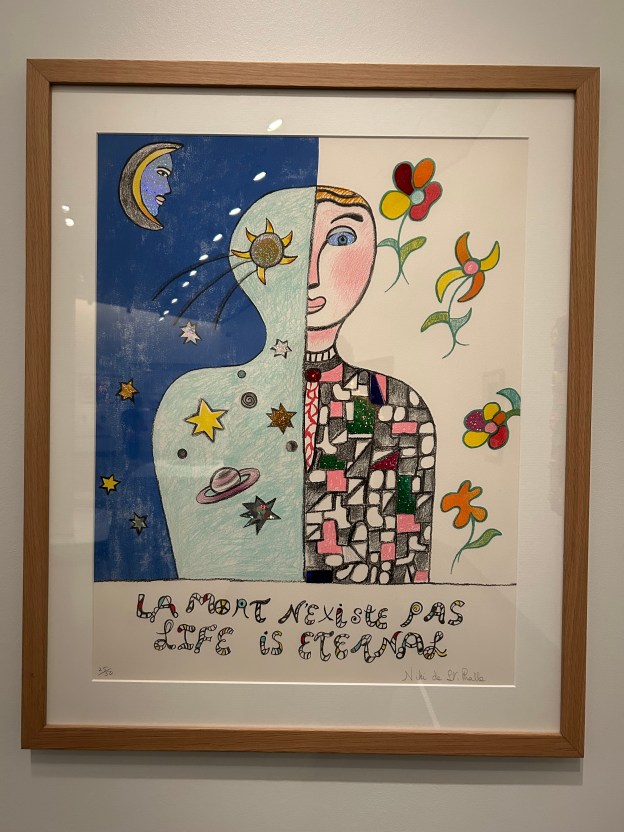
So then, perhaps what I appreciated the most about Niki de Saint Phalle’s later works was as much the longevity of their creation as it was their brilliant colors and joyous expressions. These are works which are meant to last so that generations of people will see them and perhaps in their forms feel a sense of their creator’s joy. I certainly felt that, even now 22 years after Saint Phalle’s death. I took one photo in the exhibit, of a color lithograph she made with a dualistic figure, on the one side with a human face and body and on the other the human frame surrounded by planets, moons, and stars. Beneath the dual figure Saint Phalle wrote in French and English, “La mort n’existe pas / Life is eternal.” I believe through our joy, no matter how childlike it may be, we can live on even after death. As St. Paul wrote, “Rejoice! Your kindness should be known to all.” (Phil. 4:4–9)


[1] Yes, there’s a great deal of problems with that new society’s foundations in the conquest and colonization of this continent.


Niki de Saint Phalle: Rebellion and Joy is on view in the Bloch Building at the Nelson-Atkins Museum of Art from 27 April through 21 July 2024. More information can be found here.

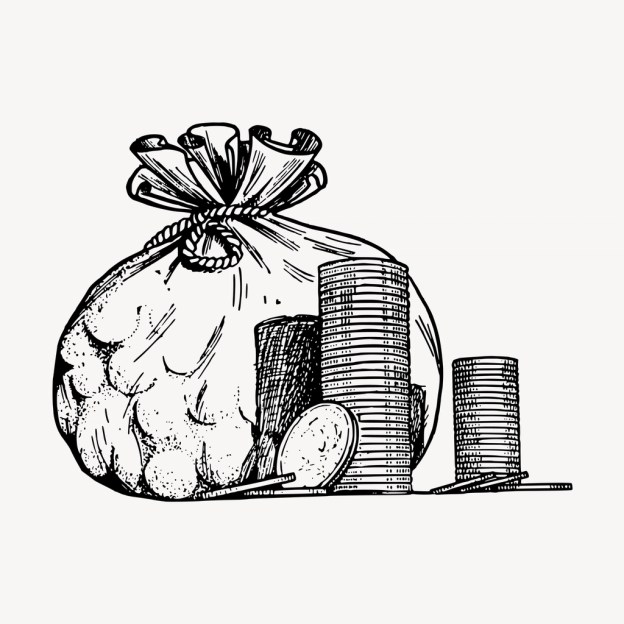
Is Cash Still King?

Over the last week, I've been thinking about how much I still use cash, and what that says about my lifestyle as a whole. Guests: Alex Brisson, New York City Elizabeth Duke, Kansas City, MO George Vial, County Donegal, Ireland — Click here to support the Wednesday Blog: https://www.patreon.com/sthosdkane


Over the last week, I’ve been thinking about how much I still use cash, and what that says about my lifestyle as a whole.


One of the chief ways that ordinary people would interact with their government was through the coins or banknotes in their pocket. We get to know the faces on our currency better for that role than for the things they did that got them printed onto dollar bills or Euro coins. Many were probably more familiar with the late Queen because her face was on the currency in the United Kingdom and all the Commonwealth realms more so than in any other fashion.

Yet, in the last five years, my cash usage has dropped significantly from a high around the mid-2010s when I used it more than my cards. Today, when I go to the bakery or when I buy concert tickets, I do so digitally. I prefer to use contactless payments on my phone over any other for the ease of use, and the security of not having to pull out my wallet in public. Still, I realized early on last week that this was a question better answered by more than one mind.

So, to answer this question, I turned to my Patreon supporters (only $5 a month at patreon.com/sthosdkane) to ask them how much they still use cash.

One of my Patreon supporters who agreed to talk to me this week was regular Wednesday Blog film expert, Alex Brisson who offered a few thoughts of his own from his home in New York City.

How much do you still use cash?

SK: When I moved to Binghamton, when I was going out there to go look at an apartment in May of that year, my Dad gave me $50 in $5 bills and said “Go, drive to Binghamton,” we were in Niagara Falls, “go, drive to Binghamton and find an apartment and be back here by tomorrow to catch the train to Toronto.” And that was the last time I ever used cash for tolls. Traditionally, I’d use cash for tolls, taxis, and really small family run Chinese restaurants. So, let me ask you then: how much do you still use cash?

AB: Almost not at all, extremely rarely. Unless it’s an arcade game that only takes cash, or once in a while the street hot dog vendors in New York only take cash, which is a big mistake in my view, and sometimes there’ll be one cart that takes card next to one that takes cash will get all the business. I’m making constant financial transactions; I’m buying things every day. New York City is just a big shopping mall. I use Apple Pay the huge majority of the time, unless a place doesn’t accept it.

SK: Yeah, it’s much more secure than even using your card. You don’t have to pull your wallet out, and also the encryption of the card number helps.

AB: Yeah, and also there are those machines that can steal your card number going around, so Apple Pay is more secure against those, though Apple Pay might be just as easily compromised, I don’t know. Definitely, money has gone from being a physical, gold-backed thing but now money is purely digital.

One of my Patreon supporters is closer to home, and we were able to do an in-person interview. – “Hi, Mom!” – “Hi, Seán!”

SK: How much do you still use cash?

ED: Very little. I carry maybe $20 for an emergency, but I rarely use cash.

SK: How much do you still use cash?

GV: Not as much as I would like to.

That’s George Vial, who spoke to me from his home in County Donegal, Ireland.

SK: So, you would prefer to use it over card?

GV: Compared to using it over card, the inaccessibility of getting to an ATM is probably the biggest drawback. Today, I had to pay a guy working on a car, and to find an ATM that would dispense the amount took two different trips, so I eventually got him the money. It would’ve been easier if he had taken a bank card, but that was the first time I used cash in almost two weeks.

Do you prefer cash over card or vice versa?

SK: So, you prefer cash over card, I get that. When you’re in the US do you use cash or card more than in Ireland?

GV: I use more cash than card in America, and vice versa in Ireland for one simple reason: Euros don’t fit in the wallet, they were never designed for wallets, and the amount of coins over here is too much. If you go out with €100 your trousers are falling down by the end of the day.

SK: Yeah, I stopped carrying a coin purse. The trouser leg didn’t look right with that in there. What do you think are the benefits to your preferred payment method? You talked about a couple of the drawbacks of using cash in Ireland, what are some of the benefits?

GV: The benefits of cash are that you stick to what you have. When you do digital payments you tap your card, while in America it’s still a lot of swiping. Here there are no minimums to how much you can spend by tapping, so you spend more freely, whereas with cash if you have €200 in your pocket that’s how much you can spend.

SK: Do you prefer cash over card or vice versa?

ED: I prefer to use a card or to actually use Apple Pay so I don’t have to pull something out of my bag. Although, at restaurants in the US you have to give them your card and they take it away from you to run it whereas in Europe they run your card for you there at the table.

SK: I’m starting to see more places in the US where they do have the portable card reader that they bring around, or even the big chain restaurants that has the machine at the table that you can play games on and also use to pay at the end.

~

AB: Money has gone from being a physical, gold-back thing, and I guess the gold is still somewhere, and now money is just a number on a screen.

SK: So, the value of the money has gone fully abstract then, in the last 120 years. So, now instead of being valued off gold it’s an abstract concept. So, what do you think are the benefits to your preferred payment method?

AB: Mainly that I no longer carry a wallet. I have my phone and there’s a little pouch on the back where I carry my cards. I’ve consolidated the things that I carry in my pocket, and as a man in New York City your pockets are prime real estate. Another one is the convenience of my phone being my payment method. Unlike cash, it can’t get wrinkled or blow away or you can’t really steal my Apple Pay. It doesn’t have to be replaced all that frequently like a credit card does, and because it’s contactless it’s safer in terms of transmission of germs and things. During the pandemic we realized we’re passing around all that dirty cash. The main people here who use cash are homeless people because they need you to give them cash, but if you don’t have cash on you then you circumvent that, which is kind of a low thing to say. And, also unlike with cash not carrying around a finite amount of it I can access all of my funds potentially, not instantly but nearly instantly if I shuffle things around.

What do you think are the benefits to your preferred payment method?

SK: So, then do you see any benefit to using cash over card?

ED: I suppose if you don’t want your purchase tracked then that’d be a benefit, or if you’re going to a farmers’ market, but even those will take cards. There are a few places that are cash only but they’re few and far between now.

SK: And inflation has impacted that now, because you have to use more cash to buy stuff now. I remember when I was little you could get a candy bar at a gas station for less than a dollar, and now it’s probably close to $2.

SK: What do you think are the benefits to your preferred payment method?

ED: It’s more secure,  if my wallet were stolen I could stop the card immediately, any of the cards I carry. The same cards work globally, so I can travel and not make many changes. It’s the convenience and the security, although I will say back when I carried cash I had a budget for discretionary spending per month. With a card it’s much harder to do that. It’s really easy to spend more with a card.

SK: When I lived in London, I found it was very beneficial to only use cash if I could because I could control my spending, whereas with my card and contactless it was very easy to buy stuff.

ED: It’s something we all need to figure out how to manage our lives now. I spend a lot more time in the bank app on my phone than I used to.

SK: I found that when I went overseas this most recent time in October that I’d get Pounds and Euros out but this time I used my card everywhere, so I never needed to stop by an ATM, and that was bizarre, even going into the Tube in London, like with OMNY in New York, I just used my phone to get in, and that’s a new thing just within the last 5 years. In New York, you used to have the MetroCard instead.

AB: You’re right, because the Apple Pay and credit card transcend borders. You can use it anywhere in the world. You don’t have to convert your cash.

SK: That was a huge realization, because I realized when I got there that I forgot to get cash out, so I started paying for things with my Apple Pay and quickly realized that I wouldn’t need to get cash out at all. I got to Brussels and paid for my first croissant and thought, “wait a second, I don’t need to get cash out here.” Yeah, that was a big benefit to it. Then, do you think cash will fully ever disappear?

Do you think cash will ever fully disappear?

SK: Yeah, so you’re doing the mental math and figuring you’re borrowing from a future paycheck to pay for this. Do you think cash will ever fully disappear?

GV: I know they’re going to try, the banks of the world, but I don’t think it will. All it will do is create more of a digital black market, so it’s everything from the criminal black market to paying all of the little cash transactions of paying the babysitter or paying the car guy which they’ll be able to monitor, so they should just leave cash as it is.

SK: So, cash in Europe it’s coming out of the European Central Bank (ECB), whereas here it’s coming out of the Federal Reserve and the Mint, while when you’re doing a card payment it’s going through Visa, MasterCard, or Discover, or American Express, or take your pick. Do you see a way that it could be problematic that those particular financial corporations would have that much of a role in our everyday monetary transactions whereas previously it was a public enterprise that was managing it?

GV: Oh, yeah absolutely because it’s throwing the control of our money to these for-profit corporations, it’s totally wrong, and we know behind the scenes the amount of charges, there’s a meme going around talking about how to spend $100 locally, yet to spend that $100 digitally the amount of transactions and fees that go on makes it all very convoluted. I’m not a fan of the big companies tracking our money.

SK: Yeah, I absolutely get that.

AB: My immediate answer is that I’m not properly educated enough to truly venture a guess at that, that said it does feel realistic to think that you could have a post-cash society. That feels very feasible in my mind at least. There’s also this aspect that you only print so many dollars, or that you could track that digitally anyway. I bet we’re shipping a lot of gold and huge stacks of dollar bills from place to place, I bet there are people who are spending time counting money. And we’re handing over a lot of our societal things to computers these days, yet this is a logical usage of this.

SK: I only hesitate with that in 2 points: Jackson County, Missouri’s systems were hacked with a ransomware attack, and the systems were shut down for a while. Having all of your money going through computer systems leaves them up to attack in that sort of hack. Secondly, having your money going through a computer system means that every transaction you make is processed by a financial institution like Visa, so they are getting a cut or have some arbitrary control over the transaction. So, does that give them too much power?

AB: There’s also the data tracking aspect of this too. The thing you were saying about how it could be hacked and disappear is true for any form of currency. There’s an episode of The George Lopez Show where his mom keeps all of her money in a safe under her bed and there’s a house fire and all of it burns. So, is there a truly safe form of currency? I think the answer is no, there’s not. You can hope that each version is more secure, at least digitally there’s a record of its existence. So, if your bank gets hacked then there’s a record of what the bank owes you. Digital money then might be more secure. It’s truly hard to say. It’s scary, the new digital world is scary in a general way, I would say, and things are changing so rapidly. The minds of this generation, and all who are alive right now are struggling to keep up with it all.

SK: Do you think cash will ever fully disappear?

ED: Maybe. It’s expensive for countries to print bills or mint coins, I don’t know. I wonder what the percentage of people are that use cash? You can’t use cash at the new Kansas City Current stadium (CPKC Stadium). So, the more places that refuse to take cash the less we’ll see people using it.

SK: Some countries that I’ve heard about that have dropped cash all together, like Sweden, it’s because the Kronor there has so little value that you’d have to use a lot of it. During my four hours at Arlanda Airport in Stockholm, I paid 200 or 300 kr for a burger there at Max’s Burgers, I thought that was a lot but it’s actually around $10. So, will inflation impact how much cash we use?

SK: Because cash is controlled by the Treasury, with card transactions those are all done through the big companies, does that give those companies too much power over our national economy or our global economy if they’re the middleman in every transaction?

ED: I know bank transfers are still monitored by the Federal Reserve. Cash was just the vehicle to exchange for goods and services, right? So, you’re still doing that exchange, it’s just happening in a contactless or a low-contact manner.

Is cash still king? I don’t think so. I could see how it might return to its former position of prominence if we had massive technological failures, yet that seems remote and unlikely. I do agree with George about the need to have better monitors on the financial institutions that house and monitor all of our digital transactions, though. I wonder if the cultural role that cash plays as our symbol of prosperity will change? This, like many questions I consider here on the Wednesday Blog, remain uncertain in their answers.


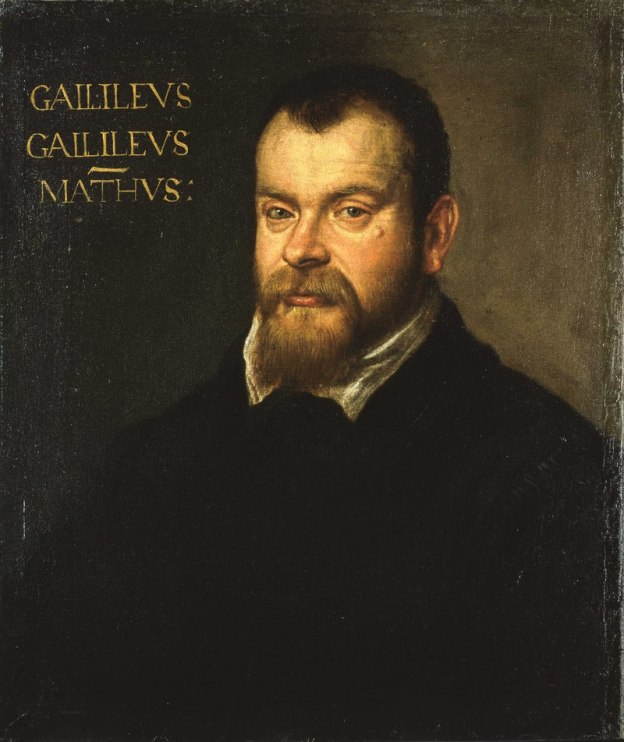
Galileo Galilei pictured in his early 40s c. 1600.

Return to Normalcy

Over the last week, I've been thinking about the standards we define to cast a model of normality, or in an older term normalcy. This week then, I try to answer the question of what even is normal? — Click here to support the Wednesday Blog: https://www.patreon.com/sthosdkane


Over the last week, I’ve been thinking about the standards we define to cast a model of normality, or in an older term normalcy. This week then, I try to answer the question of what even is normal?


One of the great moments of realization in my life to date was when it occurred to me that everything we know exists in our minds in relation to other things, that is to say that nothing exists in true isolation. The solar eclipse I wrote about last week was phenomenal because it stood in sharp contrast to what we usually perceive as the Sun’s warmth, and a brightness which both ensures the longevity of life and can fry anything that stares at it for too long. So too, we recognize the people around us often in contrast to ourselves. Everyone else is different in the ways they walk, the ways they talk, the ways they think and feel. We are our own control in the great experiment of living our lives, the Sun around which all the planets of our solar system orbit.

There is a great hubris in this realization, as a Jesuit ethics professor at Loyola said to my Mom’s class one day, in a story she often recounts, no one acts selflessly, there’s always a motive for the things we do. That motive seems to be in part driven by our desire to understand how different things work, how operations can function outside of the norm of our own preferences or how we would organize them. I might prefer to sort the books on my shelves by genre, subgenre, and then author; history would have its own shelf with the history of astronomy in its own quadrant of that shelf and Stillman Drake’s histories of Galileo set before David Wootton’s Galileo: Watcher of the Skies. Yet, at the same time I could choose to add another sublevel of organization where each author’s titles are displayed not alphabetically but by publication date. So, Stillman Drake’s Two New Sciences of 1974 would be placed before his 1978 book Galileo At Work.

This shelving example may seem minor, yet one can find greater divergence in book sorting than just these small changes here or there. My favorite London bookseller, Foyle’s on Charing Cross Road, was famous for many decades for the eccentricities of organizing the books on their shelves by genre, yet then not by author but by publisher. This way, all the black Penguin spines would be side-by-side, giving a uniform look to the shelves of that establishment. It is pleasant to go into Foyle’s today and see on the third floor all the volumes of Harvard’s Loeb Classical Library side-by-side with the Green Greek volumes contrasting with the Red Roman ones on the shelves below. Yet to have books organized by publisher when the average reader is more interested in searching for a particular author seems silly. Yet that was the norm in Foyle’s for a long time until the current ownership purchased the business.

Our normal is so remarkably defined by our lived world. In science fiction, bipedal aliens who have developed societies and civilizations are called humanoid, in a way which isn’t all that dissimilar from how the first generations of European explorers saw the native peoples of the Americas. André Thevet wrote in his Singularitez, the book which I’ve translated, that the best way he could understand the Tupinambá of Brazil was by comparing them to his own Gallic ancestors at the time of Caesar’s conquest of Gaul in the first century BCE. Even then, an older and far more ancient normal of a time when he perceived that his own people lived beyond civilization was needed to make sense of the Tupinambá. The norms of Thevet’s time, declarations of the savagery of those who he saw as less civilized for one, are today abnormal. Thus, our sense of normal changes with each generation. For all his faults and foibles, Thomas Jefferson got that right, in a September 1789 letter to James Madison, Jefferson argued that “by the law of nature, one generation is to another as one independent nation to another.” Thus, the norms of one generation will both build upon and reject those of their predecessors.

At the same time that we continue to refer to the aliens of fiction in contrast to ourselves, we have also developed systems of understanding the regulations of nature that build upon the natural world of our own planet. The Celsius scale of measuring temperatures is based on the freezing point of water. At the same time, the Fahrenheit scale which we still use in the United States was originally defined by its degrees, with 180 degrees separating the boiling (212ºF) and freezing points (32ºF) of water. the source of all life on our own planet and a necessary piece of the puzzle of finding life on other planets. I stress here that that water-based life would be Earthlike in nature, as it shares this same common trait as our own. So, again we’re seeing the possibility of other life in our own image. Celsius and Fahrenheit then are less practical as scales of measurement beyond the perceived normalcy of our own home planet. It would be akin to comparing the richness of the soils of Mars to those of Illinois or Kansas by taking a jar full of prairie dirt on a voyage to the Red Planet. To avoid this terrestrial bias in our measurements, scientists have worked to create a temperature scale which is divorced from our normalcy, the most famous of these is the Kelvin scale, devised by Lord Kelvin (1824–1907), a longtime Professor of Natural Philosophy at the University of Glasgow in Scotland. Kelvin’s scale is defined by measuring absolute 0. Today, the Celsius and Fahrenheit scales are both officially defined in the International System of Units by their relations to the Kelvin scale, while still calculating the freezing point of water as 0ºC or 32ºF.

In this sense, the only comparison that can be made between these scales comes through our knowledge of mathematics. Galileo wrote in his 1623 book Il Saggiatore, often translated as The Assayer, that nature, in Stillman Drake’s translation, “cannot be understood unless one first learns to comprehend the language and interpret the characters in which it is written. It is written in the language of mathematics, and its characters are triangles, circles, and other geometrical figures.”[1] I love how the question of interplanetary communication in science fiction between humanity and our visitors is often answered mathematically, like the prime numbers running through Carl Sagan’s Contact which tell the radio astronomers listening in that someone is really trying to talk to them from a distant solar system. There one aspect of our own normalcy can act as a bridge to another world’s normalcy, evoking a vision of a cosmic normal which explains the nature of things in a way that would have made Lucretius take note.

I regret that my own mathematical education is rather limited, though now in my 30s I feel less frustration toward the subject than I did in my teens. Around the time of the beginning of the pandemic, when I was flying between Kansas City and Binghamton and would run out of issues of the National Geographic and Smithsonian magazines to read, I would sit quietly and try to think through math problems in my mind. Often these would be questions of conversions from our U.S. standard units into their metric equivalents, equivalents which I might add are used to define those U.S. standard units. I’ve long tried to adopt the metric system myself, figuring it simply made more sense, and my own normal for thinking about units of measurement tends to be more metric than imperial. That is, I have an easier time imagining a centimeter than I do an inch. I was taught both systems in school, and perhaps the decimal ease of the metric system was better suited to me than the fractional conversions of U.S. Standard Units, also called Imperial Units for their erstwhile usage throughout the British Empire.

In his campaign for the Presidency in 1920, Republican Warren G. Harding used the slogan “Return to Normalcy.” Then and ever since, commentators have questioned what exactly Mr. Harding meant by normalcy. I think he meant he wanted to return this country to what life had been like before World War I, which we entered fashionably late. I think he also meant a return to a sort of societal values which were more familiar to the turn of the twentieth century, values perhaps better suited to the Gilded Age of the decades following the Civil War which in some respects were still present among his elite supporters. I remember laughing with the rest of the lecture hall at the presentation of this campaign slogan, what a silly idea it was to promise to return to an abstract concept that’s not easily definable. Yet, there is something comforting about the idea of there being a normal. I’ve looked for these normalcies in the world and seen some glimpses of it here or there. Perhaps by searching for what we perceive as normal, we are searching within our world for things we have crafted in our own image. We seek to carry on what we have long perceived as works of creation, the better to leave our own legacy for Jefferson’s future generations to use as foundations for their own normal.


[1] Galileo Galilei, Discoveries and Opinions of Galileo, (Garden City, NY: Doubleday Anchor Books, 1957), 238.


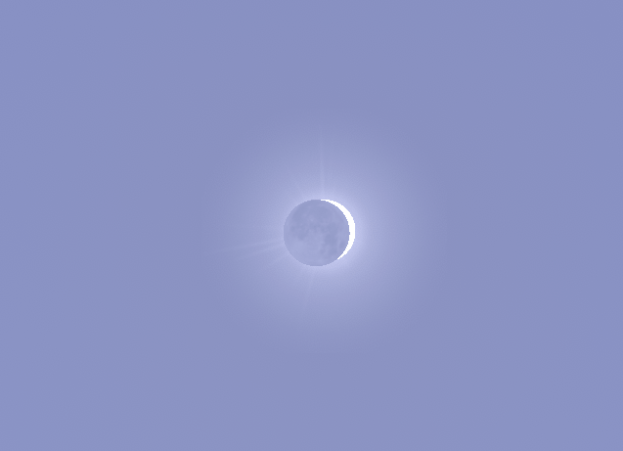
Eclipse simulation using Stellarium

The Eclipse

This Monday, North America experienced its second total solar eclipse in the last decade. — Click here to support the Wednesday Blog: https://www.patreon.com/sthosdkane


This Monday, North America experienced its second total solar eclipse in the last decade.


I remember being over-the-moon excited when we began preparing for the Total Solar Eclipse in August 2017. Several weekends before the eclipse, my parents and I drove north from Kansas City into the path of totality to scout out possible places where we might travel on Eclipse Day to see the phenomenon for ourselves. Eclipse Day 2017 also happened to be my first day as a history graduate student at the University of Missouri-Kansas City. That morning a sudden summer thunderstorm rolled through Kansas City and as the day continued the clouds persisted in our skies. When the moment of totality arrived around 12:55 pm on 21 August, we watched it through darkened clouds and heard the birds and insects around us revert to their nocturnal states and songs.

I was excited to have experienced a total solar eclipse yet disappointed that I wasn’t able to see it. So, when the prospect of traveling for this week’s total solar eclipse appeared, I seriously considered going afield to Texas to observe it. That trip didn’t end up working out because of a series of scheduling conflicts, and so instead seeing that the cloud forecast across North America called for most places along the path of totality to be obscured, I decided to stay here in Kansas City and observe our partial solar eclipse. At its greatest extent, the April 2024 solar eclipse reached about 90.5% totality. I was able to see that extent, yet the feel of it was quite different than 100% totality from seven years ago. We were watching Everyday Astronaut and the Planetary Society’s live broadcast from the Society’s Eclipse-o-rama event in Fredericksburg, Texas while observing the eclipse here at home, and what they experienced was far more dramatic than what we observed. I do regret not travelling for this eclipse, yet at the same time in the circumstances as they fell, I’m glad I chose to stay home all the same.

This concept of an eclipse is one that speaks to me both astronomically, as a big space nerd, historically, and linguistically. Eclipses are phenomena that have made their mark on the psyche of more than just us humans, note how the birds began singing their twilight songs when the Moon passed in front of the Sun. I have never put much theological potency into eclipses because we have been able to predict their occurrences with increasing accuracy for generations now. Religion, in many ways, relies on our perceptions of things. Some see in an eclipse a threat to divine order in the Cosmos. This view reminds me of Mozart’s final opera, near to my favorite of his works, Die Zauberflöte (The Magic Flute) in which the Queen of the Night is defeated by Sarastro, the high priest of the Temple of the Sun. Sarastro proclaims victory for the good and right, singing: 

Die Strahlen der Sonne

Vertreiben die Nacht.

Zernichtet der Heuchler

Erschlichende Macht.

The rays of the sun

Drive away the night.

Destroyed  is the hypocrites’  

Surreptitious power.

(Source: Aria-Database.com, trans. Lea Frey)

Sarastro’s triumphant finale in Die Zauberflöte sung by Josef Greindl with the RIAS Symphonie-Orchester Berlin.

The divine hand is better seen in the wisdom of devising a manner to mathematically ascertain the revolutions of these celestial orbs, to borrow the title of Copernicus’s magnum opus, De revolutionibus orbium coelestium. In our ability to ascertain our surroundings, and to make sense of nature we see a loving design.

Still, knowledge of the movements of the Sun, planets, moons, and stars across our night skies have had their impact in our history. During his fourth voyage, on 1 March 1504, after 9 months stranded in Jamaica, Christopher Columbus (1451–1506) used his knowledge of eclipses from an almanac he brought with him written by the Castilian Jewish astronomer Abraham Zacuto (1452 – c. 1515) to inspire the Taíno caique of that part of Jamaica to give Columbus’s men food and provisions. Columbus wrote in his journals that he pointed at the Moon and told the Taíno that “God caused that appearance, to signify his anger against them for not bringing the food” to Columbus and his men.[1] Several years ago then, when discussing this story with a friend and fellow Renaissance historian, I decided to use the Stellarium astronomy program to simulate this lunar eclipse as Columbus and those with him in Jamaica saw it. Our ability to track the movements of these celestial orbs is good enough that our computers can show exactly what was visible in the night sky (baring any atmospheric data) at any moment in the past or future.

My simulation of the March 1504 Lunar Eclipse as seen from St. Ann’s Bay, Jamaica using Stellarium.

This ability to calculate the dates and locations of eclipses came in handy when researchers look at mentions of eclipses in ancient literature to seek to date the events of the stories. Plutarch and Heraclitus both argued that the Odyssey contains “a poetic description of a total solar eclipse,” which astronomers Carl Schoch and P.V. Neugebauer proposed matched an eclipse which occurred over the Ionian Sea on 16 April 1178 BCE, though a more recent article in the Proceedings of the National Academy of Sciences by Constantino Baikouzis and Marcelo O. Magnasco offer doubts concerning this proposition owing to the difficulty of finding exact matches in spite of centuries of the Odyssey‘s transmission through the oral tradition before it was written.[2] Still, that eclipses are so readily discernible and measurable with our mathematics speaks to the potential that they could be used to date moments long remembered only in heroic literature like Odysseus’s return to Ithaca in Book 20 of the Odyssey (20.356-57). In this effort, where others divine gods, we make tools out of the Sun and Moon to better understand ourselves.

The way we describe an eclipse speaks to our culture’s relationship with the phenomenon. Our Modern English word derives from the same word in Old French, which developed from the Latin eclīpsis, which in turn was borrowed from the Ancient Greek ἔκλειψις (ékleipsis), which comes from the verb ἐκλείπω (ekleípō)meaning to abandon, go out, or vanish.” Eclipse eclipsed the Old English word āsprungennes, which derives from the past participle of the verb āspringan, meaning “to spring up, to spread out, to run out, to cease or fail.” As an adjective, āsprungen meant that something was defunct or deficient, so perhaps this sense of an eclipse meant that it seemed for a moment as though the Sun had run out of energy and ceased to burn? Again, this speaks to the idea that nature had limits as humanity does, to an older understanding of nature from the perspective of a limited human lifespan. 

In Irish, there is the Hellenic word éiclips, yet there’s an older Gaelic word which means the same thing, urú. Now, usually students of the Irish language will learn of urú in the context of Irish grammar, an urú or eclipsis is one way that Irish handles both consonant clusters and situations when one word ends in a vowel and the following word begins with another vowel. So, in that sense the word gets eclipsed by this urú which preserves some of the integrity of the language. Yesterday’s eclipse then was less an urú focail (word eclipse) and more a urú gréine (solar eclipse). That both the Sun and the words we speak in Irish can be eclipsed makes this astronomical phenomenon all the more ordinary and measurable. 

We use this word eclipse beyond astronomy in many cases; it seems to me today that the old guard of the Republican Party has been eclipsed by an orange political pulsar whose violent rhetoric and chaotic behavior have eaten away at their party’s support in these last 8 years, not unlike a pulsar discovered by NASA’s Swift and Rossi X-Ray Timing Explorer satellites in 2007. An eclipse is something wonderous to behold yet ordinary in how readily we can predict when they will appear. They have given us a great deal of cultural qualifications that continue to influence how we see our world.

On Monday then, when the sky began to darken as the Moon passed in front of the Sun, I noticed that the color spectrum that I’ve always known began to change. Before my eyes the colors seemed to take on a sort of metallic glow, as if the light which illuminated them was shifting into a spectrum that seemed unnatural to the natural world I’ve known. The Sun is fundamental to how we understand the world around us. Its light is what illuminates our senses, and without it, or even with partial changes to its glow, we would find ourselves observing a very different world.


[1] Christopher Columbus, “The Fourth Voyage,” Select Letters of Christopher Columbus: With Other Original Documents Relating to the Four Voyages to the New World, trans. and ed. R. H. Major, (London: Haklyut Society, 1847), 226.

[2] Constanino Baikouzis and Marcelo O. Magnasco, “Is an eclipse described in the Odyssey?” Proceedings of the National Academy of Sciences 105, no. 26 (2008): 8823–8828, nn. 1, 12–14.


A Matter of Grammar

This week, after going down the rabbit hole of the Chicago Manual of Style's monthly Q&A newsletter, I thought I'd talk a bit about grammar. — Click here to support the Wednesday Blog: https://www.patreon.com/sthosdkane


This week, after going down the rabbit hole of the Chicago Manual of Style‘s monthly Q&A newsletter, I thought I’d talk a bit about grammar.


One of my favorite newsletters to read is the Chicago Manual of Style‘s monthly Q&A email which tries to answer some pressing questions regarding the English language in this particularly formal academic setting that I often write in professionally. We historians in the United States use the Chicago Manual of Style as our main style guide, both for its system of extensive footnotes and for its grammatical rules. I am familiar and have used several other systems, including the AP Style Guide, and the MLA, APA, and Harvard citation systems, yet my preference remains Chicago for its clarity. Chicago is the preferred style guide for us historians as well as the basis of the style used by the American Anthropological Association.

English is an unusual language in that we don’t have a single central authoritative language academy as does French, Spanish, Irish, and German. Our best bet is to see what our two major dictionaries say: the Oxford English Dictionary and the Merriam-Webster Dictionary. The former is the standard in the United Kingdom and throughout the Commonwealth, while the latter is the American standard developed first during the Early Republic when its initial author Noah Webster sought to better differentiate American English from its imperial counterpart, the better to craft a specifically republican national language fit for our young Union. I’ve had my problems with Webster’s dictionary for a while now in part because I don’t see the point of most of his spelling reforms, and for a good part of my teens and twenties I used British spellings over American ones. Today though, I’ve reverted to the American standards in what might well be a sign of my general weariness of the constant fight over so many different topics and issues; this was one that fell by the wayside.

This month then, the Chicago Manual‘s Q&A included a question about whether it was fine for an academic writer to write in the first or second person, to use the pronouns I and you. We are taught to always restrict our writing to the third person, to avoid the subjectivity that is implicit in the first person. I’ve begrudgingly accepted this, to the extent that amid the 96,276 words that comprise the ninth draft of my dissertation only three of those are the pronoun I. All three instances where I drift into the first person are in the footnotes where it is necessary to explain my decisions regarding certain translations or connections that would otherwise not be possible in the English language. By contrast, I use this pronoun a great deal here in the Wednesday Blog, where I am writing to you, dear reader, in a more personal manner that I hope is evident in this text. Of the 189,993 words that I’ve written for the Wednesday Blog before this week, 3,360 of those are the pronoun I.

The response in the Q&A about using the pronoun I spoke to that concern for subjectivity, yet also spoke of a need that our academic writing ought to be “more lively and personal.” I see both sides of this, more and more books written by my fellow academics do include more of the first person in them, yet at the same time Kate Turabian’s writer’s manual––an abridged version of the Chicago Manual––suggests that writers “avoid beginning your sentences with I believe or I think (which go without saying).” I am often frustrated to hear people use fillers like these, or like “it goes without saying,” or “to be honest,” when those are things I hope they would be adhering to in the first place. On the other hand, I’ve heard papers at conferences where the author reads out “this author finds that _____,” which sounds ludicrous. Two weeks ago, at the Renaissance Society of America’s conference I did make it clear where I was presenting my own theories based on the evidence that my primary sources provided. A spoken context is different than a written one, not only can there be more repetition of material to bring a point home, one can also use more personal elements, bring oneself into the topic and show the audience why they ought to care about it the way you do.

Academic writing is quite formal, and it follows set patterns and standards. It is in many ways an intricate dance, whether a waltz or an older minuet, which we follow in order to write to one another in the same methods and manners that we will all recognize. One may want to deconstruct some of these Elements of Style, to borrow a title, yet those standards exist to facilitate communication. Language proscription has its place along with all the innovations that happen each and every day in speech and writing. I might use this pronoun more in my academic writing in the future, especially if I choose to write a prologue which tells my reader why I am fascinated by a topic that will invite them to consider it as well.

I would like it if there were an English Language Academy in the same vein as the Académie Française, yet I would prefer to have a say in its decisions. Is that bold of me, sure. Yet that academy’s function is best served by the continued writing and publication of those of us who use the English language to express our thoughts on a daily basis. For every article or book I submit for publication about the history of animals in the Renaissance there will be countless other works published in all manner of settings which demonstrate the versatility of this language and its uses. We academics have just as much a claim to it as anyone else, and my own English is not everyone’s English. Still, we have our common grammar that keeps this language together, and that is something worthwhile.


Corrections

3 April 2024: Soon after publication, I corrected this week’s blog post for grammar, naturally.

On Technology

Last week, I returned to Chicago, this time on a business trip to attend a conference, and on the way took time to slow things down and enjoy the lived experience. — Click here to support the Wednesday Blog: https://www.patreon.com/sthosdkane


Last week, I returned to Chicago, this time on a business trip to attend a conference, and on the way took time to slow things down and enjoy the lived experience.


On Wednesday last week I boarded Amtrak’s Southwest Chief at Kansas City Union Station bound for Chicago. This visit to the metropolis of my birth was less for family affairs and instead for business. I spoke on Friday at the Renaissance Society of America’s conference at the Palmer House Hotel about how toucans were seen by sixteenth-century French merchants as economic commodities first and foremost. It was an unusual topic, but one that fluttered enough feathers in the organizers to earn me a travel grant from the RSA and a matching grant from my own History Department back in Binghamton to cover about half of my overall expenses for the trip.

In recent months, as I’ve had this trip and all the other ones planned in 2024 in mind, I’ve found myself growing evermore tired of being in constant contact with people near and far. Our technology allows us to make wonders, and to inspire ourselves to newer and greater heights with those wonders, yet I’ve found myself asking more lately how much we really ought to rely entirely on our technology? Every so often throughout the year I will find myself with a physical book, whether a paperback or a hardcover, that seems appealing, and I’ll stop and read. I used to read constantly. 

When I was in elementary school my grandparents gave me their 1979 World Book Encyclopedia set that had gone through several moves with them over the years. That year, feeling the effects of insomnia for the first time that I can remember in my life, I often stayed up late in my room reading these encyclopedia volumes. My parents eventually gave that set away, admittedly now the knowledge contained in them is 45 years out of date, it still showed Jimmy Carter as the sitting President, yet I remain forever grateful for that gift in all its thousands of pages. I can still remember the smell of those books in particular, and the charming and sometimes funny black-and-white pictures they contained.

Later, when I was in middle school I read several large and complex books in a row, including Thomas Kinsella’s translation of the Táin Bó Cúailnge, an Irish epic set 2,000 years ago, and Frank Delaney’s book Ireland: A Novel, which my Dad bought for me at a Hudson’s in O’Hare on the way back from another trip up to Chicago to see family during my eighth grade year. Perhaps the last of these memories of endless hours reading for fun was in preparation for the release of the last Harry Potter book, the Deathly Hallows, when I read the other 6 books in 3 days.

All of this changed when I started high school. I chose St. James Academy for two main reasons: they offered Latin as a foreign language, and they offered MacBooks for all of their students. With easier internet access than ever before and the creation of YouTube around that time, I found myself hooked reading more things online and watching videos. Today, I’m often more likely to open YouTube on my computer during some downtime than I am to pull up a book on my phone. I’ve gone through waves of enjoying reading books on my phone here and there, yet these are again just waves.

I spoke to my friend, Carmelita Bahamonde, who I’ve known now for over a decade since we met as undergraduates at Rockhurst University. She gives up her social media accounts every year for Lent, and now during Holy Week is nearing the end of that technological fast for its 2024 occurrence. 

Seán: “I worry that because it’s how I connect with so many people professionally, and cousins in Europe and across the United States, that it’ll minimize how much I’m in touch with them.”

Carmelita: “Yeah, I do, and I do take time off during Lent, yet I take it further, so the longest I’ve gone was to the end of June and start of July. It’s hard to keep that up.”

Seán: “June or July! That’s a long time to keep that up.”

Carmelita: “Yeah, the first time I did it I think I made it through May, and I came back for my Masters, and I decided this was something to come back for.”

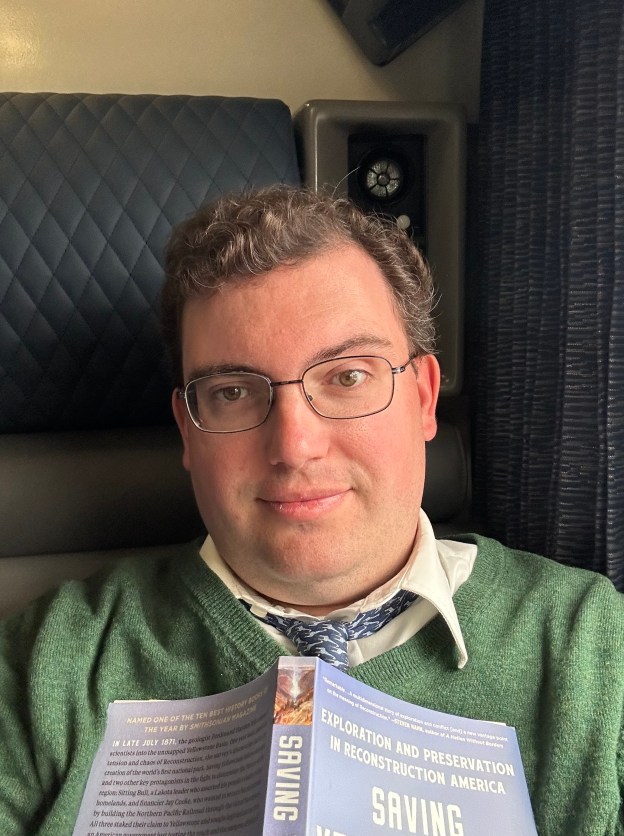
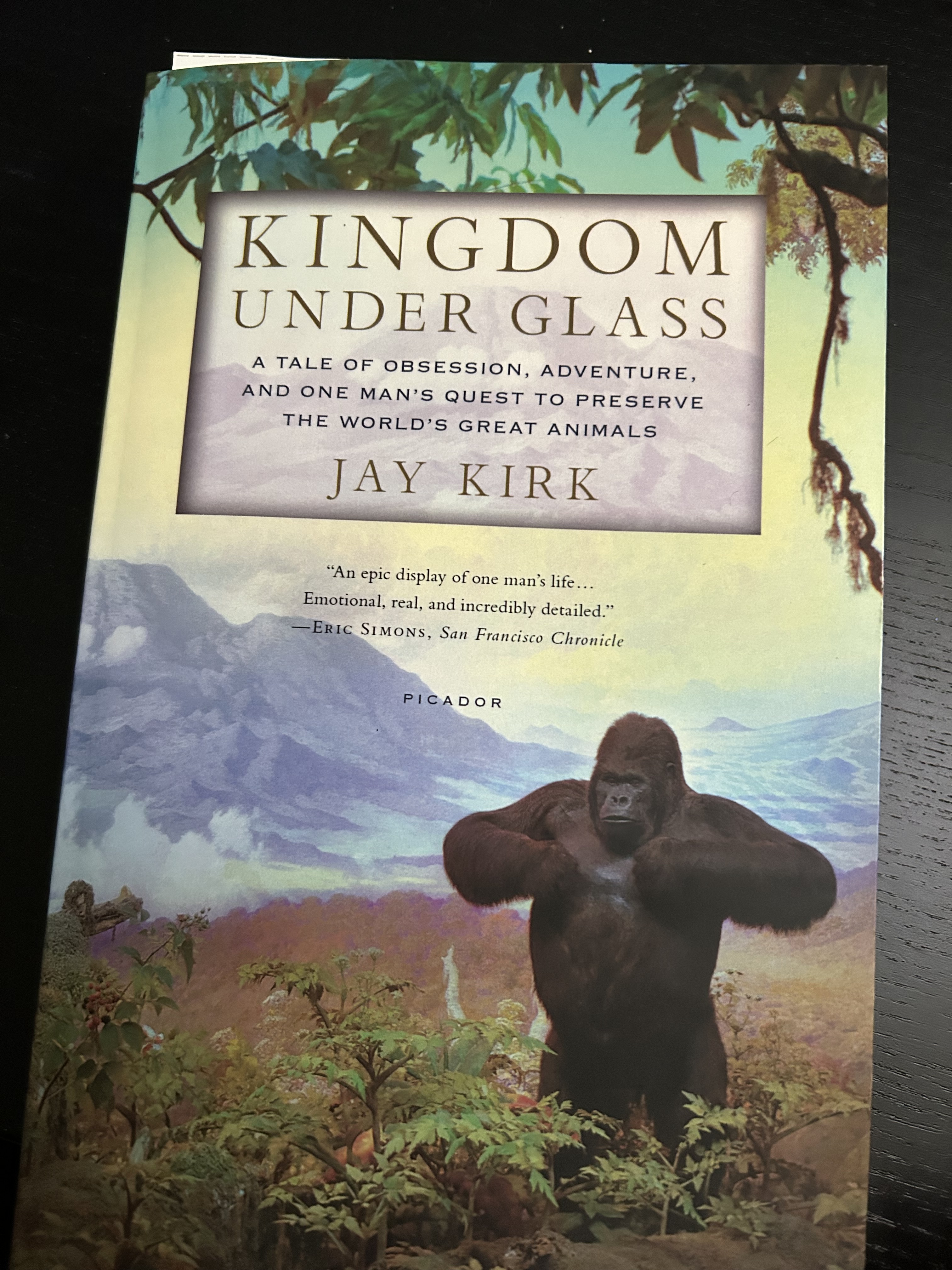
So, when I saw that I could afford to purchase roundtrip sleeper tickets on the Southwest Chief for this trip, I jumped at the opportunity to not only enjoy the best that Amtrak’s western services have to offer, but to also enjoy 7 hours of disconnection from my technology. I spent those 7 hours reading Megan Kate Nelson’s book Saving Yellowstone about the first federal expeditions to the Yellowstone Basin, the building of the Northern Pacific Railroad, the decline of the Lakota’s autonomy, and the foundation of Yellowstone National Park. I brought two other books, three magazines, and all the books downloaded on my phone with me on this trip, figuring I’d have a fair bit of time to read. (On the return trip, rather than reading the materials I brought with me I ended up reading a book I bought in Chicago at the Field Museum’s bookstore by Jay Kirk called Kingdom Under Glass: A Tale of Obsession, Adventure, and One Man’s Quest to Preserve the World’s Great Animalsabout Carl Akelely, the first Taxidermist-in-Chief at the Field Museum. I’m going off script here to say how wonderful it is.)

Seán: “And, I know people who have very full and happy and lovely lives and they’re not on social media, so it’s not necessary to be on it. Yet, it seems that’s how people connect nowadays, right?”

Carmelita: “Yeah, though I only post happy, lovely things, even when I’m at my lowest. So, I always see that so and so is travelling, and man I’m falling behind this year. Yet I wonder how much over time they’ve been doing this year that they can do that?”

Beyond even disconnecting to read, I feel a pull towards stepping back a bit from my complete adoption of all of this technology. I see myself looking more at the screens before me than at the world around me. A friend recently pointed me toward a book which considers that the decline in recreational bowling leagues in this country can be tied to an overall decline in a communal spirit and a deconstruction of our bonds of trust, which have contributed to the current sense of mass isolation, fear, and mistrust which have contributed in turn toward our present political paradigm. I haven’t read this book yet, to be clear, yet I see how the premise works. I love coming to conferences like the RSA to experience the community that these events foster. There are people here who I met last Fall at the Sixteenth Century Society Conference in Baltimore or last March at the 2023 RSA in Puerto Rico. I’ve had the opportunity to tell people here how much I appreciate their work, and to talk a bit about my own, to hear the affirmations that I so often miss in my daily life about the actual research I do.

Carmelita: “Yeah, you have both positives and negatives, you get to connect with family and peers who are far away, yet you also can lose yourself in our technology.”

We could certainly meet remotely using our technology to foster connections, yet those bonds would be far less strong than they are now that we’ve met and know some more about each other. Our technology allows us to instantaneously talk with people whole continents and oceans away, even to the astronauts orbiting our planet on the International Space Station. It has allowed us to even communicate with our furthest satellites that have reached far beyond where any human has gone before. Yet those connections are proxies for the real, physical connections we inherently desire by our basic evolutionary biology. I have trouble sometimes overcoming my own shyness in public settings, I certainly felt that at certain points on this trip, at times I’ve found conferences unbearable because I don’t feel up to talking to people I don’t already know, even when I’ve read and enjoyed their work. I do feel I would be more comfortable in these situations if I were less technologically connected and more connected to the human.

Seán: “What are some alternatives to social media that you’ve found useful?”

Carmelita: “I still have [Facebook] Messenger on my phone, so I use that to stay in touch with people. I sent a message this year to my friend in the Netherlands to say ‘Hey, just to let you know I’m taking my yearly break from social media,’ and she said ‘hey, no problem,’ and she’ll continuously text me and send me things, and my parents will show me things on social media if they’re really necessary. The people who, like you, really want to stay in touch will do so, and I really appreciate that.”

Seán: “It speaks to Robin Dunbar, who’s a primatologist and sociologist, who wrote about this idea called Dunbar’s number where there’s this maximum number that a human can have in their social circles, and I think it really speaks to that culling of that number. I’ve probably got 1700 friends on Facebook, and excluding family which is 30-40 people, there might be 10 people who I stay in touch with, and you’re one of them.”

Carmelita: “Yeah, and you are too. And I’ve actually had people reach out to me in the past and say ‘Hey, I haven’t seen anything from you, are you actually alive?’ and I’ll reply, ‘Hey, yeah I’m actually kind of better!'” (laughs)

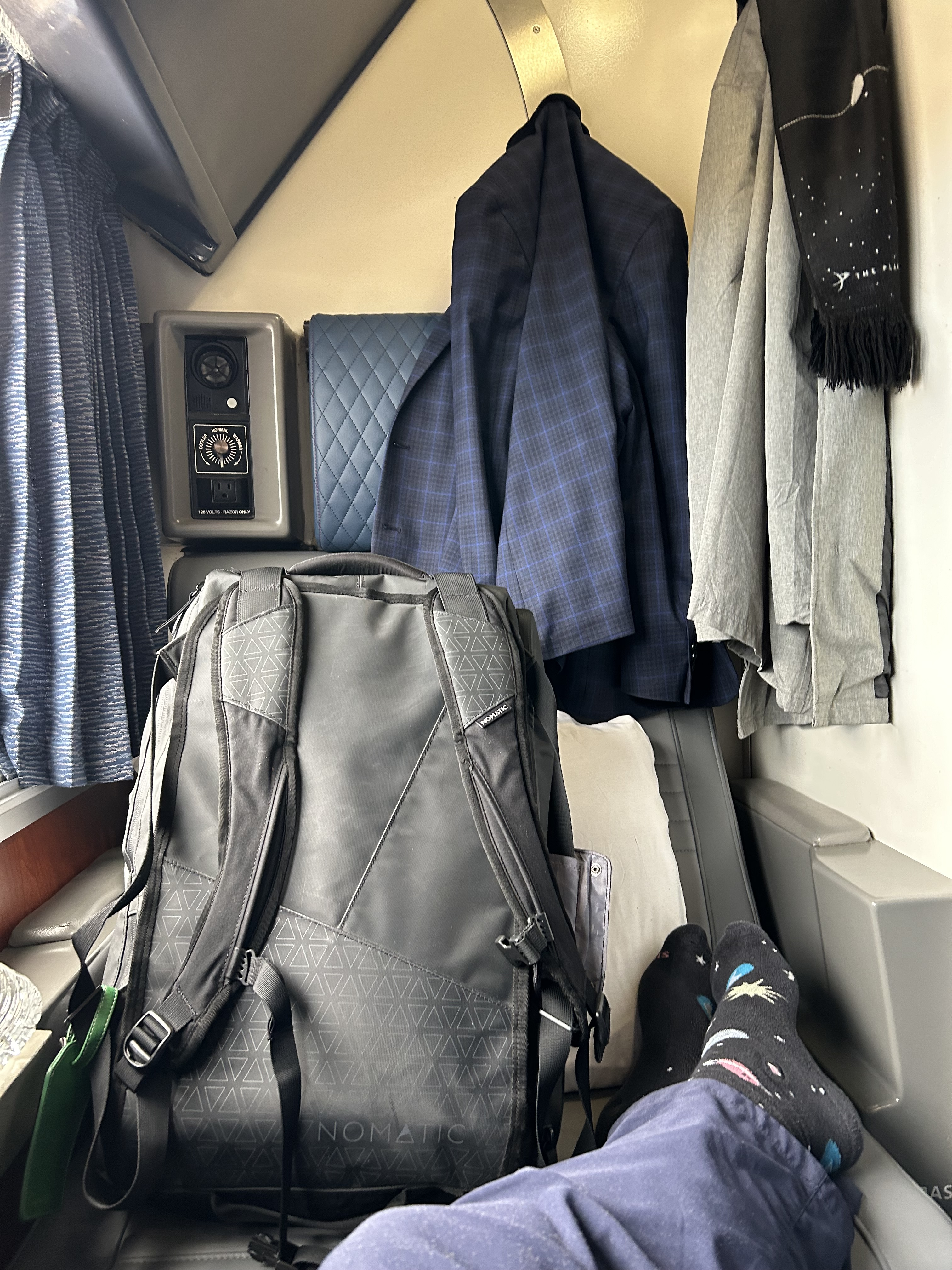
My roomette on the Southwest Chief on the way up to Chicago.

I admire my friends and family who can give up some of this technology for extended periods of time. There are things to appreciate about the connectedness our technology provides to be sure, I appreciate seeing the social media posts of those who I care most deeply about, yet within that outer circle there are the few who I see on a daily basis, and I wonder how much I really pay attention to them, or them to me, with these screens in front of us all the time?

It strikes me that more often than not, when I’m mindlessly scrolling through YouTube on a given evening at home, I’m often finding the same music as I had the evening before, listening to the same songs or variations of those songs over and over again. Those songs evoke certain emotions for me, emotions tied to dreams and memories both. Yet I ought to really be focused on the people around me, for as much as our creations may have achieved a sense of immortality with their technological life spans far outpacing our own, those whom I love will only be with me for so long.

Carmelita: “It feels like if you didn’t post it, it didn’t happen; and so last year I went on a family trip, and at the end of the year I didn’t have any pictures and it feels like it didn’t happen, so that’s why I appreciate my social media. Yet like you said earlier today, you don’t have to post everything.”

There ought to be a balance between connection and relief, between all our noise and the silence, which is an acquired taste to be sure, yet is beautiful in its own way. I appreciate the assistance that my technology can provide in my work; it is far easier to do my research using PDF copies of these sixteenth-century books than having to rely on quickly written notes made during a rare research trip to a distant library. When I did my first research trip as an undergrad in 2013 to the Library of Congress, I actually took handwritten notes of the books I read. I quickly realized it was far more efficient to take notes by computer, to type things out at 70 words per minute than to write them by hand in my elegant if at times slow cursive script. This has meant that in the 11 years since I’ve found myself writing by hand less and less, even perhaps risking the loss of the art of penmanship, and calligraphy (if I may be bold to call it that).

Seán: “What’s the underlying purpose of posting? Is it self-gratification, is it to say ‘look what I did!’ is it say ‘look at how cool I am,’ or something like that? I always try to think of the underlying reasons for what I do.”

Carmelita: “I once had a friend who asked me why I post everything, and I said ‘well, I wanted to post pictures of this trip,’ and I think it’s a good way to show what I’m doing to more distant family who I haven’t seen in twenty years. I do sometimes wonder, ‘is this for showing off?’ I don’t like to post things that are show-offy. Several years ago, I got a promotion at work and I wanted to post about it but I sat on it for a while and ended up deleting it because I can’t brag, and so it is a double-edged sword, because you don’t want to brag but you should at the same time. It comes down to perspective: who do you want to know about your successes? Graduating from my Masters, I wanted everyone to know, ‘hey, look I worked my butt off!’ but a trip to Disney isn’t something for everyone to see.”

Let me close with this: I could have all the efficiency in the world with my computer and smart watch and smart phone and voice-activation software in my car and my headphones that connect wirelessly to my other devices so I can talk and take notes on my phone at the same time. I can learn so much from watching all the videos anyone has ever made on a subject and imagine wonders I might never otherwise consider with the invention of film, television, and the videos we upload to the internet. Yet none of it is as rewarding or as joyous as seeing a friend smile, and feeling the warmth of our interaction in that one specific moment in which we are living. Perhaps we need a little more of our human nature in our lives after all.

Seán: “Let me ask you one final question and then we’ll get back to lunch here, this meatball sandwich is giving me a look: do you think technology makes us more or less human? If you think about how we originally evolved in our nature as humans, as Homo sapiens, as wise people, as learned people, and yet do our creations diminish our base humanity if we’re too focused on them?”

Carmelita: “I think it depends on what you post on social media and if you’re fake about them. We talk about influencers who post amazing photos but are broke because of it, then it’s not worth it. Social media allows us to stay connected, and that’s a wonderful thing. So, as long as you’re being true to yourself then that’s the key.”

Seán: “Excellent, I like the connection between philosophy and real life there.”


Finally, for your viewing pleasure my view facing north crossing the Mississippi at Ft. Madison, Iowa.

Correction

Corrected on 28 March 2024 to reflect the correct spelling of Carl Akeley’s name. I’ve misread it now for 31 years as Akerely.

The Essence of Being

This week, to begin Season 4 of the Wednesday Blog podcast, I want to talk about what it means to exist. I know, small topic for a Wednesday. — Click here to support the Wednesday Blog: https://www.patreon.com/sthosdkane


This week, to begin Season 4 of the Wednesday Blog podcast, I want to talk about what it means to exist. I know, small topic for a Wednesday.


Two weeks ago, I started teaching a new class that I’m calling Bunrang Ghaeilge, Beginner Irish. The students come from my fellow members of the Fr. Bernard Donnelly Division of the Ancient Order of Hibernians and their relatives, and in the first two weeks we’ve progressed slower than I initially expected yet we’re still progressing through the materials. The first verb which I taught my current students in English translates as to be, yet in Irish as two forms: is for a more permanent being and  in a more impermanent circumstance. In the moment I explained this difference by noting how I say is as Chicago mé (I am from Chicago), as in I was born in the Chicago area, but I say tá mé i mo chónaí in Kansas City (I live in Kansas City). We don’t have this distinction in English, either between the permanent and impermanent versions of the to be verb or in the clear distinction between where you’re from at birth and where you currently live; that distinction is far more subtle in English.

At the same time, I am learning Italian for a trip this summer, my own version of the Grand Tour, and on the Busuu app where I’m learning Italian they taught that I should say sono di Chicago però abito a Kansas City,as in I was born in Chicago, but I inhabit today in Kansas City. This distinction between a place that is central to our essence, the place where we were born, and the place where we now live seem important, yet it flies in the face of the American sense of reinvention that we can make ourselves into whomever we want to be. It’s struck me when I’ve met people who would rather see themselves as from the place where they currently live than the place where they were born. That is a different view from my own, born out of different lived experiences and different aspirations.

This word essence developed from the Latin word essentia, which the 1st century CE Stoic philosopher Seneca wrote was coined by the great orator Cicero as a translation of the Greek word οὐσία (ousia), a noun form of the Ancient Greek verb εἰμί (eimi), meaning “to be.” (Sen., Ep. 58.6) It refers to an innate idea that the ultimate goal of philosophy and learning in general is to better understand the self; the most famous inscription in the ancient Temple of Apollo at Delphi read γνῶθι σαυτόν (gnōthi sauton), or “know thyself.” I add to that goal the aspiration that one can improve oneself. 

This time of year, I find myself thinking more and more about what it means for me to be an Irish American. This past weekend we celebrated St. Patrick’s Day, a day of great celebration for the global Irish diaspora and our cousins back in Ireland as well. I’ve written before here about how my communities’ immigrant connections to Ireland often predate the current century, if not the twentieth century as well and how we are in many respects far more American than Irish. In recent years, I began to refer to myself in this subject as an American cousin, after all as much as I have Irish roots and I come from an Irish family, I’m an American and have lived an American life to date. I’m not as far removed from Ireland as many I know, yet this year marks the 110th anniversary of my great-grandfather Thomas Kane’s arrival in America.

There’s something about being Irish American which doesn’t quite fit neatly into any of the official boxes. In Ireland, to be Irish is to be from Ireland or to be a close enough descendant that you qualify for Irish citizenship, like my father does. In America, there’s a sense that the old stereotypes of Irish immigrants are fair caricatures to still uphold, especially on our communities’ holiday in much the same way that the sombreros are donned on Cinco de Mayo. Yet there’s a lot more to it. On both sides of the Atlantic, our communities have the same deeply intertwined connections between families near and far, friends in common, and a sense of nostalgia that I see especially strong among those of us born in America.

Perhaps the Irish language can offer the best answer here. In Irish, I’ll say to Irish people, as I wrote a few paragraphs ago, “Is col ceathrair Meiriceánach mé.” Yet the official Irish name for us Irish Americans is “na Gael-Meiriceánigh”, or Gaelic Americans. I think this speaks to something far older and deeper than any geographic or political connections. We come from common ancestors, share common histories and stories that wind their way back generations and centuries even. We are who we are because of whom we’ve come from. I hope to pass this rich legacy in all its joys and struggles onto the next generation in my family; perhaps I dream of those not yet born hoping they’ll be better versions of my own generation. I hope they’ll still feel this connection to our diaspora like I do even as we continue on our way along the long winding road of time further and further from Ireland.

I am the child of my parents, the grandchild of my grandparents, and great-grandchild of my great-grandparents. In so many ways, I am who I am today because of those who’ve come before me. The geography of my life was written by them, by a choice among other immigrants from County Mayo my ancestors found their way to Chicago instead of Boston, New York, or Philadelphia. My politics reflect my ancestors’ views as well, in the Irish context the legacies of the Home Rule Crisis of 1912-1916, the Easter Rising of 1916, the War of Independence of 1919-1921, and the Civil War of 1922-1924 all have as much of a presence in my political philosophy as does their American contemporaries: the Progressive Era and its successor in the New Deal coalition. Yet I am my own person, and from these foundations I’ve built my own house in as much of an image of the past as it is a hope for the future.

What does it mean then to be ourselves? We hear a great deal today about how people identify, in a way which seems to be a radical departure from older norms and expectations both in the English language and in how we live. We constantly seek answers to all of our questions because we anticipate that all of our questions can be answered, yet the mystery of being is one of my great joys. I love that there are always things which I do not know, things with which I’m unfamiliar and uncertain. This is where belief extends my horizons beyond what my knowledge can hold, a belief born from the optimistic twins of aspiration and imagination. I know that the essence of my being, the very fundamental elements of who I am, draw far more from these twins than any other emotion. I am what my dreams make of me, I see my world with eyes colored by what my mind imagines might be possible; and in that possibility I find the courage to hope for a better tomorrow.


The Museum

This week, to round out Season 3 of the Wednesday Blog podcast, a few words about my love for museums. — Click here to support the Wednesday Blog: https://www.patreon.com/sthosdkane


This week, to round out Season 3 of the Wednesday Blog podcast, a few words about my love for museums.


I learned about our cosmos from visiting museums and reading books as a child. Where my books could thrill my imagination into creating whisps of wonders that would dance about my mind and keep me enchanted during the quieter moments, museums offered me the physical embodiments of many of those same wonders. The older Irish word for a museum is iarsmalann, or “reliquary.” Museums, the seat of the muses of the Ancient Greek cosmos, are where we house our greatest treasures today. They are places which the public can visit and learn about our human world and the natural cosmos it inhabits. Museums are seats of knowledge where we can wonder about a great many things that otherwise would not be accessible to us.

My favorite museums to visit are the ones I return to the most. From my youth, I loved wandering the halls of Chicago’s Field Museum and Art Institute most. In the acknowledgements of my dissertation, I will note that it was in the Field Museum as a small child that I first experienced wonder, and that that is where the passion, beauty, and joy that drives my career and my life today began. One of my last truly awe inspiring visits to the Art Institute was in January 2019 on the last day of the American Historical Association’s meeting at the Hilton on South Michigan Avenue. That afternoon as I wandered around the labyrinthine halls of the Art Institute, I was struck at how endearing I found the Early Republican galleries, rooms which previously I’d been frustrated by because I still have trouble finding my way out of them. I’ve returned to the Field Museum more in the following years both to wander the halls and to remember all the joyous times I’ve had in that building as a child, a teenager, and now an adult.

Here in Kansas City, my favorite museum by far is the Nelson-Atkins Museum of Art. When we first moved to Kansas City, 25 years ago this summer, my Dad took me to the Nelson in hopes of filling that role that the Field Museum had for me back in Chicago. As I grew and matured, I found myself returning to the Nelson more and more, seeing the same art each time sure, but more so appreciating the constancy of that art than anything else. In the last six years I’ve grown to love the Kansas City Zoo & Aquarium as well; perhaps the Zoo is a better equivalent locally to the Field Museum with its dominant focus on the natural world over anything else. I think of the Zoo like another sort of museum, a living and breathing museum situated in the expansive wooded grounds of Swope Park. One of my dreams is to contribute a museum to Kansas City, ideally a natural history museum where my own particular contribution would be in a History of Science gallery.

Elsewhere, during my year in London I fell in love with many of that city’s great museums. I became a member of the British Museum and would often walk there from class and spend my afternoons wandering and loving how much I could learn there. It was on these visits to the British Museum that I decided to do my doctorate in History or Classics; I settled on History as you know, though I ended up in the Renaissance in part because of my love for the Banqueting House on Whitehall and Hampton Court Palace, two expansive palaces now turned into museums by Historic Royal Palaces. Initially, I wanted to study Roman history and focus on how the concept of Roman citizenship expanded as the Republic’s and later Empire’s borders expanded outward from the City of Rome. Yet, I instead decided to settle in the Renaissance, a period that seemed to me to evoke some aspects of the idealized Rome that I thought of while still feeling closer to home. In London too I loved my visits to the Natural History Museum and Victoria & Albert Museum in South Kensington, two that I returned to on several occasions on this most recent, if brief, visit to the British capital in October.

The more I’ve traveled, the more museums I’ve visited. In many respects they fill certain roles which I set in my mind from early on depending on their focus. In Upstate New York, if I wanted to visit a natural history museum I would go to the Museum of the Earth in Ithaca or if I wanted to wander around an art museum for an afternoon, I’d go to the Rockwell Museum in Corning or the Everson Museum in Syracuse.

I’ve been fortunate to see so many of these places and experience the life we give them amid all the relics of our past. In more ways than I probably even recognize, these museums have inspired my career, and I hope that I may contribute a verse to their songs one day.


The Columbian Exchange

The Columbian Exchange Wednesday Blog by Seán Thomas Kane

This week, I want to talk a bit about how the period I study resonates in our everyday lives through the foods we eat. — Click here to support the Wednesday Blog: https://www.patreon.com/sthosdkane


This week, I want to talk a bit about how the period I study resonates in our everyday lives through the foods we eat.


(Sound of a grill lighting.)

This week, I thought I’d record an idea that I’ve had for a while. Originally, this demonstration was going to be filmed for a course I taught last summer, but it didn’t get developed in time. So, on Tuesday afternoon when I was looking at the story I was developing for this week and saw how little I’d finished of it, thanks to my other work taking up a greater amount of my time than expected, I returned to this idea. So, here’s a synopsis of me grilling a couple burgers and talking about it.

First, I get the ground chuck burger patties out of the freezer. (frozen patties hitting the plate) Buying in bulk and freezing the beef helps keep costs down.

“Now the seasoning that I usually use for this, Lawry’s, has salt, sugar: definitely something which appeared through the Columbian Exchange from Madeira to the Caribbean and Brazil, and the spices are paprika and turmeric: those are also important with the trade connections in the 16th & 17th centuries, onion, corn starch, and garlic. So, this seasoning is certainly a part of it. This seasons the beef which is European in origin using spices that come from all around the globe.”

“And now, I’ll season these.” –– The seasoning adds flavor to what otherwise is just a frozen piece of bland-tasting beef. Meat seasonings are more common in Texas barbecue, where they take the form of rubs. When I’m making brisket, I will use a big meat rub from Joe’s Kansas City Barbecue to enhance the meat’s flavor.

“Now, of course you could top your burger with garnish, with tomatoes which come from Mexico, or lettuce, which is more ubiquitous, onions, which are European in origin, or mustard, ketchup (which is tomato sauce & sugar, I’m less fond of that). The point is that the burger has a great deal of different sources to it, many of which go back to the Columbian Exchange, elements of which are traceable back to Europe as well as the Americas. And then of course, you eat your burger with fried potatoes, with French fries (chips if you’re British.) Potatoes come from Peru and were introduced to other places from there, or sweet potatoes which also come from South America. I’ve read that sweet potatoes were sometimes called Taíno potatoes after the native people of the Caribbean, yet they were also used by the Tupinambá of Brazil who I study.”

After the grill heated up to around 650ºF (343ºC), which on this very windy evening took about 15 minutes, I took the patties outside and dropped them on the grill. (Sizzling sound)

Once I had the patties on the grill, I returned to the kitchen to prepare the cheese, to cut the cheese if you will. For this meal, I’m using two different types of cheese. On one burger I have an Irish cheddar and on the other a Mexican blend that’s mostly made up of Monterey Jack and White Cheddar. I discovered my love for the Monterey Jack burger at our local Tex-Mex restaurant, where the burger on the menu is made with Monterey Jack cheese. The flavor is distinctive and a nice change of pace. I also like putting provolone, parmesan, and mozzarella on my burgers, though in that instance to go full Italian burger I also enjoy including marinara sauce. I discovered this type of burger at a famous burger restaurant in Cambridge, Massachusetts, across the street from Harvard’s Houghton Library, called Mr. Bartley’s Burger Cottage, where this Italian burger was named the Dr. Fauci Burger on the menu.

“Alright, time to flip.”

“Now, of course none of this would’ve been possible without the transatlantic trade connections that developed after Columbus’s first voyage in 1492. The beef in these burgers come from cattle which replaced the bison which existed previously out here on the Great Plains, and there’s some debate about whether bison should replace beef all over again. So, maybe in 10 or 20 years’ time if I do this all over again, I’ll be doing it with bison instead of beef.” While I made my speech to the microphone, the timer went off on my watch telling me the patties were done cooking. “And now, the timer’s gone off. Let’s take these off. So, these are looking pretty good. There’s the cheddar one, and now my Monterey Jack one.”

“But now, if you’ll excuse me, ladies and gentlemen, I want to eat. Bye, bye.”