This morning, while looking through my YouTube feed during breakfast I came across an upload of the Air France swing ad from early in 2015. I remember seeing this ad fairly frequently in ’15 and ’16 when I was in Europe, the tune in particular that was used for that ad is something that I remember hearing on a regular basis for about a year or so. Today though, listening to it again it felt like watching something from another time.
One thing as a historian that often seems to get debated in my field is chronology, how we define specific periods of time as distinct from others. The basic way to do this is by years––decades, centuries, and millennia––but those designations often feel artificial when discussing social or cultural phenomena that seem to fit one century but creep into another. Because of this, there’s been a trend in academic historiography (the history of writing history) of referring to “the long x century” in order to compensate for that complication. This is something which I’ll admit really annoys me, I suppose because it feels overused. I personally try to avoid it, often writing in a close focus more about generations than decades or centuries. Yet watching that Air France ad from 2015, before Brexit and Trumpism, before COVID, the idea that we are in a new decade feels very natural to me.
Generally, I’d say major moments in our history are what force us into a new decade or a new century. In the past I’ve argued that in some ways humanity as a whole didn’t begin to really live in the 20th century until World War I forced our forbearers to rethink their world. Likewise, I’ve often thought that the 21st century began not on New Year’s Day 2000 but on 9/11. The 21st century has been marked by generational wars in Afghanistan and Iraq, the consequences of which we will be dealing with for generations to come, and by a new sort of fear of what dangers lie in wait.
The 2020s began with COVID, with that boogeyman that has left humanity battered and bruised, and that has left at least 2.6 million people dead globally. Our sensibilities from the 2010s, a strange combination of the optimism of a world recovering from the Recession mingled with the reactionary fear and anger that fueled a rise in divisive nationalistic politics in many countries remain, but feel somewhat out of place in our current time. We are left with some lasting images of those two sensibilities, yet reshaped in the image of our new time. The 2020s offer us a renewed sense of urgency and uncertainty. COVID has shown us that we are unprepared for a global catastrophe, our window to slow the effects of climate change is closing, and ideas that seemed untouchable and resolute a decade ago, like the doors of the US Capitol, have been broken down.
We have an uncertain future ahead of us, and like any new decade, we can choose how we will move ahead. That Air France ad and all the emotions I feel when seeing it, the nostalgia for what were for me the good times of 2015 and 2016, are now in the past. Looking at it again, it feels to me like something very truly from another decade, from another time, familiar and recent, but distinct from today. The 2020s are an unknown future for us, they could turn out to be a wonderful time in human history, or the troubles and trials of recent years brought into extreme focus with the pandemic could set the tune for the next few years to come.
By the time this is published, 1 March 2021, St. David’s Day for all my Welsh and Welsh American readers out there, we will have very nearly reached the first anniversary of the beginning of the lockdown. For me, that anniversary is on 13 March, the last day that I reported to my university for normal teaching duties. It was a Friday, an unlucky Friday the 13th. I only kept my students in class for maybe 20 minutes a piece, just long enough to explain how we were going to continue the class online going forward. I said my usual “Good luck,” and “Hope to see you on the other end of this,” and that was that. The rest of the day was filled with meetings, half of which were wrapping things up that my colleagues and I had been working on, the other half planning for the uncertain future to come.
We figured the storm would pass by Memorial Day, echoing many a voice from many a war in history, and quickly found our predictions far too brief for what would actually happen. Now, one year later, with 512,979 dead in the United States, 2.5 million or more dead globally at the time of writing this, we have seen our world forever changed by the pandemic of 2020-2021. How do we move past the past year, that annus horribilis to borrow a phrase from the Queen, and begin to live our lives again while remembering to take account for all that has happened? One thing that we absolutely should not do is try to “return to normalcy” to borrow another phrase, this time from President Harding, whose presidency a century ago was marked by scandal in ways that are painfully familiar to us now.
A century ago, our ancestors didn’t forget the horrors and sacrifices of the Spanish Flu of 1918, but that pandemic would always be overshadowed by the four-year nightmare that was World War I. After four years of brutal war and two more years of pandemic, Americans along with the rest of humanity wanted to move on, to enjoy life again. Once this pandemic is over, we should enjoy life to the fullest, but we should never allow ourselves to forget what has happened in the last year. By now, everyone of us ought to have figured out that there is no such thing as normal in this everchanging world of ours, except of course for a town in Downstate Illinois. Saying “things will be normal again” disincentivizes us from working to better ourselves and our world.
There will be more crises to come throughout this century and into the next. More hurricanes, polar vortices, wildfires, weeks of constant thunderstorms, flooding, and tornadoes, and yes even pandemics. After millions of years of evolution and tens of thousands of years of civilization you’d think we would’ve figured out that as much as we can control our own lives, we can’t control nature. Influence it, absolutely, but we’ll never be able to control it, to keep ourselves safe from the disasters that mark our lives. The best we can do is be prepared for them, winterize our power grids, and invest in green energy among other things, to leave a stable, prosperous, and healthy world for our future to enjoy.
The children of the 2020s will more than likely live into the 22nd century. Our dreams of a better tomorrow can be their today, but only if we do our part to make it. Let’s not allow ourselves to make today’s crises and stubborn inability to change the normal of tomorrow. We owe it to them and to ourselves. I’m not fond of dystopian fiction, it encourages pessimism and helps convince us that trying to improve things is a futile task. We should always be optimistic, after all we have the power and ability to make things better, to ensure there is a future for humanity.
Let that be the lesson of the Coronavirus Pandemic.
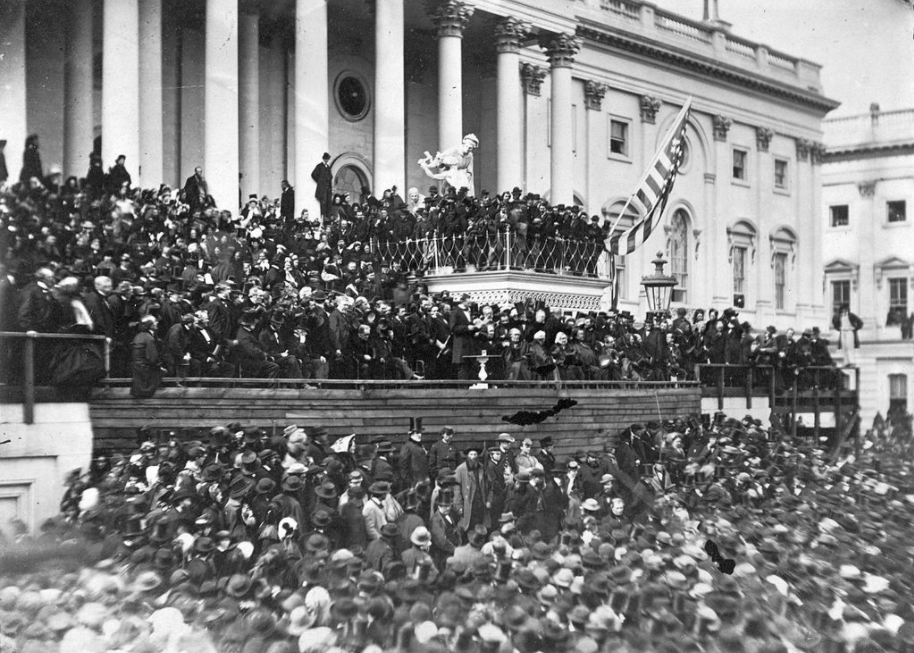
I’ve been thinking a lot lately about Lincoln’s Second Inaugural Address. I first heard perhaps the most famous and impactful line in any of his speeches as a child during the final episode of Ken Burns’s magnificent The Civil War documentary series. Spoken on 4 March 1865, a month before the end of the Civil War and a few days further removed from Lincoln’s assassination, the lawyer from Springfield, Illinois concluded his address calling on all Americans to feel “malice toward none,” and “charity for all.” After all the pain caused by the war, many of Lincoln’s goals still seeming far too distant from reality, he called on our forebearers to:
“strive on to finish the work we are in, to bind up the nation’s wounds, to care for him who shall have borne the battle and for his widow and his orphan, to do all which may achieve and cherish a just and lasting peace among ourselves and with all nations.”
Lately, I’ve wondered how best to categorize the year we’ve been living in. Could the upheaval of 2020, a combination of general public dissatisfaction with government, a global pandemic, and social and economic tensions boiling over after generations of bubbling, could all these combined be called a revolution of sorts? Could we be living through so consequential a time that in fifty or a hundred years, school children will place 2020 in the same column with the most recent global revolutionary years of 1989, 1968, 1918, 1848, 1789, and perhaps even 1776? I’ve also wondered, if we are living through a time which rhymes with Lincoln’s, are we in 1861, at the start of our national nightmare, or in 1865 at the moment of waking from that horror?
Yet when I think about Lincoln’s words again, one thing in particular strikes me. We are at our weakest as a country when we are divided. Today, when each side sees the other with such contempt, it’s hard to see how we could heal these divisions and sow back together these wounds that have cursed our country from its very inception with the conquest and colonization of this continent. Yet heal these divides we must. Someone is going to have to take the first step at reconciling the many factions and camps in this country, someone is going to have to reach across the chasm and offer a hand of friendship to someone on the other side. We need to learn to recognize the innate humanity in those we disagree with before we see their faults. We need to learn to grow past our hate.
Even a person who has committed the worst acts imaginable, people whose names live on in the darkest infamy, were still people like you and me. There are people out there who seek to divide us even further, to sow distrust among us until we are unable to bear the mere thought of one another anymore. Their power is fueled by our hatred, their lies take on the sense of truth only when so smelted by the fire of our hate. As long as we let our hate guide our actions and principles, as long as we make choices great and small based on that darkest emotion, they will win.
Listen to the voices that offer us a message of unity and hope, to the ones who offer us a future that doesn’t seem bleak, to the ones who offer solutions instead of just spewing bile and denouncing their rivals as the enemy. I fundamentally believe that all things are created good, if I know anything for certain, it’s that. Look at it this way, why would a God who wished for evil to be the only option give us free will? It is up to us to choose how we act and react, think and feel. Another thing that I fundamentally believe in is that it’s up to us to make our world as we want it. God made this reality, it’s up to us as citizens of this reality to decide its future.
True love, what many would say is the anthesis of hate, depends on free choices for survival. It’s up to us to decide which emotion our future will be shaped by: hate and its offspring distrust, fear, and bigotry, or love and its offspring hope, kindness, justice, and mercy. Let’s finish Mr. Lincoln’s work, and make 2020 the year when we began to at long last heal our nations wounds, care for each other as equals, and do what we must to earn that “just and lasting peace” for all of us, the oppressed and their erstwhile oppressor too. After all, if we leave even a single person behind, hate’s cold song will still be there for yet another generation to hear.
It’s up to us to live up to our forebearers’ visions and to build the foundations for our descendants’ dreams. Hope and pray for those visions and dreams all you want, but if you want them to come true, you and I, each and every one of us, must act on them.
2020 began for me with a long drive east: Kansas City to Pittsburgh to New York. I drove the first leg in 15 hours, arriving just before midnight on a Friday, and spent the next day wandering through the Carnegie Museums of Art and Natural History in Downtown Pittsburgh, which was the main reason for that particular stopover. That Sunday however was characteristic of how the year that this would become. I woke up around 4 am on Sunday, early enough that I hoped I could be in Manhattan for lunch. As I made a quick donut stop near Pittsburgh Airport, I checked the travel updates for the Pennsylvania Turnpike, and was shocked to discover that it was blocked in both directions just east of Pittsburgh due to a fatal multi-vehicle accident that had happened about an hour before. So, realizing that I’d have to take an alternate route, I plugged one into the navigation system in my car and made my way into one of the most eventful days of driving in my lifetime.
The route on that snowy Sunday morning in January
For the first 3 hours of the 6 that I’d have to drive that day, I was largely on US-22, a smaller rural highway, which heads east out of Pittsburgh across Pennsylvania toward the Jersey Shore. Normally I prefer to stick to the interstates for the lack of stoplights, and at that hour of the night for the lack of traffic. In this instance though I quickly found myself crawling my way across the Appalachians in a blizzard with next to no visibility. I passed semitrucks that were sliding backwards down the inclines on this normally reasonable, yet now snow-packed, highway. I’m pretty sure I passed a plow or two even, continuing onward, only really able to see where I was going thanks to the car’s navigation. Only after 7:30 am or so did the snow clear and I was able to enjoy an otherwise uneventful drive to the long-term parking garage that I frequent near Newark Airport when I drive to New York City.
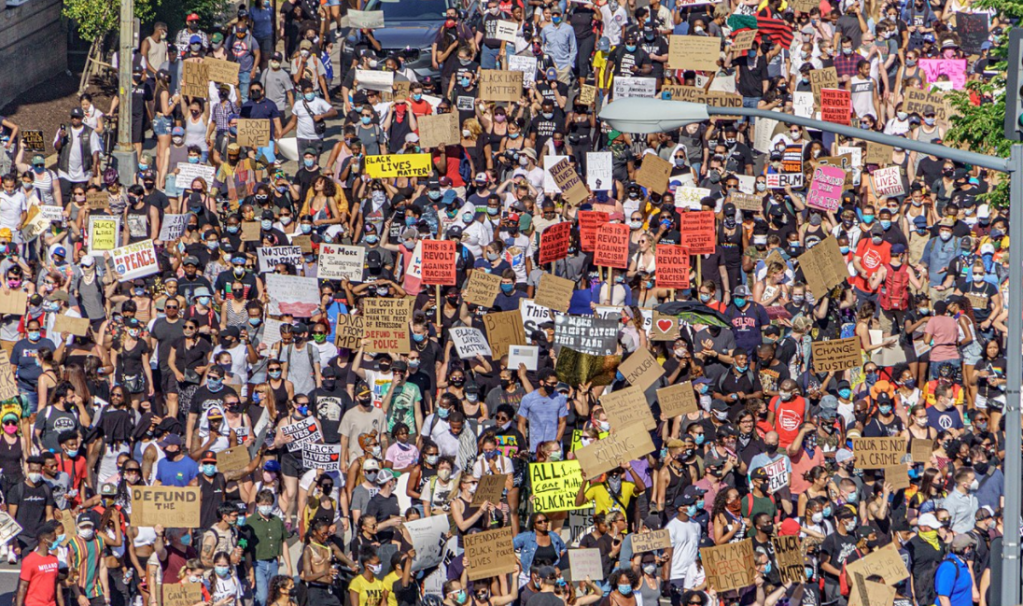
Like the rest of 2020, thus far, I was nearly stressed to my limit in the early hours of that morning. This year has been one for the record books, a right old annus horibilis to borrow a term from the Queen. At the same time that I was dodging stuck semis in the Pennsylvania mountains, this country’s leaders were saber-rattling and threatening war with Iran. We were lucky to have missed that cataclysmic fiasco of a war, though I doubt we’ll know the full details of how we missed it for a few years to come. Since then we’ve seen the rise of the greatest pandemic in a century, a near economic depression, irate armed citizens occupying government buildings over their economic and social fears, the murders of many other citizens of this country by authorities, and the largest protests this country has seen in a long time. Throughout all of this, the response of those in charge hasn’t helped to ease tensions one bit, both publicly and privately for a great many of us.
Yet unlike that early morning in January, I now feel like I have the luxury to think about it, and to stress about it. That morning, I did not have that luxury, or perhaps I had too strong of a fear-driven adrenaline rush to stress about it. After all, if I thought too hard about how terrifying of a situation I was in, I would’ve made a mistake and gone off the side of the road, not knowing what that’d bring: a field, a hill, a house, the edge of one of the mountains? If I’d let my stress take over then, I can’t be sure I’d be able to write this today. Yet in the months since I’ve been largely secluded from the world, first in my apartment in Binghamton, NY, and for the last two months in my parents’ house in Kansas City, MO. Like all of us, I’ve had a lot of extra time on my hands to think, to consider how I want my life to go forward, and to stress and worry about our world, and how it’ll either improve or wreck our future.
The stress has certainly got to me, and there have been more occasions than usual of late where I’ve had real trouble working through it. It’s left me irritable, quick to anger, and generally in a sour temper. I could probably take all this sour stress and make one of those sourdough starters that so many people started doing this Spring. I’ve always found it hard to hear the memories and feel the emotions of the best days of my life over the obnoxious clamoring of the worst memories. Lately it’s been harder than ever, but I’ve tried my best to cherish the best moments of my life and my time at home.
This past weekend in particular had so many wonderful moments. On Friday, the executives at my Mom’s company decided to give all of their employees Juneteenth off. So, that morning for the first time in at least 21 years my parents and I together went to the Zoo. When I was little, I loved going to the Brookfield Zoo near our home in suburban Chicagoland with them and have cherished those memories ever since. Now, after living in Kansas City for 21 years, we finally went as a family to the Kansas City Zoo, a place that I usually visit at least once a week on my own when I’m home. We didn’t see everything we wanted to see, but we left truly happy.
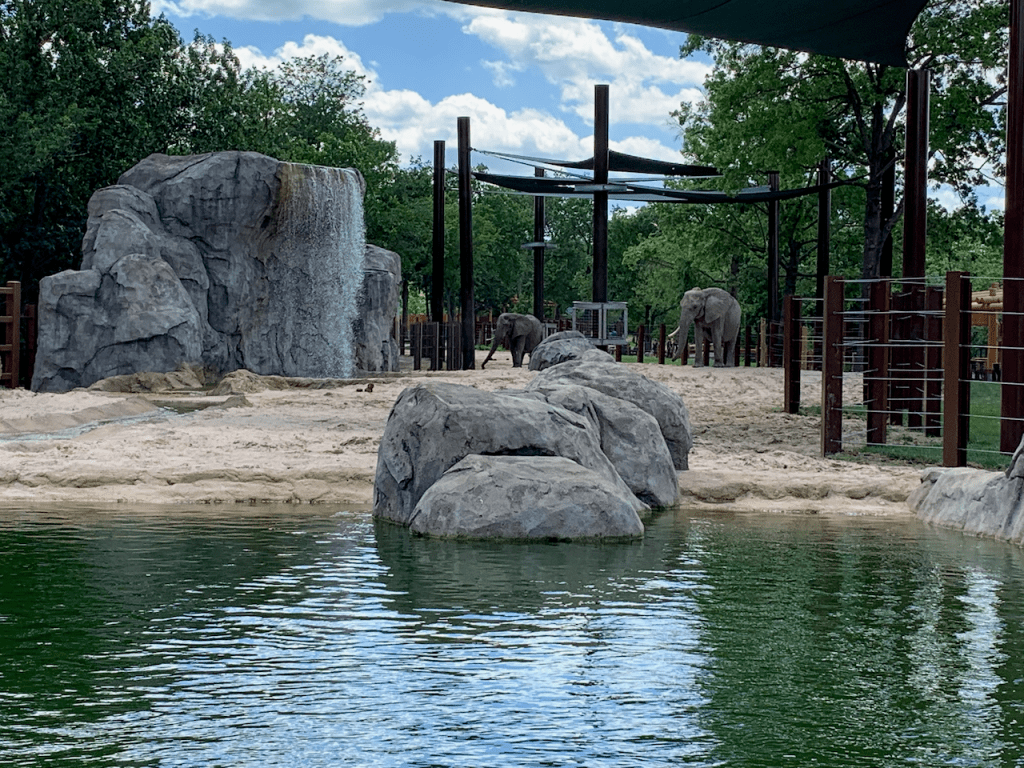
The Kansas City Zoo’s new Elephant Expedition Enclosure. The photo is my own.
Later that evening after dinner we drove up to my alma mater Rockhurst University at 52nd & Troost and took part in the Juneteenth Prayer Service that stretched for 10 miles all along Troost. This was a prayer service like no other, less silent meditation, or communal rosary, and more a celebration of the hope that our community on both sides of the dividing line feels that change is in the air. I sat there on a stone wall for an hour and watched as countless cars drove by, their drivers honking their horns, people waving, children singing from the back windows.
On Saturday we went to one of my aunt’s houses for a small backyard gathering. I always treasure the times that I have with my family, the whole crowd. Just sitting there with people whose company I enjoy, people who I’ve known my whole life, and experiencing the madness of our current world from the perspectives of their stories, jokes, and worries made everything seem better for a little bit. Sunday was similar, Father’s Day, a quiet celebration this year at home with my parents. My Mom and I made brunch for the three of us, brioche French toast and eggs, before spending the afternoon watching soccer and reading June’s National Geographic. This was followed by a quiet small gathering in Roanoke Park.
I was reminded of all of this, and in particular of that terrifying snowy morning on US-22 east of Pittsburgh on Sunday evening when we watched last year’s release A Beautiful Day in the Neighborhood, starring Tom Hanks as Mr. Rogers. In part, the film’s Pittsburgh setting triggered those memories, and my thoughts on that January Saturday evening that I’d live in Pittsburgh if I got a job there, and how much fun I had at the Carnegie Museums. Yet more than that, the kindness which Mr. Rogers exuded in his life and work reminded me that this stress doesn’t have to be permanent, and that the best of memories should be the ones I treasure. I can still vaguely remember seeing him on WTTW in Chicago in the ’90s, and even a little bit on KCPT after we moved here to KC at the turn of the millennium. At the time I don’t really remember knowing what to make of the guy. Yet today, as an adult with far more responsibility to my community, our future, and to myself, I feel like if I were to try to learn from anyone in my own work as an educator, it’d be him.


 Wednesday Blog by Seán Thomas Kane