Tag Archives: 2024 US Presidential Election

On October Baseball

This week, a great celebration commences in our national pastime. — Click here to support the Wednesday Blog: https://www.patreon.com/sthosdkane


This week, a great celebration commences in our national pastime.


Several years ago, near the start of the podcast version of my Wednesday Blog, I wrote two of my favorite stories in this continuing publication of mine about my love for baseball at the beginning of the 2022 season. I seem to remember even playing a poor rendition of Take Me Out to the Ballgame on the digital keyboard provided on GarageBand, where I do all my recording and editing. Don’t worry, I’m not planning on doing that again.

Today, I want to write instead about my joy at how this postseason is beginning. The 2024 season had plenty of potential for my beloved Chicago Cubs and my adopted second-favorite team the Kansas City Royals, and while the Cubs didn’t quite make it far enough to earn a wild card spot, the Royals did in spite of themselves. This is being released on the morning of Game 2 of the Wild Card series, following a 1-0 Royals win in Baltimore against the Orioles. So, should the Royals win again today they will advance to face the Yankees, a matchup that brings to mind the stories my Mom likes to tell of watching the Royals teams of the ‘80s face up against the Bronx Bombers in the American League playoffs.

Meanwhile in the National League the team that excites me the most in these Wild Card series is the San Diego Padres, a perennial favorite of the last four years to win the World Series. Their resounding 4-0 win at home over the Atlanta Braves last night in Game 1 proved to be a good alternative to the Vice Presidential Debate that was occurring at the same time from CBS News’s headquarters in New York. You might think it odd that someone as politically engaged as me would choose to watch a ballgame over a debate, and yes, I started the 8 pm hour watching Governor Walz of Minnesota and Senator Vance of Ohio face off on CBS, but as soon as the first question concerning the increasing odds of war between Israel and Iran occurred, I decided to seek some escapism.

There are a lot of things that we all are worried about today, and with good reason. Whereas for most of my life I’ve looked to the future with eagerness, today I’m scared about the future and what we are doing to ourselves. Over the weekend, I watched an episode of the PBS documentary series In Their Own Words about Jim Henson in which he said his inspiration for creating his 1980s children’s television show Fraggle Rock was to make something that could inspire world peace. To paraphrase the visionary creator of the Muppets, Henson believed the best chance we have at solving our problems is to speak to the youth who aren’t already jaded by the weariness of life and are more willing to imagine a good future. He spoke to the inner child in all of us, a part of me that I’ve found slinking back from the foreground as the world seems evermore scary and dangerous.

Even when I don’t have a team in the playoffs, and let’s face it as a Cub and Royal fan that’s most years, I still religiously watch the baseball playoffs because I love this sport. It’s the sport my parents introduced me to as a kid watching Sammy Sosa, Kerry Wood, and the great Cubs of the late ‘90s and early 2000s skirt so close to the glory of winning the World Series in 1998 and 2003. It’s the one sport that I played with even the remotest success. It’s a sport that I shared with generations of my family that I understood, and today it’s a nice antidote to the weekends of American football, which let’s face it I get but still don’t really understand. Baseball is one of those core things that makes me feel more American, and one of the parts of American life that I missed the most when I lived in England.

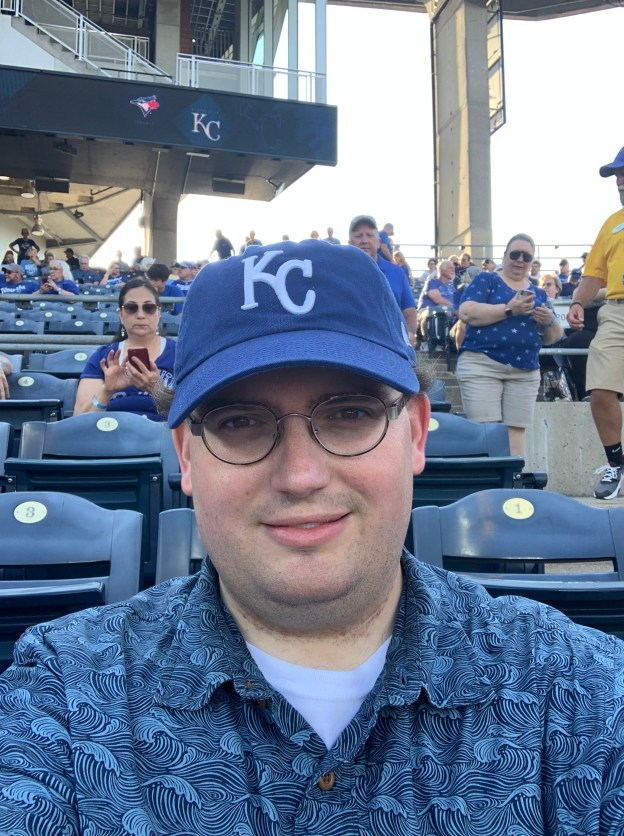
Locally here in Kansas City I feel that the Royals have lost some of their connection with the community in the wake of their failed bid to get a renewal on the stadium sales tax here in Jackson County, which would help them to fund a new stadium along Truman Road in the Crossroads neighborhood. I was one of those voters on the fence who wanted to support a downtown stadium but were really unhappy with the plan they laid out and repeatedly changed in the days and weeks leading up to the vote. Since the playoffs began, I found it harder to put on my Royals hat when going out. I’m having a hard time putting my faith in an organization that doesn’t seem to want to trust the city it represents. I hope this Royals playoff run, 10 years after their monumental and near triumphant 2014 run will revive some of that jubilation that I felt in Kansas City that year. I remember during the World Series that year driving down 47th Street in the Plaza and nearly everyone out walking down the sidewalks was wearing Royal blue jerseys and hats, and I even saw Commissioner of Baseball Bud Selig’s motorcade parked outside the Classic Cup Café at 47th and Central. I want to feel that kind of community spirit again in Kansas City, where the team and the city are open with each other and working together in a productive manner.

So, who am I picking to win the World Series this year? Well, even though we’re down to the last handful of teams, and even though I have a horse in the race this time around, it’s still too hard for me to say. I want the Royals to win again, that’s for sure, though were they not playing against the Orioles I’d be excited for Baltimore’s chances this year. In the National League though it’s a two horse race for me between the Dodgers and the Padres. While Los Angeles has one of the greatest baseball players of our time – Shohei Ohtani – on their team, the Padres have been red hot in the second half of the season, and I stand by my long held claim that the weekend I spent in San Diego in 2021 was one of the best I’ve had in the last few years. What I want to see most is amazing baseball that makes me want to watch the guys on the field play more and more and more; and by the end of this month to long for March and Spring Training.

Writing this tells me one thing for certain: even when I’m trying to celebrate something I love as much as baseball, the muddied waters of the world still appear, yet even then I remain hopeful of better tomorrows.
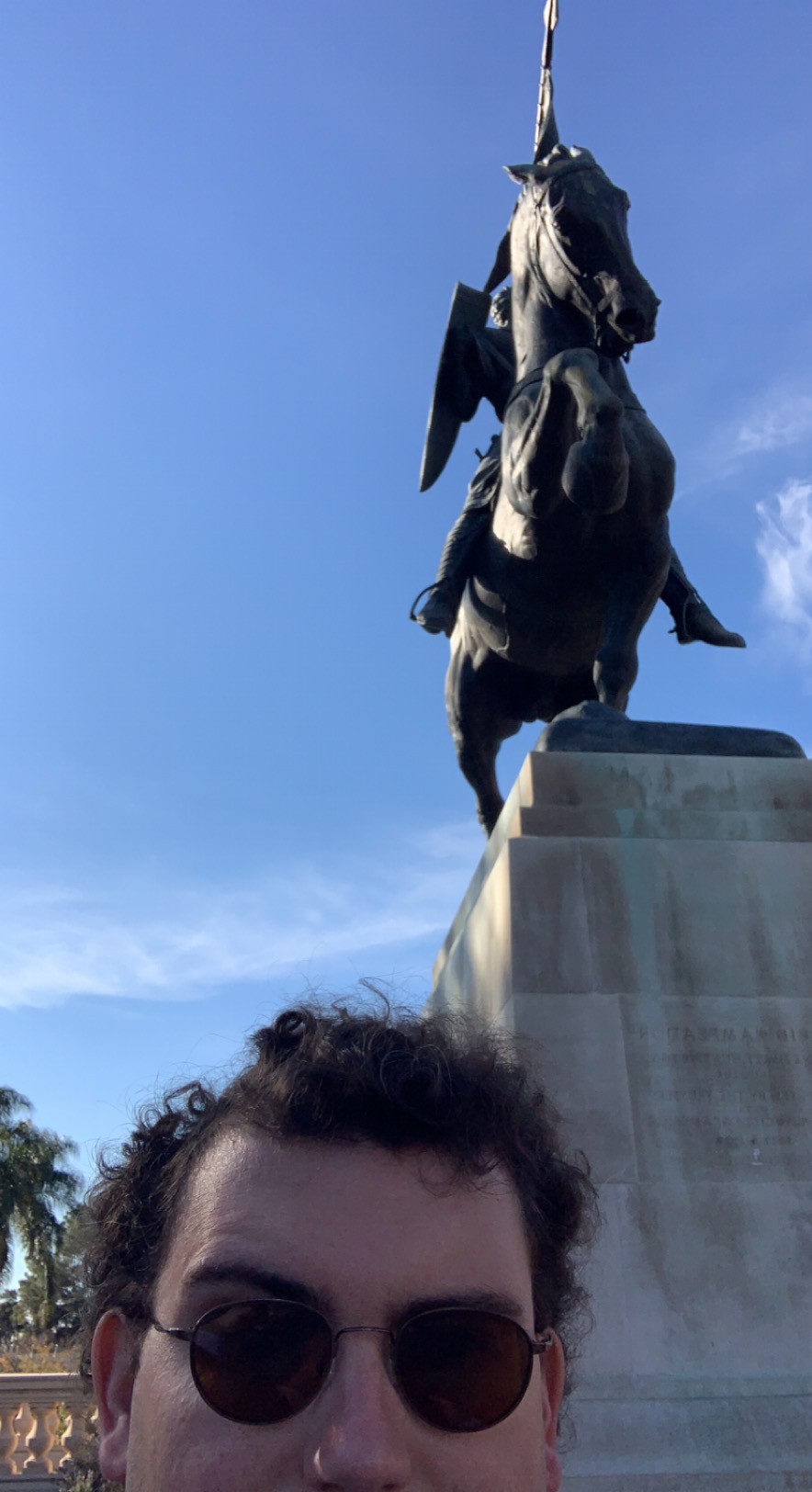
A selfie I took beneath the statue of El Cid in Balboa Park’s Plaza de Panama in San Diego on Halloween 2021.

The Power of Hope

This past weekend, history was made when President Biden dropped out of the 2024 presidential race. The next 48 hours inspired tremendous hope again. — Click here to support the Wednesday Blog: https://www.patreon.com/sthosdkane


This past weekend, history was made when President Biden dropped out of the 2024 presidential race. The next 48 hours inspired tremendous hope again.


During my senior year at Rockhurst, now a decade ago, the BBC released the first of two seasons of a new series of Shakespearean adaptations called The Hollow Crown. These films were realist adaptations of the Henriad plays Richard II, Henry IV Parts I and II, and Henry V. This first season seized my attention and enthusiasm with a tremendous rush of emotion and energy. I wrote my undergraduate capstone in History on Richard II partially because of how these films brought these medieval kings to life for me. Shakespeare’s plays have tremendous power because they speak to common human emotions and experiences, it’s why they’ve been adapted by Akira Kurosawa from their original settings to feudal Japan, and why contemporary adaptations of these plays can work even if they can also leave something to be desired. 

Yet the greatest power that Shakespeare’s plays have is in their quotability. William Shakespeare was one of the greatest writers to use the English language to tell his stories, and to breathe life into his characters and settings that the most fantastical magic of The Tempest can seem just as believable as Richard II’s grief at losing his crown. For me, one of the most readily quotable lines in Richard II comes not from the deposed king but from his uncle John of Gaunt, Duke of Lancaster, who in a speech which Jeremy Irons described as one coming from a medieval Brexiteer, offered the truism “small showers last long, but sudden storms are short.” (2.1). I think of this often in many different situations. Our politics of these last 8 years have been somewhere in the middle, an 8 year on-going rain that may seem tempestuous throughout but that has merely brought together several of these sudden storms in quick succession.

For most of my life I’ve heard the argument that ordinary people like us cannot do much to change our politics, and that we are better off leaving politics to the politicians who are going to do whatever they want anyway. I’ve grown up surrounded by this apathy, yet my parents instilled in me from my earliest memories a duty to vote, to speak up, and to play my part as a citizen. I’ve been frustrated in the last year in particular hearing so many people express a distaste in our electoral system because the two candidates running for President this year were men who seemed so out of touch and disconnected from the rest of us that we felt little need to participate. For myself, by the time the Missouri Primary came around for my party, our candidate had already secured enough delegates to claim victory in the primaries, and so this was one rare election when I didn’t vote.

All of that changed on Sunday at 12:46 Central Time when our sitting President, my party’s candidate, Mr. Biden announced he would no longer seek reelection to the Presidency this November. I was out at lunch with my parents when I got the news, and my first reaction was akin to many: fear at what would come next. I was on the fence whether President Biden should drop out of the race, unsure of what the result might be; and today writing this 48 hours later I’m still afraid of what could happen.

Yet my fears have been assuaged somewhat at the sight of how much the tone of this election has changed in my party. Where so many were going to vote for the President in order to keep his opponent out of power, in the last 48 hours our new candidate, Vice President Harris, has received more than 28,000 offers from ordinary people to volunteer for the Harris campaign. In the last 48 hours the Harris campaign and the Democratic Party have raised about $250 million in donations and pledges; of those donations more than 888,000 were from ordinary people wanting to pitch in. The tone has changed, where before last month’s debate we hoped that President Biden could lead the campaign to eke out enough moderate and undecided voters to support the Democratic side and defeat his opponent, now we have a campaign that is built less on fear of the opposition and more on the hope of what our new candidate has promised to do and could do if elected President.

Hope is far stronger than fear because it offers us a chance to aspire to something greater than ourselves. The most successful President of the twentieth-century, Franklin Delano Roosevelt, ran on a platform of hope and reform that would pull the country out of the Great Depression, and in his later campaigns defend liberal democracy from the growing tides of authoritarianism around the globe. All Democratic Presidents since Roosevelt have been judged on what FDR accomplished, and few have risen close to his level. The two that initially come to mind are Lyndon Banes Johnson, who served as President from President Kennedy’s assassination in November 1963 until January 1969, and our now outgoing President Biden. In spite of a staunch and illiberal opposition built around the premise that any and all legislation proposed by the Democrats must be blocked at all costs, even at the expense of the country, the Biden-Harris Administration has passed several landmark pieces of legislation which have been notable in the good they’ve done while being overshadowed by claims to the opposite from the clamoring gallery in the opposition.

Most of the Biden-Harris Administration’s major legislation occurred when the Democrats had a majority in both houses of Congress through the end of 2022. These included in 2021: 

  • The American Rescue Plan Act, which injected $1.9 trillion into the economy to help ordinary people during the hard times of the recent pandemic.
  • The Bipartisan Infrastructure Investment and Jobs Act, which is funding infrastructure improvements and new projects across the country. 

In 2022, Biden signed: 

  • The Inflation Reduction Act, which included elements of his failed Build Back Better Act offering significant investment in climate and energy production and a three-year extension to the Affordable Care Act.
  • The Bipartisan Safer Communities Act which is the first major federal gun control law passed in the last three decades.
  • The CHIPS and Science Act which bolstered American semiconductor manufacturing.
  • The Honoring our PACT Act, which expanded health care for US veterans.
  • The Electoral Count Reform and Presidential Transition Improvement Act which adds procedures to the Electoral Count Act of 1887 to avoid a repeat of the stalling measures to keep President Biden’s election from being certified during the January 6th attack on the Capitol.
  • The Respect for Marriage Act which codified same-sex and interracial marriage.

And finally, in 2023, Biden signed:

  • The Fiscal Responsibility Act which restrained federal spending during fiscal years 2024 and 2025, and suspended the debt ceiling until the beginning of 2025.
  • In September 2023, he established the American Climate Corps, in a Rooseveltian manner to help facilitate the national response to the climate crisis.

What is striking about Biden’s presidency is both how much he accomplished in four years, and how little most people seem to know about it. He could not fully live up to FDR’s legacy because he lacked the majorities in Congress throughout his term that would have allowed him to continue to pass legislation. In the last month, it’s become clear that what new policies his Administration announces will be intended less as viable things to be accomplished in what remains of his term, but rather as signs of hope of what his party would do if they retain the Presidency and win back a majority in the House of Representatives.

That hope now has a face and a name in the Democratic presumptive nominee for President, Kamala Harris. The Democrats would do well to recognize that the power of hope for the things she and her Administration and the congressional party can accomplish together are far more powerful than all the fears we have of what would happen should the opposition regain the Presidency and retain its majority in the House. Hope is stronger than fear because it builds on the idea that there’s something better to be had than what we now have. I believe that hope is what will unite us together in the Democratic big tent this year to win this election. The circumstances aren’t great, President Biden’s withdrawal was far later in the race than I would have liked, and in the coming weeks I want to write here about the flaws in our electoral systems that his withdrawal lays bare.

This week though, let me leave you with what I believe to be true: the Harris campaign is in a strong place with its grassroots enthusiasm, fundraising, and organizing, and has the legislative accomplishments of the Biden-Harris Administration as a strong foundation for a successful, if unexpected, campaign. It’s up to all of us to hope that she can provide better promises than her opponents, and to act on that hope and vote in November.


On Political Violence

This week, I feel compelled by this past weekend’s events to write about the follies of political violence. — Click here to support the Wednesday Blog: https://www.patreon.com/sthosdkane


This week, I feel compelled by this past weekend’s events to write about the follies of political violence.


On Saturday evening, I was making dinner for a friend and I to share when I received the first notification from the Washington Post that something had happened at a rally held by former President Trump in Pennsylvania. We first heard that that something was a shooting as we were starting dessert. The evening turned from genial conversation in my family’s dining room to tuning into NBC’s coverage to learn as much as we could at that early moment. What transpired, as far as I’m aware at time of writing, is that a single shooter firing from a nearby rooftop shot at the former President, striking him in the top of his right ear in what was clearly an assassination attempt. This is the first time an American President has been shot since Ronald Reagan’s assassination attempt in 1981, and so the first in my lifetime. We quickly saw the film of the former President being removed from the stage by the Secret Service, and only a little later did we see the actual shooting itself, albeit on RTÉ’s Instagram feed rather than on NBC.

Considering the level of senseless gun violence in this country, and the bellicose rhetoric of the former President and his allies, I’m not surprised that something like this happened. I remember well how the conservative press were using bull’s eye targets in their graphics on TV over the faces of Democratic elected officials whose seats they wanted to target in the 2010 Midterms, and how that contributed to the assassination attempt against Gabby Giffords, the former Representative of Arizona’s 8th congressional district. Things were toned down after that shooting thirteen years ago, but the rhetoric has increased in the years since, especially since 2015 when the 2016 Presidential primary races began.

I feel that political violence ought to be considered in the same vein as the concept of just war and the practice of capital punishment. Can we reasonably assert a right to use violence to influence the politics of a society? It has certainly been done time and time again. Just this Spring, I was engrossed in Apple TV’s recreation of the aftermath of the assassination of President Lincoln on 14 April 1865 in the series Manhunt. The Civil War is a good place to ponder these questions, when David Brooks of the New York Times interviewed Steve Bannon just before he reported to prison on charges of Contempt of Congress over his refusal to appear before the House Select Committee on the January 6 Attack, he brought up Lincoln’s call for restoring national unity in his second inaugural address, Bannon would not accept any such arguments, fixating instead on Lincoln’s decision to engage in the civil war with the rebellious southern states, referring to our 16th President as “a military dictator” for his actions and the actions of the military during that war.

I was deeply disturbed reading Bannon’s responses to these questions, because though we may both be Irish Americans who were raised in Catholic schools, I come from Illinois and have always seen Mr. Lincoln as a hero, as longtime readers and listeners to this publication are well aware. What disturbed me most was that this moment when these words of reconciliation, which matched what I’ve read of Lincoln’s plans postwar to engage fully in reconstruction rather than retribution, that Bannon’s reaction was belligerent and unwavering. 

For decades now the cries of “no compromise!” have rang out in our politics. I remember a friend in high school telling me that there are no moderates, only conservatives and liberals, and you are a friend to one side and an enemy to the other. I was shocked then too to hear such rhetoric from a friend because at that time we were on opposite sides. Political violence occurs because we allow ourselves to be riled up into a frenzy to the point that we believe it is justifiable to act violently against our neighbors, our countrymen and women, our fellow humans. I have a very hard time with the concept of a just war that is taught by my Church, though again in the context of the Union aims during the Civil War, I can readily see how preserving the Union and ending slavery were justified. I believe a just war needs a strong moral bedrock for it to be justifiable. We cannot run out crying “Deus vult! God wills it!” and proclaim any old brawl a just war.

The first time I was challenged to consider these questions was also in high school, about a year before that conversation mentioned in the last paragraph. In my sophomore year, I took a combined honors world history and world literature course, taught by two teachers in their first year. Our literature teacher assigned us to read Eli Wiesel’s novel Dawn, in which the main character, Elisha, is a Holocaust survivor who’s moved to the British Mandate of Palestine and joined the Irgun, a Jewish paramilitary group fighting to drive the British from the region to establish a Jewish state. The book covers the early morning hours when Elisha is preparing to execute a captured British officer, who is to be shot at dawn. My assignment was to write an essay of my own saying how I would have acted, would I have carried out the execution or would I have let the captive man live?

The essay I submitted was one of the rare essays I ever earned an F on. I wrote that to take a life is not in our rights but should be left to God alone, so I would not know how to make that decision. At sixteen, I tried to find a middle way, to fall back on my faith as a means of avoiding making such a tough decision. Today though I would choose to reprieve the captive, to let him live. When I visited the remains of the Dachau camp in the Munich suburbs in January 2020, I was struck by the thought that everyone involved, the captors and the captives, the murderers and the victims, were all at their core humans, and at one point in their lives they were all innocent, helpless, and defenseless as infants. Since then I’ve noticed more of this in people I pass on the street, where just as I still in some ways imagine myself as I was when I first recognized my own consciousness as a very young child, so too I can readily imagine others in those perhaps purer moments of life before we are weighed down by our anger and fears and pain, by our suffering and sorrow and grief.

So often, political violence is unnecessary and unwarranted; a choice made by someone on their own, an inflection point in history when the decisions of the individual can change the whole world for the worse. In more pop-culture questions about history, one will often hear people ask, “If you could go back in time and could stop Hitler or Stalin, would you kill them?” I for one prefer the way Hitler was handled on Doctor Who, when in the episode titled “Let’s Kill Hitler,” the man merely ended up being shoved into a closet.We will likely not know much more of the motives of the man who shot the former President on Saturday evening for some time, and the best thing we can do is let the investigation continue in its own pace. I do not wish death on anyone, that is a horrible thing to do. Even if the acts of some are so heinous that they may seem to be due such an extreme and ultimate punishment, I challenge you to consider what condemning or killing them would do? What benefit does it hold? And how would it change you?


An Election Year Independence Day

An Election Year Independence Day Wednesday Blog by Seán Thomas Kane

This week, I’m writing to you with this week’s holiday in mind, with some of my aspirations and hopes for America. — Click here to support the Wednesday Blog: https://www.patreon.com/sthosdkane

This week, I’m writing to you with this week’s holiday in mind, with some of my aspirations and hopes for America.


While I have colonial ancestors who settled New Haven, Connecticut and Newark, New Jersey, and who at the time of the American Revolution were living in Pennsylvania, Maryland, and North Carolina, I more closely associate with my recent immigrant ancestors. I’m one of those hyphenated-Americans who holds onto elements of a culture and identity that transcends the Atlantic and provides connections not only to this country but to the places where my ancestors came from. One aspect of the political philosophy of American nationalism that I don’t agree with says that you have to conform to a particular American identity when you come here. My ancestors did that, to varying degrees, and I’m more American than anything else, yet it’s all those other elements that give our Americanness its richness of character.

So, when I think of the music that embodies the soul of America, it’s music written by a fellow hyphenated-American, Aaron Copland, the dean of American classical music. When I tried my hand at musical composition in college, I wrote a four-movement trio sonata that told the story of a voyage from Ireland to America by St. Brendan and his monks in the sixth century. My addition to the fable was to have the tone of the music switch from being very Irish in the first and second movements to taking after Copland’s sound in the third and especially the fourth movement as they reached this side of the water. I’ve long wanted to write a blog post all about my admiration for Copland’s music, but thanks to the copyrights on his recordings I’m waiting for a few more decades. For now, go listen to Appalachian Spring and Rodeo after you’re done listening to, or reading, this.

Copland’s music speaks to me now in 2024 especially as we approach an election year. This is the most sacred task that we American citizens fulfill in our obligations to our republic: we do our duty by voting for whom we want to represent us on all levels of government, and on the host of ballot measures found further down-ballot. This election feels far more pivotal than any we’ve seen in my lifetime. For context, I was born exactly one month before the elder President Bush stood aside for President Clinton. While I may have disagreed with the policies of both Presidents Bush, they still seemed to be decent men. It’s hard to say that this year about one of the two candidates who flooded Thursday night’s debate on CNN with so many half-truths and outright lies that the network did nothing to check live on air. I was baffled watching it to think that the network’s executives and news directors didn’t choose to lay out better safeguards considering this is the same man whose rhetoric and refusal to admit his loss in 2020 led to the storming of the Capitol on January 6th, 2021.

When I think of a President who I want leading our country, I think of Copland’s Fanfare for the Common Man.I want someone who best represents the best ideals of America, someone who can speak with all of us and for all of us. I hope for someone who can work with Congress and the states to execute legislation that will lead to an overall improvement in our national well-being. I was disappointed to see the President perform so poorly during the debate on Thursday, yet of our choices this year he is the closest to embodying that ideal of the common man.

This year’s election is not politics as usual, there are deep intrinsic questions at stake over the future of our country and what sort of government we want to have. I was deeply unsettled to read the transcript of David Brooks’s recent interview with Steve Bannon, who Brooks called a Trotsky-figure for the MAGA movement. From the interview, and from the way Bannon positioned himself as a leader of that movement, he made it clear that there is no room for communication with their political opponents, who Bannon termed in a far more affrontive manner as their enemies. That is the most essential element of good government, something that all the great political philosophers recognized: we need to be able to communicate with each other and grow together as one body politick made up of a great many parts. I’ve seen the same problem on the left as on the right, a disinterest in listening and in compromising to achieve a higher ideal or a common good that will benefit everyone. Yet the greater threat is coming from the faction who’ve gained enough sway that they now control their party and their leader is again a candidate for the Presidency.

This Independence Day, Americans around the globe will celebrate the invention of our republic from an ideal written on paper during a hot and humid Philadelphia summer 248 years ago. I’ve heard it said that that was the first time that anyone thought to write down the idea that “all men are created equal.” Think about that for a moment: that was the first time that the notion of universal equality, or better universal equity, had ever been considered. The President is the President, and I respect him for serving in that office as I feel respect for the office itself. It is a monument to self-sacrifice when done well, and a trap of self-aggrandizement when the oath is taken for the wrong reasons. Yet when a sitting President leaves the office on Inauguration Day, they may still be Former President, but they are now again just another citizen who’s offered to carry that mantle in the relay until the next candidate will take it up.

The burdens of preserving, protecting, and defending the Constitution of the United States are greater than one person can carry on their own. The office holder ought to have us, we the people who come first in the Constitution, supporting them as long as they keep their oath, and do their duty for as long as their term lasts. It is a humbling thing to serve in such an august role. It is something that truly should not be taken lightly, or brought on by a candidate for any other reason than for service.