Tag Archives: Abraham Lincoln

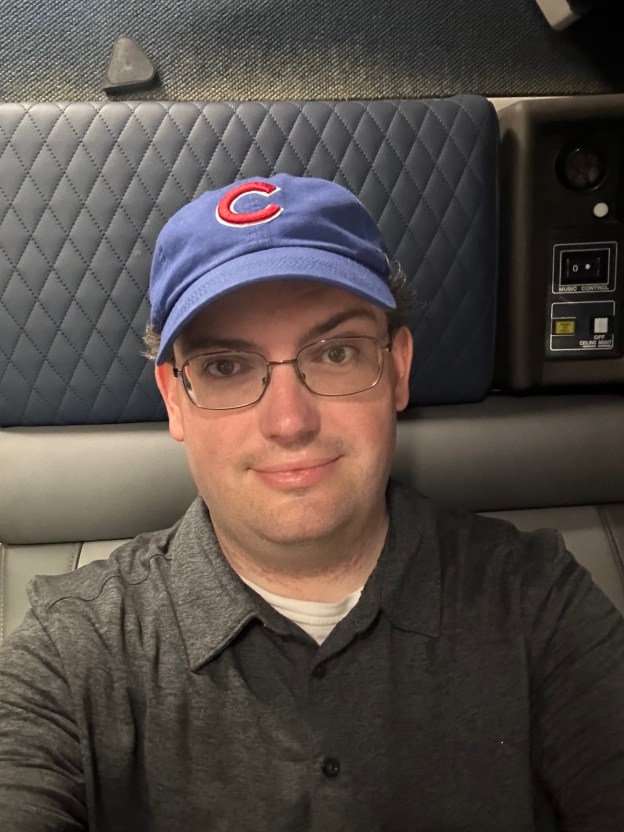
The author pulling a face at the camera.

On Writing

This week, some words about the art, and the craft, of writing.—Click here to support the Wednesday Blog: https://www.patreon.com/sthosdkane—Links in this episode:Patrick Kingsley, Ronen Bergman, and Natan Odenheimer, “How Netanyahu Prolonged the War in Gaza to Stay in Power,” The New York Times Magazine, (11 July 2025).John McWhorter, “It’s Time to Let Go of ‘African American’,” The New York Times, (10 July 2025).Bishop Mark J. Seitz, D.D., “The Living Vein of Compassion’: Immigration & the Catholic Church at this moment,” Commonweal Magazine, (June 2025), 26–32.“On Technology,” The Wednesday Blog 5.2.“Artificial Intelligence,” The Wednesday Blog 4.1.


This week, some words about the art, and the craft, of writing.


In the last week I’ve been hard at work on what I hope is the last great effort toward completing my dissertation and earning my doctorate. Yet unlike so much of that work which currently stands at 102,803 words across 295 U.S. Letter sized pages inclusive of footnotes, front matter, and the rolling credits of my bibliography I am now sat at my desk day in and day out not writing but reading intently and thoroughly books that I’ve read before yet now find the need for a refresher on their arguments as they pertain to the subject of my dissertation: that André Thevet’s use of the French word sauvage, which can be translated into English as either savage or wild, is characteristic of the manner in which the French understood Brazil as the site of its first American colony and the Americas overall within the broader context of French conceptions of civility in the middle decades of the sixteenth century. I know, it’s a long sentence. Those of you listening may want to rewind a few seconds to hear that again. Those of you reading can do what my eyes do so often, darting back and forth between lines.

As I’ve undertaken this last great measure, I’ve dedicated myself almost entirely to completing it, clearing my calendar as much as I see reasonable to finish this job and move on with my life to what I am sure will be better days ahead. Still, I remain committed to exercising, usually 5 km walks around the neighborhood for an hour each morning, and the occasional break for my mind to think about the things I’ve read while I distract myself with something else. That distraction has truly been found on YouTube since I started high school and had a laptop of my own. This week, I was planning on writing a blog post which compared the way that my generation embraced the innovation of school-issued laptops in the classroom and the way that starting next month schools and universities across this country will be introducing artificial intelligence tools to classrooms. I see the benefits, and I see tremendous risks as well, yet I will save that for a lofty second half of this particular essay.

I’ve fairly well trained the YouTube algorithm to show me the sorts of videos that I tend to enjoy most. Opening it now I see a segment from this past weekend’s broadcast of CBS Sunday Morning, several tracks from classical music albums, a clip from the Marx Brothers’ film A Night at the Opera, the source of my favorite Halloween joke, and a variety of comic videos from Conan O’Brien Needs a Friend to old Whose Line is it Anyway clips. Further down are the documentary videos I enjoy from history, language, urbanist, and transportation YouTubers. Yet in the last week or so I’ve been seeing more short videos of a minute or less with clips from Steven Spielberg’s 2012 film Lincoln. I loved this film when I saw it that Thanksgiving at my local cinema. As longtime readers of the Wednesday Blog know, I like to call Mr. Lincoln my patron saint within the American civic religion. As a young boy in Illinois in the ‘90s, he was the hero from our state who saved the Union and led the fight to abolish slavery during the Civil War 130 years before. Now, 30 years later and 160 years out from that most horrific of American wars I decided to watch that film again for the first time in a decade. In fact, I’m writing this just after watching it so some of the inspiration from Mr. Lincoln’s lofty words performed by the great Daniel Day-Lewis might rub off on my writing just enough to make something inspirational this week before I return in the morning to my historiography reading.

Mr. Lincoln knew what every writer has ever known, that putting words to paper preserves them for longer than uttering even the longest string of syllables can last. What I mean to say is they’ll remember what you had to say longer if you write it down. He knew for a fact that the oft quoted and oft mocked maxim that the pen is mightier than the sword is the truth. After all, a sword can take a life, as so many have done down our history and into our deepest past to the proverbial Cain, yet pens give life to ideas that outlive any flesh and bone. I believe writing is the greatest human invention because it is the key to immortality. Through our writing generations from now people will seek to learn more about us in our moment in the long human story. I admit a certain boldness in my thinking about this, after all I’ve seen how the readership and listener numbers for the Wednesday Blog ebb and flow, and I know full well that there’s a good chance no one in the week I publish this will read it. Yet I hold out hope that someday there’ll be some graduate student looking for something to build a career on who might just stumble across my name in a seminar on a sunny afternoon and think “that sounds curious,” only to then find some old book of my essays called The Wednesday Blog and then that student will be reading these words. 

I write because I want to be heard, yet I’ve lived long enough to know that it takes time for people to be willing to listen, that’s fair. I’ve got a growing stack of newspaper articles of the affairs of our time growing while my attention is drawn solely to my dissertation. I want, for instance, to read the work of New York Times reporters Patrick Kingsley, Ronen Bergman, and Natan Odenheimer in a lengthy and thorough piece on how Israeli Prime Minister Netanyahu “prolonged the War in Gaza to stay in power” which was published last Friday.[1] I also want to read John McWhorter’s latest opinion column “It’s Time to Let Go of ‘African American’”; I’m always curious to read about suggestions in the realm of language.[2] Likewise there are sure to be fascinating and thoughtful arguments in the June 2025 issue of Commonweal Magazine, like the article titled “’The Living Vein of Compassion’: Immigration & the Catholic Church at this moment” by Bishop Mark Seitz, DD of the Diocese of El Paso.[3] I’m always curious to read what others are writing because often I’ll get ideas from what I read. There was a good while there at the start of this year when I was combing through the pages of Commonweal looking for short takes and articles which I could respond to with my own expertise here in the Wednesday Blog. By writing we build a conversation that spans geography and time alike. That’s the whole purpose of historiography, it’s more than just a literature review, though that’s often how I describe what I’m doing now to family and friends outside of my profession who may not be familiar with the word historiography or staireagrafaíocht as it is in Irish. 

Historiography is writing about the history that’s already been written. It’s a required core introductory class for every graduate history program that I’m familiar with, I took that class four times between my undergraduate senior seminar (the Great Historians), our introductory Master’s seminar at UMKC (How to History I), and twice at Binghamton in courses titled Historiography and On History. The former at Binghamton was essentially the same as UMKC’s How to History I while the latter was taught by my first doctoral advisor and friend Dr. Richard Mackenney. He challenged us to read the older histories going back to Herodotus and consider what historians in the Middle Ages, Renaissance, Enlightenment, and Nineteenth Century had to say about our profession. Looking at it now, the final paper I wrote for On History was titled “Perspectives from Spain and Italy on the Discovery of the New World, 1492–1550.” I barely remember writing it because it was penned in March and April 2020 as our world collapsed under the awesome weight of the Coronavirus Pandemic. Looking through it, I see how the early stages of the pandemic limited what I could access for source material. For instance, rather than rely on an interlibrary loan copy of an English translation, perhaps even a more recent edition, of Edmundo O’Gorman’s The Invention of America, I instead was left working with the Spanish original that had been digitized at some point in the last couple decades. Likewise, I relied on books I had on hand in my Binghamton apartment, notably the three volumes of Fernand Braudel’s Civilization and Capitalism, in this case in their 1984 English translations. I wrote this paper and then forgot about it amid all the other things that were on my mind that Spring, only to now read it again. So, yes, I can say to the scared and lonely 27 year old who wrote this five years ago that someone did eventually read it after all.

What’s most delightful about reading this paper again is I’m reminded of when I first came across several names of fellow historians who I now know through professional conferences and have confided in for advice on my own career. The ideas first written in the isolation of lockdown have begun to bear fruit in the renewed interactions of my professional life half a decade later. What more will come of those same vines planted in solitude as this decade continues into its second half? Stretching that question further back in my life, I can marvel at the friendships I’ve cultivated with people I met in my first year of high school, now 18 years ago. That year, 2007, we began our education at St. James Academy where many of us were drawn to the promise of each student getting their own MacBook to work on. I wrote here in March 2024 about how having access to that technology changed my life forever.[4] So, in the last week when I read in one of my morning email newsletters from the papers about the soon-to-be introduction of artificial intelligence to classrooms across this country in much the same way that laptops in classrooms were heralded as the new great innovation in my youth I paused for a few moments longer before turning to my daily labor.

I remain committed to the belief that having access to a laptop was a benefit to my education; in many ways it played a significant role in shaping me into the person I am today. I wrote 14 plays on that laptop in my 4 years in high school, and many of my early essays to boot. I learned how to edit videos and audio and still use Apple products today because I was introduced to them at that early age. It helps that the Apple keyboard comes with easy ways to type accented characters like the fada in my name, Seán. Still, on a laptop I was able to write much the same that I had throughout my life to that point. I began learning to type when I was 3 years old and mastered the art in my middle school computer class. When I graduated onto my undergraduate studies though I found I could take notes far better that I could remember by hand than if I typed them. This is crucial to my story: the notes that I took in my Renaissance seminar at UMKC in Fall 2017 were written by hand, in French no less, and so when I was searching for a dissertation topic involving Renaissance natural history in August 2019, I remembered writing something about animals in that black notebook. Would I have remembered it so readily had I typed those notes out? After all, I couldn’t remember the title of that term paper I wrote for On History in April 2020 until I reopened the file just now.

Artificial intelligence is different than giving students access to laptops because unlike our MacBooks in 2007, A.I. can type for the student, not only through dictation but it can suggest a topic, a thesis, a structure, and supporting evidence all in one go. Such a mechanical suggestion is not inherently a suggestion of quality however, and here lies the problem. I’ve read a lot of student essays in the years I’ve been teaching, some good, some bad. Yet almost all of them were written in that student’s own voice. After a while the author’s voice becomes clear; with my current round of historiography reading, I’m delighting in finding that some of these historians who I know write in the same manner that they speak without different registers between the different formats. That authorial voice is more important than the thesis because it at least shows curiosity and the individual personality of the author can shine through the typeface’s uniformity. Artificial intelligence removes the sapiens from we Homo sapiens and leaves our pride in merely being the last survivor of our genus rather than being the ones who were thinkers who sought wisdom. Can an artificial intelligence develop wisdom? Certainly, it can read works of philosophy both illustrious and indescribably dull yet how well can it differentiate between those twin categories to give a fair and reasoned assessment of questions of wisdom?These are some of my concerns with artificial intelligence as it exists today in July 2025. I have equally pressing concerns that we’ve developed this wonderous new tool before addressing how it will impact our lived organic world through its environmental impact. With both of these concerns in mind I’ve chosen to refrain from using A.I. for the foreseeable future, a slight change in tone from the last time I wrote about it in theWednesday Blog on 7 June 2023.[5] I’m a historian first and foremost, yet I suspect based on the results when you search my name on Google or any other search engine that I am better known to the computer as a writer, and in that capacity I don’t want to see my voice as soft as it already is quieted further by the growing cacophony of computer-generated ideas that would make Aristophanes’ chorus of frogs croak. Today, that’s what I have to say.


[1] Patrick Kingsley, Ronen Bergman, and Natan Odenheimer, “How Netanyahu Prolonged the War in Gaza to Stay in Power,” The New York Times Magazine, (11 July 2025).

[2] John McWhorter, “It’s Time to Let Go of ‘African American’,” The New York Times, (10 July 2025).

[3] Bishop Mark J. Seitz, D.D., “The Living Vein of Compassion’: Immigration & the Catholic Church at this moment,” Commonweal Magazine, (June 2025), 26–32.

[4] “On Technology,” The Wednesday Blog 5.2.

[5] “Artificial Intelligence,” The Wednesday Blog 4.1.

On Democracy

This week, for my birthday I want to write to you about my belief in all of us and how democracy remains our best hope. — Click here to support the Wednesday Blog: https://www.patreon.com/sthosdkane


This week, for my birthday I want to write to you about my belief in all of us and how democracy remains our best hope.


One of those great efforts with which human history is concerned is the question of what our original nature was at our beginning and if and how we have changed that nature. The French anthropologist Claude Lévi-Strauss’s notion of the primitive as “closer to humanity’s origins” and living in a state without the societal and technological innovations “that obscure their nature” evokes this original nature, what in Christianity is called our original sin, or biologically our evolved state as a particular form of bipedal mammals among other lifeforms.[1] The seeming natural state of human societies until very recently has been toward forms of monarchy and aristocracy, the Tory Party in Britain today still refers to itself as the natural party of government because they descend through many generations from the old Cavaliers who supported Charles I and the aristocrats in the Parliaments of the Stuart and Georgian centuries who opposed the liberal reforms of the Whigs. Here in the United States, our own whiggish political tradition sees its modern manifestation in the old establishment wing of the Republican Party, also known as the Grand Old Party or G.O.P., whose founders in the 1850s included former Northern members of the Whig Party once led by our own aristocrats, men like Henry Clay and John Quincy Adams in the early republic.

Yet those same men stood for something beyond just preserving their own aristocratic power within their own society. These American Whigs and their Republican and Democratic successors aspired to a high ideal of human nature that entrusted power in the hands of the many rather than in those of a few or the one. Dr. Heather Cox Richardson recently wrote in her Letters from an American about how the Secessionists who dragged this country into our Civil War in 1860 and 1861 were trying to assert their own aristocratic vision of the republic that would benefit the few at the disregard of most and the expense of the many. As James J. Sheehan reminded us in his essay in the December 2024 issue of Commonweal, Tocqueville wrote that the chief difference between the source of power in an aristocracy or a monarchy, or their corrupted forms oligarchy and a tyranny, and the source of power in a democracy is that “despotism may govern without faith, but liberty cannot.”[2] The despots rely less on our trust in their rule, and in many of the cases we see today they sew discontent in government, the economy, and for all of us with each other in order to assert their authority and keep hold of power. 

Democracy is a far harder thing to keep, as Dr. Franklin knew well. The inclusion of more and more people complicates any organization, yet it also allows that organization to better reflect all involved. Democracy requires the efforts of all of us to survive; if left unwatered and unnourished by each generation it will wither and die like any other flower or fruit on the vine. Throughout my life, I’ve looked to heroes in our history from Lincoln, Mandela, Óscar Romero, Popes Francis and St. John XXIII, to people closer to my own life. What all of them have in common is a desire to improve the lot of humanity, and in the case of Lincoln and Mandela to promote democracy in their homelands. When I look ahead and worry about what might be coming in these next four years, I often wonder if I would be safer, happier, healthier, and living a more fulfilled life elsewhere in another country where I can leave the troubles of my own behind. Yet I remember these heroes, MacDonagh and MacBride, and Connolly and Pearse, my great-grandfathers who fought in the two World Wars, the dreamers and optimists who organized and marched non-violently for civil rights here in America and in Ireland too, and looking again at our own day I pause. This is our time to make life better for our successors while we live to overcome the long winter of fear before us. If I left now, could I look those heroes of mine in the eye when my time ends?

I believe in democracy because it is the best form of government we’ve yet imagined. I believe in representative government because I would rather have a say in my neighborhood, my city, my county, my state, and my country than not. I believe in democracy because I believe in humanity and that all of us can make something better if only we believed in ourselves and in each other. I believe that before that original sin there was original grace, original goodness; that before the first frown there was the first smile; that before the first thoughts of lust there were thoughts of love. I believe in democracy because I need to believe that I will have a future, that all the things which I’ve done in these last 31 years are building up to something which will, in Bill Nye’s words, “change the world,” no matter how small that change may be. To do any of this, to see any of this goodness in our hearts, to believe in ourselves again we need to be willing first to acknowledge our faults and second to forgive ourselves and put in the effort to make our lives better. For all our technology and our ever increasingly complicated ways of life, we are still the same humans as our ancestors living in Lévi-Strauss’s primitive manner. We retain the same bodies and souls. Because of this, we can build a future for our posterity in a spirit of grace, compassion, and optimism that would make the heroes of old proud.


[1] Claude Lévi-Strauss, From Montaigne to Montaigne, trans. Robert Bononno, (Minneapolis: University of Minnesota Press, 2019), 25.

[2] James J. Sheehan, “Democracy and Its Discontents,” Commonweal, December 2024, 13.


Human Goodness

This week I'm considering the fundamental question of whether we are inherently good or bad. Click here to support the Wednesday Blog: https://wednesdayblog.org/patreon.com/sthosdkane

Eight years ago, when I was a masters student in International Relations & Democratic Politics at the University of Westminster in London a question was posed in one of my first semester classes by the professor who asked “are we inherently good or bad?“ I raised my hand among the few in the room who argued that we are inherently good. That, at heart, we have evolved to trust one another, and to be kind, not only to our own tribe, our own community, but of those outsiders to whom we are in some way connected, as we are with our pets, or in human terms as we are with peoples from around the globe whom we come to meet on a personal level.

It occurs to me when thinking about some of the great and good figures in recent human history, and even going back several centuries, if not several millennia, that a great many of those figures were killed, their lives ended in acts of evil, in moments of malice. When President Lincoln gave his second inaugural address in March 1865, and called for us to “bind up the nations wounds” and to progress forward with the now immortal words that I have surely used on many occasions here on the Wednesday Blog

“With malice toward none, with charity for all, with firmness in the right as God gives us to see the right, let us strive on to finish the work we are in, to bind up the nation’s wounds, to care for him who shall have borne the battle and for his widow and his orphan, to do all which may achieve and cherish a just and lasting peace among ourselves and with all nations.” 

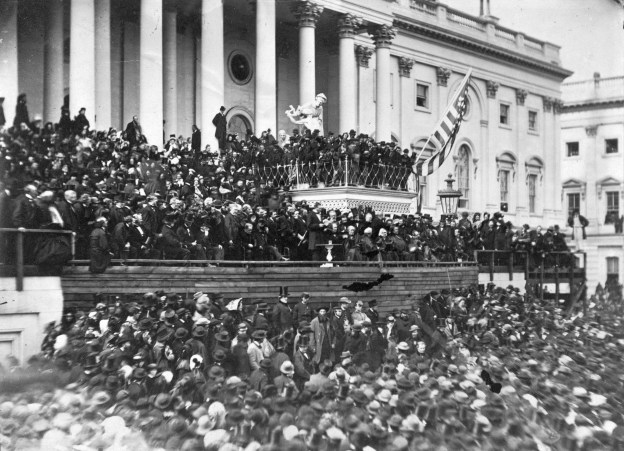
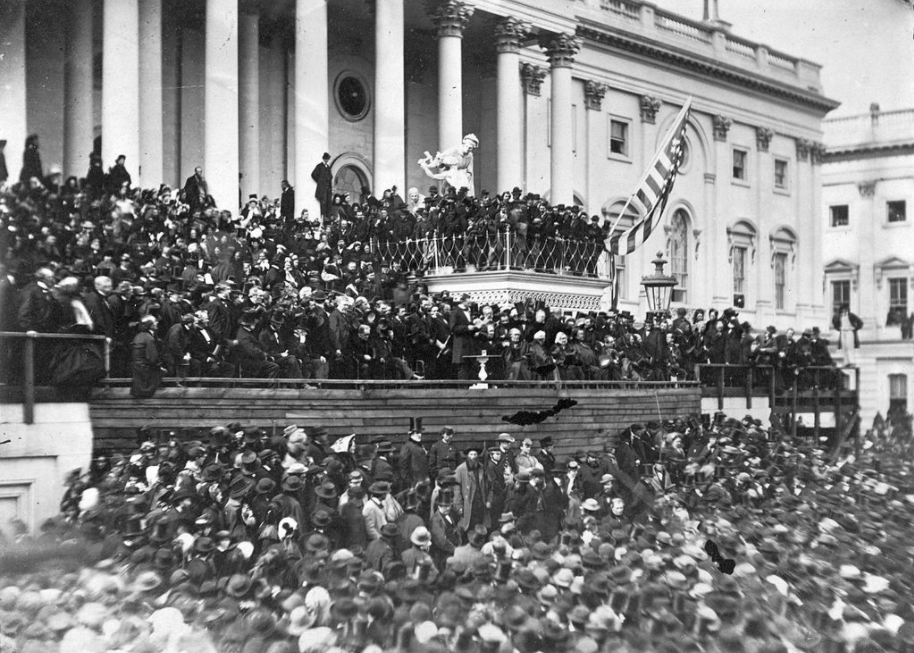
Yet there on the balcony above Mr. Lincoln in the famous photograph of his second inaugural address that depicts not only the president, but the crowd as well, one can just discern the face of John Wilkes Booth, the man who would assassinate Mr. Lincoln a little over a month later on Good Friday. Clearly then, Mr. Lincoln’s, message of reconciliation & reconstruction, not only of the nation’s infrastructure but also for the government to be more just, put pressure upon the nation’s heart to recognize that when we say all men are created equal that we mean everybody. Clearly that message didn’t resonate with his assassin. So where was the inherent goodness in John Wilkes Booth?

I think if we are to describe some innate human goodness to all of us, then we ought to recognize that it exists deep within us. We are like the strata that make up Earth’s geology, each layer representing a different age, era, or epoch in the long history of our planet in our own lives; our experiences with each passing moment add layers one atop the other, until as Aristotle wrote 23 centuries ago, we become truly wise through our lived experiences. So, our innate goodness must exist be deep within. I’m reminded of the line at the heart of the Return of the Jedi, the third film of the original Star Wars trilogy, in which Luke Skywalker tells everyone around him that he knows there’s still good in Darth Vader, despite all the evil that the fallen Jedi had committed. C.S. Lewis remarked in the final book of his Narnia series, that the eldest of the children who are the central characters in the Chronicles of Narnia, Susan, did not return to Narnia for the last battle, because she no longer believed in Narnia, for she had grown up and “put away childish things” to quote Saint Paul. Yet the best of us, or so our great allegories seem to tell us, have never really forgotten that childlike innocence, though some have never really been able to experience it, after all not everyone has the same happy childhood.

I believe that at the end of the day, the best way that we can truly find our goodness, our kind nature, is in the simple fact that at some point along the way we all want to be loved, and I would imagine for the most of us we all want to love others. I often wonder in the vein of Machiavelli‘s Prince if I do things out of a desire purely to love others, or out of a desire to make myself feel good, or out of a desire for others to love me? And which of these three is perhaps lesser than the others or is there a lesser and a greater, or are these three perhaps all equals? Is it okay to be selfish it for the right cause? I don’t know. 

There certainly should be limits to vanity, I for one am not terribly fond of taking selfies, nor do I really care for watching videos of other people watching videos. Still, as many of the self-help people will say some degree of self-love is a good thing, and to paraphrase the old saying that appeared carved in the mantle above the great doorway at the ancient Library of Alexandria, “know thyself,” one should be able to love oneself before one truly begins to appreciate the people around them and by extension world in which they live. So perhaps it ultimately comes down to one’s environment if we live in a world where you’re taught that negative news and emotions and violence ought to be glorified then that’s the kind of stuff we are going to do. However, if we look at the world as a place full of beauty and wonder, and if we find a way to appreciate the great variety of humanity and nature at large and the incomprehensibility of the Cosmos, then I think we can truly begin to define ourselves by our inherent goodness again. What a wonder it is to be a part of our human family.

Thirty

Photo by Soly Moses on Pexels.com

Yesterday, December 20th, I celebrated my 30th birthday. It seems strange to me to be thinking about my thirties as here and now, rather than something in the perhaps not so distant future, yet here they are. One story that comes to mind about the thirtieth birthday is the time when Julius Caesar found himself standing in front of a statue of Alexander the Great when the Roman general was himself 30. He found himself weeping at the thought of how little he had accomplished at that point compared what to the Macedonian king and conqueror of much of the known world had done by the age of 30.

I for one don’t care as much for conquest or war, I’d rather avoid both and live peacefully, yet I still had my own moment of reflection just a few days ago at the tomb of the man who I have on some occasions referred to as my “patron saint” in the American civic religion.

Last week, on my move back to Kansas City, I stopped in Springfield, Illinois to pay a visit at the Lincoln Tomb. It’s one such monument that I’ve visited a handful of times before, but never before this time have I been alone with the Lincolns in the building. We are at a moment in our history when things seem to rhyme with Lincoln’s day, when we Americans are divided against one another to such an extreme not seen in these last 160 years. Lincoln has always been a sort of patron saint for me in our American civic religion, someone who I looked up to as a boy in the Chicago suburbs over twenty years ago, and so in this visit I found myself asking him to guide our leaders today, to offer them wisdom to “bind up the nation’s wounds” as he endeavored to do.

In a day as now when the loudest voices nearly drown out all the rest in our public discourse we need more quiet people, like Lincoln, to step up and speak out. I have tried in my own way both in public and in the Wednesday Blog to do this but have felt inadequate to the task and unheard by society at large. I worry today that we have lost sight of the need for balance in our lives, a drive for excess, loud colors, and garish noise contributing to the cacophony which makes maintaining our great society more difficult with each passing day. We ought to remember the common humanity that binds us together and “confidently hope that all will yet be well.”I hope these next years of my fourth decade will be good ones, that all the dreams of personal and professional accomplishments will be realized, and that we may again have a time of unity, and perhaps peace, in this country and around the globe.

National Mall

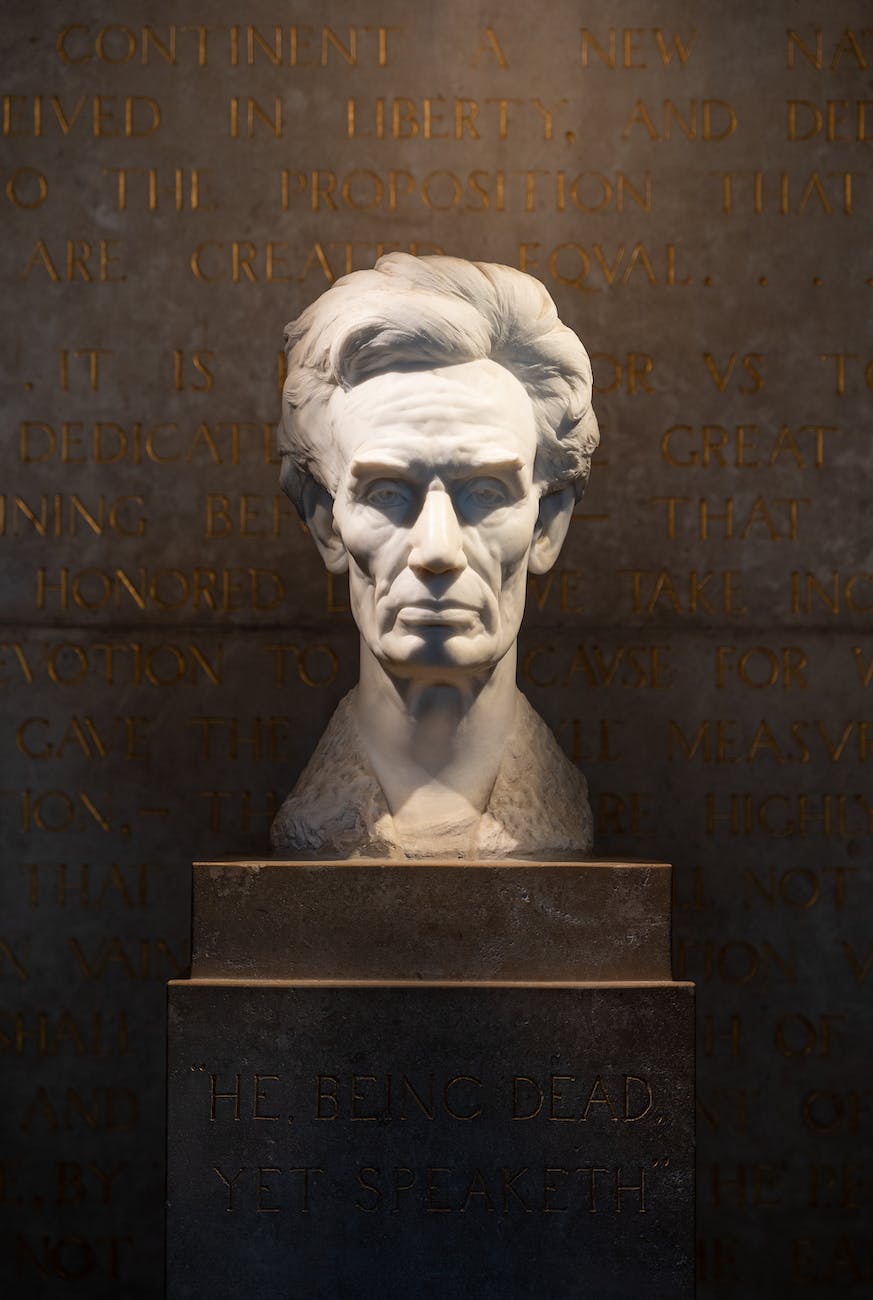
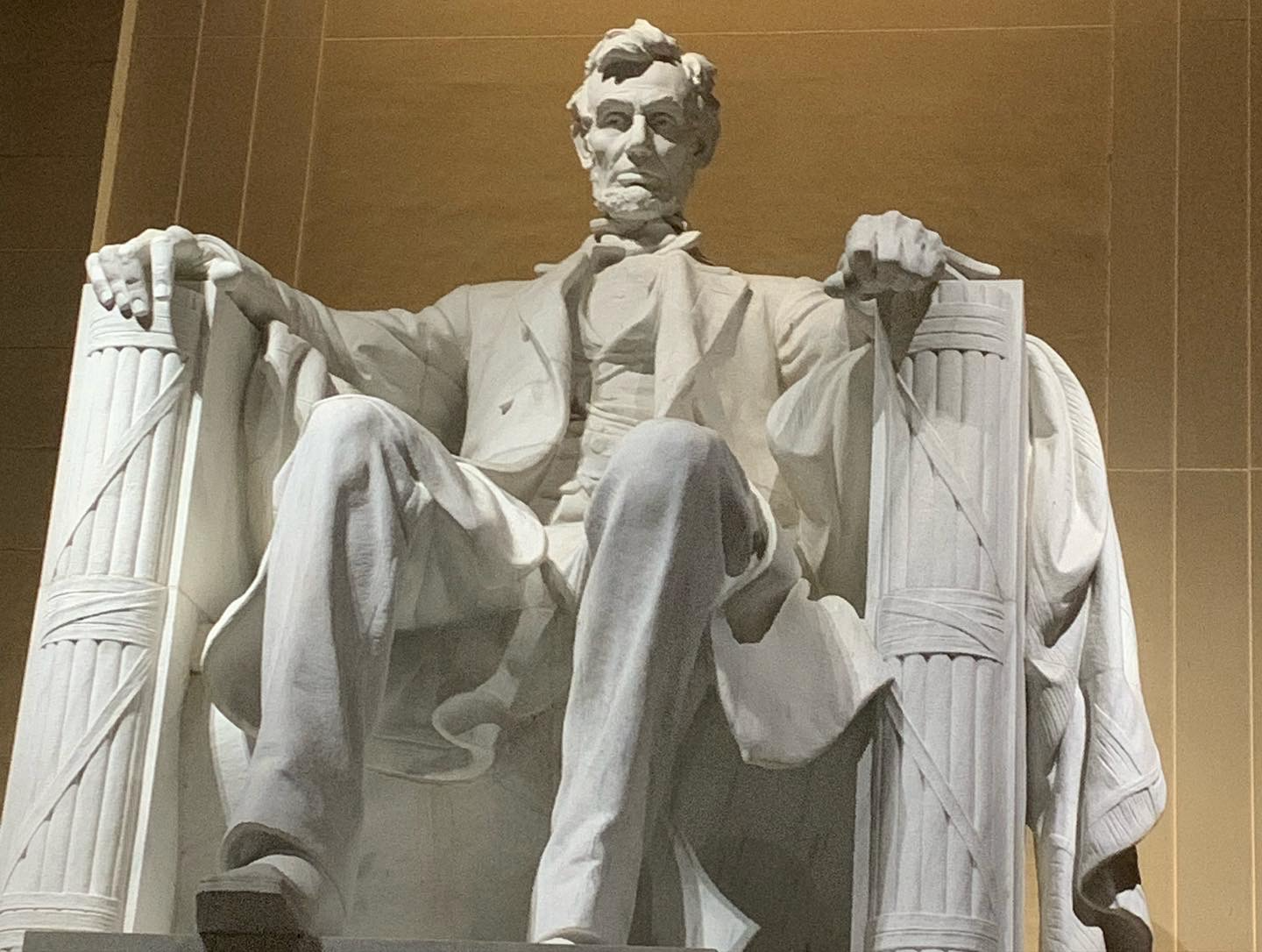
Mr. Lincoln
This week, I want to tell you about a trip I took last weekend to Washington, D.C. Links: The Smithsonian's Futures Exhibit: https://aib.si.edu/futures/ The Planetary Society's Sailing the Light documentary premiere live stream: https://youtu.be/NnKsHlV1NhA

Of all the cities in the east, Washington remains my favorite. It’s place at the emotional heart of our republic, the center of the Union that my lifelong hero President Lincoln fought to preserve, makes me yet another Mr. Smith every time I return to the capital. This week I made such a trip back to some of my favorite museums, some powerful monuments, and some good weather after months of cold and snow in Upstate New York. I decided that I wanted to make my trip a bit of an adventure and chose to drive down from Binghamton rather than fly, an easier option. This led me to an occasionally tense journey down Interstates 81 and 83 through Pennsylvania and Maryland to the BWI Amtrak station where I decided to leave my car for the weekend, figuring it’d be better to not try to drive and park in the District if possible.

Arriving in D.C. on the Acela, currently this country’s fastest passenger train, something the train nerd in me specifically chose to do, I had a similar arrival to Jimmy Stewart’s Mr. Smith at Union Station, its high vaulted ceilings designed by Chicago’s own Daniel Burnham over a century ago. Unlike Smith I didn’t see the capitol dome from the station, instead looking downward trying to find the nearest metro station to get to my hotel.

Seeing the monuments at night is always a special treat. As elegant as they are in the daytime, and some like the Vietnam Memorial are better seen under the Sun, there’s a special artistry in seeing the work of sculptors and architects illuminated with floodlights. That’s how I saw the Washington, Lincoln, and MLK Memorials, lit up solemnly. Mr. Lincoln and Dr. King looked as though they were great titans of antiquity in the glow of their memorials’ lights. 

At this time in our history, Lincoln’s struggle to save the Union and end slavery in this country once and for all seems all the more present. In the week since my last post (episode for those listening) the Russian military has invaded Ukraine. I alluded to those threats last week, but now threats have become a living nightmare for the Ukrainian people and a great storm cloud over the rest of Europe that threatens to engulf all of humanity. How do we embrace the true and righteous words of Mr. Lincoln to do the right thing and feel no evil towards others, even those like President Putin who have so brutally attacked their neighbors? I don’t have an answer to that question yet, nor am I certain that I ever will. But today’s feast, Ash Wednesday for us Catholics, fits well into this narrative as an annual reminder “Remember you are dust, and to dust you shall return.”

I spent a good deal of time on Saturday in several of the Smithsonian museums, returning to the Natural History Museum that I visited in July to double check a label for a sloth for my dissertation, and revisiting an old favorite in the Asian Art Museum. I also visited the American History Museum for the first time in over a decade and enjoyed it quite a bit more. The previous time in 2011 it seemed to be sparse in actual history, yet this time I could notice the nuance in the stories it told in the objects on display in what little space it had available.

The most insightful museum visit though was to the Futures exhibit currently housed in the Arts and Industries Building on the south side of the Mall next to the Smithsonian Castle. This exhibit, which asks visitors to imagine how our future could be a sign of human life improving offered a much needed antidote to the troubles of the world. There were examples of carbon-neutral and renewable building techniques and materials, electric cars, air taxis, and hyperloops. There was a new model of a space suit that was far less bulky than those used by astronauts today and a model of Light Sail 2, a spacecraft sent into orbit by the Planetary Society, a space advocacy organization of which I’m proud to say that I’m a member. There is no one future but many for us to choose from. It’s up to us to determine how we want our future to be written, to be designed, to be imagined.

The National Mall is the emotional heart of this country. It speaks to me of generations of memory, passion, and possibility. On this trip as well though I could imagine myself there in the future, introducing the next generation and later generations to come to that heart, to the ideals and hopes and dreams of this republic. Now at the end of my 20s, my visits to the capital mean something different to me than they did in the last decade. They represent my own future, its infinite possibilities, and how I might be able to do my part, however small it may be, to influence and improve upon our experiences.

Freedom from Fear

Credit: Wikimedia Commons CC BY-SA 3.0
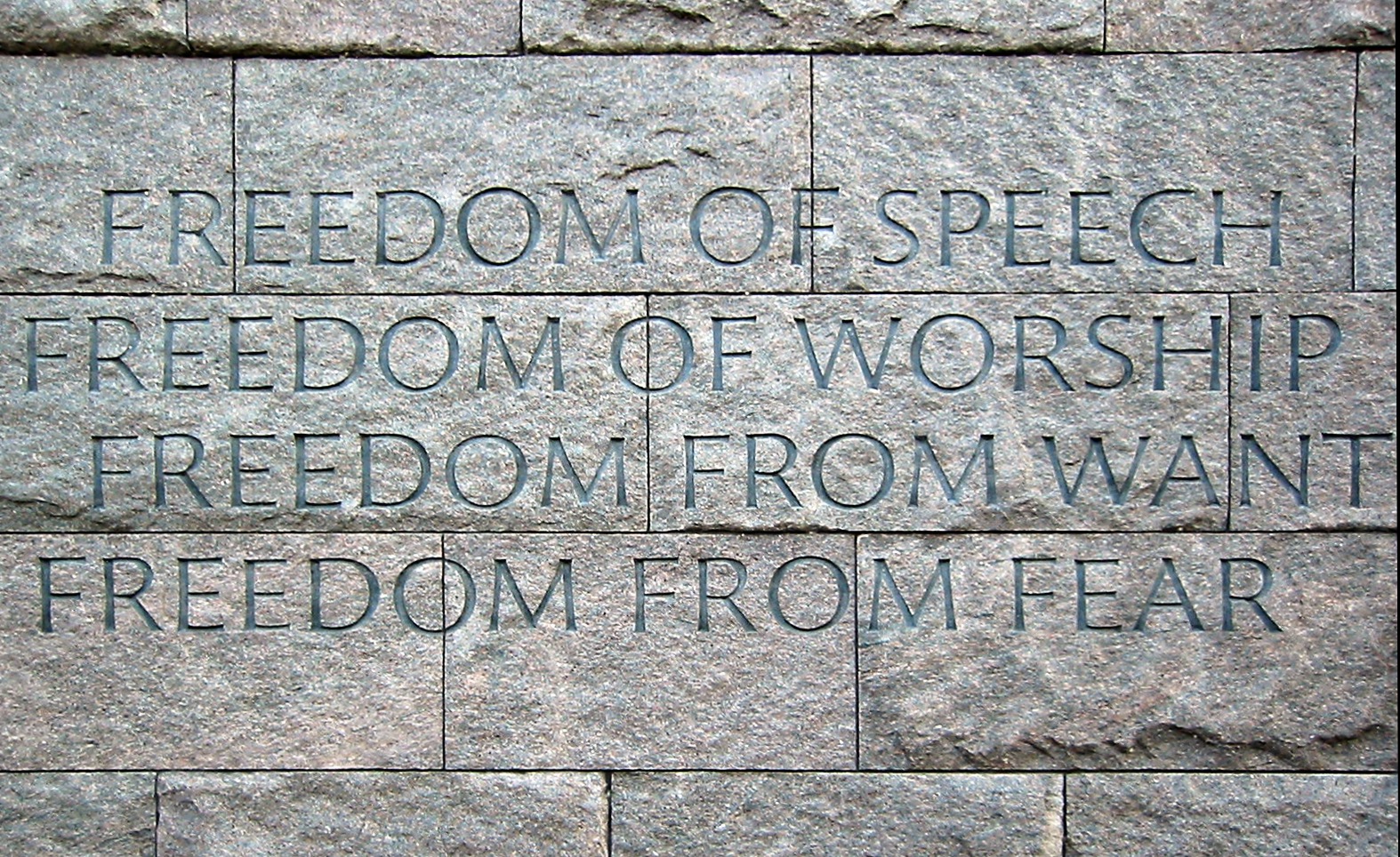
In this episode I talk about how FDR’s Four Freedoms from his 1941 State of the Union is pertinent to today.

When I worked as a Teaching Assistant for the US History II class (1877-present) at the University of Missouri-Kansas City, the week that we’d discuss the Great Depression and the New Deal, I would always highlight President Franklin Delano Roosevelt’s Four Freedoms and spend a good deal of time discussing them, what they meant to Americans in the 1940s, and what they mean to us today. Chief among these for me has always been the most abstract yet primeval of these Four Freedoms: Freedom from Fear.

At the time he announced the Four Freedoms in his 1941 State of the Union Address, 81 years ago this week, FDR saw Freedom from Fear as “a world-wide reduction of armaments to such a point and in such a thorough fashion that no nation will be in a position to commit an act of physical aggression against any neighbor –– anywhere in the world.” 

This spoke as profoundly to a world plunged into the worst war yet known in human history as it does to us today in a world where the instability of war has of late shown its face both in the form of terrorism and paramilitary attacks as well as in more conventional fighting around the globe. Yet now as I write this, headlines in the major papers and other prominent news outlets continue to warn of aggression from the likes of China or Russia against Taiwan and Ukraine, both conflicts that surely, we in the United States would be likely to involve ourselves in.

Yet beyond the terrible yet over-glorified world of weapons and war, I often think of this fourth freedom in other social contexts all the same. It saddens me, yet still doesn’t surprise me to know that now, nearly as distant from FDR’s presidency as Lincoln’s was from the Continental Congress, we still are a country that lives in fear of enemies both foreign and, yes, domestic as well. This cycle of fear has led to so many of our fellow citizens buying guns for self-defense, often in response to the frequent mass shootings and other homicides that are a wrathful shadow over our lives. 

This cycle of fear has kept us indebted to our for-profit health insurance industry, without which we couldn’t afford to pay the medical bills that result from the healthcare that keeps us alive. I thank God that my employer has good quality health insurance, because honestly if I were given the choice of surviving or going into severe debt to pay for an emergency surgery or other procedure, I’d have to really think about that before making a decision. What value is there in life if you can’t really live because all your earnings are going to pay off not only your debt but also the interest on that debt?

Fear can drive us to achieve better things, to overcome our fears, yet it can also inspire us to do terrible things. Fear of the other, fear of difference, is the root cause of so many problems that beset our country and humanity at large. I study this in the context of how the idea of the savage was understood in Renaissance natural history in my professional capacity as a PhD candidate in history.

One of my favorite episodes of Star Trek: Voyager provides a clue as to how we could truly achieve the dream of this fourth freedom. In the second season episode “The Thaw” Captain Janeway and the crew of Voyager take on an AI that was created by the imaginations of a group of interstellar settlers who put themselves into cryogenic stasis for decades. That AI ended up manifesting itself as Fear itself and proceeded to terrorize the settlers and eventually the Starfleet officers from Voyager who enter the stasis chambers to try and deactivate it from the inside. At the end of the day, Captain Janeway herself confronts Fear and proceeds to give the best argument for power that I’ve ever heard; power only lasts if its authority is unchallenged. Fear only lasts if we are afraid. At the end of the day, the answer it seems is coming to terms with our own agency, our own ability to make decisions for ourselves.

We as the United States have become paralyzed by fear; there are reforms and changes we really should make but the people who could make them more often say it’s too dangerous to disrupt the status quo, to shake the foundations if only slightly. To quote another President, this time Mr. Lincoln from his 1862 “Annual Message to Congress”, “As our case is new, so we must think anew and act anew.” Times have changed, and with them the ways we deal with our government and its relationship with the people must change as well. We need universal healthcare; we need electoral reform that will fully protect the right to vote enshrined in the Voting Rights Act. We need to make the changes necessary in our educational system, policing, and in nearly every other facet of our society to tackle bigotry in every venomous form it takes. We need to rethink our immigration laws, unscramble them, welcome in people who want to become our fellow citizens, our friends, our neighbors, who want to contribute to our society by their presence within our borders.

Eventually, I dearly hope, we’ll finally achieve FDR’s fourth freedom. I look forward to a day when I, and everyone around me has nothing to fear. I’m a teacher, admittedly in higher ed rather than in K-12, but a teacher nonetheless, and here in the United States being a teacher means knowing that there’s always a chance someone is going to decide they need to attack the students, faculty, and staff at your school or university. In my classroom, while my first priority is to teach, in that situation my first priority is to ensure my students’ safety. I long for the day when I won’t have to worry about someone attacking my classroom, and frankly I know there’s a decent chance even if I don’t experience a school shooting firsthand that I’m likely to experience a lockdown because of one, and not just the frequent drills we did for school shooters when I was in high school.

We fear each other because we don’t trust each other, and a country comprised of citizens who are too afraid to trust one another is a country in peril. Everything that I said today could well be interpreted as a partisan statement. Think about that: fear itself has been weaponized for partisan purposes to such an extent that the few solutions to that fear are themselves inherently partisan, fundamentally political. What have we done to ourselves to get to this point?

To turn again to President Roosevelt, freedom from fear “is no vision of a distant millennium. It is a definite basis for a kind of world attainable in our own time and generation.” Make this my hope, my prayer even, that if my generation and the generations to follow are remembered for anything it’s at long last overcoming those innate human fears that have driven us since the first Cain of our legendary past cast their stones against their fellow humans.


In the podcast version of this post, the recording of FDR’s 1941 State of the Union Address, his “Four Freedoms Speech” comes from the Archives of the Franklin D. Roosevelt Presidential Library and Museum in Hyde Park, New York which is operated by the National Archives and Records Administration. I’d also like to thank my friend the immensely talented voice actor Michael Ashcraft for his giving life to President Lincoln’s words in this episode.

Federalism vs. Regionalism

Federalism & Regionalism Wednesday Blog by Seán Thomas Kane

This week, I want to talk about some reasons that I see for why we Americans are so deeply divided. You can find the editorial by Charles M. Blow that inspired this episode here.

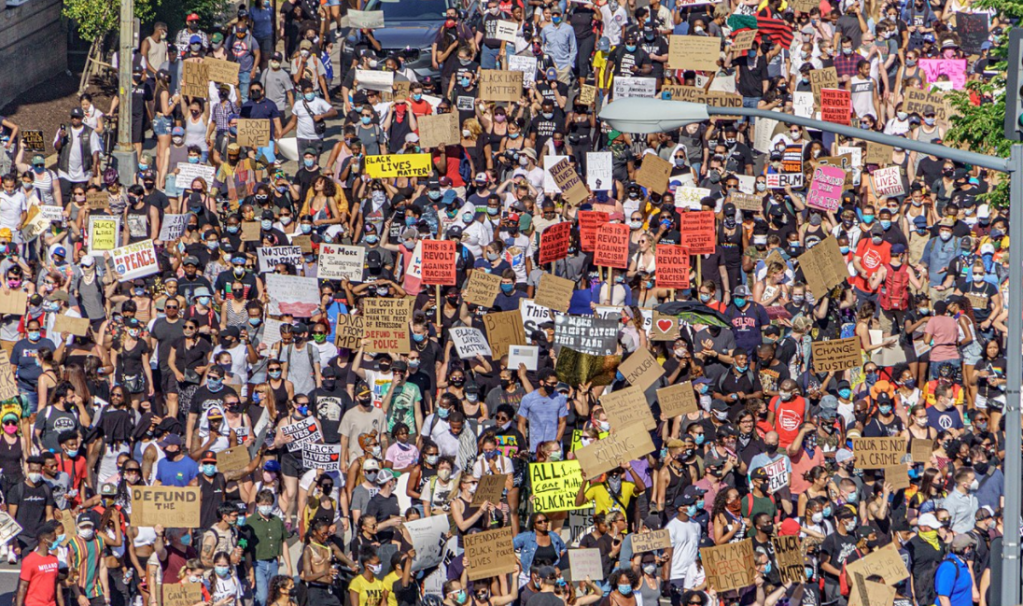
A few evenings ago, I read an editorial by the frequent New York Times contributor Charles M. Blow about what he called the first signs of the next civil war looming on the horizon. Blow’s argument boils down to the idea that today’s political actors on the right who accept our most recent former President’s Big Lie that the 2020 Election was somehow stolen are themselves inheriting rhetoric from former Vice President, and Senator from South Carolina John C. Calhoun. Calhoun has often been called the father of secession, the one who laid the rhetorical and political groundwork for eleven southern states to leave the Union in open rebellion, launching a Civil War in 1861, 11 years after Calhoun’s death, that would lead to around 720,000 American deaths. Just as today the Trumpist faction feeds on this Big Lie of their own creation, so too the secessionists of the nineteenth century made their fateful decision to embark on the conflict that my friend and fellow historian of Midwestern extraction Josh Kluever recently termed the “Treasonous Southern Enslavers’ Rebellion” on the basis of an even bigger lie, one that contends that there are varying degrees of humanity, some better than others, and that those degrees are understood on an arbitrary designation based on phenotype: distinctions in skin color.

If the Trumpist argument has any merit it’s that it’s a reaction to a sense that some Americans feel left behind by the dominant forces in our culture and society today. As much as being American implies that we are all one people, one culture, in the same way that old caesaropapist rhetoric would cry that under the banner of the emperor of the day there was “One God, One Emperor,” so too the idea that the United States is “one nation indivisible” makes it entirely evident that we are expected to be unified not only politically but culturally and socially as well. The great façade of this line from our Pledge of Allegiance is that we have never truly been “one nation” in any more of a sense than we share some common cultural and social bonds brought about in part through the spread of American dominance on this continent through westward expansion, phantom dreams of manifest destiny, and frequent generational rallying calls of “America First,” embodied in the idea of the melting pot that boils down all of us ethnic descendants of immigrants and makes us one common people: Americans. The South, in its misguided attempt at going it alone in the 1860s, has long recognized that it has a distinct culture from the rest of the country. We in the Midwest too are different from our cousins in the Northeast, even if we generally come from the same immigrant roots as our fellow Americans in New England or the Mid-Atlantic states. Then there’s the great gulf between the east and West, which falls somewhere in the Great Plains. During my recent visit to San Diego I mentioned to my family back in Kansas City that if any part of this country could even remotely think about successfully seceding from the Union it would be California, which is geographically so remote from the still largely eastern center of power and wealth in this country that as American as it does feel, it still seems foreign enough to my Midwestern senses as to be mistaken for a foreign country.

The greatest fault that our collective popular history has perpetuated is by smoothing out the surfaces of our past to make an easy to digest collective etiological story, a creation myth of this most artificial of countries born out of a series of settler colonies founded by the English in the seventeenth and eighteenth centuries on the Atlantic coast. Unlike the majority of countries around the globe, the United States is not a nation, it is a political collection of peoples living together in the same region of the globe. A nation is something far more ancient, its members share not only a common political leadership but common heritage going back centuries if not millennia. The purest examples of nationhood are countries like Iceland that have had little immigration to its shores, and thus a fairly stable population for generations. 

Considering this, by my estimation there are few nations today, instead many countries, states which represent the interests of the peoples who live in those places. Those peoples are often either native to those areas or varying degrees of newcomers. Yet the degree to which people are either native or newcomer is itself vague, after all would the old Bay Staters be considered at this point after 400 years of settlement on the shores of Massachusetts Bay native to that part of the world? Or are they, like the descendants of the Ulster Scots who were brought to Ulster in the same century still relative newcomers to the places that they have called home for generations?

Here in the United States, we often highlight the English and Dutch colonial heritage of our country while demoting the French, Spanish, and Russian colonial heritages of other regions beyond the old Thirteen Colonies. Our holidays commemorating the colonial period, notably Thanksgiving, commemorate the founding of one English colony on Cape Cod, and even the history behind that commemoration is flimsy at best. It struck me when I was walking through the Museum of Us, San Diego’s renamed anthropology museum in Balboa Park, that the most basic understanding of “us” as the intended audience of the museum’s exhibits are Anglo-Americans. I feel a sort of secondary connection to this idea of “us” as Anglo-Americans, after all I have old colonial ancestry on my Mother’s side going back to seventeenth-century Connecticut, and eighteenth-century Maryland and Pennsylvania, but I see myself far more in light of my more recent and familiar status as a third-generation Irish American. What was especially profound about this particular definition of “us” in San Diego’s anthropology museum was that it was being used in a city that was founded not by the English or later American settlers but by the Spanish in 1769. Sure, there were exhibits that included the stories of the local indigenous peoples, notably the Kumeyaay, but they were always the object of focus not the subject describing the object. In the process of conquest by the United States during the Mexican-American War of the 1840s, not only were the Amerindians living in the West and Southwest subjugated and demoted to second-class citizens in their own home, so too were the Californios, Nuevomexicanos, and Tejanos, the descendants of the Spanish colonists who settled in their northernmost American colonies and would later become regional identities in a newly independent Mexico after 1821. 

Similar patterns can be seen among the French of the Mississippi Basin; it’s noteworthy that Homer Plessy of Plessy vs. Ferguson fame was seen as a free person of color within the French and Spanish racial contexts, while to the Americans any hint of African ancestry deemed him to be legally black. If you want to understand why the fight for racial justice is so complex consider that firstly race is an artificial concept that was created to promote a colonial order of hierarchy, and secondly that out of these ideas of race entire notions of identity and community have developed that are very real, very powerful, and frankly beautiful. Just because I don’t feel any affinity for my legal identification as white doesn’t mean that my relatives, friends, and neighbors who identify as black aren’t in any way unjustified in being proud of being black.

Secessionist rhetoric had power in the nineteenth century because of how new the Union was. Remember how Lincoln introduced his Gettysburg Address, noting that he spoke “four score and seven years” after the Declaration of Independence from the British Empire was made in 1776. Speaking only 87 years after the conception of this idea of a country called America, populated by a people called Americans, it makes sense that some in the South would feel far closer to their identities as South Carolinians, Georgians, and Virginians among others. Yet it is interesting to me that the President of the Confederacy, Jefferson Davis, was born in Kentucky but served from Mississippi, both states that were created by the United States out of territories controlled by the Federal Government after the signing of the Federal Constitution in 1787. In short, Davis’s claim to some innate loyalty to his state before any loyalty to the Union was far less well founded than that of the father of secession, John C. Calhoun of South Carolina. I’ve written before about how I argue that the moment that the United States became more important than the individual states themselves was when the United States Congress began admitting new states to the Union west of the Appalachians that hadn’t existed before the Revolution. The first thirteen states created the Union, yet the Union created nearly every state that would follow its own founding, save a few holdouts with preexisting governments that elected to join the Union, whether by popular demand like Texas or by coup and minority rule like Hawaii.

Today though, secessionist rhetoric is less well founded on the idea that the states have some precedence over the Union and more on the idea that the power of the Union relies on the states’ and by extension the voters’ full faith in the credit and authority of the Union itself. No institution exists without that most fundamental level of trust that it can do what it sets out to do. Historically, governments have been able to hold power through a combination of force of arms and public support. This is at the heart of what Machiavelli argued about how a good prince ought to govern in the sixteenth century. The definition of what it means to be American is inherently exclusive, it relies on this identity created out of the twin foundation myths of Jamestown and Plymouth. Because of this we have seen a continual multigenerational struggle to expand that definition to become inherently inclusive, that it might embrace not only the English heritage of the oldest colonies that eventually contributed to the foundation of the United States but all the other identities, whether indigenous, colonial, or immigrant that best express the intricate mosaic of what it means to be an American.

If we do have a second civil war, whether on the battlefield or in the destabilization of the authority of the ballot box, it will be because we don’t recognize the interests and needs of our myriad of different Americans. I agree with Mr. Blow that the efforts of activists and politicians on the right in the last year to take control of government at the local level, whether on school boards or in local election boards, better reflects the true battleground of this second civil war. Yet I’d take that argument one step further and say that the fact that this focus has been so intent on assuming authority over the most local of political offices reflects more than anything else how at the local level we are still divided into our own nations, whether they be as Southerners, Northeasterners, Midwesterners, or Westerners, or whether it’s even more particular that we truly define ourselves by our towns and cities, or even by our neighborhoods and blocks. The homogenization inherent in the narratives constructed around being American over the last 245 years brews conflict with this hyperlocal level of identity that is inherent not only in we the American people, but in all humanity no matter who we are.

Humility in Leadership

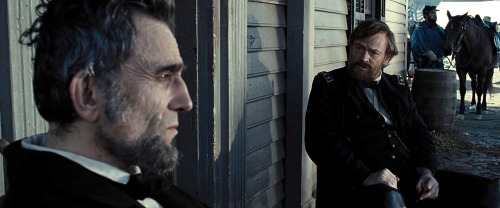
On Sunday evening while I was watching the Chiefs game, I found myself putting that contest in the background and focusing instead on YouTube on my phone. One of the first recommended videos was a clip from the 2012 Steven Spielberg film Lincoln starring Daniel Day-Lewis as the 16th President. In the clip, Lincoln sits on a porch with General Grant talking about how to handle the Confederate surrender in the coming days at the end of the Civil War. It struck me, in light of all the examples of leadership we’ve seen in the last four years in this country, how humble Lincoln was in that moment, how plain and honest his directions to Grant that the Confederate soldiers should be allowed to go home.

I’ve been entrusted with a number of leadership roles throughout my life, from serving as a two-term Senior Patrol Leader in my Boy Scout troop (Troop 1, Kansas City, KS), to most recently being entrusted with heading the committee as President of the Graduate History Society here at my university. Over the years I’ve learned that as much as having the power of an office can be alluring, I’m more interested in being an equal partner with the people who’ve entrusted me with that job. I don’t know if I’d say I’m a good leader, after all there’s more to leadership than trying to be a nice guy and someone who’s easy to work with, but I try to do my best every day.

Something that’s often talked about in terms of the long memory of leadership is legacy, what will people remember your term in office for? I wonder about that with all the work I’m doing here in my twenties. When they do write my obituary in however many decades from now, what will they say about the things I did at this point in my life? Looking back on the last six years, the years after I graduated from Rockhurst with my BA, I see a life that wasn’t nearly as stable as I’d like it to be, a transitory life where I moved from Kansas City to London, back to Kansas City, and eventually now to Binghamton. It’s been a time when I’ve moved even more frequently between jobs and dreams of what I want my future to be like.

Yet now, in 2021, I feel like I’m on the verge of some of my best writing, some of my best work. Much of that will not be possible without the support of my family and friends, and you kind readers as well. I do feel constantly tired, and I always seem to have a lot to do, but I figure if I get one thing done at a time eventually the entire puzzle will be finished, no matter how frustrating the puzzling will be in the process.

I’ve always looked up to Lincoln as someone I’ve respected since I was very little. Maybe that’s something I learned at a young age living in Illinois, but of all the presidents from the 18th and 19th centuries, I always felt like Lincoln was the one who I’d like to sit down and talk to. God willing I won’t have to experience all the pain he went through in his life, both personal and through his service as President during the Civil War. Whitman’s description of him as the captain of a ship in stormy seas is fitting for the man who seemed to have aged nearly 20 years in just 4. Still, there’s something about the man, the leader, that seems much more understandable to me than many others in our history.

Visions and Dreams in 2020

I’ve been thinking a lot lately about Lincoln’s Second Inaugural Address. I first heard perhaps the most famous and impactful line in any of his speeches as a child during the final episode of Ken Burns’s magnificent The Civil War documentary series. Spoken on 4 March 1865, a month before the end of the Civil War and a few days further removed from Lincoln’s assassination, the lawyer from Springfield, Illinois concluded his address calling on all Americans to feel “malice toward none,” and “charity for all.” After all the pain caused by the war, many of Lincoln’s goals still seeming far too distant from reality, he called on our forebearers to: 

“strive on to finish the work we are in, to bind up the nation’s wounds, to care for him   who shall have borne the battle and for his widow and his orphan, to do all which may achieve and cherish a just and lasting peace among ourselves and with all nations.”

Lately, I’ve wondered how best to categorize the year we’ve been living in. Could the upheaval of 2020, a combination of general public dissatisfaction with government, a global pandemic, and social and economic tensions boiling over after generations of bubbling, could all these combined be called a revolution of sorts? Could we be living through so consequential a time that in fifty or a hundred years, school children will place 2020 in the same column with the most recent global revolutionary years of 1989, 1968, 1918, 1848, 1789, and perhaps even 1776? I’ve also wondered, if we are living through a time which rhymes with Lincoln’s, are we in 1861, at the start of our national nightmare, or in 1865 at the moment of waking from that horror?

Yet when I think about Lincoln’s words again, one thing in particular strikes me. We are at our weakest as a country when we are divided. Today, when each side sees the other with such contempt, it’s hard to see how we could heal these divisions and sow back together these wounds that have cursed our country from its very inception with the conquest and colonization of this continent. Yet heal these divides we must. Someone is going to have to take the first step at reconciling the many factions and camps in this country, someone is going to have to reach across the chasm and offer a hand of friendship to someone on the other side. We need to learn to recognize the innate humanity in those we disagree with before we see their faults. We need to learn to grow past our hate.

Even a person who has committed the worst acts imaginable, people whose names live on in the darkest infamy, were still people like you and me. There are people out there who seek to divide us even further, to sow distrust among us until we are unable to bear the mere thought of one another anymore. Their power is fueled by our hatred, their lies take on the sense of truth only when so smelted by the fire of our hate. As long as we let our hate guide our actions and principles, as long as we make choices great and small based on that darkest emotion, they will win. 

Listen to the voices that offer us a message of unity and hope, to the ones who offer us a future that doesn’t seem bleak, to the ones who offer solutions instead of just spewing bile and denouncing their rivals as the enemy. I fundamentally believe that all things are created good, if I know anything for certain, it’s that. Look at it this way, why would a God who wished for evil to be the only option give us free will? It is up to us to choose how we act and react, think and feel. Another thing that I fundamentally believe in is that it’s up to us to make our world as we want it. God made this reality, it’s up to us as citizens of this reality to decide its future. 

True love, what many would say is the anthesis of hate, depends on free choices for survival. It’s up to us to decide which emotion our future will be shaped by: hate and its offspring distrust, fear, and bigotry, or love and its offspring hope, kindness, justice, and mercy. Let’s finish Mr. Lincoln’s work, and make 2020 the year when we began to at long last heal our nations wounds, care for each other as equals, and do what we must to earn that “just and lasting peace” for all of us, the oppressed and their erstwhile oppressor too. After all, if we leave even a single person behind, hate’s cold song will still be there for yet another generation to hear.

It’s up to us to live up to our forebearers’ visions and to build the foundations for our descendants’ dreams. Hope and pray for those visions and dreams all you want, but if you want them to come true, you and I, each and every one of us, must act on them. 

I’ve had my say, now it’s your turn.