

An Equine Etymology – Wednesday Blog by Seán Thomas Kane
This week, I discuss the two Irish words for the horse, and what they tell us about the history of the Irish language.
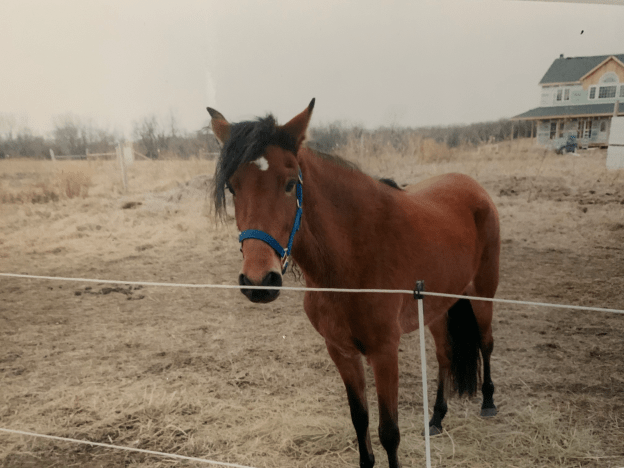
The word that we’re taught in Irish classes, in fact the word which is listed in the 1959 English-Irish Dictionary for the English word horse is capall. I like this word; it sounds to me like the clopping of a horse’s hooves on stone. Yet it actually derives from the Latin caballus, a word borrowed into Latin from the Gaulish *kaballos that gradually replaced the Classical Latin equus in late antiquity.[1] Capall then is a relative of the French chevalas well as the Welsh ceffyl. Yet Irish also has another word for horse, each, which fell out of use in favor of capall at some point in the past. Even still, each survives in words deriving from the concept of horsemanship, or equestrianism if you prefer Latin roots over the former’s Germanic ones.
How then did capall replace each, and when might Irish have come into contact with the Latin caballus that did this deed? T. F. O’Rahilly argued in the 1930s that capall may be one of several Brittonic loan words in Irish, owing to its similarities to the Welsh ceffyl.[2] I’m less sold on this idea myself, as it presumes that capallentered Irish earlier than the arrival of Christianity, though it does speak to the presence of interisland trade between the Britons and Gaels in the Iron Age.
Each derives from the Proto-Celtic *ekwālos, itself a descendant of the Proto-Indo-European *h1ékwos. Other Celtic languages derived words for horse from this root, including the Welsh word cyfeb referring to a mare in foal and ebol referring to a colt or a foal. Gaulish appears to have had the word epos for horse, existing alongside the aforementioned *kaballos, which in turn appears similar to the Gallo-Roman horse goddess Epona.
Each remains the more common Scottish Gaelic word for horse to this day, which to me rules out a possible Norman introduction, as the influence of Norman French was felt in both Ireland and Scotland in the twelfth century. Rather then, considering the Welsh connection to their word ceffyl, it seems to me that capall was introduced to Ireland by the Roman monks who brought Christianity to the Gaels in the fifth and sixth centuries. In the stories of St. Patrick, the holy man studied for the priesthood not in his native Britain but in Gaul, where again this Latin word caballus found its origins.
The recurring problem with this question is one of sources. I am trained to study texts looking for answers to historical quandaries. In the case of Irish, few textual sources from before the coming of Christianity survive. We have an idea of what life was like in Ireland before St. Patrick’s mission through the ancient epics and stories that have survived and been embellished down the generations, yet there is something lost deep within our past that could only survive as the faintest whisper of a thought in our memory.
How then do we address older stories in the historical narrative? In my mind, I am able to separate these stories from the factual accounts which I study in the same way that I am able to delineate the different spheres of the scientific from the spiritual. It doesn’t matter to me if there was never a man named Amergin Glúingel whose song on the eve of the Milesian invasion of Ireland to wrest control of the land from the Tuatha Dé Dannán, led to a peaceful division of that island home between the two peoples. What matters instead is that the story tells us to seek peace rather than war, dialogue instead of revenge as Amergin’s brothers sought in their invasion. I don’t use these stories in my research, yet I’d gladly tell them beyond the analytical sphere of my writing.
Yesterday morning, I read in the Guardian the analysis of one nostalgia expert that we historians are often drawn to study the past because of a yearning to experience a time different from our own. This story was written in the context of the 25th anniversary of the computer game Age of Empires II, which I too played in my youth. From my vantage, I see myself very much as one of the wider diasporas that came from the homelands of my ancestors. I grew up with far more connections to the Irish diaspora here in America, and so have come to know myself more as an Irish American than by any other appellation. At the heart of that sense of being Irish American is the sense that even if we today are well at home in America, our families came here as exiles, deoraithe in Irish, and in some sense, we feel that weight even today generations later.
There is a sense that something is lost when one is ever yearning for the land of their ancestors, the lives they might have lived. I’ve been to the town around which most of my paternal ancestors came, Newport, County Mayo, and I was struck on the one hand by how many of the people were the spitting images of their cousins that I’ve known in Chicago, and on the other hand how as beautiful the country around Clew Bay is I’d much prefer the city over living there. For me then, I’ve turned to the language, to Gaeilge, as a way of keeping that connection with our roots alive and flourishing like some great tree amid the physical and spiritual droughts of the world today.
My eye as a historian is drawn to finding the roots of the things that I come across, both in my studies and in my curiosities. It struck me then to see in my Fócloir Gaeilge-Béarla that different equine words in Irish retained traces of this older word for the horse: each. In my likely forlorn search for some trace of the oldest roots of the Irish language, and by extension of my own ancestors, I feel the need to understand where these two words come from. Horses are important in their own way, albeit replaced in most uses by cars, trains, and airplanes today. Despite moving to a farm when I was six in order to have horses, I don’t think I’ve ridden a horse in at least 15 years, if not a full score. When you ride a horse, you are working with the horse to move about the world. Wherever you look, the horse will wander that direction. It’s key to remember that the horse is more than just a vehicle, it is a living being with thoughts and wishes all its own.
Having two words for this animal show that the perceptions of it have changed down the generations. This word each today is used to describe people or activities which relate to horses in the same way we use the word equine in English. That English word however derives from the Latin equus, while each is a relative of the same generation as the Latin. Meanwhile, capall is the horse as the everyday being: the beast of burden, the bearer of riders, and yes the friend. As with most things concerning the origins of the Irish language, I can’t yet say for certain when or how capall entered the language though I am more certain that each was already there if only because I know that equus predates caballus in Latin, and because the most innate relationship humanity can have with a horse, as the rider, is reflected in Irish with the word eachaí.
There is much we can learn from our past, and how we lived within nature and alongside other natural things in those distant days. I do hope we can learn more as we continue on in our lives on this Earth.
[1] The use of the asterisk in these Gaulish, Proto-Celtic, and Proto-Indo-European words denote that they are theoretical reconstructions.
[2] Myles Dillon, “Linguistic Borrowing and Historical Evidence,” Language 21, no. 1 (1945): 12–17, at 13. (JSTOR)

 Wednesday Blog by Seán Thomas Kane