Tag Archives: Alex Brisson

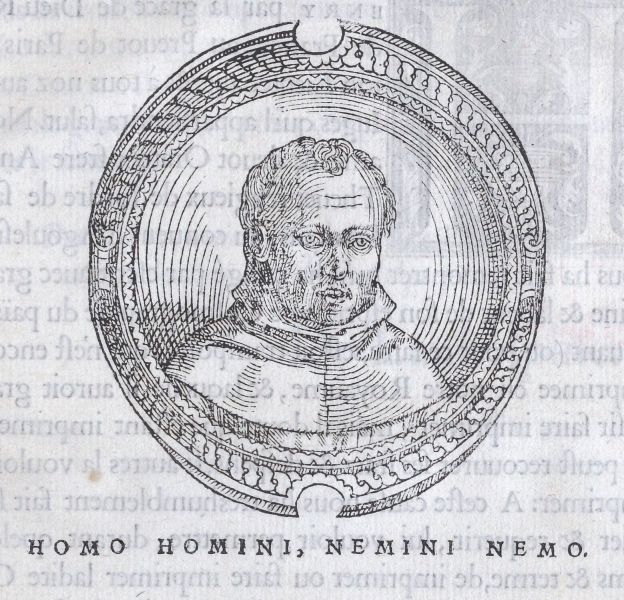
A portrait of André Thevet from 1554

Why André Thevet?

This week, the second in several scribblings about my research: why I chose to study André Thevet and build my career on the mound of his works.—Click here to support the Wednesday Blog: https://www.patreon.com/sthosdkane


This week, the second in several scribblings about my research: why I chose to study André Thevet and build my career on the mound of his works.


I initially chose to focus my dissertation on André Thevet (1516–1590) because of his account of the sloth and because he was French; I speak the language and therefore felt I would not need to learn another language to grasp the sources. Thevet is a figure who I’ve gotten to know over the last 6 years. I first encountered him in Dr. Bill Ashworth’s Renaissance seminar at the University of Missouri-Kansas City. It was in a nice classroom in the southeast corner of the third floor of Haag Hall that welcomed in the midday light as the Sun arced across the sky. We met on Tuesdays and Thursdays, and often I would walk to class from my job working at a cheese shop, the Better Cheddar, at 49th & Pennsylvania on the Plaza. What I didn’t admit at the time but have freely regaled friends and family since is that on Tuesdays the shop’s sommelier would often stop by to offer those of us working at the time wine tastings of the latest vintages. I was hired by the cheesemongers there more for my knowledge of European wines, and because I spoke French, than for my far more limited understanding of cheese going into the job. So, I often went from a delightful morning tasting cabernet francs, pinot noirs, and syrahs to a delightful afternoon sitting in the back third of Dr. Ashworth’s class listening to his stories about the Renaissance.

By this point, I was still committed to a largely unfounded master’s thesis project studying crypto-Catholics in the English court of James I and VI, which was born out of a desire that I might find my way back to London perhaps to work as a curator at the Banqueting House or Hampton Court. By Christmas, that project had well and truly died, it was only several years later that I discovered the fantastic work of the late Professor John Bossey on persistent Catholicism in the North of England that I found the anchor and line that would’ve led me toward my original research project idea. As it turned out, I found my way to Thevet through a more traditional Renaissance history master’s thesis about English humanism, specifically the education of Margaret Roper (1505–1544) and Mary Basset (c. 1523–1572), daughter and granddaughter of St. Thomas More (1478–1535). As an English-speaking Catholic of mostly Irish descent, with a fair minority of English ancestors to boot, I was drawn to the More family as models of a Catholic conscience; it is rather fitting that the upsurge of English colonialism in Ireland coincided with the English Reformation. When I lived in London, while I usually attended Mass at the Jesuit church at Farm Street in Mayfair, I would occasionally go to the English Chant Mass at Westminster Cathedral near Victoria Station. All of this came together in my History master’s thesis about Roper and Basset, my second thesis after the one I wrote in London for my degree in International Relations and Democratic Politics at the University of Westminster.
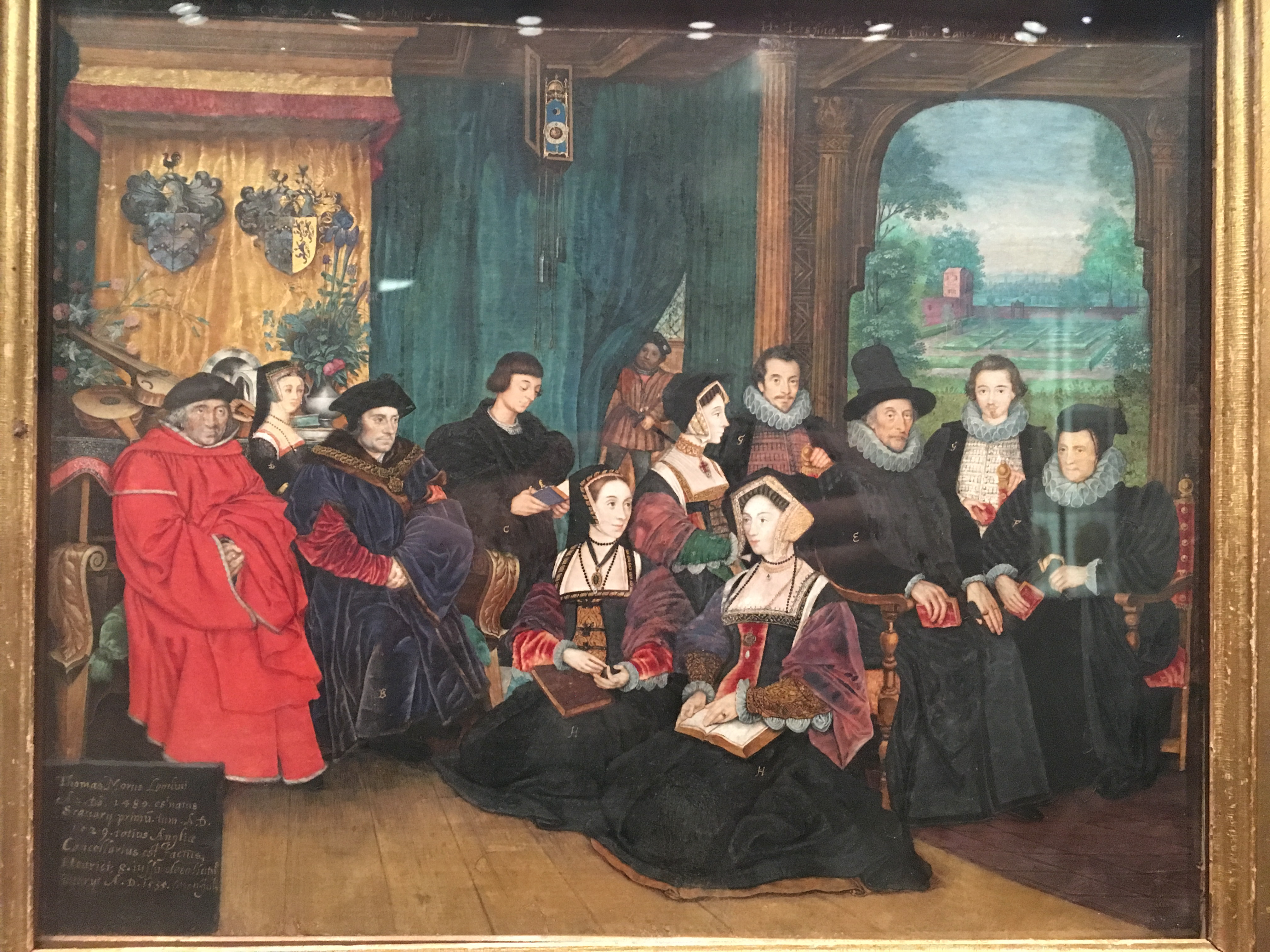
A painting miniature of the family of Sir Thomas More held in the collections of the Victoria & Albert Museum, London.
A painting miniature of the family of Sir Thomas More held in the collections of the Victoria & Albert Museum, London, c. 1527. Photo by the author.

Yet while I was working on this and writing good essays and papers, I kept hearing my friends talk about how the classes they loved the most dealt with the History of Science. One of my greatest regrets from my time at UMKC is that I didn’t take Dr. Ashworth’s Scientific Revolution class. It would’ve proved to be a good foundation considering I’ve taught essentially the same material since, and considering a great deal of the effort of my generation has been focused on deconstructing this perception of a revolution from humanism to science at the turn of the seventeenth century. So, when I discovered to my horror two weeks before leaving Kansas City to begin my doctorate at Binghamton that the thesis of the dissertation I intended to write had been published in a peer-reviewed journal a year before I took the chance to shift gears entirely and dive into the history of science. I used Thevet’s sloth as my diving board.

I met André Thevet in August 2019. We’d been introduced three years before by Bill Ashworth, yet besides the chuckles I gave at seeing his sloth engraving for the first time I turned my mind away from the Franciscan. Through Thevet I was introduced to the Renaissance notion of cosmography, a starkly different use of the term than how I’d heard it. To me, cosmos is most synonymous with Carl Sagan’s book and documentary series, including that series’ remake in the last decade by Neil DeGrasse Tyson and Sagan’s widow Ann Druyan. I kept coming across the word cosmos throughout the years I was in Binghamton in a myriad of windows. On all of my long drives I listened to audiobooks, and I usually remember the books better than the drives themselves. They animated my existence for those days in the Mazda Rua, my car, crossing the eastern half of our country by road. The first day of my August 2021 Long Drive East was so animated first by Alex Trebek’s last book, which he and Ken Jennings co-narrated, and second after I finished that book on I-70 near the Indiana-Ohio border I turned on a reading of Sagan’s Cosmos read by LeVar Burton. I stopped the car at the Ohio Welcome Center, maybe an hour into the book, to try and get another stand hour on my smart watch and was struck at how brilliant the sky above me seemed that clear August night. That day I’d been running from a massive storm that bore down on Iowa, Illinois, and northern Indiana, a derecho, and for the first time all day I couldn’t see the dark billowing clouds with bolts of lightning shooting forth like thanatic trumpets reminding all in their path that we are mere lodgers on this continent owned by Nature itself. Yet in that moment there were no clouds, no storms on the horizon, only stars burning high above.
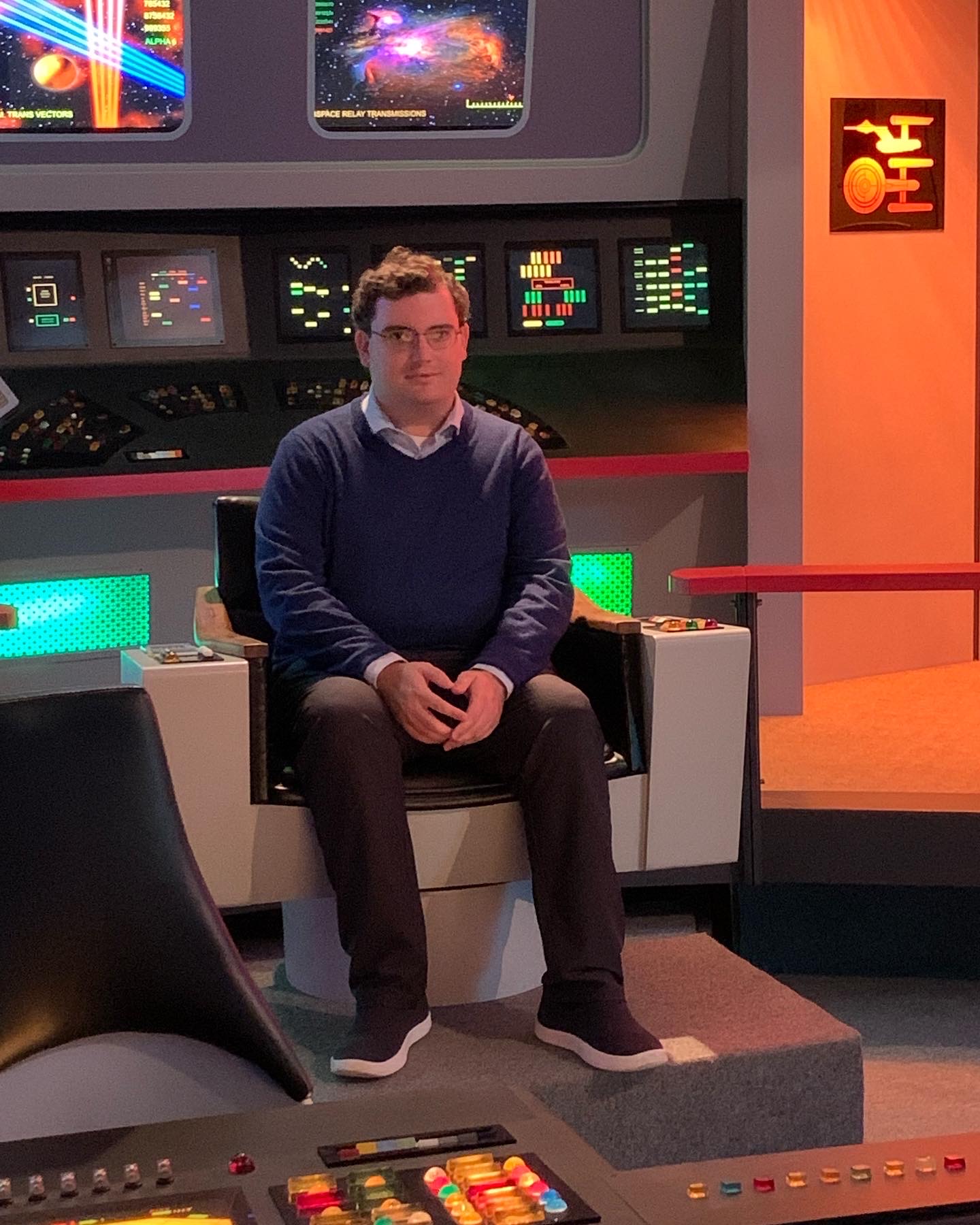
Myself in the captain’s chair at the Star Trek Tour in Ticonderoga, NY. Photo: Alex Brisson.

In another drive on a Sunday in late September 2022, at the end of a delightful weekend I spent with my friend Alex Brisson in Ticonderoga and Albany, I drove southwest through the rolling hills of Central New York toward Cooperstown to visit the Hall of Fame. While I was driving, I listened to Andrea Wulf’s biography of the Prussian naturalist Alexander von Humboldt (1769–1859). On that particular Sunday, I listened as Humboldt’s own book Kosmos was described in depth. It felt to me that I could see some of the inspiration for Sagan’s Cosmos in Humboldt’s magnum opus, and I was left wondering how Thevet’s own Renaissance cosmography fit into this cosmic lineage. As it turns out, Humboldt was familiar with Thevet’s work, and didn’t care for it at all. The Prussian naturalist is one of the earliest figures in my dissertation’s secondary literature, and he is important because he largely dismissed Thevet’s contributions to natural history writing that his vision of the cosmos was too small to warrant that word.[1] In many ways, my approach to Thevet has always been bi-directional: I’ve tried to learn more about the man by finding the books which survive from his library and the books we know he translated while at the same time I’ve always had an eye on Thevet as a starting point for understanding a specifically non-Iberian understanding of the development of the natural history of the Americas beginning in the Renaissance. My own perceptions of natural history are shaped by my childhood introduction to this vast kaleidoscope of the human vision of the rest of nature on display in my hometown natural history museum, the encyclopedic Field Museum on the Chicago lakefront. While as a child I marveled more at the dinosaurs in their upper floor galleries, now as an adult I prefer to spend my time in the museum among the taxidermy and dioramas with one eye drawn to nostalgic escape and the other toward scholarship; the Field Museum contains a specimen of one likely candidate for the species of three-toed sloth that Thevet described in his Singularitez. By taking this multidirectional focus on the history of natural history, on the one side starting with Thevet in the sixteenth century and on the other with Carl Akeley and the collecting expeditions launched by the Field Museum at the turn of the last century, I’ve developed a particular perspective on natural history that is visible in both wide and narrow focuses.
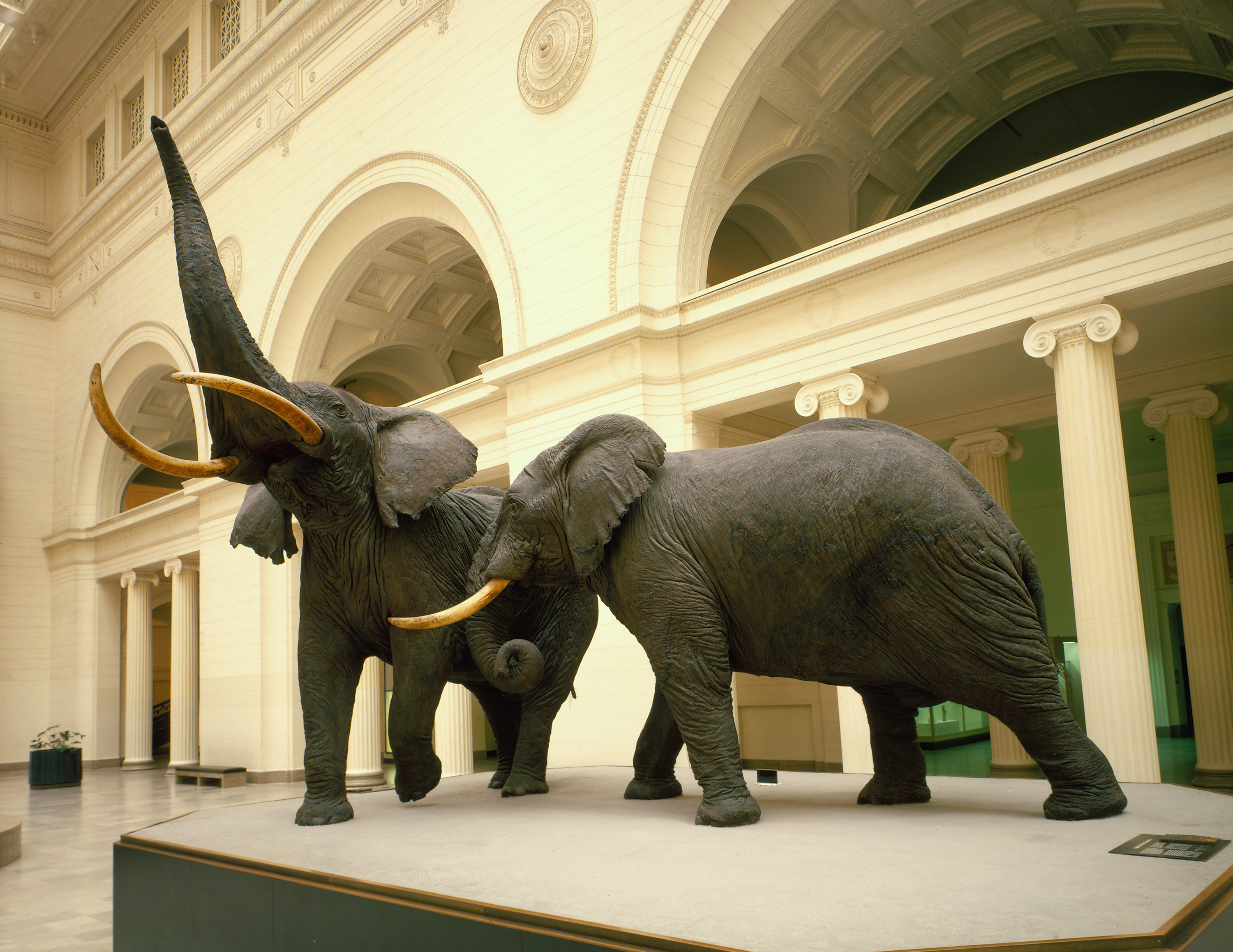
Fighting African Elephants in Stanley Field Hall. Taxidermy by Carl Akeley . 41411 is on the left with two tusks and its trunk is raised. 41410 is on the right, with one tusk. Photo credit: (c) Field Museum of Natural History - CC BY-NC 4.0.
Fighting African Elephants in Stanley Field Hall. Taxidermy by Carl Akeley . 41411 is on the left with two tusks and its trunk is raised. 41410 is on the right, with one tusk. Photo credit: (c) Field Museum of Natural History – CC BY-NC 4.0.
A portrait of André Thevet from 1554

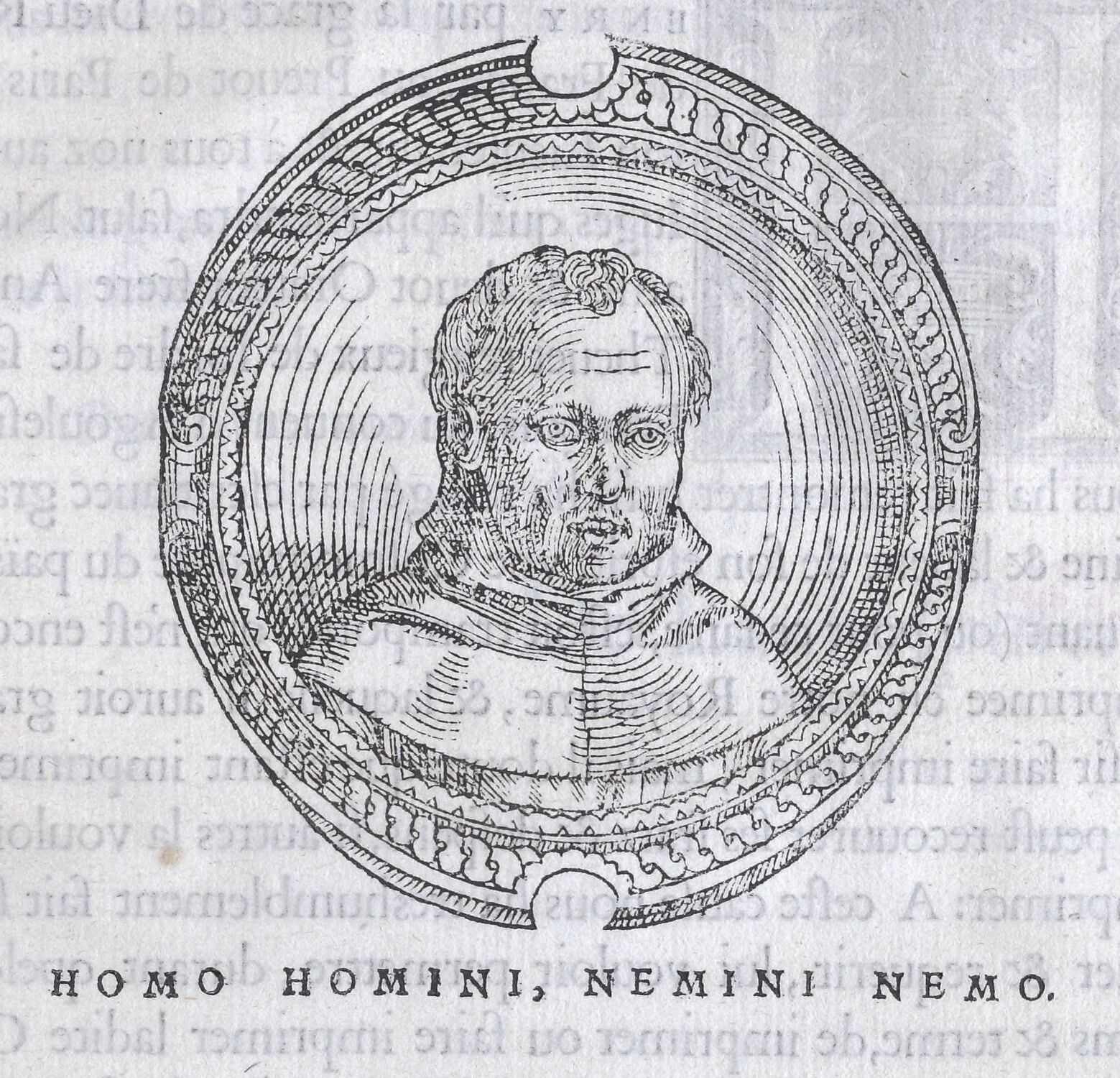
In the six years since, I felt that I not only got to know André Thevet the cosmographer but something of Thevet the man. He was just a few years older than I am when he made his first overseas voyage from France to Constantinople, the Levant, and Egypt in 1551. The most famous portraits of Thevet were published in his 1575 Cosmographie Universelle and 1584 Vrais Pourtraits des Hommes Illustres. These two portraits show Thevet at the height of his career, the cosmographer royal, the keeper of an expansive cabinet of curiosities, and a close confident of the Valois royals. Yet there’s an older portrait of Thevet as a younger man which appears in his first book, the Cosmographie de Levant, published in 1554. In it, Thevet is shown not as the resolute man of his craft but as a humble Franciscan friar. It was a position that he was put in by his father when he was 10 years old in order to give the boy a chance at a good education. I see in these three portraits something of a desire for better and greater things. In the process he crossed some people the wrong way and got a fair few things wrong in his cosmography. I’ve learned to take what Thevet wrote with a fine grain of salt especially later in his life. I wonder though if some of the acrimony that Thevet’s reputation has faced since his death in 1590 isn’t in part because of his close ties to the Valois family who declined from power and were replaced by their Bourbon cousins the year before and largely by the Valois’ infamy in the history of the French Wars of Religion, in which the Huguenots who traveled to Brazil with Thevet in 1555 were so threatened by their country over matters of faith. I recently met a woman at a Kansas City Symphony performance who was wearing a Huguenot cross necklace, and it struck me how her ancestors’ experience living as Protestants in a Catholic state mirrored my own ancestors’ experiences living as Catholics in Ireland during the Protestant Ascendancy and Act of Union with the very Protestant Kingdom of Great Britain in 1800. Like her, I’d grown up with a sense of pride in my Catholic ancestors’ resilience at staying Catholic in spite of the state which ruled over them. Seeing the long shadow of the Wars of Religion which for my people didn’t really end until Good Friday 1998 from this vantage gave me tremendous perspective. How did Thevet view it all? He blamed the Huguenots in part for the fall of France Antarctique in his Cosmographie Universelle, writing that “little of this would have happened without some sedition among the French, which began with the division and parting of four ministers of the new religion sent by Calvin to plant his bloody gospel.”[2] Why did he choose to write that the way he did? Certainly, these religious tensions gave cause for the Portuguese to eliminate the French presence in Brazil, yet wouldn’t the economic threat of the French presence in Brazil toward Portuguese trade be justification enough? Could Thevet have been responding to the political situation he found himself in when he published the Cosmographie Universelle in Paris in 1575?
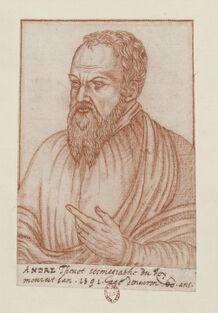
Thevet in 1584.

I like Thevet because I find the man relatable, I get the sense that we can relate somewhat; like him I’ve felt this constant need to prove myself to my peers. This need has waned somewhat as I’m moving along with my career. Yet I feel the younger Thevet depicted in his Cosmographie de Levant is more relatable to my life today in my early thirties. While not a cleric, I chose to not go down that path, I’m alone in my life with a strong sense of wanderlust. Those wanderings have taken me to Paris twice now in the last two years to get a sense of Thevet from beyond the printed books with which I’m most familiar. In October 2023 I followed a lead which took me to Rue de Bièvre, the street where he lived at the end of his life up to his death in 1590. I walked up and down that little street between Boulevard Saint-Germain and Quai de la Tournelle and stopped in the pocket park on the western side of that street. I felt that this was the closest I’d ever get to him, after all the church where he was buried, the Convent des Cordeliers, was desecrated during the Revolution of 1789-1791 and from what I’ve been able to gather, his tomb disappeared. Yet earlier this year while watching an episode of PBS’s science series NOVA about the graves found in Notre-Dame during its reconstruction, I noticed they pulled out a nineteenth-century book of old Parisian epitaphs. I did a quick search through the BnF’s Gallica database, and found Thevet’s own epitaph there transcribed from the original stone carved in 1592 that lay in the Convent of the Cordeliers. In the original French it reads:

Rue de Bièvre, where André Thevet once lived.

Cy gist venerable et scientifique personne Maistre Andre The-

vet, cosmographe de quatre roys, lequel estant aagé de LXXXVIII (88) ans, se-

roit decedé en ceste ville de Paris, le XXIII jour de Novembre M D XCII. –

Priez Dieu pour luy.[3]

In English, this translates as :

Here lies the venerable and scientific person, Mr. André Thevet,

Cosmographer of Four Kings, who was 88 years of age,

he died in this city of Paris, the 23rd day of November 1592.

God, pray for him.
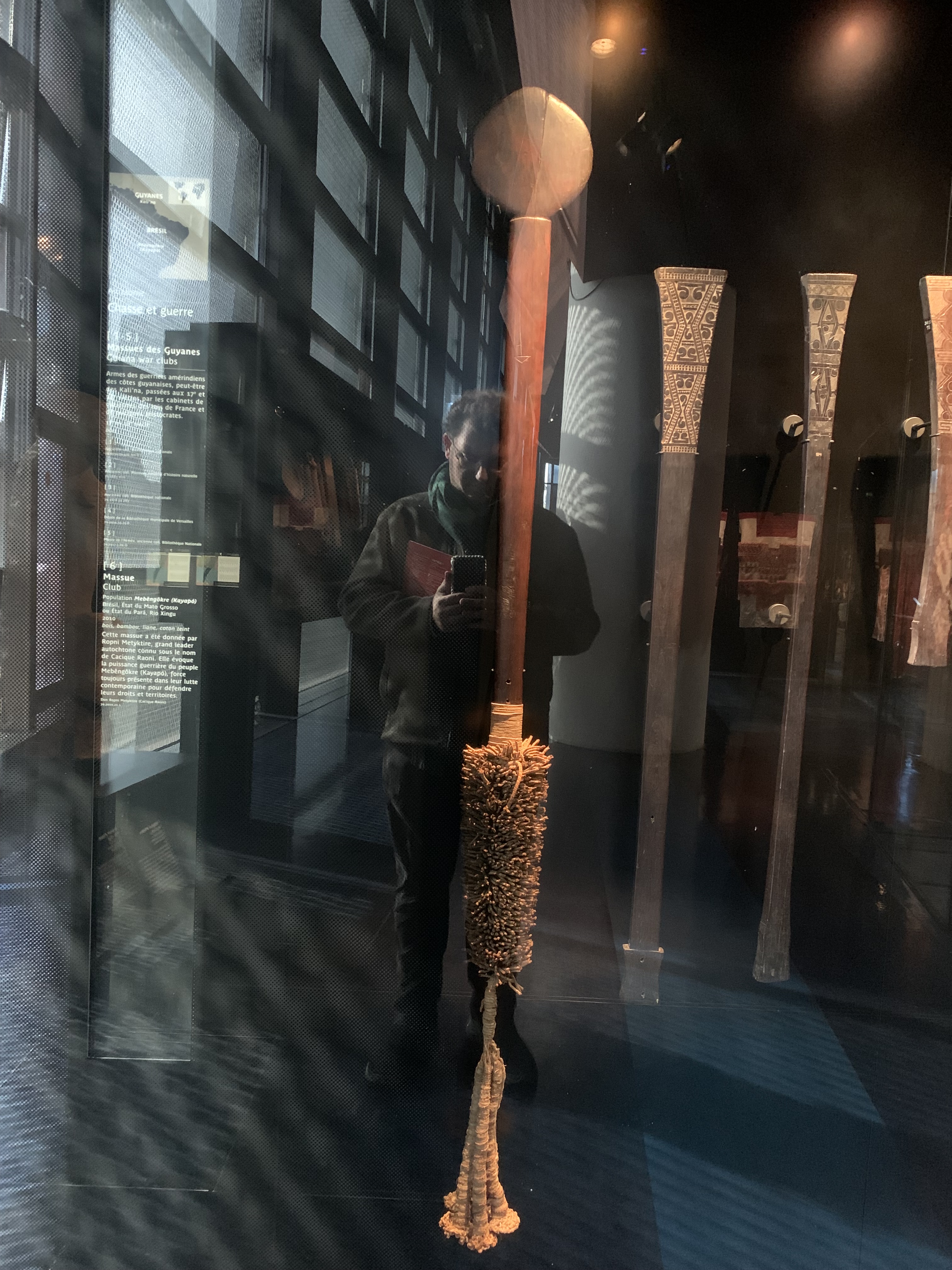
A Tupinambá war club once called “the Sword of Quoniambec” that I’m studying. Thevet brought it to France in 1556.

On that same trip I visited a wooden Tupinambá club which the Musée du Quai Branly records was donated to the royal collections by Thevet and was given to the cosmographer by the Tupinambá leader Quoniambec (d. 1555). I figured this would be the only artifact I’d see that Thevet would’ve himself handled. Little did I realize that eight months later I’d be back in Paris, this time at the BnF’s Richelieu building in the Department of Manuscripts reading through Thevet’s own handwriting. I’d made a visit there that day to read through Thevet’s translation of the Travels of Benjamin of Tudela, a twelfth-century Sephardi Jew from the northernmost reaches of Al-Andalus which told the story of his travels around the Mediterranean world. Tudela’s wanderings took place three centuries before Thevet made his own voyage east into the Mediterranean in 1551. Here, through the window Thevet crafted with his pen over 470 years before, I was reading a story retold in Thevet’s words of events that occurred over 700 years ago. That sunny June day, I spent a few quiet moments reflecting on Thevet’s penmanship, his signature, and how familiar his writing seemed. I’ve read more of Thevet than many others, after all I’ve translated the entirety of his Singularitez, and so when I was working with his Tudela translation, I found the job was made easier by how I could recognize his voice in the flourishes of his pen. I felt that I knew the man, in spite of the centuries between us. Soon after, as I walked from the Richelieu building to a café next to the Sorbonne where I was meeting an editor for a project I’m contributing to, I reflected amid my quick steps crossing the Seine that I was walking the same streets Thevet once walked. They’d changed to be sure, but there were still monuments that he’d recognize, edifices of the Paris he knew.

I chose to study Thevet out of a drive for practicality, a quick solution to a pressing problem of finding a dissertation topic that I could move to when my original plans went up in smoke. In the years since I’ve become known as a Thevet scholar. I’ve given many conference presentations and lectures about the man and his contributions to Renaissance natural history. In fact, I’ll be giving one more on June 12th with the Renaissance Society of America’s Graduate Student Lightning Talks, sponsored by the RSA Graduate Student Advisory Committee. That talk takes a different perspective on Thevet’s sloth than any other I’ve yet given, approaching it as an example of animal intelligence. Tune in to learn more.


[1] Alexander von Humboldt, “Les vieux voyageurs à la Terre Sainte (du XIVe au XVIe siècle),” Nouvelle annales des voyages, de la géographie et de l’histoire 135 (1853): 36–256, at 39.

[2] Thevet, Cosmographie Universelle, Vol. 2, 21.2, ff. 908v–909r.

[3] Émile Raunié, Épitaphier du vieux Paris, recueil général des inscriptions funéraires des églises, couvents, collèges, hospices, cimetières et charniers, depuis le moyen âge jusqu’à la fin du XVIIIe siècle. Vol. 1–3, Paris : 1890-1901), 302, n. 1171.

Is Cash Still King?

Over the last week, I've been thinking about how much I still use cash, and what that says about my lifestyle as a whole. Guests: Alex Brisson, New York City Elizabeth Duke, Kansas City, MO George Vial, County Donegal, Ireland — Click here to support the Wednesday Blog: https://www.patreon.com/sthosdkane


Over the last week, I’ve been thinking about how much I still use cash, and what that says about my lifestyle as a whole.


One of the chief ways that ordinary people would interact with their government was through the coins or banknotes in their pocket. We get to know the faces on our currency better for that role than for the things they did that got them printed onto dollar bills or Euro coins. Many were probably more familiar with the late Queen because her face was on the currency in the United Kingdom and all the Commonwealth realms more so than in any other fashion.

Yet, in the last five years, my cash usage has dropped significantly from a high around the mid-2010s when I used it more than my cards. Today, when I go to the bakery or when I buy concert tickets, I do so digitally. I prefer to use contactless payments on my phone over any other for the ease of use, and the security of not having to pull out my wallet in public. Still, I realized early on last week that this was a question better answered by more than one mind.

So, to answer this question, I turned to my Patreon supporters (only $5 a month at patreon.com/sthosdkane) to ask them how much they still use cash.

One of my Patreon supporters who agreed to talk to me this week was regular Wednesday Blog film expert, Alex Brisson who offered a few thoughts of his own from his home in New York City.

How much do you still use cash?

SK: When I moved to Binghamton, when I was going out there to go look at an apartment in May of that year, my Dad gave me $50 in $5 bills and said “Go, drive to Binghamton,” we were in Niagara Falls, “go, drive to Binghamton and find an apartment and be back here by tomorrow to catch the train to Toronto.” And that was the last time I ever used cash for tolls. Traditionally, I’d use cash for tolls, taxis, and really small family run Chinese restaurants. So, let me ask you then: how much do you still use cash?

AB: Almost not at all, extremely rarely. Unless it’s an arcade game that only takes cash, or once in a while the street hot dog vendors in New York only take cash, which is a big mistake in my view, and sometimes there’ll be one cart that takes card next to one that takes cash will get all the business. I’m making constant financial transactions; I’m buying things every day. New York City is just a big shopping mall. I use Apple Pay the huge majority of the time, unless a place doesn’t accept it.

SK: Yeah, it’s much more secure than even using your card. You don’t have to pull your wallet out, and also the encryption of the card number helps.

AB: Yeah, and also there are those machines that can steal your card number going around, so Apple Pay is more secure against those, though Apple Pay might be just as easily compromised, I don’t know. Definitely, money has gone from being a physical, gold-backed thing but now money is purely digital.

One of my Patreon supporters is closer to home, and we were able to do an in-person interview. – “Hi, Mom!” – “Hi, Seán!”

SK: How much do you still use cash?

ED: Very little. I carry maybe $20 for an emergency, but I rarely use cash.

SK: How much do you still use cash?

GV: Not as much as I would like to.

That’s George Vial, who spoke to me from his home in County Donegal, Ireland.

SK: So, you would prefer to use it over card?

GV: Compared to using it over card, the inaccessibility of getting to an ATM is probably the biggest drawback. Today, I had to pay a guy working on a car, and to find an ATM that would dispense the amount took two different trips, so I eventually got him the money. It would’ve been easier if he had taken a bank card, but that was the first time I used cash in almost two weeks.

Do you prefer cash over card or vice versa?

SK: So, you prefer cash over card, I get that. When you’re in the US do you use cash or card more than in Ireland?

GV: I use more cash than card in America, and vice versa in Ireland for one simple reason: Euros don’t fit in the wallet, they were never designed for wallets, and the amount of coins over here is too much. If you go out with €100 your trousers are falling down by the end of the day.

SK: Yeah, I stopped carrying a coin purse. The trouser leg didn’t look right with that in there. What do you think are the benefits to your preferred payment method? You talked about a couple of the drawbacks of using cash in Ireland, what are some of the benefits?

GV: The benefits of cash are that you stick to what you have. When you do digital payments you tap your card, while in America it’s still a lot of swiping. Here there are no minimums to how much you can spend by tapping, so you spend more freely, whereas with cash if you have €200 in your pocket that’s how much you can spend.

SK: Do you prefer cash over card or vice versa?

ED: I prefer to use a card or to actually use Apple Pay so I don’t have to pull something out of my bag. Although, at restaurants in the US you have to give them your card and they take it away from you to run it whereas in Europe they run your card for you there at the table.

SK: I’m starting to see more places in the US where they do have the portable card reader that they bring around, or even the big chain restaurants that has the machine at the table that you can play games on and also use to pay at the end.

~

AB: Money has gone from being a physical, gold-back thing, and I guess the gold is still somewhere, and now money is just a number on a screen.

SK: So, the value of the money has gone fully abstract then, in the last 120 years. So, now instead of being valued off gold it’s an abstract concept. So, what do you think are the benefits to your preferred payment method?

AB: Mainly that I no longer carry a wallet. I have my phone and there’s a little pouch on the back where I carry my cards. I’ve consolidated the things that I carry in my pocket, and as a man in New York City your pockets are prime real estate. Another one is the convenience of my phone being my payment method. Unlike cash, it can’t get wrinkled or blow away or you can’t really steal my Apple Pay. It doesn’t have to be replaced all that frequently like a credit card does, and because it’s contactless it’s safer in terms of transmission of germs and things. During the pandemic we realized we’re passing around all that dirty cash. The main people here who use cash are homeless people because they need you to give them cash, but if you don’t have cash on you then you circumvent that, which is kind of a low thing to say. And, also unlike with cash not carrying around a finite amount of it I can access all of my funds potentially, not instantly but nearly instantly if I shuffle things around.

What do you think are the benefits to your preferred payment method?

SK: So, then do you see any benefit to using cash over card?

ED: I suppose if you don’t want your purchase tracked then that’d be a benefit, or if you’re going to a farmers’ market, but even those will take cards. There are a few places that are cash only but they’re few and far between now.

SK: And inflation has impacted that now, because you have to use more cash to buy stuff now. I remember when I was little you could get a candy bar at a gas station for less than a dollar, and now it’s probably close to $2.

SK: What do you think are the benefits to your preferred payment method?

ED: It’s more secure,  if my wallet were stolen I could stop the card immediately, any of the cards I carry. The same cards work globally, so I can travel and not make many changes. It’s the convenience and the security, although I will say back when I carried cash I had a budget for discretionary spending per month. With a card it’s much harder to do that. It’s really easy to spend more with a card.

SK: When I lived in London, I found it was very beneficial to only use cash if I could because I could control my spending, whereas with my card and contactless it was very easy to buy stuff.

ED: It’s something we all need to figure out how to manage our lives now. I spend a lot more time in the bank app on my phone than I used to.

SK: I found that when I went overseas this most recent time in October that I’d get Pounds and Euros out but this time I used my card everywhere, so I never needed to stop by an ATM, and that was bizarre, even going into the Tube in London, like with OMNY in New York, I just used my phone to get in, and that’s a new thing just within the last 5 years. In New York, you used to have the MetroCard instead.

AB: You’re right, because the Apple Pay and credit card transcend borders. You can use it anywhere in the world. You don’t have to convert your cash.

SK: That was a huge realization, because I realized when I got there that I forgot to get cash out, so I started paying for things with my Apple Pay and quickly realized that I wouldn’t need to get cash out at all. I got to Brussels and paid for my first croissant and thought, “wait a second, I don’t need to get cash out here.” Yeah, that was a big benefit to it. Then, do you think cash will fully ever disappear?

Do you think cash will ever fully disappear?

SK: Yeah, so you’re doing the mental math and figuring you’re borrowing from a future paycheck to pay for this. Do you think cash will ever fully disappear?

GV: I know they’re going to try, the banks of the world, but I don’t think it will. All it will do is create more of a digital black market, so it’s everything from the criminal black market to paying all of the little cash transactions of paying the babysitter or paying the car guy which they’ll be able to monitor, so they should just leave cash as it is.

SK: So, cash in Europe it’s coming out of the European Central Bank (ECB), whereas here it’s coming out of the Federal Reserve and the Mint, while when you’re doing a card payment it’s going through Visa, MasterCard, or Discover, or American Express, or take your pick. Do you see a way that it could be problematic that those particular financial corporations would have that much of a role in our everyday monetary transactions whereas previously it was a public enterprise that was managing it?

GV: Oh, yeah absolutely because it’s throwing the control of our money to these for-profit corporations, it’s totally wrong, and we know behind the scenes the amount of charges, there’s a meme going around talking about how to spend $100 locally, yet to spend that $100 digitally the amount of transactions and fees that go on makes it all very convoluted. I’m not a fan of the big companies tracking our money.

SK: Yeah, I absolutely get that.

AB: My immediate answer is that I’m not properly educated enough to truly venture a guess at that, that said it does feel realistic to think that you could have a post-cash society. That feels very feasible in my mind at least. There’s also this aspect that you only print so many dollars, or that you could track that digitally anyway. I bet we’re shipping a lot of gold and huge stacks of dollar bills from place to place, I bet there are people who are spending time counting money. And we’re handing over a lot of our societal things to computers these days, yet this is a logical usage of this.

SK: I only hesitate with that in 2 points: Jackson County, Missouri’s systems were hacked with a ransomware attack, and the systems were shut down for a while. Having all of your money going through computer systems leaves them up to attack in that sort of hack. Secondly, having your money going through a computer system means that every transaction you make is processed by a financial institution like Visa, so they are getting a cut or have some arbitrary control over the transaction. So, does that give them too much power?

AB: There’s also the data tracking aspect of this too. The thing you were saying about how it could be hacked and disappear is true for any form of currency. There’s an episode of The George Lopez Show where his mom keeps all of her money in a safe under her bed and there’s a house fire and all of it burns. So, is there a truly safe form of currency? I think the answer is no, there’s not. You can hope that each version is more secure, at least digitally there’s a record of its existence. So, if your bank gets hacked then there’s a record of what the bank owes you. Digital money then might be more secure. It’s truly hard to say. It’s scary, the new digital world is scary in a general way, I would say, and things are changing so rapidly. The minds of this generation, and all who are alive right now are struggling to keep up with it all.

SK: Do you think cash will ever fully disappear?

ED: Maybe. It’s expensive for countries to print bills or mint coins, I don’t know. I wonder what the percentage of people are that use cash? You can’t use cash at the new Kansas City Current stadium (CPKC Stadium). So, the more places that refuse to take cash the less we’ll see people using it.

SK: Some countries that I’ve heard about that have dropped cash all together, like Sweden, it’s because the Kronor there has so little value that you’d have to use a lot of it. During my four hours at Arlanda Airport in Stockholm, I paid 200 or 300 kr for a burger there at Max’s Burgers, I thought that was a lot but it’s actually around $10. So, will inflation impact how much cash we use?

SK: Because cash is controlled by the Treasury, with card transactions those are all done through the big companies, does that give those companies too much power over our national economy or our global economy if they’re the middleman in every transaction?

ED: I know bank transfers are still monitored by the Federal Reserve. Cash was just the vehicle to exchange for goods and services, right? So, you’re still doing that exchange, it’s just happening in a contactless or a low-contact manner.

Is cash still king? I don’t think so. I could see how it might return to its former position of prominence if we had massive technological failures, yet that seems remote and unlikely. I do agree with George about the need to have better monitors on the financial institutions that house and monitor all of our digital transactions, though. I wonder if the cultural role that cash plays as our symbol of prosperity will change? This, like many questions I consider here on the Wednesday Blog, remain uncertain in their answers.


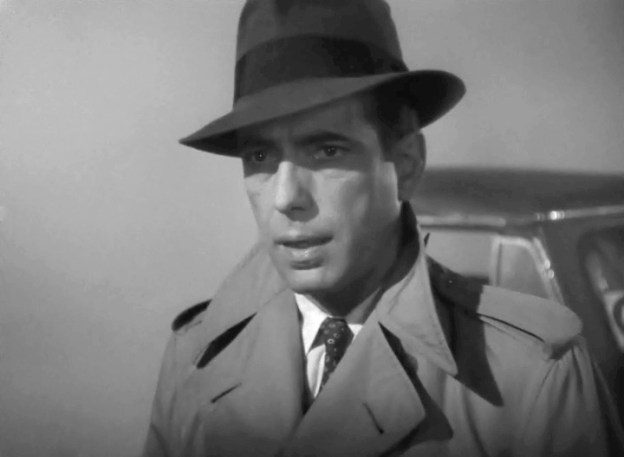
“Casablanca” at 80

Today, I'm talking about the classic 1942 film Casablanca with my good friend Alex Brisson. Click here to support the Wednesday Blog: https://www.patreon.com/sthosdkane Today's episode features contributions from Alex Brisson (https://www.alexbrisson.com) and Michael Ashcraft (https://soundslikeashcraft.com). Thanks to both of them for their help making this week's episode!

Listen to this week’s podcast for a conversation about Casablanca with Alex Brisson


Few films have held our attention for as long as Casablanca, a romantic drama filmed at the height of the Second World War telling a story yearning for America to remember it’s passion and enter the fray against the forces of evil. The story, now well known, is about an American café owner, Rick Blaine, in the Moroccan city of Casablanca, then a French protectorate under the control of the Vichy government. Into his purely neutral life walks an old love interest, Ilsa Lund with her husband the resistance leader Victor Laszlo.

Everything that could be said about Casablanca has likely already been said. So, what I’m going to say here isn’t anything new, there really isn’t any intervention that I can make into this particular discussion as my fellow academics would insist every bit of writing make. So, I’m going to point out a few things that I thought of watching the film, subtextual themes that I hadn’t noticed the first time I watched it a few years ago. That time, I paired Casablanca with a delightful French film titled Que la lumière soit ! (Let There Be Light!) starring Hélène de Fougerolles. They were an odd pairing I’ll admit.

Casablanca is set in December 1941 on the eve of the Japanese attack on Pearl Harbor and America’s entry into the war. It’s the last hour in the limelight of an isolationist America, an America that still around but has been forced into the shadows by our country’s leading role in the postwar world. I nevertheless found it interesting that the opening credits placed Casablanca the city less as a Mediterranean, or rather Mediterranean-adjacent port, but rather as a city on the map behind the opening titles on the far northwestern corner of Africa. Casablanca is a gateway for those seeking to leave Europe either to the west across the water to America or south across the Sahara to the remaining Free French and British colonies in Africa. This makes it clear that Casablanca is distinct from Europe, it’s exotic when compared to the port of origin and the destination of the travelers waylaid in Casablanca.

Amid all of them one such traveler who’s made a slightly more stable living than most, accepting the circumstances of his complicated situation in isolation amid many others of the displaced appears Rick Blaine, who’s found stability in his café after losing stability in his life at the German invasion of Paris and Ilsa’s disappearance all on the same day. The film’s central conflict is Rick’s internal struggle between the isolationism he’s adopted since Ilsa left him and he ended up a saloon keeper in Casablanca and the passion he once felt for Ilsa in the last summer of the age of optimism in 1939. Now that Ilsa appears with Laszlo, the embodiment of the resistance to Nazi rule in Europe, Rick is confronted by his lost passion for that cause. Ilsa is a reminder of the passion for liberty he once felt that left him on the run from the Nazis in Paris where they met in the first place.As with the first time that I watched this film in 2021, I now find myself pondering the message of isolation vs. passionately standing up for the causes one believes in. I know people who are leaving this country to escape all the troubles we inflict on ourselves. I’ve thought of it myself, but there’s that stubborn passion in me that won’t give up on America. Rick’s isolationism shows us how we can let bullies march into our lives and dictate orders to us if we let them if we try to simply survive. That’s a fair way to live, I dealt with bullies in school and life by not reacting to them. But at some point, a person can only take so much pushing around, and I worry that today in America we’ve forgotten that fact. Rick’s turning point comes when the Nazi officers bully their way into controlling the voice of his café, Sam’s piano, to play a march of their own, Die Wacht am Rheinwhich was written in response to French efforts to annex the western banks of the Rhine in the 1840s, a moment a century before when France was the great power and Germany still divided among its princes. Laszlo tells the band to respond to this insult by playing La Marseillaise, not only the French anthem but an anthem for the struggle of the people against oppression everywhere. At that point, Rick is no longer an isolationist, America is no longer on the sidelines, but is tacitly helping the Allies, readying to cross the Atlantic in the words of French philosopher Bernard-Henri Lévy like an Aeneas returning to the aid of old Troy.


A Trek Among the Stars

I first started watching Star Trek a month before the first waves of the pandemic hit the U.S. early in 2020. I knew a fair bit about the characters of the different series and some of the overarching stories, so when Star Trek: Picard was released in February 2020 I figured I wanted to see what it was all about. Thus began the next two years of my life in terms of TV viewing. Since then, I’ve gone all in and seen the entirety of the first two seasons of Picard, with a third coming in February 2023, as well as all seven seasons of The Next GenerationDeep Space Nine, and Voyager, all four seasons of Enterprise, and what’s so far been released of Lower Decks, and Strange New Worlds. I’m now watching the original series, Star Trek starring William Shatner, Leonard Nimoy, and DeForest Kelly that aired between September 1966 and June 1969 on NBC.

Like with the other Trek series, I’ve found the characters relatable and enjoyable to watch. I’ve also found some of the futuristic settings and technologies depicted on the show inspirational to my own imagination as a storyteller. Yet I’ll freely admit I find this series harder to get excited about compared to the later Trek series released in the ’80s,’90s, and 2000s, perhaps because this original Star Trek sought to depict the future of the late 23rd century as the 1960s dreamed it might be, whereas the later series looked to the late 24th century as the ’80s, ’90s, and 2000s aspired it to be. Being a child of the ’90s and 2000s, that post-Cold War worldview fits my own far more closely than the background surrounding the Original Series during my parents’ childhood in the ’60s.

Still, when I do get into an episode of the first of these shows, I often find I do like the stories. They’re in the same spirit as other mid-century sci-fi shows that I’ve always admired like The Twilight Zone or the older William Hartnell era Doctor Who serials. What’s more, the vibrant colors used to light the sets of Star Trekalways catch my eye in a way that keeps me focused on the action of the story.

So, a few months ago when I learned there was a recreation of the sets of the Starship Enterprise in a building in Ticonderoga, New York, I knew I had to pay a visit. I arranged things with my good friend Alex Brisson, and we made a weekend trip out of it, visiting the Star Trek: The Original Series Set Tour around noon on Saturday, 17 September. The sets were built by a local guy named James Cawley, who interned on the production of Star Trek: The Next Generation at Paramount. Over the intervening years, the team in Ticonderoga have built with meticulous detail the sets of that original Enterprise as they appeared on the soundstages at Desilu Studios in the late ’60s. In many ways, the tour is both an opportunity for fans to experience walking on board the Enterprise as much as it is for film and TV buffs like myself to see what a TV set from the ’60s would have looked like.

When we walked on the bridge and saw all the stations set out in their circle, the captain’s chair in the center of the room, most of the people in our tour were hushed, a sense of respect among us. I got a chance to sit in the chair, as did everyone there, and I’ll admit the picture of me sitting there looks a fair bit deer-in-headlights as I couldn’t decide what to focus on with so much around me to see. For me, the original Trek isn’t necessarily the show that I prefer the most, that’d have to be Deep Space Nine with Next Generation and Voyager close behind it, but it spoke to a common thread in my life over the past two years as I’ve continued with my own work and studies while in the evenings taking an hour or two to watch another story set a few centuries down the line.

I think the thing that has kept me so interested in Star Trek is how aspirational it is. Unlike so many other futuristic films and shows out there, in the stories told here humanity has figured out how to get out of our cycles of violence and greed and work with the best parts of our nature to achieve the closest we could ever come to returning to Paradise here in our own mortal lives. They are stories that say, “no matter how bad things may be now, no matter how much the pandemic and all the other troubles that came out of it have become, there’s always hope.” 

I’ve always been one to trust in the fundamental goodness of humanity, it’s an idea that really does have some deep roots in my Catholic faith, as well as in my lived experiences. I’ve been fortunate to live the life I’ve led so far, in the places I’ve lived and with the people I’ve known, family and friends who I’ve loved. The seeds of a better future are laid in that fertile soil of hope. Had I grown up in the midst of the wars that my country waged over the last 20 years in Afghanistan and Iraq or in a country with less opportunities for success than my own, my worldview would likely be quite different. Yet if we are going to ever get out of this mire we’ve been in for so long, our adolescence as a species as Carl Sagan put it in his novel Contact, then we’ve got to let our hope for a better tomorrow guide us just as much as our cynicism and bad memories of past wrongs guide us now.

In the future that Star Trek depicts humanity finally begins to overcome our faults in the last half of the current century when first contact between humans and an alien species, in this case Vulcans, occurs. Our technology, and their helping hand (however hesitant it may be) moves humanity up from an age of nation states and superpowers battling each other for supremacy and resources on Earth and into a new age where humanity is one small island in the great ocean of Space, learning to live amid our galactic neighbors, and finally contributing to the creation of a Federation of Planets in the mid 22nd century that brings about a new Golden Age of sorts not just to us on Earth but to many other worlds floating in this cosmic sea.

It’s fiction, I’m well aware of that. It’s a collection of stories dreamed up by writers and showrunners over the past six decades that could very well remain stories in our cultural memory. But maybe there is some room for our future to be more peaceful, more prosperous, and more equitable than our present is or our past ever has been. In the decades since Star Trek first premiered in 1966 so many technologies inspired by the shows have become realities from tablets to personal communicators to now virtual reality taking the place of the holodecks and holosuites of the Next Generation, Deep Space Nine, and Voyager. I’ve been drawn to these stories because they came at just the right time for me. I began watching Voyager in the long dark winter of 2021 when I was preparing for my Comprehensive Exams. That winter, being so far from home and so isolated by the continuing pandemic, I found the story of a lone ship lost 70,000 light years from home to resound with my own situation. These are stories that laud curiosity and teamwork, and while just stories with the odd bizarre plot or weekly new alien with different nose ridges, they offer us a vision of what our world could be like.

Why not give that future a try?

How Irish Understands the World

After I released my previous episode “Summer School in Irish” back at the beginning of August, I had a good conversation with one of my best friends and one of my most frequent listeners, past Wednesday Blog guest Alex Brisson, about the utility of keeping smaller languages like Irish alive. How do these languages benefit humanity when we’re moving toward a time of greater linguistic conformity, when there are a handful of global human linguae francae, such as English, Mandarin, Russian, Arabic, Spanish, and French (the official languages of the United Nations)?

I responded by lauding the beauty of Irish, by the fact that Irish helps the speaker understand the nature and world around them differently. Take the phrase Tá mé i ngrá leat for example. This means “I love you,” though not quite in the same sense as the English. In English, there’s the subject “I” who’s doing an action “love” to the object “you.” This is the same way that this sentiment is expressed in many other languages from German “Ich liebe dich” to French “Je t’aime” to Spanish’s “Yo te amo” or more simply “Te amo.” 

Irish, on the other hand takes a less forceful approach, instead having the subject “mé” being in a state of love ” i ngrá” with the object “leat.” Thus, in Irish the expression Tá mé i ngrá leat says less that one person is expressing love toward another and more that both people are in a state of love with each other, a model of relationship that I personally prefer far more. Losing a language like Irish loses this elegant worldview, it takes away one particular means of understanding how one group of humans has long perceived the world around them.

Another way that Irish does things differently from English is in the use of a habitual copular verb. In plain English this means there’s a version of “to be” that expresses an action that’s done on a regular basis, so Bím ag scríobh colún gach seachtain a The Wednesday Blog atá air. | I write a column every week which is called The Wednesday Blog. This particular verbal construction of Bím rather than the present active tense Tá mé as seen in the last example helps express the regularity of the action, the writing of the blog and podcast itself. It demonstrates that I, Seán, am on a weekly basis writing this string of ideas which you, dear reader or listener, then choose to read or listen to. It also offers a sense of much needed hope that yes, I’ll actually keep writing The Wednesday Blog, something which I’m always not sure about. Today though, looking back at the 40 episodes already written and the 38 blog posts that came before the launch of the podcast, I’d like to think I’ve gotten myself into a good rhythm.

If there’s any other chief argument I’ve made in the past for why Irish ought to be kept alive, even taken off life support one day and spoken as another one of Europe’s vibrant languages, it’s that so many echoes of its once and future vitality still exist on the face of our world today. Take my name, Seán Thomas Kane, which though not intentional is a highly traditional Irish name. In Irish, my name is Seán mac Tomás Ó Catháin, or Seán, son of Thomas, descendant of Cathán. Cathán was a King of Ulster who ruled in the late 9th century CE about the same time as Alfred the Great was on the throne of Wessex. Thomas is my Dad, Tom Kane, meaning that my name actually works quite well seeing as I am actually Seán mac Tomás, or in the more clunky English Seán, son of Thomas. You can often tell when a family over here in the U.S. are Irish Americans by the fact that the parents and kids tend to have similar Irish names like Brigid, Patrick, Maureen, Brendan, or Molly, among others. While we’ve generally lost our ancestral language through the generations spent living in English-speaking countries, we’ve still kept aspects of that culture alive.

One thing I would love to see someday is a vibrant, if spread out, Irish-speaking community here in North America. It would be neat to have that sort of communal connection through our ancestral language preserved and even slightly transformed by our own distinct experiences living in North America from the Irish that’s spoken today in Ireland. Perhaps this would be seen in the gradual creation of a North American dialect of Irish alongside the three modern dialects of Connacht, Munster, and Ulster Irish. I for one am finding it easiest to speak a bit of a mix of Connacht Irish (the dialect spoken by my family) and Ulster Irish, though I’ve also learned many a Munster mannerism and mode of doing things as well.

Here in the United States our monolingualism has so greatly influenced our way of thinking that it is strange to consider a life where one might speak one language at home and one out in society. This is something done by people everywhere, even here in the US. In that future, even if we do come up with some sort of universal translator that just renders all linguistic barriers largely null and void, there would still be room for people to speak their own languages in their own way among themselves.

Go raibh maith agaibh go héisteacht! Thanks for listening!

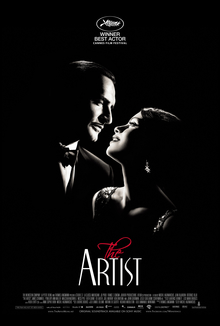
The Artist

This week I'm reflecting on the 2011 Best Picture winner "The Artist" and introducing a new segment to The Wednesday Blog in an interview with my friend Alex Brisson about the film. Alex Brisson's website: https://www.alexbrisson.com Star Trek: The Original Siblings Podcast: https://stosibspod.buzzsprout.com Brissflix: https://www.alexbrisson.com/brissflix The musical interlude in this episode comes from "April Showers" recorded by Gene Rodimich's Orchestra in 1922. Listen to the full version here: https://freemusicarchive.org/music/Antique_Phonograph_Music_Program_Various_Artists/Antique_Phonograph_Music_Program_04072015/April_Showers_-_Gene_Rodemichs_Orchestra/

This Week: Alex Brisson joins me for a conversation about The Artist

Last week after finishing my daily Jeopardy! viewing I decided to turn to Netflix for the first time in a while and see what was on my watchlist that I hadn’t touched recently. Perhaps the inclination to turn to Netflix instead of my more frequent streaming services, notably Paramount+ and PBS, might well have been urged by the recent poor market performance of the streaming giant following its first poor quarterly performance in its history. Still, there are many wonderful shows and movies to watch on Netflix, and one in particular caught my attention. 

I first saw The Artist back in 2011 when it was playing in the theatres. I went with a group of friends from Rockhurst to see it at the now old Tivoli Cinema in the Westport neighborhood of Kansas City, and for whatever reason the people I went with decided we would get there about halfway into the film, something which annoyed me because this was one that I really wanted to see. We took our places in the back row of the theatre with about 40 minutes left in the 90-minute picture. I enjoyed what I saw but felt cheated at not getting to see the entire thing, and for whatever reason I never got around to going back to the Tivoli to see it again in full. So, when I saw it was on Netflix a few years ago now I saved it to my watchlist and then never got back to it. Therefore, last week when I saw The Artist would be leaving Netflix that very night, I decided to not overthink it for once and pressed play.

What followed was everything I hoped for. Longtime readers of this blog will know I’m a fan of silent films, old friends will remember I even made a few in high school, which honestly was as much due to the poor quality of the sound that my video camera could record at the time in the late 2000s and early 2010s. I’ve written in the past in this blog about how Charlie Chaplin’s The Gold Rush touched me and spoke to me of a loneliness I truly can relate to now in grad school, and I think that blog post speaks to the unspoken power of silent films to sing directly to human emotions through visual cues only. The visual metaphors that abound in The Artist are loud and clear, as if shouting from the rooftops, yet they are iconic in their heritage from the theatre and ballet, art forms that served as some of the roots of silent film itself.

The Artist tells the story of a Douglas Fairbanks type of leading man, George Valentin, played artfully by Jean Dujardain, whose career playing the same mustachioed hero over and over again is eclipsed by the coming of sound in 1927. Into the scene walks the young extra Peppy Miller, played joyfully by Bérénice Bejo, whose own career takes off as Valentin’s descends. Valentin has many opportunities to maintain his triumph through the transition to sound, yet his fear of change and his pride make him tumble from the heights of stardom like Icarus at the roaring heat of the Sun’s rays melting the wax on his silent wings.

The film’s message is one of emotional turmoil in distress, Valentin falls as far as he can in life, almost to the grave itself, yet he continues to have people around him who love and care deeply for him. Among them first and foremost is Jack, his beloved dog and quite likely best friend, played terrifically by Uggie, a Parson Russell Terrier, who stayed with Valentin through thick and thin, even saving his life on the odd occasion. I want to pause for a minute here and acknowledge some of the discussion that was going on in 2011 about giving Uggie recognition for his work on The Artist, even perhaps an Honorary Oscar. One quote that made me do a spit take with laughter from a spokesman at the BAFTAs (British Academy of Film and Television Arts) was quoted in The Daily Telegraph as saying that Uggie wasn’t eligible because he wasn’t “a human being” and because of “his unique motivation as an actor was sausages.” I will say, I bet if we didn’t need to work for wages to survive there’d be many a person out there who might consider a good sausage a nice reward for a day’s work. Speaking of that, I need to add some brats to my shopping list …

Anyway, The Artist is special in that it was a silent film made 84 years after the development of talking pictures. It is also one of the few fully black-and-white pictures to be made in the last few decades. Another one of note that I quite liked was the 2020 David Fincher film Mank about Herman J. Mankiewicz and the creation of Citizen Kane in 1939 and 1940. As such The Artist is a silent film made with 84 years of extra technical know-how. From what I could tell as a silent film buff the creators of The Artist did a great deal to make it authentic to the period it sought to depict from the lighting to the camera angles, to the profound metaphors through set design, such as the moments when Valentin finds himself looking into mirrors and seeing what he’s become or the way in which the creators seemed to be using new yet old-looking ways of telling their story.

When sound does appear in The Artist it’s as if an alien invasion has commenced. George Valentin’s first contact with sound comes halfway through the film in the form of a series of defiant noises that terrify the silent star. Later though once comfortable with it the sound returns and becomes embedded in the world of The Artist as something ordinary and wonderful at the same time. 


This week I’m reflecting on the 2011 Best Picture winner “The Artist” and introducing a new segment to The Wednesday Blog in an interview with my friend Alex Brisson about the film.

Alex Brisson’s website: https://www.alexbrisson.com

Star Trek: The Original Siblings Podcast: https://stosibspod.buzzsprout.com

Brissflix: https://www.alexbrisson.com/brissflix

The musical interlude in this episode comes from “April Showers” recorded by Gene Rodimich’s Orchestra in 1922. Listen to the full version here.