Tag Archives: Ancient Greek

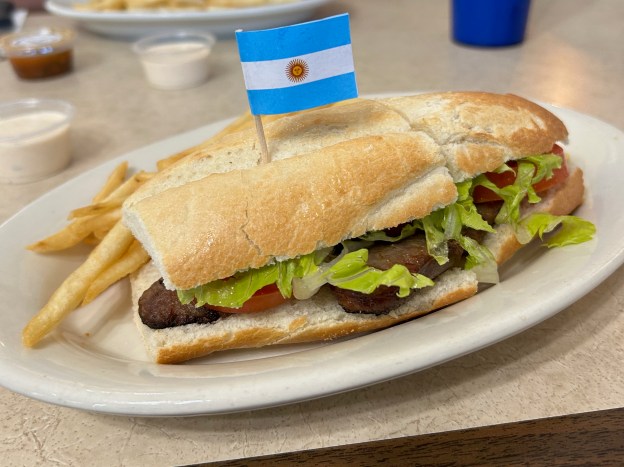
A choripán sandwich from Los Hornos Argentinian Flavors in Kansas City, Missouri photographed by the author just before it was eaten by the same.

On Language Acquisition

On Language Acquisition Wednesday Blog by Seán Thomas Kane

This week, how living in a culture is required to speak a language in depth.—Click here to support the Wednesday Blog: https://www.patreon.com/sthosdkane—Sources: [1] “A Letter from San Juan,” Wednesday Blog 3.29.[2] “The North American Tour,” Wednesday Blog 5.34.


This week, how living in a culture is required to speak a language in depth.


The languages which I speak are directly responsible for the ways my life has turned, its winding path a result of the words I use and the ideas they represent. Language is the voice of culture; it evokes the rich harmony of thought that comes from seeing things from certain points of view. At the University of Westminster, I was regularly in classes where there were maybe 10 or 20 languages spoken between each of the students, if not more. English remained our common language and the language of instruction, yet how many of us must have been switching between English and their own native language as they thought about the readings and topics in political philosophy and science which we discussed on a given day? Even then, my English is not the same as the King’s English, nor is it the same as the English I heard spoken when I drove through Alabama in July 2022. Language then reflects our individual circumstances of experience. Knowledge is gained through experience first and foremost, whether that experience be theoretical through books or practical through lived experience. I make this distinction because I often feel that when I’m reading a particularly well written book that I can actually imagine the characters as real people who I might meet in my life. The best TV shows and films are like that, their casts that we see regularly begin to seem like old friends who we look forward to visiting again and again.

Language acquisition is a lot like this for me. Today, I speak three languages: English, Irish, and French, and I can read Latin, Italian, Catalan, Spanish, and Portuguese and some Ancient Greek. I break my languages down into these two categories by their utility in my life. The handful which I can read are those which I’ve worked with in my historical capacity. I’ve spoken Italian and Spanish from time to time, yet those moments of elocution are few and far between. The same could be said for my German, though it’s now been five years since I last spoke that language in Munich, and at time of writing I can’t say that I’d be much use in remembering it today. This is even more true for my Mandarin, a language which I studied for a semester in between my two master’s degrees out of pure curiosity. I can remember the pronouns, a couple of verbs, and a noun or two but that’s about it. All this to say that I may know something about German and Mandarin yet it’s little more than a foundation for the future when I might be faced with a desire or need to learn the language properly.

I’ve been thinking lately that of any of these I need to work most on my Spanish, the most useful of these languages for me to speak here in the United States. I can understand Spanish fine yet speaking it remains a challenge. On Sunday evening after my shift I decided to reopen the Spanish course on the app Busuu––one which I used for Spanish before my March 2023 trip to the Renaissance Society of America’s annual meeting in San Juan, Puerto Rico––and try it out again.[1] That time I got through the A1 level before life got in the way, and I gave it up feeling frustrated with the process. I did not resume any online Spanish courses before my trip to Mexico last November for the History of Science Society meeting in Mérida, instead choosing the less preparatory method of winging it.[2] That worked with fits and spurts, my best Spanish conversations were in taxis with locals, though I was mostly thinking about how I would say things in French and then Hispanifying them based on my minimal knowledge of Spanish grammar. On Sunday, after I retired for the evening from my Spanish lessons on the app I realized what it was I missed so much in these apps: the human connection. Busuu prides itself on its crowd-sourced learning method; throughout the course learners are asked to submit spoken or written answers to the computer’s prompts which learners of other languages who speak the target language then correct. I like this system overall, and it does give this sense of community, yet I feel that it could go further.

After English, the second language I learned was Irish, my ancestral language. I started studying the Irish language when I was fourteen and have been focused on it to varying degrees for the last eighteen years. It really took until 2022 for me to connect with the language though, in spite of the fitful starts and stops because in that year I began to build a community around the Irish language. First on Zoom through Gaelchultúr, an Irish language school in Dublin, I met other speakers from across North America and beyond who like me were descendants of Irish immigrants old and new. I looked forward to seeing some of the same people term after term. Yet after returning to Kansas City, I began to look locally for Irish classes and came across the community that my friend Erin Hartnett has built at the Kansas City Irish Center. Through Erin I’ve met some really good friends and from our mutual appreciation for our ancestral language we’ve found a lot more in common from mutual histories to mutual appreciations for rugby. Without this community I would speak Irish but not terribly well. Now, not only do I speak Irish daily, but I also write in Irish every day. It has truly surpassed French as my second language, something I’m proud of yet not too concerned about when it comes to my Francophonic abilities.

French exists in a different sort of place for me than Irish. It’s not an ancestral language with deep family ties. Rather, it’s a language that I gravitated toward out of a fascination with French culture and history. I may have written here in the Wednesday Blog before that my first exposure to French came at sunset on a Sunday in February 2001 when my Mom put a “Learn French” cassette tape into the tape player in our family car when we were driving through the hills of northwestern Illinois toward Dubuque, Iowa. She and I were preparing for a trip to London and Paris that summer, the first European trip that I could remember, and she wanted to put in the effort for us to have some French before we arrived on the Eurostar from Waterloo Station at Paris-Gare du Nord. I didn’t like Paris much on that first visit, I found the language barrier to be too great for me to really feel a sense of connection with the place. On my next visit to France in March 2016 with three years of undergraduate French under my belt I found that I not only got the place more, but I appreciated the nuances of French culture more than I had as a child.

I owe a great deal to my undergraduate French professors M. Kathleen Madigan and Claudine Evans. It’s through their classes that I gravitated toward my career studying the French Renaissance. When I get asked why I chose to study the French I keep it simple and say it was a matter of pure convenience: I already spoke French, so I wouldn’t need to learn a new language (Spanish or Portuguese) to read my primary sources. That’s how I ended up studying André Thevet (1516–1590). I chose him because he happened to write about a sloth and for me the idea of being a sloth historian made me laugh. It’s as simple as that. I loved studying French in college, and even more teaching it with the online Beginner French course I built for the Barstow School in 2023 and 2024. I found that going through the same textbook I used a decade before I was not only teaching the students who in the future would go through my course, I was also renewing my own French education and learning things that I’d missed on my first go around. This is a critical point in language acquisition: few people are going to get a language on their first try, it’ll take multiple goes to understand what’s being said and to make oneself heard as well. It took me three tries to get Irish down, and the same is the case for Latin. Failure in the moment is merely a setback which can, and ought to be overcome in future endeavors. After all, remember that if we’re paying attention to our lives we’ll learn from our experiences.

I grew to really embrace a lot about the Francophonie to the point of paying Sling TV for access to TV5 Monde, France’s global TV channel which now broadcasts several different channels. I personally enjoy TV5 Monde Style, which tends to broadcast documentaries and cooking shows, though I don’t watch it as much as I might like. I read a lot of French books for my research, after all I work with source material that has largely only been written about in French and to a lesser extent in Portuguese. I am able to do what I do with those sources because I can read them and the secondary literature about them in French. All this made it all the easier for me to go to France and Belgium in the last several years and be able to switch from English to French as soon as I walked off the plane. I found when I was flying back to the United States in June 2024 after spending about a week speaking mostly French in Paris that I was consistently responding with the quick phrases “please, thank you, you’re welcome,” and the like bilingually with the French followed by the English as I’d heard so many people do in shops and the museums during that visit. It took me a while to get past doing this and just say things in English again after I returned.This then is why I think I’ve had so much trouble with learning Spanish. It’s the first language that I’ve given a big effort to learning outside of a classroom on my own. At least in the classroom you have fellow students around you to practice with. When you’re on your own you’re on your own, a wise-sounding craic which is to say that when alone you have no one else to talk with. I have friends here in Kansas City who speak Spanish, and I know all I have to do is ask, yet it’s finding the free time to sit down with them and work on it that I need to figure out. To truly gain a footing in a language one needs to immerse oneself in the culture. Apps and online learning will only take you so far. A classroom learner will blend into their own classroom idiolect of the language in that particular space where it exists in their life. Only if they move beyond classroom and begin to converse and live with people in places where that language is spoken will they begin to speak it in a manner which is more recognizable to native speakers.


[1] “A Letter from San Juan,” Wednesday Blog 3.29.

[2] “The North American Tour,” Wednesday Blog 5.34.
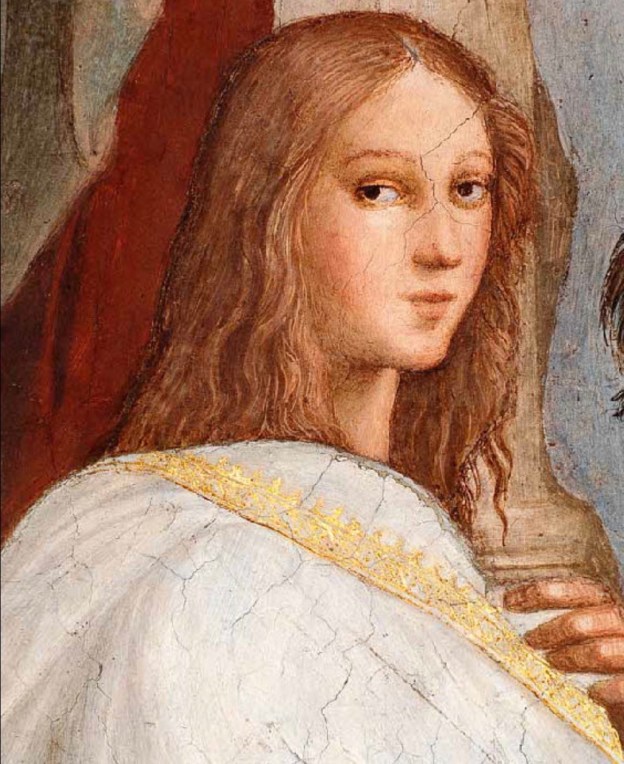

A figure from Raphael's "The School of Athens" variously identified as Francesco Maria della Rovere, Pico della Mirandola, or Hypatia of Alexandria.

On Knowledge

This week, I want to address how we recognize knowledge in comparison to the various fields of inquiry through which we refine our understanding of things.—Click here to support the Wednesday Blog: https://www.patreon.com/sthosdkaneArtRaphael, The School of Athens (1509–1511), Apostolic Palace, Vatican Museums, Vatican City. Public Domain.Sources“On Writing,” Wednesday Blog 6.27.Surekha Davies, Humans: A Monstrous History, (University of California Press, 2025).Marcy Norton, The Tame and the Wild: People and Animals After 1492, (Harvard University Press, 2024), 307.Dead Poets Society, (1989) "What will your verse be?" Video on YouTube.


This week, I want to address how we recognize knowledge in comparison to the various fields of inquiry through which we refine our understanding of things.


Lately my work has been dedicated to a thorough review of the historiography within which I’m grounding my dissertation. I wrote about this two weeks ago in an essay titled “On Writing.”[1] My research is historical, yet it touches on secondary literature which operates within various fields within the discipline of history. These include Renaissance history, and its larger sibling early modern history, the history of cartography, the history of animals, the history of botany, and more broadly the history of early modern science. Methodologically, I owe a great deal to two great twentieth-century Francophone anthropologists, Alfred Métraux (1902–1963) and Claude Lévi-Strauss (1908–2009). While Métraux and Lévi-Strauss aren’t considered directly in the historiographic section of the new introduction that I’m writing for my dissertation, which is limited to sources published since the millennium, they nevertheless stand tall in the background of my history.

Today we often talk within academia about a desire for interdisciplinarity in our work and our research. We’ve found ourselves too narrowed by our ever shrinking fields and seek greener common pastures for grazing as our intellectual and pastoral ancestors alike once knew. In my case, this interdisciplinarity lies more in my efforts to incorporate historical zoology into my work, a methodology which seeks to use zoological methodology and theory to explain historical animals. I have friends who study many things. Among them is one whose passion for history, classics, and mathematics has come together to craft a dissertation which seeks to demonstrate the intersections between those three to better understand the great transitions in human inquiry. Another seeks to follow the medical connections across oceans between disparate regions in the Americas and Europe that nevertheless existed even if they seem remarkable today. Still more, I have a friend who applies basic economic need to explain a complex diplomatic situation that once existed between the Venetian Republic and the Ottoman Empire in the Adriatic Sea. All of these historians of whom I write are applying a degree of interdisciplinarity to their work that reflects their own disparate interests and curiosities. In early modern history we talk about curiosities as objects which were collected from disparate and exotic lands into cabinets to display the erudite collector’s prestige and wealth. I say our curiosity is something to be collected by those worthy archives, libraries, museums, or universities that will employ us in the near future and for us to feed with new ideas and avenues of investigation that we will never be bored with life.

In all of these things, there is an underlying genre of knowledge which I am addressing. I’ve written thus far about history alone, yet it is the same for the anthropologists, astronomers, planetary scientists, and physicists who I know. Likewise for the literature scholars and the linguists. Our fields of inquiry all grow on the same planet that comprises of our collected knowledge. In English, this word knowledge is somewhat nebulous. To me, it says that we know things broad or specific. In London, for instance, the Knowledge is the series of tests which new cabbies must complete in order to learn every street within a certain radius of Charing Cross. The Latin translation of this word, scientia, makes things even more complicated as that is the root of the English word science. Thus, when we refer to Renaissance science, there is always a caveat in the following sentence explaining that “this is not science as we know it but a sort of protoscience.” I was advised, similarly, after a particularly poorly received presentation at a workshop at the Museum of Natural Sciences in Brussels in October 2023 that I shouldn’t refer to “sixteenth-century conservation” because no such concept existed at the time; instead, it would be better to discuss a “genealogy of conservation.” This sense that modern terms, in use since the Enlightenment of the eighteenth century, ought not to be pulled further back into the past I think loses some of the provenance of those terms and how the Enlightenment philosophes first came across them. 

I find it telling that the Ancient Greek translation of knowledge, γνῶσις (gnôsis), is a word with which I’m more familiar from theology and the concept of Gnosticism whereas scientia reminds me of philosophy and the other fields of inquiry which grew from that particular branch of the tree of human curiosity. One might even say that philosophy and theology are a pair, siblings perhaps? They seek to understand similar things: on the one hand an inquiry into thought, and ideally wisdom, and on the other a search for the nature of the Divine, which at least in my Catholicism we can know because we are made in the Image of God. The division here between the Ancient Greek term being affiliated with faith and the Latin one with reason I think speaks to the Latin roots of my own education in Catholic schools and at a Jesuit university, where I learned about Plato and Aristotle, yet I recognized Aristotle’s Historia animalium (History of Animals) by its Latin name by which it was generally known in Western Europe for centuries before the rise of vernacular scholarship rather than by its Greek original Τῶν περὶ τὰ ζα ἰστοριῶν (Ton peri ta zoia historion). Note that the English translation of this title, History of Animals reflects better the Latin cognate of ἰστοριῶν rather than the better English translation of that Greek word, Inquiry.

Added onto these classical etymologies, in my first semester Historiography class at Binghamton University I was introduced to the German translation of scientiaγνῶσις, and knowledge. Wissenschaft struck me immediately because I saw the German cognate for the English word wizard in its prefix, and because I knew that the -schaft suffix tends to translate into English as -ship. Thus, my rough Anglicization of Wissenschaft renders Wizardship, which is rather nifty. Yet this word Wissenschaft instead was seen in the nineteenth century as a general word which could be translated into English as science. This is important for us historians trained in the United States because our own historiographic tradition, that is our national school of historians traces our roots back to German universities in the early and middle decades of the nineteenth century. I remember long sessions of my historiography class at UMKC discussing the works of Leopold von Ranke (1795–1886), the father of research-based history. I felt a sense that this concept of Wissenschaft seemed relatable, and as it turned out that was because Irish has a similar concept. 

Whereas in English we tack on the suffix -ology onto any word to make it the study of that word, in Irish you add the suffix -ocht. So, geology is geolaíocht and biology is bitheolaíocht. Yet note with the second example that the suffix is not just -ocht but an entire word, eolaíocht. This is the Irish word for science, added onto the end of bitheolaíocht to demonstrate that this word refers to the study of bith- a prefix combining form of the word beatha, meaning life. So, biology then is the science of life itself. Powerful stuff. I appreciate that Irish linguists and scholars have sought overall to preserve our language’s own consistency with its scientific terminology. It means that these fields of study, these areas of knowledge, can exist purely within the purview of the Irish language without any extra need to recognize that their prefixes or suffixes come from Latin, Greek, or English. There are some exceptions of course: take zó-eolaíocht, the Irish word for zoology, which effectively adopts the Greek word ζῷον perhaps through the English zoo into Irish. Would it not have been just as easy for whoever devised this hyphenated word to instead write ainmhíeolaíocht, translated into English as the science of animals? Here though I see more influence from English because this language adopts as much as it can from other languages out of prestige and a desire for translingual communicability. As an English speaker, I find scholarly works often easier to read because we share common etymologies for our words relating to knowledge. English’s sciencegeology, biology, and zoology are French’s sciencegéologie,biologie, and zoologie. In English, we drop any pretense of Englishness to clothe ourselves in a common mantle familiar to colleagues from related cultures around the globe. In academia this is to our mutual benefit, after all so much of our work is international. I’m regularly on webinars and Zoom calls with colleagues in Europe for instance. I believe this is the lingering spirit of the old scholarly preference for Latin as a lingua franca which at least to me seems close enough in the past that it’s tangible yet realistically it’s surely been a very long time since any serious scholarly work beyond classics was published in Latin for the benefit of a broad translingual readership?

I for one admire the Irish word eolaíocht and its root eolas, which translates into English as knowledge, that is an awareness of things because eolaíocht represents a universal concept while retaining its own native nature. So often in my research I am discussing the early assimilation of indigenous cosmovisions, to borrow a Spanish word put to good use by Surekha Davies in her latest book, into the nascent global world centered on Europe.[2] I see how these cosmic conceptions faded until they were rendered in Gothic or Latin letters on the voluminous pages of encyclopedic Renaissance general and natural histories which remain among the most often cited primary sources for these indigenous cultures who Marcy Norton argued in her 2024 book The Tame and the Wild: People and Animals After 1492 had their own classical past made remote from their colonial present by European contact, conquest, and colonization.[3] Seeing these indigenous perspectives fade into their categorized and classified statuses within the cosmos defined by Europe’s natural philosophers I feel fortunate that my own diaspora (which was also colonized) has retained this element of our individual perspective. I first came across the -ocht suffix in the word poblacht, the Irish word for republic. A famous story from the birth of the Irish Free State during the Anglo-Irish Treaty negotiations in 1921 tells of British Prime Minister David Lloyd-George, a Welsh speaker, remarking to Michael Collins, an Irish speaker, that their choice of a republic was unusual because none of the Celtic languages naturally have a word for republic. That word evokes its Roman roots in the ancient Res publica Romana, the Roman Republic, whose northward expansion across the Alps led to the gradual death of the Continental Celtic languages, whose speakers’ descendants today are largely the Western Romance speakers of French, Romansh, Occitan, Catalan, Spanish, Galician, and Portuguese, among others. Romance languages are noted for their common descent from Latin, whence they all derive variations on the Latin word scientia; English gets science through Old French. “How are you going to name your new government in the Irish language?” Lloyd-George asked. Collins replied something along the lines of “a kingdom is called a ríocht, so this government of the people (pobal) will be called a poblacht. Thus, the Republic of Ireland is named in Irish Poblacht na hÉireann. Naturally, this word pobal derives from the Latin populus, so the shadow of Rome hovers even over unconquered Hibernia. Yet that is another topic for a different essay.

Let me conclude with a comment on the difference between knowledge and wisdom, as I see it. The former is far more tangible. We can know things through learning embodied best in living and in reading. I know for instance to look both ways before crossing a street because plenty of people in the last 140 years have been hit by cars, buses, and trucks, and you can never be too careful. Likewise, I know everything I do about the things I study through reading what others have written about these topics. It’s my job then to say what I will. In Whitman’s words made immortal by our recitation, the answer to the eternal question, “that the powerful play goes on, and you may contribute a verse.” That’s history, people! Reading the powerful play of what others have written and summoning up the courage to take the podium and have your say. I first heard this particular poem, as did many in my generation, recited by Robin Williams in the 1989 film Dead Poets Society. Knowledge is the recitation of these facts we’ve learned. Wisdom is understanding how these facts fit together and speak to our common humanity. What makes us human? I believe it’s as much what we know as what we remain ignorant of. Our ignorance isn’t always a curse, rather it’s another foggy field we’ve yet to inquire about, a place where someone’s curiosity will surely thrive someday. It is another evocation of eolas still to come in our long human story. How wonderous is that?


[1] “On Writing,” Wednesday Blog 6.27.

[2] Surekha Davies, Humans: A Monstrous History(University of California Press, 2025).

[3] Marcy Norton, The Tame and the Wild: People and Animals After 1492, (Harvard University Press, 2024), 307.


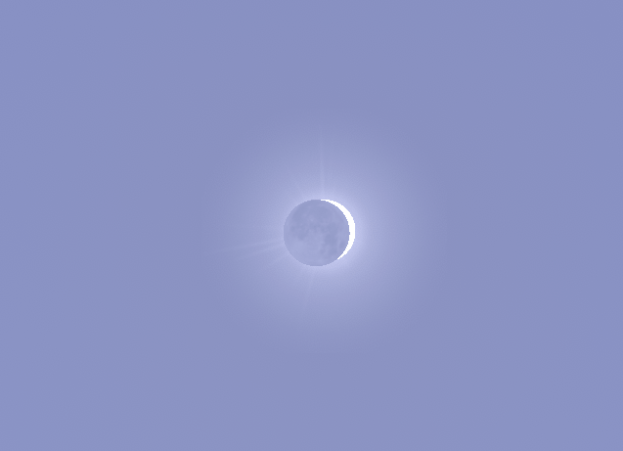
Eclipse simulation using Stellarium

The Eclipse

This Monday, North America experienced its second total solar eclipse in the last decade. — Click here to support the Wednesday Blog: https://www.patreon.com/sthosdkane


This Monday, North America experienced its second total solar eclipse in the last decade.


I remember being over-the-moon excited when we began preparing for the Total Solar Eclipse in August 2017. Several weekends before the eclipse, my parents and I drove north from Kansas City into the path of totality to scout out possible places where we might travel on Eclipse Day to see the phenomenon for ourselves. Eclipse Day 2017 also happened to be my first day as a history graduate student at the University of Missouri-Kansas City. That morning a sudden summer thunderstorm rolled through Kansas City and as the day continued the clouds persisted in our skies. When the moment of totality arrived around 12:55 pm on 21 August, we watched it through darkened clouds and heard the birds and insects around us revert to their nocturnal states and songs.

I was excited to have experienced a total solar eclipse yet disappointed that I wasn’t able to see it. So, when the prospect of traveling for this week’s total solar eclipse appeared, I seriously considered going afield to Texas to observe it. That trip didn’t end up working out because of a series of scheduling conflicts, and so instead seeing that the cloud forecast across North America called for most places along the path of totality to be obscured, I decided to stay here in Kansas City and observe our partial solar eclipse. At its greatest extent, the April 2024 solar eclipse reached about 90.5% totality. I was able to see that extent, yet the feel of it was quite different than 100% totality from seven years ago. We were watching Everyday Astronaut and the Planetary Society’s live broadcast from the Society’s Eclipse-o-rama event in Fredericksburg, Texas while observing the eclipse here at home, and what they experienced was far more dramatic than what we observed. I do regret not travelling for this eclipse, yet at the same time in the circumstances as they fell, I’m glad I chose to stay home all the same.

This concept of an eclipse is one that speaks to me both astronomically, as a big space nerd, historically, and linguistically. Eclipses are phenomena that have made their mark on the psyche of more than just us humans, note how the birds began singing their twilight songs when the Moon passed in front of the Sun. I have never put much theological potency into eclipses because we have been able to predict their occurrences with increasing accuracy for generations now. Religion, in many ways, relies on our perceptions of things. Some see in an eclipse a threat to divine order in the Cosmos. This view reminds me of Mozart’s final opera, near to my favorite of his works, Die Zauberflöte (The Magic Flute) in which the Queen of the Night is defeated by Sarastro, the high priest of the Temple of the Sun. Sarastro proclaims victory for the good and right, singing: 

Die Strahlen der Sonne

Vertreiben die Nacht.

Zernichtet der Heuchler

Erschlichende Macht.

The rays of the sun

Drive away the night.

Destroyed  is the hypocrites’  

Surreptitious power.

(Source: Aria-Database.com, trans. Lea Frey)

Sarastro’s triumphant finale in Die Zauberflöte sung by Josef Greindl with the RIAS Symphonie-Orchester Berlin.

The divine hand is better seen in the wisdom of devising a manner to mathematically ascertain the revolutions of these celestial orbs, to borrow the title of Copernicus’s magnum opus, De revolutionibus orbium coelestium. In our ability to ascertain our surroundings, and to make sense of nature we see a loving design.

Still, knowledge of the movements of the Sun, planets, moons, and stars across our night skies have had their impact in our history. During his fourth voyage, on 1 March 1504, after 9 months stranded in Jamaica, Christopher Columbus (1451–1506) used his knowledge of eclipses from an almanac he brought with him written by the Castilian Jewish astronomer Abraham Zacuto (1452 – c. 1515) to inspire the Taíno caique of that part of Jamaica to give Columbus’s men food and provisions. Columbus wrote in his journals that he pointed at the Moon and told the Taíno that “God caused that appearance, to signify his anger against them for not bringing the food” to Columbus and his men.[1] Several years ago then, when discussing this story with a friend and fellow Renaissance historian, I decided to use the Stellarium astronomy program to simulate this lunar eclipse as Columbus and those with him in Jamaica saw it. Our ability to track the movements of these celestial orbs is good enough that our computers can show exactly what was visible in the night sky (baring any atmospheric data) at any moment in the past or future.

My simulation of the March 1504 Lunar Eclipse as seen from St. Ann’s Bay, Jamaica using Stellarium.

This ability to calculate the dates and locations of eclipses came in handy when researchers look at mentions of eclipses in ancient literature to seek to date the events of the stories. Plutarch and Heraclitus both argued that the Odyssey contains “a poetic description of a total solar eclipse,” which astronomers Carl Schoch and P.V. Neugebauer proposed matched an eclipse which occurred over the Ionian Sea on 16 April 1178 BCE, though a more recent article in the Proceedings of the National Academy of Sciences by Constantino Baikouzis and Marcelo O. Magnasco offer doubts concerning this proposition owing to the difficulty of finding exact matches in spite of centuries of the Odyssey‘s transmission through the oral tradition before it was written.[2] Still, that eclipses are so readily discernible and measurable with our mathematics speaks to the potential that they could be used to date moments long remembered only in heroic literature like Odysseus’s return to Ithaca in Book 20 of the Odyssey (20.356-57). In this effort, where others divine gods, we make tools out of the Sun and Moon to better understand ourselves.

The way we describe an eclipse speaks to our culture’s relationship with the phenomenon. Our Modern English word derives from the same word in Old French, which developed from the Latin eclīpsis, which in turn was borrowed from the Ancient Greek ἔκλειψις (ékleipsis), which comes from the verb ἐκλείπω (ekleípō)meaning to abandon, go out, or vanish.” Eclipse eclipsed the Old English word āsprungennes, which derives from the past participle of the verb āspringan, meaning “to spring up, to spread out, to run out, to cease or fail.” As an adjective, āsprungen meant that something was defunct or deficient, so perhaps this sense of an eclipse meant that it seemed for a moment as though the Sun had run out of energy and ceased to burn? Again, this speaks to the idea that nature had limits as humanity does, to an older understanding of nature from the perspective of a limited human lifespan. 

In Irish, there is the Hellenic word éiclips, yet there’s an older Gaelic word which means the same thing, urú. Now, usually students of the Irish language will learn of urú in the context of Irish grammar, an urú or eclipsis is one way that Irish handles both consonant clusters and situations when one word ends in a vowel and the following word begins with another vowel. So, in that sense the word gets eclipsed by this urú which preserves some of the integrity of the language. Yesterday’s eclipse then was less an urú focail (word eclipse) and more a urú gréine (solar eclipse). That both the Sun and the words we speak in Irish can be eclipsed makes this astronomical phenomenon all the more ordinary and measurable. 

We use this word eclipse beyond astronomy in many cases; it seems to me today that the old guard of the Republican Party has been eclipsed by an orange political pulsar whose violent rhetoric and chaotic behavior have eaten away at their party’s support in these last 8 years, not unlike a pulsar discovered by NASA’s Swift and Rossi X-Ray Timing Explorer satellites in 2007. An eclipse is something wonderous to behold yet ordinary in how readily we can predict when they will appear. They have given us a great deal of cultural qualifications that continue to influence how we see our world.

On Monday then, when the sky began to darken as the Moon passed in front of the Sun, I noticed that the color spectrum that I’ve always known began to change. Before my eyes the colors seemed to take on a sort of metallic glow, as if the light which illuminated them was shifting into a spectrum that seemed unnatural to the natural world I’ve known. The Sun is fundamental to how we understand the world around us. Its light is what illuminates our senses, and without it, or even with partial changes to its glow, we would find ourselves observing a very different world.


[1] Christopher Columbus, “The Fourth Voyage,” Select Letters of Christopher Columbus: With Other Original Documents Relating to the Four Voyages to the New World, trans. and ed. R. H. Major, (London: Haklyut Society, 1847), 226.

[2] Constanino Baikouzis and Marcelo O. Magnasco, “Is an eclipse described in the Odyssey?” Proceedings of the National Academy of Sciences 105, no. 26 (2008): 8823–8828, nn. 1, 12–14.