Tag Archives: Ancient Order of Hibernians

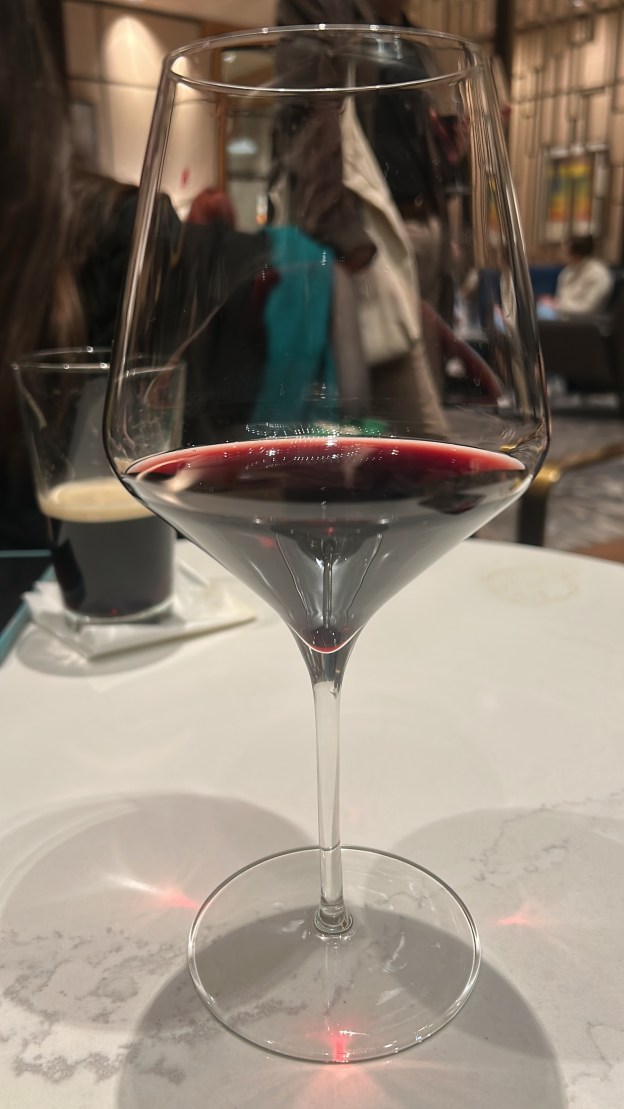
A glass of Rioja red wine drunk by the author in March 2025 in Boston.

On Drink

This week, bringing together my research and my life through wine.—Click here to support the Wednesday Blog: https://www.patreon.com/sthosdkane—Sources:%5B1%5D Thevet, Singularitez, 14v.%5B2%5D Thevet, Singularitez, 15r.%5B3%5D Thevet, Singularitez, 159r.%5B4%5D Thevet, Singularitez, 15v.%5B5%5D Émile Littré, Dictionnaire de la langue française, 4 vols., (Paris, 1873-1877) s.v. « mignol. »[6] Florike Egmond, Eye for Detail: Images of Plants and Animals in Art and Science, 1500-1630, (Reaktion Books, 2017), 30; Mackenzie Cooley, The Perfection of Nature: Animals, Breeding, and Race in the Renaissance, (University of Chicago Press, 2022), 101.[7] Thevet, Singularitez, 18v.[8] Thevet, Singularitez, 19r.[9] Thevet, Singularitez, 19v.[10] Thevet, Singularitez, 19v-20r.[11] Homer, Odyssey 9.403, trans. Fagles.

This week, bringing together my research and my life through wine.


As I progress in my efforts to prepare my translation of André Thevet’s (1516-1590) Singularitez de la France Antarctique for publication, I find myself often laughing at Thevet’s own comments about his world and the worlds he visited on his 1555 voyage from France to Brazil and his 1556 voyage home (the one with the whales). Thevet was a Frenchman through and through, yet while he referred to “our countrymen” on several occasions in the Singularitez he more often identifies himself alongside other Europeans as Christians, distinguishing them from the African and Amerindian peoples he described in various forms of other. Thevet used the broadest possible perspective to craft a story which would resonate with his reader, a story which told of the influence and impact of his fellow Christians from “our Europe” upon these distant worlds across the “Ocean Sea.” I like Thevet’s perspective because as contemporary to the middle of the sixteenth century it is, it still feels contemporary to our own time all the same. If the frontiers of mapped knowledge were just beyond the Atlantic and Pacific shores of the Americas in Thevet’s time, today they lie in the vastness of Space above us. The parallels between the First Age of Exploration to which Thevet contributed and our own Second Age of Exploration now underway are many and ought to be explored further in academic scholarship.

I’ve long loved reading about explorers, pioneers, and settlers. Over the weekend then, when I drove west with my Dad to Hutchinson, Kansas for the 2025 State Convention of the Kansas Ancient Order of Hibernians I made a point of us going to visit the Cosmosphere, one of Hutchinson’s jewels. This museum of spacecraft, memorabilia, and historical artifacts from the 1940s through the end of the Cold War is something worth visiting if you’re in Central Kansas. We’d been there before in about 2007 or 2008 with my Boy Scout Troop to do our Astronomy merit badge. The rest of the weekend was spent enjoying the company of our brother Hibernians and their wives, and in a long business meeting on Saturday in the Strataca Salt Mine Museum just outside of town. While I was in Hutchinson, I made a point of continuing my work on typing out the French original of the 1558 Antwerp edition of Thevet’s book for my impending book proposal. The chapter I worked on in Hutchinson, “On Palm Wine” was one such boozy treatise that made me laugh.

Thevet diverted on several occasions from his cosmographic endeavors of describing the botany, ethnography, geography, and zoology of these places to rest instead on their local wine, or wine substitute. He began these series of diversions on Madeira, still today famous for its wine, “which is first among all other fruits of usage.” Thevet made his case concerning wine plain from the start, writing of the Madeiran variety that it is “necessity for human life.” Vines grow on Madeira, Thevet wrote, because “wine and sugar have an affinity for Madeira’s temperature.”[1] Its wine is comparable to Cretan wine and “the most celebrated wines of Chios and Lesbos,” which Thevet identified as Mitylene. Here, he equated a modern creation, the plantation of Portuguese vines into the soils of Madeira, to the famed wines of antiquity which were prized by the Greeks, Romans, and Persians alike.[2] Thevet couched his qualifications of the greatness of modern things on their parallels with or roots in antiquity. A humanist, Thevet’s cosmography was reliant on these classical framings to assess the proper place and due of these things of which were “secrets most admirable, of which the ancients were not advised.”[3] Maderian wine was better aged, Thevet wrote, “for they let it rest under the ardor of the Sun kept with the times so that it doesn’t keep the natural heat in the wine.”[4] In a place such as this warm enough where sugar cane could be planted in January, Thevet found a paradise where even he and his countrymen could appreciate the local grape.

Two chapters later, as Thevet moved on to describe the coastline around the Cap-Vert in Senegal, the westernmost promontory of Africa and the place whence the island Republic of Cabo Verde derives its name, he stopped again to discuss their local drink, in this case palm wine. Thevet recorded an indigenous name for this drink, Mignol in his Singularitez, which Émile Littré’s Dictionnaire de la langue française recorded is a “spirited liquor extracted from a species of palm.”[5] Perhaps then, Thevet’s use of the term may be the first introduction of this word into French. He writes, with a hint of a sigh that “the vine is unfamiliar to this country where it has not been planted and diligently cultivated,” resulting in a dearth of wine and the preference for liquors extracted from palm trees. This makes wine one of the most human of inventions, something that needs labor to be crafted out of natural things. It is a bridge between the twin categories of collected objects in the cabinets of curiosities of Thevet’s time: artificalia, that which was made by human hands, and naturalia, that which was made by God.[6] While the palm “is itself a marvelously beautiful tree and well accomplished, larger than many others and perpetually verdant” Thevet contended that its fruit still requires less cultivation and work than the fruit of the vine or barley.[7] “This wine is excellent but offensive to the head,” he wrote, noting that it “needs a hot country and grows in glassy sand like salt, lest its roots end up salting when it is planted.”[8] Unlike grape wines, palm wine is “prone to corruption” because, Thevet wrote, “humidity rises in this liqueur.”[9] It is similar in color “as the white wines of Champagne and Anjou and tastes better than the ciders of Brittany, helping the locals who are subjected to continuous and excessive heat.”[10] I infer in here a slight toward the Bretons, who were only recently made subjects of the French crown in 1547 upon the coronation of Henry II of France as both King of France and Duke of Brittany.

Thevet’s point is that while alcohol can come in other forms than just the fruit of the vine, that is far superior to any other drink. I myself prefer wine, especially reds from Chinon, Rioja, and the Burgenland. I’ve had my fair few opportunities to enjoy a glass or two, or perhaps more. Polyphemus put it well when he cried out that Odysseus’s full-bodied wine must be “nectar, ambrosia [which] flows from heaven!”[11] The holy vines whence come wine carry into Christianity and in particular the Catholic and Orthodox traditions. Through transubstantiation the wine becomes the Blood of Christ. To me, this is the greatest mystery of the Faith, or at least the greatest mystery of our liturgy and rite. I find it amusing that other churches have non-alcoholic grape juice rather than wine fill this role, as in our Catholic culture there’s a certain degree of pride in the fact that we use wine proper, and that everyone partakes (if they so choose) in that wine as early as 8 years old at their First Communion. I for one think that a gradual introduction to alcohol within the right guarded circumstances can be healthy; this at least avoids the taboo that can lead to underage drinking as an act of rebellion. Yet by making drink a central tenant of our ritual life, we give it a clear place where it should remain and distinguish it from those places where it should be avoided. For instance, I customarily only drink whiskey in toasts at weddings and funerals or other special events. It’s not something that I want to have on a regular basis.

This regularity is central to our society’s relationship with alcohol. I grew up with the image of drink being embodied in the alcoholic model of Fr. Jack Hackett, played with a finesse by the late great Frank Kelly on the Channel 4 sitcom Father Ted in the 1990s. Fr. Jack’s favorite word was “drink!” always said in an exclamatory manner. Drink has its charms to be sure, yet like anything it should be taken in measure. Too much and you lose control of yourself or even your sense of self all together. Too little and you cannot really enjoy it. A century ago, American society responded to alcoholism by trying to stifle its main fuel through prohibition. The 18th Amendment to the United States Constitution prohibited the sale of alcohol, yet it was hardly effective in this effort. One of the funnier papers I wrote in my undergraduate made the satirical case that Catholicism has advantages over Protestantism because we didn’t think that Prohibition would actually work. Granted, we are the Church that had the Index of Prohibited Books, so we all make mistakes. I think a similar mistake can be made in the idea of wholesale prohibition of actions and things that are controversial today. I for one am more in favor of restricting gun sales, yet a ban simply would not work in the United States. Likewise, my Church is a loud and vocal advocate for the prohibition of abortion. In both cases, these feel like measures at undertaking a complicated surgery with a battleaxe. Instead, let’s consider the underlying societal causes of these issues and address those. Let’s bring together this country’s finest minds, experts in their fields, and have them work together to find a solution that will improve our lives and leave this a better place for our descendants to live.I do enjoy a good glass of wine. I’ve had both good wine and the bad wine to compare it to. I’ve drunk wines so bad that they make your typical communion wine taste like a nice, aged vintage. A good glass of wine elevates a meal for me. On New Year’s Eve during my prix fixe dinner at Paros, a Greek restaurant in Leawood, Kansas, I enjoyed a well-rounded Cretan red with at least one of my five courses. At the end of the meal after the lamb shanks and the octopus and the baklava and everything else I was so content that I didn’t feel the need to continue the festivities. Rather, I let the rest of the night pass by in peace and quiet. A good drink can add in the sweetness of the day, an evening’s amber glow that could just as easily be missed. It remarks on the passing opportunities that if only we saw them we might make different decisions that would make our lives even just a little bit better.


[1] Thevet, Singularitez14v.

[2] Thevet, Singularitez15r.

[3] Thevet, Singularitez159r.

[4] Thevet, Singularitez15v.

[5] Émile Littré, Dictionnaire de la langue française, 4 vols., (Paris, 1873-1877) s.v. « mignol. »

[6] Florike Egmond, Eye for Detail: Images of Plants and Animals in Art and Science, 1500-1630, (Reaktion Books, 2017), 30; Mackenzie Cooley, The Perfection of Nature: Animals, Breeding, and Race in the Renaissance, (University of Chicago Press, 2022), 101.

[7] Thevet, Singularitez18v.

[8] Thevet, Singularitez19r.

[9] Thevet, Singularitez19v.

[10] Thevet, Singularitez19v-20r.

[11] Homer, Odyssey 9.403, trans. Fagles.

We, Irish Americans

This week, to conclude what I’ve been saying.—Click here to support the Wednesday Blog: https://www.patreon.com/sthosdkane—Sources:%5B1%5D “Signs,” Wednesday Blog 1.10.[2] “On Servant Leadership,” Wednesday Blog 6.15.[3] Percy Bysshe Shelley, “Ozymandias,” Poetry Foundation.


This week, what does it mean for my community to call ourselves Irish Americans?


When I was applying for universities for my undergraduate studies, I was thrilled that one university allowed me to write in my own answer for “race or ethnicity.” I took out my pen and wrote down “Irish.” That university, Rockhurst, is the one which I chose and attended throughout my undergraduate years, and it remains the one that I list today before the others. Rockhurst holds a special place in my heart because it is so intrinsically linked with the Irish American community here in Kansas City, and it is one of those anchors that’s tethered me to this community where I’ve been able to make my own impact and presence.

That adjective I chose to write however is perhaps more complicated. I am not Irish by birth but by descent, though one generation too far removed to qualify for Irish citizenship in that manner. Still, Irish is a better descriptor of me than the generic American white, a category which my people were only accepted into for the sake of preserving the flimsy-footed tableau that is racism in America. When I moved to London, I was surprised to be confronted with three categories of white to choose from rather than the monolith I was used to. I technically qualified for all three: I have both Irish and British ancestry, yet I am from a country other than those two. I marked the box for White Irish as long as I was living and studying there because it felt the truest to my nature. Yet again, I am not Irish per se; rather I am Irish American, a member of one of the larger camps within the diaspora created out of the centuries of trouble caused by English and later British colonialism in Ireland. In this perspective, my people are victims of colonization, yet here in America we are the colonizers. So, amid all these tangled webs of identity and nature what are we, Irish Americans?

It is notable to me that in France there is no particular legal sense of identifying oneself as anything other than French. Trevor Noah put this well when he spoke about an immigrant who was granted French citizenship by President Macron after a tremendous act of heroic bravery in saving the life of a child. Yet when I’m in France, I find that if people are confused about my name I go toward my heritage to explain why it’s not your typical Anglo-American name, that my family comes from Ireland instead. I hear a similar tone from the varied generations of nativists in this country, even in the writings of President Theodore Roosevelt, a man who I overall admire a great deal, who wrote in opposition to us persisting as “hyphenated Americans.” This country ought to be a melting pot where all of the immigrants and their descendants shed away their own national and ethnic trappings in favor of becoming one people with one common identity. Yet again, I find this perspective runs contrary to my own lived experience.

To be an Irish American means to remember the place where our ancestors came from, and to remember their struggles as they sought to live their lives first at home and later in this place their newly adopted home. To be an Irish American is to remember that we too were the immigrants not that long ago and to offer a warmer welcome to the newcomers than our ancestors often received. For me, to be an Irish American is to have roots in two countries, better reflecting the interconnected and global nature of our world. Yet at the end of the day, we are Americans. In Ireland, I refer to myself as “an American cousin,” with a slight nod to that infamous play of 1865. The Ireland that many of us know is the Ireland of our grandparents and great-grandparents, the Ireland of the revolutionary generation and the twentieth century when our families left to come to this country. The Ireland of 2025 is still the same country, yet it has grown with the last generations into something that many of us find incongruent with our expectations. It is less an island than ever before with more outposts of the global world on its shores.

Our experiences greeting this global world are different because we encountered it here in America rather than in Ireland. We relate to all the peoples of the Earth through our friendships, rivalries, and mutual circumstances with the other diasporic immigrant groups in this country. I’ve wondered for a long while, including in this outlet if we are slowly with each new generation becoming less Irish Americans and more deeply rooted in other tribes in this country. We tend to be more religious than our cousins in Ireland, and as there are less Catholic schools and parishes that are explicitly Irish are we then becoming Catholic Americans more than Irish Americans? Or are we contributing to a general secularization of that larger white American demographic resulting in both our ethnicity and our religion fading into the background of our identities as ordinary Americans trying to survive in an ever more chaotic world? The key here is that our community is diversifying between political persuasions and regional identities and an overall willingness to remain connected to the lives and histories and passions of our ancestors.

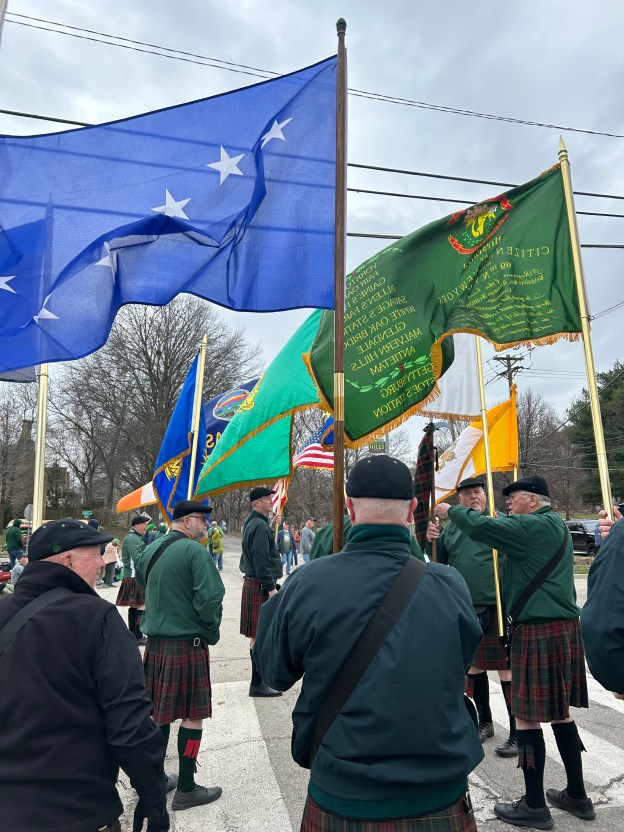
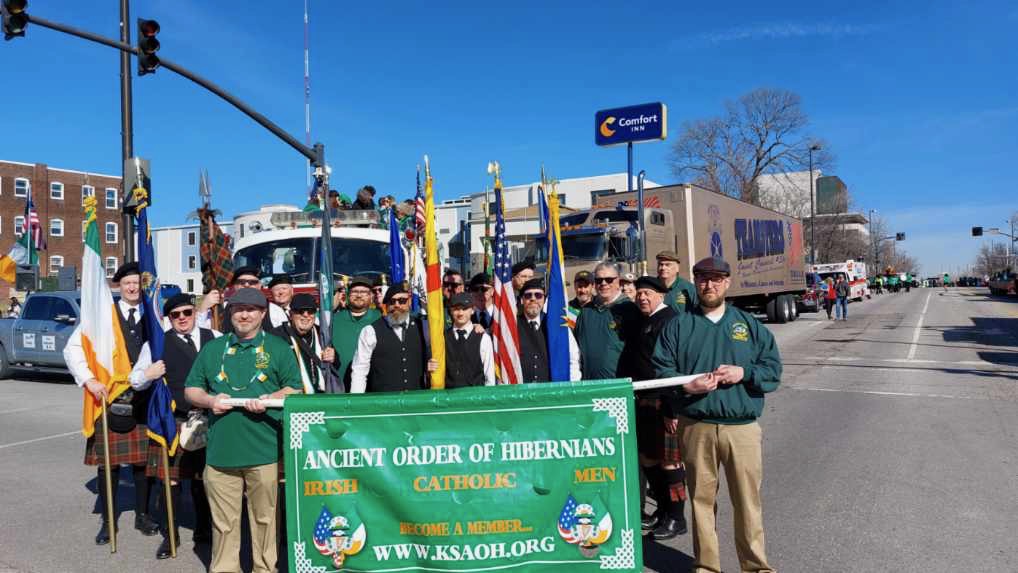
I for one have kept in touch with all of that because I believe it is intrinsic to understanding who I am. My Dad grew up under the same roof as his grandmother who came to this country from Mayo in 1920, and the fact that my parents chose to name me Sean demonstrated to me that this history was an important part of who I am even before I really began to understand what it all meant. For the record, I decided to add the fada to my name (Seán) when a little before my 10th birthday I learned that’s how it is spelled in Irish. I’ve devoted a great deal of time to learn the Irish language even though it’s not all that useful here in America because I know that it’s what my family once spoke, and in order to better understand them and by extension myself as well, I decided I ought to use one of my talents and learn it.This week we celebrated St. Patrick’s Day with our usual parades here in Kansas City. I marched in two this year, the warm-up parade on the Saturday before here in my neighborhood of Brookside and the big parade down Broadway in Midtown Kansas City on the holy day itself. Normally, I end the big parade and the holy day itself rather annoyed at how the old caricatures of Irishness and Irish Americanness persist along the route both in the parade and among the spectators. And while I did see some of that, I was more focused on marching with my brothers in the Fr. Bernard Donnelly Division of the Ancient Order of Hibernians (AOH). Many of us continued the celebration of our brotherhood and our common heritage later that day and it proved to be one of the better, and sunnier, St. Patrick’s Days that I’ve experienced in a long time. We, Irish Americans persist in our stubborn identity because we’ve built our communities in this country around our roots. It defines us distinctly from our fellow Americans, and with all good intentions demonstrates to our cousins across the water that we haven’t forgotten about them.


On Names

Season 4 Finale: This week, to celebrate Christmas I’ve decided to write a bit about naming conventions that I’ve come across, and to explain why I use my full name professionally. Nollaig shona daoibh | Merry Christmas! — Click Here to Support the Wednesday Blog: https://www.patreon.com/sthosdkane


Season 4 Finale: This week, to celebrate Christmas I’ve decided to write a bit about naming conventions that I’ve come across, and to explain why I use my full name professionally.


In American culture middle names have a bad reputation. They’re most famously used in our childhoods to scold us, and in adulthood they most often appear in legal matters. A writer naming non-descript American characters John Booth or Lee Oswald might get away with it but include their middle names Wilkes and Harvey and you have two of the most notorious assassins in American history. Most accused or convicted murderers in our legal system tend to be known in the press by their full names: first, middle, and last. There’s an odd cadence to it when these people are identified by the police or the courts. It’s one of the more common times when middle names get used.

I go by my full name professionally. On my website, in my email signature, and in every conference program and academic publication that I’ll ever appear in I’m identified as Seán Thomas Kane. Trust me, I didn’t intend to draw any connection between myself & the men mentioned in the last paragraph who killed two Presidents who I’ve always looked up to. In my case, the use of my middle name has a different sort of significance. In my extended family I often get called Seán T., in part because I have many relatives who are named Thomas, one of whom goes by T. among the family. Whether intentional or not, my parents gave me one of the most traditional Irish names they could have. Irish names are traditionally patronymic, meaning the person is so-and-so, son or daughter of so-and-so, descendant, son, or daughter of so-and-so. Those last names (or surnames if you aren’t American) that begin with O’ refer to families who are descended from a specific person who lived centuries ago. The ones that begin with Mc however are Anglicizations of the Irish word mac, meaning “son” of a specific person who lived centuries ago. My father’s name is Thomas, so in Irish my name is Seán mac Tomás, or Seán, son of Thomas. Kane is an Anglicization, or better an English phonetic rendering of the Irish name Ó Catháin, pronounced two different ways depending on where you’re from in Ireland (for those reading this, listen to the podcast to hear those two pronunciations.) Cathán was a more common Irish given name in the Early Middle Ages and derives from the word cath meaning battle.

This was in the back of my mind when I decided to start going by my full name professionally. It was 9 March 2016 and I had a few hours without much to do while waiting for a car to pick me up at Lyon-Saint-Exupéry Airport on my way to the eastern French city of Besançon, the capital of the Franche-Comté region and a city which Caesar mentioned in his book about the Gallic Wars (De Bello Gallico 1.38). That cold and rainy Wednesday in March there was a national railway strike in France and I ended up booking a back seat of a Renault Clio driven by a Frenchwoman who spoke little English alongside two other Frenchwomen who again spoke little English from Saint-Exupéry Airport outside of Lyon to Besançon, a good 4 hour drive. Right before they arrived though, I was on Facebook posting an update about my trip and thinking about how I wasn’t entirely sold on sticking with Seán Kane as my name professionally, after all when you search Seán Kane on Google you get a fair handful of results. There on Facebook I noticed that my friend Luis Eduardo Martinez, a fellow graduate student in International Relations and Democratic Politics at the University of Westminster, and a gentleman who I consider a good friend to this day, used his middle name professionally. I felt inspired and changed my name on my Facebook profile from Seán Kane to Seán Thomas Kane then and there standing in the airport parking lot.

Where the last paragraph took place.

This proved to be even more advantageous when the Renault carrying the three Frenchwomen arrived as the driver stepped out and proved that the way Seán is spelled makes little sense to a monolingual French speaker. I remembered when I started studying French at Rockhurst University and we chose French names to use in class how I immediately was discontented with being called Jean alone, as I’d rather be called Jean-Thomas because that’s essentially a French translation of my name coming from Irish. So, I suggested that she call me “Seán-Thomas” which was heard as “Jean-Thomas.” Et voilà, that’s how it all got started. For the record: the Irish name Seán is in fact just an Irish spelling of the twelfth century Norman French pronunciation of that French name Jean, which is also the source of the English name John. You can hear the connections better in an English accent than in my own American one where the oh sound in John has shifted closer further forward in the mouth.

This wasn’t the first time I’d changed my name on my Facebook profile. For a while in high school, I went by my Irish name, Seán Ó Catháin, and that was the name on my early membership cards with the Ancient Order of Hibernians. Yet as much as I was inspired by the Gaelic revival and wanted to do my part to restore our ancestral language, I found that it was impractical to use in America and that deep down I do identify more with Kane than Ó Catháin because that’s the name my grandparents, my dad, and most of my paternal relatives use. Kane itself began as a misspelling by the U.S. Army draft sergeant processing my great-grandfather Thomas Keane when his number was drawn in 1918. He enlisted and served as an artilleryman in France and eventually became an American citizen as Thomas Kane because the sergeant told him if he wanted that first e added back into Keane on his papers he would have to go back to the back of the line and start the process over again. 

So, to answer a question I often get in Kansas City: no, I’m not related to any other Kanes in this city except my Dad, and in fact outside of my Dad and his brother’s family all of my living paternal relatives who share our family name on either side of the Atlantic spell it Keane. I suppose I could change mine back to that one, I suspect my granddad’s cousin and longtime Wednesday Blog reader Sr. Mary Jo Keane would’ve approved of that, yet at this point the name dispute feels moot especially considering the Keane spelling only goes back another generation or two to about the 1850s before which in the official British government records written in English my great-grandfather’s great-grandfather’s name was written as Thady Caine. In Irish his name would’ve been Tádhg Ó Catháin, and we know he spoke Irish as his first language. So, what was his name? I’m honestly not sure.

I like how different naming conventions reflect different cultures in their own ways. Our Irish patronymic system is really more Gaelic than Irish, after all it’s the same system that’s used by our Scottish Gaelic speaking cousins and it mirrors a very similar system used in Welsh. In fact, my Welsh ancestors’ family name was Thomas, which derives from the Welsh ap Tomos. Fitting, eh?

When I teach about the Vikings I like to bring up the Norse patronymic system too and explain that Leif Erikson (as we call him in English) was actually Leifr Eiríksson in Old Norse, and that following this tradition as it’s today practiced in Iceland were I born there, or should I someday immigrate to that island republic I’d probably start going by an Icelandic version of my name: Jón Tómasson, dropping the Ó Catháin/Kane family name all together in regular use there to better fit Icelandic society while still retaining it outside of Iceland. I see this as similar to how patronymics are used in Russian, where Tolstoy’s tragic character Ivan Ilyich is known by his first and middle name and not by his first and family names Ivan Golovin as we’d do in the English-speaking world. There, for the record, Seán mac Tomás would translate as Иван Томасaвич (Ivan Tomasavich).[1] In a hypothetical blending of cultures where Irish speakers interacted more with French speakers in North America than with English speakers I could see our patronymic system developing into the French system of having double names, thus why when I still published a French translation of my C.V. I would write my name as Seán-Thomas with the hyphen which I don’t use in English.

Another set of naming systems that I’ve encountered that I appreciate are those originating on Iberia where the family names of both the mother and father are included. My same friend Luis Eduardo Martinez’s full name, and the name I first read when I met him in September 2015 is Luis Eduardo Martinez Mederico. In this Spanish naming custom, his father’s family name appears first followed by his mother’s family name. This is opposite to the Portuguese where the maternal family name precedes the paternal one. So, in the Spanish custom my name would be Seán Thomas Kane Duke, while in the Portuguese custom it would be Seán Thomas Duke Kane. My parents and I actually refer to our family as the Duke-Kane Family, and we’ve joked about what my life would’ve been like if I’d been given both family names at birth in that order. I often conclude that including the East Yorkshire name Duke alongside Kane would’ve made me sound more English.

Then there are the professional names like Smith or Miller. These derive from the first bearer’s profession, so Jefferson Smith had an ancestor somewhere in the distant unwritten past of that Frank Capra film’s imagination who was a blacksmith. Today, on Christmas, we celebrate someone who has such a name, that being Jesus. I get annoyed with my fellow Americans who see “Christ” as Jesus’s last name because it’s not a name at all but a title in the first stage of becoming a name. This name as we understand it ought to be written in English as Jesus the Christ, from the Greek Ἰησοῦς Χριστός through the Latin Iesus Christus, but that word Χριστός is merely a Greek translation of the Hebrew word māšiah (מָשִׁיחַ), which again is usually rendered in English as Messiah, the name of Handel’s most famous oratorio and what Brian certainly wasn’t (he was a very naughty boy.) This is a kingly title, fitting with our view in Christianity of Jesus as priest, prophet, and king appears most prominently this time of year in the Feast of Christ the King, something we celebrate in the Catholic Church at the Liturgical New Year, which was 24 November this year.

Jan van Eyck’s depiction of Christ the King from the Ghent Altarpiece (1426)

A brief digression here: this past Feast of Christ the King I learned that the official name of the day is the Solemnity of Our Lord Jesus Christ, King of the Universe. While that last title might sound overly grandiose in the twenty-first century it actually comes from Ancient Mesopotamia, where the most powerful monarchs of those city states as far back as Sargon of Akkad (r. c. 2334–2284 BCE) claimed this as their imperial title: šar kiššatim, which actually meant King of Kish, the primate of all Mesopotamian cities and according to the older Sumerian King List it was the first city to crown its kings following the Great Flood. So, in essence this title places Jesus, a humble carpenter who was incarnate as God the Son as the true “King of Kings (forever, and ever) and Lord of Lords (for ever and ever)” to quote from the Handel.

Now, back to that rendering Christ as Jesus’s last name. In his lifetime, Jesus was known as Jesus of Nazareth, and in earlier times Christians were known as Nazarenes (Acts 24:5). This word is still used to describe Christians in Hebrew in the form notsrí (נוֹצְרִי) and in Arabic with naṣrāniyy (نَصْرَانِيّ). Thus, he was known more by a locator name than by a last name in the modern American sense. Furthermore in John’s Gospel, St. Philip referred to Jesus as “Jesus, son of Joseph, from Nazareth.”[2] So, in the culture in which Jesus was born he would’ve been known most fully in this way rather than with any last name that we may recognize. It’s important to remember that Jesus’s ministry took place 2,000 years ago, and contrary to some popular belief he didn’t speak English. English wasn’t even a language then, though an older form of Irish was around, just probably not heard as much in Galilee or Judaea.

So, let me conclude with the bits that seem to have started as identifiers that came at the end of people’s names before there were family names in the sense that we use them today. These are often locators of where the person in question was from. In the case of Leonardo da Vinci, da Vinci merely refers to the fact that Leonardo was born in the Tuscan commune of Vinci. These particles of place tend to denote nobility in some names, see the French, Spanish, and Portuguese de, the Italian de’ and di, and the German von. However, I see the utility in having this locator in someone’s name to make it clear that even though they’re a Booth they’re not related to every other Booth around. That way a random John Booth living in 1865 would’ve had less trouble because of his more infamous counterpart’s scheming that Good Friday. I’d ask though, in my own case whither would such a locator in my name identify? Where would it refer to? Would it stick just with me, saying that my original hometown is Wheaton, Illinois, so I’d be Seán Thomas Kane of Wheaton? Or would it go back to the origins of my particular Kane/Keane/Caine/Ó Catháin family in the Derryhillagh townland outside of Newport, County Mayo, in Ireland? In Irish the way this would be written would either be with a different Irish preposition ó (yep, there are at least two of these), or with the preposition as. In my Irish as I speak it, I say as in this context more than ó, as in to say “Is as Meiriceá mé,” or “I am from America.”

We don’t do these in Irish names, in part because of our patronymic system which does a fine job on its own. Sometimes when I’m writing stuff in Latin and I want to adopt the style of the Renaissance humanists who I read in my research I’ll try to Latinize my name with one of these locators, rendering my hometown of Wheaton, Illinois by using the name of the Roman goddess of what, Ceres, and essentially making a town name from there. Thus, Wheaton becomes Ceresia. The tricky thing is that when I’m translating my name into Latin, something that was done in academia more into the nineteenth century but is almost never done today, I have a conundrum of whether to start from Kane or from Ó Catháin. I for one don’t like how a Latinized Kaniussounds, so instead I do go from Ó Catháin and use Cahanius, or Ioannes Thomae Cahanius Ceresius in full.

Names are important, and they say as much about the person who bears them as the people who named that person and the culture to which they belong. I’ve played around with my own name a fair bit, as you’ve seen. Today I’m more used to being called Seán-Thomas in French than in English, though the latter has happened more and more. I’ve even noticed that people have started calling me Thomas seeing that name and recognizing it faster than they do Seán, especially with the fada on the a. I smile and acknowledge them, after all I’m happy to be mistaken for my Dad. Looking forward, should I be fortunate enough to name my own children I’ll say these two things: first I’m not the one who’ll be pregnant with them for nine months, so I shouldn’t get first call on their names, and second there’s that Irish tradition that offers a simple answer to this conundrum. Will my first-born son be named Thomas as well then? Yeah, maybe. We’ll have to wait and see how this poorly named lifetime membership with one of the dating apps works out for me. I certainly hope I’m not putting my name out there for the rest of my life, though you can bet I’ll be using that lifetime membership joke for as long as I can.

Nollaig shona daoibh a léithoirí rúin! | Merry Christmas, dear readers!


[1] NB: I’m using Russian as the example here because that’s the one I’m more familiar with. No political inclinations toward the Kremlin in their invasion of Ukraine are intended.

[2] John 1:45 (New American Bible), see more here.