

Ab urbe condita – Wednesday Blog by Seán Thomas Kane
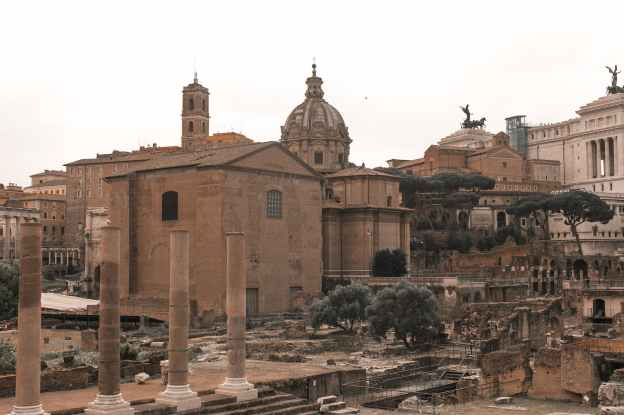
I find it interesting as an adult that my first understanding of my own religion, explained to me by my Mom when I was little, was that “we are Roman Catholics.” Even at that point, when I must’ve been no more than five years old, I knew what Rome was, I can remember my thoughts from that moment as clear as day: I pictured in my mind a map of the Italian peninsula descending from the Alps down into the Mediterranean. Whether that map was my memory of the globe in my grandparents’ home next to their collection of the 1979 edition of the World Book Encyclopedia, or of some other map I had seen I can’t say for sure. Rome, with all its antiquity, has had a hold over my imagination just as it has over the collective imaginations of those of us in the European and American orbits since its fall.
Several years later, after we’d moved to Kansas City, and I continued my schooling at St. Patrick’s in Kansas City, Kansas, I checked a book on Ancient Rome out of the school library. As I remember it, it was one of the few history books in color, most of them had been donated when the school first opened in 1949 and were by modern standards rather outdated. Still, I had this book in my bag that had a wonderful colored picture of the greatest extent of the Roman Empire in the reign of Hadrian during the 2nd century CE. I had looked over it several times already before this particular memory took place, but when one afternoon I was denied entry into an after school club, I think a geography bee club perhaps, I found myself sitting on the bench in front of the school’s office, reading that book.
My ancestors, the Irish Gaels, were never conquered by Rome. There were likely Roman merchants visiting the Leinster coast during the imperial period, after all the western boundaries of the Roman Empire were across the Irish Sea in Wales, but Roman influence didn’t fully arrive until after the Western Roman Empire had already collapsed in the form of missionaries like St. Patrick who introduced Christianity, the Latin alphabet & language, and fostered a new sense of European connectivity for my people that has never left. For me conversations of heritage are always complicated. Yes, I am an Irish American with roots going deep into that island’s past beyond what’s considered historical, but so much of the culture I’ve lived in and embraced comes from Europe’s classical past: from Greece & Rome, that I feel a strong bond if not in blood, then in civilization to those continental cultures.
When I teach Western Civilization or European History I, or whatever you want to call the intro class that covers European history from Bronze Age Greece to the Reformation, I make a point of trying to define civilization as being inherently tied to the concept of the city. Mapping civilizations is like charting the stars in the sky, with each city glowing bright like those lights in the heavens, at the heart of their own civilizations. In antiquity this ideal makes sense, for the city-state was the most common type of polity. Rome was a city-state governed by its own balance between an aristocratic Senate and an Assembly representing the rest of the People that in turn ruled over an ever growing empire of subjected peoples until at last it became too much for the standing political order in Rome to control and 150 years of civil wars lead to a Principate, rule by the Princeps, the First Citizen, in this case Augustus Caesar and his heirs and successors who we today know as the Emperors.
Today, I look at Roman history and see several ideals that every generation since its conception has espoused. On the one hand there’s the model of the Caesar as the best sort of leader. The Caesars who ruled Rome from Augustus’s elevation in 31 BCE to Constantine XI Paleologos’s death at the Fall of Constantinople in 1453 CE have their heirs and imitators in all the Kaisers, Tsars, and Emperors to rule in Europe and its erstwhile American colonies since, as well as in kings like Louis XIV, le roi soleil, who like Augustus fashioned himself the Sun at the center of all his domain. Yet on the other hand I see the republican ideal of citizen government espoused before the Principate, lauded by men like Cicero and the Gracchi yet never fully realized by anyone then or since.
I would rather emulate that republican ideal of citizenship, refashioned in a modern sense with the blending of republicanism with democracy. The founders of the United States saw in their new republic a revival of the best of Rome, emulating their ancient heroes in law, government, and architecture. One needs only wander around the National Mall to find all the classical buildings one’s heart could ever desire to see how our new Rome on the banks of the Potomac has come to be. Yet in all honesty, as much as Washington fits this idealized model of a republican Rome reborn, with even the great headquarters of our Department of Defense across the Potomac beyond the confines of the capital in the Pentagon, not unlike Rome’s ancient Campus Martius, experience has taught me that the greatest modern inheritor of the symbols of the Roman Republic in its art & architecture can be found in Paris, a city whose grand boulevards and monumental architecture built during and after the Revolution of 1789 are alive with the symbols and spirit of Roman republicanism. This is in part thanks to one of the great Romanophiles of the last 250 years, Napoléon Bonaparte, whose reign as First Consul and later Emperor of the French sought to create a new Rome in his own day, albeit in the transitional model of Julius Caesar whose reign at least nominally sought to preserve the Republic yet established the foundations for the Empire that Augustus, his adoptive son, created.Today the meaning of the republic has changed so dramatically that I doubt Cicero or even the Gracchi would approve; and as much as I look up to so many of those old Roman republicans as people who I appreciate and enjoy reading, I firmly believe we’re better off without all the trappings of what was inherently a limited and oligarchical Roman Republic. I would rather live in a modern democratic republic, one where social welfare, tradition, and the markets were kept in balance. So, on this the 2,776th anniversary of the founding of the City of Rome, I’m worried to see the reactionaries among us pulling us backward toward that oligarchy that initially established our own Republic here on the far side of the Atlantic almost 240 years ago. The Roman Republic fell because its leaders misdiagnosed the sickness and killed the patient, ignoring the needs of the people for their own power & wealth. Rome continues to provide us lessons today. We should listen to them.
 Wednesday Blog by Seán Thomas Kane