Tag Archives: binghamton

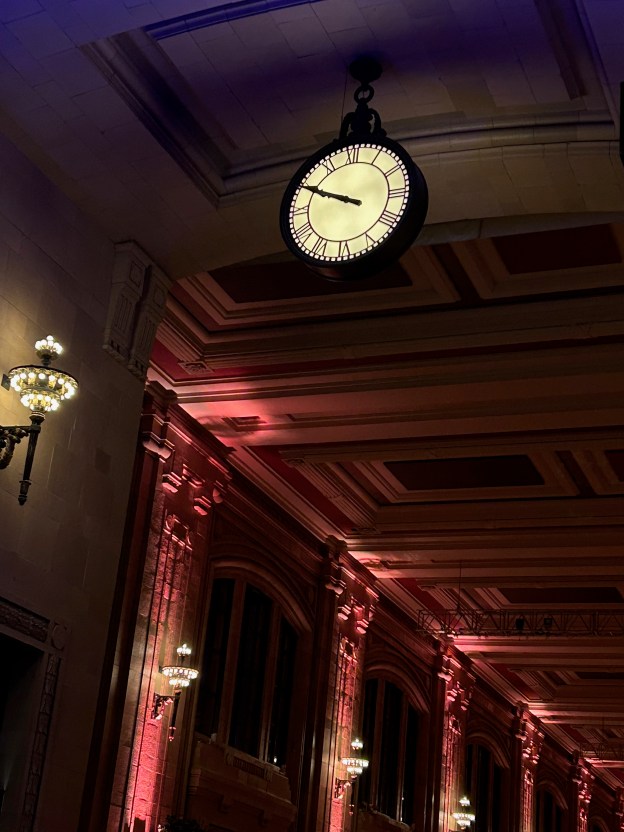
A picture of the great clock at Kansas City Union Station at night.

The Poetics of Finality

The Poetics of Finality Wednesday Blog by Seán Thomas Kane

This week, some words on endings.—Click here to support the Wednesday Blog: https://www.patreon.com/sthosdkane


This week, some words about endings.


On the morning of Flag Day, I went to the Linda Hall Library with my parents to see the classic 1951 science fiction film The Day the Earth Stood Still. I knew about this film, but this was my first time seeing it. Beside the story, what struck me most about this film was its tone, pacing, and overall character. After I finished my other two events of the day, the Plaza No Kings Rally where I watched the crowd of 11,000 people rally for democracy, and Mass that afternoon, I returned home tired yet eager to find that same tone. I went looking for it in Rod Serling’s classic series The Twilight Zone. Released between 1959 and 1964 in its first incarnation, this series had scared me a bit the previous times I’d sat down to watch an episode or two. It has an air of fear to it that is reminiscent of the reasons why I generally stay away from horror films. And yet on closer inspection, Serling’s stories tell something that is far less frightening than I first imagined because it’s a theme with which I’m all too familiar.

I came to indirectly know more about Mr. Serling when I moved to his hometown, Binghamton, New York, to undertake my doctoral studies in August 2019. His image isn’t all over town, but it’s a visible reminder of Binghamton’s history and place in the fabric of American culture. In fact, much of the stories that I’ve now watched in The Twilight Zone fit the character of that interior part of the Northeast where I lived from August 2019 to December 2022 quite well. In some ways, not too much of the built environment has changed from Serling’s day 60 years ago. Still, I noticed time and again how the optimism of that postwar era had faded. The same town was there, but some of the energy it once knew was long gone. Having lived my life to date in Chicago, Kansas City, and London, all cities with layers of history and memory, I’ve seen how the current generations have chosen to craft their own layer. 

London is a city that holds mementos to its ancient and medieval past while largely built in the form of its eighteenth, nineteenth, and twentieth century growth at the height of the British Empire. Yet today there are enough futuristic buildings and settings in the capital that it was used as a setting standing in for the space-age galactic capital of Coruscant in the latest Star Wars series Andor. I delighted in seeing familiar places from the Barbican Estate and Canary Wharf in the show.

Chicago has some of the same American character of Binghamton and the Northern states as a whole, a common history. Yet Chicago is the powerhouse of this country, the beating heart of our transportation network, the real crossroads of this nation. Where other industrial cities in the Great Lakes faltered in the 1970s, 1980s, and 1990s Chicago instead continued to power on for its sheer size and the diversity of its industry. Today, it has a very particular character which I believe makes it the most American city this country has to offer for its marriage of American settler culture and all the different indigenous, migrant, and immigrant communities that make America the patchwork of peoples in one great republic that it is.

Kansas City meanwhile saw more of the downturn for its smaller size and some of its traditional industries haven’t translated as well into the current information revolution. Kansas City once thrived as another great railway hub: the Gateway to the Southwest as the last major Midwestern metropolis along the Santa Fe Railroad as it drove across the prairies toward New Mexico, Arizona, and Southern California. Today, our interstate highways direct traffic through Kansas City more from Texas, Colorado, the Dakotas, Iowa, Minnesota, and points east than in the old northeast-to-southwest alignment of the rails. Recently while I was in downtown Kansas City, I remarked on how underwhelmed I felt visiting there for the first time after the business and thrill of going with my parents down to the Loop on weekends when we still lived in Chicago. Kansas City however has seen a renaissance of its own in the last twenty-five years that has filled in many of the gaps left by urban renewal and restored this city’s vitality. That more than anything else made my move to Binghamton a tremendous culture shock: going from a growing city to one that was a shadow of its former self struggling to invest in its future.

For every Twilight Zone episode there seems to be a fearsome unknown menace looming over the story; something that the character can perceive the effects of yet can’t quite see. Yet if there is any common thread to this menace it’s that it is a fear of the unknown. In the original pilot that launched the Twilight Zone, titled “The Time Element,” Serling’s rational psychoanalyst foil to the main character trapped in his dreams concludes through his logic that his dreams that he goes back in time from 1958 to Pearl Harbor on December 6th, 1941 could not be real because any incident that happened in this dreamed 1941, if real, would impact the patient as he lived in 1958. Yet reason is proven unequipped to address the irrational, how can it explain what it intrinsically is not? I’ve argued time and again here in the Wednesday Blog that this is where there exists room for belief in a life lived rationally. Still, having watched a fair number of Mr. Serling’s stories now, I think I can say something to this menace’s true character.

There is an intrinsic fear that comes with knowledge of seeing that we do have an ending. On a biological level, our bodies can only continue working for so long. We drift apart from our lives as they were in one moment or another, apart from friends who we admired and loved in a given moment, apart from jobs that consumed our waking and sleeping thoughts, apart from situations which challenged us to become better versions of ourselves. Yet, all those lived moments will continue on in our memory, at least for a time. I was stunned to find how well I could remember very particular moments of minute detail earlier this year when prompted by a sudden and wonderful realization about how I want to live in my life to come. Even the smallest of details that my senses perceived were there, locked away. The antidote to any fear is joy, and for me it was the most radiant joy I’ve felt in years which unlocked those memories for me of moments which led to that jubilation. Still, fear in moderation is a good counsel, a wise friend. It’s what makes me watch for traffic when I’m crossing the street here in Kansas City, or that advises me to make certain decisions over other ones at a very fundamental level to keep me alive. This is one interpretation of what the infamous tree in Genesisportended: that once humanity ate its fruit we would never again be able to be innocent from seeing flaws in the beauty of nature and in the beauty of ourselves.

Over the weekend then, I went to see the new Stephen King film The Life of Chuck starring Tom Hiddleston as Charles Krantz. I particularly grew to like young Chuck’s grandfather played by Mark Hamill. If I were to compare Stephen King’s writing to any other American storyteller of the last century it would be Rod Serling. Both tell stories of this same menacing fear. Yet in King’s Life of Chuck, the monster who’s revealed in the last scene is far more familiar, ordinary, and known to us all that I saw it less as a menace and more as a companion. There is intense poetry in both Serling’s Twlight Zone and King’s Life of Chuck around endings. They tell us that the finality of moments in our lives and of our lives all together give our lives greater meaning and purpose. I’ve found in the various projects and events I’ve helped organize that we get more done when we have goals we’re trying to achieve and a timeline by when we want to achieve those goals. I often work better when I have deadlines because if I begin to feel impatient at how long something might take, I know there’s an end date to look forward to. I feel that about little things but not the big ones, not the experiences that’ll one day make for good stories or about my life itself.

I for one don’t want to live forever, I worry that’d take some of the meaning out of my life. I would like to be remembered for my writing, for being a good person, for the history I research and leave for generations of graduate students to muddle through in their coursework. On a recent digital security Zoom call that I attended we were asked to search our names on several search engines and see what came up. Should there be anything we didn’t want searchable we could then get that removed. I was delighted to see that after my website, social media profiles, and various conference programs came page after page filled with essays published here on The Wednesday Blog. I suppose that’s one benefit of writing this weekly for the last four years: my thoughts written here will be remembered at least by the search engines. Yet I think the Wednesday Blog will have more meaning when I decide to set it aside and turn my staff to other facets of “my so potent art” to borrow from Prospero. Because then anyone who is curious enough to glance through these pages will be able to see them in their totality and know these essays are artifacts of the time when they were written in the early 2020s at a time of my life of doctoral study that feels so very close to ending.

This is not the last time you’ll hear from me on the Wednesday Blog, rather I’ve decided to end my weekly publication of this blog at the end of the current season. This is Season 5 of the podcast, or Book 6 of the blog itself. I feel that it’s had a wonderful run, and it’s been a great outlet for me while I’m biding my time as my career slowly begins. Yet now, I’ve got a lot more writing to do from new research papers to submit for peer-review to book reviews that it’ll be nice to take this off my docket. This is the 25th issue of this season, and I have a further 15 issues planned before the end. Thank you to all my readers over the last four years and all my listeners over the last three. I hope this will be an ending worthy of your curiosity.


On Vanity

This week, I reflect on the role of love in balancing between self-praise and community in a discussion of vanity.—Click here to support the Wednesday Blog: https://www.patreon.com/sthosdkane


This week, I reflect on the role of love in balancing between self-praise and community in a discussion of vanity.


Today, in Rome the College of Cardinals will convene for the new conclave to elect our next Pope. By the time you read this we may have already seen white smoke rise from the chimney and met our new pontiff by his papal name on the balcony of St. Peter’s. Or more likely when you read this the cardinals will be amid one volley or another of voting rounds and deliberating their right course of action. Since the death of Pope Francis, I’ve felt rebuffed by the electoral speculation over who will be the next pope; by and large I’ve avoided reading any of these articles or watching any of these analyses. On the one hand, in my lifetime these lists of papabili have often been wrong. Francis was an unexpected choice. Yet on the other hand I see a sense of vanity in all this speculation which seeks the political power of the Papacy while ignoring its pastoral nature. I’ve long heard that the eventual choice of Pope is supposed to be directed by the Holy Spirit, whispering perhaps into the ears of the men in red like God did to Elijah in the cave. In my own experience, I’ve seen this most in the realization that the best path for me to take often is the strangest or most winding in character.

It takes a great deal of humility to take that particularly uncertain way in life, to not know where you’re going to end up. You have to learn to trust in yourself and in the people around you to make that path work. I’ve learned to expect things to break, and nothing that I try to work, and to figure out how to move forward in spite of what I’d dreamed and hoped for. I try to learn from my experience even when it is painful or heart wrenching to see dreams vanish and new realities, perhaps less glowing than what I hoped for, take their place. Still, the best way in my experience is to be patient and let things grow naturally around you and within you. The initial instinct isn’t always accurate, yet it should not be discounted either. There are days when the useless is best just to let your mind rest and decide where to go next. The late Renaissance French humanist essayist Michel de Montaigne (he actually wrote “I am no philosopher”) wrote in his essay “Of Vanity” of the men of his own time when France was wracked by forty years of civil war, “a time when it is so common to do evil, it is practically praiseworthy to do what is merely useless.”[1] I am often focused on resolving questions by finding immediate solutions, even if they are smaller steps leading to a greater whole. Yet in recent weeks I’ve found those solutions aren’t always needed or warranted, for they can sift the complexities of a problem so far down that the problem itself slips through the strainer and remains unresolved.

I recognize a degree of vanity here; I figure I have a strong mind and being reasonably well educated that I can attend to any problem and find a logical solution. Yet logic cannot account for humanity in all our chaos and charm. The character and nature of humanity is to spy ourselves in the glass and be marveled by it. We can be so caught in imagining our own glories and our own defeats that we miss the lived moments in between when we are surviving the daily fare and writing even the smallest of verses which will contribute to the song of our lives. I’ve learned to accept that my wishes for things are not always going to happen, and that as much as I warm my soul with dreams of wonders to come those dreams will only be realized by living with the people around me, learning about them, trying to understand them, supporting them, and appreciating them for who they are. Why enforce my own persuasions on you when I could appreciate you, dear Reader, for your own self and your cosmovision? This is a word I only recently learned, I saw it first in Surekha Davies’s new book Humans: A Monstrous History. It seems to originate in Spanish as a way of expressing the way in which reality is subjectively understood through our sensory perceptions. Descartes’s famous maxim for knowledge, “I think, therefore I am” means in this sense that we know what we know because we can perceive it. The cosmos in all its wonder is familiar to us through our sight, hearing, smell, and touch. I would much rather wait to hear your song and listen to it harmonize with mine than pull your voice into my own melody against its own nature.

Montaigne admired those in his generation who kept up the good nature of humanity, its customs, laws, and mores in spite of the world around them losing so much of that common purpose. In quoting Cicero, “not by the calculation of your income, but by your manner of living and your culture, is your wealth really to be reckoned,” the essayist speaks the greater value of a good life enriched by a passion for community and a charitable outlook on our pursuits.[2] While I’m a practicing Catholic, ever striving to be more faithful in my life, I firmly believe with my whole being that the state should be secular, the better to reflect the totality of the people from whom government derives its power. I would be vain to demand that the state reflect my Catholicism at the detriment of all my neighbors, even my fellow Catholics, whose faith is personal and distinct from my own. A good person recognizes this and seeks communion through mutual respect and appreciation. The most central tenant of my faith is that God is love, άγάπηφιλίαand ἕρως alike in the original Greek, and the greatest expression of this love is in our liberty to make our own lives, our free will. If we are meant to live in this image then surely we ought to lower our pride and our vanity and hail the liberty of those around us to live their own lives and make their own choices?

For much of my life I’ve had a hard time taking criticism. I’m better at it today, yet it still is a something I know I will always need to work on. I’m no longer in a state of mind where I feel that I need to justify my actions or choices to everyone. On the inverse side, several years ago I finally caught myself trying to deflect praise with a witty quip that deflated some of the experience. This is something that I’d been doing for a long time perhaps to not inflate my ego too far. I went through my phase of wanting to be important, wanting to be a leader, and to be at the front of things and today when I am in that position in so many organizations, I’ve found that it’s much more fun to be a part of a team working together to achieve our common ends. Together these twin forces pull me toward a humility that I hope keeps me grounded, in which I’ve allowed myself to experience my successes while embracing the troubles that occurred in the course of those victories.

In my academic career I’ve published to date one public-facing article about my historical zoology research into the three-toed sloth and an encyclopedia entry titled “Amerindians in Brazil” for the volume South America: From European Contact to Independence which was published earlier this year. In both instances, I’ve since found things that I got wrong. It was a bit of a shock at first to realize this. In the case of the encyclopedia entry, I made a rather large error in misgendering a god, the Tupi deity Maire-Monan who I interpreted as feminine following the lead of the sixteenth-century Portuguese authorities, only to realize while I was writing a book chapter last summer about magic in Shakespeare’s play The Tempest the error I’d made. As such, the correction to the encyclopedia entry appears in the footnotes of that forthcoming chapter. Likewise, in the editing stage of a forthcoming article of mine, my first peer-reviewed article to be published, I was presented with conclusive evidence that my prior conclusions that the three-toed sloth found in my sources cannot be definitively identified as a southern maned sloth (Bradypus crinitus) as I’d written in that article “The ‘Sufficiently Strange’ Sloth” for EPOCH Magazine’s June 2024 issue but is in fact more likely either a northern maned sloth (B. torquatus) or a brown-throated sloth (B. variegatus). That prior assertion in favor of the southern maned sloth stands corrected now not only in my forthcoming article “A Sloth in the First French Colony in the Americas” but also in the latest draft of Chapter 3 of my dissertation.

A few years ago, I would have still had significant trouble accepting these critiques out of a strong sense of embarrassment at making such a mistake. In the case of the sloth’s historical zoology, I thought I read all there was to read about the different three-toed sloth species which live in the Brazilian Atlantic Forest, yet I was proven wrong by a generous reviewer who even offered a bibliography of where I could look to find more reliable information. Were, I always fixated on the looking glass of my successes I would surely miss the flaws that pronounce my humanity and not see the ample room for growth. I know that I’m not perfect, in fact I revel in the fact. And while my faith exists, I challenge anyone who claims to know definitive things about matters of belief whether they can really know the mind of God, a concept which as I wrote previously in my blog post from 12 March titled “The Divine Essence,” that divinity extends in scale far beyond human comprehension.

These last few years I’ve long felt a sense of disconnect between the two poles of my life. On the one hand in Binghamton, I felt a sense of professional accomplishment, I was at a good university conducting research and teaching, and a part of an academic community, however disparate that community was in practice. Yet I missed my family, I missed the Midwest, my home cities of Chicago and Kansas City became longed for isles of the blessed far to the west on the flatlands beyond the Appalachians. I longed to be active in my parish and to offer my talents to my brother Hibernians in elected office. I missed the regularity of the live music in Kansas City, the greater presence of the Kansas City Symphony in this city than anything I could find in Binghamton. Yet when I left Binghamton at a moment when I know I needed to leave, I found that I gave up more than I necessarily wanted. I lost that sense of professional accomplishment and surrounded myself by friends from beyond the academy who appreciate what I do but don’t necessarily understand the nuances of it. In the last few months, I’ve found something of that professional community through the learned societies that I’m a part of and at academic conferences where once again those two poles seem linked by a common axis. That axis is essential to a good life because it provides the balance which allows the individual to truly live to their fullest potential as a part of a wider community. I’ve known true solitude, a mantra of mine in recent weeks has been the simple Irish phrase, “Is mé i m’aonar,” or “I am alone.” It’s a plaintive call of sorts, yet it’s also a moment to learn from, that as much as I’m used to this existence that I want to grow out of it. Montaigne wrote in “Of Vanity” that “it is pitiful to be in a place where everything you see involves and concerns you.”[3] This is the solitary life, a life where about you all things revolve, and what’s worst about it is that it can be lived in community. Alone together was a phrase I read time and again during the recent pandemic. Yet even then with our need to stay apart we found ways to be together. I spent much of the pandemic years here in Kansas City rather than in Binghamton and still felt far more closely attuned to my professional community and the friends who populate it. 

In these past few weeks, I’ve been happiest when I’ve had that connection with my family and friends, when I’m with other people and experiencing their lives, their passions, their perceptions of our shared world. I put faith in the currency of human connection and community because that is the most valuable coinage I’ve yet seen. All the gold and silver that humanity has ever mined cannot compare with the value of community and the humility it brings out in all of us. I have many highly accomplished, brilliant friends, and I’m delighted to count myself among them. There is some vanity in these friendships, after all we approach each other with our own experiences and stories to share, highlighting the things we’ve done, yet in a good relationship we do so to elevate our friends and encourage them to seek greater things for themselves. I feel fortunate to have met these friends, and to be able to put my talents to use serving our common cause.This week then as the cardinals vote in Rome, I hope they will look not just to their own personal interests, theological bent, or political persuasion. I pray they will listen for that suggestion that seems just strange enough that it could be right, and that they chose a Pope to lead our Church who will continue to build bridges that may close the divides erected for millennia between ourselves and so many of our fellows. I hope for a pope who will be a friend to all, a good diplomat who can unite disparate peoples together into one common cause. May his humility guide him to be the pope we need now in the second quarter of the twenty-first century, and when he is elected may we rise to the occasion to better ourselves.


[1] Michel de Montaigne, The Complete Essays of Montaigne, trans. Donald M. Frame, (Stanford University Press, 1965), 3.9., p. 722.

[2] Montaigne, Essays 3.9., p. 724.

[3] Montaigne, Essays 3.9., pp. 725–26.


Tóg go bog é | Take it easy

Tóg go bog é | Take it easy Wednesday Blog by Seán Thomas Kane

This week, a few words on taking life slower.—Click here to support the Wednesday Blog: https://www.patreon.com/sthosdkane


This week, a few words on taking life slower.


Where I grew up first in the Chicago suburbs and later on the western edge of Kansas City, Kansas the average speed limits were around 35 mph (56 km/h). I think there’s something to be said about a life that’s taken at those sorts of speeds, that the speed we drive from place to place reflects in how we approach other aspects of our lives all the same. By comparison, in the year that I lived in London I fell out of practice with my driving, instead I knew how to navigate by walking speed, closer to 3 mph (5 km/h). Perhaps this is one of the reasons that I found Binghamton to be such an incongruent place to live because the average speed limit is 30 mph on the local streets and roads in that valley.

When I learned to drive then, the average speed that I found myself at hovered around 35 mph. Furthermore, I learned to drive on the highways before I learned city driving, as most of my early daily drives were on the highway K-7 between our home in Piper and my high school in western Lenexa, Kansas. It was a 30 minute commute each way to school every day, and one that I don’t remember getting that old too fast. In more recent memory, I found that driving a good 20-25 minutes every day down to the school I taught at in Leawood, Kansas did grow taxing to the point that now I’m less willing to drive quite as far in town as I did even a few short years ago.

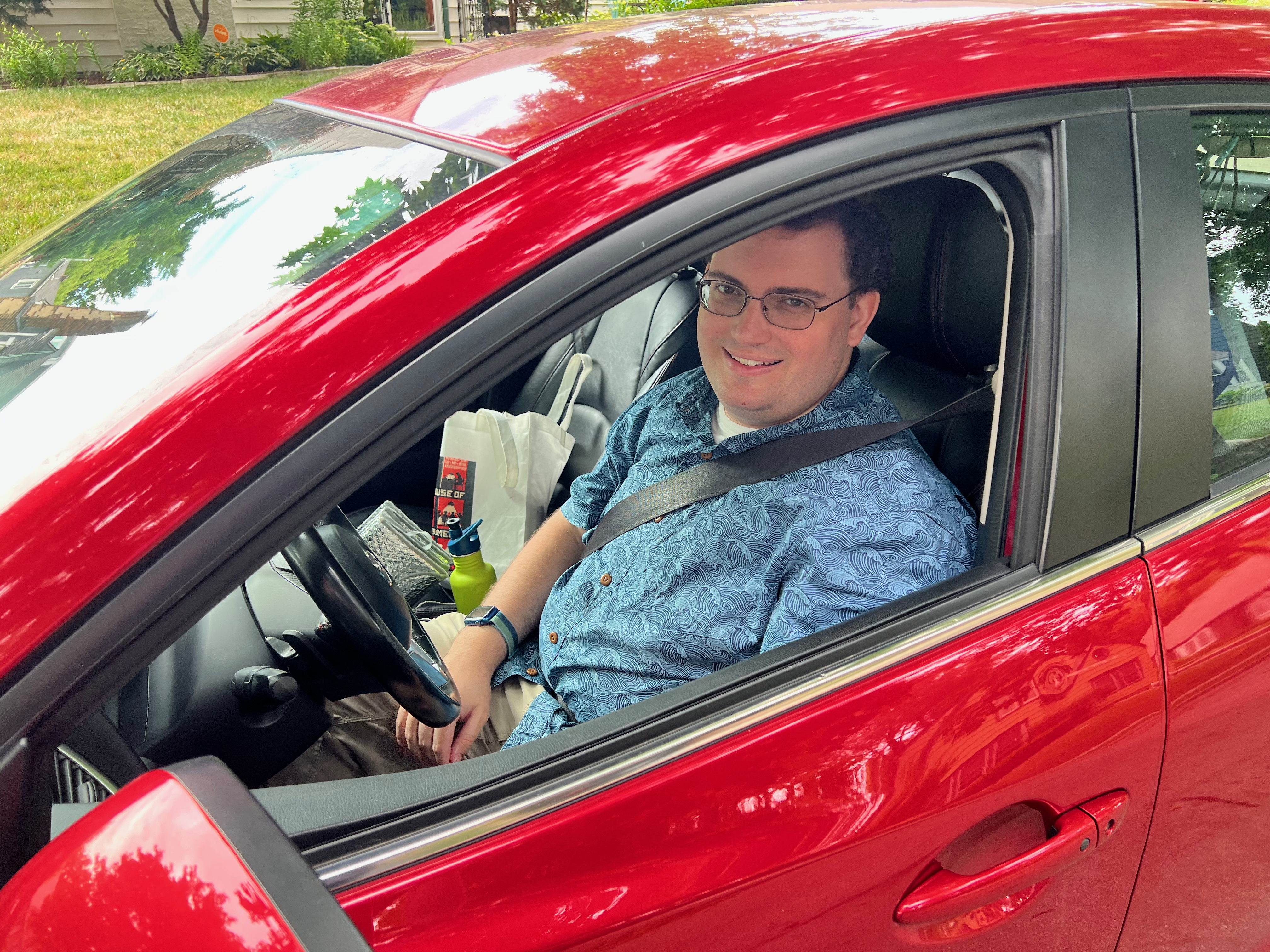
I’ve noticed several types of driving and several variations on speed that my car will embody depending on how I’m feeling on a given day. There are times when I am so attuned to my surroundings and to my car, which I lovingly named the Mazda Rua 6 years ago, that it will feel as though we are one in the same, that my car will adjust its direction and speed with the slightest turn of my hands, or the flick of my eyes from one direction to another. This feeling was especially pronounced on my 14 long drives between Kansas City and Binghamton that I undertook between August 2019 and December 2022. On those drives, I would usually keep a steady pace of around 75-80 mph (120-129 km/h) on the Interstates between the Catskills on the eastern edge of my route and the Great Plains to the west. When I’m out on the open road I’ll still sometimes set my car into cruise control at this sort of speed, which tends to be the pace of highway traffic anyway and let the day’s drive go by.

Yet I’ve noticed more and more in my drives around town, I’m not going quite as fast as I used to. I tend to drive a few times per week between my home in Brookside and my place of work in the Crossroads, always on the city streets and always in a decent amount of traffic for Kansas City. Yet the pace of traffic has slowed somewhat; where before I’d keep to that 35 mph threshold, now I’m fine if I’m hovering between 30 and 35 mph (48 and 56 km/h). Just before writing this, I drove home from a haircut with my cousin Richard Morrissey at his salon in Mission, Kansas and I found that I didn’t particularly care that the traffic was going 30 mph, especially when I crossed the border and merged onto the northern reaches of Ward Parkway. Nor did I mind the slower speeds when I decided to turn off that major boulevard and onto a side street that goes up Sunset Hill toward Loose Park where traffic really ought to be moving no faster than 15 mph (24 km/h). I didn’t mind the slower pace because I didn’t feel the need for speed.

My generation grew up with the role models of our parents and grandparents whose generations worked day in and day out for decades and who built our sprawling metropolises in which we need cars to get around. I’ve accepted this world that I was born into and its hurried tempo and made myself far busier than I probably need to be. On a recent day when I had 3 meetings in a row in the span of 3 hours I was struck by the fact that when I was still in Binghamton I was busy but not this busy; that the reason why I’ve not been keeping up with podcasts or TV shows the way I used to is because I simply don’t have as much time in the day for them.

The key here is a learned moderation which goes a long way to what I find is a happier life. There are things which I hope for and want with an eagerness that inspires me to plow on forward yet I’ve learned that the best things I can hope for are those which occur in the quiet moments of calm between those rushing evocations of the modern life. I for one would much prefer to just be an academic spending my days reading and writing about historical zoology and having deep and enriching discussions with friends and colleagues. I would much rather listen to my colleagues about what they’re researching, and about the things they’re learning in their own particular topics. And yet, when I was with my colleagues at the Renaissance Society of America’s conference the week before last in Boston, I felt that I stood out in some ways from them by all the different fires I have going at once. I’ve always been one with many different projects in the works. Even now, alongside this weekly blog and my dissertation I have two articles in the review and editing stage, a third that I’m hoping to submit to a journal soon, two books on the way that I will be reviewing, and a short story I’m plodding through writing. 

On top of this I hold several different committee assignments in the Fr. Bernard Donnelly AOH alongside my primary recording secretary duties. I also work part-time as an usher team captain for the Kauffman Center for the Performing Arts and now have somewhat of a hands off approach to my Mom’s efforts in leading and organizing a local progressive protest organization called Blue Brookside. Simply put, I have to persist at this higher speed to keep track of everything.

One of the first phrases I learned when I started studying Irish in 2007 was one which I initially misheard: Tóg go bog é, which translates as “Take it easy!” This is a nice sentiment, and one which I’m trying to live, to be less worried, to inflict less stress upon myself. Perhaps even though I didn’t identify it as such this may well be what I’m trying to give up for Lent this year. You might say it’s working in some stripes yet not in others. What remains is a key question about how I can grow from finding this balance between busyness and nonchalance? Maybe this is something we all need, time away from the constant stream of information and news and worry. I’ve recently begun responding when people talk about social media that I admire those who’ve dropped away from it; were it not such a good way of staying in touch with friends and family near and far I probably would do that too.Let this be a motto for us to aspire to: tóg go bog é, take it easy.


Doctoral Study

Photo by Ricardo Esquivel on Pexels.com

I was 27 when I arrived here in Binghamton at the start of August 2019. I made a big move out here, with immense help from my parents, and set up shop in a good-sized one bedroom apartment that’s remained my sanctuary in this part of the country ever since. I’d wanted to continue my education up to the PhD since my high school days, and it’s a plan I’ve stuck with through thick and thin. After a false start in my first attempt to apply to PhD programs in 2016, which led to two wonderful years working on a second master’s in History at the University of Missouri-Kansas City (UMKC), I applied again, now far better positioned for a PhD program and ended up here through the good graces and friendly insight of several people to whom I’m quite grateful.

Arriving in Binghamton though I found the place very cold and quite lonely. In recent months I’ve begun to think more and more about getting rid of some of my social media accounts only to then remember that Facebook, Instagram, and Twitter were some of my greatest lines of communication with friends and family back home in Kansas City and elsewhere around the globe throughout these last three years. That first semester was tough, very tough, and while the second semester seemed to get off to a good start it was marked by the sudden arrival of the Coronavirus Pandemic and the end of my expectations for these years in Binghamton. 

I spent about half of 2020 and 2021 at home in Kansas City, surrounded by family and finding more and more things to love about my adopted hometown with each passing day. When I was in Binghamton it was to work, in Fall 2020 to complete my coursework and in Spring 2021 to prepare for my Comprehensive Exam and Dissertation Prospectus defense. I still did a good deal of the prospectus work at home rather than here, though the memories of those snowy early months of 2021 reading for the comps here at this desk where I am now always come to mind when I’m in this room.

As the Pandemic began to lessen in Fall 2021 and into the start of this year, I found myself in Binghamton at a more regular pace. There was something nice about that, sure I wanted to be home with my family, but I also felt like I was getting a part of the college experience of going away for a few years to study that was reminiscent of the year I spent working on my first MA at the University of Westminster in London. I started to venture further afield in the Northeast again, traveling to Boston, New York, Philadelphia, Baltimore, and Washington again. When I first decided to come here one of the things, I decided was I’d take the opportunity of being in the Northeast to see as much of this region as possible.

2022 saw another transition, I wasn’t in one of the newer cohorts in my department anymore. Now, in Fall 2022 I’m one of the senior graduate students. It’s a weird thing to consider, seeing as it felt like 2020 and 2021 evaded the usual social life of the history graduate students here, thanks to the ongoing pandemic. I also began to look more seriously at my future, applying for jobs in cities across this country, and even looking again at some professorships, something I doubted for a while would be an option for me. If there’s anything about life that I’ve learned over the past three years spent here, it’s that you always need to have things beyond your work to look forward to. Whether that be a long walk in the woods on the weekends or a day trip to somewhere nearby, or even the latest episode of your favorite show in the evenings. Doing this job without having a life beyond it is draining. 

For me the best times here in Binghamton were in Fall 2021 and Spring 2022 when I truly began to feel like I had a place here that I’d made my own. I was confident in my work, happy with how my TA duties were going, and really enjoying my free time as I began to spend my Friday evenings up at the Kopernik Observatory and Sundays at the Newman House, the Catholic chapel just off campus. I was constantly reading for fun as well, something I’d lost in 2020, even falling behind with the monthly issues of my favorite magazines National Geographic and Smithsonian. There were many weeknights I’d spend out having dinner alone reading natural history, science fiction, anthropology, and astronomy books. 

It’s interesting looking back on myself from six years ago when I was in London, the months that summer when I decided I wanted to get back into history after a year studying political science. My motivations were to earn a job working at one of the great museums I’d spent countless hours in during that year in the British capital. While I studied for my MA in International Relations and Democratic Politics, I was still spending my free time looking at Greek and Roman statuary and wandering the halls of Hampton Court or watching the hours of history documentaries on BBC 4 in the evenings. And now that I’m back in History as much as I do appreciate and love what I do, I find my free time taken up by science documentaries and books.

It’s important if you do want to get your PhD in the humanities and social sciences to figure out why it is you want to do this before you start. Have a plan in mind, have a big research question in mind, and focus your attentions onto that question. My own story has many twists and turns from an interest in my early 20s in democratic politics to a brief dalliance with late republican Roman history before settling into the world of English Catholics during the Reformation. I ended up where I am today because of another series of events that led me to moving from the English Reformation to the French Reformation, and from studying education to natural history. So, here I am, a historian of the development of the natural history of Brazil between 1550 and 1590, specifically focusing on three-toed sloths. In a way there are echoes of all the work I’ve done to date in what I’m doing now, thus as particular as this topic is it makes sense in the course of my life as a scholar.

A month from now will be my 30th birthday, a weird thing to write let alone say aloud. My twenties have been a time of exploration of both the world around me and of myself. When I look at my photo on my Binghamton ID card, the best way to describe my appearance would be grumpy yet optimistic. Just as I was a decade ago, a sophomore in college, so now I am today, looking ahead to the next decade with excited anticipation of what it’ll bring, and hopeful that all the work I’ve done in this decade will find its reward in the next.

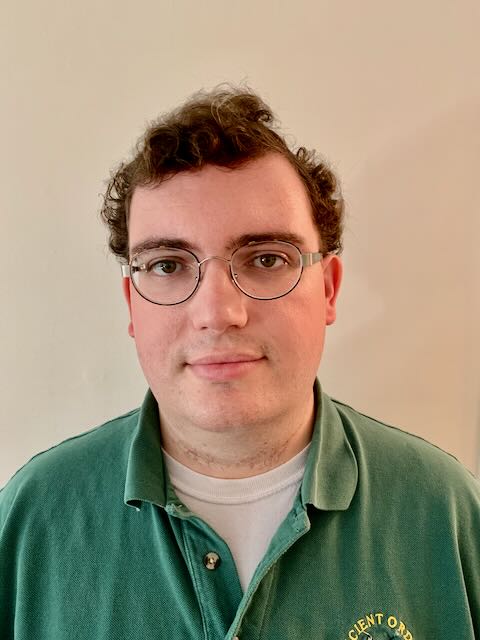
Me upon arrival in Binghamton, August 2019.

Winter

Photo by Pixabay on Pexels.com

I was born on a snowy day in December 1992 in the Chicago suburbs, and over the past 30 years my life has been marked by the cyclical changes between warm and cold months. The winters often stand out more than the summers, perhaps because winter snow is always more of an event than a really scorching hot day in July. As I’ve gotten older, I’ve come to wish for snow less and less, certainly the incentive of a snow day is mostly absent now but also snow means I’m responsible for shoveling my sidewalks and driveway, something which I’ll do but don’t wish for.

In the last few days, we haven’t had any accumulation, the ground is still too warm, but the flakes falling on my head have been enough of a warning of things to come. Last year it occurred to me that there’s a pattern to how the seasons change and how the weather gets colder over the fall months. Late Summer here in North America is often stormy with the Atlantic hurricane season at its height and changing temperatures causing seasonal rains and occasionally thunderstorms across the continent. Each successive rain has its own small change on the overall temperature, first it’ll be steamy and hot after a rain in August, then as September progresses there’s a cool spell after each rain, until finally in October there’s that climactic storm that pushes the temperature enough that once the cool spell ends the temperature doesn’t rise again to its summer highs, instead settling now into a much cooler Winter low.

Here in Binghamton that final storm that did the trick was the remnants of Hurricane Nichole which reached this valley on Friday morning bringing moderate to heavy rains from the south that sat over this valley for much of the day. That evening the skies remained too cloudy for stargazing up at my usual Friday haunt, the Kopernik Observatory, and since the clouds have only faintly parted to reveal radiant sunshine. It took until Sunday afternoon for the temperature to fall enough for the steady flickering rain to freeze and become first sleet and then snow. Winter’s arrival is likely to be for the season now, it got this cold a few weeks ago before warm winds blew in from the southwest convincing me to lose my sweaters for a day in favor of my short sleeved shirts, but that last gasp of warmth wasn’t going to last.

There are things about Winter that I admire and look forward to. The conviviality of Summer is replaced by the twinkling celebrations in the long dark nights around Christmas and New Year’s, born from ancient mystery and ritual yet vibrant in its modernity. For the moment I’m still getting used to the Sun setting around 4:30 pm, still grumbling about it. The darkness of our Winter nights is bearable because we always know it’s temporary, the long summer days will eventually return, and with them all the nostalgia fueled memories of the glories of summers now past.

Travel

Photo by Rakicevic Nenad on Pexels.com

Over this last weekend I went to the Twin Cities for the annual meeting of the Sixteenth Century Society. Their conference, always held over Halloween Weekend, was referred to by one attendee on Twitter as “history camp” and that’s certainly one feeling I got out of the experience. I attended to present my own research into how three-toed sloths were initially compared to monkeys in how they were described in the works of the sixteenth-century naturalist Conrad Gessner (1516–1565), who got his sloth information from the guy at the center of my research, André Thevet (1516–1590). Looking at the world as a sloth historian means there’s always a lot of work to do, but there also always seems to be plenty of time for naps. Not a bad life, eh?

I’ve always been a frequent traveler from my earliest days. Growing up I was very familiar with air travel; I’ve got to say I miss those old phones they used to have in the back of the center seat in each row. So, traveling as an adult is a bit of a continuation of something I’ve enjoyed throughout my life, only more so on my terms. I’ll book a first or business class seat from time to time if I get the chance, as in my trip home a month ago, but perhaps the biggest thing I’ve gotten down is a routine for travel. I don’t have a “go bag” necessarily, but I have gotten the packing down to maximum 30 minutes for most trips. 

These last few years in Binghamton have made travel a bit more complicated than any of my previous trips leaving from Chicago, Kansas City, or London. Binghamton has a local airport, but with only 1 flight per day at the moment to Detroit, a flight that is pretty expensive on most days, so it’s not my first choice. Rather, over the last three years I’ve driven at least an hour to either Scranton, Syracuse, Albany, Newark, or last weekend to LaGuardia to fly to that trip’s destination further afield. I’ve gotten used to the 3 hour drives between Newark and Binghamton, though there are times that I’ll wish I’d flown to a closer airport, especially after my one long haul transatlantic flight that got into Newark after 9 pm, seeing me return to Binghamton at midnight after flying 8 hours from Germany.

I learned early on in the Boy Scouts that what you pack you have to carry, no matter how far that hike will end up being. Because of this, I’ve learned to travel light. My biggest suggestion here is figure out how many clothes and shoes you really need to bring on a given trip. In my own case I’ll usually have the total number of travel days + 1 of underclothes, with a couple shirts, trousers, and sweaters that I can rotate through over a 3 or 4 day trip, and one pair of shoes which I’ve found are better carried in a tote bag separate from the backpack where everything else is, that way when I arrive my clothes don’t smell like my gym shoes. If necessary, as in this conference trip or the family funeral I flew home for last month, I’ll usually wear the suit I intend to wear for the big event (my panel or the ceremony) on the plane, that way it’s not getting wrinkled in my bag. On this trip to the Twin Cities, I did bring a winter coat, folded compactly into my bag alongside all my other clothes and toiletries in that bag. It turned out to be useful to bring that coat, even though it wasn’t ever really cold while I was on the ground in Minnesota (a rare thing), as I was able to put on that coat instead of the suit jacket on several occasions when I wanted to go explore the area, as in my afternoon visit to the Bell Museum’s dioramas across the river from Downtown Minneapolis.

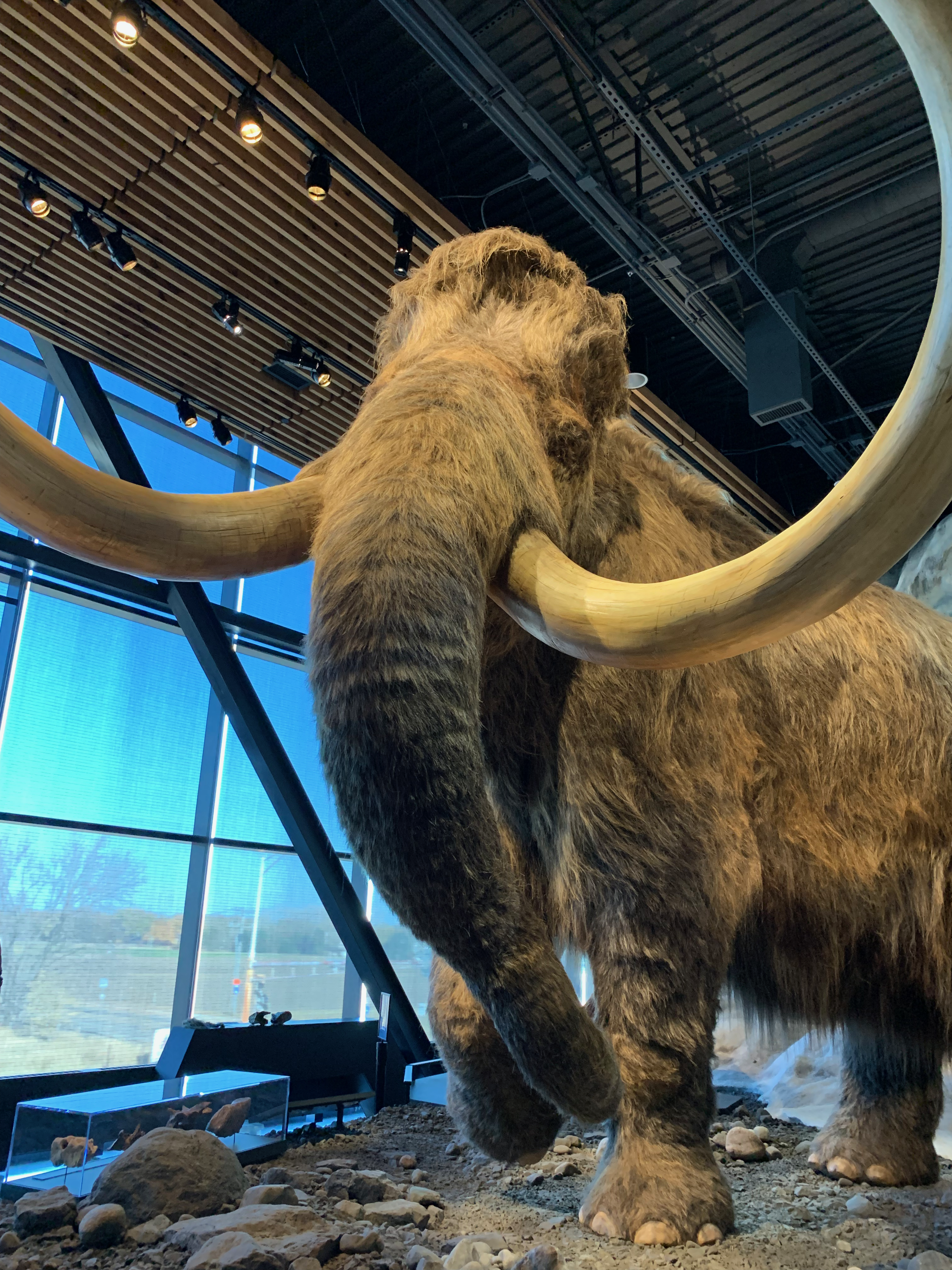
A mammoth at the Bell Museum

The same logic applies to any souvenirs I might want to bring back with me. Anything I buy on the ground has to return in my bag that was already fairly full upon arrival. With this in mind the only new things I returned with were a stack of receipts for funding purposes, some notes from my panel, the conference program, and a printed version of the script for my presentation. I didn’t buy any souvenirs this time around at any of the museums, nor any other knick-knacks while I was there. Again, anything I have with me upon leaving has to either be left behind or carried in my bag for the entire return trip.

That return trip ended up being 15.5 hours long. I was traveling with my good friend Marco Ali’ Spadaccini from the History Department here at Binghamton, and we initially were set to wake up on our return travel day, Halloween, at 3:30 am Central to catch our 7:00 am flight. The first catch appeared when our first flight from MSP to Chicago-Midway was cancelled without any notice as to why. So, at 3:30 am we discovered we were instead leaving Minnesota on an 8:55 am flight to St. Louis. I wasn’t able to go back to sleep, thus starting my own travel clock then at 3:30 am. After getting an Uber to MSP Airport we caught our first flight on time and landed a few minutes early at St. Louis’s busy Lambert Field, where we had a quick hour connection to our flight to LaGuardia. That plane also arrived in New York a few minutes early, which meant in the end after our 3.5 hour drive from LaGuardia back to Binghamton through the Catskills, I returned to my apartment at 7:00 pm instead of 7:30 or 8:00 pm like I had predicted.

At this point I’m used to long travel days, it’s become more of a common thing for me in recent years coming to Binghamton, but even returning to Kansas City can be a taxing experience with the frequent need for connections going into an airport that as of now doesn’t host an airline hub. On this trip Marco and I considered traveling to Minneapolis by train and by car, both would’ve taken longer than flying, though Apple Maps’ estimated drive time was only 90 minutes longer than what it actually took us to fly between MSP and LaGuardia and then drive from Queens up to Binghamton. By train the trip would’ve taken us 30 hours with one connection between the Lake Shore Limited and the Empire Builder in Chicago, but the real kicker to that idea was the $3,000 price tag for two sleeper tickets roundtrip. Flying became the most economical option, and in the end, it was better that I was only fully focused on driving for a good 4 hours getting to LaGuardia rather than a full 17 hours trying to drive the entire route to the conference hotel in Minneapolis.

This was my last fly-away trip from Binghamton, the last in a long line of such trips that I’ve taken since arriving here in August 2019. I think back to one of my first, the trip 3 years ago this weekend to the Sixteenth Century Society Conference in St. Louis, when on the return journey I had a 4 hour connection at O’Hare. That day was the first time that I really felt like a business traveler rather than a guy off on another adventure. It’s a feeling I got throughout this trip too.

Cultural Homogenization

Photo by Dave Frisch on Pexels.com

One of my favorite YouTubers is J.J. McCullough, a Vancouver-based political columnist for The Washington Post who creates videos discussing topics of culture, politics, and society here in North America. In the summer he made a video discussing the topic of cultural homogenization, of how all cities here in the US and Canada tend to have a fair number of similar things going on. It’s a thesis that I agree with, though with some hesitancy.

I for one am happy with this idea that you can go to any major city in these two countries today and generally feel rather familiar with your surroundings. It’s why I’ll often prefer to stay in chain hotels over smaller super-local B&Bs or even use Air BnB or VRBO when I’m traveling. I like the fact that I know what to expect in a hotel room from the generic furniture to having the same soaps and shampoos to having the same set up with the TVs. When I travel, I’m not traveling to spend my time in a hotel, rather I want that consistency as somewhere I can return to and feel familiar in after a day of going around a city that I may not know quite as well.

Likewise, on the long drives I’ve done four times a year for the past 3 years between Kansas City and Upstate New York, I’ve often mentioned along the way that I feel at home in the suburbs of the various cities I tend to stop in. In particular, my usual overnight hotel in Columbus felt quite familiar, in part thanks to its modern décor and highly suburban surroundings, far more so than Binghamton, NY where I’ve been working on my PhD. This has led me to often remark that leaving Columbus is like leaving the familiarity I’ve come to know and appreciate in the urban Midwest as I head into the Appalachians of New York.

The biggest difference here that I’ve noticed between Binghamton and the other American cities I’ve lived and worked in––Chicago & Kansas City––is that Bing has had a rougher recent economic history than either of the two. While Chicago was able to survive the decline of older industries in the Great Lakes Region, aka the Rust Belt, through its sheer size and the diversity of its economy, and while Kansas City has had a renaissance of its own in the last twenty years to the point that it is today a thriving, growing metropolis with ever increasing opportunities, Binghamton has never really had the size or the economic diversity to stay as strong throughout the bad last few decades of outsourcing jobs and closing down old factories in some of these older towns and cities in the Northeast. There are some hints of this continental North American culture here in Binghamton and in Broome County more broadly, just look at the national chains that line Vestal Parkway, but in its current state I argue that this city has far more in common with the other old industrial centers of the Northeast, particularly in New York and Pennsylvania that have seen their main industries move away within the last 40 years than it does with the broader North American culture.

Still, there are moments when I’ll be driving around suburban Broome County where I’ll find myself remarking how similar the houses are to some of the older Cook County suburbs of Chicago, albeit built in a valley surrounded by what the US Geological Survey calls “small mountains.” I myself am a child of the western DuPage County suburbs of Chicago, and after moving grew up on the far western edge of Kansas City, Kansas, whose older neighborhoods to the east are equally similar in their character and in the age of the buildings to some places here in Binghamton, Johnson City, and Endicott.

In seeing those similarities I’m seeing the broad cultural trends of a century ago. Just as today there are particular architectural styles that are in fashion across this continent, from the renovation of old urban industrial buildings into lofts to the big glass buildings that mark the styles of the later 2000s and into the 2010s, a time when after the worst of the Great Recession had passed, I do think in retrospect we’ll say was a time of optimism, however short it ended up being.

In the media I consume, I’ve often found it interesting that I’ll prefer to watch the national evening news broadcasts over the local news. In my own case I’m a PBS Newshour guy, and there’s something about watching that broadcast that I know millions of other people around the U.S. are also watching, and that it’s coming from a studio in in the Virginia suburbs of D.C. (a place I know very well), that makes me feel like I’m a part of a wider community. The same goes for watching Jeopardy! every weeknight. It’s a show that I know a big number of people watch from all living generations, and it’s 30 minutes a day when I can feel like I’ve got something in common with all of them. I don’t otherwise watch much popular TV, and when I do watch shows that’ll catch the headlines like the recently released Lord of the Rings: The Rings of Power, I often have to ignore those same headlines and subreddits for how negative they often become. In those moments, that hour a week, I want to enjoy the story and not be caught up in what other people might think about it.

Our world is built on mass-production in every sense of the word. We wouldn’t be able to sustain the lifestyles we lead, nor our current population, without industrialization. So, while I will go on a limb and try out the local cuisine when I’m traveling, whether that’s crab cakes in Maryland or the breakfast burritos in Austin, I still like to see what my usual staples are like in a given place. I’ll freely admit to preferring to get a burger or pizza or chicken when I’m doing overnight stops in cities in part because after a day of traveling, I don’t want to be as adventurous, yet also because I can use that baseline, that control, to see how they do the same sorts of meals in a given restaurant in one city and compare it to all the others I’ve tried that in. In some cases, like at Mr. Bartley’s Burger Cottage in Cambridge, Massachusetts it was a wonderful choice, in others like at many of the places I’ve ordered burgers at higher altitude in the Rockies, it’s been a poor choice seeing as I’m less of a fan of well-done beef.

Yet with all this mass-production it strikes me as funny that we often have our very particular ways of distinguishing ourselves, from monograms to those new Facebook avatars, that are themselves mass-produced. I first started seeing this style of monogram, one large letter surrounded by two smaller letters, when I was in college. They often became near logos for the people who used them, yet those very personal symbols were themselves created from templates and used by millions of other people. I did the same thing with the logo for this podcast, which I chose out of a set of templates as a matter of convenience when I was creating it, my own meager attempts at making a logo had all been rejected by Anchor’s formatting.

When it comes to some of the very local sayings that J.J. mentioned, like the often-heard Kansas Citian remark, “if you don’t like the weather just wait five minutes,” it’s something I’ve also heard in many other cities. When I moved to London, I found that our North American customs surrounding weather & seasons made a lot more sense there. The dates when we demarcate our seasons, Winter & Summer starting at the solstices, Spring & Fall at the Equinoxes, makes sense in Europe. It doesn’t make sense here in North America where the weather fluctuates dramatically within a given day. Even now, I’m wearing short sleeves on a 66ºF (19ºC) day in Upstate New York and watching the leaves now past their Fall peak begin to be blown off the trees by the impending winter air. Last week, by comparison, I was wearing thick wool sweaters, wool socks, with a coat, hat, and gloves when outside. Our weather makes a lot more sense when you think of it continentally, after all no one place is entirely separated from everywhere else in North America when it comes to the weather. The snow that strikes the Dakotas one day could well fall in the Mid-Atlantic States a day or two later.

I love Kansas City, and Chicago, the two cities I consider to be my hometowns. I love the things they do that are different from other cities, like Chicago’s hot dogs, Italian beef, and deep dish, or Kansas City’s barbecue. They are the two cities where my own experiences, and my family’s American experience has played out, both in their old urban neighborhoods and in the postwar suburban sprawl where I grew up. I appreciate all the things they have in common, things which they share with much the rest of the metropolitan cities of North America. That’s what’s made places like St. Louis, Denver, Columbus, Indianapolis, suburban Maryland & Virginia, and even Toronto feels like a place where I could settle down. I’ve heard Toronto referred to as a cleaner version of Chicago. It’s what’s made the big merging metros of the Northeast––Philly, New York, and Boston––feel less foreign to me than the cities that lie between them and the Midwest.

I’m happy that we have so much in common in this time when we seem so set on dividing ourselves into parties and camps constantly at odds with each other. Our commonalities demonstrate how much we depend on one another.

Allergies

The view at my university this time week.

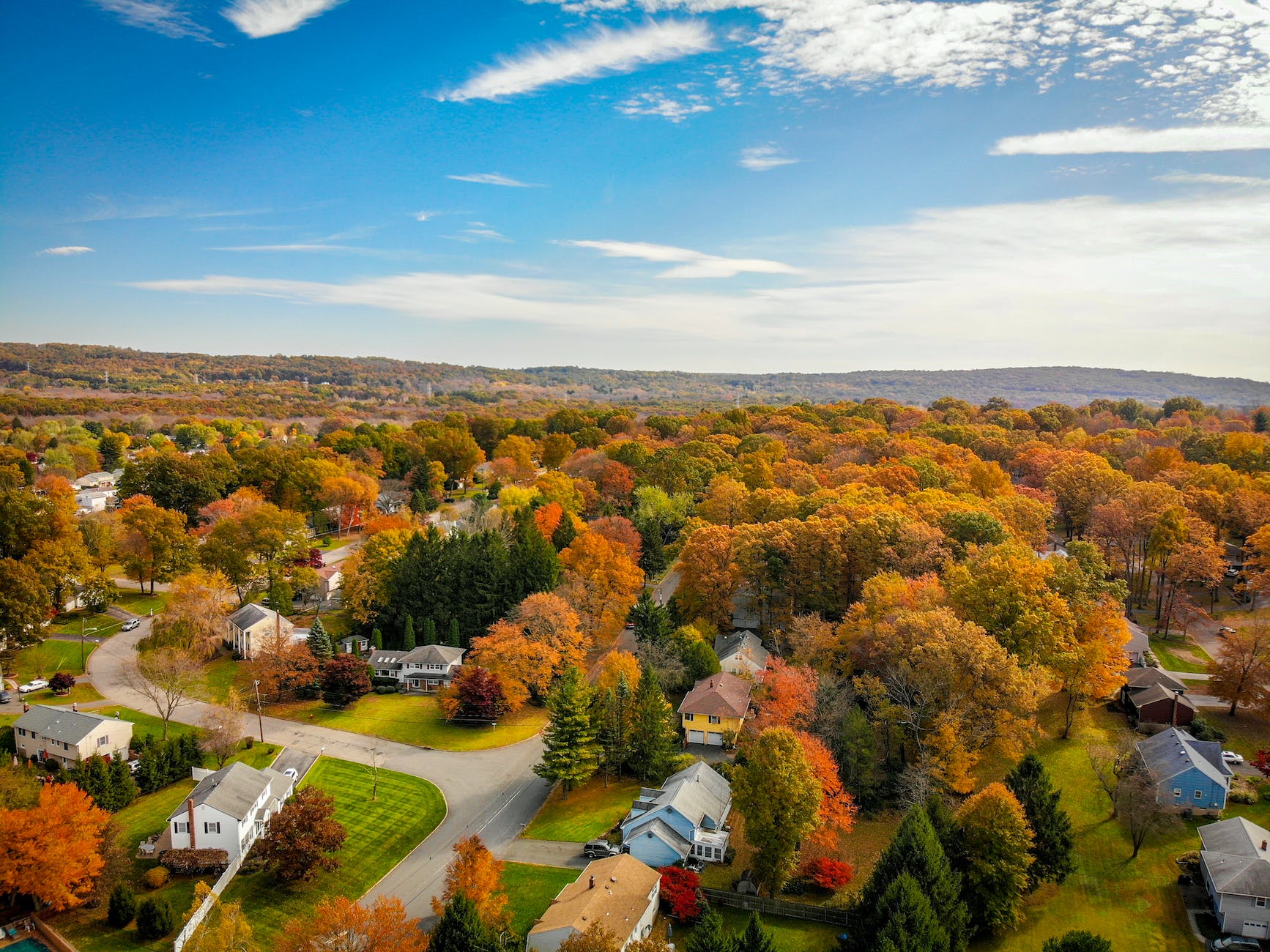
When I returned to Binghamton after a trip home at the beginning of October, I was stunned to see the leaves had changed over that weekend that I was away. The deep green of late summer had been overcome on the trees by the creeping wave of red, gold, and orange that danced down from the highest elevations and into the Susquehanna Valley until the forests surrounding this valley became a sea of radiant color. It’s the first Fall that I’ve spent here where the leaves have changed so early, let alone so fully before winter’s wind inevitably blows in from the north and strips the trees of their leaves for the season.

All my life, I’ve enjoyed the chance to live in circumstances that kept me somewhat removed from the natural world around me. I’ve grown up in air-conditioned houses in the warm months and well-heated houses in the cold months. I’ve been able to escape from Winter’s grasp and travel to warmer places, as in last Fall’s trip to San Diego for the Sixteenth Century Society Conference, which this year is being held in the far less tropical climate of Minneapolis. As such my expectations of how my body would react to different temperatures and circumstances has been transformed by my own upbringing far more secluded from nature.

So, for the couple of weeks every Spring and Fall when my Dad would insist we open the windows in our house and turn off the A/C, I’d find myself in a new form of agony as with the open air flowing through my normally secluded indoor spaces I had no refuge from my seasonal allergies. They honestly felt worse when I was younger than they do today, even though now as I write this, I am feeling their effects well and truly. By living apart from the whims of nature, I was not acclimated to it. All this made my seasonal allergies all the worse.

Often the two biggest weekends on the Kansas City Irish community’s social calendar, St. Patrick’s Day & Irish Fest, are also two weekends when my allergies rise to their worst levels. In part that’s because they fall right at the changing of the seasons, Irish Fest at the end of Summer at the beginning of September and St. Pat’s because it’s right at the end of Winter and beginning of Spring. In the last few years, I’ve learned a great deal from living in an apartment without any built-in air conditioning, and from having to self-medicate when my allergies return, and as such I’d say they’re not as bad as they ever were during my teenage years.

Yet amid all the sniffling and sneezing there is a lesson to be found here. We are foolish to think we can truly divorce ourselves from Nature, from the very complex web of life of which we are an intrinsic part. We need to recognize that our bodies are going to change with the seasons. And in our time where travel is far easier than ever before, where you could be on the far side of the planet in an entirely different environment in a matter of hours, we need to recognize that our bodies will need time to catch up with their new surroundings. I’ve often wondered during my many trips in Britain and Ireland if it’s possible that I as the descendant of immigrants from those two islands might have some built in genetic strength when it comes to the allergens native to those two places? That statement could be entirely false, after all I’m not someone who studies this sort of stuff, but it’s still something I’ve often wondered. The climates in my own hometowns of Chicago and Kansas City are nothing like those of Ireland or Britain, leading me to wonder if my own biological predispositions to certain places hasn’t kept pace with my own family’s migrations from Europe to North America. It remains a question of mine.

Winter’s chill is fast approaching. This morning I pulled out one of my thickest Irish wool sweaters and may even put on a pair of wool socks to keep the chill to a minimum. I could turn up the heater in my apartment from 65ºF where it’s currently set to around 68ºF but putting on extra layers is more cost efficient. Like my Dad has done throughout my life, now as an adult I’m open to the idea of keeping the heater off for as long as possible and opening the windows if the weather suggests it. With our climate changing overall, and often warming, it’s been suggested that by the middle of the century Kansas City’s climate will be more like that of Dallas today. This means perhaps milder winters but far hotter summers. I may be cold now, but I know in 7 to 8 months I’m going to be sweating again as the summer heat returns. And when it does return, I’m sure my body will react in ways that annoy me, like the stomach aches I get when I eat chocolate when it’s either too hot or too humid, a relatively new thing for me in the last few years. We’ve created that new world for ourselves, a world where the old web of life is reworked to fit a warmer planet. It leaves me wondering how my seasonal allergies will change, or will they like the weather in recent years become only more extreme?

The Longest Commute, Part 1

Over the last 3 years I have driven between Kansas City and Binghamton, New York twelve times, that adds up to around 15,600 miles of driving in total. It’s a lot of time on the road, and in the last few weeks I’ve begun to think of this period in my life as my Years of Wandering, a period when I have been practically migratory in how I’ve moved across the country so often. Surely at this point the postal workers in Binghamton and Kansas City recognize my name for how frequently I’m asking my mail to be forwarded from one address to another. Still, I am in a far better position professionally today than I was after my first master’s degree in 2016. And looking ahead now, the future really is bright for me. I’ve got a lot of opportunities over the horizon.

With all this in mind, I woke up at the reveille of my 06:45 alarm on Friday, 29 July 2022, as is usual, and ruminated on a strange dream I had been having involving, people singing the Internationale while making strange hand gestures and being overly polite, all as a part of a protest over fish. Must’ve been the wine the evening before. Regardless, I woke up that morning knowing exactly what I needed to do: it was time to strip my bed, start my regular morning routine, and begin packing up the car for the next Long Drive East.

To date this drive is the earliest I’ve ever left to return to Binghamton for the Fall semester. Its predecessor in that record was the original Long Drive East on 1 and 2 August 2019, after which I decided I would never again make that trip so early in August again. I intended to keep that promise, even through the period of 14-day quarantines in 2020, yet here I was, on the 29th of July packing the car for the Long Drive East, a drive that would end in a muggy humid valley in Upstate New York that feels about as far from home as it could be while still being in the Lower 48. So, after a quick breakfast of sourdough French toast, scrambled eggs, and hash browns with some friends, I left home at 10:00, bound for my first refueling stop in St. Louis.

The normal Long Drive East has four refueling stops, one every four hours. Typically, they are St. Louis, Indianapolis, Columbus, and Erie. That is if I take the fastest out of the possible 10 different routes. In this instance, I intended to keep to form and barrel my way across Missouri without stopping between Kansas City and St. Louis, so as to get the trip off to a strong start, and maybe to make better time at my overnight stop. But, as things have happened so often this summer, the first day of the trip didn’t quite go to plan. Rather than making it all the way to St. Louis without stopping I decided midway across the state to make a lunch stop in Columbia, home of Mizzou (the University of Missouri to the rest of humanity not from the Midwest). Already by that point I was beginning to feel pretty tired, and knew I needed at least a few minutes of a break. With that in mind, I made an early stop, and shrugged it off, opening the door for even more unscheduled stops over the rest of the trip to come.

This particular Long Drive East was different from every other one that I’ve done over the past few years. Sometimes, I might include a day or two of sightseeing along the way, as an extra bribe to myself to go through with driving so far for so long. The last time I did that was in January 2020 when I stopped in Pittsburgh for a couple days to see the Carnegie Museums. In the years since I’ve allowed myself half-day stops here and there, like at the Cleveland Museum of Natural History in August 2021. In all of those occasions I rarely detoured from the general Great Lakes region that lies between the Great Plains where Kansas City blooms and the Appalachians where Binghamton is nestled among those low mountains along the banks of the ancient Susquehanna River.

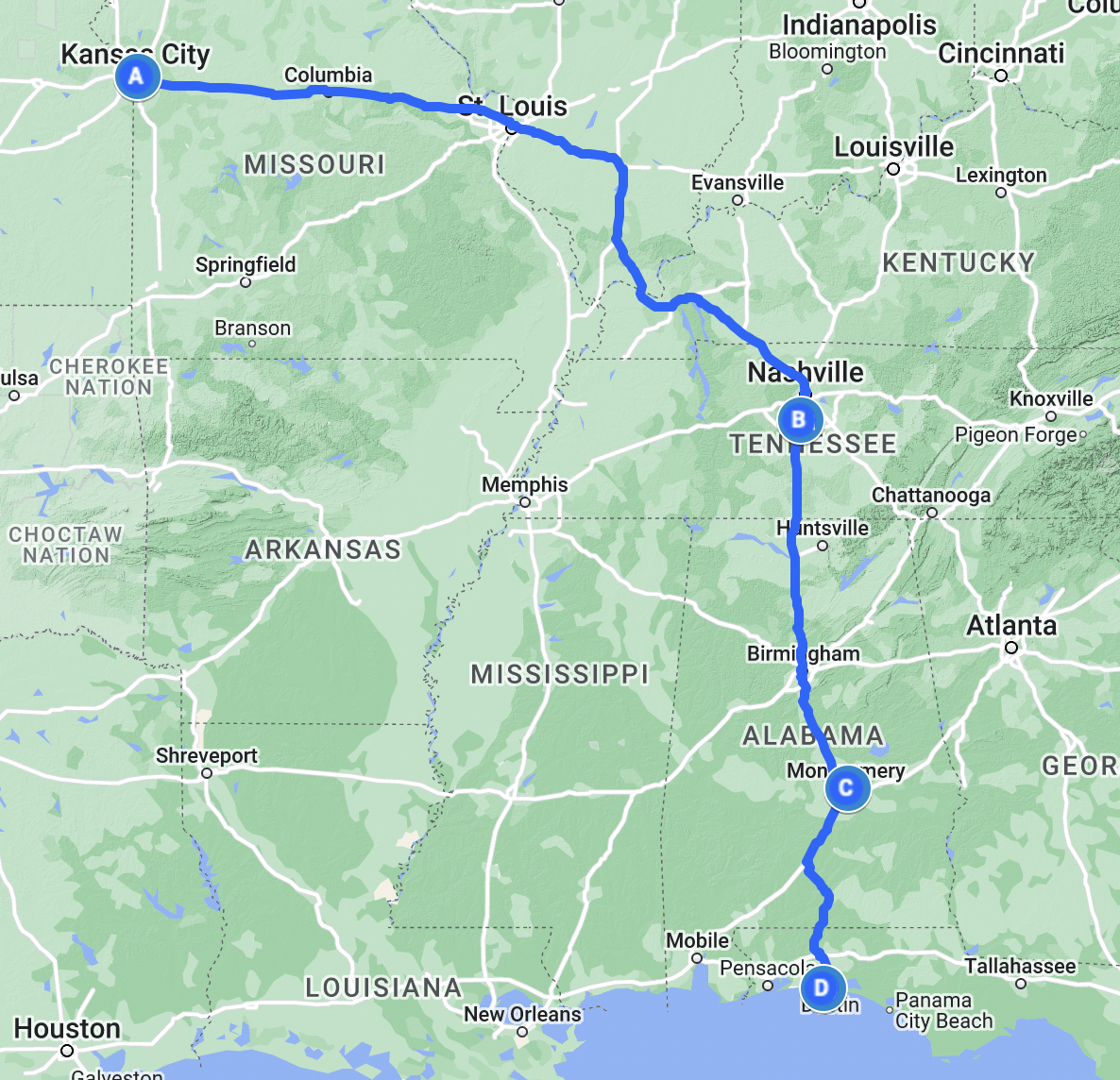
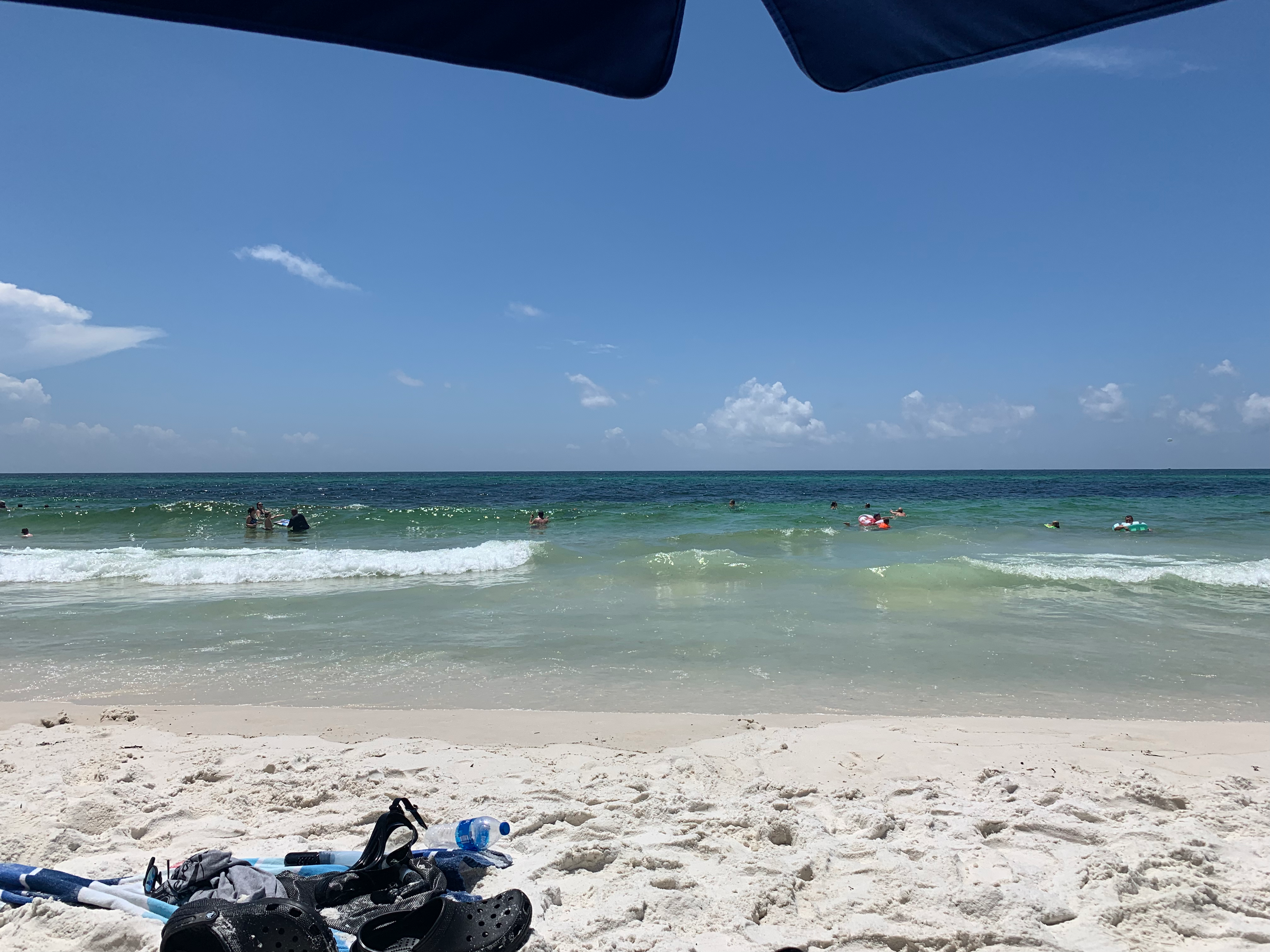
This time I was taking a long way around, not exactly what I’d call “the long way around”––that would be driving to Binghamton via Alaska––instead, I planned to return to Binghamton via the South, the one region of the country (besides Alaska and Hawaii) that I’ve spent the least amount of time in. Why would I add an extra 1,430 miles (2,301.36 km) to my route just to do a bit of sightseeing? Family, that’s why. This year my family decided to hold a reunion in Destin, Florida, a small resort town on the Emerald Coast of the Gulf of Mexico that lies about halfway between the larger Northern Florida cities of Pensacola and Panama City. 

Of the 24 of us who went to Destin this Summer about half made the trip by air along various routes, while the other half of us drove. I decided from the first moment I started planning this trip that I wanted to stick to the interstates as much as possible, seeing as I memorized most of those over years of staring at maps during road trips as a kid between Chicago and Kansas City. Most of the drivers chose to take a slightly faster route on US Highways through the Ozarks stopping overnight in Memphis and Tupelo, Mississippi (Elvis’s two hometowns). In my case, my goal for the first night was Franklin, Tennessee, a suburb south of Nashville along I-65. So, naturally as I drove across Missouri, I was repeating from time to time the general route I was following on that first day: I-70, I-64, I-57, I-24, I-65. As long as I kept those numbers in mind, I knew I’d make it to Franklin eventually.

I arrived in St. Louis around 13:30, about 2 hours later than I usually would on a Long Drive East. Granted, I also left Kansas City 2 hours later than usual, choosing that wonderful breakfast at Eggtc. over the typical simpler breakfast at home or the quick sandwich & doughnuts that I’d normally pick for such a trip. In the days before I left, the St. Louis area had been badly flooded by heavy rains, with some places in St. Charles County even seeing a foot of rain (30 cm) fall in the course of a day. The reports showed homes inundated, metro stations submerged beneath 21st century ponds, and highways deep under water. I was concerned that the aftereffects of the flooding might close some of the highways I needed to take, particularly I-70 in St. Charles County and I-64 across St. Louis County and City, but thankfully it was smooth sailing the entire way to the Arch.

I crossed the mighty Mississippi on the Poplar Street Bridge and left Missouri behind for the second state, the state of my birth, Illinois. Now the thing to say about Illinois from the start is that as much as it is the state of my birth, there is a tremendous difference between Chicago and the rest of Illinois, just as there is between any metropolitan area and the rural countryside in between across the United States. So, as much as I do kind of feel at home even there in Southern Illinois, it’s still not exactly the same as the place that I still call my original home a couple hours’ drive to the north of St. Louis. This trip marked the first time I drove southeast out of St. Louis on I-64, which is the main road between St. Louis and Louisville, continuing on from there eventually to Richmond and Hampton Roads, Virginia. I was only on I-64 for a short time, little more than an hour, when in Mt. Vernon, Illinois I left that east-west route and turned south on I-57, a highway I usually encounter in Effingham, Illinois, to head towards the furthest reaches of that state of my birth, to a place I’d long heard of and wondered about.

When I was 5 or 6 my parents bought a beautiful cloth-bound hardcover photographic atlas of the United States that was probably a special millennium edition. I remember the inside cover had a photo of a mountain climber scaling an ice-covered cliff on one of the mountains either out in the Rockies or up in Alaska. But as I drove through the southernmost reaches of Illinois, what came to mind the most was the photo of the Fall colors in Shawnee National Forest, which covers 280,000 acres (1,100 km2) of woodlands near the confluence of the Ohio and Mississippi Rivers. As a child, I always was amazed that there was a national forest in Illinois, I had only ever encountered national forests out in Colorado, and so to me that meant they must be truly wild places with great mountains and old trees and lots of animals. Shawnee National Forest certainly has some hills, the Ozark and Shawnee Hills to be precise, but the years since has tempered my initial surprise through time spent in the national forests of the Appalachians.

I crossed the Ohio at Paducah, entering the Commonwealth of Kentucky. I last visited Kentucky in September 2018 when I attended the Midwest Conference on British Studies at an Embassy Suites in Lexington. My experience of the state this time was largely the same as that time, only I’m happy to report I-24 is far less potholed than I-75 was the last time I drove it between Cincinnati and Lexington. I crossed Kentucky quickly, I-24 crosses only 93 miles in that state before entering Tennessee. While in Kentucky though I did see the first big dark clouds that marked the latest round of flooding, this time not in St. Louis but in Eastern Kentucky.

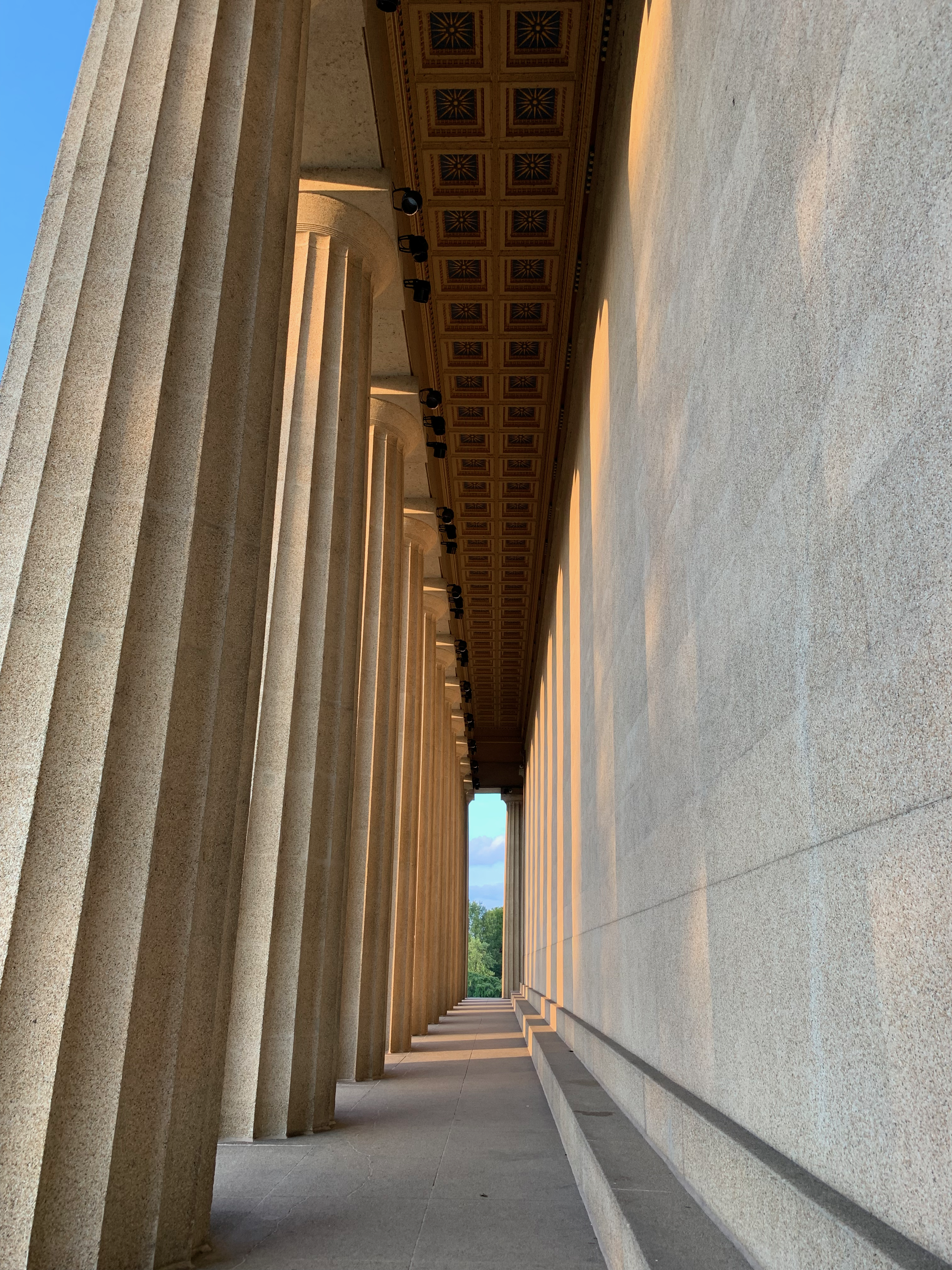
As I left Kentucky for Tennessee, I began to enter a far hillier area that makes up the northern rim of the Nashville Basin, a great bowl surrounding the state capital. Traffic picked up as I descended into the bowl, reaching the I-24/I-65 junction north of Downtown Nashville. Back in Kansas City I had chosen to enter the address of the top site on my tourist list in Nashville into my navigation system, and so I left I-65 early of my hotel for Centennial Park and the Nashville Parthenon. This building is a full-scale replica of the original Parthenon located on the Acropolis in Athens. I arrived at 19:00, sadly a few hours after the interior had closed to visitors, and thus could not enter the building. Nevertheless, I gazed in wonder at the reliefs and ornate ceilings of the porticoes and stoas.

After a quick stop at the Parthenon, I made an even quicker stop at the Tennessee State Capitol, wanting to avoid the ire of the state police for spending too long on their property, and by that point having been on the road for a full 9 hours, I really needed to get to my hotel to sleep. With those two stops in Downtown Nashville done, I returned to I-65 and made quick work of the drive south to Franklin.

The following morning, I woke with my 06:45 alarm and staggered upright after the usual vivid and surreal dreams. There were images of me in quick step striding my way across a white sand beach on the Gulf Coast, dressed in a full business suit beneath the midday Sun. In my left hand my briefcase, my right hand raised aloft trying to catch some phantom bus that was due to roll onto the shore. Riding atop my head was my cat, Kitty, lazily lunging on my scalp as if unconcerned by the precariousness of her position.

I remembered what I had to do and quickly got ready for another day of driving. While the first day had taken me along roads I knew all too well, this day would pass along many roads I’d only ever looked at on the map. I left my hotel in Franklin at 08:00, stopping for a quick breakfast before turning my attention once more to I-65 and the continuing road south. The Tennessee hills glowed in the morning Sun, their green cover of foliage marking the southern end of the great Appalachian Mountains that I knew well in New York. 

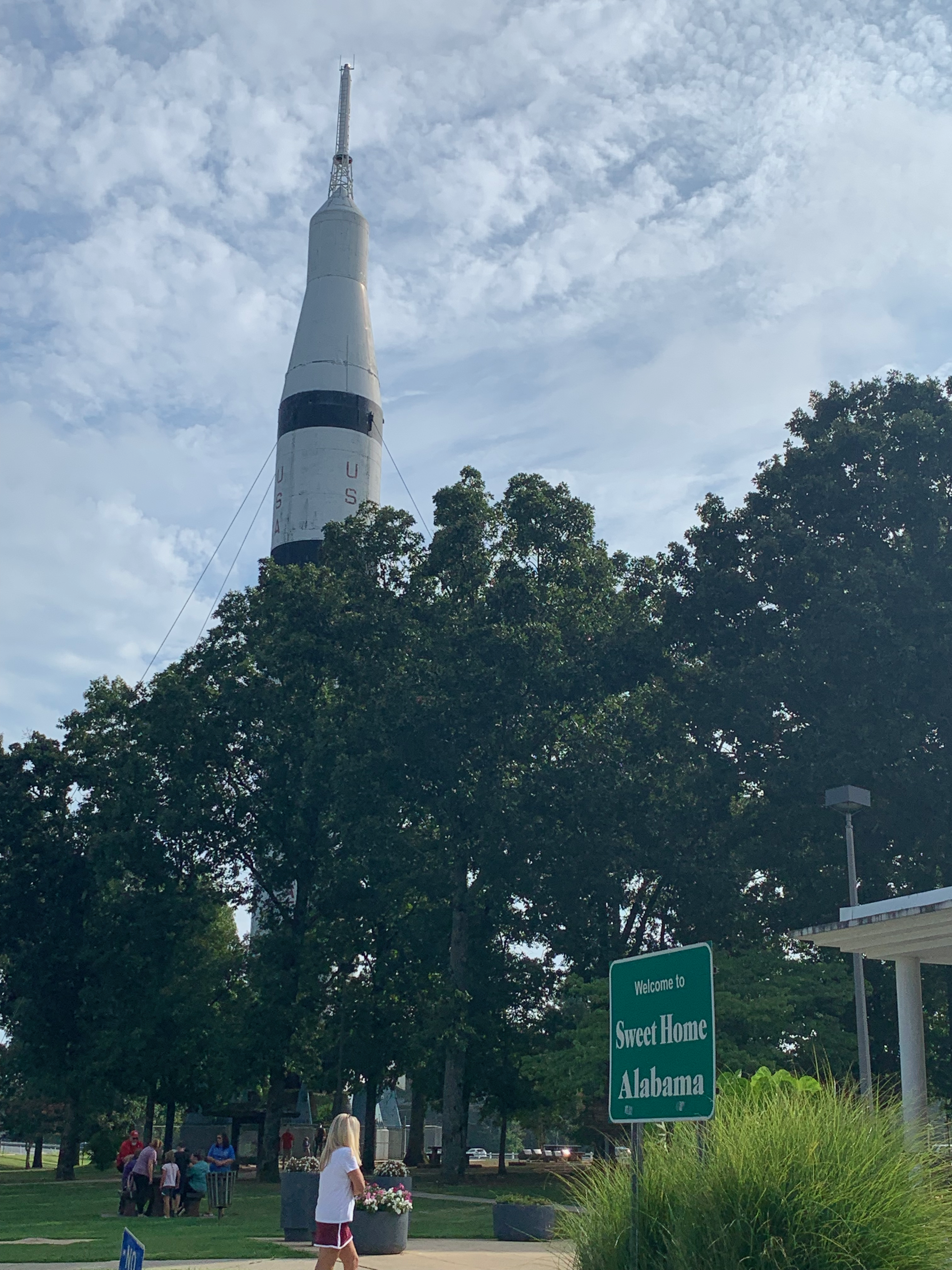
I made quick progress along I-65 to the Alabama border and soon found myself facing a Saturn IB, a NASA rocket built in Huntsville, Alabama. I pulled over into the Alabama Welcome Center parking lot and briskly walked over to the base of the rocket to take some pictures before returning to my own chariot for its continuing voyage rocketing ever southward toward far greener shores.

Alabama struck me as in some ways old fashioned, in other ways brilliant, as in how they included the mile markers on each bridge, a great way of calculating distances as I crossed the Heart of Dixie. After about an hour I entered the great valley where Birmingham was built, the largest city by far in the state. In Birmingham I began to truly notice that I was moving southward as I crossed over Interstate 20.

Here in the US, the Interstate highways are numbered in an ingenious way to help navigation: east-west highways are even numbered with the lower numbered highways in the south and higher numbered in the north, and north-south highways are odd numbered, with the lower numbered in the west and higher numbered in the east. Thus, with Interstates 5 and and 8, San Diego is the 0/0 point of the Interstate system, while Boston with its Interstates 95 and 90 is the exact opposite. There are some exceptions to the rule (I’m looking at you, I-99 in central Pennsylvania and New York), but by and large it’s a rule that’s followed nationwide. So, when I saw the signs for I-20, I knew I was making progress, especially when I started the trip in Kansas City on I-70.

Birmingham seemed like an interesting place, and while I didn’t stop there this time, I wouldn’t be entirely opposed to having a conference there in future years, if that happens. Nevertheless, I passed it on by and continued south toward my first waypoint of the day in the state capitol Montgomery. Yet after leaving Birmingham I was baffled to be stopped by bumper-to-bumper traffic that had occurred for no apparent reason. I sat in the southbound lanes crawling behind semis, RVs, boats on trailers, pickup trucks, and suburban soccer mom tanks (aka minivans) with every state’s license plate imaginable adorning their rear bumpers. The heavy traffic continued for the rest of the day’s drive until I reached the Gulf Coast late that afternoon.

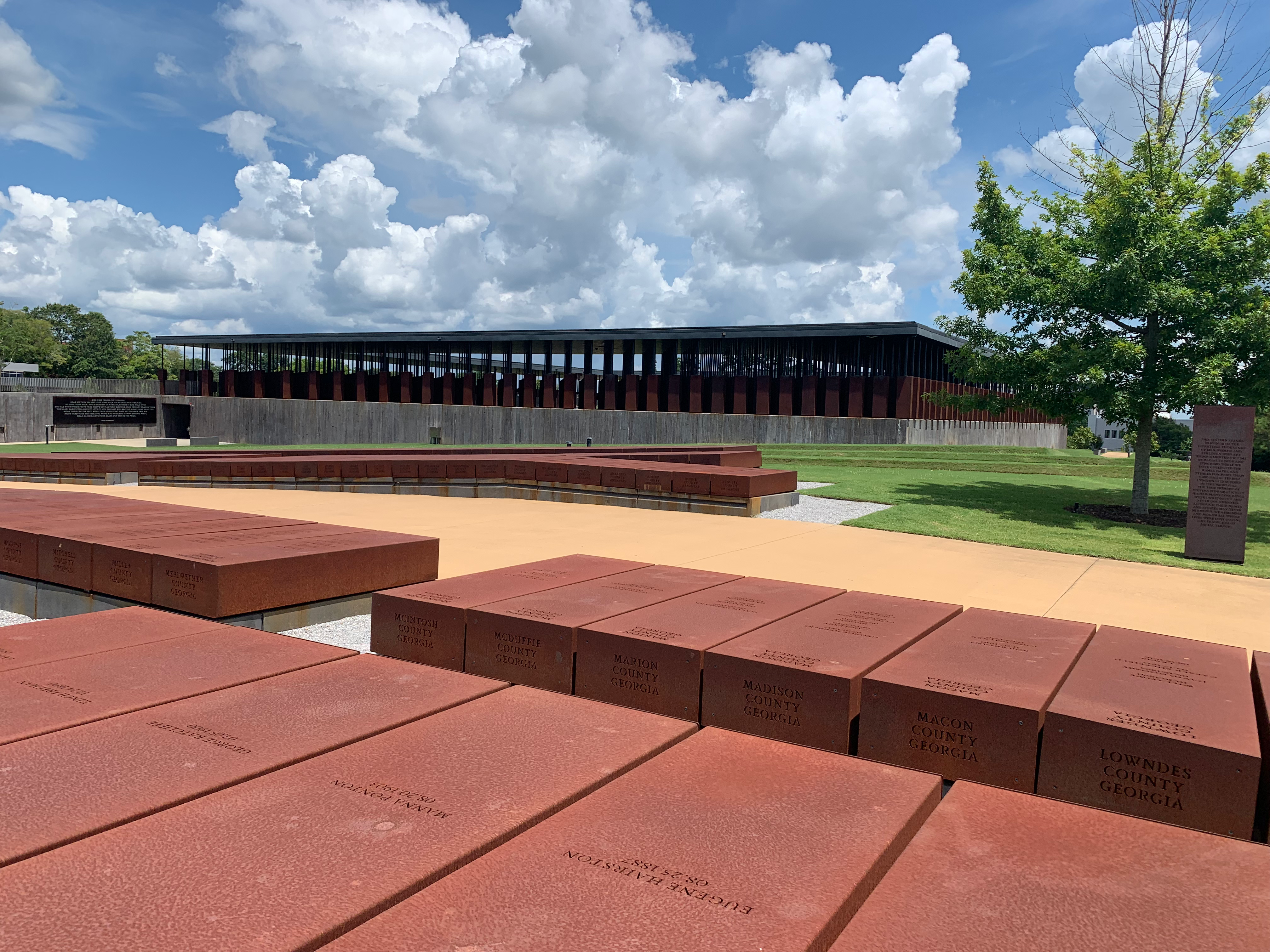
I reached Montgomery just before noon and drove straight to the main site I wanted to visit. The National Memorial for Peace & Justice opened in April 2018 to much press. A review at the time from The Washington Post’s Philip Kennicott called it “one of the most powerful and effective new memorials created in a generation.” I read all about it when it opened, and even looked into how I could travel to Montgomery to visit it. When I did arrive, I wasn’t disappointed. The memorial honors the African American victims of racially motivated lynchings that took place between the end of Reconstruction in 1877 and the beginning of the Civil Rights movement in the 1950s. The memorial is made up of a series of 805 hanging rectangular steel pillars representing each county where an African American was lynched in this country during that 73-year period. I was quiet walking up to the memorial, stunned by the sight of it. I knew what to expect, but I didn’t really grasp the power of that vision until I actually saw it in the flesh. How such racially motivated terror was, and frankly remains so common in this country is sickening. 

My eyes stayed wide as I gazed first at the pillars that hung along the entry to the memorial and then slowly turning upward as I walked down into the heart of the site, a trench that was dug deep into the ground like some vast communal grave into which all these tormented souls were buried. Some of these pillars have been taken down from their original places aloft and placed on the ground in a series of rows like in a cemetery, those that have are the ones that represent counties that have established their own memorials to mourn those who were murdered this way locally. My own home county––Jackson County, Missouri––was included among those that have erected their own memorials, in our case to a man named Levi Harrington who was murdered on 3 April 1882 on a bridge in the West Bottoms. In June 2020 the monument in question was thrown down the cliffs on the western side of Quality Hill soon after its installation by several unnamed individuals. At this moment of writing, I can’t remember if it was replaced and fixed.

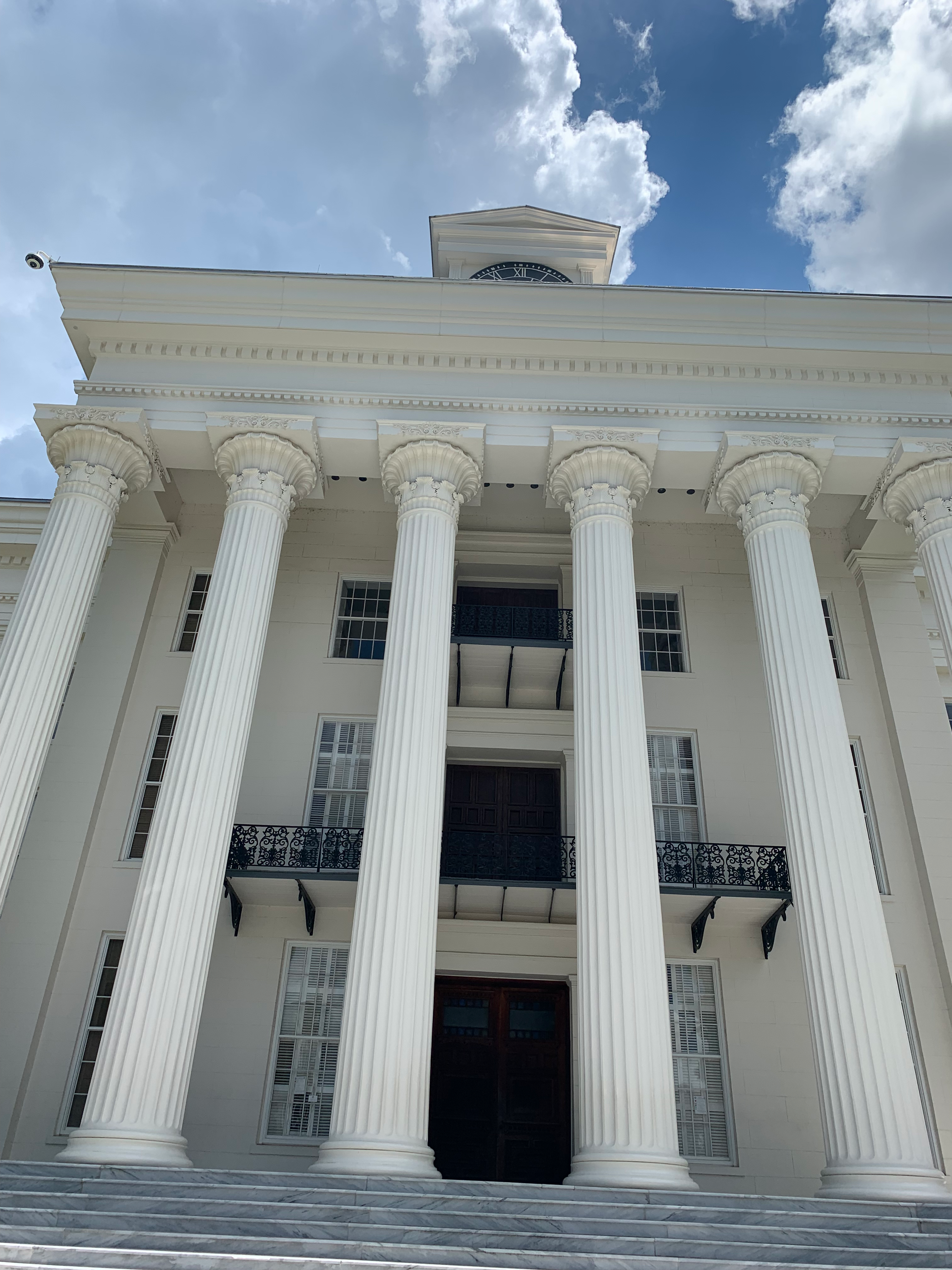
I left the memorial and drove into downtown Montgomery hoping to find lunch and make a stop at the Alabama State Capitol. Yet of all the things that could be confounding the parking situation was what kept me from making more than just the one stop on the capitol grounds. Every parking meter I stopped at had a red “Expired” sign waving like a most unwelcoming of flags before me. So, I decided the best place to risk getting ticketed for illegal parking was the State Capitol itself.

The Alabama State Capitol has a checkered history in my book. On 22 February 1862 it was the scene of the inauguration of Jefferson Davis as President of the Confederate States. While I was taking pictures of the capitol building’s white façade a guard walked over to me and asked, “You should get pictures of the statues as well, like Jefferson Davis over there?” I turned to the guard and quickly replied, admittedly without thought, “I don’t take pictures of traitors.” Alabama to me is the South personified, it was home to the first capital of the Confederacy, and the heart of the old Jim Crow South that perpetuated the evils of the old Southern way of life for generations after they were defeated in battle by the Northerners and Midwesterners. I myself didn’t have any ancestors who fought in the Civil War, they were all either too old or too young for the draft, but I do remember hearing stories of the anger towards the South in the younger generation that lived through that war, whose lives were scarred by the horrors of a war fought over the elites of one half of the country’s inability to consider an entire group of people as anything more than property. This is the reason why I’ve generally avoided the South, especially Alabama, which to me is the beating heart of that infernal system.

I left Montgomery and continued ploughing my way ever southward toward the coast. I followed I-65 for another 90 minutes of steady traffic until turning off and onto a series of smaller country roads at the town of Georgiana, birthplace of Hank Williams (1923–1953) one of the most influential country singer-songwriters of the last century. From there the road took me ever deeper into the hardwood swamp forests and bogs of southern Alabama, typified by the woods of Conecuh National Forest. As I drove through the forest the first sign that I had entered Florida was that the highway name had switched from an Alabama state highway to a Florida one. Naturally at that point I lost my data signal and briefly lost navigation and communication on my car’s computer. 

But after a good 15 minutes it all began to return as I left the thick forests of the far northern reaches of the Florida Panhandle and crossed over I-10, better known in California as the Santa Monica Freeway. After another 20 minutes I was in Fort Walton Beach approaching Destin with seemingly nearly everyone else from the Midwest and Deep South. The streets of Fort Walton Beach were packed to the gills, leading to the last mile of the drive taking a full 20 minutes to complete. Regardless, I was now in sight of the Gulf of Mexico, the second arm of the Atlantic I had driven my car, the Mazda Rua, to. It was surely the beginning of a beautiful relationship.

Teaching as a Performance

This morning, in an effort to get out of a funk born out of a mix of exhaustion and burn out after a long semester preparing for my comprehensive exams, I decided to watch the Mozart episode of Scott Yoo’s series Now Hear This, which has been airing as a part of Great Performances on PBS. In the episode, Yoo worked with pianist Stewart Goodyear to learn how to not only play the solo part in Mozart’s Piano Concerto No. 20, but to do so while conducting the orchestra as Mozart himself did when he performed that concerto in 1785. Watching Yoo and Goodyear work together on this performance got me thinking about my own work as a performer, which nowadays is usually through my work as a teacher.

At its core, the reason why I love teaching is because it’s purely a performance. Like actors and musicians, teachers have as much need to keep their audience entertained and connected to the topic of their performance as they do to transmit the content they’re teaching. All of the best teachers I’ve studied under in my 24-25 years as a student have gotten this fact down in some way or another.

To put this into context, when I teach on Friday afternoons, I have to put together an hour long performance that covers the content while making that information engaging. This means less reliance on notes and more extemporaneous dialogue with my audience, in this case my students.

I’ve found the best thing I can do at the beginning of any performance I’ve given, whether it be as a teacher, a musician, or an actor, is to try and connect with my audience, make it clear to them that I’m on their side, and that I can understand what they’re going through. This means, among other things, incorporating humor into my teaching, and acknowledging that they have other responsibilities than my class and my requirements for them should bear that fact in mind. For example, normally I have my students answer a set of weekly discussion questions. It’s a good way to make sure they come to class prepared to talk. That said, on weeks when they have a bigger assignment like an essay due, I’ll make sure to waive the regular discussion questions so I’m not giving them too much work.

Currently at Binghamton for the Spring 2021 semester, I’m teaching 2 classes of about 25 students each. It’s a decent number to handle, especially when it comes to grading, but considering at my last university I was teaching 2 classes of 35 students each, it’s not nearly as taxing. What is a bit more hard on me as a performer is that at Binghamton both of my classes are always back-to-back on Friday afternoons, meaning I have to turn around after the first performance and do the entire thing over again. It’s a huge challenge, and normally by the end of the second class I’m physically and mentally exhausted.

All that said, the challenge of creating a new show every week, and doing everything live is something I love. Having done pre-recorded shows like The Awesome Alliance, as much as I enjoy the security of playing my part ahead of time and not being around when my audience sees it, the thrill of performing isn’t as strong in that sort of a setting. That said, where a live performance differs from a pre-recorded one in my experience is in my own ability to really live in the performance. In a live class, I have to be present in the moment with my students, paying attention to their answers as well as their body language, making sure what I’m trying to teach is coming across. In a pre-recorded performance, like on Awesome Alliance, I’m more able to let myself live fully in my performance, in that case to become my character, something that is less readily feasible in teaching than in acting or music.

Improvisation is equally hugely important in my experience. I always have a lesson plan, usually revolving around my discussion questions which I provide ahead of time to my students. But beyond that, in the context of actually answering those questions, everything hinges on the unknown factor of what the students will say, how they’ll answer the questions, and then how I’ll respond to their answers. These are supposed to be discussions, focused around a particular topic but dependent as well on the individuals involved and what’s most present in their thoughts.

All of this relies on a great degree of being comfortable in your own skin. I know I’m going to make a fool of myself from time to time while teaching, it’s just a fact of life. But if I can explain a historical concept in a way that’s going to meet my students where they’re at, then I’ll find a way to do it. Last Spring, when I was TAing for a US History class, I was given a version of the Battle Hymn of the Republic written by Mark Twain to discuss with my classes. Not finding a good recording of it with the exact words of the version the professor had given me, I decided to go on a very big limb and sing it myself, after all I know the melody line pretty well.

I could’ve never begun to perform without being able to laugh at myself, and accept that in performing I am inherently putting myself out in front of people. The confidence that has allowed me to do this as an adult really began when I was in high school, when in my Junior Year English class, I decided to tell a couple jokes in what was otherwise a somewhat awkward presentation where I had to show a baby picture of myself to the class. I ended up bringing a picture of a very large and old tree on the grounds of Canterbury Cathedral with myself at age 9 just barely in the bottom of the frame, shrugging and saying “it was the best I could find.” Like Julie Andrews’s Maria in the Sound of Music, it’s great having “confidence in me.”