

Tag Archives: Books

Physical Books or Electronic Books

Photo by Janko Ferlic on Pexels.com

Welcome to Season 2 of the Wednesday Blog Podcast!

There’s a Thomas Jefferson quote that has stuck with me since the first time I saw it in the room at the Library of Congress that houses his first donation to that institution: “I cannot live without books.” It’s something I think of from time to time, looking around the office here in my apartment at the tall bookshelves lined with volumes covering topics from astronomy to ancient literature in Latin and Greek to Catholic theology to history, politics, and fiction. I collect books, largely to read but also because I love the potential that books hold; all the stories they have waiting to be revealed page by page.

Over the last few years, I’ve found myself more and more gravitating towards electronic books on Kindle, Google Play, and all the academic e-book hosting sites that I use for my research and teaching. E-books are just easier to carry. I can have an entire library right there on my phone for me to choose from when I’m having dinner alone in a restaurant here in Binghamton or when I’m tired of listening to podcasts or reading magazines on a long flight. E-books also make stories more accessible. There’s a now rare novel written by the actor Andrew Robinson about his character Elim Garak from Star Trek: Deep Space Nine called A Stitch in Time that I often see people complaining about how hard to find it is in paperback. Yet I was able to download it in just a few minutes on Google Play and read it cover to cover in a few days. 

Kindle now even has a feature where if you have the book on their app and the recording of it on Audible you can listen to some segments of it when you’re driving and then your location in the e-book will update with your progress in the audiobook. I haven’t used it yet, there’s a biography I’m listening to now about the explorer and scientist Alexander von Humboldt (1769–1859) that I could probably also be reading on the Kindle app on my phone when I have a free minute during office hours or at dinner, but I’m also enjoying just listening to it while driving around the hills here in Broome County, New York.

As an author, at least with the three books I’ve self-published to date (all available on Amazon) I usually prefer people buy the paperback versions because I’ll get more in royalties out of those than out of the e-book copies. Still, as a reader I admit I would often choose the e-book on a given day over the paperback solely for the convenience.

One thought that keeps coming to mind for me returns me to my own childhood and those wonderful mysterious days spent in the small library that my parents collected in our house in Wheaton when I was little. That same library came with us down to Kansas City and consumed our then-unfinished basement. At one point we had probably around 10,000 books in that collection of all sorts and stripes. Today, though I also picture not only my younger self but my own future children, if I’m so lucky, and ask “if I choose to go with e-books over physical ones, will my children have the same experiences I had pulling the odd book from the shelf because it looks interesting and flipping through it?” Those experiences of lounging around just flipping through books as a young child was instrumental in making me who I am today. There are so many stories that I read that way. Even now I sometimes like going into a library just to wander and see what I’ll find. 

On a recent visit to the Bartle Library at my university I had a specific book in mind that I was looking for, Gerald of Wales’s 1188 book the Topography of Ireland, which has been useful for my dissertation. Yet after I found it, I noticed another book next to it that seemed intriguing. It was bound in a blue cover, and called the Annals of Connacht, the westernmost of the four ancient provinces of Ireland, my ancestors’ home province. I pulled it off the shelf and flipped it open, quickly figuring out how to navigate its pages. Soon then, I looked up first my ancestors’ old parish, Burrishoole in County Mayo, and secondly, I looked up my own family name, Ó Catháin, to see what was in there. Both Burrishoole and Ó Catháin had entries, the former was less insightful to me than the latter, for it turned out there was a guy with my exact name who lived in Connacht in the 1520s, another Seán mac Tomás Ó Catháin. Maybe he was an ancestor of mine, it’s possible even though there are big gaps in the records during the height of the colonial period.

I could have stumbled upon that same collection of annals online and have done just that many a time with old books such as the Annals of Connacht, yet it doesn’t have quite the same feeling of accomplishment as finding that book in the flesh, holding it in my hands. I’ve joked that I deal with my primal desire as a human to hunt in two ways: firstly I hunt for food in the grocery store, and secondly I hunt for books in the library. Yeah, I know, it’s pretty corny. And while hunting for books in a library surely wouldn’t compare to hunting for a living animal in a forest, matching your wits against its own, I can say that hunting for books online can be more frustrating than hunting for books in person. When on foot in a library all you really need to worry about is that the library’s catalog system is accurate, when online you also have to figure out how to communicate with the various computer systems that are making your e-book hunt possible. 

Earlier this year when I was searching for import records and ships logs from the French port of Rouen between 1500 and 1567 for my research I found myself dealing with a third layer of complexity: a computer system that can’t actually read the original 500-year old handwritten documents, meaning you just have to hope that whoever imported the document into the system typed enough information into the computer that you can find what you’re looking for. On that one count: the easier legibility of e-books over printed ones, the easier transmission of their stories and information, and the fact that we can now share knowledge around the globe as fast as our data streams will carry that information gives me good reason to prefer e-books. But still, I want my future kids, if I’m so lucky, to have that experience of pulling books from my shelves and wandering through them, discovering that same love of reading that I’ve had all these years.

The voice of Thomas Jefferson was provided by Michael Ashcraft, voice actor extraordinaire. You can learn more about his work by visiting his website here.

Understanding Others and Communicating Well

This may not necessarily be a post that will be on a topic that’s familiar to most of you, the 30 or so people who occasionally read these posts, but it’s something that’s important to me. The ability to communicate well, and efficiently, is paramount. It’s ultimately going to be key to solving all of our problems, to making life better for everyone. I truly believe if we could, or rather would, actually sit down and talk with someone we have a disagreement with, chances are we’d find enough common ground to begin sorting our problems out.

But this post isn’t about solving humanity’s big problems, and I’m going to try to refrain from my usual upbeat optimistic conclusions that I’ve noticed I tend to write. Because this evening I want to write about a topic I’ve been interested in for nearly 20 years, one that I’ve struggled with and studied, and am only now really feeling like I’ve confidently mastered: Latin.

Latin is a language that I’ve been fascinated by for a very long time. In part, I’ll admit it’s an attraction to the prestige it embodies: the language of the Romans, and of my Church. It’s been a constant piece of the intellectual and cultural fabric of European and now Atlantic civilization (that’s another idea I’m working on) for millennia. It’s also a highly logical language, a systematic language governed by a set of rules that, once explained, make pretty good sense. Moreover, it’s the ancestor of a number of humanity’s most widely spoken languages, and has directly influenced many, many others, including English. It’s taken three tries now, but I’ve made sense of the language well enough now to feel confident not just repeating the declensions and conjugations that I’ve memorized, but understanding the intricacies of their meaning, and in so doing, to have a better idea at understanding how Latin works.

Latin has also come to reflect the people who have written in it and spoken it over the generations, particularly in their preferences in word order and writing. I’ve often thought, considering that word order isn’t as important in Latin, after all the word endings provide the meaning, couldn’t a native Irish speaker go ahead and speak Latin using a verb, subject, object order and be decently-well understood just as much as a speaker using the classical Ciceronian order of subject, object, verb? Yet there’s one thing that does survive from the ancient world in faint traces that was revived later than other customs in written Latin, something that is still not universally adopted: the macron.

Macrons: the flat line over a vowel sometimes seen in Latin writing, as well as the first family of France, is something that I believe to be fundamental in properly understanding Latin. Sure, my medievalist friends will say, it wasn’t used in Medieval Latin, so we (Medieval and Renaissance historians & scholars, myself included) don’t need to memorize the macrons. But for me, it’s the macrons that have been one of the best tools to help me make sense of Latin. It’s answered the question for me of how a Latin speaker might differentiate between līber, “a child” (pronounced like Lee) and liber, “a book” (li pronounced like literature). It helps me make sense of the difference between a 1st declension nominative singular noun (the subject form) and a 1st declension ablative singular noun (a slightly more complicated form).1 The macron makes everything clear.

This is a good explanation from a far better Latin scholar than me about the use of macrons (the apex).

Without the macron, the meaning of a sentence can be understood, but with much more difficulty. This particular idea makes perfect sense to me because of my work with my primary ancestral language, Irish. In Irish, there are two types of vowels, long and short. The long vowels are represented by a fada over the vowel, essentially an acute accent (accent aigu en français). This is how an Irish speaker knows when reading my name that they’re in fact reading about a guy named Seán and not something that’s old (sean). The presence of the fada isn’t just to make the language look cool (which it also does), but it has a very real impact on the pronunciation and meaning of the word as a whole.

I think it’s best not to think of Irish vowels with fada or Latin vowels with macrons as just variant forms of those vowels but instead as entirely different vowels all together. The á in Seán is an entirely different sound, and thus ought to be seen as an entirely different letter to the a in sean. In the same way, that ī in līber is a different character, and a different sound from the i in liber.

We don’t have these same written variations of our vowels in English. We just have the 5 vowels, occasionally 6, which are supposed to represent all of the vowel sounds that English uses, in all national and regional Englishes around the globe, and in all of their local varieties. In my own accent, I can count at least 3 different sounds that each of the vowels represent. Granted, English wasn’t always like this, macrons were also used in Old English, and through generations of linguistic change, immigration, and English’s constant adoption of foreign words the language has become the exceedingly complicated, often irregular form of communication it is today. Not only is my English influenced by the most basic form of the language studied and spoken here in North America, but there’s also hints of Irish in there as well as the strong British, German, and Nordic influences in my English from all those immigrants who settled in my home region, the American Midwest, in the 19th and 20th centuries, including some of my other ancestors from England, Finland, Flanders, Sweden, and Wales.2

In English, we’ve chosen complexity in spelling as it relates to the spoken language over a 1-to-1 matching of the written language with the spoken language. Why? My best guess is it’s to preserve the unity of English. This keeps it so that all English speakers are generally spelling their words in the same way, between the two main written forms of English (UK & Commonwealth, and US English). For the most part, it’s worked for English, and I wouldn’t recommend moving away from the current model for the exact reasons why it exists; more on that at a later date.

But returning to Latin, if students trying to learn this language, famous for its now generally unspoken nature, really want to give themselves a good chance of succeeding in learning it, then those of us familiar with Latin, whether as students or as teachers, should embrace the macron even more than it already is, and use it throughout all our written Latin. Up until recently, it was challenging especially on computers with English keyboards to type any sort of accented vowels or consonants, but the technology has advanced enough that it’s readily possible today for most keyboards to make things work. On my Mac, I can hold down any of the vowel keys until a box pops up on the screen indicating each accent that can be put on that vowel. I then just have to choose them by number. So, for līber, when it comes to the ī, all I have to do is hold down the i key and press 4, et voilà, I’ve got myself an ī. We should do ourselves, and Latin itself, a favor, after all the easier we make learning this language, the more likely people are going to want to keep learning it.

I like Latin, it’s orderly, and when it’s explained well it can make a lot of sense. All of my Latin teachers to date have done a wonderful job explaining it, sometimes though it takes a bit more maturity to make sense of things. In general, I think we tend to have trouble in the English-speaking world understanding grammar. Let’s face it, our own language has so many contradictions that often English speakers don’t even really understand the rules of English grammar all that well. One of these days, I want to write a little book, a libellus in Latin, that can provide at least what I see as some of the more important rules in English, that’ll allow English to make more sense for the average speaker.

Today though, in my Latin studies (Wheelock, Ch. 20), I learned to my delight that the word frūctus means both fruit and profit. Frankly, those two make sense together, after all what are profits but the fruits of our labors. For the rare admirer of Star Trek out there who might be reading this, it came to mind that if I ever get the chance to write for them on a future Trek TV show involving the Ferengi of DS9 fame, I’d want to have a particularly smart-ass human academic offer a Ferengi a bowl of fruit (frūctus), after all the sole goal in the life of a Ferengi is the acquisition of profit (frūctus). A Latin pun set in an imagined version of the 24th or 25th century CE somewhere out in Space. I wonder what Cicero would make of it?


1 For the sake of the narrative flow, the ablative basically is the form that distinguishes a myriad of ways a noun relates to the rest of the sentence not covered by the nominative (subject), genitive (possessive), dative (indirect object), and accusative (direct object). I’m going to let the Latin teacher who runs the Latin Tutorial channel on YouTube explain it in this playlist:

2 What can I say, I’m an American.

CORRECTION: 18 March 2021, added pronunciations of līber and liber.

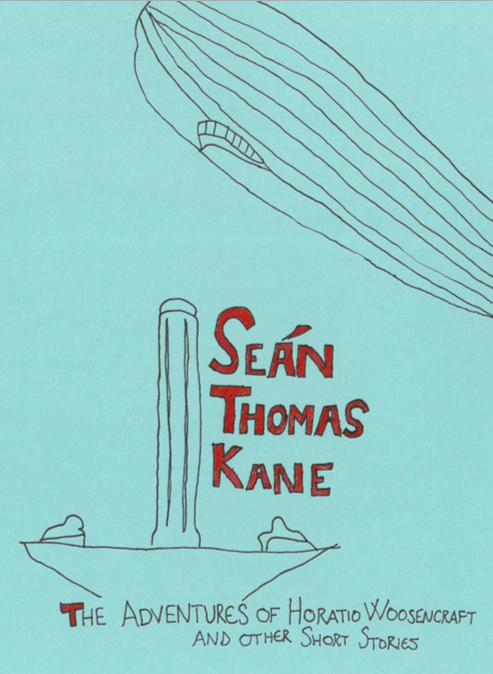
“The Adventures of Horatio Woosencraft” is on its way!

Horatio Woosencraft front cover

I am overjoyed to announce that you will be able to purchase copies of my first fiction book The Adventures of Horatio Woosencraft and Other Short Stories beginning this Friday, 18 August 2017 on Amazon! The book will be available in both paperback and Kindle editions.

In the meantime, I’ll be wrapping up work on Travels in Time Across Europe and preparing to record the companion audiobook (yes, you’ll have a chance to hear my strange accent for hours on end [it makes good listening for long road-trips, transoceanic flights, and extended waits in line at the DMV, doctor’s office, and on your commute home]).

Introducing “The Adventures of Horatio Woosencraft and Other Short Stories”

Horatio Woosencraft front cover

After a decade of writing, I have decided to release a collection of my short stories, composed between 2008 and 2017. I am happy to announce it will be available for purchase on Amazon starting in late August 2017 in paperback form to readers in Europe, and in the United States as well as to a global audience digitally on Kindle.

From the fictional Welsh immigrant detective Horatio Woosencraft who solves mysteries in an alternate-reality Kansas City to the glamour and adventure of the massive airship Phaëton and bewildering confusion of the characters in Abducted and Abandoned, this volume is sure to please. I have included my epic poem Caffydd, a tale of love and the daily struggle against evil with deep theological undertones in this volume as well. While it does not reflect my current theology quite as closely as it did when I wrote it in 2010, Caffydd still serves as a fascinating read, a vision of what might be.

Beyond the stories, this book includes many, many of the stories and ideas, the metaphors and hyperboles that I thought of through out my high school and undergraduate years. It reflects my interests in history, theology, linguistics, and the great Classical, Victorian, and Edwardian works of fiction that fill out my library.

The Adventures of Horatio Woosencraft and Other Stories will be available for sale in both paperback and Kindle formats on Amazon later this month, just in time for Halloween, any Autumn birthdays, and Christmas. Keep an eye on my website, Twitter, and the Adventures of Horatio Woosencraft and Other Stories Facebook page for further updates on the book.