

The Columbian Exchange – Wednesday Blog by Seán Thomas Kane
This week, I want to talk a bit about how the period I study resonates in our everyday lives through the foods we eat.
(Sound of a grill lighting.)
This week, I thought I’d record an idea that I’ve had for a while. Originally, this demonstration was going to be filmed for a course I taught last summer, but it didn’t get developed in time. So, on Tuesday afternoon when I was looking at the story I was developing for this week and saw how little I’d finished of it, thanks to my other work taking up a greater amount of my time than expected, I returned to this idea. So, here’s a synopsis of me grilling a couple burgers and talking about it.
First, I get the ground chuck burger patties out of the freezer. (frozen patties hitting the plate) Buying in bulk and freezing the beef helps keep costs down.
“Now the seasoning that I usually use for this, Lawry’s, has salt, sugar: definitely something which appeared through the Columbian Exchange from Madeira to the Caribbean and Brazil, and the spices are paprika and turmeric: those are also important with the trade connections in the 16th & 17th centuries, onion, corn starch, and garlic. So, this seasoning is certainly a part of it. This seasons the beef which is European in origin using spices that come from all around the globe.”
“And now, I’ll season these.” –– The seasoning adds flavor to what otherwise is just a frozen piece of bland-tasting beef. Meat seasonings are more common in Texas barbecue, where they take the form of rubs. When I’m making brisket, I will use a big meat rub from Joe’s Kansas City Barbecue to enhance the meat’s flavor.
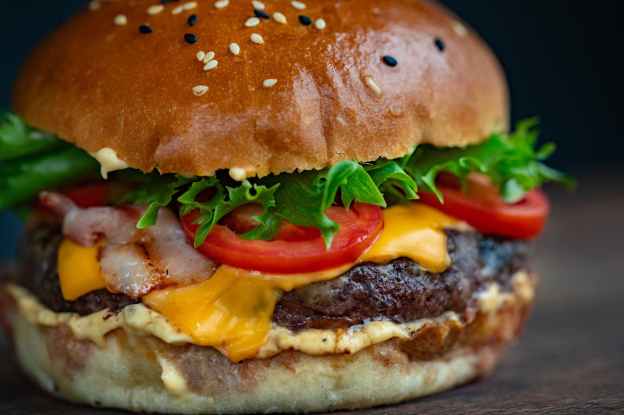
“Now, of course you could top your burger with garnish, with tomatoes which come from Mexico, or lettuce, which is more ubiquitous, onions, which are European in origin, or mustard, ketchup (which is tomato sauce & sugar, I’m less fond of that). The point is that the burger has a great deal of different sources to it, many of which go back to the Columbian Exchange, elements of which are traceable back to Europe as well as the Americas. And then of course, you eat your burger with fried potatoes, with French fries (chips if you’re British.) Potatoes come from Peru and were introduced to other places from there, or sweet potatoes which also come from South America. I’ve read that sweet potatoes were sometimes called Taíno potatoes after the native people of the Caribbean, yet they were also used by the Tupinambá of Brazil who I study.”
After the grill heated up to around 650ºF (343ºC), which on this very windy evening took about 15 minutes, I took the patties outside and dropped them on the grill. (Sizzling sound)
Once I had the patties on the grill, I returned to the kitchen to prepare the cheese, to cut the cheese if you will. For this meal, I’m using two different types of cheese. On one burger I have an Irish cheddar and on the other a Mexican blend that’s mostly made up of Monterey Jack and White Cheddar. I discovered my love for the Monterey Jack burger at our local Tex-Mex restaurant, where the burger on the menu is made with Monterey Jack cheese. The flavor is distinctive and a nice change of pace. I also like putting provolone, parmesan, and mozzarella on my burgers, though in that instance to go full Italian burger I also enjoy including marinara sauce. I discovered this type of burger at a famous burger restaurant in Cambridge, Massachusetts, across the street from Harvard’s Houghton Library, called Mr. Bartley’s Burger Cottage, where this Italian burger was named the Dr. Fauci Burger on the menu.
“Alright, time to flip.”
“Now, of course none of this would’ve been possible without the transatlantic trade connections that developed after Columbus’s first voyage in 1492. The beef in these burgers come from cattle which replaced the bison which existed previously out here on the Great Plains, and there’s some debate about whether bison should replace beef all over again. So, maybe in 10 or 20 years’ time if I do this all over again, I’ll be doing it with bison instead of beef.” While I made my speech to the microphone, the timer went off on my watch telling me the patties were done cooking. “And now, the timer’s gone off. Let’s take these off. So, these are looking pretty good. There’s the cheddar one, and now my Monterey Jack one.”
“But now, if you’ll excuse me, ladies and gentlemen, I want to eat. Bye, bye.”
 Wednesday Blog by Seán Thomas Kane