
One of the best ways for any government or other institution to assert their authority over its followers, whether they be citizens, consumers, or believers, is through a degree of providing those followers with a higher purpose to aim for in their devotions. As Catholics, we strive for Salvation, Union with God, Heaven, or whatever you want to call it. As capitalist consumers, we seek our own wealth and prosperity, and by buying into this economic system, by clicking that yellow purchase button on Amazon, we hope that our accumulation of material goods will bring us one step closer to being that prosperous person. Yet as Americans, citizens of the United States, regardless of partisanship, we are taught from a young age to value the preservation and promotion of some of the core ideals, “life, liberty, and the pursuit of happiness,” as Jefferson put it.
With each of these institutions, there is always a need to establish a degree of devotion among their followers; with each, that devotion is something that was at one time new. In the political case of the American civic religion, we can easily trace the origins of that devotion back to our founding myths surrounding the American Revolution (1775-1783), when, as the story goes, a few brave colonists decided to value their freedom over loyalty to their distant king back in Great Britain. With this determination, they rebelled and declared their independence in July 1776. The Founding Fathers of the young republic that became the United States took on the mantle of apostles or saints, and over time the institutions of the republic became nigh sacrosanct: at the end of the day, the Constitution, the rule of law, and the fact that we live in a democracy became irrefutable testaments to that religion.
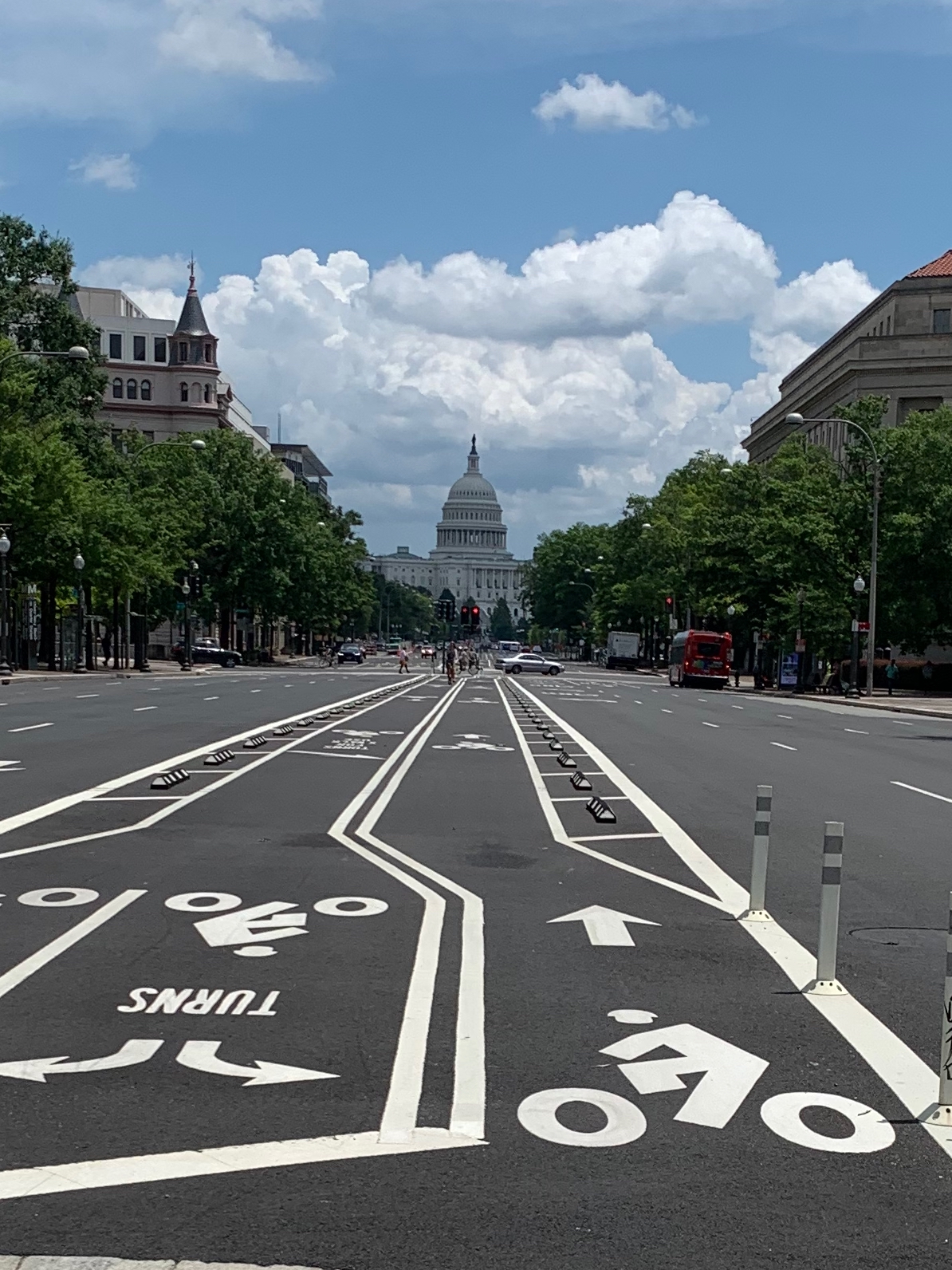
Whenever I am in Washington, D.C., and see the Capitol dome for the first time on that particular trip, I’m reminded of the scene from Frank Capra’s 1939 film Mr. Smith Goes to Washington, starring James Stewart in the title role. The naïve young senator, upon first seeing the Capitol dome from inside Washington Union Station is gobsmacked, and struck by the sight of seeing the St. Peter’s of his deep-rooted belief in the inherent goodness of our government by, for, and of the people. I admit, on my most recent trip to D.C. last week, while I was excited to see the Capitol as I crossed Pennsylvania Avenue, I couldn’t help but feel that as profound our civic religion remains, it nevertheless faced its greatest test in generations this January when the Capitol was attacked by supporters of the now former President on the day when Congress met to certify the results of the Presidential election.
It’s curious to me, because as much as people from both sides of the political divide tout their devotion to “freedom,” the meaning of that very abstract word seems to change depending on the moment. In the broadest sense, freedom is one’s ability to decide how to live one’s life; in the narrowest, freedom has been interpreted as justification to deny the same basic decency and liberty to others on the basis of one’s own biases. I could very well turn this weekly blog into a mouthpiece for all the libels I’d ever want to spin, and likely that sort of fear-mongering clickbait would increase my readership, but I like to think of myself as a nice guy, so in this outlet I refrain from those sorts of obscenities.
As with any other form of devotion, the American civic religion has its own enforcement, people who seem to make it their life’s mission to call out or track down heresies against the civic religion no matter the cost to themselves or their target. This is often realized most fully in the scare tactics used by some to keep their followers loyal to their particular version of the civic religion. Fear keeps people energized, fear of loss, fear of the other. While I will always stand and applaud at the ballpark when the obligatory salute to veterans occurs, I find it chilling that if I didn’t stand, if I didn’t salute the military, it could be damaging to me. The extreme literalness of some religious sects in this country has been carried over into the civic religion, all to the extent that it has been monetized and turned for profit in our devotion to the markets and the accumulation of wealth.
Heretic hunters often have their own faults, that’s where the sacrament of confession comes into play. As a Catholic, I believe that my sins are forgiven in the confessional, so long as I am truly repentant, truly sorry for where I’ve gone wrong. Of course it could be argued that I could then say I could do anything I wanted, so long as I went to confession afterward, but there the actions wouldn’t convert to real results, as I wouldn’t actually believe in the power of the sacrament. So too with our civic religion, as forcibly the heretic hunters may decry their opponents, their enemies as they might well call them, they themselves will always have faults of their own, sins of their own. If we are going to preserve this country, its civic religion, its belief in democracy and in a future where representative government is a strong and viable option, we need to recognize that everyone has problems, and that everyone deserves second chances.
So, as I walked across Pennsylvania Avenue last Thursday, my mind turned to the supporters of the former President who violated the most sacred temple of our civic religion on January 6. Many of the same individuals and organizations that pose as heretic hunters in this civic religion of ours were the same ones that promoted the Big Lie which drove that mob to break into the Capitol, and the rioters themselves, in that most extreme act of heresy against the civic religion, cast themselves as restoring the faith, restoring the power of the people over our government. They too deserve second chances, the opportunity to repent and return to the fold, but not without some penance for the crimes they committed.
If anything, the entire civic religion, built on myth as much as on the ideals of the Revolution, deserves a second chance. It seems increasingly clear to me that the civic religion, the United States as a political community united around our common Constitution, needs refreshing, both to address the shortcomings and wrongs of the past and present, and to reaffirm the foundational covenants of this country’s relationship with its people in a way more in line with the circumstances facing us today in 2021.
 Wednesday Blog by Seán Thomas Kane