Today, I'm talking about a particularly versatile Latin verb that I'll admit I'm rather fond of: mittō.
Click here to support the Wednesday Blog: https://www.patreon.com/sthosdkane
I first started studying Latin when I was fourteen, a high school freshman at St. James Academy. Over the next four years I studied Latin with Bob Weinstein, then the St. James Latin teacher, and even took a year of Ancient Greek with him as well. In those years I got a good foundation in Latin, though I’ll admit I didn’t learn as much as I wanted, in part thanks to my own immaturity at the time. In the years since I’ve been able to connect more of these concepts in my thinking about the language, now on my third round of studying it. I often like to say that there are certain languages which I feel I can inhabit, that are so familiar and comfortable to me that I feel empowered to read, speak, write, and even think in them on a regular basis. These four are English, my native language, Irish my ancestral language, French, the language I fell in love with in college, and Latin, my original language of study in school.
Honestly, it took me until my third round studying Latin to really get the hang of today’s verb of note: mittō. Its full dictionary entry, laying out its principal parts are mittō, mittere, mīsī, missum. Looking at these four we can see the utility of this verb, which in its most basic meaning I’d translate mittō as “I send.” It means to send, but it also includes other types of sending like dispatching, releasing, or extending a hand, yielding, bringing out, attending, and dedicating a book, among many others. To say that one verb has so many meanings, so many actions it represents seems a bit of a stretch to me, but if you only think of a language by taking its parts out of place and analyzing them individually of the rest of the language, you’ll find you’re getting a different picture than you would if you considered the whole thing in one go.
Mittō has a great many descendants in English. Just looking at that 1st person present active form (mittō) we can see emit, intermittent, omit, permit, remit, submit, transmit, and everyone’s favorite cat name mittens. Frommīsī and missum we get all of the mission words, words like intermission, missile, omission, permission, promise, remission, and transmission.
Even the word Mass as in the Catholic liturgy comes from mittō. It originated in the phrase Īte, missa est, which I’ve always heard as “Go, the assembly is dismissed” though I think of it more in line with the phrase “the Mass has ended” that you hear at the end of every liturgy. Missa in that phrase comes from missiō, a 3rd declension Latin noun meaning sending or dismissal, which itself has roots in our old friend mittō. One thing of interest regarding the name of the Mass is that the Latin word Missa is the origin of a great many names for the liturgy in the Romance and Germanic languages as well as the Polish msza. Yet in Irish the Mass is called Aifreann, which comes instead from the Latin verb participle offerendus, essentially translating as offering. The same Latin word is the origin of the name for the Mass in all of the other Celtic languages, though Welsh and Breton today call it an offeren and an oferenn respectively.
I decided to write about mittō this week because it keeps coming up in stuff as I find myself going about my work. I like versatility, the idea that we can look to something as particular as a verb like mittō to find the source for so many concepts and ideas. Language is the way we understand the world around us. It’s one of the first things in most creation myths that the humans do, they look about and start naming things. Those names transmit information about the object to people whether in earshot or in other worlds through writing. In our own day we are pushing the limits of mittō and its descendants by sending data back and forth to our furthest out exploratory spacecraft, from the Voyagers on the edge of the Solar System to the Perseverance Rover on Mars to the International Space Station in orbit. All of that data gets submitted back to each craft’s mission control here on Earth for further analysis.So, here’s to mittō, one of my favorite Latin verbs.
This week, some thoughts on what keeps a culture alive.
I really enjoy going to concerts and hearing all sorts of musicians from all around the globe perform. I’ve been lucky enough to attend some historic concerts, such as the 2012 performance of the Cuban National Symphony Orchestra at the Kauffman Center in Kansas City. It was their first performance in the United States since the beginning of the embargo on Cuba in the 1960s. In that moment I could feel echoes of a vibrant and lively culture living alongside my own in the same moment in time. The way the musicians put their own spin, their own rhythm on Gershwin’s Rhapsody in Blue to make it sound Cuban was wonderful to hear. Still, the setting of the concert hall where there is a clear physical barrier between the performers who stand or sit on a stage frozen in place with an audience watching all around does sometimes give me chills.
There have been many other concerts that I’ve attended where music or stories from particular cultures are played or told, relayed to us an audience foreign to those artists’ culture. Yet the way they’re transmitted, removed from the physical surroundings of those artists’ home, placed on a sterile stage where we can hear and see everything in perfect clarity, takes something out of the performance. It worries me that in America we’ve come to expect that particularly “cultural” things, especially if they’re foreign or “ethnic” ought to be neatly packaged in an expected format and set up. That way they can be interpreted through our own cultural lens in such a way that if I see a bottle of Italian seasonings in the grocery store, I’ll be able to tell first and foremost that those are seasonings. Yet in that standardization of culture to fit a set mold into which all its many and contradictory elements can be poured and melted down, we lose a great deal of the memories and the life that those cultural artifacts embodied.
My own people, the Irish Americans, have an interesting relationship with this. We still maintain some elements of a distinct culture from other European-descended ethnic groups in the United States, though I know some reading or listening to this might object to my use of the word “ethnic” to describe a community so assimilated into mainstream American society. The problem for me arises in trying to answer how our culture is still even partially Irish. Here in Kansas City, we have plenty of people who play Irish music, myself included, as well as a couple of local Irish dance schools. We even have a local Irish Center where classes in the Irish language are taught. Yet when most of those cultural milestones are performed, they are often more so in delineated places and situations where they are expected, say at the Kansas City Irish Fest, rather than more organically on a regular basis as a daily part of life.
One of the great exceptions to this rule is with music, after all some of my favorite concert memories have been sitting in on the jam sessions at the Irish Center and at other venues around town, even in the homes of friends. There, an element of our Irish American culture is still being performed organically, like a group of friends getting together one evening for a party. It just so happens that instead of playing the Top 40 Hits at that party they might pull out their own instruments and play their own top 40 for themselves.
Culture is fundamentally performative, and to survive it must flourish organically in the setting where it exists. This past weekend I had the honor of serving as a groomsman for one of my best friends who is Greek Orthodox. The wedding took place in his church, and clearly seemed to be an unfamiliar ceremony to many of those present who weren’t themselves Greek (myself included). Still, I found the chanted prayers and hymns––most of which were performed in English––to be fairly easy to learn, and after the first one I was able to add my own voice to the congregation. Later that evening the typical wedding reception DJ hits were freely interspersed with Greek dances, which likewise for the average participant were far easier to pick up on than any of the Irish dances I’ve done over the years. There’s a culture that’s still vibrant in how ordinary its performances tend to be for the people who live it every day.
It struck me that the idea of having Irish music played at an Irish American wedding reception would probably be met with shock, after all most of us don’t know the steps for the jigs and reels that make up Irish dance today. Furthermore, someone is bound to be annoyed by some inconsistency with what is properly Irish American, meaning that trying to toe the line of ensuring that one’s Irish American cultural practices are so highly regulated that they become harder than necessary to follow. I for one would love to try and introduce some elements of jazz into the jigs, reels, and airs that I’ve learned to play on the tin whistle, and if I do ever get around to joining in a specifically Irish dance again you can bet that I’ll let my arms move more freely than is expected.
I worry that a culture which isn’t performed as a daily routine will gradually become fossilized. Such a culture, if confined only to special events that aren’t expected or normal for the everyday, will surely die, leaving its participants poorer as a result. Perhaps one of the greatest differences between Greek American culture and Irish American culture is that our ethnic church, Roman Catholicism, did not preserve our Irish language as the language of liturgy and spirituality. Rather, Catholic priests continued to say the Mass in Latin until the 1960s, by which point so few Irish Americans still spoke Irish that there are hardly any Irish Masses performed here in the United States today. I’ve only ever been to one such Mass that was done entirely in Irish. It was said on a stage at the Dublin Irish Festival outside Columbus, Ohio where we the congregation watched on as if gazing at some exotic ceremony stuck out of place and out of time. That most essential element of any culture, the way in which it speaks and sings and laughs and cries, its language, is vital to that culture’s survival. And in a country where we make up a good portion of English-speaking Catholics, our Church has assimilated faster than our hopes for a distinct Irish American culture may have wanted.
On Saturday I took the opportunity to go to 4:00 pm Mass at my home parish here in Kansas City, MO while I was in town for Thanksgiving. It was wonderful getting to see the place again, and even though it’s only been 3 months since I left town for the semester a part of me doubted I’d actually see these places that are so dear to me anytime soon.
During the Nicene Creed as I recited the words I’ve known at least since freshman year of high school, the proclamation of the Faith, kind of a Pledge of Allegiance that we Catholics still have mostly in common with our Orthodox and Protestant cousins, I noticed something that made perfectly good sense but I hadn’t thought of yet. A friend who was standing near me said that Jesus “became human” instead of “became man.” It caught me off guard for a number of reasons. Firstly, the official English translation that we use in the US does use the older word “man” rather than the newer “human” but secondly, I had a feeling from what I could remember of the Latin translation that our English one is more closely based on that “human”, “homō” in Latin, might actually be the noun used.
That evening I made a point of going to the source. I looked up the Creed in Latin and sure enough the line there is “et homō factus est,” which I’d translate in my schoolroom Latin as “and he was made human.”1
The one catch here is that the Creed wasn’t originally written in Latin but in Greek. So, in order to get to the original meaning and intent of the Church Fathers at the Council of Nicaea (325) that wrote the Creed we still say nearly 17 centuries later, I’d need to call up my admittedly elementary and rusty knowledge of Greek. Unlike Latin, which I studied all through my high school years, have picked up again twice since, and use professionally on a regular basis as a historian of Renaissance natural history, I haven’t been lucky enough to use much of my Greek. I took Classical Greek in my senior year of high school after finishing my last required math credit the summer before, and then took a semester of Koine Greek (aka New Testament Greek) in my sophomore year of undergrad at Rockhurst. So yeah, my Greek is rusty. I can still read the alphabet pretty well and I know enough about etymologies that I can get by, but I never really got it the way I got Latin or French.
Still, I was determined to spend at least a few minutes of my Saturday evening at home working through this question: what was the original Greek line that the Latin translator rendered as “et homō factus est“?2 I went to a pretty reliable source that has both the Latin and Greek versions and started scouring the Greek, figuring I was either looking for one of two words: ἄνθρωπος (anthropos) meaning human or ᾰ̓νήρ (anḗr) meaning man.3
One of the big tricks that I’ve learned after now a few years of working with sixteenth-century printed books that are often not in English is the quickest way to find a particular word you’re looking for is basically to just focus on finding that word, don’t pay too much attention to the rest of the text. Once you’ve found the word you’re looking for then go and read the rest of it to put that word into context.
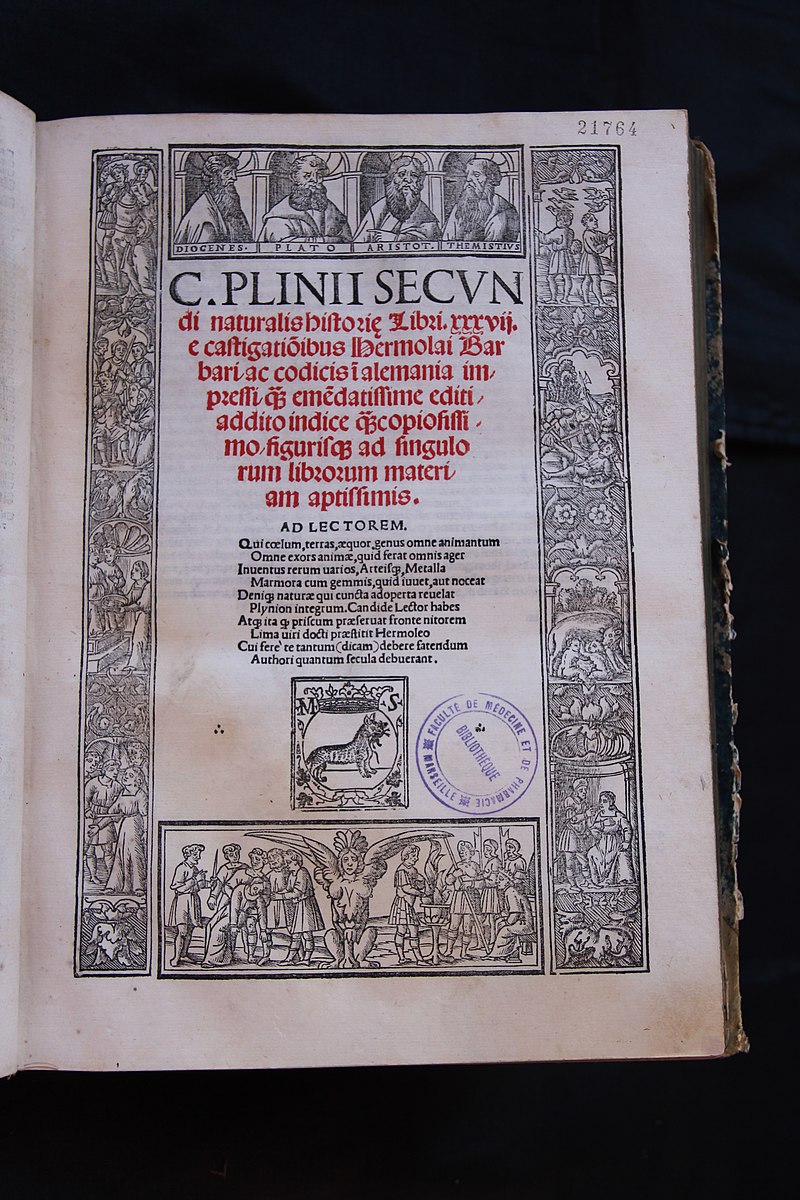
One example of a 16th century printed book that I’ve worked with.
Anyway, back to the story.
So, I scanned through the Greek original version of the Nicene Creed and was left stumped. I couldn’t find either ἄνθρωπος or ᾰ̓νήρ anywhere. I began to wonder if there was some third Greek word for human or man that I didn’t know about, and knowing what I do know about Greek there being three words for the same concept isn’t at all out of the question. Looking for clues, I turned then to the previous line, “and by the Holy Spirit was incarnate of the Virgin Mary”. In the Latin this appears as “Et incarnātus est, ex Spirītū Sānctō ex Marīā Virgine“. A great trick for any researcher working in a second or third language, or better yet one that they have a passing familiarity with is to always keep an eye out for personal names or other proper nouns: those will usually be more prominent, and when it comes to the BVM (Māter Deī, Θεοτόκος [Theotókos]) you can bet her name will be prominent. Sure enough, I quickly found mention of a Μαρίας τῆς Παρθένου (Marias tés Parthenou) meaning the Virgin Mary and kept looking along that line for something that resembled either ἄνθρωπος or ᾰ̓νήρ. Two words over came my answer: a fittingly long Greek verb ἐνανθρωπήσαντα (enanthrōpōpésanta).
I quickly returned to my favorite English-Greek dictionary and found the root form of the verb in question, ἐνᾰνθρωπέω (enanthrōpéō), meaning “to put on human/man’s nature,” or more essentially “to become human/man.” The only job left to do was to take out that clunky slash and acknowledge which noun, ἄνθρωπος or ᾰ̓νήρ was at the heart of that verb. As it turned out, and as you can see, it’s ἄνθρωπος.
Thus, to the best of my efforts as a scholar and translator, and as you can see, I’d argue that in English saying that Jesus “became human” works, perhaps even better than “became man”. Why? Well, remember that English has changed a lot as a language in the past century. We have so many more people and ideas using this language than ever before, and to be honest while the English noun man began as both a word meaning males in both gender and sex (ever a complicated series of terms) and our entire species in general, it has steadily come to lose that second, neuter meaning in favor of solely being a masculine noun. Neil Armstrong’s first words when he stepped onto the Moon’s surface in 1969 were “it’s one small step for man, one giant leap for mankind.” For a guy in 1969 that worked. But for the astronauts that will be setting foot on the lunar surface again in the next few years with the Artemis program, I firmly believe that man won’t cut it anymore.
A few years ago, I wrote a blog post that was a predecessor to this now weekly Wednesday Blog about why I prefer to say “you guys” rather than “y’all”. Long story short: I’m not a Southerner, and I’ll fully admit when I hear “y’all” I don’t tend to think of much besides the people who drug our country into a Civil War 160 years ago because they couldn’t accept the fact that it was morally corrupt to own other human beings. The fact that their heirs are still fighting against racial equity in this country makes my case for me. In that same blog post I also argued that we should move away from the word mankind, and towards something that more closely reflects a more gender neutral word for our species: humanity. On a small side note here (in a paragraph begun with a side note) I don’t like humankind because it combines the very Germanic -kind with the very Latin human. Instead, Latin gives us the word humanity, derived from the Latin hūmānitās. Let’s use that instead. It works, and frankly as we do become far more globally interconnected (which, guys, really isn’t a bad thing at all), it translates far better than humankind ever will.
All this said, getting back to the main point after a brief stop in the politics and history of American English, I think it’s actually a lot better and more profound to refer to Jesus as God becoming human instead of God becoming man. It means that Jesus came to be among all of us, to be one of all of us. I’ve written before in an academic setting about why I believe it’s flawed to refer to God in gendered terms: gender is cultural, it’s fundamentally human, and it keeps the blinders on us to the extent that we can’t make a true effort at seeing, and by seeing hopefully we can get closer to understanding the fullness of God. From there, I’ll leave the writing about how to understand the fullness of God to the theologians and clergy.
Footnotes
Why the difference between the official “became” and “was made” in my translation of the Latin passive verb factus est? Factus est is the passive perfect 3rd person singular form of the verb faciō, which my old stalwart dictionary William Whitaker’s Words translates into the English verbs “do, make, create; acquire; cause, bring about, fashion; compose; accomplish.” So, while “became” is more poetic, “was made” is more accurate to the verb in question. But, theologically was Jesus the passive recipient of the blessing of being made human? After a significant amount of time for what I thought would be a short search I found an entry in the Liddell, Scott, and Jones Ancient Greek Lexicon (LSJ) on the Perseus database that listed the original Greek verb that was translated into Latin as factus est, namely ἐνανθρωπήσαντα, as an aorist participle singular active masculine verb in the accusative case. So basically, while the Latin factus est is in the perfect passive voice (meaning it’s describing an event that fully happened to the subject in the past), the Greek verb is an event that happened in the past without any time specified as to when it happened (kinda like a French passé simple?) This alone shows the complexity of trying to translate from Greek into Latin and then by extension into English. One final note here: while the Greek verb grammatically has a masculine gender (see above in this oversized footnote) I’d stress that that gender designation is referring to Jesus who it’s generally accepted was biologically male. In the process of trying to figure out how the Greek verb in question (ἐνανθρωπήσαντα, in case you forgot) was conjugated, I found an interesting article from the Orthodox Christian Studies Center at Fordham University discussing how best to translate this very verb in the Nicene Creed from the Greek original into English. So, to return to the original question that led me to write this footnote that would outrun the Gettysburg Address in length: the fact that Jesus in the Latin was apparently the passive recipient of his humanity, given to Him by the Holy Spirit is more or less a “it’s the best we can do” translation from the original Greek where Jesus actively “became human”. So, in English while the best translation from the Latin is “was made” human, when taking the Greek into account the official Catholic “became” human works a lot better, because it recognizes that at the end of the day Jesus and the Holy Spirit are consubstantial with the Father, meaning they all share the same Substance, i.e. they are all One. “Three Persons in One God” as my notes from my undergrad freshman Honors Christianity I notes say.
For my fellow grammar constables out there, yes I put the quotation mark outside the quotes. There’s a reason for that, it’s not a part of the quote so I don’t see why it should be included in the quotes. I’m going to write another blog post about this eventually.
For my Greek friends and all Greek scholars out there: to my understanding ᾰ̓νήρ is the Ancient Greek word for “man.” To my understanding the more familiar and modern word άνδρας is descended from the accusative singular (direct object form) of ᾰ̓νήρ.




 Wednesday Blog by Seán Thomas Kane